“Arrest Him!” HOA Karen Screamed on My $8M Estate—Then the Deputy Looked at Me and Said, “Ma’am, That’s My Former Chief”
PART 2
Sterling Ridge began as three hundred acres of cleared land and developer renderings.
Greg Ashford’s company bought the tract south of mine in 2023.
Within eighteen months, there were 127 luxury homes.
Stone façades.
Black-framed windows.
Heated pool.
Clubhouse.
Walking trails.
Decorative ponds.
An HOA with bylaws thick enough to stop a small-caliber bullet.
The houses started around numbers that would have bought half my county when I was a kid.
That didn’t bother me.
People can build what they want on land they own.
That distinction would become important.
The first time Victoria drove onto my property, I was repairing a gate hinge near the house.
Black Porsche Cayenne.
Virginia plates.
She stepped out in cream-colored heels that immediately sank into the gravel.
Victoria was polished in the way some people mistake for authority.
Chestnut hair.
White linen blazer.
Gold bracelet.
Dark sunglasses.
She looked around my farmhouse, barn, and pasture with the expression of a real-estate agent mentally calculating what everything could become if only the current owner disappeared.
“Mr. Calloway?”
“That’s me.”
“I’m Victoria Ashford.”
I waited.
“President of the Sterling Ridge Homeowners Association.”
“Congratulations.”
She smiled.
“I wanted to personally welcome you to the community.”
I looked south toward the construction cranes.
“I was here before your community.”
The smile remained.
But her eyes changed.
“Well.”
She adjusted her sunglasses.
“Things have changed.”
“I noticed.”
“And we have standards now.”
That was the first time she used the word.
Standards.
I heard it many more times.
She handed me a welcome packet.
I didn’t take it.
“My land isn’t part of Sterling Ridge.”
“Adjacent properties affect community value.”
“Still not part of it.”
“Everything around us affects our residents, Mr. Calloway.”
“Tom.”
She smiled again.
“Wonderful. Tom.”
I regretted giving her that almost immediately.
“I think you’ll find cooperation benefits everyone.”
“I’ve always cooperated with neighbors.”
“Good.”
She looked toward my cedar fence.
“Then this should be easy.”
Two weeks later, I received the first certified violation.
My fence was supposedly noncompliant with Sterling Ridge architectural standards.
Three hundred dollar fine.
Fourteen days to remediate.
I called the Loudoun County clerk.
It took less than five minutes.
My property was platted in 1962.
Sterling Ridge’s HOA was formed decades later.
My parcel had never been annexed.
Never signed into covenants.
Never included in the subdivision.
No deed restriction.
No recorded amendment.
Nothing.
I put the clerk’s confirmation into a manila folder.
Label:
ASHFORD.
I had the feeling it might grow.
The second letter came a week later.
Unauthorized livestock.
Five hundred dollars per horse.
Per day.
Three horses.
Fifteen hundred dollars a day.
I drove to county zoning.
A1 agricultural classification.
Continuous since 1962.
Horses legal.
Cattle legal.
Goats legal.
Chickens legal.
Pretty much anything short of a rhinoceros would have been easier to defend than Victoria’s complaint.
I mailed her a copy.
One line:
For your records.
No answer.
Instead, she towed my truck.
I came home from the feed store and my F-250 was gone.
Private driveway.
My driveway.
My land.
I called the county impound lot.
Briarwood Towing.
Authorization form listed:
Sterling Ridge HOA parking violation.
Signed:
Victoria Ashford.
I paid $180 to retrieve my own truck.
Three hours of paperwork.
I parked it in the exact same spot when I got home.
Then put the receipt into the folder.
The next morning, Victoria came back.
Porsche.
Perfect hair.
Cream blazer.
White jeans.
She walked onto my porch without being invited.
“Mr. Calloway.”
“Victoria.”
“I thought we should discuss your property situation.”
“There is no situation.”
“Tom.”
Her tone softened.
“I understand you used to be a police officer.”
“Chief.”
She blinked.
“What?”
“I was chief of police.”
“Oh.”
She laughed.
“Right.”
Not embarrassed.
Amused.
“But this isn’t a police precinct.”
“No.”
“This is a community.”
“My land is outside it.”
“That distinction is becoming less useful.”
I looked at her.
She leaned closer.
“You own forty-five acres surrounded by valuable development.”
“Correct.”
“My husband has offered to purchase.”
“I declined.”
“He made a generous offer.”
“I still declined.”
Victoria smiled.
“You’re a retired cop living in a house you can barely maintain.”
That was interesting.
She knew nothing about my finances.
“I’ve watched families with twice your resources fold when enough pressure was applied.”
The smile stayed.
“Sell to Greg.”
“No.”
“He’ll pay fair value.”
“No.”
“Or I’ll make living here so unpleasant that you’ll eventually beg him to take it.”
She actually said it.
On my porch.
In daylight.
To a retired police chief.
For several seconds, I just looked at her.
Then toward the south slope.
Elena’s vines.
“Victoria.”
“Yes?”
“I’ve spent thirty-two years interviewing people who thought intimidation worked.”
Her smile faded slightly.
“I’ve had loaded guns pointed at me by men who had already decided they were going back to prison.”
I leaned against the porch rail.
“A parking ticket and a nice blazer aren’t going to move me.”
Something behind her eyes changed.
Not fear.
Calculation.
She turned.
Walked back to the Porsche.
Before the door closed, she was already on her phone.
I wrote down every word.
Date.
Time.
Location.
Exact quote.
Old habits.
A police officer who stops documenting is just a man with opinions.
Victoria’s next move was animal control.
I was brushing Copper when a county truck pulled in.
Danny Reeves stepped out.
Young officer.
Clipboard.
Uncomfortable expression.
“Chief Calloway.”
He used the title automatically.
“Danny.”
“I received a complaint.”
“I guessed.”
“Horses kept in unsanitary conditions.”
I opened the gate.
“Take your time.”
He inspected everything.
Five-acre pasture.
Spring-fed water.
Clean barn.
Fresh straw.
Feed.
Veterinary records.
Dental records.
Vaccination records.
Elena had maintained a more detailed feeding schedule for those horses than some parents maintain for children.
After twenty minutes, Danny closed his notebook.
“These are some of the healthiest horses I’ve seen.”
“Who complained?”
He hesitated.
“Sterling Ridge HOA office.”
I nodded.
Danny lowered his voice.
“For what it’s worth, Chief, people at the department know something’s going on.”
“What does that mean?”
He glanced toward Sterling Ridge.
“Means you’re not the first person they’ve complained about.”
That interested me.
“But you’re outside the HOA.”
“Exactly.”
He shook my hand.
“Take care, sir.”
Two weeks later, the rooster complaints started.
General.
Rhode Island Red.
Elena bought him as a joke because she said no retired chief should sleep past sunrise.
Apparently General violated a Sterling Ridge noise ordinance.
Four complaints in ten days.
The ordinance applied to Sterling Ridge residential lots.
Not A1 agricultural land.
County dismissed them.
Victoria refiled the same complaints the next week.
I added everything to the folder.
I still wasn’t angry.
Not in the way she wanted.
Annoyed.
Watching.
Then July came.
Ninety-seven degrees.
Four in the afternoon.
I walked to the barn.
The trough was dry.
Completely.
Copper was panting.
Duke stood with his head low.
Ellie was lying under the overhang.
She lifted her head when I called.
Barely.
That scared me.
I checked the well.
Running.
Main line.
Working.
Then followed the supply toward the fence junction.
The shutoff valve had been turned.
Not broken.
Not failed.
Closed.
By hand.
I opened it.
Water returned.
I filled every trough.
Hosed Ellie’s neck and chest.
Called the veterinarian.
All three were dehydrated.
Stable.
But another two hours?
The vet didn’t finish the sentence.
Neither did I.
I knelt at the valve box.
Fresh footprints.
Virginia red clay.
Wedge-shaped heel.
Size around nine.
I had seen a similar print near the mailbox after one of Victoria’s visits.
I photographed it.
Then installed a trail camera overlooking the junction.
That evening, I sat on the barn step.
Ellie came over.
Pressed her nose against my shoulder.
“Your mother would kill me if I let anything happen to you.”
She breathed against my shirt.
That was the first moment Victoria stopped being irritating.
She had moved from paper to living things.
And she had done it on the hottest day of the summer.
I started treating her like a suspect.
The following Saturday, Sterling Ridge hosted what Victoria called a wellness brunch.
Mimosas.
Charcuterie.
PowerPoint.
Sixty slides.
I didn’t attend.
Gail Porter did.
Retired school teacher.
Two years in Sterling Ridge.
She came to my porch afterward.
“I thought you’d want to know.”
“Know what?”
“Slide thirty-seven.”
I poured iced tea.
She opened her phone.
A photo of my property.
Red border drawn around it.
Caption:
NON-COMPLIANT ADJACENT PROPERTY — ACTION REQUIRED.
Victoria told the HOA that my land reduced Sterling Ridge values by fifteen percent.
She said she had a “comprehensive plan” to resolve the situation before year’s end.
Gail looked embarrassed.
“Half the room nodded.”
“What did the other half do?”
“Nothing.”
“That’s usually how bad things survive.”
She looked at me.
“I’m sorry.”
“You came here.”
She nodded.
That counted.
Victoria posted the slide publicly.
Hashtags.
Protecting property values.
Community first.
One comment:
Get him out, V.
Victoria pinned it.
I saved the screenshot.
Then came the fake survey.
White pickup.
Dominion Land Services.
Two men in orange vests.
Tripods.
Stakes.
Eastern fence line.
I walked over.
“What are you doing?”
“HOA survey.”
“My fence?”
“Appears to encroach about eleven feet into common area.”
I looked at the concrete footings.
Sixty years old.
“What’s your license number?”
The man pointed to the work order.
Maryland number.
“Licensed in Virginia?”
He stopped.
I asked again.
“Are you licensed to perform boundary surveys in Virginia?”
Within an hour, they were gone.
I called the state licensing board.
Dominion was not properly registered for the work they were doing.
The listed credential was expired.
Then I compared their coordinates to the 1962 plat.
The fake line moved enough land into Sterling Ridge to capture:
My eastern fence.
The barn.
Part of my pasture.
My private access road.
And a portion of Elena’s vineyard.
That was too exact to be sloppy.
I photographed every stake.
Every coordinate.
Every document.
Then began pulling Sterling Ridge’s original subdivision records.
Before I finished, Victoria hit the one thing that could still make me lose my judgment.
Elena’s vineyard.
Saturday morning.
Early September.
I walked outside with coffee.
Something looked wrong.
At first, I thought the leaves were changing.
Then I got closer.
Brown.
Curled.
Black at the base.
Row after row.
Two hundred vines.
Dead.
Every one.
I knelt.
Touched the soil.
Chemical smell.
Sharp.
Metallic.
I knew before the lab confirmed it.
Herbicide.
Industrial concentration.
Applied directly to the roots.
Deliberately.
Straight rows.
Consistent application.
Somebody had walked slowly from plant to plant.
The trail camera caught it.
2:47 a.m.
Dark clothing.
Face covered.
Five-gallon container.
Small frame.
Wedge sandals.
The person moved through Elena’s vines like they were killing weeds along a sidewalk.
I watched the footage.
Once.
Twice.
Then paused on one frame.
Shoes visible.
Body shape.
Movement.
I sat on the porch.
Coffee went cold.
I remembered Elena planting the first vine.
She had gotten clay on her favorite jeans.
I told her the hole was too deep.
She threw a handful of dirt at me.
“These vines are going to outlive both of us.”
They hadn’t even outlived her.
That was when grief and anger became something else.
Not rage.
Work.
I opened my laptop.
Started building a case.
Not an HOA complaint.
Not a neighbor dispute.
A criminal case.
The same way I had built hundreds.
Chronology.
Witnesses.
Financials.
Maps.
Photographs.
Chain of custody.
Digital backups.
Exact statements.
Victoria had never understood what thirty-two years in policing actually meant.
She saw retirement.
Age.
A man alone on a large property.
She never saw training.
Patience.
Or what happens when someone who knows how investigations fail decides he is not going to let this one fail.
The county records explained the first half.
Sterling Ridge’s original plat, filed by Greg Ashford, shifted the eastern boundary west.
Forty-seven feet in areas.
Enough to swallow parts of my property.
I compared it to:
1962 plat.
Tax maps.
Iron pins.
2021 county survey confirmation.
Greg’s boundary was wrong.
Not slightly.
Strategically.
That explained Victoria’s behavior.
She wasn’t confused.
Greg had drawn my land inside his future development boundary.
Victoria was manufacturing enforcement history.
Fines.
Complaints.
Violation letters.
Tow receipts.
If they eventually tried to lien the land or force a sale, they would point to years of documents saying I had behaved like an HOA member refusing to comply.
It was paper theft.
Then my old friend Ed Chambers found the money.
Ed was a retired forensic accountant.
Years earlier, he helped our department follow cartel proceeds through shell companies.
He loved spreadsheets the way homicide detectives love fingerprints.
Gail used her rights as an HOA member to request financials.
After repeated certified letters, Sterling Ridge released a redacted ledger.
Ed found:
$340,000.
“Legal consulting.”
Paid to:
Ridgeline Advisory Group LLC.
Delaware.
No real office.
No staff.
No visible business.
Officer:
Curtis Webb.
Greg Ashford’s college roommate.
Six transfers.
Structured amounts.
Ed sat at my kitchen table.
He pushed his glasses up.
“Tom.”
“Yeah?”
“This isn’t about your fence.”
“I know.”
“This is embezzlement.”
I poured coffee.
“Anything federal?”
“Potentially.”
He pointed to the payments.
“These transfers were deliberately kept in a pattern that should interest people who investigate financial crimes.”
I looked at Elena’s photo on the shelf.
Then opened my case folder.
214 pages.
And called Sarah Prescott.
Sarah was forty-one.
Deputy District Attorney.
White-collar division.
I hired her as an intern when she was twenty-two.
She used to shake before arraignments.
Now most defense attorneys shook when she opened a binder.
She sat at my table.
Read all 214 pages.
No interruptions.
Finally:
“Chief.”
“Yes?”
“Why didn’t you call me months ago?”
“Because months ago I had an HOA bully and some dead vines.”
“You had more than that.”
“Not enough.”
She almost smiled.
“You taught me not to bring half a case.”
“I taught you?”
“Yes.”
“I remember it differently.”
Three days later:
“We can move.”
“Charges?”
“Potential forged filing. False instruments. Embezzlement. Property destruction. Financial offenses.”
“What about warrants?”
“I want them.”
“Give me two weeks.”
Silence.
“Chief.”
“Sarah.”
“You’re retired.”
“I noticed.”
“You don’t get to run investigations anymore.”
“I’m not.”
“You have eight cameras arriving tomorrow, don’t you?”
“Possibly.”
She sighed.
“Two weeks.”
Those fourteen days mattered.
Eight cameras.
Eastern fence.
Barn.
Gate.
Vineyard.
Cloud backup.
I pulled Greg’s other development records.
Three projects.
Two prior boundary disputes.
One sealed drainage case.
Pattern.
Witnesses came next.
Gail.
Three families.
Two homeowners who sold below market after Victoria’s campaigns.
Then Chris and Amy Langford.
No relation.
They challenged Victoria’s spending.
Six days later CPS appeared at their door.
No problems found.
They moved to Richmond a month later.
Each story sounded different until you placed them side by side.
Then they sounded identical.
Question Victoria.
Get targeted.
Become exhausted.
Leave.
A real Virginia-licensed surveyor confirmed my land.
Every old pin.
Every fence.
Every boundary.
My property had never been part of Sterling Ridge.
Filed.
Certified.
Recorded.
Then I replanted Elena’s vines.
Same Pinot Noir.
Same spacing.
Same slope.
I spent a weekend on my knees in the dirt.
When the last vine went in, I sat on the porch.
Golden light across the rows.
“These ones are going to make it.”
Then I called Sarah.
“I’m ready.”
Victoria thought I was losing.
That was her biggest mistake.
People who confuse silence with surrender eventually tell you everything.
Thursday morning.
5:15.
Copper screamed.
If you’ve never heard a horse scream in fear, be grateful.
I ran outside.
Eastern fence.
Cut.
Cedar rails sawed clean.
Mesh sliced.
All three horses gone.
Copper stood on Ridgemont Road.
Trembling.
Scraped leg.
Duke was in a drainage ditch eating grass like nothing in the universe had ever concerned him.
Ellie had wandered half a mile.
She stood outside the Sterling Ridge clubhouse.
Shaking.
I walked them home one by one.
Cleaned Copper’s wound.
Checked legs.
Hooves.
Joints.
Then opened the camera footage.
2:12 a.m.
Dark SUV.
Two figures.
Tools.
Eight minutes cutting the fence.
Then back to the vehicle.
Headlights stayed off until they pulled away.
The SUV:
Black Porsche Cayenne.
Victoria’s plate.
I saved everything.
Three clouds.
Encrypted drive.
Veterinary records.
Photos.
I did not call her.
I waited.
Forty-eight hours.
Certified letter.
Victoria accused me of allowing unsecured livestock onto HOA property.
Demand:
$15,000.
Remove all horses permanently.
Court injunction.
I read it twice.
Then laughed.
She had cut my fence.
Released my animals.
And sued me over the consequences.
I forwarded Sarah the trail footage.
Her reply:
This woman is unbelievable.
Then Gail sent me audio from Victoria’s emergency HOA meeting.
Victoria stood in front of the board.
Pearls.
Black dress.
PowerPoint.
Three dangerous horses.
Negligence.
Community safety.
Legal liability.
She showed photographs of Ellie outside the clubhouse.
Never showed the cut fence.
Never mentioned the Porsche at 2:12 a.m.
Harold Dunn, retired attorney, asked:
“Do you have evidence the fence failed?”
Victoria answered:
“The fence was structurally deficient.”
Harold said:
“Cedar rails don’t saw themselves.”
Victoria moved to the next slide.
The board voted seven to two to authorize action against me.
Gail and Harold voted no.
I added the audio to the file.
312 pages.
Almost finished.
Victoria had one weapon left.
Reputation.
My attorney Bill Grady called.
“You need to sit down.”
“I’m sitting.”
“Victoria filed for an emergency protective order.”
“Against me?”
“Yes.”
“Basis?”
Bill hesitated.
Then told me.
Sexual advances.
Following her vehicle.
Threatening sexual statements.
Showing up at her house.
I listened.
Every allegation false.
I had never been inside her property.
Never followed her.
Never contacted her except when she initiated encounters or through written legal correspondence.
I understood immediately.
Protective order.
Restricted movement.
Public record.
Narrative shift.
She wanted herself to become the victim before the investigation became public.
The hearing was Thursday.
Victoria arrived dressed like she was attending a charity luncheon.
Navy wrap dress.
Tissue.
Expensive attorney.
Soft voice.
She cried.
Or performed crying.
Said she could not sleep.
Said she feared me.
Bill presented my evidence.
Camera logs.
GPS history.
Witness affidavit from Gail.
Dates showing Victoria visited me.
Phone location showing I never approached her house.
Then her own social-media posts.
At one time she claimed she was hiding at home because I was stalking her.
Her Instagram showed her at the clubhouse pool.
Publicly.
Judge Patricia Atwood looked over her glasses.
Petition denied.
Then:
“Ms. Ashford, filing false information in a protective-order proceeding is serious.”
Victoria’s attorney started speaking.
The judge stopped him with one look.
I left.
Sat in my truck.
Ten minutes.
Not shaken.
Calculating.
Because I had learned something in policing.
The most dangerous moment with a controlling person is when every previous tool stops working.
Three days later, Gail called.
“Tom.”
“What happened?”
“Mass email.”
Subject:
FINAL ACTION ON THE CALLOWAY PROPERTY.
Victoria told 127 families she would have me removed by law enforcement that week.
Claimed a warrant existed.
There was no warrant.
I called Sarah.
“It’s time.”
She answered immediately.
“Stay home.”
“You have it?”
“Judge signs by noon.”
I poured coffee.
Went outside.
Copper nudged my shoulder.
Duke waited for grain.
Ellie lay in the grass.
Beautiful October morning.
Friday.
8:15 a.m.
I was in the vineyard.
New shoots.
Trellis wire.
Elena always tied with two wraps.
Never hard knots.
You give vines room to grow.
I was doing exactly that when I heard engines.
Two Loudoun County Sheriff’s cruisers.
No emergency lights.
Behind them:
Victoria’s Porsche.
Then Greg’s Mercedes.
Then a white Escalade.
Victoria got out first.
White dress.
Gold sandals.
Sunglasses pushed into her hair.
She marched toward the first cruiser.
Knocked on the window.
“I called forty minutes ago.”
The young deputy inside looked uncomfortable.
Victoria pointed toward me.
“That man is trespassing on HOA property.”
I kept tying the vine.
“I want him removed.”
The first deputy opened his door.
Then the second cruiser door opened.
Jake Thornton stepped out.
Forty-four.
Broad shoulders.
Military haircut.
Calm eyes.
He had been twenty-two when I hired him.
Couldn’t write a decent incident report to save his life.
But he could look at a crime scene and notice things experienced investigators missed.
I mentored him.
Attended his wedding.
Held his first child at the christening.
Wrote the recommendation that helped get him promoted.
Jake saw me.
I saw him.
Victoria never noticed.
She was performing.
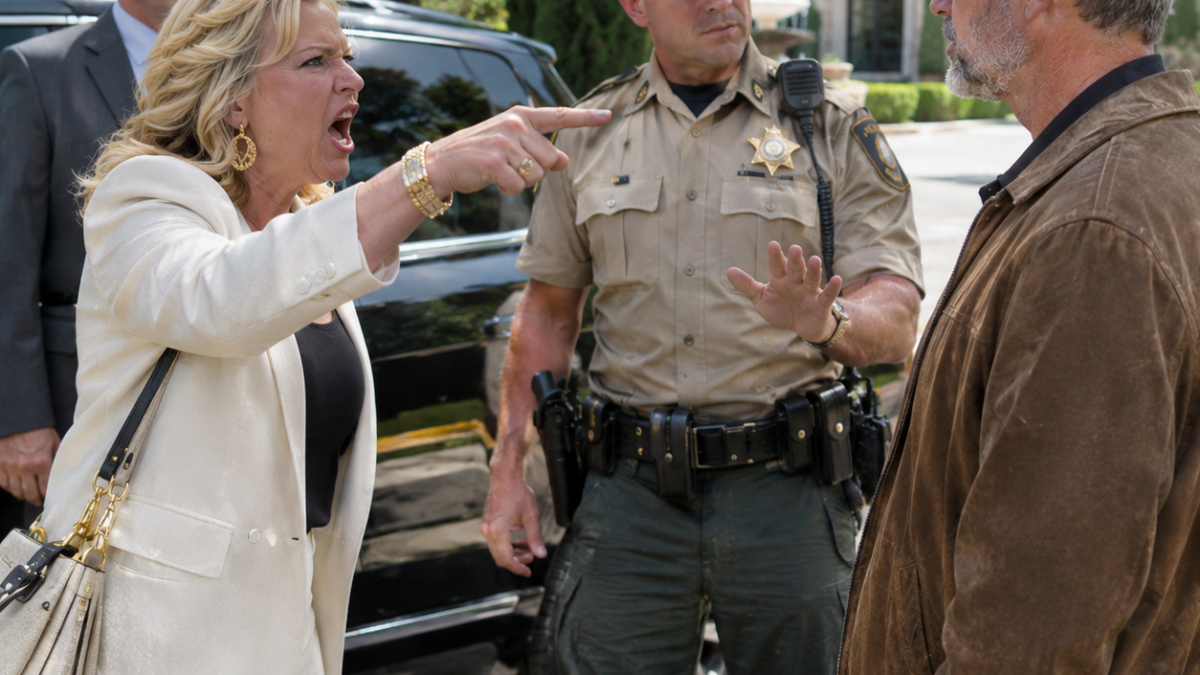
She jabbed one finger toward my chest.
“Arrest him!”
Jake looked at her.
“He has ignored multiple HOA directives.”
Jake stayed silent.
“He is trespassing on Sterling Ridge property.”
Silence.
“I have documentation.”
She held up a folder.
“He has no right to be standing there.”
Jake took two steps.
“Ma’am.”
Victoria stopped.
His voice had the tone good officers use when the conversation is about to become very simple.
“That’s Chief Calloway.”
Victoria blinked.
“What?”
“Thomas Calloway.”
Jake looked toward me.
“He served eleven years as Chief of Police in Loudoun County.”
Victoria’s mouth opened.
“He hired me.”
Jake continued.
“Trained me.”
Pause.
“Wrote my first evaluation.”
Another pause.
“Attended my wedding.”
Victoria looked between us.
Then Jake said:
“And, ma’am, you’re standing on his property.”
Silence.
Four seconds.
Maybe five.
Victoria’s finger was still pointing.
But the certainty was gone.
She turned toward the first deputy.
“This doesn’t change anything.”
Then back to Jake.
“The HOA owns this land.”
“No, ma’am.”
“My husband has the plat.”
Jake nodded.
“County records say otherwise.”
Victoria laughed.
“You people don’t understand development law.”
That was when the third vehicle arrived.
Dark blue county sedan.
Sarah Prescott got out.
Charcoal suit.
Hair back.
Manila folder.
Two plainclothes investigators behind her.
Badges visible.
Victoria watched them approach.
Confusion first.
Then concern.
Sarah walked past her.
Stopped near me.
“Morning, Chief.”
“Morning.”
She looked at the vines.
“Those new?”
“Yes.”
“Nice.”
“Thanks.”
Then Sarah turned.
“Victoria Ashford?”
Victoria straightened.
“Yes?”
“I’m Sarah Prescott, Deputy District Attorney for Loudoun County.”
Victoria’s eyes moved toward the investigators.
Sarah opened the folder.
“I have warrants.”
Something in Victoria’s face changed.
“For Thomas Calloway?”
“No.”
Sarah looked directly at her.
“For you.”
No one moved.
“And Gregory Ashford.”
Greg stepped backward beside his Mercedes.
One investigator turned toward him.
Sarah began listing suspected charges.
Recorded plat fraud.
Financial crimes involving HOA funds.
False instruments.
Destruction of agricultural property.
False reports.
Other related offenses.
Victoria laughed.
Sharp.
High.
Almost disconnected.
“You can’t be serious.”
Sarah didn’t react.
“I’m president of Sterling Ridge Estates.”
Jake said:
“That’s not going to help.”
Victoria looked at me.
“This is your doing.”
“No.”
I tied the final vine.
“You did this.”
The investigator stepped forward.
Victoria pulled her wrist back.
“Do you know who I am?”
“Yes, ma’am.”
He placed one cuff.
“That’s why we’re here.”
Greg was arrested too.
His resistance lasted less than an hour.
According to the eventual court record, once his attorney understood the evidence, Greg started talking.
He confirmed the boundary map had been redrawn to include portions of my property.
Confirmed Ridgeline Advisory was used to move HOA money.
Confirmed Victoria directed enforcement pressure.
Then came the vineyard.
Greg admitted Victoria had personally targeted Elena’s vines.
That was the only moment I had to leave the room when Sarah told me.
I walked outside.
Stood beside the barn.
Ellie came over.
I put one hand on her neck.
I had known.
The camera told me.
The shoes told me.
Greg’s statement just gave the act a voice.
Victoria never apologized.
I didn’t expect one.
The criminal case moved quickly because Greg cooperated.
The courtroom was full.
Gail.
Harold.
Former Sterling Ridge families.
Chris and Amy.
People Victoria had driven away.
People who came back because they wanted to watch the story end.
Victoria arrived in white.
Pearls.
Perfect posture.
Judge Raymond Kessler looked at her.
“This is a felony proceeding, Ms. Ashford.”
The next day she wore gray.
Greg testified.
He described the development plan.
The land.
The fake boundary.
The pressure campaign.
The finances.
According to him, phase-three expansion could have generated enormous profit if they obtained my acreage.
That was the motive.
Forty-five acres.
My family history to me.
Future development inventory to Greg.
And an obstacle to Victoria.
The prosecution played the vineyard footage.
2:47 a.m.
A dark figure.
Five-gallon jug.
Row after row.
Wedge sandals.
Then a second camera angle.
Porsche plate visible.
Clearer body profile.
The courtroom made a sound.
Not quite a gasp.
Something lower.
A room realizing ugliness had stopped being allegation.
Victoria’s attorney attacked the footage.
Chain of custody.
Lighting.
Identification.
Sarah had all of it.
That was why I had built the file the way I did.
No shortcuts.
The jury deliberated just over four hours.
Greg’s separate federal exposure and cooperation produced prison time and financial consequences.
Victoria was convicted on the charges supported at trial and faced restitution, supervision, community service, and an injunction preventing her from controlling another Virginia HOA.
When the judge read that last part, Victoria finally looked down.
No speech.
No argument.
No smile.
Nothing.
The Sterling Ridge HOA was restructured afterward.
The old board collapsed.
The homeowners formed a new board with transparent audits.
Published budgets.
Term limits.
Harold Dunn became president.
His first major action:
Review every fine issued during Victoria’s tenure.
Unsupported fines were voided.
Payments were refunded where legally appropriate.
Gail organized a block party.
No crystal mimosas.
No PowerPoint.
Hamburgers.
Beer.
Kids running.
People talking.
Some of them came to me.
Apologies.
Not all.
Enough.
Then we replanted the vineyard.
Again.
But this time I wasn’t alone.
Saturday morning.
Gail arrived with gloves.
Harold with a shovel.
Then another family.
Then another.
Twelve Sterling Ridge households.
People who had once watched Victoria target me from a distance now stood in Elena’s south slope digging holes.
Two hundred vines.
Same Pinot Noir.
Same spacing.
Harold dug the first.
Gail tied the first wire.
A seven-year-old girl named Sophie planted the last vine.
She had dirt on both hands.
She looked up.
“What grapes are these?”
“Pinot Noir.”
“Are they good?”
“My wife thought so.”
“Where is she?”
Children ask clean questions.
Adults spend too much time avoiding them.
“She died.”
Sophie looked at the vine.
Then back at me.
“Was this hers?”
“Yes.”
She pressed dirt around the roots.
“Then I’ll make this one really good.”
I had to turn away for a moment.
The vines grew.
So did something else.
Ten acres on the north end of the estate became the Calloway Youth Equestrian Center.
Free riding lessons.
Low-income families.
Foster children.
Military families.
The first program was named:
The Elena Calloway Riding Scholarship.
Twelve kids signed up.
Ellie became the first training horse.
Elena’s filly.
Patient.
Calm.
Perfect with nervous children.
The first morning, a boy named Marcus stood beside her.
Nine years old.
Wouldn’t touch the reins.
“You scared?”
He shook his head.
Clearly terrified.
“You don’t have to ride.”
He looked surprised.
“I don’t?”
“No.”
“You can just meet her.”
He reached out.
Ellie lowered her head.
Marcus touched her nose.
Five minutes later, his hand was on her neck.
Ten minutes later, he was in the saddle.
Walking.
Slow.
His foster mother cried behind the fence.
I pretended not to notice.
Afterward, she thanked me.
I said:
“Thank Elena.”
She looked confused.
I pointed at the sign.
That was when I understood the difference between revenge and legacy.
Victoria’s arrest was satisfying.
I won’t lie.
Watching her demand my arrest on my own property moments before learning there was a warrant for her—
Yes.
There was satisfaction.
But satisfaction is temporary.
A child learning to trust a horse?
That lasts.
The vineyard?
That lasts.
The estate staying whole?
That lasts.
Elena’s name helping children?
That mattered more than anything Victoria lost.
Months after the trial, Harold came to the house.
He brought a bottle of bourbon.
“Peace offering.”
“You didn’t do anything.”
“I sat on that board.”
“You voted against her when it mattered.”
“Not soon enough.”
I poured two glasses.
We sat on the porch.
He looked toward Sterling Ridge.
“You know what bothers me?”
“What?”
“I knew she was wrong.”
“How early?”
“Not about your land.”
He shook his head.
“About everything else.”
I waited.
“The fines.”
“Okay.”
“The bullying.”
“Okay.”
“The way she treated people.”
“Why didn’t you speak?”
Harold looked down.
“Because every issue seemed too small to be the hill to die on.”
I understood.
“A garden.”
He nodded.
“A paint color.”
“Noise complaint.”
“A parking fine.”
He looked at me.
“By the time the issues became big enough to fight, she had trained everyone not to fight.”
That sentence stayed with me.
People think tyranny announces itself dramatically.
Sometimes it arrives as a three-hundred-dollar fence violation.
Then a towing fee.
Then a complaint.
Then another.
The individual acts look small enough to tolerate.
The pattern is the danger.
Sterling Ridge changed because people started seeing the pattern.
The new financial audit uncovered more questionable spending.
Legal consultants.
Vendor contracts.
Payments routed through connected entities.
Not every ugly transaction became criminal.
Some were simply unethical.
Some stupid.
Some both.
The new board published everything.
Budgets.
Minutes.
Contracts.
Owners could read them.
Gail called it revolutionary.
“It’s just accounting.”
“No.”
She held up the quarterly report.
“After Victoria, arithmetic is revolutionary.”
Fair.
The county corrected the subdivision plat.
That mattered enormously to me.
Not only because of ownership.
Because a false map sitting in a government archive can become more dangerous with time.
One clerk trusts it.
One lender cites it.
One title company copies it.
Ten years later, somebody says:
“But the map has always shown…”
No.
The corrected record showed the truth.
My forty-five acres remained separate.
Agricultural.
Outside Sterling Ridge.
I stood at the county office when the correction was recorded.
The clerk stamped it.
Then slid the copy back.
“That’s it.”
I looked at the page.
“So much trouble over one line.”
She smiled.
“Lines matter.”
“Yes.”
“They do.”
I framed that corrected plat.
Not in the living room.
Barn office.
Beside Elena’s original vineyard plan.
Two different maps.
One showed where the property ended.
The other showed where she hoped the vines would grow.
Both mattered.
The first harvest from the replanted vineyard came years later.
Small.
Not enough for commercial wine.
I didn’t care.
I picked the grapes with volunteers from Sterling Ridge.
Sophie came back.
Older.
Still remembered the vine she planted.
“This one?”
She pointed.
“Close.”
“No, this was mine.”
“How do you know?”
“I put a rock next to it.”
Sure enough.
Small limestone piece.
We harvested the row.
A local winemaker helped make a tiny batch.
Nothing fancy.
Forty-eight bottles.
Label:
ELENA’S SLOPE.
I gave almost all of them away.
One to Gail.
One to Harold.
One to Sarah.
One to Jake Thornton.
When I handed Jake his bottle, he smiled.
“Chief.”
“Stop calling me that.”
“No.”
“You’re forty-seven years old.”
“And you’re still Chief.”
He looked at the label.
“My wife’s going to cry.”
“Probably.”
Then he laughed.
“You remember Victoria pointing at you?”
“I try not to.”
“I do.”
“Why?”
“Because I’ve never seen someone’s confidence disappear that fast.”
I shook my head.
“You enjoyed that.”
“A little.”
“So did I.”
Jake became sheriff years later.
At his swearing-in, he asked me to attend.
Front row.
Afterward:
“You still think I write terrible reports?”
“Yes.”
“I’m the sheriff.”
“Still terrible reports.”
He laughed.
Some things survive retirement.
The horses aged.
Copper slowed.
Duke remained completely unconcerned by life.
Ellie became the star of the youth program.
Children loved her.
Elena would have too.
One Saturday, I watched a twelve-year-old girl brush Ellie.
She had been in foster care almost her whole life.
Quiet.
Wouldn’t look adults in the eye.
She brushed the horse for twenty minutes without speaking.
Then asked:
“Does she remember people?”
“Yes.”
“How long?”
“Horses remember a lot.”
She stopped brushing.
“Does she remember your wife?”
I swallowed.
“I think so.”
“How do you know?”
“Because Ellie was calmer around her than anyone.”
The girl leaned against the horse.
“Maybe she still remembers.”
“Maybe.”
I walked away before she saw my face.
The estate became worth more over time.
Developers continued asking.
Some offers were larger than Greg’s.
I declined.
One man said:
“You understand this land could support two hundred homes.”
“Yes.”
“You could walk away with generational money.”
“I already have generational land.”
He didn’t understand.
That was okay.
Not every valuable thing needs to be liquidated.
My grandfather lost the estate through circumstances he couldn’t control.
I spent twenty-eight years bringing it back.
Elena helped make it home.
Victoria wanted to turn it into phase three.
The answer stayed no.
The first anniversary of the trial was quiet.
No celebration.
I walked the fence.
Fed the horses.
Checked vines.
At one corner, I found a Sterling Ridge resident waiting.
Older woman.
I recognized her vaguely.
“Mr. Calloway?”
“Tom.”
“My name is Marlene.”
“Morning.”
She held an envelope.
“What’s this?”
“An apology.”
“You don’t owe me one.”
“Yes.”
She looked toward the ground.
“I voted with Victoria.”
I waited.
“Every time.”
“Why?”
“She was convincing.”
That was probably true.
“She said you were dangerous.”
“Also convincing?”
Marlene winced.
“I believed her.”
I took the envelope.
“You came here.”
“I should’ve come sooner.”
“Most people should do a lot of things sooner.”
She smiled faintly.
“Are you angry?”
“Sometimes.”
“At me?”
I thought.
“No.”
“Why?”
“Because anger is expensive.”
She looked toward the vineyard.
“Those are Elena’s?”
“Yes.”
“I’m sorry.”
“Thank you.”
She left.
Inside the envelope was a check to the riding program.
I deposited it.
People can make bad choices and still become better neighbors later.
That mattered.
I didn’t want Victoria to leave behind a neighborhood permanently divided between people who were right and people who were wrong.
That would have been another kind of victory for her.
Years passed.
Elena’s vines matured.
The riding center expanded.
The farmhouse porch needed repairs again.
That’s the thing about eight-million-dollar estates.
They still have gutters.
Still have broken hinges.
Still need paint.
Money doesn’t make a place maintain itself.
One afternoon, I was on a ladder replacing trim when a young Sterling Ridge homeowner walked by.
He stopped.
“Mr. Calloway?”
“Tom.”
“Need help?”
“No.”
“You sure?”
“I’m old, not dead.”
He laughed.
Then climbed another ladder anyway.
His name was Eric.
Software engineer.
Never owned a screwdriver until age thirty-five.
We spent two hours replacing trim.
He told me he had moved into Sterling Ridge after Victoria left.
“I heard stories.”
“Most are exaggerated.”
“Was she really arrested on your land after calling the police on you?”
“That part isn’t exaggerated.”
He nearly dropped the board laughing.
I smiled.
It had become funny.
That surprised me.
For a long time, Victoria’s name raised my blood pressure.
Eventually she became a story.
That is progress.
Years after everything ended, I found the original ASHFORD folder.
Bottom drawer.
Thick.
Violation letters.
Towing receipt.
Animal-control records.
Noise complaints.
Photographs.
Fake survey.
Dead vines.
Lab report.
Financial flowchart.
Protective-order papers.
I sat at the kitchen table.
Opened it.
Then closed it.
I didn’t need to read it.
Evidence had served its purpose.
I kept the folder because retired cops don’t throw away case files easily.
But I moved it to storage.
The house no longer needed to remember Victoria every day.
Elena’s things stayed.
Her viticulture notebooks.
Riding gloves.
Photograph on the mantel.
Her coffee mug.
The case moved out.
That distinction felt important.
One autumn evening, Sophie—the little girl who planted the last vine—visited with her parents.
She was seventeen now.
Applying to college.
“What are you studying?”
“Environmental science.”
“Good.”
“I wrote my application essay about the vineyard.”
I stared.
“Why?”
“Because my parents almost moved when Victoria was president.”
I hadn’t known.
“She fined them?”
“A lot.”
Sophie shrugged.
“I remember everybody being scared.”
Then she looked at the vines.
“But I also remember planting this.”
She touched the row.
“You let us help fix something.”
That might have been the nicest thing anyone said about the entire case.
Not:
You beat Victoria.
Not:
You got her arrested.
You let us help fix something.
That was better.
At seventy, I finally stopped doing most ranch work alone.
Jake told me I was too old to fix fence posts.
I reminded him I could still fire him emotionally.
He reminded me he was sheriff.
Maggie would have laughed.
Except Maggie wasn’t there anymore.
She died years after the Victoria case.
Quietly.
Not cancer.
Age.
A good life.
I buried her beside Elena’s memorial oak.
Losing Maggie reopened old grief in new places.
For a while, I considered selling.
Not to developers.
Just leaving.
The estate felt too large.
Too quiet.
Then one morning I watched twelve children arrive for riding lessons.
Ellie, older now, stood patiently.
A little boy laughed when she sneezed.
I heard Elena in that laugh.
I heard Maggie telling me not to become sentimental and stupid.
So I stayed.
Not because promises require suffering.
Because the place still had work to do.
The Calloway Youth Equestrian Center grew into something Elena could never have imagined.
Veterans volunteered.
Foster agencies partnered.
Local businesses donated saddles.
Sarah Prescott helped create a small legal scholarship for youth aging out of foster care.
Harold donated accounting services.
Gail ran the annual fundraiser with the terrifying efficiency of a retired teacher organizing a field trip.
One year, she put my face on the flyer.
I made her remove it.
“You’re the founder.”
“No.”
“You own the land.”
“Still no.”
“What do you want on it?”
“Ellie.”
She rolled her eyes.
The horse sold more tickets.
I was right.
Victoria’s permanent HOA injunction became an odd footnote.
For a while, people sent me screenshots of her life.
New job.
Another city.
Some property company.
I asked them to stop.
“Why?”
“Because I don’t care.”
At first that wasn’t completely true.
Then it became true.
That was the final consequence I never expected.
Irrelevance.
When someone has occupied your life through conflict, hatred can keep them important long after they’re gone.
I didn’t want that.
Elena deserved more space in my memory than Victoria.
The horses did.
The kids did.
The vines did.
So eventually, Victoria became the woman who once tried to steal my land.
Past tense.
Nothing more.
The law handled the rest.
One spring morning, I was tying vines.
Same method.
Two wraps.
Gentle bend.
A young volunteer asked:
“Why not tie it tighter?”
“Because vines grow.”
“So?”
“If you tie too hard, the wire cuts them later.”
He nodded.
I looked at the row.
“Elena taught me that.”
“Your wife?”
“Yes.”
The boy smiled.
“She sounds smart.”
“She was.”
He moved to the next vine.
I stayed where I was for a moment.
That lesson applied to more than grapes.
Control feels safe to people like Victoria.
Tighter rules.
Tighter power.
Tighter ownership.
Tighter pressure.
But living things need room.
Families.
Communities.
Neighbors.
You guide.
You don’t strangle.
Sterling Ridge learned that.
The new board made fewer rules.
People painted doors different colors.
Kids left bicycles outside.
Someone planted tomatoes.
Nobody’s property value collapsed.
Harold once called me.
“Tom.”
“What?”
“There’s a vegetable garden visible from the road.”
“Terrifying.”
“I think tomatoes are growing.”
“Call state police.”
He laughed.
That was progress too.
The estate’s appraised value eventually climbed above what I paid.
I didn’t care.
The number eight million had mattered to Victoria.
To Greg.
To reporters.
To developers.
To me, value was different.
The bedroom where Elena died.
The vineyard.
The creek where I learned to fish.
My grandfather’s fence posts.
The barn.
The place Ellie stood when a frightened foster child first touched a horse.
You can appraise acres.
You can’t appraise meaning very well.
Victoria made that mistake from the beginning.
She saw forty-five acres and calculated development profit.
I saw home.
Those numbers never had a chance to agree.
The final time I saw Victoria was accidental.
Years later.
Leesburg.
I was leaving a pharmacy.
She was crossing the parking lot.
Older.
Shorter hair.
Plain clothes.
We saw each other.
Stopped.
I had imagined that moment once.
A speech.
Something clever.
Maybe:
Still think it’s HOA property?
But when it happened, I felt nothing worth saying.
Victoria looked away.
I walked to my truck.
Started the engine.
Drove home.
No shaking hands.
No anger.
No victory.
Just Tuesday.
That was when I knew the case had finally left me.
Not when the jury returned.
Not when the judge issued the injunction.
Not when Sterling Ridge elected a new board.
When Victoria became a stranger in a parking lot.
That was freedom.
The vineyard produced its best harvest the following year.
We made seventy-three bottles.
One went on Elena’s grave.
I know that’s sentimental.
Maggie would have accused me of wasting perfectly good wine.
I poured a small glass anyway.
Sat beneath the memorial oak.
“To stubborn women.”
Wind moved through the leaves.
I smiled.
Then corrected myself.
“To the right stubborn women.”
Years after Victoria screamed “Arrest him,” Jake still tells the story at department dinners.
His version gets more dramatic every year.
According to him, Victoria had six lawyers, three helicopters, and a tactical golf cart.
None of that happened.
I always interrupt.
He always ignores me.
But the five words remain accurate.
“That’s my former chief.”
People think that was the moment Victoria lost.
It wasn’t.
It was just the moment she realized she had already lost.
The real defeat happened much earlier.
When I saved the first letter.
When Danny documented healthy horses.
When I photographed the shutoff valve.
When Gail kept the PowerPoint.
When Ed followed the money.
When the surveyor confirmed the original pins.
When the cameras recorded the vineyard.
When the fake protective order failed.
When ordinary people stopped being afraid separately and started comparing what Victoria had done to all of them.
That’s how people like her fall.
Not because one hero suddenly appears.
Because the pattern finally becomes visible.
She had spent years making every victim feel alone.
Once they became witnesses for one another, her power disappeared.
I still walk the fence at seven most mornings.
Slower now.
The vines are strong.
The horses are older.
The estate looks almost exactly the way Elena imagined.
Sterling Ridge sits beyond the southern line.
Nice homes.
Good families.
A community that eventually learned the difference between governance and control.
There hasn’t been an HOA violation in my mailbox in years.
Every once in a while, a kid from the riding center asks why there are so many cameras around the property.
“Old habit.”
“Were you robbed?”
“Something like that.”
I don’t tell them the full story.
Children don’t need every ugly detail.
They need the result.
The land stayed home.
The horses survived.
The vines came back.
And a place someone tried to turn into a development phase became a place where children learned to ride.
That is enough.
If Elena were here, she would probably tell me I talk too much about justice.
She believed more in repair.
She once said:
“Anybody can point at what’s broken. The important person is the one who knows what to plant afterward.”
At the time, she was talking about the vineyard.
I understand it differently now.
Victoria destroyed vines.
We replanted.
She divided neighbors.
They rebuilt community.
She weaponized the HOA.
They replaced it with something transparent.
She targeted horses.
Those horses became part of a youth program.
She tried to make my land into somebody else’s investment.
The land became a legacy larger than anything Greg could have built.
That is the ending I care about.
Not the handcuffs.
Though I’ll admit those weren’t bad.
One October evening, I stood at the top of Elena’s slope.
Rows of vines below.
Golden pasture beyond.
Sterling Ridge lights beginning to come on south of the fence.
Ellie grazed near the riding center.
Children had already gone home.
Quiet.
I thought about the morning the cruisers arrived.
Victoria pointing.
“Arrest him.”
Jake stepping out.
The silence.
Then Sarah’s sedan.
The warrants.
For years, that had been the story people wanted.
The comeback.
The humiliation.
The moment the bully discovered who I was.
But age changes your interpretation of victory.
The deputy recognizing me mattered less than the deed.
My badge mattered less than the truth.
Even if Jake had never met me, Victoria still would have been wrong.
Even if I had spent thirty-two years repairing washing machines instead of running a police department, the property would still have been mine.
That realization mattered.
The story was never really about me being a former chief.
It was about a woman who believed some people deserve fewer rights when they appear powerless.
Retired.
Widowed.
Alone.
Older.
Living beside wealthier newcomers.
She thought status determined truth.
She was wrong.
Truth doesn’t care about your title.
Neither does a deed.
Neither does evidence.
Neither does the law when it is working the way it should.
I looked down at the vines.
The last row was the one Sophie helped plant.
Strongest on the slope.
Funny how that happens.
The plants Victoria killed were gone.
But the vineyard wasn’t.
Elena was gone.
But her work wasn’t.
Maggie was gone.
But her voice still corrected me in my head.
People leave.
What they build can remain.
I walked back toward the farmhouse.
At the gate stood the same mailbox Victoria once tried to regulate.
Beside the drive was a modest sign.
CALLOWAY ESTATE
EST. 1962
Below it:
ELENA CALLOWAY YOUTH EQUESTRIAN CENTER
No mention of Victoria.
No mention of lawsuits.
No mention of the eight-million-dollar purchase price.
No mention of my old rank.
That was deliberate.
Because in the end, the things that mattered most weren’t what I owned or what title I once held.
They were what remained after someone tried to take them.
The land.
The vines.
The horses.
The children laughing near the barn.
And the promise I made to Elena that I would take care of the place she helped me bring home.
Victoria Ashford once stood on that land, pointed at me, and demanded the sheriff arrest me.
She believed confidence could replace ownership.
She believed money could rewrite boundaries.
She believed an HOA title made her more powerful than a deed.
She believed her husband’s development plans mattered more than my family’s history.
She believed a retired widower would eventually get tired.
I did get tired.
I got tired of fake complaints.
Tired of letters.
Tired of watching people stay silent because they feared retaliation.
Tired of cleaning up damage somebody else deliberately caused.
But I never got tired enough to leave.
And that was the one outcome Victoria never planned for.
She tried to erase Elena’s vineyard.
I replanted it.
She tried to take my land.
I recorded the truth.
She tried to turn neighbors against me.
They eventually showed up with shovels.
She tried to make the sheriff remove me.
Instead, one of my former deputies looked her in the eye and told her exactly whose property she was standing on.
Then the prosecutor arrived.
That was consequence.
Everything that came afterward—
the vineyard,
the riding center,
the children,
the restored community—
that was victory.
And every morning when I walk the fence, I pass Elena’s vines and remember the rule that Victoria never understood:
You can destroy something someone loves.
You can frighten them.
Humiliate them.
Lie about them.
Even convince other people that they’re the problem.
But if they still know who they are, still know what belongs to them, and still have the courage to plant again after you’ve poisoned the ground—
you haven’t beaten them.
You’ve only shown them what needs protecting.








