After Years of Breeding Her for Profit, He Left Her to Di3 in a Shack—Then We Found Out Bodam Was Still Fighting
PART 2
I stared at the pale shape on the monitor.
“What am I looking at?”
Dr. Patel pulled his chair closer.
“The mass is attached along a difficult section of the stomach wall. I’m also concerned about the tissue around it. If it has spread extensively, we may not be able to remove enough safely.”
I looked at Bodam.
She was still asleep on the blanket.
For years, everyone around her had apparently made decisions based on what she could produce.
How many puppies.
How much money.
How much trouble she was worth.
Now we were sitting in a clean examination room discussing whether saving her life was financially reasonable.
I hated that thought.
“How much would the surgery cost?” I asked.
Dr. Patel hesitated before giving me the estimate.
It was more than our rescue usually spent on several animals combined.
My stomach dropped.
We weren’t a wealthy organization.
We survived on donations, adoption fees, volunteers and people who sometimes paid veterinary bills out of their own pockets because they couldn’t bear to say no.
I rubbed my forehead.
“Could she even survive anesthesia right now?”
“Not safely.”
“So we have time?”
“A little. But not much.”
He explained that before they could consider surgery, Bodam needed aggressive nutritional support, fluids and medication. She needed to gain enough strength that her heart and organs had a chance of handling several hours under anesthesia.
“And her eye?” I asked.
“We can control the infection and pain for now. The stomach has to be the priority.”
I sat there looking at her.
It would have been easier if she had been angry.
If she had been impossible to handle.
If she had growled every time we touched her.
It would not have changed what she deserved, but maybe it would have protected my heart a little.
Instead, when she woke and saw me, her tail tapped the blanket once.
Just once.
I covered my mouth.
Dr. Patel watched me.
“I know what you’re thinking.”
“Do you?”
“You’re wondering whether putting her through this is for her or for us.”
That was exactly what I was wondering.
I had been in rescue long enough to know that fighting was not always kindness.
Sometimes people kept animals alive because saying goodbye hurt too much.
Sometimes loving them meant stopping.
I crouched beside Bodam.
She lifted her chin.
I offered her a piece of boiled chicken that one of the technicians had brought in.
She sniffed it.
For several seconds, she did nothing.
Then she ate.
I offered another.
She ate that one faster.
Dr. Patel smiled faintly.
“There’s your first vote.”
I laughed through tears.
“Not scientifically valid.”
“No.”
Bodam looked at my hand for another piece.
“But persuasive.”
That afternoon our rescue director, Maria Torres, came to the hospital.
Maria was sixty-one, practical, tough and capable of reading a veterinary estimate without visibly flinching.
Usually.
She looked at Bodam’s numbers and sat down.
“That much?”
“That’s the estimate if everything goes well.”
“And if it doesn’t?”
“More.”
Maria closed the folder.
“Of course.”
Bodam was standing beside me, slowly eating from a raised bowl.
Maria watched her.
“You know what makes me angry?”
“I have a list.”
“She isn’t even demanding anything.”
That was true.
Bodam ate as if she was apologizing for taking the food.
Every few bites, she looked at us.
Maria walked over and crouched beside her.
“What did they teach you, sweetheart?”
Bodam licked a smear of chicken from the edge of the bowl.
Maria touched her neck.
Then she looked at me.
“We do it.”
I blinked.
“The surgery?”
“All of it.”
“We don’t have that money.”
“We’ll find it.”
“What if she doesn’t make it?”
Maria looked back at Bodam.
“Then for however many days she has left, she will know we tried for her.”
That became the plan.
For two weeks, our entire world revolved around making Bodam strong enough for a surgery that might still kill her.
The hospital became her temporary home.
A thick bed replaced the wooden floor of the shack.
Fresh water was always within reach.
Her meals were carefully measured—small portions at first so her weakened system could tolerate them.
I started cooking for her at home.
Chicken.
Rice.
Lean ground turkey.
Pumpkin.
Whatever the veterinary nutrition team approved.
Every morning before work, I brought containers to the hospital.
The first few days, Bodam ate slowly.
By the end of the first week, she began meeting me near the kennel door.
“You know what I have, don’t you?” I asked.
Her tail moved.
I held up the container.
“Turkey.”
The tail moved faster.
One of the technicians laughed.
“She can hear Tupperware from three rooms away now.”
That tiny change nearly broke me.
The dog we had carried from the shack was starting to anticipate something good.
But while Bodam recovered, another part of the story was unfolding.
The county had begun investigating her owner.
His name was Dale Mercer.
I first saw him three days after the rescue.
I had returned to the property with Animal Control Officer Ramirez because the investigators wanted photographs of the shack and any items that might establish how long Bodam had been left there.
Ramirez was inside examining a stack of feed bags when a pickup truck came down the dirt road.
It stopped hard beside the gate.
A man climbed out.
Mid-fifties.
Work boots.
Baseball cap.
Angry before he even reached us.
“What are you people doing on my property?”
Officer Ramirez stepped outside.
“Mr. Mercer?”
“You know damn well who I am.”
“Sir, this property is part of an active animal-neglect investigation.”
Mercer pointed toward the shack.
“You took my dog.”
I felt my body tighten.
His dog.
Not Bodam.
Not a living animal suffering from cancer.
His dog.
Officer Ramirez remained calm.
“The dog was removed under emergency authority because of her condition.”
“She had food.”
I looked at the two empty bowls inside the shack.
Ramirez said, “We documented the conditions.”
Mercer glanced at me.
“Who’s she?”
“Rescue representative.”
His face changed when he realized.
“So you’re the one making trouble.”
I stared at him.
Normally, I tried not to engage owners during active investigations.
But sometimes self-control is not the same thing as silence.
“She was starving.”
“She’s old.”
“She was dehydrated.”
“She doesn’t drink much.”
“She has cancer.”
That stopped him.
Not in the way I expected.
No shock.
No grief.
No question about whether she would survive.
He simply shrugged.
“Well, there you go.”
For a second I thought I had misunderstood him.
“There I go?”
“She was dying anyway.”
Officer Ramirez turned sharply toward him.
Mercer kept talking.
“I bred that dog for years. She was fine then. She got old. Animals get sick.”
The sentence landed like something physical.
I pictured Bodam standing at her hospital bowl, waiting for turkey.
“You left her locked in that shack.”
“I didn’t lock her.”
“So she could leave?”
“She had a chain.”
I stared at him.
Mercer realized too late what he had just admitted.
Ramirez’s eyes narrowed.
“What kind of chain?”
Mercer looked away.
“Just a dog chain.”
“How long?”
“I don’t remember.”
“Was she chained inside the structure?”
Mercer’s jaw tightened.
“I don’t need an interrogation on my own property.”
“You’re right,” Ramirez said calmly. “You don’t have to answer questions.”
Mercer pointed at me.
“And she doesn’t get to tell people I abused anything.”
I stepped forward before Ramirez could stop me.
“I don’t need to tell them.”
Mercer frowned.
“The photographs will.”
His face went red.
“You people always do this. Take somebody’s animal, run up a giant vet bill, then act like heroes.”
I could feel my heartbeat in my throat.
Behind him stood the shack.
Broken roof.
Rotting boards.
Empty water bowl.
I said, “Do you know what she did when we found her?”
He said nothing.
“She walked toward us.”
Still nothing.
“She was barely strong enough to stand, but she walked toward complete strangers because strangers were a better option than staying here.”
Mercer’s mouth twisted.
“It’s a dog.”
Ramirez stepped between us.
“Claire.”
I understood the warning.
I backed away.
Mercer turned to leave, then looked over his shoulder.
“If she survives, I want her back.”
Everything inside me went cold.
Ramirez answered before I could.
“That will be determined through the legal process.”
Mercer smiled.
“We’ll see.”
I watched his truck disappear down the road.
Then I turned toward Ramirez.
“He cannot get her back.”
“I know.”
“No. I mean it.”
“So do I.”
“What if he argues she was sick because of cancer?”
“That’s why we document everything.”
“What if he says he was coming back?”
“That’s why timelines matter.”
“What if—”
Ramirez raised a hand.
“Claire.”
I stopped.
He looked straight at me.
“Anger is useful if you make it organized.”
I remembered those words.
Because for the next several weeks, that was exactly what we did.
We organized it.
The photographs.
The veterinary records.
The empty containers.
The chain.
The dates.
Statements from neighbors.
Receipts from puppy sales.
Old advertisements.
Breeding records.
Everything.
A woman named Denise lived almost a mile down the road. Investigators located her after she called the county.
She had seen Mercer’s truck coming and going for years.
When Bodam was younger, Denise remembered puppies being loaded into vehicles.
“People came every few months,” she told us. “Families. Sometimes men with transport crates.”
“Did you ever go onto the property?” Ramirez asked.
“No. Dale didn’t like people around.”
“When did you last see him staying there regularly?”
Denise thought about it.
“Months ago.”
“And Bodam?”
Her face tightened.
“I heard her.”
I leaned forward.
“When?”
“Most nights.”
“What did she do?”
“Sometimes barked. Sometimes cried.”
My stomach twisted.
“Did you report it?”
Denise looked down.
“Not soon enough.”
Nobody spoke for a moment.
Then she said, “I kept telling myself someone must be feeding her.”
Her eyes filled.
“One night it got cold. Really cold. I could hear her whining from the road.”
She wiped her face.
“The next morning I called.”
That call may have saved Bodam’s life.
Back at the hospital, Bodam knew nothing about any investigation.
Her concerns were simpler.
Food.
Sleep.
Pain.
Trust.
Her swollen eye slowly improved with medication.
Her coat was cleaned.
The dirt came away.
The smell disappeared.
Beneath it all was a beautiful dog with gentle brown eyes and a white patch on her chest.
By day nine, she began trying to follow the veterinary staff into the hallway.
By day eleven, she discovered the reception desk.
The receptionist, Leah, kept treats in the second drawer.
Bodam learned this within twenty-four hours.
“You created a monster,” I told Leah.
“I reject that accusation.”
Bodam sat beside her chair.
Leah opened the drawer.
“Would an innocent woman have this many freeze-dried liver treats?”
Bodam’s ears lifted.
I laughed.
It felt strange.
Laughing around her.
The first day I met Bodam, every emotion had felt heavy.
Now moments of joy were slipping in.
Small ones.
Dangerous ones.
Because hope makes you forget how much you can lose.
Two days before surgery, Dr. Patel repeated her bloodwork.
He called me that afternoon.
“Her numbers have improved.”
“How much?”
“Enough.”
I gripped the phone.
“So we can operate?”
“We can try.”
Try.
Not save.
Not cure.
Try.
“When?”
“Thursday morning.”
I looked at the calendar.
Forty-eight hours.
I thought I would feel relieved.
Instead, fear settled into me like ice.
That night I stayed late at the hospital.
Bodam was asleep when I arrived.
I sat beside her bed.
After a while, she opened one eye.
“Sorry.”
Her tail thumped.
“I’m interrupting your beauty sleep.”
She moved her head onto my leg.
I froze.
Bodam had accepted touch before.
But this was different.
She had chosen contact.
I put one hand against her shoulder.
“You don’t owe us anything,” I whispered.
Her eyes closed.
“You understand?”
She breathed slowly.
“You don’t have to become inspirational. You don’t have to prove anything. You don’t have to survive because we need a happy ending.”
My voice cracked.
“You just have to know somebody finally wanted you here.”
Bodam sighed and pressed more of her weight against me.
I sat there until my legs went numb.
Thursday morning came too quickly.
I arrived before seven.
Bodam had been fasting since midnight, and she was deeply offended by this arrangement.
She walked straight to Leah’s desk.
No treat.
She looked at me.
Then at Leah.
Then back at me.
“Sorry,” I said.
She stared harder.
“I know.”
Dr. Patel entered wearing surgical scrubs.
“Ready?”
No.
I nodded.
Before they took Bodam back, I bent down and placed both hands around her face.
Her inflamed eye had improved enough that both eyes were open now.
“Come back,” I whispered.
She licked my wrist.
Then a technician led her through the doors.
The doors swung shut.
And there was nothing left to do.
Waiting may be the cruelest part of hope.
You cannot bargain with it.
You cannot help.
You cannot make time move faster.
Maria arrived with coffee.
I didn’t drink mine.
At nine fifteen, we heard nothing.
At ten thirty, nothing.
At eleven twenty, a surgical technician came out.
I stood so fast my chair scraped the wall.
“She’s still under,” the technician said immediately. “Dr. Patel asked me to tell you they’re continuing.”
“Is that good?”
“It means they’re continuing.”
Not good.
Not bad.
Continuing.
At noon, I walked outside because I could no longer breathe properly in the waiting room.
I sat on the curb behind the hospital.
Maria came with me.
“What if we made the wrong decision?” I asked.
She didn’t answer with something comforting.
That was one reason I trusted her.
“Then we made it for the right reason.”
“What if that isn’t enough?”
“Sometimes it has to be.”
I wiped my face.
“I told her she didn’t have to survive for us.”
Maria looked at me.
“That was a good thing to tell her.”
“Now I want her to ignore me.”
That made Maria laugh softly.
“Also understandable.”
At twelve forty-seven, the side door opened.
Dr. Patel stepped outside.
His surgical cap was still on.
There was exhaustion in his face.
I stood.
He removed his mask.
“The tumor was extensive.”
My stomach dropped.
“But?”
“We got it.”
I stared at him.
“All of it?”
“All visible tumor tissue. We removed the affected section and reconstructed the stomach. There was less obvious spread than the imaging made us fear.”
Maria covered her mouth.
I said, “She’s alive?”
“She’s alive.”
My knees nearly gave out.
Dr. Patel quickly added, “She is not out of danger. The next twenty-four to forty-eight hours matter tremendously.”
I nodded too fast.
“I understand.”
“There are risks of bleeding, infection, leakage at the surgical site—”
“I understand.”
But part of me had stopped hearing him.
Bodam was alive.
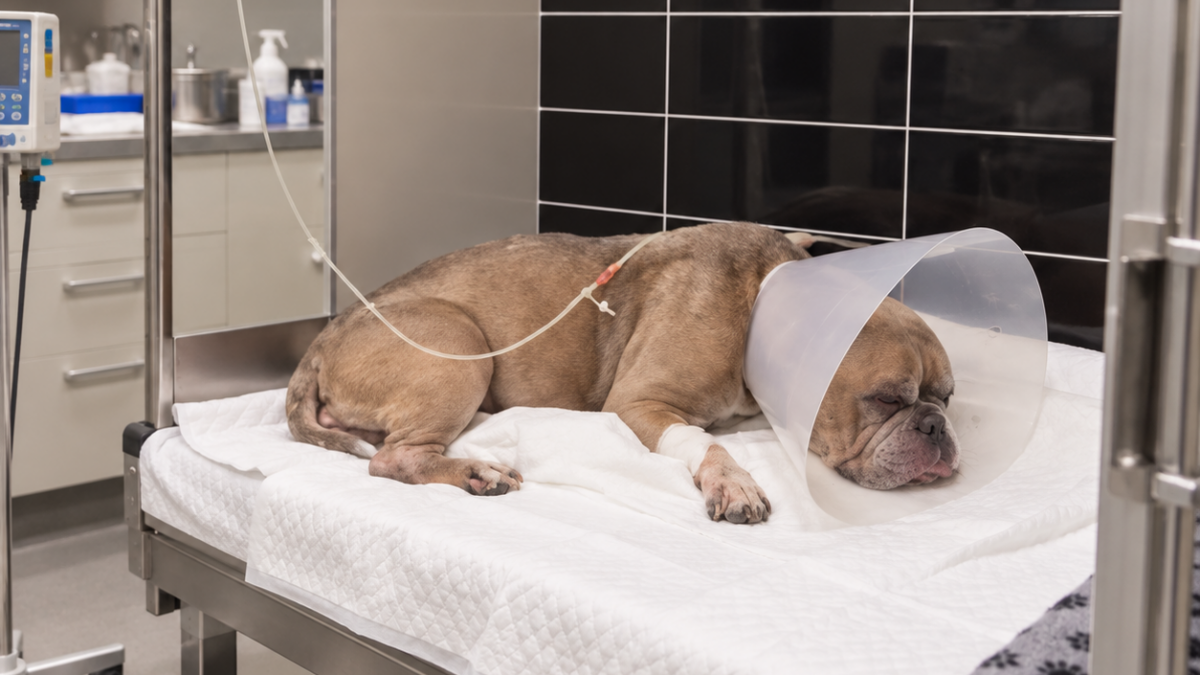
That afternoon I saw her through the glass of the recovery unit.
She was connected to monitors.
An IV line ran to her front leg.
She looked impossibly small.
The technician would not let me enter yet.
“She needs quiet.”
So I stood outside.
Her eyes were closed.
I put my fingers against the glass.
“You came back.”
The first night was difficult.
Bodam’s blood pressure dropped once.
Then stabilized.
She developed nausea.
The staff adjusted medication.
Every time my phone rang, I stopped breathing.
At 3:12 in the morning, the hospital called.
I answered before the second ring.
“What happened?”
The overnight veterinarian sounded tired.
“She’s stable.”
I sat upright in bed.
“Then why are you calling?”
“She stood up.”
“What?”
“About ten minutes ago. She stood up on her own.”
I covered my eyes.
“And?”
“And then she became extremely interested in whether the technician had food.”
I started laughing.
Then crying.
Probably both.
The veterinarian laughed too.
“I thought you’d want to know.”
“I did.”
The next morning Bodam looked at me through the kennel door and tried to stand again.
“No, no, no.”
Her tail moved.
“You just had major surgery.”
Tail.
“You are supposed to be resting.”
Tail.
Dr. Patel walked up behind me.
“She doesn’t respect medical advice.”
“Clearly.”
He examined her.
Recovery would be slow.
Meals would remain tiny and frequent.
Activity restricted.
Medication carefully timed.
But the immediate crisis had passed.
Three days later, Bodam walked down the hallway without assistance.
Everyone pretended this was routine.
It wasn’t.
Leah came out from reception.
Two technicians stopped what they were doing.
Maria had driven over specifically to see it.
Bodam walked toward us wearing a soft recovery suit over her incision.
Her steps were cautious.
But her head was up.
Halfway down the corridor, she noticed Leah.
Then she noticed the treat drawer.
Her pace increased.
Dr. Patel said, “Absolutely not.”
Leah said, “Tiny treat?”
“No.”
“Half?”
“No.”
“Quarter?”
“Leah.”
Bodam sat.
Leah pointed.
“Look at that discipline.”
Dr. Patel shook his head.
I laughed until tears came.
Two weeks after surgery, pathology results confirmed what we already knew: the mass was malignant.
But the margins from the removed tissue were encouraging.
Bodam would need monitoring.
Nobody used the word cured.
We knew better.
But for the first time, Dr. Patel used another word.
“Future.”
“She has one?” I asked.
He smiled.
“She may have a very good one.”
That was the moment I allowed myself to believe.
And it was also the moment Dale Mercer decided he wanted her back.
Officer Ramirez called me on a Tuesday.
“Mercer filed a petition challenging the seizure.”
I nearly dropped the phone.
“Why?”
“To reclaim ownership.”
“Of Bodam?”
“Yes.”
“He didn’t even ask if she survived.”
“I know.”
“He told us she was dying anyway.”
“I know.”
“He abandoned her.”
“That’s what we intend to establish.”
I stood in my kitchen staring at the container of food I had been preparing for Bodam.
“What does he want?”
Ramirez was silent for a moment.
Then he said, “Possibly the dog. Possibly control. Possibly to avoid the appearance that he surrendered her.”
I thought about the breeding records.
“Could he breed her again?”
“Not after that surgery.”
“He may not know that.”
“That possibility occurred to us.”
Something inside me hardened.
Mercer had already extracted years from Bodam.
Now, after strangers had paid to save her, he wanted to walk into a hearing and claim property rights.
“What do you need from me?”
“Everything.”
So we prepared.
The hearing was scheduled for Friday morning in the county administrative building.
The legal question was initially narrow: whether Bodam had been properly removed and whether Mercer retained the right to reclaim her while the neglect case proceeded.
But the evidence was not narrow.
The veterinary photographs alone were devastating.
Bodam’s body-condition score.
Dehydration.
Untreated eye disease.
The shack.
The empty bowls.
The chain.
The lack of sanitation.
The cancer itself was not evidence of abuse.
We were careful about that.
Cancer can happen to any animal, including deeply loved ones.
But allowing Bodam’s overall condition to deteriorate without treatment was another matter.
Dr. Patel wrote a report distinguishing the two.
The tumor could not fairly be blamed on Mercer.
The untreated suffering around it could.
That distinction mattered.
I wanted justice.
Not exaggeration.
Exaggeration gives people like Mercer somewhere to hide.
The truth was enough.
The morning of the hearing, I sat behind the county attorney with Maria.
Mercer arrived wearing a button-down shirt instead of his usual work clothes.
He had an attorney.
He did not look at us.
The hearing officer reviewed the file.
Mercer’s attorney spoke first.
He argued that Bodam had been removed without giving Mercer sufficient opportunity to arrange care.
He described her as an elderly animal with “underlying natural disease.”
He said Mercer had experienced personal and financial difficulties.
He said Bodam had not been intentionally harmed.
Then Mercer testified.
That was when the story began to unravel.
“Did you own the dog known as Bodam?” his attorney asked.
“Yes.”
“For how long?”
“About eight years.”
“Was she a family pet?”
I nearly made a sound.
Mercer said, “Yes.”
The county attorney glanced down at her notes.
Mercer continued.
“She lived around the house most of her life.”
“Did you intentionally deprive her of food or water?”
“No.”
“Did you know she had cancer?”
“No.”
“Would you have sought treatment had you known?”
“Yes.”
I felt Maria’s hand touch my wrist.
Stay still.
Mercer’s attorney finished.
Then the county attorney stood.
She was a small woman named Rebecca Cho who spoke quietly enough that people leaned closer.
“Mr. Mercer, you testified that Bodam was a family pet.”
“Yes.”
Rebecca lifted a file.
“How many litters did she produce while in your ownership?”
Mercer shifted.
“I don’t know.”
“You kept breeding records.”
“My former partner handled most of that.”
“How many litters?”
“Maybe five.”
Rebecca looked at the file.
“Would eight refresh your memory?”
Mercer stopped moving.
His lawyer leaned toward him.
Rebecca continued.
“And according to the records recovered from your property, at least forty-three puppies were documented from those litters. Is that correct?”
“I guess.”
“Were those puppies given away?”
“No.”
“Sold?”
“Yes.”
“So Bodam generated income.”
Mercer’s lawyer stood.
“Objection to characterization.”
The hearing officer said, “Counsel, rephrase.”
Rebecca nodded.
“You received money from sales of Bodam’s puppies?”
“Yes.”
“Repeatedly?”
“Yes.”
“When was her last litter?”
Mercer gave a date.
It was more than a year before we found her.
Rebecca walked to another table.
“And when did you move your primary residence away from the property?”
Mercer’s jaw tightened.
“I didn’t move.”
“You leased an apartment in town.”
“For work.”
“Did you sleep there?”
“Sometimes.”
“How often?”
“I don’t know.”
Rebecca held up utility records.
“Would approximately six nights per week be accurate?”
Mercer stared at her.
“I came back.”
“How often?”
“I don’t remember.”
“Once a day?”
“Sometimes.”
“Every other day?”
“Maybe.”
“Once a week?”
“No.”
Rebecca waited.
Mercer shifted.
She let the silence do its work.
Finally she asked, “Who was responsible for providing Bodam with water on days you did not return?”
Mercer glanced at his lawyer.
“No one.”
The room became very still.
Rebecca asked, “Who was responsible for feeding her?”
“I left food.”
“For weeks?”
“I left enough.”
She placed a photograph on the display monitor.
The empty bowl inside the shack appeared.
Then another.
The water container.
Dry.
Then Bodam herself.
The first photograph taken during her rescue.
Mercer looked away.
Rebecca did not.
“What was Bodam’s body weight when you last personally weighed her?”
“I don’t know.”
“When did she last see a veterinarian?”
“I don’t remember.”
“Within six months?”
“I don’t know.”
“One year?”
“I don’t know.”
“Two?”
“I said I don’t know.”
“Did you notice the severe inflammation in her eye?”
“She always had eye trouble.”
“And what treatment did you obtain?”
Silence.
“Mr. Mercer?”
“I used drops.”
“Prescribed by whom?”
He did not answer.
Rebecca returned to her table.
“No further questions.”
I wanted to feel triumphant.
I didn’t.
I felt sick.
Because every answer described time Bodam could never get back.
The hearing officer ruled that the emergency seizure had been justified and that Bodam would remain in protective custody.
Mercer would not get her back.
The words had barely left the hearing officer’s mouth before I felt my lungs working normally again.
Mercer turned toward us.
His face was hard.
As he passed, he muttered, “Congratulations. You got your dog.”
I stood.
Maria caught my arm.
But I didn’t need stopping.
I looked at Mercer and said quietly, “No.”
He paused.
“She got herself.”
Then I walked away.
That could have been the end of the legal fight.
It wasn’t.
Investigators discovered something else in the breeding records.
Bodam wasn’t the only dog.
There had been several females over the years.
Some had disappeared from Mercer’s records after they stopped producing litters.
That did not automatically prove a crime.
But it raised questions.
Officer Ramirez followed every one of them.
Two dogs had been sold.
One had died years earlier.
Another, a brindle female named Sasha, had apparently been given to a man in the next county.
The last record belonged to a dog named Penny.
No transfer.
No veterinary record.
No death record.
Nothing.
Ramirez called Mercer’s former partner.
Then he called past customers.
Then neighbors.
Eventually, a former employee remembered Penny.
“She went to a farm,” he said.
“Whose farm?”
“I don’t know.”
“Where?”
“Dale took her.”
“When?”
“Years ago.”
“Was she alive?”
The man hesitated.
“Yes.”
That answer generated more questions than it resolved.
I tried not to let the investigation consume me.
Bodam needed the present, not the past.
And the present was changing quickly.
Three weeks after surgery, she came into foster care with me.
I had prepared the guest room.
Orthopedic bed.
Blankets.
Water.
Baby gate.
Medication chart.
Emergency numbers.
Food portions labeled by time.
I had handled hundreds of foster placements.
I had never been this nervous.
When I opened the front door, Bodam stopped on the threshold.
My house probably smelled overwhelming.
Two previous foster dogs.
My old cat, Franklin.
Laundry detergent.
Coffee.
The chicken I had cooked that morning.
She took one step inside.
Then another.
Franklin watched from the staircase with the expression of a landlord evaluating an unauthorized tenant.
Bodam saw him.
She froze.
Franklin blinked.
Bodam lowered her head.
Franklin turned around and walked upstairs.
“Excellent,” I told Bodam. “You have been approved.”
That first night, she would not sleep in the bed.
She chose the floor beside it.
I moved the blanket.
She moved off the blanket.
I tried a thinner pad.
She stepped around it.
Finally I understood.
Softness was unfamiliar.
Maybe frightening.
So I stopped forcing it.
I sat on the floor beside her until she slept.
The next night, one paw rested on the edge of the bed.
Three nights later, half her body was on it.
By the end of the week, I found her upside down across the center of the mattress, legs stretched in every direction.
“You figured it out.”
She opened one eye.
“Yes, apparently the entire bed belongs to you.”
Tail thump.
Every new ordinary thing felt enormous.
A warm room.
A leash walk.
Grass beneath her feet.
A bowl that was never empty for long.
The first time it rained heavily, Bodam became restless.
She paced from the living room to the hallway.
Thunder rolled outside.
Then she disappeared.
I found her pressed into the corner of the laundry room.
Her body trembled.
I sat several feet away.
I did not touch her.
“It’s just rain.”
Another thunderclap.
Bodam flinched.
And suddenly I saw the shack again.
Rain striking the damaged roof.
Wind through gaps in the wall.
No one coming.
No way to leave.
I turned off the laundry room light and sat on the floor.
Franklin eventually appeared, because Franklin considered emotional crises an unacceptable disruption to household management.
He walked directly past me.
Then, to my amazement, he lay down about three feet from Bodam.
She stared at him.
He ignored her.
Her trembling gradually slowed.
After an hour, she crawled toward me.
I put my hand on the floor.
She rested her chin across it.
“You’re inside now,” I whispered.
That became our phrase.
Whenever rain frightened her.
Whenever a door slammed.
Whenever she woke abruptly at night.
“You’re inside now.”
It meant more than the house.
It meant she was no longer outside anyone’s concern.
Her medical recovery continued.
She gained weight.
Her coat became glossy.
The infection in her eye finally cleared enough that surgery on the eye was no longer necessary.
Dr. Patel joked that Bodam had apparently decided she was tired of enriching veterinarians.
Then, about six weeks after her stomach operation, we got a scare.
She refused breakfast.
Bodam never refused breakfast.
I watched her sniff the bowl and walk away.
My heart began pounding.
“Bodam?”
She lay down.
Within twenty minutes I was driving to the hospital.
Dr. Patel examined her.
Bloodwork.
Imaging.
Hours of fear.
Then he returned.
“No obvious recurrence.”
I exhaled so hard it hurt.
“So what happened?”
“Gastrointestinal irritation. Her system is still sensitive.”
“Can I officially panic less?”
“No. I’ve met you.”
Despite myself, I laughed.
Bodam received fluids and medication.
By evening, she ate a small amount.
The next morning, she was waiting beside the refrigerator.
I leaned against the counter.
“You are going to take ten years off my life.”
She wagged.
The cancer remained the shadow we could not fully escape.
Every checkup felt like a verdict.
One month clear.
Then another.
Then three.
At the same time, the criminal case against Mercer moved forward.
He was charged with animal neglect based on Bodam’s condition and the circumstances under which she had been left.
His lawyer initially suggested a plea with minimal consequences.
The county rejected it.
I did not control that decision.
But I was asked to provide a statement describing Bodam’s condition when we found her and the resources required for her recovery.
I wrote six drafts.
The first was angry.
The second was angrier.
The third sounded like something I would regret reading aloud.
Maria finally took my laptop away.
“What are you trying to do?”
“Tell the truth.”
“No. You’re trying to hurt him.”
I stared at her.
“He hurt her.”
“I know.”
“So why shouldn’t he hear it?”
“He should.”
Maria sat across from me.
“But if you make the statement about your anger, he becomes the center of it.”
I looked down.
She tapped the laptop.
“Make Bodam the center.”
That changed everything.
My final statement was simple.
I described the shack.
The empty bowls.
The smell.
The chain.
The moment Bodam lowered her head into my hand.
Her first meal.
The cancer diagnosis.
The surgery.
The nights of recovery.
Her fear of rain.
Her eventual love of soft beds.
I ended with one sentence:
“Neglect did not make Bodam worthless; it only revealed how badly the people responsible for her had failed to understand her worth.”
When the court date came, Mercer changed his plea.
He accepted responsibility for the neglect charge under an agreement that included probation, restitution toward veterinary expenses, inspection restrictions on any property where animals were kept, and a court-ordered prohibition on owning or breeding dogs during the period imposed by the judge.
The breeding operation was finished.
For some people, that was not punishment enough.
I understood them.
Part of me wanted a sentence equal to every cold night Bodam had spent alone.
But there is no sentence like that.
You cannot return time.
You cannot make someone feel the exact hunger an animal felt.
You cannot recreate fear and call it justice.
What the court could do was stop the cycle.
That mattered.
Mercer stood before the judge during sentencing.
He said he had made mistakes.
He said his finances had collapsed.
He said he had become overwhelmed.
He said he never intended for Bodam to suffer.
The judge listened.
Then she asked him one question.
“When you realized you could no longer care for the dog, why didn’t you surrender her?”
Mercer looked down.
He had no answer.
There had been shelters.
Rescues.
Veterinary clinics.
Neighbors.
Animal Control.
Dozens of doors he could have opened.
Instead, he had closed one.
The shack.
That was the choice that mattered.
Outside the courthouse, reporters approached.
I did not want Bodam turned into a spectacle.
I gave only a short statement.
“She is recovering. She is safe. That is where our attention belongs.”
Then I left.
Bodam was waiting at home.
When I walked through the door, she ran toward me.
Actually ran.
Not far.
Not fast.
But ran.
Her paws slid slightly on the hardwood floor.
I dropped my bag.
She pressed her head against my legs.
I knelt and wrapped my arms around her.
“You won.”
The words came out before I thought about them.
Then I corrected myself.
“No.”
She licked my chin.
“You survived.”
That was better.
The most satisfying part of Bodam’s story was never the courtroom.
It happened months later on an ordinary Saturday.
A couple named David and Melissa Harper came to meet her.
They lived twenty minutes outside town in a small house with a fenced yard.
Their children were grown.
Their previous dog had died the year before at fourteen.
When they first applied, I was suspicious.
I was suspicious of everyone.
That is one of the occupational hazards of fostering a dog you have nearly lost.
Melissa sat on the living room floor.
She did not call Bodam.
Did not reach.
Did not try to win her with treats.
She simply waited.
Bodam watched from beside my chair.
David asked me about her medical needs.
Not, “How expensive will she be?”
He asked, “What does she need?”
There is a difference.
I explained her diet.
Her monitoring.
The possibility of recurrence.
The follow-up scans.
Her fear during thunderstorms.
Her strange dislike of squeaky toys.
Her passionate relationship with chicken.
David wrote things down.
Actually wrote them down.
Melissa looked at Bodam.
“If she only has a year, then she gets a good year.”
My throat tightened.
“And if she has five?”
Melissa smiled.
“Then she gets five good ones.”
Bodam walked toward her.
I stopped breathing.
Melissa kept her hands in her lap.
Bodam sniffed one knee.
Then the other.
Then she did something I had seen her do with me only after weeks of trust.
She rested her head on Melissa’s leg.
Melissa’s eyes filled with tears.
She did not move.
“Hi, Bodam,” she whispered.
David looked away for a moment.
I knew then.
Not because it was dramatic.
Because it wasn’t.
Nobody cheered.
Nobody made promises.
Nobody said they had fallen in love at first sight.
They simply let Bodam choose the distance.
And she chose close.
We arranged a second visit.
Then a home check.
Then an overnight trial.
I found reasons to worry about everything.
Was the fence high enough?
Were the floors slippery?
Would the neighborhood fireworks frighten her?
What if she missed my house?
What if Franklin missed her?
Franklin, for the record, showed no outward evidence that he had ever acknowledged Bodam as a member of the household.
Then I caught him sleeping on her empty bed while she was outside.
Traitor.
The night before the adoption became final, I sat beside Bodam on the couch.
She had become very good at furniture.
Too good.
“You know you’re leaving tomorrow?”
She looked at me.
“The Harpers have a yard.”
Tail.
“And apparently David grills chicken.”
Faster tail.
“I see where your loyalty lies.”
She leaned into my side.
I buried my face against her neck.
People often told foster volunteers, “I could never do that. I’d get too attached.”
They were right about the attachment.
Wrong about the conclusion.
You are supposed to get attached.
The point is not to protect yourself from loving them.
The point is to love them enough to let the right home become theirs.
Still, I cried.
Quietly.
Embarrassingly.
Into the neck of a dog who had survived far worse things than my emotions.
“I need you to understand one thing,” I told her.
“You never have to earn this home.”
Her ear moved.
“You don’t have to make puppies.”
I swallowed.
“You don’t have to be useful.”
She looked at me.
“You don’t even have to be brave.”
I kissed the top of her head.
“You just get to be Bodam.”
The next morning, Melissa arrived with a new collar.
Plain blue.
No rhinestones.
No giant bow.
Just a soft collar with an engraved tag.
BODAM HARPER.
Below it was their phone number.
I ran my thumb over the name.
Melissa noticed.
“We can change it if you think—”
“No.”
I smiled through tears.
“Her name should stay.”
Bodam walked to the car willingly.
That hurt more than I expected.
Then she stopped before climbing in and turned around.
I crouched.
She came back.
For a few seconds, she pressed her forehead against my chest.
I wrapped my arms around her.
Then she pulled away.
Walked to Melissa.
Climbed into the car.
And left.
I stood in my driveway long after the car disappeared.
Franklin sat in the window watching me.
“You could pretend to care.”
Franklin yawned.
The first photograph arrived forty-three minutes later.
Bodam was stretched across a beige couch.
All four legs in the air.
David’s message read:
**She found her spot.**
The second photograph showed two stainless-steel bowls.
Both full.
The third showed Bodam in the backyard lying in a patch of sunlight.
That one got me.
The shack had always been dark.
Even during the day.
The windows were too small and too dirty.
Bodam had spent years existing in whatever light slipped through broken boards.
Now she was sleeping beneath an open sky because she wanted to.
Not because someone had left her outside.
Because the sun felt good.
Three months after adoption, Bodam returned for another cancer screening.
I met the Harpers at the clinic.
When Bodam saw me, she dragged David across the lobby.
“Sorry!” he shouted.
I barely had time to kneel before she collided with me.
“You remember me!”
She licked my face.
Leah came around the desk.
“And does she remember the treat drawer?”
Bodam immediately turned.
Leah gasped.
“I knew our connection was real.”
Dr. Patel performed her examination.
Blood tests looked good.
Imaging showed no obvious recurrence.
“Still clear,” he said.
Melissa squeezed David’s hand.
I touched Bodam’s back.
“How long until you stop making us nervous?”
Dr. Patel smiled.
“Ask me in several years.”
We all laughed.
Then something unexpected happened.
Officer Ramirez entered the clinic.
I had not seen him since the case ended.
“What are you doing here?”
He held a folder.
“Follow-up visit.”
“To a veterinary clinic?”
He crouched and Bodam approached him.
She sniffed his uniform.
Then wagged.
Ramirez smiled.
“Thought she might remember me.”
“She remembers anyone who helped her.”
He stood.
“There’s something else.”
He handed me the folder.
Inside was a notice.
The county had completed inspections connected to Mercer’s former breeding operation.
He had relinquished the remaining breeding equipment.
His commercial listings had been removed.
The animals investigators could trace were accounted for.
And one of the former breeding dogs, Sasha, had been located with the family who had taken her years earlier.
She was alive.
Healthy.
Loved.
“What about Penny?” I asked.
Ramirez’s expression changed.
“We found out what happened.”
I braced myself.
“She died several years ago.”
My heart sank.
“Neglect?”
“We don’t have evidence of that. The family who received her had veterinary records. She developed kidney failure when she was older.”
“So she had a family?”
“She did.”
That mattered more than I expected.
Not every missing chapter contained another horror.
Sometimes the unknown was simply unknown.
Ramirez looked at Bodam.
“She was the last dog he still had.”
“The last breeding dog?”
“The last dog, period.”
I looked down at her.
She was sitting beside Melissa.
The cycle had ended with her.
For years, Bodam had been treated as a beginning.
A source of puppies.
A source of income.
A body from which something else could be taken.
Instead, she became the end of it.
No more litters.
No more dogs waiting in that shack.
No more money made from her body.
No more chain.
Winter came.
The first hard cold front arrived in December.
Melissa sent me a video.
Snow covered the Harpers’ backyard.
Bodam stood at the open patio door staring outside.
David encouraged her.
“Go ahead.”
She stepped into the snow.
Stopped.
Lifted one paw.
Then another.
For a moment, I wondered whether the cold had brought back memories.
Then Bodam plunged her face directly into the snow.
She came up covered in white.
Melissa laughed behind the camera.
Bodam ran.
A clumsy, joyful circle across the yard.
Then another.
Then she tried to bite a snowball David tossed past her.
I replayed the video five times.
The winter we found her, cold had been something she endured.
Now she could run through it for fun and come inside whenever she wanted.
That difference still gets me.
Her next scan remained clear.
Then another.
With every good result, we allowed ourselves a little more confidence.
Bodam developed habits.
She slept beside David’s side of the bed until about 4:00 a.m., then moved to Melissa’s.
She barked exactly twice at the mail carrier each afternoon.
She hated bananas.
She loved scrambled eggs.
She stole one hamburger bun during a family barbecue and hid behind a hydrangea bush as though nobody could see her.
She became obsessed with a stuffed duck.
The squeaker had been removed because she disliked the sound, but she carried the duck everywhere.
In photographs, it appeared beside her bed.
On the couch.
In the yard.
Once in the passenger seat of David’s truck.
The first anniversary of her rescue approached quietly.
I nearly forgot the date until my phone showed me an old photograph.
Bodam in the shack.
I stared at it.
Sometimes memory is cruel because it collapses time.
One second I was in my kitchen holding coffee.
The next I could smell that room again.
The dirt.
The ammonia.
The stale air.
I could see Bodam struggling to stand.
I almost deleted the photograph.
Then I received a message from Melissa.
**Are you free tonight?**
They had planned a small dinner.
Not a rescue anniversary party.
Nothing elaborate.
Just us.
Maria.
Officer Ramirez.
Dr. Patel.
Leah.
A few people who had been there at different points.
When I arrived, Bodam met me at the door carrying her stuffed duck.
“Is that for me?”
She turned and walked away with it.
“Apparently not.”
In the backyard, David had set up a long table.
Bodam wandered from person to person collecting attention.
Dr. Patel examined her casually despite being off duty.
“You’re not allowed to work tonight,” I told him.
“Occupational hazard.”
Leah produced treats from her purse.
“Also occupational hazard.”
Maria sat beside me.
We watched Bodam roll onto her back in the grass.
“Remember the first day?” she asked.
“I try not to.”
“I thought she was going to die.”
“So did I.”
Maria looked around.
“But she didn’t.”
No.
She didn’t.
Later, Melissa brought out a small plate prepared specifically for Bodam.
Chicken.
Of course.
Everyone laughed as Bodam sat perfectly still, eyes locked on the plate.
David said, “Wait.”
Bodam waited.
“Okay.”
She inhaled it.
Dr. Patel looked horrified.
“I spent thousands of dollars repairing that stomach.”
Melissa laughed.
“It seems operational.”
When the evening ended, I stayed behind a few minutes.
Bodam lay on the porch near my feet.
The sun had gone down.
Warm light spilled from the kitchen windows.
I thought about the shack.
The broken boards.
The bowl with nothing in it.
The woman I had been when I opened that door.
At the time, I believed rescue meant removing Bodam from a bad place.
I was wrong.
That was only the first step.
Rescue was Dr. Patel standing over an operating table for hours.
It was technicians checking blood pressure at midnight.
It was Maria approving money we did not really have.
It was Denise making the phone call she wished she had made sooner.
It was Ramirez turning anger into evidence.
It was Rebecca placing photographs before a hearing officer and asking precise questions instead of dramatic ones.
It was Melissa sitting on my living room floor and waiting for Bodam to make the first move.
It was David writing down every medication.
It was a full water bowl.
A quiet room during thunderstorms.
A collar with a family name.
A door that opened from the inside.
Bodam stood and walked toward me.
She was heavier now.
Healthy weight.
Strong legs.
Bright coat.
There was a scar beneath her fur from the surgery.
Unless you knew where to look, you might never notice it.
I did.
I probably always would.
She sat beside me.
I touched the scar lightly through her coat.
“You know something?”
Bodam looked up.
“The best revenge was never what happened in court.”
Her ears lifted.
I smiled.
“It was this.”
The porch.
The family inside.
The food in the kitchen.
The bed waiting upstairs.
The fact that she no longer woke wondering whether anyone would come.
Mercer had once decided Bodam had no value after she could no longer produce puppies.
Every day she lived afterward proved how small that definition of value had been.
Her value was in the way she greeted David at the door.
The way she rested beside Melissa when she read.
The way she still remembered me.
The way she trusted strangers again despite having every reason not to.
The way she ran through snow.
The way she carried that ridiculous duck.
The way she occupied half a king-size bed like she had personally purchased it.
The court could stop Mercer from repeating what he had done.
But it could never give Bodam justice as completely as a good life could.
Two years after her rescue, I received another call from Melissa.
My heart jumped when I saw her name.
By then, every unexpected call still carried a trace of fear.
“Is she okay?”
Melissa laughed.
“Yes.”
I exhaled.
“You cannot call me like that.”
“Like what?”
“Without texting first.”
“Claire.”
“I’m serious.”
“She’s fine.”
“What happened?”
“We’re at the veterinarian.”
My fear came back.
“What happened?”
“Nothing happened.”
“Melissa.”
“She had her oncology check.”
I gripped the counter.
“And?”
“Still clear.”
I closed my eyes.
Two years.
No visible recurrence.
Melissa started crying.
Then I started crying.
Then she put the phone on speaker so David could make fun of both of us.
In the background I heard Bodam bark.
“Is that her?”
Melissa laughed.
“She wants out of the exam room.”
“Put me on speaker.”
A moment later I said, “Bodam?”
Silence.
Then another bark.
I smiled.
“Good girl.”
A week later, the Harpers sent me a photograph.
Bodam was asleep in their bedroom.
She was lying sideways across a huge padded bed.
Her stuffed duck was tucked beneath one leg.
Beside the bed sat a full bowl of clean water.
Morning sunlight covered the floor.
Nothing about the photograph looked extraordinary.
That was exactly why I loved it.
Once, Bodam’s suffering had been extraordinary enough to make strangers stop and stare.
Now her life was beautifully ordinary.
Meals.
Walks.
Naps.
Veterinary appointments.
Car rides.
Thunderstorms endured from inside a safe house.
Cold nights spent under blankets.
People who noticed when she missed breakfast.
People who knew which toy she preferred.
People who understood that her body belonged to her.
When I first entered that shack, I thought I was looking at a dog near the end of her life.
In some ways, I was.
One life was ending.
The life in which Bodam existed only for somebody else’s profit.
The life measured in litters.
The life bounded by a chain and broken walls.
The life where empty bowls could remain empty because nobody cared enough to look.
That life ended when she walked toward me.
What began afterward belonged to her.
Not to the breeder.
Not to the rescue.
Not to the doctors.
Not even to the family who loved her.
To Bodam.
She had spent years having choices made about her body.
Breed.
Wait.
Stay.
Produce.
Survive.
Then, finally, her world became filled with different choices.
Which bed?
Which room?
Chicken or turkey?
Inside or backyard?
Couch or porch?
Sleep beside David or Melissa?
Carry the duck or leave it upstairs?
Small choices.
Ordinary choices.
Freedom is often made of those.
I still think about the moment Dr. Patel first showed me the scan.
I remember believing that cancer might be the final cruelty in a life already filled with too many.
Instead, Bodam survived the operation.
She survived recovery.
She survived the fear of learning what comfort felt like.
And slowly, almost stubbornly, she learned something harder than survival.
She learned expectation.
She expected breakfast.
She expected the door to open when David came home.
She expected Melissa’s hand to reach down from the couch.
She expected clean water.
She expected shelter from storms.
She expected kindness.
For a dog once abandoned because someone decided she was no longer useful, that may have been the greatest victory of all.
Bodam stopped being surprised by love.
It became normal.
And that was exactly what she had deserved from the beginning.
After Years of Breeding Her for Profit, He Left Her to Die in a Shack—Then We Found Out Bodam Was Still Fighting
[FACEBOOK CAPTION — APPROX. 1,100 WORDS]
The dog inside that collapsing shack didn’t bark when I opened the door—she only lifted her head, as if she had already learned that making noise never brought anyone back.
Beside her sat two empty bowls, and beneath all that filthy fur was a body so thin I could feel every rib with my fingertips.
But what frightened me most wasn’t what her owner had done to her—it was what the veterinarian discovered after we carried her out.
My name is Claire Morgan, and I had been working with an animal rescue group for almost nine years when a county animal-control officer called me early on a cold Tuesday morning.
“Claire, we have a dog out on Mercer Road,” he said.
His voice sounded different from usual.
Quieter.
Careful.
“What happened?”
“We’re still figuring that out.”
I grabbed my jacket.
“What condition is she in?”
There was a pause.
“She’s been alone for a while.”
“How long is a while?”
Another pause.
“Possibly weeks.”
I was already reaching for my keys.
The property sat nearly forty minutes outside town, beyond rows of abandoned fencing and fields that had gone brown with winter.
A patrol cruiser was parked beside a rusted gate when I arrived.
Officer Ramirez stood near the vehicle wearing gloves and holding a clipboard.
He didn’t greet me with his usual dry joke.
Instead, he looked toward the back of the property.
“She’s in there.”
I followed his gaze.
The structure hardly looked like something meant to shelter an animal.
It was a sagging wooden shack leaning slightly to one side, with several wall boards missing and part of the roof dipping inward.
Old buckets, tangled wire and broken pieces of fencing were scattered around it.
There was no visible power line.
No outdoor water source.
No footprints suggesting anyone had recently been coming and going.
“Where’s the owner?” I asked.
“Not here.”
“When was he last here?”
“We don’t know yet.”
I looked toward the shack.
“Who’s feeding her?”
Ramirez met my eyes.
He didn’t answer.
He didn’t need to.
We approached slowly.
The smell reached me before I touched the door.
Stale waste.
Damp wood.
Old food.
That heavy, sour smell of a place where something living had been trapped too long.
Ramirez opened the door.
At first, I saw only darkness.
Then my eyes adjusted.
There was a dog curled against the far wall.
She was lying on a filthy piece of fabric that might once have been a blanket.
For one terrible second, I thought we were too late.
Then one ear moved.
“Hey, sweetheart,” I whispered.
Her eyes opened.
She didn’t bark.
Didn’t growl.
Didn’t even lift her head all the way.
She just looked at me.
I crouched several feet from her.
“It’s okay. You don’t have to come to me.”
Her front legs shifted.
Slowly, painfully, she pushed herself upright.
That was when I saw how thin she was.
Her stomach seemed almost hollow beneath her.
Her coat was dull and dirty.
One eye was swollen and partly closed.
Her body trembled so badly that I instinctively moved closer.
She tried to walk.
One step.
Then another.
“Easy,” I whispered.
She stopped in front of me.
I held out my hand.
Most neglected dogs hesitate.
Some retreat.
Some protect themselves because experience has taught them that a human hand can mean pain.
Bodam did neither.
She lowered her head into my palm.
And just stayed there.
I swallowed hard.
Behind me, Ramirez said quietly, “We found breeding records in the house.”
I looked over my shoulder.
“What kind of records?”
“Litters. Puppy sales. Dates.”
I turned back toward Bodam.
Her belly sagged in a way I recognized immediately.
“How many litters?”
“We don’t know yet.”
Something hot moved through my chest.
Anger.
Not the explosive kind.
The colder kind.
The kind that settles in quietly and stays.
Bodam had apparently spent years producing puppies.
As long as those puppies could be sold, someone had remembered to feed her.
Remembered to breed her.
Remembered her value.
Then her body aged.
The litters stopped.
The money stopped.
And somehow, so did everything else.
No comfortable retirement.
No surrender to a rescue.
No warm bed.
No veterinary care.
Not even the simple dignity of being allowed to leave.
Ramirez pointed toward the back corner.
That was when I saw the chain.
One end was secured inside the shack.
The other had been attached to Bodam’s collar.
My stomach turned.
“So she couldn’t even get out?”
“Not far.”
I looked at the doorway.
Sunlight was falling across the dirt just a few feet away.
Bodam had probably been able to see daylight.
Maybe smell rain.
Maybe hear cars passing down the distant road.
But the length of that chain had decided how far her world extended.
A few feet of dirt.
Broken boards.
Two bowls.
That was it.
I unclipped the chain.
The metal made a soft sound against the floor.
Bodam looked at me.
“You’re done with that,” I whispered.
I attached a clean leash.
“Come on, sweetheart.”
She followed me.
Slowly.
Painfully.
But she followed.
Outside, the sunlight hit her face.
She stopped.
Just stood there.
I wondered how long it had been since she had stood outside without the chain pulling against her neck.
Ramirez opened the back of the rescue vehicle.
I placed a folded blanket inside.
Bodam looked at it but didn’t climb up.
“I’ve got you.”
When I lifted her, she felt lighter than she should have.
Much lighter.
I could feel bone beneath my hands.
She didn’t struggle.
She rested against me as though she had surrendered the responsibility of holding herself up.
At the veterinary hospital, the staff was already waiting.
Dr. Aaron Patel examined her first.
He looked at the swollen eye.
“How long has that been like this?”
“No idea.”
He frowned.
“This is extremely painful.”
Bodam stood quietly while he touched the skin around it.
Not one growl.
Not one snap.
Nothing.
“She’s very compliant,” one technician said.
I looked at Bodam.
I hated that word in that moment.
Compliant.
Maybe she had simply learned that resisting never changed what people did to her.
Dr. Patel continued the examination.
He listened to her heart.
Checked her gums.
Ran his hands along her spine.
Then he moved toward her abdomen.
His expression changed.
He pressed gently in one area.
Then again.
I noticed immediately.
“What?”
He didn’t answer.
“Aaron?”
“I’m feeling something I don’t like.”
Every muscle in my body tightened.
“What kind of something?”
“I need imaging.”
He looked at the technician.
“Let’s get bloodwork first. Fluids too.”
Bodam was taken into the treatment area.
I sat in the waiting room with Ramirez.
Neither of us spoke for several minutes.
Finally, I said, “Do you think the owner will be charged?”
“We’re documenting everything.”
“That wasn’t my question.”
He looked at me.
“I know.”
“What kind of person leaves a dog like that?”
“The kind we build cases around.”
I stared at the floor.
“I keep thinking about those bowls.”
Ramirez nodded.
“Me too.”
A technician came out about forty minutes later.
“You can sit with her while we wait for imaging.”
I followed her into a quiet room.
Bodam was lying on a clean blanket.
An IV line had been placed in her front leg.
Someone had washed the dirt from around her face.
She looked smaller somehow.
More vulnerable.
I sat on the floor beside her.
“You made it out,” I whispered.
Bodam lifted her head.
I offered my hand.
She placed her chin across my palm.
That simple gesture nearly broke me.
“You don’t know me,” I said softly.
Her eyes slowly closed.
“But I’m going to try to deserve this anyway.”
For the first time since we found her, she fell into a deep sleep.
I watched her ribs rise and fall.
Thirty minutes passed.
Then another twenty.
Finally, the door opened.
Dr. Patel walked in carrying the scans.
He shut the door behind him.
That sound immediately made my stomach tighten.
He put the images on the monitor.
I stood.
“What did you find?”
He pointed to a shadow near Bodam’s stomach.
“There’s a mass.”
I stared at the screen.
“What kind?”
“We can’t know for certain without additional testing.”
“But you have an idea.”
He took a slow breath.
“Yes.”
My hands went cold.
“Cancer?”
He nodded.
The room went silent.
I looked down at Bodam.
She was still sleeping.
All those years.
All those litters.
All that neglect.
And now this.
“What happens if we don’t operate?”
Dr. Patel didn’t answer immediately.
“We manage her pain. Keep her comfortable. But if this is what I believe it is, she won’t have much time.”
I forced myself to ask the next question.
“And if we do operate?”
His expression became even more serious.
“She’s severely malnourished. Her body is weak. The surgery would be long, difficult and expensive. In her current condition, anesthesia alone is a major risk.”
“How bad are her chances?”
He looked at the scan again.
“Claire…”
“How bad?”
He turned the image toward me.
Then pointed to an area just beyond the mass.
“There’s something else here.”
My chest tightened.
“What?”
He studied the screen for several seconds.
Then he looked at me.
“And this is the part that could change everything.”
[END OF FACEBOOK CAPTION]








