A Woman Screamed That Her Dog Was Trapped Underwater—Then My Partner Disappeared Into the River
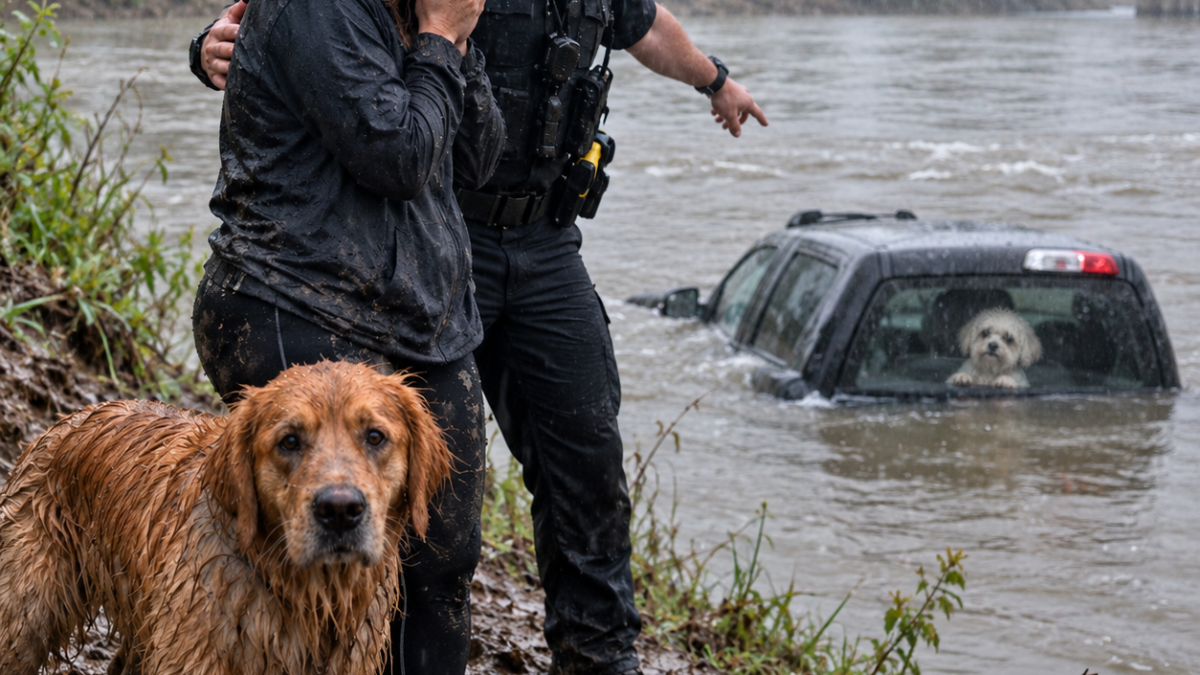
PART 2
I tightened both hands around the rescue line.
The cold went through me even though I was standing on dry ground.
“Jake!”
Nothing.
The woman beside me made a sound that wasn’t quite a cry and wasn’t quite a prayer.
“Teddy…”
I kept my eyes on the water.
Thirty seconds.
I knew Jake could hold his breath longer than that.
I also knew cold water could turn thirty seconds into something entirely different.
The river had risen after several nights of rain.
Debris was moving beneath the surface.
Branches.
Mud.
Wire.
Anything swept downstream.
A submerged vehicle created its own danger.
Broken windows.
Jagged metal.
Seat belts.
Current flowing through the cab.
One mistake could trap him.
The line moved again.
I felt a sharp pull.
Then slack.
My heart slammed against my ribs.
I started pulling.
“Jake!”
The woman grabbed my arm.
“What’s happening?”
“I don’t know.”
“Bring him back!”
“I’m trying.”
Then the river exploded.
Jake surfaced.
He sucked in air so violently I heard it from shore.
But his hands were empty.
The woman sagged.
“Oh God.”
Jake wiped water from his eyes.
“Rear door’s locked.”
I shouted, “Come back!”
He shook his head.
“Window?”
“Can’t see!”
“Jake, rescue is almost here.”
The woman stepped forward.
“No, please—”
I held up one hand.
Jake looked toward the shore.
For a second, our eyes met.
There are moments between partners when an entire argument takes place without words.
I was telling him to come back.
He was telling me he wasn’t leaving without trying again.
He filled his lungs.
Then disappeared.
“Damn it.”
The woman began crying harder.
I looked toward the road.
Still no fire trucks.
No divers.
Only us.
And somewhere beneath that water, Teddy.
Jake later told me that on his first dive he found the truck by touch.
The current had rotated it slightly.
The nose was buried deeper than the rear.
He ran his hands across the roof until he found the back door.
He pulled the handle.
Nothing.
He moved along the window.
The glass was intact.
He couldn’t see inside.
He couldn’t see his own hands.
He surfaced because his lungs were burning.
On the second dive, he went lower.
His fingers followed the window frame until he found the bottom edge.
Then he felt something strange.
A vibration.
At first he thought it was current moving through the vehicle.
Then he felt it again.
A faint tapping from inside.
That changed everything.
Teddy was still alive.
Jake surfaced again after perhaps twenty seconds.
He gasped.
“He’s alive!”
The woman screamed.
“You found him?”
“I felt him!”
“You saw him?”
“No.”
She started toward the water.
I stopped her again.
Jake shouted, “There’s an air pocket!”
At least that was what he believed.
The truck’s rear section was slightly higher than the front.
If the cabin had trapped enough air, Teddy might have found a pocket near the ceiling.
But it was shrinking every second.
Jake swam toward shore.
I pulled the line gently to assist him.
When he reached shallow water, he stumbled.
I caught him.
His lips were turning blue.
“You’re done.”
“No.”
“You’re freezing.”
“I need something to break the window.”
I ran toward the patrol SUV.
We carried a spring-loaded glass breaker.
I grabbed it.
By then I could hear sirens in the distance.
I held the tool out.
“We wait thirty seconds.”
Jake took it.
“We don’t have thirty seconds.”
The woman stood behind him.
Her face had changed.
She was still terrified.
But now hope had entered the fear.
Maybe hope is cruel that way.
Before you know someone is alive, your mind begins protecting itself.
The moment you discover they might still be saved, every second becomes unbearable.
Jake started toward the water again.
I grabbed his shoulder.
“Listen to me.”
He turned.
“If you get tangled, I pull you out. I don’t care whether you found him.”
He nodded.
“I mean it.”
“I know.”
“Jake.”
“I know.”
Then he went back in.
This time I fed the rope carefully.
He swam to where the truck rested.
He disappeared.
I watched the line.
Ten seconds.
Fifteen.
Then I heard something beneath the surface.
A muffled impact.
Then another.
The glass breaker.
The woman heard it too.
“He’s there.”
“Yes.”
Another impact.
Then the rope moved sharply.
Twenty-five seconds.
Thirty.
I began pulling just enough to maintain tension.
Suddenly bubbles erupted.
Then Jake surfaced.
He coughed.
“Window broke!”
“Where’s the dog?”
“I couldn’t reach him.”
The woman’s hope collapsed again.
Jake dragged air into his lungs.
“The seats are in the way.”
I could finally see the first fire engine coming around the bend.
“Divers are here.”
Jake looked back at the water.
“He’ll drown before they suit up.”
He was right.
I hated that he was right.
The fire engine stopped.
Men jumped out.
A captain ran toward us.
“What have we got?”
I told him quickly.
“Vehicle submerged. Driver self-rescued. Two dogs inside. One out. Small dog still trapped. My partner has made three dives. Rear window broken.”
The captain looked at Jake.
“You’re done diving.”
Jake pointed.
“He’s alive. I felt movement.”
The captain turned toward his crew.
“Get the throw bags and cold-water gear. Diver coming up.”
Jake stared at him.
“How long?”
“Two minutes.”
Jake looked at the water.
“Too long.”
“Officer, you are hypothermic.”
The captain was right.
Jake’s hands shook violently now.
Water streamed from his uniform.
His breathing was too fast.
But stubbornness can sometimes look almost identical to courage.
“I can get him.”
The captain stepped directly in front of him.
“You become unconscious underwater, my diver has to choose between you and the dog.”
That finally stopped him.
Jake looked away.
The woman came closer.
“You heard him alive?”
Jake nodded.
“He was moving.”
She covered her mouth.
“Please.”
The firefighter diver arrived at the edge wearing partial gear.
Because the water wasn’t deep enough to justify full scuba preparation, they used a tethered surface-supplied approach.
Jake grabbed his arm.
“Rear passenger window. I broke it. Truck nose down. Dog’s somewhere toward the roof.”
The diver nodded.
“Anything obstructing the opening?”
“Seat back. Maybe harness.”
“What color?”
“What?”
“Dog.”
“White.”
The woman spoke.
“He has a red harness.”
The diver looked at her.
“Red harness. Got it.”
Then he entered.
Jake stood beside me wrapped in a thermal blanket someone had thrown around his shoulders.
The woman clutched Charlie against her chest now.
The dog shook almost as badly as Jake.
Nobody spoke.
The tether moved.
Twenty seconds.
Thirty.
Then the firefighter tending the line shouted.
“He’s got something.”
The woman stepped forward.
The diver surfaced.
One arm appeared.
Then his head.
Then something small and white.
For half a second, Teddy looked like a bundle of soaked cloth.
The diver lifted him above the water.
The woman screamed.
“Teddy!”
They rushed him to shore.
I expected barking.
Movement.
Anything.
There was none.
The little dog lay limp.
The woman fell to her knees.
“No. No, no, no.”
A firefighter took Teddy.
“He’s not breathing.”
Everything moved quickly.
They placed him on a blanket.
One firefighter checked the airway.
Another started giving small rescue breaths.
The woman tried to reach him.
I held her back gently.
“Let them work.”
“That’s my baby.”
“I know.”
“Please let me hold him.”
“They need space.”
Jake stood nearby.
His face had gone completely still.
The firefighter compressed Teddy’s tiny chest with two fingers.
One.
Two.
Three.
Rescue breath.
Again.
Nothing.
I looked at Jake.
He looked destroyed.
Maybe it seems strange to some people.
A dog.
Just a dog.
I have heard those words.
I have never liked them.
Emergency work teaches you quickly that love doesn’t care what species is on the other end of it.
A family is whatever makes someone run toward danger instead of away from it.
To that woman, Teddy wasn’t property.
He was part of the shape of her life.
The firefighter continued.
Then Teddy coughed.
It was tiny.
Barely audible.
But we all heard it.
The woman froze.
The firefighter rolled Teddy slightly.
Water spilled from his mouth.
He coughed again.
Then his front paw moved.
“Oh my God,” the woman whispered.
“Teddy?”
The dog coughed once more.
His eyes opened.
The woman collapsed against me.
“He’s alive.”
“Yes.”
“He’s alive.”
Jake turned away.
I knew why.
He didn’t want anyone to see him crying.
I saw anyway.
The firefighters wrapped Teddy in a blanket and administered oxygen with a small mask from their pet-resuscitation kit.
The woman sat beside him.
Charlie pressed close against her leg.
For several minutes, nobody cared about the truck.
That could wait.
Metal could wait.
Paperwork could wait.
What mattered was the tiny chest rising and falling beneath the blanket.
The veterinarian later told us Teddy had been extraordinarily lucky.
The trapped air pocket in the rear of the cab had given him enough time.
Cold water may also have slowed his metabolism.
But luck wasn’t the only reason Teddy survived.
Jake had located the truck.
He had discovered Teddy was still alive.
He had broken the rear window.
That gave the rescue diver direct access once he entered.
Without that broken window, Teddy might not have come out in time.
An ambulance crew examined Jake.
His temperature was low.
He refused transport.
Naturally.
The paramedic looked at me.
“Your partner always this difficult?”
“Yes.”
Jake glared at me.
The paramedic wrapped another blanket around him.
“You’re going to the hospital if your temperature doesn’t improve.”
Jake pointed toward Teddy.
“What about him?”
The woman looked up.
“We’re going to the emergency vet.”
Jake nodded.
“Good.”
She stood.
Then she walked toward him.
Her face was streaked with mud and tears.
For a moment, neither spoke.
Then she hugged him.
Not politely.
Not briefly.
She wrapped both arms around him and held on.
Jake looked startled.
Then he put one arm around her.
“Thank you,” she whispered.
“You don’t have to—”
“Yes.”
Her voice broke.
“I do.”
She pulled back.
“You went down there when you didn’t even know if you could find him.”
Jake glanced toward the river.
“I knew he was somewhere.”
“You could’ve died.”
He gave a small shrug.
That annoyed me.
“Don’t shrug,” I said.
The woman almost laughed through her tears.
Jake looked at me.
“What?”
“You scared ten years off my life.”
“You weren’t that young anyway.”
That was Jake.
Five minutes after nearly freezing underwater, he was making jokes.
I wanted to punch him.
Instead, I hugged him.
That surprised both of us.
“Don’t ever do that again.”
He laughed.
“You’d have done the same thing.”
I didn’t answer.
Because he was probably right.
The tow company recovered the pickup later that afternoon.
The accident itself had been simple.
The woman’s name was Karen Whitmore.
She had been traveling to visit her sister with Charlie and Teddy.
A deer ran across the road on the curve.
Karen swerved.
Her tires hit wet gravel.
The pickup slid through the shoulder and down the embankment.
She remembered the front end striking the water.
Then everything happened at once.
The airbags deployed.
Charlie began barking.
Teddy disappeared behind the rear seat.
Karen released her own seat belt.
Water began entering.
She opened the driver-side window before the electrical system failed.
She pulled Charlie through.
Then she reached back for Teddy.
She could hear him crying.
But his harness had tangled around something behind the seat.
The water reached her chest.
Then her neck.
Karen kept trying.
That detail haunted me.
She stayed until she could barely breathe.
Finally the pressure and current pulled her toward the open window.
She escaped.
The truck sank seconds later.
She told us later that climbing out without Teddy felt like abandoning a child.
“I know people will think that sounds ridiculous,” she said.
“No,” I told her. “They won’t.”
Some probably would.
But those people weren’t standing beside the river hearing her scream his name.
Two days after the rescue, Jake and I were called into our lieutenant’s office.
Jake looked at me.
“This can’t be good.”
“Probably paperwork.”
“There’s always paperwork.”
Our lieutenant, Captain Harris, sat behind his desk.
He didn’t ask us to sit.
That was never encouraging.
He looked at Jake.
“You entered moving water without proper cold-water equipment.”
“Yes, sir.”
“You made repeated dives to a submerged vehicle.”
“Yes, sir.”
“You understand department policy.”
“Yes, sir.”
Harris looked at me.
“You allowed this.”
I resisted the urge to point out that Jake was a grown man.
“Yes, sir.”
Captain Harris leaned back.
“Do you know why that policy exists?”
Jake answered.
“Officer safety.”
“Because dead heroes don’t help anyone.”
Jake remained silent.
Harris continued.
“Your decision had a successful outcome. That does not automatically make the decision safe.”
That was true.
Something people rarely understand about rescues is that courage and recklessness sometimes stand dangerously close together.
If Jake had become trapped, the story would have been completely different.
Two victims instead of one dog.
A diver forced to rescue Jake.
A family receiving a phone call.
Success can hide risk.
Captain Harris wasn’t wrong to remind us.
Then he sighed.
“The fire captain says your broken window saved approximately one to two minutes.”
Jake’s face changed slightly.
Harris continued.
“The veterinarian believes one to two more minutes might have been fatal for the dog.”
Nobody spoke.
Captain Harris opened a folder.
“Karen Whitmore sent this.”
He handed Jake a letter.
Jake read silently.
Then gave it to me.
Karen had written three pages.
She explained what Teddy meant to her.
Her husband, Michael, had died three years earlier.
Teddy had been his dog.
That changed something.
Suddenly I understood why she had fought so hard at the river.
Michael had brought Teddy home as a puppy.
After his death, Teddy became Karen’s connection to the life they had shared.
Every morning he slept on Michael’s side of the bed.
Every evening he waited near the door around the time Michael used to come home from work.
Karen wrote:
When that truck went under, I wasn’t only watching Teddy disappear. It felt like I was losing the last living piece of the life my husband and I built together.
Jake stopped reading for a moment.
Captain Harris looked away toward his window.
The letter continued.
I know Officer Mercer took a risk. I know people may tell him he should not have done it. But when everyone else had not arrived yet, he was there. He heard me. He believed that a ten-pound dog mattered because he understood that the dog mattered to me.
Jake folded the letter.
His voice was rough.
“Can I keep this?”
Harris nodded.
Then he pointed at Jake.
“You are still doing remedial water-rescue training.”
Jake almost smiled.
“Yes, sir.”
“And next time, you wait for appropriate equipment whenever circumstances allow.”
“Yes, sir.”
Captain Harris looked at both of us.
“Dismissed.”
We walked into the hallway.
Jake stared at the letter.
“You okay?”
“Yeah.”
“You’re lying.”
“Maybe.”
He folded it carefully and placed it inside his notebook.
A week later, he asked me something I had been expecting.
“You want to go see the dog?”
I smiled.
“I thought you’d never ask.”
Karen lived about twenty miles away.
When we pulled into her driveway, Charlie began barking from inside before we reached the porch.
Karen opened the door.
She looked different.
At the river, I had only seen terror.
Now she smiled.
And then Teddy appeared.
He came around the corner like a white cotton ball with legs.
For one second he stopped.
He looked at Jake.
Then he ran.
Straight toward him.
Jake dropped to one knee.
Teddy jumped against his chest.
I don’t know whether Teddy actually remembered the man who had reached into that dark truck.
Maybe he recognized the scent.
Maybe the voice.
Maybe he was simply a friendly dog.
It didn’t matter.
Jake buried his face in Teddy’s fur.
“Hey, little man.”
Teddy licked his chin.
Karen covered her mouth.
Charlie joined the celebration.
For thirty seconds Jake disappeared beneath two excited dogs.
I laughed.
“This is what you almost drowned for.”
Jake looked up.
“Worth it.”
Karen made coffee.
We sat in her living room.
On the mantel was a photograph of a man holding Teddy as a puppy.
“That’s Michael,” Karen said.
Jake looked at it.
“Your husband?”
She nodded.
“He chose Teddy.”
The photograph showed Michael sitting in a recliner with the tiny white puppy asleep on his chest.
“He said he wanted a big dog,” Karen said.
I smiled.
“What happened?”
“He saw Teddy.”
Jake laughed.
“That’ll do it.”
Karen looked toward the dog.
“Michael had cancer.”
The room became quiet.
“Toward the end, Teddy barely left him.”
She picked up the photograph.
“When Michael couldn’t sleep, Teddy stayed awake. When Michael was too weak to get out of bed, Teddy stayed beside him.”
Her voice trembled.
“The night Michael died, Teddy slept with his head over Michael’s heart.”
Jake lowered his coffee.
Karen wiped her eyes.
“That’s why I went back into the truck.”
“You almost drowned too,” I said gently.
“I know.”
She looked ashamed.
“I know it sounds foolish.”
Jake answered before I could.
“No.”
She looked at him.
“It doesn’t.”
That seemed to release something in her.
She cried.
Not like she had at the river.
This was quieter.
Older grief.
Jake sat beside her.
“You didn’t leave him,” he said.
“I did.”
“You got out because you had to.”
“I heard him barking.”
“You got help.”
“I couldn’t save him.”
Jake looked down at Teddy.
“You kept him alive long enough for us to find him.”
Karen shook her head.
“You did that.”
“We all did.”
She stared at him.
Then she reached for his hand.
“Michael would have thanked you.”
Jake didn’t know what to say.
Neither did I.
So we sat there.
Charlie asleep under the table.
Teddy curled beside Jake’s boot.
Rain beginning softly outside.
Before we left, Karen asked Jake to wait.
She disappeared into another room.
When she returned, she carried a small wooden box.
“I want you to have this.”
Jake frowned.
“I can’t take anything expensive.”
“It isn’t expensive.”
She opened the box.
Inside was an old challenge coin.
Michael had been a firefighter.
The coin bore the emblem of his station.
“He carried it for nineteen years.”
Jake immediately shook his head.
“No.”
“Please.”
“That belongs with you.”
Karen smiled.
“I have his badge. His helmet. His wedding ring. His photographs.”
She closed Jake’s fingers around the coin.
“I want this one to go to someone who went into the water when my family needed him.”
Jake looked at the coin.
He couldn’t speak.
Karen whispered:
“Michael would have understood.”
Jake eventually accepted it.
He carried that coin for years.
Not in a display case.
In his pocket.
Every shift.
Months passed.
The rescue became something people around town knew about.
A local newspaper ran a small story.
Someone posted pictures of Teddy wrapped in the emergency blanket.
Jake hated the attention.
He refused television interviews.
When someone called him a hero, he became visibly uncomfortable.
“I broke protocol,” he would say.
“You also saved the dog,” I reminded him.
“The fire department saved the dog.”
“You broke the window.”
“They pulled him out.”
“And you found him.”
He would shrug.
There was that shrug again.
Eventually the attention disappeared.
Another story replaced ours.
Then another.
That’s how public memory works.
But some stories continue privately.
Karen sent photographs.
Teddy wearing a ridiculous Christmas sweater.
Teddy asleep beside Charlie.
Teddy sitting near Michael’s photograph.
One picture showed Teddy in a tiny life jacket standing several feet from a swimming pool.
Jake stared at it.
“Why would she put him near water?”
I read the message underneath.
Working slowly with the vet and trainer. He was terrified of water after the accident. Today he came near the pool voluntarily for the first time.
Jake smiled.
“Good boy.”
A year after the accident, Karen invited us to her house again.
When we arrived, there were several cars outside.
“What’s this?” I asked.
“No idea.”
She had organized a small dinner.
The firefighters who responded were there.
The diver who pulled Teddy out.
Two paramedics.
Captain Harris.
Even the tow-truck driver.
Teddy moved between everyone like he owned the house.
At one point, Karen tapped a glass.
“I want to say something.”
Jake immediately looked uncomfortable.
She laughed.
“Relax. I won’t embarrass you too badly.”
Everyone became quiet.
Karen stood beside Michael’s photograph.
“A year ago today, I thought I had lost everything again.”
Teddy sat at her feet.
“I had already lost my husband. And when my truck went underwater, Teddy was trapped inside.”
Her hand rested on his head.
“People sometimes say, ‘It was only a dog.’”
She looked around the room.
“But nobody standing here treated him like he was only anything.”
The firefighter who resuscitated Teddy lowered his head.
Karen continued.
“You treated the life I loved as worth saving.”
She looked at Jake.
“You went into the water.”
Then at the diver.
“You brought him out.”
Then at the firefighters.
“You made his heart keep beating.”
Her eyes filled.
“You didn’t just return Teddy to me.”
She paused.
“You returned a part of Michael.”
There wasn’t a dry eye in that room.
Including Jake.
Especially Jake.
Later that night, Jake and I stood outside.
The river was several miles away, but I found myself thinking about it.
Jake rolled Michael’s challenge coin between his fingers.
“Do you ever think about how close it was?”
“Yes.”
“All the time?”
“Sometimes.”
He stared into the darkness.
“I felt Teddy’s harness underwater.”
I turned toward him.
He had never told me that part.
“What happened?”
“Second dive.”
His voice became quieter.
“I reached through the broken glass. My hand hit the back of the seat.”
He swallowed.
“Then I touched fur.”
I said nothing.
“I found the harness strap.”
“You actually had him?”
“For maybe two seconds.”
Jake looked at his hand.
“The strap was caught. I pulled. It wouldn’t move.”
His jaw tightened.
“I ran out of air.”
He had never told me.
“I had to let him go.”
Now I understood why he had been desperate to dive again.
He hadn’t simply known Teddy was alive.
He had touched him.
He had left him underwater because staying would have killed them both.
“I heard scratching against the metal when I let go.”
Jake’s eyes were wet.
“I heard him trying to follow me.”
I put my hand on his shoulder.
“You went back.”
“Not fast enough.”
“He survived.”
“Because the diver got him.”
“Because you opened the way.”
Jake looked at me.
“That doesn’t make leaving him easier.”
“No.”
It probably never would.
Rescue stories often get simplified after the fact.
Someone went in.
Someone came out.
Everyone hugged.
Happy ending.
But the people involved remember the seconds nobody photographs.
The doubt.
The moment you choose yourself because staying another second means you die too.
The fear that the person—or animal—you leave for thirty seconds may not be alive when you return.
Jake carried that part privately.
Until that night.
I think telling me helped.
Not because I had answers.
Sometimes witnesses are more useful than answers.
Years went by.
We remained partners.
We handled burglaries.
Domestic calls.
Missing children.
Car wrecks.
Mental health crises.
Fires.
Deaths.
Births.
Everything people call 911 for because they don’t know what else to do.
There were days when we made a difference.
Days when we arrived too late.
Days when people thanked us.
Days when they hated us.
The river rescue became one memory among hundreds.
But it never became ordinary.
Then, seven years after Teddy’s rescue, I received a phone call.
It was Karen.
I knew immediately something was wrong.
Her voice sounded fragile.
“Is Jake with you?”
“No. He’s off today.”
There was a pause.
“Teddy is dying.”
I closed my eyes.
“How old is he now?”
“Fourteen.”
I hadn’t realized so much time had passed.
“He has heart failure.”
“I’m sorry.”
“The vet is coming tomorrow.”
Karen began crying.
“I thought Jake might want to say goodbye.”
I called him.
He didn’t speak for several seconds.
Then he said:
“I’m going.”
We drove to Karen’s house together.
Teddy lay on the same couch where we had first seen him after the rescue.
He was almost unrecognizable from the little white dog Jake had pulled from that submerged truck.
His fur was thinner.
His eyes cloudy.
His breathing shallow.
Charlie had died two years earlier.
Karen sat beside Teddy.
When Jake entered, she whispered:
“Look who came.”
Teddy’s eyes opened.
His tail moved once.
Jake stopped walking.
That tiny movement destroyed him.
He went to his knees.
“Hey, little man.”
Teddy lifted his head slightly.
Jake placed a hand beneath his chin.
Teddy licked one finger.
Once.
Jake laughed through tears.
“You remember me?”
Karen whispered, “Of course he does.”
Maybe he did.
Maybe he didn’t.
Again, it didn’t matter.
Jake stayed on the floor beside him for nearly an hour.
At one point, he reached into his pocket.
Michael’s challenge coin.
Still there after seven years.
He placed it on the blanket beside Teddy.
Karen shook her head.
“No.”
Jake looked at her.
“This belongs here.”
“Michael gave that to you.”
“You gave it to me.”
“And I meant it.”
Jake looked down at Teddy.
“It got me through some bad days.”
Karen waited.
“But I don’t need to keep carrying it to remember.”
He closed Karen’s hand around the coin.
“You should have it back.”
Karen cried.
Jake did too.
Then she opened her hand.
She looked at the coin.
And placed it beneath Teddy’s front paw.
“For both of them,” she whispered.
We left after sunset.
The next morning, Teddy died peacefully at home.
Karen held him.
Michael’s firefighter coin remained beside him.
She later buried Teddy’s ashes near a maple tree in her backyard.
She placed a small stone there.
Not dramatic.
No grand inscription.
Just:
TEDDY
BELOVED ALWAYS
Underneath:
FOUND IN THE DARK. LOVED IN THE LIGHT.
Years later, Jake retired.
At his retirement dinner, Captain Harris—long retired himself—stood to speak.
He told stories.
Most were embarrassing.
Everyone laughed.
Then Harris became serious.
He spoke about judgment.
About courage.
About how good officers learn the difference between protecting life and proving bravery.
Then he looked at Jake.
“I once disciplined this man for jumping into a river after a dog.”
The room laughed.
Jake covered his face.
Harris continued.
“And I was right.”
More laughter.
“So was he.”
The room became quiet.
Harris explained what he meant.
Rules mattered.
Training mattered.
Going home mattered.
But there are rare moments when a human being is forced to act with incomplete information and almost no time.
“You hope,” Harris said, “that when that moment arrives, the person standing beside you understands both the risk and the reason.”
He raised his glass.
“To Jake Mercer.”
Everyone stood.
Jake hated every second of it.
I loved it.
After dinner, he and I walked outside.
Gray hair now.
Slower steps.
Different men from the two officers who had been talking about terrible station coffee beside the river.
Jake looked at me.
“You know what’s funny?”
“What?”
“I barely remember jumping in.”
“You’ve told that story a hundred times.”
“I remember the water.”
He looked toward the parking lot.
“I remember how cold it was.”
He paused.
“I remember touching Teddy.”
His voice softened.
“But the jump itself?”
He shook his head.
“Nothing.”
“That’s adrenaline.”
“Probably.”
He smiled.
“You remember?”
“Every second.”
“Of course you do.”
“You scared me half to death.”
“I knew you’d bring that up.”
“I’m going to bring it up at your funeral.”
“Hopefully not soon.”
“Depends whether you find another river.”
He laughed.
Then he became serious.
“I’m glad we stopped.”
That sentence surprised me.
Not because I disagreed.
Because it sounded so simple.
We stopped.
That was where everything began.
A woman screamed.
We could have been thirty seconds farther down the road.
The windows could have been closed.
The radio louder.
Another car could have blocked our view.
Any tiny change could have rewritten everything.
But we heard her.
We stopped.
Jake entered the water.
Firefighters arrived.
A diver reached Teddy.
Hands compressed a tiny chest until it began moving again.
Life is sometimes built from a chain of people doing the next necessary thing.
Years after Jake retired, I was driving that same road alone.
By then I had retired too.
I was going nowhere important.
The river appeared through the trees.
I slowed.
The embankment had changed.
Guardrails had been installed after several accidents.
The county had improved drainage.
New warning markers stood along the curve.
I pulled over.
For a while, I sat inside my car.
Then I walked toward the bank.
The water was calm.
Sunlight moved across the surface.
Birds called from somewhere upstream.
If you didn’t know the story, there was nothing special about the place.
I stood where Karen had once screamed Teddy’s name.
I remembered her hands gripping my arm.
I remembered Charlie trembling in the mud.
I remembered Jake dropping his duty belt.
I remembered the rope sliding through my hands.
I remembered twenty seconds feeling like twenty minutes.
I remembered Teddy lying still on the blanket.
Then coughing.
One tiny cough.
The sound that changed the ending.
I used to think the story was about courage.
Maybe partly.
I used to think it was about Jake.
It was partly that too.
But growing older changed the way I understood it.
The story was really about what people decide matters.
To the river, Teddy weighed almost nothing.
Ten pounds of wet fur.
To Karen, he carried years of marriage.
Memory.
Grief.
Routine.
Home.
To Jake, he was a life still within reach.
That was enough.
We don’t always get to choose what needs saving.
We don’t always know why something matters so much to someone else.
Maybe we don’t need to know.
Maybe hearing them say, “Please, this matters to me,” should sometimes be enough.
I stood at the river until the sun began dropping.
Before leaving, I took out my phone.
I called Jake.
He answered after three rings.
“What?”
Retirement had not improved his manners.
“Guess where I am.”
“I don’t play guessing games.”
“The river.”
Silence.
Then:
“That river?”
“Yep.”
“How does it look?”
“Quiet.”
“Good.”
I smiled.
“I was thinking about Teddy.”
“So was I.”
That surprised me.
“Why?”
“Karen sent me a picture this morning.”
“A picture of what?”
“Her new dog.”
I laughed.
“You’re kidding.”
“Nope.”
“Another Bichon?”
“Senior mutt.”
Of course.
“What’s his name?”
“Michael.”
I stopped smiling.
“She named him after her husband?”
“Yeah.”
Jake’s voice softened.
“She adopted him yesterday.”
I looked at the river.
“How old?”
“Eleven.”
“Why did she pick him?”
Jake laughed quietly.
“Shelter said everybody kept walking past him.”
That felt right.
Pain changes some people by closing them.
Sometimes love does the opposite.
Karen had lost Michael.
Nearly lost Teddy.
Eventually lost Teddy for real.
Yet she had gone back to a shelter and chosen an old dog everyone else overlooked.
Not because replacing Teddy was possible.
It wasn’t.
Love doesn’t replace love.
It expands around the absence.
I asked Jake to send me the picture.
A few seconds later, my phone buzzed.
There was Karen sitting on her couch.
Older now.
Gray hair.
Same eyes.
Beside her was a scruffy brown dog with a white muzzle.
Michael.
She had one arm around him.
On the shelf behind them stood two photographs.
Her husband.
And Teddy.
I stared at that image for a long time.
Then Jake said through the phone:
“You still there?”
“Yeah.”
“What are you thinking?”
I looked across the river.
“That we got the ending wrong.”
“What do you mean?”
“For years I thought the happy ending was Teddy coming out of the water.”
Jake remained quiet.
“That was the rescue,” I said.
“It wasn’t the ending.”
“What was?”
I looked at Karen’s photograph again.
“This.”
A woman who had endured loss and still chose love.
A dog who survived dark water and lived long enough to grow old.
A man who carried a firefighter’s coin because one family trusted him with their grief.
A second old dog finally sleeping in a home because the first dog had taught his owner that another goodbye was still worth the years before it.
That was the ending.
Not escaping loss.
None of us escapes it.
The happy ending was that fear had not made Karen love less.
Losing Teddy had not erased what saving him gave her.
Instead, everything continued forward.
I said goodbye to Jake and slipped my phone into my pocket.
Then I turned toward my car.
Before I reached it, I looked back once.
The river reflected the evening sky.
Years earlier, I had watched Jake vanish beneath that same surface.
For several terrible seconds, I had believed I might lose my partner.
Karen believed she had lost Teddy.
Jake believed he might reach him too late.
Yet from that darkness came something none of us expected.
Not a miracle in the way people sometimes use that word.
A miracle sounds effortless.
Nothing about that morning was effortless.
It was cold water.
Panic.
Broken glass.
Training.
Risk.
Hands searching blindly.
A firefighter refusing to stop compressing a tiny chest.
A woman praying beside a muddy riverbank.
A dog coughing when everyone desperately needed him to cough.
That was what happened.
Ordinary people kept doing the next thing.
And eventually a little white dog opened his eyes.
Sometimes, even now, people ask me about the bravest thing I ever saw during my career.
They expect a dramatic answer.
Gunfire.
A burning house.
A violent arrest.
I’ve seen courage in many forms.
But the image that always returns is much quieter.
A man standing at the edge of dark water.
A woman behind him crying for a ten-pound dog.
My hand holding one end of a rope.
Jake looking at me once.
No speech.
No promise.
Then stepping forward.
Years later, I finally asked him what had gone through his mind right before he entered the river.
His answer annoyed me because it was so simple.
“She said her dog was still inside.”
“That’s it?”
“What else was there?”
“Were you scared?”
“Of course.”
“You didn’t look scared.”
He smiled.
“That doesn’t mean anything.”
Then he said something I never forgot.
“Being brave isn’t deciding something isn’t dangerous.”
He looked at me.
“It’s deciding something matters while knowing it is.”
Maybe that’s why I still tell the story.
Not because everyone should jump into freezing rivers.
They shouldn’t.
Not because rules don’t matter.
They do.
And not because every dangerous decision becomes noble if the ending is good.
It doesn’t.
I tell it because, on one cold morning beside an ordinary river, I watched fear, training, love and instinct collide.
And somehow, against the current and against the clock, life won.
Teddy got years he almost didn’t have.
Karen got more mornings with the last dog her husband had loved.
Jake carried the memory of a life he helped save.
And I carried the image of my partner disappearing beneath black water because somewhere inside a submerged pickup, a little dog was still fighting to breathe.
People may argue about whether an animal can understand what happened.
Maybe Teddy never understood the river.
Maybe he never understood the firefighter breathing air into his lungs.
Maybe he didn’t know why Jake visited him later.
Dogs don’t need the story.
We do.
We need reminders that what looks small from the outside can be someone else’s entire world.
We need reminders that compassion is sometimes inconvenient.
Sometimes frightening.
Sometimes expensive.
Sometimes wet, freezing and covered in mud.
But it matters.
The last photograph Karen sent me showed her new dog Michael sleeping on the couch.
His chin rested on one of Karen’s old blankets.
Behind him, barely visible on the bookshelf, was Teddy’s picture.
I zoomed in.
Teddy looked healthy.
White coat.
Bright eyes.
That ridiculous little face.
I smiled.
Then I noticed something beside the frame.
Michael’s challenge coin.
The same coin Karen had given Jake.
The same coin Jake returned before Teddy died.
It now rested between the photographs of Michael and Teddy.
One man.
One little dog.
Both gone.
Both still part of the house.
And below them slept another old dog who had finally been chosen.
That was when the whole story finally made sense to me.
We spend so much time thinking rescue means pulling someone from danger.
Sometimes it does.
Sometimes rescue is a man diving into a dark river.
But sometimes rescue comes years later.
It is opening your door again after grief convinced you never to risk loving anything that might leave.
It is giving another frightened animal a bed.
It is saying:
I know this will hurt someday.
Come home anyway.
Karen did that.
And somewhere, I like to think Teddy would have understood.
Because on the worst morning of his life, strangers believed his little life was worth fighting for.
Years later, Karen passed that belief to another dog.
The river rescue ended long ago.
The pickup rusted in a salvage yard.
Our uniforms went into closets.
Jake and I grew older.
Teddy grew old too.
But the thing that began on that riverbank never really ended.
Someone cared.
Someone acted.
Someone survived.
And because he survived, someone eventually learned to love again.
Whenever I pass that river now, I still slow down.
I look at the water.
And in my mind, I hear Karen screaming.
I see Jake remove his belt.
I feel the rescue line tightening between my hands.
Then I remember the moment Teddy coughed.
That tiny sound.
That impossible, beautiful sound.
And I remember exactly what I thought.
Not “We saved a dog.”
Something simpler.
Something bigger.
He’s still here.
For fourteen more years, he was.
And for the woman kneeling beside him in the mud that morning, those fourteen years were worth every freezing second.
For fourteen more years, Teddy was.
And for the woman kneeling beside him in the mud that morning, those fourteen years were worth every freezing second.
But I learned later that the rescue changed more than Karen’s life.
It changed Jake’s too.
He never talked about that part much.
Jake was the kind of man who could walk through a nightmare and describe it afterward like he had gone to the grocery store.
“How was your shift?”
“Fine.”
“What happened?”
“Nothing much.”
Then you would discover that “nothing much” meant he had crawled into an overturned car, stopped a man from jumping off a bridge, or spent two hours searching a cornfield for a missing child.
That was Jake.
He believed emotions were something you carried quietly so they didn’t become someone else’s burden.
For a long time, I thought that made him strong.
Eventually, I realized it sometimes made him lonely.
About six months after Teddy’s rescue, I began noticing something.
Whenever we drove past deep water, Jake became quiet.
Not dramatically.
If you didn’t know him, you would never notice.
But I knew the difference between Jake thinking and Jake remembering.
His jaw tightened.
His eyes stayed on the road.
Sometimes his right hand opened and closed against his thigh.
One evening, after a late call, we were driving beside a reservoir.
I glanced at him.
“You okay?”
“Yeah.”
“You’re doing the hand thing.”
“What hand thing?”
“That.”
He looked down.
His fingers were clenched.
He immediately relaxed them.
“I’m tired.”
“That’s not it.”
He stared through the windshield.
I waited.
Jake hated being pushed.
If you pushed, he built walls.
If you waited, sometimes he opened a door himself.
We drove almost a mile before he finally spoke.
“I still hear the scratching.”
My hands tightened around the steering wheel.
“Teddy?”
Jake nodded.
“Underwater.”
He looked out the passenger window.
“When I reached through that broken window, I could feel the harness. He was right there.”
“I know.”
“I pulled.”
His voice dropped.
“It wouldn’t come loose.”
I said nothing.
“I remember thinking, just one more second.”
He rubbed his thumb against his palm.
“Then my chest started hurting. I knew I had to surface.”
“You had no choice.”
“I had a choice.”
“No. You didn’t.”
Jake turned toward me.
“If I stayed—”
“You would have blacked out.”
“Maybe.”
“Not maybe.”
He looked away.
“And then the diver would have been rescuing you instead of Teddy.”
“I know.”
“Do you?”
He was silent.
I slowed the SUV slightly.
“There’s a difference between leaving someone and coming back with help.”
Jake swallowed.
“It didn’t feel different underwater.”
That sentence stayed with me.
Because emergency work teaches you that guilt doesn’t always care about logic.
You can do everything correctly and still wonder what else you should have done.
You can save someone and remember only the part where they almost died.
You can bring a little dog out of a river and still dream about the seconds when your hand slipped away from his harness.
A few weeks later, Jake surprised me.
“I signed up for advanced water rescue.”
I looked at him.
“You?”
“What?”
“You hate training.”
“I hate bad training.”
“That means yes.”
He ignored me.
The course was run by a regional search-and-rescue team.
Cold-water survival.
Vehicle submersion.
Underwater navigation.
Victim extraction.
Current dynamics.
The things Jake had been forced to improvise that morning.
I understood immediately.
This wasn’t about earning a certificate.
It was about never again feeling helpless inside dark water.
He completed the course.
Then another.
Eventually he became one of the department’s most experienced officers in vehicle-water emergencies.
Captain Harris noticed too.
One afternoon, Harris called him into the office.
I expected trouble.
Instead, he handed Jake paperwork.
“What’s this?”
“Department wants a water-rescue liaison.”
Jake frowned.
“I’m patrol.”
“You can remain patrol.”
“I don’t want a desk.”
“No one is giving you a desk.”
Harris leaned back.
“I want someone who can train new officers not to do exactly what you did.”
I laughed.
Jake glared at me.
Captain Harris almost smiled.
“You can tell them why you went in, why it worked, and why it could have killed you.”
Jake looked at the paperwork again.
“So the lesson is ‘don’t be me’?”
“The lesson is judgment.”
Harris pointed toward him.
“And occasionally, yes. Don’t be you.”
Jake accepted the assignment.
Over the years, hundreds of new officers heard Teddy’s story.
Jake never told it heroically.
He would stand in front of a classroom holding a rescue line.
“The water looked manageable,” he would say.
“It wasn’t.”
Then he would show them photographs of the river level that morning.
Explain how current moves around submerged vehicles.
How door pressure changes.
How windows become hazards.
How clothing becomes heavy.
How panic burns oxygen.
And then he would say the thing he wished someone had said to him earlier:
“Wanting to save something does not make you immune to physics.”
But he never ended there.
Because that wouldn’t have been honest either.
He would hold up the small spring-loaded glass breaker we carried in our patrol units.
“This tool bought time.”
Then he showed officers where the department now stored improved flotation devices and tether systems.
Those changes happened partly because of Teddy.
After the incident review, Captain Harris pushed for better equipment.
Water-rescue throw bags were moved into every patrol vehicle.
Window-breaking tools became mandatory.
Officers working near rivers received basic cold-water survival training.
The county installed guardrail along the curve where Karen crashed.
Reflective warning signs went up.
Drainage was improved.
Nothing could make that road perfectly safe.
But the accident forced people to look at risks they had accepted for years.
Sometimes that is another form of rescue.
Preventing the next story.
A few years later, those changes mattered.
It happened during spring flooding.
Jake and I were dispatched to a sedan stranded near a low-water crossing.
A father and teenage son were standing on the roof.
Water rushed around the vehicle.
Years earlier, Jake might have jumped straight in.
This time, he stopped.
He studied the current.
Then he said:
“No entry.”
We used the rescue line.
Fire crews arrived.
A tethered rescuer went out.
Both people came safely to shore.
Afterward, while the father hugged his son, Jake stood beside me.
“You proud of me?”
I smiled.
“Extremely.”
“I didn’t do anything.”
“That’s why.”
He laughed.
But I meant it.
Courage is not always entering danger.
Sometimes experience teaches you when not to.
That was one of the things Teddy’s rescue gave Jake.
Not fear.
Respect.
Years later, Karen learned about Jake’s training program.
She came to one of the sessions.
Teddy was too old to accompany her by then, so he stayed home.
Karen sat quietly in the back of the classroom.
Jake didn’t know she was coming.
I did.
I arranged it.
He was halfway through explaining the submerged-truck incident when he noticed her.
He stopped.
The young officers turned to see what he was looking at.
Karen smiled.
Jake shook his head at me.
“You did this.”
“Absolutely.”
After class, Karen walked toward him.
“I wanted to see what you did with it.”
“With what?”
“That morning.”
Jake looked confused.
She pointed toward the classroom.
“This.”
He glanced around at the rescue equipment.
“I just teach people.”
“No.”
Karen shook her head.
“You turned one frightening morning into something that might save somebody else.”
Jake seemed uncomfortable.
He always did when people gave him too much credit.
Karen continued.
“I thought Teddy was the only life that came out of that river.”
She smiled.
“Maybe I was wrong.”
That was a beautiful way to put it.
Because rescue can echo.
The person you save goes on living.
The rescuer changes.
Procedures change.
Equipment changes.
Training changes.
People who were not even there inherit the lesson.
Years after Teddy’s accident, a young officer named Miguel approached Jake after training.
Miguel had been unusually quiet during the submerged-vehicle portion.
He waited until everyone else left.
Then he said, “My brother drowned when I was fourteen.”
Jake stopped packing equipment.
“I’m sorry.”
“He drove into a drainage canal.”
Miguel stared at the floor.
“There were people there, but nobody knew how to get him out.”
Jake said nothing.
Miguel continued.
“That’s why I became a cop.”
Jake nodded slowly.
“I understand.”
Miguel pointed toward the rescue line.
“Would this have saved him?”
That was a dangerous question.
Not physically.
Emotionally.
People who lose someone suddenly spend years rebuilding the scene.
If someone had arrived sooner.
If the window had broken.
If he had worn a seat belt.
If she had made a different turn.
Grief feeds on alternate endings.
Jake did not lie.
“I don’t know.”
Miguel looked disappointed.
Jake continued.
“Maybe. Maybe not. Every situation is different.”
He placed a hand on the rescue bag.
“But knowing how to use this might save someone tomorrow.”
Miguel nodded.
Years later, Miguel did exactly that.
He responded to a flash-flood call where a woman was trapped in a vehicle.
Instead of entering unsafe water, he used a tethered line system until firefighters arrived.
The woman survived.
Miguel later sent Jake a message.
USED THE TEDDY LESSON TODAY.
Jake showed me the text.
Neither of us said anything for a while.
Then Jake smiled.
“Karen was right.”
“About what?”
“Maybe more than one life came out of that river.”
Karen’s life changed too.
For years after the accident, she avoided the road beside the river.
She took a twenty-minute detour whenever she visited her sister.
She knew it wasn’t rational.
But trauma rarely asks permission from reason.
Even the smell of wet upholstery made her hands shake.
Heavy rain made her anxious.
Teddy reacted too.
Bath time became difficult.
He panicked near swimming pools.
If rainwater gathered near the curb, he pulled away.
Karen worked with a trainer.
Slowly.
Carefully.
No forcing.
First Teddy learned to stand near a dry kiddie pool.
Then near one containing an inch of water.
Then two inches.
Treats.
Praise.
Patience.
Months later, he stood in shallow water without shaking.
Karen cried.
The trainer laughed.
“He’s not swimming the Atlantic. He’s standing in two inches.”
“I know.”
Karen wiped her eyes.
“You don’t understand.”
But the trainer did.
Progress is often invisible to people who haven’t lived with fear.
For Teddy, two inches of water was a mountain.
For Karen, watching him stand there meant the river hadn’t taken everything.
One summer, several years after the rescue, Karen called us.
“You need to come over.”
I laughed.
“That sentence has caused problems before.”
“Just come.”
When we arrived, she led us into the backyard.
A small plastic pool sat on the grass.
Maybe eight inches of water.
Teddy stood beside it wearing a bright red life jacket.
Jake stared.
“No.”
Karen smiled.
“Watch.”
She dropped a treat into the shallow water.
Teddy looked at it.
Then at Karen.
Then at us.
He placed one paw inside.
Stopped.
Second paw.
Then all four.
He walked through the pool.
Picked up the treat.
And walked out.
Karen clapped.
I cheered.
Jake dropped to one knee.
Teddy ran toward him.
“You did it, little man.”
Karen said, “He doesn’t love water.”
“He doesn’t have to.”
Jake scratched Teddy behind the ears.
“He just needed to know it couldn’t own him.”
Karen looked at Jake.
I think both of them understood that sentence was not only about the dog.
A year later, Karen drove the river road again for the first time.
Jake and I followed in our own vehicle.
She asked us to.
Not because she physically needed protection.
Because she needed witnesses.
People who understood why an ordinary road was difficult.
She drove slowly.
When she reached the curve, her brake lights came on.
For one second, I thought she might stop.
Then she continued.
Across the bridge.
Past the embankment.
Past the place where the pickup had vanished.
When we reached the parking lot on the other side, she pulled in.
We parked beside her.
Karen remained behind the wheel.
Her hands were trembling.
Jake walked to her door.
She opened it.
“I did it.”
“You did.”
“I hated every second.”
Jake smiled.
“That still counts.”
Teddy was in the back seat.
He stood with his paws against the window.
Karen opened the rear door.
Teddy jumped down.
He sniffed the grass.
Then, without any idea of the significance, he lifted one leg against a tree.
We all burst out laughing.
“That’s his opinion of the river,” I said.
Karen laughed harder than I had ever heard her.
That moment mattered too.
Trauma had once reduced that road to screaming and dark water.
Now, for one minute, it was just three friends and a dog laughing beside a tree.
The memory didn’t disappear.
Something new simply grew beside it.
That is how healing often works.
It doesn’t erase.
It adds.
More years.
More experiences.
More mornings when nothing terrible happens.
Eventually the worst memory becomes one chapter instead of the whole book.
Karen began volunteering with a local animal rescue organization.
At first, one afternoon a week.
Then more.
She specialized in senior dogs.
“Why old dogs?” I asked.
She looked at Teddy, who was beginning to gray around the muzzle.
“Because people keep asking how much time they have left.”
She shrugged.
“I think they’re asking the wrong question.”
“What should they ask?”
“How much life can we put into whatever time is left?”
That sounded like Karen.
Loss had made her practical about time.
Not cold.
Grateful.
She fostered an elderly beagle named Henry.
Then a twelve-year-old terrier named Lou.
She told herself she would not adopt them.
She cried every time they found homes.
Teddy tolerated them all.
Usually.
He was not a saint.
One foster dog stole his bed, and Teddy stood in the hallway barking indignantly until Karen bought another identical bed.
Then both dogs slept in the same one.
Jake loved those stories.
He visited whenever Karen had a new foster.
One Christmas, I gave him a coffee mug.
WORLD’S MOST EXPENSIVE DOG-SITTER.
He stared at me.
“That’s not funny.”
Karen laughed so hard she spilled coffee.
The river rescue became part of our friendship.
Not the center of it.
That mattered.
Karen was no longer “the woman from the submerged truck.”
Jake was no longer “the officer who jumped into the river.”
Teddy was no longer “the rescued dog.”
They became themselves again.
Karen gardened badly.
Jake complained about coffee.
Teddy hated the vacuum cleaner.
Normal life returned.
And normal life was exactly what we had fought for that morning.
Not a medal.
Not a headline.
Ordinary years.
The older I get, the more I think rescue workers misunderstand success when we’re young.
We want dramatic victories.
We want the person to open their eyes.
We want the dog to cough.
We want cheers.
But the real victory is often everything that happens afterward.
Teddy waking Karen at six in the morning because he wanted breakfast.
Teddy stealing chicken from the kitchen counter.
Karen complaining about veterinary bills.
A Christmas sweater Teddy clearly hated.
A dog bed that needed washing.
White fur on a black coat.
Small annoyances.
Routine.
Life.
That was what Jake had gone into the water for.
Not one moment of survival.
Thousands of ordinary moments that Teddy had not yet lived.
When Teddy reached thirteen, his health began changing.
First came the arthritis.
Then a heart murmur.
Medication.
More veterinary appointments.
Karen carried him upstairs on difficult days.
He no longer raced to the door.
He walked.
Sometimes he stopped halfway and forgot why he was going.
But his personality remained.
He still growled at the vacuum cleaner.
Still stole food when given the opportunity.
Still recognized Jake’s voice.
One afternoon, Karen sent us a video.
Jake stood in my kitchen when I played it.
Teddy was asleep on a blanket.
Karen said off camera:
“Guess who’s coming?”
Then Jake’s voice played through her phone from an old recording.
Teddy’s head lifted immediately.
His tail began moving.
Jake looked away.
I pretended not to notice.
“You’re crying.”
“No.”
“You are.”
“Allergies.”
“In December?”
“Shut up.”
That was us.
Years of jokes around things too emotional to say directly.
Then came the final call.
Teddy had heart failure.
Karen had done everything.
Medication helped for months.
Then weeks.
Then no longer enough.
She refused to let his final day become a crisis.
That took courage too.
People sometimes believe love means holding on as long as possible.
Sometimes love means refusing to make someone suffer because you are afraid to say goodbye.
The veterinarian agreed Teddy was tired.
So Karen chose a peaceful goodbye at home.
The night before, she invited us.
No speeches.
No ceremony.
Just people who mattered to Teddy.
I brought chicken.
The veterinarian had said he could eat anything.
Teddy’s appetite had mostly disappeared.
But when Jake held out a small piece, Teddy sniffed.
Then ate it.
Jake smiled.
“Still a thief.”
Karen laughed softly.
She gave him another piece.
We sat on the floor.
The same living room where Teddy had once run toward us after the river rescue.
I remembered that younger dog.
Fluffy.
Fast.
Impossible to hold.
Now his body was light under the blanket.
But Karen’s love for him had not become smaller.
If anything, it filled the room.
At one point, she looked at us.
“Do you know what I’m afraid of?”
Jake answered.
“Tomorrow?”
She shook her head.
“I’m afraid I’ll forget things.”
“What things?”
“The sound his paws make on the floor.”
Her voice trembled.
“The way he breathes when he sleeps. How he waits outside the bathroom. The little noise he makes when he wants something.”
She stroked Teddy’s head.
“I’m afraid time will take the small things.”
I understood.
Death takes a body once.
Time can feel like it keeps taking pieces afterward.
Jake reached into his pocket.
Michael’s challenge coin.
He placed it beside Teddy.
“You’ll remember.”
Karen looked at him.
“How do you know?”
Jake glanced toward Teddy.
“Because I still remember scratching against metal underwater.”
The room became still.
He had never told Karen that.
Her eyes widened.
“You heard him?”
Jake nodded.
“When I first found him.”
Karen covered her mouth.
“He was trying to get out.”
“Yes.”
“He knew someone was there?”
“I think so.”
Karen lowered her forehead to Teddy’s.
“Oh, baby.”
Jake continued.
“I remember things I wish I could forget.”
His voice became gentler.
“You’ll remember the things you love too.”
Karen cried.
So did I.
And Jake finally stopped pretending not to.
The next morning, Teddy died in Karen’s arms.
She told us afterward that he was calm.
The veterinarian gave him something to relax.
Teddy looked at Karen.
His breathing slowed.
Then stopped.
No river.
No panic.
No cold.
Just home.
That mattered.
A life that had nearly ended violently ended in peace many years later.
Karen kept Michael’s challenge coin.
She placed it between a photograph of her husband and one of Teddy.
When she adopted the old dog she named Michael, the coin stayed there.
Three lives connected by a tiny piece of metal.
Her husband.
Teddy.
The new dog.
When Jake heard about the name, he called her.
“You named a dog after your husband?”
Karen laughed.
“You think Michael would mind?”
“What if the dog chews furniture?”
“My husband did worse.”
Jake laughed so hard he had to put the phone down.
Michael—the dog—turned out to be difficult.
Eleven years old.
Partially deaf.
Missing several teeth.
He had spent almost six months at the shelter.
His owner had died.
Relatives surrendered him.
He stopped eating for several days.
He slept facing the kennel wall.
People passed.
Karen noticed him because nobody else did.
The first time she sat in his kennel, he refused to look at her.
She stayed forty minutes.
Eventually he moved closer.
Not much.
Maybe six inches.
She returned the next day.
Then the next.
On the fourth visit, Michael rested his chin on her knee.
Karen signed the papers.
When she told Jake, he said:
“Sounds familiar.”
“What does?”
“A scared dog deciding you’re safe.”
Karen looked at Teddy’s photograph.
“Yes.”
“I learned from the best.”
Michael lived three more years.
Three good years.
He learned to sleep on Karen’s couch.
He gained weight.
He developed a preference for scrambled eggs.
He barked at mail trucks he could barely hear.
And when he died, Karen grieved again.
But this time she knew something she had not understood after losing her husband.
Grief was not proof she had made a mistake by loving.
It was proof love had been there.
Months later, she adopted another senior dog.
Then another.
Eventually, her house became known among rescue volunteers as “the retirement home.”
No more than two dogs at once.
Karen knew her limits.
But every dog she took had been overlooked.
Old.
Slow.
Expensive.
Imperfect.
Exactly the kind of animals people worry will break their hearts too soon.
Karen always gave the same answer.
“Soon is not the same as worthless.”
I think Teddy would have approved.
Jake retired before I did.
On his last patrol shift, we drove the river road together.
I arranged it deliberately.
He knew.
“You’re sentimental.”
“You jumped into a river for a dog.”
“That was different.”
“How?”
“I was younger and stupid.”
“You’re older and stupid now.”
“True.”
We pulled over near the embankment.
The guardrail was new.
Grass had grown thick where the pickup once slid into the water.
Jake stood there.
Hands in his pockets.
For several minutes, neither of us spoke.
Then he said:
“I used to think this was the most important thing I ever did.”
I looked at him.
“You don’t anymore?”
He shook his head.
“No.”
“What was?”
He considered.
“Maybe teaching Miguel not to jump into floodwater.”
I smiled.
“Probably safer.”
“Or helping Karen with Teddy at the end.”
He looked toward the river.
“Maybe there isn’t one thing.”
“No.”
“I spent my career thinking big moments defined us.”
He kicked a small stone.
“Now I think it’s all the small ones.”
Answering another call.
Checking on someone twice.
Teaching a rookie.
Going back to visit a dog.
Sitting with a grieving friend.
Returning a challenge coin.
Small things.
But put enough of them together and they become a life.
Jake turned toward me.
“You know what I remember most clearly about that morning now?”
“The water?”
“No.”
“Teddy?”
He shook his head.
“Karen screaming.”
I waited.
“She sounded like the world was ending.”
He looked toward the river.
“And then months later she was laughing because Teddy peed on a tree.”
I laughed.
Jake smiled.
“That’s what we saved.”
“What?”
“The chance for the world not to end.”
That may be the best definition of emergency work I have ever heard.
Most days, you cannot fix someone’s whole life.
You cannot erase what happened.
You cannot guarantee tomorrow.
Sometimes all you can do is keep the worst moment from becoming the final one.
Give someone another hour.
Another year.
Another fourteen years.
Another chance to laugh beside a tree.
Years after both of us retired, Karen invited us to her seventy-fifth birthday.
Her hair was completely gray.
Jake walked with a slight limp.
My back complained every time I stood too quickly.
Time had gotten all of us.
Karen’s house was full.
Family.
Friends.
Rescue volunteers.
And two elderly dogs.
Of course.
One had only three legs.
The other had cataracts.
Jake looked at me.
“She has a type.”
“Apparently.”
On the mantel were photographs.
Michael, her husband.
Teddy.
Charlie.
The old dog Michael.
Several fosters.
A history of love measured in frames.
Near the center stood one photograph I had never seen.
Someone must have taken it the day of the river rescue.
It showed Jake sitting on the muddy bank wrapped in a gray emergency blanket.
Karen knelt beside him.
Teddy was bundled in another blanket between them.
Nobody looked heroic.
Jake looked exhausted.
Karen looked destroyed.
Teddy looked like a wet mop.
I stared at it.
Karen came beside me.
“A firefighter sent me that years later.”
“I never saw it.”
“I couldn’t look at it for a long time.”
“What changed?”
She smiled.
“I stopped seeing the worst day.”
“What do you see now?”
She pointed toward Teddy.
“Everything that came after.”
That was it.
The whole story.
One photograph could hold terror.
Or fourteen extra years.
It depended on where you stood in time.
Karen raised her glass later that evening.
She didn’t tell the whole river story.
Everyone there already knew some version.
Instead she said:
“I’ve had a strange life.”
People laughed.
“I lost people I loved. I nearly lost a little dog I loved. I spent years thinking every goodbye meant I should protect myself better next time.”
She looked toward the two old rescue dogs sleeping near the couch.
“But protecting your heart too well can become another way of not living.”
The room became quiet.
“Teddy taught me that.”
She looked at Jake.
“And so did a stubborn police officer who jumped into freezing water when I was sure everything was gone.”
Jake shook his head.
“Here we go.”
Everyone laughed.
Karen smiled.
“I learned something from all of them.”
She raised her glass.
“The answer to loss is not less love.”
No one spoke for a moment.
Then glasses lifted.
I looked around the room.
At Jake.
At Karen.
At the dogs.
At Teddy’s picture.
And I understood that the river rescue had finally reached its true ending.
Not Teddy dying.
Not Jake retiring.
Not Karen adopting another dog.
Those were endings inside the story.
But the story itself had turned into something larger.
A woman once stood beside dark water believing she was about to lose the last living connection to her husband.
A police officer went into that darkness.
A firefighter brought a small body back.
Hands restarted a heart.
Fourteen years followed.
Then grief came anyway.
But grief did not win.
Karen opened her home again.
Jake turned fear into training.
Young officers learned safer ways to save lives.
Road improvements protected drivers we would never meet.
Old dogs found beds.
Stories traveled.
Love moved forward.
That was the part nobody could have seen on the riverbank.
When Teddy coughed on that blanket, we thought the miracle was that he was breathing.
We were wrong.
The miracle was everything that breathing allowed to happen next.
Years.
Friendship.
Healing.
Training.
Adoptions.
Laughter.
Goodbyes.
More love.
I still drive by that river occasionally.
Not often.
But when I do, I look toward the water.
Sometimes it is brown after rain.
Sometimes blue beneath the sun.
Sometimes covered in morning fog.
I no longer picture only the sinking truck.
I picture Teddy racing across Karen’s living room.
I picture Jake holding him.
I picture the ridiculous red life jacket.
I picture Karen driving across the bridge again.
I picture an old dog named Michael sleeping safely on her couch.
And I think about the sentence Jake once said.
“She said her dog was still inside.”
That was enough.
Not because every risk should be taken.
Not because every rescue should happen the way ours did.
But because compassion begins when we understand that someone else’s pain does not need our permission to be real.
Teddy weighed ten pounds.
To Karen, he carried an entire marriage.
Memories.
Home.
The last heartbeat of a life she thought grief had already taken from her.
Jake understood none of that when he stepped into the water.
He didn’t need to.
He knew only one thing.
Something alive was still inside.
And someone loved it.
Sometimes, that is reason enough to try.
Years later, when people called Jake a hero, he still rejected the word.
He always said:
“I was just there.”
But I was there too.
That is why I know better.
Lots of people are “just there.”
The question is what they do next.
Jake stepped forward.
Firefighters stepped forward.
Karen kept stepping forward for years after.
Maybe that is what courage actually looks like.
Not one dramatic leap into a river.
A lifetime of deciding, again and again, that fear will not make the choice for you.
The last time I saw Karen, she walked me to my car.
One of her old rescue dogs stood in the doorway behind her.
Before I left, she touched my arm.
“Do you ever wish that morning never happened?”
I thought about it.
The accident.
The terror.
The risk.
Teddy nearly dying.
There was an obvious answer.
“Yes.”
She nodded.
“So do I.”
Then I added:
“But I’m grateful for everything that happened after.”
Karen smiled.
“So am I.”
That is how I remember it now.
I do not romanticize the crash.
I do not pretend danger was necessary to create meaning.
I wish Karen had never left the road.
I wish Teddy had never known the terror of dark water.
I wish Jake had never needed to risk himself.
But since it happened, I am grateful that fear did not get the final word.
Life did.
Teddy did.
For fourteen years.
And after Teddy was gone, love kept speaking for him.
In every old dog Karen brought home.
In every officer Jake trained.
In every rescue bag placed inside a patrol car.
In every driver who slowed at the improved curve.
In every quiet evening when Karen looked at Teddy’s photograph and remembered not the river, but the years afterward.
That is why, whenever I hear someone dismiss an animal as “just a dog,” I think of a cold river before sunrise.
I think of a woman screaming.
I think of my partner disappearing beneath the surface.
I think of a firefighter pressing two fingers against a tiny chest.
And I think of fourteen years.
Fourteen birthdays.
Fourteen winters.
Thousands of mornings.
Thousands of nights.
All hidden inside one small heartbeat that almost stopped beside a muddy river.
Then started again.
That was Teddy’s gift.
He taught all of us that sometimes the smallest life in the story carries the biggest meaning.
And long after the water became calm again, that meaning remained.








