A Truck Killed Her Kitten—For 3 Days She Refused to Leave His Side, Until I Saw What Had Happened to Her Paws
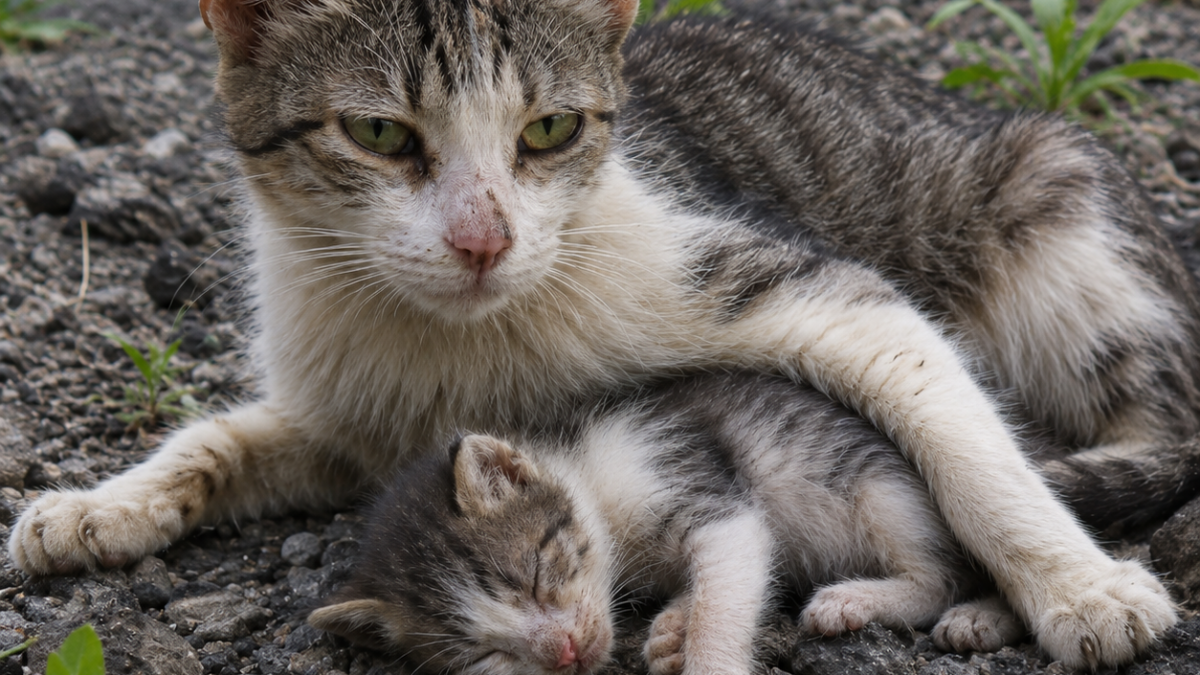
PART 2
I turned toward him.
“Three days?”
The old man nodded.
His face was lined and weathered, the kind of face that belonged to someone who had spent most of his life outdoors.
“You knew she was here?”
“I saw her yesterday.”
The answer came out more sharply than I intended.
“And you didn’t help her?”
He looked down.
“No.”
For a second, anger rose so quickly inside me that I forgot the cat.
“You saw this and kept going?”
“I thought someone had called.”
“Someone?”
He had no answer.
I stared at him.
Behind me, the mother cat gave another weak sound.
The anger drained into something heavier.
There would be time later to ask why people had ignored her.
Right now, she needed help.
I called the nearest veterinary clinic.
The receptionist answered on the third ring.
“I found an injured cat beside the river road outside Bellwood village. She’s alive, but her paws are badly damaged. There’s also a kitten. I think he’s dead.”
“Can you safely transport her?”
“I don’t know. She won’t let me near the kitten.”
“Do you have a box or blanket?”
“In the car.”
“Move slowly. If she’s in pain, she may bite.”
I looked at the cat.
She barely had the strength to hold up her head.
“I don’t care if she bites me.”
“Please care. We don’t need two patients.”
Despite everything, that almost made me smile.
I opened my trunk.
There was an old wool blanket I kept for emergencies.
I also found a cardboard box from groceries I’d bought the day before.
When I returned, the old man was still there.
The cat watched both of us.
“Can you help me?” I asked him.
His eyes widened.
“Me?”
“Yes. Unless you’re planning to ride away again.”
He winced.
I immediately regretted the cruelty of the sentence.
But he nodded.
“What do I do?”
“Hold the box.”
I approached from the side.
The mother flattened her ears.
“It’s okay.”
One step.
She hissed.
Another.
Her body shifted over the kitten.
I stopped.
“You think I’m going to take him.”
The old man whispered, “She won’t leave him.”
“No.”
I sat on the wet grass.
For several minutes, I did nothing.
The cat watched me.
My jeans soaked through.
Cars passed behind us.
I didn’t move.
Eventually, she blinked slowly.
I extended one hand.
She hissed again but didn’t retreat.
Then her body simply gave up.
She collapsed beside the kitten.
I moved.
Fast, but carefully.
I wrapped the blanket around her.
She tried to fight.
There was almost no strength behind it.
“I’m sorry.”
She cried out.
“I know. I know.”
The old man set down the box.
“What about the kitten?”
I looked at the small body.
Leaving him there felt impossible.
Not only for me.
For her.
“Bring him too.”
The old man hesitated.
“He’s dead.”
“I know.”
“We’re taking him?”
“Yes.”
I looked at the mother.
“We’re not making her lose him twice.”
He picked up the kitten with both hands.
The mother panicked immediately.
She twisted inside the blanket, trying to reach him.
“Put him beside her.”
He did.
The moment the kitten touched the blanket, she calmed.
She pressed her face against his head.
My throat tightened.
The old man turned away.
We placed both animals in the box.
He closed the sides loosely so the mother couldn’t escape but could still see light.
I carried them toward my car.
Before I got in, I looked at him.
“What’s your name?”
“Petru.”
“I’m Anna.”
He nodded.
“Will she live?”
“I don’t know.”
He looked miserable.
“Can you tell me?”
“What?”
“If she lives.”
I wanted to say no.
I wanted him to feel what it meant to see suffering and walk away.
Instead, I took his number.
“Yes.”
I drove twenty-five minutes to the veterinary clinic.
The entire way, I could hear the mother cat moving weakly inside the box.
Every few minutes, she made a low sound.
Not for me.
For her kitten.
“I’m sorry,” I whispered.
I repeated it until we arrived.
Two technicians met me at the door.
One took the box.
The other asked what happened.
“Truck accident three days ago.”
Her face changed.
“Three days?”
“She stayed beside the kitten.”
“The kitten?”
“Didn’t survive.”
The technician looked into the box.
“Oh…”
They carried both inside.
I followed.
A veterinarian named Dr. Laura Bennett examined the mother.
She was maybe three years old.
Underweight even before the accident.
No microchip.
No collar.
One hind leg was badly bruised but not broken.
Her front paws were another story.
Dr. Bennett looked at me after cleaning the first one.
“How did this happen?”
“She kept dragging the kitten.”
“For three days?”
“That’s what people say.”
Dr. Bennett stared at the cat.
“She wore the pads off.”
I swallowed.
“Can you save her paws?”
“I think so.”
“Will she walk?”
“Eventually.”
“Will she live?”
Dr. Bennett took a breath.
“She is severely dehydrated, exhausted, and probably hasn’t eaten properly since the accident. But her internal injuries appear limited.”
“So?”
“So if infection hasn’t spread too far, yes.”
I closed my eyes.
“Good.”
Then Dr. Bennett looked toward the kitten.
“We need to move him.”
The mother cat was watching.
I understood.
“What happens if she sees you take him?”
“We can’t leave him indefinitely.”
“I know.”
Dr. Bennett’s voice softened.
“Animals grieve too.”
“What do we do?”
“Let her understand.”
I had never heard anyone say that about an animal before.
The kitten was placed on a clean blanket.
The mother lay beside him.
For nearly an hour, no one separated them.
She sniffed his face.
Licked one ear.
Waited.
Then something changed.
She stopped nudging him.
She stopped meowing.
She rested her head against his side.
Her eyes closed.
Dr. Bennett whispered:
“I think she’s beginning to know.”
I cried then.
Not loudly.
I just stood beside the examination table with tears running down my face.
I had never met either of them before that morning.
I didn’t even know their names.
But grief does not ask whether you have known someone long enough to deserve it.
It simply arrives.
Afterward, the clinic staff carefully removed the kitten.
The mother watched.
She did not fight.
She made one small sound.
Then lowered her head.
I stayed until evening.
The staff gave her fluids.
Antibiotics.
Pain medication.
Her paws were cleaned and bandaged.
They offered food.
She refused.
Water.
Nothing.
“She may be in shock,” Dr. Bennett said.
“Can I stay?”
“If you want.”
So I did.
Around nine that night, I sat beside her enclosure.
“People keep asking what your name is.”
Her ears moved.
“I suppose you need one.”
I thought of several.
Nothing felt right.
Then I remembered how she had covered her kitten from the rain.
“Mara.”
I don’t know why.
The name simply came.
“Mara.”
Her eyes opened.
“Do you hate it?”
No response.
“I’ll take that as approval.”
She went back to sleep.
The next morning, I called Petru.
“She survived the night.”
There was silence.
Then:
“Thank God.”
“She isn’t safe yet.”
“But alive?”
“Yes.”
He exhaled shakily.
“I couldn’t sleep.”
I wanted to tell him that was appropriate.
Instead I asked:
“Why didn’t anyone stop?”
Another silence.
“Anna…”
“Three days, Petru.”
“I know.”
“People saw her.”
“Yes.”
“Why?”
He sounded older than he had beside the road.
“Because everyone thought someone else would do it.”
That sentence stayed with me.
Everyone thought someone else would do it.
It was such an ordinary explanation.
That was what made it frightening.
Cruelty wasn’t always someone causing pain.
Sometimes it was twenty people seeing pain and deciding responsibility belonged to number twenty-one.
On the second day, Mara ate.
Three bites of wet food.
The clinic called me immediately.
You would have thought she had performed a miracle.
I drove over after work.
When Mara saw me, she did not hiss.
That was progress.
I sat near the enclosure.
“Apparently, you’re eating now.”
Her tail moved once.
“Very impressive.”
She stared at me.
“I’ve been told I’m supposed to celebrate.”
Another small movement.
I smiled.
Her paws required treatment every day.
Some tissue had died.
The veterinarian worried about infection.
For the first week, Mara screamed whenever her bandages were changed.
Not because anyone was hurting her intentionally.
Because she had reached the point where even gentle touch meant pain.
I often stayed.
I talked while Dr. Bennett worked.
“You’re okay.”
Mara struggled.
“Don’t bite Laura. She’s expensive.”
Dr. Bennett gave me a look.
“Thank you.”
“I’m helping.”
“You are absolutely not helping.”
By the second week, Mara began to understand the routine.
Bandages came off.
Wounds were cleaned.
Medicine.
Fresh bandages.
Then food.
The clinic became less frightening.
People became less frightening.
Slowly.
One afternoon, Dr. Bennett asked:
“What are you going to do with her?”
“What do you mean?”
“When she’s discharged.”
I stared.
“I don’t know.”
She smiled.
“You’re here every day.”
“That doesn’t mean anything.”
“You named her.”
“Someone had to.”
“You bought her a blanket.”
“The clinic blankets are ugly.”
“You brought toys.”
“She needs stimulation.”
Dr. Bennett folded her arms.
“You’re adopting her.”
“No.”
Mara looked at me.
I looked at Mara.
Dr. Bennett laughed.
“Sure.”
I had never owned a cat.
I worked long hours.
My apartment was small.
I traveled occasionally.
There were a hundred reasons this was a bad idea.
Three weeks later, Mara came home with me.
I bought a cat bed.
She slept on my couch.
I bought another bed for the bedroom.
She slept on my pillow.
Apparently, animals enjoy making sure money is wasted.
Her paws healed slowly.
At first, she couldn’t walk more than a few steps.
Then across the room.
Then to the kitchen.
Then, one morning, I woke to find her standing on the windowsill.
I nearly screamed.
“How did you get up there?”
Mara looked at me as if I were embarrassing myself.
I laughed.
That was the first time I remember feeling relief without sadness attached to it.
She was going to live.
Really live.
But the road accident had started to bother me.
Not because I blamed the truck driver for hitting them.
Accidents happen.
The villagers said he had braked.
Several people heard the tires.
He had even stopped farther down the road.
But there were questions.
Why had he left before anyone checked the cats?
Why did everyone say trucks came through that curve too fast?
Why were there no warning signs?
Why had another dog been killed in the same place six months earlier?
One evening, Petru visited.
He brought a bag of cat food.
Mara hid beneath the table.
“I don’t think she remembers me.”
“She might.”
He set the food down.
“I brought this.”
“Thank you.”
He looked at her bandaged paws.
“Better?”
“Much.”
He sat quietly.
Then said:
“I keep seeing her.”
“By the road?”
“Yes.”
“Good.”
He looked at me.
I immediately realized how harsh that sounded.
“I mean… maybe remembering will make you stop next time.”
Petru nodded.
“You’re right.”
Then he surprised me.
“I talked to others.”
“About what?”
“The road.”
He told me the villagers had complained for years about heavy trucks speeding through the curve.
A quarry operated twelve miles away.
KamAZ trucks carried stone through the village.
Drivers were paid partly based on how many loads they completed.
More trips meant more money.
The faster they completed a route, the sooner they could start another.
“That doesn’t mean the driver was speeding,” I said.
“No.”
“But?”
“People say they all speed.”
“Any proof?”
Petru looked at me.
“There are cameras at the gas station.”
The station stood about half a mile before the curve.
I visited the next morning.
The owner, Mihai, knew exactly which accident I meant.
“The cats?”
“Yes.”
He frowned.
“Terrible.”
“You have cameras.”
“Yes.”
“Could you check the morning of the accident?”
He hesitated.
“Why?”
“I want to know how fast that truck was moving.”
“Camera doesn’t show speed.”
“It shows time.”
“And?”
“There is another camera at the mechanic’s shop after the curve.”
Mihai stared at me.
“You’ve been thinking about this.”
“A lot.”
He eventually agreed.
We found the truck.
Large.
Gray.
Company logo on the door.
The timestamp gave us the first clue.
When we compared it to footage from farther down the road, the truck had covered the distance far faster than a vehicle obeying the village speed limit should have.
Not perfect evidence.
But enough to ask questions.
The company was called Black Ridge Hauling.
I called.
A manager answered.
I explained who I was.
He became defensive almost immediately.
“It was a stray cat.”
“A mother and kitten.”
“I understand, but the driver didn’t intentionally hit them.”
“I never said he did.”
“Then what exactly do you want?”
“I want to know why your trucks drive through Bellwood like they’re on a highway.”
Silence.
“Our drivers follow all traffic laws.”
“I have camera timestamps suggesting otherwise.”
Another silence.
Then:
“Are you law enforcement?”
“No.”
“Then I don’t think there’s anything else to discuss.”
He hung up.
That was a mistake.
Not legally.
Emotionally.
It made me curious.
I contacted the local police.
They weren’t enthusiastic.
No human had been injured.
The cat had no owner.
The kitten was dead.
The driver had technically stopped after the collision.
But I kept asking.
Eventually, an officer named Adrian Ionescu agreed to review the footage.
He called me three days later.
“You were right.”
“About the speed?”
“Probably.”
“How fast?”
“Estimated fifteen to twenty miles per hour over the posted limit.”
My anger returned.
“Can you charge him?”
“Not based only on this.”
“What about company records?”
“We’d need more.”
“Then get more.”
He laughed once.
“You’re persistent.”
“You haven’t met Mara.”
“I’ve seen the photographs.”
That was another thing.
Mara’s story had spread.
Someone at the veterinary clinic posted about her with my permission.
A picture showed her sitting beneath a blanket, all four paws bandaged.
The caption explained that she had remained beside her kitten for three days.
People shared it.
Then local newspapers called.
Then television.
I didn’t want to turn Mara into entertainment.
But I agreed to one interview.
I talked about what mattered.
Not shock.
Not gore.
The fact that people had driven past her.
Again.
And again.
And again.
I said:
“The truck accident lasted seconds. Her suffering lasted three days because everyone assumed someone else would stop.”
That sentence became the headline.
I didn’t know whether to be pleased.
The attention changed things.
More villagers came forward.
Drivers.
Shop owners.
Parents.
A school bus driver.
They described speeding trucks.
Near misses.
Broken fences.
One truck that had slid off the road the previous winter.
Complaints had been made.
Nothing changed.
Black Ridge Hauling issued a statement.
Safety was their highest priority.
Drivers were regularly trained.
The accident involving “unowned animals” was regrettable.
I read that phrase several times.
Unowned animals.
As though not belonging to a human made their suffering smaller.
Petru read it too.
He came to my apartment furious.
“Unowned.”
“I saw.”
“They think nobody will care because she didn’t belong to anyone.”
I looked toward the couch.
Mara was asleep.
“She belongs to someone now.”
Petru smiled.
“So you admit it.”
“Admit what?”
“That she’s yours.”
I looked at Mara.
“No.”
Petru raised an eyebrow.
I sighed.
“I’m hers.”
“That sounds more accurate.”
Police eventually identified the driver.
His name was Viktor Marin.
Thirty-six years old.
Married.
Two daughters.
That surprised me.
Somehow, anger had turned him into a faceless villain in my imagination.
Then I saw a photograph.
Just a tired-looking man.
I learned he had returned to the area once after the crash.
Nobody told me why.
Then one evening, he came to my building.
I opened the door.
“Anna?”
“Yes.”
“My name is Viktor.”
I knew immediately.
My body went rigid.
“You drove the truck.”
He nodded.
I almost shut the door.
Then he said:
“I came to see the cat.”
Mara was behind me.
I moved so he couldn’t see her.
“Why?”
His face tightened.
“Because I haven’t slept properly since.”
“Good.”
He flinched.
I didn’t apologize.
“I tried to stop.”
“I know.”
“I didn’t see them until the curve.”
“You were speeding.”
His silence answered.
“How fast?”
“Too fast.”
“Why?”
He looked down.
“Because if you’re late with loads, they punish you.”
“Who?”
“The company.”
“You mean fines?”
“Lost bonuses. Bad routes. Less work.”
“And that mattered more than slowing down in a village?”
“No.”
“But you did it.”
“Yes.”
For a long moment, neither of us spoke.
Then I asked the question that had bothered me.
“Why did you leave?”
His eyes filled.
“I stopped.”
“I know.”
“I walked back.”
“You didn’t help her.”
“She ran toward the kitten.”
“You saw that?”
He nodded.
“Then why did you leave?”
Viktor wiped his face.
“Dispatcher told me I had to move the truck. Traffic was building. I called the company.”
“And?”
“They told me animals weren’t our responsibility.”
My hands curled.
“You listened?”
“Yes.”
“You saw her injured.”
“Yes.”
“You saw the kitten.”
“Yes.”
“And you drove away.”
His voice was barely audible.
“Yes.”
I wanted to hate him.
Part of me did.
But there was something broken in the way he stood there.
“You’re not asking me to forgive you.”
“No.”
“Good.”
“I want to testify.”
I stared.
“About what?”
“The schedules.”
“The company?”
“Yes.”
He looked directly at me.
“They know we speed.”
That was when the story changed again.
Viktor had saved messages.
Dispatch records.
Route schedules.
Warnings from drivers.
One driver had complained about worn brakes on a truck.
Another said village limits made the required number of daily trips impossible.
A supervisor replied:
“Then stop driving like a grandmother.”
The company knew.
More importantly, they rewarded it.
Viktor had been afraid to speak.
Mara changed that.
“She stayed with her kitten three days,” he told me.
“I couldn’t even stay five minutes.”
I didn’t know what to say.
So I said nothing.
Viktor gave his records to police.
Investigators contacted transportation authorities.
Black Ridge’s safety practices were audited.
They found repeated violations.
Drivers exceeding maximum hours.
Maintenance delays.
Incomplete inspections.
Pressure to meet unrealistic schedules.
The truck that hit Mara and her kitten had working brakes.
The accident might still have happened.
But speed had reduced the driver’s ability to stop.
There was no dramatic murder charge.
No evil confession.
Reality was messier than that.
Viktor received penalties for speeding and violations related to the collision.
He accepted them.
Black Ridge received far larger penalties.
Several licenses were temporarily suspended.
The route through Bellwood was restricted.
Heavy trucks were required to use a different road during certain hours.
Speed cameras were installed near the curve.
Warning signs appeared.
A raised crossing zone forced vehicles to slow.
For the first time in years, the village road became quiet.
People called it justice.
Some called it revenge.
I didn’t.
Revenge would have been another truck crash.
Another body.
Another family grieving.
This was better.
The thing that almost killed Mara became the reason the road changed.
But Mara’s own battle wasn’t finished.
Her paws healed physically.
Emotionally, she carried the road inside her.
The first time I tried to take her outside in a carrier, she panicked when a truck passed.
She threw herself against the plastic door.
I brought her back upstairs.
“Okay.”
She trembled.
“We don’t have to.”
For weeks, we stayed inside.
Then we tried the hallway.
Then the building entrance.
Then a quiet courtyard.
Every step was hers.
I stopped deciding when she should be brave.
That mattered.
We humans love recovery stories because we want a clean transformation.
Afraid.
Then safe.
Broken.
Then healed.
Life doesn’t work like that.
Mara could sleep peacefully on my couch and still panic at an engine.
She could purr when I touched her and still jerk away if my hand moved too quickly.
She could heal and hurt at the same time.
Both were true.
Months passed.
Her fur became glossy.
She gained weight.
Her paws regained enough padding that Dr. Bennett finally smiled during an examination.
“Look at that.”
“What?”
“She has normal feet again.”
I laughed.
“That’s a strange thing to celebrate.”
“You haven’t spent six months treating those feet.”
Mara pulled one paw away indignantly.
Dr. Bennett scratched under her chin.
“I know. Very rude.”
One thing didn’t change.
Mara hated rain.
Whenever it started, she went to the window.
She would sit there for hours.
I wondered if she remembered lying over her kitten in the wet grass.
Maybe she did.
Maybe she simply disliked rain.
I stopped forcing human meaning into everything.
Then came the day the kitten’s body was returned to me.
The clinic had held him while authorities documented the accident.
I had arranged cremation.
But when the small container arrived, I couldn’t leave it on a shelf.
Mara sniffed it.
Then sat beside it.
For nearly an hour.
That night, she slept near the box.
I cried again.
I decided he needed a name.
No one knew whether anyone had ever called him anything.
So I named him Leo.
A tiny life should have a name somewhere.
I took Leo’s ashes to the village.
Petru came.
So did Viktor.
I wasn’t expecting Viktor.
He stood far away.
I almost asked him to leave.
Then Petru said:
“He came because I told him.”
I looked at the riverbank.
A young apple tree had been planted several yards from the road.
The village council had approved it.
Beneath it was a small stone.
LEO
SMALL LIFE. GREAT LOVE.
I buried the ashes there.
Mara did not come.
I decided she had already said goodbye.
Viktor stood behind us.
When the others left, he stayed.
“I don’t deserve to ask this.”
“What?”
“Can I put flowers there sometimes?”
I looked at him.
“You don’t need my permission.”
He nodded.
“I know.”
“Then why ask?”
“Because it feels like I do.”
I thought for a moment.
“Bring flowers.”
He did.
Every month.
Sometimes his daughters came.
That bothered me at first.
Then I learned they had adopted an abandoned kitten.
They named him Leo.
Life is strange that way.
A year after I found Mara, Bellwood held a small event beside the road.
Not for the accident.
For the new safety project.
There were signs.
Speed cameras.
Reflective markers.
A fenced animal crossing area near the river.
The village school had started teaching children how to report injured animals safely.
Petru helped organize it.
He had changed too.
He became a volunteer with a local rescue group.
The man who once cycled past Mara because he thought someone else would help now carried a transport box on the back of his bicycle.
I teased him about it.
“You’re becoming dangerous.”
“Why?”
“You might actually have to stop somewhere.”
He smiled.
“I hope so.”
Then he became serious.
“You were very angry with me.”
“I was.”
“You were right.”
“I was cruel too.”
“No.”
“Yes.”
I remembered what I had said.
“Maybe remembering will make you stop next time.”
Petru shook his head.
“It did.”
We looked toward the road.
Cars slowed at the curve now.
All of them.
Because they had no choice.
Petru said:
“Do you know what bothers me most?”
“What?”
“I thought I was a good man.”
“You probably are.”
“No.”
He looked toward Leo’s tree.
“I thought being good meant not hurting anyone.”
I waited.
“But sometimes you also have to help.”
That was the lesson I carried too.
Mara became locally famous.
I hated the word famous.
She didn’t know what it meant.
People asked to meet her.
Mostly I said no.
She wasn’t a symbol.
She was a cat who liked chicken, hated closed doors, and woke me at five in the morning because apparently breakfast could not legally happen after sunrise.
But once, I agreed to bring her to the veterinary clinic during a fundraiser.
Dr. Bennett promised a quiet room.
Mara sat in my lap.
A little girl approached.
She had braces on both legs and walked with crutches.
Her mother asked:
“Can she say hello?”
I looked at Mara.
Mara looked at the girl.
“Slowly.”
The girl sat.
She extended one hand.
Mara sniffed.
Then stepped onto the girl’s lap.
The girl’s mouth fell open.
“She likes me.”
“Yes.”
“Did her legs hurt like mine?”
I swallowed.
“Her paws did.”
“Did she get better?”
“She did.”
The girl touched Mara’s back.
“Me too.”
Her mother turned away, crying.
I stared at the floor.
That moment stayed with me longer than the television interviews.
Maybe because it wasn’t about tragedy.
It was about recognition.
Two beings who knew what it meant for movement to hurt.
Mara began helping other animals without knowing it.
The clinic created a fund named after her.
Not because I asked.
Because donations kept coming.
The Mara Fund paid for emergency care for injured strays.
The first animal it helped was a dog hit by a car.
Then two abandoned kittens.
Then an injured owl.
Then an old cat found frozen beneath a porch.
Every time Dr. Bennett sent me an update, I showed Mara.
“You paid for this.”
She licked herself.
“No interest?”
Nothing.
“Very humble.”
Years passed.
The story became less sharp.
That was good.
I didn’t want the worst day of Mara’s life to remain the most important day forever.
We moved to a small house outside the city.
Mara finally had a garden.
At first, I was terrified to let her outside.
I built a secure enclosure instead.
She spent hours lying in sunlight.
Birds annoyed her.
Butterflies fascinated her.
Rain still sent her inside.
Every once in a while, a truck passed on the distant road.
Her ears would lift.
But she no longer ran.
That was how I measured healing.
Not forgetting.
Freedom from being controlled by the memory.
Petru visited every few months.
He always brought something unnecessary.
Food.
A blanket.
Once, a ridiculous cat toy shaped like a fish.
Mara loved it.
Viktor visited only once.
It happened three years after the accident.
He called first.
“I want to tell you something.”
We met at Leo’s tree.
He looked different.
Older.
Calmer.
He no longer drove trucks.
He worked at a repair shop.
“I couldn’t do it anymore.”
“Because of the accident?”
“Yes.”
He looked at the road.
“Sometimes I’d see something move near the shoulder and slam the brakes.”
I understood more than I wanted to.
He reached into his jacket.
There was a folded paper.
“What is that?”
“A letter.”
“To me?”
“To Mara.”
I almost laughed.
“She can’t read.”
“I know.”
“Then why?”
“Because I need to say it.”
I took the letter.
Later, at home, I opened it.
It was simple.
Mara,
I am sorry.
I know sorry doesn’t change what happened.
I drove too fast because I cared more about finishing my route than about what could happen on the road.
When I saw you and your kitten, I tried to stop.
But I had already made the decision that mattered before I ever reached the curve.
I drove away because I was afraid of losing my job.
You stayed beside your kitten even when staying almost killed you.
I have thought about that difference every day.
You were braver than I was.
I hope the rest of your life has been gentle.
Viktor.
I sat at the kitchen table for a long time.
Mara jumped onto the chair beside me.
“What am I supposed to do with this?”
She sniffed the paper.
Then walked away.
I laughed.
“Fair enough.”
I kept the letter.
Not because Viktor deserved forgiveness.
Because accountability mattered.
He never asked me to say what he did was okay.
He admitted it wasn’t.
That was enough.
Mara was nearly nine when she began slowing down.
Nine wasn’t terribly old for a cat, but her body had been through more than most.
She developed arthritis in one of the legs injured by the truck.
Medication helped.
Warm beds helped more.
I bought four.
She continued sleeping on mine.
Dr. Bennett laughed.
“You’ve learned nothing.”
“I’ve learned cat beds are decorative objects.”
“Progress.”
One autumn afternoon, we drove to Bellwood.
Mara had not been near the road since the day I found her.
I had avoided it.
Partly for her.
Mostly for myself.
But the village had built a small fenced garden near Leo’s tree.
No vehicle could reach it.
I carried Mara inside a secure carrier.
When I opened the door, she remained inside.
I waited.
Five minutes.
Ten.
Then she stepped out.
She sniffed the grass.
Walked three feet.
Stopped.
The road was nearby.
A truck approached.
I froze.
Mara’s body stiffened.
The truck slowed at the new raised crossing.
It passed gently.
Mara watched.
Then lowered her head and sniffed the grass again.
I started crying.
Petru was standing nearby.
He didn’t say anything.
He simply placed one hand on my shoulder.
Mara walked toward Leo’s tree.
She sniffed the stone.
Then lay in the sunlight beside it.
I don’t know whether she knew.
I won’t pretend.
But I sat beside her.
“That’s him.”
Her ears moved.
“You stayed with him.”
I looked toward the road.
“You almost died because you wouldn’t leave.”
Mara rolled onto one side.
I laughed through tears.
“Very emotional.”
She closed her eyes.
We stayed for almost an hour.
That was the only time I ever took her back.
It was enough.
By the time Mara was eleven, Petru had become one of the village’s most active animal-rescue volunteers.
The clinic’s emergency fund had paid for more than two hundred animals.
Black Ridge Hauling no longer existed under that name.
After fines, lawsuits, and lost contracts, the owners sold the company.
The new operator used electronic speed monitoring.
Drivers were no longer paid in a way that rewarded rushing through villages.
Viktor occasionally spoke at driver-safety meetings.
He always told Mara’s story.
Not as the man who “accidentally hit a cat.”
As the driver who made several choices before and after the crash that he wished he could take back.
That distinction mattered.
People asked me once whether seeing his life changed felt like revenge.
No.
Revenge would have kept me tied to the worst moment.
What happened was better.
He had to live differently because of it.
Petru had to live differently.
The village had to live differently.
I had to live differently.
Mara, ironically, was the one least interested in punishment.
She wanted breakfast.
Sunlight.
My pillow.
Peace.
Maybe animals understand something we don’t.
They don’t waste much time imagining how their enemies should suffer.
They spend their energy trying to feel safe again.
When Mara was twelve, Dr. Bennett found kidney disease.
We managed it for almost two years.
Special food.
Medication.
Fluids.
Regular tests.
Mara hated every part except the attention.
Then, one winter, she stopped eating.
I knew before the blood results came back.
Dr. Bennett sat beside me.
“Anna.”
“No.”
She didn’t continue.
“No.”
My voice broke.
“There has to be something.”
“We can keep her comfortable.”
“That’s not the same.”
“I know.”
I looked at Mara.
She was sitting in her carrier, annoyed about being at the clinic.
Thirteen years earlier—or almost thirteen—I had found her unable to stand beside a road.
Now she was an old cat.
My old cat.
That should have felt like victory.
Instead, it hurt.
We went home.
For three weeks, Mara had good days.
I measured life differently.
Did she eat?
Did she walk to the window?
Did she purr?
Did she choose to sit with me?
As long as the answers were mostly yes, we continued.
Then came the morning she didn’t get up.
I carried her to the couch.
Rain tapped against the windows.
Mara opened her eyes.
I almost laughed at the cruelty of the weather.
“You always hated rain.”
Her paw moved against my hand.
I called Dr. Bennett.
She came to the house.
Petru drove from Bellwood.
I hadn’t asked him.
He simply came.
He stood in the doorway.
“Can I see her?”
“Yes.”
He sat on the floor.
Mara looked at him.
“You know,” he said, “you made me a better man.”
His voice broke.
“I wish I had been one sooner.”
Mara closed her eyes.
Petru kissed his fingers and touched them lightly to the blanket.
Then he left.
Dr. Bennett gave us time.
I held Mara.
I thought I would know what to say.
I didn’t.
Finally, I whispered:
“I remember the first time I saw you.”
Her breathing was shallow.
“I thought you were just a cat beside the road.”
I touched her head.
“I didn’t know you had already spent three days proving what love looked like.”
My tears fell into her fur.
“You didn’t understand why your baby wasn’t waking up.”
I swallowed.
“But you made sure he wasn’t alone.”
Mara’s eyes opened.
“And then you weren’t alone either.”
Her paw rested against my wrist.
“You lived thirteen more years.”
I smiled through tears.
“You were supposed to be a stray.”
A breath.
“You became my family.”
Another.
“You changed a village.”
I kissed her forehead.
“You changed people who didn’t even deserve a second chance.”
Her breathing slowed.
“You can rest now.”
Mara died in my arms.
No road.
No rain.
No pain in her paws.
She was warm.
She was home.
I buried her in my garden.
But I put a second small stone beside Leo’s tree in Bellwood.
MARA
SHE STAYED.
AND BECAUSE SHE STAYED, WE LEARNED TO STOP.
The village held no ceremony.
I didn’t want one.
Petru and I placed the stone ourselves.
Viktor left flowers the next morning.
I knew they were his because he always brought white daisies.
Years have passed.
I still drive through Bellwood.
The road is different now.
Trucks slow.
Children cross safely.
People stop when they see an injured animal.
Not always, I’m sure.
Humans aren’t suddenly perfect.
But the story remains.
People remember.
Once, I stopped near Leo’s tree and saw a teenage boy crouched beside the road.
A pigeon had been injured.
He was holding a cardboard box.
“What happened?” I asked.
“Wing’s hurt.”
“You call anyone?”
“Animal rescue is coming.”
I smiled.
“You didn’t just leave?”
He looked confused.
“Why would I?”
I almost cried.
That was the ending I wanted.
Not Black Ridge losing money.
Not Viktor living with guilt.
Not fines.
Not headlines.
A boy seeing a hurt animal and believing stopping was the obvious thing to do.
Mara’s revenge, if you want to call it that, was not suffering.
It was change.
The road that almost killed her became safer.
The people who ignored her became rescuers.
The driver who left learned to stay.
The village that assumed “someone else” would help learned that sometimes you have to be that someone.
And the kitten she refused to abandon became the reason hundreds of other animals were eventually helped.
Sometimes I still think about those three days.
Especially the nights.
Mara in the rain.
Hungry.
In pain.
Her paws becoming raw from trying to move Leo away from danger.
Cars passing.
Headlights.
Engines.
People seeing.
People continuing.
That part still makes me angry.
But then I remember the rest.
A woman finally turning her car around.
An old man putting down his bicycle.
A veterinarian refusing to give up.
A driver telling the truth.
A village changing a dangerous road.
A rescue fund.
Two small stones beneath an apple tree.
And thirteen years of an ordinary cat doing ordinary things.
Sleeping.
Eating.
Purring.
Stealing my pillow.
Those thirteen years matter more than the three terrible days.
That is the part I wish more people understood about rescue.
Saving an animal isn’t only about preventing death.
It is about giving life back its ordinary moments.
A sunny window.
A full stomach.
A warm bed.
A hand that doesn’t hurt.
Time.
Mara got time.
Leo didn’t.
I will always wish he had.
But his short life mattered too.
His mother made sure of that.
She loved him so fiercely that she nearly destroyed herself refusing to leave his side.
And in the end, that love forced an entire community to look at itself.
There was no dramatic revenge.
No one needed to suffer the way Mara had suffered.
Something better happened.
People changed.
The next animal on that road didn’t have to wait three days.
That is enough for me.
Sometimes, when I pass Leo and Mara’s tree, I stop.
I put my hand on the two stones.
And I remember the first thing Petru told me.
“She has been waiting for someone to stop for three days.”
For years, I thought that sentence was about Mara.
Now I think it was about all of us.
We spend so much of life moving.
Driving.
Working.
Looking at our phones.
Assuming somebody else will notice what we don’t have time to notice.
But somewhere, somebody is always waiting for someone to stop.
Sometimes it is a person.
Sometimes it is an animal.
Sometimes stopping changes almost nothing.
And sometimes it changes everything.
That morning, I could have kept driving.
I almost did.
Instead, I turned around.
Mara taught me never to forget the difference.
Years have passed since Mara died, but there are mornings when I still wake before sunrise and expect to hear her paws on the hallway floor.
For thirteen years, that sound had been part of my life.
Soft steps.
A pause outside my bedroom.
Then one impatient scratch against the door if I didn’t wake quickly enough.
Mara had survived being struck by a truck.
She had survived three days beside the road.
She had survived hunger, rain, infection, and injuries so severe that the pads of her paws were nearly gone.
But in my house, she eventually became known for something far less dramatic.
She hated waiting for breakfast.
Sometimes I think that is the greatest victory of her story.
Not that she became famous.
Not that a trucking company was investigated.
Not even that the road was changed.
It was that she eventually became ordinary.
A cat who complained about breakfast.
A cat who stole my pillow.
A cat who sat directly on whatever paper I happened to be reading.
A cat who spent winter afternoons asleep beside a radiator and summer mornings stretched across the warm windowsill.
The world had given her a terrible beginning.
She refused to let that become her entire life.
After Mara’s death, I thought my connection to Bellwood would slowly fade.
I was wrong.
Petru kept calling.
Sometimes about injured animals.
Sometimes about nothing.
He had become deeply involved with the volunteer rescue network by then.
The man who once rode his bicycle past a suffering cat because he assumed someone else would help eventually became the person everyone called when an injured animal was found.
He bought an old van.
It barely ran.
The passenger door only opened from the inside, and the heater worked when it felt like it.
But on the side, Petru painted:
BELLWOOD ANIMAL RESPONSE.
I laughed the first time I saw it.
“You’ve become official.”
He looked proud.
“Very professional.”
“The door is held shut with wire.”
“Temporary repair.”
“You said that six months ago.”
“It has remained temporarily repaired.”
Inside the van were blankets, carriers, gloves, bottled water, dog food, cat food, towels, and a basic first-aid kit.
Petru kept everything organized.
He carried the phone day and night.
When someone called about an animal beside the road, he went.
He was nearly seventy by then.
I told him constantly that he needed help.
His answer was always the same.
“Someone has to stop.”
That sentence had become part of us.
A few younger volunteers eventually joined him.
One was a mechanic named Stefan.
Another was a high school teacher named Elena.
The teenage boy I once saw rescuing the injured pigeon became a volunteer after finishing school.
His name was Alex.
When I first learned that, I smiled for the rest of the day.
The boy who had looked at me and asked, “Why wouldn’t I stop?” grew into a young man who carried animal crates in Petru’s battered van.
Maybe that was how change really happened.
Not in one enormous moment.
One person changed.
Then another.
Then another.
Until something that once seemed extraordinary became normal.
Bellwood changed too.
The dangerous curve where Mara and Leo had been hit became almost unrecognizable.
The road was narrowed slightly near the village.
Reflective signs warned drivers to slow down.
Speed cameras monitored heavy vehicles.
There were raised sections of pavement near the crossing area.
Bushes had been trimmed back so drivers could see animals, bicycles, and pedestrians sooner.
The quarry trucks still passed sometimes.
But slowly.
Very slowly.
Drivers complained at first.
Some said the restrictions were ridiculous.
One man told the local newspaper:
“We can’t redesign every road because a cat got hit.”
Petru carried that newspaper around for two weeks.
I finally asked why.
“So I remember why the work matters.”
“Because of that comment?”
“Yes.”
He pointed to the article.
“He thinks it was one cat.”
Petru shook his head.
“It was never one cat.”
He was right.
Mara’s accident exposed something that had existed for years.
A dangerous road.
Speeding trucks.
A company that rewarded rushed schedules.
People who had become accustomed to seeing risk and assuming nothing could be done.
Mara did not create those problems.
She simply made them impossible to ignore.
The Mara Fund grew as well.
What began with leftover donations from her veterinary treatment eventually became a registered local emergency program.
I didn’t want my name attached to it.
I didn’t want to run it.
Dr. Bennett handled most of the medical decisions.
Petru handled rescue calls.
A small committee managed donations.
I mostly helped when someone needed Mara’s story told.
The fund paid veterinary bills for animals whose owners couldn’t afford emergency treatment.
It helped strays.
Wildlife.
Abandoned litters.
Hit-and-run cases.
One year, Dr. Bennett sent me a photograph of a tiny fox recovering from a broken leg.
Underneath, she wrote:
MARA PAID FOR THIS ONE.
I called her immediately.
“Mara was a cat.”
“Very observant.”
“Why is she paying for foxes?”
“Her fund doesn’t discriminate.”
“I don’t remember approving that.”
“You’re not in charge.”
That was probably for the best.
Another time, the fund paid for surgery on an elderly shepherd whose owner was an eighty-two-year-old widower.
The man came to the clinic with twelve dollars in his wallet.
His dog needed emergency surgery.
When Dr. Bennett told him the fund would cover the difference, he cried.
“I’ll pay it back.”
“You don’t have to.”
“I will.”
Months later, he returned with twenty dollars.
Then another twenty.
Then ten.
He kept coming.
By the time he had repaid less than a quarter of the cost, Dr. Bennett finally said:
“Why don’t you volunteer instead?”
So he did.
He washed blankets once a week.
That was how Mara’s story kept growing.
One rescue created another.
One act of kindness created another.
Not because Mara understood any of it.
She probably would have been annoyed that her name was on paperwork.
But the suffering she survived had been transformed into something useful.
That mattered to me.
Viktor remained part of the story too.
For years, I didn’t know exactly how I felt about him.
He had been driving the truck.
He had been speeding.
He saw Mara crawl toward her dead kitten.
And he left.
Those facts did not disappear because he later told the truth.
Accountability doesn’t erase consequences.
But people are complicated.
Viktor never asked me to call him a good man.
He never tried to turn himself into another victim.
That made it easier to listen when he spoke.
After leaving the trucking industry, he began working with a regional road-safety organization.
At first, he repaired equipment for them.
Then someone asked him to speak to new commercial drivers.
He refused.
Then agreed.
The first time he told the story publicly, Petru attended.
Viktor stood in front of twenty young truck drivers.
He did not show photographs of Mara’s injured paws.
He did not try to shock them.
He simply said:
“I thought speeding by fifteen miles an hour was a small decision.”
The room was quiet.
“I thought leaving after the accident was another small decision.”
He paused.
“They became the two worst decisions of my life.”
One driver asked:
“But if the animal ran in front of you, was it really your fault?”
Viktor answered:
“The accident may not have been completely avoidable. My speed was.”
Then he added:
“And leaving was completely avoidable.”
Petru told me later that was when he finally stopped hating him.
Not forgave.
Stopped hating.
There is a difference.
Years later, Viktor’s oldest daughter became a veterinarian.
When she graduated, she sent me a photograph of herself in her white coat.
The message said:
My father told me Mara’s story my whole life. I think she is part of the reason I chose this.
I stared at that message for a long time.
The kitten who died.
The mother who stayed.
The driver who left.
The daughter who became a veterinarian.
Life almost never moves in straight lines.
Sometimes something terrible creates consequences no one could have predicted.
I still wished the accident had never happened.
Nothing good that came later made Leo’s death acceptable.
Nothing made Mara’s pain necessary.
People sometimes say:
“Everything happens for a reason.”
I have never believed that.
Some things simply happen.
Some things are cruel.
Some things are unfair.
The meaning comes from what we decide to do afterward.
Mara didn’t suffer so Bellwood could become safer.
Bellwood became safer because people finally decided her suffering could not be ignored.
That distinction matters.
Every year on the anniversary of the accident, someone left flowers beneath Leo and Mara’s apple tree.
At first, I assumed they were from Viktor.
Usually, they were.
Then other things began appearing.
A child’s drawing of two cats.
A little wooden heart.
A dog collar.
A handwritten note that said:
WE STOPPED FOR ONE TODAY.
Another year, someone left a photograph of a rescued kitten with the message:
FOUND NEAR THE HIGHWAY. SAFE NOW. THANK YOU, MARA.
I kept copies of some of the notes.
Not all.
Some belonged there.
The tree grew taller.
Its branches spread.
Eventually, the two small stones beneath it sat in shade.
Leo.
Small Life. Great Love.
And Mara.
She Stayed.
And Because She Stayed, We Learned to Stop.
One spring, Bellwood’s elementary school asked whether I would speak to the children.
My first instinct was no.
I didn’t enjoy public speaking.
I especially didn’t want to tell a room full of children about a kitten being killed.
The teacher promised they had already discussed the story in an age-appropriate way.
So I agreed.
I stood in front of nearly sixty children.
I showed them a photograph of Mara years after the accident.
Not injured.
Healthy.
Sitting in my garden with sunlight on her fur.
A boy raised his hand.
“Is that really the same cat?”
“Yes.”
“She looks happy.”
“She was.”
Another child asked:
“Did she remember the truck?”
“I don’t know.”
“Did she remember her baby?”
That question was harder.
“I think animals remember many things. But I can’t tell you exactly what Mara remembered.”
A little girl near the front lifted her hand.
“Was she sad forever?”
I looked at Mara’s photograph.
“No.”
The girl seemed relieved.
“She was sad. And scared. For a while. But she wasn’t sad forever.”
That was important.
I told them Mara eventually played.
She slept in sunny places.
She became demanding about breakfast.
She learned to trust people.
“She had bad things happen to her,” I said. “But bad things were not the only things that happened to her.”
The children understood that better than many adults.
At the end, I asked them one question.
“If you see an animal hurt somewhere, what should you do?”
Hands shot into the air.
“Call an adult!”
“Call a rescue!”
“Don’t run into traffic!”
“Give them water!”
The teacher corrected that one because sometimes giving food or water isn’t appropriate.
Then a quiet boy near the back raised his hand.
“What if someone else already called?”
I stopped.
That question brought me back to Petru beside the road.
Everyone thought someone else would do it.
I answered carefully.
“You can still make sure.”
The boy nodded.
That became the school’s rule.
Don’t assume.
Make sure.
They printed it on small posters.
REPORT IT. DON’T ASSUME. MAKE SURE.
Petru put one in his van.
Dr. Bennett put one in the clinic.
I put one near my front door.
Mara would have hated all this attention.
I often imagined her reaction.
Probably one irritated flick of the tail before demanding dinner.
The years continued.
Petru eventually had to stop driving the rescue van because of his eyesight.
That was difficult for him.
He called me the day the doctor took his license.
“I can’t do the work anymore.”
“That’s not true.”
“I can’t drive.”
“You can answer phones.”
He was quiet.
“You can train volunteers.”
More silence.
“You can organize supplies.”
“I hate organizing supplies.”
“I know.”
He sighed.
“I want to go when someone calls.”
“I know.”
For a man who had once failed to stop, losing the ability to go toward suffering felt like punishment.
I reminded him of something.
“Do you remember what you told me?”
“Probably something stupid.”
“You said someone has to stop.”
“Yes.”
“You taught dozens of people to stop.”
That quieted him.
“The van goes without you now because you built the team.”
He finally said:
“That sounds annoyingly reasonable.”
“I learned from Dr. Bennett.”
Petru became the dispatcher.
His house turned into the unofficial command center.
Maps on the walls.
Phone numbers everywhere.
Chargers.
Animal carriers stacked in the hallway.
His kitchen table became impossible to use because it was covered with rescue records.
He complained constantly.
He loved every minute.
When Petru died at eighty-one, the Bellwood Animal Response van followed his hearse.
So did three rescue vehicles from neighboring towns.
Viktor attended.
Dr. Bennett.
Alex.
Dozens of people.
Someone placed Petru’s old bicycle beside the church.
Attached to the back was the animal carrier he had used for years.
I cried harder than I expected.
After the service, Alex found me outside.
“He told me something once.”
“What?”
“That the worst thing he ever did was keep riding.”
I nodded.
Alex continued.
“He said the best thing he ever did was turn around after that.”
I looked toward the bicycle.
“That sounds like him.”
Alex became coordinator of Bellwood Animal Response after Petru.
He replaced the terrible van.
I objected.
“That van was historic.”
“That van was dangerous.”
“Petru loved it.”
“Petru also used wire to hold the door shut.”
“Tradition.”
Alex laughed.
The new van was white, clean, and actually passed inspection.
On one side, beneath the rescue organization’s name, Alex added a sentence:
SOMEONE HAS TO STOP.
That nearly broke me.
Dr. Bennett retired a few years later.
On her last day, the clinic held a small reception.
I attended.
So did several former patients.
Mostly humans.
A few dogs.
One furious cat.
Someone had created a board filled with photographs from Dr. Bennett’s career.
In the middle was Mara.
Bandaged paws.
Wide eyes.
Then another photograph beside it.
Mara years later, fat and deeply asleep on my couch.
I pointed.
“You chose the least flattering picture possible.”
Dr. Bennett smiled.
“She was comfortable.”
“She was enormous.”
“She was healthy.”
“She was shaped like a loaf of bread.”
“She deserved every ounce.”
We stood in front of the photographs.
“You saved her,” I said.
Laura shook her head.
“We helped her.”
“You operated.”
“You stopped.”
I looked at her.
“That’s where it started.”
It always came back to stopping.
I had spent years thinking Mara’s story was about loyalty.
A mother refusing to leave her kitten.
And it was.
But over time, I realized it was also about attention.
Who notices?
Who stops?
Who says, “This is my responsibility now,” even when technically it isn’t?
Mara stayed because Leo was hers.
I stopped even though Mara wasn’t.
Petru learned to stop even when the animal belonged to nobody.
Viktor learned that responsibility doesn’t end just because an accident was unintentional.
The village learned that safety isn’t someone else’s job.
Maybe that was why the story stayed alive.
Because almost everyone has experienced that moment.
You see something wrong.
You have somewhere to be.
You tell yourself somebody else will handle it.
Most of the time, maybe they do.
But what if they don’t?
The last time I visited Bellwood’s school, the apple tree had grown taller than the roof of a nearby shed.
A new generation of children knew Mara’s name.
That surprised me.
One little girl asked:
“Did you love her right away?”
I smiled.
“No.”
She looked shocked.
“You didn’t?”
“I didn’t know her.”
“When did you love her?”
That question stopped me.
I thought of the clinic.
Bandages.
Three bites of food.
The first time Mara looked at me without fear.
The first night she slept beside me.
The morning she reached the windowsill.
I finally said:
“I don’t know exactly.”
The girl frowned.
“Maybe that’s how love works sometimes.”
“What do you mean?”
“You only realize it’s there after it already happened.”
She seemed to accept that.
Before leaving, I walked alone to the apple tree.
There were new flowers.
I sat on the bench the village had installed nearby.
Cars passed.
Slowly.
A heavy truck approached the curve.
It reduced speed.
Almost crawling.
A cat darted from the grass.
The truck stopped easily.
The cat crossed.
Then disappeared through a garden fence.
The driver waited.
No horn.
No anger.
Then continued.
I sat completely still.
It was such a small thing.
A truck stopped for a cat.
No one else noticed.
No newspaper.
No police.
No crowd.
Just brakes.
A few seconds.
A cat continuing home.
I started crying.
Because thirteen years earlier, there had not been enough distance to stop.
Now there was.
That was Mara’s legacy in its simplest form.
Not the fund.
Not the signs.
Not the articles.
Enough distance to stop.
I went to the two stones.
“Did you see that?”
Of course, there was no answer.
I touched Leo’s stone first.
“You should have had that.”
Then Mara’s.
“But somebody else did.”
For a long time, grief had made me wish I could rewrite the past.
Make Viktor drive slower.
Make someone stop on the first day.
Make Leo survive.
Make Mara’s paws remain uninjured.
But life doesn’t let us edit backward.
We can only edit what comes next.
That realization finally gave me peace.
We could not save Leo.
We could not spare Mara those three days.
But we could make the next road safer.
Save the next animal sooner.
Teach the next child to call.
Convince the next driver to slow down.
Give the next frightened animal a warm bed.
Maybe that’s what a satisfying ending actually is.
Not undoing what happened.
Making sure it doesn’t happen the same way again.
A few months ago, I received a call from Alex.
“Are you home?”
“Yes.”
“We have a situation.”
“No.”
“You don’t know the situation.”
“I recognize your voice.”
He laughed.
“We found a cat.”
“Then take it to the clinic.”
“The clinic says she’s medically okay.”
“Good.”
“She needs somewhere quiet.”
“No.”
“Temporary.”
“That word has ruined my life before.”
“Two nights.”
“No.”
He arrived twenty minutes later.
The cat was small.
Gray.
One ear slightly bent.
Terrified.
She remained at the back of the carrier.
I stared at Alex.
“You manipulated me.”
“Absolutely.”
“What happened?”
“Found near the highway.”
I sighed.
“Of course.”
I opened the carrier inside my spare room.
The cat didn’t move.
I placed food nearby.
Water.
A blanket.
Then I sat several feet away.
No reaching.
No forcing.
I knew this routine.
An hour passed.
Then the cat moved forward.
One paw.
Then another.
She ate.
The next morning, she allowed me to touch her head.
By day three, she slept on my couch.
Alex called.
“Ready for me to pick her up?”
I looked at the cat.
She looked at me.
“No.”
He laughed.
“I knew it.”
“Don’t say anything.”
“What did you name her?”
“I didn’t.”
Silence.
“Anna.”
“Fine.”
“What did you name her?”
I looked toward the window.
“Mila.”
“That’s naming her.”
“Goodbye, Alex.”
I hung up.
Mila still lives with me.
She is nothing like Mara.
That matters.
I didn’t want another Mara.
There could never be another Mara.
Mila is loud.
Mara was quiet.
Mila loves rain against the windows.
Mara hated it.
Mila sleeps at the foot of the bed instead of stealing my pillow.
She has her own story.
Her own habits.
Her own life.
But sometimes I watch her sleeping safely in my house and think about the chain of events that brought her there.
A truck hit two cats.
A mother stayed.
People passed.
I stopped.
Petru changed.
A village changed.
A rescue network formed.
Alex joined.
Years later, Alex brought Mila to my door.
One life touching another.
And another.
And another.
Mara did not know she was starting any of that.
Heroes rarely do.
Maybe she wasn’t a hero.
Maybe she was simply a mother who refused to leave her baby alone.
That is enough.
One night recently, it rained hard.
I woke around two in the morning.
For a moment, half asleep, I expected Mara to be sitting at the bedroom door.
Instead, Mila was on the windowsill watching the rain.
I walked over.
The road outside my house was empty.
Water ran along the curb.
I thought about that first night Mara spent beside Leo.
Cold.
Injured.
Covering him with her body.
I still wish someone had stopped.
I always will.
Then I looked at Mila.
Warm.
Safe.
Dry.
And I remembered the boy with the injured pigeon.
The truck stopping for the cat at Bellwood’s curve.
Petru’s rescue van.
Viktor’s daughter in her veterinary coat.
The school poster.
DON’T ASSUME. MAKE SURE.
Maybe we cannot give Mara those three days back.
But because of her, other animals got their days back.
Hundreds of them.
Maybe thousands eventually.
That is the ending I choose to carry.
Not a mother cat lying beside the road.
A village learning to stop.
Not paws torn against asphalt.
Hands lifting injured animals into blankets.
Not a driver leaving.
Drivers slowing before the curve.
Not Petru riding away.
Petru teaching others to turn around.
Not Leo dying unseen.
Leo’s name beneath an apple tree.
Not Mara’s suffering.
Mara asleep on my pillow thirteen years later, completely certain she belonged there.
Cruelty and indifference often make more noise.
But kindness has endurance.
It moves quietly from one life to another.
Mara stayed with Leo because she could not abandon someone she loved.
I stopped because, for one moment, I refused to keep going.
Petru learned to do the same.
Then Alex.
Then children who never even met Mara.
And whenever someone asks me what that cat taught me, I no longer tell them about loyalty first.
I tell them this:
Never assume someone else will stop.
Because sometimes everyone is thinking exactly the same thing.
Sometimes you are the someone.
Sometimes the difference between three days of suffering and immediate help is one person deciding to turn the car around.
I know because once, a long time ago, I almost kept driving.
Then I looked in my mirror.
And turned back.
Everything that came after began with that one decision.
Mara’s thirteen years.
Petru’s rescues.
Bellwood’s safer road.
The emergency fund.
The animals treated.
The children taught differently.
Even Mila sleeping in my house tonight.
One turn.
One stop.
One life noticed.
That is why, whenever I pass the apple tree at Bellwood, I still slow down.
Sometimes I stop completely.
I sit beside the two stones.
I listen to cars reducing speed at the curve.
And I imagine Mara there as she was at the end of her life.
Not injured.
Not soaked by rain.
Not grieving.
Warm.
Fat.
Impatient.
Probably demanding breakfast.
That is how I remember her now.
Not as the cat who stayed beside death for three days.
As the cat who lived for thirteen years afterward.
And somehow taught an entire village that when suffering appears in front of you, the most important thing you can do is very simple.
Stop.








