A Terrified Labrador Clawed at Our Dumpster for Two Hours—Then We Checked the 5:07 A.M. Security Footage
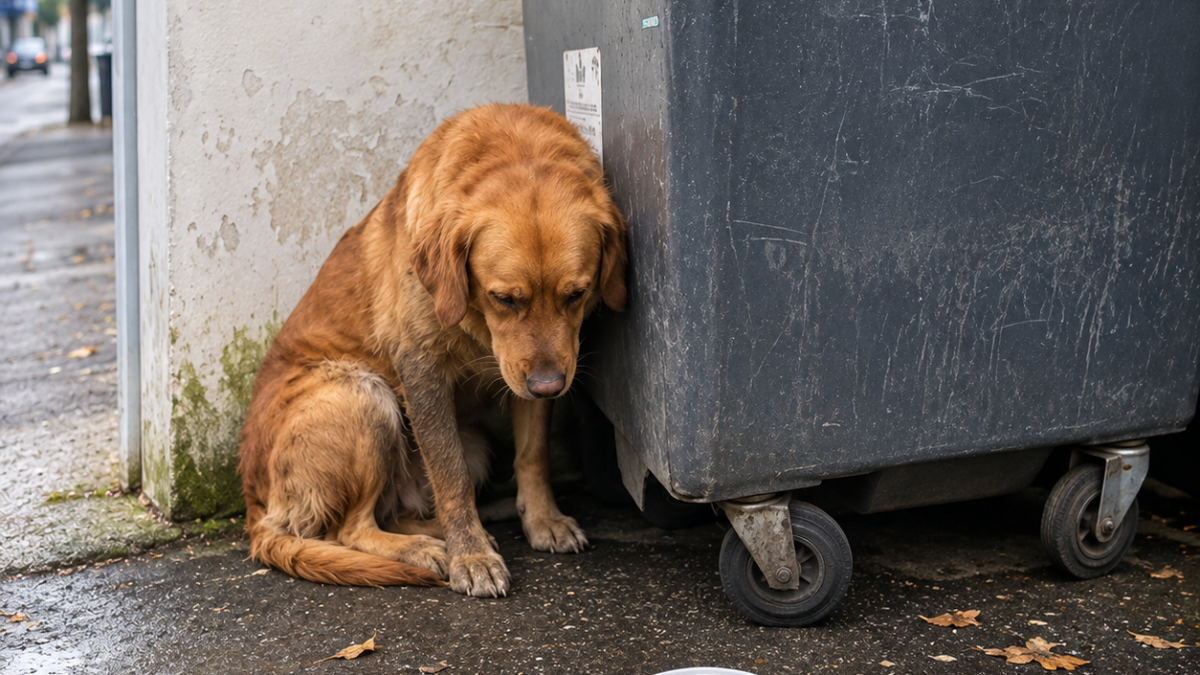
At six in the morning, a terrified Labrador was clawing at the dumpster behind our supermarket so desperately that she kept slipping on the frozen pavement, yet she refused every bite of food I put in front of her.
Whenever I moved toward her, she flattened herself against the wall as if she expected me to hit her—but the second I backed away, she dragged herself straight back to that same metal container.
Then our security guard pulled up the footage from 5:07 a.m., and what we saw made both of us realize she hadn’t come to our store because she was hungry.
My name is Isabelle Martin.
I was fifty-two years old at the time, and I worked as a cleaner at a supermarket outside Tours, France.
My mornings started at 5:30.
Before customers arrived, I mopped the entrance, emptied trash cans, cleaned the employee areas, and usually made one final trip behind the building to check the loading area.
That Tuesday morning was bitterly cold.
The kind of cold that made your fingers ache even through gloves.
I had just pushed open the service door when I saw her.
A dark-golden Labrador stood near the last dumpster.
Her coat was filthy.
Mud covered all four legs.
She was breathing hard, and when she noticed me, she immediately dropped to the ground.
Not sat.
Dropped.
Her belly pressed against the pavement, her head lowered so far that her chin nearly touched the concrete.
I stopped.
“Easy, sweetheart.”
She didn’t move.
“I’m not going to hurt you.”
Her eyes followed me, but the rest of her body stayed frozen.
I’d seen frightened strays before.
Usually hunger eventually won.
I went inside, filled a plastic bowl with water, found some leftover cooked chicken from my lunch, and returned.
I set both several feet away.
Then I backed off.
She looked at the food.
Then she looked at the dumpster.
She didn’t take a single bite.
I had work to do, so eventually I went back inside.
But I couldn’t forget her.
About an hour and a half later, I checked again.
The food was untouched.
The water looked untouched too.
But the dog was no longer lying still.
She was circling the dumpster.
Sniffing the wheels.
Pushing her nose under the metal edge.
Scratching at the side.
Once, she rose onto her hind legs and tried to reach the lid.
Her paws scraped down the metal.
She landed badly and nearly fell.
I instinctively stepped forward.
The change in her was immediate.
She curled into herself.
Her tail disappeared beneath her belly.
Her head dropped.
I stopped.
“Okay. Okay.”
I backed away.
The moment I did, she stood up again and returned to the dumpster.
That was when I knew something was wrong.
I called Thomas, our security guard.
“Can you come behind the store?”
“What happened?”
“There’s a dog out here.”
“A stray?”
“I don’t know. She’s been here since before six.”
Thomas arrived wearing his heavy security jacket.
He watched her for maybe thirty seconds.
The Labrador ignored the food.
She ignored us.
She moved around the dumpster again, pressed her nose against one corner, and whined.
Thomas frowned.
“She’s not looking for garbage.”
“I know.”
“Watch her.”
The dog circled once more.
Same corner.
Same lid.
Same desperate scratching.
Thomas looked at me.
“She knows something is in there.”
A chill moved through me that had nothing to do with the weather.
We went inside the security room.
Thomas pulled up the overnight camera recordings.
He fast-forwarded.
Nothing.
Empty loading area.
A delivery truck.
Rain.
Then at 5:07 a.m., headlights appeared.
“Stop.”
Thomas froze the image.
A dark car drove behind the supermarket and stopped beside the dumpsters.
A man stepped out.
He opened his trunk.
Then he lifted out a cardboard box.
Even on the grainy footage, I could see thick tape wrapped around the top.
He carried it to the last dumpster.
Lifted the lid.
Dropped the box inside.
Closed the lid.
Then drove away.
Neither Thomas nor I spoke.
He fast-forwarded again.
At 5:51, the Labrador appeared at the edge of the camera view.
She was running badly, almost stumbling.
She lowered her nose to the pavement.
Moved along the route the car had taken.
Then she stopped directly in front of the dumpster.
She rose onto her hind legs.
Fell.
Tried again.
And again.
Finally, she curled up directly in front of it.
Thomas paused the video.
Through the security-room window, we could still see her outside.
Waiting.
Thomas slowly stood.
“Isabelle…”
He didn’t finish.
He didn’t need to.
He grabbed a pair of heavy gloves.
I followed him toward the service door.
And when I looked through the glass at that trembling dog one last time, I knew we couldn’t make her wait another minute.
PART 2
Thomas reached the dumpster first.
The Labrador immediately stood.
For one hopeful second, I thought she might come toward us.
Instead, when Thomas touched the metal lid, she panicked.
She lunged forward.
Not to bite.
To stop him.
Her front paws hit the side of the dumpster, and she let out a sharp, desperate bark.
Thomas froze.
“Easy.”
I moved several feet to his right and crouched.
“It’s okay, sweetheart.”
She looked between us.
“Whatever is in there,” I whispered, “we’re trying to help.”
Of course she couldn’t understand my words.
But she could understand tone.
I kept talking.
Thomas slowly raised the lid.
The Labrador began whining.
The sound went straight through me.
Thomas leaned over.
Then stopped moving.
“What?”
He didn’t answer.
“Thomas?”
His face had changed.
“There’s a box.”
“The same one?”
“I think so.”
“Can you reach it?”
“It’s down toward the front.”
He grabbed the long metal hook we used for retrieving objects that had fallen behind the loading equipment.
He caught the edge of the cardboard.
Pulled.
The box scraped against the inside of the dumpster.
The Labrador went frantic.
She jumped against the metal again.
I moved closer to her.
“Almost.”
Thomas dragged the box upward.
It was crushed on one side.
Dark moisture had soaked through the bottom.
The tape across the top was still intact.
Then I heard something.
I raised my hand.
“Wait.”
Thomas stopped.
“What?”
“Listen.”
For several seconds, there was only the hum of the building ventilation system.
Then it came again.
A tiny sound.
So faint I thought I might have imagined it.
A whimper.
Thomas looked at me.
I looked at the Labrador.
She was staring directly at the box.
“Oh my God.”
Thomas hauled it out.
The moment he set it on the ground, the Labrador rushed forward.
She stopped inches away.
Sniffed every side.
Then began licking the cardboard.
Her entire body was shaking.
Thomas pulled a box cutter from his pocket.
“Careful,” I said.
“I know.”
He sliced through the tape.
The Labrador pushed her nose toward his hands.
Thomas opened one flap.
Then another.
For one second, I couldn’t understand what I was seeing.
There was a blanket.
Dirty.
Wet.
And underneath it—
Movement.
“Oh, no.”
I dropped to my knees.
Puppies.
Six of them.
Tiny.
Much too young to be away from their mother.
They were piled on top of one another, their bodies cold and trembling.
One let out another weak cry.
The Labrador pushed past my arm.
She buried her face into the box.
She sniffed one puppy.
Then another.
Then she made a sound I will never forget.
It wasn’t a bark.
It wasn’t quite a whine.
It was almost a sob.
The puppies immediately became more active.
One lifted its head.
Another crawled toward her nose.
The Labrador began licking them frantically.
Thomas swore under his breath.
“She’s their mother.”
I couldn’t speak.
For almost two hours, that dog had stayed beside the dumpster.
Hungry.
Freezing.
Terrified of us.
She could have left.
She could have searched for food.
She could have run from humans entirely.
Instead, she had stayed with her babies.
Even though she couldn’t reach them.
Even though she didn’t know whether anyone would help.
I reached toward the nearest puppy.
The Labrador stiffened.
I stopped.
“You’re right.”
I pulled my hand back.
“They’re yours.”
Thomas had already taken out his phone.
“I’m calling the animal rescue.”
“Tell them some of the puppies are barely moving.”
He nodded.
The supermarket wasn’t open yet, but several employees had started arriving.
Within minutes, word spread.
Nathalie from the bakery came outside with towels.
Our assistant manager, Alain, brought blankets from the employee emergency cabinet.
Someone found a large plastic crate.
Someone else brought warm water bottles wrapped in towels.
I stayed on the ground beside the Labrador.
We eventually moved the entire cardboard box into the heated loading area.
The mother followed every inch.
She wouldn’t let it leave her sight.
Inside, under better lighting, I got my first real look at her.
She was much thinner than I had realized.
Her ribs were visible beneath the dirty coat.
The skin around her neck was rubbed raw.
There was an old mark where a collar had probably been too tight.
Her teats were swollen from nursing.
One front paw had a fresh cut.
And every time a man moved too quickly near her, she lowered herself.
Thomas noticed too.
“Someone’s been rough with her.”
I didn’t answer.
I didn’t want to imagine it.
We offered food again.
This time she ate.
But only after we placed the bowl beside the puppies.
She swallowed so quickly I worried she’d choke.
Then she drank nearly an entire bowl of water.
After that, she lay down against the cardboard box.
One by one, the puppies crawled toward her.
The transformation was immediate.
The shaking dog who had spent the morning terrified became completely still.
Protective.
Focused.
She began nursing them.
I sat a few feet away.
“Good girl.”
Her eyes met mine.
For the first time, she didn’t lower her head.
The animal rescue arrived twenty-five minutes later.
A veterinarian came with them.
Her name was Dr. Claire Moreau.
She examined the puppies first.
“How long were they in the dumpster?”
“We don’t know exactly,” Thomas said. “The box went in at 5:07. We opened it a little after eight.”
Claire’s jaw tightened.
“Three hours in this temperature.”
“Are they going to survive?”
She didn’t give me false reassurance.
“I don’t know yet.”
My stomach dropped.
She checked them one by one.
Four were cold but responsive.
One was very weak.
The smallest puppy barely moved at all.
Claire rubbed him vigorously with a towel.
“Come on.”
The mother tried to stand.
I rested my hand near her shoulder without touching.
“It’s okay.”
Claire listened to the tiny puppy’s chest.
“Heartbeat’s there.”
She wrapped him against a warmed pad.
“We need to move.”
The mother stood immediately.
“We’re taking her too,” Claire said.
“Obviously.”
Claire looked at me.
“You’d be surprised.”
That sentence made me angry in a way I couldn’t explain.
We loaded the puppies into a heated transport crate.
The Labrador refused to enter the second crate.
Every time someone tried to guide her inside, she pulled toward the puppies.
Finally, Claire opened the larger transport compartment.
“Put her with them.”
The mother climbed in before anyone had to help.
She curled around the puppies.
The smallest one disappeared against her chest.
Before the rescue vehicle left, I crouched by the door.
The Labrador looked at me.
I reached through slowly.
This time, she didn’t flatten herself.
I touched two fingers to the side of her face.
“You found them.”
Her eyes closed for half a second.
Then the door shut.
I stood there until the van disappeared.
Thomas came beside me.
“You okay?”
“No.”
“Me neither.”
For the rest of my shift, I couldn’t concentrate.
Every trash bag felt heavier.
Every cardboard box made me think of those puppies.
At eleven, Claire called the supermarket.
Alain found me near aisle seven.
“Isabelle, phone.”
I almost ran.
“Hello?”
“It’s Claire from the rescue.”
“How are they?”
“The mother is exhausted and dehydrated, but stable.”
“And the puppies?”
A pause.
My hand tightened around the phone.
“Five are responding well to warmth and feeding.”
“Five.”
“The smallest male is critical.”
I closed my eyes.
“Is he alive?”
“Yes.”
“Then don’t give up.”
“We aren’t.”
I swallowed.
“Have you found a microchip?”
“Not yet. We’re scanning her again after she settles.”
“Please call me.”
“I will.”
When I hung up, I realized Thomas was standing several feet away.
“Five doing okay?”
I nodded.
“And one?”
“Critical.”
He looked toward the security office.
“We need to find that car.”
That afternoon, our store manager agreed to save every relevant camera recording.
Thomas and I went through them frame by frame.
The license plate was partially visible when the car turned.
We could make out most of it.
Not all.
Thomas contacted the police.
An officer arrived shortly before the end of my shift.
I showed him the footage.
He watched the man take the box from the trunk.
Watched him throw it into the dumpster.
Then he watched the dog arrive.
“Can I have a copy?”
“Already made one,” Thomas said.
The officer nodded.
“The rescue needs to document every injury.”
“They are.”
“Has the dog been chipped?”
“We’re waiting to hear.”
He took my statement.
Thomas gave his.
Then the officer asked a question that hadn’t occurred to me.
“Did the man ever get the dog out of his car?”
“No.”
“So she wasn’t dumped here at the same time.”
“No.”
He pointed to the screen.
“She came from the road nearly forty-five minutes later.”
“I know.”
“Which means either she was already loose…”
He paused.
“Or she followed him.”
I looked at the frozen image of the Labrador running into view.
“From where?”
“That’s what we’d like to know.”
I went home that evening with the same scene replaying in my head.
The car.
The box.
The dumpster lid.
Then the mother appearing later.
Running.
Searching.
How far had she come?
What had happened before the camera caught her?
My apartment felt unusually warm when I stepped inside.
My husband, Marc, had died six years earlier.
My daughter lived in Lyon with her husband and their little boy.
Most nights, I was used to being alone.
That night, the silence bothered me.
I made tea and didn’t drink it.
At 8:42, my phone rang.
Claire.
I answered immediately.
“The little one?”
“Still alive.”
I sat down.
“Thank God.”
“He’s stronger than he was this morning.”
“And the mother?”
“We found a microchip.”
My heart jumped.
“So you know who owns her.”
“We know who she’s registered to.”
“Who?”
“I’m not allowed to give you the personal details.”
I understood.
“Is it the man?”
“We don’t know yet.”
“But you’ve spoken to the police?”
“Yes.”
Claire’s voice changed slightly.
“There’s something else.”
“What?”
“The dog’s name is Maya.”
Maya.
I repeated it quietly.
“She’s six years old.”
“Six.”
“And based on her physical condition, I don’t think this was her first litter.”
I stared at my dark kitchen window.
“How many?”
“We can’t know for certain.”
“Has she been bred repeatedly?”
“It looks that way.”
My anger returned.
“What about the injuries?”
“Some are recent. Some aren’t.”
“What does that mean?”
Claire hesitated.
“She has scarring around the neck. Old pressure sores near the hind legs. Her nails are badly overgrown. She’s underweight.”
I closed my eyes.
“Someone kept her like that?”
“I can only document what I see.”
I knew why she was being careful.
But I heard the answer anyway.
Before hanging up, I asked, “Can I visit her?”
Claire was quiet.
Then she said, “Come tomorrow afternoon.”
I barely slept.
The following day after work, I drove directly to the rescue clinic.
Maya was in a quiet room with the puppies.
When I opened the door, she lifted her head.
For one terrible second, I thought she wouldn’t remember me.
Then her tail moved.
Once.
Just once.
But I saw it.
“Hi, sweetheart.”
I sat on the floor.
Maya watched me.
I didn’t approach.
After maybe a minute, she stood.
She walked toward me.
Slowly.
Then she lowered her head and pressed it against my knee.
My eyes filled immediately.
“You’re safe.”
Her tail moved again.
Claire entered behind me.
“She hasn’t done that with many people.”
“I bribed her with supermarket chicken.”
Claire smiled.
Then I looked at the puppies.
They were cleaner now.
Warm.
Five were nursing.
The smallest puppy was in a separate heated bed beside them.
“That’s him?”
Claire nodded.
He was tiny.
Dark gold like his mother.
One white patch on his chest.
“Any better?”
“A little.”
“Does he have a name?”
“No.”
I watched his sides rise and fall.
“Then he needs one.”
Claire raised an eyebrow.
I thought about the dumpster.
The cold.
The fact that he’d made it through three hours inside a taped cardboard box.
“Hope.”
Claire smiled.
“Hope?”
“Espoir sounds too dramatic.”
She laughed.
“Hope it is.”
For the next four days, I stopped at the clinic after every shift.
Maya began meeting me at the kennel door.
Hope improved.
Slowly.
On Friday, Claire let me hold him for the first time.
He fit in both hands.
“Don’t get attached,” she warned.
“Too late.”
“I meant because the legal situation may become complicated.”
I looked at her.
“What happened?”
Claire sat down.
“The registered owner has been contacted.”
My stomach tightened.
“And?”
“He claims Maya ran away three days ago.”
“Three days?”
“Yes.”
“But the man in the video—”
“The police are working on that.”
“Did he ask about the puppies?”
Claire’s expression told me before she spoke.
“He says he didn’t know she had given birth.”
I stared at her.
“What?”
“He claims Maya escaped while pregnant.”
“That’s impossible.”
“I didn’t say I believed him.”
“She was nursing. The puppies were how old?”
“About three weeks.”
“So she supposedly gave birth somewhere while missing?”
“That’s what he’s implying.”
“And then another man happened to put her six puppies in our dumpster?”
Claire didn’t answer.
I stood.
“He’s lying.”
“Probably.”
“Probably?”
“Isabelle, I need you to understand something. We have evidence of abandonment involving the puppies. We have evidence of neglect involving Maya. What we don’t yet have is a complete chain connecting one person to everything.”
“Then find it.”
“The police are trying.”
I walked to the window.
Maya watched me from the blanket.
“What happens if he asks for her back?”
Claire was silent too long.
I turned around.
“No.”
“Isabelle—”
“No.”
“If ownership is legally established—”
“He hurt her.”
“That has to be proven.”
“He kept her until her collar cut into her neck.”
“Documented.”
“He starved her.”
“Documented.”
“He bred her.”
“Likely.”
“And he gets to ask for her back?”
Claire stepped closer.
“He can ask.”
I looked at Maya.
She had lowered her head onto her puppies.
I remembered how she flattened herself against the wall when I first approached.
“No.”
This time I said it quietly.
Claire studied me.
“What are you thinking?”
“I don’t know yet.”
That wasn’t entirely true.
I was thinking that whoever had done this had made one mistake.
He had chosen our dumpster.
Our cameras.
Our security guard.
Our witnesses.
And now he had put six puppies and one terrified mother in front of people who were not going to forget them.
The first break came from Thomas.
He called me Sunday morning.
“Are you home?”
“Yes.”
“I found something.”
“What?”
“Remember the car?”
“Of course.”
“I went back through the footage from the previous month.”
“Why?”
“Because something bothered me.”
I sat straighter.
“What?”
“The driver knew exactly where the cameras were.”
“What do you mean?”
“He kept his head down. Parked close to the wall. He didn’t hesitate when he came in.”
“So?”
“So I wondered whether he’d been here before.”
My heart started pounding.
“And?”
“January 12. Same car.”
“What was he doing?”
“Nothing illegal. He came to the store.”
“Can you see the plate?”
“Perfectly.”
I stood up.
“Thomas.”
“I’ve already called the officer.”
“Is it the same man?”
“Looks like him.”
Within two hours, the police had the complete plate.
By Monday afternoon, they had identified the driver.
His name was Luc Perrin.
Forty-four years old.
He lived less than six miles from the supermarket.
And Maya’s microchip was registered to his address.
When Claire told me, I felt a strange calm.
Not relief.
Something colder.
“So it was him.”
“The police haven’t formally told me every detail.”
“But the address matches.”
“Yes.”
“And the car belongs to him.”
“Yes.”
“And he said Maya ran away.”
“Yes.”
I looked down at Hope sleeping beside my hand.
“Then he didn’t just dump the puppies.”
Claire nodded slowly.
“He lied about it afterward.”
The police went to his property that evening.
I wasn’t there.
I learned what they found later.
Two outdoor kennels.
A dirty shed.
Old dog crates.
Breeding records.
Advertisements printed from online listings.
Photographs of Labrador puppies.
Sales messages.
Empty medication containers.
And, in a locked enclosure behind the shed, another female dog.
A chocolate Labrador.
Thin.
Nursing.
No puppies with her.
When I heard that, I felt physically sick.
“Where are her puppies?”
Claire shook her head.
“They don’t know yet.”
“Is she safe?”
“Yes. They removed her.”
“What about Maya?”
“She’s under protective custody now. He can’t take her while the investigation is active.”
I exhaled for what felt like the first time in days.
Then Claire said, “There’s more.”
I didn’t want more.
“What?”
“Luc Perrin wasn’t the only person selling puppies from that property.”
“Who else?”
“His brother.”
My stomach tightened.
“Was his brother the man in the footage?”
“We don’t know yet.”
The investigation widened.
For the next two weeks, everything seemed to happen at once.
Police interviewed neighbors.
One woman said she regularly heard dogs crying at night.
A delivery driver remembered bringing bulk dog food to the property.
A former buyer contacted the rescue after Maya’s story appeared in a local newspaper.
He had purchased a Labrador puppy from Luc eight months earlier.
The puppy became seriously ill within days.
When he contacted Luc, Luc blocked his number.
Then another buyer came forward.
Then another.
The pattern was always similar.
Cash payment.
No proper health records.
Puppies sold too young.
Sick animals.
No refunds.
No questions.
Maya and the puppies had become evidence in something much larger than a single act of abandonment.
But for me, the most important battle remained Hope.
At four weeks old, he developed pneumonia.
Claire called me at work.
“He’s struggling.”
I left early.
When I arrived, he was in an oxygen enclosure.
Maya paced outside it.
The moment she saw me, she came to the door.
I sat beside her.
For three hours.
She pressed against my leg while we watched Hope breathe.
His tiny chest worked too hard.
Up.
Down.
Pause.
Up.
Down.
I had lost my husband to a heart attack.
One ordinary morning, Marc had kissed me goodbye.
By lunchtime, he was gone.
I knew what helpless waiting felt like.
I knew how terrifying it was to love something while having absolutely no control over whether it stayed.
I put my hand on Maya’s head.
“He’s stubborn.”
She looked at the oxygen enclosure.
“So are you.”
At 9:30 that night, Claire checked him again.
“His oxygen level is improving.”
“Is he going to make it?”
“I can’t promise.”
“I hate that sentence.”
“I know.”
Maya whined.
Claire crouched beside us.
“But he’s fighting.”
Hope survived the night.
Then another.
On the third day, he ate without assistance.
I cried over a puppy eating mush from a saucer.
I wasn’t embarrassed.
Maya watched him eat, then looked at me.
“Your son is dramatic,” I told her.
Her tail thumped against the floor.
The story began spreading around town.
Someone at the supermarket had told a customer.
The customer told a local journalist.
The article was careful not to name Luc while the investigation continued.
But it described the Labrador found outside the supermarket.
The taped box.
The six puppies.
The surveillance footage.
Donations began arriving at the rescue.
Blankets.
Dog food.
Money.
Children sent drawings.
One envelope contained ten euros and a note written in shaky handwriting:
“For the mommy dog because she didn’t leave her babies.”
Claire showed it to me.
I had to turn away for a moment.
Not everyone was kind.
Online, people started arguing.
Some said we were exaggerating.
Others claimed Luc was being judged before trial.
One anonymous account repeatedly wrote that Maya had been “a difficult dog” and that the puppies had already been sick.
Thomas noticed.
“So?”
“So the account was created yesterday.”
“Could be anyone.”
“It keeps mentioning details that were never published.”
That got my attention.
“What details?”
“The shed.”
My stomach tightened.
The newspaper hadn’t mentioned the shed.
Neither had the rescue.
Only police, veterinary staff, and a few of us knew.
Thomas took screenshots.
We gave them to the investigator.
Two days later, the anonymous account disappeared.
Then Luc came to the supermarket.
I was mopping near the employee entrance when Thomas found me.
“Don’t go outside.”
I looked up.
“What happened?”
“He’s here.”
“Who?”
Thomas’s face answered.
“Luc?”
He nodded.
My heart hammered once.
Hard.
“Where?”
“Front parking lot.”
“Why?”
“Says he wants to talk to you.”
I put down the mop.
Thomas blocked my path.
“No.”
“Move.”
“Absolutely not.”
“He came to my workplace.”
“Exactly why you’re not going out alone.”
Our manager called the police.
Luc didn’t wait.
He walked into the store.
I saw him from twenty yards away.
I recognized him immediately from the footage.
Average height.
Dark jacket.
Short hair.
Nothing remarkable.
That disturbed me.
Some part of me had expected cruelty to have a face.
Something obvious.
Instead he looked like a man you could stand behind at a bakery.
Thomas stepped between us.
“You need to leave.”
Luc looked around him.
“Isabelle?”
I didn’t answer.
His eyes found me.
“You.”
My skin went cold.
Thomas raised one hand.
“Sir, leave the store.”
Luc ignored him.
“Do you know what you’ve done?”
For a moment, I was too stunned to respond.
Then I almost laughed.
“What I’ve done?”
“You turned everyone against me.”
“No.”
I walked closer, stopping behind Thomas.
“You did that yourself.”
His face tightened.
“You don’t know anything.”
“I know what I saw.”
“You saw a box.”
“I opened the box.”
He looked away for half a second.
That was enough.
“You knew what was inside.”
His jaw clenched.
“They were sick.”
“So you put them in a dumpster?”
“I didn’t say that.”
“The camera did.”
Several customers had stopped nearby.
Luc noticed.
His voice dropped.
“You think you’re some hero?”
“No.”
“You’re a supermarket cleaner.”
Thomas shifted closer.
“That’s enough.”
Luc’s eyes stayed on me.
“You stole my dog.”
I felt something inside me go completely still.
“Maya isn’t property you get to throw away when she stops making you money.”
His face changed at the sound of her name.
“Her name is Roxie.”
I stared at him.
The rescue’s chip record said Maya.
The old veterinary papers the police recovered said Maya.
He didn’t even remember her name.
I don’t know why that detail hurt so much.
“You don’t know her name.”
He realized his mistake.
Too late.
I stepped around Thomas slightly.
“Do you know what she did after you drove away?”
Luc said nothing.
“She followed you.”
Silence.
“She ran until her paws bled.”
“Isabelle,” Thomas warned quietly.
But I couldn’t stop.
“She found that dumpster. She knew her babies were inside. And she stayed there in the cold because unlike you, she refused to abandon them.”
Luc’s face hardened.
“Those dogs were mine.”
“No.”
The word came from somewhere deep inside me.
“They were dependent on you.”
I pointed toward the security cameras.
“And you failed every one of them.”
His fists tightened.
Thomas immediately stepped fully between us.
“Leave.”
Luc shoved Thomas’s shoulder.
That was his second major mistake.
The first had been choosing a dumpster under a camera.
The police arrived less than four minutes later.
By then, Luc was standing near the entrance shouting that we had destroyed his reputation.
Customers had filmed everything.
Our cameras recorded everything.
Thomas had two witnesses to the shove.
Luc left in the back of a police vehicle.
I stood in the employee room afterward shaking so badly I couldn’t hold my coffee.
Thomas sat across from me.
“You okay?”
“Yes.”
“You’re lying.”
“Yes.”
He smiled slightly.
Then I started crying.
Not because Luc had frightened me.
Though he had.
I cried because when he called Maya by the wrong name, I understood something.
She had spent years being useful to him without ever being loved by him.
She gave him puppies.
Money.
Whatever he wanted.
And he hadn’t even bothered to remember who she was.
That evening, I went directly to the rescue.
Maya was lying on a blanket.
Hope was climbing clumsily over one of his sisters.
I sat down.
Maya came to me.
I buried my face against her neck.
“Your name is Maya.”
She licked my cheek.
“I know your name.”
For the first time since Marc died, I cried into the fur of another living creature and didn’t care who saw.
The legal process moved slowly.
Painfully slowly.
Luc and his brother denied intentionally harming any dogs.
Their lawyer argued the puppies had been abandoned because they believed them to be dead or dying.
That lie lasted until the veterinary reports were introduced.
All six puppies had been alive.
Five had been in reasonably stable condition before prolonged cold exposure.
Hope’s pneumonia was consistent with that exposure.
Then investigators recovered messages from Luc’s phone.
One message to his brother was sent at 4:41 that Tuesday morning.
It said:
“Get rid of the litter before she starts making noise again.”
Another message came nineteen minutes later.
“Done.”
I read those words months afterward.
I had to put the paper down.
Get rid of the litter.
Six living animals.
That’s what they were to him.
A litter.
An inconvenience.
Something to dispose of before sunrise.
The most damaging evidence came from Luc himself.
During questioning, he insisted Maya had escaped before he knew the puppies existed.
Investigators then recovered video from a neighbor’s doorbell camera.
At 4:48 that morning, Luc’s car had left his property.
Maya could be seen behind a fence.
Pacing.
When the car disappeared, she began jumping against the gate.
At 5:16, another camera caught her on the road.
Dragging a broken length of nylon tether.
She had broken free.
Then she followed the road.
Nearly five miles.
Five miles.
In winter darkness.
After the car carrying her puppies.
I watched that footage once.
Only once.
Maya ran with her nose down.
Stopped at intersections.
Searched.
Ran again.
At one point, a vehicle passed close enough that she jumped into a ditch.
Then she climbed back onto the road and kept going.
I thought about how many people called animals stupid.
Maya had followed the fading scent of a car through several miles of roads and found the exact dumpster where her babies had been thrown.
Then she had waited for help.
I don’t know if that was intelligence.
Instinct.
Love.
Maybe all three.
I only know that I had never seen anything more determined.
By the time the case reached court, all six puppies had survived.
Even Hope.
He remained the smallest.
And the loudest.
The rescue began accepting adoption applications, but because of the legal case, no puppy could leave immediately.
More than three hundred people applied.
Three hundred.
For puppies someone had treated like trash.
Claire and the rescue team screened every home carefully.
No impulse adoptions.
No backyard breeders.
No one looking for a “cheap Labrador.”
Potential adopters had to understand what the puppies had survived.
I secretly hoped nobody would apply for Hope.
Claire figured that out quickly.
“You know you’re allowed to admit it.”
“Admit what?”
“You want him.”
“I do not.”
“Isabelle.”
“I work full time.”
“So?”
“My apartment isn’t huge.”
“You have a ground-floor garden.”
“I’ve never raised a puppy.”
“You raised a daughter.”
“That was different.”
“Was it?”
“Children don’t chew table legs.”
Claire stared at me.
“My daughter did once.”
We both laughed.
Then Maya came over and rested her chin on my knee.
Claire looked at her.
“And her?”
I stopped laughing.
“What about her?”
“When the case is finished, she’ll need a home too.”
My throat tightened.
I had avoided thinking that far ahead.
“You know the answer.”
“I want to hear you say it.”
I scratched Maya’s ear.
“If they’ll let me…”
Maya leaned harder against my leg.
“She’s coming home with me.”
“And Hope?”
I looked across the room.
The little puppy was attacking a towel with the confidence of an animal who had no memory of nearly dying.
I sighed.
“That depends.”
“On?”
“Whether I lose my mind.”
Hope tripped over his own feet and landed face-first in the blanket.
Claire smiled.
“Too late.”
The day of the hearing arrived seven months after I first found Maya.
I was asked to testify.
I hated every second of it.
Luc sat across the courtroom.
Clean shirt.
Combed hair.
Quiet expression.
If I hadn’t known him, I might have thought he was nervous.
Maybe even sympathetic.
Then I remembered the box.
The tape.
The dumpster.
I told the court everything.
5:30 a.m.
The service door.
Maya against the wall.
The untouched food.
The scratching.
The security footage.
The cardboard box.
When the prosecutor asked what happened when we opened it, my voice almost broke.
“We found six puppies.”
“Were they moving?”
“Yes.”
“Was Maya present?”
“Yes.”
“What did she do?”
I looked toward Luc.
“She tried to get to them before we had even completely opened the box.”
“How would you describe her behavior?”
“Desperate.”
“Was she aggressive?”
“No.”
“Did she attempt to bite anyone?”
“No.”
“What happened once she was reunited with the puppies?”
“She lay down with them.”
I swallowed.
“They started nursing.”
The prosecutor paused.
“Mrs. Martin, before that morning, had you ever seen Maya?”
“No.”
“Did you have any reason to fabricate what you witnessed?”
“No.”
The defense attorney stood later.
He asked whether I was an animal behavior expert.
No.
A veterinarian?
No.
Could I prove Maya knew the puppies were in the dumpster?
I looked at him.
“She ran five miles to that exact dumpster.”
“That isn’t what I asked.”
“No. I can’t tell you what’s inside a dog’s mind.”
“Thank you.”
“But I can tell you she didn’t leave.”
He looked irritated.
“Mrs. Martin—”
“You asked what I observed.”
The judge allowed me to finish.
“She stayed there for almost two hours when food was sitting beside her. She kept trying to get inside one specific dumpster. The second we pulled out that box, she went directly to it.”
The defense attorney returned to his table.
I looked at Luc.
He didn’t look back.
The veterinary evidence followed.
Then the breeding records.
The online advertisements.
The neighbor statements.
The recovered messages.
The security recordings.
The footage of Maya breaking free.
Luc’s brother eventually changed his plea.
That broke the case open.
He admitted Luc had ordered him to dispose of the puppies after several became difficult to sell.
He admitted the dogs had been bred repeatedly.
He admitted Maya was kept tethered for long periods because she tried to stay near the puppies.
Then he admitted something none of us knew.
Luc had wanted to get rid of Maya too.
Not that morning.
Later.
Once the litter was gone.
She was six.
To Luc, that apparently made her less valuable.
When I heard that, I stopped feeling angry.
I felt something colder.
He had thrown away her puppies.
Then planned to throw away their mother.
He simply hadn’t expected her to break free first.
The court found Luc responsible for multiple animal welfare violations, abandonment, neglect, and falsification connected to the dogs’ records.
He received a custodial sentence, part of which was suspended under the conditions imposed by the court.
He was fined.
The breeding operation was shut down.
Most importantly to me, he received a long-term ban from owning or breeding animals.
All animals seized from the property were permanently surrendered.
Maya was free.
The chocolate Labrador, later named Ruby, was free.
And six puppies no longer legally belonged to the man who had thrown them into a dumpster.
People later asked whether I felt satisfied watching Luc leave court.
Yes.
But not in the way they probably meant.
I didn’t want to see him hurt.
I didn’t want someone to throw him into a cold metal container and make him understand fear.
I had thought about revenge during the worst moments.
I would be lying if I said I hadn’t.
But standing outside the courthouse, I realized the best revenge was much simpler.
Luc had treated Maya like a machine for producing money.
Now he would never profit from her again.
He had treated six puppies like garbage.
Now families were waiting to give them beds, toys, veterinary care, and names.
He had tried to erase them before sunrise.
Instead, hundreds of people knew their story.
He had told me I was “just a supermarket cleaner.”
Maybe I was.
But a supermarket cleaner had opened the box he’d hoped nobody would ever find.
That was enough for me.
Three days after the judgment, Claire called.
“Are you sitting down?”
“No.”
“Sit.”
I sat at my kitchen table.
“Okay.”
“Maya is officially available for adoption.”
My throat tightened.
“And?”
“And there are applications.”
I stopped breathing.
Claire was quiet.
Then she laughed.
“One from a fifty-two-year-old cleaner outside Tours with terrible impulse control.”
I covered my eyes.
“You scared me.”
“Good.”
“Claire.”
“Do you still want her?”
“Yes.”
“You didn’t even let me finish.”
“Yes.”
“Then come tomorrow.”
I barely slept.
The next afternoon, I arrived with a collar.
Not a cheap collar.
A soft red one.
Wide enough that it wouldn’t hurt her neck.
I also bought a tag.
**MAYA**
On the back:
**HOME**
When Claire brought her into the reception area, Maya saw me.
She froze.
Then ran.
I’d never seen her run toward a person before.
She hit me hard enough that I nearly fell backward.
I dropped to my knees.
She pushed her entire body against me.
I laughed and cried at the same time.
“You’re coming home.”
She licked my face.
“Forever.”
Claire handed me the adoption paperwork.
Then she placed another form underneath.
I looked at it.
“No.”
“You haven’t read it.”
“I know what it is.”
“Application for Hope.”
“Claire.”
“You already filled out half of it.”
“I was emotionally vulnerable.”
“You wrote three pages about why you wanted him.”
“Temporary insanity.”
A high-pitched bark came from behind the counter.
Hope appeared in the arms of a volunteer.
He was almost six months old now.
Long legs.
Oversized ears.
Completely ridiculous.
The moment he saw Maya, he started squirming.
The volunteer put him down.
He ran straight toward her.
Maya lowered herself.
Hope crashed into her chest.
She licked his face while he climbed over her.
I stood there with the adoption paperwork in my hand.
Claire said nothing.
She didn’t have to.
I looked at Maya.
Then Hope.
Then at my bank account in my imagination.
“You’re evil.”
Claire smiled.
“Is that a yes?”
I sighed.
“Give me the pen.”
Hope came home with us.
So much for practical decisions.
The first week was chaos.
Maya was easy.
She entered my house, walked through every room, found the rug in the living room, and lay down.
Hope ate one of my slippers.
Then part of a magazine.
Then tried to carry a toilet brush through the hallway.
At 2:00 a.m. on his third night, I found him sitting inside the shower.
I stared at him.
He stared at me.
“What are you doing?”
His tail wagged.
Maya watched from the doorway with an expression that seemed to say he was my problem now.
But something else happened too.
Maya changed.
At first, sudden movements still frightened her.
If I raised a broom too quickly, she crouched.
If a man with a deep voice came into the garden, she stayed near the back door.
The first time I accidentally dropped a metal pan, she ran into the bedroom and hid for twenty minutes.
I didn’t force her out.
I sat in the hallway.
Hope sat beside me.
Eventually Maya appeared.
I held out my hand.
She touched it with her nose.
“Nobody’s angry.”
Week by week, she began believing me.
She learned that doors opening did not mean she would be dragged outside.
That collars could be loose.
That food arrived every morning and every evening.
That nobody took her bowl away before she finished.
That sleeping indoors was allowed.
That the couch belonged to her if she wanted it.
And most importantly, she learned that Hope could leave a room and come back.
At first, if I took him to the veterinarian without her, she paced.
Then she waited by the window.
Eventually, she simply slept until we returned.
Healing didn’t erase what happened.
It taught her the past wasn’t happening anymore.
The other five puppies found homes too.
Claire insisted I meet each family before the adoption.
“Why me?”
“Because they’ll listen to you.”
“I clean supermarket floors.”
“Apparently that’s your answer to everything now.”
The first puppy, a female we called Poppy, went to a retired couple with a fenced garden and two grandchildren.
Her brother Leo went to a young veterinarian.
Another, Max, was adopted by a firefighter and his wife.
Two sisters, Daisy and Olive, were adopted together by a family who had lost their old Labrador the year before.
On adoption day, Maya watched each puppy leave.
That worried me.
I remembered how she had fought to reach them at the dumpster.
But something beautiful happened.
Each family came into the room first.
They sat with Maya.
Let her smell them.
Played with the puppy while she watched.
Nobody rushed.
When Poppy left, Maya walked to the door.
She whined once.
Then returned to me.
When Leo left, she did the same.
By the final adoption, she seemed to understand.
They weren’t being thrown away.
They were being carried somewhere safe.
Daisy and Olive left together.
Their new family sent me a photograph that night.
Two puppies asleep on a child’s bed.
I showed Maya my phone.
“Look.”
She sniffed the screen.
“They’re okay.”
Maybe she understood.
Maybe she didn’t.
I needed to say it anyway.
A year passed.
Then two.
The supermarket replaced the old dumpsters.
Thomas joked that we should keep the last one in a museum.
I told him absolutely not.
But before it was removed, I walked behind the building one morning.
Same loading area.
Same wall.
Same cold winter air.
For a moment, I could see Maya exactly as she’d been that first day.
Thin.
Muddy.
Terrified.
Waiting in front of a dumpster.
I remembered putting down food and thinking hunger would be enough to make her move.
How little I’d understood.
Thomas came outside.
“You thinking about that morning?”
“Yes.”
“Me too sometimes.”
I looked at the spot.
“What do you think would’ve happened if I hadn’t come back outside?”
“Someone else would’ve found her.”
“You don’t know that.”
“No.”
He put his hands in his pockets.
“But you did.”
I looked at him.
“So did you.”
He smiled.
“We made a decent team.”
“You almost fell into a dumpster.”
“Heroically.”
“You screamed when the cardboard moved.”
“I did not scream.”
“You absolutely screamed.”
“It was a masculine emergency noise.”
I laughed.
That felt important.
For a long time, I couldn’t think about that morning without feeling sick.
Now I could remember something else.
Not only what Luc had done.
What everyone afterward had done.
Thomas checking the cameras.
Nathalie bringing towels.
Claire staying awake with Hope.
The police tracing the car.
Neighbors speaking up.
Families adopting.
Children sending coins.
People choosing to care.
Cruelty had started the story.
But cruelty didn’t get to decide how it ended.
Luc disappeared from our lives.
I heard once that after his release he moved away from the area.
I didn’t ask where.
I didn’t care.
The only thing that mattered was that he couldn’t legally own dogs.
Years later, I unexpectedly saw him again.
I was leaving a garden center with a bag of potting soil.
Maya and Hope were waiting in my car.
The windows were cracked.
It was a cool day.
As I pushed my cart through the parking lot, I saw a man coming from the opposite direction.
Luc.
He looked older.
So did I.
For half a second, neither of us moved.
Then he noticed my car.
Hope’s head was sticking up behind the passenger seat.
Maya was beside him.
Luc stared.
Maya saw him.
Her body changed instantly.
Her head lowered.
Her ears moved back.
Even after all those years, she remembered.
I felt anger rise in me.
Then Hope nudged her.
Maya looked at him.
Then at me through the windshield.
Her ears relaxed.
She sat down again.
Luc watched.
I expected him to say something.
He didn’t.
I walked past him.
Then he spoke.
“She’s still alive.”
I stopped.
I turned.
“Yes.”
He looked toward Maya.
“She looks different.”
I almost laughed.
Her coat was thick now.
Her ribs were covered.
The scar around her neck was hidden beneath healthy fur.
Her eyes were clear.
She wasn’t crouching.
She wasn’t chained.
She wasn’t pregnant.
She wasn’t afraid of every hand reaching toward her.
“She is different.”
Luc looked at me.
“I paid for that dog.”
There it was.
Years later.
Still the same.
Not “I raised her.”
Not “I loved her.”
Not even “she was mine.”
I paid for that dog.
I walked closer.
“You know what I remember most about you?”
He didn’t answer.
“You didn’t know her name.”
His face hardened.
“That’s not true.”
“At the supermarket, you called her Roxie.”
He looked away.
“Her name was on the chip.”
“No.”
I shook my head.
“Her name was in every vet record. On the documents from your own property. But you didn’t remember.”
He said nothing.
I looked toward the car.
Maya was watching me.
Hope had one paw against the back of my seat.
“You know her name now?”
Luc stayed silent.
I smiled.
“That’s what I thought.”
I pushed my cart away.
He called after me.
“You think you won?”
I stopped once more.
I didn’t turn around immediately.
Then I looked over my shoulder.
“No.”
I nodded toward Maya.
“She did.”
I got into the car.
Maya leaned over the center console and touched her nose to my shoulder.
Hope immediately tried to climb into the front seat.
“Absolutely not.”
His tail wagged.
I started the engine.
In the mirror, Luc became smaller.
Then disappeared.
That was the last time I ever saw him.
And strangely, that was the moment I finally understood revenge.
For years, part of me had wanted him to suffer.
Not because I’m proud of anger.
Because I’d seen the consequences of what he’d done.
I had held Hope when he could barely breathe.
I’d watched Maya flatten herself whenever a man raised his hand too quickly.
I’d seen scars that didn’t belong on any animal.
Anger felt natural.
But the best revenge wasn’t watching Luc lose his business.
It wasn’t the courtroom.
It wasn’t the fines.
It wasn’t even knowing he could never legally breed another litter.
It was Maya sitting in my car without a chain around her neck.
It was Hope beside her, healthy and annoying and very much alive.
It was five other dogs sleeping in homes where people sent me birthday photographs every year.
It was Luc seeing with his own eyes that everything he considered disposable had survived him.
That was enough.
Today, Maya is an old dog.
Her muzzle has turned almost completely white.
She moves more slowly.
Hope, despite being younger, has somehow become even more foolish with age.
He still steals socks.
He still hates the vacuum cleaner.
He still believes every visitor has come specifically to see him.
Maya prefers the garden.
On warm afternoons, she lies beneath the small apple tree near the fence.
Sometimes Hope lies beside her.
Sometimes he doesn’t.
She doesn’t panic anymore when she can’t see him.
But once in a while, he falls asleep close enough that his paw rests across hers.
Whenever I see that, I remember the dumpster.
A taped box.
Six puppies pressed together for warmth.
A mother on the other side of a steel wall.
People sometimes tell me Maya was lucky I found her.
I always correct them.
I didn’t find Maya.
Maya found us.
She followed a car for almost five miles.
She tracked it behind a supermarket.
She found the dumpster.
She stayed.
She scratched.
She waited.
And because she refused to give up, six puppies lived long enough for us to help them.
That matters to me.
Especially now.
Because for years after my husband died, I sometimes believed strength meant accepting whatever life took from you.
Marc was gone.
Nothing could change that.
I went back to work.
Paid bills.
Visited my daughter.
Kept moving.
I thought that was strength.
Maya taught me another kind.
Sometimes strength is refusing to leave.
Sometimes it’s making noise until someone finally pays attention.
Sometimes it’s following what you love farther than anyone thinks you can.
And sometimes it’s trusting the next person who reaches toward you even though the last person taught you that hands can hurt.
There was one final thing I wanted to do before Maya became too old to travel comfortably.
So on the fifth anniversary of the morning we found her, I organized a reunion.
All six puppies.
Maya.
The families.
Claire.
Thomas.
Several supermarket employees.
We used a fenced field behind the rescue.
I worried it might overwhelm her.
I shouldn’t have.
The first to arrive was Poppy.
Then Leo.
Max.
Daisy and Olive.
Hope was already with us.
Six adult Labradors.
All different now.
Different sizes.
Different collars.
Different lives.
For several seconds, Maya simply watched.
Then Poppy ran toward her.
Maya stood.
Poppy slowed.
Their noses touched.
Leo came next.
Then Max.
Within a minute, Maya was surrounded.
Six grown dogs.
Her puppies.
The same six animals that had once fit inside a cardboard box.
Thomas stood beside me.
He didn’t say anything.
Neither did I.
Claire was openly crying.
“I’m not crying,” Thomas announced.
“Nobody asked.”
“Allergies.”
“In November?”
“Very aggressive pollen.”
I laughed through my own tears.
The dogs ran across the field.
Hope chased Max.
Daisy stole a ball.
Olive rolled in the grass.
Poppy kept coming back to Maya.
Maya mostly stood near me, watching.
At one point, all six dogs happened to gather around her.
Not perfectly.
Not like a staged photograph.
Real life doesn’t arrange itself that neatly.
But for maybe five seconds, they were all there.
Claire raised her phone.
“Isabelle.”
I looked.
She took the picture.
I have it framed in my living room.
Maya in the center.
White around her muzzle.
Six healthy adult dogs around her.
Me kneeling behind them.
Thomas claims he was cropped out unfairly.
I tell him history has spoken.
Underneath the photograph, I placed something else.
The red tag from Maya’s first collar after adoption.
The one that said:
**MAYA**
**HOME**
Because that is how I want to remember the story.
Not the dumpster.
Not Luc.
Not the court.
Home.
One winter morning, a man believed six living creatures could disappear beneath a supermarket’s garbage.
He believed nobody would know.
He believed their mother was just another dog he could control.
He was wrong about all three.
The puppies survived.
The truth survived.
And Maya refused to disappear.
Sometimes I still wake before dawn.
Years of early shifts will do that to you.
Maya sleeps beside my bedroom door now.
Hope usually takes up far too much of the hallway.
When I walk toward the kitchen, Maya lifts her head.
Her tail taps the floor.
Once.
Twice.
I kneel beside her.
“Morning, sweetheart.”
She leans into my hand.
There are no chains.
No cold pavement.
No dumpster between her and the ones she loves.
Just an old dog in a warm house.
A ridiculous son asleep nearby.
And a woman who happened to open the right service door at the right moment.
People like to say I saved Maya.
But every time I look at that reunion photograph, I think about the mother who ran five miles through darkness because six tiny lives were depending on her.
I think about how she refused food when they couldn’t eat.
How she refused to leave when she couldn’t reach them.
How she kept scratching at that steel wall even after her paws hurt.
And I know the truth.
Maya saved her puppies first.
All we did was finally listen to her.
And in the end, the man who tried to throw her family away didn’t get the last word.
She did.








