A Soaked Old Dog Kept Clawing at Our Nursing Home Doors—Then His Owner’s Daughter Begged Me Not to Let Him Inside
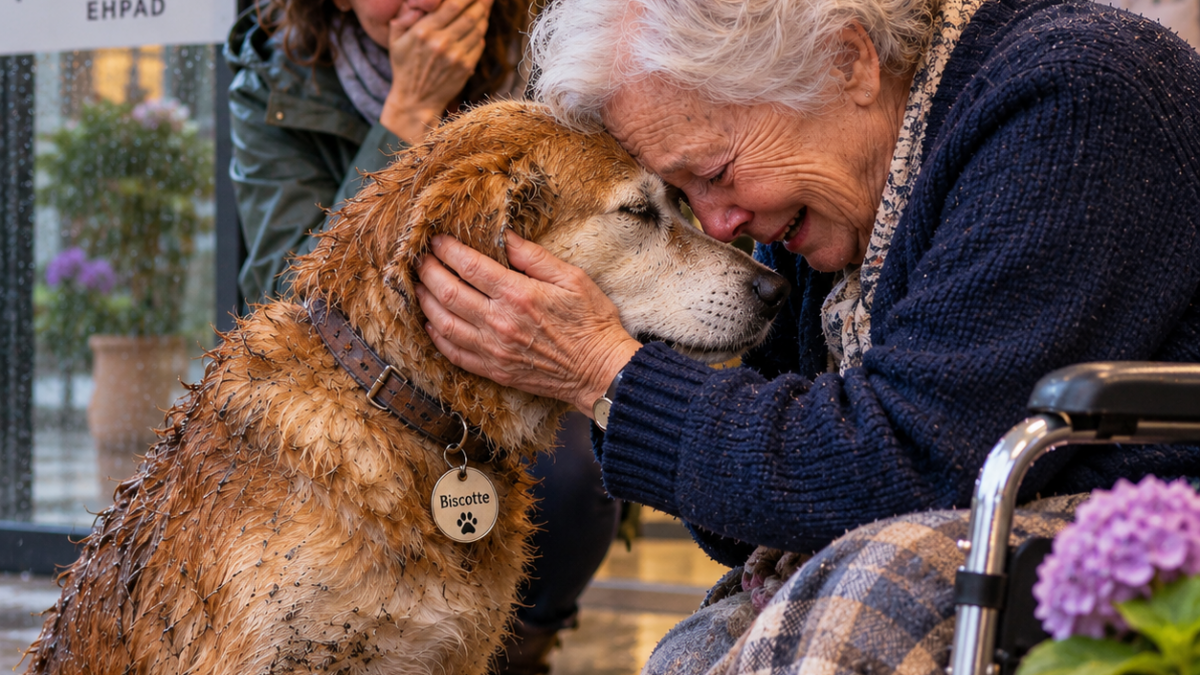
The old dog had been throwing himself against the glass doors of our nursing home for nearly twenty minutes when I finally got close enough to read the name on his collar.
He was soaked, trembling, and gripping a torn blue-and-white dish towel between his teeth as if it were the only thing keeping him from falling apart.
But when I realized who that name belonged to—and why the woman coming to collect him was terrified of letting him inside—I knew this was no ordinary lost-dog call.
I’m Marion, and I worked the front desk at Les Glycines, a care residence outside Tours. That rainy Thursday morning, I was sorting mail when I heard banging against the entrance.
Not knocking.
Claws.
An elderly dog with a white muzzle was braced against the glass, sliding down on muddy paws, backing up, then trying again. Every time the automatic doors opened, he lunged forward as if he knew exactly where he needed to go.
“Get that dog away before he hurts himself,” a visitor snapped.
I hurried outside.
“Easy, boy.”
He didn’t growl. He barely looked at me. His eyes kept darting over my shoulder toward the hallway leading to the residents’ rooms.
That was when I noticed the dish towel. It was old, white with faded blue checks. When I reached for it, he clamped down harder.
“Fine. Keep it.”
Elsa, one of our nursing assistants, brought water. He drank, then returned to the doors.
“He must belong nearby,” she said.
I turned the scratched metal tag on his collar.
BISCOTTE.
Then:
SUZANNE LEMAIRE.
I looked at Elsa.
“First floor?”
Her face changed.
Suzanne had been with us for three weeks after two bad falls at home. She talked about Biscotte constantly. He slept at the foot of her bed, followed her to the bakery, hated thunderstorms. She often asked whether anyone had received a recent picture.
According to Suzanne, Biscotte now lived with her daughter, Maud.
“He’s happy there,” she always said. “Maud has a garden.”
I called the number engraved beneath Suzanne’s name.
A woman answered.
“Hello?”
“I’m calling from Les Glycines. We have a dog outside named Biscotte.”
Silence.
Then: “Oh no. He got out again?”
“You know him?”
“He’s my mother’s dog. I’m coming right now. Please—do not let him inside.”
I glanced at Biscotte.
“Your mother is here.”
“I know.”
“Wouldn’t she want to see him?”
“I’ll explain.”
She hung up.
Twenty minutes later, a gray car pulled in. A woman in her fifties hurried toward us.
“Biscotte!”
The dog turned. His tail moved once.
But instead of going to her, he backed closer to our doors.
Maud reached for his collar.
“Come on. We’re going home.”
Biscotte stepped away.
“I’m sorry,” she told me. “The garden gate was left open during a delivery.”
“How did he know to come here?”
“He was with us the day we moved Mom in. He watched her go through these doors.”
“He crossed the neighborhood for her?”
“He’s thirteen. Apparently he remembers more than I thought.”
“Then let Suzanne see him.”
Maud’s face hardened.
“No.”
“Why?”
“Because if she sees him, she’ll want to leave with him.”
She explained the falls, the hospital stay, the nights she had spent at her mother’s house because Suzanne refused help. She had children, a job, and a home of her own. She looked exhausted enough that I believed every word.
Then Biscotte stood.
A voice carried down the hallway.
“What’s happening at the entrance?”
Suzanne was coming toward us with her walker.
She saw her daughter.
Then the dog.
“Biscotte?”
The dish towel fell from his mouth.
He cried out so sharply that everyone in the lobby stopped.
When the doors opened, he rushed forward, then slowed and pressed his head against Suzanne’s legs.
She buried one hand in his wet fur.
“You found me.”
Maud stepped closer.
“Mom, I have to take him back.”
Suzanne looked up.
“Why didn’t you ever bring him to see me?”
“We talked about this.”
“No,” Suzanne said. “You talked. I waited.”
She picked up the soaked towel and recognized it.
Then she looked at her daughter.
“Maud, do you really think seeing my dog would make me forget everything you’ve done for me?”
Maud opened her mouth.
Nothing came out.
Suzanne’s voice stayed calm.
“Then tell me the real reason you’ve been keeping us apart.”
For the first time since she arrived, Maud stopped watching the clock, pulled a chair toward her mother, and sat down.
[END OF FACEBOOK OPENING]
[FULL STORY CONTINUATION]
Maud kept both hands in her lap for several seconds.
Biscotte was still pressed against Suzanne’s legs, his wet fur darkening the fabric of her pants. Suzanne’s fingers moved slowly over the top of his head as if she were counting every ridge of his skull.
Finally, Maud looked at me.
“Could we have some privacy?”
I started to step away, but Suzanne stopped me.
“No.”
Her daughter’s face tightened.
“Mom.”
“I want Marion here.”
“This is family business.”
Suzanne’s hand stopped moving.
“For three weeks, everyone has decided what I should know because it was ‘family business.’ I would like one person in the room who hasn’t been deciding things for me.”
That landed harder than shouting would have.
Maud looked down.
I almost wished Suzanne hadn’t asked me to stay. I wasn’t a counselor. I worked reception. I answered phones, organized transportation, calmed confused families, and occasionally fixed the printer by unplugging it and pretending I understood technology.
But I stayed.
Maud leaned forward.
“The first week you were here, you called me fourteen times.”
Suzanne frowned.
“I had just moved into a nursing home.”
“I know.”
“You make it sound unreasonable.”
“I’m not saying it was unreasonable.”
“You counted.”
“Yes, Mom. I counted.”
Her voice cracked on the last word.
That was when I understood we weren’t going to hear the confession of some heartless daughter who had stolen an old woman’s dog.
We were going to hear something messier.
Maud rubbed both palms over her face.
“You asked me to bring you home every day. You said you could manage. You said the second fall was bad luck. You told me you didn’t need the walker. You told the physical therapist she was wasting her time. And every time you asked about Biscotte, you said the same thing.”
Suzanne’s chin lifted.
“What?”
“If Biscotte were with me, I’d be fine.”
“I meant emotionally.”
“I didn’t know that.”
“You could have asked.”
“I was afraid of the answer.”
Suzanne stared at her.
Biscotte shifted and sat on her left foot.
Maud continued.
“The first night he stayed at my house, he wouldn’t sleep. He stood by the front door until three in the morning.”
Suzanne’s face changed.
“You told me he settled immediately.”
“I know.”
“The next day?”
“He barely ate.”
“You said he liked your kitchen.”
“He does now.”
“Maud.”
Her daughter swallowed.
“He went back to your house.”
Suzanne’s fingers froze in Biscotte’s fur.
“What?”
“Two days after we moved you here, the gate wasn’t fully latched. He got out.”
“And?”
“I found him sitting on your front step.”
Suzanne closed her eyes.
Maud spoke faster now, as if she had spent weeks holding everything behind her teeth and could no longer stop it.
“I brought him back. Three days later he slipped his leash when Julien was walking him. He went to the bakery.”
The corner of Suzanne’s mouth trembled.
“Our bakery?”
“Yes.”
“He knew the way.”
“Yes.”
“And you never told me.”
“No.”
“Why?”
“Because every time he did something like that, I could already hear what you would say.”
Suzanne looked directly at her.
“Say it.”
“You would say he needed you.”
“He did.”
“And then you would say you needed him.”
“I did.”
“And then you would say you were going home.”
Silence filled the lobby.
Maud leaned forward.
“I could not do it again.”
Suzanne’s expression hardened.
“Do what?”
“Find you on the kitchen floor.”
Her voice broke completely.
For a second, she was no longer an irritated middle-aged daughter fighting with a stubborn mother.
She was frightened.
“I found you twice, Mom.”
Suzanne looked away.
“The first time you had been down there for forty minutes. The second time, nobody knows how long.”
“I know.”
“No, you don’t.”
Maud’s chair scraped as she shifted closer.
“You joke about it now. You say you slipped. But I walked into that kitchen and thought you were dead.”
Suzanne’s eyes filled.
Maud continued.
“Then you came home from rehab and tried to carry laundry down the basement stairs the next morning.”
“I was trying to live.”
“You were trying to pretend nothing had changed.”
“And you were trying to change everything.”
“Because something had changed!”
Her voice rose through the lobby.
Biscotte lifted his head.
Immediately, both women went quiet.
Suzanne stroked his ear until he relaxed.
When Maud spoke again, she whispered.
“I didn’t keep him away because I wanted to punish you.”
Suzanne said nothing.
“I kept him away because I thought if you saw him here, you would decide this place was the enemy. And I would become the person standing between you and your house again.”
“You already became that person.”
“I know.”
The words came so quietly I almost missed them.
Suzanne stared at her daughter.
Then she surprised all of us.
“I don’t want to go home today.”
Maud blinked.
“What?”
“I said I don’t want to go home today.”
“But you’ve been asking—”
“I wanted to know I still had a home to return to.”
“That’s not the same thing.”
“No.”
Suzanne looked around the entrance hall.
“But neither is asking to see my dog.”
Maud’s shoulders dropped.
“I was afraid one would become the other.”
“And instead, you made every question dangerous.”
Neither of them spoke.
Suzanne looked down at Biscotte.
“He’s thirteen.”
“I know.”
“How many years do you think we have left?”
Maud pressed her lips together.
“Mom—”
“No. Answer me.”
“I don’t know.”
“Neither do I.”
Suzanne’s hand trembled as she touched the old dog’s white muzzle.
“I have already lost your father. I have lost my stairs, my kitchen, my garden, my bed, half my clothes, and the ability to stand up without planning the movement first.”
She looked back at her daughter.
“You do not get to decide that I should practice losing him too.”
Maud started crying.
Not dramatically.
She simply lowered her face and wiped at her cheeks with both hands.
I looked away.
It felt too private.
Then Biscotte stood and walked the two steps between them.
He put his nose against Maud’s knee.
She laughed once through her tears.
“Traitor.”
His tail moved.
Suzanne almost smiled.
That was the first crack in the wall.
Not forgiveness.
Not agreement.
Just enough space for both women to breathe.
Our director, Madame Girard, came downstairs twenty minutes later after Elsa quietly explained what had happened.
She found Suzanne sitting in one chair, Maud in another, and Biscotte stretched across both women’s shoes.
Madame Girard looked at me.
“Is the dog staying?”
Maud answered immediately.
“No.”
Suzanne answered at the same time.
“Yes.”
Madame Girard closed her eyes.
“I see.”
I bit the inside of my cheek to keep from smiling.
Suzanne pointed at Biscotte.
“I am not asking you to turn my room into a kennel.”
“That is reassuring.”
“I want him to stay for lunch.”
Maud shook her head.
“Mom.”
“One lunch.”
“He’s wet.”
“We own towels.”
“I have to work.”
“I am not asking you to sit beside him.”
“Who takes him outside?”
“I can.”
Maud stared at her walker.
Suzanne followed her eyes.
“I can walk to the courtyard.”
“With your therapist.”
“Then my therapist and I can take him.”
Madame Girard raised one hand.
“Before we create an entire care plan in the lobby, perhaps we can start with one hour.”
Suzanne looked at the clock.
“Two.”
“One.”
“Ninety minutes.”
Madame Girard smiled.
“Now I understand where Maud gets it.”
Maud actually laughed.
We settled on ninety minutes.
That first visit was not magical.
Biscotte did not heal Suzanne.
Suzanne did not stand up and walk without assistance.
No violin music started playing from the ceiling.
He sniffed every chair in her room, stole a piece of toast from her breakfast tray, drank from the water pitcher before we could stop him, and spent ten full minutes trying to push his nose beneath her wardrobe.
But Suzanne changed.
I saw it.
For three weeks, every conversation about physical therapy had started with resistance.
That afternoon, Elsa told her, “If you want to take Biscotte into the courtyard, we need to practice that turn with the walker.”
Suzanne looked at the distance from her bed to the door.
Normally she would have said she was tired.
Instead she gripped the handles.
“Move the chair.”
She walked.
Slowly.
Painfully.
Biscotte moved beside her.
Whenever she stopped, he stopped.
He did not pull.
At the courtyard door, Suzanne was breathing hard.
But she was smiling.
“Look at that,” she whispered.
Maud stood behind us.
Her arms were folded.
Her expression was impossible to read.
I moved beside her.
“She’s walking farther.”
“I can see.”
“She hasn’t done that for us.”
“I can also see that.”
There was bitterness in her voice.
I understood it.
For months, Maud had driven to appointments, made meals, washed clothes, argued with doctors, checked medications, begged her mother to use a walker, and spent nights half-awake listening for a fall.
Then one muddy thirteen-year-old dog showed up and Suzanne walked down a hallway because he was waiting.
Caregiving has a cruel way of making love look like resentment.
I said quietly, “It doesn’t mean what you did mattered less.”
Maud glanced at me.
“You don’t know that.”
“I know she asked whether seeing Biscotte would make her forget what you’d done for her.”
Her eyes dropped.
“So she knows.”
Maud looked through the glass.
Suzanne had reached the courtyard bench. Biscotte stood beside her while Elsa locked the walker’s brakes.
“She never says it.”
“No.”
“Do mothers become impossible at eighty-one?”
“I’m hoping someone else figures that out before I get there.”
Maud smiled despite herself.
At the end of the visit, we expected trouble.
We were right.
When Maud picked up Biscotte’s leash, he immediately moved behind Suzanne’s walker.
“Come on, Biscotte.”
He stayed.
Suzanne’s face tightened.
I saw her fighting the urge to say something.
Maud tugged gently.
Biscotte planted all four feet.
“Don’t drag him,” Suzanne said.
“I’m not dragging him.”
“He’s old.”
“I know he’s old.”
“Then stop pulling.”
“Mom, please.”
The tension came back so fast it felt as if the ninety peaceful minutes had never happened.
I crouched beside Biscotte.
“Hey, old man.”
He looked at me.
I took a small piece of cheese Elsa had saved from lunch and held it near Maud.
Biscotte hesitated.
Then stepped forward.
Suzanne made a wounded sound.
He turned.
I thought we were about to begin all over again.
Then Suzanne said the smartest thing she could have said.
“Go.”
Biscotte watched her.
“Go with Maud. I’ll see you Saturday.”
Maud looked at her mother.
“Saturday?”
Suzanne’s eyes never left the dog.
“If that works.”
It was the first time she had asked rather than demanded.
Maud swallowed.
“Yes.”
“Saturday.”
Biscotte followed the cheese.
When the doors closed behind him, Suzanne did not ask to go home.
She sat quietly for a long time.
Then she said, “I hate this place a little less.”
I laughed.
“Please don’t put that in the satisfaction survey.”
Saturday became Wednesday.
Wednesday became Sunday.
Within three weeks, Biscotte was visiting three times a week.
The change in Suzanne was obvious enough that her physical therapist, Benoît, wrote it into her notes.
Motivation improved.
Participation improved.
Her walking distance increased.
She stopped refusing group meals on days Biscotte visited.
Most importantly, she stopped asking every morning when she could go home.
Not because she had abandoned the idea.
Because she no longer believed everything she loved existed outside our doors.
But the arrangement created a new problem.
Maud.
She was doing all the driving.
Her house was twenty-five minutes away when traffic was good. She worked in Tours. Her oldest daughter had exams. Her younger son played soccer three evenings a week.
At first, Maud said nothing.
Then she began arriving late.
Once, she brought Biscotte and left his food bag on the roof of the car.
Another time she showed up wearing two different shoes.
I noticed because one was black and one was brown.
“You know your feet don’t match.”
She looked down.
“Oh.”
“That seems bad.”
“I had a conference call at six-thirty, Biscotte threw up at seven, Lucas forgot his sports bag, and Mom called me at seven-twenty to remind me not to be late.”
I winced.
“She does enjoy reminding people.”
Maud leaned against the reception desk.
“I’m tired, Marion.”
“I know.”
“No, I mean really tired.”
I waited.
She rubbed her forehead.
“Julien doesn’t want Biscotte at our house anymore.”
That surprised me.
“Why?”
“He scratched the back door while we were at work. Then he had an accident in the hallway. He’s started pacing again on the days he doesn’t come here.”
“Have you spoken to the vet?”
“Yes.”
“And?”
“Anxiety. Age. Possibly early cognitive decline.”
My stomach tightened.
“Is he sick?”
“Not exactly.”
Maud looked toward the elevator.
“He doesn’t understand why he lives with us and his person lives here.”
There it was.
The problem none of us had solved.
Visits had made Suzanne better.
They had also made Biscotte’s situation clearer.
Every visit ended with another separation.
“He waits in the car when we leave,” Maud said. “He looks back at the building until we turn the corner.”
“What are you thinking?”
“I don’t know.”
But her face told me she did.
Three days later, I found out.
She had contacted an animal rescue.
Not to abandon Biscotte.
To ask whether a foster family could take him.
When Suzanne learned, she exploded.
I heard her from the elevator.
“You are not giving away my dog!”
By the time I reached her room, Maud was standing near the window while Suzanne sat rigidly on the edge of her bed.
Biscotte was not there.
That somehow made the argument worse.
“I’m not giving him away,” Maud said.
“You called a shelter.”
“I called an association about temporary care.”
“With strangers.”
“People who are home during the day.”
“He has me.”
“You live here!”
“I noticed.”
“Then tell me what I’m supposed to do!”
Maud’s voice cracked across the room.
Suzanne stared at her.
“I have tried everything. He is miserable at my house. Julien is angry. My children are stressed. I’m driving here three times a week. I’m missing work. I can’t leave Biscotte alone because he panics.”
Suzanne’s face softened for half a second.
Then pride returned.
“So the answer is to send him somewhere else?”
“I’m asking for help.”
“You didn’t ask me.”
“Because every time I ask you anything about Biscotte, you hear ‘I’m taking him away.’”
“Because you already did.”
Maud flinched.
There are sentences people deserve to hear once.
After that, they stop being truth and become weapons.
I think Suzanne knew it the moment she said it.
She looked away first.
Maud picked up her purse.
“I can’t do this today.”
“Maud.”
“I’ll call tomorrow.”
She walked out.
Suzanne did not stop her.
For the first time since Biscotte had arrived at our doors, I was angry with Suzanne.
Not because she wanted her dog.
Because Maud had finally said exactly what she needed—help—and Suzanne had answered with the oldest wound in the room.
I closed the door.
Suzanne stared at me.
“Don’t.”
“I didn’t say anything.”
“You have a face.”
“Most people do.”
“Yours is irritating.”
“That’s been reported.”
She looked toward the empty corner where Biscotte usually slept during visits.
After a while, she whispered, “I shouldn’t have said that.”
“No.”
“I was angry.”
“I know.”
“She really called a shelter?”
“A foster organization.”
“Same thing.”
“No.”
Suzanne looked at me.
“A foster home means Biscotte stays somewhere temporary while a longer-term solution is found. It means Maud is admitting she cannot do everything.”
Suzanne’s jaw tightened.
“I didn’t ask her to do everything.”
“No.”
“Then why does everyone keep saying that?”
“Because when people are scared you’ll refuse help, they sometimes stop asking what help you actually want.”
She was quiet.
I sat in the chair Maud had left.
“Your daughter made a mistake.”
“One?”
“Today I’m discussing this one.”
That got a small smile.
“She thought keeping Biscotte away would keep you safe.”
“It was cruel.”
“Yes.”
“She lied.”
“Yes.”
“She treated me like a child.”
“Yes.”
Suzanne stared at me, almost suspicious.
“You’re terrible at arguing.”
“I’m not trying to win.”
“Then what are you doing?”
“Trying to point out that Maud being wrong does not make her unlimited.”
The smile vanished.
I leaned forward.
“You want Biscotte with you.”
“Yes.”
“She cannot keep providing transportation and twenty-four-hour care at her house.”
Suzanne looked down.
“Yes.”
“So we need another answer.”
For the first time, she did not say there wasn’t one.
The next morning, I went to Madame Girard’s office.
“I have a bad idea.”
She looked up from her computer.
“That sentence has never improved my day.”
“What would it take for Biscotte to live here?”
Her expression answered before she did.
“No.”
“Legally or because you don’t want him?”
“Both would be convenient.”
“I’m serious.”
“So am I.”
“Residents can receive animal visits.”
“Visits.”
“What prevents one from staying?”
She removed her glasses.
“Liability. Hygiene. Falls. Allergies. Staff workload. Other residents. Veterinary care. Feeding. Walking. Emergencies. What happens if Suzanne is hospitalized? What happens if Biscotte bites someone? What happens if he becomes incontinent? What happens when an employee says, correctly, that animal care is not in their job description?”
I waited.
She sighed.
“You were hoping I hadn’t thought about this.”
“A little.”
“I have.”
“So it’s impossible?”
“I didn’t say impossible.”
That was all I needed.
Her eyes narrowed.
“Marion.”
“What?”
“Do not smile.”
I stopped smiling.
She opened a binder from a shelf behind her.
“Three years ago, our parent organization drafted guidelines for resident companion animals. We never adopted them here because we didn’t have a case that justified the administrative burden.”
“You do now.”
“I have one very stubborn resident and a thirteen-year-old dog.”
“Exactly.”
“That was not support.”
I leaned forward.
“What would the guidelines require?”
She read.
Vaccination records.
Behavioral assessment.
Veterinary certificate.
Liability insurance.
A designated family member responsible for medical expenses.
A backup caregiver.
A plan for walking.
A plan for feeding.
Agreement that staff were not responsible except in emergencies.
A suitable room.
That last one was the problem.
Suzanne lived on the first floor at the end of a long carpeted hallway.
Biscotte’s hips were bad.
The elevator was manageable but not ideal for four bathroom trips a day.
Madame Girard tapped the paper.
“If she lived downstairs near the enclosed courtyard, I would consider a trial.”
“Room fourteen.”
“Occupied.”
“Room twelve?”
“Occupied.”
“Seven?”
She looked at me.
“Marion, we are not evicting residents for a dog.”
“I wasn’t suggesting—”
“You were mentally moving Madame Pelletier. I saw it.”
“I like Madame Pelletier.”
“You were still moving her.”
I folded my arms.
“So we wait for a room.”
“If the medical coordinator agrees.”
“And Suzanne.”
“I suspect Suzanne may agree.”
“And Maud.”
Her voice softened.
“That may be harder.”
She was right.
When I told Maud, she did not react with relief.
She stared at me as if I had proposed giving Biscotte his own apartment and checking account.
“Live there?”
“With Suzanne.”
“Full time?”
“If approved.”
“No.”
I almost laughed.
It was Suzanne’s exact answer.
“Why?”
“Because my mother can barely manage herself.”
“She would not be solely responsible.”
“You say that now.”
“There would be a written plan.”
“And when he needs to go out at six in the morning?”
“Dog walker.”
“Who pays?”
“Suzanne can, if she wants.”
Maud shook her head.
“And at midnight?”
“Courtyard access with assistance if needed.”
“From whom?”
“We’re working on it.”
“That means staff.”
“Maybe an overnight aide in an emergency, but not as a routine.”
“Exactly.”
I leaned back.
“What are you actually afraid of?”
She gave me an angry look.
“I just told you.”
“No. You told me logistics.”
“Logistics matter.”
“Yes.”
“But you’re reacting like I said Suzanne is moving back home.”
Maud went still.
That was it.
I waited.
Eventually she whispered, “If Biscotte lives there, she’ll think she won.”
“Won what?”
“The argument.”
“What argument?”
“That she can make this place become her old life.”
I stared at her.
“Is that bad?”
“She has to accept things are different.”
“Maybe Biscotte being there is part of accepting that.”
Maud shook her head.
“You didn’t see her at home.”
“No.”
“She would refuse the walker because Biscotte needed a walk. She would bend down to fill his bowl and lose her balance. She would open the door without her cane because he was scratching.”
“That’s why we would build a plan around those risks.”
“And when she ignores it?”
There was no good answer.
Maud saw that.
“Exactly.”
She picked up her keys.
“You all think I’m controlling.”
“I think you’re scared.”
She laughed without humor.
“Those can look the same from the outside.”
Then she left.
The next week gave us no time to solve anything.
Biscotte stopped eating.
Maud called on Monday morning.
“He won’t touch breakfast.”
“Did he eat yesterday?”
“Half dinner.”
“Water?”
“A little.”
“Call the vet.”
“I already did.”
By noon, he was at the clinic.
Blood tests showed kidney values that concerned the veterinarian but did not indicate immediate failure. His arthritis had worsened. He was dehydrated.
But nothing fully explained the sudden decline.
The vet asked about changes.
Maud told him.
Visits.
Separations.
Pacing.
Escapes.
The vet wrote two words in his report.
Separation distress.
When Maud showed me, she looked almost angry at the paper.
“What am I supposed to do with that?”
I read the sentence twice.
“Stop treating the dog’s problem and your mother’s problem as separate.”
She stared at me.
“I know how that sounds.”
“Do you?”
“Yes.”
“It sounds like you’re blaming me again.”
“I’m not.”
“You all keep saying that while explaining how every bad thing connects back to something I decided.”
That shut me up.
Because she was right.
We had made Maud the central problem because she was the one making visible decisions.
But she had been making them because everyone else’s needs flowed toward her.
Suzanne needed help.
Biscotte needed care.
Julien wanted his house back.
The children needed their mother.
Her employer needed her at work.
The nursing home needed forms.
The veterinarian needed decisions.
And all of us kept asking Maud what she was going to do.
I lowered the report.
“What do you need?”
She frowned.
“What?”
“Not Suzanne. Not Biscotte. You.”
Her face changed.
For a moment, I thought she might cry.
Then she said, “One week where nobody needs me to solve anything.”
I nodded.
“I can’t give you that.”
“I know.”
“But maybe we can stop making you the only person who solves this.”
That became our strategy.
Not emotion.
Not guilt.
A plan.
Benoît, the physical therapist, evaluated Suzanne specifically around dog-related movements.
Could she attach a leash while seated?
No.
Could she open the courtyard door safely with the walker?
Yes, if it had an automatic closer.
Could she fill a bowl?
Yes, if it sat on an elevated stand.
Could she handle Biscotte pulling?
Absolutely not.
The good news was Biscotte almost never pulled when with Suzanne.
The bad news was “almost” was not a safety standard.
So we found a local dog walker named Camille who already worked with two elderly residents in the neighborhood.
She could come morning and late afternoon.
Maud agreed to pay half.
Suzanne insisted on paying the other half.
A night plan remained.
Biscotte could use a small grass area just outside the ground-floor corridor if someone opened the door.
Madame Girard refused to make that a nursing duty.
Fairly.
Then Elsa surprised us.
“I already go through that door on my rounds.”
Madame Girard stared at her.
“You are not volunteering the night staff.”
“I am volunteering to open a door if the dog is standing there while I’m already passing.”
“That becomes an expectation.”
“Then write that it isn’t.”
Madame Girard sighed.
“We cannot build policy around goodwill.”
“No,” Elsa said. “But goodwill is allowed to exist inside policy.”
I liked her even more after that.
Suzanne’s niece, Amélie, agreed to be backup caregiver if Maud was unavailable.
Julien agreed Biscotte could return to their house temporarily in an emergency.
That surprised Maud.
“You said you were done.”
Julien shrugged.
“I said I didn’t want to live like this forever.”
“That’s not what I heard.”
“I know.”
Their conversation happened in our lobby.
Apparently people had stopped believing in privacy.
Julien touched his wife’s shoulder.
“I also didn’t understand how much of this you were carrying.”
Maud looked at him.
“You were there.”
“Being nearby and helping are not the same thing.”
I pretended to sort envelopes.
Very slowly.
Maud started crying.
Julien hugged her.
I took the envelopes into another room.
Some conversations deserve a closed door.
The veterinary behavior assessment came next.
Biscotte was gentle.
No bite history.
No resource guarding.
No aggression toward wheelchairs, walkers, or strangers.
He was startled by sudden noises.
He disliked having his paws handled.
At thirteen, he slept most of the day.
The evaluator concluded he was suitable for a controlled residential environment.
We had almost everything.
Except the room.
Then, in early November, room seven became available.
I hated myself for how quickly I thought of Biscotte.
The resident who had lived there transferred closer to her son in Lyon. She was happy to go.
No tragedy.
No one had been moved for a dog.
I walked directly into Madame Girard’s office.
“Room seven.”
She didn’t look up.
“I know.”
“You know why I’m here.”
“I do.”
“So?”
“Medical committee Thursday.”
I smiled.
“Stop.”
I stopped.
Thursday arrived.
The meeting included Madame Girard, our physician, head nurse, Benoît, the occupational therapist, a representative from the parent organization, Suzanne, Maud, and me.
I still don’t know why I was invited.
Probably because by that point I had become impossible to remove from the situation.
Suzanne wore a navy sweater and had her hair done.
Maud sat beside her.
Not across from her.
That mattered.
Biscotte was not allowed in the meeting.
That had been Madame Girard’s firmest condition.
“No emotional lobbying.”
Suzanne had muttered, “Coward.”
The first twenty minutes were practical.
Falls.
Sanitation.
Insurance.
Noise.
Emergency care.
Then the parent-organization representative, Monsieur Delmas, asked Suzanne a question I was not prepared for.
“What happens when Biscotte dies?”
The room went completely still.
Maud turned sharply toward him.
“That’s not necessary.”
“Yes,” Suzanne said.
Her daughter looked at her.
Suzanne kept her eyes on Delmas.
“It is.”
He spoke gently.
“You are asking the residence to incorporate this animal into your care plan. At thirteen, we have to consider the emotional consequence of loss.”
Suzanne folded her hands.
“You think I haven’t?”
“No.”
“I think about it every time he takes too long to stand up.”
Nobody spoke.
She continued.
“If Biscotte dies at Maud’s house, I will grieve him here.”
Her voice remained steady.
“If he dies here beside me, I will grieve him here.”
She looked around the table.
“You are not deciding whether I will lose him.”
Then she leaned forward.
“You are deciding whether I am allowed to have him before I do.”
Delmas looked down at his notes.
No one moved.
That should have been enough.
It wasn’t.
He turned to Maud.
“And you support this arrangement?”
Every eye in the room went to her.
I knew what she had said privately.
I knew she feared falls.
I knew part of her still believed Biscotte would become a symbol of her mother refusing reality.
Maud’s hand tightened around a pen.
Suzanne did not look at her.
For several seconds, Maud said nothing.
Then she put the pen down.
“I didn’t.”
Suzanne’s face changed.
Maud continued.
“I thought the dog was part of the problem.”
Delmas waited.
“I thought if Mom had Biscotte, she would use him as a reason to reject everything else.”
Suzanne looked down.
Maud’s voice shook.
“I was wrong.”
Her mother looked at her.
“Not about the risk,” Maud said. “The risk is real.”
She turned toward Suzanne.
“You fall again because you try to chase him down a hallway, I’m going to be furious.”
Suzanne almost smiled.
“But I was wrong to think safety meant removing every choice that scared me.”
Nobody interrupted.
Maud looked back at Delmas.
“My mother is still capable of making decisions. I forgot that when I became afraid.”
Then she added:
“And Biscotte is miserable without her.”
Delmas closed the folder.
“That answers my question.”
The trial was approved for thirty days.
I had imagined Suzanne cheering.
She didn’t.
She reached for Maud’s hand.
Her daughter took it.
That was better.
Biscotte moved in the following Monday.
We brought his bed.
His bowls.
His medication.
A basket of toys he ignored.
And the checkered dish towel.
When Suzanne saw it, she laughed.
“You washed it.”
Maud looked offended.
“It smelled like a ditch.”
“It smelled like his journey.”
“It smelled like a ditch.”
They argued for two minutes.
Then Suzanne spread it over Biscotte’s cushion.
He sniffed the fabric.
Turned twice.
Lay down.
Suzanne sat on the edge of her bed.
For the first time since he had arrived at our doors, Biscotte did not position himself facing an exit.
He put his head down and slept.
The first week went almost too well.
That made me nervous.
Biscotte learned Camille’s schedule.
At eight every morning, he waited near room seven.
At eight-ten, if Camille was late, he stared accusingly at reception.
Suzanne found this delightful.
Madame Girard did not.
“He is judging me.”
“He judges everyone.”
“He stared at me through an entire phone call.”
“He dislikes bureaucracy.”
“So do I.”
At lunchtime, Biscotte slept under Suzanne’s chair in the dining room until we received our first complaint.
Madame Roussel, who sat three tables away, did not like dogs.
“He’s watching me eat.”
“He’s asleep,” I said.
“He knows.”
We moved Suzanne’s table.
Problem solved.
Then Biscotte stole half a croissant from Monsieur Fabre.
Problem not solved.
Monsieur Fabre thought it was hilarious and began deliberately dropping food.
We had to give him a lecture about pancreatitis.
Biscotte became part of the building in ways none of us had expected.
Residents who rarely left their rooms began finding reasons to walk past room seven.
One woman with moderate dementia repeatedly called him “Rex,” the name of a dog she had owned as a child.
Biscotte never corrected her.
A former schoolteacher named André began reading the newspaper aloud to him every afternoon.
Biscotte slept through most of it.
And Suzanne worked harder.
Not because Biscotte magically made her healthy.
Because responsibility gave her a reason to use the strength she still had.
She learned to attach his indoor leash from a seated position.
She practiced turning with her walker while Biscotte remained beside her.
She accepted help.
That last change mattered most.
One afternoon I heard Benoît say, “Let me steady the walker.”
Old Suzanne would have answered, “I can do it.”
New Suzanne said, “Fine, but don’t hover.”
Progress.
The thirty-day review came.
No falls.
No aggression.
No hygiene incidents beyond one accident near the courtyard door, which the cleaning staff treated with less drama than management.
Biscotte stayed.
Maud cried when Madame Girard told her.
Suzanne did not.
She said, “I assumed he would.”
Later, when nobody was looking, I saw her kiss the top of Biscotte’s head and wipe her eyes.
Maud continued visiting twice a week.
But something between mother and daughter had shifted.
Their arguments became ordinary again.
Not about autonomy.
About sweaters.
Food.
Whether Suzanne needed another pair of shoes.
Whether Maud’s children called enough.
One Sunday I heard Suzanne say, “Your son needs a haircut.”
Maud answered, “He’s sixteen.”
“He looks homeless.”
“He looks sixteen.”
“That’s what I said.”
I knew then they were recovering.
Not because they stopped fighting.
Because the fights became safe.
There was one conversation they avoided for nearly two months.
Suzanne’s house.
It remained empty.
Maud had been checking it weekly, paying utilities from Suzanne’s account with permission, collecting mail, and keeping the heat low.
Suzanne still spoke of it as if she might return.
“Once my balance improves.”
“Once winter ends.”
“Once the doctor stops exaggerating.”
Everyone knew she probably would not live there alone again.
Nobody wanted to say it.
Biscotte had made staying at Les Glycines bearable.
But he had not erased what home meant.
In January, a pipe burst in the house during a cold snap.
Maud called me because Suzanne refused to answer her phone.
“I told her the repairs could be expensive.”
“What did she say?”
“She said the house survived fifty years before I started worrying about it.”
“That sounds like her.”
“She knows she can’t go back.”
I looked toward room seven.
“Does she?”
“She has to.”
“That wasn’t my question.”
Maud went quiet.
The next day, she came with photographs.
Water damage in the utility room.
Warped flooring.
A cracked section of plaster.
Suzanne looked through them.
For once, she didn’t argue.
She touched one picture with her thumb.
“Your father installed those shelves.”
Maud sat beside her.
“I know.”
“He measured them wrong.”
“I know.”
“They leaned for twenty-six years.”
“I know, Mom.”
Suzanne laughed softly.
Then her eyes filled.
Biscotte lifted his head from the rug.
She looked at him.
“If we sell the house, where does that leave him?”
Maud glanced around room seven.
“Here.”
Suzanne looked at her.
“And me?”
“Also here.”
They both laughed.
Then Suzanne cried.
Maud did too.
I left without saying goodbye.
Some endings happen quietly, and witnesses only make them harder.
The house was sold in spring.
Not because Maud forced it.
Suzanne chose the real estate agent.
Suzanne approved the price.
Suzanne rejected the first offer because, in her words, “Anyone who complains about the apple tree doesn’t deserve the property.”
The second buyers were a young couple with a little girl.
They loved the tree.
Suzanne accepted.
Before closing, she asked to visit the house one last time.
The care team approved a short outing.
Maud drove.
I went because Suzanne said, “Someone has to stop my daughter from rushing me.”
Biscotte came too.
When we opened the garden gate, he moved faster than I had seen him move in months.
Not running.
But close.
He went directly to the back door.
Suzanne stood in the driveway with her walker.
For a moment, she couldn’t move.
Maud touched her arm.
“We can leave.”
“No.”
“You don’t have to do this.”
“Yes, I do.”
We went inside.
The house smelled closed.
Dust.
Cold plaster.
Old wood.
Suzanne walked into the kitchen.
Biscotte went to the exact corner where his bed had once been.
Nothing was there.
He sniffed the floor.
Suzanne pressed her lips together.
Then she opened a drawer.
Inside was another blue-and-white checkered dish towel.
Maud laughed.
“You have twenty of those?”
“Had.”
Suzanne took it out.
She looked at Biscotte.
“You traveled three kilometers carrying one of these ridiculous things.”
He wagged his tail once.
We moved through the rooms.
Suzanne touched the back of her husband’s old chair.
The hallway wall where the grandchildren’s heights had been marked in pencil.
A dent in the kitchen cabinet.
The bedroom door.
She did not ask to stay.
That surprised Maud more than anyone.
At the garden, Suzanne sat on the bench beneath the apple tree.
Biscotte lay at her feet.
Maud stood nearby.
After a long silence, Suzanne said, “You were right about one thing.”
Maud looked suspicious.
“This should be recorded.”
“I cannot live here alone.”
Maud’s face crumpled.
Suzanne pointed a finger at her.
“Do not make a scene.”
“I’m not.”
“You’re crying.”
“I have allergies.”
“In April?”
“Very aggressive allergies.”
I nearly laughed.
Suzanne looked back at the house.
“You should have told me the truth and let me reach it myself.”
Maud nodded.
“I know.”
“I would have made it difficult.”
“I know.”
“I might have hated you for a while.”
“I know.”
Suzanne looked at her daughter.
“But I would have known you trusted me enough to let me be angry.”
Maud crouched beside her.
“I was scared.”
“So was I.”
“I thought if I let you make one unsafe choice, something terrible would happen.”
Suzanne reached for her hand.
“And something terrible will eventually happen anyway.”
“Mom.”
“I’m eighty-one, not immortal.”
“Can you please not say things like that?”
“No.”
That was Suzanne.
Maud laughed through her tears.
The house sold two weeks later.
Suzanne used some of the money to pay for Biscotte’s walker and veterinary care.
She put the rest into her own account.
Maud did not have access unless Suzanne asked her to help.
No one made a dramatic announcement about it.
They had simply learned that support worked better when the person receiving it still owned the decisions.
Summer came.
Biscotte turned fourteen.
We celebrated with a small dog-safe cake that he ate too quickly and then spent the afternoon regretting.
Suzanne said it was his own fault.
I reminded her she had fed him extra pieces under the table.
She denied everything.
By then, Biscotte had become unofficial staff.
Camille walked him.
Residents spoiled him.
Elsa kept treats hidden in a desk drawer despite repeatedly promising Madame Girard she did not.
I began arriving ten minutes early because Biscotte had learned the sound of my car.
He would be waiting near reception when I came in.
Not scratching at the glass.
Not desperate.
Just waiting.
There is a difference.
Then one October evening, a storm rolled over Tours.
Hard rain.
Wind.
Thunder strong enough to shake the windows.
I was working late because the night receptionist’s daughter was sick.
At nine-thirty, Elsa came downstairs.
“Biscotte’s pacing.”
I stood.
“Where’s Suzanne?”
“In bed.”
We went to room seven.
The small bedside lamp was on.
Suzanne sat upright under her blankets.
Biscotte circled near the door.
“He hates storms,” she said.
“I remember.”
“He used to hide in the kitchen.”
Thunder cracked.
Biscotte flinched.
Suzanne held out her hand.
“Come here.”
He looked at her.
At fourteen, climbing onto the bed was impossible.
I moved to help him.
Suzanne stopped me.
“His blanket.”
I looked around.
“The checkered one.”
We spread the old towel over his cushion.
It barely covered half of it.
Biscotte sniffed it.
Then lay down.
Suzanne reached over the side of the bed and rested her fingers on his head.
The storm continued.
But his breathing slowed.
I stood in the doorway.
The image hit me so hard I had to grip the frame.
Months earlier, that same dog had arrived soaked through, carrying that towel in his teeth and throwing himself at our doors because the person he loved was somewhere inside.
Now the doors were behind him.
He had nowhere else he needed to go.
The following winter was harder.
Biscotte’s hips weakened.
His hearing faded.
He developed kidney disease.
Nothing catastrophic happened all at once.
Age rarely works that way.
It takes small things.
A walk becomes shorter.
A meal is left half-finished.
Standing requires two attempts.
Sleep becomes deeper.
The veterinarian adjusted medication.
Camille shortened walks.
Suzanne stopped pretending not to worry.
One morning in February, Biscotte refused breakfast.
By lunch, he still had not eaten.
The vet came that afternoon.
I was not supposed to be in the room.
Suzanne asked me to stay.
Maud came straight from work.
Julien arrived later.
The veterinarian examined Biscotte on his cushion.
Afterward, she sat with us.
“His kidneys are significantly worse.”
Suzanne’s hand tightened on the blanket.
“What can you do?”
“Fluids may help temporarily.”
“Temporarily?”
“Yes.”
“How long?”
The veterinarian hesitated.
Suzanne’s voice became firmer.
“I am eighty-two. I know what hesitation means.”
“A few weeks, perhaps. Maybe less.”
Maud looked away.
Suzanne stared at Biscotte.
“Is he suffering?”
“Not severely right now.”
“Will he?”
“Probably.”
The room became quiet.
Suzanne reached down.
Biscotte lifted his head.
It seemed to take enormous effort.
She stroked his ear.
“Not yet.”
The veterinarian nodded.
“Not yet.”
We had eleven more days.
Good days and bad ones.
Biscotte ate chicken from Suzanne’s hand.
He slept through most afternoons.
Residents came to visit.
André read him the newspaper one final time, although his voice broke halfway through an article about local road construction.
Madame Roussel, who had once complained that Biscotte watched her eat, brought him a piece of ham.
Madame Girard pretended not to see.
On the ninth day, Biscotte no longer wanted to go outside.
Camille carried him to the courtyard.
Suzanne followed.
They sat in the winter sun for twenty minutes.
When they came back, Suzanne said, “That was his last walk.”
Nobody argued.
The next morning, Biscotte could not stand.
Maud called the veterinarian.
This time Suzanne did not accuse her of deciding too quickly.
She simply said, “Yes.”
We moved chairs out of room seven.
The veterinarian arrived at four.
Maud sat beside her mother.
Julien waited near the window.
Elsa stood in the hallway.
I stayed near the door.
Biscotte lay on his cushion.
The old checkered towel was beneath his head.
Suzanne touched his white muzzle.
“You caused an unbelievable amount of trouble.”
His eyes opened.
“You know that?”
His tail moved once.
Maud started crying.
Suzanne looked at her.
“Come here.”
Her daughter knelt on the other side of the dog.
For a while, neither woman spoke.
Then Suzanne said, “Thank you.”
Maud looked confused.
“For what?”
“For taking him.”
Her daughter’s face twisted.
“I took him away.”
“You took care of him when I couldn’t.”
“I kept him from you.”
“Yes.”
“I’m sorry.”
“I know.”
“I thought I was protecting you.”
“I know that too.”
Maud lowered her head.
Suzanne touched her hair.
“You were wrong.”
Maud laughed through tears.
“Thank you, Mom.”
“I am not dead. I don’t have to pretend you were right.”
That made all of us laugh.
Even the veterinarian.
Then Suzanne’s expression softened.
“But you came back from being wrong.”
Maud looked up.
“That matters.”
Biscotte shifted.
The room became quiet again.
The veterinarian explained the medication.
Suzanne listened.
When the first injection made Biscotte sleepy, his body relaxed.
His head sank deeper into the checkered towel.
Suzanne bent over him.
“You found me,” she whispered.
I closed my eyes.
Those were the same words she had said in the lobby months earlier.
Biscotte exhaled.
Maud placed one hand over his side.
Suzanne kept hers on his head.
The second injection went in.
His breathing slowed.
Then stopped.
No struggle.
No panic.
No locked doors between them.
Suzanne remained bent over him for a long time.
Finally, she said:
“He wasn’t afraid.”
“No,” Maud whispered.
“He knew where I was.”
“Yes.”
Suzanne nodded.
“Good.”
After the veterinarian left, we gave them privacy.
I sat at reception.
Rain tapped lightly against the glass.
Not a storm.
Just rain.
I kept looking toward the place where Biscotte had once thrown himself against those doors.
I had spent months believing the story was about a dog who refused to give up searching for his person.
It wasn’t.
Not entirely.
It was also about a daughter who became so frightened of losing her mother that she began taking choices away from her.
About a mother who mistook help for control because control had sometimes been disguised as help.
About a family learning that safety and dignity could exist in the same room if everyone stopped treating them like enemies.
Biscotte had only done one thing.
He had shown up.
Wet.
Old.
Stubborn.
Carrying a piece of home in his mouth.
The rest of us had been forced to catch up.
For several weeks after his death, room seven felt wrong.
Suzanne kept the cushion.
She folded the checkered towel on top.
Nobody touched it.
Her physical therapy dipped.
Not dangerously.
But noticeably.
Benoît told me she had started saying, “What’s the point?” again.
I worried.
Maud worried more.
But this time she did not start making decisions.
She asked.
“What do you want?”
Suzanne’s answer changed from day to day.
Sometimes:
“Nothing.”
Sometimes:
“To be left alone.”
Sometimes:
“Coffee.”
Once:
“My dog.”
Maud cried in the hallway afterward.
But she did not try to fix the answer.
That was progress too.
Three months later, something unexpected happened.
A volunteer organization that brought therapy animals into hospitals contacted Les Glycines.
They had heard about Biscotte through Camille.
Madame Girard nearly blamed me.
“I didn’t call them.”
“You have a history.”
“I admit nothing.”
They proposed twice-monthly animal visits.
Not replacing Biscotte.
Nothing could.
Just dogs visiting residents who wanted them.
Madame Girard agreed to a trial.
The first dog was a calm black Labrador named Nestor.
Suzanne refused to come downstairs.
“I don’t want another dog.”
“No one said another dog.”
“That is literally another dog.”
Fair.
We left her alone.
On the second visit, she stayed upstairs again.
On the third, Nestor’s handler stopped outside room seven by accident while speaking with Elsa.
Nestor sat.
Suzanne looked through the open door.
The dog looked back.
Neither moved.
Finally Suzanne said, “He’s too fat.”
The handler laughed.
“He’s working on it.”
“Badly.”
Nestor’s tail thumped.
Suzanne stared at him for another ten seconds.
Then she said, “He may come in for five minutes.”
He stayed twenty.
She did not adopt him.
She did not fall in love with him.
She complained about his weight every visit.
But eventually Suzanne began coming downstairs on therapy-dog days.
Other residents did too.
Les Glycines made the program permanent.
A photograph of Biscotte went on the wall near reception.
Maud chose the picture.
Not the dramatic one of him arriving wet.
Not one of him sick.
It showed Suzanne sitting in the courtyard, Biscotte asleep beside her walker, both of them in sunlight.
Underneath, Madame Girard placed a small plaque:
BISCOTTE
2010–2024
HE KNEW WHICH DOOR MATTERED.
Suzanne complained that it was sentimental.
She also dusted the frame herself.
Maud and her mother never became one of those families who suddenly communicated perfectly because something emotional had happened.
They still argued.
A lot.
But the shape of the arguments changed.
When Maud wanted Suzanne to do something, she explained why.
When Suzanne refused, Maud asked whether she understood the risk.
Sometimes Suzanne changed her mind.
Sometimes she didn’t.
Sometimes Maud went home angry.
Sometimes Suzanne called ten minutes later and apologized badly.
“I may have been slightly unreasonable.”
According to Maud, that sentence represented historic progress.
A year after Biscotte’s death, Suzanne was still at Les Glycines.
She used her walker.
She attended lunch.
She played cards badly and accused everyone else of cheating.
She no longer spoke about returning home.
Not because Maud had won.
Because it had become Suzanne’s decision too.
One rainy Thursday morning, almost exactly two years after the day Biscotte first appeared, I was sorting mail when something struck the entrance glass.
I froze.
For one ridiculous second, my heart jumped.
Then I heard it again.
Tap.
Tap.
I looked up.
Suzanne was on the other side of the doors.
Maud stood beside her holding an umbrella.
They had returned from a medical appointment.
Suzanne was tapping her cane against the glass because the automatic sensor had not caught her.
I opened the door.
“Very funny.”
“What?”
“You nearly gave me a heart attack.”
“Your equipment is defective.”
“It works when people stand in the correct place.”
“I was in the correct place.”
“You were three feet to the left.”
“The door should adjust.”
Maud rolled her eyes.
“See what I live with?”
Suzanne pointed at her daughter.
“She lives twenty-five minutes away.”
“Still.”
They came inside.
Suzanne paused beneath Biscotte’s photograph.
She did that often.
Not every day anymore.
But often.
Maud waited.
She did not hurry her.
After a few seconds, Suzanne reached up and straightened the frame.
“It’s crooked.”
“It isn’t,” I said.
“It was.”
She looked at the photograph.
Then at the glass doors.
“Do you remember how wet he was?”
“I remember the smell.”
“He never smelled that bad at home.”
“He had crossed half the neighborhood in the rain.”
“Still.”
Maud smiled.
Suzanne touched the edge of the frame.
“He knew where I was.”
“Yes.”
“I still don’t know how.”
Maud answered before I could.
“He watched you come through the doors.”
Suzanne looked at her daughter.
“You told me that.”
“I know.”
“I thought he’d forget.”
“So did I.”
They stood quietly.
Then Suzanne said:
“You know what bothered me most?”
Maud tensed slightly.
“What?”
“That you thought I would choose him over you.”
Her daughter looked down.
“I didn’t think that.”
“Yes, you did.”
“I thought you would choose going home over being safe.”
Suzanne nodded.
“Because you thought Biscotte and home were the same thing.”
Maud considered that.
“Maybe.”
“They weren’t.”
“No.”
Suzanne looked at the photograph again.
“He was just one piece of it.”
Maud reached for her mother’s hand.
This time Suzanne did not make a joke.
She held on.
Then the elevator doors opened.
Nestor, the overweight therapy Labrador, came waddling into the lobby.
Suzanne dropped Maud’s hand immediately.
“Oh, good grief. He’s fatter.”
The handler laughed.
“He lost two pounds.”
“He found them again.”
Nestor walked directly to her.
Suzanne pretended to be annoyed.
Then she scratched behind his ears.
Maud looked at me.
I smiled.
There was no dramatic revenge in the end.
No villain being punished.
No courtroom.
No public humiliation.
Maud’s consequence was harder and more useful than any of that.
She had to face the fact that love could become control when fear made every decision.
Suzanne had consequences too.
She had to admit that refusing help did not make her independent if someone else had to spend every night afraid she would fall.
Both of them lost arguments.
Both of them changed.
And neither got everything she wanted.
That was probably why the solution lasted.
As for Biscotte, people still asked about him long after he was gone.
New employees heard the story.
Residents’ families noticed the photograph.
Once, a man visiting his father stood beneath it and asked me:
“Is that the dog who came here by himself?”
“Yes.”
“How far?”
“A few kilometers.”
“At thirteen?”
“Yes.”
He shook his head.
“That’s incredible.”
Maybe.
But the distance was never the part that stayed with me.
What stayed with me was that old dog lying outside our entrance with his nose against the doors, carrying a torn kitchen towel because it smelled like the life he understood.
He did not know about care plans.
Falls.
Insurance.
Family exhaustion.
Safety assessments.
He did not know Maud was afraid.
He did not know Suzanne was angry.
He only knew she had gone through those doors.
So when he got the chance, he followed.
And because he did, a mother and daughter were forced to stop arguing about what love was supposed to look like and actually listen to each other.
Years later, I can still picture the last storm Biscotte spent with us.
The bedside lamp glowing.
Rain hitting the window.
Suzanne’s hand hanging over the side of her bed.
Biscotte asleep beneath it with that ridiculous checkered towel under his head.
The first time he came to Les Glycines, he had carried that piece of cloth through the rain because he was trying to find home.
By the end, he no longer needed to carry it anywhere.
Home had finally stopped being a place he had to search for.
It was the room where Suzanne was.
And for the rest of his life, no one closed the door between them again.
[END OF STORY]








