A Soaked Dog Stormed Into My Bakery and Ignored the Food—Then He Dragged Us to a Collapsed Shed Behind His Owner’s House
# **A Soaked Dog Stormed Into My Bakery and Ignored the Food—Then He Dragged Us to a Collapsed Shed Behind His Owner’s House**
The dog burst into my bakery just after eight on a storm-soaked Saturday morning, knocked over an entire rack of baguettes, and stood bleeding on my tile floor while customers shouted for someone to call animal control—but the strangest part was that he never touched a single piece of bread lying around his paws.
Every few seconds he ran to the door, came back to my nineteen-year-old apprentice, tugged gently at the bottom of her pants, and stared at us with such frantic desperation that I slowly realized this wasn’t a hungry stray causing trouble inside my shop; this was a dog trying to make humans understand something before time ran out.
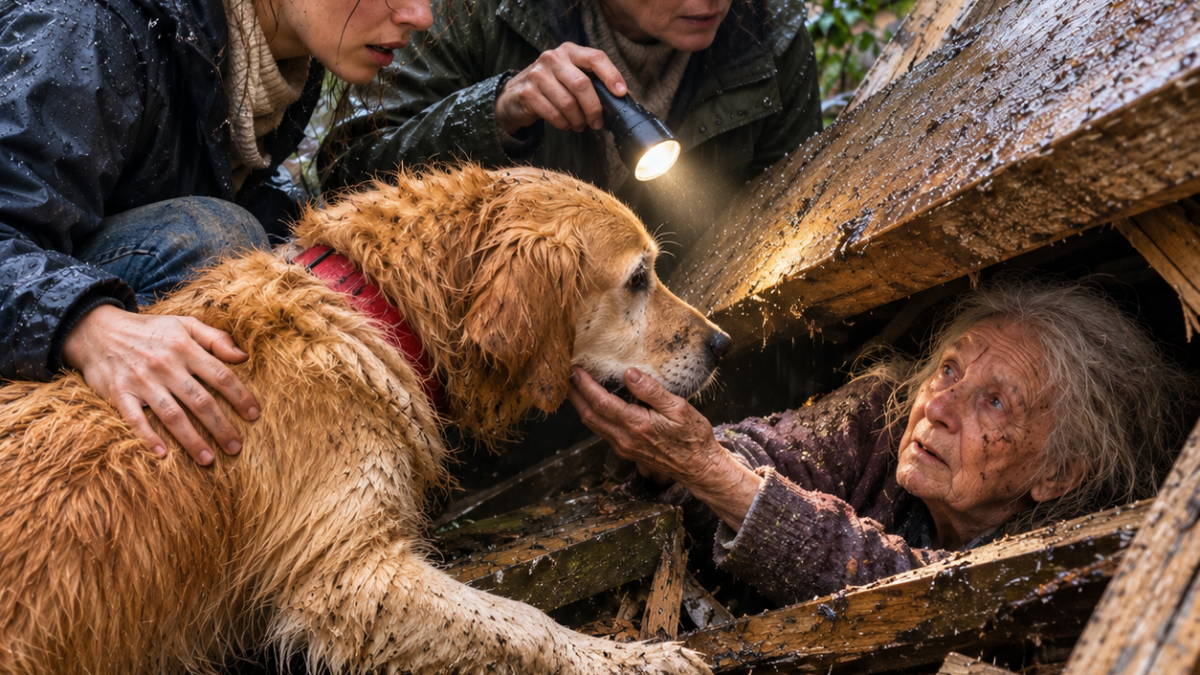
And when we finally followed him through the rain to the damaged house of the seventy-nine-year-old woman who owned him, Biscotte led us behind the building to a collapsed garden shed, where three faint knocks from beneath the broken timber made every complaint we had heard in the bakery suddenly seem very far away.
I had owned that small bakery in Anjou for eleven years, long enough to know almost every Saturday customer by habit.
Monsieur Dumas wanted his baguette nearly burned.
Madame Lefèvre counted every coin twice.
Some people came for bread.
Others came because ten minutes of conversation at my counter was the only company they might have all morning.
And then there was Madame Perrin.
Seventy-nine.
Retired schoolteacher.
Stubborn enough to argue with bad weather.
She lived alone in an aging house outside the center of the village with a honey-colored rescue dog named Biscotte.
Nearly every morning, Madame Perrin walked into my bakery carrying a cloth shopping bag while Biscotte waited outside.
Always outside.
He sat beside her bag.
Never barked at customers.
Never pulled away.
Never entered.
That was why I knew something was terribly wrong the moment he came crashing through my door that morning.
“Call the pound before he bites someone!” Monsieur Dumas shouted after Biscotte knocked over the baguette rack.
“Everyone stop moving,” I said.
Léa, my apprentice, stared at the dog.
“Marion… that’s Biscotte.”
I looked closer.
Red collar.
Honey-colored coat.
Except now the coat was soaked dark with rain.
His front paw was bleeding.
Mud covered his belly.
And he was panting as if he had been running for miles.
“Where’s Madame Perrin?”
At the sound of her name, Biscotte jerked upright.
He raced to the door.
Pushed it with his nose.
Then came back.
Léa whispered, “He wants us to follow him.”
Monsieur Dumas snorted.
“He wants breakfast.”
I took a piece of ham from my lunch and placed it on the floor.
Biscotte sniffed once.
Ignored it completely.
Then he caught Léa’s sleeve gently between his teeth and pulled.
Not biting.
Pulling.
“Marion.”
I stared at the blood marks his paw was leaving on my floor.
Then remembered the storm.
Violent wind through the night.
Heavy rain.
Broken branches everywhere.
And I remembered something else.
Madame Perrin had argued with her daughter Hélène the afternoon before.
Half the street had heard them.
Hélène had been trying for months to convince her mother to move somewhere safer.
Madame Perrin always refused.
“I’m not abandoning forty years of my life because I have a few more wrinkles,” she once told me.
Biscotte scratched the bakery door again.
That decided it.
“Léa, get your coat.”
“What about the shop?”
I called my husband.
“Come down immediately. Take over.”
Then I looked at the customers.
“We may have an emergency.”
Monsieur Dumas complained that he had already waited ten minutes.
I ignored him.
The second I opened the bakery door, Biscotte ran.
Across the village square.
Past the pharmacy.
Down a narrow road bordered by old stone walls.
Every time we fell behind, he stopped and looked back.
Then ran again.
When we reached Madame Perrin’s house, the garden looked as though the storm had torn through it with both hands.
A fig tree branch blocked part of the path.
Flowerpots were smashed.
A gutter hung from the wall.
Roof tiles lay broken on the ground.
The front door was locked.
“Madame Perrin!”
Nothing.
Biscotte disappeared behind the house.
We followed.
That was when we saw the garden shed.
Half the roof had collapsed.
A heavy beam lay diagonally across the entrance.
Broken wooden panels were jammed underneath it.
Biscotte began clawing at them.
“Back up!” I shouted.
He refused.
Then Léa grabbed my arm.
“Listen.”
Three faint knocks.
Silence.
Then three more.
We dropped to our knees.
I pressed my ear toward a narrow opening.
“Madame Perrin?”
A weak voice answered.
“I’m here.”
My stomach twisted.
“We’re calling emergency services. Don’t move.”
“I tried to stop the door from banging…”
She struggled to breathe.
“The beam fell.”
Léa was already dialing.
Then Madame Perrin whispered something that frightened me more than anything else.
“Marion…”
“Yes?”
“I can’t feel my leg.”
A pause.
“And I’m so cold.”
I looked at the unstable timber above us, at the rainwater still running from the broken roof, and at Biscotte finally lying flat beside the opening as though he had delivered us exactly where he needed us to be.
That was when I understood.
Getting here had been Biscotte’s job.
Getting Madame Perrin out alive was now ours.
—
## **[END OF FACEBOOK OPENING — CONTINUE STORY BELOW]**
The emergency dispatcher asked me the same question twice.
“Is she conscious?”
“Yes.”
“Is she trapped beneath debris?”
“Yes.”
“Can you see her?”
“No.”
“Do not attempt to move the beam yourselves.”
I looked at the beam.
It was thick enough that Léa and I probably couldn’t have lifted it anyway, but panic creates stupid confidence.
Part of me wanted to grab one end.
Push.
Pull.
Do something.
Anything.
The dispatcher’s voice became firmer.
“Madame, listen carefully. The structure may be unstable. If you move the wrong section, more of the roof could collapse.”
That stopped me.
Léa crouched beside Biscotte.
He was still panting.
His injured paw trembled.
“Biscotte.”
He looked toward her.
“You did it.”
His ears moved.
“You found us.”
Madame Perrin called weakly from inside.
“Is he there?”
I leaned closer.
“Biscotte?”
“Yes.”
“He’s here.”
Her answer was almost inaudible.
“Good.”
I don’t know why that one word affected me so much.
Maybe because even trapped beneath a broken shed, cold enough to shake and unable to feel one leg, she had still been wondering whether her dog was safe.
Biscotte crawled closer to the gap.
He placed his muzzle against the wet wood.
Madame Perrin whispered:
“My boy.”
His tail struck the mud once.
Then again.
“Keep talking to her,” the dispatcher said through my phone.
So I did.
“Madame Perrin, help is coming.”
“How long?”
“Soon.”
A lie, maybe.
I had no idea.
Léa asked:
“Are you hurt anywhere else?”
“My shoulder.”
“Can you move your hands?”
“Yes.”
“Are you bleeding?”
“I don’t know.”
Biscotte whined.
Madame Perrin answered him.
“I know.”
As if they were having their own conversation.
Within minutes, we heard sirens.
The sound grew louder.
Biscotte stood immediately.
Then hesitated.
He looked toward the garden entrance.
Then back at the shed.
“Stay,” Léa said.
He ignored her and ran toward the front.
Three firefighters and two paramedics came around the side of the house with equipment.
Biscotte circled them.
One firefighter put a hand out.
The dog avoided it.
Then ran back to the shed.
The man looked at me.
“He’s showing us?”
“Yes.”
“He came to the bakery.”
The firefighter glanced at Biscotte.
“Smart dog.”
Biscotte had already returned to the gap.
The rescue team moved fast but not recklessly.
One firefighter inspected the roofline.
Another checked the beam.
A third looked for a safer access point from the side.
“Madame Perrin?” a paramedic called.
“Yes.”
“We’re with the fire service. We’re going to get you out, but I need you to stay as still as possible.”
“I’m not going anywhere.”
Even trapped, she still had that dry teacher’s voice.
I nearly laughed.
The firefighter nearest me said:
“How long has she been under there?”
“I don’t know.”
Madame Perrin heard.
“Since before sunrise.”
I looked at my watch.
Almost nine.
Hours.
Léa whispered:
“My God.”
The firefighter asked:
“What time?”
“I went outside around five.”
“Why?”
“The door was banging.”
Of course.
Madame Perrin had survived seventy-nine years by fixing her own problems.
Storm or no storm.
Dark or daylight.
She had probably heard the loose shed door and thought:
I’ll handle it.
The beam had come down while she was trying.
The firefighter looked at the roof.
“If we lift this main beam without supporting the upper section, those panels could drop.”
Another firefighter returned from the side.
“We can open from the rear, but there’s another support leaning inward.”
“So we shore first.”
Equipment arrived.
Metal braces.
A hydraulic lifting tool.
Protective boards.
Everything happened in a language I barely understood.
But I understood one thing.
No one was rushing blindly.
And that was good.
Because impatience had already nearly killed Madame Perrin once.
Not her impatience exactly.
Her determination to prove she could still do everything alone.
Biscotte tried to move closer.
A firefighter gently blocked him.
“Not there, buddy.”
Biscotte ducked around.
The firefighter blocked again.
“Persistent.”
“You have no idea.”
Léa took Biscotte’s leash from a hook near the back door.
“How did you know that was there?” I asked.
“His name is on it.”
She clipped it on.
Biscotte pulled.
“Stay with me.”
He did not want to.
But he stayed.
The paramedics passed a thermal blanket through an opening.
Madame Perrin managed to pull part of it over herself.
Her voice weakened.
“Marion?”
“I’m here.”
“Don’t let Hélène sell the house.”
I stared.
Of all the things.
“You’re trapped under a shed.”
“I know.”
“And you’re worried about the house?”
“Yes.”
I almost shouted.
Then stopped.
Fear makes people hold tightly to whatever they believe they are losing.
For Madame Perrin, that was not only mobility.
It was independence.
The house represented that.
Her daughter wanted her to leave it.
Maybe the argument the day before had been worse than anyone knew.
“Let’s get you out first,” I said.
“Promise.”
“I’m not promising anything about your house.”
“You were always difficult.”
I stared at the wood.
“Me?”
“You overbake the croissants on Tuesdays.”
Léa covered her mouth.
Even one of the firefighters smiled.
Good.
If Madame Perrin still had the energy to criticize my croissants, perhaps we had more time than I feared.
Then the upper section shifted.
A loud crack split through the garden.
Everyone froze.
“Back!”
The firefighters moved away.
I grabbed Léa.
Biscotte lunged.
Another panel fell across the roof.
Dust and wet leaves spilled down.
From inside came a cry.
“Madame Perrin!”
“I’m here!”
Biscotte barked wildly.
He dragged Léa two steps toward the shed.
“Biscotte!”
One firefighter raised his voice.
“Nobody comes closer until we stabilize it!”
I hated him for ten seconds.
Then loved him for being right.
They repositioned supports.
Rain started again.
Not heavy.
Enough.
Water ran down the broken panels.
The temperature felt colder than before.
The paramedic crouched beside me.
“Has she eaten this morning?”
“I don’t know.”
“Medical history?”
“I don’t know.”
“Medications?”
“I don’t know.”
Every answer embarrassed me.
I had known Madame Perrin for eleven years as a customer.
I knew she liked a traditional baguette, not too dark.
I knew she paid in cash.
I knew she hated raisins in pastries.
I knew she had once taught half the village.
But I didn’t know what medication she took.
We often think knowing someone’s routine means knowing them.
It doesn’t.
The paramedic entered the house with Léa to search for medication lists and identification.
I stayed near the shed.
Biscotte sat beside me now.
He stopped pulling.
Maybe exhaustion had finally reached him.
I looked at his paw.
The cut was deeper than I first thought.
“You ran all the way to us with that?”
He licked it.
“Don’t.”
I held his collar loosely.
“You could have gone to Hélène.”
Of course he could not answer.
Maybe he had tried.
Maybe the bakery was simply part of his morning map.
Madame Perrin went there almost every day.
When she did not come home, perhaps Biscotte went to the place where she usually appeared.
Maybe he had chosen us.
Maybe routine had.
Either way, he had made himself impossible to ignore.
The firefighters finally began lifting.
Very slowly.
A hydraulic tool took the weight of the beam.
One man called measurements.
Another watched the roof.
A third crawled through the widened opening.
“Madame Perrin, I’m coming toward you.”
“I can see your light.”
“Good. Don’t move.”
Biscotte stood.
His whole body trembled.
Minutes stretched.
Then the firefighter inside called:
“Her left leg is pinned.”
My stomach dropped.
“What by?” someone asked.
“Part of the side frame.”
“Can you release?”
“Not without lifting.”
Another tool went in.
Léa returned carrying a medication list and a jacket.
“She takes blood pressure medication.”
The paramedic nodded.
Then Léa whispered to me:
“There’s blood in the kitchen.”
“What?”
“Just a little. On the floor near the back door.”
We looked at Biscotte.
His injured paw.
He must have run through the house after the collapse.
Maybe scratched at the shed.
Then tried the gate.
Then the road.
Then finally the bakery.
He had been working while we were selling bread.
I suddenly remembered Monsieur Dumas shouting:
Call the pound before he bites someone.
Anger flashed through me.
Then disappeared.
I had hesitated too.
That mattered.
We are often most furious at others for doing almost exactly what we nearly did ourselves.
The firefighter inside called:
“Ready to lift.”
Everyone became silent.
The frame rose a few centimeters.
“Hold.”
Another centimeter.
“Stop.”
Madame Perrin cried out.
Biscotte barked.
I crouched beside him.
“She’s there.”
His chest moved rapidly.
“She’s still there.”
The firefighter said:
“Leg is clear.”
A paramedic moved forward.
They needed to slide Madame Perrin onto a rescue board without twisting the injured hip or shoulder.
The opening was narrow.
Everything had to happen slowly.
Léa held my hand.
I didn’t realize until she squeezed.
Then we saw a boot.
A blanket.
A gloved hand.
And finally Madame Perrin.
Her face was gray with cold.
Hair wet.
Mud on one cheek.
But alive.
Biscotte made a sound so high and desperate that every person in the garden turned.
Madame Perrin’s eyes opened.
“Biscotte.”
The dog lunged.
A firefighter caught the leash.
“Wait.”
“He needs to see her,” I said.
The paramedic nodded.
“Quickly.”
Biscotte approached the stretcher.
He sniffed Madame Perrin’s hand.
Her fingers moved.
Touched the top of his head.
“There you are.”
His entire body relaxed.
That was the first time Biscotte stopped fighting.
Not when we gave him food.
Not when the firefighters arrived.
Not when the roof was stabilized.
Only when he had confirmed she was alive.
Then he sat.
Madame Perrin was loaded into the ambulance.
Hip injury.
Possible nerve compression.
Hypothermia.
Shoulder trauma.
Dehydration.
Nothing sounded small.
Hélène arrived as the ambulance doors were closing.
She jumped from her car before it had fully stopped.
“Mom!”
Madame Perrin heard her.
Her face changed.
“Hélène.”
The argument from the day before still existed.
But fear had erased its importance.
Hélène climbed into the ambulance for thirty seconds.
When she came back out, she was crying.
“What happened?”
I pointed toward the shed.
Then Biscotte.
“He came for us.”
Hélène stared.
“What?”
“He ran to the bakery.”
She looked at Biscotte.
His bleeding paws.
Mud.
Wet coat.
“He did that?”
“Yes.”
Hélène dropped to her knees.
Biscotte approached slowly.
She wrapped her arms around his neck.
“You found someone.”
He licked her face.
Hélène cried harder.
“I left angry last night.”
I didn’t know what to say.
“She wouldn’t listen.”
Still nothing.
“I told her if she wanted to behave like a stubborn old woman, she could manage everything herself.”
There it was.
The sentence that would haunt her if Madame Perrin didn’t recover.
I knew that kind of sentence.
Every family has one.
The words said in anger that become unbearable only after something goes wrong.
I crouched.
“Hélène.”
She shook her head.
“I should have stayed.”
“You didn’t know the storm would do this.”
“I knew the shed was bad.”
“What?”
She looked toward the wreckage.
“I told her last month it needed repairing.”
My stomach tightened.
“She said it could wait until spring.”
The firefighter overheard.
“When was it last inspected?”
Hélène laughed bitterly.
“Inspected? It was built by my father in 1987.”
Madame Perrin had probably spent decades believing anything her late husband built could outlive all of them.
That belief had nearly killed her.
Hélène went to the hospital.
Biscotte could not ride in the ambulance.
So I took him.
My husband handled the bakery.
Léa came too.
In the car, Biscotte sat upright in the back seat.
He hated being separated from Madame Perrin.
Every stoplight triggered whining.
“It’s okay,” Léa whispered.
No, it wasn’t.
But we kept saying it.
At the veterinary clinic first, Biscotte’s paws were cleaned.
One pad was cut.
Several nails cracked.
No fractures.
The vet looked at me.
“How long was he running?”
“I don’t know.”
“Where did the blood start?”
“Probably the garden.”
The veterinarian cleaned the wounds.
Biscotte tolerated everything badly.
Not aggressively.
He kept trying to stand.
Trying to leave.
“He’s looking for his owner,” I explained.
“I know.”
Once his paws were wrapped, we took him to the hospital parking lot.
Dogs were not allowed in the ward.
Hélène came outside.
Her face looked worse.
“How is she?”
“Hip fracture.”
“Anything else?”
“Shoulder dislocation. Mild hypothermia. They’re worried about the leg because she still has numbness.”
“Surgery?”
“Probably.”
She looked at Biscotte.
He pulled toward her.
Hélène took the leash.
“I’ll take him home.”
I hesitated.
“To your mother’s house?”
“Yes.”
“Is that safe?”
“The house is.”
She looked toward the wrecked shed in the distance of her memory.
“The garden isn’t.”
Biscotte went with her.
That should have been the end of my involvement.
It wasn’t.
The next morning, before eight, I was opening the bakery when Monsieur Dumas arrived.
He looked around.
“Where’s the dog?”
I stared at him.
“Why?”
“I heard.”
Everyone had heard.
Small villages move information faster than weather.
He looked uncomfortable.
“I didn’t know.”
“No.”
“If I had—”
“You would’ve done what?”
He looked down.
I regretted the sharpness immediately.
Almost.
“I thought it was just a dog causing trouble.”
“So did half the shop.”
“You didn’t.”
“I almost did.”
He looked at me.
That was the truth.
I could have put food outside.
Closed the door.
Called someone else.
Maybe Biscotte would have tried another business.
Maybe another person.
Maybe Madame Perrin would have spent another hour under that beam.
No one needed to imagine the rest.
Monsieur Dumas cleared his throat.
“I brought something.”
He placed a bag on the counter.
Inside was a large package of dog treats.
I almost laughed.
“Biscotte nearly died running for help and you bought biscuits?”
“I didn’t know what else to do.”
That answer softened me.
“Keep them here.”
“For what?”
“He comes almost every morning with Madame Perrin.”
Then I remembered.
Maybe he wouldn’t anymore.
The bakery suddenly felt quiet.
Over the next several days, we learned more.
Madame Perrin underwent surgery for the hip fracture.
The nerve problems in her leg were caused partly by prolonged compression.
Doctors could not promise full sensation would return immediately.
Physical therapy.
Rehabilitation.
Time.
At seventy-nine, all three sounded exhausting.
Hélène came into the bakery on the fourth morning.
Alone.
“You look terrible,” I said.
“Thank you.”
“Coffee?”
“Yes.”
I poured one.
She sat at the small table near the window.
I brought a croissant.
“No.”
“You need food.”
“I’m not hungry.”
“Neither was Biscotte when he came here. I’m beginning to dislike this family’s relationship with meals.”
She almost smiled.
Then broke.
“She’s blaming me.”
“For what?”
“The house.”
I sat across from her.
“How?”
“She says I’m using the accident to force her out.”
“Are you?”
Hélène looked at me.
“I want her alive.”
“That isn’t what I asked.”
Silence.
Then:
“Yes.”
I appreciated the honesty.
“I want her to move.”
“Where?”
“Closer to me. Maybe assisted living eventually.”
“Does she want that?”
“No.”
“Then you have a problem.”
“I have been dealing with that problem for two years.”
She stared into the coffee.
“My father died six years ago. After that she got worse.”
“Physically?”
“Stubbornly.”
I laughed.
“Hélène.”
“She refuses help. Climbs ladders. Carries wood. Fixes gutters.”
“At seventy-nine?”
“Yes!”
“Why?”
“Because Dad used to do everything outside, and she thinks accepting help means admitting he’s gone.”
That changed the story.
The old house was not only a building.
It was proof that the life Madame Perrin shared with her husband still existed.
Every wall.
Tree.
Shed.
Even the broken roof.
Hélène whispered:
“I told her that yesterday.”
“What?”
“That Dad is dead and refusing to repair the house won’t bring him back.”
I closed my eyes.
There it was.
The sentence.
The one Hélène would replay at three in the morning.
“She told me to leave.”
“And you did.”
“Yes.”
I leaned forward.
“Listen to me.”
She looked up.
“The last thing you said in an argument is not the whole relationship.”
Her eyes filled.
“You don’t know us.”
“No.”
“But I know guilt.”
She waited.
“You can apologize.”
“If she listens.”
“You can apologize anyway.”
“What if she never forgives me?”
“That’s her job.”
I pushed the croissant toward her.
“Your job is to show up.”
She ate.
One bite.
Good enough.
Madame Perrin stayed in the hospital for twelve days.
Biscotte stayed with Hélène.
That arrangement was terrible.
Not because Hélène didn’t care for him.
Because Biscotte refused to accept that his morning routine had changed.
At 7:40 every day, he stood at Hélène’s door.
Whined.
Went to the gate.
Hélène lived fifteen kilometers away.
The first morning, she tried taking him around her neighborhood.
Biscotte resisted.
The second, he refused breakfast.
The third, Hélène called me.
“I’m bringing him.”
“To the bakery?”
“Yes.”
“Why?”
“He won’t stop looking for his routine.”
So at 8:15, Biscotte entered my bakery for the second time in his life.
This time nobody shouted.
Léa crouched.
“Hey, hero.”
Biscotte wagged.
Monsieur Dumas happened to be there.
He immediately stepped aside.
Biscotte sniffed the treat bag behind the counter.
Apparently now that Madame Perrin was not trapped beneath a shed, food had regained importance.
I gave him one.
Monsieur Dumas looked relieved.
“He eats.”
“Yes.”
“I offered him bread that morning.”
“He ignored ham.”
“Really?”
“Yes.”
Monsieur Dumas looked at Biscotte with newfound respect.
“You were serious.”
Biscotte took another treat.
Very serious.
From the bakery, Hélène walked him along his usual route.
Past the pharmacy.
Toward Madame Perrin’s house.
When they reached the gate, Biscotte stopped.
The shed was fenced off.
Workers had begun removing the unsafe structure.
Biscotte pulled toward the back.
Hélène stopped him.
“No.”
He whined.
“She isn’t there.”
He looked toward the house.
Hélène sat on the front step.
Biscotte sat beside her.
For twenty minutes, neither moved.
The next day, she did it again.
Routine cannot always be preserved.
Sometimes it must be gently rewritten.
By the end of the first week, Biscotte ate normally at Hélène’s house.
But every few days, she drove him back to the village.
Bakery.
Old route.
House.
Then hospital parking lot.
Eventually, the hospital allowed a supervised visit in a courtyard.
Madame Perrin sat in a wheelchair.
Her left leg rested awkwardly.
She looked smaller than before.
Biscotte saw her.
Stopped.
Then ran.
Hélène lost the leash.
“Biscotte!”
Too late.
He reached the wheelchair and nearly knocked it sideways.
A nurse caught the handle.
Madame Perrin laughed for the first time since the accident.
“My idiot.”
Biscotte climbed halfway into her lap.
“Madame, careful,” the nurse warned.
“I have survived worse.”
She wrapped both arms around his neck.
Hélène stood several feet away.
Not moving.
Madame Perrin looked up.
Their eyes met.
Everything unsaid from the argument remained there.
Then Hélène whispered:
“Mom.”
Madame Perrin looked away.
“I brought the dog.”
“I can see that.”
“Mom…”
“Not here.”
The wall went up immediately.
Biscotte looked between them.
Then did something stupid and perfect.
He got down from Madame Perrin.
Walked to Hélène.
Pressed his head against her leg.
Then returned to Madame Perrin.
Back to Hélène.
Again.
The nurse laughed.
“He’s organizing you.”
Madame Perrin tried not to smile.
Failed.
Hélène started crying.
“I’m sorry.”
Her mother looked at her.
“I was angry.”
“I know.”
“I should have stayed.”
“You were angry.”
“I still should have stayed.”
Madame Perrin became quiet.
Then said:
“I should have fixed the shed.”
Hélène laughed through tears.
“Yes.”
“Don’t sound so pleased.”
“I’m not.”
“You are.”
Biscotte placed his front paws on the wheelchair again.
The argument did not disappear.
Neither did forty years of mother-daughter patterns.
But something shifted.
The word sorry entered the room.
Sometimes that is enough to begin.
Madame Perrin spent almost six weeks in rehabilitation.
The sensation in her leg gradually returned.
Not fully at first.
Then more.
She learned to stand with support.
Then walk with a frame.
Then short distances with a cane.
She hated every minute.
“I taught children for forty-three years,” she complained when I visited. “Now people clap because I cross a hallway.”
“Then cross faster.”
She glared.
Good.
Angry meant energy.
Biscotte visited when allowed.
He became strangely gentle around her.
No pulling.
No jumping.
He walked at wheelchair pace.
One physical therapist said:
“He adapts.”
Of course he did.
He had spent the morning of the accident adapting.
Door blocked?
Find road.
Humans ignore?
Enter bakery.
Food offered?
Ignore.
Sleeve available?
Pull.
Biscotte was not sophisticated.
He was persistent.
Persistence is intelligence wearing muddy paws.
The argument over the house grew worse before it got better.
Hélène wanted her mother to move.
Madame Perrin refused.
Rehabilitation staff advised changes if she went home.
Bathroom supports.
Handrails.
No climbing.
No garden shed.
Daily check-ins.
Emergency alert pendant.
Home nursing initially.
Madame Perrin accepted exactly none of it.
“I am not an invalid.”
Hélène snapped:
“You were trapped under a roof for three hours!”
“And I survived.”
“Because your dog ran into a bakery!”
“Excellent dog.”
“That is not a medical plan!”
I happened to be visiting during that exchange.
I quietly moved toward the door.
Madame Perrin pointed at me.
“You stay.”
Why?
No idea.
Hélène turned to me.
“Tell her.”
Never become the neutral person in a family argument.
It is a trap.
“Tell her what?”
“That she cannot live alone.”
Madame Perrin glared.
“Traitor.”
“I haven’t said anything.”
“You’re thinking.”
“I am thinking about bread.”
“Liar.”
I sighed.
“Fine.”
Both waited.
I looked at Madame Perrin.
“You can probably go home.”
Hélène stared at me.
“Marion!”
“Wait.”
Then I looked at her.
“But going home cannot mean pretending nothing happened.”
Madame Perrin crossed her arms.
“You need modifications.”
“No.”
“Then move.”
She stared.
“Those are your choices.”
“I have a third choice.”
“What?”
“Everyone leaves me alone.”
“No.”
I surprised myself with how quickly I said it.
Madame Perrin looked offended.
“Why not?”
“Because Biscotte nearly tore his paws open trying to make sure you weren’t left alone.”
Silence.
That hit.
I continued.
“You can be independent.”
She looked at me.
“But independence does not mean making it impossible for anyone to help you.”
Hélène’s face softened.
Madame Perrin looked toward the window.
“I don’t want my house turned into a hospital.”
“Then make it safer, not clinical.”
“I don’t want strangers coming every day.”
“Fine. Some days can be Hélène.”
Mother and daughter both objected simultaneously.
“No.”
I laughed.
“There’s the family harmony.”
They hated my solution.
That was a good sign.
Compromise was close.
In the end, Madame Perrin returned home.
But the house changed.
A rail beside the steps.
Bathroom safety bars.
Emergency pendant.
A weekly home-care visit.
Hélène came twice a week.
I stopped by often.
Léa sometimes delivered bread.
And Biscotte resumed his morning routine.
The first day home, Madame Perrin insisted on walking to the bakery.
Everyone told her no.
She won.
Of course.
At 8:10, the bakery door opened.
Madame Perrin entered using a cane.
Biscotte sat outside.
Exactly where he had always sat before the storm.
The entire shop became silent.
Monsieur Dumas was there.
He held his baguette.
Looked at her.
Then Biscotte.
He cleared his throat.
“Madame Perrin.”
“Yes?”
“I owe your dog an apology.”
She looked confused.
“For what?”
“I wanted Marion to call the pound.”
Madame Perrin stared.
Then looked through the window at Biscotte.
“Why?”
“He knocked over the bread.”
She nodded seriously.
“That is serious.”
Monsieur Dumas flushed.
Then she smiled.
“But apparently he had a reason.”
The shop laughed.
He walked outside.
Biscotte looked up.
Monsieur Dumas crouched.
“I’m sorry.”
Biscotte sniffed his hand.
Monsieur Dumas offered a dog treat.
Biscotte took it.
Madame Perrin called from inside:
“Don’t forgive too quickly!”
More laughter.
For weeks, people talked about Biscotte.
Hero dog.
Miracle dog.
Rescue dog saves owner.
I disliked much of it.
So did Madame Perrin.
“He didn’t perform a miracle,” she said.
“He made a mess in my bakery.”
“Exactly.”
“But he saved you.”
“Yes.”
She looked through the window.
“He knew where people were.”
That was more accurate.
Biscotte did not call emergency services.
He did not lift the beam.
He did not diagnose hypothermia.
He knew one thing.
His person was trapped.
He could not fix it.
So he found humans.
That was enough.
A local newspaper came.
Madame Perrin refused photographs at first.
Then agreed on one condition.
“Marion is in it.”
“Why me?”
“You opened the door.”
“Léa followed him too.”
“Then Léa too.”
The photograph showed all four of us.
Madame Perrin with her cane.
Léa.
Me.
Biscotte.
The headline said:
**THE DOG WHO REFUSED TO GIVE UP.**
Monsieur Dumas bought six copies.
I never let him forget it.
Then came an unexpected consequence.
The municipality began receiving reports about dangerous old sheds, loose roofing and storm-damaged structures.
Some residents had apparently looked at Madame Perrin’s accident and thought about their own properties.
The fire service held a public safety meeting.
People complained about inspections.
People always complain about inspections until something falls.
Madame Perrin attended.
She sat in the front row.
When one man said:
“My shed has been standing for fifty years,”
Madame Perrin raised her cane.
“So had mine.”
That ended the argument.
The remains of her old garden shed were finally removed completely.
Hélène wanted to build a new storage structure.
Madame Perrin refused.
“What will you do with the space?”
“Garden.”
“You can’t kneel.”
“Raised beds.”
I smiled.
She had already planned it.
That spring, we helped build two raised garden boxes.
Hélène carried soil.
I brought coffee.
Léa planted herbs.
Monsieur Dumas appeared inexplicably with tomatoes.
Madame Perrin looked suspicious.
“What do you want?”
“To help.”
“Why?”
He sighed.
“Must there always be an interrogation?”
“You used to complain when my dog interrupted your bread.”
“Yes.”
“And now you’re planting tomatoes.”
“Yes.”
“Suspicious.”
But she let him.
Biscotte lay in the sun.
His injured paw had healed completely.
The scars remained.
One afternoon, I noticed Madame Perrin touching them.
“You still think about that morning?”
“Every day.”
She looked at Biscotte.
“I was shouting.”
“At him?”
“No. At the beam.”
I smiled.
“Useful.”
“I thought nobody would hear me.”
Her voice changed.
“My phone was inside the house. My leg was trapped. It was dark.”
She swallowed.
“I started thinking maybe Hélène was right.”
“About the house?”
“About me.”
I sat beside her.
“She wasn’t saying you were useless.”
“That is how it sounded.”
“She was saying you were vulnerable.”
“Worse.”
I understood.
Old age often feels like a series of people politely removing your authority.
You should not drive.
You should not climb.
You should not live alone.
You should not.
You should not.
Eventually every suggestion sounds like someone narrowing the walls.
Madame Perrin whispered:
“I thought if I admitted I needed help, they would take everything.”
“Did they?”
She looked toward the house.
“No.”
“Then perhaps needing help is not the same as losing your life.”
She sighed.
“You sound like Hélène.”
“Take that back.”
She laughed.
Their relationship improved.
Not magically.
They still argued.
Hélène wanted her mother to use a walker on bad days.
Madame Perrin hid it in a closet.
Hélène wanted an automatic medication dispenser.
Madame Perrin called it “a machine that treats me like an idiot.”
But they spoke.
That mattered.
Hélène started staying for dinner once a week.
Then sometimes overnight.
One evening, she came into the bakery without her mother.
“I need advice.”
“Dangerous.”
“It’s her birthday.”
“What are you buying?”
“I don’t know.”
“She hates useless objects.”
“I know.”
“Nothing decorative.”
“I know.”
“Not clothes.”
“I know.”
“Why are you asking me?”
Hélène smiled.
“I was thinking of repairing Dad’s old garden bench.”
I stopped.
The bench sat beneath the fig tree.
Weathered.
One slat broken.
Madame Perrin’s late husband had built it.
“That might work.”
“Or make her cry.”
“Probably both.”
We had it repaired quietly.
On Madame Perrin’s eightieth birthday, Hélène led her outside.
The bench stood beneath the tree.
Fresh wood.
Same shape.
Madame Perrin stopped.
Her hand covered her mouth.
“You repaired it.”
“Yes.”
“You shouldn’t have changed the wood.”
Hélène’s face fell.
Then her mother touched the new slat.
“But your father would have approved.”
That was the closest Madame Perrin came to saying thank you for five minutes.
Then she hugged Hélène.
Biscotte pushed between them.
Naturally.
That photograph ended up beside the newspaper clipping.
Years passed more quietly after that.
Quiet was good.
Madame Perrin’s hip never became perfect.
She used a cane.
Sometimes two.
Her left leg tired easily.
But she remained in her house.
Safely.
With help.
A compromise she once would have called surrender.
Biscotte aged too.
The honey-colored coat became pale around his muzzle.
At first, nobody noticed.
Then one morning Léa said:
“He’s going gray.”
Madame Perrin became offended.
“He is distinguished.”
“He’s old.”
“Do not say that in front of him.”
Biscotte slept outside the bakery.
Deeply.
His hearing weakened.
That created a strange reversal.
Once, Biscotte had been the one alerting humans.
Now we started watching him.
If Madame Perrin left the bakery, he sometimes did not notice immediately.
She touched his shoulder.
His head lifted.
“There I am.”
He stood.
Followed.
The bond changed shape.
Not weaker.
Different.
At thirteen, Biscotte developed arthritis.
His morning walks slowed.
Madame Perrin’s walks were already slow.
They matched perfectly.
I sometimes watched them from the bakery window.
Old woman.
Old dog.
Cane.
Gray muzzle.
Stopping at every corner.
They looked as though they had designed aging for each other.
Then Hélène came into the bakery one winter morning.
Alone.
Her face told me something was wrong.
“What happened?”
“Biscotte collapsed.”
My stomach dropped.
“Where?”
“Home.”
“Is your mother okay?”
“No.”
Of course not.
Biscotte had been taken to the veterinarian.
Heart problem.
Age-related.
Medication might help.
No guarantee.
Madame Perrin sat beside him through the examination.
The vet eventually said:
“He can go home.”
She asked:
“For how long?”
The veterinarian gave the answer nobody likes.
“We don’t know.”
Biscotte recovered enough to return to routine.
Slower.
Medication twice a day.
No long walks in heat.
No stairs unnecessarily.
Madame Perrin became obsessive.
“Did he take the pill?”
“Yes.”
“Are you sure?”
“I watched.”
“Did he swallow?”
“Yes.”
“He hides them.”
“Madame Perrin.”
“He is deceptive.”
Biscotte was asleep.
The woman who once refused an emergency pendant now kept a written chart for her dog’s heart medication.
Hélène teased her.
“You know, this is exactly what I did with you.”
“Different.”
“How?”
“He listens.”
Hélène laughed so loudly I heard it from the counter.
At fourteen, Biscotte stopped walking to the bakery every morning.
Some days Hélène drove them.
Other days I delivered bread.
That seemed fair.
The morning route had once belonged to Madame Perrin and Biscotte.
Then Biscotte had reversed it.
He came alone.
Dragged us back.
Now we brought the bakery to them.
One rainy morning, I arrived at the house.
Madame Perrin sat beside the window.
Biscotte slept at her feet.
“You’re late,” she said.
“By three minutes.”
“Unacceptable.”
“I can take the bread back.”
“No.”
I handed over the baguette.
Biscotte lifted his head at the smell.
“Still food motivated.”
“Always.”
Madame Perrin broke off the tiniest piece.
I pointed.
“His vet says not too much bread.”
“He saved my life.”
“That does not grant unlimited carbohydrates.”
“It should.”
“No.”
Biscotte ate the piece.
We both pretended I had authority.
That summer, Hélène finally asked the question everyone had avoided.
“What happens to Biscotte if something happens to you first?”
Madame Perrin’s face changed.
“I’m not dying.”
“No one said today.”
“I know what you meant.”
“Mom.”
Silence.
Then Madame Perrin looked at Biscotte.
“He goes with you.”
Hélène nodded immediately.
“Yes.”
“He does not go to a shelter.”
“Never.”
“He sleeps inside.”
“Yes.”
“Not the garage.”
“Mom.”
“I’m being specific.”
“He sleeps inside.”
“Good.”
Then Madame Perrin added:
“And if he dies first?”
Hélène stopped.
That was the question beneath everything.
Madame Perrin had already lost her husband.
The house had become her proof of continuity.
Biscotte had become another.
If he disappeared first, what remained?
Hélène sat beside her.
“Then you still have me.”
Her mother looked at her.
For once, no argument.
That conversation mattered sooner than we wanted.
The following autumn, Biscotte stopped eating breakfast.
Not entirely.
He sniffed.
Walked away.
For Biscotte, that was serious.
Madame Perrin called the vet.
Bloodwork showed worsening heart function and kidney changes.
Medication changed.
Food changed.
Some days improved.
Then worsened.
Good day.
Bad day.
Good.
Two bad.
A good morning became precious.
One Sunday, Biscotte insisted on going outside.
Madame Perrin followed with her cane.
He walked toward the space where the old shed once stood.
The raised beds were empty after harvest.
He sniffed.
Then lay down.
Hélène called me.
“You should come.”
“Why?”
“I don’t know.”
I went.
Léa came too.
Now twenty-three and no longer my apprentice—she had finished her training and worked with me as a full baker.
Monsieur Dumas arrived carrying no tomatoes this time.
Nobody had invited him.
He had heard.
Small village.
Biscotte lay in the autumn sun.
Madame Perrin sat on the repaired bench.
The dog’s breathing was slower than normal.
Hélène whispered:
“The vet says days, maybe.”
Madame Perrin stared ahead.
“No.”
We had heard that word before.
Years earlier:
I cannot feel my leg.
No.
Now:
Your dog is dying.
No.
The most human word.
A refusal without power.
Biscotte lifted his head when I approached.
I crouched.
“Hey.”
Tail.
One slow movement.
I touched the scar on his old front paw.
“Remember when you destroyed my bakery?”
Madame Perrin said:
“He improved it.”
“He knocked over thirty baguettes.”
“Temporary damage.”
Monsieur Dumas cleared his throat.
“I complained.”
Everyone looked at him.
“Yes,” I said.
“I know.”
He approached Biscotte.
The dog sniffed his hand.
Monsieur Dumas sat on the grass despite his expensive pants.
“I was an idiot.”
Madame Perrin replied:
“Frequently.”
He laughed.
“I deserved that.”
Then he looked at me.
“I really thought he might bite somebody.”
“So did others.”
“I told you to call the pound.”
“Yes.”
He stroked Biscotte’s shoulder.
“And instead he brought us here.”
The dog closed his eyes.
Monsieur Dumas said quietly:
“He changed me.”
That sounded dramatic.
Then he explained.
“After that day, I started checking on my neighbor.”
We looked at him.
“Why?”
“She’s eighty-six. Lives alone.”
Madame Perrin smiled.
“About time.”
He nodded.
“I used to assume her son handled everything.”
“And?”
“He lives in Strasbourg.”
Madame Perrin looked satisfied.
“So Biscotte trained you.”
“Apparently.”
There it was.
The revenge, if anyone needed one.
The man who wanted the dog removed became someone who stopped ignoring what he could not immediately understand.
No humiliation.
No punishment.
Change.
Better.
Biscotte had another good week.
Then a bad night.
He struggled to breathe.
Madame Perrin called Hélène at 2:10 in the morning.
They went to the emergency veterinarian.
Oxygen helped.
Medication helped briefly.
The veterinarian explained options.
Hospitalization.
More aggressive intervention.
Possible days.
Maybe weeks.
Madame Perrin asked:
“Comfortable weeks?”
The veterinarian was honest.
“Probably not many.”
Hélène called me at six.
I drove over.
Madame Perrin sat in the waiting room with Biscotte’s head in her lap.
He looked tired.
Not frightened.
Just exhausted.
“We’re taking him home,” she said.
I nodded.
No argument.
The veterinarian arranged a home visit later that day.
Biscotte returned to the house one last time.
Madame Perrin insisted on putting his bed near the back door.
“Why?”
“So he can smell the garden.”
The door remained open slightly.
Cool autumn air came in.
Biscotte lifted his nose.
The raised beds.
Fig tree.
Old wood.
Home.
Hélène sat on one side.
Madame Perrin on the other.
I stayed farther back.
This belonged to them.
Léa came briefly.
She crouched.
“You nearly tore my pants.”
Biscotte’s tail moved.
She cried.
“You were right.”
She kissed his head.
Then left.
Monsieur Dumas sent a bag of treats nobody used.
I kept it.
The veterinarian arrived in the afternoon.
He examined Biscotte.
Listened to his heart.
Then waited.
Madame Perrin asked:
“Am I too early?”
The veterinarian answered gently:
“You’re preventing a crisis, not causing his death.”
She closed her eyes.
That sentence mattered.
People often wait because they want certainty.
Certainty comes too late.
Biscotte had taught us all not to wait until every sign becomes obvious.
Madame Perrin leaned down.
“You know what you did?”
Biscotte breathed.
“You came for help.”
Her voice broke.
“I didn’t.”
Hélène took her hand.
Madame Perrin continued:
“I kept thinking I could do everything myself.”
She touched Biscotte’s ear.
“You knew better.”
The first medication relaxed him.
His breathing softened.
Madame Perrin whispered:
“Good boy.”
Hélène cried quietly.
Biscotte opened his eyes once.
Looked toward the sound of Madame Perrin’s voice.
Then closed them.
The veterinarian waited.
Madame Perrin nodded.
The final medication was given.
Biscotte died with his head against the same hand he had spent years following through the village.
No storm.
No broken wood.
No blood on his paws.
No need to run for anyone.
His job was finished.
Madame Perrin sat beside him for a long time.
Then she said:
“He never ate the ham.”
I knew immediately what she meant.
That first morning.
Food at his feet.
He ignored it.
I laughed through tears.
“No.”
“He loved ham.”
“Apparently you mattered more.”
She stared at him.
“I hope he knew.”
“He knew.”
That was one statement I allowed myself without proof.
Because behavior had already answered.
Biscotte’s ashes came home several weeks later.
Madame Perrin put the urn on a shelf beside a photograph of her husband.
Hélène objected.
“Mom, that shelf is going to collapse.”
Madame Perrin glared.
“Do not joke about collapsing structures in this house.”
We laughed so hard she eventually joined us.
Grief did not make her leave the house.
Not immediately.
But something changed.
Without Biscotte, the morning walk disappeared.
The bakery route stopped.
For the first week, I delivered bread.
Then Madame Perrin surprised us.
She arrived at the bakery alone.
Cane.
Cloth bag.
No dog outside.
The empty place beside the door hurt.
She entered.
I said nothing.
She put the bag on the counter.
“One baguette.”
“Not too dark?”
“Have you learned nothing in fourteen years?”
“Apparently not.”
I wrapped it.
She remained.
Then looked toward the doorway.
“He should be there.”
“Yes.”
“I almost stayed home.”
“I’m glad you didn’t.”
“So am I.”
That was the beginning.
Madame Perrin kept walking.
Not every day.
Twice a week.
Then three.
Hélène visited.
The emergency pendant remained around her neck.
She stopped calling it ridiculous.
One afternoon, she said:
“Maybe I should move.”
I nearly dropped a tray.
“What?”
“Don’t look so pleased.”
“I’m shocked.”
“The house is too much.”
Those were words Hélène had waited years to hear.
But when Madame Perrin told her, Hélène did something intelligent.
She didn’t celebrate.
She asked:
“Where would you want to go?”
Not:
I told you so.
Not:
Finally.
Where would you want to go?
That changed everything.
Madame Perrin did not move into a nursing home.
Not then.
She chose a smaller apartment five minutes from Hélène.
Ground floor.
Small terrace.
Enough space for plants.
She sold the old house to a young couple with two children.
The day she handed over the keys, I went with her.
We stood in the garden.
The raised beds were overgrown.
The repaired bench remained beneath the fig tree.
The place where the shed had stood looked ordinary.
She touched the bench.
“I thought leaving meant abandoning him.”
“Your husband?”
“Yes.”
“And Biscotte.”
I waited.
“What changed?”
She looked at me.
“They’re dead whether I stand here or somewhere else.”
Harsh.
True.
Then she smiled faintly.
“But what they gave me isn’t in the bricks.”
We sat.
She cried.
I did too.
Then the new owners arrived and their little boy ran straight into the garden.
Madame Perrin watched him.
“Keep him away from old sheds.”
The father looked confused.
I laughed.
“Long story.”
At the new apartment, Hélène placed Biscotte’s urn beside the red collar he had worn for years.
Madame Perrin protested.
“Not there.”
“Why?”
“Too much sun.”
Of course.
Even in death, Biscotte had environmental requirements.
Months became years.
Madame Perrin turned eighty-three.
Then eighty-four.
She became less stubborn.
Not un-stubborn.
That would have been medically impossible.
But different.
She accepted rides.
Asked for help before climbing anything.
Stopped pretending the emergency pendant was jewelry.
Every Saturday she still came to the bakery.
Monsieur Dumas sometimes carried her bag.
Léa eventually became my business partner.
And near the door, above the spot where Biscotte once knocked over the baguette display, we hung a small framed photograph.
Nothing dramatic.
Just Biscotte sitting outside beside Madame Perrin’s shopping bag.
Below it, Léa wrote:
**HE DIDN’T WANT THE BREAD. HE WANTED US TO PAY ATTENTION.**
Madame Perrin hated it.
“Too sentimental.”
“You cry every time you read it.”
“Allergies.”
“Inside a bakery?”
“Flour.”
Fair.
Years later, a stray dog ran into the shop.
Not Biscotte.
Young.
Brown.
Hungry.
This one absolutely wanted bread.
He stole half a croissant before anyone stopped him.
A customer shouted:
“Get him out!”
Monsieur Dumas was standing near the register.
I watched him.
He looked at the dog.
Then at me.
Then walked slowly to the door.
“Wait.”
Everyone became quiet.
He crouched.
The dog backed away.
Monsieur Dumas said:
“Maybe we should figure out why he’s here first.”
I smiled.
Biscotte’s revenge.
Still working.
The stray was simply lost.
Tag on collar.
Owner found within an hour.
No trapped person.
No collapsed shed.
No dramatic rescue.
Perfect.
Not every interruption hides tragedy.
But because of Biscotte, we checked.
That was the lesson.
Years after the storm, people still told the story wrong.
They said Biscotte “knew exactly what to do.”
I don’t know that.
Maybe he did.
Maybe he simply tried everything.
He scratched at the debris until his paws bled.
Couldn’t reach Madame Perrin.
So he left.
Found the center of the village.
Found the bakery she visited every morning.
Entered a place he had never entered before.
Ignored food.
Pulled Léa.
Returned to the door.
Again.
Again.
Again.
Until human beings finally became useful.
That is extraordinary enough without pretending he understood rescue logistics.
What mattered was persistence.
He failed at the shed.
So he changed strategy.
That idea stayed with me beyond the dog.
Madame Perrin failed to remain fully independent.
So eventually she changed strategy.
Hélène failed to convince her mother through pressure.
So she changed strategy.
Monsieur Dumas failed by assuming the dog was dangerous.
So he changed.
Even I had almost dismissed Biscotte.
Then I followed.
Sometimes the difference between disaster and rescue is not knowing the perfect answer.
It is being willing to change your interpretation before it becomes too late.
The older I get, the more I think about that morning.
Not only because Madame Perrin survived.
Because of how ordinary everything was before Biscotte entered.
Customers.
Bread.
Coins.
Complaints.
The oven timer.
A man irritated about waiting ten minutes.
Then a wet dog knocked over a rack.
Suddenly somewhere behind a house, an old woman’s life depended on whether we treated disruption as inconvenience or information.
That frightens me.
How often do we mistake signals for annoyances?
A neighbor who calls too much.
A dog who barks.
An elderly person who suddenly stops appearing.
Someone whose behavior changes.
A closed shutter.
A missed routine.
We do not need to become suspicious of everything.
But we should notice changes.
Biscotte noticed one.
Madame Perrin was not where she belonged.
So he acted.
That simple.
At eighty-six, Madame Perrin suffered another fall.
This one in her apartment.
Smaller.
She was wearing the emergency pendant.
She pressed it.
Help came within minutes.
She fractured nothing.
When I visited, she looked deeply offended.
“The machine works.”
“I’m devastated for you.”
“Hélène will be unbearable.”
“Yes.”
“She’ll say I told you so.”
“Probably.”
Madame Perrin looked toward Biscotte’s photograph.
Then smiled.
“He would too.”
Maybe.
She recovered.
At eighty-eight, she finally chose assisted living.
Her choice.
That mattered.
Hélène helped her move.
I brought bread.
Léa brought flowers.
Monsieur Dumas brought tomatoes nobody requested.
Madame Perrin took Biscotte’s photograph and collar.
The urn had already been buried beneath a rosebush at Hélène’s home.
At the residence, staff learned quickly who Biscotte was.
Madame Perrin told the story constantly.
Usually incorrectly.
“He dragged three firefighters through the village.”
“No, he didn’t.”
“You weren’t there.”
“I was literally there.”
She ignored me.
“He broke down the bakery door.”
“He pushed it.”
“Same thing.”
Eventually I stopped correcting her.
Old age earns some narrative freedom.
On her ninetieth birthday, the bakery made a cake.
No raisins.
Obviously.
She sat beside Hélène.
We displayed a photograph of her and Biscotte.
Someone asked:
“Was that the dog who saved you?”
Madame Perrin looked at the picture for a long time.
Then said:
“He was the dog who knew when I needed help before I did.”
That was better than every newspaper headline.
Hélène took her hand.
Madame Perrin squeezed it.
They had lost years to arguing about independence.
Biscotte had not magically fixed them.
People are harder than dogs.
But the accident forced them to stop postponing reconciliation.
That may have been his greatest rescue.
Not pulling Madame Perrin from the shed.
The firefighters did that.
Biscotte brought people.
Then, somehow, kept bringing them.
Marion.
Léa.
Hélène.
Neighbors.
The village.
A mother and daughter back into the same room.
The last time I saw Madame Perrin, she was ninety-one.
Frail.
Sharp-minded.
Still complaining about croissants.
I brought her a small baguette.
She broke a piece.
Looked toward the empty floor beside her chair.
Habit.
Then smiled.
“I still forget he’s gone.”
“So do I sometimes.”
“He made a terrible mess in your shop.”
“Yes.”
“Good dog.”
“The best.”
She became quiet.
“Do you know what I regret?”
“What?”
“Not thanking him properly.”
I sat beside her.
“You fed him half your breakfast for years.”
“That was bribery.”
“Still counts.”
She laughed.
Then said:
“I used to think needing someone made me weak.”
I looked at her.
“And now?”
“Now I think being able to ask is a skill.”
Her eyes moved toward Biscotte’s photograph.
“He was better at it than I was.”
That sentence stayed with me.
Because Biscotte had not been embarrassed.
His paws failed.
He could not move the beam.
He could not reach her.
So he went for help.
Humans often waste years pretending we can lift every beam ourselves.
Biscotte wasted no time.
Madame Perrin died peacefully months later.
Hélène was beside her.
No storm.
No accident.
No one alone behind a closed door.
After the funeral, Hélène came to the bakery.
She carried a small box.
“What’s that?”
“My mother’s things.”
Inside was Biscotte’s old red collar.
Hélène handed it to me.
“She wanted you to have this.”
“Why?”
“There’s a note.”
I unfolded it.
Madame Perrin’s handwriting had become shaky.
It said:
**For the bakery door he should never have entered, and the people who were wise enough to let him leave it open behind him.**
I cried behind the counter.
Léa cried.
Monsieur Dumas happened to enter and immediately looked terrified.
“What happened?”
I handed him the note.
He read.
Then looked toward Biscotte’s photograph.
“I still owe that dog.”
“You planted tomatoes.”
“Not enough.”
He touched the frame.
Maybe none of us ever feel we have done enough for the creatures who change us.
I hung the red collar beneath the photograph.
It remains there.
People ask why.
Sometimes I tell the whole story.
Sometimes only this:
A dog once entered the bakery during a storm.
He had blood on his paws.
Bread all around him.
He refused to eat.
We thought he was causing trouble.
He was asking for help.
And because one nineteen-year-old girl looked at him carefully enough to say, “He wants us to follow,” a seventy-nine-year-old woman survived long enough to turn ninety-one, reconcile with her daughter, leave her old house on her own terms, and complain about my baking for more than a decade.
That is a very good return on one ruined rack of baguettes.
If people insist on calling the ending revenge, then this is the only revenge I want.
The dog people wanted removed became the reason a woman stayed alive.
The customer who wanted him taken away became a man who checked on his elderly neighbor.
The stubborn mother who thought accepting help meant surrender learned to ask before the next crisis.
The daughter who believed forcing her mother to move was the only way to love her learned that safety works better when dignity is part of the plan.
And the bakery where everyone complained because Biscotte interrupted a busy Saturday became the place where, years later, nobody dismissed a frightened animal without looking twice.
No one was destroyed.
No one needed to be.
The thing that lost was indifference.
The thing that lost was pride.
The thing that lost was the assumption that somebody else would handle it.
Biscotte won because people changed.
That ending satisfies me more than punishment ever could.
Even now, on rainy Saturday mornings, when the bakery windows fog and wet shoes leave marks across the floor, I sometimes glance toward the door expecting to see a honey-colored dog sitting outside beside a cloth shopping bag.
He is never there.
Of course.
But every time something unusual happens, I notice faster.
So does Léa.
So does Monsieur Dumas.
So did Madame Perrin, eventually.
That is how some animals stay in a place long after they are gone.
Not as ghosts.
As habits.
Better ones.
Biscotte spent one stormy morning teaching an entire village a lesson he probably never knew he was giving:
When someone who never causes trouble suddenly does, sometimes the trouble is the message.
And sometimes the life you save begins with being willing to stop what you are doing, open the door, and follow.








