A Soaked Dog Kept Throwing Himself in Front of Cars—When I Finally Stopped, I Heard Something Crying Beneath the Road
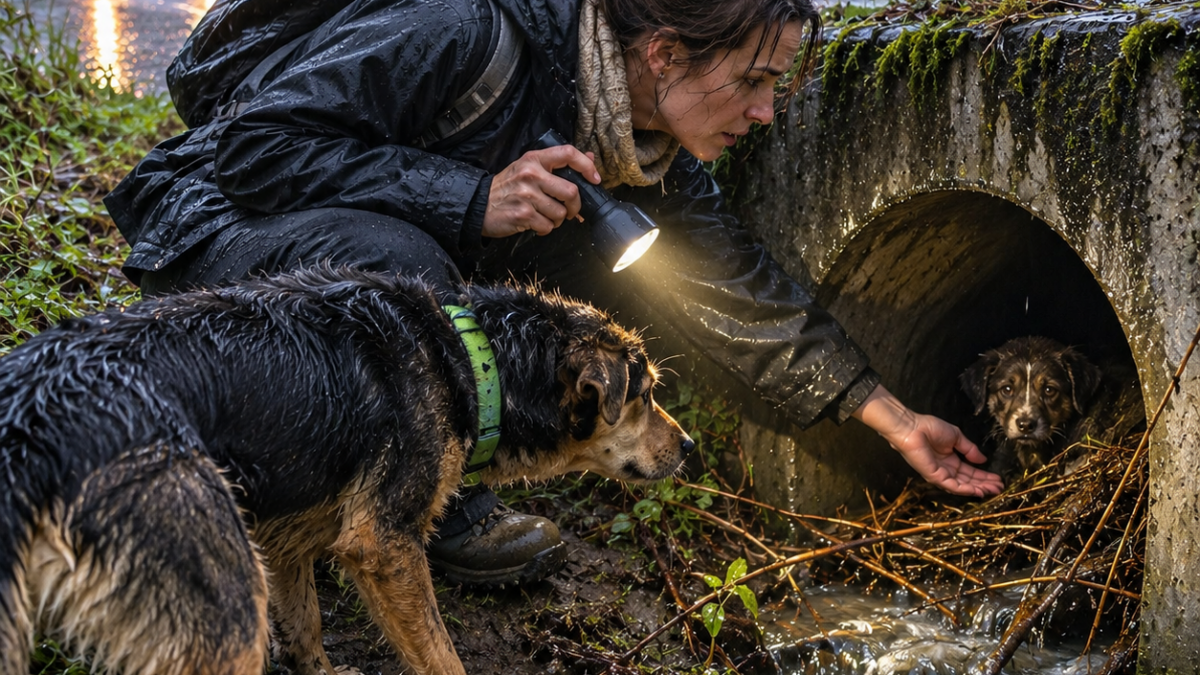
# **A Soaked Dog Kept Throwing Himself in Front of Cars—When I Finally Stopped, I Heard Something Crying Beneath the Road**
The dog wasn’t chasing cars—he was trying to stop them, stepping into the road whenever a vehicle slowed, then racing back toward the same flooded ditch as if every passing driver was another chance to make somebody understand what he had been desperately trying to say.
I almost became one more person who honked, swerved around him, and kept driving, but when that soaked black-and-tan dog planted himself directly in front of my car, pressed his muddy nose against my door, and then ran toward the roadside while looking back to make sure I followed, something about the panic in his eyes made me turn off the engine.
And when I finally climbed down into the ditch and heard a faint sound coming from somewhere beneath the road, I realized the dog had not been asking anyone to rescue him at all—he had been begging strangers to notice what was disappearing in the rising water where nobody driving past could see.
I was driving home from work a little after six that evening, along a narrow departmental road in Haute-Vienne, where the rain had been falling almost continuously since morning and the fields on both sides had begun turning dark with water.
I still had about twenty minutes to go.
That was when I saw the dog.
Large.
Black and tan.
Green collar.
Standing on the shoulder.
The car in front of me slowed when he stepped toward the pavement.
The driver sounded the horn.
The dog jumped back.
I assumed that would be the end of it.
Instead, he ran about thirty yards through the wet grass toward a deep drainage ditch, stopped, looked behind him, then returned to the road.
Strange.
Another car came.
Same thing.
The dog stepped forward.
Horn.
The dog retreated.
Back toward the ditch.
Then onto the road again.
By the time I reached him, traffic had begun stacking behind me, and I was already tired enough to be irritated.
I slowed almost to a stop.
The dog stood directly in front of my hood.
His chest rose rapidly.
Water dripped from his fur.
Mud covered his legs nearly to the belly, and one front paw looked scraped.
“Come on,” I muttered through the windshield. “Move.”
He didn’t.
I rolled forward a few inches.
He stepped backward.
Then he came around the side of my car and pressed his nose against the driver’s window.
That changed everything.
I turned on my hazard lights.
Cut the engine.
Opened the door.
“What are you doing out here?”
The dog immediately backed away.
Then ran.
Not far.
He stopped about thirty yards away near the ditch.
Turned.
Looked at me.
I stayed beside the car.
He came halfway back.
Then ran to the ditch again.
This time, I followed.
The slope descended toward a large concrete culvert running beneath the road.
Because of the rain, water was pouring through it much faster than normal, carrying leaves, mud and broken branches.
The dog moved toward the entrance.
Whined.
Then started digging furiously at the mud beside the concrete.
“What is it?”
He barked.
One short bark.
Then another.
I crouched.
At first, I saw only black water and branches jammed against an old metal grate deeper inside the tunnel.
Then I heard it.
Not the dog beside me.
Something else.
A tiny whimper.
Almost drowned out by the rushing water.
I switched on my phone flashlight.
Several yards inside the culvert, behind tangled branches, two eyes reflected the light.
Another dog.
Smaller.
Female.
Her body was trapped between the side of the concrete tunnel and a mass of debris that had been pushed against the grate by the storm.
Only her head and part of one shoulder were clearly above the water.
The black-and-tan dog tried to enter.
I grabbed his green collar.
“No.”
He fought me.
Not to escape.
To reach her.
That was when I saw his paws properly.
The pads were torn.
His nails packed with mud.
He had tried digging around the culvert.
Probably for hours.
And when digging failed, he had done the only thing left.
He had gone to the road.
Cars meant people.
People meant hands.
He just needed one of us to stop.
I called emergency services.
While I explained where I was, the dog paced constantly between the road and the tunnel entrance.
Every time the trapped female whimpered, he froze.
Then paced again.
The water continued rising.
Within minutes, blue emergency lights appeared through the rain.
Firefighters stopped traffic and climbed into the ditch.
One shone a powerful light inside.
“She’s wedged hard.”
Another studied the debris.
“With this flow, we can’t just pull.”
The dog with the green collar refused to leave.
Every time somebody moved him away, he came back.
Finally, one firefighter crouched beside him.
“All right, buddy. We understand. She’s your friend.”
He slid two fingers beneath the collar to check for injuries.
Then stopped.
“Wait.”
Something small hung beneath the mud.
A metal tag.
He wiped it with his glove.
One word appeared.
**MOKA.**
Below it was a phone number.
He handed me the tag.
“Try calling while we work.”
I dialed.
Once.
Twice.
Three rings.
No answer.
I called again.
Nothing.
Behind me, firefighters began removing branches one by one while Moka sat beside my leg, staring into the culvert as though nothing else in the world existed.
Then my phone vibrated.
The number was calling back.
“Hello?”
An elderly woman answered.
Her voice sounded frightened.
I asked if she knew a dog named Moka.
There was a long silence.
Then she asked one question.
“Did you find Prune too?”
—
## **[END OF FACEBOOK OPENING — CONTINUE STORY BELOW]**
I looked toward the tunnel.
The smaller dog whimpered again.
“I think Prune is here.”
The woman on the phone stopped breathing for a second.
“What do you mean you think?”
“She’s trapped.”
“Where?”
“In a culvert beneath the road.”
“Oh God.”
Her voice broke.
“Is she alive?”
“Yes.”
That was all I could honestly promise.
“She’s alive.”
The woman started crying.
Not loudly.
The kind of crying people do when they are trying to ask questions at the same time.
“Moka?”
“He’s here too.”
“Is he hurt?”
“His paws are scraped, but he’s standing.”
“He found her.”
The certainty in her voice made me look at him.
Moka stood beside the firefighters, muscles tight, rain running from his coat.
“What happened?” I asked.
The woman took a shaky breath.
“My name is Denise. They’re mine.”
“How long have they been missing?”
“Since this morning.”
That surprised me.
I had imagined days.
“They got out?”
“The wind knocked part of the garden gate open.”
Her words came quickly now.
“I didn’t realize at first. I let them into the yard after breakfast. I went back inside. When I called them fifteen minutes later, they were gone.”
“Have you been looking?”
“All day.”
I could hear exhaustion.
“I called neighbors. My son drove around. I walked until I couldn’t anymore.”
“How old are they?”
“Moka is six. Prune is four.”
“Are they related?”
“No.”
Then she added:
“But don’t tell Moka that.”
Despite the situation, I almost laughed.
“They’re inseparable.”
The firefighter nearest the culvert called out:
“We need another line.”
I turned away from the phone.
“What?”
“The debris is shifting.”
The water surged beneath the branches.
Inside, Prune cried out.
Moka lunged.
I caught his collar again.
He twisted so hard I nearly fell.
“Moka!”
The woman heard me.
“What happened?”
“Nothing yet.”
I tried to keep my voice steady.
“The firefighters are working.”
“I’m coming.”
“Denise—”
“I’m coming.”
“Are you driving?”
Silence.
Then:
“No. My son is here.”
“Good.”
I gave her the location.
Before hanging up, she said something I still remember.
“Please don’t let Moka go in there.”
I looked at the dog fighting me to reach Prune.
“I won’t.”
“He will try.”
“I know.”
“He doesn’t understand danger when it’s her.”
I believed that immediately.
The rescue became more complicated by the minute.
The main problem was not simply that Prune was trapped.
It was how.
Branches had washed into the culvert and wedged against an old metal grate. Prune had somehow been carried or had entered behind them, and as debris accumulated, part of her body became pinned against the wall.
The water was pressing everything tighter.
Pull the wrong branch, and the pile might collapse deeper onto her.
Remove the wrong pressure point, and rushing water could drag her farther into the tunnel.
One firefighter entered on a secured rope.
Another controlled the line.
A third worked from the opposite side of the road.
Traffic had completely stopped.
Drivers stood near their cars in the rain, watching.
Some were probably the same people who had honked at Moka earlier.
I wondered if they recognized him.
I wondered if they felt guilty.
At that moment, I didn’t have energy to judge them.
I had almost driven past too.
The firefighter inside shouted:
“I can touch her!”
Everyone froze.
Moka barked once.
“Can you free her?”
“Not yet.”
He reached around the debris.
“Her back leg is caught.”
The current strengthened.
Prune’s head lowered.
Then rose again.
I crouched beside the opening.
“Prune!”
Her ears moved.
“Moka is here.”
I had no idea whether that mattered.
Moka clearly thought it did.
The moment I said her name, he whined and leaned toward the tunnel.
Prune answered with a weak sound.
The firefighter closest to me said:
“Keep talking.”
So I did.
“Prune.”
Her eyes found the light.
“You’re okay.”
A lie.
But a useful one.
“Moka’s right here.”
Moka whined.
Prune’s head lifted.
“That’s it.”
The firefighter inside shouted:
“I need cutters!”
Someone ran.
I heard an engine in the distance.
Another vehicle stopped behind the fire truck.
A man jumped out.
An elderly woman sat in the passenger seat before he even opened the door.
Denise.
Her son helped her down.
She wore a raincoat over house clothes and slippers that were already soaked.
“Moka!”
The dog turned.
Everything in him changed.
He ran toward her.
For the first time since I had stopped my car, he moved away from the culvert voluntarily.
Denise dropped to her knees despite her son trying to support her.
Moka pressed into her chest.
“Oh, you idiot.”
She held his face.
“You beautiful idiot.”
Moka licked her chin once.
Then immediately turned toward the ditch.
Denise followed his gaze.
“Prune.”
I stepped closer.
“She’s alive.”
Denise looked at me.
“You stopped?”
“Yes.”
She grabbed my hand.
“Thank you.”
Before I could answer, the firefighter inside shouted.
“Cutting now!”
The old grate had warped.
One section was pressing debris around Prune’s hind leg.
They needed to create enough space without releasing the entire blockage at once.
A firefighter positioned farther downstream yelled:
“If that pile goes, she’ll move!”
Another rope was prepared.
Denise stood beside me gripping Moka’s collar.
The dog trembled from head to tail.
“He found her,” she whispered.
“How did they end up here?”
“I don’t know.”
Her eyes never left the culvert.
“They left together. They always do everything together.”
Moka pulled.
Denise tightened her hand.
“No.”
The metal cutters snapped through something.
A harsh sound echoed inside the tunnel.
Then the debris shifted.
Everyone shouted at once.
“Hold!”
“Line!”
“Back!”
Prune disappeared beneath the water.
Denise screamed.
Moka went wild.
He dragged both of us several steps before Denise’s son caught his harness.
“Prune!”
For one second, there was nothing.
Then the firefighter inside yelled:
“I have her!”
A head appeared.
Prune coughed.
The rescuer had one arm around her chest.
Another firefighter pulled the safety line.
Branches broke free and shot downstream.
The water surged.
Moka barked continuously.
Denise cried his name.
I do not remember breathing.
Slowly, centimeter by centimeter, the firefighter backed out of the culvert with Prune held against him.
When her front paws touched the muddy bank, she collapsed.
Moka ripped free from Denise’s son.
He reached Prune before anyone could stop him.
He sniffed her face.
Her ears.
Her shoulders.
Then he made a sound I had never heard from a dog before.
Not a bark.
Not a whine.
Something low and shaking.
Prune lifted her head.
She licked his muzzle.
Moka’s entire body relaxed.
The firefighters gave them only a few seconds before separating them enough to examine Prune.
She was cold.
One hind leg had a deep abrasion where it had been trapped.
Her breathing was fast.
But she was alive.
Denise knelt between them.
“You two.”
She was laughing and crying.
“You nearly killed me.”
Moka stood pressed against Prune.
The firefighter who had entered the tunnel sat in the mud, breathing hard.
I walked to him.
“You okay?”
He nodded.
“Better than she is.”
Prune tried to stand.
Failed.
Moka immediately leaned against her side.
The firefighter smiled.
“That one is not leaving her.”
“No.”
Denise overheard.
“He never does.”
Emergency veterinary care was arranged.
Denise’s son offered to drive.
The firefighters advised them to go directly.
I assumed my part was finished.
I had stopped.
Called.
Help arrived.
That should have been the end.
Then Moka walked back to my car.
He sniffed the driver’s door.
The same place where his nose had touched the glass earlier.
Denise saw.
“He knows.”
I laughed.
“Knows what?”
“That you listened.”
I wanted to dismiss it as sentimental.
But Moka looked at me.
Tail moving now.
Slowly.
Then he returned to Prune.
Maybe Denise was right.
Maybe not.
I didn’t need to know.
Before they left, Denise asked my name.
“Claire.”
She took my hand again.
“Claire, I don’t know what would have happened if you kept driving.”
I looked toward the line of stopped vehicles.
Neither did I.
That thought followed me home.
The rain continued.
I drove the final twenty minutes much slower than usual.
At every ditch, every shadow, every movement near the road, I looked twice.
That night, I kept hearing horns in my head.
Car after car.
Moka stepping forward.
People driving away.
I could have been one of them.
I had almost been one of them.
The next morning, Denise called.
I answered immediately.
“Prune?”
“Alive.”
I sat down.
“Good.”
“She spent the night at the veterinary clinic.”
“How bad?”
“Hypothermia. Cuts. The leg is swollen, but they don’t think it’s broken.”
“And Moka?”
“Refuses to leave the clinic door.”
I laughed.
“Of course.”
“He has bandages on both front paws.”
“From digging?”
“The vet thinks so.”
Denise became quiet.
Then said:
“They told me something.”
“What?”
“Prune had probably been trapped for hours.”
I closed my eyes.
“Moka must have stayed with her.”
“Yes.”
“Then gone to the road.”
“Yes.”
We were quiet.
Denise continued.
“They think he tried digging around the culvert first. His paws are full of tiny cuts.”
I remembered the mud beneath his nails.
“What made him understand cars could help?”
“I don’t know.”
Neither did I.
Dogs do not explain their plans.
Maybe Moka had seen people stop cars before.
Maybe he simply knew humans came from vehicles.
Maybe desperation creates intelligence.
Whatever the reason, he had adapted.
Digging failed.
So he found another tool.
Us.
Over the next few days, Denise sent updates.
Prune stood the second day.
Walked three steps the third.
Moka stayed close enough that the veterinary team eventually allowed supervised visits because separating him seemed to make both dogs more stressed.
One photograph showed Prune on a blanket with Moka lying beside her, his two bandaged paws stretched forward.
I saved it.
I didn’t know why.
I barely knew these dogs.
But something about that image stayed with me.
A week later, Denise invited me to visit.
I almost declined.
Then I remembered Moka’s nose against my car window.
I went.
Denise lived about fifteen minutes from the road, in a small stone house surrounded by a large garden.
The damaged gate had already been replaced.
Twice.
New wooden gate.
Then a second internal barrier.
“You rebuilt a fortress,” I said.
Denise’s son, Laurent, laughed.
“She checks it six times a day.”
“Seven,” Denise corrected.
Prune came outside slowly.
Her hind leg was bandaged.
Moka followed immediately.
When he saw me, he stopped.
His ears lifted.
I crouched.
“Do you remember me?”
He approached.
Sniffed my shoes.
Then my hands.
Then leaned briefly against my knee.
Denise smiled from the doorway.
“He does.”
Prune was more cautious.
Understandably.
I let her choose.
She sniffed from several feet away.
Then returned to Moka.
Denise made coffee.
That was how I learned the rest of their story.
Prune had been abandoned as a young dog near Denise’s village.
Moka had already lived with Denise for two years.
When Prune first arrived, she was terrified of everyone.
“She lived under my woodpile for three days,” Denise told me.
“Moka sat outside.”
“Just sat?”
“Wouldn’t come in.”
She pointed toward him.
“Stubborn fool.”
Eventually, Prune followed Moka into the house.
From then on, they were inseparable.
“They sleep together?”
“Not touching.”
Denise smiled.
“But if one gets up, the other checks.”
The morning they disappeared, strong wind had apparently forced open a weakened section of gate.
Denise found muddy tracks leading toward nearby fields.
She believed Moka and Prune had been exploring.
Then the storm intensified.
No one knew how Prune ended up in the culvert.
Perhaps she stepped into the ditch and was swept toward the opening.
Perhaps she followed an animal.
Perhaps the ground gave way.
We would never know.
But Moka stayed.
That much was clear.
Denise looked at me.
“I keep imagining him beside her.”
“So do I.”
“How long before he went to the road?”
“I don’t know.”
She stared into her coffee.
“He might have been trying for hours.”
Her hands began trembling.
“I was driving around looking in the wrong places while he was…”
I recognized that kind of guilt.
“You were searching.”
“Not there.”
“You didn’t know.”
“I should have checked the culverts.”
“How many culverts are there?”
She looked annoyed.
“Too many.”
“Exactly.”
She sighed.
“You sound like my son.”
“Your son sounds reasonable.”
“That is not why I raised him.”
I laughed.
Denise smiled.
Then became serious.
“Do you know what bothers me?”
“What?”
“The people who drove by.”
There it was.
I had thought about them too.
“How many?”
“I don’t know.”
“You saw some.”
“Yes.”
“And none stopped.”
I hesitated.
“I almost didn’t either.”
“But you did.”
“Only because he touched my window.”
Denise shook her head.
“That’s enough.”
Maybe.
But the question stayed.
How many times had Moka tried before me?
Ten cars?
Twenty?
Fifty?
Had somebody laughed?
Had someone cursed at him?
Had anyone thought:
Stupid dog.
Move.
I knew how easy it was.
Because that had been my first reaction.
Life rarely gives us the satisfying villains stories do.
Sometimes the villain is hurry.
Assumption.
The belief someone else will stop.
I went home thinking about that.
Then the video appeared.
Someone had recorded part of the rescue from the line of traffic.
Moka moving between the road and ditch.
Firefighters working.
Prune coming out.
The video spread through local social media.
Within days, people were calling Moka a hero.
Denise hated the word.
“He’s a dog.”
“He saved Prune.”
“He loved Prune.”
She looked at me.
“That’s different.”
Maybe it was.
A hero sounds like someone deciding to be brave.
Moka had simply refused to leave his friend.
But the video brought something else.
Comments from people who recognized the road.
One man wrote:
**I passed that dog around 5:40. I thought he was trying to bite tires.**
Another:
**I honked at him. I feel terrible now.**
Another:
**We drove around him ten minutes before the rescue.**
People argued.
Some attacked the drivers.
Others defended them.
How could anyone know what the dog wanted?
Then someone posted:
**You didn’t need to know what he wanted. You only needed to know something was wrong.**
That sentence spread almost as widely as the video.
I showed Denise.
She read it twice.
“That’s it.”
“What?”
“That’s what people should learn.”
We were sitting in her kitchen.
Moka slept beneath the table.
Prune lay near the heater.
Denise looked down at them.
“You don’t have to understand everything before you stop.”
That became important later.
Because two weeks after Prune’s rescue, another storm came.
Not as severe.
But enough for local authorities to inspect drainage systems.
The culvert where Prune had been trapped drew attention because firefighters had reported the old grate and dangerous debris accumulation.
An inspection found the grate was badly deteriorated.
Branches and trash had collected against it repeatedly.
People who lived nearby said flooding there had worsened over several years.
No one had deliberately trapped Prune.
No evil person had pushed her into the tunnel.
But there had been warnings about that drainage point.
Maintenance requests.
Complaints.
Delays.
The municipality responded quickly once the rescue video attracted attention.
The old grate was removed.
The culvert cleared.
Approaches reinforced.
Warning markers installed.
Some people called that public pressure.
Denise called it:
“Prune’s revenge.”
I laughed.
“On a drain?”
“No.”
She pointed toward the newspaper story.
“On everyone who said, ‘Later.’”
That I understood.
A hazard ignored for months became impossible to ignore after one soaked dog stopped traffic.
Moka had forced the road to pay attention.
I liked that better than revenge.
Accountability.
Not dramatic.
Useful.
Prune’s recovery took almost six weeks.
The leg healed.
She regained confidence more slowly.
For the first few days after coming home, she refused to go near the garden gate.
If rain fell, she stayed inside.
The sound of water in roadside drains made her freeze during walks.
Denise worried.
“She used to love walking.”
“She may again.”
“What if she doesn’t?”
“Then you adjust.”
Moka did something interesting.
Whenever Prune froze, he stopped too.
He did not pull.
Did not circle.
Did not become excited.
He simply stood beside her.
Then, when she moved, he moved.
I witnessed it once.
We were walking along a quiet lane.
Water ran beneath a small bridge.
Prune stopped.
Her body went rigid.
Denise immediately shortened the leash.
Moka stopped three feet ahead.
Turned.
Came back.
He stood beside Prune.
No touching.
Just there.
A minute passed.
Prune sniffed.
Moka stepped forward.
One step.
Waited.
Prune followed.
Denise’s eyes filled.
“He’s teaching her.”
I’m not sure that was literally what he was doing.
But he was giving her something humans often forget to give.
Time.
No one dragged her.
No one forced exposure.
No one said:
You survived, so stop being afraid.
Moka simply adjusted his pace.
Prune eventually crossed.
That became their pattern.
By early summer, she walked confidently again.
Still cautious near deep ditches.
Fair.
So was I.
Every time I drove that road, I slowed near the culvert.
The first few times, I stopped completely.
Not because there was danger.
Because memory was strange.
I could still see Moka in front of my hood.
Then one afternoon, I saw a small sign newly installed near the drainage area.
**DRAINAGE CROSSING — SLOW DURING HEAVY RAIN**
Nothing dramatic.
No plaque for Moka.
No statue.
Good.
He didn’t need one.
The real monument was the road becoming safer.
Denise’s life changed too.
Before the rescue, she had lived relatively quietly.
Widow.
Seventy-four.
Two dogs.
A son who checked on her.
Neighbors.
Afterward, people recognized Moka.
At the market:
“Is that the dog?”
At the pharmacy:
“The hero dog?”
Children asked to meet him.
Moka hated the attention.
He preferred cheese.
Prune preferred no strangers at all.
Denise began refusing most requests.
“They are not attractions.”
I loved her for that.
One local school asked whether she would bring Moka for a safety talk.
She almost refused.
Then the teacher explained the topic.
What to do when you see an animal behaving strangely near a road.
When to call for help.
Why not to chase.
How to stay safe.
Denise agreed.
Moka went.
Prune stayed home.
I was invited too because apparently I had become “the driver who stopped.”
I hated that title.
The children sat on the floor.
Moka lay beside Denise.
One boy raised his hand.
“Did he know you had a phone?”
Everyone laughed.
“I don’t think so.”
“Then why did he stop your car?”
“I don’t know.”
Another girl asked:
“Were you scared?”
“Yes.”
“Of him?”
“At first, maybe.”
Moka yawned.
I continued.
“Mostly I was annoyed.”
The teacher looked surprised.
I wanted the children to hear the truth.
“I thought he was blocking traffic.”
A boy said:
“So you almost left?”
“Yes.”
The room became quiet.
I pointed toward Moka.
“He didn’t need me to know exactly what was wrong. He only needed me to notice that something was wrong.”
The girl nodded seriously.
“What if it was dangerous?”
“Then you don’t put yourself in danger. You call an adult or emergency services. But you don’t have to pretend you saw nothing.”
Denise looked at me.
That sentence became ours.
Don’t pretend you saw nothing.
The children made thank-you cards for the firefighters.
And one for Moka.
His had a drawing of two dogs under a road.
Moka ate the corner.
Heroism.
Months passed.
I kept visiting Denise occasionally.
At first because she invited me.
Later because we became friends.
She lived alone, and while her son visited often, she appreciated company.
I liked listening to her complain about everything.
Weather.
Government.
Supermarket tomatoes.
People who called Moka heroic while letting their own dogs run off leash.
She was exhausting.
I adored her.
Moka and Prune became ordinary again.
That may sound disappointing.
It wasn’t.
Ordinary is what rescue is supposed to earn.
Breakfast.
Walk.
Nap.
Barking at delivery trucks.
Stealing toast.
Arguments over sofas.
Prune developed a habit of sleeping upside down with her paws against the wall.
Moka started carrying one of Denise’s slippers to the front door every morning.
Never chewing.
Just moving it.
“Why?”
Denise asked me.
“I have no idea.”
“He is broken.”
“He saved a dog from drowning.”
“Doesn’t mean he understands footwear.”
Prune’s fear of rain slowly diminished.
The first heavy storm after her recovery was difficult.
Thunder began around midnight.
Denise called me.
Not because of an emergency.
Because she was frightened for Prune.
“She’s under the table.”
“That’s okay.”
“She’s shaking.”
“Stay with her.”
“Moka is there.”
“Then stay with both.”
Denise sat on the kitchen floor for two hours.
Prune pressed against Moka.
Moka pressed against Denise.
Nobody slept.
By dawn, the storm passed.
Prune came out.
Ate breakfast.
Recovery.
Not miraculous.
One storm at a time.
A year after the rescue, local firefighters organized a community open day.
They invited Denise.
She complained for three weeks.
Then attended.
The firefighter who had entered the culvert recognized Moka immediately.
“Hey, traffic cop.”
Moka wagged.
The man knelt.
“You remember me?”
Moka sniffed him.
Then licked his chin.
Denise laughed.
“He remembers people who smell like mud.”
Prune stayed close to her.
The firefighter looked at Prune.
“You look better.”
She wagged once.
He smiled.
“I’m taking that as gratitude.”
We took a photograph.
The rescuer.
Moka.
Prune.
Denise.
Me.
In the background was the emergency vehicle.
I keep that photograph.
But my favorite is another.
Taken later.
No people.
Moka and Prune asleep in the sun.
Prune’s head resting across Moka’s back.
No mud.
No water.
No road.
No urgency.
That is what safety looks like after the story stops being exciting.
Then, nearly two years after the culvert rescue, Denise fell.
Not dramatically.
She slipped in her kitchen.
Fractured her wrist.
Nothing life-threatening.
But at seventy-six, a fall changes logistics.
Her son Laurent insisted she stay with him for several weeks.
The problem was his apartment building did not allow two large dogs long-term.
He could manage Moka.
Prune became overwhelmed around his young children.
Denise called me.
“I need a favor.”
I knew before she asked.
“Prune?”
Silence.
“Yes.”
“For how long?”
“Three weeks.”
“Bring both.”
“What?”
“Separating them seems stupid.”
“My house is small.”
“So is mine.”
“You have a garden.”
“A tiny one.”
“Claire.”
“Bring them.”
That was how Moka and Prune temporarily moved into my house.
I had no dogs.
Never had.
My childhood dog had died when I was nineteen, and I had convinced myself my work schedule made another impossible.
Moka changed the argument within twelve hours.
At 6:03 the first morning, he put his nose against my bedroom door and whined.
I opened one eye.
“No.”
Whine.
“Denise said seven.”
Moka stared.
Prune stood behind him.
“Traitors.”
I got up.
They ate.
Then waited by the door.
“Walk?”
Both tails.
By the third day, they had reorganized my life.
Coffee happened after walk.
Shoes belonged in cupboards because Moka relocated them.
Prune hated the vacuum.
Moka loved watching television if animals appeared.
I learned that two dogs can somehow occupy eighty percent of a couch.
Denise called constantly.
“How are they?”
“Alive.”
“Did Moka eat?”
“Yes.”
“Prune?”
“Yes.”
“Stool?”
“Denise.”
“What?”
“I will not discuss stool every morning.”
“You will if you love them.”
Apparently.
At the end of three weeks, Denise returned.
Moka lost his mind when he saw her.
Prune made a strange squealing sound and climbed against her legs.
I laughed.
Denise cried.
Then she looked at me.
“You miss them already.”
“They are still here.”
“You will.”
She was right.
The house felt enormous after they left.
For the first time, I understood why Denise had said Moka and Prune were not simply pets.
They were structure.
Reasons to move.
Noise.
Warm bodies in rooms that otherwise remain still.
I began joining their Sunday walks.
That became routine.
Then Denise’s health worsened gradually over the following years.
Nothing dramatic at first.
High blood pressure.
Arthritis.
A heart rhythm problem.
She remained stubborn.
Of course.
Laurent worried.
I helped when I could.
Moka turned nine.
Prune seven.
Then ten and eight.
Their faces changed slightly.
Moka’s black muzzle collected gray.
Prune became calmer.
One rainy afternoon, we walked near the repaired culvert.
Denise had resisted going there for years.
Then suddenly she asked.
“Take me.”
“Why?”
“I want to see it.”
“You’ve seen photographs.”
“Not the same.”
So we went.
The drainage area looked completely different.
Vegetation trimmed.
No old grate.
Improved flow.
Warning posts.
Moka sniffed the ground.
Nothing dramatic.
Prune stopped.
I watched.
Her body tightened slightly.
Denise noticed too.
“Should we leave?”
“Wait.”
Moka moved forward.
Prune watched him.
Then followed.
Slowly.
They crossed the grassy area above the culvert.
Prune sniffed.
Marked a bush.
Denise laughed.
“That’s what she thinks of the place.”
I laughed so hard I nearly dropped the leash.
There it was.
Prune’s revenge.
Not fear.
Not drama.
Peeing on a bush and walking away.
Denise stood beside the road.
“People drove past here.”
“Yes.”
“You stopped.”
“Yes.”
She looked at me.
“Why?”
I thought about it.
“I don’t know.”
“That’s not satisfying.”
“I almost didn’t.”
“That’s worse.”
“I know.”
I looked at Moka.
“Maybe he didn’t give me enough time to make the wrong decision.”
Denise smiled.
“That sounds like him.”
Moka had simply kept escalating.
Road.
Window.
Ditch.
Look back.
Again.
He made misunderstanding difficult.
I sometimes wonder how many people and animals disappear because their signals are quieter.
No dog blocking a car.
No emergency.
Just something slightly wrong that everyone assumes somebody else will notice.
That became the uncomfortable lesson.
Moka was lucky not because he was clever enough to stop cars.
He was lucky because eventually one car stopped.
Those are different things.
Around that time, the local municipality launched a small awareness campaign about rural road hazards during storms.
Culverts.
Flooded crossings.
Animals.
Not because of Moka alone.
But his case was mentioned.
Denise received a printed flyer.
She framed it.
I mocked her.
“You hate the hero story.”
“I like being right.”
“About what?”
“That they should have fixed the drain years ago.”
Fair.
Then came the winter when Moka developed heart disease.
He was eleven.
Denise called me after the veterinary appointment.
“He has Bernard’s problem.”
“Who is Bernard?”
“My husband.”
I had only heard his name in passing.
“He died from heart failure.”
I sat down.
“What did the vet say?”
“Medication.”
“And?”
“Monitoring.”
“And?”
She became angry.
“Why does everyone ask ‘and?’”
“Because there’s always an and.”
Silence.
“He’s old.”
I closed my eyes.
Moka was not allowed to become old in my head.
He was permanently the soaked dog in front of my car.
But time had continued.
Prune remained healthy.
She seemed to understand Moka slowing before we did.
During walks, she stopped ranging ahead.
She matched him.
Always.
If he rested, she rested.
When medication made him nauseous, she lay beside his food bowl until he ate.
Denise said:
“They are ridiculous.”
I said:
“They learned from you.”
“Insulting.”
Moka’s condition stabilized.
For more than a year, medication gave him good life.
Shorter walks.
More naps.
Still interested in food.
Still interested in Prune.
Still moving shoes.
That mattered.
Then Denise had a stroke.
Mild enough that she survived.
Serious enough that independent living became impossible for several months.
Laurent called me from the hospital.
“What do we do with the dogs?”
My answer was immediate.
“They come to me.”
Both.
This time nobody argued.
Moka and Prune moved back into my house.
Older.
Slower.
More certain they owned it.
Prune slept beside the sofa.
Moka took the rug near my bedroom.
Denise spent six weeks in rehabilitation.
We visited as often as rules allowed.
The first time Moka saw her after the stroke, his reaction was completely different from the dramatic reunion years earlier.
He walked slowly.
Reached her wheelchair.
Placed his head on her knee.
Denise started crying.
Prune sat beside him.
No jumping.
No pulling.
Just presence.
Denise’s speech was still slightly affected.
She whispered:
“My babies.”
Moka wagged.
One slow sweep.
Prune licked her hand.
The rehabilitation staff allowed the visit to last fifteen minutes.
It became thirty.
Some rules are defeated by old women crying.
Afterward, Denise told me:
“If I can’t go home…”
“You will.”
“Claire.”
I stopped.
“If I can’t.”
I knew.
“Moka and Prune stay with me.”
“Yes.”
“Together.”
“Yes.”
“Always.”
“Yes.”
She looked at me.
“You promise too easily.”
“I learned from Moka.”
That satisfied her.
Denise did return home.
But not permanently alone.
Laurent arranged for help.
I visited more.
Then, eighteen months later, she died in her sleep.
Peacefully.
Her son called at six in the morning.
I knew before he spoke.
Moka was thirteen.
Prune eleven.
Both at my house because Denise had been in the hospital for several days with pneumonia.
I sat on the kitchen floor after the call.
Moka came first.
Pressed his body against me.
Prune followed.
I put one arm around each.
“How do I tell you?”
Of course I couldn’t.
Laurent asked whether we should take them to Denise’s house one last time.
We did.
The medical equipment had already been removed.
Her chair remained.
Blanket.
Slippers.
Moka entered.
Stopped.
Sniffed.
Walked through every room.
Prune followed.
They searched.
Moka returned to the living room.
Picked up one of Denise’s slippers.
Of course.
He carried it to the front door.
Placed it there.
Then lay down.
Laurent cried.
I did too.
Prune curled beside him.
We sat around those dogs for nearly an hour.
No one spoke much.
After Denise’s funeral, there was no question where they would go.
My house.
The place I had once said was too small for dogs.
Apparently large enough for two old ones.
Moka adjusted faster than Prune.
Maybe because he had already lived there twice.
Prune spent the first week waiting near the door every evening.
At seven.
Denise’s old dinner time.
I started feeding them then.
Routine became comfort.
I kept one of Denise’s sweaters on the couch.
Prune slept on it.
Moka kept the slipper.
He never chewed it.
Just carried it from room to room for months.
The first year without Denise was difficult.
For all three of us.
But ordinary life returned.
Breakfast.
Medication.
Slow walks.
Naps.
Rain.
I still drove the road near the culvert.
Sometimes with both dogs in the car.
One afternoon, I pulled over near the safe parking area and let them out on leashes.
Moka stood near my driver’s door.
He sniffed the same panel where his nose had once pressed against the glass.
Coincidence.
Probably.
I smiled anyway.
“You bullied me.”
His tail wagged.
Prune sniffed the ditch.
No fear now.
We walked along the edge.
The water was low.
Clearer than that day.
I looked beneath the road.
No trapped dog.
No branches.
Just moving water.
Moka sat.
Prune sat beside him.
I took a photograph.
Old Moka.
Gray face.
Green collar replaced years earlier but still the same color because Denise insisted.
Prune beside him.
The culvert behind them.
I never posted it.
Some photographs feel like they belong to the people inside the story.
Even if two are dogs.
Moka’s heart worsened that autumn.
The vet adjusted medication.
Then again.
Eventually the good days began shrinking.
He still ate.
Still wanted Prune.
Still moved Denise’s slipper.
Then one morning, he did not want to walk.
For Moka, that meant something.
This was a dog who had once run between moving cars because standing still while Prune was in danger was impossible.
Now he looked at the open door and lowered his head.
I sat beside him.
“Not today?”
He leaned against my leg.
Prune stood nearby.
She sniffed his face.
Then lay down beside him.
The veterinarian came that afternoon.
Heart failure was progressing.
Fluid.
Fatigue.
Medication could help.
But only so much.
“How long?”
I hated myself for asking.
“Could be weeks.”
“Good weeks?”
Silence.
The same question always comes in the end.
Not time.
Quality.
For another month, Moka had enough.
Short walks.
Food.
Prune.
Sleep.
One sunny morning, he even barked at a delivery driver.
I celebrated.
The driver thought I was insane.
Then came the day Moka collapsed.
Not unconscious.
His legs simply failed after crossing the kitchen.
I lifted him.
Too light compared to the powerful dog I remembered.
Prune followed us to his bed.
I called the vet.
Then Laurent.
He came immediately.
We all knew.
The vet examined him at home.
Moka’s breathing was difficult.
His body was tired.
There were options.
Hospitalization.
Oxygen.
More aggressive management.
Maybe days.
Perhaps weeks.
I looked at him.
Then Prune.
She was pressed against his side.
I asked:
“Would he come home feeling like himself?”
The vet’s eyes answered before his words.
“Probably not for long.”
I nodded.
I hated myself.
Then loved him enough to keep nodding.
“We do it here.”
No clinic.
No final car ride.
No strange room.
Moka’s bed.
Prune.
Me.
Laurent.
Denise’s slipper beside him.
Before the vet prepared anything, I had one idea.
“Can we take him outside?”
The yard was damp from morning rain.
We wrapped him in a blanket.
Carried him.
Placed him on the grass.
Prune lay beside him.
Moka lifted his nose.
Wind.
Wet earth.
Cars far away.
Birds.
His breathing slowed.
I sat.
“Do you remember stopping my car?”
Of course he did not understand the question.
“You were unbelievably annoying.”
Laurent laughed through tears.
Moka’s tail moved once.
“You could have gotten yourself killed.”
Prune pressed closer.
“And you didn’t care.”
That was true.
Everything had been about her.
I stroked his head.
“You found somebody.”
My voice broke.
“You found me.”
I had always thought I rescued Prune because I stopped the car.
Over the years, that story had reversed.
Moka brought Denise into my life.
Prune.
Laurent.
The firefighters.
A house that eventually became less empty because two old dogs moved in.
Maybe he had stopped my car for more than one reason without ever knowing it.
We stayed outside ten minutes.
Then Moka became tired.
We carried him inside.
The veterinarian gave the first medication.
Moka relaxed.
Prune stood.
Sniffed his face.
Then did something none of us expected.
She walked to the front door.
Turned.
Looked at us.
Then returned to Moka.
Once.
Twice.
Laurent whispered:
“She wants something.”
I knew.
“The road?”
It sounded absurd.
Then I remembered.
Moka had gone from Prune to road.
Road to Prune.
Again and again.
Maybe we were projecting.
Probably.
But I suddenly wanted one thing.
I brought my car keys.
“What are you doing?” Laurent asked.
“Just something stupid.”
Moka was sedated but conscious.
We could not drive him anywhere safely.
So I opened the front door.
Walked outside.
Started my car.
Turned it off.
Then came back.
I placed the keys beside his bed.
Laurent stared.
“That is the stupidest thing I’ve ever seen.”
“Yes.”
I held Moka’s face.
“You can stop traffic now.”
I cried.
“You did it.”
Prune lay beside him.
Moka’s nose touched her fur.
The veterinarian waited.
I nodded.
The final medication was given.
Moka took one slow breath.
Then another.
Then stopped.
Prune remained beside him.
No panic.
No dramatic sound.
She sniffed his face.
Waited.
Then rested her head across his neck.
Exactly like the photograph from years earlier.
Only reversed.
Once, Moka had waited beside Prune while humans tried to save her.
Now Prune waited beside him while no rescue remained to perform.
I cried harder than I expected.
Laurent sat on the floor.
“He saved her.”
“Yes.”
“He saved Mom too, in a way.”
“Yes.”
Then he looked at me.
“And you.”
I shook my head.
Maybe.
But that was not a story I was ready to tell.
We buried Moka’s collar tag with Denise’s ashes beneath the tree Laurent had planted at her house.
The actual collar stayed with me.
Green.
Always green.
Prune struggled after Moka died.
There is no romantic way to describe it.
She searched.
Kitchen.
Bedroom.
Yard.
Front door.
She refused food the first day.
Ate a little the second.
At night, she slept in Moka’s bed.
I moved Denise’s old sweater beside her.
For weeks, our walks were slow.
Prune looked behind us constantly.
I found myself doing the same.
Grief can make humans imitate dogs.
Then, little by little, she changed.
Not forgot.
Adapted.
She started eating normally.
Sleeping on the couch.
Barking at the mail carrier.
She took over one of Moka’s habits.
Shoes.
The first time she carried my slipper to the front door, I started laughing and crying at once.
“You have got to be kidding.”
Prune looked at me.
Then dropped it.
Maybe imitation.
Maybe coincidence.
I kept the slipper anyway.
Prune lived three more years.
Those years became ours.
Not Moka’s.
Not Denise’s.
Ours.
She was old.
Gentle.
Still suspicious of deep water.
Still loved grass.
She followed me from room to room.
When I drove, she preferred the back seat.
I never passed the culvert without slowing.
Prune always lifted her head near that section.
Again, maybe coincidence.
But memory lives in smell and sound differently for dogs.
One spring morning, we stopped.
I walked her down carefully.
The ditch was dry.
Prune stood near the entrance.
Sniffed.
Then looked toward the road.
A car passed.
She did nothing.
Another.
Nothing.
I smiled.
“No one needs stopping today.”
We walked home.
At fifteen, Prune’s body began failing.
Kidneys.
Arthritis.
Old age.
The same slow negotiation.
Medication.
Food.
Comfort.
She became picky.
Denise would have laughed.
Eventually, the day came when Prune stopped wanting the yard.
I knew.
Not because one symptom decides everything.
Because I knew her.
The veterinarian came.
We talked.
I asked the question.
Good days?
Not enough.
So we chose home again.
Prune lay on her favorite blanket.
Moka’s green collar sat on the table.
Denise’s sweater folded nearby.
I thought about bringing everything close.
Then decided against turning the room into a museum.
Prune needed me.
Not symbols.
I lay beside her.
“You know, you caused all of this.”
Her eyes opened.
“If you hadn’t gotten yourself stuck…”
I laughed.
“Terrible decision.”
Prune breathed.
“Moka found me.”
I corrected myself.
“He found somebody.”
I stroked her ear.
“You got out.”
That was what mattered.
The first medication relaxed her.
I whispered:
“No water.”
Her breathing slowed.
“No branches.”
I put my forehead against hers.
“No road.”
Prune’s eyes closed.
“No one leaving you behind.”
The final medication came.
She slipped away quietly.
The house became silent.
For the first time in years, truly silent.
No nails.
No bowls.
No leash.
No Moka moving shoes.
No Prune following me from room to room.
I sat on the floor until evening.
Then I did something strange.
I drove to the road.
Not because I planned to.
I simply found myself there.
The culvert was barely visible in the dark.
Traffic was light.
I pulled safely off the road.
Turned on my hazard lights.
Exactly as I had years earlier.
For a moment, I saw Moka in front of the car.
Soaked.
Mud to his belly.
Nose against my window.
Go.
Follow.
Please.
I got out.
Walked to the ditch.
Listened.
Only water.
No whimper.
Good.
I stood there for a long time.
Then another car slowed.
The driver rolled down his window.
“Everything okay?”
I looked at him.
That simple question almost broke me.
Everything okay?
A stranger had seen hazard lights and stopped.
Years earlier, people had driven past a dog.
Now a person stopped for me.
I smiled.
“Yes.”
“You sure?”
“Yes.”
“Need help?”
“No.”
He nodded.
Then drove away.
I watched his taillights disappear.
Maybe that was Moka’s real revenge on that road.
Not shame.
Change.
People had heard the story.
Drivers slowed during storms.
Residents reported blocked culverts.
The municipality maintained the drainage point.
And sometimes, apparently, strangers stopped just because something looked wrong.
Moka had spent one terrible evening forcing people to pay attention.
Years later, the road remembered.
I went home.
Over time, I began volunteering occasionally with a local animal association.
Not every day.
Not dramatically.
I still worked.
Still complained about being tired.
Still almost said no sometimes.
But I helped with transport.
Lost-dog searches.
Emergency calls.
One evening, years after Moka’s rescue, someone called about a dog running along a road.
“Probably chasing cars.”
I felt my entire body change.
“Where?”
I drove out.
Different dog.
Different road.
The dog really was chasing cars.
Young.
Excited.
Stupid.
We eventually caught him.
His family had been searching.
Nothing beneath the road.
No dramatic rescue.
I laughed on the drive home.
Not every strange dog is Moka.
That was important too.
The lesson was never:
Every dog has a secret emergency.
The lesson was:
Look before you decide nothing matters.
One winter, a school invited me back to talk about Moka.
He had been gone for years.
The teacher remembered the original visit.
A new group of children sat before me.
They had never met him.
One boy asked:
“Was Moka the smartest dog ever?”
“No.”
The teacher looked surprised.
I laughed.
“He was clever.”
“But he knew to stop cars.”
“Yes.”
“So he was super smart.”
“Maybe.”
I thought about it.
“I think he was more determined than smart.”
“What’s the difference?”
“Smart means you know what to do.”
I smiled.
“Determined means you keep trying when the first thing doesn’t work.”
The children became quiet.
“Moka tried digging.”
I held up one finger.
“Didn’t work.”
Second.
“He stayed near Prune.”
“Didn’t fix it.”
Third.
“He went to the road.”
“Cars didn’t stop.”
Fourth.
“So he tried again.”
A girl said:
“Until you stopped.”
“Yes.”
She thought for a second.
“So the cars were stupid.”
The teacher covered her face.
I laughed.
“I was in one of the cars.”
“You stopped.”
“Eventually.”
The girl nodded.
“Then less stupid.”
Fair.
I showed them one photograph.
Not Prune trapped.
Not Moka soaked.
The later one.
Both dogs asleep in the sun.
“That’s why we stopped.”
They stared.
“For this?”
“Yes.”
Life afterward.
That was always the answer.
Rescue is not dramatic because something almost dies.
Rescue matters because of what gets to happen instead.
Prune lived years after the culvert.
Moka grew old.
Denise got more mornings with them.
I got friendships I would never have had.
A dangerous drain was repaired.
People learned to stop.
Those things were hidden inside one moment beside a road.
We could not see them yet.
That is why stopping matters.
You never know what future is waiting behind the thing you decide to notice.
People still ask whether I believe Moka knew exactly what he was doing.
I give the same answer every time.
I don’t know.
I know he tried to reach Prune.
I know his paws were injured from digging.
I know he moved between cars and the ditch.
I know he approached my door.
I know he returned toward the culvert and looked back.
I know he repeated the behavior.
That is enough.
We don’t need to turn animals into humans for their loyalty to be extraordinary.
Moka did not need a rescue plan written in his head.
He only needed one unchanging fact:
Prune was trapped.
And he was not leaving.
That loyalty forced him to improvise.
Maybe that is more beautiful than pretending he understood emergency services.
He did what he could.
Then he kept doing it.
There is one final thing I rarely tell people.
Months after Prune died, Laurent brought me a box from Denise’s house.
He had been clearing the attic.
Inside were photographs.
Receipts.
Old collars.
And a notebook.
Denise had kept notes about Moka and Prune.
Nothing formal.
Dates.
Vet appointments.
Food.
Funny things they did.
I turned pages.
Then found the date of the rescue.
She had written:
**Moka brought Prune home today. A woman named Claire helped him. Must remember to thank her properly when I stop shaking.**
I laughed.
On the next line:
**Prune sleeping. Moka won’t move away from her.**
Then:
**Maybe dogs understand loyalty better because they don’t waste time pretending not to need anyone.**
I read that line several times.
Denise was right about many things.
Also wrong about supermarket tomatoes.
But that sentence stayed.
Humans are often embarrassed by needing help.
Dogs are not.
Prune cried.
Moka responded.
Moka failed alone.
He recruited strangers.
He did not care whether drivers thought he looked ridiculous.
Dangerous.
Annoying.
He needed help.
So he asked in the only language he had.
Again.
Again.
Again.
Until somebody understood.
The last page of Denise’s notebook contained another sentence, written after her stroke.
**If something happens to me, Claire gets both dogs. They already chose her once.**
I had to sit down.
They already chose her once.
I had always told the story differently.
I stopped.
I followed.
I called.
I helped.
Denise thought the dogs chose me.
Maybe both versions were true.
On a rainy road in Haute-Vienne, I thought I was deciding whether to stop for a dog.
Maybe Moka was deciding whether I was finally the person who would listen.
He put his nose against my window.
And I passed the test by the smallest possible margin.
I got out.
That was all.
Everything else came after.
The firefighters.
Denise.
Prune surviving.
Years.
Friendship.
Loss.
Memory.
A safer road.
A house full of dogs.
A life rearranged because one wet animal refused to accept every passing car as another failure.
If there is any revenge in Moka’s story, it is not against a person.
It is against indifference.
Every horn that told him to move was answered by one driver who stopped.
Every branch that trapped Prune was eventually removed.
The broken drainage point was repaired.
The frightened dog beneath the road grew old enough to die peacefully in a warm house.
The dog who tore his paws trying to reach her lived long enough to gray around the muzzle.
And the road where nobody understood him became a road where people learned to look twice.
That is enough revenge for me.
The people who kept driving did not need to suffer.
They needed to change.
Some did.
One of the men who admitted online that he had honked at Moka later became a volunteer firefighter.
I met him once by accident.
He recognized me.
“You’re Claire?”
“Yes.”
He became embarrassed.
“I was one of the cars.”
“I know.”
“You saw the comment?”
“Yes.”
“I still feel terrible.”
I looked at him.
“What did you do after?”
“What?”
“After you felt terrible.”
He looked toward the fire station.
“I joined as a volunteer the following year.”
I smiled.
“Then stop punishing yourself.”
He stared.
“That easy?”
“No.”
I thought of all the guilt humans carry long after it stops being useful.
“But guilt should eventually become something.”
He nodded.
I think Moka would have approved.
Or ignored us because we had no cheese.
Either way.
When heavy rain falls now, I still think about that evening.
The wet road.
The hazard lights.
The dog in front of my car.
Sometimes I imagine the version where I keep driving.
I hate that version.
But I do not stay there.
Because the truth is simpler.
I stopped.
Moka ran.
I followed.
Prune cried.
Help came.
And the dog who had spent hours trying to save her finally sat down beside me and stopped looking at the road.
He had what he wanted.
Someone was listening.
That is the Moka I remember.
Not as a hero.
Not as a miracle dog.
Just soaked.
Exhausted.
Paws bleeding.
Eyes fixed on the dark tunnel beneath the road.
Refusing to leave Prune behind.
And if I had to reduce everything he taught me to one sentence, it would be this:
Sometimes the thing standing in your way is not trying to stop you.
Sometimes it is asking you to stop.








