A Pit Bull Blocked My Cart and Begged Me to Follow Him—What He Led Me to Behind the Store Changed Everything
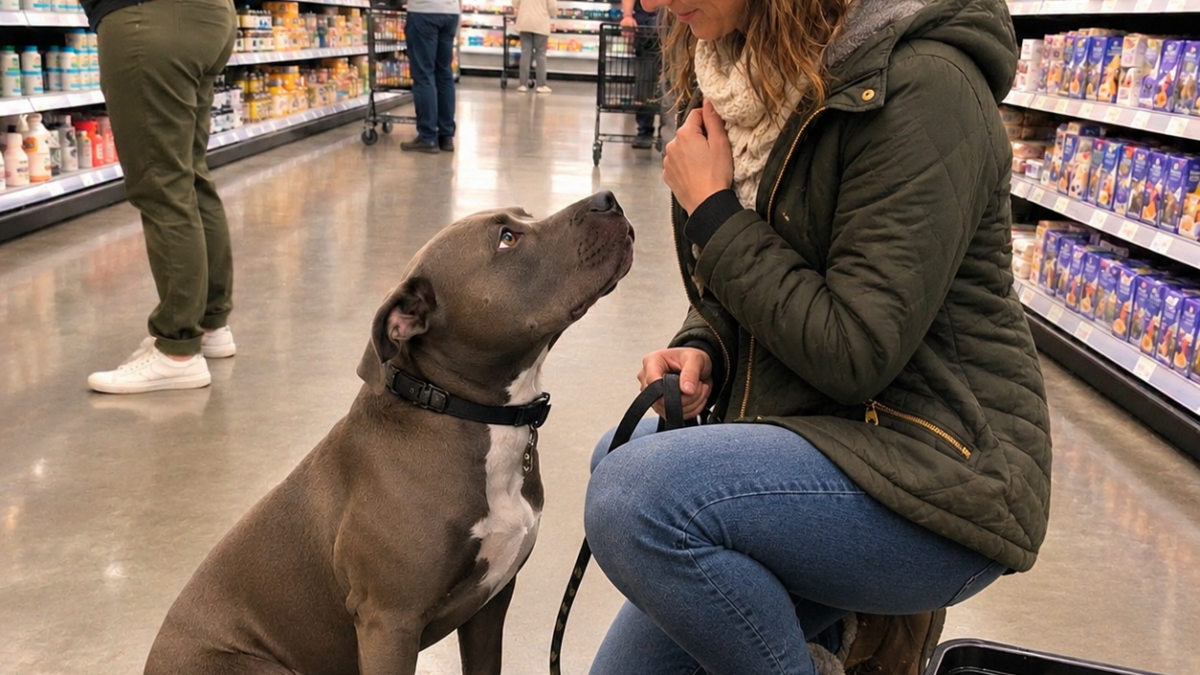
PART 2
The dispatcher kept me on the line.
“Is he breathing?”
“Yes, but barely.”
“Do not give him food or water.”
“I won’t.”
“Do you know him?”
“No.”
“Do you know the dog?”
“No.”
The pit bull looked at me when I said that.
For some reason I felt guilty.
“Actually, I know he’s very smart.”
The dispatcher paused.
“Ma’am?”
“Nothing.”
I moved closer to the man.
He looked somewhere in his late fifties or early sixties.
Gray at the temples.
Work boots.
Dark jeans.
A faded green jacket.
There was a scrape on the right side of his forehead.
His lips looked almost colorless.
The dog nudged his hand.
“What’s his name, buddy?”
The dog stared at me.
“Right. Stupid question.”
I reached carefully toward the blue collar.
He tensed.
I stopped.
“Okay.”
The dog sniffed my fingers.
I let him.
Then I touched the collar.
There was a metal tag.
BLUE.
Underneath was a phone number.
The same number was listed beneath a second line.
THOMAS REED.
“Blue?”
His ears shot up.
I almost laughed from relief.
“Your name is Blue.”
His tail moved once.
“Thomas?”
The dog’s head turned toward the unconscious man.
“That’s him?”
Another tiny movement.
Maybe I imagined it.
Maybe not.
“Okay, Blue. They’re coming.”
He pressed his nose beneath Thomas’s hand.
Sirens appeared less than four minutes later.
Blue heard them first.
His head lifted.
His body tightened.
Two paramedics came running around the building with a stretcher.
A firefighter followed.
Blue immediately moved in front of Thomas.
Not growling.
Blocking.
“Dog!” one paramedic shouted.
“He’s not attacking.”
“Ma’am, step back.”
“He brought me here.”
The firefighter slowed.
“What?”
“The dog found me inside.”
Blue watched the strangers approaching.
His body trembled.
I crouched beside him.
“Blue.”
He looked at me.
“They’re helping Thomas.”
The firefighter approached sideways instead of directly.
Smart man.
“Hey, buddy.”
Blue looked at Thomas.
Then at me.
I touched his shoulder.
“Let them.”
For reasons I still don’t fully understand, he did.
Blue stepped aside.
The paramedics went to work.
One checked Thomas’s airway.
Another attached a monitor.
“Blood glucose thirty-one.”
The other man’s head snapped up.
“Severe hypoglycemia.”
They started an IV.
One paramedic examined the scrape on Thomas’s forehead.
“Probably went down hard.”
Blue moved closer.
The firefighter gently blocked him.
“Easy.”
Blue whined.
I stayed beside him.
“Thomas is still here.”
One of the paramedics looked at me.
“You family?”
“No.”
“Witness?”
“Only after I found him.”
“How long has he been down?”
“I don’t know.”
The paramedic frowned.
Then a voice came from behind us.
“What the hell is going on?”
I turned.
A man in a red store-management vest was walking quickly from the loading dock.
I knew him by sight.
Brent Lawson.
Assistant store manager.
I’d seen him arguing with cashiers before.
He looked at the ambulance.
Then Thomas.
Then Blue.
His expression changed.
“That dog again.”
Blue immediately lowered his body.
Not submission exactly.
Fear.
I noticed.
So did the firefighter.
“You know the dog?”
I asked.
Brent looked at me.
“He’s been running around the property.”
“How long?”
“Today.”
“Did you see him?”
“He got inside.”
“He found me inside.”
“I know.”
My stomach tightened.
“How do you know?”
Brent ignored the question.
He pointed toward Blue.
“That animal needs to be removed.”
The firefighter looked at him.
“Animal control can handle the dog after EMS clears.”
“He was aggressive with staff.”
I stared at him.
“No, he wasn’t.”
“You weren’t here.”
“I was when he found me.”
Brent gave me the look people use when they think a woman is getting emotional and therefore irrelevant.
“He came through the back loading area earlier. Growling. Barking. We pushed him out.”
My hand went cold.
“How much earlier?”
Brent shrugged.
“Twenty minutes. Maybe thirty.”
I looked toward Thomas.
The paramedics were lifting him onto the stretcher.
“You saw the dog trying to get inside thirty minutes ago?”
“He was loose.”
“And you never checked why?”
Brent’s face tightened.
“Ma’am, dogs wander into businesses all the time.”
Blue started whining as Thomas was wheeled away.
I grabbed his collar gently.
“Stay.”
The paramedic called out, “We’re taking him to St. Joseph’s.”
Blue lunged once toward the stretcher.
I held him.
“Blue!”
He stopped.
His eyes never left Thomas.
The ambulance doors closed.
The vehicle pulled away.
Blue ran several steps after it before the leashless collar stopped him only because I had both hands wrapped around it.
“I’m sorry.”
He stared down the road.
The siren faded.
Then he sat.
He looked completely lost.
Brent stepped closer.
“I’ll call animal control.”
I turned.
“Why?”
“The dog’s unattended.”
“His owner is in an ambulance.”
“Exactly.”
“He just saved that man’s life.”
Brent laughed once.
“That’s a little dramatic.”
I felt something hot move through me.
“The dog went into your store, found a stranger, led me here, and stayed with him until paramedics arrived.”
Brent folded his arms.
“Or he wandered inside and you followed him.”
Blue looked at him.
Then moved behind me.
That answered more than Brent realized.
The firefighter who had stayed behind noticed too.
His name badge read M. GARZA.
He looked at Brent.
“You said the dog came through the loading area earlier?”
“Yes.”
“What did you do?”
“Told an employee to get him out.”
“Did anyone check outside?”
Brent’s mouth tightened.
“We were unloading frozen delivery.”
Garza stared at him.
“So no?”
Brent’s expression changed.
“This is a grocery store, not an animal shelter.”
Garza didn’t answer.
He didn’t need to.
Animal control arrived fifteen minutes later.
The officer was a woman named Denise Moore.
Blue wouldn’t go with her.
He planted his feet.
Looked at me.
Then toward the road where the ambulance had vanished.
“He knows his owner left,” Denise said.
“What happens now?”
“We’ll scan the chip, contact whoever is registered, and hold him while we figure out whether Mr. Reed has family.”
“Can I come?”
Denise studied me.
“You just met this dog.”
“I know.”
Blue leaned into my leg.
She smiled faintly.
“Apparently he doesn’t.”
—
I never finished my shopping.
My abandoned cart was still near the cereal aisle when I went back inside.
A teenage employee had moved it to the side.
I retrieved my purse from the child seat.
Brent was nowhere around.
A cashier named Jenna looked at me.
“You’re the woman who followed the dog?”
“Yes.”
Her face changed.
“Did he find the man?”
“Yes.”
“Is he alive?”
“When the ambulance left.”
Jenna closed her eyes.
“Oh, thank God.”
I stopped.
“You knew?”
She looked toward the manager’s office.
Then lowered her voice.
“The dog came in earlier.”
“How much earlier?”
“Maybe twenty-five minutes before you.”
“Through the front?”
“No. Loading dock first.”
My pulse quickened.
“How do you know?”
“Brent came up front complaining about it.”
“What did he say?”
Jenna hesitated.
“Please don’t tell him I said anything.”
“I won’t.”
“He said some pit bull was making noise near receiving.”
“Did anyone go outside?”
“I don’t know.”
“Jenna.”
She looked scared.
“I saw Blue later.”
“You know his name?”
“You called him Blue when you came back through.”
“Right.”
“He came in through the automatic doors. He was whining and running up to people.”
“Before me?”
She nodded.
“How long?”
“Maybe five minutes.”
“And?”
“Brent grabbed a broom.”
My stomach dropped.
“What?”
“He didn’t hit him.”
She said it quickly.
“At least, I didn’t see him hit him.”
“What did he do?”
“Pushed him toward the door.”
“Blue?”
“Yes.”
“Was the dog aggressive?”
“No.”
“Did he growl?”
“I didn’t hear it.”
“Did he bite anyone?”
“No.”
I stared toward the manager’s office.
“What did Brent say?”
Jenna looked miserable.
“He said, ‘Get that damn pit out before somebody gets sued.’”
I swallowed.
“Then Blue came back?”
“Yes.”
“And found me.”
“Yes.”
I took out my phone.
“Will you tell animal control that?”
Jenna went pale.
“I can’t lose this job.”
“I understand.”
That was true.
I did understand.
But I hated that fear was already becoming part of the story.
“There’s security video, right?”
Jenna looked toward the ceiling.
Cameras everywhere.
“Yes.”
“Back loading area too?”
“I think so.”
I stared at one of the black domes.
For the first time, I had the feeling the truth might already exist.
All we had to do was keep someone from burying it.
—
I drove to St. Joseph’s Hospital.
I had no right to do that.
Thomas Reed was a stranger.
Blue was a stranger’s dog.
Still, I couldn’t go home.
The emergency desk wouldn’t tell me much.
“Are you family?”
“No.”
“Then we can’t provide medical information.”
“I found him.”
The nurse softened.
“I understand.”
“Can you at least tell me if he’s alive?”
She hesitated.
“He is currently receiving care.”
That was enough.
I sat in the waiting room.
Forty minutes later, a hospital social worker named Karen approached.
“Claire Sullivan?”
“Yes?”
“Mr. Reed had your name in the EMS report.”
I stood.
“Is he okay?”
“He’s stable.”
My knees nearly gave out.
“Thank God.”
“He had a severe hypoglycemic episode. It appears he lost consciousness and struck his head.”
“Will he recover?”
“The physicians are optimistic, but he’s still not fully conscious.”
“Does he have family?”
“We’re trying to reach his daughter.”
“Blue?”
She looked confused.
“His dog.”
“Oh.”
“Animal control has him.”
Karen looked at her clipboard.
“Thomas’s emergency contact is his daughter, Anna Reed. Her number may be outdated.”
“Can I leave my number?”
“For her?”
“For anyone.”
Karen smiled slightly.
“I’ll note it.”
I went home that evening without groceries.
My refrigerator contained mustard, two eggs, half a bottle of wine, and something in a plastic container I was no longer brave enough to identify.
I ordered pizza.
Then I stared at my phone.
At nine-thirty, it rang.
“Claire?”
“Yes?”
“This is Denise Moore from county animal services.”
I sat up.
“Blue?”
“He’s fine physically.”
“What does that mean?”
She sighed.
“We have an issue.”
“What issue?”
“The store filed an incident report.”
My stomach dropped.
“What kind?”
“Possible dangerous-dog behavior.”
I stood.
“That is ridiculous.”
“The report says Blue entered employee-only areas, barked aggressively, charged staff, and had to be forced outside.”
“Who filed it?”
“I can’t give you—”
“Brent Lawson.”
Silence.
“Claire.”
“He lied.”
“You were not present for the first incident.”
“No. But an employee was.”
“Will they give a statement?”
I thought of Jenna.
“I don’t know.”
“There may also be video.”
“I know.”
“Good. The dangerous-dog review is preliminary. Blue isn’t being euthanized or anything like that.”
The fact that she said the word euthanized made my heart stop.
“What happens to him?”
“Normally he would remain on hold until the owner or authorized family claims him.”
“Can I see him tomorrow?”
Denise hesitated.
“Why?”
I looked around my quiet living room.
Because he asked me to follow him.
Because he had trusted me when nobody else had.
Because Thomas was lying in a hospital and Blue had already spent too long trying to get somebody to listen.
“Because I told him I understood.”
Denise was quiet.
Then:
“Ten a.m.”
—
Blue sat at the back of his kennel.
He had food.
Fresh water.
A blanket.
He touched none of it.
When I approached, his head lifted.
“Hey.”
He stood.
His tail moved once.
Then he rushed to the door.
The shelter worker opened it.
Blue pressed his entire body against my legs.
I crouched.
“Thomas is alive.”
His ears lifted at the name.
“Thomas.”
His tail began moving.
“Yes.”
Blue whined.
“He’s at the hospital.”
I don’t know whether he understood words or only tone.
It didn’t matter.
He pushed his face beneath my chin.
I wrapped my arms around him.
The shelter worker watched.
“He hasn’t done that with anybody.”
“Eat?”
“Barely.”
I looked at the untouched bowl.
“You’re waiting for him.”
Blue looked toward the hallway.
I sat on the concrete.
“So am I.”
For thirty minutes, we stayed there.
Then Denise approached.
“Claire?”
I stood.
“Any news?”
“On Thomas?”
She shook her head.
“On the complaint.”
“What?”
“The store is requesting that we document Blue as an aggressive stray that created a safety incident.”
“He isn’t a stray.”
“I know.”
“He has an owner.”
“I know.”
“He went for help.”
“I believe you.”
I stared.
“But?”
“Belief isn’t the same as documentation.”
I hated how reasonable she sounded.
“What do you need?”
“Video would help.”
“Then get it.”
“We requested it.”
“And?”
“Store management says they’re reviewing it internally.”
That didn’t sound right.
“How long does that take?”
“Depends.”
“What if they delete it?”
Denise’s face changed.
“Then they create a much bigger problem.”
I thought of Brent.
For some reason, I wasn’t reassured.
—
Thomas woke that afternoon.
His daughter called me.
“Claire?”
“Yes?”
“My name is Anna Reed.”
I stood so fast my kitchen chair tipped.
“How is he?”
“He’s awake.”
I closed my eyes.
“Thank God.”
“He doesn’t remember everything.”
“That’s normal after—”
“I know.”
Her voice shook.
“He remembers Blue.”
I smiled.
“Of course he does.”
“He keeps asking where he is.”
“County shelter.”
“I tried explaining.”
“Can I come?”
Anna was silent.
Then:
“My dad asked for ‘the woman Blue found.’”
I laughed.
“He said that?”
“Pretty much.”
I drove to the hospital.
Thomas looked smaller than he had behind the supermarket.
Gray hair.
Bruised temple.
IV in his arm.
Anna sat beside him.
She looked around thirty-five.
Same dark eyes.
Thomas turned toward me.
“You Claire?”
“Yes.”
He smiled weakly.
“My dog bother you?”
I laughed before I could stop myself.
“Only enough to make me abandon thirty dollars worth of groceries.”
“Sounds like him.”
“Blue saved you.”
Thomas’s expression changed.
“He found somebody?”
“He found me.”
Thomas closed his eyes.
For several seconds, he didn’t speak.
Then tears ran from the corners of his eyes.
“I told him.”
“What?”
He looked at me.
“I remember getting dizzy.”
Anna leaned closer.
“Dad?”
“I’d gone behind the store toward the bus stop.”
“You drove there,” Anna said.
Thomas frowned.
“No.”
“Your car was found in the lot.”
He looked confused.
The doctor had warned her memory might be fragmented.
Thomas rubbed his forehead.
“I remember sitting down.”
He swallowed.
“Blue was with me.”
I waited.
“I told him, ‘Go find somebody.’”
My throat tightened.
“You taught him that?”
Thomas smiled faintly.
“When he was young.”
“Why?”
“Heart attack four years ago.”
Anna shook her head.
“Dad, you never told me that part.”
“I taught him to go to the nearest person if I fell.”
“Professionally?”
“No.”
He smiled.
“Hot dogs.”
I laughed.
“You trained your dog to get emergency help using hot dogs?”
“Blue is highly educated.”
Then his expression became serious.
“He came back once.”
I froze.
“What?”
Thomas looked toward me.
“Before you?”
“Yes.”
“What happened?”
“I was in and out.”
He closed his eyes, forcing memory.
“I heard him.”
Anna touched his hand.
“Don’t push.”
“No.”
Thomas shook his head.
“Man yelling.”
My pulse quickened.
“What man?”
“Red shirt.”
Brent.
“What did he say?”
Thomas’s breathing changed.
“Something about dog.”
“Thomas.”
Anna looked at me.
I stopped.
But Thomas continued.
“Blue came back.”
His eyes filled.
“He licked my face.”
“Then what?”
“Ran again.”
I sat very still.
Blue had found Brent first.
Brent sent him away.
Blue returned to Thomas.
Thomas was still alive.
Then Blue tried again.
And found me.
—
The next morning, Anna and I went to the shelter together.
The moment Blue saw her, he barked.
Anna started crying.
“He remembers me.”
Blue licked her hands.
But he kept looking behind her.
Searching.
Anna crouched.
“Dad’s not here.”
Blue’s ears lowered.
“He will be.”
Denise joined us.
“Mr. Reed confirmed ownership?”
“Yes,” Anna said.
“Then once he’s medically cleared to make decisions, we can resolve custody.”
“What about the dangerous-dog report?” I asked.
Denise sighed.
“Still pending.”
Anna stood.
“What dangerous-dog report?”
I explained.
Her face changed.
“My father is lying in a hospital because Blue saved him, and somebody is trying to label him dangerous?”
“It’s not that simple.”
“It sounds simple.”
I liked Anna immediately.
Denise said, “We need facts.”
“Then let’s get facts,” Anna replied.
We did.
The first fact came from Jenna.
She called me that night.
“I’ll talk.”
“Are you sure?”
“No.”
“Then don’t—”
“I watched the news clip.”
“What news clip?”
“Somebody posted about the dog saving that man.”
The local station had picked up the story from a paramedic’s public comment.
Jenna continued.
“Brent told all of us not to talk.”
My stomach tightened.
“Why?”
“He said corporate legal was handling it.”
“Handling what?”
“The dog incident.”
“Jenna.”
“I saw Blue before you did.”
“I know.”
“There were two times.”
I sat down.
“Tell me.”
“The first time was by receiving. I was back there getting change from the office.”
“What happened?”
“Blue was outside the loading door barking.”
“And Brent?”
“He opened the door.”
“Then?”
“Blue backed up and kept looking toward the alley.”
“Did Brent follow?”
“No.”
“What did he do?”
Jenna was silent.
“Jenna?”
“He threw a plastic crate at him.”
My hand went cold.
“Hit him?”
“No. It landed beside him.”
“And then?”
“Blue ran toward the alley.”
“Did Brent see Thomas?”
“I don’t know.”
That answer sounded wrong.
“What aren’t you saying?”
She whispered:
“I think he did.”
My stomach dropped.
“Why?”
“Because he walked outside after Blue ran away.”
“For how long?”
“Maybe thirty seconds.”
“And?”
“When he came back, I asked if somebody was hurt.”
“What did he say?”
Jenna’s voice broke.
“He said, ‘Just some drunk sleeping back there.’”
I stopped breathing.
“He saw Thomas.”
“I think so.”
“And didn’t call 911.”
“No.”
“How long before Blue found me?”
“About twenty minutes.”
Twenty minutes.
A blood sugar of thirty-one.
A head injury.
Twenty minutes during which Thomas could have slipped into a coma.
Died.
“Will you say that officially?”
Jenna started crying.
“I need my job.”
“I know.”
“My mom lives with me.”
“I know.”
“I can’t—”
“Jenna.”
She stopped.
“You don’t owe me your livelihood.”
Silence.
“But you do owe yourself the truth about whether you can live with staying quiet.”
I hated saying it.
Because it sounded like pressure.
Maybe it was.
Three days later, Jenna gave a sworn statement.
Brent fired her the next morning.
That turned out to be his second major mistake.
—
His first major mistake was assuming the security footage belonged only to him.
The delivery company had cameras too.
A driver named Luis Mendoza had been unloading frozen food that afternoon.
His truck used a continuous dash-and-side camera system.
Luis saw the news report.
Then Jenna’s firing.
He contacted Anna.
“I think my truck recorded the alley.”
The footage arrived two days later.
We watched it in Anna’s apartment with Denise and Thomas’s attorney.
Yes.
Thomas now had an attorney.
Once the hospital’s patient advocate learned the delay might have been caused by store negligence, things escalated quickly.
The video began at 2:06 p.m.
Thomas walked into frame with Blue.
He stopped.
Grabbed the wall.
Sat down.
Then collapsed.
Blue immediately went to him.
Licked his face.
Circled.
Ran toward the loading dock.
At 2:09, Blue barked outside the door.
Brent appeared.
Opened it.
Blue backed toward Thomas.
Barked.
Ran toward Thomas.
Came back.
There was no ambiguity.
Blue was trying to lead him.
Brent threw the empty crate.
Blue jumped aside.
Brent walked into the alley.
Ten steps.
Fifteen.
He stopped.
Thomas was visible.
Maybe sixty feet away.
Brent looked in his direction.
Then turned around.
Went inside.
No phone call.
No check.
Nothing.
At 2:17, Blue returned.
The loading door was closed.
He scratched.
Barked.
Nobody opened it.
At 2:23, he disappeared from the camera.
That was when he entered through the front.
He found me approximately three minutes later.
The room was completely silent when the video ended.
Anna stood.
“He saw him.”
The attorney nodded.
“Yes.”
“He saw my father on the ground.”
“Yes.”
“He walked away.”
Nobody answered.
Thomas sat on the couch.
Blue had not yet been returned to him, so his hands were empty.
He stared at the frozen image of Brent turning away.
Finally he said:
“Blue went to him first.”
I looked at him.
“Yes.”
Thomas smiled.
Not happily.
“Bad judge of character.”
That made us laugh despite everything.
Then his face hardened.
“Can I have my dog back now?”
Denise nodded.
“Yes.”
—
Their reunion happened outside the shelter.
Thomas still used a walker.
His head wound had healed.
His blood sugar was better controlled.
He stood beside Anna.
I held Blue’s leash.
The moment the doors opened, Blue saw him.
He froze.
Thomas said one word.
“Blue.”
The dog screamed.
Exactly like that.
A high, broken sound that turned every head in the parking lot.
He pulled so hard I almost fell.
I released the leash.
Blue ran.
Thomas barely had time to brace himself.
Blue stopped inches before impact.
Then rose onto his hind legs and placed both paws carefully against Thomas’s thighs.
As though even in joy, he understood Thomas was fragile.
Thomas dropped one hand onto Blue’s head.
Then the other.
“My boy.”
Blue whined.
Licked his face.
Pressed against him.
Thomas lowered himself painfully onto a bench.
Blue climbed halfway into his lap.
“You did good.”
Blue’s entire body shook.
“You did exactly right.”
Anna turned away, crying.
Denise wiped her eyes.
So did I.
Thomas buried his face against Blue’s neck.
“I should’ve listened when the doctor said carry sugar.”
Anna laughed through tears.
“Yes, you should.”
“Not the moment.”
“Absolutely the moment.”
Blue looked at her.
Thomas smiled.
“See what I deal with?”
For the first time since the supermarket, everything felt right.
Then Denise handed Thomas another document.
“What is this?”
“Dangerous-dog review.”
Thomas’s face darkened.
“It is officially closed.”
He looked up.
“No designation.”
“No restrictions beyond normal licensing.”
Thomas folded the paper.
“Good.”
Denise smiled.
“For the record, the reviewing officer described Blue as ‘persistent, controlled, and unusually purposeful.’”
Thomas scratched Blue’s ears.
“Told you. Highly educated.”
—
Brent Lawson was fired two days later.
But that wasn’t the end.
Miller’s Market corporate office released a statement saying an individual employee had “failed to follow emergency response expectations.”
I read it twice.
Then laughed.
Failed to follow emergency response expectations.
What a sterile way to describe looking at a man lying unconscious on pavement and walking away.
The company offered Thomas a settlement.
Medical bills.
Lost wages.
Additional compensation.
Confidentiality clause.
Thomas rejected it.
Anna nearly choked.
“Dad.”
“What?”
“That’s more money than you’ve ever had.”
“Yes.”
“And you’re saying no?”
“Yes.”
“Why?”
Thomas looked at Blue.
“Because they want me to say nothing happened.”
“That isn’t exactly—”
“It is.”
His attorney said, “Thomas, we can negotiate the language.”
Thomas shook his head.
“I don’t want revenge money.”
I was sitting beside him.
“What do you want?”
He looked at me.
“I want them to stop acting like the dog was the problem.”
That became the center of everything.
The company had allowed Brent’s incident report to remain active even after the video existed.
Jenna had been fired immediately after giving a statement.
Her termination notice claimed attendance problems.
Her employment history showed excellent reviews.
Luis’s footage proved the delay.
Then corporate’s own internal security backup was subpoenaed.
They had preserved it.
Thank God.
That footage showed even more.
Blue entered through the front doors.
Customers moved away.
One woman screamed because she saw a pit bull loose inside.
Blue did not approach her.
He moved from person to person.
Looked into faces.
Whined.
Ran toward the back.
Returned.
A floor supervisor tried to corner him with a cart.
Blue escaped.
Then he saw me.
He stopped.
Something about me must have looked usable.
Maybe I was simply the first idiot willing to listen.
The footage showed Blue walking toward me.
Looking into my face.
Looking toward the rear.
Me crouching.
Then abandoning my cart.
When the video ended, Thomas said:
“He picked you.”
“I guess.”
“Why?”
“I have no idea.”
Anna smiled.
“Maybe you looked trainable.”
Thomas laughed.
“That’s it.”
—
The lawsuit never went to trial.
Corporate lawyers knew what the video would do to a jury.
Thomas’s final settlement remained partly confidential, but one portion did not.
He insisted on that.
Miller’s Market created mandatory medical-emergency response training for managers in every store in the regional chain.
Employees were specifically instructed that unusual animal behavior could indicate a nearby human emergency.
Jenna received a settlement of her own after challenging her termination.
She did not return to Miller’s.
She went to nursing school.
Luis got a company commendation from his employer for preserving evidence.
And Brent?
Brent tried claiming he had thought Thomas was intoxicated.
That made things worse.
Because, as Thomas later said:
“Apparently drunk people don’t deserve ambulances either.”
There was one additional investigation.
The county prosecutor reviewed whether Brent’s actions met the threshold for criminal neglect.
No criminal charge ultimately resulted.
Thomas was disappointed.
I was angry.
Then his attorney said something that helped.
“Justice and punishment aren’t always the same thing.”
Thomas looked at Blue.
“No.”
He scratched the dog’s head.
“Sometimes justice is making sure he can’t do it again.”
Brent’s management career in our town was finished.
His name became attached publicly to the footage.
No threats.
No revenge attack.
No dramatic confrontation.
Just evidence.
Sometimes evidence is crueler than anger because it doesn’t get tired.
—
Six months later, Thomas invited me to his house.
It was the first time I’d been there.
Small ranch-style home.
Blue dog bed beside the couch.
Photographs everywhere.
One showed Thomas with a woman around his age.
His late wife, Carol.
Another showed a younger Blue with ridiculous oversized paws.
“You rescued him?”
I asked.
Thomas nodded.
“County shelter.”
“How old?”
“Ten months.”
“He was already a pit bull.”
“That condition has no known cure.”
I laughed.
Thomas handed me coffee.
“He was supposed to be Carol’s dog.”
“Supposed to?”
“He picked me.”
“Seems familiar.”
Thomas smiled.
Carol had died from ovarian cancer three years earlier.
Afterward, Blue became Thomas’s entire routine.
Morning walk.
Breakfast.
Medicine.
Evening walk.
“The first year after she died, I wasn’t doing well.”
Thomas stared into his cup.
“Anna and I fought.”
Anna sat across from him.
“You mean you stopped answering my calls.”
“I answered some.”
“Voicemail doesn’t count.”
Thomas looked at me.
“She enjoys details.”
“I see.”
Blue lay between them.
Thomas continued.
“I had a heart attack.”
“That was when you taught him to get help?”
“Yes.”
“Why didn’t you get a medical alert dog?”
“Have you seen the price?”
Anna sighed.
“Dad.”
“I taught Blue three things. If I fall, lick my face. If I don’t respond, bark. If I still don’t respond, find a person.”
“With hot dogs.”
“Premium hot dogs.”
Blue’s ears lifted at the phrase.
I laughed.
“You still remember?”
Thomas pointed at him.
“He remembers every food-related lesson.”
Anna became serious.
“When Dad collapsed behind the store, Blue did exactly what he had been trained to do.”
Thomas shook his head.
“No.”
“What?”
“He did more.”
We looked at him.
“I taught him to find one person.”
Thomas rested his hand on Blue’s back.
“When the first person failed him, he tried again.”
That sentence stayed with me.
Because that was the real story.
Not that Blue knew how to ask for help.
That he refused to stop asking when the answer was no.
—
The local television station eventually convinced Thomas to do an interview.
He agreed on one condition.
Blue had to be beside him.
The reporter asked, “Do you consider Blue a hero?”
Thomas thought about it.
“No.”
The reporter looked surprised.
“No?”
“He thinks he did his job.”
Blue yawned.
Thomas smiled.
“Heroes are people who know they could walk away and don’t.”
He pointed at Blue.
“This guy never considered walking away.”
I watched from behind the camera.
Then the reporter asked about Brent.
“Are you angry?”
Thomas nodded.
“Yes.”
“Do you forgive him?”
“No.”
The room went quiet.
Thomas didn’t apologize.
“Maybe someday.”
He looked at the reporter.
“But forgiveness isn’t something injured people owe on a schedule.”
I nearly applauded.
“Do you want revenge?”
Thomas smiled.
“No.”
Then he looked down at Blue.
“I already got something better.”
“What?”
“The truth survived.”
That line made the final broadcast.
It also became the sentence people remembered.
—
Not everybody loved the story.
That surprised me.
Most people praised Blue.
Some didn’t.
Online comments appeared.
Pit bulls are unpredictable.
Probably staged.
Dog shouldn’t have been in a grocery store.
If the manager had gotten bitten, everyone would blame him.
Thomas read three comments.
Then Anna took his phone away.
“Stop.”
“They’re idiots.”
“Yes.”
“I want to answer.”
“No.”
Blue was asleep beside him.
Thomas pointed at the screen.
“One guy says pit bulls can’t be trusted.”
Anna looked at Blue.
“Blue says he doesn’t trust strangers on the internet.”
“Smart dog.”
The controversy did lead to something useful.
The county animal shelter invited Thomas and Blue to an event about responsible dog ownership and breed stigma.
Thomas almost refused.
Then he learned pit bulls made up a large portion of long-term shelter residents.
He went.
Blue walked through rows of kennels.
One dog looked almost exactly like him.
Gray.
White chest.
Blue collar.
Thomas stopped.
“No.”
Anna immediately knew.
“Dad.”
“No.”
“You haven’t even asked anything.”
“I know that tone.”
The dog pressed against the kennel door.
Thomas looked at me.
“Claire.”
“Don’t involve me.”
“You started this.”
“I followed one pit bull. I am not responsible for the species.”
Anna laughed.
The shelter worker approached.
“Her name is Daisy.”
Thomas closed his eyes.
“No.”
Daisy wagged.
Three weeks later, Thomas adopted her.
Blue pretended this was annoying for approximately eleven minutes.
Then they slept touching.
—
A year passed.
My life became far less predictable than it had been before aisle nine.
Thomas and Anna became friends.
Blue became family.
Daisy became trouble.
Jenna graduated from her first semester of nursing school.
Luis occasionally joined us for coffee.
Even Denise from animal control came to Thomas’s annual barbecue.
Thomas called us “the people Blue collected.”
He wasn’t wrong.
Then the first anniversary of the supermarket incident arrived.
Thomas had an idea.
A bad one.
Which meant we all had to help.
He created the Blue Alert Fund.
Not an emergency-response organization.
A small nonprofit fund administered through the county shelter.
Its purpose was simple.
Pay for basic training classes, microchips, and veterinary care for pit bulls and other large dogs whose owners were elderly, disabled, or medically vulnerable.
“Why training?” I asked.
Thomas looked at Blue.
“Because one stupid hot-dog game saved my life.”
That was hard to argue with.
The fund started small.
Then the television station covered it.
Donations came.
Miller’s Market contributed.
Thomas stared at their check.
“You going to cash that?”
Anna asked.
“Absolutely.”
I laughed.
“What happened to principles?”
“This is different.”
“How?”
He held up the check.
“They’re buying dog food now.”
That, apparently, was revenge Thomas could support.
—
Brent Lawson disappeared from our lives.
For a while.
Then two years later, I saw him.
Not at the supermarket.
At a gas station.
I recognized him immediately.
He recognized me too.
We stood on opposite sides of a pump.
For several seconds, neither spoke.
Then he said:
“You’re Claire.”
“Yes.”
His face looked older.
Tired.
“You still hang around with Reed?”
“Yes.”
“And the dog?”
“Blue is fine.”
He nodded.
I expected anger.
Instead he said:
“I made one mistake.”
I stared.
“One?”
His jaw tightened.
“You know what I mean.”
“No.”
“I saw a man lying down.”
“Unconscious.”
“I thought he was drunk.”
“You didn’t check.”
“No.”
“You didn’t call anyone.”
“No.”
“You threw a crate at his dog.”
“I didn’t hit him.”
I laughed.
He flinched.
“You think I deserved to lose everything?”
I considered it.
“No.”
He looked surprised.
“I think you deserved to lose the job you proved you shouldn’t have.”
His expression hardened again.
“Easy for you.”
“No.”
I shook my head.
“I was there too.”
“What does that mean?”
“I could’ve ignored Blue.”
He said nothing.
“I had groceries. Dinner plans. A normal Tuesday. I could have decided a loose pit bull wasn’t my problem.”
Brent looked away.
“I didn’t.”
Silence.
Then he said quietly:
“I was busy.”
The same words he had essentially used before.
Something about them sounded smaller now.
“Thomas nearly died because you were busy.”
His eyes closed briefly.
“I know.”
That stopped me.
Not because it forgave anything.
Because for the first time he sounded like a man rather than a defense.
“What happened after Miller’s?”
He hesitated.
“Couldn’t get hired in management.”
I said nothing.
“Work warehouse now.”
“Okay.”
He looked at me.
“Tell Reed…”
I waited.
“I don’t know.”
“Tell him yourself.”
He shook his head.
“I don’t think he’d want that.”
“Probably not.”
I put the gas cap back on.
Then Brent asked:
“Did the dog really pick you?”
I looked at him.
“Yes.”
“Why?”
I smiled slightly.
“No idea.”
He nodded toward my car.
“Lucky.”
I opened the door.
“For Thomas?”
“For all of you.”
I drove away.
I never told Thomas about the conversation.
Not because it was secret.
Because Brent no longer deserved much space in the story.
—
Blue aged.
Slowly at first.
Then all at once.
Gray appeared around his muzzle.
He became stiff on cold mornings.
Daisy remained ridiculous.
Thomas’s diabetes became easier to manage because Anna forced him into a continuous glucose monitor.
He complained constantly.
“It beeps at me.”
“That’s the point.”
“Blue never beeped.”
“Blue is not a medical device.”
Thomas looked at him.
“Debatable.”
Blue still watched Thomas closely.
If the glucose monitor sounded, Blue often stood before Thomas even checked it.
Nobody had trained him to do that.
He simply learned.
One afternoon, Thomas’s blood sugar began dropping while he was asleep in his recliner.
The monitor alarmed.
Thomas didn’t wake.
Blue came to me.
I happened to be in the kitchen helping prepare food for one of Thomas’s cookouts.
He whined.
I froze.
The sound.
I remembered it immediately.
Same strained, urgent sound from the supermarket.
“No.”
Blue turned toward the living room.
Then back.
I dropped the knife.
“Thomas!”
His glucose was forty-seven.
We treated it quickly.
He woke angry.
“Why is everyone yelling?”
Anna pointed at Blue.
“Because your dog saved you again.”
Thomas looked at him.
Blue’s tail moved.
Thomas sighed.
“Show-off.”
I sat down.
My hands were shaking.
The whole supermarket came back.
Fluorescent lights.
Blue’s eyes.
The abandoned cart.
The alley.
Thomas on pavement.
He saw my face.
“Claire.”
“I’m fine.”
“No, you’re not.”
I started crying.
Blue came to me.
I wrapped my arms around him.
“You’re not allowed to do this twice.”
Thomas smiled.
“He apparently didn’t read the contract.”
—
Blue lived to be thirteen.
For a pit bull who had spent his youth being judged by strangers, he became remarkably famous for staring at people until they did what he wanted.
His final year was slower.
Arthritis.
Heart murmur.
A tumor that turned out benign.
Then another that wasn’t.
Cancer.
Thomas took the diagnosis quietly.
Anna didn’t.
She cried in the parking lot.
I sat with her.
“How long?”
“Maybe months.”
Thomas came outside with Blue.
He crouched as far as his knees allowed.
“Hey.”
Blue licked his chin.
Thomas laughed.
“You always did have terrible timing.”
We spoiled him shamelessly.
Chicken.
Car rides.
Slow walks.
Sunlight on Thomas’s porch.
Daisy stayed close.
She seemed to know.
Blue stopped attending public events.
People asked.
Thomas told them:
“He retired.”
The Blue Alert Fund kept going.
By then it had helped hundreds of dogs.
The supermarket incident became one of those local stories people told as though it had happened a generation earlier.
But for us it was always close.
Then one Tuesday morning—of course it was Tuesday—Thomas called me.
“Claire.”
His voice told me.
“I’m coming.”
“No hurry.”
That meant hurry.
I drove to his house.
Anna was already there.
Blue lay on a blanket beneath the oak tree in the backyard.
Daisy beside him.
Thomas sat in a chair.
The veterinarian would come at noon.
Blue had stopped eating.
His breathing was difficult.
Pain medication no longer gave him enough comfort.
Thomas stared at him.
“You know what I keep thinking about?”
“What?”
“The store.”
I sat beside him.
“What about it?”
“He could’ve stayed with me.”
I knew immediately.
“When you collapsed.”
“He could’ve stayed.”
Thomas rubbed his eyes.
“He could’ve laid there until somebody found us.”
“But he didn’t.”
“No.”
“He left you because helping you required leaving you.”
Thomas nodded.
“That must’ve scared him.”
Probably.
Blue had run into a building full of strangers.
Been chased.
Threatened.
Driven outside.
Then tried again.
Thomas whispered:
“He was braver than me.”
I looked at him.
“About what?”
“After Carol died.”
He stared toward the dog.
“I stopped trying.”
Anna heard.
She sat on the grass.
“Dad.”
“It’s true.”
He looked at his daughter.
“Blue kept making me get up.”
Anna put her hand over his.
Thomas smiled.
“He saved me before the supermarket too.”
Blue lifted his head at his name.
Thomas stood slowly.
He walked over.
Then lowered himself onto the grass.
It hurt.
He didn’t care.
He placed Blue’s head in his lap.
“Remember that day?”
Blue’s eyes opened.
“I told you to go find someone.”
Tail movement.
“You found Claire.”
I laughed through tears.
“Poor judgment.”
Thomas smiled.
“Best thing you ever did.”
The veterinarian arrived quietly.
No white exam table.
No bright lights.
Just grass.
Family.
Daisy pressed against Blue’s back.
I sat near his front paws.
Anna beside Thomas.
Thomas rubbed Blue’s ears.
“You know something?”
Blue breathed slowly.
“I never paid you for that first rescue.”
His tail moved once.
Thomas laughed.
“Still waiting for hot dogs?”
Another tiny movement.
Anna sobbed.
Thomas leaned down.
“You did your job, buddy.”
The veterinarian gave the sedative.
Blue relaxed.
His eyes became heavy.
Thomas’s voice broke.
“You don’t have to find anyone this time.”
Blue looked at him.
“We’re all here.”
That sentence destroyed me.
Thomas touched his forehead to Blue’s.
“You got everybody.”
Anna.
Me.
Daisy.
The veterinarian.
The friends Blue had collected.
“You brought us all.”
Blue’s breathing slowed.
Thomas whispered:
“Good boy.”
One last breath.
“Best boy.”
Blue died beneath the oak tree with the man he had saved holding his head.
No aisle.
No sirens.
No fear.
Nobody sending him away.
Nobody misunderstanding what he was trying to say.
We understood.
Every one of us.
—
Thomas buried Blue beneath that oak.
On the stone, he put:
BLUE REED
HE WENT LOOKING FOR HELP
AND FOUND A FAMILY
Underneath:
WHEN THE FIRST PERSON DIDN’T LISTEN,
HE TRIED AGAIN.
That was the sentence that mattered most.
Not pit bull.
Not hero.
Not service dog.
Try again.
Because there are moments in life when the first door closes.
The first person says no.
The first attempt fails.
And everything depends on whether you decide that answer is final.
Blue didn’t.
The Blue Alert Fund eventually changed its logo.
A simple blue collar.
No dog breed.
No heroic pose.
Just the collar.
Thomas explained:
“The collar is what tells you somebody belongs somewhere.”
I liked that.
Years later, the fund expanded to help elderly people keep their dogs when medical bills, training costs, or temporary hospitalization might otherwise separate them.
Jenna became a registered nurse.
She works in an emergency department now.
The first time she called Thomas after graduating, she said:
“I don’t ignore things anymore.”
Thomas replied:
“You were twenty-two.”
She said:
“Old enough.”
Thomas smiled.
“Then make it useful.”
Luis still delivers food.
Denise retired from animal control.
Anna took over much of the fund after Thomas’s health began declining.
And me?
I never again walked through Miller’s Market without looking toward aisle nine.
For a while, I stopped shopping there.
Then Thomas told me that was stupid.
“They changed.”
“Because they got sued.”
“Still changed.”
Eventually I returned.
The first time, I stood in almost the exact place Blue had found me.
People moved around with carts.
Children argued over cereal.
An employee restocked shelves.
Nothing dramatic.
I remembered Blue standing twenty feet away.
That blue collar.
Those eyes.
The strange sound.
Thomas once asked me why I followed him.
I never had a good answer.
Maybe because he looked desperate.
Maybe because I grew up with dogs.
Maybe because something in his face was impossible to dismiss.
But I think the truth is simpler.
For one moment, Blue treated me as though I was the kind of person who would help.
And I wanted to deserve that assumption.
That changed me more than the rescue itself.
Before Blue, I thought goodness was mostly about intention.
Being kind.
Caring.
Feeling bad when something terrible happened.
Blue taught me that compassion is a verb.
You move.
You follow.
You call.
You stay.
You speak when silence is easier.
You tell the truth even when the person asking you to hide it signs your paycheck.
You keep trying after somebody closes the door.
The first person Blue asked for help ignored him.
The second drove him away.
The third was me.
People sometimes called me his hero.
I hated that.
I wasn’t.
I was just the first person who listened long enough to realize the dog already knew exactly what needed to be done.
Blue saved Thomas.
Then he saved Jenna from spending the rest of her life wondering why she stayed quiet.
He changed a store policy.
He helped hundreds of dogs through a fund that outlived him.
He gave Thomas years he might not otherwise have had.
He gave Anna more time with her father.
And he gave me a strange second family I never went shopping for.
All because one Tuesday afternoon, a pit bull stood in front of my cart and refused to let me continue with my ordinary day.
There was revenge in what came after.
Brent lost the position he had abused.
The company paid for the failure it tried to minimize.
The dangerous-dog complaint disappeared.
The employee who told the truth came out stronger.
But after enough years passed, none of that felt like the most satisfying part.
The satisfying part was that Blue had been called dangerous and became known for saving a life.
He had been driven out of a store and later had a fund named after him.
Someone had decided he was an inconvenience.
He became impossible to forget.
That was better than revenge.
That was correction.
The world had looked at him once and gotten him completely wrong.
Then Blue forced everyone to look again.
Thomas lived six more years after Blue died.
Daisy stayed with him.
When Thomas eventually passed away peacefully at home, Anna adopted Daisy.
At the funeral, she placed a photograph beside the flowers.
Thomas on his porch.
Blue on one side.
Daisy on the other.
All three looking directly at the camera.
I stood there for a long time.
Anna came beside me.
“You know what Dad said the week before he died?”
“What?”
“He said if there was anything after this, Blue better not make him wait at the gate.”
I laughed through tears.
“That sounds like Thomas.”
Anna nodded.
“He also said Blue would probably go find somebody else first.”
That sounded like Blue.
After the funeral, I drove home past Miller’s Market.
I almost continued.
Then I pulled in.
I went inside.
Aisle nine.
Same lights.
Different displays.
I stood where my cart had been.
For a moment, I could see him.
Gray coat.
White chest.
Blue collar.
Watching me.
Waiting to see whether I would understand.
I whispered:
“I got it, buddy.”
People passed.
Nobody noticed.
“You didn’t have to ask twice.”
Then I laughed softly.
“That isn’t true.”
Blue had asked more than twice.
That was the whole point.
He had asked until someone listened.
And sometimes that is what saves a life.
Not strength.
Not perfect timing.
Not even luck.
Sometimes it’s simply refusing to believe that the first person who turns you away gets to decide how the story ends.








