A One-Pound Puppy Lay Motionless in the Street—Then His Owner Said Something I’ll Never Forget
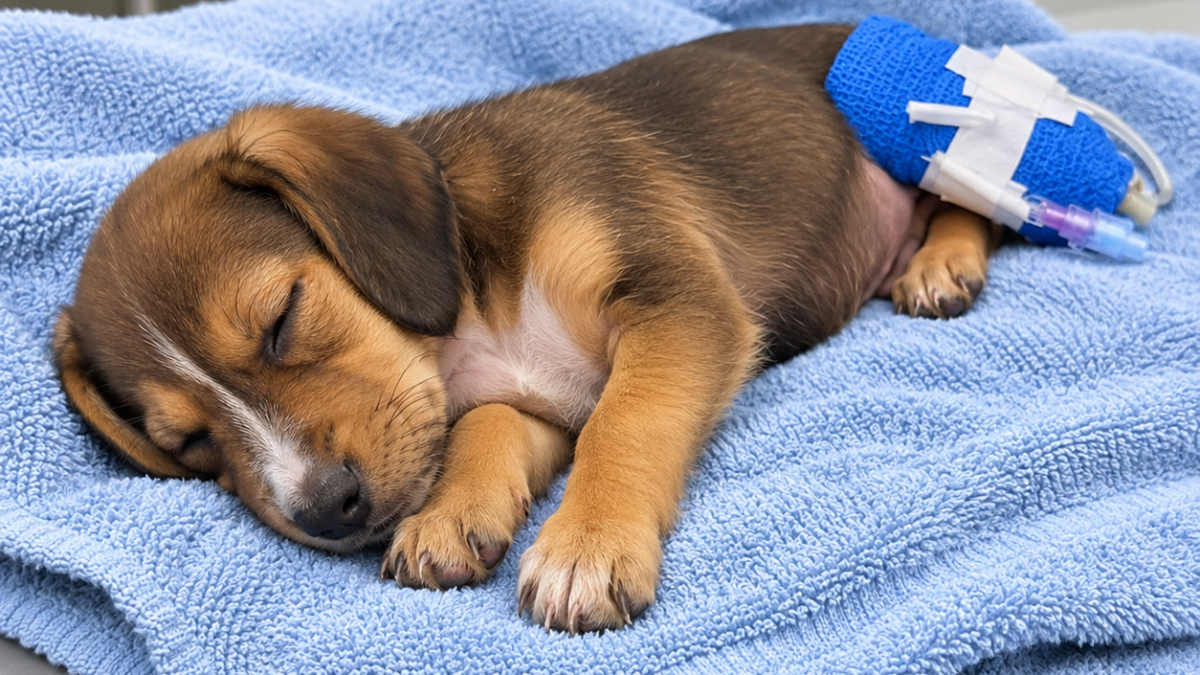
The puppy lying in the middle of the street was only six weeks old, weighed barely one pound, and wasn’t moving when a young man stepped between him and the person who was supposed to protect him.
At the hospital, the doctors gave Rico only a 30 percent chance of surviving the damage inside his tiny body, and for days we waited beside him without knowing whether he would ever open his eyes again.
But the moment that changed everything came later, when the man who had owned him was finally asked to explain why that little puppy had been left there in the first place.
My name is Elena, and I had been helping with animal rescue for several years when Rico came into my life.
I wasn’t there when he first hit the pavement.
A young man named Daniel was.
He was walking home when he noticed a man standing in the street.
At first, Daniel thought there had been an accident.
Then he saw the puppy.
Tiny.
Brown and white.
Almost impossibly small.
He was lying on his side near the curb.
Not crying.
Not trying to get up.
Not moving at all.
Daniel rushed over.
“Is that your dog?”
The man looked down.
“Yes.”
“What happened?”
The answer Daniel received didn’t make sense.
“He’s always been sick.”
Daniel crouched beside the puppy.
Rico’s breathing was shallow.
His body felt limp.
“How old is he?”
“Six weeks.”
Daniel stared at the man.
“You need to take him to a veterinarian.”
The man didn’t move.
Daniel looked from Rico to the owner.
“Did you hear me?”
“I don’t want him anymore.”
Daniel later told me those were the words that made him take out his phone.
Not because he wanted to start an argument.
Because suddenly he understood that if he walked away, Rico might die right there.
He called for help.
When our rescue received the message, we were told only that a critically injured puppy needed immediate transport.
I arrived with another volunteer.
The first thing I saw was Daniel kneeling beside something so small that his hands looked enormous around it.
Then I saw Rico.
“Oh my God.”
I crouched.
“Is he breathing?”
“Yes,” Daniel said. “Barely.”
The owner stood several feet away.
He didn’t come closer.
I touched Rico’s chest.
His heart was beating.
Fast.
Too fast.
His head rested awkwardly against the pavement.
There was no normal puppy reaction when I touched his paw.
No pulling away.
No searching for his mother.
No frightened cry.
Nothing.
“We’re going to the emergency clinic.”
The owner shrugged.
I looked at him.
“You’re coming?”
“No.”
I thought I’d misunderstood.
“He could die.”
“I already told him I don’t want to deal with this.”
Daniel stood.
“You were just going to leave him?”
The man looked irritated.
“He’s been sick since I got him.”
Daniel took one step toward him.
I moved between them.
“Not here.”
I looked at the owner.
“If you’re surrendering Rico, say it clearly.”
He glanced at the puppy.
Then at me.
“Take him.”
That was it.
No goodbye.
No touch.
No question about whether Rico might survive.
Just two words.
Take him.
I wrapped Rico in a towel.
He weighed almost nothing.
At the clinic, the receptionist saw us and immediately called for a medical team.
They placed Rico on a treatment table.
Oxygen.
IV access.
Blood tests.
X-rays.
Neurological checks.
Everything happened at once.
I stood against the wall while the veterinarian examined his eyes with a small light.
There was almost no response.
“What are you seeing?” I asked.
She didn’t answer immediately.
That frightened me.
Eventually, she turned.
“He has a significant head injury.”
I swallowed.
“How significant?”
“We need imaging and more testing.”
Then came the rest.
Evidence of trauma to internal organs.
Severe weakness.
Pneumonia.
His lungs were already struggling.
I stared at the tiny body beneath the warming blanket.
“What are his chances?”
The veterinarian hesitated.
“Right now?”
“Yes.”
“About thirty percent.”
Thirty percent.
I looked at Rico’s closed eyes.
“What do we do?”
“We support him and see whether he chooses to fight.”
I reached through the side of the oxygen enclosure and touched one finger to his paw.
He didn’t move.
“Then fight, little guy.”
For the next two days, Rico’s eyes stayed closed.
And none of us knew whether the puppy inside that tiny body was still finding his way back to us.
PART 2
The first night was the worst.
Rico’s temperature wouldn’t stay where the veterinary team wanted it.
His breathing was rapid.
Then shallow.
Then rapid again.
The pneumonia made every breath harder than it should have been for a six-week-old puppy.
He remained on oxygen.
IV fluids ran continuously.
Antibiotics were started immediately.
Medication was given to control inflammation and reduce the pressure caused by the injury to his brain.
Every few hours, somebody checked his pupils.
His reflexes.
His breathing.
His heart.
And every few hours, I asked the same question.
“Any change?”
Usually the answer was:
“Not yet.”
Daniel came to the clinic that evening.
He stood outside Rico’s treatment area and stared through the glass.
“He’s smaller than I remembered.”
“He weighs about a pound.”
Daniel shook his head.
“I could’ve walked past.”
“But you didn’t.”
“I almost did.”
I turned toward him.
“What stopped you?”
He thought about it.
“The owner.”
“What about him?”
“The way he was standing there.”
Daniel looked through the glass again.
“Rico wasn’t moving, and that man was just looking down at him. Like he was waiting for the problem to stop being his problem.”
I knew exactly what he meant.
Animal suffering can be chaotic.
People panic.
They cry.
They make bad decisions.
But indifference looks different.
It has a stillness to it.
Daniel had seen that stillness.
And he’d stopped.
The second day brought almost no improvement.
Rico still didn’t open his eyes.
He didn’t lift his head.
He couldn’t eat on his own.
The veterinarian explained that surviving the first twenty-four hours didn’t mean he was safe.
His brain remained swollen.
His lungs were still compromised.
His body had suffered more trauma than something that small should ever have endured.
I sat beside the enclosure.
“Do puppies know when somebody’s here?”
A technician named Maria looked at me.
“What do you mean?”
“Can he hear us?”
“Maybe.”
“Even like this?”
“Maybe.”
That was enough for me.
I talked.
For hours.
I told Rico about everything waiting for him if he woke up.
Grass.
Chicken.
Warm beds.
Chew toys.
Dogs bigger than him.
Dogs smaller than him, if such a thing existed.
I told him he had already caused more adults to worry than most puppies managed in their first year.
“You’re very high maintenance,” I whispered.
Nothing.
“But if you wake up, I’ll forgive you.”
His paw stayed still.
That evening, Daniel returned.
“Still nothing?”
I shook my head.
He stood silently for a while.
Then said, “I reported the owner.”
I looked at him.
“To animal control?”
“Yes.”
“What did you tell them?”
“Everything.”
He pulled out his phone.
“I also have part of what happened recorded.”
I hadn’t known that.
“You recorded him?”
“After he said he didn’t want Rico.”
Daniel looked uncomfortable.
“I didn’t know if it would matter.”
“It matters.”
In the video, Rico’s owner could be heard saying the puppy had always been sick.
Then Daniel asked why he hadn’t taken him for veterinary care.
The answer came clearly.
“I don’t want to spend money on a dog that’s probably going to die anyway.”
I shut my eyes.
Daniel stopped the recording.
“There’s more.”
“I don’t need to hear it right now.”
“I thought you’d want the evidence.”
“I do.”
I looked through the glass.
“But right now I want that puppy to wake up.”
Day three.
Nothing.
Day four.
Still nothing.
The veterinary staff warned us that even if Rico regained consciousness, we didn’t know what kind of neurological damage might remain.
He might have seizures.
He might not walk normally.
He might struggle to eat.
His personality could be affected.
His development could be delayed.
There were so many possibilities that eventually I stopped asking.
Alive first.
Everything else later.
On the morning of day five, my phone rang before sunrise.
The clinic.
My stomach dropped.
I answered immediately.
“Hello?”
“Elena?”
It was Maria.
“Yes.”
“You need to come in.”
My heart nearly stopped.
“Why?”
Then she laughed softly.
“Because somebody opened his eyes.”
I don’t remember getting dressed.
I don’t remember most of the drive.
I remember running through the clinic doors.
Maria pointed.
“He’s back there.”
Rico was lying beneath a blanket.
His eyes were open.
Not wide.
Not focused.
But open.
“Oh, Rico.”
I crouched.
His head moved slightly toward my voice.
I covered my mouth.
“You did it.”
His eyes drifted.
Then returned.
The veterinarian came beside me.
“This is encouraging.”
“Encouraging?”
I laughed through tears.
“This is the greatest thing I’ve ever seen.”
“We still have a long road.”
“I know.”
But I didn’t care.
Not that morning.
Rico was awake.
Thirty percent had become something.
Not safety.
Not certainty.
Something.
And something was enough.
The next ten days became a cycle of tiny victories and terrifying setbacks.
Rico couldn’t regulate his strength normally.
One hour he’d seem more alert.
The next, he looked exhausted.
His pneumonia refused to disappear.
His brain remained swollen.
He required constant monitoring.
Someone was always beside him.
Day and night.
When he slept, I watched him breathe.
When he woke, I tried to get him interested in food.
When his medications were due, we organized everything around the clock.
On day ten, he managed to lick soft food from my finger.
On day twelve, he swallowed several tiny bites.
On day fourteen, he attempted to raise his head without help.
Then came day fifteen.
I arrived to find Maria smiling.
“What?”
“You’re going to want to see this.”
Rico was lying on his stomach.
Maria positioned one hand near him but didn’t touch.
“Come on, Rico.”
His front legs moved.
His head lifted.
His body swayed.
I held my breath.
Then, somehow, the little puppy who had spent days completely motionless pushed himself upright.
He sat.
Crooked.
Shaking.
But sitting.
I started crying.
“Oh my God.”
Maria laughed.
“He’s been practicing.”
Rico tilted to one side.
I caught him before he fell.
“No, no, that’s enough.”
He looked up.
His eyes still seemed strange.
Not focused.
But I was too happy to analyze it.
“You sat up.”
I kissed the top of his head.
“You actually sat up.”
The clinic staff celebrated that milestone as though Rico had won an Olympic medal.
For us, he had.
The puppy had been given a thirty percent chance.
Now he was sitting.
The investigation into his owner continued in the background.
Daniel gave a formal statement.
So did we.
The veterinary team documented Rico’s injuries.
His brain trauma.
Damage to his internal organs.
The pneumonia.
His body condition.
Everything.
Animal control interviewed the owner.
His explanation changed several times.
At first, he insisted Rico had simply collapsed.
Then he said the puppy had always been weak.
Then he said Rico had fallen.
When investigators asked why he hadn’t immediately taken a six-week-old unconscious puppy to a veterinarian, he became defensive.
Eventually he said something close to what Daniel had already recorded.
Rico had always been sick.
And he didn’t want to take care of him anymore.
That sentence became important.
Because there is a difference between not being capable of providing complicated medical care and choosing not to seek help at all.
There were rescues.
Shelters.
Clinics.
Surrender options.
People who would have taken Rico.
Daniel had proved that in the simplest possible way.
He had stopped.
One stranger had stopped.
That was all it took for Rico to reach a hospital.
The owner had had Rico before that moment.
And hadn’t.
Weeks passed.
Rico survived.
That alone felt impossible.
By day thirty, the pneumonia had improved significantly.
His brain swelling had decreased.
He responded more consistently to voices.
He became hungry.
Very hungry.
That was the first piece of normal puppy behavior we saw.
I cooked soft meat for him because chewing and coordination were still difficult.
The smell alone made him excited.
“Wait.”
Rico didn’t understand the concept.
He tried to crawl toward the plate.
“You spent weeks pretending food didn’t exist, and now you’re demanding restaurant service?”
His little tail moved.
I placed a small amount in front of him.
Rico ate slowly.
Concentrating hard.
Sometimes food fell out of his mouth.
He’d search for it.
Then try again.
He wanted every bite.
Watching him eat became one of my favorite things.
Because eating meant wanting.
Wanting meant living.
By day forty-five, Rico was stronger through his shoulders.
His hind legs remained weaker.
Physical therapy became part of every day.
We supported him with towels beneath his body.
Helped position his paws.
Massaged his legs.
Encouraged him to push.
Some sessions lasted only minutes.
He tired quickly.
But Rico had one advantage nobody could teach.
Stubbornness.
On day sixty, he tried to stand without help.
His front paws found the floor.
His back legs shook.
His body rose.
For one glorious second, all four paws were underneath him.
Then he tipped sideways.
I caught him.
“Nope.”
He wriggled.
“You want to try again?”
Apparently yes.
Again.
Up.
Shake.
Fall.
Again.
Up.
Shake.
Two seconds.
Again.
Three.
I laughed.
“Okay, Rocky.”
Maria looked over.
“Rico.”
“I know his name. I’m calling him Rocky because apparently he’s training for a boxing movie.”
That was when we noticed something strange.
Rico could stand.
He could move.
But when he tried walking, he didn’t go straight.
He curved.
Then circled.
Sometimes clockwise.
Sometimes the other direction.
At first, we assumed it was neurological balance.
His brain had been badly injured.
It made sense.
But I noticed something else.
If I stood several feet away and called him, he turned toward my voice.
If I moved silently, he didn’t follow.
I held a toy in front of him.
No response.
I moved it.
Nothing.
I waved my hand near his face.
His eyes didn’t track it.
My stomach tightened.
“Maria.”
She came over.
“What?”
“Watch.”
I repeated the movement.
Rico didn’t react.
She frowned.
“Maybe he’s tired.”
I knew she was trying to protect me.
“Maybe.”
The veterinarian performed another neurological examination.
Then an ophthalmic evaluation.
Rico’s eyes themselves didn’t look badly damaged.
That gave me hope.
Maybe this was temporary.
Maybe swelling was interfering.
Maybe his vision would return as his brain healed.
More tests followed.
Then the veterinarian asked me to sit down.
I hated when veterinarians asked people to sit down.
“What?”
She placed the results in front of her.
“The injury affected the pathways between Rico’s eyes and his brain.”
I stared.
“What does that mean?”
“The eyes can receive light, but the neurological pathways needed to process that visual information have been severely damaged.”
I knew what she was saying.
I didn’t want her to say it.
“So when the swelling goes down…”
She was quiet.
“Will he see?”
“Elena.”
“Just tell me.”
She took a breath.
“We don’t expect his vision to return.”
The room went completely silent.
I looked at Rico.
He was sniffing the edge of my shoe.
“No.”
I don’t know why I said it.
Maybe because we’d already beaten too many terrible predictions.
Thirty percent survival.
He survived.
Unconscious for days.
He woke.
Couldn’t sit.
He sat.
Couldn’t stand.
He was learning.
Surely this was one more thing we could fight.
“What if we wait?”
“We will continue monitoring him.”
“What about surgery?”
“There’s no surgery that can repair this kind of nerve damage.”
“Medication?”
“No.”
I looked away.
The tears came immediately.
“He’s six weeks old.”
“He’s older now.”
“You know what I mean.”
“Yes.”
“He hasn’t even seen anything yet.”
The veterinarian’s voice softened.
“We don’t know exactly what he saw before the injury.”
That somehow made it worse.
I looked at Rico.
“Does he know?”
“Know that he’s blind?”
“Yes.”
“Dogs don’t conceptualize it the way we do.”
“So what happens?”
“He learns.”
I laughed bitterly.
“He learns?”
“Yes.”
“How?”
“The same way he’s already learning everything else.”
She pointed toward him.
“Smell. Sound. Touch. Memory. Routine.”
I wiped my face.
“He’ll have limitations.”
“Yes.”
“Can he have a normal life?”
“He can have a good life.”
I looked at her.
“That’s not the same answer.”
“No.”
She didn’t lie to me.
I appreciated that later.
Not in that moment.
In that moment, I wanted a miracle.
Instead, I got a blind puppy.
A living blind puppy.
It took me several days to understand how enormous the second part of that sentence was.
Rico didn’t mourn his vision.
I did.
He was too busy learning.
We changed his environment.
Furniture stayed in predictable places.
Food bowl always on the same mat.
Water several feet to the right.
Bed against the wall.
We used different textures on the floor.
A rubber mat near water.
A small rug beside his bed.
Smooth tile leading toward the door.
I started using words constantly.
“Step.”
“Door.”
“Food.”
“Wait.”
“Left.”
“Right.”
He learned my footsteps.
My voice.
The smell of food.
The jingling tag on another dog’s collar.
And the world slowly became a map inside his head.
At first, he bumped into everything.
Chair legs.
Walls.
Cabinets.
My ankles.
Every collision made me flinch.
Rico usually just backed up and tried again.
I realized I was the frightened one.
Not him.
One afternoon, he walked directly from his bed to the water bowl.
No circle.
No wall bump.
Straight there.
I stood behind him.
“Rico.”
He drank.
“You did that yourself.”
His tail wagged.
I called Maria.
“He found the water.”
She laughed.
“I’m glad he located one of the two largest objects in his room.”
“You’re ruining my moment.”
“Sorry. Incredible achievement.”
“It was.”
And it was.
That night, Rico fell asleep beside me.
I placed my hand on his little chest.
His heartbeat had become stronger.
Regular.
Nothing like the tiny desperate flutter I’d felt in the street.
“I wish I could fix your eyes.”
Rico slept.
“I really do.”
He shifted closer.
Then something inside me changed.
I stopped asking what we’d lost.
I started looking at what we still had.
Rico.
Alive.
Warm.
Hungry.
Annoying.
Curious.
Stubborn.
Mine?
I wasn’t ready to admit that part yet.
The rescue began discussing long-term placement.
A blind dog requires commitment.
A blind dog with neurological damage requires even more.
He might always circle when overstimulated.
He could have future seizures.
His development might remain delayed.
He’d need a home willing to adapt.
People started asking whether Rico was available.
Some were sincere.
Others were drawn to the story.
That worried me.
Rico didn’t need to become someone’s inspirational accessory.
He needed somebody who would remember not to move the coffee table without warning him.
Somebody willing to take him outside on a leash every time until he knew the yard.
Somebody willing to wake up when he became confused.
Somebody willing to become his eyes.
One night, I was preparing his dinner.
Soft meat.
His favorite.
Rico sat behind me.
I turned.
“How do you always know I’m cooking?”
His nose lifted.
“Okay. Stupid question.”
I placed the food down.
Rico walked directly to it.
No bump.
No circle.
He ate.
Every bite.
When he finished, he followed my voice into the living room.
Then he curled beside my foot.
I looked down at him.
And said it before I could stop myself.
“You know I’m keeping you, right?”
Rico’s tail moved.
I sat on the floor.
“You can’t make decisions this important based on food.”
Another tail wag.
“Fine.”
I picked him up.
He rested against my chest.
“I’ll be your eyes.”
He licked my chin.
“For the rest of your life.”
That was the promise.
No dramatic adoption announcement.
No crowd.
No music.
Just a blind puppy in my arms and a plate that still smelled like dinner.
The legal case progressed at the same time Rico became part of my home.
Daniel agreed to testify.
That mattered.
The owner tried to minimize everything.
He said Rico had been born unhealthy.
He said he couldn’t be blamed for neurological problems the puppy already had.
But the veterinary findings told a different story.
The severity of the brain injury was consistent with trauma.
The internal injuries were not explained by congenital weakness.
The pneumonia could have developed during prolonged illness and neglect, but it didn’t explain the rest.
Then Daniel testified about what he had seen.
Rico motionless in the street.
The owner standing over him.
The refusal to seek immediate veterinary care.
The statements captured on Daniel’s phone.
The owner was asked why he had not surrendered Rico earlier if he didn’t want him.
He had no good answer.
Then he said:
“I thought he was going to die anyway.”
I was sitting in the hearing room.
My hands clenched beneath the table.
Going to die anyway.
As if that made doing nothing acceptable.
As if Rico’s life only mattered if survival was guaranteed.
The officer asked one more question.
“And if the young man had not stopped?”
The owner looked down.
Daniel answered from the other side of the room.
“He’d be dead.”
Nobody spoke.
That was the truth.
Not dramatic.
Not exaggerated.
If Daniel had kept walking, Rico almost certainly would have died on that street.
The owner faced animal cruelty and neglect consequences under the applicable local laws, including restrictions preventing him from immediately taking another vulnerable animal into the same situation.
Rico was permanently surrendered.
He was mine legally now.
When the decision became final, Daniel called me.
“So?”
“He’s safe.”
“Forever?”
“Forever.”
Daniel was quiet.
Then he said, “Good.”
“You should come see him.”
“I will.”
“He walks now.”
“Seriously?”
“Sort of.”
“What does sort of mean?”
“He walks like he’s had three margaritas.”
Daniel laughed.
“He’s blind?”
“Yes.”
The laughter stopped.
“I heard.”
“He’s doing okay.”
“Can I see him?”
“Come Saturday.”
Daniel arrived carrying a toy that made noise.
Smart.
Rico heard the little bell immediately.
His head lifted.
Daniel sat on the floor.
“Hey, buddy.”
Rico froze.
The voice was unfamiliar.
Daniel shook the toy gently.
Rico moved toward it.
Slowly.
Nose working.
He found Daniel’s knee.
Sniffed.
Daniel’s face changed.
“What?”
“Nothing.”
“You’re crying.”
“I’m not.”
“You absolutely are.”
Daniel put his hand near Rico’s nose first.
Rico sniffed it.
Then allowed Daniel to scratch his chest.
“This is the same puppy?”
“The one you found.”
“He’s bigger.”
“He weighs almost seven pounds.”
Daniel smiled.
“Monster.”
Rico climbed partially into his lap.
Daniel looked at me.
“He doesn’t know me.”
“No.”
“I thought maybe…”
“You saved his life.”
Daniel shook his head.
“I made a phone call.”
“You stopped.”
He looked down.
“I almost didn’t.”
“But you did.”
Rico settled against him.
Sometimes the difference between life and death isn’t heroic.
It’s interruption.
Someone interrupts what everyone else is willing to ignore.
Daniel interrupted Rico’s death.
I never forgot that.
Rico’s rehabilitation continued.
By six months old, he knew the apartment so well that visitors sometimes didn’t realize he was blind.
He’d trot from the bedroom to the kitchen.
Find his toys.
Locate his bed.
Navigate around the couch.
Then someone would leave a backpack on the floor.
Boom.
Rico would bump into it.
Stop.
Sniff.
Then look deeply offended.
“Not my fault,” I’d say.
It was absolutely my fault.
I became militant about clutter.
Shoes against walls.
Chairs pushed in.
Nothing in hallways.
Doors fully open or fully closed.
Never halfway.
Rico learned verbal cues quickly.
“Careful” meant slow down.
“Step” meant elevation change.
“Left.”
“Right.”
“Stop.”
He also learned completely useless words.
“Chicken.”
“Treat.”
“Grandma.”
“Daniel.”
And somehow:
“Who did this?”
Whenever something was destroyed, Rico looked innocent.
Which was easy when you couldn’t see him avoiding eye contact.
His blindness didn’t stop him from becoming mischievous.
One morning I woke to a strange noise.
Rip.
Pause.
Rip.
“Rico?”
Silence.
Rip.
I found him in the living room dismantling a roll of paper towels.
There were pieces everywhere.
He sat in the center of the destruction.
“You can’t even see the mess you’ve made.”
Tail wag.
“That isn’t a defense.”
Tail wag harder.
I started laughing.
That was when I realized Rico wasn’t a patient anymore.
He was a puppy.
A normal, irritating, beautiful puppy.
The brain injury left some permanent effects.
When excited, he sometimes circled.
Mostly to the right.
If he became confused in a new environment, the circles became tighter.
People sometimes felt sorry for him.
I stopped.
Not because his disability wasn’t real.
It was.
But pity wasn’t useful to Rico.
Information was.
Consistency was.
Patience was.
Confidence was.
If I panicked every time he bumped into something, Rico became cautious.
If I said, “You’re okay,” and gave him a cue, he kept moving.
So I learned to be calm.
Even when I wasn’t.
His first trip to a park terrified me.
Not him.
Me.
Too many sounds.
Children.
Dogs.
Bicycles.
Birds.
Leaves.
Cars in the distance.
Rico stood beside my leg.
Nose in the air.
Processing.
“Ready?”
He took one step.
Then another.
I kept the leash loose but short.
“Grass.”
His paws reached it.
Rico stopped.
Sniffed.
Then suddenly lowered his face and rubbed his entire body into the grass.
I laughed.
“Seriously?”
He rolled.
For the first time in his life, Rico was experiencing a park on his own terms.
He couldn’t see green.
He didn’t need to.
He smelled dirt.
Leaves.
Other dogs.
Sun-warmed grass.
He heard children.
Birds.
My voice.
The world was still enormous.
Just different.
We practiced walking a familiar loop.
At first, Rico stayed glued to my leg.
Then he became braver.
Two feet away.
Three.
Nose leading.
Ears moving constantly.
When he heard my voice, he corrected his direction.
“Left.”
Turn.
“Step.”
Slow.
“Good boy.”
Tail.
One afternoon, another dog owner watched us.
“Is he blind?”
“Yes.”
“Poor thing.”
I smiled.
Rico was busy trying to eat a stick.
“He doesn’t know he’s poor.”
The woman laughed awkwardly.
I didn’t mean to embarrass her.
But I had learned something.
People often see disability before they see the animal.
Rico didn’t wake up each morning thinking:
I am blind.
He woke up thinking:
Where is breakfast?
Where is Elena?
Where is the squeaky duck?
Why is breakfast taking so long?
That’s a much healthier philosophy.
His first birthday became emotional for everyone except him.
I invited Daniel.
Maria.
Dr. Patel, the veterinarian who had treated him.
Several rescue volunteers.
Rico received toys.
Food.
A ridiculous birthday hat he hated.
Daniel held up his phone.
“Remember how small he was?”
“No.”
That was a lie.
I remembered too clearly.
One pound.
Closed eyes.
Oxygen.
Thirty percent.
I looked at Rico standing beside his cake.
He was muscular now.
Healthy.
Still small, but solid.
Dr. Patel scratched his head.
“You weren’t supposed to make my job this difficult.”
Rico licked her hand.
She looked at me.
“Do you ever think about that first week?”
“All the time.”
“I thought we were going to lose him on night two.”
I stared.
“You never told me that.”
“You didn’t need to know.”
“I absolutely needed to know.”
“No.”
She smiled.
“You needed to keep talking to him.”
Daniel overheard.
“She talked to him?”
“For hours.”
“Poor dog.”
I threw a napkin at him.
Everyone laughed.
Rico barked because he thought the noise involved food.
That was his revenge.
Not against his former owner.
Against the prediction.
Thirty percent.
He took those odds personally.
The case against Rico’s former owner eventually closed.
There were penalties.
Restrictions.
A record of what had happened.
Daniel’s testimony mattered.
The veterinary reports mattered.
The recording mattered.
Some people asked if I wished the punishment had been harsher.
Of course part of me did.
I’d watched Rico unconscious for days.
I’d watched him struggle for breath.
I’d watched him sit for the first time.
I’d cried when I learned he would never see.
Anger doesn’t disappear because a court case ends.
But one day, much later, something happened that changed what revenge meant to me.
Rico and I were walking near a small neighborhood market.
It was a route he knew well.
“Step.”
Down.
“Left.”
Turn.
Rico moved confidently beside me.
Then he stopped.
His nose lifted.
His entire body became still.
I looked around.
A man stood near a parked car.
Rico’s former owner.
I recognized him immediately.
He recognized me too.
Neither of us spoke.
Then Rico pulled slightly toward him.
My stomach tightened.
Scent.
Dogs remember scent.
The man looked down.
“Rico?”
Rico’s ears moved.
He knew the voice.
I felt a wave of anger so intense I nearly turned around.
Instead, I stayed.
The man crouched.
“Hey.”
Rico moved one step.
Then another.
I let the leash remain loose.
Not because the man deserved access to him.
Because I wanted Rico to make the choice if he felt safe.
He reached the man.
Sniffed his shoe.
His leg.
The man’s hand.
The man’s face changed.
“He remembers me.”
I said nothing.
He scratched Rico once behind the ear.
Rico stood still.
Then the man looked at his eyes.
“He really can’t see?”
“No.”
“Nothing?”
“Nothing useful.”
He looked away.
“I didn’t know he was that bad.”
I laughed once.
There was no humor in it.
“He was unconscious in the street.”
“He was sick from the beginning.”
“You said that before.”
“It was true.”
“The brain injury wasn’t.”
His jaw tightened.
“You think you know everything.”
“No.”
I looked at Rico.
“I know what the medical reports say.”
The man stood.
“I didn’t mean for any of that to happen.”
That was the closest thing to regret I’d ever heard from him.
I could have attacked it.
Could have listed every day.
Day one.
Day five.
Day fifteen.
Day sixty.
Blindness.
Pneumonia.
Brain swelling.
I didn’t.
Instead I asked one question.
“Why didn’t you ask for help?”
He didn’t answer.
“You said you didn’t want him.”
“I couldn’t deal with him.”
“He was six weeks old.”
“I know.”
“You could have surrendered him.”
Silence.
“You could’ve made one call.”
He looked toward the ground.
“I made mistakes.”
I almost said:
You nearly killed him.
Instead Rico moved.
He left the man’s side.
Turned.
Found the slight tension in the leash.
Then walked back toward me.
He stopped against my shin.
I placed my hand on his back.
The man watched.
“He knows you.”
“Yes.”
“Better than me.”
I looked down at Rico.
“Yes.”
Something about that answer hurt him.
I saw it.
For a long time, I would have enjoyed that.
Instead, I felt tired.
The man called softly.
“Rico.”
Rico lifted his head.
Listened.
Then turned toward my voice when I said:
“Home.”
One word.
Rico moved immediately.
He started walking with me.
No hesitation.
No circling.
No confusion.
Home.
I didn’t look back.
That was the last time we saw his former owner.
For a while, I told myself Rico had chosen me.
Maybe he had.
But later I realized something deeper.
Rico had learned the word home.
He couldn’t see the building.
Couldn’t see our street.
Couldn’t see my face.
But he knew home through everything else.
My voice.
My steps.
The smell of our doorway.
The rug beneath his paws.
The food bowl in the corner.
The sound of the refrigerator.
The squeak in the bedroom floor.
He knew home without ever seeing it.
That broke my heart in the best way.
Rico’s life became bigger as he grew.
We visited schools occasionally with the rescue team.
Not to turn him into a spectacle.
To teach children how blind animals navigate.
Kids asked better questions than adults.
“How does he know where you are?”
“He hears me.”
“How does he know where food is?”
“He smells it.”
“Does he know what you look like?”
That one always stopped me.
“No.”
A little girl once thought for several seconds.
Then asked:
“Does he know what you feel like?”
I swallowed.
“Yes.”
She smiled.
“Then that’s enough.”
Children.
Again.
Making simple what adults complicate.
At two years old, Rico could navigate most familiar places almost effortlessly.
At three, he learned to climb onto the couch despite my repeated requests that he not.
At four, he developed a habit of stealing socks.
Being blind apparently did nothing to reduce criminal instincts.
At five, he started recognizing Daniel’s car by sound before Daniel even parked.
Daniel would open the door.
“Rico!”
Rico’s tail would start immediately.
Daniel became family.
He still occasionally said:
“All I did was stop.”
And I always answered:
“Exactly.”
Because that’s the point.
Everybody wants the dramatic rescue moment to involve extraordinary courage.
Often, it involves ordinary attention.
Look.
Stop.
Ask.
Call.
Daniel did four simple things.
Because of that, Rico lived.
There were difficult years too.
The head injury left him at increased risk for seizures.
His first seizure happened when he was almost three.
I thought I was losing him.
I held him afterward while he recovered.
My hands shook more than his body did.
The veterinarian adjusted his care.
We learned what to watch for.
We learned when it was an emergency.
We learned not to let fear steal every good day between bad ones.
That lesson became important.
Rico had survived so much that I sometimes became obsessed with protecting him from everything.
Stairs.
Furniture.
Dogs.
Illness.
Noise.
Life.
One day Maria watched me stop Rico from exploring a garden because there were rocks.
“Elena.”
“What?”
“Let him be a dog.”
“He could hurt himself.”
“He could.”
“He’s blind.”
“I noticed.”
I glared.
She laughed.
“He knows how to navigate.”
“He still bumps things.”
“So do you.”
“I can see.”
“That makes it worse.”
She had a point.
I loosened the leash.
Rico explored.
He bumped one flowerpot.
Sniffed it.
Walked around.
No tragedy.
I had promised to be his eyes.
I eventually understood that didn’t mean controlling every step.
It meant giving him enough information to choose his own steps.
That’s love too.
Not only protection.
Freedom.
Rico became older.
His muzzle began turning gray.
People who heard his story assumed blindness was the defining feature of his life.
It wasn’t.
Food was.
Rico remained passionately committed to eating.
Soft meat became regular dog food once he was healthy enough.
But whenever I cooked chicken, he appeared instantly.
“How do you know?”
Nose.
Of course.
He’d sit beneath the stove like a tiny union representative demanding compensation.
“You had dinner.”
Tail wag.
“Thirty minutes ago.”
Tail.
“You’re exploiting your medical history.”
Tail harder.
I always gave him a tiny piece.
He knew I would.
One rainy afternoon, years after his rescue, I found the original photograph Daniel had taken.
Rico in the street.
One pound.
Motionless.
I stared at it.
Then looked toward the couch.
Rico was upside down.
Four paws in the air.
Snoring.
I started crying.
Not because I was sad.
Because the distance between those two moments felt impossible.
Daniel had captured Rico at what could have been the end of his life.
I was looking at the years that came after.
Years nobody had promised us.
That is the part people sometimes misunderstand about rescue.
A happy ending isn’t one dramatic transformation.
It’s accumulated ordinary time.
Breakfasts.
Walks.
Vet appointments.
Bad weather.
Birthdays.
Stolen socks.
Medication.
Naps.
Annoying habits.
One more year.
Then another.
Those things are the ending.
Rico never regained his sight.
I want to be clear about that.
There was no miracle cure.
No operation years later.
No sudden moment when his eyes focused and he saw me for the first time.
For a long time, I secretly wanted that.
I imagined it.
Rico opening his eyes and looking directly into mine.
Recognizing me visually.
Then I realized I was wanting something for myself.
Rico didn’t need to see me to know me.
He knew the rhythm of my breathing when I picked him up.
He knew my footsteps among a crowd.
He knew my hands.
My voice.
My smell.
My moods.
If I cried quietly, Rico found me.
Blind dog.
Across the room.
He’d walk toward the sound I was trying not to make.
Press against my leg.
Who was guiding whom?
That question never had a simple answer.
On Rico’s seventh birthday, Daniel came over with a small cake made for dogs.
“You realize this guy is middle-aged now.”
“Don’t say that.”
“Seven.”
“Stop.”
“Gray hair.”
“Daniel.”
Rico barked.
Daniel laughed.
“He agrees.”
We sat on the floor.
Rico between us.
Daniel scratched his chest.
“I still think about that day.”
“So do I.”
“What do you think would’ve happened?”
I knew what he meant.
“If you hadn’t stopped?”
He nodded.
I didn’t answer.
We both knew.
Daniel stared at Rico.
“I was late for work.”
“What?”
“That day. I almost kept walking because I was already late.”
I’d never heard that detail.
“What made you stop?”
Daniel thought.
“Rico moved.”
I frowned.
“He was unconscious.”
“Mostly.”
Daniel demonstrated with his finger.
“One paw twitched.”
“That was it?”
“Yes.”
“One twitch?”
“One.”
He smiled sadly.
“I thought, if he’s still trying, somebody should probably help him.”
I looked down.
Rico was licking cake crumbs from the floor.
One paw.
One tiny movement.
That’s how close life can be.
A stranger notices.
Or doesn’t.
Stops.
Or doesn’t.
Rico spent his entire life on the other side of Daniel’s decision.
Years later, when Rico’s body finally began showing his age, I remembered the promise I’d made over that first bowl of soft meat.
I’ll be your eyes for the rest of your life.
At the time, I thought the difficult part would be guiding him through the world.
I was wrong.
The difficult part was accepting that “the rest of his life” would eventually end.
His joints stiffened.
His neurological issues became more noticeable.
Some days the circling increased.
His hearing softened.
A blind dog losing hearing terrified me.
We adapted again.
Touch cues.
Floor vibrations.
Gentle taps.
Routine became even more important.
He adapted faster than I did.
Of course.
Rico had been adapting since he was six weeks old.
One evening, I sat beside him outside.
The sun was going down.
Rico couldn’t see it.
But he could feel the warmth.
He stretched across the grass.
I ran my fingers down his back.
“You know, I always wished you could see sunsets.”
Rico sighed.
Then rolled over for a belly rub.
I laughed.
“Okay.”
Maybe he didn’t need sunsets.
He had warmth.
Grass.
Smells.
My hand.
Perhaps a world does not become smaller because one sense is missing.
Perhaps it simply becomes different.
The final chapter of Rico’s life came quietly.
No street.
No emergency.
No owner looking away.
He was old.
His body was tired.
One morning he refused breakfast.
Rico refusing food was practically a medical emergency by itself.
I knew.
The veterinarian confirmed what my heart already understood.
His body was failing.
There were things we could try.
Short-term things.
But nothing that would return him to comfort for long.
I sat on the clinic floor.
Rico’s head rested in my lap.
The veterinarian asked:
“What do you want for him?”
I remembered a six-week-old puppy fighting for breath.
I remembered saying:
Fight.
But love cannot always ask for another fight.
Sometimes love has to say:
You’ve fought enough.
I called Daniel.
He arrived twenty minutes later.
No questions.
He sat beside us.
Rico smelled him.
Tail.
Weak.
But there.
Daniel laughed and cried at the same time.
“Hey, buddy.”
Rico pushed his nose into Daniel’s hand.
I looked at the two of them.
The first person who had chosen Rico.
And the person who’d promised to stay.
Bookends.
Daniel whispered:
“Good job, little man.”
I put my forehead against Rico’s.
“You know where I am?”
His nose moved.
I touched his paw.
“I’m right here.”
That was how we said goodbye.
No fear.
No street.
No loneliness.
Hands on him.
Voices he knew.
Home all around him.
Afterward, Daniel and I sat outside the clinic.
Neither of us spoke for a long time.
Eventually he said:
“You kept your promise.”
I looked at him.
“What promise?”
“You were his eyes.”
I shook my head.
“No.”
Daniel frowned.
“Then what?”
“I think he taught me how to see.”
Daniel cried harder after that.
So did I.
Rico’s ashes came home two weeks later.
I placed them near the window above the spot where his bed had always been.
For weeks, I still said “careful” when walking through doorways.
Habit.
Sometimes I woke at night listening for his paws.
Nothing.
Grief is strange when the animal you lost never saw your face.
I kept thinking:
He never knew what I looked like.
Then I’d remember the little girl’s question.
Does he know what you feel like?
Yes.
He did.
He knew me in ways sight had nothing to do with.
People still occasionally send me Rico’s old rescue posts.
The tiny puppy.
The first time he sat.
The first time he stood.
Videos of him walking in circles.
Learning the house.
Following my voice.
They call it a transformation.
They’re right.
But not in the way people think.
Rico’s greatest transformation wasn’t from injured to healthy.
He was never completely healthy.
Not from blind to sighted.
His sight never returned.
The transformation was from unwanted to irreplaceable.
From a puppy someone didn’t want to care for…
to a dog whose smallest movement could make an entire room celebrate.
From lying alone in the street…
to spending his final moment surrounded by people who couldn’t imagine life without him.
That is what rescue changed.
His former owner once said Rico was probably going to die anyway.
Technically, every living thing will.
That isn’t a reason not to care.
It’s the reason care matters.
Rico had no guaranteed future when Daniel stopped.
Thirty percent chance.
Brain injury.
Pneumonia.
Internal damage.
Then blindness.
If someone judged his life only by prognosis, he would have been easy to give up on.
But a life isn’t valuable because it’s guaranteed to be long.
Rico’s wasn’t guaranteed to last five days.
He gave us years.
A life isn’t valuable because the body works perfectly.
Rico’s didn’t.
He still learned.
Played.
Ate.
Loved.
Stole socks.
Found grass.
Recognized voices.
Walked toward home.
And a life isn’t worthless because someone once decided they didn’t want the responsibility.
Rico proved that every day he lived.
If there was revenge in his story, it wasn’t what happened to his former owner.
It wasn’t a hearing.
A penalty.
A restriction.
Those things mattered because accountability matters.
But Rico’s real revenge was much quieter.
Someone said he wasn’t worth caring for.
Then dozens of people cared.
Someone left him motionless in a street.
Then people celebrated the first time he sat upright.
Someone believed he would die anyway.
Then he had birthdays.
Someone didn’t want to spend money helping him.
Then veterinarians worked around the clock to save him.
Someone stopped choosing him.
Daniel chose him for one critical moment.
And I chose him every day after.
The injury took Rico’s sight.
It didn’t take his world.
He rebuilt that world with sound.
Smell.
Touch.
Memory.
Trust.
And love.
I promised to be his eyes for the rest of his life.
But if I could speak to that one-pound puppy again—the little body lying in the street while his owner stood above him—I wouldn’t tell him about everything he was going to lose.
I wouldn’t tell him he would wake up blind.
I wouldn’t tell him about the months of therapy.
Or the circles.
Or the seizures.
Or the difficult days.
I’d tell him only what he needed to know.
Someone stopped.
Help is coming.
You are going to wake up.
You are going to learn.
You are going to stand.
You are going to walk.
And one day, when somebody says the word “home,” you won’t need eyes to know exactly where to go.
Because someone will be right there beside you.
And this time, they won’t leave.








