A Golden Dog Blocked My Morning Run—Then I Heard Something Beyond the Bend
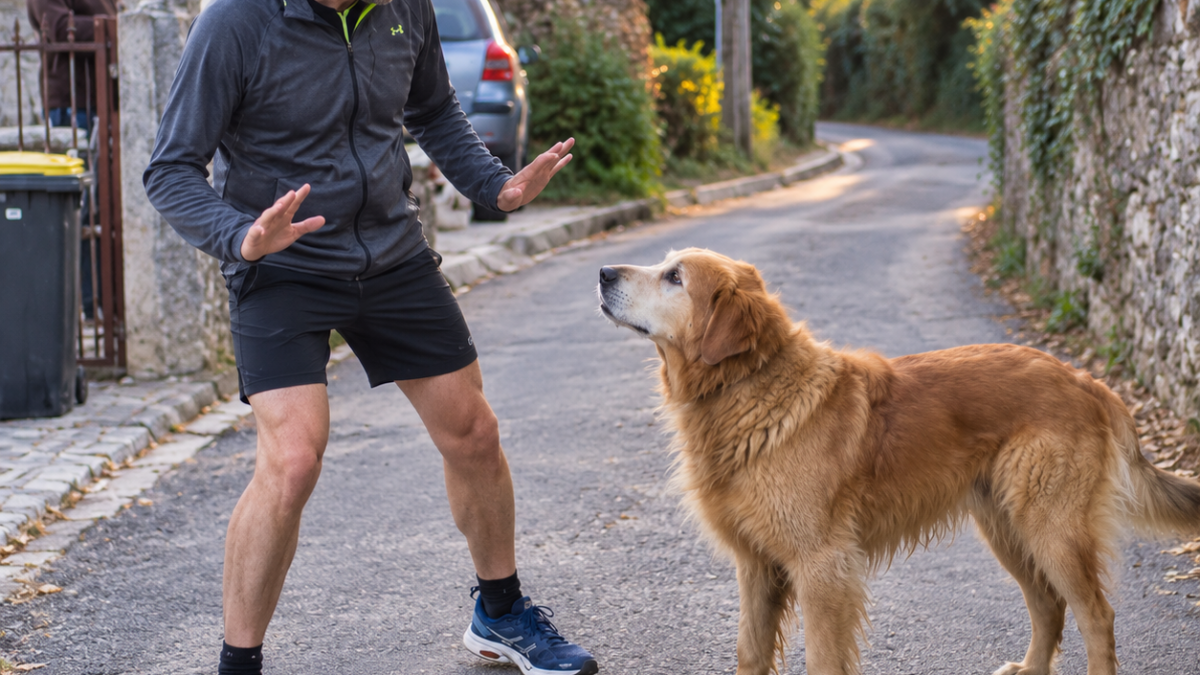
The golden dog stepped into my path every single time I tried to go around him.
He never barked, growled, or showed his teeth, but there was something in his eyes that made me stop treating him like a stray.
A few minutes later, I heard a sound beyond the bend that made me realize he had chosen me for a reason.
“Come on. Move.”
The dog didn’t move.
I stepped left.
He moved left.
I tried right.
He blocked me again.
I stopped in the middle of the narrow road and stared at him.
“Seriously?”
Across the street, a man dragging his trash cans toward his house laughed.
“Forget it!” he called. “Probably a stray.”
Normally, I would have listened.
Back then, walking away was something I had become very good at.
I’m Julien. I was forty-two, living outside Lyon, and I ran almost every morning before work.
Same six-mile route.
Same quiet streets.
Same time.
I liked routines because routines didn’t ask questions.
They didn’t need anything from me.
But that morning, this dog had apparently decided my schedule no longer mattered.
He looked like a golden retriever mix, probably beautiful when he was clean.
Now his coat was dull with dried mud. Burrs clung to the fur around his legs. One ear sat slightly lower than the other, and when he moved, I noticed a faint limp in his back leg.
He wasn’t dangerously thin.
But he looked exhausted.
I took one slow step toward him.
His body stiffened.
“Easy.”
He didn’t run.
He just watched me.
That was when my irritation disappeared.
There was no aggression in his face.
There was something closer to urgency.
“Okay,” I said. “What do you want?”
To my surprise, the dog turned around.
He walked ten yards.
Stopped.
Looked back.
At me.
“No.”
He waited.
“I’m not following you.”
Nothing.
He walked farther.
Stopped again.
Turned his head.
I actually laughed.
“You’ve got to be kidding.”
The dog tilted his head.
For some reason, that did it.
I checked my watch.
I was already going to be late getting home.
“Fine. Five minutes.”
The dog turned immediately.
This time he moved faster.
I followed.
Every ten or fifteen yards, he checked behind him.
If I slowed down, he slowed down.
If I stopped, he stopped.
He wasn’t wandering.
He knew exactly where he was going.
We left my regular running route and headed toward a descending road bordered by plane trees and thick brush.
I knew the area.
I had run past it dozens of times.
Yet that morning something felt wrong.
It took me a few seconds to understand why.
The silence.
No birds.
No nearby voices.
No engine sounds.
Even the dog had stopped panting.
He suddenly accelerated toward a curve.
“Hey.”
He disappeared around it.
I jogged after him.
Then I heard something.
Faint.
I stopped.
“What was that?”
Nothing.
I listened.
Then it came again.
A muffled sound.
Low.
Broken.
For one second I thought it might be an injured animal.
Then I heard it a third time.
My stomach tightened.
It wasn’t an animal.
It was a human voice.
“Hello?”
No clear answer.
The dog reappeared at the bend.
He ran toward me, stopped several feet away, then spun around and rushed back.
“Okay. I’m coming.”
I followed him around the curve.
At first I saw nothing except trees, brush, and the steep grassy shoulder dropping beside the road.
Then the dog left the pavement.
He scrambled toward the edge.
I slowed.
“Careful.”
He looked down.
Then back at me.
That was when I noticed something in the weeds.
A broken piece of red plastic.
Then another.
Fresh tire marks disappeared across the soft shoulder.
My pulse jumped.
I stepped closer to the edge.
Below me, hidden beneath branches and tall grass, something metallic caught the morning light.
The dog began whining.
Not loudly.
Desperately.
I looked down into the ditch.
And for the first time that morning, I understood that this dog had never been trying to stop my run.
He had been trying to make sure I didn’t pass the person waiting below.
PART 2
I dropped to my knees at the edge of the embankment.
At first, my brain refused to make sense of what I was seeing.
A small silver car had left the road, crashed through brush, and come to rest at an angle against two trees about twenty feet below.
The front end was crushed.
The passenger side was buried beneath broken branches.
The driver’s door faced uphill.
And beside that door, half-hidden by weeds, was a woman.
She was moving.
Barely.
“Can you hear me?”
The woman made another sound.
The golden dog scrambled down the slope.
“Milo…”
Her voice was so weak I almost missed the name.
The dog reached her and immediately pressed himself against her shoulder.
That was when everything clicked.
He wasn’t a stray.
He belonged to her.
I pulled out my phone and called emergency services.
While I gave the dispatcher our location, I studied the slope.
It was steep but manageable.
The woman looked older—maybe late sixties or early seventies.
There was blood near her hairline.
One leg was trapped awkwardly beneath her.
The driver’s side window was broken.
The golden dog stood over her, shaking.
The dispatcher told me not to move her unless there was an immediate danger.
“Help is coming,” I called down.
The woman’s eyes opened.
For a moment she looked straight at me.
Then at the dog.
“Milo…”
“He’s here.”
Her eyes closed again.
“Ma’am, stay with me.”
No answer.
“Stay with me. What’s your name?”
A pause.
“Madeleine.”
“Okay, Madeleine. My name is Julien. An ambulance is coming.”
She swallowed.
“Milo…”
“He found me.”
Her eyes opened slightly.
“What?”
“He found me and brought me here.”
A tear slipped from the corner of her eye.
I don’t know whether it came from pain or relief.
Maybe both.
I started down the embankment carefully.
Milo watched me.
For the first time since he had blocked my path, he growled.
Very softly.
I froze.
“Okay.”
His body was between Madeleine and me.
I lifted both hands.
“I’m not going to hurt her.”
Of course he didn’t understand every word.
But he understood tone.
I stayed still.
He stared at me.
Then Madeleine whispered his name.
“Milo.”
The growl stopped.
The dog looked at her.
Then back at me.
Slowly, I continued down.
When I reached them, I saw the full extent of the scene.
Madeleine had apparently managed to crawl partly out of the vehicle after the crash.
One arm lay awkwardly beside her.
Her coat was torn.
Her face was pale.
Her breathing was shallow but steady.
I knelt several feet away.
“You’re doing great.”
That wasn’t exactly true.
But sometimes the lie people need during an emergency isn’t about the situation.
It’s about surviving the next minute.
“The ambulance is almost here.”
She opened her eyes.
“Cold.”
I took off my running jacket.
I couldn’t move her, so I laid it across her upper body as carefully as possible.
Milo immediately sniffed it.
Then he lay beside her again.
His entire body trembled.
From the road, the wreck was almost completely invisible.
If Milo hadn’t stopped me, I would have passed within thirty yards of Madeleine and never known she was there.
That thought made my skin crawl.
“How long have you been here?”
Madeleine’s lips moved.
I leaned closer.
“Since… dark.”
My stomach dropped.
It was after seven in the morning.
“All night?”
Her eyelids fluttered.
A tiny nod.
I touched two fingers gently to her wrist.
Pulse.
Fast.
Still there.
“Milo went…”
Her voice faded.
“What?”
“He went for help.”
I looked at the dog.
He was staring at me.
“You sent him?”
A tiny nod.
“Good boy,” Madeleine whispered.
Milo licked the side of her face.
I turned away for a second because something hit me hard in the chest.
People talk about heroic dogs as if the dog understands that he is being heroic.
Milo didn’t.
He had simply known Madeleine needed something he could not give her.
So he had gone looking for someone who could.
And somehow, out of every person on every street that morning, he had decided I was the one who needed to stop.
Sirens became audible in the distance.
Milo’s head snapped up.
His body tensed.
“It’s okay.”
He stood over Madeleine.
When the first firefighters appeared at the top of the slope, Milo barked.
Once.
Sharp.
Warning.
One firefighter began descending.
Milo growled again.
“Wait,” I said.
The firefighter stopped.
I moved slowly toward the dog.
“Milo.”
His eyes met mine.
“I know.”
I held out my hand.
This time he came close enough to sniff it.
Then I touched his neck.
His fur was damp and cold.
“It’s okay.”
He looked at Madeleine.
The firefighter moved again.
Milo watched him.
But he didn’t growl.
For the next twenty minutes, everything happened quickly.
A rescue team stabilized the slope.
Paramedics assessed Madeleine.
A neck brace.
Oxygen.
Equipment.
Questions.
Commands.
Metal scraping.
Branches being cut.
I stayed off to one side with Milo.
He fought the temporary leash one of the firefighters found for us.
Every time someone touched Madeleine, he tried to go back.
“She needs them,” I kept telling him.
He whined.
“I know.”
When they finally lifted Madeleine onto the stretcher, Milo pulled so hard I had to wrap the leash around both hands.
Madeleine’s eyes opened.
She saw him.
“Milo.”
He stopped fighting.
The paramedic leaned toward her.
“Your dog is safe.”
Madeleine tried to lift one hand.
She couldn’t.
“Don’t… leave him.”
“I won’t,” I said.
I had no idea why I said it.
No idea what that promise would mean.
But she heard me.
Her eyes found mine.
“Please.”
“I’ve got him.”
The ambulance carried her away.
And suddenly the road was quiet again.
I stood there holding a muddy golden dog I had not known existed forty minutes earlier.
One firefighter looked at me.
“Yours?”
“No.”
He smiled.
“Looks like he thinks otherwise.”
Milo sat beside my leg.
His entire attention remained fixed on the road where the ambulance had disappeared.
A police officer approached.
“We’ll need a statement.”
I nodded.
“Of course.”
He looked toward the slope.
“You saw the crash?”
“No. I found it.”
“How?”
I looked down.
Milo was still watching the empty road.
“He found me first.”
The officer raised an eyebrow.
I told him what had happened.
How Milo blocked my path.
How he copied every step I took.
How he led me around the bend.
How he kept checking to make sure I followed.
The officer glanced at the dog.
“That’s something.”
“Yeah.”
He began writing.
Then I remembered the broken red plastic.
“There was debris near the road.”
“From the car?”
“I don’t think so.”
He looked up.
“Why?”
“Her car is silver. The plastic was red.”
The officer stopped writing.
“Show me.”
We walked to the edge.
Two pieces remained in the grass.
One looked like part of a taillight.
The other had blue paint across one side.
The officer put on gloves.
“You touched these?”
“No.”
He crouched.
Then he studied the tire marks.
There were two sets.
One belonged to Madeleine’s car.
The other stopped near the shoulder and continued along the road.
His expression changed.
“Interesting.”
“What?”
“Could be nothing.”
I hated that phrase immediately.
“Could also be something.”
He looked at me.
“You’re right.”
Another officer began photographing the area.
I thought about Madeleine lying in that ditch all night.
“What do you think happened?”
“Too early to say.”
“Was she hit?”
“Maybe. Maybe somebody forced her off the road. Maybe the debris was already here.”
He pointed his pen at me gently.
“Don’t build the story before we have the facts.”
He was right.
Still, something about those second tire marks bothered me.
So did the red plastic.
So did the fact that nobody had called in the crash.
If another vehicle had been involved, someone had left Madeleine there.
I looked at Milo.
Mud covered his paws.
There was a small scrape near his back leg.
“How long do you think he was out looking for help?” I asked.
The officer shook his head.
“No idea.”
The answer bothered me more than it should have.
Maybe because I started imagining it.
A crash in darkness.
Madeleine injured.
Milo escaping through a broken door or window.
Staying beside her.
Waiting.
Hours passing.
Cold settling in.
Then finally leaving the person he loved because staying wasn’t saving her.
Walking roads he didn’t understand.
Looking for someone.
Anyone.
He could have been hit.
He could have gotten lost.
Someone could have taken him.
Instead he found me.
And when I tried to walk around him, he refused to let me.
The officer finished my statement.
“You can go.”
I looked down at the leash.
“What about Milo?”
“We can have animal services take him.”
Milo looked up at me.
“No.”
The answer came so quickly the officer laughed.
“No?”
“I promised her.”
“You know the owner?”
“No.”
“That might make things complicated.”
“I’ll figure it out.”
He shrugged.
“All right. Get the dog checked. Give us your contact information.”
I called work.
For the first time in years, I said I wasn’t coming in.
My boss sounded stunned.
“Are you sick?”
“No.”
“Family emergency?”
I looked at Milo.
“Something like that.”
The nearest veterinary clinic opened at eight-thirty.
Milo sat in the back seat of my car.
At least, he sat for the first thirty seconds.
Then he stood.
Then paced.
Then put his head between the front seats.
“You are not helping.”
He panted.
“You smell terrible.”
More panting.
“And I have absolutely no idea what I’m doing.”
He licked my ear.
“Great.”
At the clinic, the receptionist looked from me to Milo.
“Name?”
“Milo.”
“Last name?”
I stopped.
“I don’t know.”
She looked at me.
“He’s not yours?”
“It’s complicated.”
An hour later, a veterinarian confirmed Milo had no serious injuries.
Minor strain.
A superficial scrape.
Dehydration.
Exhaustion.
His microchip identified Madeleine Delorme as the registered owner.
The vet looked at me.
“You know what’s interesting?”
“What?”
“He probably ran farther than you think.”
I frowned.
“Why?”
“The pads on his paws.”
She showed me.
Several were irritated.
“How far?”
“Could’ve been miles over the course of the night.”
I looked at Milo.
He rested his head on the exam table.
“Idiot.”
His tail moved once.
The vet smiled.
“You say that like you’re proud of him.”
“I’ve known him two hours.”
“Dogs have done more with less.”
After the appointment, I called the hospital.
At first nobody would tell me anything.
I understood.
Eventually I explained that I had found Madeleine and currently had her dog.
I was transferred twice.
Then a woman answered.
“Mr. Laurent?”
“Yes.”
“My name is Claire. I’m Madeleine’s daughter.”
I sat straighter.
“Is she okay?”
A pause.
“She’s alive.”
I closed my eyes.
“That’s good.”
“She has a fractured pelvis, broken ribs, a shoulder injury and a concussion.”
My grip tightened around the phone.
“But she’s alive.”
“Yes.”
Claire’s voice broke slightly.
“Doctors said several more hours out there could have been very bad.”
I looked at Milo.
He was asleep on my kitchen floor.
“Your mother has a good dog.”
Claire started crying.
Quietly.
“I know.”
I didn’t know what to say.
Finally she asked, “Where is he?”
“With me.”
“You?”
“I’m the runner he found.”
Silence.
Then:
“You’re the man?”
“I guess.”
“My mother woke up for a few minutes. She kept saying a runner came because Milo brought him.”
“That’s what happened.”
Claire laughed through tears.
“I thought she was confused.”
“No.”
I looked at Milo sleeping.
“He knew exactly what he was doing.”
Claire lived in Geneva and was already driving toward Lyon.
She said she would pick Milo up when she arrived.
That should have been the end of my involvement.
I had found Madeleine.
She had survived.
Milo had family coming.
I should have returned to my routine.
But that afternoon, the police called.
The officer from the scene introduced himself as Inspector Bernard.
“We found evidence another vehicle may have been involved.”
I stood by my kitchen window.
“What kind?”
“Paint transfer on Mrs. Delorme’s car.”
Madeleine Delorme.
Now I had her full name.
“Blue?”
“Yes.”
I remembered the plastic.
“Do you know what vehicle?”
“Not yet.”
“What happened?”
“We’re still reconstructing.”
“Was she hit?”
“Looks more like sideswiped or crowded off the lane.”
“And they left?”
“That’s what we need to determine.”
I looked at Milo.
He had woken up.
“Inspector, she was down there all night.”
“I know.”
“If another driver knew—”
“I know.”
His voice softened.
“We’ll do our job.”
I wanted to believe that.
At six that evening, Claire arrived.
She was a tall woman in her late thirties with Madeleine’s eyes.
Milo heard her voice in the hallway.
He exploded.
He ran toward the door so hard his back feet lost traction.
Claire dropped to her knees.
“Milo!”
The dog crashed into her.
She wrapped both arms around him.
For the first time that day, I heard Milo make a sound I can only describe as crying.
Not barking.
Not whining.
Something deep and breathless.
Claire buried her face in his neck.
“Oh, buddy.”
I turned away.
Some moments don’t need an audience.
When I looked back, she was wiping her face.
“Thank you.”
“Milo did everything.”
“You stopped.”
I shrugged.
“He didn’t give me much choice.”
She laughed.
“That sounds like him.”
We sat at my kitchen table.
Claire told me about Madeleine.
Seventy-one.
Retired elementary school teacher.
Widowed four years.
Milo had originally belonged to Madeleine’s husband, Henri.
After Henri died, Madeleine and Milo became inseparable.
“She says he’s the reason she gets up every morning.”
I looked toward the dog.
He was lying across Claire’s feet.
“That tracks.”
Claire smiled.
Then her expression changed.
“The police think someone hit her.”
“I know.”
“They called me.”
“Did your mother remember anything?”
“Not yet.”
She rubbed her eyes.
“The last thing she remembers is driving home from my aunt’s house.”
“What time?”
“Around ten-thirty.”
The accident had probably happened close to eleven.
Milo had stayed with her until sometime before dawn.
Then he went for help.
I pictured him again.
The dark road.
The cold.
Searching.
Claire shook her head.
“I keep thinking about what would have happened if you hadn’t been running there.”
“Don’t.”
“I can’t help it.”
“Milo would’ve stopped someone else.”
She looked at him.
“Maybe.”
“No.”
I smiled.
“He absolutely would have.”
Milo lifted his head at the sound of his name.
Claire spent that night at Madeleine’s apartment with him.
I returned to my regular life.
Or tried to.
The next morning I ran the same route.
When I reached the place where Milo had blocked me, I slowed.
The road looked ordinary again.
A man watered plants.
A delivery truck passed.
Then I reached the bend.
I stopped.
Police tape remained near the damaged brush.
Pieces of glass sparkled in the dirt.
I stood there longer than I intended.
A blue van came around the curve.
My body reacted before my mind did.
I stepped backward.
The van passed.
Nothing unusual.
Still, I turned and watched it.
That became a problem.
For the next several days, every blue vehicle bothered me.
I knew it was irrational.
There were thousands.
Then Madeleine woke properly.
Claire called me.
“She remembers something.”
I sat down.
“What?”
“A truck.”
“What kind?”
“She says it was blue. A work truck or van.”
My heart beat faster.
“Did she see the driver?”
“No.”
“What happened?”
“She said it came up behind her fast.”
I waited.
“She moved toward the shoulder to let it pass. It pulled alongside her. Then something hit her passenger side.”
“Did the driver stop?”
“No.”
“Maybe he didn’t know.”
Claire was silent.
“What?”
“My mother says he looked back.”
A cold feeling moved through me.
“How?”
“After the impact, before she went off the road, she saw him turn his head.”
I said nothing.
Claire continued.
“She remembers the brake lights.”
“The red plastic.”
“What?”
“There was broken red plastic at the scene.”
I stood.
“What else does she remember?”
“Letters.”
“What letters?”
“On the side of the vehicle. White letters. She thinks they started with B.”
That wasn’t much.
But it was something.
Police took another statement.
Then days passed.
Madeleine underwent surgery.
Milo wasn’t allowed into the hospital.
Claire stayed near her mother.
I checked in more often than I probably should have.
At first I told myself I was asking because I cared about Madeleine.
That was true.
But I was also angry.
I kept thinking about that driver looking back.
If Madeleine remembered correctly, someone had known she crashed.
Someone had known.
And left.
One week after the accident, Inspector Bernard called.
“We have a possible company.”
My pulse jumped.
“What company?”
“Borel Paysage.”
I knew the name.
Half the landscaping trucks around the area seemed to carry their logo.
Blue vehicles.
White lettering.
The company maintained apartment complexes, parks, office grounds and several municipal properties.
“What happened?”
“We identified one of their vans on traffic cameras near the area.”
“The one that hit her?”
“We don’t know yet.”
“Did you inspect it?”
A pause.
“That’s where things get interesting.”
I waited.
“The van assigned to that route was taken for repairs the morning after the crash.”
I stood completely still.
“What repairs?”
“Rear light assembly. Side panel.”
I thought about the red plastic.
“Are you serious?”
“Yes.”
“Who was driving?”
“We’re working on that.”
That answer annoyed me.
“How hard can that be?”
“Mr. Laurent.”
“I’m sorry.”
“No, you’re not.”
“No.”
He almost laughed.
“Let us work.”
Three days later, the story changed.
Borel Paysage claimed the van had been damaged at one of its own storage yards.
The company provided an incident report dated the morning after Madeleine’s crash.
An employee named Philippe Borel had supposedly backed into a metal post at 6:40 a.m.
Convenient.
Very convenient.
Philippe was the nephew of the company owner.
Twenty-nine years old.
Two previous speeding violations.
No serious criminal record.
Police interviewed him.
He denied being anywhere near Madeleine’s accident.
The company said a different employee had driven that route.
For a while, it seemed the trail might stop there.
Then I remembered the man with the trash cans.
He had been outside when Milo blocked me.
I went back.
His name was René.
He recognized me immediately.
“The dog man.”
“That’s me.”
“How’s the lady?”
“Recovering.”
“Good.”
I hesitated.
“Can I ask you something?”
“Sure.”
“Were you outside earlier that morning? Before I came by?”
He scratched his chin.
“Maybe.”
“Did you see any vehicles?”
“Lots.”
“A blue landscaping van?”
His expression changed.
“Actually…”
My heart jumped.
“What?”
“One came through fast.”
“When?”
“Early.”
“How early?”
“Still dark.”
“Did you see the company?”
“No.”
“Driver?”
“No.”
“Anything?”
René thought.
“One brake light was broken.”
I stared at him.
“Which one?”
He pointed toward the road.
“Left rear, I think.”
“Did you tell the police?”
“No one asked.”
I called Bernard before I reached my car.
He did not sound pleased that I was doing his job for him.
“You need to stop investigating this yourself.”
“I asked one man one question.”
“Exactly.”
“And he saw the van.”
Silence.
“He saw a blue van with a broken rear light.”
Another silence.
“Give me his address.”
I did.
Before he hung up, Bernard said, “Julien.”
“Yes?”
“You already saved a woman’s life. You don’t need to solve the whole case.”
I looked toward the bend.
“That driver had a chance to save her too.”
Bernard didn’t answer.
Two weeks after the crash, I visited Madeleine.
She was sitting upright in a hospital chair.
Paler than I expected.
Smaller.
Claire stood beside the window.
Milo still wasn’t allowed inside, so I had brought photographs.
The first showed him sleeping upside down on Claire’s couch.
The second showed him carrying one of Madeleine’s slippers.
The third showed him sitting beside the apartment door.
Madeleine touched that one.
“He waits there?”
Claire nodded.
“Every afternoon.”
Madeleine looked down.
“He thinks I’m coming home.”
“He knows you are,” I said.
She looked at me.
I had never actually spoken to her while she was fully conscious.
For a few seconds we simply studied each other.
“So you’re Julien.”
“So I’ve been told.”
“You’re taller than I remember.”
“You had a concussion.”
“That may explain it.”
Claire laughed.
Madeleine smiled.
Then her eyes filled.
“You followed him.”
“Yes.”
“Why?”
I considered the question.
“Because he wouldn’t let me leave.”
She shook her head.
“That dog.”
“He’s very persuasive.”
Her smile disappeared.
“He left me.”
I misunderstood.
“Only to get help.”
“I know.”
A tear rolled down her cheek.
“That’s what I mean.”
She looked toward the photographs.
“Milo never leaves me.”
Claire touched her shoulder.
Madeleine whispered, “He must have been terrified.”
That was the first time I realized she wasn’t crying for herself.
She was crying because her dog had been frightened.
I pulled a chair closer.
“He was scared.”
Madeleine looked at me.
“But he was also unbelievably determined.”
I told her everything.
How he blocked me.
How he mirrored every step.
How he led me.
How he kept checking behind him.
How he protected her when I came down the slope.
How he resisted the firefighters until she said his name.
Madeleine cried quietly.
“He did all that?”
“Every bit.”
She closed her eyes.
“I always thought I was taking care of him.”
Claire smiled sadly.
“Apparently he had other ideas.”
Before I left, Madeleine took my hand.
“Thank you.”
I shook my head.
“He deserves the credit.”
“Maybe.”
Her grip tightened.
“But dogs can ask.”
She looked into my eyes.
“People still have to answer.”
That sentence followed me for weeks.
Dogs can ask.
People still have to answer.
The police answered too.
René’s statement mattered.
So did traffic footage.
But the most important break came from somewhere nobody expected.
A mechanic.
His name was Sami.
He worked at a small repair garage outside the city.
Philippe Borel had brought the van there just after seven on the morning following the crash.
Not to the company’s usual service center.
To Sami.
He wanted a rear light replaced immediately.
He wanted blue paint damage on one side polished.
And he wanted to pay cash.
At first Sami hadn’t thought much about it.
Vehicles get damaged.
People pay cash.
Then he saw a local report about Madeleine’s crash.
Blue commercial vehicle.
Damaged rear light.
Driver fled.
He hesitated for days.
Philippe was connected.
Borel Paysage was a major client.
Sami had employees.
Bills.
A family.
Coming forward could cost him.
Then police visited.
They already had part of the picture.
Sami gave them the rest.
He had security footage.
The van was visible entering the garage.
Timestamp: 7:08 a.m.
The left rear light was broken.
There was fresh damage along the passenger side.
And in one camera angle, investigators could see something even more important.
Silver paint.
Madeleine’s car was silver.
When Bernard told me, I sat in stunned silence.
“That’s enough?”
“It’s significant.”
“Did he confess?”
“No.”
“What did he say?”
“That he hit a roadside barrier.”
“At eleven at night?”
“He claims he doesn’t remember the exact time.”
I laughed once.
There was no humor in it.
“He remembers enough to repair the van at seven in the morning.”
Bernard sighed.
“Julien.”
“What?”
“We’re getting there.”
But Philippe wasn’t finished.
Through a lawyer, he claimed the van had been stolen for several hours that night.
No theft report had been filed.
No keys had been missing.
No one at the company remembered a theft.
Still, the claim created delay.
That was when I started understanding something about justice.
Truth can be simple.
Proving it rarely is.
Madeleine was the injured person.
Milo was the one who found help.
The van was damaged.
The repair existed.
The paint matched.
To me, it looked obvious.
To the law, each piece had to be documented, preserved, challenged, verified.
Bernard explained that impatient people often ruined strong cases by moving faster than the evidence.
I didn’t like hearing it.
But he was right.
Meanwhile, Madeleine had a different battle.
Recovery.
She was transferred to a rehabilitation facility.
The first time she tried to stand between parallel bars, she lasted seven seconds.
Seven.
Her arms trembled.
Her injured shoulder protested.
Her good leg shook from weeks of reduced movement.
The therapist told her to sit.
“No.”
“Madeleine.”
“One more.”
“You’ve done enough.”
“Then one more is extra.”
That was the kind of person she was.
Stubborn in a way that somehow made you smile instead of wanting to scream.
The therapist looked at me.
“Does she always negotiate?”
“I barely know her.”
Madeleine glared.
“Coward.”
She lasted four more seconds.
Then collapsed carefully into the chair.
Her face had gone pale.
But she was smiling.
“Eleven.”
The therapist sighed.
“Eleven.”
Claire stood beside me.
“She was a teacher for thirty-eight years.”
“I believe it.”
“She argued with school inspectors exactly like this.”
“I also believe that.”
Madeleine heard us.
“I can still hear.”
Claire leaned down.
“Good. Then hear this: you’re exhausting.”
Madeleine smiled.
“Family trait.”
Milo was finally allowed to visit several days later.
Only outside.
Only briefly.
Only if he remained calm.
I almost laughed when the staff said that.
“Milo? Calm?”
Claire looked at me.
“He can be calm.”
“He body-checked me into a hedge last week because he saw a pigeon.”
“That pigeon was suspicious.”
We brought him into the courtyard.
Madeleine sat beneath a tree in a wheelchair.
The moment Milo saw her, he froze.
He didn’t run.
That surprised me.
His whole body simply locked.
Madeleine covered her mouth.
“Milo.”
His ears went forward.
She said it again.
“Come here, baby.”
Then he ran.
Claire dropped the leash.
Milo crossed the courtyard so fast his back legs almost slid from beneath him.
At the last second, he slowed.
As if he understood she was fragile.
He approached the wheelchair carefully.
Madeleine leaned forward.
Milo pressed his head into her lap.
She wrapped both arms around his neck.
No one said anything.
Not Claire.
Not me.
Not the nurse standing nearby.
Milo’s tail moved slowly.
Madeleine cried into his fur.
“I’m sorry.”
The dog pressed closer.
“I’m sorry I sent you away.”
I had to look down.
After a minute, Madeleine lifted her face.
Milo licked her chin.
She laughed through tears.
“There you are.”
For the next half hour, he never moved more than three feet from her.
When a therapist helped Madeleine stand, Milo stood too.
When she took three steps, he walked beside her.
When she sat, he sat.
The therapist smiled.
“I think I’ve been replaced.”
Madeleine rubbed Milo’s ear.
“He works for biscuits.”
“So do I.”
That reunion changed her recovery.
I don’t mean medically.
Doctors and therapists did the medical work.
But effort is easier when you have something waiting at the other end.
Madeleine wanted to walk Milo again.
Not far.
Just around her block.
That became her goal.
Ten meters.
Twenty.
Fifty.
A hallway.
A courtyard.
A cane.
Then no cane for short distances.
There were setbacks too.
One morning, she called Claire in tears because pain had forced her to stop halfway through a therapy session.
“I’m going backward.”
Claire put the phone on speaker because I happened to be visiting Milo.
“No, you’re not,” she said.
“I walked farther yesterday.”
“And today you’re tired.”
“I should be stronger.”
“You had a car throw you into a ditch.”
Madeleine said nothing.
Claire continued.
“You don’t get to insult yourself because your body needs time.”
Silence.
Then Madeleine muttered, “That sounded annoyingly reasonable.”
“I learned from you.”
After the call, Milo walked to the apartment door and sat.
He stared at it for nearly an hour.
I sat beside him.
“She’s coming home.”
His ears moved.
“Eventually.”
He placed one paw on my shoe.
I looked down.
“I know.”
We stayed there together.
Meanwhile, the case against Philippe tightened.
The police recovered phone-location data placing his device near the crash.
A traffic camera captured the van several kilometers away minutes beforehand.
René’s statement placed a damaged blue van passing the neighborhood before dawn.
Sami’s security footage showed the repair.
The paint transfer matched.
The broken red plastic recovered at the scene fit the replacement part removed from the van.
Then investigators found another witness.
A delivery driver named Laurent—not related to me—had been parked near a twenty-four-hour bakery around ten minutes after Madeleine’s crash.
He remembered a blue Borel van speeding through the intersection.
Why?
Because it nearly clipped his side mirror.
At the time, he cursed, finished his delivery and forgot about it.
Weeks later, when police asked local businesses and drivers for information, his employer checked route logs.
Laurent had dashcam footage.
The video wasn’t dramatic.
No crash.
No clear view of the driver’s face.
But the van appeared.
Blue.
White company lettering.
Left rear light damaged.
The timestamp was eleven minutes after the estimated collision.
That mattered.
Philippe’s stolen-van story began collapsing.
Then investigators interviewed employees.
At first, nobody wanted to talk.
Borel Paysage employed almost sixty people.
Many had families.
Mortgages.
Rent.
One worker later told police that Philippe had arrived at the yard shortly after six in the morning looking pale and agitated.
Another remembered him asking for access to an older spare van.
A third said Philippe had ordered him to clean mud from the vehicle’s tires.
That employee had refused because his shift had not started.
Piece by piece, the night stopped being mysterious.
What remained mysterious was why Philippe hadn’t stopped.
That question obsessed me.
Maybe too much.
I asked Bernard once.
He looked at me for a long moment.
“You want a reason that makes sense.”
“Yes.”
“There may not be one.”
“People don’t just leave someone in a ditch.”
“They do.”
“That’s not an answer.”
“It is. You just don’t like it.”
I looked away.
Bernard continued.
“Sometimes fear makes people selfish. Sometimes intoxication. Sometimes panic. Sometimes they think about consequences before they think about the person they hurt.”
“Do you think he was drunk?”
“We’re investigating.”
“Could you prove it now?”
“Probably not.”
That answer frustrated me.
“So he gets away with that part.”
“If it happened, maybe.”
I stared through the window of Bernard’s office.
He said, “Julien, justice is not the same thing as discovering every fact.”
“That sounds depressing.”
“It’s realistic.”
“What’s the difference?”
“Justice works with what can be proved.”
I hated that too.
But Madeleine handled it better.
When I repeated Bernard’s words, she shrugged.
“He’s right.”
“You’re okay with that?”
“No.”
She adjusted the blanket over her knees.
“But I don’t need to know whether Philippe had two drinks or five.”
She looked at me.
“I need the truth about the choice that matters.”
“What choice?”
“He saw me.”
Her voice became quiet.
“He saw the car leave the road.”
She touched the scar near her temple.
“He knew I might be hurt.”
Then she looked toward Milo.
“And he left.”
That was the choice she cared about.
The rest was detail.
One afternoon, Claire called me.
“You’re not going to believe this.”
“What?”
“They offered my mother money.”
“Who?”
“Borel’s lawyers.”
“For what?”
“A private settlement.”
“That’s normal in some cases.”
“This wasn’t.”
Her voice hardened.
“They wanted confidentiality.”
I understood.
“No public statements.”
“No talking about the company.”
“No interviews.”
“No mention of Philippe.”
“How much?”
“Enough to tempt someone.”
“What did Madeleine say?”
Claire laughed.
“You know my mother.”
I didn’t really.
But I was learning.
“What did she say?”
“She told them she spent thirty-eight years teaching children that running away from what you did does not make you innocent.”
I smiled.
“That sounds like her.”
“She rejected it.”
The offer wasn’t technically illegal.
It came through lawyers.
Carefully written.
No direct admission.
No obvious threat.
But the timing angered Madeleine.
She still struggled to climb stairs.
Still woke at night from pain.
Still couldn’t take Milo on the route they had walked for years.
And someone thought silence could be negotiated like the price of a car.
She asked Claire to put the settlement letter away.
“Don’t throw it out.”
“Why?”
“I want to remember.”
“Remember what?”
Madeleine looked at her daughter.
“That some people think money can buy the part of your memory that embarrasses them.”
That sentence later became important.
Because Borel Paysage had bigger problems coming.
Investigators discovered the false 6:40 a.m. yard-damage report had not been created by Philippe alone.
An office supervisor had entered it into the company system.
The timestamp had been altered.
The report claimed a metal post in the storage yard had damaged the van.
Police inspected the post.
No fresh marks.
No matching paint.
No debris.
Then they checked access cameras.
The van had not even been inside the yard at the time the report claimed the accident occurred.
Someone had built an alibi.
When confronted, the office supervisor initially insisted he had simply entered information Philippe gave him.
Then police showed him phone records.
Three calls between him and the company owner before the report was created.
His story changed.
He admitted the owner had told him to “make the problem look internal.”
That phrase spread through the company like fire.
Employees began talking.
One produced text messages.
Another produced photographs.
A manager had written:
“Get van 14 off-site until we know what happened.”
Another message:
“Do not discuss P.B. route from last night.”
The cover-up had grown beyond one frightened driver.
Borel Paysage had chosen to protect its name instead of helping investigators understand why an elderly woman had spent a night injured in a ditch.
That decision would cost them more than they expected.
Several municipalities suspended new work with the company pending investigation.
Two large apartment-management firms announced reviews of their contracts.
Then a newspaper published an article about the crash.
It didn’t reveal every detail.
It didn’t need to.
The facts were enough.
A seventy-one-year-old woman.
A suspected hit-and-run.
A blue company van.
A falsified damage report.
A dog who had left his injured owner to find help.
Suddenly Milo became the part everyone talked about.
Madeleine hated that at first.
“He is not a celebrity.”
Claire smiled.
“He doesn’t know that.”
“He is a dog.”
Milo was chewing a newspaper someone had placed too close to the floor.
I pointed.
“A very grounded celebrity.”
Madeleine tried not to laugh.
She failed.
But media attention created a strange kind of pressure.
Reporters called.
Messages arrived.
People sent dog treats.
One local bakery offered Milo free biscuits for life.
Madeleine accepted that one.
“Principles have limits,” she said.
The attention also made Philippe’s situation harder.
Every inconsistency was now public.
Every delayed answer looked worse.
His lawyers claimed the coverage made a fair hearing difficult.
Maybe they had a point.
Madeleine refused interviews about the criminal case until proceedings were over.
“I don’t want revenge by newspaper,” she said.
“What do you want?” I asked.
She looked at me.
“A room where he can’t walk away before the truth is finished.”
The criminal case moved forward.
Months passed.
By then Madeleine could walk with a cane.
Milo had returned home with her.
Claire stayed for several weeks, then moved back to Geneva once Madeleine was stable.
I began visiting every Sunday.
I told myself it was because Madeleine needed occasional help.
Groceries.
Repairs.
Driving.
That was partly true.
Mostly, I liked them.
Madeleine made terrible coffee.
Milo stole socks.
We argued about whether runners were sensible people.
“They are not,” Madeleine said.
“You were saved by one.”
“I was saved by a dog.”
“Fair.”
Milo lay between us.
Madeleine pointed at him.
“He found the useful part.”
I laughed.
My life had changed in ways I had not expected.
Before Milo, I had built everything around efficiency.
Work.
Run.
Eat.
Sleep.
Repeat.
I answered messages when necessary.
Declined invitations.
Avoided complications.
Then a dog stood in the road and refused to let me continue.
At first I thought he had interrupted my morning.
Really, he interrupted the way I was living.
One Sunday, Madeleine asked, “Why were you so determined to help with the case?”
I shrugged.
“Anyone would’ve been.”
“No.”
She looked at me over her coffee cup.
“Most people would have helped with the accident.”
I waited.
“You kept going afterward.”
I looked toward Milo.
He was asleep beneath the table.
“The driver left you there.”
“Yes.”
“That bothered me.”
“Obviously.”
“No.”
I tried to explain.
“My father died three years ago.”
Madeleine stayed quiet.
“He had a heart attack at home.”
“I’m sorry.”
“I was supposed to visit him that night.”
I stared at my hands.
“I canceled.”
“Why?”
“Work.”
The word sounded pathetic once spoken.
“He called. I said I was tired. Told him I’d come Sunday.”
Madeleine didn’t interrupt.
“My sister found him the next morning.”
Silence filled the kitchen.
“I know visiting him probably wouldn’t have changed anything.”
“No.”
“But you don’t know.”
“Exactly.”
I swallowed.
“Since then I’ve gotten very good at not needing anyone.”
Madeleine looked at me.
“That sounds exhausting.”
“It’s efficient.”
“No.”
She smiled gently.
“It sounds exhausting.”
I laughed despite myself.
She leaned back.
“Milo stopped you because I needed help.”
“Yes.”
“Maybe he stopped you because you did too.”
I hated that sentence.
Mostly because she was right.
The hearing began in early spring.
Philippe entered the courthouse wearing a dark suit.
He looked younger than I expected.
I had built him into something in my imagination.
A monster.
But monsters are easy.
Philippe looked ordinary.
That made it worse.
Ordinary people make terrible choices every day.
Some turn back.
Some call for help.
Some lie.
Philippe had lied.
And kept lying.
I was called as a witness.
I described the morning.
The dog.
The sound.
The car.
Madeleine.
The debris.
The second tire marks.
Philippe’s lawyer tried to make my observations sound uncertain.
“You are not an accident reconstruction expert, correct?”
“No.”
“You did not witness the collision.”
“No.”
“You cannot personally identify my client as the driver.”
“No.”
“So your testimony tells us only that you found Mrs. Delorme afterward.”
“And that her dog had to search for a stranger because whoever hit her didn’t stop.”
The lawyer objected.
The judge instructed me to answer only the question.
I apologized.
I wasn’t sorry.
René testified.
He described the blue van.
The damaged light.
The speed.
The hour.
Philippe’s attorney pressed him.
“You said you were taking out trash.”
“Yes.”
“Were you wearing your glasses?”
“Yes.”
“Are those the same glasses you use for distance?”
René leaned toward the microphone.
“I use them for seeing.”
Someone behind me coughed to hide a laugh.
The judge didn’t smile.
But I saw Bernard look down at his notes.
Sami testified next.
He looked miserable.
His garage had lost Borel Paysage as a client.
Someone had posted false reviews online accusing him of betraying customers.
A window at his business had been broken.
Police could not prove who did it.
Still, Sami appeared.
He described the van arriving.
Philippe asking for an immediate repair.
Cash.
No invoice initially.
The damaged taillight.
Silver paint transfer.
The prosecutor asked, “Why didn’t you contact police immediately?”
Sami looked toward Madeleine.
“I was afraid.”
No one moved.
He continued.
“I have employees. Children. That company sent us a lot of work.”
The prosecutor nodded.
“What changed?”
Sami swallowed.
“I saw the story about the woman.”
He looked at Madeleine again.
“And the dog.”
His voice cracked slightly.
“I realized I was protecting the wrong person.”
Madeleine nodded at him.
Just once.
That small gesture seemed to matter.
The delivery driver’s dashcam footage came next.
Then traffic cameras.
Then phone-location evidence.
Then repair records.
Then photographs of the company yard showing the metal post had no corresponding damage.
Then the falsified report.
One document after another.
Truth is sometimes dramatic.
More often, it is paperwork.
A timestamp.
A phone record.
A paint sample.
A maintenance entry.
A photograph no one thought mattered.
By itself, each thing was small.
Together, they formed a wall Philippe could no longer step around.
Then Madeleine testified.
She walked slowly to the witness area with a cane.
Milo was not allowed inside the courtroom.
He waited with Claire outside.
Madeleine looked at Philippe.
For a moment, he looked back.
Then away.
She described the headlights behind her.
The van getting too close.
The impact.
The car leaving the road.
The violent spinning sensation.
Branches hitting glass.
Metal folding.
Silence afterward.
She described waking in darkness.
Milo beside her.
Pain so severe she could barely breathe.
She described trying her phone.
It had been thrown somewhere inside the vehicle.
She couldn’t reach it.
She called for help.
No one came.
Hours passed.
She became colder.
Milo refused to leave.
She told the court how he curled beside her.
How he licked her face whenever she became too still.
How several times she woke because he nudged her.
Then, as early light began to appear, she realized waiting might kill them both.
She touched his collar.
“I told him to go.”
The courtroom was silent.
Her voice shook.
“I kept saying, ‘Go find someone.’”
She looked toward me.
“I didn’t know whether he understood.”
Milo had understood.
Madeleine continued.
“Eventually he left.”
Her eyes filled.
“I was terrified I had made a mistake.”
She waited.
“I thought I might die there alone and my last decision would have been sending my dog away.”
Claire cried silently behind me.
Madeleine took a breath.
“Then I heard Julien.”
Philippe finally looked at her.
The prosecutor asked the most important question.
“Mrs. Delorme, before your vehicle left the road, did you see the other driver?”
“Not clearly.”
“Did you observe anything about him after the impact?”
Madeleine nodded.
“He looked back.”
The prosecutor waited.
“How can you be sure?”
“Because our eyes met.”
That sentence changed the room.
Philippe shifted.
His lawyer wrote something quickly.
Madeleine did not look away.
“He saw me.”
The prosecutor asked, “And then?”
“He drove away.”
No dramatic shouting followed.
No one gasped.
But something settled over the courtroom.
Evidence can establish contact.
Paint can establish impact.
Cameras can establish presence.
But Madeleine’s testimony established the human moment.
Philippe had looked back.
He knew.
And he left.
His defense called the collision an accident.
Maybe it was.
Accidents happen.
The leaving was not.
The cover-up was not.
The false repair report was not.
The changing stories were not.
Those were choices.
When Philippe finally testified, he admitted he had been driving.
After months of denial, the evidence left him nowhere else to go.
He said he panicked.
He said he thought Madeleine’s car had only gone into a shallow ditch.
He said he planned to call later.
The prosecutor asked a simple question.
“Why didn’t you?”
Philippe stared at the table.
No answer.
“Why did you repair the van?”
“I was scared.”
“Why did you lie about when it was damaged?”
“I was scared.”
“Why did you tell police someone stole it?”
“I was scared.”
The prosecutor nodded.
“Mrs. Delorme was trapped overnight with broken bones.”
Philippe swallowed.
“Do you imagine she was scared?”
His lawyer objected.
The question was withdrawn.
It didn’t need an answer.
Then came the part nobody expected.
The prosecutor introduced phone records showing Philippe had called his uncle, the owner of Borel Paysage, less than twenty minutes after the crash.
The call lasted four minutes and twelve seconds.
Philippe had previously claimed he did not tell anyone until the next morning.
Now the timeline said otherwise.
The prosecutor asked:
“What did you discuss?”
Philippe said he didn’t remember.
“Four minutes.”
“I was upset.”
“You called your uncle at 11:18 p.m.”
“Yes.”
“You say you do not remember why.”
“No.”
The prosecutor displayed another record.
“Then you called him again at 11:46.”
Philippe’s face changed.
“Do you remember that?”
“No.”
“Then your uncle called the office supervisor at 5:52 a.m.”
No answer.
“Then you arrived at the yard shortly after six.”
Philippe shifted.
“Then a false internal damage report was created.”
Silence.
“Then the van went to Mr. Sami’s garage.”
Philippe’s attorney objected to the sequence being characterized as coordinated.
The judge allowed the prosecutor to continue with the factual timeline.
One call.
Another.
A false report.
A hidden repair.
Suddenly, the cover-up looked less like panic and more like a plan.
The company owner was not on trial in that proceeding.
But his name hung over the courtroom anyway.
Philippe’s lawyer tried to save what remained.
He emphasized age.
No prior serious convictions.
Stress.
Fear.
A mistake followed by poor decisions.
The prosecutor did not argue Philippe intended to injure Madeleine.
That mattered.
This was not a story about a man who woke up wanting to hurt someone.
It was about what he did after something terrible happened.
The court found Philippe responsible for the hit-and-run and the related cover-up offenses.
He lost his driving privileges for an extended period.
He received a custodial sentence, part of which was subject to the court’s sentencing structure and conditions, along with financial penalties and restitution obligations.
The falsified evidence created additional consequences.
The company investigation continued separately.
I won’t pretend the judgment erased what happened.
Madeleine still had pain.
She still limped on cold mornings.
She still became tense when a vehicle approached too quickly from behind.
Justice did not undo the ditch.
But it did something important.
It stopped the lie from becoming the official story.
Outside the courthouse, reporters gathered.
One shouted:
“Mrs. Delorme, do you feel you got revenge?”
Madeleine stopped.
Claire looked at her.
I expected her to keep walking.
Instead, she turned.
“No.”
The reporter raised his microphone.
“Why not?”
Madeleine looked toward the courthouse doors.
“Because revenge would mean I wanted him hurt.”
She pointed toward Milo, waiting beyond the barrier with a family friend.
“I wanted the truth to catch him.”
The reporter asked, “Do you forgive him?”
Madeleine smiled sadly.
“That is a different question.”
Then she walked away.
The separate investigation into Borel Paysage moved faster after the criminal case.
The office supervisor cooperated.
Employees turned over messages.
The owner’s role became harder to dismiss.
Public contracts were suspended.
A municipal review found the company had violated disclosure obligations after the crash.
Insurance issues followed.
Clients terminated agreements.
The owner eventually stepped down.
Borel Paysage survived, but under new management and after significant financial damage.
Some people called that the satisfying part.
I didn’t.
A company losing money did not repair Madeleine’s pelvis.
A reputation collapsing did not erase a night in the cold.
But there was something fitting about the consequence.
They had tried to hide damage.
In the end, the hiding created more damage than the truth would have.
That became the pattern running through the entire story.
Philippe made a terrible mistake.
Then he made it worse by leaving.
Then worse by lying.
Then worse by repairing the van secretly.
Then worse by helping create a false report.
Then worse by inventing a theft.
One decision multiplied into ten.
Madeleine once said to me:
“If he had stopped that night, called an ambulance and admitted what happened, I might have been angry.”
She looked down at her cane.
“But I would have known he was human.”
I thought that was the cruelest consequence of all.
Not the sentence.
Not the money.
Not the license.
Madeleine had spent months wondering how another person could look directly at her car disappearing into darkness and decide his own fear mattered more.
Her recovery continued.
Slowly.
Painfully.
There were days when she improved.
Days when she seemed stuck.
One afternoon, several months after the hearing, I arrived to find her sitting on the front steps with Milo.
No cane.
I stopped.
“What are you doing?”
“Sitting.”
“Without the cane?”
“You usually don’t need one to sit.”
“You know what I mean.”
She smiled.
Milo stood.
Madeleine reached for his leash.
“We’re going around the block.”
I looked at her.
“Does Claire know?”
“No.”
“Does your therapist know?”
“She said I could try.”
“That sounds suspiciously incomplete.”
“She said I could try if someone was with me.”
Madeleine handed me the leash.
“There. Someone.”
“You planned this.”
“Of course.”
Milo wagged.
“You’re both manipulative.”
We started walking.
Slowly.
Madeleine’s first steps were careful.
Milo matched her pace.
That dog, who could pull hard enough to nearly remove my shoulder when he saw a rabbit, walked like he was carrying a glass of water on his back.
No pulling.
No sudden turns.
Every few feet, he looked up at Madeleine.
She noticed.
“Stop checking on me.”
Milo looked again.
“I’m serious.”
Another look.
She laughed.
“Fine.”
We reached the corner.
Madeleine stopped.
Her breathing was heavier.
“You okay?”
“Yes.”
“We can turn back.”
“No.”
“Madeleine.”
She looked at me.
“The accident took the road from me.”
I waited.
“I want it back.”
So we continued.
Halfway around the block, she cried.
Not from pain.
At least not only pain.
She held Milo’s leash with both hands.
“I thought I’d never do this again.”
“You’re doing it.”
Milo stopped and leaned against her leg.
She placed a hand on his head.
“Yes.”
Her voice cracked.
“I am.”
That walk took twenty-three minutes.
Before the crash, it would have taken seven.
When we returned, Madeleine sat down on the front steps and laughed.
“Terrible time.”
“Awful.”
“I could beat it tomorrow.”
“You are not doing it tomorrow.”
“We’ll see.”
“We absolutely will not.”
She looked at Milo.
“Do you hear this man?”
Milo yawned.
“Traitor,” I said.
That small walk mattered more to Madeleine than the court judgment.
I knew because later that night she called me.
“I’ve been thinking.”
“That’s dangerous.”
“I’m serious.”
“What?”
“The reporter asked whether I got revenge.”
“Yes.”
“I gave him the wrong answer.”
I frowned.
“What should you have said?”
She was quiet.
Then:
“My revenge is walking Milo again.”
I didn’t answer.
She continued.
“Philippe left me in that ditch and drove away believing he had escaped what happened.”
Her voice was calm.
“I walked out of court.”
A pause.
“I walked around my block.”
Another.
“I’m going to walk farther.”
I smiled.
“That’s a better answer.”
“I know.”
“Very humble.”
“I was a teacher. Humility is for other professions.”
A year after the accident, I ran the same road again.
Same time.
Same route.
Six miles.
But I wasn’t alone.
Milo ran beside me.
Not the entire distance.
Madeleine would have killed me.
Just the final kilometer.
She waited near the place where the accident happened.
Her limp was barely noticeable now.
We had arranged it deliberately.
A strange anniversary.
When Milo saw her, he accelerated.
“Easy!”
He ignored me.
Of course.
Madeleine opened her arms.
“There’s my traitor.”
Milo crashed into her legs.
She laughed.
“You abandoned me for a runner.”
He wagged.
“Unbelievable.”
I unclipped his running lead and handed it to her.
We stood near the bend.
The brush had grown back.
You could barely see where the car had gone down.
Someone had installed a roadside barrier after the accident.
The municipality had also added reflective markings and reduced the speed limit through that curve.
Small changes.
But real ones.
Madeleine looked down the slope.
“I haven’t stood here since that morning.”
“You don’t have to.”
“Yes, I do.”
We stayed there.
Milo sniffed the grass.
Then he wandered toward the exact place where he had left the road to lead me down.
He stopped.
Looked at me.
Then looked at Madeleine.
My throat tightened.
“Do you think he remembers?” she asked.
“Yes.”
“You sound certain.”
“I am.”
Milo walked back to her.
She rested a hand on his head.
“I remember too.”
For a minute, none of us spoke.
Then a runner approached from behind us.
Young guy.
Headphones.
Focused.
Milo stepped directly into his path.
The runner jumped sideways.
“Whoa!”
I burst out laughing.
Madeleine laughed so hard she had to grab my arm.
The runner removed one earbud.
“Does he always do that?”
I wiped my eyes.
“You have no idea.”
Milo wagged at him.
The young man went around us.
Madeleine looked at Milo.
“No more rescuing strangers today.”
He sneezed.
“Exactly what you said last time,” I told her.
She smiled.
We walked back toward her house.
By then, Sunday lunch at Madeleine’s had become routine.
Claire came whenever she could.
René sometimes joined us.
Even Sami came once after Madeleine insisted on thanking him.
He seemed uncomfortable with the praise.
“I only told the truth.”
Madeleine looked at him.
“Yes.”
She smiled.
“That turned out to be unusually valuable.”
Milo moved between us collecting pieces of bread nobody admitted to giving him.
My old life would have hated that table.
Too loud.
Too many conversations.
Too many people staying too long.
Now I looked forward to it.
One afternoon, Madeleine asked why I still ran the same route.
“Habit.”
“That’s a terrible reason.”
“You used to say routines were good.”
“I say many things.”
Milo rested at my feet.
I looked down at him.
“Maybe I run it because I like remembering the morning something finally stopped me.”
Madeleine became quiet.
Then she nodded.
Years have passed since that day.
Milo’s muzzle has gone pale around the edges.
Madeleine walks more slowly.
So do I, if I’m being honest.
I no longer run every morning.
Sometimes I walk.
Sometimes I stop.
That may sound insignificant.
It isn’t.
Before Milo, stopping felt like failure.
Stopping meant losing momentum.
Losing control.
Falling behind.
A dog taught me something different.
Sometimes stopping is the entire point.
If I had kept moving that morning, Madeleine might have died below a road I had traveled hundreds of times.
If Milo had accepted my first attempt to step around him, the outcome might have been different.
But he refused.
He blocked the left.
Then the right.
Then he looked at me until I finally did something I had spent years avoiding.
I paid attention.
That was all.
I paid attention.
And because I did, I heard a sound.
Because I heard the sound, I followed.
Because I followed, Madeleine lived.
People like to say I rescued her.
I don’t.
Milo rescued Madeleine.
I was simply the tool he managed to recruit.
And he was very persistent about recruitment.
On the second anniversary of the accident, Madeleine gave me a small framed photograph.
It showed Milo standing in the road.
Not from that morning.
We didn’t have a picture from then.
Claire had taken it later.
Underneath the photograph was one sentence.
I read it and laughed.
“When life blocks your path, make sure it isn’t trying to show you something.”
“That’s terrible,” I said.
Madeleine frowned.
“I thought it was profound.”
“It sounds like something printed on a mug.”
“I can put it on a mug.”
“Please don’t.”
She did.
The mug is still in my kitchen.
I use it almost every morning.
And sometimes, when people ask why I keep a ridiculous cup with a golden dog printed on the side, I tell them the story.
Not the court case first.
Not the hit-and-run.
Not Philippe.
Those things mattered.
But they are not the heart of it.
I tell them about a dog standing in my way.
About how annoyed I was.
About how many times I tried to go around him.
About the moment he turned, walked a few yards, and looked back.
I tell them how he checked every few seconds to make sure I was following.
How he had spent a cold night beside an injured woman and finally made the impossible decision to leave her.
How he searched until he found someone.
How that someone almost kept running.
Then I tell them about Madeleine.
About her first steps with Milo beside her.
About the courthouse.
About the day she walked him without a cane.
About how the driver who left her eventually had to face the truth he had spent months trying to outrun.
And I tell them what happened to Milo.
He went home.
That may be the most important part.
After the police.
After the hospital.
After rehabilitation.
After the courtroom.
After all the noise adults created around what had happened—
Milo got what he had wanted from the beginning.
Madeleine came home.
The first night she returned to her apartment, Claire sent me a picture.
Madeleine was asleep on the couch.
Milo was on the floor beside her.
Not on his bed.
Not across the room.
Directly beside the couch.
One paw rested on her slipper.
As if he had decided that if anything happened again, this time he was going to know immediately.
Months later, he eventually returned to sleeping in his own bed.
Mostly.
Madeleine claims he snores.
I claim she snores louder.
Neither has provided convincing evidence.
As for Philippe, I saw him once after everything was over.
Nearly two years later.
I was leaving a bakery.
He was walking toward me.
For a second, both of us stopped.
He recognized me.
I recognized him.
I expected anger.
Strangely, I felt none.
He looked older.
Tired.
He said, “You’re the runner.”
“Yes.”
He looked down.
“I heard she recovered.”
“She did.”
A pause.
“And the dog?”
“With her.”
He nodded.
We could have ended there.
Then he said, “I was scared.”
I knew exactly what he meant.
“I know.”
His eyes came up.
“I didn’t mean for the car to go off.”
“I believe you.”
That seemed to surprise him.
I continued.
“The collision may have been an accident.”
He swallowed.
“Leaving wasn’t.”
His face tightened.
“I know.”
There was no satisfaction in hearing him say it.
No victory.
Just something sad.
I thought about all the damage created by the few seconds after his mistake.
He could have stopped.
Madeleine could have received help immediately.
He might still have faced consequences for the collision.
But there would have been no night in the ditch.
No dog wandering for help.
No false report.
No destroyed reputation.
No months of lying.
The worst part of his story had not begun when he made a mistake.
It began when he chose to run from it.
I almost laughed at the irony.
I had spent years doing a quieter version of the same thing.
Not crimes.
Not lies.
Just avoidance.
Run around the difficult thing.
Ignore the uncomfortable conversation.
Keep moving.
Philippe’s consequences were obviously far more serious.
But standing there, I understood something.
Running away rarely makes the road behind you disappear.
Sometimes it only makes the distance back longer.
He nodded once.
“I’m sorry.”
I looked at him.
“If you mean that, don’t tell me.”
He understood.
“Tell her.”
“I don’t think she’d want to see me.”
“Write.”
He looked uncertain.
Then nodded.
Months later, Madeleine received a letter.
She didn’t show me all of it.
Only the final line.
“I should have stopped.”
She folded the paper.
“Do you forgive him?” I asked.
Madeleine looked at Milo.
The old dog was sleeping in a patch of sunlight.
“I don’t know.”
She considered it.
“But at least now he understands what the whole thing was about.”
“What?”
She looked at me.
“Stopping.”
That word again.
Stopping.
The golden dog who blocked my morning run taught all of us something about it.
Milo stopped me because Madeleine needed help.
I stopped long enough to listen.
Sami stopped protecting a customer and told the truth.
René stopped dismissing what he had seen as unimportant.
Madeleine stopped letting fear keep her from driving.
Even Philippe, eventually, stopped lying.
Some people did it too late.
Some just in time.
That morning, I was lucky enough to be one of the people who stopped before it was too late.
There was one more thing I never told Madeleine.
Not until years later.
About three months after the accident, before the court hearing, I had gone back to the ditch alone.
It was raining lightly.
I don’t know why I went.
Maybe I wanted to see it without police tape.
Without ambulances.
Without Milo.
Maybe I wanted to prove to myself that it had really happened.
I stood beside the road for almost twenty minutes.
Cars passed.
None slowed.
From the pavement, the bottom of that embankment was almost invisible.
That was when I understood how easily Madeleine could have disappeared there.
One night.
Two.
Maybe longer.
People would have driven past.
I would have run past.
The world would have continued thirty yards away.
That frightened me more than the courtroom ever did.
How close we can be to another person’s worst moment without knowing.
How often suffering is hidden not by walls, but by ordinary distance.
I went down the slope.
The car was gone, of course.
Only flattened weeds and broken branches remained.
Near one tree, something small caught my eye.
A piece of leather.
Dark brown.
Mud-stained.
I picked it up.
Part of a dog collar.
Not Milo’s main collar.
Claire later told me Madeleine had kept an older leather strap attached to his harness.
It must have torn during the crash.
I cleaned it.
Put it in a drawer.
I don’t know why.
Years later, when Milo had grown old and his legs began slowing, I finally gave it to Madeleine.
She held that small piece of leather in both hands.
“Where did you get this?”
“The ditch.”
“When?”
“Months after.”
She stared at me.
“You kept it?”
“Yes.”
“Why?”
I didn’t have a good answer.
“Because everything else from that morning disappeared.”
She looked down.
“The wreck went away. The glass was cleaned. The branches grew back.”
I touched the leather.
“This didn’t.”
Madeleine was quiet for a long time.
Then she walked to a cabinet.
Inside was the red plastic fragment from the van.
Not the original evidence piece.
A photographed replica Bernard had given her after the case.
She placed Milo’s torn leather beside it.
Two objects.
One from the person who left.
One from the dog who stayed.
Madeleine looked at them.
“That’s the whole story, isn’t it?”
I understood.
One person caused damage and ran.
One dog had every reason to stay safe beside the person he loved, yet left only because leaving might save her.
Fear can send two creatures in opposite directions.
Philippe ran away from responsibility.
Milo ran toward it.
That contrast stayed with me.
Today, Madeleine still walks Milo every morning.
Their route is shorter now.
Milo’s hips are stiff.
Madeleine’s pelvis never completely forgot the crash.
They move slowly.
Side by side.
She carries treats in one pocket and a phone in the other.
I join them sometimes.
Whenever we reach that bend, Milo usually looks toward me.
Maybe I’m imagining it.
Maybe not.
Then he keeps walking.
He doesn’t need to lead anyone down the slope anymore.
There is nobody there waiting to be found.
The ditch is empty.
The road is safer.
Madeleine is beside him.
And I am no longer the man trying to get around everything that gets in his way.
One morning, as we reached the spot where Milo had first blocked me, Madeleine stopped.
“What would you have done if he had growled?”
“Run.”
She laughed.
“You?”
“Absolutely.”
“I thought runners were brave.”
“We’re efficient cowards.”
Milo looked back at us impatiently.
Madeleine smiled.
“Look at him.”
“What?”
“He still thinks he’s in charge.”
“He is.”
She handed me the leash.
“Then you take him.”
Milo immediately started walking.
I followed.
Of course I did.
Some lessons are worth learning permanently.
The first time I saw Milo, I thought he was an obstacle.
A dirty, limping golden dog ruining my routine.
I tried left.
He blocked me.
I tried right.
He blocked me again.
I told him to move.
He refused.
And thank God he did.
Because beyond that bend, hidden beneath trees and brush, was a woman whose life was measured in hours.
Milo could not call an ambulance.
He could not lift her.
He could not explain what had happened.
He could do only one thing.
Find someone.
Then make that person care enough to follow.
He found me.
Not because I was special.
Not because I was brave.
Probably because I happened to be there.
But being there is sometimes the beginning of everything.
I still think about the moment our eyes met in the road.
His coat dirty.
One leg sore.
His body exhausted from a night I knew nothing about.
Yet he would not give up.
I thought he wanted food.
He wanted help.
I thought he was lost.
He knew exactly where he needed to go.
I thought he was blocking my way.
He was showing me another one.
And when I finally stopped trying to get around him and said, “Show me,” Milo turned immediately.
No hesitation.
No confusion.
He had been waiting for those words.
He led me down the road.
Around the bend.
Toward the faint sound I nearly missed.
Toward Madeleine.
Toward the morning that changed all three of us.
And every time I see that old golden dog walking beside her now, I remember one simple fact.
He never needed me to save him.
He needed me to listen.
Once I did, he handled the rest.
A few winters ago, Milo stopped running completely.
His hips had become too stiff.
The veterinarian said age had simply begun collecting its debt.
Madeleine pretended to take the news well.
She didn’t.
For years, Milo had been the strong one when her body failed.
Now the roles reversed.
She bought him a padded harness.
Shortened their walks.
Put rugs over slippery floors.
Started lifting his food bowl so he didn’t need to bend as far.
One evening I arrived and found her sitting beside him on the floor.
Milo was asleep.
Madeleine had one hand resting on his chest.
“You okay?”
“No.”
I sat beside her.
“He’s still here.”
“I know.”
She rubbed behind his ear.
“But I can see it coming.”
I knew what she meant.
The old enemy.
The ending you can’t investigate.
Can’t prosecute.
Can’t appeal.
Madeleine looked at me.
“You know what’s unfair?”
“What?”
“He saved my life.”
Her voice broke.
“And I can’t save him from getting old.”
I looked at Milo.
“No.”
She wiped her eyes angrily.
“I hate that answer.”
“So do I.”
We sat quietly.
Then Milo woke.
He lifted his head.
Saw Madeleine.
Saw me.
His tail thumped once against the rug.
Madeleine laughed through tears.
“Still checking.”
“Always.”
She leaned down and whispered, “I’m right here.”
Months later, there came a morning when Milo could not stand without help.
Madeleine called me before sunrise.
I drove over.
No running this time.
The veterinarian came to the apartment.
Milo lay on his favorite blanket near the window.
Madeleine sat beside him.
Claire had driven through the night.
I stayed near the door.
I did not want to intrude.
Madeleine looked at me.
“Come here.”
I sat.
Milo’s eyes were cloudy.
But when I said his name, his tail moved.
Barely.
I laughed despite the pain in my throat.
“You’re still bossy.”
Madeleine placed one hand beneath his chin.
“Do you remember the road?”
Of course he could not answer.
She smiled.
“I do.”
Her voice trembled.
“You found him.”
Then she looked at me.
“And he found me.”
I shook my head.
“Milo found both of us.”
The veterinarian gave us time.
No rushing.
No pressure.
Madeleine kept talking to him.
About Henri.
About walks.
About stolen bread.
About the morning he disappeared and returned with a stranger.
At one point she said:
“You can stop now.”
Those words destroyed me.
“You don’t have to find anyone else.”
She kissed his forehead.
“I’m safe.”
Milo exhaled.
Long.
Slow.
His body relaxed.
And when the time came, he left with Madeleine’s hand on him.
Claire’s hand too.
Mine resting against his shoulder.
The dog who had once refused to let me pass finally became still.
For a long time, none of us moved.
Then Madeleine whispered:
“He stopped.”
I knew exactly what she meant.
The word that had followed our story from the beginning had returned one final time.
Stopping.
Milo had stopped me.
Stopped the morning from continuing unnoticed.
Stopped Madeleine’s life from ending in that ditch.
Stopped fear from deciding everything.
And now, after years of walks, biscuits, sunlit naps and stubborn devotion, his own running was finished.
We buried his ashes beneath a tree near Madeleine’s favorite walking path.
Not beside the crash site.
She refused.
“That place belongs to what almost happened.”
She touched the tree.
“This belongs to what happened after.”
Claire placed Milo’s old tag beneath a small stone.
Madeleine kept one thing.
The torn piece of leather I had found in the ditch.
She framed it beside a photograph of Milo standing in the road.
Underneath, she added different words.
Not the ridiculous mug quote.
Something simpler.
HE WENT FOR HELP.
That was enough.
After Milo died, I worried Madeleine would stop walking.
For three weeks, she did.
Then one Sunday morning, she called me.
“You running?”
“Not today.”
“Good.”
“Why?”
“Walking.”
I knew what she meant.
I drove over.
Madeleine stood outside with no leash in her hand.
That emptiness hurt more than I expected.
We started down the street.
Slowly.
At the first corner, she stopped.
“This feels wrong.”
“Yes.”
“I keep waiting for him to pull.”
“He never pulled with you.”
“He pulled when he saw pigeons.”
“True.”
She smiled.
We continued.
When we reached the road where I had first met Milo, Madeleine paused.
I expected tears.
Instead, she looked at the exact spot where he had blocked me.
Then she stepped into the middle of the road.
“Madeleine.”
She held up one hand.
I stopped.
She turned toward me.
“Left.”
“What?”
“Try to go around me.”
I understood.
“No.”
“Do it.”
I stepped left.
She stepped left.
I moved right.
She moved right.
Exactly like Milo.
For one second I stared at her.
Then we both started laughing.
Hard.
The kind of laughter that comes too close to grief and somehow survives it.
A driver approached slowly and honked.
Madeleine moved aside.
The driver shook his head.
She waved.
“Old woman,” she called after him. “Probably a stray.”
I nearly collapsed laughing.
That was Madeleine.
Grief did not make her smaller.
It made her more determined to remain alive.
We reached the bend.
She looked down into the ditch.
Then at me.
“Do you remember what you said?”
“What?”
“When you finally agreed to follow him.”
I thought.
Then remembered.
“Show me.”
She nodded.
“That’s right.”
We stood there together.
No Milo.
No sirens.
No wreck.
Just two people whose lives had been redirected by a dog who refused to move.
Madeleine linked her arm through mine.
“Well?”
“Well what?”
“Show me.”
“Show you what?”
“The rest of the walk.”
So I did.
We kept going.
And that, more than the courtroom, more than Philippe’s sentence, more than the company losing contracts, felt like the ending Milo had earned.
The woman he saved was still walking.
The stranger he recruited was walking beside her.
The truth had been told.
The lies had failed.
And the road that almost became the place Madeleine died had become simply a road again.
Years earlier, Philippe had driven away from that bend believing distance could protect him.
It didn’t.
Milo had run away from Madeleine for the opposite reason.
Not to escape responsibility.
To fulfill it.
One man fled because he was afraid of what would happen if he stopped.
One dog left because he was afraid of what would happen if he didn’t.
In the end, the dog understood courage better.
I still use the mug Madeleine gave me.
The picture is fading.
The handle has a small crack.
I should throw it away.
I won’t.
Every morning when I see Milo’s golden face, I remember a cold road, muddy paws and a dog who looked at a stranger as if there were no possibility in the world that I would refuse him.
Maybe that certainty saved Madeleine.
Maybe it saved something in me too.
Before Milo, I believed the safest life was one with fewer interruptions.
Fewer complications.
Fewer people needing things.
I was wrong.
The most important moment of my life began as an interruption.
A dog in the road.
A ruined running time.
A five-minute detour.
That is all it looked like.
Sometimes the thing delaying you is not wasting your time.
Sometimes it is asking you to use your time for something that matters.
I think about René too.
The man who told me to ignore Milo.
He later apologized.
“I nearly sent you away.”
“You didn’t know.”
“I should’ve looked.”
“That’s the point.”
He nodded.
After Milo died, René planted a small golden rosebush near his gate.
When I asked why, he said:
“Reminder.”
“For what?”
He looked down the road.
“To pay attention before I call something a nuisance.”
Sami kept his garage.
The false reviews disappeared once the case became public.
People in the area began bringing him more business, not less.
He hated when anyone called him brave.
“I waited too long.”
Maybe.
But he still spoke.
Sometimes doing the right thing late is better than defending the wrong thing forever.
Claire eventually moved closer to Madeleine.
Not because Madeleine needed full-time help.
Because after almost losing her mother, distance felt different.
They fought constantly.
Lovingly.
Claire accused Madeleine of keeping expired food.
Madeleine accused Claire of reorganizing cabinets nobody had asked her to touch.
I attended many arguments.
Usually Milo would once have resolved them by stealing something.
Without him, I occasionally volunteered.
“You’re both unbearable.”
They would turn on me.
It worked surprisingly well.
Madeleine began volunteering at a local reading program for children.
The first day, one child asked about the scar near her temple.
She didn’t hide it.
“Car accident.”
“Did it hurt?”
“Yes.”
“Were you scared?”
“Yes.”
“What happened?”
Madeleine thought.
“My dog found help.”
The child’s eyes widened.
“Like a superhero?”
Madeleine smiled.
“Better.”
“Why?”
“Superheroes know they’re heroes.”
She looked toward me where I stood near the door.
“Milo just knew somebody needed him.”
That may be the best description anyone ever gave him.
Today, if you drive that road, you would never know.
Trees.
Houses.
The barrier.
Reflective markings.
Nothing dramatic.
No memorial.
Madeleine didn’t want one.
She said she had already given the road too much power.
But sometimes I stop there.
Not often.
Just enough.
I stand where Milo first blocked me.
I look toward the bend.
And for one second I can see him again.
Mud on his coat.
One ear lower.
Limping slightly.
Exhausted.
Waiting.
I step left in my memory.
He steps left.
I step right.
He steps right.
“Seriously?”
He stares.
“What do you want?”
He turns.
Walks several yards.
Looks back.
And I know now that my entire life sat inside the next decision.
Keep running.
Or follow.
I followed.
Behind the bend was pain.
Fear.
A crash.
A woman barely holding on.
But beyond all of that came things none of us could see yet.
A rescue.
A friendship.
A daughter getting more years with her mother.
A mechanic finding the courage to speak.
A lie collapsing.
A company forced to answer for protecting the wrong person.
A woman learning to walk again.
A guilty man eventually writing the words he should have lived by from the beginning:
I should have stopped.
And a golden dog going home with the person he refused to leave behind.
That morning, Milo did not know about any of those things.
Neither did I.
He knew only one fact.
Madeleine needed help.
So he found someone.
Then he stood in the road and refused to accept no.
I used to think courage was running toward danger.
Now I think sometimes courage is simpler.
It is refusing to keep going when someone needs you to stop.
Milo taught me that.
Madeleine lived it.
And Philippe learned it too late.
If there was revenge in the story, it was not that Philippe suffered.
It was that the thing he tried to abandon survived him.
Madeleine survived the ditch.
She survived surgery.
She survived rehabilitation.
She walked Milo again.
She stood in court and made him look at the person he had tried to leave behind.
She reclaimed the road.
She outlived the lie.
And even after Milo was gone, she kept walking.
That is the ending I wanted.
Not somebody destroyed.
Somebody restored.
One autumn morning, years after Milo died, Madeleine and I were walking that same route when a small brown dog appeared near a driveway.
No collar.
Nervous.
It stepped into the road.
I stopped immediately.
Madeleine looked at me.
“What?”
“The dog.”
She stared.
The dog stared back.
Then it wandered toward us.
I crouched.
Madeleine started laughing.
“What?”
“You didn’t even hesitate.”
“Of course not.”
She laughed harder.
“You’re trained.”
I looked at her.
“By the best.”
The dog belonged to a family two streets away.
A gate had been left open.
Nothing dramatic.
No injured person.
No wreck.
No hidden emergency.
We returned him home ten minutes later.
The owner thanked us repeatedly.
As we walked away, Madeleine said:
“Disappointed?”
“Why would I be disappointed?”
“No mystery. No courtroom. No heroic rescue.”
I smiled.
“Best possible outcome.”
She nodded.
Exactly.
Not every dog in the road is leading you to a life-changing moment.
Sometimes a dog is simply lost.
Sometimes a delay is only a delay.
But I would rather stop ten times for nothing than run past the one time it matters.
Milo changed that in me.
Forever.
The morning I met him, I measured life in kilometers.
Deadlines.
Calls.
Schedules.
Efficiency.
Now I notice pauses.
The old man struggling with groceries.
The neighbor I used to wave at without ever speaking to.
A dog standing where he shouldn’t be.
A silence that feels wrong.
A sound behind a bend.
Maybe that is what Milo really gave me.
Not heroism.
Attention.
And attention, I learned, can sometimes be the difference between passing someone’s story and becoming the reason it continues.
The last photograph I have of Milo was taken about six months before he died.
Madeleine is sitting on a bench.
Milo is beside her.
I am standing behind them.
None of us is looking at the camera.
A bird had landed nearby.
Milo noticed it.
Madeleine noticed Milo.
I was watching Madeleine laugh.
It is not a perfect photograph.
That is why I love it.
Nothing dramatic is happening.
Nobody is being rescued.
Nobody is injured.
Nobody is running.
We are simply there.
Together.
Alive.
For years, I thought the most important image of Milo would always be the one in my head from that first morning.
The exhausted dog blocking the road.
I was wrong.
The most important image came later.
An old dog beside an old woman on an ordinary bench.
Safe.
No emergency.
No reason to leave.
Because maybe the best thing a rescue can become is boring.
Breakfast.
Walks.
Naps.
Arguments over treats.
Rainy afternoons.
A worn leash beside the door.
Years that were never guaranteed.
Madeleine was supposed to die in a ditch nobody could see.
Milo changed that.
Philippe tried to turn his fear into silence.
The truth changed that.
I tried to live a life where nothing interrupted me.
A dog changed that too.
Now when I reach that road, I sometimes hear Madeleine’s voice in my head.
“Show me.”
And I keep walking.
Not faster.
Not around.
Forward.
There is a difference.
If Milo taught me anything, it is this:
The road in front of you is not always the one you are meant to stay on.
Sometimes the most important direction comes from the thing standing in your way.
That morning, a muddy golden dog refused to move.
I thought he was ruining my run.
He was saving a woman.
He was exposing a coward.
He was beginning a friendship.
And whether he knew it or not, he was dragging one stubborn runner back into a life where other people mattered.
I tried left.
He blocked me.
I tried right.
He blocked me again.
Finally I asked the question I should have asked first.
“What do you need?”
Milo turned.
He looked back.
And I followed.
I have never regretted a single step.








