PART 2: A Dog Forced My Delivery Truck to Stop—Then He Clawed at the Back Doors Until His Owner Whispered, “I Know Who He Thinks Is Inside”
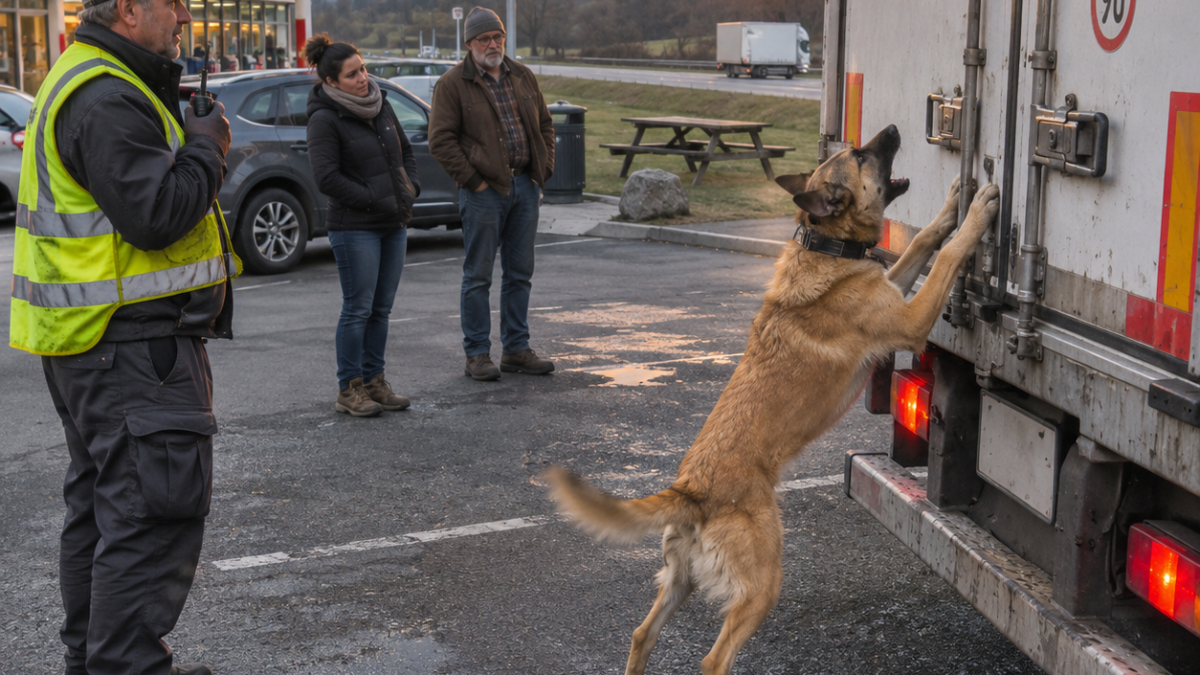
PART 2
Nobody spoke for several seconds.
The traffic behind us had begun moving again under police direction, but the people who had gathered around my truck remained where they were.
Julien kept one hand buried in Rio’s fur.
The officer asked gently, “Who?”
Julien swallowed.
“My brother.”
Rio looked at him when he said the word.
Something in my chest tightened.
“Your brother drives a delivery truck?” I asked.
Julien looked at me.
“Drove.”
One word.
That was all it took.
I stood up slowly.
“I’m sorry.”
Julien nodded, but his attention had already returned to the truck.
“My brother Thomas drove one almost exactly like this.”
He gave a short, painful laugh.
“Same white body. Same rear doors. Even the sound when they close.”
Rio walked toward the bumper again.
Julien called him back.
This time, Rio obeyed, but reluctantly.
“He raised him,” Julien continued. “Rio was technically both of ours, but Thomas was his person.”
Mrs. Laurent put a hand over her mouth.
I suddenly understood why she had recognized the dog.
She must have known the family.
Julien explained that Thomas had lived two streets from her, in a small house he shared with Rio.
Every evening, around six, Rio would hear Thomas’s delivery van before it even turned onto their street.
He would race to the front gate.
Thomas would park.
The rear doors would open.
Sometimes he would take out an empty tote or paperwork before coming inside.
Rio had built a ritual around it.
Truck.
Doors.
Thomas.
Home.
“He waited at that gate every night,” Julien said.
I looked at Rio.
“How long ago did your brother…”
“Eight months.”
His voice tightened.
“He died in a crash.”
The words landed heavily.
Rio sat beside him.
“He never came home that night,” Julien continued. “Rio waited until after midnight. The neighbors said he kept running to the gate every time a vehicle passed.”
Mrs. Laurent looked down.
“I remember.”
Julien rubbed Rio’s neck.
“When I brought him to my place afterward, he kept listening for delivery trucks. For weeks he would run to the window every time one stopped nearby.”
He looked at my vehicle.
“I thought he’d stopped.”
I stared at the dog who had nearly climbed through my rear doors.
“He didn’t.”
“No.”
The officer asked, “How did he get here?”
Julien looked embarrassed.
“I don’t know yet. My side gate was open when I woke up. I thought I’d latched it last night.”
Mrs. Laurent said, “Maybe he heard the truck from your street.”
Julien shook his head.
“I live more than a mile from here.”
I looked at Rio.
A mile.
Through morning traffic.
Following a truck because he believed a dead man might be inside.
I had spent thirty years making deliveries.
Until that morning, a truck had always been exactly that to me.
A machine.
A route.
A schedule.
For Rio, mine had been a promise.
The officer helped Julien secure a temporary leash from the patrol car.
As people began returning to their vehicles, I closed my rear doors.
The metal latch slammed.
Rio flinched.
Then he looked at them again.
Julien noticed.
“So that’s it,” he murmured.
“What?”
“That sound.”
I looked at him.
“What about it?”
“Thomas’s van sounded exactly like that.”
For reasons I still can’t explain, I looked at the fleet number printed near my bumper.
218.
Then something old and half-forgotten moved in my memory.
I had not always driven 218.
Six months earlier, the company had reassigned trucks after a fleet reshuffle.
Before that, I had spent nearly three years driving truck 206.
There had also been 211.
214.
218.
Thomas.
I looked at Julien.
“What company did your brother work for?”
“Loire Transit Services.”
My stomach dropped.
The name printed on my employment papers.
The same subcontractor paying my wages.
I stared at him.
“Thomas what?”
“Thomas Delorme.”
For one second, the noise of the road disappeared.
I knew that name.
Not well.
But I knew it.
Drivers in large delivery networks don’t always meet each other often. We work different shifts, different zones, different depots.
But we know names.
Especially after someone dies.
“Thomas Delorme drove for us.”
Julien’s eyes narrowed.
“You knew him?”
“I don’t think I ever met him properly.”
Then I remembered a face from a morning briefing.
Dark hair.
Lean build.
Always carrying coffee.
Maybe twice.
Maybe three times.
“I remember him.”
Julien stared at me.
“You work for Loire Transit?”
“Yes.”
Something changed in him.
Not anger exactly.
Caution.
He took a half step backward.
Rio stayed between us.
I understood immediately.
Whatever had happened after Thomas’s death, Julien did not trust the company.
I raised both hands slightly.
“I’m just a driver.”
“I know.”
But his expression said something different.
I asked, “Which truck did Thomas drive?”
Julien looked toward my rear doors.
“I don’t know the number.”
Mrs. Laurent spoke.
“I remember fourteen.”
We both turned toward her.
“What?” Julien asked.
“There was a number on the back. I used to see it when he parked. Two-one-four, maybe.”
My mouth went dry.
214.
I remembered that truck.
Everybody at the depot remembered 214.
Not because of Thomas.
Because of the brakes.
I said nothing.
Not yet.
Julien looked at me.
“What is it?”
“Nothing.”
His eyes sharpened.
“That wasn’t nothing.”
I should have lied.
My job would have been safer if I had.
Instead, I asked, “What did the police say caused your brother’s crash?”
Julien went completely still.
“Why?”
“Just tell me.”
He hesitated.
“They said he entered a curve too fast during heavy rain.”
“And the company?”
“Same thing. Driver error.”
Rio leaned against his leg.
Julien’s voice hardened.
“They said Thomas was behind schedule and probably speeding.”
I stared at the pavement.
Behind schedule.
Speeding.
Driver error.
I had heard those words before.
Not about Thomas.
About every driver who complained about impossible routes.
“Bernard?” one of the police officers called.
I looked over.
Traffic was moving.
They wanted my truck gone.
I nodded.
“One minute.”
Then I turned to Julien.
“Do you still have the phone your brother used?”
Julien frowned.
“Yes.”
“Messages?”
“Some.”
“Work messages?”
“I don’t know.”
He stared at me.
“Why?”
I glanced toward the police officers, then toward the company logo printed small on my cab door.
“I think you and I need to talk somewhere that isn’t the side of a road.”
His face changed.
“What do you know?”
I lowered my voice.
“Maybe nothing.”
“That’s not an answer.”
“No.”
I looked back at Rio.
The dog was staring at my truck again.
Then I said something I would think about many times afterward.
“But I remember truck 214.”
Julien’s hand tightened on the leash.
“What about it?”
I heard the police officer call my name again.
I stepped toward my cab.
“The brakes.”
Julien followed me two steps.
“What about the brakes?”
I opened the door.
“There were complaints.”
He went pale.
“What complaints?”
“I can’t do this here.”
“You just told me my dead brother’s truck had brake complaints.”
“I said I remember complaints. I don’t know if they were before his accident or after. I don’t know whether it was even the same mechanical problem.”
“Then why mention it?”
Because Rio had spent eight months waiting for Thomas.
Because I suddenly remembered a driver in the break room saying truck 214 pulled left under braking.
Because I remembered a mechanic swearing at management after a service request had been delayed.
Because three years of small details were suddenly arranging themselves into a shape I didn’t like.
I pulled an old delivery receipt from my cab and wrote my phone number on the back.
I handed it to Julien.
“Call me tonight.”
He stared at the paper.
“Why tonight?”
“Because I need to check something first.”
His eyes never left mine.
“Are you going to warn your company?”
“No.”
That was the moment I crossed a line.
I knew it.
Maybe Julien knew it too.
I climbed into my truck.
Rio tugged once toward the back doors.
Julien held him.
“Come on, buddy.”
I started the engine.
Rio’s ears lifted.
For half a second, I felt guilty for driving away.
Then Julien knelt beside him.
I watched them through the mirror.
Rio stared after my truck until I turned at the roundabout and lost sight of them.
I finished my route three hours late.
My dispatcher, Alain, was furious.
“You blocked half the business district because of a dog?”
“I didn’t ask the dog to stop my truck.”
“You should have moved.”
“There were police.”
“Customers are complaining.”
I stared at him through the office window.
Behind him was a whiteboard full of route times.
Red numbers.
Green numbers.
Performance percentages.
Drivers reduced to minutes.
“You remember Thomas Delorme?” I asked.
The irritation vanished from Alain’s face.
Not slowly.
Instantly.
That told me more than I wanted it to.
“Why?”
“Dog this morning belonged to him.”
Alain looked at me for a long second.
“So?”
“So nothing.”
He leaned back.
“What are you asking, Bernard?”
“I’m asking if you remember him.”
“Of course I remember him. A driver died. It was awful.”
“What truck?”
His expression tightened.
“You know what truck.”
“214?”
Silence.
I nodded.
“Thought so.”
Alain stood.
“Where is this coming from?”
“Did 214 have brake problems?”
“No.”
Too fast.
He answered too fast.
I watched him.
“Never?”
“Old vans have maintenance issues. That doesn’t mean—”
“So there were issues.”
“I didn’t say that.”
“Yes, you did.”
He stepped around the desk.
“Bernard, listen to me. The police investigated that accident.”
“I know.”
“The insurer investigated it.”
“I know.”
“Thomas was speeding.”
“Were you there?”
His jaw tightened.
“We had telemetry.”
“Then why are you nervous?”
His face hardened.
“I’m not.”
But he was.
I had known Alain eleven years.
I had seen him furious.
Tired.
Drunk at Christmas dinners.
Panicked during strikes.
That afternoon, for the first time, I saw fear.
He lowered his voice.
“Do yourself a favor. Forget whatever idea you’re building.”
“I haven’t built anything.”
“Good.”
He walked toward the door.
“Keep it that way.”
I waited until he left.
Then I went to my locker.
I had an old phone there.
Cracked screen.
Barely worked.
I used to keep it for music during routes.
Years earlier, our drivers had a private group chat.
Before management created the official messaging system, we shared traffic alerts, depot complaints, jokes, photos of broken loading equipment.
Most of us stopped using it.
I hadn’t opened the chat in almost a year.
I charged the phone.
The screen flickered.
I searched.
214.
Dozens of old messages appeared.
Most were meaningless.
“214 back at dock.”
“Who has keys to 214?”
“214 needs fuel.”
Then I found one.
Three weeks before Thomas died.
**Thomas D.: 214 brake pedal soft again. Told workshop.**
My stomach tightened.
Below it:
**Michel: Same yesterday?**
**Thomas D.: Worse downhill.**
Then another driver:
**Bernard: Don’t take it if unsafe.**
I stared.
My own message.
I had forgotten.
Thomas replied:
**Thomas D.: Tell that to Alain. Route has to go.**
I stopped breathing for a second.
I kept scrolling.
Two weeks before the crash:
**Thomas D.: 214 pulling right when loaded. Workshop says parts next week.**
Another message from a driver named Karim:
**They’re still sending you out in that thing?**
Thomas:
**Apparently customers need shampoo more than I need brakes.**
A laughing emoji followed.
That made it worse.
People joke about things they are afraid to say seriously.
I took screenshots.
Then I found a message dated four days before the crash.
A voice note.
Eleven seconds.
I pressed play.
Thomas’s voice came through the tiny speaker.
“If I end up in a field one day, tell them I asked twice about these damn brakes.”
He laughed at the end.
Just a joke.
A tired driver making a dark joke.
Except Thomas had ended up in a field.
I sat on the bench beside my locker.
For a long time, I didn’t move.
At six-thirty, my phone rang.
Unknown number.
“Hello?”
“It’s Julien.”
I closed my eyes.
“I found something.”
Silence.
Then:
“About Thomas?”
“Yes.”
“Tell me.”
“Not over the phone.”
“Bernard—”
“Julien, listen to me. I have messages from your brother.”
He stopped breathing.
At least that was what it sounded like.
“What messages?”
“About truck 214.”
His voice broke slightly.
“What did he say?”
I looked at the closed office door.
“He complained about the brakes.”
Nothing.
Then I heard Julien whisper, “I knew it.”
We met that evening at a small café away from the depot.
Rio came with him.
The moment he saw me, his ears lifted.
I wondered whether he recognized my scent from the road.
Or the truck.
He stayed close to Julien.
I placed my old phone on the table.
“I want you to understand something before you see this.”
Julien’s eyes never left the phone.
“What?”
“I don’t know if these messages prove what caused the crash.”
He nodded impatiently.
“I know.”
“They prove he complained.”
“Show me.”
I handed him the phone.
He read.
His face changed line by line.
When he reached the voice message, he stopped.
His thumb hovered above it.
“That’s him?”
“Yes.”
Julien pressed play.
Thomas’s voice filled the small space between us.
“If I end up in a field one day, tell them I asked twice about these damn brakes.”
The laugh.
Julien covered his mouth.
He turned away.
Rio stood instantly.
He placed his head against Julien’s thigh.
Julien bent down and pressed his forehead against Rio’s.
“I’m sorry.”
I looked away.
After a while, Julien sat up.
He wiped his eyes.
“The company told us he never reported a mechanical problem.”
I felt something cold move through me.
“What?”
“They said maintenance records showed the truck had passed inspection.”
“You have that in writing?”
“Yes.”
“Who told you?”
“The regional manager.”
“What name?”
Julien’s jaw tightened.
“Gérard Vannier.”
I knew Gérard.
Everyone did.
He visited the depot once a month.
Expensive coat.
Polished shoes.
Talked about “operational discipline.”
Never loaded a truck in his life.
Julien continued.
“My mother asked whether Thomas had complained about the van because he’d mentioned something to her. They said no. They told us he had probably been trying to make up time.”
“Did Thomas say anything else to you?”
Julien stared at the table.
“A week before he died, he said he was sick of being sent out in junk.”
My stomach turned.
“He specifically mentioned brakes?”
“I don’t remember.”
He looked furious with himself.
“We were having dinner. I wasn’t paying attention.”
“That isn’t your fault.”
“I should have.”
“No.”
He looked at me.
“You don’t understand.”
“I understand more than you think.”
I leaned forward.
“We complain all the time. Tires. brakes. route times. scanners. doors. You hear it so often that you stop hearing it.”
Julien looked down at Rio.
“Thomas didn’t get to stop hearing it.”
“No.”
That night became the beginning of something neither of us had planned.
At first, Julien wanted to go straight to the police.
I agreed.
But I told him we should preserve everything properly first.
He contacted the lawyer who had handled the family’s insurance dispute.
The lawyer listened to the voice message twice.
Then said:
“Do not contact the company.”
Too late for me.
I had already asked Alain.
The lawyer’s expression darkened when I admitted it.
“Did he know you had the messages?”
“No.”
“Keep it that way.”
We copied the entire chat history.
Not just Thomas’s messages.
Context mattered.
Dates.
Replies.
Other drivers.
A week later, police interviewed me.
Then the labor inspector.
Then an accident investigator who had worked on Thomas’s original case.
That man looked embarrassed when he read the messages.
“We requested maintenance documentation,” he said.
“What did the company provide?”
“Records indicating brake inspection twelve days before the crash.”
Julien sat beside me.
“Then somebody lied.”
The investigator didn’t answer.
He didn’t need to.
The case was reopened.
That was when things became ugly.
Two days later, I arrived at work and discovered my route had been removed.
Alain called me into the office.
“Administrative leave.”
“For what?”
“Performance issues.”
I laughed.
“You’re serious?”
“Repeated late deliveries.”
“After thirty years?”
“Recent incidents.”
“The dog?”
“Among others.”
I leaned over the desk.
“You’re suspending me because I spoke to police.”
His eyes flashed.
“Nobody said that.”
“You didn’t have to.”
“Be careful, Bernard.”
I stood up straight.
“There it is again.”
“What?”
“You telling drivers to be careful.”
He looked at me.
I thought of Thomas’s voice.
*Tell them I asked twice.*
“You should’ve been more careful with 214.”
Alain went white.
“You need to leave.”
I did.
But not quietly.
Outside, six drivers were waiting.
Karim was one of them.
He had been in the old chat.
He looked at me.
“They suspended you?”
“Yes.”
“For the Thomas thing?”
“They called it performance.”
Karim laughed bitterly.
“Of course.”
Another driver, Sophie, stepped closer.
“I still have photos.”
I turned.
“What photos?”
“214.”
My heartbeat quickened.
“When?”
“Maybe two months before the crash. Brake warning light.”
“Why did you photograph it?”
“Because workshop kept resetting the dashboard.”
Every driver went silent.
Sophie pulled out her phone.
She searched.
Then showed me.
A dashboard.
Warning light glowing.
Fleet tag visible.
214.
Date metadata still attached.
Julien’s lawyer nearly shouted when I called him.
Within days, more drivers came forward.
Once the first person speaks, silence becomes harder for everyone else.
Karim had an email.
Michel had a screenshot from a maintenance request.
Another driver remembered refusing 214 after it shuddered under braking.
Then a mechanic named Lucas called me at night.
“I heard what’s happening.”
“Who gave you my number?”
“Doesn’t matter.”
“What do you know?”
Silence.
Then he said:
“Everything.”
We met in a supermarket parking lot.
Lucas looked terrified.
He had worked at the fleet workshop when Thomas died.
“I didn’t touch his inspection,” he said immediately.
“I’m not accusing you.”
“You don’t understand.”
He looked around before continuing.
“The company delayed repairs constantly. Parts cost money. Taking vans off road cost money. We’d write defects. Supervisors would mark vehicles usable pending repair.”
“Was 214 one of them?”
“Yes.”
My mouth went dry.
“The brakes?”
“Yes.”
“Before Thomas died?”
Lucas looked at me.
“Three times.”
I closed my eyes.
“Do you have proof?”
He swallowed.
“I might.”
“Might?”
“Workshop records were digital. But I used to photograph handwritten job sheets because management kept changing priorities and blaming us.”
“Do you still have them?”
He nodded.
“Why didn’t you come forward?”
That question hurt him.
I saw it immediately.
“Because I was scared.”
He looked down.
“I had two kids. Mortgage. They told us police already had the official records. I convinced myself the issue couldn’t have caused the crash.”
I thought about how easy it is to judge fear when you aren’t the one paying its price.
“What changed?”
Lucas looked at me.
“I heard Thomas’s brother was asking questions.”
Then he added quietly:
“And I heard his dog stopped your truck.”
I almost laughed.
Not because it was funny.
Because somehow Rio had started something none of us had been brave enough to start ourselves.
Lucas gave investigators copies of the job sheets.
One entry was dated seventeen days before Thomas’s crash.
**Vehicle 214: brake fluid pressure irregular, inspect master cylinder, rear pads below recommended threshold.**
Status:
**Deferred—vehicle required for route.**
Another entry six days later.
**Driver reports pedal fade after extended urban route.**
Status:
**Tested—monitor.**
Then three days before Thomas died:
**Return for repair ASAP.**
But the truck had gone out.
Thomas drove it.
The crash happened in rain on a descending curve outside Tours.
The original report concluded excessive speed.
But when investigators reconstructed the event with the new evidence, the picture changed.
Thomas had been traveling slightly above the posted limit.
Not wildly.
Not recklessly.
The telemetry showed he pressed the brake pedal before the curve.
The vehicle did not slow as expected.
That detail had been interpreted as late braking.
Now it looked different.
The prosecutor opened a formal investigation into falsification of maintenance records and possible criminal negligence.
Gérard Vannier’s name appeared everywhere.
Approval chains.
Emails.
Budget reductions.
Messages telling depot managers to avoid “unnecessary downtime.”
One email became central.
Alain had sent Gérard a list of seven trucks requiring urgent maintenance.
214 was on it.
Gérard replied:
**Keep fleet active through end of month. Noncritical repairs can wait.**
Thomas died five days later.
Julien read that sentence in his lawyer’s office.
Then he stood up and walked outside.
I followed him.
Rio was waiting with Mrs. Laurent beneath a tree.
Julien took the leash.
He didn’t speak.
We walked for almost ten minutes.
Finally he said:
“Five days.”
I nodded.
“They chose five days of deliveries.”
I said nothing.
“They chose packages.”
His voice began shaking.
“Boxes.”
I thought of my truck.
Of Rio clawing at the doors.
Julien stopped.
“They chose boxes over him.”
“No.”
He turned sharply.
“What?”
“Don’t give them that.”
His eyes narrowed.
“What are you talking about?”
“They didn’t choose boxes.”
I pointed toward the office building behind us.
“They chose money. Their decision. Their responsibility. Don’t make it sound like some accident of business.”
Julien looked at me.
“You’re angry.”
“Yes.”
“You barely knew Thomas.”
“No.”
I looked at Rio.
“But I know drivers.”
For three decades, I had watched men and women eat lunch behind steering wheels because routes were too tight.
Drive with back pain.
Ignore warning lights because dispatch said finish first.
Miss birthdays.
Funerals.
Doctor appointments.
And whenever something went wrong, the first question was always the same.
What did the driver do?
Not what did management ignore?
Not what did the schedule demand?
The driver.
Always the driver.
Julien rubbed his face.
“I want Gérard to feel what we felt.”
There it was.
The thing he had never said aloud.
Revenge.
I understood it.
Maybe too well.
“I want him to lose sleep,” Julien continued. “I want him afraid every time his phone rings. I want him to know what it’s like when someone tells you your family is gone because of a decision you didn’t make.”
I let him speak.
Then I said:
“He probably will.”
Julien looked at me.
“But not because you hurt him.”
His jaw tightened.
“Because everything he hid is coming back.”
Rio sat between us.
I looked at him.
“Your dog chased the right truck.”
For the first time in weeks, Julien smiled.
Barely.
“He chased the wrong truck.”
“No.”
I shook my head.
“He found me.”
The company tried to fight.
First they denied everything.
Then they claimed workshop notes were preliminary.
Then they said Thomas had known about the vehicle condition and should have refused to drive.
That argument nearly destroyed Julien.
“He complained and they still blame him?”
His lawyer answered:
“That is why we keep going.”
Then something happened none of us expected.
Alain asked to meet me.
He chose a roadside restaurant twenty miles away.
When I arrived, he looked ten years older.
“I’m not here to fight.”
“Good.”
He slid a folder across the table.
“What’s this?”
“Copies.”
“Of?”
“Dispatch logs.”
I didn’t touch them.
“Why?”
He looked at his coffee.
“Because I’m done.”
I waited.
Alain’s voice became low.
“Thomas refused 214 the morning before the crash.”
My stomach tightened.
“What?”
“He told me the pedal felt wrong.”
“And?”
“I told him workshop had cleared it.”
“Had they?”
Alain closed his eyes.
“Not exactly.”
Anger rose so quickly that I stood.
“You sent him out.”
“Bernard—”
“You sent him out!”
People turned toward us.
Alain didn’t defend himself.
That made me angrier.
“He had a route,” Alain whispered.
I stared at him.
“A route?”
“I had Gérard calling every hour about completion numbers. We were short three vans.”
“So you gave Thomas the keys.”
“Yes.”
I wanted to hit him.
I truly did.
For one dangerous second, I understood exactly what Julien meant when he said he wanted someone else to feel pain.
Then I saw Thomas in my mind.
Not really Thomas.
The voice message.
*Tell them I asked twice.*
I sat down.
“Why are you telling me now?”
Alain looked broken.
“Because I lied.”
“To police?”
“Yes.”
My stomach turned.
“What did you say?”
“That Thomas never refused the vehicle.”
I stared.
“Why?”
“Gérard told me if I admitted we knowingly dispatched it, I’d be personally responsible.”
“You were personally responsible.”
“I know.”
Silence.
He pushed the folder toward me.
“These logs show Thomas was reassigned to another truck for half a day after complaining. Then 214 went back into service.”
I looked at him.
“You’re giving this to investigators.”
“Yes.”
“Not me.”
“I wanted you to know first.”
“Why?”
His eyes filled with tears.
“Because I heard the dog story.”
I almost laughed again at the absurdity of it.
Rio.
Always Rio.
Alain stared down.
“I keep thinking about that animal waiting eight months.”
He swallowed.
“And I keep thinking Thomas warned me.”
For the first time, I saw no manager.
Just a frightened man who had made a terrible choice and spent months pretending it belonged to someone else.
“You should tell Julien yourself.”
Alain went pale.
“I can’t.”
“Yes, you can.”
“He’ll hate me.”
“Yes.”
That answer surprised him.
I leaned forward.
“He gets to.”
Alain looked away.
“But if you’re serious about telling the truth, then you don’t get to choose which consequences are comfortable.”
Three days later, Alain sat across from Julien.
I was there.
So was Julien’s lawyer.
Alain told him everything.
Thomas’s complaint.
The reassignment.
Gérard’s pressure.
The decision to send 214 out.
The lie afterward.
Julien listened without interrupting.
When Alain finished, the room was silent.
Then Julien asked:
“Was my brother afraid?”
Alain looked confused.
“What?”
“That morning. Was he afraid to drive it?”
Alain’s face collapsed.
“He was angry.”
Julien nodded.
“That sounds like him.”
Alain wiped his eyes.
“He said, ‘If this thing kills me, tell my brother I was right.’”
Julien’s lips parted.
No sound came out.
I stared at Alain.
“You never mentioned that.”
“I couldn’t.”
Julien stood.
For a second, I thought he might attack him.
Instead, he walked to the window.
His shoulders shook.
Rio was not there that day.
I wished he had been.
Eventually Julien turned around.
“I don’t forgive you.”
Alain nodded.
“I know.”
“I may never forgive you.”
“I know.”
“But you’re going to tell the police exactly what you told me.”
“Yes.”
“And you’re going to testify.”
“Yes.”
Julien stared at him.
“Then do one useful thing with the rest of this.”
Alain cried openly.
“I will.”
That was the closest thing to mercy Julien could offer.
The criminal case took more than a year.
During that year, my life changed too.
The company fired me.
Officially, they called it restructuring.
My lawyer called it retaliation.
We fought.
Eventually, I received a settlement.
Not enough to make me rich.
Enough to let me stop working for people who thought a route was more important than a person.
I joined a small courier cooperative operated by former drivers.
We owned fewer trucks.
Routes were shorter.
If a warning light came on, the truck stopped.
The first time our manager said, “No package is worth a driver,” I nearly laughed.
Such a simple sentence.
It shouldn’t have sounded revolutionary.
Julien and I became friends.
Not the kind who spoke every day.
The kind connected by something neither had planned.
Sometimes I visited.
Rio eventually stopped watching every white truck.
But not immediately.
For months, whenever I arrived in a van, he would run to the rear doors.
He never scratched them again.
He simply looked.
Then he looked at me.
I would open them.
Empty cargo space.
Packages.
No Thomas.
Rio would sigh and walk away.
That broke my heart every time.
One afternoon, I said to Julien:
“Maybe I should stop bringing the truck here.”
He shook his head.
“No.”
“Why?”
“He needs to learn.”
“Learn what?”
“That trucks come and go.”
He looked at Rio.
“And not every one has to bring Thomas back.”
The trial began the following spring.
By then investigators had reconstructed the entire chain of decisions.
The prosecution argued that the company knowingly operated a vehicle with unresolved brake defects, falsified or altered maintenance documentation, pressured depot supervisors to keep vans on the road, and later shifted blame onto Thomas.
Gérard Vannier sat behind his lawyers.
For months I had imagined him as some enormous villain.
He wasn’t.
He was ordinary.
Gray suit.
Thin glasses.
Tired face.
That bothered me.
Because terrible decisions are not always made by monsters.
Sometimes they are made by men looking at spreadsheets.
The defense attacked everything.
They said the job sheets lacked context.
They questioned Lucas’s motives.
They argued drivers exaggerated mechanical issues.
They claimed Thomas’s speed remained the primary cause.
Then they played his own voice message.
“If I end up in a field one day, tell them I asked twice about these damn brakes.”
The courtroom changed.
It was only eleven seconds.
But eleven seconds can carry a dead man back into a room.
Julien closed his eyes.
I looked at Gérard.
For the first time, he lowered his head.
Lucas testified.
Sophie testified.
Karim testified.
I testified.
Then Alain.
The defense attorney asked Alain:
“Mr. Moreau, are you telling this court you knowingly dispatched a vehicle you considered unsafe?”
Alain swallowed.
“Yes.”
“Why?”
“Because my superior told me to keep the fleet active.”
“Did Mr. Vannier specifically tell you to send Thomas Delorme out in vehicle 214?”
“No.”
“Then that was your decision.”
Alain looked at Gérard.
“Yes.”
Julien stiffened beside his lawyer.
Then Alain continued.
“But I made that decision inside a system he created.”
The attorney objected.
The judge allowed him to explain.
Alain described the calls.
The route targets.
The maintenance delays.
The threats about bonuses and staffing.
Then the prosecutor showed the email.
**Keep fleet active through end of month. Noncritical repairs can wait.**
“What did ‘noncritical’ mean?” she asked.
Alain gave a bitter smile.
“Whatever kept the truck moving.”
“And vehicle 214?”
“It should not have been moving.”
The courtroom went silent.
Julien testified last.
He did not speak like a lawyer.
He spoke like a brother.
He described Thomas at sixteen, fixing bicycles in their father’s garage.
Thomas adopting Rio as a puppy after finding him through a local rescue.
Thomas teaching Rio to bring back a ball but never teaching him to give it back.
People laughed softly.
Then Julien described the night of the crash.
The phone call.
His mother sitting on the kitchen floor.
Driving to identify Thomas’s belongings.
Rio waiting at the gate.
“When I arrived at my brother’s house after midnight,” Julien said, “Rio was still outside.”
His voice broke.
“He kept looking down the street.”
Nobody moved.
“For weeks afterward, every delivery truck made him run to the window.”
Julien looked toward Gérard.
“Eight months later, he escaped my yard because he heard another white delivery truck. He chased it more than a mile through traffic. He forced it to stop.”
He paused.
“Then he clawed at the back doors because he thought my brother was inside.”
I felt my throat tighten.
Julien continued.
“That dog understood one thing better than the company did.”
Gérard looked up.
“Thomas was supposed to come home.”
No dramatic shouting.
No threats.
Just that sentence.
Thomas was supposed to come home.
The judgment came six weeks later.
The company was found criminally responsible for serious safety failures and falsification of records.
Gérard was convicted on charges connected to the concealment and negligent decisions that contributed to Thomas’s death.
Alain also faced consequences for his role, reduced because of his cooperation and admission.
Financial penalties were severe.
The company lost major contracts.
A victim compensation order was issued to Thomas’s family.
A separate labor ruling found my dismissal retaliatory.
When Julien called me after the verdict, I was sitting in my new cooperative’s tiny office.
“We won,” he said.
I knew what he meant.
Still, I answered:
“No.”
Silence.
Then he understood.
“No,” he said quietly. “We didn’t.”
Because Thomas was still dead.
Justice does not resurrect anyone.
It does not rewind a curve in the rain.
It does not make a truck stop sooner.
It does not erase eight months of a dog waiting for an engine that will never return.
But it does something.
It tells the truth.
And sometimes the truth is the only revenge worth having.
That evening, I went to Julien’s house.
I did not drive the van.
I came in my own car.
Rio met me at the gate.
By then he knew me well.
He wagged his tail, sniffed my coat, then looked toward the street.
Old habits.
Julien opened the door.
“Come in.”
On the table was a photograph of Thomas.
I had seen pictures before, but this one was different.
Thomas sat on the rear bumper of truck 214.
Rio beside him.
The dog looked younger.
Thomas had one arm around his neck.
Both were staring at the camera.
I stood there for a long time.
“That was his favorite picture,” Julien said.
“Where was it taken?”
“End of a summer route.”
I looked at the white truck behind them.
The doors were open.
Now I understood exactly what Rio had seen that morning.
Not my truck.
A memory.
Julien poured coffee.
We sat outside.
Rio lay between us.
After a while, Julien said:
“I used to want Gérard ruined.”
I nodded.
“He is.”
“Not enough.”
I looked at him.
Julien smiled sadly.
“That’s what I thought before the trial.”
“And now?”
He watched Rio.
“Now I think the worst thing that happened to him is that everyone knows.”
I understood.
A man can explain away money.
Convictions.
Lost contracts.
He can call himself unlucky.
Misunderstood.
Targeted.
But the truth followed Gérard now.
Thomas had complained.
The brakes were bad.
They sent him out.
Then they blamed him.
No polished statement could erase that.
Julien leaned back.
“I thought revenge would feel hot.”
“What?”
“Like anger.”
He shook his head.
“It doesn’t.”
“What does it feel like?”
He looked at Rio sleeping in the grass.
“Quiet.”
I smiled.
“Yes.”
Months passed.
Then a year.
Rio changed.
Not dramatically.
Dogs rarely heal in dramatic ways.
One morning, Julien called me laughing.
“You won’t believe this.”
“What?”
“A delivery truck stopped outside.”
I immediately became serious.
“Rio?”
“He looked at it.”
“And?”
“He went back to sleep.”
I said nothing.
Julien laughed again.
“He didn’t even stand up.”
For anyone else, that would have meant nothing.
For us, it meant everything.
A few weeks later, I had a delivery near Julien’s neighborhood.
I called first.
“Mind if I stop by?”
“Only if you bring croissants.”
“Extortion.”
“Yes.”
I arrived in one of our cooperative’s new vans.
White.
Of course.
Apparently every delivery company in France had agreed white was the only possible color.
Rio was lying beside the front step.
He heard the engine.
His head lifted.
I parked.
For a second, he stared at the van.
I waited.
He stood.
Walked toward the gate.
My heart tightened.
Then he saw me.
His tail began wagging.
I got out.
“Hey, Rio.”
He came over.
No rear doors.
No scratching.
No desperate barking.
Just Rio.
I gave him half a dog biscuit I kept in my pocket.
Julien appeared.
“You carry those now?”
“For important customers.”
“You’re becoming soft.”
“I was always soft.”
Rio leaned against my leg.
I looked toward the back of the van.
“You think he remembers?”
Julien followed my gaze.
“Yes.”
“Then how does he do this?”
“Do what?”
“Move on.”
Julien thought for a moment.
“Maybe moving on isn’t forgetting.”
I looked at him.
“Maybe it’s knowing the memory won’t come through the door.”
That stayed with me.
Two years after the morning Rio stopped my truck, Julien invited me to a small ceremony.
The local council and a road-safety organization had installed a memorial plaque near the curve where Thomas died.
Nothing grand.
A tree.
A bench.
A small marker bearing his name.
The transport cooperative donated funds.
So did several former Loire Transit drivers.
Lucas came.
Sophie.
Karim.
Even Alain.
He stood at the edge of the group.
Julien saw him.
For a moment, I wondered what he would do.
Then he nodded.
Just once.
Alain nodded back.
Not forgiveness.
Recognition.
Sometimes that is enough.
Rio came too.
He was on a leash beside Julien.
At one point, he sniffed the base of the tree.
Then sat.
Julien knelt.
“You know who this is for, buddy?”
Rio looked at him.
Julien smiled through tears.
“Yeah.”
He scratched behind Rio’s ears.
“Me too.”
After everyone left, Julien and I remained.
Cars passed along the road.
None of us spoke for a while.
Then a white delivery truck approached.
My whole body tightened without permission.
Rio’s ears lifted.
The truck passed.
Rio watched it.
Then he looked at Julien.
That was all.
No pulling.
No barking.
No chase.
The vehicle disappeared around the curve.
Julien exhaled.
I realized he had been holding his breath too.
“He knows,” I said.
Julien nodded.
“I think so.”
We sat on the bench.
Rio lay at our feet.
A year later, he began slowing down.
Nothing serious at first.
Gray around the muzzle.
Longer naps.
Shorter walks.
He still loved food with unreasonable enthusiasm.
He still hated baths.
He still stole Julien’s socks.
But he was aging.
One winter afternoon, I visited and found him asleep beside the radiator.
Julien smiled.
“He used to sleep by Thomas’s radiator exactly like that.”
I sat down.
“Do you think dogs remember people for their whole lives?”
“Yes.”
He answered without hesitation.
“How can you be sure?”
Julien looked at me.
“You met Rio.”
Fair point.
On the third anniversary of Thomas’s death, Julien found something while cleaning his brother’s old storage boxes.
A small delivery jacket.
Thomas’s.
It still had the company patch.
Julien held it for several days before deciding what to do.
Finally, he brought it into the living room.
Rio was asleep.
Julien placed the jacket on the floor.
Rio opened his eyes.
He lifted his head.
Then froze.
Julien almost removed it.
Rio stood.
Approached slowly.
He sniffed the fabric.
Once.
Twice.
Then his entire body changed.
His tail began moving.
Not wildly.
Slowly.
He lowered himself onto the jacket.
Placed his head on the sleeve.
And closed his eyes.
Julien called me afterward.
He could barely speak.
“I think he remembers the smell.”
I swallowed.
“Probably.”
“I thought it would upset him.”
“Maybe it did.”
“He seems peaceful.”
I looked out my apartment window.
“Those aren’t always opposites.”
Julien kept the jacket.
For years afterward, Rio sometimes slept on it.
The first time I saw him there, I understood something I had missed all along.
That morning on the road, we had all thought Rio was confused.
A dog mistaking one truck for another.
A sad little error.
But maybe that was too simple.
Rio had not forgotten Thomas.
He had refused to accept that a ritual so deeply written into his life could simply end.
White truck.
Rear doors.
Thomas comes home.
For eight months, the world kept breaking that rule.
Then one morning, he heard the right engine sound.
Saw the right shape.
Smelled diesel and cardboard and road dust.
Something inside him said:
This time.
This time he is back.
So Rio ran.
Through an open gate.
Down streets.
Between cars.
Past horns and strangers.
Until he found my truck.
He forced me to stop.
Then he clawed at those doors because hope can look a lot like panic when it has been waiting too long.
And behind those doors, there was nobody.
At least, that is what we thought.
There were packages.
Boxes.
Plastic wrap.
But in another way, Thomas was there.
His old job.
His truck.
His coworkers.
His complaints.
His voice buried inside an abandoned group chat.
The truth everyone had stopped looking for.
Rio did not find Thomas.
He found the trail Thomas had left behind.
And because a dog refused to walk away from an empty delivery truck, people started asking questions again.
Questions led to messages.
Messages led to records.
Records led to witnesses.
Witnesses led to the truth.
And the truth finally made its way home.
Years later, when people asked me why I left my old company, I rarely told the whole story.
It was too long.
Too strange.
Sometimes I simply said:
“A dog changed my route.”
They would laugh.
I would smile.
They had no idea how true it was.
Rio changed my route that morning.
Not just the streets I drove.
My life.
He reminded me that getting home matters more than arriving on time.
That a machine is never worth a person.
That silence can protect the wrong people.
That fear keeps terrible secrets alive.
And that sometimes the one who refuses to let the truth disappear is the one who cannot speak at all.
Rio grew old in Julien’s house.
He slept in sunlight.
He ate too many treats.
He barked at birds.
He carried Thomas’s old jacket from one bed to another until Julien finally gave up trying to keep it clean.
And he stopped chasing delivery trucks.
Completely.
One summer morning, years after our first meeting, I visited Julien and found Rio lying beneath a tree in the garden.
I sat beside him.
His muzzle was almost entirely gray.
“Remember me?”
His tail moved against the grass.
I laughed.
“Good.”
Julien brought coffee.
We sat there quietly.
A delivery van stopped three houses away.
Doors opened.
Metal slammed.
Rio’s ears moved.
Nothing more.
He stayed beside us.
I rested my hand gently on his back.
For a second, I remembered the dog attacking my truck doors with everything he had.
The desperation.
The barking.
Those trembling legs.
I looked at him now.
Peaceful.
Safe.
Julien followed my gaze.
“He finally stopped waiting.”
I shook my head.
“I don’t think so.”
Julien looked at me.
“What do you mean?”
I looked at the old dog.
“I think he just learned Thomas wasn’t coming back in a truck.”
Julien’s eyes filled.
After a moment, he smiled.
“Yeah.”
He touched Rio’s head.
“He’s already here.”
I looked toward the house.
Thomas’s photograph still stood near the window.
Rio and Thomas.
Rear bumper.
Open doors.
A happy dog.
A tired driver.
A moment before any of us knew how important ordinary evenings could become.
Julien sat beside Rio.
The dog placed his chin on his shoe.
A breeze moved through the garden.
Somewhere farther down the street, another truck started its engine.
Rio didn’t move.
And for the first time since I had known him, that sound no longer seemed like a question.
The men who had tried to bury Thomas’s warnings lost their jobs, their contracts, their reputations, and eventually the lie they had built around his death.
Julien never needed to threaten them.
He never needed to hurt anyone.
Thomas’s own words did the damage.
The maintenance sheets did the damage.
The truth did the damage.
That was the revenge.
Not cruelty returned with cruelty.
Accountability.
A dead man’s name cleared.
A family finally told that their son and brother had not simply been reckless.
And a dog who had waited longer than anyone realized finally allowed to stop searching every white truck for the person he loved.
I sometimes think about how close we came to missing all of it.
If I had driven five seconds faster, Rio might not have reached my truck.
If I had refused to open the doors, Mrs. Laurent might have walked away.
If she had not recognized him, Julien would not have arrived.
If Julien had not mentioned Thomas’s job, I might never have remembered 214.
If my old phone had been thrown away, Thomas’s voice might have remained buried forever.
One dog.
One truck.
One morning.
That was all it took.
And whenever someone tells me animals don’t understand loss the way people do, I think of Rio standing beneath my rear doors, looking into an empty cargo bay and refusing to believe the person he loved was gone.
Maybe he did not understand death the way we do.
Maybe he understood something simpler.
Someone who always came home had stopped coming home.
And Rio wanted an answer.
In the end, he found one for all of us.








