A Bleeding Dog Kept Chasing White Vans Outside My Bakery—Then My Security Camera Showed Who Left Him There
[TITLE]
A Bleeding Dog Kept Chasing White Vans Outside My Bakery—Then My Security Camera Showed Who Left Him There
[FACEBOOK OPENING — 700–800 WORDS]
The dog was bleeding onto the sidewalk outside my bakery, yet every time a white delivery van slowed down, he dragged himself toward traffic as if getting hit mattered less than missing whoever he was waiting for.
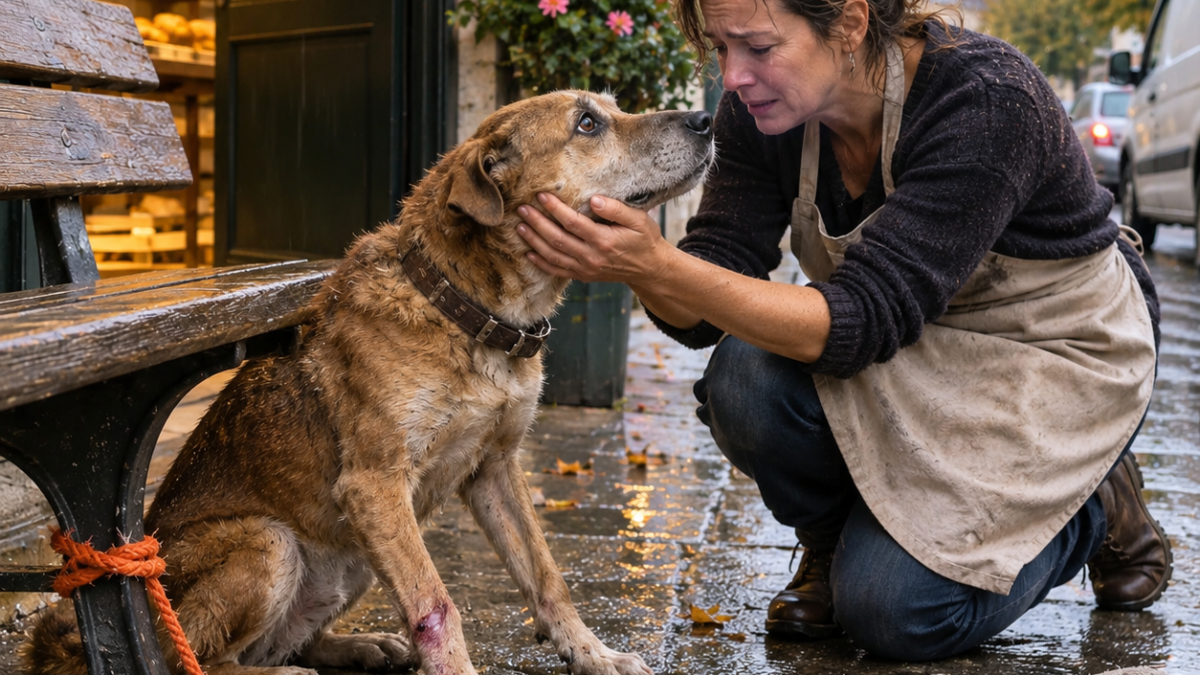
An orange rope was still knotted around the leg of the bench where he had spent the night, but the other end had been chewed through so completely that I realized he had been free for hours and had chosen not to leave.
When I finally opened the security footage from the night before, I saw one small detail on the van that turned a heartbreaking mystery into something far more personal.
My name is Élise, and I run a small bakery in a town in Loir-et-Cher. For eight years, I’ve unlocked the front door before six every morning, which means I know the usual delivery vans, the early commuters, and the regulars who want their baguettes before sunrise.
That Monday in November, somebody else was waiting for me.
Léa, my apprentice, spotted him first.
“Élise, come outside. Now.”
A medium-sized tan dog was curled beneath the wooden bench under our awning. His muzzle was going gray, and cold rain had darkened his fur. When he tried to stand, his front legs trembled.
“Don’t scare him,” I said.
“I’m not worried about scaring him. I’m worried he’s going to get killed.”
As if to prove her point, a white utility van slowed near the crosswalk.
The dog shot up.
He limped toward the curb so fast I barely caught his collar.
“Hey! No.”
He fought me for two seconds, then sagged against my knees.
Léa stared at the road. “He’s done that with every white van since I got here.”
I brought water and pieces of chicken. He drank, but he ignored the food.
That was when I saw the rope.
Bright orange. Thick enough for a medium dog. One end was wrapped several times around the metal foot of the bench. The other ended in wet, shredded fibers.
There were dark marks on the paving stones. At first I thought they were mud.
Then I saw his paws.
Two pads were raw. One nail was split. The skin beneath his old brown collar had been rubbed nearly bloody.
Someone had tied him there.
And he had fought hard enough to get loose.
“Call the vet,” I told Léa.
The dog had no tag and no number on his collar. When I tried to slip a leash over his head, he backed away, but another engine sounded at the end of the street and he immediately turned toward it.
A white van.
Again.
I blocked him with my body.
“Whatever you think is coming back, it isn’t worth dying for.”
He looked straight past me.
With Léa’s help, I wrapped him in a blanket and got him into my car.
At the clinic, the veterinarian cleaned his paws, treated the wound around his neck, and checked his irritated gums.
“He chewed through something for a long time,” he said.
“The rope outside my shop.”
“That would explain the gums.”
He scanned the dog twice.
No microchip.
No identification.
“How long was he tied there?”
“I don’t know.”
The vet looked at the injuries. “Long enough.”
A local animal welfare association agreed to help with the legal steps while I fostered him temporarily. I live above the bakery, so that afternoon I made a bed in my apartment.
He ate a few bites, drank, then went directly to the door.
I assumed he needed outside.
Instead, the moment a delivery van stopped below, he began whining.
That sound stayed with me all evening.
Around nine, I remembered the security camera above the bakery entrance.
It covered the bench.
I opened my laptop and went back through Sunday night.
At 8:53 p.m., a white utility van pulled up.
A man stepped out.
The dog followed him willingly, tail moving.
The man tied the orange rope to the bench, crouched, and stroked the dog’s head.
The dog rose on his hind legs and pressed his muzzle against the man’s face.
Then the man stood, got into the van, and drove away.
The dog lunged after him.
The rope snapped him backward.
For more than an hour, he pulled, twisted, and chewed.
At 10:14 p.m., the rope finally broke.
He was free.
But he didn’t run for shelter.
He didn’t leave the block.
He climbed back under the bench and waited for the van to return.
My hands were shaking when I rewound the footage.
This time I paused on the rear doors just before the vehicle disappeared.
Under the dirt, three faded blue letters were visible on the panel.
I knew those letters.
And I knew exactly where I had seen that van before.
[END OF FACEBOOK OPENING]
[FULL STORY CONTINUATION]
They belonged to VLM Dépannage, a small plumbing and heating company based less than four miles from my bakery.
I knew the company because their vans were everywhere in our town.
But I knew that particular van for another reason.
There was a long dent beneath the right rear light.
I had seen it parked outside my shop dozens of times.
And I knew the man who drove it.
His name was Jérôme Valette.
He wasn’t a friend.
But he was the kind of customer you recognize without ever knowing much about his life.
Forty-something. Broad shoulders. Dark hair going gray at the temples. Usually work pants with paint or plaster on the knees. Double espresso. One pain au chocolat.
He came in several mornings a week.
Sometimes he joked with Léa.
Sometimes he complained about clients who expected miracles from tradesmen.
Once, when my water heater failed in January, I had even called VLM.
Jérôme was the technician who came.
He had stood in my apartment.
Drunk coffee at my kitchen table.
And now I was staring at a security video of him tying an injured-looking dog to my bakery bench and driving away.
I replayed the recording.
Maybe I was wrong.
Maybe the dent was common.
Maybe the letters belonged to a different company.
Then Jérôme turned toward the camera for half a second before climbing into the van.
The image wasn’t perfect.
But it was him.
I sat back.
The dog was lying three feet from me on the kitchen floor.
His head came up at the sound of the video.
On the laptop, Jérôme slammed the van door.
The dog stood.
He stared at the speakers.
Then he started whining.
I shut the laptop immediately.
“Oh, God.”
He limped toward the door.
I crouched beside him.
“You still think he’s coming back.”
The dog put his nose against the wood.
I didn’t sleep much that night.
At five the next morning, I called Nora, the woman from the animal welfare association.
“I know who left him.”
“Are you certain?”
“I have video.”
There was a pause.
“Do not contact him.”
“I wasn’t planning to.”
That was a lie.
I had spent most of the night imagining exactly what I would say if Jérôme walked into my bakery.
Nora continued.
“Save the original recording. Make copies. Don’t edit it. Don’t post his name.”
“I’m not interested in internet justice.”
“Good.”
“I’m interested in him looking me in the face and explaining why that dog spent the night bleeding outside my shop.”
“That part may have to wait.”
She told me to make a formal report and bring the footage.
The dog stayed upstairs with the blinds partly closed while Léa and I opened the bakery.
At 6:42, the first VLM van passed.
Not Jérôme’s.
The dog heard it anyway.
His nails scraped across the floor above us.
Léa looked at the ceiling.
“He’s doing it again.”
“I know.”
“Have you named him?”
“No.”
“We can’t keep calling him ‘the dog.’”
“He has a name somewhere.”
“Maybe whoever abandoned him doesn’t deserve to pick it anymore.”
I looked at her.
“You’re twenty. You’re supposed to be less angry than me.”
“I’m efficient.”
Despite myself, I smiled.
At eight, Nora arrived and took copies of the veterinary report and footage.
At nine-thirty, I went to the local gendarmerie.
The officer who spoke to me, Adjudant Morel, watched the video without saying anything.
When the rope broke, he leaned closer.
When the dog returned to the bench instead of leaving, Morel’s jaw tightened.
“Can you identify the man?”
“I believe it’s Jérôme Valette from VLM Dépannage.”
“Believe or know?”
“I know him as a customer.”
He paused on the frame.
“Vehicle registration isn’t readable here.”
“The pharmacy across the street has a camera pointed toward the road.”
Morel looked at me.
“You’ve thought about this.”
“I’ve had a long night.”
He wrote down the pharmacy’s name.
“Do not confront him.”
“Everyone keeps telling me that.”
“For good reason.”
“What happens now?”
“We verify the vehicle. We identify the animal if possible. We contact the person.”
“And the dog?”
“For now, follow the association’s instructions.”
“He can’t go back to the man.”
Morel closed the file.
“That is not your decision.”
I hated hearing it.
He saw that.
“But the video matters,” he added. “So does the veterinary report.”
I left unsatisfied.
I wanted something immediate.
A knock on Jérôme’s door.
A demand for answers.
A punishment.
Instead, I got paperwork.
Real life has terrible pacing.
When I returned to the bakery, Léa met me by the ovens.
“You have a visitor.”
My stomach tightened.
“Who?”
She looked toward the front.
“Jérôme.”
For one second, I thought she was joking.
Then I saw him through the service window.
He stood beside the counter, hands in his jacket pockets.
The same man from the recording.
The same man who had crouched to pet a dog before leaving him tied in the rain.
I wiped flour from my hands and walked out.
“Morning, Élise.”
“Jérôme.”
His eyes moved around the shop.
“Usual?”
“No.”
That was the first strange thing.
Jérôme always ordered before saying anything else.
He leaned toward the counter.
“I heard you found a dog yesterday.”
My pulse jumped.
“News travels.”
“Small town.”
“Yes.”
“What kind?”
I stared at him.
“You tell me.”
His expression changed for less than a second.
Then he smiled.
“What’s that supposed to mean?”
“It means you came in asking about a dog you haven’t described.”
“I saw somebody mention it.”
“Where?”
He hesitated.
“A client.”
“Which client?”
His smile disappeared.
“Why are you interrogating me?”
I kept both hands flat on the counter because I wanted to point toward the door and tell him exactly what I thought of him.
Instead I said, “If you think the dog belongs to you, the association handling him can speak with you.”
His eyes sharpened.
“Association?”
“Yes.”
“Why did you call them?”
“Because an injured dog was left outside my business overnight.”
“He wasn’t left.”
The words came too quickly.
I stopped breathing for a second.
Jérôme realized what he had said.
I lowered my voice.
“Then what was he?”
He looked toward Léa.
She was pretending to wipe the coffee machine.
Badly.
Jérôme leaned closer.
“I had a situation.”
“What situation requires rope?”
“It wasn’t like that.”
“I have video.”
His face went still.
There it was.
No more pretending.
“What video?”
“The camera over my door.”
He looked toward the entrance.
His eyes lifted automatically toward the black dome mounted beneath the awning.
When he looked back at me, the color had drained from his face.
“How much did it record?”
“All of it.”
“Elise—”
“You tied him there.”
“I was coming back.”
“You didn’t.”
“You don’t know what happened.”
“I know he chewed through the rope until his gums bled.”
His jaw tightened.
“He was fine when I left.”
“He wasn’t fine when I found him.”
“I didn’t hurt him.”
“You tied him to a bench in November and drove away.”
“I knew you opened early.”
That sentence stunned me.
Not because it excused anything.
Because it meant he had chosen my bakery deliberately.
“You knew I opened early?”
“Yes.”
“So you left him there for me.”
“I thought someone would find him.”
“Someone?”
He rubbed his forehead.
“I couldn’t keep him.”
“Then you call a shelter.”
“They said they were full.”
“You call another.”
“I did.”
“You ask for help.”
“You think I didn’t?”
His voice rose.
Two customers turned.
I lowered mine.
“Then tell me what happened.”
He glanced toward them and stepped back.
“Not here.”
“Then contact the association.”
“I want the footage deleted.”
For a moment I genuinely thought I had misheard him.
“What?”
“You don’t need it.”
“The gendarmerie already has a copy.”
His face changed completely.
“You went to the police?”
“I reported what happened.”
“You had no right.”
That almost made me laugh.
“You used the bench outside my business to abandon a dog.”
“I did not abandon him.”
“What word would you prefer?”
He leaned over the counter.
“I’m telling you right now, Élise, stay out of something you don’t understand.”
Léa stopped pretending to clean.
I saw her reach for her phone.
I didn’t move.
“Get out.”
Jérôme stared at me.
“You’re making this bigger than it is.”
“No. You made it exactly this big.”
He stepped back.
For one second, I thought he might say something else.
Instead he walked out.
Through the window, I watched him climb into a different VLM van.
Before driving away, he looked up at the security camera.
Léa appeared beside me.
“I hate him.”
“You don’t know him.”
“I know enough.”
I wished I could say the same.
Because the more I thought about it, the less the story made sense.
Jérôme hadn’t dumped the dog like trash.
The video showed that clearly.
He had knelt.
Pet him.
Allowed the dog to touch his face.
There had been affection in that moment.
Maybe guilt.
Maybe grief.
Something.
Cruel people are easier to understand when they act cruelly every second.
Jérôme had not.
That made what he did worse in a different way.
He knew the dog trusted him.
And left anyway.
Nora came upstairs that afternoon to check on the dog.
He was asleep beneath my kitchen table.
“He needs a name for the foster paperwork.”
“I know.”
“Temporary is fine.”
I looked at him.
“Not yet.”
Nora crouched several feet away.
He opened one eye.
“Has he reacted to anything besides vans?”
“Men with heavy footsteps on the stairs.”
“Food?”
“Chicken.”
“Good.”
“Bread too.”
“He’s living above a bakery. That may become a problem.”
“He has standards.”
Nora smiled.
Then her expression turned serious.
“The gendarmes contacted VLM.”
“So they identified the van?”
“The pharmacy camera got enough of the plate.”
I sat down.
“And?”
“It was assigned to Jérôme Sunday night.”
No surprise.
Still, hearing it confirmed changed something.
“What did he say?”
“They haven’t interviewed him formally yet.”
“He came here.”
Nora looked up sharply.
“What?”
I told her.
Especially the part about wanting the footage deleted.
“Did your camera record audio?”
“Inside, yes. The counter camera.”
“Elise.”
“I know.”
“Save that too.”
I did.
Two hours later, my phone rang.
Unknown number.
I nearly ignored it.
“Hello?”
A woman spoke.
“Is this Élise Martin from the bakery?”
“Yes.”
“My name is Camille Valette.”
The surname made me stand straighter.
“Are you related to Jérôme?”
“He’s my brother.”
I said nothing.
She continued.
“I need to ask you something. Did you find a tan dog?”
“Yes.”
Her breath caught.
“Gray around the muzzle?”
“Yes.”
“Brown collar?”
“Yes.”
“Small white patch on his chest?”
I looked under the table.
The dog raised his head.
I had not noticed the white patch until then.
“Yes.”
The woman started crying.
Not softly.
She tried to apologize.
“I’m sorry. I’m sorry. His name is Milo.”
The dog stood.
I froze.
“Milo?”
His ears lifted.
I repeated it.
“Milo.”
He came toward me.
Not running.
But unmistakably responding.
Camille heard my breath change.
“That’s him?”
“Yes.”
“Oh, thank God.”
I sat on the kitchen floor.
Milo stopped two feet away.
His tail moved once.
For the first time since I found him, I knew what to call him.
“Who does he belong to?”
Camille was quiet.
Then she said, “He belonged to our father.”
Belonged.
Past tense.
“My father died in August.”
I closed my eyes.
“I’m sorry.”
“Milo was his dog for almost ten years.”
“And Jérôme?”
“He promised to take him.”
There it was.
The next piece.
Camille lived in Lyon with two cats and a landlord who would not allow another animal. Their father, André, had lived alone outside Blois after their mother died.
Milo had been his constant companion.
When André became ill, Jérôme took Milo temporarily.
When their father died, the arrangement became permanent.
At least, Camille thought it had.
“I asked Jérôme about him every week,” she said.
“What did he say?”
“That Milo was adjusting.”
My hand tightened around the phone.
“When did you last ask?”
“Sunday afternoon.”
The day Milo was tied outside my bakery.
“What did he tell you?”
“He said Milo had finally stopped waiting by Dad’s bedroom door.”
I looked at the dog standing beside me.
“What happened Monday?”
Camille went silent.
“Camille?”
“He called me yesterday morning.”
My stomach turned.
“What did he say?”
“That Milo had run away.”
I stared at the wall.
“He said the garden gate blew open Sunday night. He said he searched until two in the morning.”
I could barely answer.
“He lied.”
“I know that now.”
“How did you get my number?”
“Nora. I contacted the association after seeing their found-dog notice. I sent a photograph. She said the description matched but that I should call you because you’re fostering him.”
“Does Jérôme know you called?”
“No.”
“Good.”
The word came out before I could stop it.
Camille gave a sad little laugh.
“I’m starting to feel the same way.”
Then she said something that made the entire situation worse.
“Elise, I have messages.”
“What kind of messages?”
“From Jérôme.”
I waited.
“He’d been complaining about Milo for months.”
“Complaining how?”
“That he scratched doors. Howled when left alone. Had accidents. Kept trying to get back to Dad’s house.”
Exactly what I was seeing with the vans.
Camille continued.
“Last week he said his girlfriend had given him an ultimatum.”
“What ultimatum?”
“The dog or their relationship.”
“Why?”
“She has a three-year-old. Milo growled once when the little boy fell on him.”
My anger paused.
That mattered.
“Did he bite?”
“No. Jérôme said no.”
“Any other aggression?”
“Not that I know of.”
“Then why didn’t he bring Milo to you?”
“I offered to find a place.”
“And?”
“He said he would handle it.”
She inhaled.
“Sunday at 7:46 p.m., he sent me a message saying, ‘I’m done fighting over this dog. I’m sorting it tonight.’”
My pulse quickened.
“Do not delete that.”
“I won’t.”
“Anything else?”
“At 9:31 he wrote, ‘Milo bolted when I opened the gate. I’ve been looking everywhere.’”
I looked at the timeline in my head.
At 8:53, Jérôme had tied Milo outside my bakery.
At 9:31, while Milo was still fighting against the rope, Jérôme was telling his sister the dog had escaped.
The lie was not panic after the fact.
It was planned.
“Send everything to Nora,” I said.
“And the gendarmes?”
“Yes.”
Camille began crying again.
“I should have taken him.”
“You offered to help.”
“I should have driven there.”
“You didn’t know.”
“I knew Jérôme was angry.”
“That isn’t the same as knowing he would do this.”
She was quiet.
Then she asked the question I dreaded.
“Can I see Milo?”
The meeting happened three days later.
We chose the association’s enclosed garden rather than my apartment.
Camille arrived carrying a faded green blanket.
The moment she stepped through the gate, Milo froze.
For several seconds, neither moved.
Then Camille whispered:
“Hey, old man.”
Milo’s ears lifted.
She crouched.
He walked toward her.
Slowly at first.
Then faster.
His injured paws kept him from running, but his tail began moving harder than I had ever seen it.
Camille dropped to both knees.
Milo pressed his face against her chest.
She sobbed into his neck.
I looked away.
Not because the scene was too sad.
Because grief deserves privacy even when it happens in front of you.
After several minutes, Camille unfolded the green blanket.
“Dad’s.”
Milo sniffed it.
Then lay down on top of it.
Nora wiped her eyes.
“I was doing fine until the blanket.”
“Same,” I said.
Camille stroked Milo’s back.
“I can’t take him permanently.”
I had expected that.
“My landlord already said no. And one of my cats has heart disease. I’m trying to find another apartment, but that doesn’t solve today.”
“You don’t have to solve today,” Nora said.
Camille looked at me.
“How is he with you?”
I glanced at Milo.
“Terrible.”
She looked alarmed.
I smiled slightly.
“He follows me everywhere. Cries at white vans. Sleeps outside my bedroom door instead of on the bed I bought him. Refuses expensive dog food but eats bread crusts like a criminal.”
Camille laughed through tears.
“That sounds like him.”
“He’s welcome for now.”
“For now?”
I hated that she heard the hesitation.
I had spent years building my life around the bakery.
Wake up at four-thirty.
Bed by nine.
Six days a week.
Deliveries.
Suppliers.
Accounts.
An apartment that smelled permanently of butter and yeast.
A dog had never fit into that picture.
Especially an older dog with separation anxiety and damaged paws.
But when I looked at Milo lying on his dead owner’s blanket, the word temporary felt dishonest.
Not impossible.
Just dishonest.
The legal side moved slower.
Jérôme was interviewed.
He admitted tying Milo to the bench.
But he denied abandoning him.
His version was that he had intended to leave the dog there for less than an hour while he “cooled off” after an argument with his girlfriend.
He claimed he returned later and Milo was gone.
That was unfortunate for him.
My camera recorded the bench continuously until dawn.
Jérôme never came back.
When the gendarmes confronted him with that, he changed his story.
He said he drove past but didn’t stop because Milo wasn’t visible.
That was also a problem.
The pharmacy camera showed no VLM van returning on that stretch of road.
Then Camille turned over the messages.
His story changed again.
He said “sorting it tonight” meant contacting rescues.
At that point, according to Nora, Adjudant Morel stopped debating him and simply recorded the statement.
I should have felt satisfied.
Instead, I became nervous.
Because Jérôme stopped coming to the bakery.
Then his friends started.
One morning a man I barely knew stood at the counter while Léa packed his order.
“You ruined Jérôme’s life over a dog.”
I stared at him.
“I reported what my camera recorded.”
“He made a mistake.”
“Then he can deal with the consequences of it.”
“You people act like he tortured the animal.”
Léa slammed the bread bag onto the counter.
“He was bleeding.”
“Léa.”
She looked at me.
“Back room.”
“But—”
“Now.”
She went.
The man shook his head.
“You know Jérôme has a kid on the way?”
“No.”
“His girlfriend is pregnant.”
That explained some of the panic.
Not the abandonment.
But the pressure.
“He was trying to get his life in order.”
“And Milo was disorder?”
“You know what I mean.”
“I do.”
That was the problem.
Jérôme’s life had become complicated.
His father died.
He inherited a grieving dog.
His partner had a small child.
Another baby was coming.
Milo howled.
Scratched doors.
Tried to escape.
Possibly growled when overwhelmed.
Jérôme was tired.
Maybe angry.
Probably scared of losing his relationship.
All of those things were believable.
None of them required orange rope.
The man left without buying anything else.
The next week, a one-star review appeared online.
Then another.
Then five.
All within two days.
One claimed I kept animals “where food was prepared.”
False.
Milo never entered the commercial bakery.
My apartment had a separate entrance and floor.
Another review accused me of using “a private family crisis for publicity.”
I had never posted Jérôme’s name.
Another said I had stolen someone’s dog and refused to return him.
That one worried me.
Then the health inspector arrived.
Léa found me in the kitchen.
“There’s a woman from food safety.”
I looked toward the ceiling.
“Of course there is.”
The inspector was professional.
She explained a complaint had been filed alleging an injured dog was being kept inside the production area.
I showed her everything.
Separate apartment.
Separate staircase.
Closed fire door.
No access to kitchen or sales space.
She inspected the premises.
No violation.
Before leaving, she said, “Your records are unusually organized.”
“I’m very angry.”
She smiled.
“That can improve paperwork.”
I asked whether I could know who complained.
“No.”
I didn’t need to.
That afternoon, Jérôme called.
I nearly declined.
Then I remembered Nora’s advice.
Document everything.
I answered.
“Elise.”
“Jérôme.”
“You happy?”
“No.”
“You got inspectors sent to my workplace.”
I frowned.
“I didn’t contact your employer.”
“My boss suspended my van.”
“That has nothing to do with me.”
“Don’t pretend.”
“I’m not.”
“Camille sent him the video.”
That surprised me.
“I didn’t know.”
“He says I used a company vehicle for personal business and lied on my mileage sheet.”
Again, not my doing.
But a consequence he had created himself.
“I’m sorry you’re dealing with that.”
“Bullshit.”
I held the phone away from my ear.
“You want to know what this dog cost me?”
“No.”
“A door. Two rugs. Half the furniture in my entryway. Three months of sleep.”
“Then you needed help.”
“I asked for help.”
“And nobody answered?”
“Every shelter was full.”
“So you left him at mine.”
Silence.
Then:
“I left him where I knew someone would find him.”
“You tied him there at nine at night.”
“You open at five-thirty.”
“It was raining.”
“He had shelter under the awning.”
“His paws were bleeding.”
“He did that to himself.”
I went completely still.
“What?”
“He pulled. I didn’t make him pull.”
For several seconds, I couldn’t speak.
Then I understood something.
Jérôme had spent so much time defending himself that he had reached the point where Milo’s desperation had become Milo’s fault.
I lowered my voice.
“You should stop talking.”
“Why?”
“Because every time you do, you make this worse.”
He laughed bitterly.
“You think you’re some hero because you found a dog?”
“No.”
“Then what do you want?”
“I wanted you to tell the truth.”
“I did.”
“No. You gave me explanations.”
“What’s the difference?”
“The truth is shorter.”
Silence.
I said it for him.
“You didn’t want Milo anymore.”
He did not answer.
“Your girlfriend didn’t want him. He was difficult. You were tired. So you drove to a place where you knew someone would find him in the morning, tied him down so he couldn’t follow you home, and left.”
Still nothing.
“That is what happened.”
Finally, his voice came quietly.
“You have no idea what it was like.”
“You’re right.”
I meant that.
“I don’t.”
Then I added:
“But Milo knew exactly what it was like.”
I hung up.
My hands shook for several minutes afterward.
That night, Milo heard a white van outside.
He stood.
Walked to the door.
Waited.
Then returned to the green blanket.
It was the first time he had done that.
I sat on the floor beside him.
“You’re learning faster than some people.”
He sighed.
Three weeks after I found him, Milo’s paw bandages came off.
The wound around his neck had closed.
His gums healed.
His limp remained, but the veterinarian said much of that was arthritis, not the night at the bench.
His emotional recovery was slower.
White vans remained the worst.
I started changing the routine.
Every morning around delivery time, I took Milo into the small fenced garden behind the building.
When the flour van arrived, he could hear it without seeing the road.
At first he ran to the gate.
Then he learned the sound of that particular engine.
Then the dairy van.
Then the produce truck.
Vehicles became vehicles again.
Not promises.
One afternoon, Léa sat with him while I did accounts.
“You know he likes me better.”
“He likes whoever has cheese.”
“That still counts.”
Milo rested his chin on her shoe.
Léa smiled.
“You should keep him.”
I didn’t look up.
“No.”
“You already bought him a better bed.”
“The first one was too small.”
“And stairs.”
“For his joints.”
“And that ridiculous orthopedic bowl.”
“The vet recommended it.”
“You sleep on the couch when he has bad nights.”
I put down my pen.
“I am fostering.”
“Sure.”
“I work sixty hours a week.”
“He sleeps sixteen.”
“I live above a bakery.”
“He likes bread.”
“I have never owned a dog.”
“He has.”
I stared at her.
“That sentence makes no sense.”
“It made enough.”
She scratched Milo’s ears.
I returned to the accounts because numbers were easier than admitting she was right.
Then Jérôme came back.
It was a Thursday.
Five-fifteen in the morning.
Dark outside.
Léa had not arrived yet.
I was alone in the production kitchen when someone pounded on the front door.
Not knocked.
Pounded.
I looked through the service window.
Jérôme.
I should have ignored him.
Instead, I wiped my hands and went to the entrance.
I did not unlock the door.
“We’re closed.”
“Open it.”
“No.”
“I need to talk to you.”
“Call me later.”
“Where’s Milo?”
My stomach tightened.
“Not here.”
Another lie.
He was upstairs.
“Camille told me you’re keeping him.”
“Nora handles the placement.”
“He’s legally my dog.”
“Then speak to the association.”
“I did.”
“And?”
“They won’t release him while this complaint is open.”
“Then there’s your answer.”
Jérôme hit the glass with the side of his fist.
Not hard enough to break it.
Hard enough to make me step back.
“Open the door.”
“No.”
“Do you understand what you’ve done?”
I reached beneath the counter and pressed the silent call button connected to our security service.
“I reported a recording.”
“You sent it to Camille.”
“I did not.”
“She sent it to my boss.”
“Talk to your sister.”
“My girlfriend took our son and went to her mother’s.”
I said nothing.
“My boss says I’m suspended until the case is resolved.”
“I’m sorry.”
“Don’t.”
His voice cracked.
For the first time, I saw something besides anger.
Fear.
“My whole life is falling apart because of one night.”
“No.”
He stared at me.
I surprised myself with how calm my voice sounded.
“Your life is falling apart because you lied after that night.”
His face hardened again.
“You think I wanted to leave him?”
“I don’t know what you wanted.”
“I loved that dog.”
That stopped me.
Not because I believed everything suddenly.
Because I believed that sentence.
In his own damaged, exhausted way, I thought Jérôme probably had loved Milo.
Maybe still did.
“That makes it worse,” I said.
His eyes changed.
“You think I don’t know that?”
For several seconds, neither of us spoke.
Then he looked toward the ceiling.
“Is he okay?”
I hesitated.
“Yes.”
“Does he still…”
He stopped.
“Still what?”
“Chase vans?”
The question came out barely above a whisper.
“Yes.”
Jérôme closed his eyes.
I watched his shoulders drop.
Then he said, “He used to do that with Dad.”
“What?”
“My father drove a white Citroën van for twenty years. Milo could recognize it from half a kilometer away.”
Suddenly everything made even more sense.
The vans weren’t only Jérôme.
They were André too.
Years of waiting for a white vehicle to bring his person home.
After André died, the same kind of van became Jérôme’s.
Then Jérôme disappeared in one.
Milo wasn’t waiting for one man.
He was waiting for his world.
Jérôme leaned his forehead against the glass.
“I didn’t think he’d stay.”
“What?”
“I thought he’d chew through it.”
My stomach turned.
“You knew he might?”
“He chewed leashes before.”
“Then why tie him?”
“Because if I just opened the van door, he would follow me.”
There it was.
Perhaps the cruelest truth of all.
He had not tied Milo because the dog might run away.
He tied him because he knew the dog would not.
I felt suddenly cold.
Jérôme continued, speaking more to the glass than to me.
“I thought he’d get loose after I was gone. I knew you opened early. I thought somebody would see him.”
“You planned it.”
He looked up.
“I panicked.”
“No.”
“Elise—”
“You planned enough to choose my bakery. You brought rope. You tied knots.”
His mouth closed.
“You didn’t panic. You chose a solution you didn’t want to call by its name.”
His face went red.
“I came here to ask if he was okay.”
“No. You came here pounding on my door.”
He stepped back.
“Fine.”
Then his voice changed.
Hard again.
“If I lose my job because of this, I’m holding you responsible.”
I pointed toward the camera above him.
“This conversation is being recorded.”
He looked up.
The anger drained from his face.
I almost felt sorry for him.
Almost.
“Go home, Jérôme.”
He left three minutes before the gendarmes arrived.
I gave Morel the recording.
That included Jérôme saying he had deliberately chosen my bakery, expected Milo to chew through the rope, and tied him because otherwise he would follow.
Morel watched it once.
Then again.
“You didn’t provoke this?”
“I kept the door locked.”
“Good.”
“What happens?”
“He should not contact you again.”
“That’s not what I asked.”
Morel looked at me.
“I know.”
The case moved forward.
Meanwhile, life did too.
That may be the strangest part of any crisis.
You expect the world to remain focused on the terrible thing.
Instead, croissants still burn if you forget them.
Invoices still arrive.
Customers still complain if the traditional baguettes are gone by noon.
Milo still needed his medication.
The association still needed foster reports.
Léa still forgot to label containers.
One morning, I found Milo asleep in a patch of sunlight in my living room.
He was on his back.
All four legs relaxed.
I realized I had never seen him sleep like that.
Not curled around himself.
Not facing the door.
Not listening.
Just asleep.
I stood there for almost a minute.
Then my phone rang and ruined it.
Camille.
“I found something.”
Her voice was tight.
“What?”
“Dad’s old phone.”
I sat down.
She had been clearing the last boxes from André’s house before it was sold.
Inside a drawer, she found his previous phone.
There were photographs.
Videos.
And voice messages.
One video showed Milo as a young dog racing alongside André’s white work van in the yard.
Another showed André opening the back doors and Milo jumping inside.
Then Camille found a recording made six weeks before her father died.
André had apparently been leaving himself reminders.
This one was longer.
Camille played it for me later.
Her father’s voice was weak but clear.
“If anything happens before I get home, Milo goes with Jérôme for now. Camille wants him, but her building won’t allow it. Jérôme says he can manage. I told him Milo is difficult when he’s left alone. He’ll wait by the door. Don’t punish him for that. He’s always waited for me.”
Camille stopped the recording.
I looked at Milo.
His head was on my knee.
“I don’t know if this matters legally,” she said.
“Maybe not.”
“It matters to me.”
“Yes.”
She wiped her eyes.
“Dad warned him.”
That mattered to me too.
Jérôme had not inherited a mystery.
He knew.
Maybe not how hard it would be.
Knowing something intellectually and living it at two in the morning are different things.
But André had told him.
Milo would wait.
Milo would panic.
Milo would need patience.
Jérôme had promised.
The hearing took place almost five months after the night at the bench.
By then, spring had arrived.
Milo had gained weight.
His coat shone.
The hair around his neck had grown over the scar.
He still limped on cold mornings.
And he still occasionally lifted his head when a white utility van slowed outside.
But he no longer ran.
The first time that happened, I cried in the stockroom where Léa couldn’t see me.
She saw me anyway.
“You’re crying.”
“Onions.”
“This is a bakery.”
“Very aggressive onions.”
She laughed.
The court was nothing like television.
No dramatic shouting.
No judge slamming a gavel.
Mostly paper.
Waiting.
Quiet voices.
But when Jérôme walked into the room and saw Camille sitting beside me, something in his face closed.
His lawyer argued that Jérôme had been overwhelmed after his father’s death.
That part was true.
He had taken Milo when other relatives could not.
Also true.
He had sought help from two rescue organizations that told him they had no immediate space.
True again.
He had been under pressure at home because his partner was pregnant and her young son had become afraid of Milo after the growling incident.
All true.
I listened.
For the first time, I heard the version of the story that made Jérôme human.
He had spent three months waking twice a night because Milo scratched at the doors.
He paid for a trainer.
He replaced a damaged sofa.
He drove Milo back to André’s empty house twice after the dog escaped there.
His relationship deteriorated.
He missed work.
He became resentful.
None of that appeared in my security video.
For a moment, I felt something uncomfortable.
Compassion.
Then the prosecutor played the video.
At 8:53 p.m., Jérôme’s van stopped.
Milo jumped out.
Tail wagging.
Trusting.
Jérôme tied the rope.
Milo pressed his muzzle against his face.
Jérôme left.
The room watched the dog throw himself against the rope.
Again.
Again.
Again.
No one spoke.
The timestamp continued.
9:10.
9:30.
10:00.
The prosecutor paused at 9:31.
Then Camille’s message record appeared.
At that exact minute, Jérôme had written:
**Milo got out. I’ve been searching everywhere.**
Jérôme looked down.
His lawyer shifted.
The video resumed.
10:14.
The rope broke.
Milo stood free.
He could have gone anywhere.
Instead, he returned to the bench.
The prosecutor stopped the footage.
Then played the recording from my bakery door months later.
Jérôme’s voice filled the room:
**I thought he’d chew through it.**
Then:
**If I just opened the van door, he would follow me.**
The room became completely still.
His lawyer objected to the context.
The judge allowed the recording to remain part of the evidence already submitted.
Then Camille testified.
She did not attack her brother.
That made it stronger.
She explained their father’s death.
Milo’s history.
Jérôme’s promise.
Her own inability to take the dog immediately.
The messages.
The lie.
Then Jérôme’s lawyer asked her:
“You knew your brother was struggling, correct?”
“Yes.”
“And you did not take the dog.”
“I couldn’t.”
“So responsibility fell almost entirely on him.”
Camille swallowed.
“Yes.”
“Did that make him a bad person?”
The prosecutor started to object.
Camille answered first.
“No.”
The lawyer stopped.
She continued.
“It made him overwhelmed.”
Then she looked at her brother.
“Tying Milo to a bench and lying that he escaped made him wrong.”
Jérôme’s face tightened.
Camille’s voice shook.
“I could have helped more. I should have.”
The room went silent.
“But I didn’t tie the rope.”
That was the line I remembered afterward.
Not because it was clever.
Because it separated guilt from responsibility.
Camille could regret what she had failed to do without carrying what Jérôme chose to do.
The veterinarian testified next.
He described Milo’s injured pads.
Broken nail.
Neck abrasions.
Irritated gums.
He explained that the wounds were consistent with prolonged pulling and chewing.
Jérôme’s lawyer asked whether Jérôme had directly inflicted those wounds.
“No.”
“So the dog injured himself?”
The veterinarian paused.
“The dog sustained the injuries while attempting to escape the restraint.”
“That was not my question.”
The vet looked directly at him.
“It is my answer.”
I liked him very much in that moment.
My turn came later.
I explained finding Milo.
The vans.
The rope.
The camera.
Jérôme’s visits.
His request to delete footage.
His early-morning confrontation.
His lawyer asked whether I had developed “an emotional attachment” to Milo.
“Yes.”
“Strong enough that you wished to keep him?”
By then, the foster arrangement had changed.
The association had approved me as his permanent adopter pending final legal clearance.
Everyone in the room knew it.
“Yes.”
“So you personally benefited from Mr. Valette losing possession of the animal.”
I looked at Jérôme.
Then at the lawyer.
“If Milo had arrived healthy because Jérôme had legally surrendered him to a rescue, and that rescue later allowed me to adopt him, I would have been just as happy.”
The lawyer frowned.
“That’s hypothetical.”
“Yes.”
“So answer the question. Did you want the dog?”
I thought about the first night.
The door.
White vans.
Léa accusing me of buying too many dog beds.
“Yes.”
“I do now.”
“Now?”
“Yes.”
“I didn’t know him before someone left him bleeding outside my bakery.”
The lawyer stopped.
The judgment did not come that day.
More waiting.
Of course.
Three weeks later, the decision arrived.
Jérôme was held responsible for abandoning Milo in circumstances that put the dog at risk.
The court imposed a financial penalty, a suspended sentence, and a temporary prohibition on owning animals.
He was also ordered to contribute toward veterinary and care expenses incurred after the abandonment.
There was no dramatic prison van.
No handcuffs.
No public spectacle.
But there were consequences.
VLM dismissed him.
I did not celebrate that.
His boss later came into my bakery and told me the decision had not been based solely on the animal case.
Jérôme had used a company vehicle without authorization that Sunday, falsified the mileage record, then lied repeatedly when asked about it.
Once again, the thing that hurt him most was not one terrible decision.
It was everything he did to hide it.
His partner did not return immediately.
I learned that through Camille.
Eventually, Jérôme moved into a small apartment.
He found another job several towns away.
For months, he did not speak to Camille.
I assumed that was the end of their relationship.
It wasn’t.
People are rarely that tidy.
Six months after the judgment, Camille came to visit Milo.
She brought apple slices.
Apparently André used to give them to him.
Milo took one from her fingers and carried it to his bed before eating it.
“He always does that,” she said.
“Why?”
“He used to take them to Dad’s feet.”
I looked away.
Camille sat beside me.
“Jérôme asked about him.”
My shoulders tightened.
“What did you tell him?”
“That he’s okay.”
“Anything else?”
“That you adopted him.”
I looked at her.
“He knows?”
“Yes.”
“How did he react?”
“He didn’t.”
“That sounds healthy.”
Camille smiled sadly.
“He asked if Milo still chases vans.”
My throat tightened.
“What did you say?”
“Not much anymore.”
She stared into the garden.
“He cried.”
I said nothing.
“I’m not telling you because I think you should forgive him.”
“It isn’t mine to forgive.”
“I know.”
“And Milo doesn’t need a reunion.”
“I agree.”
We sat quietly.
Then Camille said:
“My brother did love him.”
“I know.”
She looked surprised.
“You do?”
“Yes.”
“That makes it harder.”
“I know.”
If Jérôme had hated Milo, the story would have been simple.
He didn’t.
He had reached a point where his love was weaker than his exhaustion, fear, resentment, and desire to escape responsibility.
That distinction mattered.
It did not excuse him.
But it taught me something I hadn’t understood before.
You do not have to stop loving someone before you fail them.
Sometimes people fail exactly where love should have made them braver.
Milo officially became mine in late spring.
Nora brought the paperwork to the bakery.
Léa bought a blue collar.
I objected.
“He has a collar.”
“It’s ugly.”
“It’s functional.”
“It looks like it survived a war.”
“It nearly did.”
She replaced it anyway.
I kept the old brown collar in a drawer upstairs.
Not as a shrine.
Just because I couldn’t throw it away.
The orange rope was different.
The gendarmes eventually returned the section that had been collected from outside the bakery after the case closed.
I held it once.
The frayed end was stiff.
Some of the fibers were dark with old dirt.
I imagined Milo’s teeth working at it for more than an hour.
I put it in the trash.
Léa saw.
“You don’t want to keep it?”
“No.”
“Why keep the collar, then?”
“The collar belonged to him.”
I pushed the rope deeper into the bin.
“That belonged to what somebody did to him.”
I didn’t want it in our home.
Milo settled into bakery life with surprising efficiency.
He learned that four-thirty in the morning meant I got up but he did not have to.
He learned Léa arrived at five-twenty and always carried a forbidden piece of cheese.
He learned the milk delivery driver would scratch his ears if I brought him into the back garden after the van was unloaded.
He learned the bell above the bakery door did not concern him.
He never entered the food preparation area.
He didn’t need to.
He had the apartment.
Garden.
Office.
And, most importantly, the sunny landing at the top of the private stairs where he could hear everything without being in the way.
Customers began asking about him.
I never told them Jérôme’s name.
Some eventually figured it out.
Small towns are like that.
But I refused to turn Milo into a weapon.
When people wanted gossip, I said:
“He’s safe now.”
That was enough.
For some people, apparently, it was disappointing.
For me, it became the whole point.
The first winter with Milo was harder than I expected.
His arthritis worsened.
Some mornings I had to support his back end down the stairs.
The veterinarian added medication.
I bought a ramp.
Léa laughed at the ramp.
Then used it more carefully than I did.
One Wednesday in January, snow began falling before dawn.
A white delivery van pulled up outside.
Milo was upstairs.
I heard him stand.
Nails on the floor.
Then silence.
I waited.
No whining.
No scratching.
No rush toward the stairs.
After the delivery, I went up.
Milo was lying on the green blanket Camille had brought.
His head was raised.
He looked toward the window.
Then at me.
“Not interested?”
His tail moved once.
I sat beside him.
Outside, the white van drove away.
Milo watched it go.
Then lowered his head onto my leg.
I called Camille.
“You’re going to think I’m ridiculous.”
“I already do.”
“He didn’t get up.”
Silence.
Then:
“For a van?”
“Yes.”
Camille started crying.
So did I.
Neither of us pretended otherwise.
A few months later, I saw Jérôme again.
Not at the bakery.
At the cemetery outside Blois.
Camille had invited me to visit André’s grave with Milo.
I almost declined.
Then she said:
“Dad would have liked to know where Milo ended up.”
So I went.
Milo moved slowly between the graves.
When we reached André’s, he sniffed the stone.
Nothing dramatic happened.
He did not suddenly understand death.
He did not howl.
He sat beside Camille.
That was enough.
Then I heard footsteps.
Jérôme.
I stood immediately.
Camille did too.
“You said you weren’t coming.”
“I changed my mind.”
His eyes went to Milo.
Everything in his face collapsed.
Milo looked at him.
My hand tightened around the leash.
Jérôme stopped several yards away.
He did not call the dog.
That mattered.
For a few seconds, no one spoke.
Then Jérôme looked at me.
“Can I…”
He stopped.
I knew what he wanted.
Touch him.
One last time.
Part of me wanted to say no.
A stronger part wanted to say something cruel.
You had your chance.
You left him.
You don’t get this.
Then I looked at Milo.
This was not my revenge to design.
I loosened the leash slightly.
“I’m not bringing him to you.”
Jérôme nodded.
“I understand.”
“If Milo wants to approach, I won’t stop him.”
Camille watched her brother.
Jérôme crouched.
He kept his hands on his knees.
“Milo.”
The dog’s ears lifted.
My chest tightened.
Milo stood.
For one moment, he looked almost like the dog in the security video.
Alert.
Hopeful.
Then he walked toward Jérôme.
Slowly.
Jérôme started crying before Milo reached him.
The dog sniffed his hands.
Then his jacket.
Jérôme whispered:
“Hey, buddy.”
Milo’s tail moved.
Once.
Twice.
Jérôme covered his face.
“I’m sorry.”
Milo stood there.
No judgment.
No forgiveness ceremony.
No magical understanding.
Just a dog recognizing someone who had once been part of his life.
Jérôme reached out.
Stopped.
Looked at me.
I nodded once.
He touched Milo’s cheek.
His hand shook.
“You waited for me.”
I looked away.
Jérôme pressed his forehead against Milo’s.
“I know.”
Camille was crying.
I was not.
Not yet.
Then Jérôme said:
“I knew you would.”
That broke me.
Because it was the truth he had spent months avoiding.
He knew.
He knew Milo would follow the van.
Knew he would fight the rope.
Knew he would wait.
That was why he had tied him.
Jérôme sat back on his heels.
“I’m sorry I made the thing you loved about me the reason I could leave you.”
I don’t know whether Milo understood a word.
But I did.
Milo sniffed his hand once more.
Then turned.
He walked back to me.
Jérôme closed his eyes.
I clipped my fingers around the leash.
Not because Milo was trying to leave.
Because I needed something to hold.
Jérôme stood.
“I won’t bother you again.”
“You didn’t bother me today.”
He looked surprised.
“Thank you.”
I shook my head.
“Don’t thank me.”
He glanced toward Milo.
“Take care of him.”
“I do.”
“I know.”
He walked away.
Camille watched him go.
Then she asked:
“Was that a bad idea?”
“I don’t know.”
“Helpful.”
“I’m a baker.”
She laughed through her tears.
“I make bread. Nobody should be asking me to manage complicated family trauma.”
Milo leaned against my knee.
Camille smiled.
“He picked you.”
“No.”
“What?”
I looked down at him.
“I think somebody finally stopped making him pick.”
That was closer to the truth.
Milo did not need to erase André.
Or Jérôme.
Or Camille.
He didn’t need to prove which person he loved most.
He needed stability.
A door that opened again.
A person whose leaving was temporary.
A home where the sound of an engine did not mean his life was disappearing down the road.
Time gave him that.
Two years passed.
Léa finished her apprenticeship and stayed at the bakery full-time.
She claimed it was because I paid well.
I knew it was because Milo had trained her.
Camille visited every few months.
Jérôme did not.
Once, at Christmas, a card arrived.
No return address.
Inside was a photograph.
André sitting beside a much younger Milo in front of a white van.
On the back, Jérôme had written:
**For his things. Not mine.**
Nothing else.
I put the photograph beside the green blanket.
Milo sniffed it.
Then sneezed.
Léa laughed for five straight minutes.
“Very emotional.”
“Show some respect.”
“He sneezed on his tragic past.”
“He’s practical.”
The years softened some things.
Not everything.
When I saw orange rope at a hardware store, my stomach still tightened.
When someone joked about leaving an inconvenient pet on a country road, I stopped finding them funny.
And whenever a frightened dog appeared in a rescue notice, I thought about how easily people say:
Someone will find him.
As though “someone” is a plan.
As though the hours before someone arrives do not count.
Milo grew old.
Really old.
His muzzle turned almost completely white.
His hearing faded.
His eyes clouded.
He no longer cared about vans at all.
By the time he was fourteen, a delivery truck could reverse beneath my window with its warning alarm screaming and Milo would keep sleeping.
“What happened to your security career?” I asked him once.
He snored.
His world had become smaller.
My apartment.
The garden.
The bakery stairs.
Léa.
Me.
Camille sometimes.
And bread.
Always bread.
Then one September morning, he did not come into the kitchen when I opened the refrigerator.
That frightened me more than anything else could have.
“Milo?”
His head lifted from the bed.
He tried to stand.
Couldn’t.
I was beside him immediately.
The veterinarian came before noon.
His heart had weakened.
His kidneys were failing.
At his age, there was no single dramatic diagnosis.
His body was simply reaching the end of what it could do.
“How long?” I asked.
The veterinarian looked at Milo.
“Days. Maybe a few weeks.”
I sat on the floor.
Milo placed his chin on my shoe.
Exactly as he had done countless times.
“I’m not ready.”
The vet nodded.
Nobody ever answers that sentence because there is no answer.
Camille came the next day.
She lay beside Milo on the floor and told him stories about André.
The time Milo stole a sausage from the grill.
The time he jumped into a pond and André had to drive home with every window open.
The time he sat in the driver’s seat of the white van and leaned on the horn until a neighbor came outside.
Milo slept through most of it.
Camille didn’t care.
At one point, she asked:
“Should I tell Jérôme?”
I stared at the garden.
“Yes.”
She looked surprised.
“You’re sure?”
“No.”
“But?”
“He should know.”
Jérôme did not come.
He sent one message through Camille:
**Tell him I’m sorry. Tell him I remember.**
I didn’t resent him for staying away.
Maybe that was the kinder choice.
Maybe it was cowardice.
Maybe both.
Milo’s last good day was a Sunday.
The bakery was closed.
Rare for me.
I opened the garden door and let him lie in the sun.
Léa came with chicken.
Camille brought André’s old green blanket even though it was already at my apartment most of the time.
We sat together.
Nobody talked about goodbye.
At four in the afternoon, a white utility van slowed outside.
Roadwork.
Years earlier, Milo would have dragged himself toward the street.
That day, his ears barely moved.
Then he lifted his head.
Not toward the van.
Toward me.
I sat beside him.
“Still here.”
His tail tapped the blanket.
Once.
That night, he stopped drinking.
The veterinarian came the next morning.
I asked if we could do it in the garden.
She said yes.
Milo lay on the green blanket.
I had considered bringing his old brown collar.
Then I decided against it.
He wore the blue one Léa bought him.
The life he had now.
Not the one he had survived.
Camille sat on one side.
I sat on the other.
Léa stood behind us crying openly.
The veterinarian gave the first injection.
Milo relaxed.
His breathing slowed.
I stroked the space between his eyes.
“You don’t have to wait for anyone anymore.”
Camille covered her mouth.
I kept going because if I stopped, I knew I wouldn’t start again.
“No benches.”
His eyes were closing.
“No ropes.”
I bent closer.
“No vans.”
His tail moved once against the blanket.
“You can rest.”
The second injection went in.
A few moments later, Milo was gone.
For a long time, none of us moved.
Then a delivery van passed the end of the street.
White.
I heard it.
Milo didn’t.
For the first time since I had known him, that sound meant absolutely nothing.
The bakery felt wrong afterward.
I kept expecting nails above the ceiling.
Léa still carried cheese upstairs for a week before remembering.
I found one of Milo’s pills beneath the refrigerator and sat on the kitchen floor holding it like an idiot.
Grief is humiliating that way.
It attaches itself to ridiculous objects.
A tablet.
A bowl.
A hair on a sweater.
A scratch on a door.
Camille came a month later.
We walked outside.
The bench was still there.
Same wooden slats.
Same metal feet.
The bakery awning had been replaced, but otherwise the place looked almost exactly as it had the morning Milo appeared.
Camille touched the bench.
“This one?”
“Yes.”
She sat.
I sat beside her.
For a while we watched traffic.
Then a white van slowed for the crosswalk.
I felt the old reflex in my chest.
Camille must have felt something too because she reached for my hand.
The van continued.
Neither of us moved.
“I used to hate this bench,” I said.
“Why keep it?”
“I almost didn’t.”
I looked down at the metal leg.
The orange rope was gone.
No mark remained.
“But it wasn’t the bench’s fault.”
Camille smiled.
“Very philosophical.”
“I sell croissants.”
“Right.”
We sat until the afternoon light changed.
Then she told me something I had not expected.
“Jérôme volunteers at a shelter now.”
I turned.
“What?”
“Once a month.”
I stared at her.
“He isn’t allowed to own an animal yet. Volunteering is supervised.”
“Why?”
“He says because he was tired of being the worst thing he ever did.”
I looked toward the road.
“How do you feel about that?”
“I don’t know.”
“Helpful.”
She laughed.
Then became serious.
“I don’t forgive what he did to Milo.”
“Neither do I.”
“But I don’t want him to spend the rest of his life proving the worst version of himself was the correct one.”
That stayed with me.
Months later, Jérôme came to the bakery.
Not at five in the morning.
Not angry.
A normal Tuesday at nine-thirty.
He waited in line.
When he reached the counter, Léa went completely still.
I stepped forward.
“Hello, Jérôme.”
“Hello.”
He looked older.
Not dramatically.
Just worn.
His eyes moved toward the photograph behind the counter.
I had framed one picture of Milo.
Not from the night I found him.
Not from his final days.
He was lying in the garden with flour dust on his nose because he had stuck his face into an empty delivery sack.
Jérôme smiled slightly.
“That was him.”
“Yes.”
“I heard.”
I knew what he meant.
Camille had told him Milo died.
“I’m sorry,” he said.
“Thank you.”
He looked toward the door.
“I almost didn’t come.”
“I can imagine.”
“I wanted to give you something.”
He placed a small object on the counter.
A keychain.
Plastic.
Scratched.
A tiny white van.
I stared at it.
“My dad kept it on his keys,” Jérôme said. “Milo used to hear those keys and run to the door.”
I didn’t touch it yet.
“Why give it to me?”
“Because I don’t want it.”
“That’s not a good reason.”
He nodded.
“You’re right.”
He thought for a moment.
“Because it belongs with the part of his life that was good.”
That was better.
I picked it up.
The tiny van was yellowed with age.
“Thank you.”
Jérôme swallowed.
“I know this doesn’t fix anything.”
“No.”
“I know volunteering doesn’t fix it.”
“No.”
“I know saying sorry doesn’t.”
“No.”
He almost smiled.
“You haven’t gotten easier.”
“I’m fifty-three and wake up before dawn. This is the final version.”
That made him laugh.
Then his face changed.
“Did he ever stop waiting?”
I knew exactly what he meant.
“Yes.”
His eyes filled.
“When?”
“Slowly.”
He nodded.
“That’s good.”
“He stopped chasing vans first.”
Jérôme looked down.
“Then he stopped getting up for them.”
Another nod.
“And eventually?”
I thought about Milo asleep in the sun.
About the last white van.
About his eyes turning toward me instead.
“Eventually, he knew the person he needed was already home.”
Jérôme covered his mouth briefly.
Then he straightened.
“I’m glad.”
I believed him.
He ordered a double espresso.
No pain au chocolat.
I gave him one anyway.
He tried to pay.
I refused.
“Don’t misunderstand. This isn’t forgiveness.”
“I didn’t.”
“It’s yesterday’s pastry.”
He laughed.
“Of course.”
He left a few minutes later.
I watched him walk past the bench.
He stopped.
Only for a second.
Then continued.
I never saw him there again.
The following spring, we replaced the old bench.
The wood had begun to rot.
Léa wanted to keep one slat.
“No.”
“Why not?”
“Because we are becoming dangerously sentimental.”
“You kept Milo’s collar.”
“That’s different.”
“You kept the tiny van.”
“That’s also different.”
“You have a whole drawer of ‘different.’”
She had a point.
We installed a new bench.
Underneath it, I bolted a stainless-steel water bowl to the ground for dogs passing through town.
No plaque.
No name.
No sad story.
Just water.
On hot mornings, dogs drank from it while their owners bought bread.
Sometimes an old dog rested beneath the awning.
Every time, I looked twice.
Years have passed now.
The camera above the door has been replaced.
The bakery has new ovens.
Léa is my business partner.
My knees complain about the stairs.
The world moved on because that is what worlds do.
But every November, when the first cold rain comes, I remember that Monday morning.
A dog beneath a bench.
Bloody paws.
Orange fibers.
White vans.
For a long time, I thought the most heartbreaking part was watching the security video and seeing Jérôme leave.
It wasn’t.
The worst part came eighty-one minutes later.
The rope broke.
Milo was free.
Nothing physically kept him at my bakery anymore.
No knot.
No fence.
No locked gate.
He could have run anywhere.
Instead, he crawled back beneath the bench and waited.
That was the part I could never forget.
Because Milo did not stay because he was stupid.
He stayed because every important white van in his life had always come back.
And for one terrible night, he had no reason to believe this one would be different.
By the time he died years later, that had changed.
He had learned that engines could disappear without taking his whole world with them.
He had learned that a closed door could open again.
That being left alone for an hour did not mean being abandoned forever.
That he did not have to chase every van disappearing down the road.
On his last Sunday, one passed our bakery.
Milo heard it.
He lifted his gray head.
Then he looked at me instead.
I remember putting my hand against his chest and feeling the slow beat of his heart.
The van disappeared around the corner.
Milo never moved.
For the first time since the morning I found him, he wasn’t waiting for someone to come back.
He already knew who had stayed.
[END OF STORY]








