PART 2: HOA Built a 40-Slip Marina on My Private Lake—So I Opened the Spillway and By Sunrise Their $112K Dream Was Sitting in Mud
PART 2
I drove into town before breakfast.
Fannin County’s courthouse was one of those places where everybody knows three generations of everybody else, which is useful until you’re trying to uncover something that somebody important hoped would remain buried.
Donna worked upstairs in the clerk’s office.
She had known me since I was nine.
I placed a photograph of the laminated permit on the counter.
“Need you to check a notary.”
She adjusted her glasses.
Typed.
Paused.
Typed again.
Then looked at me.
“Wade.”
“What?”
“This woman’s commission didn’t expire.”
I waited.
“She died.”
“When?”
“2019.”
I looked at the photograph.
Permit dated 2024.
“Print it.”
“What?”
“Everything showing her commission history.”
Donna’s expression changed.
She stopped being my childhood neighbor and became a county clerk.
“Three certified copies?”
“Please.”
She printed them.
Stamped them.
I paid eleven dollars.
Then drove directly to Sam Bagley’s office.
Sam and I met at the University of Georgia in 1990.
He became a land-use and water-rights attorney.
I went into engineering.
For thirty years, whenever one of us had a problem the other could solve, we called.
He looked at the photographs.
Then the dead notary record.
Then me.
“Wade.”
“Yes.”
“This isn’t a boundary misunderstanding.”
“No.”
“This is unauthorized construction on a registered dam reservoir, possible forgery, possible fraud, and depending on what that permit was used for, maybe a lot more.”
“How long?”
“To do what?”
“Build the case.”
“A week.”
“You have four days.”
He took off his glasses.
“Why four?”
I didn’t answer.
His eyes narrowed.
“Wade.”
I drank cold coffee.
“Tell me you are not thinking about the deep drain.”
Still no answer.
He leaned back.
“I’ve known you thirty-four years.”
“Then you know better than to ask questions you already know the answer to.”
“The answer better involve state authorization.”
“It will.”
“You are not your grandfather.”
“No.”
“That man solved problems with a bulldozer.”
“I solve them with hydraulics.”
“That sentence did not make me feel better.”
It made me feel slightly better.
Then Marlene called the sheriff on me.
I arrived home Tuesday afternoon and found a cruiser by my porch.
Marlene stood beside it in a white linen blazer with her arms folded and her phone angled toward me.
Deputy Castro waited until I parked.
Young guy.
Maybe twenty-eight.
Professional.
Polite.
“Mr. Harrison?”
“Yes.”
“Need a couple minutes.”
Marlene started immediately.
“He threatened the marine contractors.”
Castro raised a hand.
She kept talking.
“He stood on the bank taking photographs, intimidated the workers, interfered with permitted HOA improvements—”
I looked at Castro.
He looked tired already.
Then he said:
“Mr. Harrison, she’s representing that the construction is on community property and properly permitted. Do you have documentation showing otherwise?”
“Yes.”
“Can I see it?”
“Come inside.”
Marlene started up the steps.
Castro stopped her.
“Ma’am, stay by the cruiser.”
Her face tightened.
I liked him immediately.
Inside, he removed his hat.
Granddaddy used to say you can learn something about a man by whether he remembers he’s wearing a hat indoors.
I poured coffee.
Then laid eleven documents across the kitchen table.
1928 deed.
1947 dam construction permit.
1971 amendment.
1996 boundary survey.
2009 spillway redesign approval.
Safe Dams registration.
Current property tax bill.
Lake-bed ownership.
High-water survey.
Every legal shoreline point.
Castro read.
Slowly.
Then he looked at me.
“I’m going to tell you something embarrassing.”
“Go ahead.”
“I drove up here thinking I might cite you.”
“I figured.”
“She was persuasive.”
“She usually is.”
He looked back at the documents.
“These pilings are inside your property.”
“Forty feet.”
“And the lake bed?”
“Mine.”
“Dam?”
“Mine.”
“Water?”
“Mine.”
He shook his head.
Then:
“I owe you an apology.”
“No.”
He looked up.
“Do your job. Take pictures.”
He did.
The report he wrote included phrases Marlene probably did not expect.
Civil trespass.
Unauthorized construction.
Possible forgery of notarial act.
When he stood to leave, he hesitated.
“Can I tell you something off the record?”
“You can.”
“We have a folder on Mrs. Witford.”
“How thick?”
He smiled.
“Couple inches.”
“For what?”
“False complaints. Harassment. Frivolous reports. She went after an elderly couple off Dough Creek Road. District attorney was already looking at that one.”
I leaned against the counter.
“She’s been told no before.”
“Not successfully.”
He put his hat back on.
“Some people spend so long winning arguments that they forget losing one is possible.”
Outside, he spoke to Marlene for about thirty seconds.
Her face moved through three expressions.
Confusion.
Anger.
Then something colder.
Planning.
She got into her Lexus and left.
That was when Sam called.
“Report number?”
I gave it to him.
“Good.”
“Possible forgery is in writing.”
“Even better.”
“She’s going to escalate.”
“I know.”
“How?”
“No idea.”
“Wade.”
“Yes?”
“Do not touch the marina.”
“I won’t.”
“Promise.”
“I promise.”
I meant it.
The marina wasn’t my target.
The documents were.
By Thursday, I had been to the clerk three times.
Assessor twice.
Soil and Water once.
Probate Court once.
I was looking for the document Marlene had used as the legal foundation for everything.
The 1973 lake-use easement.
Unlike the fake 2024 permit, the easement actually existed in the record books.
That surprised me.
It had supposedly been signed by my grandfather.
It granted shoreline construction rights.
Sixty feet.
Community access.
Enough language for Marlene to claim the HOA could build.
I laid it beside a timber-harvest contract my grandfather signed the same day.
Donna leaned over the counter.
We compared them.
Same date.
Different handwriting.
My grandfather’s capital E had a distinctive backward curl.
The easement did not.
His lowercase r closed tight.
The easement looped.
The signature looked traced.
Heavy ink twice along the same lines.
“Donna.”
“I see it.”
Then we checked the notary.
The woman whose stamp appeared on the version Marlene was using?
She would not even be born until nine years after the supposed signing date.
I felt something cold move through my stomach.
“Pull every Earl Harrison document from 1965 until his death.”
Donna did.
Seventeen total.
Sixteen signatures consistent.
Sixteen legitimate notarizations.
One easement different.
Then we traced the record history.
The original book entry had been pulled into a later filing.
Modified.
Re-recorded in 2009.
A new forged notary stamp appeared.
Donna remembered who had brought in the later package.
Tall.
Blonde.
White linen.
Marlene.
“How many documents has she filed here?”
Donna looked at me.
“Wade.”
“All of them.”
Forty-seven.
That evening, I sat at the kitchen table checking notary registrations against the Secretary of State database.
One.
Two.
Three.
By midnight:
Eleven documents carried notary stamps belonging to people who had died, retired before the date, or never existed in the state registry.
Eleven.
Luke called.
“You okay?”
“No.”
“What happened?”
“I think the marina is the smallest problem.”
Silence.
“How small?”
“Eleven possible forged notarizations.”
“Dad…”
“And I found the HOA financials.”
That part may have been worse.
Mountain Mirror had paid $218,000 over four years for something called:
Lake Maintenance and Shoreline Restoration Services
Contractor:
Mountain Mirror Lake Stewardship LLC.
Registered agent:
Gregory Witford.
Sole member:
Marlene Witford.
She had paid herself through her husband’s company to maintain a lake neither of them owned.
Residents’ dues.
Four years.
Two hundred eighteen thousand dollars.
For my lake.
I stared at the spreadsheet.
Then closed the laptop.
Went outside.
Dozer followed slowly.
The moon sat above the lake.
Pilings stood black against silver water.
High Tower Creek ran over the spillway exactly the way it had since my childhood.
I spoke toward the darkness.
“Granddaddy, I’m sorry it took me this long.”
Dozer thumped his tail.
Once.
Then again.
I went back inside.
At 12:43 a.m., I sent the State Safe Dams engineer my formal maintenance drawdown notice.
I did not invent a reason.
I did not need to.
The marina construction had churned sediment into the reservoir.
Sediment had migrated toward my low-level intake.
The trash rack needed inspection.
The outlet required examination.
A controlled drawdown was legitimate dam maintenance.
I knew the rules because I had helped write some of them.
That distinction mattered.
I was not opening a dam to destroy Marlene’s marina.
I was lowering my reservoir for documented safety work.
If unauthorized structures had been built inside the lake bed without considering the fact that the lawful owner could lower his own reservoir?
That was their design problem.
Luke arrived Friday evening.
Beat-up Subaru.
Survey GPS.
Laser rangefinder.
Duffel bag.
Three energy drinks.
Annotated Georgia code.
He hugged me.
Then looked toward the water.
“Dad.”
“Yeah?”
“Holy crap.”
“That about covers it.”
We ate before I showed him the file.
Margaret used to tell me I became unbearable when I forgot meals during an engineering problem.
Luke inherited her ability to enforce food.
After supper, I cleared the kitchen table.
One folder at a time.
Deeds.
Forgery comparisons.
Financial disclosures.
LLC registration.
Sheriff’s report.
Construction photographs.
Drawdown notice.
Luke read for forty minutes.
Then looked up.
“You’re going to drain the lake.”
“Lower.”
“How much?”
“Nine feet.”
“How long?”
“About eleven hours.”
“Starting when?”
“Tomorrow at sunset.”
His eyes widened.
“The slips.”
“Yes.”
He looked toward the window.
“Dad, those platforms are designed around the current operating elevation.”
“I know.”
“At minus nine…”
“They’ll be sitting above water.”
“How far?”
“Some nearly two hundred feet from the new shoreline.”
Luke stared at me.
Then laughed.
It was the first real laugh I had heard from him since his mother died.
Not polite.
Not brief.
He put both hands over his face.
“Oh my God.”
“What?”
“You are the most boring vigilante in Georgia.”
“I’m not a vigilante.”
“You have twenty-one pages of dam safety appendices.”
“Exactly.”
“That makes it worse.”
I smiled.
Margaret would have liked that moment.
Luke stopped laughing when he reached the HOA financials.
“Two hundred eighteen thousand?”
“Yes.”
“To maintain your lake?”
“Yes.”
“Through her husband?”
“Yes.”
He leaned back.
“That’s not just HOA misconduct.”
“No.”
“Electronic payments?”
“Probably.”
His engineering brain and his generation arrived at the same conclusion.
“Federal investigators are going to look at this.”
“Sam is handling it.”
He stared at the marina.
“What about the workers?”
That mattered.
Blue Ridge Marine Works had employees.
People with families.
Paychecks.
They might have been shown forged documents and told everything was legal.
I had no interest in making laborers collateral damage.
The contractor had already been warned through counsel that the permit was disputed and the notarization suspect.
By Friday evening, crews had stopped showing up.
Good.
Luke asked:
“What time?”
“7:14.”
“Why 7:14?”
“That’s when your great-grandfather opened the outlet during the 1971 inspection.”
“Of course it is.”
“Tradition matters.”
“You’re terrifying.”
Saturday morning, State Engineer Marisol Cabrera arrived.
Forty-one.
Sharp.
No patience for drama.
Exactly who you want reviewing a dam.
She walked the crest with me.
Checked sediment.
Looked at intake conditions.
Reviewed rainfall forecast.
Downstream notification.
Hydraulic calculations.
Then stood with her hands on her hips.
“This drawdown is justified.”
“You comfortable with nine feet?”
“Yes.”
“Eleven hours.”
“Yes.”
“Outlet at approximately eighty-three percent.”
“Yes.”
She looked toward the marina.
“Those structures are not part of my analysis.”
“They shouldn’t be.”
“They’re unauthorized?”
“Completely.”
“Then their elevation problem belongs to whoever built them.”
“Thank you.”
She lowered her voice.
“Off the record?”
“I’m retired. I love off the record.”
“DNR is coming tomorrow.”
I waited.
“Army Corps wants eyes on the site.”
I raised an eyebrow.
“Secretary of State investigator is already looking at the notary issue.”
Another eyebrow.
“And federal investigators are aware of the HOA financial transactions.”
I stared.
“You people move fast.”
“Eleven questionable notarizations help.”
Then she smiled.
“Apparently half of Atlanta wants to watch you lower a lake.”
“I’m making coffee.”
“Make a lot.”
By noon, the operation had become almost absurdly formal.
Sam would be there.
Marisol.
Sheriff.
Federal investigators observing.
DNR.
Press had learned enough to send a reporter.
Downstream property owners had received advance notice.
Nobody objected.
In fact, two had complaints of their own involving bogus “stewardship fees” connected to Marlene’s operation.
Then Joe Varin arrived.
Eighty-one years old.
Retired conservation officer.
Knew my grandfather.
Attended Granddaddy’s funeral.
Attended Margaret’s.
Had not been back since.
He stepped out of an old F-150, looked at the pilings, then at me.
“Boy.”
“Joe.”
“Took you long enough.”
“I know.”
“What you need?”
“Stand on the dam tonight.”
“That all?”
“I need somebody who remembers this lake before I do.”
He looked at me.
“I’ll be there at quarter to seven.”
He arrived half an hour early.
By five, vehicles started appearing.
Sam.
Two paralegals.
Marisol’s state Tahoe.
Sheriff Ben Hightower.
Reporter.
Federal agent.
Luke set up documents on a folding table.
Dozer occupied a camp chair like he had been appointed chairman.
At 5:53, my phone rang.
706 area code.
I knew.
“Marlene.”
“Mr. Harrison.”
Her voice had changed.
No laugh.
No condescension.
“We need to speak immediately.”
“About?”
“I think there has been a serious misunderstanding.”
There it was.
That word people use when the facts become expensive.
“I would like to come over and resolve this neighbor to neighbor before things escalate.”
I looked toward Sam.
He was listening.
“Marlene, things escalated when you drove twenty-eight pilings into my lake.”
“There are forty families involved.”
“I know.”
“They each contributed $2,800.”
“I know.”
“That is one hundred twelve thousand dollars.”
“I know multiplication.”
“If you damage their investment—”
I interrupted.
“They did not invest in my lake.”
Silence.
“They paid you into a project built using an invalid permit and a forged easement.”
“That is disputed.”
“No.”
“Wade—”
“Don’t.”
She stopped.
I had never allowed her first-name familiarity before.
She tried again.
“There are children in this community.”
I looked at Luke.
“Then I suggest you explain to their parents why you collected money for a marina you had no authority to build.”
“You are going to ruin people.”
“No.”
I felt my voice become calmer.
“You did that when you sold them something you didn’t own.”
Then:
“Call Sam.”
I hung up.
At 6:07, a black Escalade came flying up the gravel road.
Marlene stepped out.
White linen dress.
No makeup.
Greg followed.
Golf shirt.
Face gray.
Sheriff Hightower stepped between them and the porch.
“Mrs. Witford. Mr. Witford. Stay below the steps.”
Marlene looked at him.
“We need to speak to Mr. Harrison.”
“This is private property.”
“He invited us—”
“I did not,” I said.
Her eyes found mine.
“Wade, please.”
Sam stepped forward.
Manila folder.
“Mr. Witford?”
Greg looked at him.
“You’ve been served.”
“What?”
“Civil complaint filed today.”
Greg accepted the folder slowly.
Sam continued.
“Named parties include both of you individually, the HOA, Mountain Mirror Lake Stewardship LLC, and Blue Ridge Marine Works as appropriate to the construction dispute.”
Greg flipped the cover page.
His lips moved.
Then he looked at his wife.
“What is this?”
Sam said:
“State investigators have received information regarding multiple potentially forged notarizations. Federal authorities are separately reviewing financial transactions.”
Greg’s face drained.
He turned toward Marlene.
“What did you do?”
That may have been the first time anyone close to her asked the right question.
She ignored him.
Looked at me.
“Please don’t open that valve.”
The anger I had expected to feel was gone.
In its place was something sadder.
She had built her whole strategy around the assumption that if she moved fast enough, spent enough, collected enough money, the physical project would become too real to challenge.
Now she was asking me to preserve the result of her choices because reality had finally caught up.
I said:
“This drawdown is being performed because your construction increased sediment near my low-level intake.”
“You’re doing this to punish me.”
“No.”
“Yes.”
“No, Marlene.”
I pointed toward Marisol.
“The state engineer authorized it.”
Then the sheriff.
“The county is documenting it.”
Then Sam.
“My attorney notified all relevant parties.”
Then Luke’s table.
“Downstream owners received notice.”
I looked back at her.
“The fact that your marina cannot survive a lawful change in the operating level of a lake you don’t own is not my engineering problem.”
She stared.
I continued.
“Have a good evening.”
Sheriff Hightower escorted them back to the Escalade.
Dust followed them down the road.
Joe looked at me.
“Your granddaddy would have said more.”
“I know.”
“He cussed better than you too.”
“I know.”
At 7:08, we walked the dam crest.
Joe beside me.
Luke behind with the checklist.
Marisol behind him.
Sam by the spillway railing.
Sheriff at one abutment.
Federal observer at the other.
Reporter farther back.
The tower rose from the lake beside the dam.
Concrete cylinder.
Steel walkway.
Forty-eight-inch wheel.
Green paint worn smooth where hands had touched it over decades.
I climbed.
Luke followed.
The last time I had opened the outlet for inspection was twelve years earlier.
At 7:11, the sun disappeared behind the ridge.
At 7:13, I placed both hands on the wheel.
For one second, I remembered being three years old.
Granddaddy’s hands.
A hundred-year flood had come through.
He carried me onto the dam.
I remembered the sound more than the image.
Metal.
Water.
Power moving through earth.
Luke stood behind me now.
Same family.
Same dam.
Different problem.
I looked at him.
He nodded.
Looked down at Joe.
Joe nodded.
Then I turned the wheel counterclockwise.
The first movement was reluctant.
A deep metallic groan.
Again.
Third turn.
The stem began moving smoothly.
Then the pipe below us made a sound like something enormous waking underground.
Luke’s eyes widened.
“Dad.”
“I know.”
By the sixth turn, water roared through the low-level outlet.
Not uncontrolled.
Not reckless.
Engineered.
Calculated.
Thirty-one thousand gallons per minute at the operating condition we had authorized.
I kept turning.
Thirty turns.
Thirty-three.
Thirty-six.
Then stopped.
Joe shouted from below:
“Why stop?”
“Eighty-three percent.”
He grinned.
“Your granddaddy would’ve opened her all the way.”
“No.”
Joe paused.
Then laughed.
“You’re right.”
A full drawdown risked unnecessary ecological stress.
Nine feet was enough for inspection.
Enough to expose the intake.
Enough to address sediment.
Enough.
That mattered.
I wasn’t destroying my own lake to win an argument.
By 9:14, the first piling showed more wood.
At 10:30, several stood visibly above the falling water.
By midnight, people from Mountain Mirror lined their shore.
Some in pajamas.
Some with flashlights.
Some filming.
The water kept retreating.
Slow.
Steady.
Unarguable.
Luke checked a neighborhood social-media feed.
“People are asking where the lake went.”
“It didn’t go anywhere.”
“Someone says you ruptured the dam.”
“Tell them nothing.”
“Someone says the federal government seized the lake.”
I looked at him.
“Definitely tell them nothing.”
He laughed.
Joe sat with coffee.
Dozer slept.
At 1:30 in the morning, exposed lake bed stretched farther than I had seen since childhood.
At 3:00, you could see the original contours.
Old stones.
Mud flats.
Spring channels.
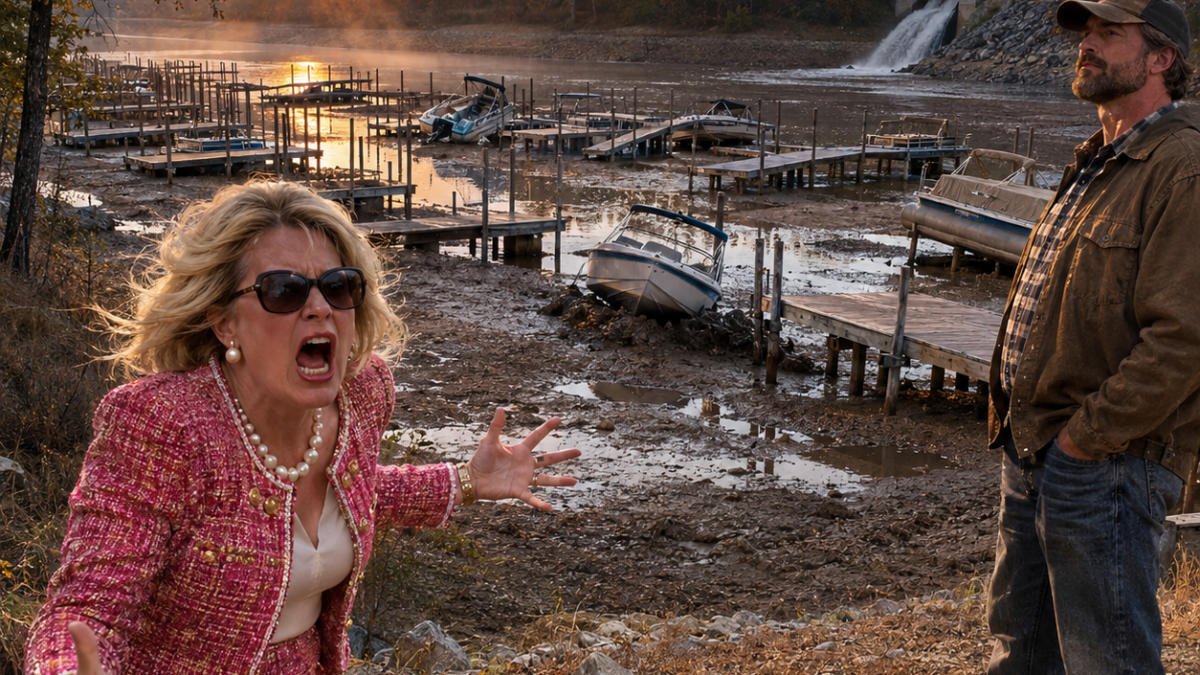
The marina looked absurd.
Pilings standing in nothing.
Gangway sections leading toward retreating water.
By 5:45, the reporter’s photographer had already begun setting up for sunrise.
At 7:18, sunlight came over the ridge.
The lake had dropped a little more than nine feet.
And there it was.
Twenty-eight installed marina pilings standing in black mud.
Pontoon frames useless.
Gangway terminating on exposed lake bed.
Water roughly 190 feet downhill from part of the project.
And Marlene’s own boat—the one somebody had tied to the unfinished slip days earlier—sat tilted in the mud.
Nameplate visible.
BOARDWALK BLONDIE.
Joe saw it first.
He read the name.
Then looked at me.
“Don’t.”
“I didn’t say anything.”
“Your face did.”
A blue heron landed on the half-finished gangway.
It stood there like it had been waiting seventy-seven years for the photograph.
By 7:30, sixty people stood across the lake.
By eight, closer to a hundred.
Emergency HOA meeting.
Pajamas.
Coffee mugs.
Angry voices.
Parents.
Retirees.
People who had paid $2,800 because they trusted someone.
News vehicles arrived.
I didn’t feel triumphant anymore.
Seeing the residents changed it.
Those families were not all Marlene.
Most had been sold a story.
“Community lake.”
“Approved marina.”
“Permanent lake rights.”
“Deeded access.”
Words.
Marlene had given them confidence without truth.
That is an expensive combination.
At 8:42, her white Lexus appeared.
No Greg.
She stepped out wearing the same dress.
She looked toward the lake.
Stopped.
Her face did not move.
Her body did.
Like she had forgotten how to breathe.
She saw the mud.
Pilings.
Her boat.
Heron.
Cameras.
Then me.
I stood on the dam crest with Dozer beside me.
Joe.
Sheriff Hightower.
Marisol.
Sam.
Federal investigators.
Marlene walked toward our side.
Stopped at the flagged property line.
For once, she did not cross.
That detail mattered to me.
She finally saw a boundary.
She lifted her phone.
Started recording.
Sheriff Hightower walked forward.
“Mrs. Witford.”
She lowered the phone.
“You are under arrest.”
Everything went still.
The charges he read included multiple counts tied to forged notarial acts, theft by deception involving the HOA funds under investigation, and a false statement to law enforcement.
Marlene’s neighbors watched.
No cheering.
That surprised me.
Maybe it shouldn’t have.
There is something sobering about seeing a person you elected placed in handcuffs.
Even if you’re angry.
Even if she betrayed you.
This was not television.
This was a woman’s life collapsing in front of people who had trusted her.
The sheriff advised her of her rights.
She looked at me.
I did not say anything.
I had imagined speeches.
Granddaddy would have had one.
Margaret would have told me not to.
Margaret usually won those arguments.
When Hightower finished, I walked to the property line with a manila folder.
Her attorney had arrived.
I handed it to the sheriff.
He passed it across.
Sam whispered:
“What’s that?”
“They already have everything.”
“So?”
“That’s Granddaddy’s original 1947 dam permit.”
Sam looked at me.
“Why?”
I watched Marlene’s attorney open the folder.
“Real signature.”
Sam closed his eyes.
“You’ve been waiting all night to do that?”
“Yes.”
“That is petty.”
“Yes.”
“Margaret would be disappointed.”
“No.”
He thought.
“Fair.”
The crowd across the lake stood quietly.
A few people removed their hats.
Not for me.
For the moment.
Maybe for the lake.
Maybe because they realized how badly they had been deceived.
I picked up Dozer.
He was not dignified about it.
Forty-three pounds of elderly cattle dog objecting to being carried.
Luke walked beside me.
We returned to the porch.
The lake began refilling almost immediately.
Springs do not care about lawsuits.
High Tower Creek kept running.
Rain came hard during the final week of September.
By the second week of October, water had climbed nearly back to normal.
By the third week, Earl’s Pond sat where it always had.
The marina did not return with it.
Mountain Mirror held a special meeting October 3.
The dock project was terminated.
Unanimous vote.
Every driven piling ordered removed.
Shoreline restored.
Each of the forty families refunded their $2,800 contribution from HOA reserves.
Sixty-three votes.
Zero against.
Marlene did not attend.
Neither did Greg.
Their legal problems had moved beyond HOA politics.
The new board hired a licensed marine contractor.
A different one.
Proper insurance.
Proper permits.
DNR oversight.
Marisol monitored restoration.
Twenty-eight pilings came out.
Lake bed regraded.
Disturbed shoreline stabilized.
No replacement marina.
By October 30, a DNR biologist certified the site restored.
I walked the shoreline after the last machine left.
Luke came with me.
The ground was still scarred.
Mud.
Freshly stabilized bank.
Areas where pilings had been.
Luke said:
“Looks rough.”
“It’ll heal.”
“How long?”
“Year for the bank.”
“Lake?”
“Spring.”
“And people?”
I looked toward Mountain Mirror.
“Longer.”
Marlene went to trial months later.
She fought the charges.
That did not surprise me.
People who build entire systems around denying boundaries rarely become comfortable with responsibility overnight.
Prosecutors presented document history.
Notary records.
County filings.
Financial transactions.
Lake Stewardship LLC.
Her husband.
HOA payments.
The altered easement.
The handwriting analysis.
Eleven questioned notarizations.
Nine ultimately supported convictions.
The jury found her guilty on nine forgery counts, theft by deception, and the false-statement count.
The sentence:
Four years in state correctional custody, with the final two suspended under conditions including restitution.
Greg took a different route.
Federal case.
Wire-fraud counts.
He pleaded.
Twenty-six months.
People asked how I felt.
That question followed me for months.
“Happy?”
No.
“Vindicated?”
Yes.
“Sorry?”
For the people they hurt.
“For them?”
Complicated.
I had spent a career designing systems where failure could kill people.
Dam engineering teaches you something about responsibility.
You can sympathize with the person who made the mistake.
You can understand pressure.
You can recognize fear.
But water does not care about sympathy.
If you design badly, the dam still fails.
Consequences remain.
Marlene had been given chance after chance.
I corrected her politely.
She ignored me.
She built.
I documented.
She produced paperwork.
I checked it.
She called the sheriff.
The sheriff checked deeds.
She relied on a forged easement.
We traced it.
She collected HOA money.
We followed it.
She had exits.
She chose forward every time.
That mattered.
The most meaningful visit happened November 1.
A pickup came up my road.
Not a Lexus.
An older Ford.
Patricia Andrews climbed out.
Retired schoolteacher.
New HOA president.
She had been the one dissenting board voice under Marlene.
She carried a foil-covered pan.
“Pecan cobbler.”
“That gets you onto the porch.”
She smiled.
We sat.
Dozer positioned himself strategically.
Patricia looked at the lake.
“No marina.”
“No marina.”
“No motorboats.”
“Not from the HOA.”
She nodded.
Then she said:
“Community wants to ask you something.”
I waited.
“Five-year access arrangement.”
“For?”
“Canoes. Kayaks. Fishing.”
I said nothing.
“No structures.”
Still nothing.
“No docks.”
She continued.
“Eight people maximum at one time unless you approve more.”
I watched her.
“Reservation system.”
“Children fish free.”
I looked toward the water.
“What do you want from me?”
“Your terms.”
That was different.
Marlene had arrived with rights she invented.
Patricia arrived with a request.
I respected requests.
“I’ll think about it.”
“Take as long as you need.”
“Overnight.”
She looked surprised.
“That’s all?”
“Probably.”
“What’s the catch?”
“I want to speak to Luke.”
“Fair.”
Then I pointed toward the cobbler.
“And that stays.”
She laughed.
That night, Luke and I sat on the porch.
The lake was full.
No pilings.
Moonlight.
He asked:
“What would Granddaddy do?”
“Say no.”
“Really?”
“Absolutely.”
“Why?”
“He thought sharing fishing spots was how you ruined fishing.”
Luke laughed.
“What would Mom say?”
That question hurt less than it once had.
“She’d say yes.”
“Why?”
“She liked kids.”
“She liked telling you that you were too territorial.”
“That too.”
Luke looked toward the eastern cove.
“What do you want?”
I thought a long time.
For ninety-six years, my family had owned water.
But ownership and use are different things.
Marlene tried to turn access into entitlement.
That made me defensive.
But I didn’t want her behavior to teach me that generosity was weakness.
That would mean she still controlled something.
I told Luke:
“Yes.”
“With conditions?”
“One.”
He waited.
“The east cove.”
“What about it?”
“I want to put it into permanent youth fishing access.”
Luke stared.
“For Mountain Mirror?”
“For everybody.”
The next morning, I called Patricia.
“Yes.”
She inhaled.
Then:
“Really?”
“Canoes and kayaks only.”
“Yes.”
“No motors.”
“Absolutely.”
“No structures without written approval.”
“Yes.”
“Reservation limits.”
“Yes.”
“And I’m adding a condition.”
There was a pause.
“What?”
“Five-acre cove on the eastern shore gets dedicated as a permanent youth fishing easement through the county land trust.”
Silence.
Then:
“Wade…”
“Free.”
“For HOA kids?”
“For every kid.”
She was quiet long enough that I wondered if the call dropped.
Then:
“Marlene would hate that.”
I laughed.
“Not why I’m doing it.”
“I know.”
We handled it properly.
Not a handshake alone.
Real documents.
Land-trust review.
Survey.
Recorded easement.
Insurance.
Use rules.
No ambiguity.
I had seen what ambiguity could cost.
We named it Earl’s Cove.
After my grandfather.
The man who built the dam.
The first youth fishing day happened the following May.
Sixty-three children came.
More than I expected.
Joe Varin, eighty-one years old and stubborn enough to outlive all of us, taught kids how to tie clinch knots.
Luke handled registration.
Patricia Andrews managed lunch.
Dozer slept beneath a picnic table.
I sat on the dam crest with coffee.
The same dam where I had opened the outlet months earlier.
Now the spillway was quiet.
Water full.
Spring green everywhere.
A nine-year-old girl from Mountain Mirror hooked a largemouth bass off the new simple wooden fishing pier we built for Earl’s Cove.
Not forty slips.
One pier.
Rough-sawn pine.
Designed for kids.
She struggled with the rod.
Her father panicked more than she did.
Joe yelled instructions.
She finally brought the fish up.
Held it with both hands.
Her face looked like she had discovered gold.
She turned toward the dam.
“Mr. Harrison!”
I raised a hand.
“It’s a big one!”
I shouted back:
“Honey, they all are!”
People laughed.
I sat down again.
And something inside me settled.
For months, people had talked about ownership.
My water.
My dam.
My deed.
My rights.
All true.
Necessary.
But ownership is not meaningful because you can keep everyone out.
Ownership matters because you get to decide what you protect, what you share, and on what terms.
Marlene wanted the lake because she saw forty rentable slips.
Forty families.
Assessments.
Fees.
Power.
She turned water into a business line.
Granddaddy saw something else.
He saw drought protection.
Fish.
Cattle.
Family.
A place to sit in the evening.
Margaret would have seen children.
Maybe that was why Earl’s Cove felt better than simply locking the gate forever.
It was my answer to Marlene without needing her name in it.
She tried to take.
I chose to give.
There is a difference.
One is entitlement.
The other is permission.
People from Mountain Mirror began using the lake differently after that.
Slowly.
Respectfully.
A father and daughter in a canoe.
Two retired women paddling in the morning.
Kids fishing.
Nobody building.
Nobody staking shoreline.
Nobody showing up with laminated permits.
Patricia sent me monthly access logs at first.
I finally told her:
“You can stop sending these.”
“You sure?”
“Yes.”
“I thought you liked records.”
“I do.”
She smiled.
“You’re healing.”
“Don’t diagnose me.”
She laughed.
The HOA itself changed.
Financial records opened.
Outside audit.
Conflict-of-interest rules.
No board member could hire an entity they owned without disclosure and member approval.
Lake Stewardship LLC disappeared.
The $218,000 scandal became the reason residents started reading budgets instead of approving them blindly.
That mattered.
Marlene didn’t steal only because she was dishonest.
She succeeded because forty-eight homes assumed somebody else was checking.
People hate hearing that.
They want corruption to be entirely about the corrupt person.
It isn’t.
Systems fail when trust has no verification.
That is engineering too.
We don’t inspect dams because we think concrete is evil.
We inspect because failure is possible.
HOAs are not dams.
But governance needs inspection for the same reason.
Patricia once asked me to attend a board meeting.
I said no.
“Why?”
“I retired.”
“You sit on dam committees.”
“Those involve water.”
“We involve water.”
“Not anymore.”
She laughed.
I eventually went once.
Residents wanted to understand the forged easement.
I brought copies.
Not originals.
Always copies.
I explained how my grandfather’s signatures differed.
How the recorded chain was altered.
How notary validity can be checked.
How a permit on HOA letterhead is not a government permit.
Someone asked:
“How did forty people pay money without checking?”
The room went quiet.
That was the question.
I said:
“Because Marlene sounded certain.”
A man in the back nodded.
“She did.”
“Certainty feels like evidence if you hear it from someone you trust.”
Patricia asked:
“How do we prevent that?”
“Make important claims easy to verify.”
One resident said:
“We should’ve asked to see the lake deed.”
“Yes.”
Another:
“She told us you were refusing to cooperate.”
“I was.”
They looked surprised.
I continued.
“I refused to cooperate with people claiming rights they didn’t have.”
Different thing.
A woman asked:
“Did you know all along you were going to lower the lake?”
“No.”
“When did you decide?”
“When sediment from the unauthorized construction created a legitimate inspection issue.”
“But you knew the slips would end up in mud.”
“Yes.”
“Did that feel good?”
The room got uncomfortable.
I answered honestly.
“A little.”
Some nervous laughter.
“But not as good as you think.”
“Why?”
“Because your money was in those pilings.”
That ended the laughter.
I looked around.
“You were victims too.”
Several people looked down.
“Marlene hurt my property.”
Then:
“She stole your trust.”
That was worse in some ways.
Property can be repaired.
Trust takes longer.
After the meeting, a man named Curtis approached.
He had paid for one of the slips.
“$2,800.”
“I know.”
“I wanted a pontoon.”
“I figured.”
“Still do.”
“I’m not banning pontoons from Earth.”
He laughed.
Then said:
“I hated you that morning.”
“I know.”
“Thought you did it just to embarrass us.”
“I knew you did.”
“Then they showed us the documents.”
I waited.
“My wife asked why we never saw a real county permit.”
“What did you tell her?”
“That I assumed Marlene had handled it.”
There it was.
He shook his head.
“Never again.”
Good.
Months later, Curtis helped build the kids’ pier.
No payment.
Just showed up.
Sometimes accountability becomes contribution.
That is the best version.
Joe Varin came to the first fishing day wearing the same Stetson he wore on drawdown night.
I asked:
“You own another hat?”
“No.”
“You’ve had that thing since Granddaddy’s funeral.”
“Before.”
“How before?”
“Your granddaddy gave it to me.”
I looked at him.
“You never told me.”
“You never asked.”
That irritated me.
Then moved me more than I wanted to admit.
Joe looked across Earl’s Cove.
“Earl would’ve liked this.”
“Kids stealing his bass?”
“He’d complain.”
“Exactly.”
“Then feed them supper.”
I nodded.
That sounded like Granddaddy.
I thought about the night I apologized to him out loud.
Sorry it took me this long.
Maybe I had been apologizing for more than the marina.
After Margaret died, I came home and treated survival like engineering.
Routine.
Work.
Measurements.
Book.
Trips to see the baby.
Don’t die yet.
That was my master plan.
Then Marlene gave me something to fight.
I hate admitting that.
Conflict woke me up.
Not in a healthy way at first.
Anger filled places grief had hollowed.
Suddenly I had calls to make.
Records to check.
A dam to operate.
A son arriving with equipment.
Joe on the porch.
People everywhere.
Life demanding attention.
When the case ended, I worried the emptiness would return.
Instead, Earl’s Cove happened.
Kids.
Luke.
Patricia.
Community.
The fight accidentally pushed me toward people again.
Margaret would have recognized the irony immediately.
She used to say:
“You become useful whenever you’re sad because usefulness lets you avoid being sad.”
She was right.
She was annoyingly right about most things.
One evening Luke and I sat on the rebuilt shoreline.
He asked:
“You okay?”
“Define.”
“Dad.”
“Yes.”
“You know Mom’s been gone three years.”
“I know exactly.”
“You talk about her more now.”
I looked at the water.
“That bad?”
“No.”
“Why mention it?”
“Before the marina, you barely said her name.”
I didn’t answer.
Luke continued.
“I think you thought if you talked about her, you’d fall apart.”
“Maybe.”
“And?”
“I didn’t.”
“No.”
I looked at him.
“Close.”
He smiled.
“Good enough.”
We sat there.
Earl’s Pond had always been family history.
Granddaddy.
Grandmother.
My childhood.
Now it held Margaret differently too.
Not because she lived there.
She rarely spent extended time on the farm before retirement.
But because what happened afterward reminded me what she valued.
People.
Generosity.
Children.
Fishing even though she hated touching bait.
I decided to put a small bench near Earl’s Cove.
No monument.
No giant plaque.
Just:
For Margaret — who believed quiet places should be shared carefully.
Luke approved.
Meredith cried when she saw it.
I pretended not to.
The lake stayed structurally healthy.
Marisol returned for formal inspection after restoration.
We opened the outlet briefly under normal procedure.
Nothing dramatic.
She smiled.
“Disappointed?”
“No.”
“No reporters?”
“Best inspection I’ve had in years.”
“Boring?”
“Perfect.”
She checked the trash rack.
Sediment had been removed.
Slope conditions stable.
Outlet clear.
Shoreline recovering.
She signed the report.
Then looked toward Earl’s Cove.
“That is a better dock.”
“One pier.”
“For children.”
“Yes.”
“Engineering improvement.”
“Philosophical improvement.”
She laughed.
“Retirement is making you soft.”
“No.”
“Definitely.”
I let her have it.
I later heard that photographs of the drained marina circulated widely.
People called it revenge.
“Man drains lake to destroy HOA marina.”
That headline was catchy.
Wrong in important ways.
I did not empty Earl’s Pond.
I lowered it nine feet.
I did not secretly sabotage the marina.
I filed safety justification.
Notified downstream owners.
Obtained state authorization.
Had law enforcement and engineers present.
The marina failed because it had been built illegally around an operating elevation the HOA did not control.
That difference matters.
If you remove the paperwork from the story, I sound reckless.
The paperwork is the story.
Granddaddy built a dam with a borrowed bulldozer.
I defended it with documents.
Different generations.
Same stubbornness.
The biggest myth was that I waited until the marina was complete.
I didn’t.
Marlene planned forty slips.
Only twenty-eight pilings were installed when the drawdown occurred.
The project was unfinished.
Which somehow made the sight even more ridiculous.
A dream interrupted halfway.
That is how bad schemes often look when reality arrives.
Not finished enough to become permanent.
Too expensive to pretend nothing happened.
Marlene’s boat in the mud became the image everyone remembered.
Boardwalk Blondie.
I never knew whether she named it herself.
Probably.
People asked what happened to it.
A marine recovery company removed it.
I did not keep it.
Did not claim it.
Did not want it.
I wanted my lake.
Not her things.
That distinction became important in the civil case.
Sam wanted damages for shoreline disturbance, sediment, trespass, legal costs, restoration.
Reasonable.
Documented.
No fantasy number.
The HOA’s insurers negotiated.
Blue Ridge Marine Works cooperated once it became clear their permit package had been fraudulent.
They turned over emails.
Work orders.
Payment histories.
The contractor had asked Marlene for proof of lake rights.
She provided the altered easement.
They had some responsibility to verify.
But they also became useful witnesses.
I never wanted to bankrupt people unnecessarily.
That surprised Sam.
“You’re getting philosophical.”
“No.”
“You used to be meaner.”
“I used to be forty.”
“True.”
The civil resolution covered restoration and verified losses.
My focus remained the criminal and governance consequences already moving independently.
People love stories where the villain pays millions directly to the protagonist.
Real life divides responsibility.
Insurer.
HOA.
Contractor.
Individuals.
Separate claims.
Separate evidence.
That is less cinematic.
More honest.
Mountain Mirror survived.
That mattered.
Forty-eight families should not lose their community because one president and her husband abused it.
The new board rebuilt reserves.
Refunded slip contributions.
Removed corrupted vendor contracts.
Audited dues.
Some residents were angry that their own HOA reserves had to repair shoreline.
Understandable.
Then Patricia explained at a meeting:
“We either pay for damage committed in our association’s name or pretend we aren’t responsible.”
They voted to pay.
That was leadership.
Not glamorous.
Responsible.
Marlene thought leadership meant getting what she wanted.
Patricia understood it often means telling people what they don’t want to hear.
One spring morning, Curtis brought his pontoon down to a public reservoir twenty miles away.
He invited me.
I almost declined.
Then went.
He looked at me when we launched.
“See? Legal dock.”
“Beautiful.”
“Public ramp.”
“Outstanding.”
“Permit sticker.”
“I’m emotional.”
He laughed.
We fished three hours.
Caught almost nothing.
Better than a lawsuit.
On the drive home, he said:
“You know, if Marlene had just asked you…”
“I would’ve said no to forty slips.”
“I know.”
“What about ten?”
“Probably no.”
“Four?”
“Maybe.”
He looked surprised.
“Seriously?”
“If properly designed and limited.”
“Then she could’ve had something.”
“Yes.”
That was the tragedy of entitlement.
Marlene might have negotiated.
Perhaps a small shared facility.
Maybe kayaks.
Maybe limited access.
Instead, she forged the right to everything and lost the possibility of anything.
People think refusing to ask gives you more power.
It usually gives you fewer options.
I eventually found the old photograph from 1971.
Granddaddy on the dam.
Three-year-old me beside him.
The original spillway valve mechanism behind us.
Joe younger.
No Mountain Mirror.
No houses.
Just forest and water.
I framed it in my study.
Beside it, I put a photograph from the drawdown night.
Not Marlene.
Not the muddy marina.
Me and Luke at the valve wheel.
Two generations.
That was the part I wanted to remember.
My son had arrived because I asked.
Stayed all night.
Helped calculate levels.
Reflagged boundaries.
Then helped build Earl’s Cove months later.
The HOA conflict became family time I had not known how to ask for.
Pain creates strange gifts.
I would not choose the pain to get them.
Still, once they exist, you can be grateful.
Meredith brought my granddaughter up when she was old enough to toddle around Earl’s Cove.
The child had no interest in fish.
She wanted rocks.
Collected seventeen.
Put them in my pockets.
Margaret would have laughed herself sick.
Meredith sat beside me on the pier.
“Mom would love this.”
“I know.”
“You okay?”
“Luke asks that too.”
“We coordinate.”
“Of course.”
She smiled.
Then:
“You seemed more alive after the marina thing.”
“Your brother said the same.”
“That isn’t an insult.”
“I know.”
“Was it worth it?”
“No.”
She looked surprised.
“No?”
“I’d rather Marlene had never touched the lake.”
“Obviously.”
“But?”
“But I’m glad I didn’t let anger decide what came after.”
She put her head against my shoulder.
For a moment, she was eight again.
I watched my granddaughter throw one of my rocks into the water.
Gone.
The lake closed over it.
That is what water does.
Takes disruption.
Absorbs.
Settles.
Maybe humans can learn something.
Years passed.
Earl’s Cove became a county tradition.
First Saturday in May.
Kids.
Fishing rods.
Lunch.
Joe eventually became too old to stand all morning teaching knots, so he sat under a canopy and criticized everyone else’s knots.
Much more efficient.
Patricia Andrews stayed HOA president for two terms.
Then stepped down.
Voluntarily.
Imagine.
Her replacement continued the access agreement.
Every five years, we reviewed it.
Not automatic.
That was deliberate.
Rights granted forever are hard to undo.
Permissions renewed with trust remain healthy.
The first renewal meeting lasted twenty minutes.
No lawyers.
I still sent Sam the paperwork.
He called.
“You don’t trust them?”
“I trust people.”
“That sounds suspiciously optimistic.”
“I don’t trust memory.”
“Better.”
Written clarity protects friendship.
Another lesson Marlene accidentally taught us.
The forged easement remained archived as evidence even after criminal cases closed.
I requested a certified copy for family records.
Luke looked at it once.
“Burn it.”
“No.”
“Why keep it?”
“History.”
“Bad history.”
“Still history.”
He nodded.
Then:
“Granddaddy’s signature looks terrible.”
“It wasn’t his.”
“I mean real signature.”
“Oh.”
“Looks like a seismograph.”
“He wrote fast.”
I laughed.
We had hundreds of legitimate examples.
Checks.
Letters.
Deeds.
Notes.
That was why the forgery was so obvious once anyone actually looked.
Marlene’s scheme depended less on creating a perfect fake than on nobody comparing it.
That may be the most useful lesson in the entire story.
Fraud often survives because verification feels impolite.
“Surely the president checked.”
“Surely the developer knows.”
“Surely the notary is valid.”
“Surely the county would catch it.”
Marlene lived inside those surelies.
Until Donna checked.
Until Castro looked.
Until Sam traced.
Until Luke measured.
Until Marisol authorized.
Systems are only as good as the moment somebody says:
Show me.
One afternoon, a law student contacted Sam about using parts of the dispute in a land-use seminar.
Sam asked permission.
I said yes if names were omitted.
“What should the lesson be?” he asked.
“Which one?”
“Private reservoir rights?”
“Too narrow.”
“Forgery?”
“Too obvious.”
“HOA overreach?”
“Too dramatic.”
He waited.
I said:
“Physical construction doesn’t create legal rights.”
That was Marlene’s biggest assumption.
If pilings existed, residents would defend them.
If forty families paid, politics would protect them.
If money moved, the project would become too expensive to undo.
That logic appears everywhere.
Build first.
Ask later.
Force the owner into settlement.
Granddaddy would have understood immediately.
He used to say:
“A fence put in the wrong place is still in the wrong place no matter how expensive the posts are.”
Marlene used pilings instead of fence posts.
Same principle.
Sam liked that line better.
He stole it for the seminar.
Lawyers.
The lake remained registered as a Class I structure.
Inspections continued.
I kept logs.
Retirement did not cure me of spreadsheets.
Rainfall.
Reservoir elevation.
Outlet conditions.
Vegetation.
Seepage.
Luke eventually took more interest.
He finished his master’s.
Environmental engineering.
Then took a job that still allowed him to visit.
One weekend, he walked the dam with a tablet.
I followed.
He stopped.
“What?”
“Nothing.”
“You’re staring.”
“You walk like me.”
He looked horrified.
“No.”
“Yes.”
“Take it back.”
“Can’t.”
He resumed.
Definitely me.
Margaret would have loved that.
Dozer did not live forever.
I knew he wouldn’t.
Still hurt.
He made it long enough to sleep beneath the table during the first Earl’s Cove fishing day.
That seemed like a proper final public appearance.
When he died, Luke helped bury him uphill beneath a dogwood.
I put no fancy marker.
Just:
DOZER
GOOD DOG
MOSTLY TIRED
Joe said:
“Most accurate gravestone I’ve seen.”
For weeks afterward, I still looked toward the camp chair during meetings.
Loss leaves habits.
Margaret taught me that.
Dozer reminded me.
The property became less lonely anyway.
Kids once a year.
Family visits.
Patricia with cobbler sometimes.
Curtis.
Luke.
Meredith.
Joe until he couldn’t drive anymore.
The conflict Marlene created had ironically tied the farm back into the community.
Again:
Not worth what happened.
Still something good after.
When people ask if I regret opening the spillway, I say no.
Not because I enjoyed the marina sitting in mud.
Because the drawdown was necessary.
Sediment had reached the low-level intake.
A dam owner who ignores maintenance because he fears appearing vindictive is still an irresponsible dam owner.
I would have drawn down without the marina.
That is the truth.
Would I have enjoyed the visual consequence less if Marlene had been innocent?
Of course.
But engineering did not change for my emotions.
Water level came down because it needed to.
That separation protected me legally and morally.
Do the correct maintenance.
Let unauthorized construction deal with reality.
At some point, an online version claimed I “pulled the plug” overnight and emptied forty-seven acres into a creek.
Nonsense.
A nine-foot controlled drawdown is not emptying a reservoir.
Full draining could have damaged springs, aquatic habitat, banks, downstream conditions.
I stopped at thirty-six turns for a reason.
Joe joked Granddaddy would have opened it all the way.
Then admitted he wouldn’t.
Granddaddy was stubborn.
Not stupid.
The satisfying part was restraint.
Enough.
Not more.
That became a theme.
Enough evidence.
Enough drawdown.
Enough damages.
Enough punishment to be accountable.
Then stop.
Revenge has trouble stopping.
Justice needs boundaries too.
One evening, years later, Patricia and I sat on the porch.
She brought cobbler again.
“You bribed me the first time.”
“Worked.”
“It did.”
She looked toward Earl’s Pond.
“Can I ask you something?”
“Sure.”
“What if Marlene had called you before construction?”
“I would’ve met.”
“What if she offered money?”
“For forty slips?”
“Yes.”
“No.”
“Any amount?”
“Probably not.”
“Why?”
“Too much shoreline impact.”
“Twenty?”
“No.”
“Ten?”
“Maybe depending on location.”
“Five?”
“Possible.”
She laughed.
“She really did ruin everything.”
“She ruined certainty.”
“What?”
“If she had asked, we could’ve designed something.”
Patricia thought.
“Now we’ll never know.”
“Exactly.”
That is another cost of dishonesty.
It destroys options nobody knows existed.
Marlene probably believed I was an old man who would never cooperate.
She never tested the assumption.
She forged instead.
One neighbor later told me Marlene had said:
“Wade Harrison will never allow progress.”
I laughed when I heard.
Earl’s Cove existed because I allowed something new.
I simply insisted new things begin with truth.
That isn’t anti-progress.
That is how bridges stay standing.
One summer, a local nonprofit asked to use Earl’s Cove for children whose parents were deployed overseas.
We expanded the fishing day.
Another organization brought kids from foster families.
Patricia asked:
“Is this still what you imagined?”
“I didn’t imagine any of it.”
“Margaret would.”
“Yes.”
That was enough.
I began thinking of the lake in chapters.
Granddaddy built it.
Dad maintained it.
I redesigned the spillway.
Marlene challenged ownership.
Earl’s Cove opened it carefully.
Luke will decide what comes next.
That is what property really is.
Not possession.
Stewardship across time.
When you forge an easement, you aren’t just taking something from today’s owner.
You are rewriting decisions made by people who came before and choices belonging to people who come after.
That was why the 1973 forgery made me angrier than the pilings.
The pilings were obvious.
The forged signature tried to make Granddaddy agree.
He had been dead for decades.
Couldn’t object.
I could.
So I did.
I visited the Methodist cemetery once after the trial.
Granddaddy’s grave.
Grandmother beside him.
The legitimate notary from 1947 was buried several rows away, just like the old records indicated.
I found the stone.
Stood there.
Felt ridiculous.
Then said:
“Thanks for being alive when you stamped it.”
Nobody answered.
Probably best.
I went to Granddaddy.
Told him Earl’s Cove had sixty-three kids the first year.
Told him one girl caught a bass.
Told him Joe’s knot instruction had become unbearable.
Wind moved through the trees.
I said:
“Lake’s fine.”
That was what he would have asked.
Not:
Did you win?
Not:
Did she go to prison?
Lake’s fine?
Yes.
Dam’s fine?
Yes.
Family?
Getting there.
Good enough.
Years after the event, the original spillway wheel was due for refurbishment.
We removed it under controlled maintenance.
Cleaned.
Inspected.
Repainted.
Luke wanted to put the old wheel on display.
I refused.
“It goes back.”
“Why?”
“Because it works.”
“It’s historic.”
“It’s a valve wheel.”
“It changed everything.”
“No.”
He looked at me.
“The documents changed everything.”
“You’re impossible.”
“Engineering degree yet?”
“Yes.”
“Then act like it.”
We put it back.
Green.
Functional.
No plaque.
I liked that.
Tools should remain tools.
The wheel wasn’t revenge.
It controlled water.
That night it had simply done what it was designed to do.
Marlene’s marina happened to learn the difference between a fixed structure and a variable reservoir.
Gravity is not personal.
That may be why engineering comforted me after Margaret.
People leave.
Physics doesn’t.
Painful maybe.
Stable.
Water moves downhill.
Concrete has strength limits.
Steel expands.
Valves open.
Lakes rise and fall.
Some truths are indifferent.
When human truth becomes messy, indifferent truth feels merciful.
The legal truth eventually became just as simple.
My deed.
My dam.
My lake.
Forged easement.
Unauthorized marina.
Improper financial benefit.
No amount of HOA confidence changed those facts.
The case faded from media.
New scandals came.
People forgot.
Good.
I did not want to be “that guy who drained the HOA lake.”
It was never their lake.
That is the point everybody still gets wrong.
A reporter contacted me five years later.
“Whatever happened to the HOA lake?”
I said:
“My lake is fine.”
Pause.
Then she laughed.
“Still correcting people?”
“Until I die.”
She asked if forty slips were ever rebuilt.
“No.”
“Any motorized marina?”
“No.”
“HOA access?”
“Limited paddle access.”
“Why allow it after everything?”
I looked toward Earl’s Cove.
“Because they asked.”
She went quiet.
That answer ended up in her piece.
Good.
The difference between Marlene and Patricia fit inside three words.
She asked.
That is civilization.
One person has something.
Another wants access.
Ask.
Terms.
Agreement.
Record it.
Everyone leaves with dignity.
Marlene skipped the first step and manufactured the rest.
That is why forty families woke up to mud.
Not because an angry widower wanted revenge.
Because their president promised control over something she did not own.
I wish the title people repeat included that.
But titles are titles.
The truth belongs in the story.
And the truth is this:
At 7:14 p.m. on a September Saturday, I opened a valve on my family’s dam under an authorized maintenance plan.
The lake fell nine feet overnight.
By sunrise, twenty-eight installed marina pilings stood in mud.
The rest of the forty-slip project never got finished.
The forgery investigation widened.
The HOA finances unraveled.
Marlene and Greg faced criminal consequences.
The residents got their money back.
The shoreline was restored.
The lake refilled.
And months later, instead of forty private boat slips, we built one simple fishing pier for children.
That is the ending I care about.
Not the mud.
Not the handcuffs.
Not Boardwalk Blondie tilted sideways while a blue heron stood on the gangway.
Though I admit that photograph still makes Luke laugh.
The ending is the nine-year-old girl yelling:
“Mr. Harrison! It’s a big one!”
The ending is Joe teaching knots.
Patricia serving lunch.
Dozer sleeping underneath the table.
Luke handling registration.
Meredith bringing my granddaughter.
The ending is a cove my grandfather stocked in 1949 becoming permanently available to kids he would never meet.
That feels larger than revenge.
Marlene tried to convert the lake into a private amenity controlled by one HOA.
Her fraud ended up helping create public youth access instead.
I don’t believe everything happens for a reason.
That phrase annoyed Margaret too.
Bad things happen because people make bad choices.
Good things happen afterward because other people decide what to do with the damage.
That is different.
Marlene made choices.
So did I.
I could have locked everybody out forever.
I didn’t.
I could have drained the reservoir farther than necessary.
I didn’t.
I could have treated every Mountain Mirror resident as my enemy.
I didn’t.
Because if somebody else’s abuse turns you into a smaller person, they are still taking from you.
I had lost enough already.
Margaret.
Years.
Peace.
I wasn’t giving Marlene generosity too.
So yes.
I opened the spillway.
Yes.
Her marina was sitting in mud by sunrise.
Yes.
She saw her own pontoon tilted on the lake bed while cameras rolled.
Yes.
The paperwork she trusted collapsed.
Yes.
She went to prison.
But the deepest satisfaction came much later.
A summer afternoon.
No reporters.
No sheriff.
No FBI.
No white Lexus.
Just a child with a fishing rod.
I was sitting on the dam crest.
Thermos beside me.
Earl’s Pond full and blue.
The girl hooked a fish and started shouting.
Her father tried to help.
Joe shouted conflicting instructions.
Everyone laughed.
She brought the bass in.
Held it up.
Sunlight on the scales.
For one second, I could see my grandfather at three different ages.
Young man with a borrowed bulldozer.
Old man sitting on the porch.
And the memory of him lifting me up to see the spillway wheel turn.
I could hear Margaret saying:
“See? You didn’t need forty docks.”
No.
We didn’t.
The little girl yelled across the water:
“Is this the biggest fish in the lake?”
I shouted:
“Absolutely.”
Luke looked at me.
“You’re lying.”
“She’s nine.”
“Engineering ethics.”
“Retired.”
He laughed.
The fish went back into the lake.
Water closed over it.
Everything quiet again.
That is how I prefer the story to end.
Not with a lake emptied.
With a lake full.
Not with people excluded.
With the right people welcomed.
Not with a forged easement.
With a real one.
Not with forty slips built for prestige.
With one pier built for kids.
Not with Marlene deciding what my grandfather’s lake should become.
With my family choosing for ourselves.
She thought the power was in the marina.
She was wrong.
She thought the power was in the HOA presidency.
Wrong again.
She thought the power was in a notarized page, even if the stamp belonged to a dead woman.
Still wrong.
The power had always been simpler.
Ownership.
Truth.
Records.
Water.
And the right to say:
No.
Then, when someone finally learns to ask properly, the right to say:
Yes.
The next time I turned the spillway wheel, there were no reporters.
Routine inspection.
Luke beside me.
Marisol reviewing measurements remotely.
I turned it only enough for the test.
Water roared briefly.
Then closed.
Luke looked toward the eastern cove.
Kids were fishing.
“No marina.”
“No.”
“Better?”
I followed his eyes.
“Much.”
He nodded.
Then we walked back toward the farmhouse.
The same porch where Granddaddy had watched the lake.
The same porch where I came because my wife died and I did not know what else to do with the rest of my life.
I had arrived with a U-Haul, an old dog, and a plan consisting of three words.
Don’t die yet.
Years later, I had a different plan.
Keep the dam safe.
Keep the lake honest.
Keep Earl’s Cove open.
See my granddaughter grow.
Remember Margaret without being destroyed by remembering her.
And never again underestimate what can happen when a person mistakes somebody else’s patience for permission.
The lake glittered through the trees.
Full.
Exactly where it belonged.
And forty unauthorized boat slips?
They never came back.








