HOA Karen Ordered My “Shed” Demolished—Then Federal Agents Showed Up at Her Door
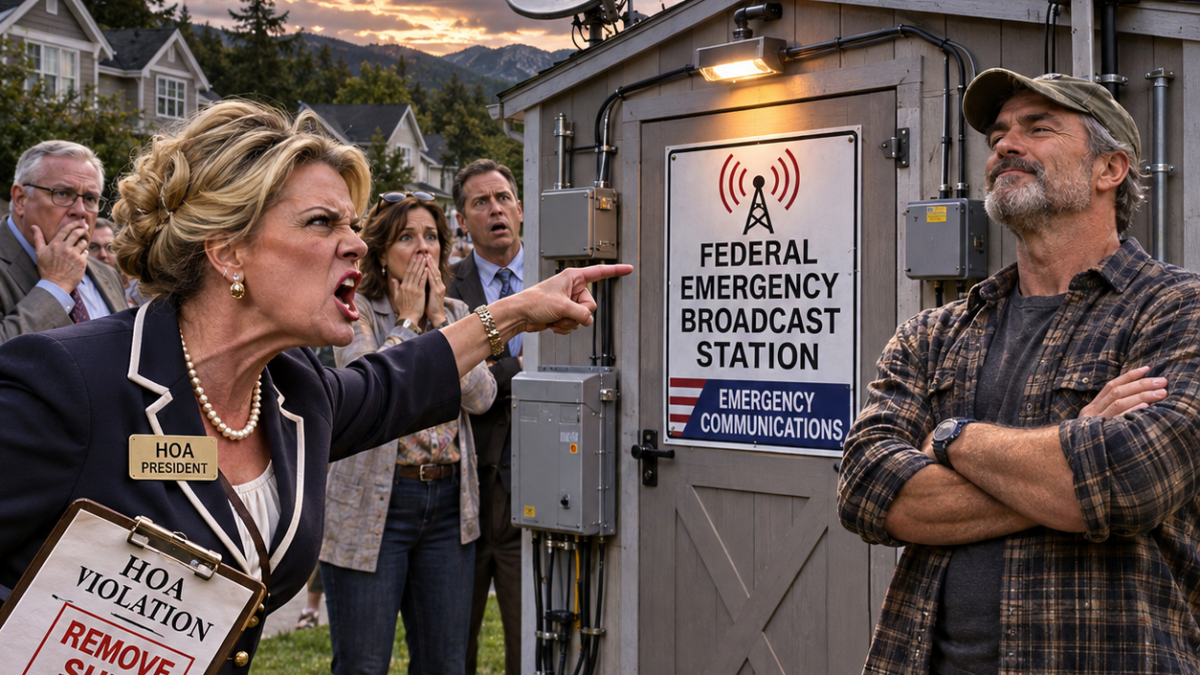
Karen stood on my front porch waving a violation notice like a judge holding a death sentence, gave me seven days to tear down the gray building in my backyard, and smiled when she warned me that if I refused, the HOA would send a demolition crew and charge me for the privilege.
She thought she was threatening a retired widower over an illegal shed, but the structure behind my house had its own hardened foundation, independent backup power, secure communications equipment, federal authorization, and a purpose important enough that people far above our little neighborhood already knew exactly where it sat.
I could have ended the argument that morning by telling Karen everything, but the look in her eyes told me she had already decided facts were just another obstacle to her authority—and sometimes the only way to teach someone where their power ends is to let them keep walking until they reach a line they cannot cross.
“My seven-day deadline is not a suggestion, Mr. Turner.”
Karen tapped the paper against her clipboard.
I looked past her toward the backyard.
The building she was furious about was twelve feet wide, twenty feet long, finished in plain gray siding, and deliberately designed to attract as little attention as possible.
No windows facing the street.
No bright lights.
No sign.
No antenna farm rising above the roofline.
From Karen’s point of view, it probably did look like a very expensive shed.
That misunderstanding could have been forgiven.
What she did after being corrected could not.
I looked back at her.
“I’ll review your notice.”
Her smile vanished.
“You’ll remove the structure.”
“I heard what you said.”
“You don’t seem to understand.”
“I understand perfectly.”
Her cheeks reddened.
Behind her, parked against the curb, was the ridiculous purple golf cart she used to patrol Oak Haven Estates. A small HOA flag fluttered from the back.
Karen had been president for four years.
Long enough that people had stopped distinguishing between the HOA and Karen herself.
Grass too high?
Karen.
Trash cans visible?
Karen.
Wrong flowerpot?
Karen.
Holiday lights left up too long?
Karen.
Someone once joked that if clouds formed over Oak Haven without architectural approval, Karen would fine the sky.
Nobody laughed very loudly when she was nearby.
She pointed toward my backyard.
“Article Seven, Section Four. Unauthorized outbuildings are prohibited without board approval.”
“I know the section.”
“Then why did you build one?”
“I didn’t.”
Her eyes narrowed.
“I can see it.”
“I said I didn’t build an unauthorized outbuilding.”
She made an irritated sound.
“It has walls. It has a roof. It sits in your backyard. It’s a shed.”
“No.”
“What is it?”
I considered giving her the shortest version.
Then decided against it.
Not because the information was secret.
Because everything relevant had already been provided to the HOA’s management company before construction began.
They had received copies of federal authorization, permitting coordination, and legal notices explaining that the installation was not subject to ordinary HOA architectural approval.
Karen either hadn’t read them or had decided they didn’t matter.
Both possibilities were revealing.
“You should review the documentation your board received last month.”
“I know what my board received.”
“Apparently not.”
Her eyes hardened.
“Seven days.”
She slapped the violation notice against my door.
“After that, the fine is one hundred dollars per day. We will place a lien on the property if necessary.”
I looked at the notice.
Then at her.
“And demolition?”
“We’ll have the structure removed.”
“You personally intend to authorize that?”
“Yes.”
“Good.”
That answer confused her.
“Good?”
“I like clarity.”
For the first time, uncertainty crossed her face.
Only for a second.
Then Karen recovered.
“You veterans always think rules don’t apply to you.”
I felt something shift inside me.
Not anger exactly.
A colder thing.
“My military service has nothing to do with this.”
“It has everything to do with your attitude.”
I held the door.
“We’re finished.”
“You’ll hear from the board.”
“I’m counting on it.”
Karen turned, marched down my walkway, climbed into her golf cart, and accelerated away as if she had just won something.
I closed the door.
Walked into the kitchen.
Set the violation notice on the counter.
Then I placed it beside a much thicker folder bearing federal seals.
The building behind my house was designated ECR7.
Emergency Communications Relay Station Seven.
It was part of a federally contracted emergency communications network designed to keep public warning and emergency messaging alive if ordinary systems failed.
Karen had just threatened to bulldoze it.
And she had put that threat in writing.
PART 2
I stood in the kitchen for several minutes looking at the two stacks of paper.
Karen’s violation notice was one page.
My federal file was nearly three inches thick.
It contained engineering approvals.
Communications licenses.
Infrastructure agreements.
Emergency management directives.
Security requirements.
Utility coordination documents.
A copy of the federal contract identifying me as the civilian custodian responsible for ECR7.
And, most importantly for Karen, multiple notices explaining why local zoning rules, private architectural restrictions, and neighborhood covenants could not be used to disable the station.
I poured coffee.
Black.
No sugar.
Then I sat down.
Twenty-five years in the Army Signal Corps teaches you something about communication.
Most failures don’t start because people lack information.
They start because somebody refuses to hear information that interferes with what they already want to believe.
I had seen commanders ignore technical warnings because a deadline mattered more.
I had seen contractors insist damaged equipment was operational because admitting failure would cost money.
And now, apparently, I was seeing an HOA president convince herself that federal infrastructure became an illegal shed simply because her binder said so.
My late wife, Sarah, would have found the whole thing hilarious.
That thought hurt.
Three years after losing her, memories still arrived without warning.
Sarah had been the reason I moved to Oak Haven after retirement.
Or more accurately, losing Sarah was.
We had spent most of our marriage moving.
Army housing.
Rentals.
Temporary assignments.
A house near Fort Gordon.
Another near Fort Huachuca.
Two overseas tours.
Places where furniture never quite felt permanent because there was always another set of orders coming.
We used to joke about buying our final house.
Somewhere boring.
Somewhere quiet.
Somewhere the biggest emergency would be a neighbor complaining about a lawn mower.
Then cancer took her before retirement did.
The large house we had shared for the last few years became unbearable afterward.
Too much silence.
Too many rooms still arranged the way she had left them.
Our daughter, Emily, lived forty minutes from Oak Haven.
That became reason enough.
The backyard became the second reason.
It backed onto protected green space.
Excellent elevation.
Low interference.
Ideal line-of-sight characteristics.
The federal emergency communications program had been looking for a suitable location for a hardened relay node.
My background made me an obvious custodian.
The government would install it.
I would maintain it under contract.
The work gave me purpose without dragging me back into full-time service.
I had researched Oak Haven before buying.
Read every covenant.
Every bylaw.
Every architectural rule.
I knew the outbuilding restriction.
That was why the federal legal team contacted the county, city, utilities, management company, and HOA before construction.
There was no surprise.
No secret building operation.
The documentation existed.
Someone just hadn’t bothered respecting it.
I pulled Karen’s notice toward me and started writing.
My response was intentionally boring.
That was important.
Angry letters give people something to argue with.
Boring letters give them facts.
I acknowledged the violation number.
Identified the structure.
Explained its federal emergency communications function.
Referenced the prior notices.
Attached copies.
Clarified that the HOA had no authority to fine, lien, remove, disable, enter, damage, or otherwise interfere with the installation.
Then I gave them an easy exit.
I wrote:
I understand that the appearance of the facility may have caused confusion. I trust the enclosed documentation resolves the matter and that the violation will be rescinded without further action.
No insult.
No threat.
No victory lap.
Just an off-ramp.
I mailed it certified.
Return receipt.
Signature required.
Two days later, someone at the management office signed for it.
Then silence.
One week.
Nothing.
I began to hope an actual attorney had read the packet.
Then the Oak Haven newsletter arrived.
Sarah used to tease me for reading the newsletter.
“You’ve survived hostile communications environments,” she once said. “But somehow you’re voluntarily reading three pages about mulch.”
The latest edition was exactly what you would expect.
Fall festival.
Pool closing schedule.
Recipe for pumpkin dip.
Yard of the Month.
Karen again.
Then a new section.
COMMUNITY COVENANT COMPLIANCE
I knew before reading it.
Karen wrote:
It has come to the board’s attention that certain residents believe they are exempt from the rules agreed upon by every homeowner. Oak Haven’s standards apply equally. No resident may erect large unauthorized structures and then hide behind technical excuses.
I stopped.
Technical excuses.
Federal authorization had become a technical excuse.
The paragraph continued.
The board will use every lawful tool available to protect our property values and community character.
I smiled.
Not because it was funny.
Because she had just changed the situation.
Before the newsletter, she could still claim misunderstanding.
Now she had been informed.
And had chosen defiance.
The next morning, a fine notice appeared on my door.
One hundred dollars.
I photographed it.
Filed it.
The next day:
Two hundred cumulative.
Then three.
Then four.
Each notice was saved.
Date.
Time.
Photograph.
Envelope.
Copies.
I called my federal contact.
Director Helen Evans.
She had managed emergency communications infrastructure longer than I had known her.
Blunt.
Efficient.
Unimpressed by almost everything.
“Mark?”
“We have an HOA problem.”
She laughed.
“You retired into combat?”
“They’re fining ECR7.”
Silence.
“They’re what?”
“One hundred dollars per day.”
“For what?”
“Unauthorized shed.”
Silence again.
Then:
“Tell me you’re joking.”
“I’m not.”
“You sent the preemption packet?”
“Before construction.”
“They acknowledged?”
“Management company signed.”
“Have they touched the installation?”
“No.”
“Do they intend to?”
“They threatened removal.”
Her tone changed immediately.
“Document everything.”
“Already am.”
“If anyone enters the secured footprint or attempts interference, you call me immediately.”
“Understood.”
“Mark.”
“Yes?”
“Do not play soldier.”
“I’m retired.”
“You know exactly what I mean.”
I did.
No confrontation.
No chest-thumping.
No turning a civil dispute into a security incident.
Facts.
Documentation.
Escalation through proper channels.
I had spent a career teaching that to younger soldiers.
Now I had to follow my own advice.
My second letter was firmer.
Not emotional.
Clear.
It referenced the previous correspondence.
Noted the fines.
Noted the newsletter.
Described continued enforcement as willful interference after notice.
Then I copied FEMA.
Department of Homeland Security counsel.
Regional communications contacts.
Again, I gave Karen a way out.
Rescind the fines.
Acknowledge the exemption.
Do not interfere with the station.
That evening I was watering the lawn when I heard the golf cart.
Karen stopped at the curb.
“You think you’re clever.”
I turned off the hose.
“Good evening, Karen.”
“With your fancy letters.”
“Did you read them?”
“We have a lawyer.”
“Good.”
“He says your claims are nonsense.”
That interested me.
“Your lawyer says HOA covenants can authorize removal of a federally contracted emergency communications facility?”
“He says this is private property.”
“It is my property.”
“Then it’s subject to the covenants.”
“No.”
She pointed.
“That shed is coming down.”
“Karen.”
“What?”
“Please have your lawyer read everything again.”
“I don’t need legal advice from you.”
“I’m not giving legal advice.”
“What do you call it?”
“A warning.”
Her face flushed.
“Are you threatening me?”
“No.”
I looked toward ECR7.
“I’m trying to protect you from making a very expensive mistake.”
She laughed.
“You people always say that.”
“What people?”
“Men who think uniforms make them important forever.”
That one almost got through.
Almost.
I remembered Evans.
Do not play soldier.
I smiled instead.
“Have a good evening.”
Karen sped away.
The neighborhood started noticing.
Some residents looked at me suspiciously.
Karen had told people I was running an illegal commercial operation.
Others heard I had built a bunker.
One rumor claimed I had an amateur radio station powerful enough to interfere with pacemakers.
Another claimed I was storing weapons.
Fear fills gaps where facts are missing.
Then Dave, my next-door neighbor, approached me at the fence.
Thirty-two.
IT security.
Worked remotely.
Owned too many grills.
“Hey, Mark.”
“Dave.”
“You okay?”
“Why?”
“I saw Karen yelling at you.”
“Normal Tuesday.”
He laughed.
Then lowered his voice.
“She’s telling people the building is illegal.”
“I know.”
“She said you refused inspection.”
“She has no authority to inspect it.”
“I figured.”
He looked toward the station.
“So what is it?”
I hesitated.
Then answered with the public version.
“Emergency communications.”
“Government?”
“Yes.”
His eyebrows rose.
“Seriously?”
“Yes.”
“And she knows?”
“Yes.”
“She’s still fining you?”
“Yes.”
Dave stared down the street.
Then said:
“She is out of her mind.”
“Possible.”
He leaned closer.
“Not everyone supports her.”
“I know.”
“No, I mean people are sick of her.”
“Why?”
Dave laughed.
“You’re new.”
“Relatively.”
“She measured Stan’s grass with a ruler.”
“That can’t be real.”
“It is.”
“She fined Maria because her roses were the wrong color.”
“There’s a rose-color rule?”
“No.”
“Good.”
“She invented one.”
I stared at him.
Dave nodded.
“Welcome to Oak Haven.”
The demolition crew arrived Wednesday morning.
I heard the truck before I saw it.
Heavy diesel.
Not normal for our street.
I looked out my office window.
Flatbed.
Small backhoe.
Pickup with a logo:
A–Z LANDSCAPING & DEMOLITION
My stomach tightened.
Not from fear of losing ECR7.
The station itself had security protocols.
The problem was three working men who probably had no idea what Karen had hired them to touch.
I activated exterior recording.
Took my identification.
Then walked outside.
The foreman looked relieved when he saw me.
“Mr. Turner?”
“That’s me.”
“We’re here for the HOA.”
“I assumed.”
He pointed toward the backyard.
“Remove an unauthorized structure.”
“Did anyone explain what it is?”
He shrugged.
“Shed.”
“No.”
He looked confused.
I held out the identification card connected with my custodial role.
“That structure is part of a federally contracted emergency communications system.”
He stared.
“Federal?”
“Yes.”
He looked toward ECR7.
Then back.
“Karen said it was just a shed.”
“She has received written notice multiple times.”
The other men stopped unloading.
The foreman read the warning language.
“Man…”
He looked genuinely sick.
“I don’t want any trouble.”
“Neither do I.”
“We already signed paperwork.”
“With Karen?”
“HOA.”
“Does your paperwork authorize entry onto my property?”
He checked.
His face told me the answer before he spoke.
“It says the HOA has authority.”
“They don’t.”
“Can I call the office?”
“Please do.”
He walked away.
I heard pieces.
“…federal…”
“…not touching that…”
“…I don’t care what she said…”
Then he looked at me.
“She’s coming.”
“Of course.”
Five minutes later, Karen arrived.
Faster than I’d ever seen that golf cart move.
“What is happening?”
The foreman held up his hands.
“We’re not doing this.”
“You have a contract.”
“He says federal.”
“He is lying.”
The foreman looked at me.
Then Karen.
“I saw the card.”
“He printed it!”
I almost admired her commitment.
“Karen,” I said.
She turned.
“For the last time, you were notified before construction. You were notified after your violation notice. You were notified again after the fines began.”
“You cannot hide behind federal jargon.”
“This isn’t jargon.”
“Remove it.”
“No.”
“Then I will.”
The foreman said, “Not with my guys.”
Karen spun toward him.
“I’m paying you.”
“Not enough.”
“You signed a contract.”
“Then sue me.”
A few neighbors had come outside.
Dave stood on his porch.
Maria watched from farther down.
Karen knew she had an audience.
That made her worse.
“Mr. Turner is deliberately misleading this community.”
I raised my voice just enough for everyone.
“The station is federally protected emergency communications infrastructure. The board has documentation.”
Karen shouted:
“It is a shed!”
I pointed toward her contractors.
“Then why won’t they touch it?”
Silence.
The foreman began loading tools.
Karen looked horrified.
“You’re leaving?”
“Yes.”
“You’ll never work in this subdivision again.”
“Fine.”
“I’ll report you.”
“Fine.”
“I’ll sue you.”
“Lady, I am not going to federal court because you hate a shed.”
Dave laughed from his porch.
Karen heard him.
Her face turned crimson.
The crew drove away.
She stood alone in the street.
For the first time, Oak Haven saw Karen lose publicly.
That changed everything.
The group chat started that afternoon.
Dave added me.
Then Maria.
Then Tom.
Then six more residents.
Maria was sixty-eight.
Retired paralegal.
Sharp enough to cut glass.
Her first message:
Now that Karen has attempted to bulldoze federal infrastructure, can we finally discuss the rose situation?
I laughed.
Then Tom replied.
Retired accountant.
I’d rather discuss why the HOA financial report contains $20,000 of “community beautification” with no supporting detail.
That caught my attention.
We met at my house two nights later.
Eight residents.
Coffee.
Printed bylaws.
Violation letters.
Stories.
Maria had been fined over roses.
A military family over a children’s playset.
An elderly widow threatened with a lien after storm damage.
A father whose son used a wheelchair had been denied a ramp because it violated façade consistency.
That one changed the room.
“What happened?” I asked.
Dave answered.
“They appealed.”
“And?”
“Karen denied it.”
“Ramp installed?”
“Eventually, after they threatened an ADA complaint.”
Maria leaned forward.
“This is the problem.”
“What?”
“She doesn’t enforce rules.”
Tom nodded.
“She enforces obedience.”
I looked at the stack of HOA notices in front of me.
My fight suddenly felt small.
Not unimportant.
Small.
Karen had been doing this for years.
I was simply the first person who happened to be connected to a line she could not legally cross.
“We need records,” I said.
Tom smiled.
“I already drafted the request.”
The HOA fought the financial request.
Of course.
First they said homeowners could inspect but not copy.
Maria found the state statute.
Then they limited review to one hour.
Maria responded again.
Then they required Karen’s presence.
Maria threatened a formal complaint.
Finally, documents appeared.
Five years.
Bank statements.
Invoices.
Contracts.
Expense reimbursements.
Tom took them home.
For two days we heard nothing.
Then he called.
“Mark.”
“Yeah?”
“You sitting down?”
“I am now.”
“There’s a landscaping account.”
“Okay.”
“Community beautification.”
“How much?”
“Enough.”
“That isn’t a number.”
“Karen used it like a personal checking account.”
My stomach tightened.
“Details.”
“Meals. Travel. Conference expenses. Payments to a consulting company.”
“Whose?”
“Her brother.”
I stared at the wall.
“Conflict disclosed?”
“No.”
“Competitive bid?”
“No.”
“Anything else?”
“Selective fine waivers.”
“For who?”
“Her friends.”
Tom’s voice hardened.
“She punished people she didn’t like and erased violations for people who supported her.”
“How well documented?”
“Beautifully.”
I smiled.
Accountants have a different definition of beautiful.
We started collecting resident stories.
Dave built a secure form.
Anonymous if residents preferred.
The response was immediate.
Too immediate.
People had been waiting.
Wrong mulch.
Wrong garage-door color.
Unapproved lawn furniture.
Holiday lights.
Children’s toys.
Fences.
Satellite dishes.
Driveway stains.
Storm damage.
Wheelchair access.
Karen’s name appeared repeatedly.
Sometimes directly.
Sometimes through “the board.”
Maria reviewed statements.
“This is a pattern.”
Tom said, “It’s also leverage.”
I shook my head.
“Not leverage.”
“What then?”
“Accountability.”
Tom gave me a look.
“You always talk like that?”
“Occupational damage.”
I sent one final letter.
Thirty-day opportunity to resolve everything.
Rescind my fines.
Formally acknowledge the station’s protected status.
Issue an apology.
Correct the public misinformation.
No damages demanded.
No lawsuit.
No public humiliation.
Just correction.
Maria read it.
“She’ll never agree.”
“I know.”
“Then why offer?”
“Because someday someone will ask whether she had a chance to stop.”
“And?”
“I want the answer to be yes.”
That mattered to me.
Twenty-five years in uniform had taught me something Sarah understood before I did:
Victory is cleaner when the other side has been given a reasonable exit.
Karen’s attorney responded two weeks later.
The letter was astonishing.
My federal arguments were “spurious.”
The HOA covenants were “contractually binding.”
A lien would be filed.
Foreclosure proceedings were threatened.
Demolition remained possible.
I read it three times.
Then emailed it to Director Evans.
Subject:
HOA threatens foreclosure over ECR7
Her response arrived nine minutes later.
Thank you, Mark. We are taking it from here.
I leaned back in my chair.
For months I had managed the problem.
Now the problem had left my hands.
The federal visit happened Tuesday.
Two black sedans.
One government SUV.
Four people.
I recognized the type before the doors opened.
Not because of uniforms.
Because of posture.
Purpose.
Karen opened her front door holding coffee.
I could see her from my window.
At first, annoyance.
Then confusion.
Then fear.
One official handed her documents.
Another spoke.
Karen’s hand went to her throat.
The coffee mug fell.
Shattered.
They were inside nearly an hour.
Nobody on the street pretended not to watch.
When they left, Karen remained in the doorway.
Her face looked gray.
Dave texted:
What just happened?
I replied:
Thursday meeting.
Thursday became standing room only.
Library event room.
Nearly every household represented.
Karen sat in front.
Carol and Bob beside her.
Her loyal board allies.
She looked smaller.
Not physically.
Authority has a shape.
Karen’s had collapsed.
Maria opened.
“We’re here to discuss governance, finances, and legal compliance.”
Then she handed me the microphone.
I projected a photograph.
My backyard.
ECR7.
“My name is Mark Turner.”
Pause.
“Many of you know me as the man with the illegal shed.”
Laughter.
Nervous at first.
Then louder.
“For two months, your board has fined me for this structure.”
Next slide.
Violation notice.
Next.
Fine.
Next.
Certified response.
Next.
Federal authorization.
Next.
Demolition crew video.
The room became silent.
I played Karen shouting that the station was “just a shed.”
Then paused the video.
“Before that crew arrived, the board had already received federal documentation multiple times.”
I showed delivery receipts.
Dates.
Signatures.
“After the crew refused, the board threatened a lien.”
Next slide.
Attorney letter.
“Then foreclosure.”
People murmured.
One resident said:
“Over that building?”
“Yes.”
“What is it?”
I clicked.
Simple diagram.
No sensitive technical details.
Public description only.
“Emergency Communications Relay Station Seven.”
Silence.
“It supports federal emergency communications resilience.”
A man in the back said:
“You mean FEMA?”
“Yes.”
Someone whispered:
“Oh, God.”
I continued.
“The people who visited Karen Tuesday represented federal legal and communications authorities. They delivered formal orders related to interference with this station.”
Karen stood.
“This is intimidation!”
Maria said, “Sit down.”
Karen stared at her.
Maria did not blink.
Karen sat.
That alone drew applause.
I finished.
“I’m not asking you to believe me.”
I pointed toward the documents.
“I’m asking you to read.”
Then Tom stood.
His presentation was worse for Karen.
Money always makes people pay attention.
Charts.
Five years.
Fines collected.
Beautification fund.
Consulting payments.
Travel.
Meals.
Her brother’s company.
Waived fines.
Preferential treatment.
People became angry.
Not theoretical anger.
Personal anger.
“That’s our dues.”
“Why did we pay for that?”
“My lien went to this?”
“Where is the audit?”
Karen tried speaking.
Nobody cared.
Then Maria stood.
She didn’t use slides.
“How many of you have received a violation you believed was arbitrary?”
Hands.
Dozens.
“How many appealed to a board controlled by the same person who issued or supported the violation?”
More hands.
“How many felt afraid to speak because you believed retaliation would follow?”
Almost every hand.
Then stories began.
Widow.
Roof.
Playset.
Wheelchair ramp.
Roses.
Mailbox.
Trash cans.
Each one.
Karen shrank.
Not because people insulted her.
Because they stopped being afraid.
Tom made the motion.
Vote of no confidence.
Entire board.
The response was nearly unanimous.
Karen’s era ended in one roar.
The resignations came the next morning.
Karen.
Carol.
Bob.
The HOA attorney followed.
Conflict of interest, he claimed.
Maria laughed when she read the letter.
“Translation?”
“He wants distance.”
Interim board.
Maria president.
Tom treasurer.
Dave secretary.
Their first formal act:
Rescind every fine against me.
Second:
Written apology.
Third:
Independent financial audit.
Fourth:
Review every disputed enforcement action from Karen’s tenure.
Fifth:
Emergency legal review of the covenants.
I asked Maria:
“You don’t need to approve ECR7.”
“I know.”
“Then why is there an agenda item?”
She smiled.
“Symbolism.”
The next newsletter included:
The Oak Haven Estates Homeowners Association formally acknowledges that ECR7 is not subject to HOA architectural restrictions and apologizes for prior actions taken against Mr. Turner and the federal communications installation.
Dave brought me a copy.
“Frame it.”
“No.”
“Sarah would.”
That stopped me.
He knew about Sarah.
Most neighbors did by then.
I looked at the paper.
“She would put it on the refrigerator.”
“Then do that.”
I did.
For three months.
The federal case continued separately.
That distinction mattered.
The HOA’s internal collapse was one thing.
Federal interference was another.
Karen’s written threats.
Attempted demolition.
Knowledge after notice.
Financial conduct transmitted through electronic systems.
Federal prosecutors evaluated everything.
I cooperated.
No exaggeration.
No revenge language.
Documents.
Video.
Dates.
A grand jury returned charges.
The local paper ran her photograph.
The headline mentioned interference with federal communications infrastructure.
Karen’s lawyer called the case an overreaction to a neighborhood dispute.
The prosecutor called it documented conduct after repeated notice.
Carol and Bob cooperated.
Karen eventually accepted a plea agreement.
One major count of interference.
Restitution obligations.
Substantial fine.
Probation.
Community service.
Permanent agreement never to serve on an HOA board again.
Some people wanted prison.
Dave did.
“This woman tried to bulldoze federal infrastructure.”
“She also failed.”
“That’s not the point.”
“No.”
“You’re satisfied?”
“I’m done.”
He stared.
“That’s different.”
“Yes.”
I didn’t need Karen locked away to feel safe.
I needed the interference stopped.
The money restored.
The community protected.
The record clear.
Anything beyond that belonged to prosecutors and courts.
Not me.
The civil settlement hurt her more financially.
Homeowners sued over misused funds.
Unjust fines.
Harassment.
Karen sold her house.
The Yard of the Month sign remained planted outside while movers carried boxes past it.
That was almost too perfect.
I watched from my kitchen.
Not smiling.
Not exactly.
Maria walked over.
“You’re missing your big moment.”
“What moment?”
“Nemesis moving truck.”
“I’m retired. I don’t have nemeses.”
She looked toward Karen’s house.
“Sure.”
Karen came outside.
For a second I thought she would look toward me.
She didn’t.
Her shoulders were stiff.
She climbed into a car.
Left.
The golf cart had disappeared days earlier.
That should have felt triumphant.
Instead I thought about Sarah.
She would have said:
“You won. Now stop staring out the window like a supervillain.”
I laughed quietly.
Maria looked at me.
“What?”
“Nothing.”
A week later, a federal envelope arrived.
Letter of commendation.
Director Evans.
Professional conduct.
Protection of a critical asset.
Meticulous documentation.
Inside was a challenge coin.
Small.
Heavy.
I held it for a long time.
Twenty-five years of military service had given me medals.
Certificates.
Coins.
Plaques.
Most sat in boxes.
This one went in my desk drawer beside a photograph of Sarah.
Not because the HOA fight mattered more than my career.
Because Sarah had worried retirement would leave me without purpose.
She had been wrong.
Purpose changes shape.
Sometimes it looks like a communications network.
Sometimes it looks like defending your backyard from a golf cart.
Oak Haven changed.
Maria hated being called president.
“Temporary.”
She said it every meeting.
She served three years.
The board rewrote the rules.
Not eliminated.
Rewritten.
Clear.
Limited.
Reasonable.
Safety.
Shared property.
Maintenance.
No flower-color nonsense.
No arbitrary playset restrictions.
The wheelchair-ramp process was revised first.
That mattered to everyone.
Tom built transparent financial reports.
Every major contract listed.
Competitive bids.
Conflicts disclosed.
Dave created a website.
Residents could see budgets.
Meeting minutes.
Rules.
Appeals.
Nothing hidden.
Nothing depended on Karen’s mood.
ECR7 became neighborhood folklore.
At first people asked too many questions.
“Can it contact satellites?”
“Yes.”
“Can it survive an EMP?”
“It has hardened features.”
“Can you listen to us?”
“No.”
“Can the government?”
“Ask the government.”
“Is there a secret tunnel?”
“No.”
“Would you tell me if there were?”
“No.”
That answer caused a month of rumors.
Eventually, the novelty faded.
Maria brought me an orchid.
“For the shed.”
“It has a designation.”
“For the shed.”
“It’s federal infrastructure.”
“Federal shed.”
I gave up.
We placed the orchid on the office shelf.
It died in three weeks.
Apparently federal preemption does not apply to my inability to keep orchids alive.
One Saturday, Dave had a barbecue.
Kids ran between yards.
Someone pointed toward ECR7.
“That’s the station?”
A new resident.
Dave nodded.
“Yep.”
“And the old HOA tried to tear it down?”
“With a backhoe.”
The new resident stared.
“You’re kidding.”
“No.”
“What happened?”
Dave looked toward me.
“Ask Mark.”
I shook my head.
“Long story.”
Maria shouted from the patio:
“Karen lost.”
Everyone laughed.
That was enough.
Months later, I met the demolition foreman again.
Hardware store.
He recognized me.
“Federal shed guy.”
“That’s becoming a problem.”
He laughed.
“How you doing?”
“Fine.”
He looked embarrassed.
“I’m sorry about that day.”
“You left.”
“Fast.”
“That was smart.”
He nodded.
“Karen never paid our cancellation fee.”
“That sounds like Karen.”
“She threatened to sue.”
“Did she?”
“No.”
“Good.”
He hesitated.
“Can I ask something?”
“Sure.”
“Would I really have been arrested?”
I thought.
“If you knowingly entered and damaged protected federal communications equipment after warning, you could have created serious legal problems for yourself.”
He exhaled.
“So leaving was good.”
“Very.”
“I told my guys that.”
He shook my hand.
Then laughed.
“My wife still says, ‘At least you didn’t demolish FEMA.’”
“Your wife sounds wise.”
“She is.”
One year after Karen left, Oak Haven held a block party.
First successful one in years, according to Maria.
Children decorated the sidewalk with chalk.
Someone brought a bounce house.
The old Karen board would have required three forms.
Maria approved it by text.
That scandalized Tom.
“You need documentation.”
“It’s inflatable.”
“Still.”
“Put it in the minutes.”
He did.
I sat near the edge watching families.
For most of my adult life, community had meant units.
Teams.
Commands.
People connected by mission.
Civilian neighborhoods were stranger.
People lived fifty feet apart and sometimes knew nothing about each other.
Karen had exploited that.
Isolation.
One homeowner at a time.
One fine.
One threat.
One private humiliation.
The moment people compared stories, her power collapsed.
That lesson stayed with me.
Director Evans visited ECR7 for an inspection.
Officially routine.
Unofficially she wanted to see the famous neighborhood.
She walked around the station.
Checked logs.
Backup systems.
Maintenance records.
Everything good.
Then she looked toward Karen’s old house.
“So which one?”
I pointed.
“That.”
She stared.
“Yard of the Month?”
“Three years running.”
Evans laughed.
“I shouldn’t laugh.”
“You can.”
“She really called this a shed?”
“Yes.”
“She really hired a demolition crew?”
“Yes.”
Evans shook her head.
“I’ve dealt with hurricanes. Wildfires. cyber incidents. Tornado recovery.”
“And?”
“HOA presidents may be the most persistent threat.”
I laughed.
“Classified assessment?”
“Absolutely.”
The family that bought Karen’s house had no idea what happened.
At first.
Young couple.
Two children.
One afternoon, the father walked over.
“Are you Mark?”
“Yes.”
“I’m Nathan.”
“Welcome.”
He looked uncomfortable.
“We found something in the garage.”
“What?”
He held out a purple flag.
HOA logo.
Karen’s golf cart flag.
I stared.
Nathan said, “Do you want this?”
“No.”
“I figured there was history.”
“Burn it.”
He laughed.
“You serious?”
“No.”
Pause.
“Mostly.”
He threw it away.
Probably better.
The old board’s financial audit ended with recovery agreements and reforms.
Some expenses could not be reclaimed.
Some were clearly improper.
Some lived in the gray world of poor governance rather than crime.
That distinction mattered.
People wanted every mistake called theft.
Tom refused.
“We are not Karen.”
“What does that mean?” Dave asked.
“It means we don’t decide guilt because we’re angry.”
I smiled.
Tom caught me.
“What?”
“Nothing.”
“You agree.”
“Yes.”
“That worries me.”
Good governance is frustrating.
It requires treating people fairly even after unfairness.
Maybe especially then.
Maria asked me to join the board.
“No.”
“You haven’t even heard the pitch.”
“No.”
“Mark.”
“No.”
“You’re good with rules.”
“That’s why I refuse.”
“You would be good.”
“Exactly.”
She stared.
“Explain.”
“I know how easy it is to start believing competence means entitlement.”
“That is annoyingly self-aware.”
“Retirement has benefits.”
“You could help.”
“I do help.”
“From outside.”
“Yes.”
“Coward.”
“Correct.”
She laughed.
The station remained.
Gray siding.
Quiet hum.
Occasional maintenance.
Most days nobody noticed it.
That was success.
Emergency infrastructure should be boring until it isn’t.
During one severe storm season, a regional communications outage affected several systems.
ECR7 went into elevated operational status.
Backup power kicked in.
Federal monitoring increased.
Nobody in Oak Haven knew much about it.
They didn’t need to.
But one night, Dave saw the generator running.
“Working?”
“Yes.”
“Emergency?”
“System support.”
“Serious?”
“Handled.”
He nodded.
Then looked at ECR7.
“Glad Karen didn’t bulldoze it.”
“So am I.”
That was the moment the story changed for him.
Before, ECR7 had been funny.
A shed Karen shouldn’t have touched.
Now he understood the purpose.
Somewhere beyond Oak Haven, people depended on communications systems they would never see.
The station existed for them.
Not for me.
Not for the HOA.
Not for the story.
Duty without visibility.
That mattered.
Sarah would have understood.
She had always understood duty better than I did.
My military career had been full of people applauding sacrifice.
Sarah lived the invisible version.
Moves.
Loneliness.
Interrupted careers.
Birthdays without me.
Deployments.
A thousand adjustments nobody gave medals for.
When Oak Haven finally felt peaceful, I visited her grave.
I brought flowers.
Not roses.
Maria had ruined roses for me temporarily.
I sat beside the marker.
“You would hate Karen.”
Wind.
Nothing.
“You’d probably invite her for coffee.”
Still nothing.
“And then destroy her politely.”
I smiled.
“That sounds like you.”
I told Sarah about ECR7.
The demolition crew.
Federal visit.
The board meeting.
Maria.
Dave.
Tom.
Everything.
Then I said:
“I found the boring place.”
That hurt.
Because she should have been there.
But grief changes.
At first it is a room with no doors.
Then, slowly, it becomes something you carry without entering every day.
Oak Haven helped.
Even Karen, in a strange way, helped.
Her fight forced me to know people.
Without her, I might have spent retirement behind a closed door maintaining equipment and calling that peace.
Instead, I got neighbors.
Two years later, Maria finally stepped down.
Her farewell meeting was packed.
Tom presented her with a plaque.
She hated plaques.
Dave made a slideshow.
She hated slideshows.
I brought nothing.
She hugged me first.
“Smart man.”
The new president was a schoolteacher named Jennifer.
First meeting, she said:
“I do not intend to measure anyone’s grass.”
Applause.
Then:
“I do intend to collect dues on time.”
Less applause.
Normal.
Perfectly normal.
A teenage boy once asked me:
“Mr. Turner, did you know you were going to win?”
I was helping Dave repair a fence.
“No.”
“But federal government.”
“What about it?”
“The HOA couldn’t beat that.”
“The legal issue was clear.”
“So yes.”
“No.”
He looked confused.
“You can be legally right and still have a terrible year.”
“Oh.”
“You can win a case and lose sleep.”
He nodded slowly.
“You can win and still wish the fight never happened.”
“Then why fight?”
“Because sometimes not fighting costs more.”
He thought about that.
Then:
“My dad says you made Karen sell her house.”
“No.”
“She sold because of you.”
“No.”
“Come on.”
“Her choices created consequences. I documented them.”
“That sounds like something a lawyer says.”
“I’m not a lawyer.”
“Sounds worse.”
Fair.
Karen’s old lawyer eventually sent the new HOA a letter offering services.
Maria forwarded it to the group chat with one word:
No.
That may have been the most unanimous decision Oak Haven ever made.
I kept every original violation notice.
At first for evidence.
Later out of habit.
One day Emily came over.
My daughter.
She opened the file.
“Dad.”
“Yes?”
“You still have this?”
“Records.”
“The case is closed.”
“Records are records.”
“You have the first fine.”
“Yes.”
“The second.”
“Yes.”
“Third.”
“Yes.”
She looked at me.
“You need help.”
“Probably.”
She pulled out the original demolition threat.
Seven days.
One hundred dollars daily.
Lien.
Removal.
She laughed.
“Frame this one.”
“No.”
“Please.”
“No.”
“Mom would.”
That argument worked again.
We framed it.
It now hangs inside ECR7.
Not publicly.
Beside the federal commendation.
On top, Karen’s violation.
Below it, the commendation for protecting the station.
Visitors who understand the story laugh.
I do too.
Now.
One summer afternoon, Karen’s name came up during a cookout.
A newer resident asked:
“Whatever happened to her?”
Maria knew more than most.
She started answering.
I stopped her.
“Does it matter?”
Everyone looked at me.
Dave said, “Kind of.”
“No.”
“What do you mean?”
“She left. Legal consequences happened. Community recovered.”
Maria smiled.
“You’re becoming philosophical again.”
“I’m getting older.”
“Same thing.”
I looked toward ECR7.
“Karen spent years making herself the center of everyone’s attention.”
“So?”
“I’m not giving her permanent residency in our conversations.”
That ended the topic.
It felt good.
The federal emergency communications program eventually upgraded equipment.
New satellite hardware.
Improved backup power.
Better monitoring.
Contractors arrived.
This time, Jennifer, the HOA president, came over.
Not with a clipboard.
With cookies.
“I wanted to make sure the crew knows where they can park without blocking the road.”
“That’s helpful.”
“And I brought this.”
She handed me a form.
I stared.
“What?”
“Joke.”
It was blank except for:
OFFICIAL HOA APPROVAL FOR FEDERAL THINGS WE DO NOT CONTROL
I laughed.
“Approved?”
“Unanimously.”
“Get off my property.”
She left the cookies.
One night, a storm knocked power out across Oak Haven.
Dark street.
No porch lights.
No televisions.
No air conditioning.
ECR7 continued humming.
Generator.
Independent systems.
The station’s exterior status light glowed faintly.
Neighbors came outside.
Dave looked over the fence.
“Your shed has power.”
“My station has power.”
“Can I plug in my freezer?”
“No.”
“Federal selfishness.”
“Correct.”
The outage lasted six hours.
Nobody panicked.
But in the darkness, I understood something.
Karen had looked at ECR7 and seen ugliness.
Noncompliance.
A threat to uniformity.
She never asked why it existed.
Control often destroys curiosity.
When your first question is “Who approved this?” you may never reach the more important one:
“What is this for?”
That lesson became larger than Oak Haven.
Authority is necessary.
I believe that.
I spent my career inside structured authority.
Orders.
Regulations.
Chains of command.
But legitimate authority begins with jurisdiction.
You need to know where your power applies.
Karen never understood that.
She thought being HOA president meant everything visible from the golf cart was hers to regulate.
She believed the title expanded until someone stronger stopped it.
Real authority works the opposite way.
A responsible person looks for limits first.
Can I do this?
Should I?
Who is affected?
What law controls?
What facts don’t I know?
Karen skipped every question.
And because nobody challenged her for years, she mistook silence for permission.
The residents did too.
They weren’t bad people.
That mattered.
It would be easy to tell the story as brave homeowners versus corrupt queen.
Reality was softer.
Most people were tired.
Busy.
Parents.
Retirees.
Workers.
Nobody wanted a neighborhood war.
So they paid fifty dollars.
Then one hundred.
Removed the playset.
Changed the roses.
Moved the trash can.
Stayed silent.
Each individual decision made sense.
Together, those decisions built Karen’s authority.
That scared me more than Karen herself.
Petty tyranny rarely arrives because one person is powerful.
It arrives because everyone else decides resistance costs too much.
Until eventually, someone’s wheelchair ramp gets denied.
Or a widow gets threatened.
Or a federal emergency station gets a demolition order.
Then the absurdity becomes visible.
Years later, Dave asked:
“Would you do anything differently?”
“Yes.”
He looked surprised.
“What?”
“Talk to people sooner.”
“You handled it pretty well.”
“I handled my problem.”
“So?”
“Karen was hurting people before me.”
Dave nodded.
“You didn’t know.”
“I didn’t ask.”
“That’s not the same.”
“No.”
But it still mattered.
I had read every HOA document before buying.
I hadn’t spoken to the widow.
The military family.
The father whose son needed a ramp.
Due diligence can tell you rules.
People tell you culture.
If I had known earlier, maybe nothing would have changed.
Maybe Karen still would have escalated.
But maybe the community wouldn’t have needed federal infrastructure to wake up.
The orchid Maria brought died.
She replaced it.
That one died too.
The third survived.
I accused her of buying increasingly invincible plants.
She said:
“You can maintain emergency communications across five states but cannot water an orchid once a week.”
“Different skill set.”
“Clearly.”
The surviving orchid became another neighborhood joke.
Someone labeled it:
ECR7 AUXILIARY BIOLOGICAL SYSTEM
Dave printed the label.
I left it.
When Emily’s son was old enough, I showed him the station.
Only the safe, public areas.
He stared at racks.
Lights.
Equipment.
“Grandpa, is this secret?”
“Some things are restricted.”
“So yes.”
“Not exactly.”
“Can it warn people about tornadoes?”
“Systems like this help emergency messages keep moving.”
He nodded.
“Did a lady really try to smash it?”
I sighed.
“Your mother told you?”
“Everyone told me.”
“Wonderful.”
“Why?”
“She thought it was a shed.”
He looked around.
“It kind of looks like one.”
I stared.
He grinned.
Sarah would have loved him.
The final legal restriction on Karen’s HOA service became public record.
Years later, another community reportedly considered her for a committee.
Someone found the case.
She was not selected.
I heard through Maria.
She seemed delighted.
I felt almost nothing.
That surprised me.
At one time, Karen’s humiliation felt satisfying.
Later, it felt irrelevant.
That was how I knew the story was truly over.
Not when she moved.
Not when the plea agreement was signed.
When her future stopped affecting my peace.
I retired from the federal custodial contract eventually.
Not because of Karen.
Age.
New generation.
ECR7 remained.
A different custodian took responsibility.
The station was upgraded again.
The government negotiated a formal long-term infrastructure arrangement tied to the property.
When I sold the house years later, the disclosure package was enormous.
The buyer was an engineer.
He read everything.
Then looked toward ECR7.
“I know the story.”
Of course he did.
“Does that worry you?”
“No.”
“Why?”
He smiled.
“I’m not joining the HOA board.”
Smart man.
Before moving, Oak Haven held a farewell dinner.
I hated the idea.
Maria ignored me.
Dave organized.
Tom made a budget.
Naturally.
Jennifer gave a speech.
“Mark came to Oak Haven looking for peace.”
People laughed.
She continued.
“He accidentally caused a constitutional crisis involving landscaping.”
More laughter.
“Technically inaccurate,” I said.
Ignored.
“He reminded us that rules exist to serve people, not the other way around.”
That quieted the room.
“He also reminded us that reading your mail before threatening federal infrastructure is generally good practice.”
Laughter again.
Then Maria stood.
No notes.
“Karen picked the wrong fight.”
I smiled.
She looked at me.
“But that isn’t why this neighborhood changed.”
She turned toward everyone.
“It changed because after Mark fought back, we finally admitted what was happening to the rest of us.”
That was true.
“The feds didn’t fix Oak Haven.”
She pointed around the room.
“We did.”
That was more true.
When it was my turn, I kept it short.
“Thank you.”
People waited.
“That’s it?” Dave asked.
“Yes.”
“No speech?”
“No.”
Maria shouted:
“Twenty-five years Army and he has nothing.”
I sighed.
Then stood again.
“Fine.”
Everyone applauded.
I looked around.
“So much of my life was built around communications.”
I paused.
“Radios. Networks. Signals. Redundancy. Keeping information moving when things fail.”
I looked at Dave.
Maria.
Tom.
Jennifer.
Families.
Neighbors.
“The biggest failure in Oak Haven wasn’t Karen.”
The room went quiet.
“It was that none of us were talking to each other.”
Maria smiled.
“Karen could tell one person one thing and another person something else.”
I continued.
“She could convince everyone their problem was isolated.”
I looked toward the door.
“Once we communicated, she couldn’t control the story anymore.”
I raised my glass.
“So if you remember anything from the shed incident—”
Laughter.
“—remember this.”
I smiled.
“Talk to your neighbors.”
That was my speech.
Good enough.
On my last morning in Oak Haven, I walked into the backyard.
ECR7 hummed quietly.
Same gray walls.
Same simple roof.
Still looked like a shed.
I touched the siding.
Sarah’s photograph was in my wallet.
The challenge coin in my pocket.
The framed violation notice would stay with the station.
I decided it belonged there.
The new custodian came outside.
“You ready?”
“No.”
“You sold the house.”
“I know.”
“That usually means yes.”
“Smartass.”
He smiled.
I handed him the final maintenance log.
Then I looked toward Oak Haven.
Children heading to school.
Trash cans by the curb.
A basketball hoop.
One lawn slightly too long.
Nobody measuring it.
Good.
Before leaving, I drove past Karen’s old house.
Different family now.
Different flowers.
No Yard of the Month sign.
No purple golf cart.
Just a house.
That was perfect.
People often ask what the best part was.
The demolition crew backing down?
Good.
The federal officials knocking on Karen’s door?
Memorable.
The community meeting?
Powerful.
The financial audit?
Necessary.
Karen moving away?
Satisfying.
But none of those were the best part.
The best part came later.
A normal Saturday.
Dave grilling burgers.
Kids riding bikes.
Maria carrying an orchid.
ECR7 humming in the background.
Nobody afraid.
Nobody angry.
Nobody talking about fines.
The structure Karen had tried to destroy was still standing.
But more importantly, the community around it had become something worth protecting.
That was the victory.
Karen thought authority meant being obeyed.
I had spent twenty-five years learning the opposite.
Authority means responsibility.
The more authority you hold, the more carefully you should understand its limits.
Karen used rules to enlarge herself.
The Army had taught me rules existed to serve a mission.
FEMA used rules to protect infrastructure.
The new HOA used rules to protect residents and shared property.
Same concept.
Different purpose.
That difference changes everything.
If Karen had stopped after my first letter, there would have been no story.
No federal visit.
No public meeting.
No financial investigation.
No resignation.
No plea.
No moving truck.
She had an exit every step of the way.
She refused each one.
Why?
Because admitting she was wrong felt more dangerous to her than becoming more wrong.
That is how people destroy themselves.
Not one catastrophic choice.
A chain of smaller choices made to protect the previous mistake.
First:
“It’s a shed.”
Then:
“The federal letter is an excuse.”
Then:
“The fines are valid.”
Then:
“The demolition crew has authority.”
Then:
“The lien is enforceable.”
Then:
“We can foreclose.”
Each step required the next lie.
Eventually, federal officials arrived carrying reality in a folder.
The original violation notice said:
Unauthorized structure must be removed within seven days.
Years later, ECR7 remained.
Karen didn’t.
That line always makes people laugh.
I understand why.
But I try not to tell the story as a joke anymore.
Because underneath the absurdity were real people.
The widow who feared a lien.
The disabled boy whose ramp became a design issue.
The family embarrassed over a playset.
Residents who paid money they couldn’t afford because fighting seemed harder.
The demolition crew that almost walked into a legal disaster because Karen lied about her authority.
This wasn’t really about a shed.
It was about what happens when nobody asks a small authority to prove its limits.
The station survived because federal law protected it.
The neighborhood improved because people finally protected one another.
Those are different victories.
The second one mattered more.
Sometimes, when I think about Sarah, I imagine telling her everything again.
She would listen.
Laugh at Karen’s tracksuit.
Mock the purple flag.
Correct my retelling whenever I made myself sound too calm.
“You were furious,” she’d say.
“I was composed.”
“You were furious.”
“Professionally composed.”
“You reorganized your entire federal file at midnight.”
“That was documentation.”
“That was rage with labels.”
She would be right.
She usually was.
Then she would ask:
“Did you make friends?”
I would say yes.
And that would matter more to her than the federal case.
I know that now.
The last photograph I took before leaving Oak Haven was not ECR7.
It was the street.
Nothing dramatic.
Late afternoon.
A boy riding a bicycle.
A dog pulling on a leash.
Someone’s garage open.
A trash can still at the curb after the permitted time.
No violation notice.
No golf cart.
No fear.
Just a neighborhood.
I sent the picture to Emily.
She replied:
Mom would’ve liked that.
I stared at the message for a long time.
Then wrote:
Yeah. She would.
That is the ending.
Not Karen’s punishment.
Not the federal investigation.
Not even the station.
A quiet street.
Because that was what I wanted when I retired.
I thought quiet meant the absence of conflict.
I was wrong.
Real peace is not a place where nobody ever challenges you.
It is a place where power has limits, people know their rights, neighbors speak to one another, and disagreements do not become fear.
Oak Haven had to lose its illusion of harmony before it could build the real thing.
Karen accidentally started that process when she stood on my porch and pointed at ECR7.
To her, it was an ugly little shed.
To the federal government, it was emergency infrastructure.
To me, it became something else.
A line.
The line between authority and entitlement.
Between rules and control.
Between silence and community.
Karen ordered me to remove it in seven days.
Instead, seven days became months.
Months became investigations.
Investigations became accountability.
And when everything was finished, that plain gray building was still exactly where it had always been.
Quiet.
Functional.
Unimpressed by drama.
The way good infrastructure should be.
And the way I finally learned to be too.








