They Told a 16-Year-Old Girl She Didn’t Belong With the Military Families—Then Seven K9s Broke Formation and One Recognized Her as the Daughter of the Soldier Who Saved His Life.
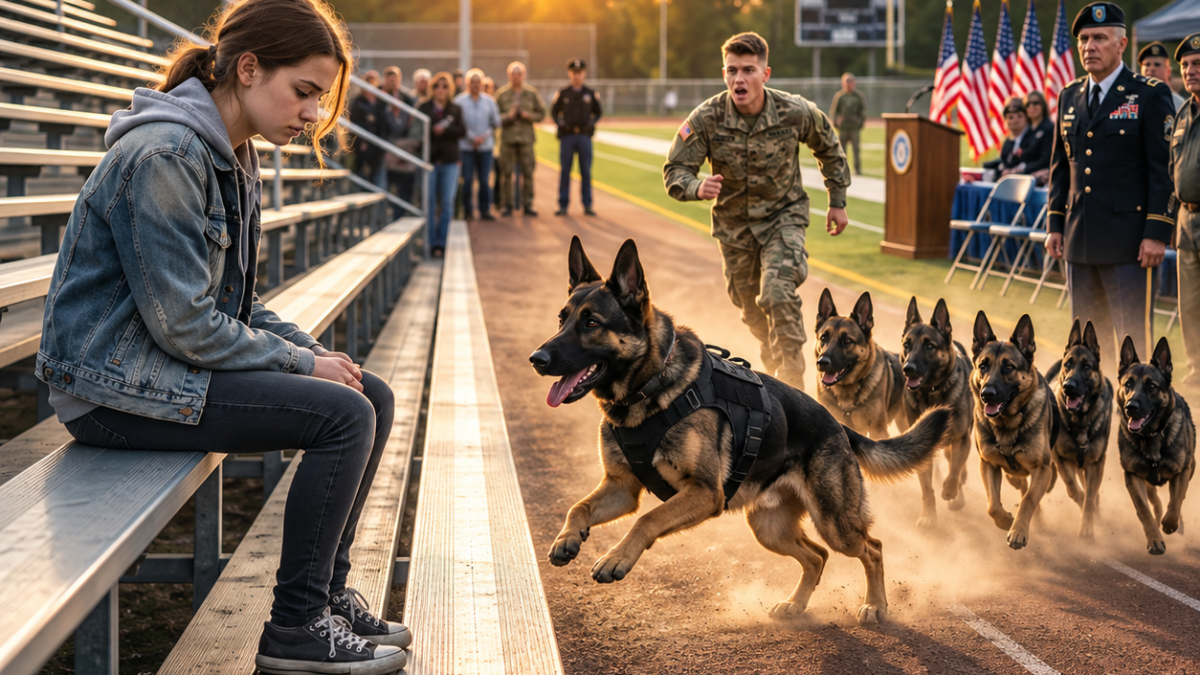
They Told a 16-Year-Old Girl She Didn’t Belong With the Military Families—Then Seven K9s Broke Formation and One Recognized Her as the Daughter of the Soldier Who Saved His Life.
The sixteen-year-old girl in the faded denim jacket did not argue when a volunteer sent her to the back because she “wasn’t military family”—she simply lowered her eyes and took the seat closest to the exit.
Minutes later, seven military working dogs ignored screaming handlers, broke a flawless formation in front of hundreds of officers, and raced straight toward the girl everyone had decided did not belong.
Then the lead German Shepherd pressed his head into her hand, she whispered the name of her dead father, and a secret buried in an Army file for eleven years began coming back to life.
Hannah Doyle had spent three years perfecting the art of disappearing.
At sixteen, she knew how to enter a room without making people look up.
She knew how to choose the chair nearest the wall.
How to eat lunch quickly enough that nobody noticed she was eating alone.
How to answer teachers with exactly enough words to avoid follow-up questions.
How to smile when somebody asked whether she was okay.
How to say, “I’m fine,” in a voice that ended the conversation.
Most teenagers wanted to be seen.
Hannah had learned that being seen usually meant being studied.
And being studied usually led to questions about her father.
So she became small.
Not physically.
She was tall for her age, almost five-foot-eight, with long brown hair she wore in a plain ponytail.
But she had a way of folding inward.
Shoulders slightly rounded.
Hands tucked into the sleeves of a faded denim jacket two sizes too big.
Eyes down.
Back row.
Always the back row.
That Saturday afternoon, the back row should have protected her.
Instead, it became the place where three hundred people finally saw her.
Fort Drayton’s main ceremonial gymnasium had been decorated for Major General Daniel Hargrove’s retirement.
Thirty-two years of service.
Two combat commands.
Three overseas deployments.
A Bronze Star.
Enough ribbons on his uniform that Hannah had stared at them for a full five seconds before reminding herself not to stare.
American flags stood behind the podium.
Rows of folding chairs covered the polished floor.
Military families filled the front sections.
Veterans wore caps embroidered with old unit numbers.
Children climbed over their parents’ knees.
Officers shook hands with people they had not seen in years.
Hannah did not know any of them.
That was the problem.
She had not really been invited in the normal sense.
Her aunt Claire cleaned administrative offices at Fort Drayton two nights a week.
One of the civilian secretaries, Mrs. Pruitt, knew Hannah liked dogs.
At least, that was how she had phrased it.
“Hannah likes dogs, doesn’t she?”
Claire had laughed.
“Hannah likes anything that doesn’t ask too many questions.”
So Mrs. Pruitt had found two guest passes.
PART2:
“The K9 unit is doing a demonstration during General Hargrove’s retirement ceremony. Bring her. Might be good for her to get out.”
Claire could not attend.
Saturday shift at the packaging plant.
Double pay.
They needed it.
Hannah almost threw the guest pass away.
Military bases made her uncomfortable.
Not because she disliked soldiers.
Because uniforms made her think about Daniel Doyle.
Her father.
Specialist Daniel Robert Doyle.
Eleven years Army.
Two deployments overseas.
Honorable discharge.
Dead at thirty-nine.
That was almost everything people knew.
The rest lived in whispers.
PART3:
He came home wrong.
He drank.
He stopped sleeping.
He couldn’t hold a job.
He crashed his truck on County Road 18 at two in the morning.
Probably fell asleep.
Maybe he’d been drinking.
Tragic.
Sad.
Shame.
Small towns could reduce an entire human life to six sentences if given enough time.
Hannah had heard every version.
Nobody ever told her the part before.
Before the nightmares.
Before the silence.
Before Daniel sat alone on the back porch until sunrise because closing his eyes made him remember things he refused to describe.
Before he stopped attending Veterans Day events.
Before he took the Army photographs off the wall.
Before the accident.
There had been another Daniel Doyle once.
Hannah remembered him only in pieces.
A laugh from the kitchen.
Large hands tying her shoes.
The smell of motor oil.
A bedtime voice doing terrible impressions of cartoon characters.
A habit of saving half his bacon for any dog within twenty feet.
And one photograph.
That photograph was with Hannah that afternoon.
It had been with her almost every day for three years.
Tucked inside a clear plastic sleeve.
Hidden in the front pocket of her backpack behind a broken zipper she had repaired with a safety pin.
She did not know where it had been taken.
Somewhere hot.
Somewhere far away.
Daniel was younger in the picture.
Twenty-something.
Dirty uniform.
Dust on his face.
Sitting cross-legged on hard ground.
A German Shepherd lay across his lap.
The dog’s left flank was shaved and bandaged.
Daniel’s hand rested on its neck.
Both looked exhausted.
Both looked strangely peaceful.
Hannah found the photograph after his funeral.
No writing on the back.
No date.
No name for the dog.
She had asked Aunt Claire once.
Claire said she didn’t know.
Then she’d left the room crying.
Hannah stopped asking.
That was what her family did with painful things.
They stopped asking.
So on the morning of General Hargrove’s ceremony, Hannah took the bus to Fort Drayton alone.
She almost turned around at the gate.
A security officer checked her pass.
“Family?”
“No, sir.”
“Guest?”
“Yes.”
He looked at her jacket.
Her old sneakers.
The patched backpack.
Then waved her through.
Inside the gymnasium, a volunteer wearing a red identification ribbon stood near the reserved seating.
Hannah looked down at her pass.
Mrs. Pruitt had written something on the back.
K9 demonstration guest.
The volunteer noticed her standing near the front.
“Can I help you?”
“I was told I could watch the dogs.”
“Certainly.”
He smiled politely.
“Families of active personnel are seated here.”
Hannah nodded.
He glanced at the empty chair beside her.
“Are you here with someone?”
“No.”
His expression changed only slightly.
Not cruel.
That almost made it worse.
The kind of automatic sorting people did without realizing it.
“Okay. These rows are reserved for military families and official guests.”
Hannah looked at the pass.
“I have this.”
He barely glanced.
“General admission is in the rear bleachers.”
“Oh.”
A woman standing nearby looked Hannah up and down.
Then murmured to another woman:
“Probably wandered into the wrong section.”
The second woman said:
“She doesn’t belong here.”
Not loudly.
Loud enough.
Hannah had heard versions of that sentence most of her life.
At school.
At church.
At a friend’s birthday party after somebody’s mother learned who her father was.
She did not argue.
She nodded.
“Sorry.”
“You’re fine,” the volunteer said.
He meant it kindly.
That was the strange thing.
Humiliation doesn’t always come from cruel people.
Sometimes it comes from decent people who do not stop long enough to look.
Hannah walked all the way to the last row of metal bleachers.
Closest seat to the exit.
Nobody wanted it because one of the support beams partly blocked the view of the podium.
Perfect.
She sat.
Folded her hands.
Made herself small.
A lieutenant’s wife arrived with three children.
“Would you mind scooting over?”
Hannah moved.
Another family arrived.
She moved again.
By the time the ceremony began, she had been pushed against the far wall.
That was fine.
She could see the dogs.
Seven military working dogs entered halfway through the program.
Hannah straightened without realizing it.
The crowd reacted immediately.
Children whispered.
Phones came up.
Handlers entered in a clean line.
Two German Shepherds.
Three Belgian Malinois.
A Dutch Shepherd.
And a black Labrador trained for explosives detection.
The lead German Shepherd was named Atlas.
Hannah knew because the announcer introduced each dog.
“Military Working Dog Atlas, handled by Corporal Mateo Reyes.”
Atlas was larger than Hannah expected.
Dark saddle.
Amber eyes.
Scar along his left flank visible where the fur changed direction.
Hannah’s fingers tightened around the bench.
Something tugged at memory.
Not recognition exactly.
A feeling.
The same feeling she had whenever she looked at the photograph in her backpack.
She leaned forward.
Atlas moved with precision.
Reyes gave hand signals.
Atlas obeyed instantly.
Sit.
Down.
Heel.
Turn.
The dog seemed connected to the corporal by an invisible wire.
Sergeant First Class Maria Delgado stood at the side of the gym overseeing the demonstration.
She had run K9 operations for fourteen years.
According to the program, Atlas had two overseas deployments and a flawless evaluation history.
The announcer spoke about obedience under distraction.
Noise.
Crowds.
Sudden movement.
Gunfire simulation.
Atlas did not react.
Then General Hargrove began the final portion of his speech.
Hannah looked away from the podium.
She was watching Atlas.
The dog stopped.
Just stopped.
Reyes took two more steps before noticing.
“Atlas.”
The German Shepherd’s head turned.
Not toward his handler.
Toward the bleachers.
Toward Hannah.
His ears lifted.
His entire body changed.
Reyes gave a sharp correction.
“Heel.”
Atlas did not move.
People nearest the floor began whispering.
Hannah froze.
The dog was staring directly at her.
Impossible.
She looked behind herself.
Wall.
Nothing.
Atlas took one step.
“Atlas, heel!”
The command cracked through the gym.
The dog launched.
A collective gasp rose.
Atlas ran straight across the polished floor.
Reyes shouted.
“ATLAS!”
The dog ignored him.
Two handlers moved instinctively.
Then Bodie, one of the Malinois, broke formation.
Daisy followed.
Then Rook.
Then Echo.
Then Samson.
Then the Labrador, Cooper.
Seven dogs.
Seven handlers yelling commands.
Every animal moving toward the same corner of the gymnasium.
Chairs scraped.
A flag stand toppled.
Children screamed in excitement.
Adults stood.
General Hargrove stopped speaking midsentence.
Hannah could not move.
Atlas reached the bleachers first.
Up one step.
Two.
Three.
Reyes chased behind him.
“Atlas, no!”
The German Shepherd stopped directly in front of Hannah.
For half a second dog and girl simply stared at each other.
Then Atlas made a sound.
A low, trembling whine.
Not aggressive.
Not excited.
Something deeper.
Something painful.
Hannah’s eyes filled instantly.
She did not know why.
The other six dogs arrived and spread around her.
One sat.
Another pressed against the bench.
Daisy rested her chin on Hannah’s knee.
Cooper circled once and lay at her feet.
The whole gymnasium had gone silent.
Not quiet.
Silent.
The kind of silence in which three hundred people suddenly become conscious of breathing.
Reyes reached the bleachers.
His face was red.
“Ma’am, don’t move.”
Hannah looked at him.
“He won’t hurt you. I just—Atlas, heel!”
Nothing.
“Atlas!”
The dog didn’t even flick an ear.
Reyes reached for the leash.
Atlas leaned harder into Hannah’s legs.
That was when Hannah moved.
Slowly.
She held out her hand.
Reyes said:
“Please wait.”
Atlas pressed his head into her palm before anyone could stop him.
Hannah closed her eyes.
Her fingers disappeared into the fur between his ears.
Something about the texture.
The smell.
The warmth.
She suddenly remembered being eight years old and sitting on the garage floor while her father described a dog.
Not his dog.
A dog from overseas.
A shepherd.
Daniel had said:
“Smartest soldier I ever knew.”
Hannah had laughed.
“Dogs aren’t soldiers.”
Daniel became serious.
“Some are.”
She opened her eyes.
Atlas stared up at her.
Hannah whispered:
“Daniel Doyle.”
Atlas jerked as if struck by electricity.
His ears flattened.
Then lifted.
He barked once.
Sharp.
He pushed his entire body against Hannah.
The other dogs stirred.
Reyes went pale.
Hannah whispered the name again.
“Daniel.”
Atlas began whining.
Not loudly.
A broken little sound.
Hannah covered her mouth.
Reyes stared.
“How do you know that name?”
Hannah looked at him.
“What?”
“You said Daniel Doyle.”
“My father.”
Reyes slowly lowered his hand from the leash.
“Your father was Daniel Doyle?”
“Yes.”
“Specialist Doyle?”
Hannah’s heart jumped.
“You knew him?”
“No.”
Reyes looked toward Delgado.
“But that name…”
Sergeant Delgado was already coming.
Major General Hargrove stepped down from the stage.
People parted instinctively.
Hannah saw the man being honored that afternoon walk the length of the gym toward her.
The volunteer who had sent her to the back was standing beside the aisle.
His face looked stricken.
General Hargrove stopped at the bottom of the bleachers.
He looked at the dogs.
Then Hannah.
“What is your name, young lady?”
“Hannah Doyle, sir.”
The general’s expression changed.
“Doyle?”
“Yes, sir.”
“Daniel Doyle’s daughter?”
Hannah stared.
“You knew him too?”
The general did not answer.
Not immediately.
He looked at Atlas.
The dog had pressed his nose into Hannah’s sleeve.
Hargrove’s face drained of color.
“Sergeant Delgado.”
“Yes, sir.”
“Private room.”
The retirement ceremony stopped.
Nobody complained.
Delgado led Hannah into a side office.
Atlas followed.
Reyes tried to redirect him.
Hargrove said:
“Let him.”
The other dogs stayed outside with their handlers.
Atlas walked beside Hannah as though assigned to her.
In the office, Hannah sat in a plastic chair.
Atlas positioned himself against her left leg.
Reyes stood near the door.
Delgado opened a laptop.
General Hargrove removed his service cap and placed it on the table.
“Hannah, I’m going to ask you some questions.”
She nodded.
“If anything makes you uncomfortable, say so.”
“Okay.”
“What do you know about your father’s military service?”
“Not much.”
Hargrove frowned.
“Nothing?”
“He didn’t talk about it.”
“Did your family receive his service records after he died?”
“My aunt has a box.”
“Medals?”
“Yes.”
“Discharge papers?”
“Probably.”
Hannah looked down.
“Nobody really explained them to me.”
Delgado asked:
“Did your father ever mention working with a military dog?”
Hannah’s fingers stopped.
“Yes.”
Atlas lifted his head.
“What did he say?”
“Not much.”
She thought.
“He said there was a dog whose handler got hurt.”
Reyes and Delgado exchanged a look.
“He took care of it for a while.”
“What was the dog’s name?”
“I don’t know.”
Atlas whined.
Hannah looked down at him.
“My dad said it got hurt.”
Hargrove sat very still.
“How?”
“He never said.”
“When did he tell you this?”
“I was maybe ten.”
“Three years before his death?”
“Yes.”
“What exactly did he say?”
Hannah tried to remember.
“He told me somebody ordered him to leave the dog.”
Reyes inhaled sharply.
“He wouldn’t.”
Hargrove leaned forward.
“What happened?”
Hannah’s voice became softer.
“He carried it.”
“How far?”
“I don’t know.”
“Where?”
“I don’t know.”
She became frustrated.
“He didn’t tell me details.”
“That’s okay.”
“No.”
Her eyes filled.
“Everybody keeps asking things about him after he’s dead. Nobody asked when he was alive.”
The room went still.
General Hargrove looked down.
Hannah immediately regretted it.
“Sorry, sir.”
“Don’t apologize.”
He meant that.
“Hannah, you’re right.”
She stared.
He repeated:
“You’re right.”
Delgado began typing.
Search terms.
Daniel R. Doyle.
Army.
Working dog.
Deployment records.
Hannah watched.
Several results appeared.
Most were administrative.
Enlistment.
Promotions.
Deployments.
Medical evaluation.
Honorable discharge.
Then Delgado found an archived incident report.
She stopped scrolling.
“Sir.”
Hargrove came behind her.
Reyes moved closer.
Hannah could not see the screen.
“What?”
Nobody answered.
“What’s wrong?”
Hargrove read silently.
Then looked at Atlas.
Then at Hannah.
“Nothing is wrong.”
He pulled a chair closer.
“Your father served in Task Force Meridian during his final deployment.”
Hannah waited.
“One mission involved a military working dog named Atlas.”
Her breath stopped.
She looked down.
The German Shepherd was watching her.
“No.”
Delgado rotated the laptop.
The file contained an old K9 identification photograph.
Younger.
Thinner.
Same eyes.
Same left-flank scar.
Hannah’s hand flew to her backpack.
She tore open the broken zipper.
Pulled out the plastic sleeve.
The photograph.
She placed it beside the laptop.
Nobody spoke.
Young Daniel Doyle.
Dusty uniform.
German Shepherd across his lap.
Delgado picked up the photograph carefully.
She compared the markings.
Black mask.
Ear notch.
Scar.
A tiny white patch beneath the dog’s jaw.
Reyes crouched beside Atlas.
“Oh my God.”
Hannah whispered:
“That’s him?”
Reyes looked at her.
“Yes.”
“How?”
Nobody had an answer yet.
Delgado began reading the incident report aloud.
September 14.
Eleven years earlier.
A patrol in a mountainous region had been hit by an explosive followed by small-arms fire.
Atlas’s primary handler, Staff Sergeant Eric Malloy, sustained severe leg injuries.
Atlas was wounded by shrapnel.
Evacuation was delayed.
Doyle, assigned as communications support, assisted the K9 team.
During withdrawal, commanders believed Atlas could not keep pace.
The report contained one brutal line:
Canine asset deemed non-ambulatory.
Hannah frowned.
“What does that mean?”
Reyes answered reluctantly.
“He couldn’t walk.”
The next line:
Recommendation made to leave animal pending secondary recovery.
Hannah stared.
“They were going to leave him?”
Hargrove said:
“They were under fire.”
“But my dad didn’t.”
“No.”
The report continued.
Specialist Doyle disregarded instruction and transported MWD Atlas approximately 2.7 kilometers while maintaining communications support.
Reyes whispered:
“That’s almost two miles.”
Hannah looked at Atlas.
Her father’s dog.
No.
Not his dog.
The dog he refused to leave.
The dog who survived.
The dog now pressed against her knee.
Delgado scrolled.
There was more.
Atlas reached extraction.
Emergency surgery.
Returned to service fourteen months later.
Transferred twice.
Eventually assigned to Fort Drayton.
Hannah touched the scar.
“You carried him.”
Atlas closed his eyes.
She began crying.
Quietly.
No dramatic sobbing.
Tears simply moved down her face.
“My dad never told me.”
Hargrove’s voice was low.
“He should have been recognized.”
“Wasn’t he?”
Delgado looked at the file.
“This incident report recommends him for commendation.”
Hannah looked up.
“What does that mean?”
No one answered immediately.
Then Hargrove said:
“It means somebody believed what he did deserved formal recognition.”
“Did he get it?”
Delgado searched.
Nothing.
She searched again.
Nothing.
No medal.
No commendation.
No citation.
The recommendation ended with:
Administrative review pending.
Eleven years pending.
General Hargrove’s jaw tightened.
“Find the packet.”
Delgado nodded.
“Sir.”
“Every page.”
Hannah wiped her face.
“Why?”
Hargrove looked at her.
“Because your father’s name should not have disappeared between two pieces of paperwork.”
That was how the investigation began.
Not because seven dogs ran across a gym.
Because an old commendation recommendation had vanished.
The ceremony recessed for what was announced as “a brief operational delay.”
It lasted more than two hours.
Nobody left.
Rumor moved through the gymnasium.
Who is she?
Whose daughter?
Why did the dogs know her?
The volunteer who had sent Hannah to the back sat alone.
Mrs. Pruitt found him.
“What happened?”
He told her.
Her face hardened.
“You moved Hannah Doyle to the back?”
“She wasn’t listed as family.”
“She is military family.”
“I didn’t know.”
“That was the problem.”
He looked devastated.
“I was following the seating chart.”
Mrs. Pruitt sighed.
“Then maybe next time look at the person before the chart.”
Inside the office, records began arriving.
Digital archives.
Scanned reports.
Old emails.
Personnel notes.
One name appeared repeatedly.
Captain Richard Bale.
Daniel Doyle’s company commander during the deployment.
Retired now.
The original commendation had been routed through Bale.
Then stalled.
Why?
An attached note offered a clue.
Recommendation returned for clarification regarding disobedience of tactical withdrawal order.
Hannah stared at the words.
“My dad got in trouble for saving him?”
Hargrove frowned.
“Possibly.”
Another document.
Captain Bale’s response:
SPC Doyle acted outside instruction, creating additional evacuation burden. Heroic intent acknowledged; formal valor recognition not recommended.
Reyes swore under his breath.
Delgado looked at him.
“Corporal.”
“Sorry, Sergeant.”
Hannah didn’t speak.
Hargrove kept reading.
A lieutenant had objected.
Lieutenant Samuel Price.
His handwritten statement had been scanned.
Doyle did not create the emergency. The emergency already existed. He prevented abandonment of a trained working animal and maintained communications while doing so. K9 survived because of Doyle’s actions.
Hannah swallowed.
“Who is Samuel Price?”
Hargrove looked at the name.
“I know him.”
“Where?”
“Retired.”
“Alive?”
“As far as I know.”
Hargrove took out his phone.
It took twelve minutes to reach him.
Samuel Price lived ninety miles away.
Seventy now.
When General Hargrove introduced himself, Price was polite.
Then Hargrove said Daniel Doyle.
Silence.
Price’s voice changed.
“What about Doyle?”
“His daughter is sitting in front of me.”
Another silence.
“Daniel had a daughter?”
“Yes.”
“Good Lord.”
Hargrove put the call on speaker.
“Hannah, this is Lieutenant Price.”
“Former lieutenant.”
Price laughed softly.
“Very former.”
Hannah clutched her sleeve.
“Did you know my dad?”
“I did.”
“What was he like?”
The question escaped before she could stop herself.
Price went quiet.
Then said:
“Stubborn.”
Hannah almost smiled.
“Very stubborn.”
Atlas shifted against her.
Price continued.
“Funny when he wasn’t supposed to be.”
Hannah’s eyes filled.
“Terrible coffee.”
She laughed.
A tiny sound.
“Your father could sleep on rocks but complained endlessly about mattresses.”
That sounded like Daniel.
Hannah covered her mouth.
Price’s voice softened.
“He was a good soldier.”
Nobody had said that to her before.
Not once.
People had called him troubled.
Quiet.
Sad.
Damaged.
Difficult.
A good soldier.
Hannah closed her eyes.
“Did he save Atlas?”
Price took a breath.
“Yes.”
“Tell me.”
Hargrove began to interrupt.
“Hannah—”
“No.”
She looked at him.
“Please.”
Price told her.
The patrol had been moving through a narrow valley.
The blast injured Malloy and Atlas.
Enemy fire came from above.
The unit had limited carrying capacity.
Malloy needed evacuation.
Atlas couldn’t walk.
Someone suggested they mark the location and recover the dog when the area was secure.
Daniel refused.
Not loudly at first.
He tried making a sling.
It failed.
Then the withdrawal order came.
Move now.
Daniel lifted the seventy-pound German Shepherd across his shoulders.
Kept his radio strapped across his chest.
Walked.
Fell twice.
Got up.
Atlas bit him once from pain.
Daniel kept moving.
“At one point,” Price said, “I told him to put the dog down.”
Hannah’s fingers tightened.
“What did he say?”
Price laughed.
“I remember every word.”
“What?”
“He said, ‘You want him left, sir, you carry him back there yourself.’”
Reyes smiled.
Hargrove covered his mouth.
Hannah laughed through tears.
“That sounds like him.”
“Yes.”
Price’s voice became heavier.
“We reached extraction. Atlas survived. Malloy survived.”
“Why didn’t Dad get the medal?”
Price went silent.
“Lieutenant?”
“I tried.”
“What happened?”
“Captain Bale believed your father violated an order.”
“Did he?”
“Yes.”
The answer surprised everyone.
Price continued.
“He did.”
Hannah looked down.
“But sometimes the whole truth is larger than whether somebody followed a sentence exactly.”
Price explained that Daniel had already been struggling with leadership.
Questioned decisions.
Argued about civilian safety.
Refused to treat dogs as equipment.
His reputation was “difficult.”
The rescue became another example in Bale’s eyes.
Daniel’s commendation disappeared into administrative limbo.
Price pushed.
Then deployed elsewhere.
Months passed.
Atlas recovered.
Daniel came home.
Nobody reopened the packet.
Hannah asked:
“Did Dad know?”
“I don’t know.”
Price sounded ashamed.
“I assumed somebody fixed it.”
Nobody had.
Eleven years.
Hannah said:
“He died thinking nobody remembered.”
Price’s voice cracked.
“I remembered.”
“But you never called.”
Silence.
There it was.
The cruelty of good intentions delayed too long.
“I didn’t know where he was.”
“You could’ve found him.”
Price did not defend himself.
“Yes.”
Hannah cried again.
Price said:
“I’m sorry.”
This time she did not say it’s okay.
Because it wasn’t.
That was another thing Hannah was learning that afternoon.
You did not have to erase someone else’s failure just because they apologized honestly.
“I wish you had.”
“So do I.”
General Hargrove looked toward the closed office door.
Outside were hundreds of people waiting for a retirement ceremony.
Inside sat one teenager discovering that her father had once been brave enough to carry a wounded dog under fire and forgotten enough to die without public recognition.
Hargrove stood.
“Sergeant Delgado.”
“Yes, sir.”
“Get Judge Advocate involved.”
Hannah looked up.
“What?”
“We’re reopening the commendation review.”
Her eyes widened.
“Can you do that?”
“I can start it.”
“He’s dead.”
“That doesn’t make the record less wrong.”
The sentence landed hard.
The record less wrong.
Hannah had spent three years watching people remember the end of Daniel Doyle’s life as though the end explained the whole man.
Now somebody with stars on his shoulders was saying records could be wrong.
Memories could be incomplete.
Institutions could fail.
And failure did not become truth just because enough time passed.
Then Delgado found something else.
Daniel Doyle’s post-service medical notes.
Hannah didn’t want to read them.
Hargrove didn’t show her.
But he read enough.
Sleep disturbance.
Hypervigilance.
Chronic pain.
Hearing damage.
Probable post-traumatic stress.
Missed appointments.
Alcohol misuse.
Occupational instability.
One physician requested specialized trauma treatment.
Appointment delayed.
Another note:
Patient unreachable.
Hannah whispered:
“He stopped answering phones.”
Aunt Claire had told her that.
Daniel sometimes unplugged his phone for days.
Another record.
Veterans outreach attempted twice.
No contact.
Case closed.
Two words.
Case closed.
Hannah stared.
“That’s it?”
Hargrove looked at the screen.
“No.”
“But that’s what they did.”
His jaw tightened.
“Yes.”
“He carried a dog two miles when people told him to leave it.”
Nobody spoke.
“And when he stopped answering his phone, everybody left him?”
Reyes looked away.
Hannah’s voice rose for the first time.
“Everybody says he was difficult.”
Tears filled her eyes.
“Maybe he was tired.”
“Hannah—”
“Everybody says he drank.”
Her breathing shook.
“He did.”
She looked at Hargrove.
“I know he did.”
Nobody interrupted.
“He forgot my birthday once.”
Her voice cracked.
“He yelled at Aunt Claire.”
She wiped her face angrily.
“He sat in the dark.”
Atlas pushed closer.
Hannah rested a hand on him.
“I know he wasn’t okay.”
Then:
“But nobody ever told me why.”
That sentence changed General Hargrove’s retirement ceremony into something else.
An accounting.
Not only for Daniel Doyle.
For everybody institutions remembered best when they were useful and too easily lost when they stopped functioning cleanly.
Hargrove sat beside Hannah.
Not across.
Beside.
“I served with men who came home carrying things their families never saw.”
Hannah listened.
“Some asked for help.”
He paused.
“Some couldn’t.”
“Did you help them?”
“Not enough.”
She looked at him.
That answer mattered.
No speech.
No excuse.
Not enough.
Hargrove continued.
“I can’t fix what happened to your father.”
“No.”
“I can’t give you the three years since he died.”
“No.”
“I can’t make him hear whatever recognition comes now.”
Hannah stared at Atlas.
“But I can make sure nobody in this building leaves today believing Daniel Doyle was just a man who came home and fell apart.”
Her eyes filled again.
“Would that be okay?”
Hannah nodded.
“Yes.”
The gymnasium doors reopened.
People sat.
Handlers gathered the six other dogs.
Atlas refused to leave Hannah.
Reyes gave one command.
Nothing.
He tried food.
Nothing.
Delgado finally said:
“Give her the leash.”
Reyes looked at Hannah.
“You comfortable?”
“I think so.”
He handed it over.
Atlas immediately stood.
Hannah walked into the gymnasium holding the leash of the dog her father had once carried under fire.
Every person turned.
The difference from two hours earlier was almost unbearable.
Same girl.
Same denim jacket.
Same worn sneakers.
Same broken backpack.
Now colonels stood as she passed.
Veterans removed caps.
The volunteer who sent her to the back looked like he wanted the floor to swallow him.
General Hargrove returned to the podium.
He looked at the prepared retirement speech.
Then pushed it aside.
“Ladies and gentlemen, before we conclude today, I need to tell you why our K9 demonstration failed.”
A nervous ripple of laughter.
Hargrove did not smile.
“Actually, that’s not accurate.”
He looked at Atlas.
“The dogs did not fail.”
Silence.
“We did.”
Every head lifted.
Hargrove told them Daniel Doyle’s name.
He described the deployment.
The blast.
The wounded handler.
The wounded dog.
The withdrawal.
The order.
Daniel carrying Atlas 2.7 kilometers through hostile terrain.
Maintaining communications.
Refusing to leave the animal.
He told them the commendation recommendation had been stalled.
Not denied through a completed process.
Stalled.
Forgotten.
He told them Daniel returned home carrying injuries that could not be seen on parade grounds.
He did not romanticize what followed.
“Specialist Doyle struggled.”
Hannah closed her eyes.
“He made mistakes.”
She opened them.
“He experienced addiction, isolation, and severe readjustment problems.”
Hargrove paused.
“But a man’s hardest years do not erase his bravest ones.”
The room changed.
An older veteran in the third row stood.
Slowly.
Nobody had asked him.
Hargrove continued.
“Three years ago Daniel Doyle died in a vehicle accident.”
Atlas looked at Hannah.
“His sixteen-year-old daughter has spent those three years carrying a photograph most of us did not know existed.”
Hannah felt hundreds of eyes.
Normally that would have terrified her.
Atlas leaned into her leg.
She stayed.
“Today she was seated in the back of this gymnasium because nobody knew who she was.”
The volunteer bowed his head.
Hargrove looked toward him.
Not cruelly.
“We saw a teenager in old clothes.”
Pause.
“Our dogs saw family.”
A woman began crying.
Hargrove said:
“Atlas recognized something before we did.”
He did not pretend science could explain exactly what.
Maybe Daniel’s name.
Maybe scent carried through an old photograph and belongings.
Maybe posture.
Maybe coincidence magnified by memory.
Maybe Atlas broke formation and the other dogs followed his emotional cue.
None of that changed the truth.
Atlas knew Daniel Doyle.
And something about Hannah made the old dog refuse to walk past her.
Hargrove finished:
“Specialist Daniel Doyle would not leave a soldier behind, even when that soldier had four legs.”
The old veteran raised his hand in salute.
Another stood.
Then another.
The room rose.
Not applause at first.
Standing.
Three hundred people.
Hannah’s mouth trembled.
The volunteer who had sent her away stood too.
Then he did something unexpected.
He left his place near the aisle.
Walked toward Hannah.
Stopped several feet away.
“Miss Doyle?”
She looked at him.
“My name is Peter Collins.”
She remembered.
He had been wearing the red ribbon.
“I owe you an apology.”
The gymnasium was silent enough to hear him.
“You don’t have to—”
“Yes, I do.”
He swallowed.
“You had a valid guest pass.”
Hannah looked down.
“I should’ve checked it more carefully.”
He continued.
“But more than that, I looked at you and decided who you were before asking.”
His face reddened.
“I sent you to the back because you didn’t look like the people I thought belonged in the front.”
Nobody moved.
Hannah felt something painful rise in her throat.
Peter said:
“I’m sorry.”
She stared at him.
Then said:
“Thank you.”
Not it’s okay.
Thank you.
He nodded.
That distinction mattered.
Hargrove invited Hannah to the podium.
She shook her head.
“No.”
Atlas looked up.
The crowd waited.
General Hargrove said:
“You don’t have to.”
Hannah took one breath.
Then another.
She stood.
Walked forward.
Atlas beside her.
At the podium, the microphone was too high.
Hargrove lowered it.
Hannah looked at three hundred faces.
She almost ran.
Back row.
Exit seat.
Invisible.
She knew how to do invisible.
But Atlas sat.
Waiting.
Hannah touched his head.
Then spoke.
“My dad wasn’t always easy.”
The room became still.
“After he came home, he was angry sometimes.”
She swallowed.
“He didn’t sleep.”
“He drank too much.”
Her aunt would hate that she said it publicly.
Hannah continued anyway.
“He forgot things.”
Her eyes filled.
“Sometimes I was mad at him.”
Atlas leaned against her.
“When he died, people told me I should remember the good parts.”
She looked at the photograph in her hand.
“The problem was nobody would tell me what the good parts were.”
A woman in uniform covered her mouth.
“All I heard was what happened at the end.”
Hannah’s voice shook.
“I started thinking maybe the person I remembered when I was little wasn’t real.”
She looked down at Atlas.
“Today I found out he was.”
That broke the room.
Reyes wiped his eyes openly.
Hannah lifted the photograph.
“My dad carried this dog.”
Atlas’s ears moved.
“And somehow this dog carried something back to me.”
She stopped.
Could not continue for several seconds.
General Hargrove stood close enough to help but did not touch her.
Finally Hannah said:
“I don’t need my dad to have been perfect.”
Her voice strengthened.
“I just needed him to be more than the worst thing people remembered.”
The old veteran near the aisle whispered:
“Amen.”
Hannah nodded.
“That’s all.”
She stepped away.
The applause began.
Not explosive.
Not celebratory.
It grew.
Row by row.
People stood straighter.
Handlers saluted.
Veterans clapped.
Families cried.
Hannah wanted to disappear.
Instead she stood beside Atlas and let them see her.
That should have been the end.
It wasn’t.
General Hargrove postponed the private retirement dinner.
His wife understood.
“Thirty-two years can wait one evening,” she said. “That girl has already waited three.”
The investigation continued.
Delgado contacted the Army Human Resources Command.
Archived commendation records were pulled.
Judge Advocate reviewed the original packet.
Retired Captain Richard Bale was located in Arizona.
At first he declined to speak.
Then a reporter learned about the story.
Not from Hannah.
From somebody inside the ceremony.
The headline spread locally:
MILITARY K9 BREAKS FORMATION, REUNITES WITH DAUGHTER OF SOLDIER WHO SAVED HIM.
Then nationally.
Bale called Fort Drayton himself.
General Hargrove took the call.
Hannah was not present.
She later learned what he said from Hargrove.
Bale maintained that Daniel had violated a lawful order.
Hargrove agreed.
Then asked:
“Why didn’t you formally deny the commendation?”
Silence.
Bale said the unit had been overwhelmed after deployment.
Paperwork was chaotic.
Personnel rotated.
“I thought it was handled.”
Hargrove responded:
“Everybody thought somebody else handled Daniel Doyle.”
That sentence appeared in the review report later.
It became the sentence Hannah hated most.
Because it explained too much.
His medal.
His treatment.
His phone calls.
His loneliness.
Everybody thought somebody else handled it.
A week after the ceremony, Samuel Price drove to Hannah’s duplex.
He brought a box.
Aunt Claire almost didn’t let him inside.
“You knew Daniel?”
“Yes.”
“And you waited how long?”
Price lowered his eyes.
“Too long.”
Claire wanted to slam the door.
Hannah said:
“Let him in.”
Price sat at their small kitchen table.
He had brought photographs.
Dozens.
Daniel laughing with soldiers.
Daniel asleep against a truck tire.
Daniel holding Atlas’s leash.
Daniel feeding the dog from his hand.
Daniel kneeling beside Staff Sergeant Malloy in a hospital after both Malloy and Atlas had survived.
Hannah touched each photo.
“He smiled.”
Price looked confused.
“What?”
“People tell me he used to smile.”
Her voice broke.
“I forgot.”
Claire turned toward the sink.
Price stared at the table.
“Hannah, there is something else.”
He handed her an envelope.
Old.
Folded.
“I wrote your father after I retired.”
“Did he get it?”
“I never sent it.”
Hannah’s face hardened.
“Why bring it?”
“Because cowardice doesn’t improve in a drawer.”
She stared at him.
He continued.
“I kept telling myself I’d find the right address.”
His hands trembled.
“Then I heard he died.”
“What’s in it?”
“An apology.”
Hannah pushed it back.
“I don’t want it.”
Price nodded.
“Fair.”
He did not pressure her.
That made her look at him again.
“You keep it.”
“I will.”
“Maybe I’ll want it someday.”
“Then it’s yours.”
Before leaving, Price stopped at the door.
“Your father saved more than Atlas that day.”
Hannah frowned.
“What do you mean?”
“Malloy’s evacuation team was delayed because Atlas was with us.”
Hannah stiffened.
“I thought that was bad.”
“In one sense.”
Price smiled sadly.
“But Atlas began alerting while we were waiting.”
“To what?”
“Secondary explosive.”
The room went still.
Price explained.
Atlas, injured and barely conscious, detected explosives near the alternate extraction route.
The team changed position.
Minutes later, the explosive detonated.
No soldiers were standing there.
Hannah stared.
“How many?”
“Six.”
Claire sat down.
“Daniel carried the dog that warned them?”
“Yes.”
“Was that in the report?”
“Buried in an annex.”
Of course it was.
Buried.
Hannah almost laughed.
Her father’s whole life seemed buried in annexes, boxes, and memories other people assumed someone else would preserve.
The new investigation added that detail.
The commendation review became stronger.
Not because saving Atlas needed justification.
But because institutional systems understood outcomes.
Daniel’s refusal had saved the dog.
The surviving dog had then potentially prevented further casualties.
What had once been labeled disobedience looked different when the whole chain of events was visible.
Six weeks later, Aunt Claire received a call.
Fort Drayton requested their presence.
Private ceremony.
Hannah wore the denim jacket.
Claire protested.
“You have nicer clothes.”
“I want this.”
“Why?”
Hannah thought.
“Because this is what I was wearing when Atlas found me.”
Claire nodded.
“Fair.”
When they arrived, the same volunteer, Peter Collins, met them.
This time he did not ask for a pass.
“Miss Doyle.”
“Hi.”
“I saved you a seat.”
Front row.
Hannah looked at it.
Then at the back bleachers.
Peter became nervous.
“If you’d rather—”
“Front is okay.”
She smiled.
He almost cried.
General Hargrove stood at the podium.
Not in dress uniform this time.
Service uniform.
Sergeant Delgado.
Corporal Reyes.
Samuel Price.
Staff Sergeant Eric Malloy.
Hannah did not recognize Malloy at first.
He walked with a cane.
Gray hair.
He had driven nine hours.
Atlas saw him.
The dog went wild.
Reyes laughed as Atlas strained toward the older man.
Malloy dropped to one knee.
“Hey, partner.”
Atlas buried his face against him.
Hannah watched.
Another piece returning.
Malloy eventually stood and faced her.
“You’re Danny’s girl.”
Nobody had called Daniel Danny around Hannah in years.
“Yes.”
Malloy hugged her only after asking.
“Your dad saved my dog.”
Hannah said:
“He saved you too.”
Malloy’s face changed.
“Yeah.”
He nodded.
“He did.”
The Army approved a posthumous Soldier’s Medal with an accompanying corrected service citation recognizing Daniel’s actions.
Not every requested valor decoration was possible under the circumstances and documentation.
General Hargrove explained that carefully.
Hannah appreciated the honesty.
She didn’t need the biggest medal.
She needed a true record.
Hargrove read the citation.
Daniel Robert Doyle.
For courageous action under hazardous conditions.
For preserving the life of a military working dog despite personal risk.
For continued mission support during emergency withdrawal.
For conduct reflecting great credit upon himself and the United States Army.
Claire sobbed.
Hannah stood.
The medal was placed in a box.
Hargrove handed it to her.
Heavy.
Cold.
Real.
She stared.
“He should have gotten this.”
“Yes.”
“While he was alive.”
“Yes.”
Hargrove did not hide behind procedure.
“We were late.”
Hannah looked at him.
“You didn’t know him.”
“No.”
“But you’re saying we.”
“Yes.”
“Why?”
“Because institutions don’t get to claim collective honor and then turn failures into somebody else’s problem.”
Hannah held the medal tighter.
That answer stayed with her.
Outside the K9 training field, the base installed a small plaque.
Not enormous.
Daniel would have hated enormous.
SPECIALIST DANIEL R. DOYLE
HE WOULD NOT LEAVE A SOLDIER BEHIND.
The last line:
LOYALTY IS WHAT WE DO WHEN LEAVING WOULD BE EASIER.
Hannah touched the plaque.
Atlas sat beside her.
Then came the question nobody expected.
Reyes approached General Hargrove.
“Sir, Atlas is nine.”
Hargrove nodded.
“He’s still cleared.”
“Yes, sir.”
“But?”
Reyes looked toward Hannah.
Atlas had spent every available moment seeking her out.
During training he remained obedient.
But whenever Hannah visited, the old dog transformed.
He followed her.
Waited outside rooms.
Rested at her feet.
Reyes said:
“He’s eligible for retirement review.”
Hargrove understood.
“You want her to adopt him?”
Reyes smiled.
“I think he already decided.”
It wasn’t simple.
Military working dog retirement had procedures.
Medical evaluations.
Ownership transfer.
Suitability assessment.
Home inspection.
Claire worried about food costs.
Veterinary bills.
Their duplex had a small yard.
Hannah said nothing.
She didn’t want to ask.
Three weeks later, there was a knock on the door.
Hannah opened it.
Reyes stood outside.
Atlas beside him.
No working harness.
Just a blue collar.
Hannah stared.
Reyes held out a folder.
“Military Working Dog Atlas has officially retired.”
Hannah’s mouth opened.
Behind her Claire began crying before anyone finished speaking.
Reyes continued:
“Pending one final signature.”
He held out a pen.
Hannah’s hands shook.
“What?”
“Adoption.”
She looked at Claire.
Her aunt nodded.
“We’ll figure out the food.”
Hannah signed.
Reyes crouched beside Atlas.
For two years, the dog had been his partner.
That goodbye hurt.
Everyone saw it.
“You be good.”
Atlas licked his face.
Reyes laughed through tears.
“You never ignored me once until she showed up.”
Hannah whispered:
“Sorry.”
Reyes looked at her.
“Don’t be.”
He stood.
“Your dad gave him back to us once.”
He handed Hannah the leash.
“Seems right we give him back to you.”
That night Atlas slept beside Hannah’s bed.
She woke at 2:14 a.m.
The room dark.
Rain against the window.
For one terrified second she thought about her father.
County Road 18.
Twisted truck.
Police lights.
Aunt Claire’s face.
Then she felt Atlas’s head against her hand.
He had climbed halfway onto the mattress.
Hannah whispered:
“Did you miss him too?”
Atlas sighed.
She buried her fingers in his fur.
“I did.”
The dog stayed.
Hannah started sleeping better.
Not perfectly.
Grief doesn’t leave because a dog arrives.
But silence felt different when another living thing shared it.
At school the story had spread.
That part Hannah hated.
Students who had ignored her suddenly wanted to ask questions.
“Is it true seven Army dogs attacked the crowd to get to you?”
“No.”
“Did your dad save like fifty soldiers?”
“No.”
“Was he special forces?”
“No.”
“Did Atlas remember your scent from when you were a baby?”
“I have no idea.”
Rumor tried to make Daniel bigger than reality.
Hannah resisted.
She had spent too long watching people flatten him into failure.
She wasn’t going to flatten him into a superhero either.
He had been a man.
Brave sometimes.
Broken sometimes.
Funny.
Angry.
Loving.
Absent.
A soldier.
A father.
An alcoholic for a period.
A rescuer.
A person who needed help.
A person who gave help.
Human.
That was enough.
One afternoon a boy named Mason approached her.
He had mocked her jacket the year before.
Hannah remembered.
Mason looked uncomfortable.
“My dad served.”
“Okay.”
“He doesn’t go anywhere anymore.”
Hannah waited.
“Crowds.”
He shrugged.
“Fireworks mess him up.”
Hannah understood.
Mason continued:
“My mom says he’s difficult.”
Hannah looked at him.
“He might be.”
Mason’s face fell.
Then she added:
“That doesn’t mean that’s all he is.”
He nodded.
“My dad saw your dad’s story.”
“And?”
“He cried.”
Mason shoved his hands into his pockets.
“He never cries.”
Hannah did not know what to say.
Mason said:
“He called the VA the next morning.”
That was the first moment Hannah understood her father’s repaired record might matter beyond their family.
Stories gave people permission.
Sometimes to judge.
Sometimes to ask for help.
General Hargrove learned that too.
Retirement did not go as planned.
His wife had imagined travel.
He ended up spending part of his first year working with veterans’ transition organizations.
Fort Drayton created a review initiative for overlooked commendation recommendations and unresolved post-deployment referrals.
Nobody called it Daniel’s program officially.
Everybody knew.
Sergeant Delgado expanded family outreach around retiring K9s.
Peter Collins rewrote guest-seating instructions for base ceremonies.
The new first line said:
DO NOT ASSUME GUEST STATUS BASED ON APPEARANCE. VERIFY BEFORE REDIRECTING.
He sent Hannah a photograph.
She replied:
Good.
One word.
Peter printed it and taped it over his desk.
Captain Richard Bale eventually wrote Hannah a letter.
She left it unopened for two months.
Then one rainy Sunday she sat on the porch with Atlas and opened it.
Bale did not ask forgiveness.
That surprised her.
He wrote:
Your father disobeyed my order.
At the time I believed allowing that action to be publicly celebrated would undermine discipline.
I was wrong to let that belief prevent a complete review of what he actually accomplished.
Command requires decisions under pressure.
It does not excuse refusing to reconsider them when evidence changes.
I did not know what Daniel experienced after returning home.
I cannot claim responsibility for all that followed.
But I am responsible for the recommendation I allowed to disappear.
I am sorry.
Hannah read it twice.
Then put it back in the envelope.
Claire asked:
“You okay?”
“I don’t know.”
“You forgive him?”
Hannah shrugged.
“I think I believe him.”
Sometimes that was enough.
Samuel Price kept visiting.
Eventually Hannah read his unsent letter.
It said mostly what he had already told her.
Daniel had been a good soldier.
A difficult subordinate.
A loyal friend.
Price wrote that courage was not obedience.
Sometimes courage and obedience lined up perfectly.
Sometimes they collided.
When they collided, consequences came.
But consequences did not erase courage.
Hannah kept that letter.
She also began asking Aunt Claire harder questions.
“Why didn’t Dad live with you after he got bad?”
Claire cried.
“He wouldn’t.”
“Did you try?”
“Yes.”
“How much?”
Claire flinched.
Hannah regretted the tone.
But Claire answered.
“For years.”
She told Hannah things Daniel had hidden from his daughter.
Night terrors.
Panic attacks.
A suicide attempt nobody had told Hannah about.
Rehab.
Three sober stretches.
Relapse.
The shame.
The final six months before his death, when Daniel had actually been improving.
Hannah stared.
“He was getting better?”
“Yes.”
“Why didn’t anyone tell me?”
“You were thirteen.”
“I was his daughter.”
“I was trying to protect you.”
“From what?”
Claire cried.
“From thinking hope was safe.”
That answer broke both of them.
Claire had been afraid Daniel would recover and relapse again.
Afraid Hannah would trust him and be disappointed.
So she lowered expectations.
Kept emotional distance.
Tried to protect.
In doing so, she accidentally helped erase the good.
Hannah learned something painful.
People could hurt you while trying to protect you.
The opposite of cruelty was not always wisdom.
Sometimes love made mistakes too.
One evening Hannah took Atlas to Daniel’s grave.
She had not visited in almost a year.
The cemetery sat on a hill overlooking town.
Simple government headstone.
DANIEL R. DOYLE
SPC US ARMY
BELOVED FATHER
Dates.
Nothing else.
Hannah sat in the grass.
Atlas sniffed the stone.
Then stopped.
His body became still.
He pressed his nose against Daniel’s name.
Hannah’s breath caught.
“Do you know?”
Atlas lay down.
Head between his paws.
Hannah placed the Soldier’s Medal beside the stone.
“They fixed it.”
Wind moved through the trees.
No answer.
Obviously.
Yet Hannah spoke.
“I wish you knew.”
Atlas lifted his head.
“I wish you told me.”
Tears came.
“I was mad at you.”
She wiped them.
“I’m still mad.”
That mattered.
Recognition did not erase childhood hurt.
A medal did not undo missed birthdays.
Heroism did not cancel addiction.
Hannah said:
“I think everybody wants me to feel proud now.”
Atlas watched.
“I am.”
She swallowed.
“But I’m still mad.”
The dog moved closer.
She put her arm over him.
“I guess both can be true.”
They sat until sunset.
The next year Hannah entered an essay contest.
She almost didn’t.
The prompt was:
What Does Service Mean?
Everyone expected her to write about Daniel carrying Atlas.
She wrote about what happened after.
She titled it:
WHO CARRIES THEM HOME?
The essay began:
My father once carried a wounded military dog almost two miles through hostile terrain.
For eleven years, people remembered the dog more carefully than they remembered the man.
That wasn’t because the dog mattered less.
It was because my father became harder to look at after he came home.
She wrote about trauma.
Families.
Responsibility.
The difference between honoring soldiers while useful and supporting them when wounded in ways uniforms cannot show.
She wrote:
We are very good at standing for heroes.
We need to become better at sitting beside human beings.
The essay won state.
Then national.
Hannah hated the ceremony.
She went anyway.
Atlas accompanied her as a retired military working dog.
People stood when his service was announced.
Hannah said into the microphone:
“Please don’t stand only for him.”
Then she told them about Daniel.
Not the polished version.
The full version.
The man who saved Atlas.
The father who struggled.
The institution that forgot paperwork.
The family that stopped asking questions.
The daughter who hid in back rows.
The dog who broke formation.
By seventeen, Hannah no longer automatically sat closest to exits.
Sometimes she did.
Healing isn’t linear.
But sometimes she chose the middle.
Once she even chose the front.
Mrs. Pruitt saw her at a veterans’ event.
“Front row?”
Hannah smiled.
“Atlas likes the view.”
Atlas was slowing.
Ten years old now.
Gray around the muzzle.
Hip stiffness.
Retirement suited him.
Long walks.
Couch privileges Claire pretended not to allow.
Peanut butter medication.
He slept beside Hannah’s desk while she studied.
Hannah decided she wanted to become a veterinarian.
Then changed her mind.
Then considered psychology.
Then social work.
Then canine behavioral science.
Normal teenage uncertainty.
Daniel’s story stopped determining every decision.
That was healthy.
The biggest test came when Atlas became sick.
Cancer.
Splenic mass.
Aggressive.
The veterinarian explained options.
Surgery might buy time.
Might not.
Hannah stared.
“How much time?”
“Hard to know.”
“Will he hurt?”
“We can manage pain.”
Claire sat beside her.
Hannah was eighteen by then.
Legally the owner.
The decision was hers.
She chose surgery.
Atlas survived.
Six more months.
Good months.
Slow walks.
Chicken he wasn’t supposed to eat.
Naps in sunlight.
One last visit to Fort Drayton.
Reyes came.
Now Sergeant Reyes.
He sat on the grass with his old partner.
“You got fat.”
Atlas wagged.
Hannah laughed.
“He’s retired.”
“So am I emotionally.”
Delgado, now nearing retirement herself, brought out the current K9 unit.
Not seven dogs from years before.
New generation.
They stood nearby.
Atlas lifted his head.
Watched them work.
Hannah wondered what he remembered.
War?
Daniel?
Commands?
The gymnasium?
Her?
Maybe dogs did not remember in stories.
Maybe scent.
Feeling.
Safety.
Loss.
Hannah had stopped needing an explanation for the day he ran to her.
Some things become less powerful when you force them to fit cleanly inside an answer.
On Atlas’s final day, he could no longer stand without help.
Hannah carried him from the car.
Not two miles.
Twenty feet.
He was heavy.
She understood something physical about her father then.
Seventy pounds is different when the body trusts you completely.
She lowered Atlas onto a blanket beneath the maple tree behind their duplex.
The old photograph lay beside them.
Daniel carrying Atlas.
Atlas finding Hannah.
A circle.
Reyes came.
Claire.
General Hargrove, walking with a cane now.
Sergeant Delgado.
Samuel Price.
No media.
No ceremony.
Hannah didn’t want either.
She rested Atlas’s head in her lap.
The veterinarian gave the medication.
Atlas breathed slowly.
Hannah whispered:
“My dad carried you.”
His eyes stayed on her.
“You carried him back to me.”
Her voice broke.
“So we’re even.”
Atlas exhaled.
Hannah pressed her forehead against his.
“Go find him.”
One final breath.
Then stillness.
Nobody moved for a long time.
Hannah cried differently than she had at sixteen.
Not quieter.
She no longer believed grief needed to be quiet to remain dignified.
She sobbed.
Reyes sobbed.
Delgado cried.
Hargrove removed his cap.
Price saluted.
They buried Atlas near Daniel.
That required permissions and arrangements, but General Hargrove made calls.
The marker was simple.
ATLAS
MILITARY WORKING DOG
FAITHFUL IN SERVICE
FAITHFUL IN MEMORY
Beside Daniel’s grave, Hannah placed a copy of the photograph under glass.
Years later, visitors still left dog tags, tennis balls, unit patches, and small American flags.
Hannah went to college.
Not far.
She studied social work with a concentration in veteran and military family services.
Nobody who knew her was surprised.
She spent summers at Fort Drayton helping with family programs.
One afternoon she entered the same gymnasium where Atlas had found her.
Different ceremony.
Different general.
Same bleachers.
A volunteer approached.
“Families are seated in front.”
Hannah smiled.
“I’m speaking.”
The volunteer turned red.
“Sorry.”
She laughed.
“It’s okay.”
Then caught herself.
“No.”
He looked confused.
She smiled again.
“Actually, don’t apologize for asking. Asking is good.”
He nodded.
Hannah walked toward the podium.
Passed the back row.
Stopped.
For a moment she saw herself.
Sixteen.
Denim jacket.
Hands folded.
Trying to disappear.
She sat in the old seat.
Just for a minute.
Then stood.
Front row.
Podium.
Microphone.
She gave a speech to families of returning service members.
She did not tell them recovery was easy.
She did not promise love would fix trauma.
She told them to ask questions.
To learn the signs of isolation.
To understand boundaries.
To listen without turning suffering into shame.
To seek professional help early.
To keep showing up without pretending they could save someone alone.
At the end she told Daniel’s story.
Then Atlas’s.
A young soldier approached afterward.
“My wife says I’ve changed.”
Hannah heard her father inside the sentence.
The man looked embarrassed.
“I don’t want counseling.”
“Why?”
“Feels weak.”
Hannah said:
“My father carried a seventy-pound dog through enemy fire.”
The soldier nodded.
“He still needed help afterward.”
The man looked away.
Hannah continued:
“Strength in one moment doesn’t make you invulnerable in every moment after.”
He accepted a referral card.
She never knew whether he called.
That was another lesson.
You could offer a road.
You couldn’t walk it for someone.
General Hargrove died when Hannah was twenty-six.
His family invited her to the funeral.
She sat in front.
Not because she wanted attention.
Because she belonged there.
Afterward his widow gave Hannah an envelope.
“He wrote this years ago.”
Inside was a short note.
Hannah,
Retirement was supposed to be the day I looked back at my career and decided what it meant.
Instead, a dog ran across a gymnasium and taught me what I had missed.
Rank teaches people to notice you.
Loss teaches you to notice others.
Thank you for forcing an old general to look toward the back row.
Daniel would have been proud of you.
Hannah sat in her car and cried.
Then she laughed.
Because nobody who met General Hargrove would have believed a two-star general enjoyed being “forced” to do anything.
The original denim jacket stayed in Hannah’s closet for years.
Claire kept asking why.
“It’s falling apart.”
“I know.”
“You don’t wear it.”
“I know.”
“Then throw it away.”
“No.”
Eventually Hannah framed it.
Not professionally.
Cheap shadow box.
Beside it, the faded photograph.
The Soldier’s Medal.
Atlas’s retired collar.
Peter Collins’s rewritten seating instruction.
And a small card Hannah wrote herself.
It read:
BELONGING IS NOT ALWAYS VISIBLE.
Years after the ceremony, Fort Drayton invited Hannah back for the dedication of a new K9 recovery and veteran-family support center.
They wanted to name it after Daniel.
Hannah said no.
The board was shocked.
“Why?”
“Because it’s not just his story.”
She suggested:
The Doyle–Atlas Center.
They accepted.
At the dedication, hundreds attended.
Young handlers.
Old veterans.
Families.
Dogs.
Hannah stood beside a bronze plaque.
It showed no heroic battlefield scene.
No dramatized soldier.
Just two names.
DANIEL DOYLE
ATLAS
BENEATH THEM:
NEITHER LEFT THE OTHER BEHIND.
Claire cried before the ceremony started.
Hannah hugged her.
“You okay?”
“No.”
“Good no or bad no?”
“Old woman no.”
“You’re fifty-eight.”
“Ancient.”
They laughed.
A reporter asked Hannah the question she had answered a hundred times.
“Do you believe Atlas truly recognized you that day?”
Hannah smiled.
“I believe Atlas recognized something.”
“What?”
“I don’t know.”
“Your father’s scent?”
“Maybe.”
“Voice?”
“I didn’t speak until he reached me.”
“Family resemblance?”
“Maybe.”
“Instinct?”
“Could be.”
The reporter waited.
Hannah said:
“But everybody always asks what the dog recognized.”
She looked toward the old gymnasium.
“I think the better question is why three hundred people didn’t recognize anything until the dog did.”
The reporter stopped writing.
Hannah continued.
“I was a grieving military child sitting alone at a military ceremony.”
Her voice stayed calm.
“Nobody asked why.”
Pause.
“A dog did.”
That quote spread farther than the original story.
Not because it was about military dogs.
Because everybody knew a Hannah.
The quiet employee nobody asked about.
The kid eating alone.
The widow at the edge of a room.
The veteran who stopped showing up.
The teenager in old clothes.
The person whose story did not announce itself loudly enough for busy people to notice.
Years later, Hannah still corrected people when they called Daniel a forgotten hero.
“He wasn’t forgotten by everybody.”
Atlas remembered.
Price remembered.
Malloy remembered.
Claire remembered the man before the war.
Hannah remembered the father before the nightmares.
The problem was none of those memories had been connected.
That was what the ceremony changed.
It connected them.
A dog’s memory.
A daughter’s grief.
An old report.
A retired lieutenant’s guilt.
A commander’s willingness to admit institutional failure.
A volunteer’s apology.
A room full of people standing for a girl they had not bothered to see an hour earlier.
None of them alone could restore Daniel Doyle.
Together, they restored the truth.
And truth mattered to Hannah more than sainthood.
Daniel had not been a perfect father.
He had not been a perfect soldier.
He had disobeyed an order.
He had struggled after service.
He had hurt people who loved him.
He had also carried a wounded dog nearly two miles through enemy fire.
He had kept communications running while exhausted.
He had saved Atlas.
Atlas had helped save others.
And eleven years later, that same dog had crossed a gymnasium to sit at his daughter’s feet.
All of it belonged in the story.
Not just the clean parts.
Especially not just the ugly ones.
Hannah was thirty-one when a new teenage girl came into the Doyle–Atlas Center with her mother.
The girl wore an oversized hoodie.
Sat closest to the exit.
Barely spoke.
Her father had returned from deployment six months earlier.
He wasn’t sleeping.
He was angry.
The girl believed it was her fault.
Hannah sat across from her.
Not behind a desk.
Never behind a desk with kids if she could help it.
The teenager stared at the floor.
“My dad used to like me.”
Hannah felt the old wound open.
“He might still.”
“He doesn’t act like it.”
“That matters.”
The girl looked up, surprised.
Most adults rushed to defend parents.
Hannah didn’t.
“You’re allowed to be hurt by how he’s acting.”
The girl swallowed.
“He says he’s fine.”
Hannah nodded.
“Mine did too.”
“Was he?”
“No.”
The teenager stared.
“What happened?”
Hannah looked at the framed photograph on her office wall.
Young Daniel.
Atlas across his lap.
“I spent a long time thinking the worst years of my dad’s life told me who he really was.”
“Didn’t they?”
“They told me part of who he was.”
The girl listened.
“So what do I do?”
“Tell safe adults what’s happening.”
“He’ll get mad.”
“Maybe.”
“I don’t want him in trouble.”
“Getting help and getting in trouble aren’t the same thing.”
Sometimes.
Not always.
But Hannah had learned that silence protected pain more reliably than it protected people.
The girl eventually spoke with her mother.
Her father entered treatment.
Not magically.
Not perfectly.
But earlier than Daniel had.
Six months later, the family returned together.
The father shook Hannah’s hand.
“You knew Daniel Doyle?”
She smiled.
“He was my dad.”
The man’s eyes widened.
“The dog story?”
“Yeah.”
“My unit talks about him.”
Hannah swallowed.
Even now that sentence had power.
“My unit talks about him.”
Daniel’s name survived.
Not as gossip.
As history.
When Hannah went home that night, she stopped by the cemetery.
Daniel’s stone.
Atlas’s marker.
She sat between them.
“You’re still causing trouble.”
Wind in the grass.
She smiled.
“You’d like that.”
For a while she said nothing.
Then she remembered the ceremony.
Sixteen years old.
The sentence from behind her:
She doesn’t belong here.
She had believed versions of it for years.
Not military enough.
Not polished enough.
Not rich enough.
Not normal enough.
Daughter of the town drunk.
Daughter of the dead veteran.
Girl with the thrift-store jacket.
Girl from the duplex.
Girl nobody noticed.
But belonging had never been about the jacket.
Or the pass.
Or the assigned seat.
Daniel’s service lived in her whether the room knew it or not.
His mistakes lived in her story too.
His courage.
His wounds.
His love.
His absence.
The whole inheritance.
Atlas had not made Hannah belong that afternoon.
He had exposed everybody who failed to notice she already did.
That was the difference.
Before leaving, Hannah touched Daniel’s headstone.
Then Atlas’s.
“I have to go.”
She stood.
The sun was setting beyond the cemetery.
For one second the light made the glass over the old photograph glow.
Daniel’s young face.
Atlas’s head across his lap.
Two tired soldiers resting before either knew what would happen next.
Hannah smiled.
The world remembered them now.
But more importantly, she remembered them truthfully.
And maybe that was what she’d been searching for from the beginning.
Not a hero.
Not a myth.
Not an apology big enough to repair everything.
Just proof that her father had mattered before pain became the loudest thing about him.
Proof that he had once seen a living creature everyone else believed had to be left behind and said no.
Proof that loyalty could survive eleven years.
Proof that memory could run across a crowded gymnasium on four legs.
Proof that being overlooked did not mean being insignificant.
The last time Hannah visited Fort Drayton’s old gymnasium before it was renovated, she walked in alone.
No ceremony.
No uniforms.
No crowd.
The bleachers were still there.
She climbed to the very top.
Found the seat closest to the exit.
Sat.
She could almost hear it.
Atlas’s paws striking polished wood.
Handlers shouting.
Chairs scraping.
Three hundred people inhaling.
A dog whining.
Her own voice whispering:
Daniel Doyle.
Hannah rested her hands in her lap.
Then she looked toward the empty floor.
“Thanks, Atlas.”
Nothing answered.
That was okay.
Some answers only need to happen once.
She stood.
Walked down every bleacher step.
Crossed the center of the gymnasium.
And left through the front doors.
Not the exit beside the back row.
The front.
Because the girl who had spent years making herself small had finally learned something a dog understood instantly.
She had never needed anyone’s permission to belong.







