They Sealed His K9 Inside a Burning Hangar and Ordered the SEAL to Retreat—Then Two Faint Clicks Came Through His Earpiece, Telling Him His Partner Was Still Alive
PART3:
O’Shea had a gift for making jokes that sounded careless only to people who did not understand fear. He was thirty-two, red-haired, broad-shouldered, and had stitched half their team back together at one time or another. He talked when the silence got too heavy. Men like him kept rooms human.
Across the cabin, Buckley checked his rifle for the third time.
“Two minutes,” the crew chief announced.
The helicopter dropped lower.
The night outside the open side door was ink-black, broken only by faint stars and the ghostly outline of the Yemeni coast. Salt air blew into the cabin. Sand, sea, machine oil, and storm pressure.
Thomas checked Havoc’s collar.
The system had taken months to perfect.
A titanium communications collar fitted with a bone-conduction microphone and a reinforced jaw switch mounted on the chest rig. Havoc had been trained to bite the toggle silently. One click meant scent found. Two clicks meant hostile target cornered, awaiting command. Three rapid clicks meant immediate extraction required.
No bark.
No radio chatter.
No light.
No wasted motion.
In the world Thomas operated in, silence was not preference. It was survival.
The mission was called Operation Broken Compass.
Officially, it was a surgical night raid on Al Khadra Airfield, an abandoned Soviet-era military installation along a desolate strip of coast. Intelligence said Hangar 4 held stolen drone guidance systems ripped from downed American UAVs, high-value technology scheduled to be moved by a Russian cargo plane at 0400.
Small team.
Fast hit.
Recover the guidance systems.
Destroy anything that could not be carried.
Extract before dawn.
That was the brief.
Thomas had lived long enough to distrust any plan that fit too neatly into four sentences.
The helicopter flared low over dunes.
“Go,” the crew chief ordered.
They fast-roped into darkness.
Boots hit packed earth.
Havoc landed light, silent, already moving into position at Thomas’s left side. The helicopter lifted and vanished into blackness, its rotors fading until the desert swallowed the sound.
Ahead, Al Khadra Airfield rose from the dunes like a dead animal.
Rusted radar dishes.
Broken watchtowers.
Runways half-buried under sand.
Hangars crouched in the distance, hulking and dark beneath the stars.
Thomas had seen abandoned military installations before. Most felt empty. This one did not.
This one felt like it was waiting.
They advanced in staggered diamond formation.
Buckley forward.
Thomas and Havoc slightly left.
O’Shea behind.
Corcoran in the center where Thomas could keep half an eye on him.
The CIA man’s breathing came too loud over comms. Wet. Uneven.
At fifty yards from Hangar 4, Havoc stopped dead.
Not slowed.
Stopped.
His ears flattened against his skull. The hair along his spine rose beneath the edge of his vest. He did not growl. Havoc was better trained than most men. Instead, he leaned hard against Thomas’s leg, pressing his full weight into him.
Immediate danger.
Not possible danger.
Not interest.
Immediate.
Thomas raised a fist.
The team froze and dropped low.
“What is it?” Buckley whispered.
Thomas’s eyes stayed on Havoc.
“He doesn’t like this.”
Corcoran exhaled sharply.
“Oh, for God’s sake.”
Thomas ignored him.
“Havoc’s smelling something wrong,” he said. “Not just explosives. He’s acting like we’re walking into a cage.”
“Guidance systems are inside,” Corcoran hissed. “This is not optional. We have a strict timetable.”
Buckley’s rifle stayed pointed toward the hangar.
“Quiet.”
Corcoran pushed forward anyway.
In the green wash of night vision, his face looked pale and damp.
“There are maybe two or three local guards. We breach the eastern personnel door, locate the crates, extract the tech. That’s the operation.”
Thomas looked toward the eastern wall.
The massive front blast doors were sealed shut. A smaller hydraulic personnel door sat half-hidden in shadow, keypad mounted beside the frame. There were old tire marks in the sand near it, partly windblown but recent enough to matter.
Havoc stared at the door without blinking.
Thomas had learned to trust that stillness.
“Recommend we bypass the eastern door,” he said. “Let Havoc find another entry.”
Corcoran turned on him.
“We do not have time for a secondary entry.”
“We have time not to die.”
“I am the senior intelligence officer on the ground,” Corcoran snapped, voice rising despite the comm discipline. “Lieutenant Buckley, order your man to breach.”
Buckley said nothing for one second too long.
Thomas knew what that silence meant. Buckley was doing the math. Mission clock. Intel source. Unknown threat. Dog alert. Chain of command. Political fallout. The kind of math men got killed doing.
Corcoran drew his sidearm.
That made Thomas shift.
Just enough.
Corcoran saw it and swallowed.
“If this team refuses to proceed,” he said, “I will file dereliction charges before we are even airborne.”
Buckley finally spoke.
“Croft, check the door. If it’s wired, we fall back.”
Thomas did not like it.
But he trusted Buckley enough to obey.
He signaled Havoc forward.
The German Shepherd moved low and silent, nose twitching, body controlled. He checked the base of the door. Hinges. Keypad. Cracks in the frame. The dog inhaled slowly along the steel, then turned back and gave a single sharp nod of his head.
No device on the door itself.
Thomas approached.
As he reached for the breaching charge, something caught his eye.
The keypad was clean.
Too clean.
Every surface around it was dusted with sand and salt, but the pad had been wiped within the hour. Fresh scratches marked the steel frame. Deep gouges. Heavy equipment had been dragged through recently.
This was not a forgotten smuggler hideout.
It was active.
“Hold,” Thomas whispered.
Corcoran moved before anyone could stop him.
He shoved past Thomas and slapped a cloned keycard against the reader.
Green light.
The hydraulic latches disengaged with a heavy metallic clack that echoed into the night.
“Doors open,” Corcoran said, breathless. “Go, go, go.”
Thomas felt the moment split.
Before.
After.
His hand dropped to Havoc’s lead.
He unclipped it.
“Seek,” he whispered.
Havoc slipped through the opening into darkness.
Thomas followed with rifle raised, stepping into the mouth of Hangar 4.
The interior swallowed them whole.
The smell hit first.
Aviation fuel.
Rotting canvas.
Ozone.
Hot metal.
Not the cold storage smell he expected. Not dust and stolen electronics. Something alive had moved through here recently. Something mechanical. Something armed.
Wooden shipping crates rose in tall stacks, forming narrow corridors across the main floor. Above, rusted catwalks crossed the hangar like skeletal ribs.
Thomas moved forward, rifle tucked tight, breath controlled.
Ahead, Havoc vanished between crates.
One click sounded in Thomas’s earpiece.
Scent found.
Thomas raised two fingers.
The team slowed.
Then the world turned white.
Floodlights exploded on overhead, blinding and violent. Night vision washed out instantly. Thomas ripped the optics up from his helmet just as the catwalks above came alive.
Men.
Not smugglers.
Not local guards.
Mercenaries in matte black plate carriers, rifles already aimed down.
“Ambush!” Buckley roared. “Break contact!”
The hangar erupted.
Automatic gunfire hammered the floor. Sparks jumped from steel. Crates splintered. Concrete spat dust and fragments. The noise became physical, pressing against Thomas’s chest and teeth.
He dove behind a rusted forklift, dragging Corcoran down with him by the back of his vest as rounds stitched the air where the CIA man had stood.
Corcoran screamed.
O’Shea leaned out behind a crate and returned fire, controlled bursts at the catwalk.
Buckley moved like he had been born in firefights, firing, shifting, shouting positions.
Thomas scanned desperately.
Havoc.
No visual.
His pulse spiked.
Then the earpiece crackled.
Click. Click.
Two.
Target cornered.
A scream ripped through the hangar.
Not from the team.
High above, a mercenary toppled over the lower catwalk railing, struck a crate, and crashed to the floor. Another man thrashed on the grating, Havoc’s jaws locked around his weapon arm, dragging him down with brutal precision.
Thomas felt savage pride punch through the fear.
“Havoc, out!”
Before the dog could disengage, an RPG fired from the upper gantry.
The backblast lit the ceiling orange.
“Down!” Buckley shouted.
The rocket slammed into a stack of crates thirty yards left.
The explosion lifted Thomas off the ground.
For a split second, he was weightless.
Then the concrete hit him.
Hard.
Air left his lungs. His vision went black at the edges. Hot shrapnel tore through the back of his thigh. Pain opened like a white door.
He rolled, coughing, ears ringing.
The crates were not full of drone guidance systems.
They were packed with unstable explosives and fuel.
Fire roared to life, climbing instantly, feeding on spilled accelerant. Black smoke rolled upward in thick choking waves.
“Thomas!” O’Shea grabbed his plate carrier and hauled him backward. “You’re hit!”
“Where’s Havoc?”
“We’re blown,” Buckley shouted over comms. “Fall back! Fall back!”
Thomas forced himself onto one knee.
Blood ran hot down his leg.
He looked toward the exit.
Corcoran was already outside.
Not firing.
Not helping.
Standing by the external manual override panel.
His face shone with sweat in the firelight. His eyes moved from the flames, to Thomas, to the panel.
Calculating.
Understanding hit Thomas harder than the blast.
Corcoran had known.
There were no drone guidance systems.
No sleepy smuggler guards.
No simple recovery mission.
Hangar 4 was a burn box.
Corcoran had lured them here.
Why?
The answer formed in fragments.
The wrong smell.
His panic.
His insistence on the eastern door.
The mercenaries already in position.
The explosives hidden in crates.
This was not a raid gone wrong.
It was an execution staged to look like one.
“Corcoran!” Thomas roared.
The CIA man flinched.
Then slammed his hand onto the red override button.
The hangar’s massive steel blast doors began to move.
A low hydraulic groan filled the air.
“No!”
Thomas shoved O’Shea away and lurched toward the closing personnel gap.
“Havoc! Here!”
The dog appeared through flame and smoke, sprinting toward him.
A burning steel beam crashed down from above.
It hit the floor in a shower of sparks, blocking Havoc’s path.
The dog skidded.
Stopped.
Flames rose between them.
Thomas reached the doorway just as the gap narrowed to three feet. He jammed his rifle into the track, trying to wedge it open. Hydraulic pressure snapped the composite stock like bone.
“Havoc!”
Through fire, the German Shepherd locked eyes with him.
There was no panic in Havoc’s face.
No confusion.
Only loyalty.
Only trust.
Thomas reached through the shrinking gap until heat burned his glove.
The doors slammed shut.
The locking bolts slid home with a final hydraulic hiss.
The sound ended something inside him.
For one second, Thomas stood frozen in the sand.
Behind the steel, the hangar roared.
O’Shea and Buckley grabbed him.
“Tommy, move!” O’Shea shouted. “That place is going to blow!”
Thomas did not move.
His hand pressed to his earpiece.
The desert wind faded.
Buckley shouting faded.
His own breathing faded.
Then he heard it.
Click.
Click.
A pause.
Heavy canine breathing, distorted by static and heat.
Click.
Click.
Havoc.
Still alive.
Still biting the toggle.
Two clicks meant hostile target cornered.
But that was not what it meant now.
Not really.
Now it meant:
I’m here.
I’m still fighting.
Find me.
Thomas turned slowly.
Corcoran was backing away toward the dunes, satellite radio in hand, already preparing to summon whatever version of the story saved him.
Thomas drew his SIG Sauer.
The weapon came free smooth and cold.
He walked toward Corcoran.
The CIA man saw his face and stumbled backward.
“Croft,” he said, holding up one hand. “Listen to me.”
Thomas did not answer.
The rhythmic clicking continued in his ear.
Click.
Pause.
Click.
“Give me the manual override code.”
Corcoran’s mouth trembled.
“You don’t understand—”
Thomas pressed the pistol to his forehead.
“Give me the code.”
Buckley came up beside Thomas.
His rifle was lowered but ready.
O’Shea stood several feet away, jaw tight, one hand pressed against Thomas’s bleeding thigh to slow the blood loss even as Thomas refused to stand still.
Corcoran looked to Buckley for help.
He found none.
“You cannot go back in there,” Corcoran said. “The secondary cache is compromised. The whole structure will detonate.”
Thomas pushed the barrel harder, breaking skin.
“Then we burn together.”
Corcoran whimpered.
“It requires a sequence and biometric scan.”
“Get up.”
“Croft—”
Thomas cocked his head slightly.
The kind of movement that made men stop talking.
“Get. Up.”
Buckley grabbed Corcoran by the vest and hauled him to his feet. He shoved him toward the panel.
Heat radiated off the sealed hangar in waves. Paint bubbled on the exterior. Smoke leaked from upper vents in dark streams. Inside, something exploded, making the walls pulse outward.
Corcoran typed with shaking fingers.
One digit wrong.
Thomas pressed the muzzle into the base of his skull.
“Again.”
Corcoran typed slower.
A beep.
He placed his thumb against the scanner.
Another beep.
The locks disengaged.
“Do not open it fully,” Thomas said. “Three feet. No more.”
Buckley stared at him.
“You have two minutes.”
“I need ninety seconds.”
“You have two minutes,” Buckley repeated. His voice cracked. “After that, I am dragging your ass out myself or leaving you behind. I will not lose the team for the dog.”
Thomas looked at him.
Buckley’s eyes were wet, furious, loyal.
They both knew he was lying.
Buckley would not leave him easily.
That was why Thomas said nothing.
He pulled a fire blanket from his pack, draped it over his shoulders, secured his respirator, and tightened his gloves.
O’Shea grabbed his arm.
“Tommy.”
Thomas looked at him.
O’Shea held out a small emergency injector.
“Pain blocker. It’ll keep you moving. It’ll also make you stupid if you let it.”
Thomas took it and drove it into his thigh above the wound.
Fire entered his blood.
Then numbness.
Enough.
The doors opened a narrow gap.
Superheated smoke blasted out like the breath of hell.
Thomas ducked and forced himself through.
The inside of Hangar 4 had become a furnace.
Flames climbed forty feet. Crates burst apart in waves of sparks and black smoke. Steel groaned overhead. Burning fuel spread across the concrete in shifting pools. The air struck Thomas’s exposed skin like a physical blow.
His respirator gave him seconds of filtered breath, maybe a minute if he was lucky.
“Havoc!” he shouted.
The roar swallowed his voice.
Click.
Pause.
Click.
Weaker now.
Thomas moved by memory.
Past the forklift.
Left of the crate maze.
Low under smoke.
The temperature baked through his uniform. The soles of his boots began to stick against the concrete. Burning debris rained around him.
“Havoc, talk to me!”
Click.
The sound came from beneath a collapsed section of catwalk near the center clearing.
Thomas dropped to hands and knees, crawling under the worst of the smoke.
He saw bodies first.
Mercenaries.
Burning equipment.
A rifle twisted by heat.
Then he saw the scorched edge of Havoc’s vest.
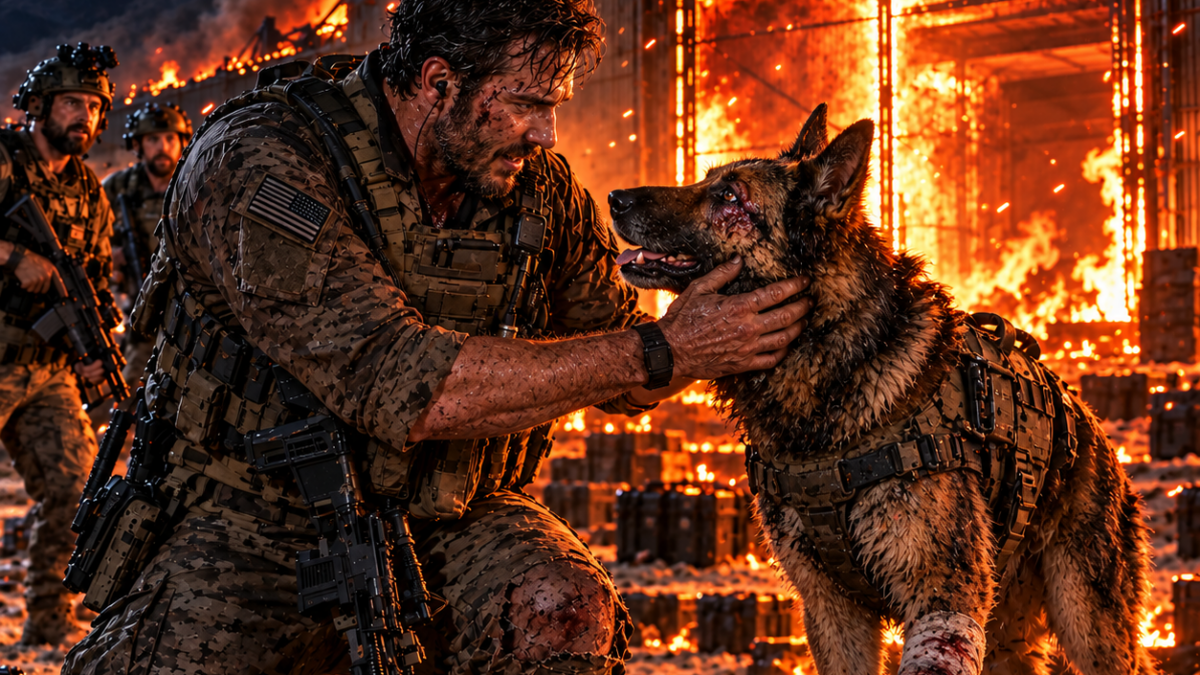
The dog lay on his side beneath a fallen steel support beam. His left hind leg was pinned beneath the weight. Blood matted the fur above his eye. His Kevlar vest smoked. His breathing came hard and shallow.
But when Thomas crawled close, Havoc lifted his head.
The amber eyes widened.
Recognition.
Joy.
Trust.
Then Havoc nudged the toggle with his chin.
Click.
One last triumphant signal.
Thomas tore off one glove and pressed his hand to Havoc’s muzzle.
“I’ve got you,” he rasped. “I’m here.”
Havoc tried to wag his tail.
The beam pinning him was massive.
Too heavy.
Under normal conditions, impossible.
Thomas was not operating under normal conditions.
He wedged his shoulders beneath the steel.
Heat burned straight through the fire blanket and into his uniform. Pain bit through the blocker. His leg screamed. His lungs fought for air.
He pushed.
Nothing.
He reset his stance.
Dug his boots into melting concrete.
Pushed again.
A sound left him that did not feel human.
The beam shifted.
Not enough.
He pushed harder, vision flashing black, muscles tearing, blood filling his mouth where he bit through his own lip.
The beam rose four inches.
“Havoc,” he gasped. “Move.”
The dog yelped, dragging his pinned leg free.
Thomas let the beam fall.
It slammed down, cracking concrete.
He collapsed beside the dog for half a second.
Then the far side of the hangar detonated.
The shockwave rolled through the structure, knocking fire sideways.
“Croft!” Buckley screamed through comms. “Ten seconds! It’s going critical!”
Thomas grabbed Havoc’s harness.
The dog weighed seventy-five pounds dry. With gear, injury, and dead weight from pain, he felt like twice that.
Thomas lifted anyway.
He hauled Havoc over his shoulders in a fireman’s carry, the way he had carried wounded men through alleys and ravines and rooms full of screaming.
Havoc did not struggle.
He trusted him completely.
That trust was heavier than the dog.
Thomas turned toward the thin line of night visible through the door.
The route back had changed. Flames blocked the direct path. Catwalk sections crashed behind him. Ammunition cooked off in sharp pops. Smoke turned the world black and orange.
He ran.
Or what passed for running with shrapnel in his thigh, a dog over his shoulders, and hell collapsing around him.
Every step tore something.
Every breath burned.
“Havoc,” he gasped, though the dog could not answer now. “Stay with me.”
Buckley’s voice counted down in his ear.
“Five!”
Thomas stumbled over debris and nearly fell.
“Four!”
A beam crashed behind him.
“Three!”
He saw the gap widening in his vision like salvation and judgment at once.
“Two!”
He dove.
Thomas hit the sand outside the hangar chest-first, twisting midair to take the impact instead of Havoc. They rolled down the embankment together.
Behind them, Hangar 4 detonated.
The world became white.
A blast wave rolled over the desert like the fist of God. Heat and pressure slammed Thomas flat. Sand, metal, fire, and shattered concrete screamed overhead. He covered Havoc with his body, arms locked over the dog’s head and chest.
For a long time, there was only sound.
Then nothing.
Silence returned slowly.
Not peace.
Aftershock.
Thomas opened his eyes to ash falling like black snow.
His ears rang.
His mouth tasted of blood and dust.
Then something warm and rough dragged across his cheek.
Havoc licked him.
Once.
Twice.
The dog was alive.
Thomas laughed.
It came out broken and half-choked, but it was a laugh.
“You stubborn son of a bitch,” he whispered.
Havoc’s tail thumped faintly against the sand.
O’Shea reached them first, dropping to his knees.
“You crazy, beautiful idiot,” he shouted, tears cutting tracks through the soot on his face. “You actually got him.”
Buckley arrived seconds later, looking like he wanted to punch Thomas and hug him at the same time.
Instead, he turned toward Corcoran.
The CIA liaison sat in the sand, hands bound, face slack with shock.
His plan had failed.
His burn box had not swallowed the evidence.
His sole-survivor story would never be told.
Thomas tried to stand and almost collapsed.
O’Shea caught him.
“Easy. Easy. You’re bleeding like hell.”
“Havoc first.”
“Of course Havoc first,” O’Shea snapped. “Because God forbid I treat the human who ran into an exploding hangar.”
Thomas looked at him.
O’Shea’s expression softened.
“I’ve got him.”
They worked on Havoc under the red glow of the burning horizon.
Splint for the injured leg.
Oxygen from a field mask adapted awkwardly over the muzzle.
Burn gel.
Pressure bandage above the eye.
Havoc tolerated all of it with exhausted dignity, eyes never leaving Thomas.
The extraction helicopters arrived twenty minutes later, their rotors cutting through columns of smoke.
Corcoran was loaded separately, guarded by Buckley with a rifle and a look that promised the man would not enjoy the flight home.
Thomas and Havoc flew together.
No one tried to separate them.
Not after that.
In the helicopter, O’Shea finally cut open Thomas’s pant leg.
“Shrapnel’s deep,” he said. “You’re lucky it missed the artery.”
Thomas leaned back against the bulkhead, one hand on Havoc’s vest.
“Hate that word.”
“What word?”
“Lucky.”
O’Shea glanced at the dog.
“Fine. You’re annoyingly hard to kill.”
“That works.”
Buckley sat across from them, helmet off, face illuminated by dim red light.
For several minutes, no one spoke.
Then Buckley keyed his comms to the aircraft recorder.
“For official record,” he said, voice flat, “Operation Broken Compass was compromised prior to team insertion by CIA liaison David Corcoran, who knowingly falsified intelligence, led a Naval Special Warfare element into a prepared ambush, attempted to seal active U.S. personnel and a military working dog inside a burning explosives facility, and was detained by this command.”
Corcoran looked up from the rear of the aircraft.
“You don’t understand what you’re doing.”
Buckley did not look at him.
“For supplemental record,” he continued, “Chief Petty Officer Thomas Croft re-entered a burning hostile structure under imminent detonation conditions to recover military working dog Havoc, whose final distress signals confirmed life and location. Dog and handler are alive.”
Thomas closed his eyes.
Dog and handler.
Alive.
For the first time that night, the words felt bigger than survival.
By the time they reached the ship, Havoc was taken straight to veterinary surgery. Thomas tried to follow and collapsed outside the operating compartment because his body finally remembered it had limits.
He woke in a medical bay with his thigh bandaged, burns across his shoulders and neck, two cracked ribs, and Buckley sitting in a chair beside him reading a paperback upside down.
Thomas blinked.
“You look stupid.”
Buckley looked up.
“You look worse.”
“Havoc?”
“Surgery went well.”
Thomas closed his eyes.
Buckley let him have three seconds.
“Fractured femur, burns, smoke inhalation, lacerations. They stabilized him. Vet says he’s tough.”
“He is.”
“Vet also said if you try to get out of that bed in the next six hours, O’Shea is authorized to sedate you.”
Thomas opened one eye.
“Where’s Corcoran?”
“Under guard.”
“Talking?”
“Oh, he’s singing entire operas now that tribunal became a possibility.”
Thomas stared at the ceiling.
“What was in the hangar?”
Buckley’s face hardened.
“Not drone guidance systems.”
“I know that.”
“Unauthorized weapons, cash, intelligence files, contractor payroll records, black budget transfer documentation. Enough to bury Corcoran and several people who thought they were untouchable.”
Thomas turned his head.
“So Havoc smelled the explosives and the fuel.”
“He smelled the lie before any of us did.”
Thomas swallowed.
That sounded right.
A silence settled.
Then Buckley leaned forward, elbows on knees.
“When those doors closed, I thought he was gone.”
Thomas said nothing.
“I thought you were gone too when you went back in.”
“You told me two minutes.”
“I lied. I was giving you ninety seconds before I came in after you.”
Thomas looked at him.
Buckley shrugged.
“Don’t look at me like that. O’Shea would’ve followed, and then we all would’ve died heroically and stupidly.”
Thomas almost smiled.
“You’re a terrible officer.”
“Best you’ve got.”
They sat in silence again.
This time, it was easier.
Two days later, Thomas was allowed to see Havoc.
The veterinary recovery room smelled sharp and sterile. Havoc lay on a padded medical cot, left leg bandaged and braced, fur shaved in several places, burns treated, eyes half-open from medication.
His tail thumped once when Thomas entered.
Thomas stopped in the doorway because the sight hit him harder than he expected.
He had seen Havoc charge through gunfire. Leap through windows. Drag men down. Clear rooms without hesitation.
Seeing him small beneath a blanket nearly broke something.
The veterinarian, a Navy commander with tired eyes, said, “Five minutes.”
Thomas nodded.
He sat carefully beside the cot.
Havoc lifted his head with effort.
“Don’t,” Thomas whispered. “Stay.”
The dog obeyed, though his tail kept moving weakly.
Thomas placed one hand against the dog’s neck.
“I heard you,” he said.
Havoc blinked.
“You clicked. I heard you.”
The dog breathed slowly.
Thomas leaned forward until his forehead touched Havoc’s.
“They called you an asset,” he whispered. “They were wrong.”
He sat there until the vet gave him seven extra minutes and then pretended not to notice it had been twelve.
The investigation unfolded like a controlled demolition.
At first, officials tried to keep the story small.
Failed intelligence.
Compromised site.
Rogue liaison.
Operational tragedy avoided.
But Buckley had recorded everything. Havoc’s signal logs. Corcoran’s false brief. The override panel. The contractor weapons. The black-site contents. O’Shea had photographed what he could before the hangar detonated. The extraction team had Corcoran alive.
And Thomas had something no bureaucrat could classify into silence.
Burns across his back from re-entering the hangar.
A dog with a pinned leg and smoke-damaged lungs.
A team willing to testify.
Corcoran broke during interrogation after fourteen hours.
Not because of torture.
Because cowards often mistake pressure for death.
He gave names.
Accounts.
Contractors.
A shell company in Cyprus.
A defense official who had looked the other way.
A private logistics network moving stolen weapons through humanitarian air corridors.
The raid had been designed to erase the evidence and kill the team sent to retrieve it. Corcoran expected mercenaries to eliminate the SEAL element inside Hangar 4, trigger the fire, and blame the deaths on unstable explosives stored by smugglers. He would be extracted as the shaken intelligence liaison who barely escaped.
A tragic failure.
No loose ends.
Except Havoc smelled the cage before they entered it.
Except Thomas trusted him.
Except fire could not burn loyalty fast enough.
The tribunal took months.
Thomas testified in dress uniform because Buckley insisted.
His leg had healed enough for him to stand with a cane. Burns still pulled across his shoulders beneath the fabric. Havoc, officially retired from combat duty during recovery, lay beside his chair wearing a simple black service harness.
No Kevlar.
No doggles.
No communications collar.
Just Havoc.
When Corcoran entered the courtroom, the dog lifted his head.
A low sound vibrated in his chest.
Thomas touched two fingers to the harness.
“Easy.”
Havoc settled.
Corcoran looked thinner. Smaller. Men like him often did once rooms stopped protecting them. Without title, clearance, and secrecy, he was only a frightened man in an expensive suit.
During cross-examination, Corcoran’s attorney tried to imply Thomas had misread the situation under combat stress.
“Chief Croft,” the lawyer said, pacing before the panel, “is it possible that due to injury, smoke inhalation, extreme stress, and emotional attachment to the animal, your recollection of Mr. Corcoran’s actions may be less than reliable?”
Thomas looked at him.
Then at Corcoran.
Then back.
“No.”
The lawyer blinked.
“No?”
“No.”
“You do not believe there is any possibility—”
“The dog signaled danger before entry,” Thomas said. “The door access pad had been recently cleaned. Heavy equipment had moved through within the hour. Hostile personnel were staged on elevated positions before breach. Mr. Corcoran opened the door against recommendation, then sealed it during active contact while a U.S. service member and military working dog remained inside. That is not stress. That is sequence.”
The room went still.
The lawyer recovered.
“You refer to Havoc as a service member?”
Thomas’s jaw tightened.
“I refer to him as my partner.”
A panel member, a Marine colonel with silver hair, leaned forward.
“Chief Croft, why did you go back inside?”
The lawyer looked pleased, as if the question helped him.
Thomas looked down at Havoc.
The dog’s head rested on his paws, eyes alert.
“Because he was alive.”
“That structure was under imminent detonation.”
“Yes, sir.”
“You understood the risk.”
“Yes, sir.”
“You could have died.”
“Yes, sir.”
The colonel studied him.
“So why?”
Thomas answered before he could polish it into something acceptable.
“Because he would have done it for me.”
No one spoke.
The colonel nodded once and sat back.
Corcoran was convicted on charges that would keep him inside concrete for the rest of his life. Several others fell with him. Careers ended. Contracts vanished. Two senior officials resigned before indictments could reach them, which did not save them from investigation. The weapons network collapsed under daylight.
But justice, Thomas learned, was not the same as healing.
Justice happened in rooms with flags.
Healing happened at 0300 when Havoc whimpered in his sleep and Thomas lowered himself painfully to the floor, pressing a hand to the dog’s chest until both of them remembered they were no longer inside the hangar.
For months, Havoc limped.
Physical therapy irritated him.
Water therapy offended him.
The first time a young veterinary technician tried to guide him onto an underwater treadmill, Havoc gave Thomas a look so betrayed that O’Shea laughed until he had to leave the room.
“He’s judging you,” O’Shea said.
“He judges everyone.”
“He thinks this is beneath him.”
“It is.”
“Then why are you making him do it?”
Thomas watched Havoc reluctantly step into the therapy tank.
“Because he wants to run again.”
O’Shea’s smile softened.
Havoc did run again.
Not quickly at first.
Three steps.
Then ten.
Then a slow trot across a rehab yard at Coronado, ears up, tail level, Thomas walking beside him with a cane and pretending dust in the air explained his wet eyes.
Six months after Yemen, they went to the beach.
Not on mission.
Not for training.
No rifle.
No comms.
No collar.
Just a sunny morning in Coronado with waves curling silver under the light and recruits running in formation far down the sand.
Havoc stood beside Thomas, older now in a way that showed. The fur around his muzzle had gone whiter. A thick scar crossed his flank. His left hind leg would always carry a slight hitch.
But his eyes were bright.
Thomas held a worn tennis ball.
Havoc stared at it like it was classified intelligence.
“You sure?”
The dog huffed.
Thomas threw the ball into the surf.
Havoc launched after it.
Not like before.
Not with the explosive speed of his prime.
But with joy.
Pure, undignified, ridiculous joy.
He splashed into the water, snatched the ball, and trotted back with his tail high.
Thomas laughed.
The sound surprised him.
It had been a long time since laughter came out without having to fight through grief first.
Havoc dropped the ball at his feet.
Ready again.
“Of course,” Thomas said. “One more.”
A voice behind him said, “You look better without smoke inhalation.”
Thomas turned.
O’Shea walked down the sand carrying two coffees. Buckley followed, hands in his pockets, sunglasses on, expression unreadable.
“You both stalk all your former teammates?” Thomas asked.
Buckley shrugged.
“Only the ones who run into burning buildings and then refuse invitations.”
“I didn’t refuse.”
“You ignored.”
“Operational difference.”
O’Shea handed him coffee.
Havoc pressed his wet body against Buckley’s leg, soaking his pants.
Buckley looked down.
“Havoc.”
The dog wagged.
Buckley sighed.
“I missed you too.”
They stood facing the ocean.
For a while, no one talked.
That was the nice thing about men who had seen bad nights together. Silence did not frighten them.
Finally, Buckley said, “They approved the retirement paperwork.”
Thomas stared out at the water.
“For Havoc?”
“For both of you, if you want it.”
Thomas looked down at the dog.
Havoc shook seawater violently, spraying all three men.
O’Shea swore.
Buckley closed his eyes in defeat.
Thomas smiled.
The Navy still had forms, evaluations, boards, and language. Havoc’s file would say medically retired. Thomas’s would say something about service-related injury, long-term recovery, operational unsuitability, maybe commendation.
Words.
Small words for big things.
“What happens to him officially?” Thomas asked.
Buckley handed him an envelope.
Thomas opened it.
Adoption transfer.
Handler priority.
Permanent placement approved.
Havoc Croft, if Thomas wanted the name changed.
Thomas read the page twice.
The letters blurred.
“He’s mine?”
Buckley looked at him like the answer should have been obvious.
“He’s always been yours.”
Thomas swallowed.
Havoc nudged his hand, impatient for the ball.
Thomas crouched slowly, ignoring the pull in his thigh, and held the dog’s scarred face between both hands.
“You hear that?” he whispered. “No more cages. No more burn boxes. No more doors closing on you.”
Havoc licked his chin.
Thomas laughed again.
O’Shea looked away toward the water.
Buckley removed his sunglasses and wiped at one lens that did not need wiping.
Two years later, Thomas bought a small house near the coast.
Not large.
Not fancy.
Just a place with a fenced yard, a workshop, and enough space for Havoc to sleep in whatever patch of sunlight he considered tactically superior.
There were bad days.
There always would be.
Thunderstorms still made Havoc lift his head sharply. Fireworks sent him to Thomas’s side, pressing close. The smell of aviation fuel could still turn Thomas’s stomach. Sometimes he woke with his hand reaching for a rifle that was not there.
But the bad days no longer owned every room.
Havoc learned to nap through mail trucks.
Thomas learned to leave the porch light on without checking the window every two minutes.
They developed rituals.
Morning coffee on the back steps.
Slow walks by the water.
Physical therapy disguised as fetch.
Evening grooming sessions Havoc pretended to tolerate only for Thomas’s sake.
Some nights, Thomas sat on the floor with his back against the couch and Havoc’s head heavy in his lap. He would trace the dog’s scars gently, memorizing the map of every place the world had tried to take him.
The flank scar.
The healed burn near his shoulder.
The nicked ear.
The titanium tooth.
Proof of survival.
Proof of cost.
Proof that loyalty was not soft.
One afternoon, a letter arrived from a military working dog memorial foundation. They wanted Havoc honored at a ceremony. Bronze plaque. Public recognition. Speeches. Cameras.
Thomas read the letter twice and set it aside.
Havoc looked up from his bed.
“You want a speech?” Thomas asked.
The dog sighed and put his head back down.
“Agreed.”
They went anyway, but only because O’Shea bullied him and Buckley threatened to accept on his behalf.
The ceremony was small.
No cameras beyond official documentation.
Havoc wore a simple collar.
When they read the citation, Thomas kept one hand on the dog’s shoulder.
The words sounded strange.
Heroic.
Exceptional valor.
Unwavering service.
Critical signal under extreme conditions.
Thomas listened, but what he remembered was not the official language.
He remembered click, click through static.
He remembered amber eyes through flame.
He remembered a dog waiting in hell because he believed his handler would come.
Afterward, a young handler approached with a Belgian Malinois at heel.
The kid could not have been more than twenty-four. His uniform was too crisp. His nerves showed in the way he swallowed before speaking.
“Chief Croft?”
Thomas nodded.
“I just wanted to say… what Havoc did. What you did. It’s the reason I volunteered for K9.”
Thomas looked at the young dog beside him.
Alert.
Restless.
Ready.
He thought about warning the kid.
About telling him that the bond would cost him more than he understood. That one day he might have to choose between orders and instinct, between survival and loyalty, between the language of command and the language of love.
Instead, Thomas said, “Listen to your dog.”
The kid blinked.
“Yes, Chief.”
“No. I mean it. Brass, intel, officers, plans—they all matter. But if your dog tells you something is wrong, you listen.”
The young handler looked down at his Malinois, then back up.
“I will.”
Thomas nodded.
“That’s how both of you come home.”
That evening, back at the house, Thomas opened the back door and let Havoc into the yard.
The old dog moved slower now. He sniffed the fence line, checked the gate, circled the patio, and finally settled under the olive tree where the last of the sunlight warmed the grass.
Thomas sat beside him.
The world was quiet.
Not empty.
Quiet.
There was a difference.
He thought about Hangar 4 sometimes, but not as often as he used to. When he did, the memory still came with heat, smoke, and the awful final slam of steel doors. But it no longer ended there.
It ended with sand beneath his hands.
Ash falling.
Havoc licking his face.
Alive.
Years later, when Havoc’s muzzle had turned almost completely white and his legs no longer trusted long runs, Thomas carried him to the beach at sunrise.
Not because it was time yet.
Just because some mornings deserved ceremony.
He spread a blanket on the sand and sat with Havoc leaning against him, both of them watching the Pacific roll in under a pink sky.
“You remember Yemen?” Thomas asked softly.
Havoc’s ear twitched.
“Yeah. Me too.”
The dog rested his head against Thomas’s thigh.
“You saved me before I saved you,” Thomas said. “That’s the part they never put in the citation.”
The waves advanced and retreated.
Thomas ran a hand down Havoc’s neck.
“They think I went back because you clicked. But the truth is, I went back because of every time you came back for me first.”
Night terrors.
Ambushes.
Rooms cleared.
Roads searched.
Loneliness survived.
Havoc had been signaling long before the hangar.
I’m here.
Still fighting.
Come back.
Thomas watched the sun lift above the water.
For most of his life, he had believed courage meant moving toward danger.
Now he understood that was only part of it.
Sometimes courage meant refusing to let the world turn someone you loved into a line item. Sometimes it meant trusting a signal everyone else dismissed. Sometimes it meant walking back toward the fire because loyalty had called your name and you could still answer.
Havoc sighed.
Thomas smiled.
“No more missions, buddy.”
The dog’s tail moved faintly.
“Just this.”
They stayed until the tide crept close enough to wet Thomas’s boots.
Then he lifted Havoc carefully and carried him home.
In the years after, people told the story many ways.
Some said a Navy SEAL risked everything to save his dog.
Some said a K9 exposed a CIA betrayal with his final signal.
Some said a burning hangar proved the bond between handler and dog was stronger than steel, fire, and treason.
All of that was true.
But not complete.
The real story was simpler.
A door closed.
A dog clicked.
A man listened.
And because he listened, the truth survived the fire.








