They Mocked the Quiet Female Co-Pilot—Then Both Engines Died at 30,000 Feet and Her Fighter-Pilot Past Came Back
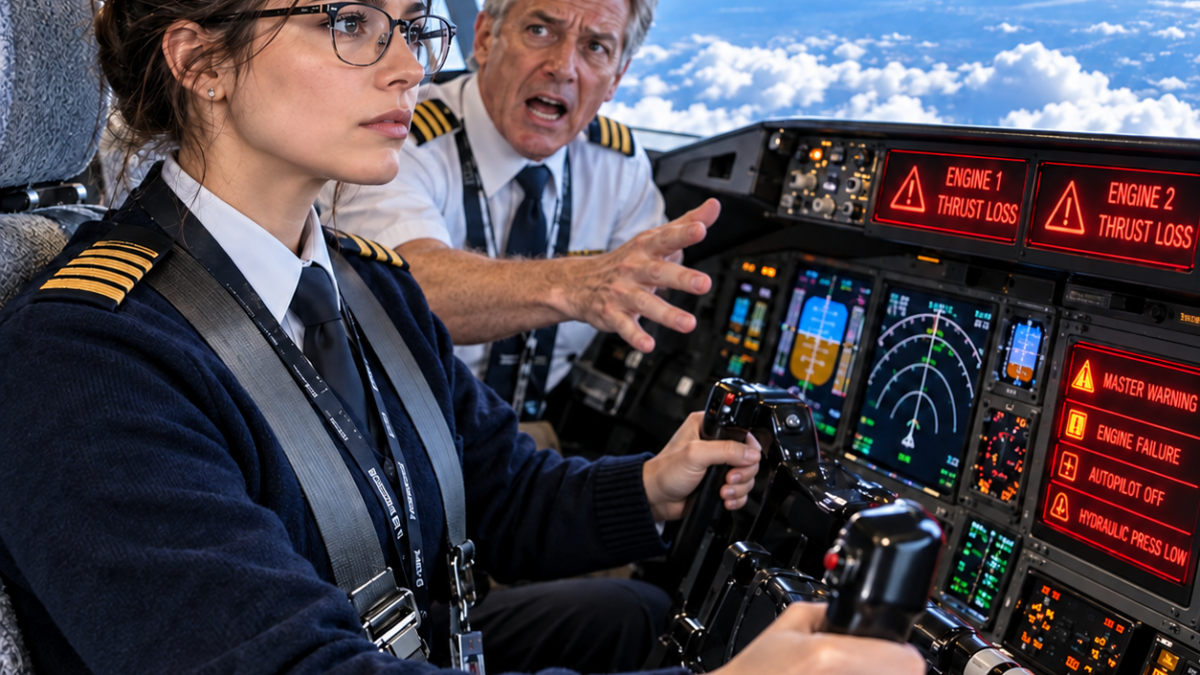
They Mocked the Quiet Female Co-Pilot—Then Both Engines Died at 30,000 Feet and Her Fighter-Pilot Past Came Back.
For two days, Captain Ripley Corkran treated Evelyn Porter like a timid corporate hire who needed automation to keep a Boeing 777 pointed across the Atlantic, never realizing the quiet woman beside him had once flown an F-15E home through enemy fire with part of the aircraft missing.
When volcanic ash killed both engines at thirty thousand feet and Corkran’s panic nearly stalled a two-hundred-ton airliner over the freezing North Atlantic, Evelyn stopped asking permission, took control, and began flying Flight 815 the way she had once flown a dying fighter jet out of a combat zone.
Then, after 284 people walked alive onto Icelandic soil, an investigator stepped into the empty cockpit, called her “Major Porter,” and forced Evelyn to confront the military identity—and the dead wingman—she had spent five years trying to bury.
Thirty thousand feet above the North Atlantic, the sound disappeared.
That was what everyone remembered later.
Not the alarms.
Not the screaming.
Not the violent shaking when the second engine failed.
The silence.
A Boeing 777 at cruise should never be silent.
The engines are always there.
A deep, continuous pressure more than a sound, powerful enough that passengers stop consciously hearing it within minutes.
When both engines on Flight 815 died, that pressure vanished.
In its place came wind.
A thin, rising howl scraping across the fuselage.
Captain Ripley Corkran stared through the dark windshield with both hands locked around the control column.
“No.”
The word came out almost inaudibly.
Then again.
“No.”
The aircraft was descending.
The autopilot had dropped offline.
Half the cockpit displays had gone dark.
Behind the reinforced flight-deck door sat 284 passengers who had no idea yet that the machine carrying them toward Iceland had become a glider.
Evelyn Porter watched the airspeed fall.
Three hundred knots.
Two seventy.
Two forty.
Corkran pulled back.
Wrong.
She saw his shoulders lock.
His breathing shortened.
His eyes fixed on the altimeter.
“Captain.”
He did not respond.
“Ripley.”
Still nothing.
Two hundred fifteen knots.
The control column began to shake.
The stall warning.
Evelyn’s pulse should have exploded.
Instead, something inside her became quiet.
The cockpit disappeared.
The airline uniform disappeared.
Five years of deliberate anonymity disappeared.
PART2:
There was only an aircraft with failing energy, an unstable pilot beside her, black ocean below, and people who would die if she hesitated.
“Push the nose down.”
Corkran pulled harder.
“We’re falling.”
“No.”
“We’re falling!”
“We’re stalling.”
The control column shook violently.
Corkran muttered:
“Up.”
He hauled back again.
“Captain, release.”
“No.”
“Release the controls.”
“I am the captain!”
The nose climbed another fraction.
Airspeed collapsed.
Evelyn saw the exact point approaching where recovering a two-hundred-ton wide-body would become much harder.
She stopped asking.
Her left hand locked around her own control column.
Her right drove hard across the center space, knocking Corkran’s arm free from the yoke.
He turned in shock.
“What the hell—”
“I have the aircraft.”
Her voice was not loud.
It was cold.
Absolute.
She shoved the nose down.
The Boeing responded sluggishly at first.
Then gravity took hold.
Passengers behind them screamed as the aircraft pitched into a steep descent.
Airspeed came back.
Two hundred.
Two twenty.
Two forty.
The stall warning stopped.
Corkran stared at Evelyn Porter as if the woman sitting beside him had been replaced by someone else.
He was not entirely wrong.
Four hours earlier, Captain Ripley Corkran had thought he understood his first officer.
She was thirty-four.
Quiet.
Polite.
By-the-book.
Soft Midwestern voice.
Perfectly round glasses she did not medically need.
A slightly oversized navy uniform sweater that concealed a body far more athletic than her manner suggested.
She checked everything twice.
Fuel.
Alternates.
Weather.
Oceanic clearance.
ETOPS data.
Emergency frequencies.
Corkran found that irritating.
He had been flying commercial aircraft thirty-two years.
Wide-bodies before Evelyn was old enough to drive.
His four captain’s stripes carried the weight of decades.
He had crossed the Atlantic hundreds of times.
She had joined the airline less than a year earlier after what her personnel record described only as “prior government aviation service.”
Corkran assumed regional transport.
Maybe Air Force cargo.
Probably administrative flying.
He never asked.
At JFK that afternoon, Evelyn had been reviewing diversion calculations when Corkran dropped into the captain’s seat.
“You know what your problem is, Porter?”
She looked up.
“I wasn’t aware I had one yet.”
“You’re trying to fly the trip before we take off.”
“I’m reviewing contingency fuel.”
“It’s a 777.”
“Yes.”
“She practically flies herself to Iceland.”
Evelyn looked back down.
“That’s usually when I prefer knowing what happens if she doesn’t.”
He laughed.
“You kids.”
Evelyn did not correct the word.
At thirty-four, she was hardly a kid.
But Corkran enjoyed categories.
Young pilot.
Old pilot.
Captain.
First officer.
People who had seen things.
People who had not.
“Just let the automation do the heavy lifting.”
He said.
“You’ll live longer.”
Evelyn’s hands stopped for half a second.
You’ll live longer.
Corkran did not notice.
There had been another man once who said something close.
Captain Daniel Mitchell.
Her wingman.
Five years earlier.
Different cockpit.
Different sky.
Different Evelyn.
Mitchell had smiled over secure radio before a night mission and said:
“Relax, Wraith. If you keep checking that targeting pod, you’re going to wear the pixels out.”
Evelyn had answered:
“You worry about your jet.”
“You worry enough for both.”
“Somebody has to.”
He laughed.
That was one of the last ordinary things Daniel Mitchell ever said.
Evelyn pushed the memory away.
At JFK, she replied to Corkran:
“Understood, Captain.”
That pleased him.
Submission usually did.
Lead purser Timothy Wright leaned into the cockpit twenty minutes later.
Tim was fifty-four.
Silver hair.
The cheerful, unhurried manner of a man who had spent three decades convincing frightened passengers that turbulence was normal and delays were temporary.
“Cabin secured.”
Corkran turned on charm.
“Thank you, Timmy.”
“Please don’t call me Timmy in front of the new people.”
“Then stop looking twelve.”
Tim rolled eyes.
He looked at Evelyn.
“You need anything?”
“No, thank you.”
“Coffee?”
“After departure.”
“You sure?”
“She’s too busy calculating the probability coffee might splash during rotation.”
Corkran said.
Tim looked between them.
Evelyn smiled faintly.
“I’ll survive.”
Corkran laughed at his own joke.
Tim did not.
After he left, Evelyn resumed checklist.
Nobody on Flight 815 knew who she had been.
Not Tim.
Not Corkran.
Not the cabin crew.
Not the airline.
Not fully.
The airline knew she had ten years of military aviation.
They knew she had completed transition training unusually quickly.
They knew portions of her Air Force history were inaccessible through normal verification channels.
They knew Department of Defense personnel had confirmed her hours and qualifications.
That was enough.
The airline did not know the rest because Evelyn had worked hard to keep it that way.
Five years earlier she had been Major Evelyn “Wraith” Porter.
F-15E Strike Eagle pilot.
Nine combat deployments? Let’s keep plausible: multiple deployments over decade.
Hundreds of combat hours.
Night strike missions.
Close-air support.
Dynamic targeting.
Low-level ingress.
Missile warnings.
Refueling in weather so bad the tanker disappeared between lightning flashes.
She had once flown through enough anti-aircraft fire that the mission debrief counted fourteen separate radar-guided launches against her formation.
She had earned decorations she kept in a cardboard box.
One Silver Star.
One Distinguished Flying Cross.
Several medals she could no longer remember in the order somebody once arranged them on a uniform.
The Silver Star came from the mission she never discussed.
Her squadron had been tasked with hitting a weapons-transfer site in Syria after intelligence suggested mobile missile components were being moved under cover of an oil-field fire.
The smoke column had been visible fifty miles away.
Black.
Massive.
Hot enough to distort targeting systems.
Evelyn and Daniel Mitchell flew as a two-ship element.
They entered low.
Fast.
Radar warning receiver screaming.
The first missile missed.
The second detonated close enough to throw Evelyn’s F-15 violently sideways.
Shrapnel ripped into the left wing.
Hydraulic pressure dropped.
Fuel began disappearing.
Her canopy filled with warning lights.
Mitchell stayed.
“Wraith, you’re hit.”
“I noticed.”
“Turn south.”
“Target still active.”
“Forget target.”
“They’ll move it.”
“Evelyn.”
She remembered his voice changing.
Not Captain Mitchell.
Daniel.
“Go home.”
They completed the strike.
Then another radar lit them.
Mitchell turned toward the threat.
“Break west.”
“I’m not leaving you.”
“That wasn’t a suggestion.”
His jet rolled.
The missile came.
Evelyn remembered white light first.
Then orange.
Mitchell’s F-15 disappeared into flame.
No parachute.
No radio.
Nothing.
She had screamed his call sign until her throat hurt.
“Raven Two.”
“Raven Two, come up.”
“Daniel.”
“Daniel!”
No answer.
Then ground fire began again.
Her own jet was failing.
She flew home anyway.
Half the left wing damaged.
One hydraulic system gone.
Landing gear warning unreliable.
Fuel leaking.
She crossed friendly airspace with three minutes of usable fuel remaining.
The aircraft hit the runway crooked.
Blew one tire.
Left wing nearly struck pavement.
She kept it upright.
The Air Force called the landing extraordinary.
The medal citation praised her “exceptional airmanship under hostile fire.”
Evelyn remembered only walking away from the aircraft and asking:
“Did they find Daniel?”
Nobody answered.
She resigned her commission eleven months later.
Officially:
voluntary separation after completion of service obligation.
Unofficially:
she could no longer climb into a fighter without seeing Mitchell’s fireball reflected in the canopy.
The adrenaline she once loved had become poison.
At night, radar-warning tones lived in her dreams.
During daylight, contrails became missiles.
A loud bang in a grocery store sent her behind a display before she understood where she was.
She wanted boring.
Predictable.
Civilian.
So she became a commercial pilot.
No weapons.
No tactical formations.
No mission briefings listing potential casualties.
People complained about connections and overhead-bin space.
She loved that.
Her medals went into a box in Seattle.
Her call sign stopped existing.
She started wearing round glasses she did not need because they softened her face.
The sweater hid the pale shrapnel scar across her left collarbone.
Most of all, she made herself quiet.
Underestimated people are rarely questioned.
Corkran had mistaken that for weakness.
Flight 815 departed JFK shortly after sunset.
The Rolls-Royce engines pushed them hard down the runway.
Evelyn felt that familiar moment when weight became lift.
The city dropped away.
Atlantic darkness opened ahead.
The Boeing climbed through cloud and emerged beneath stars.
Corkran handled the departure.
Evelyn managed radios and systems.
At cruise, automation took over.
Corkran leaned back.
“See?”
He gestured toward displays.
“Machine knows what she’s doing.”
Evelyn checked oceanic track clearance.
“Until she doesn’t.”
He smiled.
“You really need a hobby.”
“I have one.”
“What?”
“Not dying.”
Corkran laughed.
Evelyn did not.
Three hours passed.
Normal.
Painfully normal.
Cabin dimmed.
Passengers slept.
Flight attendants whispered over coffee.
Below them:
black Atlantic.
Above:
stars.
Evelyn looked out.
Night sky had once been home.
Now it unsettled her.
She adjusted glasses.
Took measured breath.
Civilian.
Safe.
Routine.
Then came the smell.
Faint.
Acrid.
Electrical.
Almost sulfurous.
Evelyn leaned forward.
Scanned.
Oil.
Hydraulics.
Electrical buses.
Pressurization.
All normal.
“Captain.”
Corkran had been half asleep over a magazine.
“What?”
“You smell that?”
He inhaled.
“Galley.”
“I don’t think so.”
“Porter.”
He rubbed his face.
“Every strange odor is not an emergency.”
Then the windshield began glowing.
Tiny violet filaments crawling along glass.
St. Elmo’s fire.
Evelyn sat upright.
No weather returns ahead.
No thunderstorm.
Nothing on radar.
The cockpit chime sounded.
Evelyn answered.
“Flight deck.”
Tim’s voice had changed.
“Evelyn, we’ve got a sulfur smell in the cabin.”
“How strong?”
“Getting worse.”
“Anything else?”
“Passengers say there’s dust near the vents.”
Evelyn’s stomach tightened.
“Dust?”
“Yes.”
“Gray?”
“Hard to tell.”
She looked at Corkran.
He saw it.
The word formed between them.
Ash.
“Tim, secure loose items.”
“What’s happening?”
“I’ll call you back.”
She disconnected.
“Captain, we may be inside volcanic ash.”
Corkran stared at weather radar.
“There’s no advisory.”
“Ash doesn’t always paint on weather radar.”
“There’s no eruption report.”
“Sulfur.”
“Static discharge.”
“Dust.”
She pointed toward windshield.
“We need immediate turn and reduced thrust.”
Corkran shook head.
“Not without confirmation.”
“We are ingesting particulates.”
“You don’t know that.”
“Look outside.”
“I am.”
“We’re over North Atlantic, Porter.”
“You don’t throw a triple-seven into a U-turn because cabin smells strange.”
“Captain—”
“I have command.”
There.
The phrase.
Evelyn’s jaw tightened.
“Then command us out.”
He stared at her.
Before he could respond, the aircraft shuddered.
Hard.
A vibration ran through the fuselage.
Engine one EGT climbed.
Warning.
Compressor instability.
Then:
ENGINE 1 FAIL.
Corkran lunged forward.
“What the hell?”
“Ash.”
Evelyn reached for checklist.
“Thrust idle.”
Corkran shoved left throttle forward.
“Captain, no.”
“I’m restarting.”
“Idle both.”
“Don’t touch.”
“You’re feeding heat into contaminated core.”
“Porter!”
He pushed.
Engine one remained dead.
Engine two began vibrating.
Evelyn heard compressor stall before display registered.
BANG.
BANG.
BANG.
The right wing lit orange.
Passengers screamed.
Then the second engine spooled down.
The roar faded.
Electrical buses dropped.
Cabin lighting died.
The aircraft entered the silence.
Now at twenty-nine thousand feet, Evelyn had Corkran off the controls and nose lowered.
Airspeed returned.
She leveled at best glide as much as circumstances allowed.
Emergency power came alive.
Ram air turbine deployed.
Minimal instrumentation returned.
Corkran pressed hand to his forearm where Evelyn had knocked him away.
His pride seemed more injured than anything else.
“You assaulted me.”
“You were stalling the airplane.”
“I’m still pilot in command.”
“You were not controlling the aircraft.”
“I had it.”
“You were pulling into stall.”
“I was maintaining altitude.”
“With zero thrust.”
His face whitened.
The absurdity reached him.
Evelyn looked directly at him.
“We can discuss rank if we survive.”
Then:
“Get the QRH.”
He did not move.
“Ripley.”
“What?”
“The checklist.”
Something in her voice changed him enough to obey.
He reached for Quick Reference Handbook.
His hands shook.
Evelyn noticed.
She had seen that before.
Pilots under fire.
Soldiers hearing first incoming round.
There is a moment when training and reality collide.
Some people sharpen.
Some freeze.
You cannot always predict who.
“Dual engine failure.”
Corkran said.
His voice trembled.
“Engine start selectors…”
“Flight.”
“Thrust levers…”
“Idle.”
“Fuel control switches…”
They worked.
No ignition.
Engines remained dead.
Evelyn transmitted emergency.
“Mayday, mayday, mayday.”
Static.
Again.
Then a distant cargo crew answered.
FedEx 920.
Fifty miles north.
They relayed.
No runway within glide distance.
Evelyn did math immediately.
Altitude.
Wind.
Glide ratio.
Ocean.
Nothing.
No land.
Corkran understood.
“We ditch.”
“Not yet.”
“What else?”
“Restart.”
“They seized.”
“They may not remain seized.”
He looked at her.
Evelyn pointed toward dead engine parameters.
“Ash melts in hot sections.”
“It coats blades.”
“When engines cool, deposits can harden and fracture.”
“This isn’t simulator.”
“No.”
“It isn’t a fighter either.”
“No.”
“So where are you getting this?”
“Training.”
“What training?”
“Later.”
He stared.
Evelyn continued:
“We need clear air.”
They descended.
The static glow weakened.
Sulfur smell decreased.
Cabin temperature began falling.
Tim called.
Passengers frightened.
Evelyn spoke slowly.
“We are gliding.”
He went silent.
“Gliding?”
“Yes.”
“Are we ditching?”
“Not yet.”
“People are asking.”
“Tell them we are handling an engine issue.”
“Evelyn.”
“Yes?”
“Are we going to make it?”
The question pierced armor.
She saw Daniel Mitchell’s jet again.
The flame.
The silence.
Not now.
“I am going to do everything possible to keep this aircraft out of the water.”
She refused to promise more.
“Secure cabin for severe turbulence.”
“Understood.”
“Seat belts tight.”
“Everything locked.”
“Prepare for possible emergency landing.”
Tim inhaled.
“Copy.”
He disconnected.
Corkran stared.
“You told them severe turbulence.”
“Yes.”
“What are you planning?”
Evelyn looked at altitude.
Twenty-one thousand.
Then engine core rotation.
Low.
Too low.
“We need more windmilling RPM.”
“How?”
“Speed.”
His eyes widened.
“No.”
“Yes.”
“If we dive, we sacrifice altitude.”
“If we don’t restart, altitude only tells us when we die.”
“You don’t know restart will work.”
“No.”
“Then—”
“Neither do you.”
He recoiled.
Evelyn’s voice softened half degree.
“We have one resource.”
“Potential energy.”
“Altitude.”
“We convert some to airspeed.”
“Use airspeed to rotate cores.”
“Attempt restart.”
“If it fails, we still have ditching option with less altitude.”
“Less time.”
“Yes.”
Corkran shook head.
“No.”
“You want guarantee.”
“Yes!”
“There isn’t one.”
That silenced him.
Then smoke warning.
Forward electronics bay.
Electrical contamination or secondary fault.
Now clock shortened further.
Evelyn’s decision became easier.
“We go now.”
Corkran grabbed armrest.
“Porter—”
“Shoulder harness.”
He stared.
“Now.”
He locked.
Evelyn pushed nose over.
The giant jet descended.
Passengers screamed.
Loose items rattled.
Airspeed increased.
Two seventy.
Two eighty.
Three hundred.
Corkran read numbers with rising panic.
“Descent four thousand feet per minute.”
“Continue.”
“Three ten.”
“Continue.”
“Evelyn!”
“Read N2.”
“Seven percent left.”
“Five right.”
“More.”
Cockpit shook.
Smoke seeped from vents.
Her eyes burned.
Three twenty.
N2 rose.
Nine.
Eleven.
Fifteen.
Then a crack.
Sharp.
Another.
Not structural.
Engine.
Core rotation surged.
Corkran leaned toward display.
“They’re windmilling.”
“Attempt restart.”
He froze.
“Ripley!”
His hands moved.
Ignition.
Fuel.
Engine one tried.
Nothing.
Altitude falling.
Twelve thousand.
Engine two coughed.
No light.
Nine thousand.
Corkran whispered:
“Come on.”
Evelyn kept dive stable.
Seven thousand.
“Left EGT rising!”
“Watch.”
Flame.
A violent ignition.
Left engine shook.
Then rotation climbed.
Thrust.
Not full.
But alive.
“We’ve got one.”
Corkran cried.
Evelyn began recovery.
Slow.
Controlled.
At high airspeed, abrupt pull could destroy what engines could not.
She eased.
Pressure increased.
Altitude continued unwinding.
Five thousand.
Four.
Three.
The Atlantic came into view.
Dark.
Whitecaps.
Too close.
Left engine built thrust.
Evelyn fed rudder.
Corrected asymmetric yaw.
Two thousand feet.
She leveled.
The Boeing shuddered.
Then held.
One engine.
One dead.
Emergency electrical buses coming back.
Main displays.
Cabin lights.
Systems.
Evelyn exhaled once.
Corkran began crying.
Not dramatically.
Tears simply ran.
Evelyn keyed radio.
“FedEx 920, Flight 815.”
Immediate reply.
“815, go.”
“We have one engine restored.”
Static.
Then:
“Copy one engine restored.”
“Relaying.”
“Nice work.”
Evelyn looked east.
“Request Keflavik.”
The cargo captain paused.
“815, nearest suitable is Keflavik.”
“Approximately three hundred nautical miles.”
Corkran looked at fuel.
One engine could carry.
But damaged.
No guarantee.
Evelyn calculated.
Altitude low.
They could climb gradually.
Not too high.
Engine health uncertain.
“Tell them we’re coming.”
The next two hours were worse in a different way.
Crisis at least gives motion.
After crisis comes waiting.
Every vibration felt suspicious.
Every engine fluctuation sounded fatal.
Evelyn kept left engine below aggressive thrust settings.
She did not trust deposits.
Right engine remained dead.
The aircraft limped east.
Cabin warmed slowly.
Passengers received limited explanation.
Tim walked aisle with crew.
Some prayed.
Some cried.
Some sat utterly still.
A businessman in 4C wrote goodbye texts.
A teenager in row 31 recorded a video for her mother, then deleted it when cabin lights returned because she decided deletion might make survival more likely.
A father held both children’s hands until fingers hurt.
Nobody knew woman keeping them airborne was reliving another cockpit.
Evelyn heard Daniel every few minutes.
Break west.
Go home.
She forced memory into useful channels.
Check engine.
Check fuel.
Check weather.
Check hydraulics.
Keflavik weather deteriorated.
Crosswind.
Rain.
Gusts above forty knots.
Corkran heard forecast.
“No.”
Evelyn glanced.
“What?”
“Single-engine approach in that.”
“Yes.”
“We need another field.”
“Not with this engine.”
“It’s outside comfort.”
“Everything since engine one failed is outside comfort.”
He looked down.
He had changed since flameout.
Humiliation had stripped something.
He no longer lectured.
He asked.
“Can you do it?”
Evelyn did not answer immediately.
That mattered.
Confidence without analysis is vanity.
“I can fly approach.”
“Whether wind lets us land is different.”
“Go-around?”
“One engine.”
“Possible.”
“Not desirable.”
Corkran nodded.
“What do you need from me?”
That was first correct question he had asked her.
Evelyn looked over.
“Checklist discipline.”
“Call deviations.”
“Do not grab controls unless I say.”
He swallowed.
“Understood.”
Then:
“I’m sorry.”
“Later.”
“No.”
“Later.”
He nodded.
They descended toward Iceland.
Weather wrapped coast.
Rain struck windshield.
The engine note changed as power adjusted.
Evelyn’s hands remained light.
Corkran watched.
She did not muscle airplane.
She anticipated.
Corrected before movements grew.
Years in fighters had trained body to feel deviations too small for passengers to notice.
Commercial aircraft demanded gentler inputs.
But physics remained physics.
Wind.
Energy.
Alignment.
Rate.
Keflavik tower cleared emergency approach.
Fire crews positioned.
Runway wet.
Crosswind brutal.
Corkran called:
“Localizer captured.”
“Gear down.”
“Gear down.”
“Flaps twenty.”
“Twenty.”
The 777 yawed.
Evelyn fed rudder.
Wind pushed.
She crabbed.
Corrected.
Corkran’s voice steadier now.
“Five hundred.”
“Stable.”
“Four hundred.”
“Three.”
A gust hit.
Aircraft rolled.
Evelyn corrected.
“Two hundred.”
Runway lights jumped in rain.
“Hundred.”
Another gust.
Corkran inhaled sharply.
“Seventy.”
“Fifty.”
Automated voice.
“Forty.”
Evelyn transitioned.
Rudder.
Wing.
Nose alignment.
“Thirty.”
“Twenty.”
“Ten.”
Main gear hit.
Hard.
Not dangerous.
Decisive.
Tires screamed.
Aircraft pulled.
Evelyn corrected with rudder.
Braking.
Single-engine reverse cautiously.
Speed falling.
Seventy knots.
Fifty.
Thirty.
Then stop.
Centerline.
Exactly.
Evelyn’s hands stayed on controls.
She waited.
Engine idled.
Fire trucks surrounded.
Corkran stared forward.
Behind cockpit door came sound.
At first muffled.
Then rising.
Applause.
Crying.
Shouting.
284 people realizing ground would remain beneath them.
Corkran unbuckled slowly.
He turned.
“Who are you?”
Evelyn closed eyes.
Of course.
That question.
She had avoided it for five years.
Tim opened cockpit door.
His face was pale.
Hair disordered.
Tie crooked.
“Everyone’s alive.”
Evelyn nodded.
“Keep them seated.”
“Fire inspection first.”
He stared at her.
“You saved us.”
“We had one engine.”
“You saved us.”
“Tim.”
He understood she did not want it.
“Right.”
He turned.
“Cabin stays seated.”
Emergency crews boarded.
Smoke source checked.
Passengers eventually deplaned by buses.
Some touched fuselage as they stepped onto wet Icelandic pavement.
Some hugged strangers.
One woman knelt and kissed ground.
Another passenger yelled:
“Thank the pilots!”
Applause again.
Evelyn remained inside.
She powered systems down.
Checklist.
Always checklist.
Corkran was taken for medical evaluation.
Shock.
Bruised arm.
Possible stress response.
Before leaving, he stood cockpit doorway.
“I almost killed them.”
Evelyn did not lie.
“Yes.”
His face crumpled.
“I have thirty-two years.”
“Yes.”
“How did I freeze?”
“Startle doesn’t check logbook.”
“That sounds kind.”
“It isn’t.”
He looked down.
“You hit me.”
“I knocked your hand away.”
“You nearly broke my wrist.”
“You nearly stalled airplane.”
A weak laugh escaped him.
“Fair.”
He became serious.
“I treated you like child.”
“Yes.”
“I thought—”
“I know.”
“How did you fly like that?”
Evelyn folded checklist.
“Go get checked.”
“Evelyn.”
She looked.
He asked again.
“Who are you?”
Before she could answer, airport security appeared.
Corkran left.
Evelyn packed flight bag.
The cockpit felt enormous without passengers and noise.
Rain streaked windshield.
She removed glasses.
They had never needed lenses.
Just clear glass.
Part of costume.
She folded them into case.
A man entered.
Dark civilian suit.
Leather folder.
American.
“First Officer Porter?”
“Yes.”
He shut door behind.
“I’m Special Agent Nathan Miller.”
He showed credentials.
Not Icelandic authority.
United States Air Force Office of Special Investigations.
Evelyn stared.
“This is civilian accident.”
“I know.”
“Then why are you here?”
“We have liaison personnel in-country.”
“And?”
“Your emergency squawk hit systems linked to protected former personnel.”
Her face hardened.
“You monitor me?”
“No.”
“Your identity flag triggers notification during certain international incidents.”
“That sounds like monitoring.”
“Take it up with Washington.”
“I intend to.”
Miller smiled faintly.
Then:
“Major Porter.”
Her whole body went still.
Do not.
She did not say it.
He saw.
“I understand you don’t use rank.”
“I’m not Major anymore.”
“No.”
“I’m First Officer Porter.”
“Yes.”
He glanced cockpit.
“Quite a flight.”
“Is that why you’re here?”
“Partly.”
“What’s other part?”
“Your former commander heard.”
She looked away.
“General Maddox?”
“Retired now.”
“Still has friends.”
“Unfortunately.”
Miller smiled.
“He said to tell you—and I quote—‘Wraith always did hate landing healthy airplanes.’”
For one terrible second Evelyn almost laughed.
Then Daniel Mitchell came back.
Raven Two.
Fireball.
No parachute.
She pressed lips together.
Miller’s smile faded.
“He also said something else.”
“What?”
“He said Mitchell would’ve been proud.”
Wrong thing.
Evelyn’s face went cold.
“Don’t.”
Miller stopped.
“You don’t get to use him like that.”
“I’m sorry.”
“He died.”
“I know.”
“No.”
“You read file.”
“You don’t know.”
Miller nodded.
“You’re right.”
Good.
Evelyn picked up bag.
“I’m leaving.”
“Air Force may contact.”
“No.”
“Just letting you know.”
“I left.”
“Nobody is ordering you back.”
“Then don’t say the sky calls its ghosts back or whatever dramatic nonsense somebody briefed you with.”
Miller blinked.
She walked past.
“That is exactly what I was going to say.”
“I know your type.”
For the first time that night she smiled.
Barely.
Then she left.
The airport terminal was chaos.
News crews.
Passengers.
Airline staff.
Icelandic authorities.
Fire personnel.
Evelyn tried using service corridor.
Tim found her.
“Wrong way.”
“I know.”
“You’re trying to escape.”
“Yes.”
“Not happening.”
“Why?”
“Passengers want to see you.”
“No.”
“Evelyn.”
“No.”
Tim lowered voice.
“Some of them think Corkran landed plane.”
“Good.”
“That isn’t good.”
“It doesn’t matter.”
“It matters to them.”
She looked through glass.
Passengers waiting.
Children.
Old couples.
People she would never see again.
A little boy held airplane toy.
A woman with mascara streaks.
The businessman from 4C.
Evelyn did not want applause.
But maybe they needed a face.
She walked out.
The reaction was immediate.
People stood.
Applause.
She hated every second.
And somehow loved that they were alive enough to make noise.
A man approached.
“Captain?”
“First officer.”
He blinked.
“You flew?”
“Yes.”
He hugged her before asking.
Evelyn stiffened.
Then allowed.
One by one.
Thank you.
Thank you.
Thank you.
She could not answer all.
Eventually she said:
“You’re welcome.”
That felt strange.
A teenage girl asked:
“Were you scared?”
Evelyn looked at her.
“Yes.”
The girl seemed surprised.
“You didn’t sound scared.”
“That’s not the same thing.”
She nodded.
Evelyn liked her.
The story escaped within hours.
PASSENGER JET LOSES BOTH ENGINES.
MIRACLE OVER ATLANTIC.
FEMALE FIRST OFFICER SAVES 284.
Then military history leaked.
Not all.
Enough.
DECORATED FORMER F-15 PILOT.
SILVER STAR.
CLASSIFIED COMBAT MISSION.
“WRAITH.”
Photographs appeared.
Evelyn in flight suit.
Helmet beneath arm.
Younger.
Harder.
A squadron photograph with Daniel standing beside her.
She saw that online and dropped phone.
For five years, Mitchell had existed only where she permitted.
Memory.
A photograph in a drawer.
A name on memorial.
Now strangers zoomed into his face.
Articles described:
“Her wingman died heroically covering her retreat.”
Evelyn hated it.
Not because false.
Because small.
Daniel was more than final act.
He hated mustard.
Played terrible guitar.
Called his mother every Sunday.
Could not fold maps properly.
Once drove forty miles because convinced a taco truck was “worth operational diversion.”
He had a life.
Now internet turned him into sacrifice.
Evelyn shut phone off.
Airline investigation began.
Standard.
Data.
Cockpit voice recorder.
Flight data recorder.
Maintenance.
Weather.
Ash encounter.
Crew actions.
Corkran’s handling.
Evelyn’s intervention.
Everything.
The elbow strike became issue.
Of course.
Aviation investigators asked:
“Did you physically interfere with captain?”
“Yes.”
“Why?”
“He was applying nose-up input during stall warning after dual-engine failure.”
“Did you announce transfer?”
“Yes.”
“Did he acknowledge?”
“No.”
“Did you believe immediate action necessary?”
“Yes.”
“Would aircraft have stalled?”
“If pull continued, yes.”
“Did you intend injury?”
“No.”
“Do you regret physical intervention?”
“No.”
Investigators stared.
Evelyn added:
“I regret that it was necessary.”
Better.
Cockpit recording supported.
Corkran himself supported.
That mattered.
At his interview he said:
“I lost situational control.”
The room went quiet.
Captains do not admit easily.
“I was startled.”
“I reverted to a physical instinct to climb.”
“I ignored the first officer.”
“She prevented stall.”
Then:
“If she had not struck my arm, I believe I would have continued pulling.”
That ended much debate.
Corkran was removed from active duty pending medical and proficiency review.
He called Evelyn two weeks later.
She almost did not answer.
“Porter.”
“Captain.”
“Ripley.”
Silence.
“Evelyn.”
“Okay.”
He sighed.
“I’ve been replaying CVR.”
“You shouldn’t have access outside investigation.”
“Training excerpt.”
“Ah.”
Another silence.
“I sound like a fool.”
“You sound panicked.”
“Which is worse?”
“Neither useful.”
He laughed weakly.
“I owe you apology.”
“For what part?”
“That’s fair.”
He started with JFK.
The comments.
Regional airline assumption.
Automation.
Belittling.
Then ash.
Ignoring.
Slapping hand away.
Panic.
“Thirty-two years.”
He said.
“I thought experience made me immune.”
“It doesn’t.”
“I know.”
He hesitated.
“Did military make you immune?”
“No.”
That answer mattered.
“Then how?”
“I wasn’t calm because I’m special.”
“What were you?”
“Familiar with catastrophe.”
He stayed silent.
Evelyn continued.
“Your brain thought the impossible had happened.”
“Mine had already lived through impossible.”
“That’s not advantage I recommend.”
Ripley exhaled.
“No.”
Then:
“Would you fly with me again?”
She was surprised.
“After retraining?”
“Yes.”
She considered.
“If medical clears.”
“And if you stop calling anyone under forty kid.”
He laughed.
“Deal.”
The investigation took months.
Cause:
Volcanic ash encounter from previously unreported high-altitude plume associated with submarine volcanic activity and atmospheric transport.
Both engines experienced ash-related flameout.
One restart successful after descent and windmilling.
Why the second remained dead remained under technical examination.
Some experts later argued Evelyn’s aggressive dive exceeded conservative handbook guidance.
Others noted no standard checklist fully addressed their precise combination of failures.
The airline’s internal safety board praised crew-resource management recovery after initial breakdown while sharply criticizing captain’s early rejection of first officer’s hazard identification.
Corkran accepted findings publicly.
That surprised people.
He issued statement:
“I failed to listen when my first officer recognized a threat before I did.”
No excuses.
He later entered simulator retraining voluntarily.
Evelyn respected that more than apology.
The media wanted Evelyn everywhere.
Morning shows.
Documentaries.
Military podcasts.
A publisher offered book deal.
She refused all.
Then one interview changed her mind.
A reporter named Lena Cho called.
Not asking:
What was it like to be hero?
Instead:
“Why did you hide your military history?”
Evelyn almost hung up.
Then answered.
“Because people turn trauma into identity.”
Lena did not interrupt.
Evelyn continued.
“If they know medals first, they stop meeting you.”
“They meet story.”
“So you wanted anonymity.”
“I wanted to be allowed to be boring.”
“What changed?”
“Nothing.”
“You’re famous now.”
“That does not mean I wanted it.”
“Do you regret military career?”
“No.”
“Do you regret leaving?”
“No.”
“Do you regret Flight 815 exposing you?”
Long pause.
“Yes.”
The honesty surprised reporter.
“Why?”
“Because surviving something does not automatically mean you want strangers owning it.”
Lena asked:
“What would you want people to understand?”
Evelyn thought.
“Do not underestimate quiet people.”
Too cliché.
“No.”
She restarted.
“Competence doesn’t always announce itself.”
Better.
Then:
“And experience doesn’t make you infallible.”
She thought about Corkran.
“The strongest cockpit is one where rank does not prevent challenge.”
That became headline.
Good.
Airline changed training.
Not because Evelyn demanded.
Because Flight 815 exposed a problem.
Senior captains received additional startle-response and authority-gradient modules.
First officers trained more explicitly on assertive intervention.
Volcanic ash recognition updated.
Scenario simulations included ambiguous environmental cues before official advisories.
Corkran eventually became instructor.
Not captain initially.
Instructor.
He taught the very failure that nearly killed them.
At first Evelyn thought irony cruel.
Then useful.
He began every class:
“I once had thirty-two years of experience and made the worst decision in cockpit.”
Students listened.
He showed how expertise can become tunnel.
How authority discourages challenge.
How shame after error can either harden or teach.
He never used Evelyn’s combat history as explanation for why she was right.
That was important.
He said:
“She recognized the evidence.”
“She challenged.”
“I dismissed.”
“That is failure.”
Later:
“She happened to have extraordinary background.”
“But she should not have needed it to be heard.”
Evelyn heard recording of that lecture and sat quiet a long time.
Maybe Corkran changed.
People can.
Her own change took longer.
The Air Force contacted her.
Not to return combat.
To speak at human-performance conference.
She refused.
Then former commander called personally.
General Maddox, retired.
His voice had aged.
“Wraith.”
“Don’t.”
“Evelyn.”
“Better.”
“How are you?”
“Famous against my will.”
“I saw.”
“You leaked?”
“No.”
“If I discover—”
“You’ll do what?”
She smiled.
“Complain.”
“Terrifying.”
Silence.
Then Maddox said:
“I miss him too.”
Her smile disappeared.
“Daniel.”
“Yes.”
“I don’t want to talk.”
“I know.”
“Then why say?”
“Because you’ve spent five years making his death private punishment.”
Her chest tightened.
“You don’t know that.”
“I watched you leave.”
“That’s not same.”
“No.”
“But I knew him.”
She almost ended call.
Maddox continued.
“He covered you because that was mission.”
“He did not die because you survived.”
Evelyn whispered:
“Don’t.”
“He made decision.”
“Don’t.”
“You don’t honor him by disappearing.”
She hung up.
Then threw phone onto couch.
Angry for three days.
Because he was wrong.
Because he was right.
Because both.
Therapy resumed.
She had stopped two years earlier.
Her therapist, Dr. Mara Chen, listened.
“You think Flight 815 means military self returned.”
“Yes.”
“Did it?”
“I don’t know.”
“Did you want to hit targets?”
“No.”
“Pull nine Gs?”
“No.”
“Go back combat?”
“No.”
“What returned?”
Evelyn stared.
“The part that didn’t freeze.”
“That sounds like skill.”
“It felt like him.”
“Daniel?”
“No.”
“Wraith.”
“What is Wraith?”
“Call sign.”
“No.”
Mara leaned.
“What does she mean to you?”
Evelyn answered slowly.
“Someone who could function when afraid.”
“Then why bury her?”
“Because Daniel died.”
“That’s correlation.”
“Not answer.”
Evelyn hated therapy again.
Good sign.
Months later she opened cardboard box.
Uniform items.
Medals.
Photographs.
Silver Star.
Citation.
She read for first time in years.
The official version annoyed her.
“Disregarding personal safety…”
She had not disregarded.
She had been terrified.
“Demonstrating unparalleled courage…”
Hyperbole.
Then Daniel’s squadron photograph.
She held.
Not cried immediately.
Eventually.
She remembered taco truck.
Bad guitar.
Mustard.
Not missile.
Progress.
Flight 815 passengers formed online group.
Evelyn avoided.
Then anniversary invitation came.
One year.
Keflavik? They planned gathering in New York.
She said no.
Tim called.
“You’re going.”
“No.”
“284 people disagree.”
“Democracy doesn’t apply.”
“Reyes? Wrong story. Keep Tim.”
Tim said:
“Some people need closure.”
“So do I.”
“Maybe same place.”
She went.
Not in uniform.
No sweater.
No fake glasses.
Simple black dress.
Shrapnel scar visible near collarbone.
Nobody knew that part before.
Passengers applauded when she entered.
She raised both hands.
“No.”
They laughed and sat.
Corkran came.
He had returned to flying limited duties.
Gray suit.
No stripes.
They hugged awkwardly.
“Still hate applause?”
“Yes.”
“Good.”
He had brought something.
Small framed page.
Flight 815 cockpit checklist.
At bottom:
I HAVE THE AIRCRAFT.
Signed Ripley Corkran.
Evelyn stared.
“That’s ridiculous.”
“You said it.”
“I say it every flight.”
“Not like that.”
She smiled.
Passengers spoke.
The businessman from 4C read message he had written his daughter believing he would die.
Teenage girl explained she now studied aerospace engineering.
A mother introduced baby conceived after flight and joked:
“He exists because you restarted an engine.”
Evelyn did not know how respond.
Then an older Icelandic firefighter spoke.
“We train for aircraft accidents.”
He said.
“That night we prepared for bodies.”
The room quieted.
“You gave us passengers.”
Evelyn looked down.
That line stayed.
Not saved souls.
Passengers.
Living people.
Ordinary.
Exactly what she wanted.
Afterward, Corkran sat beside her.
“You still think you shouldn’t be proud?”
She looked.
“I’m proud of landing.”
“Not military?”
“Different question.”
“Okay.”
They sat.
Then:
“I owe Mitchell something.”
Corkran said carefully.
Evelyn turned.
“You never met him.”
“No.”
“But whatever he taught you came with us.”
She thought.
Daniel had taught countless small things.
How to distrust bad weather.
How to verbally challenge fixation.
How to laugh after terrifying sortie.
How to keep scanning when one threat dominates.
Maybe.
“He taught me not to die stupid.”
Corkran laughed.
“That sounds like pilot.”
“He was.”
Evelyn did eventually speak at Air Force conference.
Once.
Condition:
No hero introduction.
No medal list.
No combat footage.
Topic:
Startle, Authority Gradients, and Transfer of Tactical Decision-Making to Civil Aviation.
Very Evelyn.
She stood before room of military and civilian aviators.
First slide:
A perfectly ordinary cockpit.
She said:
“I spent five years believing the best way to survive my past was to pretend it had no use.”
“Then two engines quit over Atlantic.”
Small laughter.
“My past was useful.”
“That does not mean trauma was gift.”
Silence.
“I would rather Daniel Mitchell be alive.”
No one moved.
“But what we learn remains whether we want it or not.”
She discussed.
Threat recognition.
Energy management.
Task saturation.
Startle paralysis.
Assertiveness.
Rank.
Corkran sat back row.
Maddox beside.
At end, question:
“Major Porter, do you think combat pilots are better equipped for catastrophic airline emergencies?”
Evelyn shook head.
“No.”
“Why not?”
“Different aircraft.”
“Different environment.”
“Different risk culture.”
“Combat experience helped me.”
“It also hurt me for years.”
“Do not romanticize.”
Another asked:
“What saved Flight 815?”
People expected answer.
Evelyn gave:
“A lot of things.”
“Aircraft design.”
“Engine restart.”
“Crew.”
“Cabin crew.”
“Emergency power.”
“Weather.”
“Training.”
“Luck.”
Then:
“And eventually, Captain Corkran listening.”
Ripley looked down.
She added:
“That matters.”
Afterward Maddox approached.
No hug at first.
“You were good.”
“Don’t sound surprised.”
“I trained you.”
“You mostly yelled.”
“Effective.”
She rolled eyes.
Then:
“I’m sorry I hung up.”
“No.”
“You needed.”
“I hated you.”
“I survived.”
She looked at him.
“Daniel would have liked airline.”
Maddox smiled.
“He would have complained about no afterburner.”
“He would have stolen first-class desserts.”
“He would have hit on half crew.”
“Only half?”
Evelyn laughed.
Then cried.
Maddox hugged.
For first time in five years, speaking Daniel’s name did not feel like reopening wound.
It felt like remembering person.
Flight 815 changed Evelyn’s career.
Not immediately.
She stayed first officer.
Declined accelerated command.
The airline offered captain upgrade early.
She refused twice.
Third time, accepted.
Her first trip as Captain Evelyn Porter was not Atlantic.
Seattle to Denver.
Two hours.
Clear weather.
No drama.
A twenty-six-year-old first officer named David Shah sat beside her.
Nervous.
He overchecked numbers.
Evelyn noticed.
She almost smiled.
Before departure he said:
“I’m sorry, Captain.”
“For?”
“I keep double-checking.”
“Good.”
“I heard some captains hate that.”
“I hate being dead more.”
He laughed.
Then hesitated.
“Can I ask something?”
“Probably.”
“Flight 815?”
She looked.
“Yes.”
“Did you really knock captain off controls?”
“I redirected his arm.”
“That’s not what internet says.”
“Internet prefers elbows.”
David grinned.
Then serious:
“I hope I’d speak up.”
Evelyn looked at him.
“Don’t hope.”
“What?”
“If you see something, say it.”
“Even if captain says no?”
“Especially then.”
“What if I’m wrong?”
“Then we verify.”
He nodded.
Evelyn continued.
“My four stripes don’t improve physics.”
That became cockpit rule.
Her crews loved her.
Mostly.
She was demanding.
Checklist-obsessed.
She despised sloppy briefings.
But never mocked questions.
Never used experience to end discussion.
If first officer challenged:
“Show me.”
If wrong:
“Here’s why.”
If right:
“Good catch.”
Corkran once rode jumpseat years later.
He watched.
After flight:
“You became exactly opposite captain I was.”
Evelyn considered.
“Not opposite.”
“You were good at a lot.”
He looked surprised.
“You were.”
“Experience wasn’t problem.”
“Using it as shield was.”
He nodded.
“I’ll take that.”
He had retired from line flying.
Now taught.
His relationship with Evelyn became strange friendship.
Every anniversary he texted:
ENGINES?
She replied:
STILL ATTACHED.
One year he wrote:
ASH?
She responded:
DON’T START.
Humor turned catastrophe manageable.
Tim retired too.
At retirement party, he presented Evelyn with her old round glasses.
“How did you get those?”
“You left spare in crew hotel after Iceland.”
“You stole.”
“Souvenir.”
She put them on.
Room laughed.
They no longer felt disguise.
Just ridiculous glasses.
She kept.
AFOSI Agent Miller occasionally emailed.
Mostly jokes.
The protected-person notification remained active until somebody finally removed.
He wrote:
YOU ARE OFFICIALLY NOT INTERESTING TO NATIONAL SECURITY.
She replied:
DREAM ACHIEVED.
He wrote:
UNTIL NEXT CRASH.
She blocked him for a day.
Life became, eventually, what Evelyn had wanted.
Predictable enough.
Not perfectly.
Nothing is.
She bought a small house outside Seattle.
Kept medals in drawer rather than box.
Mitchell’s photo on shelf.
Not shrine.
Just him.
Once a year she visited memorial.
No uniform.
No speech.
She brought terrible gas-station taco because he would have found it funny.
One year she said aloud:
“You would have liked Ripley.”
Then laughed.
“No.”
“You would’ve tormented him.”
Wind moved grass.
No answer.
Fine.
Grief no longer demanded one.
The public story remained cleaner than truth.
Quiet female co-pilot.
Arrogant captain.
Both engines die.
Secret fighter ace takes over.
Heroic landing.
Military agent reveals identity.
People love transformation.
But Evelyn never transformed in cockpit.
That was misunderstanding.
She did not become Wraith.
Wraith had always been there.
So had frightened Evelyn.
So had civilian pilot.
So had widow-like grief of losing wingman though they had never been married.
People are not separate selves waiting switches.
Training lives in body.
Trauma lives too.
Flight 815 forced all of it into same seat.
The miracle was not fighter pilot replacing civilian.
It was Evelyn using everything she had become.
Combat reflexes.
Civil procedures.
Engineering understanding.
Crew coordination.
Fear.
Grief.
Judgment.
All.
One interview years later finally asked question she liked.
“What was hardest part?”
Not engines.
Not dive.
Not landing.
She thought.
“Trust.”
“Whom?”
“Initially?”
“Myself.”
“Then Corkran.”
“Then?”
“The idea that past could come back without owning me.”
Reporter waited.
She continued.
“I thought if I ever used those instincts again, I’d become person I was in Syria.”
“Did you?”
“No.”
“I became person who survived Syria and kept learning.”
That was better.
On Flight 815’s tenth anniversary, Keflavik Airport placed small plaque inside terminal.
Not hero plaque.
At Evelyn’s insistence.
It read:
FLIGHT 815
284 PASSENGERS AND CREW LANDED SAFELY AFTER A DUAL-ENGINE EMERGENCY OVER THE NORTH ATLANTIC.
DEDICATED TO TRAINING, CREW COORDINATION, AND THE DISCIPLINE TO LISTEN WHEN ANOTHER PERSON SEES WHAT YOU DO NOT.
No name.
Perfect.
Corkran complained.
“You deserve name.”
“No.”
“You’re impossible.”
“Yes.”
A group of passengers attended.
Some gray now.
Children grown.
The teenage aerospace student was engineer.
The baby conceived afterward was nine and bored.
Tim cried immediately.
Corkran tried not.
Evelyn stood near back.
A young airport employee asked:
“Were you on flight?”
She smiled.
“Yes.”
“Passenger?”
“No.”
“Crew?”
“Yes.”
The employee nodded.
“Must’ve been scary.”
Evelyn looked through windows toward gray Iceland sky.
“Yes.”
Then employee returned work.
No recognition.
Evelyn stood there enjoying anonymity again.
Not hiding.
Different.
Hiding is fear someone will know.
Privacy is knowing you can tell and choosing not to.
She finally had privacy.
Later that evening, Corkran and Evelyn walked outside terminal.
Wind.
Cold.
Aircraft lights.
He said:
“You know the part I remember most?”
“What?”
“When second engine died.”
“Silence?”
“No.”
She looked.
“You.”
“What about me?”
“You stopped sounding polite.”
Evelyn laughed.
“That’s your trauma?”
“Yes.”
“You became terrifying.”
“I saved your life.”
“Both can be true.”
They watched an airliner climb.
Corkran said:
“I used to think captain meant being person with answer.”
“And now?”
“It means making sure right answer can get into room.”
Evelyn nodded.
“You finally learned.”
“Took thirty-two years and elbow.”
“Arm.”
“Elbow sounds better.”
“Internet got to you.”
He smiled.
Then:
“Would you have done same if you weren’t combat pilot?”
Evelyn considered.
“I don’t know.”
Honest.
“Would you have listened if I had told you my past before JFK?”
Corkran winced.
“I’d like say yes.”
“But?”
“I might have been worse.”
“How?”
“Competing.”
She nodded.
Probably.
“Then hiding helped.”
“Maybe.”
“Until it didn’t.”
“Yes.”
Life is rarely clean.
Her secrecy protected.
Then limited.
His experience guided.
Then trapped.
Her military training saved.
Then haunted.
Corkran’s panic endangered.
Then his cooperation mattered.
No single person was one thing.
That was why Evelyn disliked legend.
Legends simplify.
People do not.
Before leaving Iceland anniversary, she stopped before plaque.
Read last line again.
THE DISCIPLINE TO LISTEN WHEN ANOTHER PERSON SEES WHAT YOU DO NOT.
That was the lesson she carried.
Daniel had seen threat she did not.
“Break west.”
She had ignored because target.
Corkran ignored her ash warning.
Pattern.
Different outcome.
What if Evelyn had listened to Daniel faster?
Would he live?
Therapy taught that question had no useful answer.
Combat geometry too complex.
But lesson remained:
confidence narrows.
Trust widens.
She applied in every cockpit.
Years later, during a routine domestic flight, a first officer smelled something strange.
Electrical.
Evelyn saw normal instruments.
Old impulse could have said:
Probably galley.
Instead:
“Tell me what you’re noticing.”
They investigated.
A coffee maker wiring fault.
Nothing major.
Maintenance handled.
Afterward first officer said:
“Thanks for not laughing.”
Evelyn looked.
“Why would I?”
“Previous captain did.”
She thought about North Atlantic.
“Sometimes smell is all you get.”
That night, she sat hotel room and realized Flight 815 had changed more lives through small habits than plaque.
Listen.
Verify.
Do not mock caution.
Do not confuse quiet with weakness.
Do not confuse experience with certainty.
Do not wait until disaster to respect person beside you.
Those rules travelled.
Corkran taught.
Evelyn taught by flying.
Passengers told families.
Airline changed curriculum.
Maybe that was how survival earns meaning without pretending catastrophe is gift.
You do not thank disaster.
You use what it reveals.
Evelyn never returned Air Force.
Never flew fighter again.
Maddox offered back-seat orientation in restored F-15? No, not possible casually. Instead he invited base visit.
She refused for years.
Eventually visited Nellis for reunion.
The flight line sound hit hard.
Jet engines.
Burnt fuel.
Heat.
Her hands trembled.
She stayed.
Squadron heritage room displayed photographs.
One showed Daniel.
She stood.
A young captain approached.
“Ma’am, did you know him?”
Evelyn smiled through tears.
“Yes.”
“He’s kind of legend around here.”
She laughed.
“He would hate ‘kind of.’”
The captain smiled.
“What was he like?”
Finally, right question.
Not how died.
What was he like?
Evelyn told taco truck.
Bad guitar.
Mustard.
The captain laughed.
Daniel became human again.
Before leaving, she touched photograph.
“Still flying.”
She whispered.
Maybe to him.
Maybe herself.
The flight home was commercial.
Passenger seat.
She looked out window.
No fear spike.
Just clouds.
Progress.
When turbulence hit, man beside gripped armrest.
“You okay?”
Evelyn asked.
“Hate flying.”
She almost said:
It’s safe.
Instead:
“Want know what plane is doing?”
He nodded.
She explained.
Air movement.
Wing loading.
Normal corrections.
His grip loosened.
“Are you pilot?”
“Yes.”
“Military?”
She paused.
“Used to be.”
He looked impressed.
She added:
“Now I mostly complain about coffee.”
He laughed.
That was all.
No reveal.
No legend.
Evelyn liked.
At home, her medals remained visible enough.
Not prominent.
Silver Star beside old round glasses and Flight 815 checklist Corkran gave.
Mitchell photo.
Three pieces of different lives.
Not competing.
One evening she held fake glasses.
Why did she ever need?
They made her feel harmless.
Safe.
Forgotten.
She set down.
No shame.
The woman who needed invisibility deserved compassion too.
You cannot mock earlier survival strategy because later you no longer need.
That understanding softened her.
Captain Evelyn Porter eventually became check airman.
Irony.
She evaluated captains.
Corkran sent text:
GOD HELP THEM.
She replied:
YOU STARTED THIS.
Her evaluations were feared.
Not because cruel.
Because thorough.
She asked captains:
“What if first officer says you’re wrong?”
Expected answers.
“I’ll listen.”
“CRM.”
“Verify.”
Then she created scenarios where ego got challenged.
Some failed.
She debriefed:
“You answered right in classroom.”
“Why not cockpit?”
One captain admitted:
“Because I knew scenario.”
“Exactly.”
Knowing principle and living under stress differ.
Flight 815 in every lesson, unnamed.
At retirement? We need maybe not end too far. Could end at symbolic flight.
Her last Atlantic crossing as captain came many years later.
JFK to Keflavik.
Same route broadly.
Not Flight 815 number anymore.
Weather clean.
Engines perfect.
First officer named Lena Martinez.
Thirty-one.
Meticulous.
During briefing Lena checked ash advisories twice.
Evelyn noticed.
Corkran voice echoed:
You kids overthink.
Evelyn smiled.
“What?”
Lena asked.
“Nothing.”
“Did I miss something?”
“No.”
“Why smiling?”
“Keep checking.”
Lena frowned.
“Okay.”
They departed.
Hours later stars over Atlantic.
Evelyn looked down.
Somewhere below, water.
The place not exact.
Ocean too large.
She thought of silence.
Dive.
Engine ignition.
Iceland runway.
Daniel.
All.
No panic.
No ghosts demanding.
Just memory.
Lena said:
“Captain?”
“Yes?”
“You okay?”
Evelyn smiled.
“Perfect.”
The engines hummed steadily.
Boring.
Beautiful.
Exactly what she once wanted.
But now she understood boring did not mean erasing past.
It meant past no longer controlled every sound.
Keflavik weather:
light wind.
Clear.
They landed gently.
No applause.
Passengers stood before seat-belt sign turned off.
Normal.
Evelyn taxied.
Shut down.
Checklist.
Lena said:
“That was easy.”
Evelyn looked.
“Never insult easy.”
Lena laughed.
Evelyn gathered bag.
At cockpit door, she paused.
Years before, 284 people had walked out alive because a quiet first officer everyone underestimated remembered how to fly when machine stopped behaving like machine.
The public called her hidden hero.
Legendary fighter ace.
Ghost of Air Force.
She eventually stopped correcting every title.
People need stories.
But she knew truth.
She had not saved Flight 815 because she was fearless.
She had been afraid.
She had not saved it because she was secretly invincible.
She was not.
She had not saved it because war made her superhuman.
War had nearly destroyed her.
She saved them because when everything failed, she recognized what mattered, used what she knew, challenged authority when authority became dangerous, and kept working the problem after panic would have been easier.
Years earlier, Daniel Mitchell had died helping her escape a sky on fire.
For a long time, Evelyn believed surviving him meant she owed the rest of her life to silence.
Flight 815 taught her something different.
She could carry him without becoming his memorial.
She could carry Wraith without putting uniform back on.
She could be Evelyn Porter, commercial captain, woman who liked predictable routes and boring coffee, and still possess everything the fighter pilot had taught her.
Nothing had to be buried.
Nothing had to command her either.
On the terminal wall at Keflavik, the anniversary plaque remained.
Evelyn stopped once more.
A family walked past without recognizing her.
Good.
She touched the edge of the plaque.
Then walked toward the gate with her bag over one shoulder.
Behind her, another aircraft lifted into the Icelandic sky.
Its engines roared steadily.
No alarms.
No ash.
No heroics.
Just people going somewhere.
That was enough.
And if anyone later asked what happened the night Flight 815 lost both engines over the freezing North Atlantic, the simplest version was also the truest.
Captain Ripley Corkran thought his quiet first officer was a timid civilian pilot who relied too much on checklists.
He did not know she had once flown an F-15E out of enemy fire while mourning the wingman who never came home.
When both engines died, his experience failed him for one terrible moment.
Evelyn’s past did not.
She took the aircraft.
She traded altitude for airspeed.
She brought one engine back.
She carried 284 people across hundreds of miles of black ocean.
And she landed in Iceland with a dead engine, a damaged airplane, a captain who had finally learned to listen, and a military identity she could no longer pretend had disappeared.
The secret was out.
But for the first time in five years, Evelyn Porter discovered that being seen did not have to mean being trapped by who she used to be.
She had been Major Wraith Porter.
She was Captain Evelyn Porter.
Both were true.
And neither one needed to hide anymore.








