They Ignored My Bridge Warnings for Six Months—Then Their Luxury Shuttle Stopped Midspan With 12 Neighbors Inside, and the Deck Began to Sag.
PART2:
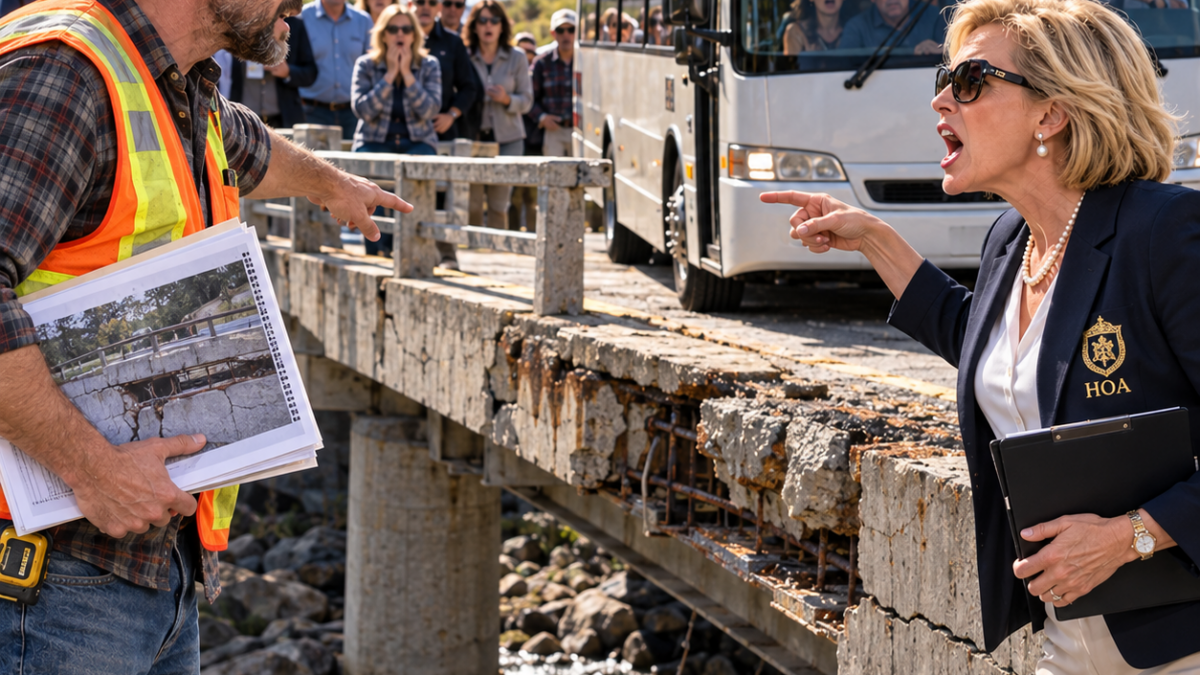
I was halfway across when something near one of the support members caught my eye.
Nothing dramatic.
A hairline crack.
If you had been walking your dog, you probably wouldn’t have noticed it.
I stopped.
Bent down.
Looked closer.
The crack ran farther than I expected.
I took out my phone and photographed it.
Then I went home.
That should have been the end of my concern.
Old bridges crack.
Concrete cracks.
That alone doesn’t mean a bridge is about to collapse.
A week later, I checked again.
The crack looked different.
Slightly wider at one end.
I took another photograph.
Then another from a consistent angle.
I started doing what I had been trained to do.
Document.
Measure.
Compare.
I found another crack near a joint.
Then an area of concrete deterioration below the deck.
PART3:
After a week of heavy rain, moisture staining became more obvious.
I began marking locations on a simple sketch.
Date.
Weather.
Approximate width.
Changes from previous photographs.
I wasn’t trying to start a fight.
I wasn’t preparing for litigation.
At that point, I genuinely believed I was being helpful.
Ashford Heights had been built in the late 1980s outside Asheville, North Carolina.
One hundred eighty-three homes.
Mountain views.
Mature trees.
A clubhouse.
Tennis courts.
Walking trails.
The kind of community that described itself in brochures as “established luxury.”
The bridge predated several of the later phases.
It had originally carried traffic to a private estate road before the subdivision expanded.
When the HOA eventually took responsibility for internal roads, it inherited the bridge too.
That transfer mattered.
The county maintained the public road up to our entrance.
Once you passed the gate, Ashford Heights was responsible for the bridge.
Not the county.
Not the state.
The HOA.
That distinction became the center of everything later.
At the time, I did not think about it much.
I had lived there nine years.
My wife, Claire, and I bought our house after our daughters left for college.
We wanted quiet.
Trees.
A place where she could garden and I could pretend retirement was not approaching.
I was fifty-six.
Still working full-time for a regional engineering firm.
Mostly municipal infrastructure.
Stormwater.
Retaining systems.
Bridge rehabilitation planning.
I had spent thirty-one years staring at things most people prefer not to notice.
Cracks.
Settling.
Corrosion.
Drainage failures.
Bad welds.
Deferred maintenance.
I did not enjoy being alarmist.
Engineers who panic at every imperfection become useless.
The job is distinguishing ordinary aging from patterns that deserve attention.
Ashford Bridge deserved attention.
My first email went to the HOA maintenance committee.
Subject:
Ashford Bridge — possible deck/support deterioration.
I attached four photographs.
I wrote:
I have observed widening cracking near the southern expansion area, spalling beneath the east edge, and what appears to be persistent moisture penetration. I recommend the Association retain a licensed bridge/structural engineer for a formal condition assessment.
Not:
The bridge is collapsing.
Not:
Everybody will die.
A condition assessment.
Routine professional language.
The maintenance chair, Frank Delaney, responded the next morning.
Thanks, Daniel. We’ll take a look.
I thought:
Good.
Done.
Two weeks passed.
Nothing.
I checked the bridge again.
The main crack had widened.
Barely.
But enough that a thin plastic crack gauge I owned for field work gave me a measurable change.
I emailed Frank.
He said the board had discussed it.
Next meeting.
That was when I first met Elaine Porter.
HOA president.
Fifty-nine.
Retired executive from a private healthcare company.
Impeccable.
Controlled.
The kind of person who could make a disagreement sound like a performance review.
She ran board meetings efficiently.
Maybe too efficiently.
Agenda.
Time limits.
Motion.
Vote.
Move on.
When the bridge came up, I stood during homeowner comments.
“I’m not asking the board to accept my opinion as final.”
Elaine nodded.
“Good.”
“I’m asking you to hire someone independent.”
“We’ve reviewed your photos.”
“With who?”
“Our maintenance contractor.”
“What kind of contractor?”
“General property services.”
I waited.
“That’s not a bridge engineer.”
A few residents looked up.
Elaine smiled politely.
“We understand you have professional expertise, Daniel.”
“Then why not inspect it?”
“Because professional inspections cost money.”
“Yes.”
“We have to prioritize.”
“This should be one of the priorities.”
That was the first time her expression hardened.
“We disagree.”
I sat.
Frank found me afterward.
Quietly.
“I think we should inspect.”
“Then why didn’t you vote for it?”
He looked uncomfortable.
“The clubhouse roof is already over budget.”
There it was.
Money.
Not corruption.
Not conspiracy.
Deferred maintenance competing with visible projects.
HOA boards love improvements people can photograph.
New landscaping.
New furniture.
New roofs.
Fresh paint.
Nobody takes a brochure picture of properly inspected bridge bearings.
But invisible maintenance is often what keeps visible life possible.
I sent a second email.
Then a third.
By month two, the deck cracking became more obvious near the southern quarter point.
I noticed rust-colored staining emerging from one spalled area beneath the deck.
That suggested reinforcement corrosion.
Again:
Not proof of imminent collapse.
But one more reason to investigate.
I photographed.
Measured.
Created a simple condition memo.
Three pages.
I included a disclaimer in bold:
THIS IS NOT A FORMAL STRUCTURAL INSPECTION AND SHOULD NOT BE USED AS ONE.
I wrote that because I did not have full access.
No lift.
No testing.
No drawings.
No load history.
No material sampling.
I was a resident observing visible deterioration.
I did not want anybody later claiming I had certified safety.
The board did something I did not expect.
They used my disclaimer against me.
Elaine wrote:
Since Mr. Mercer acknowledges he has not performed a formal inspection, the Board does not believe emergency action is warranted.
I read that sentence six times.
Claire found me at the kitchen table.
“What?”
I showed her.
She read it.
Then:
“That seems backwards.”
“It is.”
“You said they need an inspection because you haven’t done one.”
“Yes.”
“And they’re saying you haven’t done one, so they don’t need one.”
“Yes.”
She slid the laptop back.
“That would make me yell.”
“I’m trying not to.”
“You’re doing badly.”
True.
The board tabled inspection again.
Reason:
Reserve study update pending.
Then came the shuttle.
Elaine announced it in the monthly newsletter.
ASHFORD CONNECT.
A twenty-two-passenger luxury shuttle for residents.
Leather seating.
Wi-Fi.
Wheelchair lift.
Scheduled trips downtown.
Medical centers.
Shopping.
Airport connections twice weekly.
The HOA had a large retired population.
Many residents loved the idea.
Honestly?
It was a good idea.
Claire liked it.
“My driving at night is getting worse.”
“I know.”
“You say that too quickly.”
“Engineering habit.”
“What habit?”
“Accepting field data.”
She threw a dish towel at me.
The shuttle cost $286,000 after customization and service setup.
Paid partly from a transportation initiative reserve the board had created with a special assessment approved the previous year.
Separate fund, Elaine emphasized when residents asked why they could afford a shuttle but not a bridge inspection.
Technically, that mattered.
Funds were not entirely interchangeable.
But the board still had discretionary reserves.
And more importantly, they were planning to run a twelve-ton loaded vehicle across the very bridge I had asked them to inspect.
I wrote another warning.
This one certified mail.
Elaine Porter.
Frank Delaney.
Entire board.
The shuttle’s maximum gross vehicle weight is materially greater than typical passenger vehicle loading. Given observed bridge deterioration, I strongly recommend that no heavy community vehicle be placed in regular service across Ashford Bridge until a qualified structural engineer has assessed the span.
I included photographs.
Measurements.
Sketch.
The mail receipts came back.
Signed.
Two weeks later I received a formal letter from HOA counsel.
Not threatening exactly.
Careful.
It said repeated assertions about infrastructure danger could create unnecessary alarm and adversely affect property values.
I laughed.
Then stopped laughing.
They were telling me:
Quiet down.
Not because I was demonstrably wrong.
Because warnings themselves had become inconvenient.
At the next meeting, Elaine said publicly:
“Mr. Mercer has repeatedly presented speculative concerns unsupported by a formal engineering study.”
I raised my hand.
“You are the people refusing to commission the study.”
She continued.
“We will not allow one resident to disrupt community operations through fear.”
“Hire the inspector.”
“Daniel.”
“Hire one.”
“Your time is over.”
I sat.
Claire squeezed my hand.
Under the table she whispered:
“Now I want to yell.”
The board approved shuttle operations.
First run scheduled in six weeks.
That gave me enough time to do something I had resisted.
Hire my own structural engineer.
Not because I needed validation.
Because my observations had become a dispute.
I wanted independent eyes.
I called Dr. Maya Chen.
We had worked together on a municipal bridge rehabilitation project years earlier.
She ran a small structural consulting firm.
Bridge specialist.
I told her everything.
Her first question:
“Do you own the bridge?”
“No.”
“Do you have permission to inspect?”
“No.”
“Then I can only observe from public or permitted areas.”
“Correct.”
“You understand I cannot issue a condition rating without access?”
“Yes.”
“But I can review your documentation.”
“That’s what I need.”
She came on a Sunday.
We walked the deck.
Observed from the riverbank.
Used binoculars.
No climbing.
No testing.
No trespass into restricted areas.
After forty minutes she said:
“You’re not imagining this.”
My stomach dropped.
I had wanted her to say:
Looks ugly, probably fine.
Instead:
“I see enough to recommend immediate controlled inspection.”
“How immediate?”
“I would not put a new heavy shuttle into regular service before getting underneath and looking at the support details.”
“Closure?”
She hesitated.
“Daniel, without access I cannot tell you to close a private bridge.”
“I know.”
“But I would advise the owner to restrict heavy vehicles until inspection.”
She wrote a letter.
Not a formal bridge report.
A professional recommendation based on limited visual review and my documented progression.
I sent it certified.
Elaine responded:
The Association acknowledges receipt of Ms. Chen’s limited visual opinion, which expressly states it is not a formal inspection. The Board will continue evaluating infrastructure needs within its normal capital planning process.
Normal capital planning.
I forwarded it to Maya.
Her reply:
They are very determined not to understand what I wrote.
That was month four.
Month five brought rain.
Three days heavy.
The river rose.
Drainage from the deck flowed through joints and cracks.
Afterward, I found a small piece of spalled concrete near the eastern abutment.
Palm-sized.
Probably from underside edge.
I photographed it in place.
Did not touch initially.
Called Frank.
He came alone.
Stood beside me.
Looked.
“That’s new?”
“Yes.”
“Could it be old debris?”
“Maybe.”
He looked at the deck.
“I’m starting to worry.”
“You should have been worried five months ago.”
“That isn’t helpful.”
“No.”
I exhaled.
“Sorry.”
He called Elaine.
She came.
So did the property manager.
They looked.
Elaine said:
“We have no proof it came from the bridge.”
I stared at her.
“Where do you think it came from?”
“Construction debris.”
“There hasn’t been construction here.”
“Daniel, speculation—”
“Stop.”
Claire told me later that was the moment my voice changed.
“Stop calling every observable fact speculation because you don’t like what it implies.”
Elaine’s face hardened.
“Do not speak to me like that.”
“Then hire the inspection.”
She turned away.
That evening I wrote my second certified warning.
This one stronger.
VISIBLE DETERIORATION HAS PROGRESSED.
I recommended:
Immediate heavy-vehicle restriction.
Engineering inspection.
Temporary traffic controls.
Consideration of single-lane loading pending evaluation.
I included dates.
Photographs.
Crack-width changes.
Maya’s letter.
Then I did something else.
I copied the HOA’s insurance broker.
That got attention.
Two days later, the board’s insurer requested information.
Elaine was furious.
She emailed me:
Your decision to involve the Association’s insurance partners without Board authorization was inappropriate and potentially harmful.
I replied:
I did not represent the Board.
I transmitted safety documentation to an entity with financial interest in the bridge.
No further explanation.
The insurer recommended inspection.
Not ordered.
Recommended.
The board finally scheduled one.
Six weeks away.
Cheapest qualified firm available.
Then moved it another two weeks because the clubhouse parking resurfacing project overlapped.
I wish I were inventing that.
Three weeks before the near-collapse, the luxury shuttle began service.
I stood in my driveway.
It rolled past.
Blue and silver.
ASHFORD CONNECT in white letters.
Residents waved from windows.
Claire stood beside me.
“You look sick.”
“I feel sick.”
“Should we call someone?”
“Who?”
“County?”
“Private bridge.”
“State?”
“No direct jurisdiction unless tied to public system or specific hazard authority.”
“Police?”
“For what? A vehicle using its own community bridge?”
She looked at me.
“There has to be somebody.”
“There will be after something happens.”
I hated saying it.
That is the failure pattern.
Before failure:
Responsibility fragmented.
After failure:
Everybody discovers authority.
I began checking the bridge daily.
Not obsessively.
Professionally.
That is what I told myself.
Maybe both.
Then on Monday afternoon I saw the crack at the southern joint had opened enough to trap the edge of a dime.
That was no longer subtle.
I photographed it.
Sent emergency email to board.
Subject:
IMMEDIATE ACTION RECOMMENDED — ASHFORD BRIDGE.
Called Elaine.
Voicemail.
Called Frank.
He answered.
“I saw the email.”
“Close to heavy vehicles.”
“I don’t have authority alone.”
“Call Elaine.”
“I am.”
“Stop the shuttle.”
“We have medical runs tomorrow.”
“Then use vans.”
“Daniel—”
“Frank.”
Silence.
“I am telling you as clearly as I can.”
Another silence.
“I know.”
At 7:12 the next morning, Ashford Connect left the clubhouse.
Twelve passengers.
Driver.
Thirteen people total.
I know because the shuttle reservation log later became part of the investigation.
Destinations:
Cardiology appointment.
Physical therapy.
Grocery store.
Pharmacy.
Two residents going downtown for breakfast.
Ordinary lives.
Claire and I were eating oatmeal.
At 7:19 I heard the shuttle engine outside.
Our house sat one hundred yards from bridge approach.
I looked through window.
Saw it descend.
I stood.
Claire saw my face.
“What?”
“It’s the shuttle.”
“So?”
I was already moving.
Shoes.
Phone.
I walked fast down driveway.
The shuttle reached bridge.
Nothing happened immediately.
Front axle crossed the southern expansion area.
Then the rear.
I heard a sound.
Soft.
Not cinematic.
A dull concrete pop.
The vehicle stopped.
Brake lights.
Driver door opened slightly, then closed.
I started running.
The deck behind the rear wheels looked wrong.
Lower.
Maybe an inch.
Maybe two.
Hard to judge.
Then railing shifted.
My body went cold.
“BACK UP!”
Driver could not hear.
I ran closer.
Not onto the span.
Stopped at approach.
The shuttle driver, Marcus Green, opened his window.
“What?”
“Do not move.”
“What?”
“DO NOT MOVE THE BUS.”
Passengers turned.
I called 911.
“My name is Daniel Mercer.”
“I’m a civil engineer.”
“We have a loaded shuttle stopped on a private bridge with visible deck deformation and progressive structural distress.”
Dispatcher changed immediately.
“Any injuries?”
“Not yet.”
“Is the vehicle stable?”
“For the moment.”
“Can occupants exit?”
I looked.
The bus sat maybe twenty feet onto span.
Rear axle near damaged section.
If everybody moved at once toward one door, load shift could matter.
“I don’t want uncontrolled movement.”
“Understood.”
I yelled to Marcus:
“ENGINE OFF.”
He did.
“PARKING BRAKE.”
Thumbs up.
“Tell everyone to stay seated.”
Passengers were frightened now.
One woman pressed both hands to her face.
Another man stood.
I yelled:
“SIT DOWN!”
He did.
Then bridge made the sound.
The sound I had dreaded.
A grinding crack from below.
Not loud.
Deep.
You feel those sounds through your shoes.
Claire had followed but stayed back.
She whispered:
“Oh God.”
I told her:
“Get everyone away from both approaches.”
Neighbors were emerging from houses.
Phones.
Questions.
“MOVE BACK.”
Fire department arrived in seven minutes.
Longest seven minutes of my life.
Captain Robles took command.
I gave him the fastest briefing of my career.
“Progressive cracking six months.”
“Possible reinforcement corrosion.”
“Visible sag initiated under rear axle.”
“Unknown bearing condition.”
“Thirteen occupants.”
“Do not bring apparatus onto bridge.”
He nodded.
“Best evacuation?”
I looked at geometry.
The safest path was backward toward south approach, but the shuttle’s single main passenger door was forward on right side.
Emergency rear exit existed.
Weight distribution complicated.
Robles asked:
“Can they walk out?”
“Yes.”
“Should they?”
“One at a time.”
“Direction?”
“Rear.”
“Why?”
“Shortest distance to solid approach.”
He looked toward shuttle.
Rear emergency door roughly sixteen feet from south abutment.
Firefighters placed ladders and rescue lines from bank where possible.
No one drove heavy equipment onto span.
Good.
The first passenger was seventy-eight-year-old Margaret Bell.
Walker.
She could not climb easily through rear emergency exit.
Firefighters stabilized a ladder platform from the approach edge without loading damaged section.
Marcus helped inside.
We unloaded passengers carefully.
One at a time.
No running.
No crowding.
Each person crossed the short rear section under rescue direction.
The bridge shifted once.
Maybe quarter inch.
Enough that everyone stopped.
Margaret started crying.
“I can’t.”
A firefighter said:
“You can.”
She looked toward me.
I don’t know why.
Maybe because I was the one shouting first.
I said:
“Margaret, look at the firefighter.”
She did.
“Not the water.”
She nodded.
“You only have to make one step at a time.”
She moved.
That is how twelve passengers came off.
Then driver.
All thirteen.
Nobody injured.
Not one.
When Marcus stepped onto solid pavement, maybe four minutes later, a portion of the southern deck edge dropped several inches.
Concrete broke loose underneath.
Not full collapse.
But enough that one wheel of the empty shuttle tilted.
Everybody stared.
Then the rear of the shuttle sank farther.
Captain Robles ordered everyone back.
Twenty minutes later, engineers from county emergency management arrived because the fire chief had requested technical support.
Then sheriff.
Then state transportation liaison.
Private bridge or not, an active structural emergency with trapped residents attracts attention.
The shuttle remained stranded until a recovery plan could be developed.
Eventually it was removed with controlled equipment from the south side after temporary support and engineering review.
Nobody drove it off.
The bridge closed immediately.
Entire Ashford Heights community lost its only normal vehicle entrance.
That was the second emergency.
One hundred eighty-three homes.
No vehicle access.
Ambulances.
Fire.
Residents with mobility issues.
Food deliveries.
The old maintenance trail on the north side could fit small vehicles but was not designed as a road.
By noon the county had helped establish controlled emergency access through an adjacent utility easement.
Temporary.
Single lane.
Rough.
The HOA suddenly became very interested in infrastructure.
Elaine Porter arrived while firefighters were still working.
She looked at the bridge.
Then at me.
“What happened?”
I stared.
Claire later told me she had never seen me look at anyone that way.
“What happened?”
Elaine swallowed.
“I mean specifically.”
“The bridge moved under the shuttle.”
She looked toward the cracked deck.
“Is it going to collapse?”
“I don’t know.”
That answer terrified her more than yes would have.
“Daniel—”
“I have been telling you I don’t know for six months.”
She looked away.
Frank arrived behind her.
He looked ten years older.
“I should have stopped the shuttle.”
I said nothing.
He continued.
“I almost called Marcus this morning.”
“But?”
“I thought…”
He stopped.
That unfinished sentence carried everything.
I thought one more trip would be fine.
I thought inspections could wait.
I thought yesterday proved today.
Structures punish that thought eventually.
By afternoon the HOA’s attorney sent residents an email.
Emergency closure.
Alternate access.
Independent investigation.
Please avoid speculation.
I laughed when I read that phrase.
Avoid speculation.
For six months they had called evidence speculation.
Now speculation meant residents asking who knew what.
Claire said:
“Don’t send anything angry.”
“I know.”
“You’re typing.”
“I know.”
“Delete it.”
I did.
Instead I created a timeline.
Because that is what I do.
First photograph.
First email.
Board responses.
Crack measurements.
Maya Chen letter.
Certified warning one.
Certified warning two.
Insurance notification.
Heavy vehicle recommendation.
Shuttle launch.
Monday emergency warning.
Tuesday incident.
Every attachment.
Every receipt.
Every timestamp.
Then I backed it up.
Three places.
The board hired an emergency bridge firm.
Not the cheap inspection company originally scheduled.
A serious one.
Full access.
Temporary shoring.
Material testing.
Reinforcement scan.
Bearing inspection.
Drainage.
Load assessment.
Their preliminary findings came three days later.
The failure mechanism was not one dramatic defect.
It was exactly the kind of ugly combination engineers fear.
Long-term water infiltration through failed joints.
Corrosion of embedded steel.
Concrete delamination and spalling.
Deterioration near a critical support region.
Drainage problems accelerating damage.
Possible bearing restriction contributing to unintended stress.
Deferred repair.
Then the shuttle load produced enough additional demand to trigger localized deck/support distress.
The bridge had not been seconds from total collapse in the movie sense.
That distinction mattered.
But it had become unsafe.
And continued heavy loading could have produced far worse consequences.
Maya called me after reviewing the preliminary information.
“You were right.”
I hated the sentence.
“I wish I wasn’t.”
“I know.”
People imagine vindication feels good.
Sometimes.
Not when twelve neighbors were sitting above a failing support.
Then came records.
The HOA’s insurer demanded everything.
Emails.
Minutes.
Budgets.
Maintenance reports.
Warnings.
The county asked for records because emergency access had become a public-safety issue.
Attorneys told the board to preserve documents.
Residents demanded transparency.
Elaine resisted initially.
Then something leaked.
An internal email.
Three months before the incident.
From Frank to Elaine and treasurer.
Subject:
Bridge inspection / Daniel Mercer concerns.
Frank wrote:
I think we should authorize an independent bridge review. Daniel may be overstating urgency, but the progression in his photos is concerning and I do not want the new shuttle crossing until we have an engineer’s opinion.
Elaine replied:
I am not allocating another $18-25K this quarter based on Daniel’s personal crusade. We have clubhouse roof, pool filtration, landscape contract, and shuttle launch commitments. If we respond every time he sends another crack photo, we reward disruptive behavior.
Then:
The bridge has carried delivery trucks for decades. One shuttle does not change that.
That line became infamous.
One shuttle does not change that.
Technically, load history matters.
But past truck crossings do not prove current capacity.
And the warning was not:
One shuttle will definitely collapse it.
The warning was:
Condition changed.
Inspect before adding regular heavy loading.
The email spread through Ashford Heights within a day.
Someone printed it and taped it to the clubhouse door.
I did not.
Wish I could say I was above enjoying that.
I wasn’t entirely.
But humiliation still wasn’t the goal.
Accountability was.
The next email hurt more.
Treasurer asked:
Could bridge inspection come from reserves?
Elaine:
Yes, but I don’t want to trigger a large repair obligation until after clubhouse projects close. Once we commission a report, we may be legally required to act on whatever it finds.
There it was.
Not ignorance.
Avoidance.
She did not want information because information creates responsibility.
That is one of the most dangerous forms of deferred maintenance.
Not:
We don’t know.
But:
If we officially know, we have to spend money.
So we choose not to know officially.
I had seen it in private development.
Industrial sites.
Small municipalities.
The phrase changes.
The logic does not.
Once documented, we have to act.
Therefore delay documentation.
Bad engineering.
Worse governance.
A special HOA meeting was scheduled.
Fire marshal limited clubhouse occupancy.
People stood outside listening through open doors.
Elaine sat at board table.
Frank beside her.
Treasurer.
Two other members.
I sat with Claire in the second row.
I did not want to speak first.
Residents did that for me.
Margaret Bell—the seventy-eight-year-old who had climbed out through the rear exit—stood with her walker.
She faced Elaine.
“I voted for you.”
Elaine looked down.
Margaret continued.
“I rode that shuttle because my cardiologist doesn’t want me driving.”
Her voice trembled.
“I was sitting over that crack while Daniel stood outside telling us not to move.”
Nobody breathed.
“I don’t understand bridges.”
“I shouldn’t have to.”
“That is why we elect people to hire people who do.”
She sat.
That line ended Elaine more completely than anything I could say.
Then Marcus Green, the shuttle driver.
“I asked before launch whether bridge clearance had been checked.”
Heads turned.
“What?”
He held up his phone.
An email from transportation vendor to HOA.
Question:
Please confirm route supports vehicle gross weight and clearance.
HOA management replied:
Yes. Existing community bridge routinely accommodates service and delivery vehicles.
No engineering certification.
No load posting review.
Just assumption.
Marcus said:
“If somebody had told me there was a structural concern, I would never have driven thirteen people onto it.”
Elaine responded:
“No formal report declared it unsafe.”
I stood then.
Could not help it.
“No.”
Everyone turned.
I kept my voice low.
“Because you refused to commission the formal report.”
Silence.
Elaine said:
“You had no authority to declare closure.”
“I never claimed I did.”
“You created alarm without complete data.”
“I asked you to get the complete data.”
She looked toward the room.
“We cannot govern by homeowner opinion.”
I nodded.
“Correct.”
That surprised her.
“So stop doing that.”
“What?”
“You made the opposite homeowner opinion.”
“You decided it was safe enough without an inspection.”
“You made an engineering conclusion too.”
“You just liked yours better because it was cheaper.”
The room reacted.
Elaine’s attorney leaned forward.
She ignored him.
“That is unfair.”
“No.”
I shook my head.
“Unfair would be claiming I told you the bridge would collapse Tuesday.”
“I did not.”
“I told you the visible deterioration justified inspection and heavy-load restriction.”
“That was correct.”
“The thing you are angry about is not that I predicted too much.”
“It is that I warned enough.”
Her attorney touched her arm.
She stopped answering.
Then Frank spoke.
“I failed.”
Everyone looked at him.
No qualifiers.
“I thought Daniel was probably right.”
Elaine stared.
Frank continued.
“I kept letting procedure become my excuse.”
“Vote next month.”
“Budget next quarter.”
“Inspection after shuttle launch.”
“I told myself we weren’t ignoring it because it stayed on the agenda.”
He looked toward Margaret.
“But we were ignoring it.”
That mattered.
Accountability without theater.
Residents voted to initiate recall proceedings against Elaine.
She resigned before the vote.
Frank resigned from maintenance chair but remained on board temporarily to assist transition.
Treasurer stayed.
The HOA appointed an interim infrastructure committee with one requirement:
No member could substitute for professional inspection.
I refused to chair.
Naturally, they asked.
“No.”
“Why?”
“Because I live here.”
“So?”
“And because I am now part of the dispute record.”
“We need expertise.”
“Hire it.”
That was the entire lesson.
Do not use free resident expertise as a substitute for responsible professional services.
I agreed to answer technical questions.
Nothing more.
Then reconstruction costs arrived.
Bad.
Very bad.
Temporary shoring.
Demolition of damaged sections.
Bearing rehabilitation.
Concrete repair.
Joint replacement.
Drainage upgrades.
Guardrail.
Load testing.
Engineering.
Contingency.
Initial estimate:
$1.4 million.
Final project:
just under $1.9 million.
Residents panicked.
Special assessment.
Insurance dispute.
Reserve depletion.
People blamed Elaine.
Some blamed me.
Yes.
Me.
One anonymous letter:
If you hadn’t involved insurers and engineers, this could have been handled gradually without destroying our property values.
I showed Claire.
She read it.
Then tore it in half.
“That’s mine.”
“No.”
“It was on our porch.”
“Still mine.”
She tore again.
Sometimes healthy governance begins at home.
A few residents argued the bridge might have lasted years if we had not “overreacted.”
The emergency engineer addressed that at a public meeting.
He put photographs on screen.
Corroded reinforcement.
Delaminated concrete.
Restricted bearing.
Cracked support region.
Then said:
“Could the structure have carried more vehicles?”
“Possibly.”
“For how long?”
“We cannot answer.”
“Would responsible engineering recommend continued unrestricted traffic after observing this condition?”
“No.”
Simple.
Engineers do not need certainty of collapse before restricting risk.
That distinction matters.
You do not wait until a bridge proves incapacity by falling down.
The insurer eventually covered portions tied to sudden incident and emergency response but contested long-term deterioration as maintenance responsibility.
Expected.
The HOA paid through reserves and special assessment.
Painful.
But less painful than funerals.
Ashford Heights used temporary modular bridge access for nine months during repairs.
Ugly.
Single lane.
Traffic signals.
Delivery scheduling.
Garbage trucks one at a time.
School buses stopped outside community.
Kids transferred to smaller vans.
Residents complained constantly.
I did too.
Good.
You can be grateful and annoyed simultaneously.
Property values dipped during the access mess.
Then recovered after the new bridge certification.
Funny.
The thing Elaine claimed would damage values—acknowledging a problem—ended up being what restored confidence.
The HOA published inspection records online afterward.
Annual visual checks.
Five-year professional inspections, or more often based on engineer recommendation.
Heavy vehicle route review.
Maintenance reserve tied to actual infrastructure inventory.
Boring governance.
Beautiful.
Claire served one term on the new board.
That surprised me.
“You hate HOAs.”
“No.”
“I hate poorly managed assets.”
“Very romantic.”
“I married you.”
“Case in point.”
She ran on one promise:
If we own it, we maintain it.
She won.
No campaign signs.
People knew us by then.
The board hired a reserve specialist who actually included:
Bridge.
Drainage culverts.
Retaining walls.
Private roads.
Gate systems.
Stormwater structures.
Not just clubhouse finishes.
The reserve study became depressing.
Also honest.
Deferred maintenance always sends invoices eventually.
Three months after repairs began, Elaine came to my house.
I considered not opening door.
Claire did.
Of course.
Elaine stood on porch.
No binder.
No board polo.
Just sweater and jeans.
She looked smaller.
Not physically.
Authority changes posture.
“I’d like five minutes.”
Claire looked at me.
Your choice.
I stepped outside.
Elaine said:
“I am sorry.”
I waited.
“I ignored you.”
“Yes.”
“I convinced myself you were escalating because you wanted influence.”
“Why?”
She looked toward rebuilt temporary access road.
“Because you kept pushing.”
“That is what warnings do when nobody responds.”
“I know that now.”
I crossed my arms.
She continued.
“I had spent years dealing with residents who declared every cracked sidewalk an emergency.”
“That happens.”
“You were different.”
“Yes.”
“I treated you the same.”
“Why?”
She thought.
“Because if I admitted you were different, I had to spend money we didn’t have.”
There it was.
More honest than I expected.
“We had money.”
“Not enough.”
“You had reserves.”
“For scheduled projects.”
“Projects can be rescheduled.”
She nodded.
“I know.”
“Now.”
“Yes.”
She looked at me.
“I thought leadership meant holding the plan.”
I said:
“Sometimes it means changing it when reality changes.”
“I know.”
Long silence.
Then:
“Margaret won’t speak to me.”
“That isn’t mine to fix.”
“No.”
“I just…”
She stopped.
“I wanted you to know I understand what happened.”
I looked at her.
“Do you?”
“I avoided the inspection because I was afraid of what it might require.”
“Yes.”
“And by avoiding information, I made the risk bigger.”
“Yes.”
She nodded.
“Then I understand enough.”
I believed her.
Not forgiveness.
Not friendship.
Enough.
She left.
Claire asked:
“How do you feel?”
“Hungry.”
“You’re impossible.”
That evening we ordered pizza.
Life continued.
The bridge reopening happened nine months later.
No ribbon cutting initially.
I requested none.
The board wanted ceremony.
Residents had suffered.
Contractor deserved recognition.
County emergency management helped.
Fine.
They held a small reopening event.
Margaret Bell cut the ribbon.
Perfect.
Not me.
Not board president.
Margaret.
The first vehicle across was not the luxury shuttle.
Fire engine.
Intentional.
Slow.
Within certified loading.
Then ambulance.
Then school van.
Then residents.
Ashford Connect had been repaired after tilt damage and stored for months.
It returned to service two weeks later.
Marcus Green remained driver.
Before crossing the first morning, he stopped at bridge entrance.
Opened door.
Looked at me standing nearby.
“You sure?”
I laughed.
“There is an actual inspection now.”
“That’s not what I asked.”
“Yes.”
“I’m sure.”
He drove.
No sound.
No sag.
Just tires over new deck.
That should have felt triumphant.
Instead I mostly felt tired.
Then Margaret rolled down a window and shouted:
“Daniel, we’re alive!”
Everyone laughed.
I did too.
The investigation into board conduct never became criminal.
There was no bribe.
No stolen money.
No forged inspection.
No evil scheme.
That disappointed people who prefer clean villains.
The truth was more useful.
Governance failure.
Deferred maintenance.
Confirmation bias.
Budget pressure.
Status conflict.
Fear of discovering expensive facts.
The HOA’s insurer required board training.
Fiduciary duty.
Risk management.
Document retention.
Infrastructure maintenance.
One slide reportedly said:
LACK OF KNOWLEDGE IS NOT RISK CONTROL.
Frank sent me a photo.
I framed it in my office.
Frank stayed in Ashford Heights.
We became closer eventually.
He carried guilt longer than Elaine, maybe because he understood enough to know how close it had come.
One morning he found me walking the bridge.
New bridge.
He said:
“You still inspect it.”
“Habit.”
“You trust the engineers?”
“Yes.”
“Then why look?”
I thought.
“Because infrastructure deserves attention before it earns fear.”
He nodded.
“Mind if I walk?”
We did.
He asked about joints.
Drainage.
Expansion.
Not because he planned to become engineer.
Because he had learned ownership means curiosity.
Good.
Three years later Frank became HOA president.
I told him he had poor judgment.
He agreed.
His first newsletter did not mention community lifestyle once.
Mostly road resurfacing.
Tree trimming.
Reserve funding.
Residents complained it was boring.
Claire said:
“That’s how you know he’s good.”
The bridge incident changed my professional work too.
I had always taught young engineers technical reporting.
Condition ratings.
Load paths.
Failure mechanisms.
After Ashford, I added something else.
Communication under resistance.
I told them:
A warning is not complete because you sent it.
Ask:
Who received it?
Did they understand it?
What authority do they have?
What happens if they do nothing?
What escalation path exists?
What record will survive?
Engineers sometimes hide behind precision.
We write:
Further assessment recommended.
Then believe responsibility transferred.
Sometimes yes.
Sometimes no.
If the consequence is serious enough, communication itself becomes engineering work.
But there is a limit.
You cannot personally govern every owner.
That lesson mattered too.
I spent six months carrying anxiety for a bridge I did not control.
It affected sleep.
Marriage.
Work.
I checked cracks at dawn.
Opened emails at midnight.
Claire finally said:
“You are treating the bridge like a patient you are personally keeping alive.”
She was right.
“What was I supposed to do?”
“Everything you did.”
Then:
“And recognize when it became theirs.”
Hard.
Engineers like solvable systems.
Human systems are not.
I documented.
Warned.
Escalated.
Involved insurer.
Hired independent review.
I could not physically close a bridge I did not own.
That truth took therapy, surprisingly.
Not because I had trauma from the near-collapse in some dramatic sense.
Because for months afterward I kept replaying:
What if?
What if I had parked my truck across it?
What if I had called sheriff?
What if I had stood there every morning?
What if shuttle had fallen?
Guilt loves imaginary authority.
A counselor told me:
“You are assigning yourself powers you did not have because the alternative is accepting uncertainty.”
I hated that sentence.
Which meant it was probably useful.
Margaret recovered emotionally too.
She stopped using shuttle for months.
Then one day she called Claire.
“Tell Daniel I’m getting back on.”
Why tell me?
Apparently she thought I needed permission to stop worrying.
Maybe I did.
She rode downtown.
Had lunch.
Returned.
No incident.
Then weekly.
Ordinary crossings restored trust more effectively than ceremonies.
Elaine moved two years later.
Not because residents drove her out.
Her daughter had a baby in Virginia.
She sent Claire a card before leaving.
Inside:
I still hear the bridge sometimes.
Claire showed me.
I understood.
Structures can become memories too.
Ten years after incident, Ashford Bridge is no longer technically the same bridge.
Major rehabilitation replaced enough components that Ship of Theseus questions apply.
New deck sections.
New bearings.
New joints.
Repaired reinforcement.
Upgraded drainage.
Modern monitoring points.
But residents still call it Ashford Bridge.
Of course.
Names outlast materials.
So do lessons.
There is now a small stainless-steel plaque near pedestrian entrance.
I argued against it.
Claire lost argument for me.
It does not mention me.
Good.
It says:
INSPECT WHAT YOU OWN.
MAINTAIN WHAT YOU DEPEND ON.
LISTEN BEFORE FAILURE SPEAKS FOR ITSELF.
Frank wrote it.
A little dramatic.
I approve.
My daughters joke that their inheritance will be crack gauges.
Probably.
I still carry one.
Not because every structure is dangerous.
Because measuring beats guessing.
The original crack gauge from Ashford sits in my desk drawer.
Beside it:
Certified-mail receipt.
Elaine’s first dismissal letter.
Maya’s limited-review memo.
I kept them for legal reasons initially.
Now history.
The luxury shuttle eventually reached 180,000 miles.
Replaced.
The new one was lighter.
Not because bridge required it.
Fleet efficiency.
But before purchase, the board requested route loading review.
Marcus sent me photo of new vehicle.
Caption:
LOOK, PAPERWORK FIRST.
Progress.
Margaret died at eighty-six.
Her family held memorial at clubhouse.
I attended.
Her son told me:
“She talked about that bridge for years.”
“I’m sorry.”
“No.”
He smiled.
“She used it to bully us into going to doctors.”
“What?”
“She’d say, ‘I climbed out of a collapsing bus at seventy-eight. You can get your cholesterol checked.’”
That sounded like Margaret.
I miss her.
Frank eventually retired from board.
Claire did too.
I retired from engineering at sixty-four.
Then immediately began consulting two days a week because apparently I have no hobbies.
Claire says this is false.
My hobby is noticing drainage problems on vacation.
She banned me from discussing hotel retaining walls after dinner.
Fair.
One spring morning, long after everything, I walked Ashford Bridge with my granddaughter Sophie.
Six years old.
She rode scooter.
Stopped at plaque.
“Grandpa.”
“Yes?”
“What’s failure speak?”
I looked at words.
“That’s badly written.”
She frowned.
“What’s it mean?”
I crouched.
“It means things usually give little warnings when they need help.”
“Like people?”
Of course child would make it harder.
“Yes.”
“Like when I’m tired and mean?”
“Exactly.”
“Mom says I’m mean when I’m hungry.”
“She is correct.”
Sophie touched new railing.
“Did this bridge talk?”
I smiled.
“Sort of.”
“What did it say?”
“Fix me.”
“Did you?”
“Lots of people did.”
“Why didn’t they fix it before?”
That was the whole story.
I could have said:
Bad HOA president.
Cheaper projects.
Ignored engineer.
Instead:
“Sometimes people don’t like answers that cost money.”
She accepted this faster than adults.
“That’s silly.”
“Yes.”
Then rode away.
Children remain efficient governance critics.
When I think back now, I do not remember the near-collapse first.
I remember the first crack.
Morning mist.
Quiet river.
One hairline mark.
Easy to ignore.
That is how most large failures begin.
Small information.
Inconvenient information.
Information competing against budgets, schedules, pride, optimism, and normal life.
The bridge did not go from safe to dangerous Tuesday morning.
Tuesday morning was simply when denial became visible.
For six months, evidence accumulated.
Crack.
Stain.
Spall.
Measurement.
Letter.
Photograph.
Independent opinion.
Insurance concern.
Another crack.
Another warning.
Each one an opportunity.
That is the tragedy of preventable failures.
Not that nobody knew.
That enough was known, in pieces, for long enough that action was possible.
Elaine’s worst decision was not buying the shuttle.
The shuttle was useful.
Not resurfacing clubhouse lot.
That work needed doing eventually.
Not even delaying one inspection meeting.
Organizations delay things.
Her worst decision was turning evidence into a personality conflict.
Daniel is disruptive.
Daniel is alarmist.
Daniel has a crusade.
Once she made me the problem, every new crack became part of my behavior instead of part of the bridge.
That is a dangerous cognitive move.
Attack the messenger hard enough and information becomes easier to dismiss.
I have seen it since in companies.
Municipalities.
Families.
The sentence changes:
He’s always negative.
She’s difficult.
They’re overreacting.
He worries about everything.
Maybe.
But after saying that, you still need to check the crack.
That is the discipline.
Separate messenger from measurement.
If I am arrogant, inspect anyway.
If I annoy you, inspect anyway.
If I was wrong last month, inspect today’s evidence anyway.
Physics does not care whether you like the engineer.
Ashford Bridge taught our community that at nearly unbearable cost.
But not the worst cost.
Nobody died.
Nobody broke a bone.
Twelve passengers and one driver came home.
That matters more than every email.
More than the $1.9 million.
More than recall.
More than my being right.
People ask me sometimes:
“How close was it really?”
I answer carefully.
“Close enough.”
Because engineering is not fortune-telling.
I cannot tell you the exact minute a deteriorated bridge would have experienced catastrophic failure.
Maybe Tuesday.
Maybe months later.
Maybe some truck heavier than the shuttle.
Maybe flood event.
Maybe it would have remained standing while damage worsened.
That uncertainty is exactly why inspection was necessary.
Uncertainty is not reassurance.
It is a reason to learn more.
The board treated:
We don’t know whether it will fail
as if it meant:
There is no proof it will fail, so continue.
Engineering treats the same sentence differently:
We don’t know, and consequences are high, so investigate.
That difference nearly became fatal.
Ashford Heights now teaches new board members a short infrastructure orientation.
Bridge.
Drainage.
Private roads.
Dams—small detention structure uphill.
Retaining walls.
Emergency access.
They walk the assets.
Touch them.
See them.
Not just budget lines.
The current board president once told me:
“The best thing your bridge did was ruin the idea that the clubhouse is our biggest asset.”
I corrected him.
“My bridge?”
He laughed.
“Community bridge.”
“Better.”
Ownership matters.
So does shared responsibility.
The bridge belongs to all of them now not emotionally, but literally through the association.
That means every resident who votes against reserves because assessments are unpleasant participates in risk.
Not equally.
Board has fiduciary responsibility.
But communities get the infrastructure culture they tolerate.
That lesson was uncomfortable too.
Before the incident, residents packed meetings to argue about landscaping colors.
Nobody came for reserve presentations.
Afterward?
Standing room.
For a while.
Then attendance faded.
Of course.
Memory decays.
That is why systems matter.
Inspection schedule.
Reserve policy.
Written escalation.
Records.
Do not rely on permanent fear.
Fear fades.
Policy remains if designed well.
I keep telling current board:
“Do not expect people to remember Tuesday forever.”
“Build something that works after they forget.”
They did.
That is success.
Not a plaque.
Not a hero story.
A calendar reminder five years later that says:
BRIDGE INSPECTION DUE.
And someone hires the engineer.
No drama.
That is the ending I prefer.
The morning the shuttle nearly went down, I heard concrete crack beneath people I knew.
Margaret.
Marcus.
Mrs. Jensen from 114.
Tom Avery, whose wife had died the year before.
Dr. Patel from upper cul-de-sac.
People who had trusted a board they elected to maintain a bridge they never thought about.
They should have been able to trust that.
They were not supposed to become bridge experts.
That is what governance is for.
The responsibility belonged to people who held information and authority.
I had information.
The board had authority.
For six months those two things failed to connect.
Tuesday finally connected them.
Too late for prevention.
Just early enough for rescue.
That line stays with me.
Just early enough.
I am grateful for it.
And terrified by it.
So when Sophie asks what the bridge said, I tell her:
“Fix me.”
Simple.
The truth was louder.
It said it for six months.
We just needed the people with authority to stop calling the warning disruptive long enough to listen.