The Shelter Cat Everyone Walked Past—Until One Woman Discovered Why She Was Afraid to Be Chosen
PART3:
Denise’s mouth tightened, just a little.
“No,” she said. “She doesn’t perform.”
I should have heard something in her voice then.
I should have asked what she meant.
Instead, I looked around at the families laughing over kittens, the bright posters, the adoption applications clipped to boards, the donation jar shaped like a paw print.
The shelter smelled of disinfectant, dry food, litter, and hope fighting exhaustion.
“I lost my cat in March,” I said.
The words came out before I decided to share them.
Denise did not give me the quick sympathy face people make when they want grief to pass through the room without touching anything.
She simply nodded.
“What was their name?”
“Henry.”
“Good name.”
“He was eighteen.”
“Long life.”
“Not long enough.”
“No,” she said softly. “Never is.”
Henry had been with me through college, two apartments, one bad marriage, one worse divorce, my mother’s cancer, my father’s death, and every version of myself I had outgrown. He had been gray around the muzzle before I was gray at the temples. He slept on my chest when I had panic attacks and shouted from the bathroom sink every morning as if tap water were a civil right.
When he died, my house became too quiet.
Not peaceful quiet.
Accusing quiet.
The kind of quiet that makes you aware of how often you had been loved by habit.
For six months, I left the food bowl in the cabinet and the litter mat by the laundry room door because removing them felt like betrayal and keeping them felt like begging a ghost to come back.
My sister Rachel finally drove me to Briarwood Shelter because, in her words, “You don’t need to replace Henry. You need to stop living like love is finished.”
I had been furious with her.
Mostly because she was right.
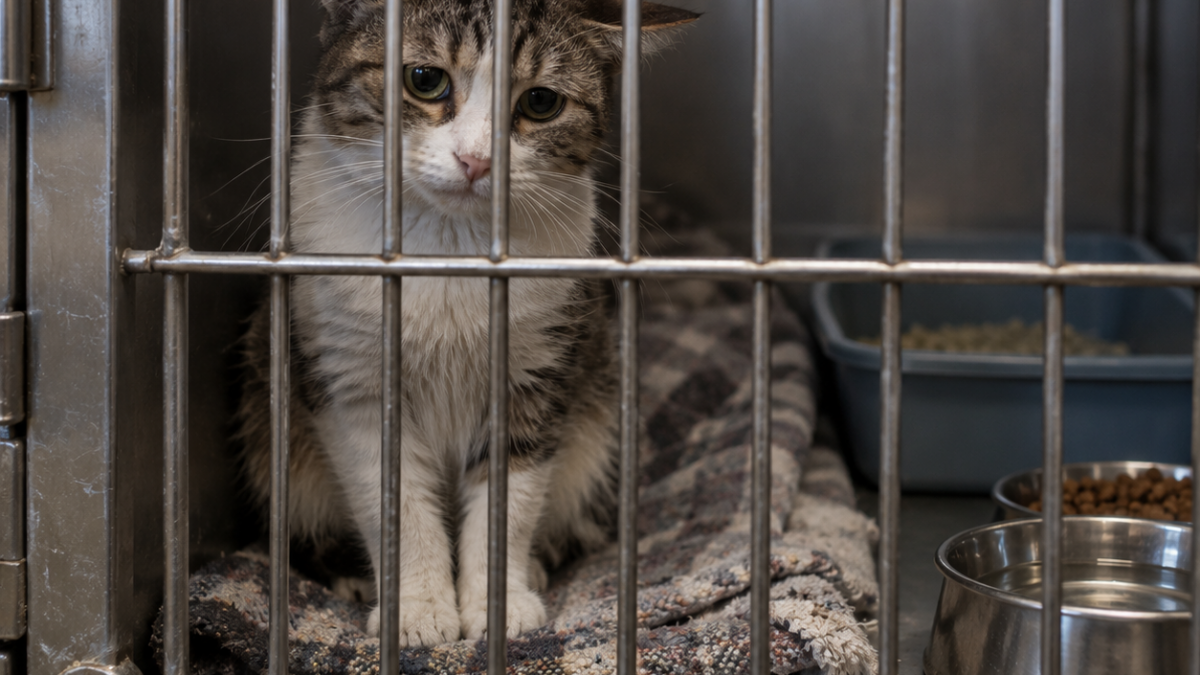
Mabel shifted in the back of the kennel. Her paw moved forward half an inch, then retreated.
“She doesn’t like people?” I asked.
“She wants to,” Denise said.
That answer stayed with me.
Not, She’s scared.
Not, She’s difficult.
Not, She’s traumatized.
She wants to.
Denise unlocked the kennel door.
“Would you like to sit with her?”
I stepped back automatically.
“I don’t want to scare her.”
“That’s already better than most.”
She opened the kennel slowly, talking to Mabel in a low voice.
“Hey, sweetheart. We’re just saying hello.”
Mabel flattened slightly, but she did not hiss.
Denise lifted her gently with both hands, supporting her body close. Mabel went stiff, not fighting, not relaxing, just enduring contact the way some animals endure weather. Denise carried her into a small meet-and-greet room with a cat tree, two chairs, a scratching pad, and a soft blanket patterned with cartoon fish.
“She probably won’t come to you,” Denise warned.
“That’s okay.”
“I mean it. She may hide the whole time.”
“That’s okay too.”
Denise set Mabel near the cat tree.
Mabel immediately slipped behind it and disappeared into the shadow between the carpeted base and the wall.
Denise looked apologetic.
“Sorry.”
“For what?”
“This is usually where people decide she isn’t friendly enough.”
“I didn’t come here to be flattered by a cat.”
Denise laughed once.
It was a small laugh, but I could tell she needed it.
“I’ll give you some time.”
She left the room.
For ten minutes, nothing happened.
I sat in one of the chairs with my hands in my lap and listened to muffled sounds through the door. A child squealed in the hallway. Someone laughed. A kennel latch clicked. A dog barked somewhere farther back. A phone rang at the front desk.
Mabel remained behind the cat tree.
I could not see her.
That seemed fair.
I looked at the floor and said, “I don’t want anyone staring at me when I’m scared either.”
No response.
“My sister made me come,” I added. “She thinks I’m lonely.”
Still nothing.
“She’s right, but she’s annoying.”
A tiny movement came from behind the cat tree.
Not enough to count as progress.
Enough to keep me from leaving.
I stayed thirty minutes.
Mabel never came out.
When Denise returned, I was sitting on the floor instead of the chair, reading emails on my phone so I would not stare at the cat.
Denise stopped in the doorway.
“Oh.”
“What?”
“She’s closer.”
I looked carefully.
Mabel had moved from behind the cat tree to beneath the chair across from me. Only her eyes and front paws were visible.
I smiled before I could stop myself.
“That counts?”
Denise’s face softened.
“With Mabel? That absolutely counts.”
I went home without adopting her.
I told myself that was responsible.
I needed to think.
I needed supplies.
I needed to make sure I was not reacting to grief with impulse.
All reasonable things.
All cowardly too, in their own way.
That night, I sat at my kitchen table eating soup I did not want and kept thinking about the sticker on her kennel.
LONGEST RESIDENT.
Three hundred and eleven days.
Almost a year of people walking past.
Almost a year of children pressing fingers to glass for kittens who played, families asking for cats who cuddled immediately, visitors pausing at her kennel and then moving on because she did not sell herself hard enough.
Almost a year of waiting quietly in a world that rewards noise.
I returned the next morning.
Denise saw me from the front desk and did not hide her smile well.
“Possibly looking again?” she asked.
“Possibly applying.”
She handed me a clipboard.
I filled out the adoption application in the lobby while a teenage boy tried to convince his father that two kittens were easier than one because “they entertain each other.” The father looked defeated in a way that suggested he was already going home with both.
The application asked questions I appreciated.
Do you rent or own?
Any other pets?
Children in home?
Experience with cats?
How would you introduce a shy animal?
What would you do if the cat hides for several weeks?
That last one made me pause.
I wrote:
Let her hide. Keep food, water, litter nearby. Sit quietly. No forcing. No grabbing. Let her decide.
Denise read it later and looked at me for a long moment.
“You mean this?”
“Yes.”
“People write what they think we want to hear.”
“I’ve been a middle-school counselor for twelve years,” I said. “I can recognize performative patience.”
Denise laughed.
“Fair.”
The shelter approved me that afternoon, pending a final conversation with the adoption coordinator. I bought supplies on the way home: litter box, unscented litter, food, water bowls, scratching posts, a covered bed, pheromone diffuser, soft blankets, a few toys I knew she would ignore at first, and a low hiding cube for the spare room.
The spare room still held boxes from my divorce.
I had avoided them for two years.
That night, I cleared them out.
Old tax records.
Framed vacation photos with my ex-husband’s face turned toward me like an accusation from another lifetime.
A sweater I had meant to donate.
A chipped mug from a marriage counselor’s office that said Progress, Not Perfection.
I threw that one away with more force than necessary.
By midnight, the spare room was empty except for a bed, a chair, and the things Mabel would need. I placed the litter box in the far corner, food and water away from it, the hiding cube beside the wall, a fleece blanket under the window, and one small toy mouse near the door.
I stood in the doorway and felt ridiculous.
“I’m getting a room ready for a cat who may hate me,” I told Henry’s old food bowl in the cabinet.
That made me cry.
Grief does that.
It waits until you are doing something hopeful and then asks whether you feel guilty yet.
I cried for Henry.
For the empty months.
For Mabel in kennel seventeen.
For myself, though I did not enjoy admitting that part.
Then I washed my face and went to bed.
The adoption event happened the next day.
That was when I first met Madison Cross.
She arrived at Briarwood Shelter at eleven in the morning with a camera, two assistants, a cloud of perfume, and the kind of smile that seemed designed to be seen by people who were not in the room.
I knew who she was vaguely.
Everyone in our county did.
Madison ran a local lifestyle channel called Madison Makes It Better. She filmed home makeovers, rescue spotlights, charity events, “random acts of kindness,” and videos of herself crying over causes she had discovered six minutes earlier. She had raised money for the shelter before, which meant the shelter board loved her. Staff feelings were more complicated.
I learned that later.
At the time, I only knew she had perfect hair, a cream coat, and a voice that rose half an octave whenever the camera turned on.
“We’re here at Briarwood,” she said brightly into the lens, standing in front of the cat adoption room. “Where so many beautiful animals are waiting for forever families.”
One assistant adjusted a ring light.
The cats reacted exactly as cats should when confronted with unnecessary lighting.
Several retreated.
Princess looked offended.
The orange kitten screamed.
Mabel pressed herself into the back of kennel seventeen and lowered her head.
Denise, standing beside me with the adoption packet, muttered something I could not quite catch.
“What?”
“Nothing.”
Madison moved slowly down the row, narrating every animal like she was selling houses.
“Oh my gosh, look at this little face. This baby is ready to go home today. And these two brothers? We cannot separate this love story.”
Then she reached Mabel’s kennel.
She paused.
Not with tenderness.
With calculation.
The camera hovered.
Madison read the card.
“Mabel,” she said. “Longest resident.”
Her lips curved.
“Poor thing.”
Mabel shrank.
I stepped forward before I meant to.
Denise touched my arm lightly.
Not yet.
Madison crouched in front of the kennel.
“Some animals just need someone extra special,” she said to the camera. “Although, to be totally honest, not every rescue animal is right for a home. Some are very damaged, and that’s something people need to understand before making emotional decisions.”
The words landed softly, but something in them scraped.
Damaged.
Emotional decisions.
Madison’s eyes flicked toward me.
Had she heard from staff that I was adopting Mabel? Had she simply sensed a usable moment? I still do not know.
She turned fully, camera still rolling.
“Are you interested in this one?”
Denise stiffened beside me.
I should have said, “The adoption is private.”
I should have walked away.
Instead, because I had spent most of my adult life being polite under pressure, I said, “Yes.”
Madison smiled wider.
“That’s very brave.”
I did not like the way she said brave.
“It’s not brave,” I said. “She just needs time.”
“Of course,” Madison said to the camera. “And sometimes people who are lonely or grieving feel drawn to animals who seem broken. It can be healing, but it can also create unrealistic expectations.”
My face went hot.
The adoption room seemed to grow louder and quieter at the same time.
A woman holding a kitten looked over.
The teenage boy with the two kittens stared.
Denise said sharply, “Madison, we don’t film adopters without consent.”
Madison lowered the camera slightly, but not enough.
“Oh, I’m not trying to embarrass anyone.”
That is a sentence people usually say while embarrassing someone.
“I’m only saying shy cats require serious commitment. They’re not therapy objects.”
The implication hung there.
Lonely woman.
Dead cat.
Broken animal.
Emotional mistake.
I heard my ex-husband’s voice suddenly, from years before.
You always need something sad to save so you don’t have to look at yourself.
My hands tightened around the adoption folder.
For one second, I almost gave Mabel back.
Not because I believed Madison.
Because humiliation has a way of making you want to undo whatever exposed you.
Then Mabel lifted her head from the back of the kennel.
Her green eyes met mine.
Only for a moment.
But that was enough.
“I agree,” I said, keeping my voice calm. “Animals are not therapy objects. They’re not content either.”
Madison’s smile flickered.
Denise made a sound that might have been a cough.
The assistant lowered the camera.
I looked at Denise.
“Can we finish the paperwork somewhere quieter?”
“Absolutely.”
I did not watch Madison’s face as we left.
I wish I could say I felt powerful.
I did not.
I felt shaky and exposed and angry that a stranger had found a bruise and pressed it on camera.
But I signed the papers.
I listened to the medical notes.
Mabel had no major ongoing medical issues, though she had arrived thin and flea-bitten months earlier. She was spayed. Vaccinated. Microchipped after intake. FIV/FeLV negative. She did not like being picked up. She startled at loud noises. She hid from sudden movement. She sometimes stopped eating when stressed. She needed a slow introduction and a quiet environment.
“She may hide for days,” Denise said.
“I know.”
“Weeks.”
“I know.”
“She may never be a lap cat.”
“I’m not adopting a lap.”
Denise’s eyes softened.
“No. You’re adopting Mabel.”
When they brought Mabel out in the carrier, she was pressed so far back that all I could see was a gray shape and one terrified eye.
I crouched beside the carrier.
“Hey,” I whispered. “We’re going home. You don’t have to do anything when we get there.”
Mabel did not move.
“That’s our whole plan,” I said. “Do nothing until you want to.”
Denise walked me to the car.
At the door, she hesitated.
“I’m sorry about Madison.”
I looked through the shelter window.
Madison was now filming with a puppy.
“She’s a donor?”
“She raises money.”
“That wasn’t my question.”
Denise sighed.
“Yes.”
“Does she always talk like that?”
“Only when there’s an audience.”
I loaded Mabel carefully into the back seat, secured the carrier, and looked at Denise.
“Do you think I’m making an emotional decision?”
Denise studied me.
“Yes.”
The answer surprised me.
Then she continued.
“But that doesn’t mean it’s a bad one. All love starts emotional. The question is whether you keep showing up after the feeling gets inconvenient.”
I nodded.
“I can do inconvenient.”
Denise smiled.
“I thought so.”
Mabel did not make one sound during the drive home.
That worried me more than crying would have.
I parked in the garage, closed the door before opening the car, and carried her inside. The spare room was ready. Food. Water. Litter. Bed. Hiding cube. Blanket. I placed the carrier on the floor and opened the door.
Then I left.
That was harder than it sounds.
Everything in me wanted to coax, comfort, prove myself, show her the room, tell her she was safe. But need can become pressure even when it comes dressed as kindness.
So I opened the carrier and gave her privacy.
For six hours, nothing happened.
At least nothing I saw.
I sat in the hallway with my back against the wall and read a book out loud in a low voice. Not to lure her. Not exactly. Just to let my voice become part of the air.
At midnight, I peeked in.
The carrier was empty.
The hiding cube had acquired one gray shadow.
The food was untouched.
The litter unused.
I whispered, “Good night, Mabel.”
Her eyes glowed from the cube.
I closed the door.
The first week was not beautiful.
It would have made terrible video content.
Day one: Mabel hid.
Day two: Mabel hid and ate six bites of food at three in the morning.
Day three: Mabel hid, used the litter box, and ignored the toy mouse with such commitment that I began to take it personally.
Day four: I entered the room and found her on the window blanket. We both froze. She bolted under the bed. I apologized to a cat for owning a door.
Day five: She ate while I sat in the chair, but only if I looked at my phone and did not acknowledge the event.
Day six: She hissed at a falling sock.
Day seven: She blinked at me.
Slowly.
Maybe.
I blinked back so carefully that my eyes watered.
I told Rachel about it on the phone.
“You sound like you got engaged,” she said.
“She blinked.”
“Congratulations. Should I buy a dress?”
“You’re mocking something sacred.”
“I’m celebrating your weird little life.”
Mabel did not become affectionate overnight.
She did not crawl into my lap because soft music played.
She did not understand she was finally safe just because I told her.
Trust is not a switch.
It is a receipt book.
Every day writes one more line.
Fed breakfast, no grabbing.
Changed water, no chasing.
Cleaned litter, no punishment.
Entered room, spoke softly.
Dropped spoon, apologized.
Sat nearby, did not stare.
Left and came back.
Left and came back.
Left and came back.
That was the most important one.
The first time she followed me to the doorway, I almost cried.
She did not cross the threshold.
She only stood there, halfway hidden behind the doorframe, watching me walk down the hall.
I stopped ten feet away and sat on the floor.
“Hi.”
She stared.
I slid one treat across the hardwood.
It stopped halfway.
Mabel looked at it.
Looked at me.
Looked at it again.
Then retreated into the room as if the treat had insulted her.
Ten minutes later, I heard crunching.
Progress.
Three weeks after adoption, Madison’s video went online.
I would not have seen it except Rachel called me furious.
“Do not open Facebook.”
That is, of course, the fastest way to make someone open Facebook.
The clip was edited beautifully.
Soft music.
Shelter shots.
Madison holding animals.
Madison tearing up while talking about adoption.
Then me.
Only five seconds.
But enough.
My face, tense and embarrassed, holding Mabel’s adoption folder while Madison said, “Sometimes lonely people are drawn to broken animals, and we have to make sure adoption is truly about the pet, not just filling a hole in ourselves.”
She had blurred nothing.
My name was not mentioned, but Briarwood was a small town.
People recognized me.
The comments split into the usual cruelty of strangers who believe a screen is a wall.
She’s right though. Some people use pets as emotional crutches.
That poor cat looks terrified.
Why adopt an animal that doesn’t even like people?
The woman looks unstable.
I hope the shelter checks on that cat.
Others defended me, which somehow made it worse because now my private grief had become a public argument.
I closed the app and sat at my kitchen table with my hands flat on the wood.
Mabel was under the sideboard.
She had started coming downstairs at night if the house was quiet. She liked the dining room rug and the space beneath the sideboard where Henry used to hide from the vacuum.
I had not realized she was there until I heard the faint shift of paws.
“You picked a dramatic household,” I told her.
She did not answer.
“Sorry.”
That night, I received an email from a woman on the shelter board named Patricia Voss.
Dear Ms. Martin,
Due to concerns raised following recent public discussion, Briarwood Shelter would like to schedule a post-adoption welfare visit for Mabel. While such checks are routine, we want to ensure that Mabel’s transition is proceeding appropriately given her special behavioral needs.
Routine.
I stared at that word.
There had been no mention of a routine welfare visit in the adoption papers.
I replied politely.
Of course. Mabel is adjusting slowly but appropriately. I am available Saturday morning.
Then I forwarded the email to Denise.
She called within three minutes.
“I am so sorry.”
“Is this routine?”
“No.”
“Is Mabel in danger of being taken back?”
“No,” she said quickly. Too quickly. “Not if everything is fine.”
“She hides most of the day.”
“That is fine for Mabel.”
“She has not let me touch her.”
“That is also fine for Mabel.”
“She eats. Uses the litter box. Explores at night. Sits near me sometimes.”
“That is good.”
“Then why do I feel like I’m being audited for loving incorrectly?”
Denise was quiet.
“Because Madison made private patience look like public pathology.”
That was too accurate to be comforting.
The welfare visit happened Saturday at ten.
Patricia Voss arrived in a navy blazer and pearl earrings, carrying a clipboard she did not need. Denise came with her. Denise looked apologetic before she crossed the threshold.
Mabel vanished before the doorbell finished ringing.
Patricia inspected the spare room.
Food.
Water.
Litter.
Beds.
Hiding spaces.
Scratching post.
Pheromone diffuser.
She made notes.
“Has she shown affection?”
“Not in the way you probably mean.”
“Has she allowed handling?”
“No.”
Patricia looked up.
“No?”
“She doesn’t want to be touched yet.”
“It has been three weeks.”
“Yes.”
Denise stepped in gently.
“Mabel’s adjustment period may be longer than average.”
Patricia’s pen hovered.
“Has she bonded with you?”
I felt heat rise in my face.
“She sleeps in the same room sometimes. She eats when I’m nearby. She follows me at a distance. She slow-blinked last Tuesday.”
Patricia’s expression suggested slow-blinking might not hold up in court.
From beneath the bed, a faint sound came.
A tiny chirp.
All three of us heard it.
Denise’s eyes moved toward the hallway.
Mabel appeared at the top of the stairs.
Not fully.
Just her face.
Patricia turned.
Mabel froze.
I looked down immediately.
Do not stare.
Do not pressure.
Do not make yourself the danger.
“Hi, Mabel,” I said softly. “You’re okay.”
Mabel took one step down.
Then another.
Denise stopped breathing.
Patricia watched too directly.
Mabel paused.
I shifted my body sideways, making myself smaller, and placed one hand palm-up on the floor without reaching.
Mabel came down four more steps.
Then turned and disappeared into the living room.
It was not dramatic.
It was not enough for a person who wanted proof on a clipboard.
But Denise’s eyes were bright.
“She never did stairs at the shelter,” she whispered.
Patricia cleared her throat.
“Well. The environment appears appropriate.”
She left five minutes later.
Denise stayed on the porch after Patricia went to the car.
“She’s doing well,” she said.
“I know.”
“She is.”
“I know.”
My voice cracked on the second one.
Denise touched my shoulder.
“Madison won’t get to define this.”
But for a while, she almost did.
The video kept circulating.
Parents at school glanced at me differently. One eighth grader asked if I was “the sad cat lady from Facebook,” then immediately looked horrified because he had not meant to say it out loud.
I told him, “I prefer emotionally invested feline guardian.”
He apologized three times.
I forgave him immediately because thirteen-year-olds are unfinished humans with poor impulse control.
Adults have fewer excuses.
At the grocery store, a woman from church said, “I saw that shelter video. It must be nice to have something to take care of again.”
Something.
I smiled because I did not trust myself to speak.
That evening, I sat on the living room floor and cried silently while pretending to sort mail.
Mabel watched from the dining room.
She had become braver at dusk.
Not daytime brave.
Dusk brave.
She moved through the house like a question. Room to room, staying near walls, pausing at thresholds, memorizing furniture. If I moved too quickly, she vanished. If I sat still, she sometimes stayed.
That night, she crossed the dining room.
Slowly.
Cautiously.
She stopped six feet away.
I wiped my face quickly, embarrassed to be caught crying by a cat who still considered me suspicious.
“Sorry,” I whispered.
Mabel sat.
Tail around paws.
Quiet little shelter cat.
Watching.
Then she did something new.
She tucked her feet beneath her and lay down.
In the same room.
Facing me.
Not touching.
Not trusting fully.
But staying.
I cried harder.
“Okay,” I said, laughing through it. “That’s not helpful.”
Mabel blinked.
Slowly.
Definitely.
I began keeping a notebook.
Not because anyone asked.
Because I needed evidence against my own doubt.
October 12: Ate breakfast while I sat in chair.
October 13: Came downstairs before midnight.
October 16: Slept on dining room rug.
October 18: Stayed in room while dishwasher ran.
October 19: Played with toy mouse after I pretended not to notice.
October 23: Sat near me while I cried.
October 27: Slow blink. Confirmed.
The notebook kept me from measuring progress by what Mabel was not doing.
She was not cuddling.
Not purring in my lap.
Not greeting visitors.
Not letting me pick her up.
But she was eating.
Watching.
Exploring.
Choosing proximity.
Leaving and returning.
Building a life in tiny, almost invisible increments.
Then came the first real breakthrough.
It happened because of rain.
A thunderstorm rolled in hard one evening in November, turning the windows black and rattling the house with wind. Mabel was in the living room when thunder cracked so loudly the floor seemed to jump.
She bolted.
Not upstairs.
Not under the bed.
Toward the laundry room.
I heard the crash before I saw it.
The old folding drying rack had fallen against the wall, trapping nothing but making enough noise to terrify any sane creature. Mabel wedged herself behind the washing machine.
The space was too narrow.
Too dangerous.
Electrical cords. Dust. A gap near the wall.
I stopped in the doorway.
“Mabel?”
No response.
Another thunderclap.
She scrambled deeper.
I thought about grabbing her.
I could do it, probably. Move the washer, reach behind, pull her out. Force safety on her.
Instead, I turned off the laundry room light, sat on the floor six feet away, and began talking.
Not coaxing.
Talking.
About my day.
About the seventh grader who had apologized for calling me a cat lady.
About Henry, who used to try to murder thunder by yelling back.
About Rachel’s insistence that I buy a brighter coat because my wardrobe looked “emotionally overcast.”
For forty minutes, Mabel did not move.
Then I heard one small sound.
A paw shifting.
Then another.
Her gray face appeared at the edge of the washing machine.
I kept looking at my hands.
She stepped out.
Her body was low, tail tucked, eyes huge.
She did not go upstairs.
She came to me.
Not all the way.
Close enough that her whiskers brushed the edge of my sock.
I did not move.
I barely breathed.
Mabel sniffed once.
Then retreated to the doorway and sat there.
It was the first time she had come toward me when afraid.
The next morning, I wrote it in the notebook and underlined it twice.
November 3: During storm, came toward me instead of away.
A week later, Madison came back into the story.
This time, not through a video.
Through a lawyer.
The letter arrived in a white envelope with my name printed in sharp black ink. It stated that Madison Cross Media LLC had received complaints regarding defamatory statements I had allegedly made online and in the community suggesting that Ms. Cross exploited shelter animals for content.
I read the letter twice.
Then a third time.
I had made no public statements.
I had posted nothing.
I had told Rachel, Denise, and one coworker that Madison was cruel.
Apparently cruelty was now a protected brand asset.
The letter demanded I cease making false claims and refrain from interfering with Madison’s charitable partnerships.
At the bottom, in smaller language, it mentioned that Madison was “concerned for the welfare of the gray cat adopted under emotionally questionable circumstances.”
I laughed.
Not because it was funny.
Because my body had no better option.
Then I called Denise.
She swore.
I had never heard Denise swear before.
It was impressive.
“She’s doing this because the shelter board is reviewing the video,” Denise said.
“What?”
“After your welfare visit, Patricia told the board Madison’s filming made the shelter look bad. Staff filed complaints too. Madison is trying to frame this as you attacking her.”
“I didn’t say anything publicly.”
“I know.”
“What does Mabel have to do with her partnership?”
Denise went quiet.
“What?”
“There’s something I need to tell you, but I need to be careful.”
My stomach tightened.
“About Mabel?”
“Yes.”
Denise exhaled.
“When Mabel came in, she was brought through night drop.”
Night drop was a locked intake compartment at the back of the shelter, meant for emergencies when no staff were present. People were supposed to leave information with the animal. Many did not.
“No note,” Denise said. “No carrier. She was inside a taped cardboard box with air holes. Fleas. Thin. Terrified.”
My hand tightened around the phone.
“Was she injured?”
“Not badly. Some scratches. Overgrown nails. Stress-related fur loss. Nothing like severe physical trauma.”
“Was there a microchip?”
“No. We scanned twice. Nothing.”
“Why didn’t you tell me?”
“It was in the intake file. Not hidden. But we don’t always lead with the worst details unless adopters ask. Sometimes people hear taped box and decide the animal is too damaged.”
I looked toward the living room.
Mabel was under the coffee table, asleep with one paw stretched forward.
“Why are you telling me now?”
Denise hesitated.
“Because one of our kennel techs recognized something in an old video.”
“What old video?”
“Madison’s.”
The air changed.
Denise continued carefully.
“About a year and a half ago, Madison fostered a gray cat for a weekend during a campaign. The cat was only in one video. We thought the foster was returned to the rescue she came from because Madison said it didn’t work out.”
My mouth went dry.
“Denise.”
“The video is still online. The cat looks like Mabel.”
I stood slowly.
“Are you saying Madison had Mabel?”
“I’m saying a gray cat with a white chest patch and a nicked ear appeared in Madison’s video months before Mabel was abandoned in our night drop.”
“That’s not proof.”
“No.”
“But you think it’s her.”
“I think we need to look.”
I went to Madison’s page.
It took ten minutes to find the video.
It was called A Weekend Saving the Shyest Rescue Cat.
The thumbnail showed Madison in a pale pink sweater holding a gray cat stiffly against her chest.
My hands went cold.
Mabel.
Thinner now in my house than in the video? No. About the same size. Same pale green eyes. Same white locket patch. Same tiny notch in the ear.
In the video, Madison spoke softly to the camera about patience. She said shy animals needed love. She said she had opened her home to “little Misty,” a frightened foster cat who just needed confidence.
Then came clips that made my stomach turn.
Madison trying to pull the cat from under a couch while laughing.
Madison carrying her toward the camera as the cat twisted away.
Madison placing her on a decorative bed under bright lights.
Madison saying, “She’s still not cooperating, but we’ll get there.”
The cat’s ears were flat.
Her body rigid.
Her eyes huge.
Mabel.
Misty.
Whatever name had been placed on her for the camera.
Near the end, Madison appeared alone.
“Sometimes foster situations don’t work out,” she said, smiling sadly. “Misty needs more specialized care, and we always have to do what’s best for the animal.”
The comments praised her compassion.
No one asked where the cat went.
I sat in the dark with the laptop open and felt something inside me settle into a hard, clear line.
I did not know exactly what Madison had done.
But I knew she knew Mabel.
And I knew that when she stopped at kennel seventeen with her camera and called her damaged, she had not been looking at a stranger.
The investigation began quietly.
Not because I was calm.
Because Denise insisted we had to do it right.
“Screenshots,” she said. “Download the video if possible. Dates. Intake records. Staff statements. No public posts. No accusations online.”
“You sound like animal control.”
“I learned from being disappointed.”
The shelter director, Tom Alvarez, pulled Mabel’s intake file. Night drop, February 8. Gray female cat. No microchip. No note. Taped box. Security camera at the back door had been malfunctioning that night.
Convenient.
Too convenient.
But not enough.
The old Madison video had been posted January 28.
Eleven days before Mabel appeared in night drop.
The rescue Madison claimed had provided the foster cat no longer existed, but Denise tracked down the former coordinator, a woman named Helen Price. Helen remembered Madison because Madison had asked for a “camera-friendly foster with a sad story.”
My skin crawled when Denise told me that.
Helen had allowed Madison to foster a shy gray cat named Misty for a weekend during an awareness campaign. The arrangement was supposed to be temporary, with return scheduled Monday morning.
Misty never came back.
Madison’s assistant emailed that the cat had been transferred to a “behavioral specialist” recommended by Madison’s veterinarian.
No records were provided.
Helen had pushed, but the rescue was collapsing financially, three other emergencies hit, and Madison’s donation kept their doors open another month. Misty’s file was never resolved.
“People lose animals in systems all the time,” Denise said bitterly. “Especially when the person losing them has money.”
I called a lawyer.
Not because Madison’s cease-and-desist frightened me exactly, though it did.
Because Mabel could not speak, and if the truth was going to matter, I needed not to make the kind of mistake powerful people wait for ordinary people to make.
The lawyer’s name was Priya Shah. She specialized in nonprofit and civil matters and had the calmest voice I had ever heard.
After reviewing Madison’s letter, my adoption papers, and the documentation Denise had gathered, Priya said, “Do not respond personally. I’ll handle it.”
“What about Mabel?”
“Mabel is legally adopted to you.”
“Could Madison claim her?”
“On what basis?”
“She may have fostered her.”
“Fostering is not ownership. Abandoning her in a night drop, if that’s what happened, certainly would not strengthen a claim.”
“If we can prove it.”
Priya paused.
“We may not prove everything. But we can establish enough to stop intimidation.”
That was the first time I understood the difference.
Truth is what happened.
Proof is what can survive a challenge.
They are related.
They are not the same.
While the adults gathered documents, Mabel continued healing in inches.
She knew nothing about letters, lawyers, Madison, old videos, former names, or the way humans build paperwork around pain.
She knew the dining room rug.
The spare room.
The hallway.
The sound of the treat bag.
The safe distance between her body and mine.
She knew that I sat on the floor every night for twenty minutes and read aloud.
One evening, while I was reading a mystery novel, Mabel walked across the living room, approached my outstretched foot, sniffed my sock, and tapped it once with her paw.
Then she left.
I stared after her.
“Was that affection or criticism?”
She did not clarify.
The next week, she touched my hand.
I was sitting on the floor sorting laundry. She came close, as she sometimes did now, moving in that careful little way of hers. I kept folding.
A towel.
A sweater.
A T-shirt.
Then I felt the lightest pressure against my knuckle.
One paw.
Soft.
Brief.
Gone.
I looked down too quickly.
Mabel retreated two steps.
“Sorry,” I whispered.
She watched me.
Then, after a long pause, she came back and touched my hand again.
This time, I did not move.
Her paw remained there for three seconds.
I cried later in the pantry because apparently that had become my emotional support room.
Public trouble came in December.
Briarwood Shelter held its annual holiday adoption fundraiser at the community center. I did not want to go. Denise asked me to.
“Mabel’s story matters,” she said.
“Mabel’s story is private.”
“It can be both.”
That was the part I was struggling to understand.
Denise did not want me to parade Mabel. Mabel would not attend. She wanted me present because the shelter board was meeting afterward to decide whether to renew Madison’s media partnership.
Priya advised me not to speak publicly unless asked a direct question.
So I went.
The community center was decorated with paper snowflakes, donation trees, and framed photos of adopted animals. Volunteers sold cookies. Kids made cat toys out of felt and bells. A local high school choir sang carols near the front badly but enthusiastically.
Madison arrived thirty minutes late.
Of course.
She wore red, camera-ready and radiant, with two assistants behind her. People turned. Some smiled. Some whispered. By then, rumors had begun to move beneath the surface of the town. Nobody knew the whole story, but enough people knew there was one.
Madison saw me near the donation table.
Her smile sharpened.
“Elise,” she said warmly, loudly enough for nearby donors. “How is Mabel?”
“Doing well.”
“I’m so glad. I was worried after hearing she still hadn’t bonded.”
“She is bonding at her own pace.”
Madison tilted her head.
“That’s what people always say before admitting the animal might not be in the right home.”
A few people nearby went quiet.
I felt the old heat of humiliation rise in my face.
This time, I did not shrink.
“This is not a good place for that conversation.”
“Oh, I agree,” Madison said. “Private matters should stay private. That’s why I was surprised to hear you’ve been spreading some upsetting claims about me.”
There it was.
Public.
Framed.
A trap.
Priya, standing near the wall, straightened.
Denise froze halfway across the room.
I kept my voice even.
“I have made no public claims about you.”
“But you’ve been asking questions.”
“Yes.”
“About an animal that was legally adopted through Briarwood?”
“About an animal you appear to have fostered under another name before she was abandoned.”
The room went silent.
Madison’s smile did not move, but her eyes changed.
“I have fostered many animals,” she said.
“I’m sure.”
“If you’re implying something, be careful.”
Priya stepped beside me.
“I would advise both parties to continue this with counsel present.”
Madison glanced at Priya.
“And you are?”
“Elise’s attorney.”
That was the first moment Madison looked genuinely surprised.
Bullies often expect shame.
They are less prepared for preparation.
Before Madison could answer, Tom Alvarez, the shelter director, approached.
“Madison,” he said, “the board is ready to begin.”
Her jaw tightened.
“Of course.”
The meeting was supposed to be closed.
It did not stay that way for long.
Board members, shelter staff, Madison, Priya, and eventually me sat in a room too small for the amount of tension inside it. Denise presented documentation calmly.
Mabel’s intake records.
Night drop date.
Condition on arrival.
Madison’s foster video featuring a visually identical cat named Misty.
The former rescue coordinator’s written statement.
Emails showing Madison’s assistant claimed Misty had gone to a behavioral specialist, though no specialist had been identified.
Screenshots.
Dates.
A pattern.
Madison leaned back in her chair with her arms crossed.
“This is absurd,” she said. “Do you know how many gray cats exist?”
Denise clicked to the next slide.
Side-by-side images.
Misty in Madison’s video.
Mabel’s shelter intake photo.
Same chest patch.
Same ear notch.
Same small white toes on one front paw.
Madison laughed once.
A brittle sound.
“You’re turning markings into a conspiracy.”
Tom said quietly, “Then provide the name of the behavioral specialist.”
Madison looked at him.
“What?”
“The one your assistant said received Misty after the foster failed.”
“I would need to check records.”
“We asked two weeks ago.”
“My team handles logistics.”
“Your team has not provided anything.”
A board member named Alan asked, “Was the cat returned to the rescue?”
Madison’s face flushed.
“I don’t remember.”
Denise’s voice sharpened.
“You filmed her for content, kept her for a weekend, announced she needed specialized care, failed to return her, and now you don’t remember?”
“She was difficult,” Madison snapped.
The room changed.
There it was.
Not proof of abandonment.
But truth slipping through anger.
“She hid under furniture. She scratched one of my assistants. She was impossible to film. The rescue misrepresented her temperament.”
I stared at her.
“She was scared.”
Madison turned toward me.
“You have no idea what it was like.”
“No,” I said. “I know exactly what it was like. She hides when people move too fast. She panics at cameras. She freezes when someone reaches under furniture. Do you know why I know that? Because I let her tell me instead of dragging her into better lighting.”
Madison’s face hardened.
“You are emotionally unstable.”
“Maybe,” I said.
Priya’s eyes flicked toward me.
I should have stopped.
I did not.
“But Mabel is safe.”
For a moment, nobody spoke.
Then Patricia Voss, the board member who had inspected my house with the clipboard, cleared her throat.
“I owe Ms. Martin an apology.”
I turned toward her.
Patricia folded her hands on the table.
“I allowed public pressure to influence my assumptions about the adoption. The welfare visit established that Mabel was being appropriately cared for. I should have said that clearly then.”
It was not a dramatic apology.
It did not undo the humiliation.
But it mattered.
The board voted that night to suspend all partnerships with Madison Cross Media pending further review.
Madison stood so fast her chair scraped the floor.
“You will regret this,” she said.
Tom looked exhausted.
“We already regret quite a bit.”
Animal control became involved after that.
Again, not dramatically.
Officer Lee reviewed the records, interviewed Helen Price, requested documents from Madison’s team, and eventually obtained enough to determine what likely happened.
Misty had been fostered by Madison.
The foster agreement required return to the rescue.
No legitimate transfer had occurred.
The “behavioral specialist” did not exist.
Madison’s assistant, under interview, admitted that after the filming weekend went badly, Madison told her to “take the cat back somewhere” because she was “useless for the campaign.”
The assistant claimed she thought Briarwood’s night drop was a safe surrender option.
She also admitted the box had been taped because the cat “kept trying to get out.”
Madison denied directing abandonment.
The assistant had texts.
Not perfect ones.
Enough.
The legal consequences were not as satisfying as a movie would have made them.
There was no jail cell.
No dramatic courtroom collapse.
Madison paid fines related to improper abandonment and violating the foster agreement. She was barred from fostering through partner shelters. Her media partnership with Briarwood ended permanently. Donations connected to her campaign were redirected into a restricted fund for long-term and shy shelter animals. Her assistant entered a diversion program and community service agreement with animal welfare education.
Madison posted a statement.
It was polished.
It took responsibility in the way public statements do when lawyers hold both elbows.
It said mistakes were made.
It did not say, I used a frightened cat for content and discarded her when she failed to perform.
But the record existed.
The documents existed.
Mabel was no longer a nameless difficult cat who appeared in night drop.
She had a history.
A wrong had a name.
Sometimes that is the justice you get.
Not enough.
But something.
Winter settled over the town.
Inside my house, Mabel became herself.
Not quickly.
Never quickly.
But steadily.
She began sleeping on the back of the couch during the day if the curtains were partly closed. She learned that the dishwasher was loud but not murderous. She discovered the heated bed I had bought and ignored for six weeks, then decided it had always belonged to her.
She followed me from room to room at a distance of exactly six feet.
Rachel called it “emotional stalking.”
I called it bonding.
The first time Mabel purred, I did not hear it.
I felt it.
She had approached while I was lying on the living room rug stretching my back after work. I had one arm out, palm up, and was half asleep.
Something warm brushed my fingertips.
I opened my eyes.
Mabel stood beside my hand.
Then, with the gravity of a formal treaty, she lowered herself onto the rug close enough that her side touched my wrist.
I froze.
A faint vibration moved through her body into my skin.
At first, I thought I imagined it.
Then it came again.
Purr.
Small.
Rusty.
Uneven.
Like a machine unused for years finally turning over.
I cried so quietly I impressed myself.
Mabel looked offended by moisture and left after thirty seconds.
But thirty seconds counts.
The notebook grew thicker.
December 14: First contact nap. Thirty seconds.
December 19: Sat on couch while I sat on couch. Opposite ends. Still counts.
December 23: Accepted one chin scratch, then remembered her brand.
January 1: Slept through fireworks under bed but came out afterward when called.
January 9: Purred while eating. Food may be primary relationship.
January 17: Touched nose to my finger.
January 30: Jumped onto bed at 4:12 a.m., stood on my chest, left without explanation.
By spring, Mabel had rules.
No picking up.
No sudden two-handed approaches.
No camera flash ever.
No closed doors between us after dinner.
Treats must be placed on the floor, not offered too close to her face.
Visitors were to be ignored from under the chair until proven boring.
She adored Rachel, which annoyed me deeply because Rachel did nothing except sit on the floor and say, “I’m not interested in you,” which apparently made her irresistible.
“She likes me better,” Rachel said one afternoon while Mabel sniffed her purse.
“She likes your disrespect.”
“Cats value boundaries.”
“Cats value manipulation.”
Mabel chose that moment to rub against Rachel’s shoe.
“See?” Rachel said.
“I raised her.”
“You adopted her.”
“Emotionally, I raised her.”
Rachel looked around my living room: cat trees, window beds, food puzzle, toy basket, three blankets in sun patches.
“Yes,” she said. “You’re clearly the victim.”
In April, I received a letter from Briarwood.
Not a legal letter.
A handwritten one from Patricia.
Dear Elise,
I wanted you to know that the board approved a new program this week: The Mabel Fund. It will cover enrichment, medical care, foster support, and adoption counseling for shy, long-term, and special-needs cats who are often overlooked.
Denise suggested the name. The vote was unanimous.
I am sorry again for how I handled your adoption review. I mistook caution for concern and concern for judgment. Mabel deserved better. So did you.
With respect,
Patricia Voss
I read it twice.
Then I carried it to the living room.
Mabel sat in the window, watching birds with intense but silent hatred.
“You have a fund.”
She did not react.
“It’s named after you.”
She blinked.
“You’re being humble.”
She began washing one paw.
“Or indifferent.”
The Mabel Fund changed things.
Not overnight.
But real change often looks like boring administrative work.
Shy-cat counseling became mandatory for certain adoptions. The shelter created quiet visiting hours with no cameras, no children running, no loud events in the cat room. Long-term residents received foster breaks. Volunteers were trained to explain fear without labeling animals as broken. Adoption bios changed from “shy” and “needs work” to specific language: enjoys quiet voices, prefers side-by-side company, accepts treats, startles at fast movement, bonds slowly but deeply.
The longest-resident sticker came down.
Denise hated it suddenly.
“It tells people they’ve been unwanted,” she said.
“What replaced it?”
A new sticker.
WORTH THE WAIT.
I visited the shelter in May to bring donated blankets.
In kennel seventeen sat a tortoiseshell named Fern, tucked into the same back corner where Mabel had once sat. A woman sat outside the kennel on the floor, reading quietly from a paperback.
Denise nudged me.
“She’s been there forty minutes.”
“Adopter?”
“Maybe.”
Fern’s paw stretched forward through the bars.
Just one inch.
The woman did not reach.
She only kept reading.
I smiled.
“That counts.”
Denise smiled too.
“With cats like Fern? It absolutely counts.”
Mabel’s one-year adoption anniversary came in October.
I did not throw a party because Mabel would have considered that a hate crime.
I bought a tiny cake for myself and a can of expensive food for her. Rachel came over with a gift bag containing a toy shaped like a champagne bottle.
“Mabel is sober,” I said.
“Mabel has been through a lot.”
“Mabel is a cat.”
“Mabel contains multitudes.”
Mabel ignored the champagne toy for three hours, then attacked it under the dining room table with such violence that Rachel looked emotionally fulfilled.
That night, after Rachel left, I sat on the couch with a blanket over my legs.
Mabel jumped up.
Not beside me.
On me.
Four paws.
Full weight.
My breath caught.
She stood on my lap, looking deeply uncertain about the decision she herself had made. Her tail flicked once. Her eyes moved from my face to the blanket, then to the room, then back to me.
I did not move.
“You can leave,” I whispered.
She did not.
Slowly, carefully, she lowered herself onto my lap.
I stared straight ahead, crying silently like a person held hostage by a miracle.
Her body was warm and tense at first.
Then softer.
Then heavier.
A purr began.
Not rusty anymore.
Still quiet.
But steady.
I thought of kennel seventeen.
The back corner.
The longest-resident sticker.
Madison’s camera.
The taped box.
The public comments.
The welfare visit.
The boardroom.
The notebook.
The first storm.
The first paw touch.
The first purr.
All of it led to this ordinary, impossible weight.
A shy gray cat asleep on my lap.
People talk about rescue like it is one moment.
The adoption photo.
The cage door opening.
The drive home.
But rescue is not a moment.
It is repetition.
It is showing up so many times that fear becomes bored of warning against you.
It is filling the bowl again.
Opening the door again.
Sitting on the floor again.
Apologizing for the spoon you dropped.
Letting the animal hide without making their fear about your feelings.
It is understanding that trust given slowly is not less love.
Sometimes it is the deepest kind.
Madison moved away the following year.
Her channel never fully recovered locally, though people with cameras always find new audiences if they are willing to change towns and call accountability bullying. I stopped checking. That was its own kind of freedom.
Melissa, Madison’s former assistant, later sent Briarwood an apology letter and a donation to the Mabel Fund. Denise showed it to me with the name covered.
“She said she should have refused,” Denise said.
“She should have.”
“Yes.”
“Does the apology help?”
Denise folded the letter.
“Maybe not Mabel. Maybe the next cat.”
That had to be enough.
Three years later, Mabel became the sort of cat visitors did not believe had once been untouchable.
Not because she became outgoing.
She did not.
She still hid when strangers came in. Still hated cameras. Still believed the vacuum cleaner was a federal crime. Still did not like being picked up, and because I valued my skin and her dignity, I did not pick her up unless absolutely necessary.
But with me, she became soft.
Demanding, even.
She slept against my hip most nights.
She sat on the bathroom mat while I brushed my teeth.
She yelled if dinner was late by more than eight minutes.
She placed one paw on my wrist when she wanted attention, the same light touch that had once felt like a miracle.
The house no longer sounded empty.
It sounded like paws on hardwood.
Like bowls clicking.
Like purring in the dark.
Like life insisting, gently but persistently, that it had returned.
One afternoon, I found the old adoption notebook while cleaning a drawer.
I sat on the floor and read through the entries.
Slow blink maybe.
Ate six bites.
Stayed in room during rain.
Touched sock.
Sat nearby.
First purr.
Lap.
Beside the last written entry, dated almost a year after adoption, I had written only:
Home.
Mabel climbed into the drawer I was emptying because cats view organization as an invitation to sabotage.
“You are standing on your medical records,” I told her.
She blinked slowly.
I touched her head.
She leaned into my hand.
People sometimes ask me if I saved Mabel.
I understand why.
It is the easy shape of the story.
Lonely woman adopts overlooked shelter cat.
Cat heals.
Woman heals.
Villain exposed.
Justice served.
Happy ending.
Some of that is true.
But easy shapes leave out important things.
Denise saved Mabel by seeing who she was before anyone else did.
Marco at the shelter saved her every morning by cleaning the kennel slowly so she would not panic.
The former rescue coordinator saved part of her story by keeping old records.
Priya saved me from being intimidated into silence.
Patricia saved her pride by admitting she had been wrong.
Even Madison, in the ugliest possible way, exposed the harm of turning frightened animals into props.
And Mabel saved herself too.
That matters.
She kept a small piece of trust alive after people had mishandled it.
She watched.
Measured.
Waited.
Tried.
Retreated.
Tried again.
She did not become brave because I loved her.
She became brave because, day after day, love proved it was not another trap.
As for me, I did not adopt Mabel because I was whole.
I adopted her because I was not.
Madison had been wrong about almost everything, but not about grief drawing people toward animals.
Of course grief does that.
Loneliness does that.
Broken places recognize each other.
The lie is not that wounded people love wounded animals.
The lie is that this makes the love lesser.
A grieving person can still offer safety.
A shy animal can still offer companionship.
Two creatures do not have to be untouched to be good for each other.
They only have to stop using pain as an excuse to harm.
They only have to stay.
One winter evening, five years after I brought Mabel home, snow began falling outside the living room window.
Mabel was older now, rounder, softer, with a few silver hairs near her mouth that looked ridiculous on an already-gray cat. I sat on the couch grading student essays. She slept beside me with her head on my thigh.
The house was warm.
Rachel had left soup in the fridge.
Henry’s old collar hung in a small shadow box near the bookshelf. Mabel’s adoption photo sat beneath it: one terrified gray face peering from a carrier, unaware of everything waiting ahead.
My phone buzzed.
A message from Denise.
Photo attached.
Fern adopted today. Her person read to her for six months. Thought you’d want to know.
In the photo, the tortoiseshell cat sat inside a carrier with a woman’s hand resting nearby but not touching. Fern looked cautious. Unsure. Not yet safe, but no longer unseen.
I looked down at Mabel.
“Fern went home.”
Mabel opened one eye.
I showed her the phone because I had become exactly that kind of person.
“She was worth the wait too.”
Mabel stretched one paw across my wrist.
Then closed her eye again.
Outside, snow softened the street.
Inside, the shy cat everyone had walked past slept without wondering whether someone would come back.
Because I had.
Because she had.
Because love, the real kind, is not loud at the beginning.
Sometimes it does not reach through the bars.
Sometimes it does not ask to be chosen.
Sometimes it sits quietly in the last kennel with its paws tucked under its body, watching the world pass by, too frightened to hope and too gentle to demand.
And sometimes, if someone is patient enough to stop, sit down, lower their voice, and wait, that love will take one small step forward.
Then another.
Then one day, years later, it will fall asleep on your lap as if it always knew it belonged there.
That is the ending Mabel deserved.
Not a viral moment.
Not a perfect transformation.
Not a performance for anyone else’s approval.
Just a home where no one measured her love by how quickly she gave it.
A home where fear was allowed to leave slowly.
A home where the door opened, and the person on the other side kept coming back.
A home where the quiet little shelter cat finally stopped waiting to be chosen and began living like she already was.








