The K9 Would Let No One Touch His Dying Partner—Until He Smelled the Nurse He Had Saved Years Before
PART3:
Because I did not know how to explain that something in my body had recognized the shape of the emergency before my mind had put a name to it.
A police dog.
An ICU room.
People trying to help.
A frightened animal reading help as threat.
It was not memory exactly.
It was a door opening in the dark.
“I might be able to help,” I said.
Marla blinked. “With an aggressive police dog?”
“Maybe.”
She looked at me the way people look when they are deciding whether calm is competence or shock.
“Cherry, if ICU needs another nurse, they’ll call for one.”
“They already called for bodies. That means they’re out of ideas.”
I handed her my clipboard and walked toward the elevators before she could tell me not to.
On the ride up, I watched the floor numbers blink.
Two.
Three.
Four.
My left wrist had begun to ache beneath my sleeve.
It did that sometimes.
Old injuries are loyal in the worst ways. They remind you of weather, stress, fear, and anniversaries your brain tries to avoid. The scar tissue tightened from my wrist to mid-forearm, pale and raised and ugly beneath the fabric.
Three years had passed since the collapse on West Harrison Street.
Three years since concrete turned my apartment into a coffin.
Three years since I learned that darkness could have weight.
I pressed my hand flat against my thigh until the elevator doors opened.
The fourth-floor ICU corridor was chaos held together by hospital policy.
Police officers in dark uniforms lined the walls. Nurses stood in clusters with IV bags clutched uselessly in their hands. Security officers held catch poles and heavy canvas blankets. A hospital administrator with a tight gray bun kept repeating, “We need a decision,” as if saying it enough times would create one.
Two animal control officers had just arrived.
One carried a tranquilizer rifle.
The sight of it stopped me for half a second.
A tall physician in a white coat was arguing with a man I recognized from the evening news: Dr. Arthur Pendleton, attending intensivist, thirty years of experience and exactly the kind of authority voice that made frightened families either calm down or fall apart.
“I cannot treat my patient from the hallway,” he snapped. “His propofol is nearly empty, his antibiotic drip is overdue, and if that chest tube clots off, we are going to lose him while everyone stands here debating sentiment.”
The administrator said, “Arthur, nobody is debating sentiment. That dog nearly bit a nurse.”
“He snapped near her leg. That is not nearly. That is luck.”
“I understand that, but darting a police K9 in the ICU—”
“Then remove him another way.”
“If we send in catch poles and he fights—”
“He is already fighting.”
A police officer sat in a chair near the glass, elbows on knees, head in his hands.
He looked like he had aged ten years in one night.
I learned later his name was Officer Daven Abrams.
At that moment, all I saw was the kind of defeat that comes when a man has tried every word he knows and the one creature who usually understands him no longer can.
Behind the glass wall of room 412, Officer Tmaine Gordon lay motionless under white sheets.
Even from the hallway, I could see the damage.
Bruising down one side of his face. Chest bandages beneath the hospital gown. A ventilator tube taped to his mouth. IV lines. Central line. Foley. Chest tube. Pressure monitor.
Machines were keeping him in the world.
Barely.
And beside the bed stood the dog.
Duke.
Eighty-five pounds of German Shepherd muscle and grief.
His black-and-tan coat looked dull under the fluorescent light, streaked with dust that no one had fully cleaned away. One ear stood high, the other angled slightly from an old injury. His police harness had been removed, but his thick leather collar remained around his neck.
He sat beside Tmaine’s bed like a statue carved out of fury.
Not pacing now.
Not lunging.
Waiting.
That was worse.
His dark eyes never left the door.
His body trembled with exhaustion, but his posture said what no human in that corridor wanted to admit:
Try me.
I stepped closer to the glass.
Duke’s ears twitched.
Even through the door, even through the commotion, he sensed movement.
His head turned slightly, tracking us all.
Someone behind me said, “That dog has been like that for three hours.”
Another answered, “He snapped at Abrams. Abrams helped train him.”
The animal control officer raised the rifle slightly. “If the dog is in a sustained high-arousal state, you’re not going to talk him down. If we wait until he attacks, we risk fatal injury.”
I looked at Daven Abrams.
“What’s his name?”
He raised his head slowly, eyes bloodshot.
“Duke.”
“How old?”
“Six.”
“Partner?”
He nodded toward the man in the bed. “Tommy. Officer Tmaine Gordon. They’ve been together since Duke was a pup.”
“Did he bite anyone?”
Daven looked away.
“He snapped at a nurse. Snapped at me. Didn’t break skin.”
“That matters.”
Dr. Pendleton turned sharply. “Excuse me?”
I faced him.
“If he wanted to bite, he would have.”
“Are you suggesting I should be comforted by the restraint of an eighty-five-pound animal blocking lifesaving care?”
“No. I’m saying if he is still showing bite inhibition, he is not lost.”
The hallway went quiet enough that the monitors inside the room seemed louder.
The administrator frowned. “Who are you?”
“Cherry Cook. Float nurse, cardiac step-down.”
Dr. Pendleton’s scowl deepened. “Not now, Cherry.”
“I see the patient’s propofol bag is almost empty.”
“Yes, because that animal will not let anyone replace it.”
“I’ll do it.”
“No, you will not.”
The answer came from three people at once.
Dr. Pendleton.
The administrator.
Daven.
Even the animal control officer said, “Ma’am, that is not advisable.”
I kept looking through the glass.
Duke’s eyes were locked on me now.
Good.
Not friendly.
Not safe.
But focused.
“You’re going to dart him?” I asked.
“If we have no choice,” the animal control officer said.
“And how long until he’s down?”
“Depends on injection placement, adrenaline level, body weight.”
“How long?”
He hesitated. “Five minutes, maybe ten.”
“And if he fights the sedation?”
“Could be longer.”
“And if his pressure spikes? Or he crashes from the drug?”
No one answered.
I turned to Dr. Pendleton.
“How long does Officer Gordon have before those drips become a bigger problem?”
His jaw tightened.
“Not long.”
“Then hand me the bags.”
The administrator stepped forward. “Absolutely not. I’m not risking liability by sending an unprotected nurse into that room.”
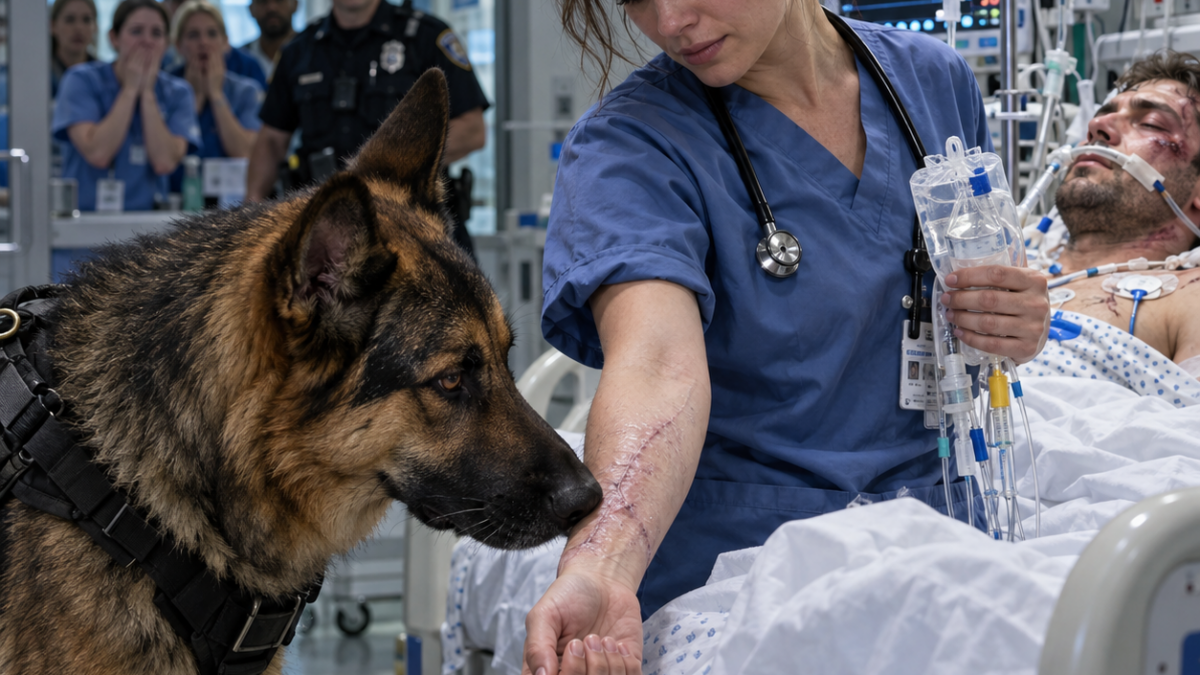
I reached up and unbuttoned the cuffs of my scrub jacket.
The motion was slow.
Deliberate.
I slid the sleeve on my left arm upward.
Fluorescent light caught the scar tissue.
People usually try not to react.
They always fail in some small way.
A flicker of the eyes.
A tightening mouth.
A breath caught too quickly.
My scar began at the base of my palm, where the skin puckered white and uneven. It wrapped around my wrist and climbed my forearm in a jagged raised path of surgical repairs, healed lacerations, and old staple marks. It looked less like a scar than a map of something that had once tried to tear me apart.
Daven stared at it.
So did Dr. Pendleton.
The animal control officer lowered the rifle half an inch.
“I said,” I repeated softly, “hand me the bags.”
The administrator found her voice. “That dog will tear your arm off.”
“No,” I said.
It was not bravery.
People mistake certainty for bravery all the time.
Bravery is walking into something you do not understand.
I understood exactly enough to try.
“No,” I said again. “He won’t.”
Dr. Pendleton looked at my face, then my arm, then the patient behind the glass.
His medical brain did what good medical brains do in crisis: calculated risk against outcome.
“If he moves to bite,” he said, “you back out immediately.”
“If I move to run, he’ll chase.”
His expression shifted.
He had not expected that answer.
I took the antibiotic bag, the fresh propofol, and the syringes from the crash cart. My hands were steady. I made sure of that. Dogs read hands. Patients read hands. Frightened rooms read hands.
Behind me, Daven said, “Cherry.”
I turned.
He swallowed.
“He just snapped at me. And I’ve known him since he was a pup.”
“That’s why it hurt him to do it.”
Daven’s face changed.
I opened the door to room 412.
The seal broke with a soft whoosh.
Duke rose instantly.
The grieving companion vanished.
The guard appeared.
His hackles lifted, a rigid line of dark fur rising along his spine. His lips curled back from teeth so clean and sharp they looked almost unreal under the ICU lights. The growl began in his chest before he made any other movement.
It did not sound like anger.
It sounded like a warning carved out of pain.
I stepped inside and let the door close behind me.
The hallway voices vanished into muffled noise.
Now it was only me, Tmaine Gordon, the machines, and the dog who believed every person in scrubs had become an enemy.
“Hey, Duke,” I said.
Not sweetly.
Not the baby-talk voice people use when they are trying to convince themselves an animal is not dangerous.
Soft.
Low.
Steady.
His eyes fixed on my face.
I did not stare back.
Direct eye contact is pressure. Challenge. Demand.
I kept my gaze soft and angled toward Tmaine’s chest.
The ventilator hissed.
The heart monitor beeped.
Duke took one step forward, blocking the path to the IV pole.
I slowed my pace until each movement felt almost unreal.
My breathing wanted to speed up.
I did not allow it.
Fear has scent.
Adrenaline sharpens it. Sweat carries it. Dogs know the truth of the body before humans can put lies over it.
I had been afraid in my life.
Truly afraid.
Pinned under concrete for twenty-two hours afraid.
Bleeding into dust afraid.
Listening to rescuers shout that the structure was failing afraid.
This was not that fear.
This was focus.
At four feet, Duke lunged.
It was not a full attack.
It was a bluff charge, fast enough to make every human instinct scream run.
His jaws snapped inches from my hip.
The sound cracked through the room.
Outside the glass, somebody shouted.
I stopped.
I did not jerk back.
I did not lift my hands.
I did not say no.
Duke backed up half a step, confused.
Good.
Confusion is a door.
He barked once, deafening in the small room. His muscles bunched for a second strike.
Slowly, I lifted my left arm.
Not toward his head.
Not toward his collar.
I simply extended my forearm into the air between us, scar exposed to the flow from the ventilation system.
“It’s okay, Duke,” I whispered.
His ears twitched.
His nose moved.
Once.
Twice.
He drew in a sharp breath.
The room held still.
I watched recognition arrive in fragments.
Not human recognition.
Not memory with pictures, dates, and names.
Scent memory.
The deepest kind dogs carry.
Bleach.
Alcohol.
Latex.
Blood.
Dust that no longer existed except in my skin.
Panic that had once soaked through my body in the dark.
And beneath it, the chemical trace of survival.
His growl broke in his throat.
He leaned forward.
Cautious.
Uncertain.
His nose approached my scarred wrist.
One inch.
Half an inch.
Then he inhaled.
Deep.
His whole body changed.
The ridge along his spine began to flatten. His ears moved forward. The hard black focus in his eyes widened into something almost unbearable.
Recognition.
I felt my throat close.
“You remember,” I whispered.
Duke made a sound that tore straight through me.
A high, broken whine.
He stepped forward, no longer blocking, and pressed his massive head against my scarred forearm. His nose pushed into my palm. His body leaned into my legs as if some invisible structure inside him had finally given way.
I lowered my fingers onto the top of his head.
The fur between his ears was coarse and warm.
“I know,” I said.
A tear slipped down my cheek before I could stop it.
“I know you’re protecting him.”
He whined again.
“But I have to help him now. You have to let me help him.”
Duke stood there, head pressed to my hand, breathing hard.
Then he looked back at Tmaine.
At the bed.
At the machines.
At me.
With a long exhausted sigh, he stepped aside.
He walked to the corner of the room, lowered himself to the floor, and rested his head on his paws.
His eyes stayed on me.
But he let me pass.
Outside the glass, the hallway erupted into silent disbelief.
Mouths opened.
Hands covered faces.
The animal control officer stared like his training manual had just caught fire.
I moved quickly.
The propofol bag came down. The fresh one went up. Tubing checked. Pump programmed. Antibiotic hung. IV site assessed. Chest tube chamber checked. Output measured. Dressing intact. No obvious new air leak. Saturation still low but holding.
Duke’s tail thumped weakly once when I glanced at him.
Just once.
I almost smiled.
Dr. Pendleton pushed the heavy glass door open with agonizing caution.
Duke’s head snapped up.
The rumble returned immediately.
I dropped to one knee beside him, ignoring every sterile boundary in the ICU.
My scarred hand settled firmly on the thick muscle of his neck.
“Quiet, Duke,” I said. “He is a friend. We are helping.”
Duke looked at Dr. Pendleton.
Then at me.
The growl faded into a huff.
He leaned his full weight into my thigh.
Dr. Pendleton let out a breath he had clearly been holding.
He stepped to the opposite side of the bed, eyes flicking between Duke and the monitors.
“Blood pressure is stabilizing,” he murmured.
He checked the new drips, adjusted the ventilator settings, listened to Tmaine’s chest, and looked at me across the bed with the expression of a man who had practiced medicine for thirty years and just watched something happen outside his understanding.
“I have never,” he said slowly, “seen an animal stand down like that.”
I stroked the fur behind Duke’s ear.
“We have history.”
“What did you do to him?”
“He remembered me.”
Dr. Pendleton did not ask more.
Good doctors know when an answer is enough until the patient is safe.
For the next seventy-two hours, I lived more in room 412 than in the rest of the hospital.
The administration rewrote schedules without admitting they were afraid to let anyone else take over. Officially, I was assigned as primary nurse because continuity benefited the patient and helped reduce environmental stressors for the K9.
Unofficially, nobody wanted to see what happened if I left.
Duke allowed other nurses and doctors to enter only when I was present. Even then, he watched every hand, every syringe, every movement near Tmaine’s lines.
He did not growl if I said, “Friend.”
He did not move if I kept one hand on him.
But if someone rushed, he rose.
If someone reached over Tmaine without warning, his ears pinned.
If voices sharpened, his lips twitched.
He was not calm.
He was controlled.
There is a difference.
I understood that better than most.
At the end of my first twelve-hour stretch, Marla came upstairs with a sandwich and stood outside the room until I noticed her.
“You look like hell,” she said through the doorway.
“That’s your professional assessment?”
“Yes.”
I took the sandwich.
Duke sniffed it.
“It’s turkey,” I told him. “You can’t have it.”
His ears moved.
Daven Abrams, still slumped in the corner chair, gave a tired laugh. It was the first sound from him in hours that did not have fear underneath it.
“He likes turkey.”
“Then he has excellent taste.”
Daven rubbed both hands over his face.
“I’ve never seen him listen to anyone but Tommy like that.”
“He isn’t listening to me the way he listens to Tommy.”
“What’s the difference?”
“He trusts Tommy. He recognizes me.”
Daven looked at my arm.
The question hung there.
I let it.
But I did not answer yet.
Some memories have to be approached like injured animals.
Slowly.
Sideways.
With no sudden lights.
On the evening of the fourth day, a thunderstorm rolled over Chicago.
Rain battered the ICU windows in hard silver sheets. Lightning flashed white across Tmaine’s face, revealing and erasing the bruises in seconds. The machines had settled into a steady rhythm. His intracranial pressure numbers were improving. His oxygenation was better. The antibiotics were doing their job.
Duke lay beside the bed, nose near the wheel, eyes half-open.
Daven sat in the corner with a stale cup of coffee he had stopped pretending to drink.
“I still can’t wrap my head around it,” he said.
I was charting.
“Wrap your head around what?”
“You. Him. All of it.”
I kept writing.
Daven leaned forward, elbows on knees.
“When that building came down on West Harrison three years ago, it was absolute hell.”
My pen stopped.
Not visibly, maybe.
But inside me, every sound in the room changed.
Daven did not notice at first.
“Gas lines were blowing. Fire department said to pull back because the structure was unstable. They thought there would be a secondary collapse.”
I looked down at the chart.
The letters blurred.
“But Tommy refused,” Daven continued. “He and Duke were on the basement level. Duke caught a scent in the rubble and wouldn’t leave it. Tommy dug with his bare hands until his fingernails tore off.”
The room tilted slightly.
I set the pen down.
Daven stared at the floor, lost in the memory.
“There was a woman trapped under a concrete support beam. Rebar through her arm. Bleeding bad. Duke stayed near her head, kept licking dust off her face, whining whenever she started fading. Tommy crawled in beside her and held her hand for hours while heavy rescue tried to lift the beam.”
My breath became too shallow.
“He never got her name,” Daven said. “By the time they got her out, she was unconscious. Tommy had inhaled so much concrete dust he collapsed himself. Spent two weeks in the hospital after.”
He laughed once, but there was no humor in it.
“He always wondered if she made it.”
The monitors beeped.
Rain struck glass.
The ventilator sighed.
My memories, which trauma had stored in broken pieces, came back with terrifying clarity.
The ceiling cracking.
The smell of gas.
The scream from somewhere below me that stopped too suddenly.
The weight.
God, the weight.
Concrete pinning my left arm. Rebar through flesh. Dust filling my mouth. My phone crushed somewhere out of reach. Darkness so thick I could not tell if my eyes were open.
I had screamed until my voice became nothing.
Then I had prayed.
Then I had stopped praying because even prayers seemed to need too much air.
Hours passed without hours existing.
There was only pain.
Thirst.
Dust.
The sickening warmth of my own blood cooling under me.
Then scratching.
Frantic.
Desperate.
A wet nose pushing through a gap in the rubble.
A dog whining near my face.
A rough tongue licking dust from my cheek.
A flashlight beam.
And a man’s voice.
Deep.
Hoarse.
Steady because he was forcing it to be steady.
“I’ve got you,” he said. “Duke and I are right here. Keep breathing for me.”
I remembered his hand.
Large.
Calloused.
Warm.
Holding my uninjured right hand in the dark. His thumb stroking my knuckles over and over again.
“Keep breathing,” he repeated.
For hours.
When I begged him to leave because the building was groaning, he said, “Not happening.”
When rescue sirens wailed warnings outside, he tightened his grip.
When I said I was tired, he said, “Then let me count for you. In. Out. In. Out.”
I had never seen his face.
By the time they pulled me free into the blinding halogen lights, I was in hemorrhagic shock. I remembered noise, cold air, the dog’s desperate bark, and that hand slipping from mine as paramedics lifted me away.
When I woke a week later, the officers were gone.
No one had their names.
Or maybe someone did and the system swallowed them before they reached me.
I had asked once.
Maybe twice.
Then surgeries came. Debridement. Infection. Nerve repair. Physical therapy. Pain so constant it became weather. Medical bills. Nightmares. Learning to use my hand again. Learning to sleep with the light off.
And eventually, learning to stop asking.
I lowered the clipboard slowly.
My eyes moved to Tmaine Gordon.
His face was bruised. Swollen. Half-hidden by tubes and tape.
But his right hand rested on the sheet.
Large.
Scarred across the knuckles.
Familiar.
“It was him,” I whispered.
Daven looked up.
“What?”
“It was him.”
The words barely came out.
I reached with my scarred left hand and gently touched Tmaine’s right.
My fingers trembled.
“He was the one holding my hand.”
Daven’s eyes dropped to my forearm.
The scar.
His mouth opened.
No sound came out.
Duke stood as if the shift in the room had touched him physically. He walked to me and pressed his head against my hip, letting out a soft low whine.
He knew.
From the moment he smelled me.
He had known what my human mind had not yet been able to assemble.
I bent over and buried my face in Duke’s thick fur.
“You knew,” I cried quietly. “You knew me.”
Daven wiped his face with one shaking hand.
“Tommy is going to lose his mind when he wakes up,” he said. “He’s been carrying the ghost of that night for three years.”
I lifted my head.
The tears were still falling, but something underneath them had hardened into resolve.
“Then we better make sure he wakes up.”
From that moment, room 412 stopped being only a patient assignment.
It became a debt.
Not the kind anyone demanded.
The kind your own heart recognizes before your pride can refuse it.
Tmaine Gordon had held my hand in the dark when concrete was trying to bury us both.
Duke had refused to leave me when the fire department wanted everyone out.
I was alive because two officers had decided a stranger under rubble mattered more than their own safety.
Now one of them lay broken in front of me, and the other stood guard on four paws.
I was going to get them both home.
The next forty-eight hours blurred into numbers, medications, lab trends, neuro checks, suctioning, repositioning, and short conversations held in low voices.
Tmaine’s intracranial pressure dropped steadily.
His oxygenation improved.
His fever broke.
His chest tube output decreased.
Dr. Pendleton began saying cautiously optimistic things, which in ICU language meant everyone had permission to hope but not enough to relax.
Duke remained vigilant, but exhaustion softened him.
He let me hand-feed him kibble Daven brought from the precinct. He drank water only after I placed the bowl near Tmaine’s bed and told him, “Your partner needs you strong.”
He listened.
Of course he did.
Partners understand duty.
On day six, dawn came pale and gold over the Chicago skyline.
The storm had washed the city clean, or at least made it look that way from the fourth floor. Light came through the blinds in narrow bars across Tmaine’s bed.
Dr. Pendleton stood at the head of the bed, reviewing the latest numbers.
“He’s fighting the tube,” he said.
My heart began to beat harder.
“Reflexes are returning.”
Duke sat rigidly at my feet, tail tapping once against the floor.
Dr. Pendleton looked at me.
“It’s time.”
Daven stood from the corner chair so quickly his coffee sloshed over his hand.
“Now?”
“Now.”
The room filled with controlled motion.
Respiratory therapist at bedside.
Suction ready.
Oxygen ready.
Emergency airway equipment ready.
Duke stood, anxious.
I put one hand on his head.
“Quiet. We are helping.”
He trembled but stayed.
Dr. Pendleton leaned over Tmaine.
“Officer Gordon, you’re in the hospital. You’re safe. We’re going to take the breathing tube out. I need you to cough on three.”
Tmaine did not appear awake enough to understand.
Patients often do not.
Bodies understand before minds.
“One. Two. Three.”
The respiratory therapist deflated the cuff.
Dr. Pendleton pulled the tube free in one smooth motion.
Tmaine gagged violently.
His body arched off the mattress, then collapsed back in pain. A harsh coughing fit seized his crushed chest. The heart monitor spiked.
Duke barked.
Not threatening.
Desperate.
“Easy,” I said, leaning over Tmaine and grabbing his right hand with both of mine. “Tmaine, breathe shallow. Short breaths. Your ribs are fractured. You’re safe.”
His eyes snapped open.
Panic flooded them.
Not ordinary confusion.
Combat panic.
The kind that wakes with the body before the mind knows what year it is.
His gaze darted around the sterile room. Ceiling. Tubes. Monitors. Faces. Door. Window. Restraints? No restraints. Pain. Air. Too much light.
Then Duke reared up carefully, placing his front paws on the mattress edge.
The dog whined and licked Tmaine’s free hand.
The panic in Tmaine’s eyes shattered.
A single tear slipped down through the bruising on his temple.
“Duke,” he rasped.
His voice sounded like gravel dragged across glass.
Duke yelped once and buried his nose against Tmaine’s shoulder.
“He hasn’t left your side,” I said.
Tmaine turned his head slowly toward my voice.
His eyes found my face first.
There was no recognition there, not yet. How could there be? He had never seen me in the light.
Then his gaze dropped to our hands.
My scarred left hand was wrapped around his right.
His breath hitched.
His thumb moved.
Weakly.
Almost unconsciously.
It stroked across my knuckles.
Once.
Twice.
The way it had in the dark.
His eyes widened.
The room fell away.
He whispered two words.
“Keep breathing.”
I gasped.
The tears came so fast I could not stop them.
“I am,” I said. My voice broke completely. “I’m breathing. I’m still breathing because of you.”
Tmaine stared at me.
At my scar.
At my face.
At Duke, who panted between us with trembling joy.
“You’re the girl in the dark,” he choked.
“My name is Cherry.”
The monitor betrayed the emotion his body could not hide. Heart rate climbing. Blood pressure rising.
Dr. Pendleton said gently, “Officer Gordon, stay with us. Slow breaths.”
Tmaine did not look away from me.
“You made it.”
“I made it.”
“I never knew.”
“I know.”
“I tried to find—”
“I know.”
His eyes filled.
I squeezed his hand.
“When they brought you in, Duke wouldn’t let anyone near you. They were going to dart him. Maybe worse. He was going to die before he let anyone touch you.”
Tmaine looked at Duke.
Duke pressed closer, whining softly.
“How did he let you in?”
I smiled through tears.
“He smelled the scar.”
Tmaine looked back at my arm.
“He remembered the girl from the rubble.”
Silence settled over room 412.
Not empty silence.
Full silence.
The kind that arrives when life has folded itself into a shape so impossible that everyone inside it stops trying to explain and simply stands there witnessing.
Outside the glass, Daven had both hands pressed to the window.
He was openly crying.
I rested one hand on Duke’s head.
“You saved my life, Tmaine.”
His grip tightened weakly.
“You saved mine.”
“No,” I said. “We’re returning the favor. You held the line for the city. Duke held the line for you. I’m just making sure the two best officers in Chicago get to go home.”
He closed his eyes.
Another tear slid down.
Duke laid his head carefully on the mattress beside his hand.
For the first time since I had walked into that room, the dog fully relaxed.
Recovery is rarely cinematic after the moment people clap for.
It is slow.
Messy.
Humbling.
Tmaine’s first words were followed by hours of pain management, respiratory therapy, coughing that felt like punishment, neurological assessments, and the particular frustration of a strong man trapped inside a damaged body.
He hated the incentive spirometer.
Everyone hates the incentive spirometer.
He glared at it like it had insulted his ancestors.
“Again,” I said.
“I just did it.”
“That was three minutes ago.”
“I liked you better when I was unconscious.”
“No, you didn’t.”
Daven laughed from the corner.
Duke thumped his tail.
Tmaine shot the dog a betrayed look.
“You’re supposed to be on my side.”
Duke yawned.
Traitor, clearly.
The story spread through the hospital despite everyone pretending confidentiality still had a chance against forty nurses, half the Chicago Police Department, and a dog who had held an ICU hostage.
By the second week, people brought Duke treats in labeled bags.
Only approved food made it into the room because I threatened to chart anyone who gave him gas-producing snacks as a hostile actor.
Dr. Pendleton, who had first wanted Duke removed, began carrying plain chicken pieces in his coat pocket.
He denied this.
Badly.
Duke accepted the chicken with solemn professionalism.
The administrator avoided me for three days, then finally appeared at the doorway holding a folder.
“I owe you an apology,” she said.
I was adjusting Tmaine’s pillows.
He looked immediately interested.
“No,” I told him.
“I didn’t say anything.”
“You were about to enjoy this.”
“I enjoy accountability.”
The administrator cleared her throat.
“I made a decision based on risk management, not patient context.”
“That is the most administrative apology I have ever heard,” Tmaine rasped.
Daven nearly choked on coffee.
The administrator’s mouth tightened, but to her credit, she continued.
“I was wrong.”
I looked at her.
That part mattered.
“Thank you.”
She glanced at Duke.
“And the hospital will be revising its policy regarding working animals in critical care areas.”
Dr. Pendleton, walking in behind her, muttered, “God help the committee.”
I said, “Put someone on it who has actually handled a traumatized K9.”
The administrator nodded. “I was hoping you would consult.”
I almost laughed.
“I’m a float nurse.”
“You walked into a room no one else could enter.”
“That does not make me a policy expert.”
“No,” Dr. Pendleton said dryly. “But it makes you significantly more qualified than half the people who will claim to be.”
That was how Mercy General’s working animal crisis protocol began.
Not with a press release.
Not with a polished speech.
With a near-disaster, a scar, and a room full of people forced to admit that animals have histories too.
A week later, Tmaine asked me to tell him the whole story.
Not the hospital version.
Not Daven’s summary.
Mine.
He was sitting propped in bed by then, chest wrapped, voice stronger but still rough. Duke slept against the side rail. Afternoon light warmed the edge of the blanket.
“You don’t have to,” he said.
“I know.”
“I just…”
He looked at my arm, then away.
“I only remember pieces.”
“I do too.”
So I told him.
I told him about finishing a double shift and coming home to an apartment that smelled faintly like gas. About thinking the downstairs neighbor must have left a burner on. About reaching for my phone right before the world split open.
I told him about waking in darkness with something crushing my arm.
About not being able to move.
About screaming until dust took my voice.
About hearing rescue teams above me and then hearing them retreat when the structure shifted.
Tmaine’s jaw tightened.
“I remember that order,” he said. “Pull back.”
“You didn’t.”
“No.”
“Why?”
He looked at Duke.
“Because he wouldn’t.”
Duke lifted one ear without opening his eyes.
Tmaine’s mouth softened.
“He found you. He went crazy at a crack in the slab, digging and whining. I thought he had a live scent, but I couldn’t see you. Then I heard you.”
“I don’t remember what I said.”
“You said, ‘Please don’t leave.’”
I closed my eyes.
I had not remembered that.
Tmaine’s voice roughened.
“So I didn’t.”
I told him about his hand in mine. How he counted breaths. How he told me Duke was ugly but loyal, which was apparently untrue because Duke was handsome and knew it. How he promised me that if I stayed awake, he would personally make sure the hospital gave me the good pudding.
Tmaine smiled faintly.
“I did say that.”
“You failed.”
“I was unconscious.”
“Convenient excuse.”
He laughed, then winced hard enough that I reached for the pain pump.
But he shook his head.
“Wait. I want to feel this part.”
“What part?”
“That you’re here.”
I looked down at our hands.
His thumb moved lightly over my knuckles again.
“I tried to find out if you lived,” he said.
“I asked about you too. No one knew who pulled me out.”
“City bureaucracy.”
“Hospital bureaucracy.”
“Together, unstoppable.”
We smiled.
It was small.
It was not romantic then.
Not exactly.
It was recognition.
The kind that does not ask for anything yet.
The kind that simply sits down beside you and says, There you are.
By the time Tmaine transferred out of ICU, Duke had become an unofficial staff member.
He escorted the wheelchair during the move to step-down like a bodyguard assigned by heaven itself. He inspected the new room. Sniffed the bathroom. Checked the window. Stared at the smaller bed with obvious dissatisfaction.
“This room is not up to his standards,” Daven said.
“Few things are,” I replied.
Tmaine settled into rehabilitation with the reluctant determination of a man who hated needing help but hated weakness more.
Physical therapy humbled him.
Occupational therapy irritated him.
Respiratory therapy made him bargain like a criminal defendant.
“If I do five more breaths, can I skip the walk?”
“No,” I said.
“I wasn’t asking you.”
“You were looking at me.”
“I was looking near you.”
“Walk.”
Duke walked beside him the first time Tmaine made it ten steps with a walker. The dog moved slowly, matching his pace, shoulder aligned with Tmaine’s knee. Every time Tmaine’s breath caught, Duke stopped before any therapist said a word.
The therapists began watching the dog instead of the monitors.
“He knows before the numbers change,” one of them said.
I said, “He knew before all of us.”
There were hard days.
The first time Tmaine learned he might not return to full active duty, he went silent for six hours.
Daven tried jokes.
Dr. Pendleton tried clinical reassurance.
His captain tried a speech about service.
None of it worked.
Finally, I found him staring out the window at dusk, jaw locked, Duke pressed against his leg.
“You want me to say something comforting or true?” I asked.
He did not look at me.
“True.”
“This is going to hurt longer than you want it to.”
His eyes closed.
“And people are going to call you lucky because you survived, and you’re going to want to punch some of them because survival still costs something.”
His throat moved.
“You’re not done. But you may not get to be the exact version of yourself you planned.”
He turned then.
“What if I don’t know who I am without the job?”
I thought about my arm.
My old career path.
The version of me before West Harrison who never flinched at elevators, never slept with a lamp on, never measured rooms by exit points.
“You learn the difference between losing a role and losing yourself.”
“How?”
“Badly at first.”
That made him laugh once under his breath.
Duke put his head in Tmaine’s lap.
I said, “You held my hand in the dark and talked me through breathing while a building was falling around you. If the department cannot find a place for that kind of man, that is a failure of imagination.”
He looked down at Duke.
“And him?”
“He already has a job.”
“What job?”
“Keeping you honest.”
Duke sneezed.
Point made.
Weeks later, when Tmaine Gordon finally left Mercy General Hospital, the lobby was packed.
Chicago police officers in dress blues lined both sides of the entrance. Nurses stood behind them. Doctors who claimed to be too busy found reasons to pass through at exactly the right time. Security guards pretended not to cry.
Dr. Pendleton stood near the front with his hands folded, looking stern until Duke trotted over and sat on his shoe.
“Really?” he muttered.
Duke looked up at him.
The doctor sighed and slipped him a piece of chicken.
“I knew it,” I said.
Dr. Pendleton did not look at me.
“I have no idea what you mean.”
The applause began when the elevator doors opened.
Tmaine sat in a wheelchair because hospital policy insisted and because I had threatened to sit on him if he tried to walk out for pride.
Daven pushed from behind at first, but Tmaine stopped him.
“Cherry,” he said.
I looked down.
“You mind?”
My throat tightened.
“No.”
I stepped behind the chair and took the handles.
Duke walked on Tmaine’s right, wearing his K9 badge. His tail wagged with steady dignity. Daven walked slightly behind us, wiping his face and pretending allergies had attacked him indoors.
As we moved through the lobby, the applause grew thunderous.
But Tmaine did not look at the crowd.
He turned his head slightly toward Duke.
Then toward me.
His hand rose slowly and rested over my scarred left hand on the wheelchair handle.
Not hiding it.
Not avoiding it.
Honoring it.
Outside, sunlight spilled across the hospital entrance.
The city sounded like itself again.
Sirens in the distance.
Traffic.
Someone laughing near the curb.
A radio crackling.
Life, rude and loud and continuing.
At the bottom of the ramp, Tmaine’s captain approached.
“Gordon,” he said.
“Captain.”
“You gave us a scare.”
“Wasn’t my best week.”
The captain looked at Duke.
“Your partner caused a policy nightmare.”
Tmaine’s eyes narrowed slightly.
“My partner saved my life.”
The captain held his gaze.
Then nodded.
“Yes,” he said. “He did.”
That was justice too, in its small way.
Not a courtroom.
Not a headline.
A man in authority choosing the right words in front of witnesses.
Duke sat taller.
He understood tone.
Maybe not rank.
But tone, yes.
Over the following months, Tmaine recovered in pieces.
Not perfectly.
Perfect recovery is something people who have never been broken invented for movies.
He had pain.
Bad days.
Nightmares.
Frustration sharp enough to cut anyone standing too close.
I had those too.
That was one of the reasons we understood each other.
We did not heal each other.
I dislike that phrase.
People are not medicine bottles.
But we made healing less lonely.
Some evenings, after my shift, I would stop by his apartment with food because left to himself he considered cereal an acceptable dinner and Duke considered that neglect.
Duke greeted me first every time.
He would press his head into my scarred hand, breathe me in, and then step aside like I had passed inspection.
Tmaine would say, “He likes you more than me.”
I would say, “He has taste.”
He would say, “I was crushed by a building.”
I would say, “Don’t use trauma for sympathy.”
He would say, “You started it.”
It became a rhythm.
A strange, tender, cautious rhythm neither of us named too soon.
We went back to West Harrison Street together once.
The city had cleared the old apartment complex. A chain-link fence surrounded the lot. Weeds grew through cracked pavement. A sign announced future development.
For a long time, none of us spoke.
Duke stood between us, nose lifted, reading ghosts in the air.
Tmaine’s hand found mine.
Not by accident.
“I used to think this place was where I failed you,” he said.
I looked at the empty lot.
“I used to think it was where my life ended.”
“And now?”
I watched Duke sniff a patch of weeds near the fence.
“Now I think it’s where three lives got tied together without asking permission.”
Tmaine smiled faintly.
“Duke would say four. You forgot him.”
“Duke would say he was the only competent one there.”
“He might be right.”
Duke barked once, as if agreeing with his own reputation.
A year after the ICU incident, Mercy General launched a formal K9 and service animal emergency response training program.
They asked me to speak at the first session.
I almost said no.
Public speaking felt like standing under lights with your scars turned into a slideshow.
But then I thought of Duke behind that glass.
The tranquilizer rifle.
The way everyone had seen danger but not history.
So I said yes.
The room was full of nurses, doctors, security officers, animal control staff, and police handlers.
Duke lay at Tmaine’s feet in the front row, retired officially from patrol but not from supervision.
I stood behind the podium and looked at the faces waiting for expertise.
“I’m not a dog trainer,” I began. “I’m not a behaviorist. I’m a nurse who got lucky enough to be remembered by the right dog at the right time.”
A few people smiled.
Then I told them what mattered.
“An aggressive animal in a hospital is a real danger. Pretending otherwise helps no one. Staff safety matters. Patient safety matters. But fear narrows the story. It makes us ask only, ‘How do we stop this?’ when sometimes we also need to ask, ‘What happened first?’”
I looked at Duke.
He was watching me.
“What did the animal see? What did he smell? Who does he trust? What is he protecting? Is he attacking, or is he guarding? Is he out of control, or is he following the only rule he still understands?”
Tmaine’s eyes stayed on me.
I raised my left arm, sleeve rolled.
The room went quiet.
“This scar got me into room 412. But what saved Officer Gordon was not the scar. It was the fact that Duke had a memory the rest of us did not. He knew I had once been helpless. He knew he and his handler had saved me. So when I walked in, I wasn’t another threat in scrubs. I was part of his unfinished story.”
No one moved.
“That is what trauma does. To dogs. To patients. To nurses. To police officers. To anyone who survives something they cannot fully explain afterward. It makes the past enter the room before the present gets a chance.”
I lowered my arm.
“Our job is not to shame that reaction. Our job is to understand it fast enough to keep everyone alive.”
Afterward, a young nurse approached me in the hallway.
She looked about twenty-three and terrified of seeming young.
“My brother has a service dog,” she said. “He’s a veteran. Sometimes the dog blocks the door when people argue.”
“Then he has decided arguments are a threat.”
“What should we do?”
“Start by believing the dog is telling you something. Then figure out what.”
She nodded like I had handed her something she could use.
That felt better than applause.
Two years after room 412, Tmaine asked me to marry him in the least dramatic way possible, which was exactly right.
He did it at his kitchen table while Duke slept under my chair and a pot of chili simmered on the stove.
“I have a question,” he said.
“If it’s about whether you can skip your follow-up appointment, no.”
“It is not.”
“If it’s about whether Duke can have chili, also no.”
Duke opened one eye.
Tmaine reached across the table and took my scarred hand.
His thumb moved over my knuckles.
The same way it had in darkness.
The same way it had when he woke in ICU.
“I loved you before I knew your face,” he said.
My breath caught.
“In the dark, I loved you as a life I wanted to keep in the world. In the hospital, I loved you as the woman who saved mine. Now I love you as Cherry. The woman who steals my hoodies, threatens doctors, overfeeds my dog, and still sleeps with a light on when it rains hard.”
I started crying before he reached into his pocket.
He smiled.
“I’m not done.”
“Then hurry up.”
He laughed, eyes wet.
“I don’t want to make a speech about fate because you hate that.”
“I do.”
“And I don’t want to say Duke chose you first because that gives him too much power.”
Duke lifted his head.
“But he did,” Tmaine admitted.
Correct.
Duke put his head back down.
Tmaine opened the small box.
The ring was simple.
Beautiful.
Not too perfect.
“I want every ordinary day I can get with you,” he said. “Hospital coffee. Bad weather. Duke judging both of us. Pain days. Good days. All of it. Cherry Cook, will you marry me?”
I looked at him through tears.
“Yes.”
Duke barked once.
Then tried to eat the ring box.
So much for dignity.
We married in a small ceremony in a park near Lake Michigan.
Daven stood beside Tmaine and cried before I even reached the aisle. Dr. Pendleton attended and denied crying despite witnesses. Marla brought tissues in bulk because she knew nurses. The hospital administrator sent flowers and a card that said, “With admiration and revised policies.”
Duke wore a formal K9 collar and took his job as ring bearer with terrifying seriousness.
When the officiant asked for the rings, Duke refused to release the pouch to anyone except me.
Everyone laughed.
Tmaine leaned close and whispered, “He still outranks us.”
“He always did.”
During the vows, Tmaine held my scarred hand openly.
The sun caught the raised tissue along my wrist.
For years, I had hidden that arm because people either pitied it or stared at it or asked questions they had no right to ask.
That day, I let it show.
Not because I had become fearless.
Because the scar was part of the road that brought me there.
A wound.
A map.
A witness.
The place where Duke had recognized me.
The place where Tmaine had found me again.
At the reception, Daven gave a toast that began with, “I was told to keep this short,” and then immediately proved he could not follow orders outside active duty.
He talked about Tmaine as a partner.
About Duke as a menace.
About me as “the only person in Chicago who can tell both of them to sit and get results.”
Then he grew serious.
“There are nights in this city that take things from people,” he said. “West Harrison took a lot. That warehouse took a lot. Room 412 almost took more. But sometimes, if we’re lucky, the people who survive the dark find each other again.”
He raised his glass.
“To the ones who held the line.”
Everyone drank.
Tmaine squeezed my hand.
Duke sneezed under the table.
Years have passed now, and people still ask about the story when they recognize Duke from an old news segment or see Tmaine’s scar along his collarbone when his shirt shifts.
They ask if it felt like destiny.
I never know how to answer.
Destiny sounds too clean.
Too polished.
Too easy.
There was nothing clean about concrete dust in my mouth.
Nothing polished about Tmaine coughing blood into an oxygen mask.
Nothing easy about a dog standing between life and treatment because trauma had taught him that guarding meant survival.
I think the truth is harder and better.
We are saved, sometimes, by the parts of us that remember.
A dog remembered a woman in the rubble when every human in the hallway saw only danger.
A man remembered the words he spoke in the dark before he knew the woman’s name.
A nurse remembered what it felt like to be helpless and walked toward the growl instead of away from it.
None of us were unbroken.
That is not the point of surviving.
The point is not to return untouched.
The point is to carry what happened honestly enough that when the past enters the room, you can recognize it before it destroys the present.
Duke is old now.
His muzzle has gone gray. His hips ache in winter. He no longer patrols every window with the same military precision, though he still tries when thunder rolls over the city.
On bad pain days, Tmaine and I help him onto the couch even though we once swore he would not be allowed on furniture.
That was a lie.
Dogs know our rules are mostly negotiations waiting to happen.
Sometimes Duke still wakes from dreams with a low growl in his throat.
Tmaine places a hand on his side.
I place mine over the old scar on my wrist.
“Quiet,” I say softly. “We’re helping.”
Duke exhales.
The danger ends.
The room returns.
Some nights, Tmaine wakes too.
Pain. Memory. Sirens in dreams. The warehouse falling again.
I take his hand.
His thumb finds my knuckles by instinct.
“Keep breathing,” he whispers sometimes, not fully awake.
“I am,” I answer.
And I am.
Still breathing.
Still here.
Because once, in the worst dark of my life, an officer and his dog refused to leave me behind.
Because years later, when that officer was dying behind glass and everyone saw his dog as a threat, I walked in with my scar uncovered.
Because Duke smelled the past on my skin and made room for the future.
People love to say scars tell stories.
That sounds pretty.
It is not always true.
Some scars stay silent for years.
Some are hidden under sleeves.
Some are misunderstood.
Some ache when rain is coming and never explain themselves to anyone.
But every now and then, a scar speaks in a language deeper than words.
Mine spoke to Duke.
It told him I was not there to hurt his partner.
It told him he had saved me once.
It told him that maybe, just maybe, he could trust me to return the favor.
And because he listened, Tmaine lived.
Because Tmaine lived, I found the face of the man who held my hand in the dark.
Because we found each other, a dog who had been called a lethal weapon got to become what he had always been beneath the training, beneath the trauma, beneath the growl.
A guardian.
A partner.
A friend.
So when people ask me what happened in room 412, I tell them the truth.
A K9 blocked every nurse who entered.
Doctors panicked.
Administrators argued.
Animal control raised a rifle.
And then a scarred nurse walked through the door.
Not fearless.
Not magical.
Just remembered.
Sometimes that is enough.
Sometimes the thing that looks like damage is actually the key.
Sometimes the wound you spend years hiding becomes the proof that you survived exactly the darkness someone else is trapped inside.
And sometimes, if grace is patient, the life you once lost in the rubble comes back to you in a hospital room, guarded by the same dog who refused to let you die.








