The HOA Sent Fake “Officers” to Clamp My Trailer and Fine Me in My Own Driveway—They Had No Idea I’d Spent 24 Years Learning Exactly What Real Enforcement Authority Looks Like.
PART3:
On damp mornings, the neighborhood smelled like wet bark and clean pavement.
At six-thirty, you heard garage doors.
Diesel pickups starting.
Dogs barking.
People shouting goodbye from front porches.
It was ordinary.
For years, the HOA had also been ordinary.
That is praise.
People complain about boring institutions until they experience an exciting one.
The old board collected dues.
Maintained landscaping.
Opened and closed the pool.
Sent reminders if someone left a sofa at the curb for a week.
Handled common-area repairs.
The parking restrictions were simple enough.
No commercial trucks over a certain size left overnight on the street.
No RVs parked permanently in front yards.
No abandoned vehicles.
Trailers had to be stored behind the front plane of the house unless actively loaded or unloaded.
That last rule mattered.
My utility trailer was a fourteen-foot tandem-axle equipment trailer.
Gray.
Nothing special.
I used it for hauling lumber, brush, machinery parts, and occasionally my neighbor Rick’s zero-turn mower when he broke something he had definitely been warned not to break.
The trailer lived beside my workshop behind the house most of the time.
But when I was using it, I parked it in the driveway.
The declaration allowed forty-eight hours for loading and unloading.
I knew because I had read the document before buying the house.
Fire marshals read fine print recreationally.
It is a disease.
For the first three years, no issue.
Then the HOA elected Celeste Harwood.
Celeste was fifty-four.
Former regional manager for a self-storage company.
She spoke in complete bullet points.
Everything was an initiative.
Every disagreement was “noncompliance.”
Every meeting ended with an “action pathway.”
Lenora attended one board meeting with me and whispered afterward:
“She talks like PowerPoint became a person.”
Accurate.
Celeste ran on a platform of “restoring standards.”
Apparently Asheford Ridge had deteriorated into anarchy because two people had blue recycling bins visible from the sidewalk.
Her first newsletter included photographs.
Not addresses.
Just examples.
A trash can.
A garden hose.
A basketball hoop leaning slightly.
A boat trailer behind a fence.
The subject line:
STANDARDS PROTECT VALUE.
I did not care.
My lawn was cut.
Trailer was stored legally.
Workshop doors stayed shut.
I paid dues.
Then Celeste hired Civic Compliance Solutions.
The announcement came by email.
To improve consistent enforcement and relieve volunteer board members from direct confrontation, Asheford Ridge Estates has contracted Civic Compliance Solutions, a professional compliance and neighborhood enforcement provider.
Neighborhood enforcement provider.
That phrase bothered me.
Not legally.
Linguistically.
The company website bothered me more.
Dark blue.
Silver shield logo.
Photographs of employees wearing black tactical-style polo shirts.
Brass badges.
Vehicle door graphics:
COMMUNITY COMPLIANCE OFFICER.
One tab said:
PRIVATE CODE ENFORCEMENT.
Another:
FIELD OFFICER SERVICES.
They offered:
Violation documentation.
Parking enforcement.
Immobilization.
Towing coordination.
Property-access inspections.
Compliance notices.
“Resident contact.”
I searched the company.
Registered Virginia LLC.
Private business.
No police authority.
No governmental code-enforcement delegation from the county.
Maybe properly licensed for certain security functions.
That alone would not make the contract improper.
HOAs can hire vendors.
They can document covenant violations.
They can sometimes tow vehicles from common property if rules and applicable law permit it.
They can issue contractual notices on behalf of an association.
But a private contractor does not become a government officer because someone orders a brass badge.
I told Lenora:
“This is going to end badly.”
She looked at the website.
“Why?”
“Too much costume.”
She scrolled.
“They do look very official.”
“Exactly.”
“Maybe that is the point.”
“Exactly.”
She stared at me.
“Do you want to be retired or not?”
“Very.”
“Then do not adopt this as a hobby.”
I promised.
For almost three weeks, I kept that promise.
Then residents started getting notices.
Rick got one because his pickup tire touched grass.
Mrs. Donnelly received a $50 “compliance assessment” because her grandson parked across the sidewalk for eleven minutes while unloading groceries.
A renter named Jasmine got an orange tag on her car saying:
FINAL ENFORCEMENT WARNING.
There had been no first warning.
A young father down the street found a notice on his door stamped:
OFFICER INSPECTION COMPLETE.
He asked me:
“Can they inspect my property?”
“From public areas?”
“Maybe.”
“Inside?”
“No.”
“They walked around my side yard.”
“Did you give permission?”
“No.”
I told him to document it and contact the HOA.
I still stayed out.
Then came my trailer.
I had spent a Friday helping a former coworker replace shelving in his garage.
The trailer came home around five.
I backed it onto my driveway.
Not street.
Not sidewalk.
My driveway.
I planned to unload Saturday morning and return it behind the workshop.
At 7:15 Saturday, I made coffee.
At 7:22, Lenora said:
“There are two men outside.”
I looked.
White Ford Escape.
Amber light bar.
CCS shield on doors.
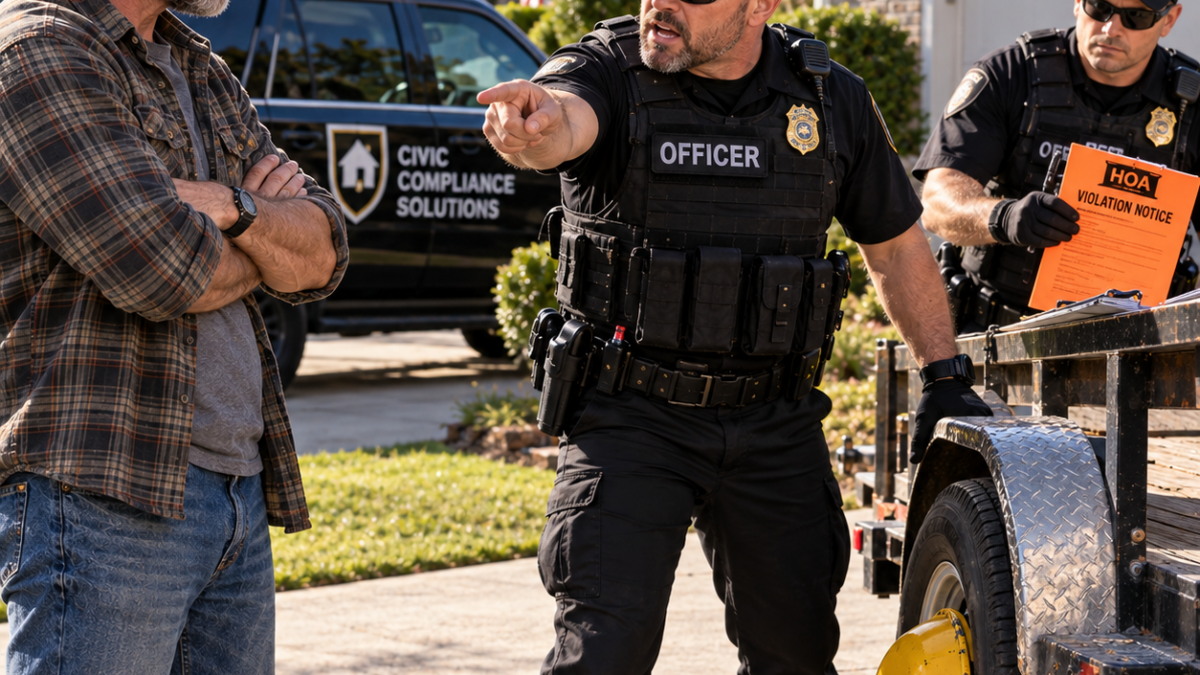
Two men in black polos and gray tactical-style vests.
One crouched beside my trailer wheel.
The other held a clipboard.
I went outside.
“Morning.”
Clipboard man turned.
“Gideon Mercer?”
“Yes.”
“I’m Officer Trent, Civic Compliance Solutions.”
He tapped his badge.
OFFICER.
No agency name.
His partner remained crouched.
“What are you doing?”
“Vehicle immobilization.”
“That’s a trailer.”
“It’s in violation.”
“Of what?”
“Association parking standards.”
“Which section?”
He glanced at clipboard.
“Exterior vehicle storage.”
“That isn’t a section number.”
The crouching man tightened a steel clamp around the left wheel.
Click.
I took out my phone.
Turned recording on.
Held it casually.
Officer Trent noticed.
Good.
“Are you recording?”
“Yes.”
“We do not consent.”
“You’re standing in my driveway.”
“We’re performing authorized enforcement.”
“Then it should record beautifully.”
His partner stood.
Badge:
OFFICER.
Name patch:
M. BARNES.
Barnes slapped a fluorescent orange adhesive notice onto trailer frame.
I winced.
Not because of law.
Because I had painted that frame myself.
The notice read:
PROPERTY IMMOBILIZED
CIVIC COMPLIANCE SOLUTIONS
AUTHORIZED COMMUNITY ENFORCEMENT
REMOVAL / TOW SUBJECT TO IMMEDIATE ACTION
RELEASE FEE: $85
I asked:
“Who authorized you to immobilize personal property on my private driveway?”
Trent smiled.
“The HOA.”
“Show me.”
He held up a work order.
Not handed.
Just displayed.
Address.
Violation code CCS-14.
Description:
TRAILER VISIBLE FROM PUBLIC STREET.
“That’s your company code.”
“Correct.”
“What covenant provision?”
“It maps to your association restrictions.”
“Which one?”
“You received the rules.”
“I’m asking which one.”
He exhaled.
“Sir, you can dispute through management.”
“Before or after you take my trailer?”
Barnes said:
“If the release isn’t paid, property can be removed.”
“By who?”
“Our contracted tow partner.”
“From my driveway?”
“Yes.”
“Without my consent?”
“Yes.”
“Without a court order?”
“Yes.”
“Under what law?”
Trent laughed.
“HOA law.”
I almost thanked him.
Instead:
“What is HOA law?”
“Private community enforcement authority.”
“Source?”
“The association contract.”
“With me?”
“You accepted covenants when you bought here.”
“Show me where those covenants authorize your company to enter my driveway and physically seize use of my personal property.”
He looked annoyed.
“Immobilization is not seizure.”
I nodded.
“Okay.”
“Then unlock it.”
“No.”
“So I cannot move it.”
“Correct.”
“You intentionally prevented me from using property I own.”
“Until the compliance fee is paid.”
“Sounds like possession control.”
Barnes stepped closer.
“Now maybe you’ll learn to obey the HOA.”
There it was.
Clear.
I asked:
“Are either of you law-enforcement officers?”
Trent tapped badge.
“We are compliance officers.”
“That was not my question.”
“We are authorized officers.”
“Police?”
“No.”
“Sheriff’s deputies?”
“No.”
“County code enforcement?”
“No.”
“State agents?”
“No.”
“Court officers?”
“No.”
“Government employees?”
“No.”
“Then your authority comes entirely from a private company contract?”
Trent said:
“Our authority comes from the HOA governing documents.”
“Which you still haven’t identified.”
He stopped answering.
I asked:
“Are you licensed to immobilize vehicles on private residential driveways in Virginia?”
Barnes said:
“We’re fully licensed.”
“Under what license category?”
No answer.
That was when Celeste arrived.
Not physically.
By phone.
Trent called her.
Put speaker on.
“President Harwood, resident refuses compliance.”
Celeste’s voice:
“Gideon?”
“Morning, Celeste.”
“I understand you’re interfering with officers.”
I looked directly at Trent’s badge.
“Private contractors.”
“They are authorized compliance officers.”
“Authorized to do what?”
“Enforce parking standards.”
“On common property?”
“Throughout the association.”
“In my private driveway?”
“Your property remains subject to covenants.”
“Yes.”
“That includes parking.”
“Yes.”
“Then there is no problem.”
“There is several.”
She sighed.
“Gideon, please don’t make this difficult.”
I looked at my phone.
Still recording.
“Which covenant section did I violate?”
Silence.
Then:
“Your trailer is visible from the street.”
“Visibility isn’t prohibited while loading.”
“It’s been there overnight.”
“Less than fifteen hours.”
“Our updated enforcement policy doesn’t allow overnight trailer storage in front-facing driveways.”
“Updated when?”
“Last month.”
“Amendment to declaration?”
“Board policy.”
“Rule adopted under which authority?”
“Gideon.”
“Was notice sent?”
“Yes.”
“Show me.”
“You received electronic notice.”
“I did not.”
“We have distribution records.”
“Great.”
“Send it.”
Her voice sharpened.
“The officers will remove the immobilizer once the release fee is paid.”
“No.”
“Then the trailer may be towed.”
“From my driveway?”
“If necessary.”
“Celeste, I’m going to say this once while everyone is recorded.”
Trent looked at Barnes.
I continued.
“You have no permission to enter my driveway except ordinary social access.”
“These men are directed to leave.”
“They are not permitted to touch my trailer further.”
“They are not permitted to remove it.”
“If you believe the HOA has contractual enforcement rights, use the covenant process.”
“Notice.”
“Hearing.”
“Fine if properly authorized.”
“Lien if lawfully available.”
“Court if needed.”
“But you do not invent self-help powers because they look efficient.”
Celeste said:
“Our attorney approved this program.”
“Name?”
She hung up.
Trent stared at phone.
Then at me.
“Fee is eighty-five dollars.”
“I heard you.”
“You have until noon.”
“For?”
“To release voluntarily.”
“Or?”
“Tow authorization.”
“From my driveway.”
“Yes.”
I said:
“Please leave.”
They did.
That surprised me.
The clamp stayed.
Orange sticker stayed.
Their SUV left.
I photographed everything.
Wide shots.
Wheel.
Clamp serial number.
Sticker.
Tire position.
Driveway.
Property line.
Trailer location relative to sidewalk.
Then I did something twenty-four years in enforcement had trained into me.
I did not remove anything.
When evidence is useful, stop improving the scene.
Lenora came outside.
“Can you cut it off?”
“Yes.”
“Are you going to?”
“No.”
She smiled.
“You’re having fun.”
“No.”
“You are.”
“Maybe seven percent.”
She pointed at orange sticker.
“They put glue on your trailer.”
My anger returned.
“Eight percent.”
I called the non-emergency sheriff’s number.
Deputy arrived forty-five minutes later.
Young woman named Deputy Claire Benson.
I knew her face vaguely from county meetings but had never worked directly with her.
I did not introduce myself as former fire marshal until she asked what I used to do.
First:
“My trailer is immobilized on my private driveway by an HOA contractor.”
She looked at clamp.
“They put that on?”
“Yes.”
“Permission?”
“No.”
“Court order?”
“No.”
“Tow notice?”
“That orange paper.”
She read it.
“Authorized community enforcement.”
Then looked at badge-shaped logo.
“Who are they?”
“Private vendor.”
She asked:
“Did you tell them to leave?”
“Yes.”
“Before or after clamp?”
“After I came outside. Clamp was being installed.”
“Did they threaten you?”
“No.”
“Touch you?”
“No.”
“Demand money?”
“Eighty-five dollars for release.”
She raised eyebrows.
“Do you have that recorded?”
“Yes.”
We watched enough.
HOA law.
Private community enforcement authority.
Tow from driveway.
She stopped playback.
“Okay.”
“What?”
“This is above my roadside-property-dispute enthusiasm level.”
I laughed.
She photographed.
Called supervisor.
Then asked:
“Do you need trailer today?”
“No.”
“Leave clamp in place if you can.”
“Exactly my thought.”
“You really were fire marshal.”
“Retired.”
“People say that until paperwork appears.”
Lenora shouted from porch:
“He’s failing retirement.”
Deputy Benson laughed.
She completed report.
Did not arrest anyone.
Correct.
Facts needed sorting.
She told me:
“If they return and attempt to remove trailer, call immediately.”
“I will.”
“Do not physically fight a tow operator.”
“I won’t.”
“You’d be surprised.”
“No.”
Actually, I would not.
Then I called the HOA management company.
The manager, Allison Price, sounded horrified.
“CCS immobilized what?”
“My utility trailer.”
“Where?”
“My driveway.”
Long silence.
“Let me call you back.”
She did.
Twenty minutes.
“The board approved enforcement contract, but I need to review whether immobilization applies to private lots.”
“Please do.”
“Don’t remove clamp yet.”
“I wasn’t planning to.”
“Why?”
“Because I enjoy the color.”
She missed joke.
Management.
An hour later Rick walked over.
Saw clamp.
Burst out laughing.
“Congratulations.”
“For?”
“You got booted at home.”
“Thank you.”
“What’d you do?”
“Apparently existed overnight.”
He took picture.
I told him not to post yet.
“Why?”
“Because I want them to finish making mistakes before everyone starts yelling.”
That was the fire-investigation part of me.
Do not contaminate witness behavior prematurely.
At 11:52, Civic Compliance returned.
Different vehicle.
This time with tow truck.
I called Deputy Benson immediately.
Then started recording from porch.
Trent.
Barnes.
Tow operator.
Tow operator looked at trailer.
Then house.
Then paperwork.
He did not seem enthusiastic.
I walked to edge of porch.
“Morning again.”
Trent called:
“Final opportunity.”
“Show me tow authority.”
“Association authorized.”
“Tow driver, do you have written authorization from property owner?”
The driver looked at Trent.
Trent said:
“The HOA controls parking enforcement.”
I asked driver:
“Do you understand the trailer is twenty feet inside my privately owned driveway?”
He looked.
“It’s not common lot?”
“No.”
“Street?”
“No.”
“Association owns driveway?”
“No.”
Trent interrupted:
“It is covenant-controlled property.”
Tow operator said:
“That isn’t what I asked.”
I liked him instantly.
He called dispatch.
Then asked Trent:
“You got an order?”
“This.”
Work sheet.
“Court?”
“No.”
“Police?”
“No.”
“Property owner signature?”
“HOA president.”
Tow operator looked at me.
“You owner?”
“Yes.”
“Do you consent?”
“No.”
He handed paper back.
“I’m not touching it.”
Trent’s face went red.
“You’re under contract.”
“With CCS for lawful tows.”
“This is lawful.”
“Then you tow it.”
He walked back to cab.
Perfect timing.
Deputy Benson arrived.
With sergeant.
Sergeant’s name was Mark Holloway.
Older.
Forties.
He listened.
Then asked Trent:
“Show me legal authority to tow from this driveway.”
Trent went back to:
HOA covenants.
Sergeant:
“Which section?”
Trent looked at Barnes.
Barnes looked at clamp.
Nobody knew.
Sergeant Holloway asked:
“Do you possess law-enforcement authority?”
“No.”
“County enforcement authority?”
“No.”
“State?”
“No.”
“Then stop using the word officer like it answers the question.”
That sentence spread through neighborhood later.
I did not leak it.
Rick probably did once bodycam became available.
Sergeant looked at me.
“Do you want them trespassed from the property?”
“Yes.”
He told both CCS employees:
“You are not permitted beyond sidewalk or public approach to this residence unless invited or under separate lawful authority.”
Trent said:
“We have contractual right of inspection.”
Sergeant answered:
“Argue that with counsel.”
Then:
“Remove clamp.”
Trent refused.
Not dramatically.
He said company policy required payment or supervisor authorization.
Sergeant called CCS supervisor.
Ten minutes.
More paperwork.
Eventually Barnes unlocked the wheel.
No $85.
He peeled warning.
Badly.
Left fluorescent adhesive.
Lenora stared at residue.
“Now I want eighty-five dollars.”
I loved that woman.
CCS left.
I thought incident was basically over.
It was not even close.
That afternoon Celeste sent neighborhood email.
Subject:
ENFORCEMENT INTERFERENCE INCIDENT.
It said:
A resident today obstructed authorized compliance officers and involved county law enforcement in a private covenant matter.
Then:
Residents are reminded that CCS officers act under delegated HOA enforcement authority and must be treated with the same cooperation expected during any official compliance activity.
Same cooperation expected during any official compliance activity.
Interesting.
Then:
Attempts to intimidate, film, obstruct, or misrepresent field officers may result in enhanced fines.
I printed it.
Called Owen Blake.
Owen had been county attorney for municipal matters years earlier and now worked private practice.
I had testified opposite him and beside him more times than either of us remembered.
He answered:
“You’ve been retired three months.”
“Yes.”
“What did you do?”
“Got booted in my driveway.”
Long pause.
“I’m sorry?”
I sent him documents.
Recording.
HOA email.
Covenants.
CCS website screenshots.
He called back forty minutes later.
“Okay.”
“What?”
“We start with governing documents.”
He found trailer rule.
Same one I remembered.
Temporary loading in driveway permitted up to forty-eight hours.
No amended rule had been filed in member records he received.
Then enforcement powers.
HOA could issue notices.
Schedule hearings.
Assess fines subject to procedure.
Tow vehicles from association-owned roads and common parking areas under specified circumstances.
Nothing authorizing wheel immobilization on privately owned residential driveways.
Nothing authorizing contractors to enter private lots and seize control of personal property as first-line enforcement.
Could a declaration theoretically grant stronger self-help rights?
Maybe.
Ours did not.
Then Owen looked at CCS.
“The bigger issue may be how they’re presenting themselves.”
“What do you mean?”
“Badges.”
“Officer.”
“Private code enforcement.”
“Threatening property removal.”
“Residents might reasonably believe these are government actors.”
“Especially elderly residents.”
“Exactly.”
He asked:
“Anyone paid?”
We found out quickly.
Rick posted carefully in neighborhood group:
Has anyone paid Civic Compliance release or enforcement fees?
Responses exploded.
Mrs. Donnelly:
$85 after they booted grandson’s car in her driveway.
Jasmine:
$125 “escalation fee.”
Retired Navy veteran named Paul:
$85 clamp release.
Single mom named Avery:
$210 tow cancellation because CCS called truck while her car was parked partly over sidewalk.
Some violations may have been real covenant problems.
That was not the point.
The issue was process and authority.
Several residents said they paid because they thought CCS was county code enforcement.
Why?
Badges.
The phrase OFFICER.
One receipt heading:
OFFICIAL COMPLIANCE ASSESSMENT.
One notice:
Failure to comply may result in enforcement action against property.
Another:
Officer access shall not be obstructed.
A woman named Mrs. Ruiz said:
“I thought they were like parking police.”
That mattered.
Owen sent a preservation letter.
To HOA.
CCS.
Management company.
Tow contractor.
Preserve:
Contracts.
Training.
Emails.
Fee schedules.
Body camera footage.
Resident notices.
Payments.
Licenses.
Instructions.
Badge specifications.
Vehicle graphics.
Then he advised reporting concerns to the appropriate state licensing authority overseeing private security businesses.
I also contacted county code enforcement director.
Not as former employee demanding favors.
Formal citizen inquiry.
“Does Asheford Ridge or Civic Compliance Solutions have any delegated county code-enforcement authority?”
Written answer:
No.
“Any authority to enforce county vehicle or property-maintenance codes?”
No.
“Any county relationship?”
No.
That single email mattered.
Because Celeste kept calling them officers.
I asked:
“Officers of what?”
She never answered.
The HOA scheduled a disciplinary hearing against me.
Charges:
Trailer violation.
Obstruction of enforcement.
Unauthorized filming of compliance personnel.
Failure to pay release fee.
That last one was beautiful.
They wanted $85 I never owed.
Hearing room was clubhouse.
Three board members.
Celeste.
Management.
CCS representative.
Owen beside me.
Residents filled chairs.
Celeste opened:
“Mr. Mercer, this is not a legal trial.”
Owen said:
“Excellent.”
People laughed.
Celeste glared.
I did not.
Mostly.
She continued:
“This is an internal compliance proceeding.”
I nodded.
“Then identify violated covenant.”
She handed a page.
“Vehicle storage policy.”
Not declaration.
Board policy dated two weeks before clamp.
It prohibited any trailer in visible driveway between midnight and 6:00 a.m.
Interesting.
“Was this distributed?”
“Yes.”
“Where?”
“Email.”
Owen asked for proof.
Management produced email distribution report.
Subject:
COMMUNITY STANDARDS UPDATE.
Sent to residents.
My address?
Bounced.
Why?
Their system still had an old email typo from when we moved in.
I had corrected it multiple times for billing but apparently compliance list remained wrong.
Still, whether notice legally required depended on documents.
But bigger problem:
The policy itself gave a written process.
First violation:
Notice.
Second:
$50 fine after hearing.
Third:
Possible additional remedies.
No wheel clamp.
No $85 private release fee.
Owen asked:
“Where does immobilization appear?”
Celeste said:
“In the CCS service agreement.”
Owen smiled.
“The HOA cannot give a contractor greater authority over homeowners than the HOA itself possesses under the declaration.”
Silence.
CCS representative shifted.
His name was Victor Salas.
Operations director.
Owen asked:
“Is that your position?”
Victor said:
“We act as agent for the association.”
“Correct.”
“Can an agent do something principal cannot do?”
Victor did not answer.
Then I played recording.
Trent:
Now maybe you’ll learn to obey the HOA.
Then:
HOA law.
Then towing from my private driveway without court order.
The room changed.
Residents had read about it.
Hearing voices mattered.
Celeste said:
“Field personnel may have used imprecise language.”
I asked:
“Was the clamp imprecise?”
Someone laughed.
Celeste slammed pen.
“This is serious.”
“Yes.”
I leaned forward.
“That is why I recorded it.”
Then we discussed my filming violation.
I asked:
“What rule prohibits recording people on my own driveway?”
No answer.
Celeste said:
“CCS employees have privacy rights.”
“Of course.”
“Where legally applicable.”
“But your notice says residents may not film compliance officers.”
“Yes.”
“Adopted when?”
Pause.
After my incident.
Owen looked toward board.
“You are attempting to punish him under a rule adopted after the conduct?”
The vice president—a quiet accountant named Fred Mallory—looked at Celeste.
“Is that true?”
She said:
“The rule clarified existing expectations.”
Fred asked:
“Was it in writing before?”
No answer.
That was the first crack in board loyalty.
My violations were dismissed two days later.
Not by Celeste.
Board vote.
3–2.
She lost.
But CCS remained under contract.
That changed when the state investigator arrived.
Her name was Monica Reyes.
State regulatory investigator assigned to private security licensing and business practices.
She did not care about HOA drama.
That was refreshing.
She asked narrow questions.
What license does CCS hold?
Which employees?
What training?
What does “officer” mean in their marketing?
Were badges designed to imply governmental status?
Were residents told clearly that CCS was a private contractor?
What services were authorized under their license category?
What authority supported immobilization and fee collection?
Were vehicles on private residential lots or association property?
Who received the $85?
HOA?
CCS?
Tow company?
That answer was ugly.
CCS kept $65.
HOA received $20 administrative rebate.
So every clamp generated revenue for both.
That created incentives.
Celeste had negotiated it.
Emails showed:
Per-event enforcement fee structure will reduce contract cost and encourage resident compliance without increasing dues.
Encourage compliance.
By making more violations financially useful.
Monica asked CCS:
“How does an employee determine whether to immobilize?”
Training manual:
Officer discretion based on severity, visibility, prior history, and resident cooperation.
Resident cooperation.
My recording made that phrase feel different.
If you questioned authority, clamp likelihood increased.
Not written exactly.
But field messages suggested it.
One supervisor text to officers:
Don’t waste time arguing. If resident gets combative, tag/boot and let management deal with it.
Combative included:
Asking which rule.
Several body-camera clips confirmed.
One elderly man asked:
“Are you police?”
CCS employee answered:
“We’re the enforcement officers for this community.”
Technically maybe.
Practically misleading.
Another resident asked:
“Can you fine me?”
Employee:
“We can do more than that.”
Then applied boot.
Monica requested full records.
CCS lawyer became involved.
The HOA held another emergency meeting.
This one was crowded before doors opened.
Celeste tried defending program.
“Professional enforcement removes personal bias.”
A resident shouted:
“They make money per fine!”
Another:
“They walked into my yard!”
Another:
“They told my daughter they could tow her car!”
Fred Mallory asked management:
“Did board approve per-enforcement revenue sharing?”
Celeste said:
“The contract was approved.”
Fred:
“Did the packet show rebate schedule?”
Treasurer looked through minutes.
No.
The board had approved service contract summary.
Celeste signed final schedule later under executive procurement authority.
Legal perhaps, depending limits.
Politically disastrous.
Then Mrs. Donnelly stood.
Seventy-four.
Small.
White hair.
Church every Sunday.
Not dramatic.
She held an $85 receipt.
“My grandson parked in my driveway.”
Everyone quiet.
“His truck was there because he was fixing my water heater.”
She looked at Celeste.
“Two men came.”
“They wore badges.”
“One told me the vehicle was under enforcement.”
“I asked if he was with county.”
“He said, ‘We are the authorized officers for Asheford.’”
She swallowed.
“I thought that meant government.”
“So I paid.”
Celeste said:
“Mrs. Donnelly, residents received notice—”
“No.”
Mrs. Donnelly lifted hand.
“I am speaking.”
Celeste stopped.
“I have lived here seventeen years.”
“I pay dues.”
“I follow rules.”
“But if you want money from me, you should not need someone dressed like police to scare me into giving it.”
No applause.
Good.
It was too serious.
Then Jasmine spoke.
“I rent.”
“My landlord owns the house.”
“They told me if I didn’t pay, my car could be impounded.”
She looked at CCS representative.
“I asked what law.”
“He said HOA code.”
“What is HOA code?”
Exactly.
No one had answer.
The board suspended immobilization program that night.
Celeste voted against.
CCS officers stopped field work pending review.
Then sheriff’s office issued community bulletin after receiving multiple reports.
Not accusing anyone of crime.
Clarifying:
Civic Compliance Solutions personnel are private employees.
They are not deputies.
They are not county code-enforcement officers.
They do not possess general governmental law-enforcement authority.
Residents should contact sheriff if any person claims authority inconsistent with private status.
That bulletin spread faster than any HOA newsletter in history.
Someone taped it beside clubhouse entrance.
Probably Rick.
The state investigation took four months.
No spectacular raid.
No federal agents.
No dramatic arrests.
Real accountability arrived through notices.
Interviews.
Licensing review.
Consumer complaints.
Civil claims.
Contract analysis.
The state found multiple problems.
Some related to licensing and presentation.
Some to operating practices.
Some allegations were not sustained.
Important.
For example, using the word “officer” itself was not automatically illegal in every private context.
Private security officer is a real category.
The problem was how the total presentation and statements created confusion about governmental authority, especially combined with actions not clearly supported by association rights.
The company agreed to change badge design.
Vehicle markings.
Training scripts.
Notices.
They stopped using “private code enforcement” in ways regulators considered misleading.
Their employees had to identify themselves expressly as private contractors in resident interactions.
Immobilization practices were suspended at residential locations unless a clearly lawful basis existed.
Refund process began for certain fees deemed improperly collected under Asheford program.
CCS lost Asheford contract entirely.
Not because state closed company.
Because residents forced board to terminate.
Vote:
4–1.
Celeste alone voted to retain them.
Then came the recall.
She could have survived if she’d apologized early.
I believe that.
Residents were angry but not bloodthirsty.
Instead she doubled down.
Newsletter:
A small group resistant to standards has weaponized outside agencies to undermine lawful self-governance.
That phrase finished her.
Weaponized outside agencies.
Mrs. Donnelly circulated recall petition.
Not me.
I refused to lead it.
Lenora asked why.
“Because this needs to be residents deciding what governance they want.”
“You’re a resident.”
“Yes.”
“So?”
“I’m also obvious opponent.”
“Fair.”
I signed petition.
Number forty-three.
They needed thirty.
Got sixty-nine.
Recall meeting was packed.
Celeste spoke for twenty-two minutes.
Property values.
Order.
Standards.
Professionalization.
She said:
“Without meaningful enforcement, covenants become suggestions.”
Not wrong.
That was what made her argument effective.
Then Fred Mallory spoke.
He had supported her election.
“I agree covenants need enforcement.”
He paused.
“But enforcement must stay within the authority the association actually has.”
There it was.
My entire career in one sentence.
“You cannot make a power real by hiring someone to perform it.”
People listened.
“The association can fine when documents and procedure allow.”
“It can tow from property where it has lawful towing rights.”
“It can sue.”
“It can seek injunctions.”
“What it cannot do is skip process because badges and clamps are faster.”
Celeste stared at him.
Fred continued.
“Standards without limits become something else.”
Recall passed.
Seventy-three percent.
Celeste left before final count announced.
No cheering.
Lenora squeezed my hand.
“Feel vindicated?”
“I feel hungry.”
“You always say that.”
“Because meetings run through dinner.”
New board president?
Fred.
He did not want it.
Which was probably why he was decent at it.
First month, he created compliance review committee.
I refused appointment.
Naturally.
“Gideon.”
“No.”
“You know enforcement.”
“Yes.”
“That is why.”
“That is also why no.”
He frowned.
“Explain.”
“I retired.”
Lenora laughed from kitchen.
“Allegedly.”
I agreed to review one draft policy as neighbor.
Not permanent.
The new process was boring.
Excellent.
Violation observed.
Photograph.
Citation to exact covenant or rule.
Written notice.
Correction period.
Hearing opportunity.
Fine only if authorized.
Appeal.
Escalation through civil process.
Towing limited to clearly authorized common-area situations with legal review.
No private driveway immobilization.
No costume drama.
No badges.
The HOA hired one ordinary compliance coordinator.
Her name was Denise.
She wore khakis and a polo.
Carried tablet.
No vest.
No clamp.
Residents complained about her too.
Perfect.
That meant normal had returned.
My trailer?
I kept it behind workshop most of time.
Not because Celeste won.
Because that’s where it belonged.
When loading, driveway.
One weekend I left it there thirty-six hours.
Denise sent me email.
Subject:
Trailer reminder.
Gideon, just a heads-up—you’re approaching the 48-hour temporary driveway limit under Section 6.4. Let me know if there’s an issue.
I replied:
Thank you. Moving it this afternoon.
That was it.
No brass badge.
No $85.
No sheriff.
Authority does not become weaker when it becomes polite.
It becomes clearer.
CCS settlement with affected residents happened later.
Owen organized group claims.
I did not seek some giant payday.
Clamp caused no physical damage beyond sticker residue and minor wheel scuff.
My claim was modest.
Refund? I never paid.
Property cleanup.
Attorney expenses.
Documented interference.
Settlement included compensation and release.
More important to many residents:
Refunds.
Mrs. Donnelly got $85 back.
Jasmine got $125.
Paul got his release fee.
Some towing charges were more complicated because underlying parking violations existed.
Those were reviewed individually.
Not every person became innocent because contractor overreached.
That is another lesson.
Two things can be true.
Your car may violate a rule.
The remedy may still be improper.
Bad process does not erase every underlying obligation.
And a real violation does not authorize any remedy someone invents.
I said that at one meeting.
Rick groaned.
“You’re ruining a good villain story.”
“Sorry.”
“You’re not.”
“I know.”
Months later Officer Trent—his first name was Aaron Trent, not actually a governmental officer—came to my house.
Not in uniform.
Jeans.
Pickup.
He stayed on sidewalk.
Good sign.
I walked out.
“Can I come up?”
“Yes.”
He stopped near porch.
“I don’t work there anymore.”
“CCS?”
“No.”
“Okay.”
“I wanted to say something.”
I waited.
“That line.”
“Which?”
“Now maybe you’ll learn to obey.”
I remembered exactly.
“I’ve heard it in my head about a thousand times.”
“Why?”
“Because I sounded like an asshole.”
Accurate.
He continued.
“We were trained to control the interaction.”
“Meaning?”
“Don’t debate.”
“Don’t let resident take over.”
“State rule.”
“Fee.”
“Leave.”
I nodded.
“When I asked what authority?”
“I didn’t know.”
“Why not?”
“Because nobody expected us to be asked.”
That was one of the most honest things anyone said.
He looked toward driveway.
“We were told HOA had legal sign-off.”
“Did you ever see it?”
“No.”
“You wore badge.”
“Yes.”
“You understood residents might think you had government authority.”
He looked embarrassed.
“Honestly?”
“Yes.”
“That was kind of the point.”
There it was.
Not necessarily to impersonate police.
To borrow the emotional effect.
He said:
“People argue less when you look official.”
“Exactly.”
“I didn’t think about what that meant.”
“You are now.”
“Yes.”
He apologized.
I accepted apology.
Not because incident was trivial.
Because people should be allowed to learn.
He later took a facilities job.
No badge.
Probably healthier.
Barnes never contacted me.
Fine.
Celeste moved from neighborhood two years later.
House sold.
Her listing mentioned:
Well-managed community.
I laughed.
Lenora hit my arm.
“Behave.”
“I didn’t comment.”
“Good.”
Then she smiled.
“Send it to Rick.”
I did.
Retirement settled around me after all that.
Workshop projects.
Travel.
Lenora started painting.
I learned woodworking badly.
Apparently precision with fire codes does not transfer automatically to cabinet doors.
Our daughter Elise brought grandchildren.
The neighborhood aged.
Trees grew.
Pool still broke every third summer.
HOA argued about mulch.
Beautiful.
Normal.
Sometimes new residents hear story.
They come by.
“Are you the fire marshal who arrested fake cops?”
No.
“Nobody was arrested in my driveway.”
“Oh.”
Disappointed.
“Did the state shut the company down?”
“No.”
“Oh.”
“Did the HOA president go to jail?”
“No.”
Then they look confused.
Because viral stories teach us accountability must involve handcuffs.
It doesn’t.
Sometimes accountability is:
Contract canceled.
Money refunded.
Rules rewritten.
Badges redesigned.
Records created.
President recalled.
Residents educated.
Company retrained.
That can matter more.
One teenager asked me once:
“Then what was the big deal?”
I pointed toward my driveway.
“Imagine two men wearing badges come onto your property.”
“They lock your bike.”
“They say you owe money.”
“They imply they can take it.”
“You ask why.”
“They say because they are officers.”
“If you are sixteen, what do you do?”
He thought.
“Probably pay.”
“Exactly.”
Authority affects behavior before legality is checked.
That is why presentation matters.
I spent twenty-four years enforcing fire laws.
I had walked into businesses and told owners:
You cannot open tonight.
That is enormous power.
I never forgot it.
When I ordered a closure, I cited code.
I gave written notice.
Explained appeal.
Documented hazard.
Sometimes obtained administrative order.
Sometimes involved building official.
Sometimes judge.
If immediate hazard existed, emergency provisions applied—but those provisions themselves came from law.
I could not say:
I have a badge, therefore leave.
That is not authority.
That is theater.
One memory from my career returned often after CCS incident.
I was thirty-four.
Restaurant had dangerously overloaded assembly event.
Blocked exits.
Crowd beyond approved occupancy.
Owner furious when we reduced capacity.
He yelled:
“You enjoy this!”
I did not.
But I remember checking myself afterward.
Did I sound like I enjoyed it?
Did my tone turn power into punishment?
That question stayed with me.
Any system that enforces rules should ask it.
Is the goal compliance with legitimate standard?
Or emotional submission?
Those are not same.
Barnes said:
Now maybe you’ll learn to obey.
Not comply.
Obey.
That word told me more than badge.
A legitimate regulator does not need homeowner obedience as personality.
It needs compliance with specific requirement.
Cite it.
Correct it.
Close file.
When enforcement becomes about teaching someone a lesson, abuse becomes easier.
That applies to government too.
I am not romantic about public authority.
I spent enough years inside it to know uniforms do not make people virtuous.
Rules.
Supervision.
Appeal.
Documentation.
Transparency.
Those are what protect both public and officer.
Private organizations need limits for same reason.
The new Asheford board eventually adopted a line I suggested.
I did not want credit.
It reads:
ENFORCEMENT SHALL BE CORRECTIVE, NOT PUNITIVE, EXCEPT WHERE THE GOVERNING DOCUMENTS EXPRESSLY AUTHORIZE A PENALTY.
Fred asked:
“Too lawyerly?”
“Yes.”
“Keep it?”
“Yes.”
They did.
Lenora framed my original orange warning tag for Christmas.
Yes.
My wife.
She cleaned adhesive.
Mounted in shadow box.
Below it she printed:
AUTHORIZED COMMUNITY ENFORCEMENT.
Underneath:
Saturday, 7:22 A.M.
Gideon’s Retirement, Day 93.
I stared.
“You’re cruel.”
“You love it.”
“I do.”
It hangs in workshop.
Beside an old county fire marshal badge.
That juxtaposition is accidental genius.
One badge had authority because law gave my office duties and limits.
One warning had the appearance of authority because people hoped nobody would ask.
Visitors see both.
Sometimes I explain.
Sometimes not.
The old badge means less to me now than it once did.
Not because service meant less.
Because title was never the important part.
The limitation was.
I was proudest not when I could close a building.
When I knew when I could not.
That is harder.
Power feels strongest at boundary where it stops.
People who respect that boundary deserve trust.
People who hide it deserve questions.
Asheford Ridge still has rules.
Good.
Trash cans cannot live on sidewalk.
Pool gate stays locked.
No parking in fire lane.
Trailers have limits.
Lawn standards exist.
I am not anti-HOA.
That surprises people too.
Shared communities need shared rules.
The question is never:
Rules or no rules?
It is:
Who made them?
Under what authority?
What exactly do they say?
What process applies?
What remedy is permitted?
Can someone challenge it?
Those are boring questions.
Boring questions save people from expensive drama.
A few years after incident, the county invited me to speak at a training for code inspectors and private community managers.
Retired fire marshal perspective.
I almost declined.
Lenora said:
“You’ve been practicing speech for three years.”
“I have not.”
“You lecture grocery clerks about exit doors.”
“They ask.”
“They do not.”
I went.
I brought two slides.
First:
My old fire marshal badge.
Second:
CCS badge.
Both brass.
Both said OFFICER somewhere.
I asked room:
“What is difference?”
People offered:
Government.
Training.
Statute.
Jurisdiction.
Correct.
Then I said:
“The difference is not metal.”
“It is source and limit.”
I told driveway story.
No names initially.
Then gave framework:
Never imply governmental power you do not possess.
Never assume contract grants authority broader than principal.
Never use appearance to replace explanation.
Never create revenue incentives that reward escalation without safeguards.
Always give exact rule.
Always explain appeal.
And if you cannot answer:
What gives me authority to do this?
Stop until you can.
That became my retirement speech.
Boring.
Useful.
Exactly what I wanted.
Mrs. Donnelly still lives three houses down.
Her grandson eventually became licensed plumber.
He still parks in driveway when fixing things.
We joke.
One day she asked:
“Gideon, do you miss your job?”
“Sometimes.”
“What part?”
“Solving things.”
“You solved that badge company.”
“No.”
She looked skeptical.
“A lot of people did.”
“Deputies.”
“Residents.”
“State.”
“Board.”
“Lawyer.”
“They solved themselves too, eventually.”
Mrs. Donnelly waved hand.
“You always ruin compliments.”
“Professional hazard.”
She smiled.
Then:
“I still check people’s badges now.”
Good.
That was worth more than recall vote.
Healthy skepticism.
Not hostility.
If someone says they have authority, let them show it.
Real authority can.
Years later, I found the wheel clamp model online.
$79.99.
Same exact steel jaws.
For a moment I considered buying one as joke.
Lenora stopped me.
“We already have too many souvenirs from your inability to relax.”
Fair.
The trailer itself lasted another six years.
Eventually rust won.
I sold it to a landscaping contractor for $900.
Before he drove away, he saw faint rectangle where orange sticker adhesive had discolored paint.
“What happened there?”
“Long story.”
“HOA?”
“Very.”
He laughed.
Everyone has one now.
I replaced trailer.
New one black.
Lives behind workshop.
One Saturday, I parked it out front to load lumber.
Denise—the normal compliance coordinator—walked by with dog.
She called:
“Forty-eight hours, Gideon.”
I saluted.
“Yes, officer.”
She stopped.
Turned slowly.
“Do not start.”
I laughed so hard Lenora came outside.
That is how you know wound healed.
When joke stops hurting.
Not everything vanished.
I still notice badges.
Language.
Authority claims.
Probably always will.
But I no longer check every HOA email for hidden coup.
Good.
The institution became boring again.
That is the ending.
Not me defeating anyone.
Boring restored.
A private company learned presentation has consequences.
A board learned delegation has limits.
Residents learned they can demand citations instead of intimidation.
I learned retirement apparently includes paperwork.
Lenora learned nothing because she was right from beginning.
If she reads this, that sentence will become evidence.
The orange tag still hangs in workshop.
Sometimes my grandson asks about it.
He is nine.
“What does immobilized mean?”
“They locked Grandpa’s trailer.”
“Why?”
“They thought I broke a rule.”
“Did you?”
“Maybe a new rule.”
“Then why didn’t you just pay?”
Children ask brutal questions.
“Because they could not explain why they were allowed to lock it.”
He thought.
“But if you did break rule…”
“Yes?”
“Shouldn’t you still fix it?”
Exactly.
“Yes.”
“Then both people were wrong?”
I smiled.
“Possibly.”
He nodded like he had solved civilization.
Maybe he had.
I moved trailer later that day because even after winning argument, visible driveway storage limit was now properly adopted and properly noticed.
That is the part people leave out of revenge stories.
Winning against overreach does not make you exempt from legitimate rules.
It means rules have to remain legitimate.
Celeste’s mistake was thinking effective enforcement required people to feel small.
CCS’s mistake was thinking looking official could save them from explaining authority.
My mistake?
Maybe assuming experience made me immune to anger.
It didn’t.
When Barnes told me to obey, every year I had spent carefully using real public authority rose in my throat.
I wanted to tell him exactly who I was.
What I knew.
Who I knew.
What office I had run.
I didn’t.
That was probably the best decision I made.
Because once I announced former fire marshal, they could adjust.
Become careful.
Call supervisor.
Choose better words.
Instead I let them explain themselves as they had been trained to explain themselves to everyone else.
That recording mattered because I was not special yet.
Just another homeowner.
That is what regulators needed to see.
How did this system behave when it believed nobody knowledgeable was watching?
That question exposes more than credentials ever will.
So if you remember anything from my wheel clamp, remember this:
Do not be impressed by theater.
A brass badge is metal.
A vest is fabric.
A clipboard is plastic.
A confident voice is air.
Authority begins somewhere else.
A law.
A contract.
A covenant.
A delegation.
A court order.
And every legitimate power has an edge.
A place where it stops.
The morning Civic Compliance Solutions entered my driveway, they expected the badge to end the conversation.
Instead I asked where their authority began.
They never found a good answer.
That was the entire problem.