The HOA Sent 29 Trucks to Demolish My Family Farm—Then My Wife Said, “Let Them Prove What This Is,” and I Stepped Aside.
PART2:
When she moved onto Tucker Farm after we married, she stood near the barn one evening and said, “I think this is the first place I’ve ever lived where the dirt feels permanent.”
I laughed at her.
She did not.
“I mean it.”
After that, she treated the paperwork protecting the farm with almost religious care.
Taxes.
Insurance.
County filings.
Surveys.
Deeds.
Water records.
Agricultural documents.
If our names appeared on a piece of legal paper, Claire had either the original or a certified copy.
Everything important went into a fireproof safe inside the office closet.
I used to tease her.
“You planning for a courthouse fire?”
“No.”
“Then why three copies?”
“Because people lose things.”
“The county has copies.”
“People at counties lose things.”
It turned out Claire’s paranoia was better described as foresight.
The trouble started when Hawthorne Ridge Estates began Phase Four.
The subdivision sat along our eastern boundary.
When I was a teenager, that land belonged to a dairy farmer named Leland Price.
By the time Claire and I were in our forties, Leland’s children had sold.
PART3:
First came survey crews.
Then roads.
Then utilities.
Then houses.
Big houses.
Stone fronts.
Tall windows.
Three-car garages.
Everything had names.
The Overlook.
The Preserve.
The Commons.
Even the drainage pond had been renamed Lake Hawthorne, which would’ve amused Leland because I had once watched three pigs escape into the exact same mud hole.
I never blamed the homeowners.
Most were decent.
They wanted houses.
Some wanted schools.
Some liked the countryside.
One family bought beef from us twice a year.
Another neighbor, Dr. Glenn Patel, helped me pull a calf one winter because he happened to be walking near the fence and heard me yelling.
My problem wasn’t the houses.
My problem was Judith Kessler.
Judith was HOA president.
Fifty-seven.
Former regional sales director.
Always dressed as though an unexpected television interview might begin at any moment.
Cream blouses.
Dark trousers.
Low boots that somehow never collected mud.
She spoke quietly.
That made her more effective.
People lean toward a person who doesn’t need to shout.
Our first conversation happened at my mailbox.
She drove up in a black Lexus.
Got out with folder.
“Mr. Tucker?”
“Ryan.”
“Judith Kessler. Hawthorne Ridge board president.”
“I know.”
“We’re neighbors.”
“So I’ve noticed.”
She smiled politely.
“I wanted to introduce myself.”
That should have been harmless.
It wasn’t.
She began with drainage.
Then fencing.
Then “visual compatibility.”
Finally she asked whether I had considered selling the eastern pasture.
“How much?”
“Approximately thirty-two acres.”
“No.”
She blinked.
“We haven’t discussed terms.”
“Still no.”
“It would be a very generous offer.”
“I believe you.”
“Our developer is prepared to pay substantially above agricultural value.”
“No.”
Her smile stayed.
“You haven’t heard the number.”
“I don’t need number.”
That bothered her.
People who negotiate for a living often view no as an opening position.
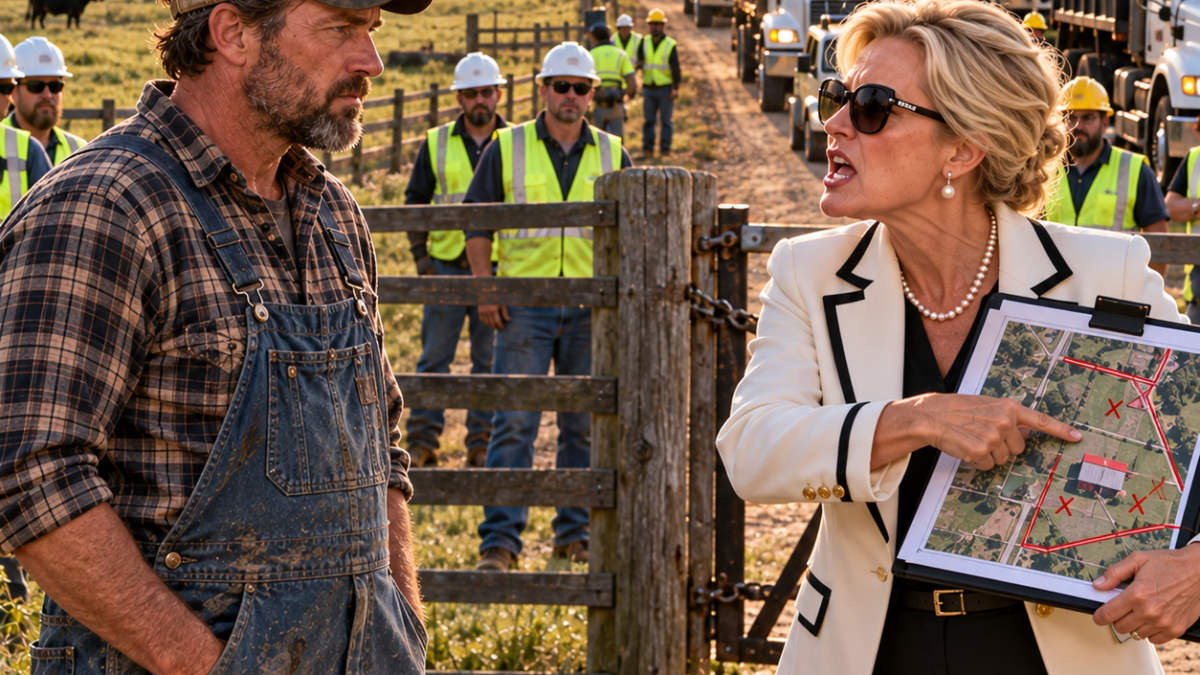
She pulled a folded rendering from folder.
I should have known.
Developers love renderings.
The picture showed Hawthorne Ridge extended across land that was still mine.
Curved streets.
Trees.
A clubhouse.
Walking paths.
A road came through our east field and continued south toward the state highway.
My barn was gone.
The irrigation pond had become something labeled:
NATIVE WATER FEATURE
I pointed.
“That’s my pond.”
“Conceptually.”
“You moved my barn.”
“The plan is preliminary.”
“You’ve drawn houses on my hayfield.”
“Because we’re trying to show opportunity.”
I handed map back.
“No.”
She looked toward farm.
“You may want to think about long-term highest and best use.”
“I already know its best use.”
“Agriculture?”
“Yes.”
She smiled in a way that told me she considered that answer sentimental.
“We’ll leave door open.”
“I won’t.”
That was the first offer.
The second came from the developer himself.
His name was Adrian Vale.
Vale Residential Partners.
They had developed Hawthorne Ridge from Phase Two onward.
Adrian was younger than I expected.
Forty-four.
Polished.
Smart.
Not a cartoon villain.
He understood land.
That made what happened later worse.
He visited with a land-acquisition agent and offered $1.8 million for the entire eighty-five acres.
More than ordinary farm value.
Less than what it was worth to him.
I declined.
He raised to $2.4 million.
Then three.
Claire asked him one question.
“Why do you need all eighty-five?”
Adrian smiled.
“Planning flexibility.”
Claire waited.
He continued.
“Stormwater.”
“Road alignment.”
“Open-space requirements.”
“Utility routing.”
Normal development reasons.
But Claire heard what wasn’t said.
After they left, she spread county planning maps across kitchen table.
“What?”
She pointed.
“Look at the new interchange.”
The state had announced preliminary approval for an interchange on Route 16, two miles southwest.
Hawthorne Ridge currently accessed county highway to east.
Congested.
Narrow.
Phase Four and planned Phase Five would add more than two hundred homes.
The most economical secondary connection to the future interchange ran across the high ground of Tucker Farm.
Not because anything magical was buried beneath us.
No gold.
No oil.
The value under my boots was grade.
Elevation.
Stable soil.
A strip of high ground wide enough for road, sewer, and utilities without crossing the floodplain south of us or building a multimillion-dollar bridge over Miller Creek.
Claire saw it immediately.
“If they don’t get us, they have to go south.”
I traced alternate line.
“Bridge.”
“And sewer lift station.”
“Probably.”
“How much?”
“Millions.”
That explained offers.
Still didn’t make me want sell.
A month later, the HOA started sending letters.
The first was almost funny.
UNMAINTAINED PERIMETER FENCING VISIBLE FROM HAWTHORNE RIDGE COMMON AREAS.
Fine:
$150.
I called property-management company.
“I’m not in Hawthorne Ridge.”
The manager paused.
“Address?”
I gave.
Longer pause.
“I’ll have board review.”
Two days later Judith called.
“The violation remains.”
“Why?”
“Your property lies within Hawthorne Ridge’s extended planning boundary.”
That phrase was new.
“My farm predates Hawthorne Ridge.”
“Extended community boundary was recorded as part of Phase Four.”
“What exactly was recorded?”
“A corrective boundary instrument.”
“By who?”
“The association and developer.”
“Did I sign?”
“No signature from you was required.”
That got my attention.
I said:
“If you think you can annex my land into your HOA without me, send the document.”
She did.
Forty-six pages.
Amended Declaration of Covenants.
Attached map.
Most pages concerned actual Hawthorne lots.
Then Exhibit F.
A boundary graphic.
There it was.
A red line wrapped around my eighty-five acres.
Label:
Hawthorne Agricultural Transition Tract.
I laughed when I first saw it.
Claire did not.
“Ryan.”
“What?”
“Look at legal description.”
I did.
Not just map.
The text included metes and bounds.
Started at a monument near Tucker Road.
Followed old Price property line.
Then crossed through our field.
Around barn.
Back to road.
It described my farm.
The document stated the tract was:
Included within Hawthorne Ridge Master Community for purposes of architectural transition, landscape compatibility, access planning, and future annexation upon satisfaction of applicable ownership conditions.
I read twice.
“Future annexation.”
Claire:
“Exactly.”
“So they know it isn’t annexed.”
“Keep reading.”
Another paragraph:
Until formal annexation, the Association may enforce limited exterior compatibility standards necessary to protect existing owners from adverse neighboring uses.
I laughed again.
“That’s not a thing.”
“I don’t know.”
“It isn’t.”
“You’re not a lawyer.”
“Neither is Judith.”
Claire called one.
His name was Patrick Sloan.
Land-use attorney in the county seat.
Gray hair.
No patience for theatrics.
He read document.
Then asked:
“Who owns Hawthorne Ridge?”
“Individual owners. Common areas HOA.”
“Who owns your farm?”
“We do.”
“Any deed restrictions connecting?”
“No.”
“Any reciprocal agreement?”
“No.”
“Any easement to HOA?”
“No.”
“Any annexation consent?”
“No.”
He leaned back.
“Then they can write whatever they want on paper. It doesn’t make your land theirs.”
“Can they record it?”
“County recorder records instruments that meet formal filing requirements. Recording doesn’t guarantee instrument is legally effective against every parcel named.”
Claire smiled.
I should have listened to her years earlier.
Patrick continued:
“They’ve created a cloud.”
“Meaning?”
“Title company will notice. Buyer might notice. Lender definitely.”
“So they can harass us.”
“They can create a dispute.”
“Can we remove?”
“Yes. Demand withdrawal. If refused, quiet-title action.”
I wanted lawsuit immediately.
Claire did not.
“First letter.”
Patrick nodded.
Good lawyers like spouses who reduce billable aggression.
He sent demand.
The HOA replied through counsel.
Their attorney, Melissa Grant, was more reasonable than Judith.
Her letter said the HOA did not claim fee ownership of Tucker Farm.
Good.
It claimed only “limited protective rights arising from recorded master-planning instruments and long-standing development agreements.”
Patrick called.
“This is smoke.”
“What do we do?”
“Ask what agreement binds you.”
They could not produce one.
The next violation arrived anyway.
Barn roof.
“Reflective metal inconsistent with community palette.”
$300.
My barn roof had existed fourteen years.
Then cattle trailer.
“Commercial equipment visible from residential lots.”
$450.
Then hay bales.
“Unsightly agricultural storage.”
$600.
Then pond.
“Unscreened water-management feature.”
I almost framed that.
Our irrigation pond had existed since 1971.
Claire kept every notice.
Spreadsheet.
Date.
Amount.
Authority claimed.
Our response.
Certified mail tracking.
Photos.
She created folders by month.
I said:
“You’ve been waiting your whole life for this.”
She didn’t smile.
“People lose things.”
Then came the lien.
I learned through bank.
We had a farm operating line.
Nothing dramatic.
Seasonal cash.
Feed.
Fuel.
Fertilizer.
The bank’s annual title check showed new record:
NOTICE OF ASSESSMENT LIEN — HAWTHORNE RIDGE OWNERS ASSOCIATION
Amount:
$14,870.
Fines.
Legal fees.
“Compliance costs.”
Against:
Tucker Farm, Parcel 11-042.
All eighty-five acres.
I drove straight to Patrick.
He stared at lien.
Then removed glasses.
“They did not.”
“They did.”
“Who signed?”
Judith.
Notarized.
The lien claimed Tucker Farm was “subject to enforcement provisions of Hawthorne Ridge Master Declaration.”
Patrick called their attorney.
Melissa sounded surprised.
I could hear one side.
“Melissa, your client filed lien on nonmember farm.”
Pause.
“No, don’t send me your boundary exhibit.”
Pause.
“Show me deed covenant.”
Pause.
“Then why is lien recorded?”
Longer pause.
Patrick looked at me.
His expression changed.
“What?”
He held finger.
“Okay. Call me back.”
Hung up.
“She didn’t know.”
“How?”
“Board apparently used a different firm for collections.”
That firm had relied on management ledger showing us as “transition member.”
Transition member.
New phrase.
Claire added to spreadsheet.
Patrick filed suit.
Quiet title.
Declaratory judgment.
Release of lien.
Slander of title.
Injunction against HOA enforcement.
Developer named because boundary amendment originated with them.
That should have slowed everything.
Instead it accelerated.
Three weeks later, survey flags appeared inside south pasture.
I confronted crew.
Politely.
They showed work order from Vale Residential Partners.
Phase Five Preliminary Road Corridor.
“You know this is private?”
Crew chief:
“We were told developer has site access.”
“From who?”
He showed email.
Judith Kessler.
She claimed HOA possessed “inspection and planning access over transition tract.”
I told crew to leave.
They did.
I sent photograph of work order to Patrick.
He added to case.
Then one of my fence posts disappeared.
Corner marker beside Tucker Road.
Not original survey monument.
Just fence post.
But twenty feet farther west, new orange stake appeared.
Claire photographed.
Surveyor came.
Name was Reed Halvorsen.
He had surveyed our farm after Dad died.
Reed found monuments.
“Nothing moved legally.”
“What’s orange?”
“Proposed boundary.”
“Proposed by who?”
He read cap.
“Vale.”
He shook head.
“Surveyor should label this more clearly.”
“Can they just mark?”
“Surveying with permission. They didn’t have yours.”
“Does line mean anything?”
“No.”
I wanted to pull stakes.
Claire:
“Leave them.”
“Why?”
“Evidence.”
She was becoming terrifying.
Then Adrian Vale came again.
No Judith.
No acquisition agent.
Just him.
He stood in our kitchen.
“Ryan, this has gotten out of hand.”
“Yes.”
“I’d like resolve.”
“Release lien.”
“We can.”
“Withdraw boundary.”
“We can discuss.”
“No. Withdraw.”
He sighed.
“The planning exhibit is not ownership claim.”
“Then stop using it to fine me.”
“That is HOA.”
“You created exhibit.”
“We prepared master plan.”
“You’re surveying road.”
“We’re evaluating options.”
“Without permission.”
He looked at Claire.
Then me.
“Four million.”
“For farm?”
“Yes.”
“No.”
“Ryan.”
“No.”
“Five.”
Claire watched.
I asked:
“Why now?”
Adrian leaned forward.
“Because the interchange schedule moved.”
There.
Truth.
“State wants right-of-way coordination by quarter end. If we can connect Phase Five west, project works.”
“If not?”
“Alternative is expensive.”
“How expensive?”
He smiled tiredly.
“Enough that five million makes sense.”
“No.”
He sat back.
“You understand development is coming around you either way.”
“Maybe.”
“You’ll have houses on three sides.”
“Still no.”
“Your kids going to farm forever?”
“My kids decide later.”
“You’re turning down generational money because of emotion.”
Claire said:
“Adrian.”
He looked.
“You keep saying emotion like it makes ownership less real.”
He had no answer.
Before leaving he said:
“This will not get easier.”
I thought he meant price.
Claire didn’t.
“What did he mean?”
“Negotiation.”
“Maybe.”
“Put cameras at gate.”
We did.
Two weeks later, county planning board delayed Hawthorne Phase Five because developer lacked verified secondary access corridor.
That was the pressure point.
Our case hearing was scheduled three weeks out.
Then on Tuesday, Patrick called.
“They filed something new.”
“What?”
“Corrective Owner Consent.”
I felt stomach tighten.
“What is that?”
He emailed.
One page.
Consent to Inclusion and Development Coordination
It purported to be signed by me.
Ryan Tucker.
Signature.
Notary.
Dated eleven months earlier.
I stared.
Claire walked behind.
“What?”
I turned laptop.
She looked.
Then went very still.
“That isn’t your signature.”
“No.”
It looked like mine.
Almost exactly.
Because it was mine.
Copied.
From somewhere.
Patrick said:
“This changes case.”
“Forgery?”
“Potentially. Do not accuse publicly yet.”
“Who notarized?”
Name:
Sharon Bell.
Notary commission number.
Claire opened files.
“What are you doing?”
“Finding signature.”
Twenty minutes.
She brought old document.
2018 equipment financing release.
My signature at bottom.
We scanned both.
Same shape.
Same tiny hitch on R.
Same pressure mark rendered digitally.
Even same accidental ink dot after last name.
It wasn’t simply similar.
It appeared reproduced.
Patrick’s voice hardened.
“Send me both.”
He notified court.
Requested emergency hearing.
Also referred questionable notarized instrument to sheriff and secretary of state’s notary division.
That should have stopped them.
Instead, two mornings later, twenty-nine trucks came through my gate.
It was 6:34.
Claire was making coffee.
I heard diesel.
Not one engine.
A line.
I walked to front window.
Headlights.
Dump trucks.
Flatbeds.
Two excavators on lowboys.
Dozers.
Skid steers.
A mobile fuel truck.
Three contractor pickups.
A white SUV with Hawthorne Ridge logo magnet on door.
They had opened gate.
Our farm gate was usually latched, not locked during working hours because feed deliveries and hired help came.
First truck turned in.
Then second.
Then tenth.
I started for boots.
“What the hell?”
Claire came beside me.
She didn’t speak immediately.
Then saw white SUV.
“Judith.”
At front of convoy.
Her.
Adrian Vale was behind in black pickup.
I grabbed phone.
“I’m shutting gate.”
Claire took my arm.
“Wait.”
“They’re trespassing.”
“I know.”
“That’s our barn.”
Bright orange X marks had been sprayed on two old fence sections.
Survey ribbons ran through pasture.
One excavator was unloading near machine shed.
“I’m stopping them.”
Claire looked at me.
“Let them prove what this is.”
“What?”
“Don’t fight twenty-nine trucks.”
“I can close—”
“No.”
Her voice flat.
“Call sheriff. Call Patrick. Record everything. Make them show us the paper.”
Those five words she had said first—
Let them prove what this is.
She wasn’t telling me surrender.
She was telling me don’t give them excuse to turn paper fraud into physical confrontation.
She was right.
Again.
I hate how often.
I called 911.
“Twenty-nine construction vehicles have entered private farm without permission. There is an active property litigation and suspected forged owner consent.”
Dispatcher’s tone changed.
“Any weapons?”
“No.”
“Any threats?”
“No.”
“Do not confront. Units en route.”
Patrick next.
It was 6:39.
He answered groggy.
“They’re what?”
“On farm.”
“With equipment?”
“Demolition.”
“Ryan, do not touch anyone. Get paperwork.”
Claire called county building department emergency number because one lowboy bore demolition placard.
At 6:44 I walked outside.
Phone recording in shirt pocket.
Claire had already opened live camera feeds.
Judith stood beside barn talking to contractor foreman.
Adrian was looking at plans.
The foreman was big man in orange vest named Curtis Bell.
He turned when I approached.
“Mr. Tucker?”
“Yes.”
He looked relieved.
“Good. We need verify utility disconnect before we take barn.”
“You’re not taking anything.”
His expression changed.
“I’m sorry?”
“This is private land. No one has permission.”
Judith stepped forward.
“Ryan, don’t interfere.”
“Judith, get off my farm.”
“This work has been authorized pursuant to transition tract enforcement and developer access agreement.”
“No.”
Adrian raised both hands.
“Ryan, let’s keep calm.”
I almost laughed.
“You brought twenty-nine trucks.”
“We have legal authorization.”
“Show me.”
Curtis looked between.
“This is property owner?”
Judith answered before me.
“He’s the occupant.”
Occupant.
I looked at her.
“My name is on deed.”
Curtis reached into truck cab.
Pulled packet.
“Sir, our office has owner authorization, demolition permit, site-control certification.”
“Show me.”
He hesitated.
Then handed copy.
First page:
County demolition permit.
Barn.
Machine shed.
Fence sections.
“Clearing for Phase Five infrastructure corridor.”
Applicant:
Vale Residential Partners.
Owner authorization attached.
I turned.
There it was.
My forged signature.
Another document too.
Right of Entry and Early Site Work Authorization.
Also “signed” by me.
Different date.
Same stolen signature.
Notary Sharon Bell again.
I felt anger so clean it almost became calm.
I looked at Curtis.
“I did not sign this.”
Everything stopped.
He stared.
“What?”
“That signature was copied from an old document. There is active lawsuit over it.”
Judith said:
“Ryan, this has been adjudicated.”
“No, it hasn’t.”
“You’re represented. Your lawyer knows.”
“No.”
Curtis looked at Adrian.
“Adrian?”
Adrian’s face had changed.
Not much.
Enough.
“Documents came through land department.”
Curtis:
“Do you have title certificate?”
Adrian:
“We have site-control documents.”
Curtis:
“That’s not what I asked.”
Good contractor.
He pulled radio.
“All crews hold. Do not unload anything else.”
Judith snapped:
“You are under contract.”
Curtis looked at her.
“I’m under contract to work on authorized property. If owner says signature forged, we stop until verified.”
“HOA has authority.”
Curtis:
“Lady, I don’t work for HOA.”
I liked him immediately.
At 6:52 sheriff deputies arrived.
Two cruisers.
Then third.
Nobody cuffed anyone.
Nobody drew gun.
They separated.
Reviewed.
I showed deed copy from Claire’s fireproof safe.
Certified.
Tax record.
Pending complaint.
Forged document comparison.
Judith produced HOA amendment.
Adrian produced permit.
Deputy Sergeant Malik Turner rubbed forehead.
“This is a civil title dispute with potential document fraud.”
I said:
“They’re inside my property preparing demolition.”
“That part I understand.”
He told contractor:
“Until ownership/access verified, no work.”
Curtis:
“We’re already stopped.”
Adrian protested.
“We have county permit.”
A white county truck arrived at 7:06.
Building official, Denise Parker.
Claire had reached her.
Denise looked at permit.
Then owner authorization.
Then me.
“Did you sign?”
“No.”
“Did you authorize Vale as agent?”
“No.”
“Then permit is suspended immediately pending review.”
Adrian:
“You can’t—”
“I can suspend permit obtained through disputed owner attestation.”
She called office.
Permit status changed.
At 7:14, nobody had demolished anything.
One fence post had been pushed by truck turning.
Some grass rutted.
That was it.
Twenty-nine trucks sat idle.
Claire brought me coffee.
I looked.
“You made coffee?”
“You hadn’t finished first.”
Curtis laughed.
Judith didn’t.
At 7:21 Patrick arrived wearing suit pants, dress shirt, no tie, work boots he had clearly grabbed by door.
He had filed emergency motion electronically on drive? No. His associate had from office.
“Judge scheduled 9:30.”
Judith looked at him.
“For what?”
“Temporary restraining order.”
“We have permits.”
“Not anymore.”
She turned to Adrian.
“Tell him.”
Adrian remained quiet.
That silence told me more than speech.
Patrick said:
“Ryan, take no further action. Let contractor exit.”
I did.
At 7:42 convoy began leaving.
Twenty-nine trucks in.
Twenty-nine out.
No barn touched.
No fence demolished.
No pasture cleared.
But they had left something behind.
Documents.
The thing Claire wanted.
Proof.
The demolition packet connected everything.
Forged owner consent.
HOA boundary amendment.
Developer’s early-work plan.
County permit application.
An internal map.
And one notation on page four:
POSSESSION/CLEARANCE PRIORITY — COMPLETE BEFORE 8/15 TITLE HEARING.
Before title hearing.
They had not misunderstood.
They were trying to create facts before judge heard ownership.
Patrick stared.
“This is bad.”
“For them?”
“For everyone.”
Emergency hearing lasted three hours.
Judge Maribel Stone.
County circuit court.
No theatrics.
Patrick presented deed.
Recorded title.
No HOA covenant.
No valid consent.
Pending challenge.
Demolition permit suspended.
Contractor affidavit.
Video.
Opposing counsel argued developer reasonably relied on recorded consent and HOA master declaration.
Judge asked:
“Who owns fee title today?”
Their attorney:
“Mr. and Mrs. Tucker, subject to disputed association rights.”
“Does any document permit demolition?”
They pointed to owner authorization.
Judge:
“Which the purported owner denies signing?”
“Yes.”
“Then we are not demolishing a barn while authenticity is litigated.”
Temporary restraining order granted.
No entry by HOA, developer, agents.
No alteration.
No construction.
No enforcement lien collection.
No further recording against farm without court leave pending case.
Judge ordered expedited document authentication.
Then she said:
“I am particularly concerned by the phrase ‘complete before title hearing.’”
So was everyone.
That afternoon Judith posted HOA message:
Routine preliminary work at the Hawthorne Transition Tract was temporarily delayed due to legal technicalities raised by neighboring landowners.
Neighboring landowners.
Claire read aloud.
Then:
“She has nerve.”
I said:
“Save screenshot.”
“Already did.”
The document investigation moved quickly because notary was real.
Sharon Bell worked for Vale Residential.
Administrative coordinator.
Detective interviewed.
She initially claimed she witnessed my signature.
Problem:
On purported signing date, Claire and I were in Tennessee at our daughter’s graduation.
Hotel receipt.
Photos.
Toll records.
My phone.
Thirty witnesses.
Sharon revised.
She said document had been brought to her already signed.
Who brought?
Adrian’s land-acquisition manager, Sean Pike.
Sean said Judith’s management office sent it.
Judith said developer prepared.
Round.
Then forensic examiner compared digital scans.
My signature on forged consent was not merely similar to 2018 financing release.
It was an exact image extraction.
Same pixel irregularities.
Same ink dot.
Someone copied and pasted.
The notary seal was valid but acknowledgment false.
Now criminal investigators cared.
Still, criminal case wasn’t automatic.
Who copied?
Who knew?
Who directed?
Emails answered.
Discovery in civil case uncovered internal messages.
Judith to Sean:
Ryan will never sign. We need a recordable bridge until annexation is resolved.
Sean:
Counsel says no annexation without owner joinder.
Judith:
Then use planning consent from prior file. Claire hoards documents but Ryan signs everything. There has to be something usable.
There.
Then Sean to internal admin:
Pull Tucker signature page from 2018 right-of-way packet. Need clean scan.
There.
Not subtle.
Adrian’s involvement more complicated.
He claimed land team acted without knowing signature fake.
Some emails supported distance.
Others hurt.
One week before convoy, Adrian wrote:
If site work begins before hearing, practical alignment becomes much harder to unwind.
Patrick read that aloud.
“Practical alignment.”
Meaning:
Once road corridor cleared, barn gone, fences removed, maybe court looks at altered land.
Not legal ownership.
Pressure.
Claire said:
“They wanted to make us too late.”
Exactly.
What sat beneath our boots was not hidden treasure.
It was geometry.
Our high ridge line connected Hawthorne to new interchange.
The southern alternative required 1,400-foot bridge over creek and floodplain, a sewer lift station, additional stormwater detention, and about $11.6 million according to Vale’s own feasibility report.
Buying Tucker Farm at five million saved money.
Forcing access saved more.
An internal appraisal estimated Phase Five gained $26 million in additional net value if western connection existed.
Suddenly $14,870 HOA lien looked different.
Not about hay bales.
Leverage.
Emails from Judith:
Assessment pressure may encourage sale.
Keep documenting noncompliance.
If bank sees title cloud, Tucker will have to resolve.
Do not waive fines.
A board member named Elise Navarro became important.
She was HOA secretary.
She had opposed farm enforcement from beginning.
In deposition she testified Judith told board the developer’s attorneys had confirmed Tucker Farm was inside “transition authority.”
Elise asked for opinion.
Never received.
She voted against lien.
Minutes recorded 4-1.
Judith had not acted alone.
Board had approved based on representations.
Some should have asked harder.
But they did not know signature forged.
When Elise learned, she turned over her emails voluntarily.
One message from her to Judith:
I cannot find any owner consent. Please stop using phrase “annexed tract.”
Judith replied:
You are getting lost in legal semantics.
Legal semantics.
In property law.
Amazing.
Hawthorne residents started asking questions.
Legal fees.
Why were dues paying to fight farmer not in HOA?
Why was president helping Vale Residential?
Then payment records emerged.
Judith owned a company:
Kessler Community Planning LLC.
Vale had paid it $7,500 monthly for ten months.
“Community liaison and stakeholder consulting.”
She had disclosed that she did “consulting work” generally.
Not that developer trying to acquire Tucker Farm was client.
Conflict.
Not automatically criminal.
But devastating.
Board held emergency meeting.
Packed.
Claire and I did not attend.
Not our HOA.
Elise called afterward.
“They removed Judith as president.”
“When?”
“Tonight.”
“Vote?”
“Five to one. She voted no.”
Of course.
Judith issued statement:
I have been targeted by outside land interests seeking to undermine Hawthorne Ridge’s long-term planning.
Outside land interests.
Me.
The man whose land they had drawn into theirs.
Hawthorne board hired independent counsel.
That changed civil case.
New HOA counsel contacted Patrick.
“We want separate from developer.”
Good.
They agreed release lien immediately.
Recorded satisfaction.
They withdrew all violations.
Disclaimed any ownership or enforcement rights over Tucker Farm.
That settled HOA piece partly.
We still had damages and fees.
But title cloud began clearing.
Developer fought.
Vale argued the HOA amendment was planning instrument only and that forged consent was work of rogue employee.
Sean Pike negotiated with prosecutors.
Sharon Bell too.
The county district attorney opened forgery and false-instrument case.
State investigators reviewed.
I stayed out.
That’s hard when crime involves your name.
Patrick said:
“You are witness. Act like one.”
I did.
No public interviews.
No angry Facebook posts.
No confronting Judith.
Claire said:
“This is first time your stubbornness useful because you’re stubborn about not talking now.”
Marriage.
Months followed.
Not exciting.
Depositions.
Experts.
Surveys.
Title reports.
Bank letters.
Insurance adjusters.
Legal invoices.
The kind of conflict that feels less like war than dripping faucet.
I worked farm.
Cattle still needed feed.
Hay didn’t care about litigation.
One morning, three days after deposition, a calf got through fence.
I spent two hours chasing.
Claire found me sitting on tailgate.
“You okay?”
“Judge can keep farm. Cow wins.”
She laughed.
Normal life saves you from making lawsuit identity.
Adrian Vale approached settlement after lender learned about forged site-control instrument.
Phase Five financing relied partly on representation that western corridor was “controlled.”
Not necessarily owned, but controlled.
It wasn’t.
Lender suspended draw.
State planning office removed Tucker route from active review.
Vale stock? Private company. Investors pressured.
Adrian resigned project lead but remained principal initially.
Civil settlement terms eventually:
Vale Residential acknowledged no ownership, easement, annexation, or access over Tucker Farm.
Permanent release of all claims based on Hawthorne master plan.
Payment of our legal fees and title-curing expenses.
Compensation for trespass and minor property damage.
Confidential additional settlement related to forged instruments and business interference.
I won’t invent number.
It was meaningful.
Not life-changing.
Farm remained farm.
HOA paid separate portion under insurer settlement, largely reimbursed by Vale under indemnity.
Hawthorne residents weren’t bankrupted.
That mattered.
I didn’t want seventy-eight? Actually Hawthorne may have hundreds. Let’s say 214 homes. They had been misled too.
Criminal case:
Sean Pike pleaded guilty to recording a false instrument and conspiracy-related charge.
Sharon lost notary commission, pleaded to false notarization, received probation and community service due cooperation.
Judith was charged with conspiracy to file false instrument and attempted fraudulent lien enforcement, plus related counts. She denied knowing exact signature method.
Prosecutors had emails.
She eventually entered plea to reduced felony? We should be careful. Fictional state unspecified, can say “felony count involving fraudulent instrument and misdemeanor misuse-related counts.” But that’s awkward. Better “one felony count involving a fraudulent recorded instrument and one misdemeanor count tied to false lien enforcement” under plea. Fine.
Adrian?
Evidence he knew site control doubtful. Emails about site work but not direct forgery. Prosecutors did not charge him with forgery. He faced civil/federal bank inquiry? Could be too much. Better keep civil consequences. Maybe company paid regulatory penalty for false permit application. Let’s avoid overcriminalizing.
The demolition contractor Curtis Bell? He became strongest witness, not liable. He testified stopped immediately when told. His company sued Vale for mobilization costs. They got paid. He and Ryan later friendly.
Need mention why 29 trucks? Developer planned one-day clear: barn, fences, strip. We can explain.
- 4 excavators, 3 dozers etc.
- demolition permit forged authorization.
Need climax maybe county hearing? Could have a court trial where survey map shown. But enough. Maybe user likes dramatic reversal. We can add trial/settlement plus discovery. We need long story around 10k. Current draft around 4k? We need more. Continue richly.
Let’s assess. We need final answer maybe 9000 words. Continue from current point. We have perhaps 5000 words. Need ~4000 more. Let’s continue inside writing block. We can build aftermath, family history, road alternative, conservation easement, Judith confrontation, developer route, emotional ending with Claire and dad. Add courtroom trial perhaps declaratory judgment on title before settlement? Let’s continue.
Need not mention “fiction”. Write seamlessly.
Continue after “without taking farm.” Include civil hearing where judge invalidates boundary amendment and lien, formal recorded order. The developer may appeal? no.
Let’s continue in same block, no additional heading. Need preserve no section headings. Good.
Let’s add:
- Circuit court final order after partial settlement: recorded corrective order, declaration.
- HOA residents possibly bring derivative action against Judith for consulting conflict.
- Judith tries media narrative then gets undercut by records.
- Ryan’s children: Emily and Ben? Let’s name daughter Hannah, son Luke? Already not set. Let’s keep “our daughter Emily?” Actually no names yet. Could introduce adult son Jack and daughter Beth. But opening says family. We can maybe avoid.
- father memory, Claire’s paperwork.
- state DOT route eventually goes south / different parcel? Better new developer after Vale sold phase rights builds expensive southern bridge, proving land wasn’t necessary, just cheaper. Or negotiates with county for northern connector outside farm. This supports boundaries.
- farm maybe conservation easement with flexibility.
- Judith moves; perhaps she visits once.
- Final “let them prove what this is” as theme.
Let’s continue.