The HOA Burned My Family’s 138-Year-Old Windmill and Tried to Buy the Ridge From Me—One Week Later, Their President Walked Into Federal Court and Saw Me Sitting Above Her.
PART3:
Stone can fracture when heated unevenly.
Roof sections fall.
There was nothing heroic I could do with a garden hose.
So I stood behind the engine line in pajama pants, boots, and an old field coat while men and women I had known since childhood fought a fire inside the building where my father taught me to use a block plane.
At 2:49, the upper blade assembly collapsed.
The sound was not dramatic.
Just a deep wooden crack followed by a rush of sparks.
I turned away.
Fire Chief Sam Redding stood beside me.
“You okay?”
“No.”
He nodded.
That was the correct response.
No speech.
No reassurance.
Just acknowledgment.
By four, the fire was controlled.
By five-thirty, the horizon was turning gray.
The stone tower remained partially standing.
The roof was gone.
Two upper windows had blown outward.
The internal staircase had burned through near the top.
The mechanism my father had rebuilt was a black tangle of iron and charred timber.
The blades were destroyed.
I walked the perimeter with Sam and county fire investigator Helen Ward.
Helen had been doing fire investigations nearly twenty years.
She crouched near what had been the east service door.
Looked.
Then looked again.
“Gideon.”
“Yes?”
“Don’t touch anything.”
“I wasn’t going to.”
“I mean anything.”
Her tone changed.
I knew that tone.
It meant this was no longer only a fire scene.
“What?”
She pointed toward ground outside the door.
The lock assembly had failed under heat, but the doorframe showed damage lower than expected.
There were footprints in wet soil.
At least two sets.
One narrow.
One heavy tread.
A section of exterior camera cable had been cut before the fire reached it.
Not melted.
Cut.
I felt something in my chest turn cold.
I had installed four cameras around ridge after survey trespasses the previous summer.
Three fed a recorder inside the mill.
That recorder was gone with everything else.
The fourth transmitted wirelessly to a storage unit in the main house.
Whoever cut cable apparently did not know that.
Helen asked:
“Do you have cameras?”
“Yes.”
“Offsite?”
“One.”
She looked directly at me.
“Do not open the footage.”
“Why?”
“Preserve it. Let us make copy properly.”
I nodded.
She stood.
“Any reason somebody would want this building gone?”
That question had a name.
Marjorie Kesler.
But judges—and good witnesses—learn not to answer a question with a conclusion when they have facts.
So I said:
“There is a development dispute involving the ridge.”
Helen pulled notebook.
“Start there.”
That dispute had begun nine months earlier.
Brier Glenn Estates sat on the southern slope below Ashen Ridge.
One hundred eighty-six houses.
Stone entrance.
Clubhouse.
Pool.
Walking paths.
A private lake that was more retention pond than lake.
The HOA had existed legitimately for twenty-two years.
Marjorie Kesler had been president for five.
She was sixty.
Former regional tourism executive.
Polished.
Intelligent.
Good at a room.
That last part matters.
People like to reduce every HOA conflict to some shrieking woman waving a clipboard.
Marjorie was not that.
She rarely raised her voice.
She did not need to.
She remembered names.
Children.
Anniversaries.
She could make an ordinary resident feel as though their concern about a mailbox color was a matter of civic significance.
People trusted her because she made governance feel personal.
Her problem was not incompetence.
Her problem was that she gradually stopped distinguishing between representing a community and owning everything the community wanted.
The ridge became one of those things.
My first meeting with Marjorie happened two months after I returned.
She came to the house with a man named Pierce Langford.
Pierce was fifty-one.
Developer.
Silver hair.
Expensive boots that had never been near cattle.
He was building a resort on the north side of Brier Glenn.
Not inside the HOA, technically.
Adjacent.
The project had a hotel, spa, twenty-four villas, event space, and something called an “elevated wellness pavilion,” which I eventually learned meant a room with glass walls where rich people could stretch while looking at land they did not own.
Marjorie loved the project.
She described it as “transformational.”
Brier Glenn residents had mixed feelings.
Some wanted jobs and higher property values.
Some feared traffic.
Some feared short-term rentals.
I had no position on the resort itself.
Build on land you own.
Obtain permits.
Manage drainage.
Don’t damage neighbors.
That has always been my philosophy.
The problem was Pierce’s map.
He unrolled it on my dining table.
A beautiful rendering.
Resort below.
Road climbing north.
Observation deck.
A line continuing to the top of Ashen Ridge.
Right through my property.
At the ridge summit:
HERITAGE OVERLOOK & RESTORED MILL PLAZA
I stared.
“What’s that?”
Pierce smiled.
“A concept.”
“On my land.”
“Which is why we’re here.”
Marjorie folded her hands.
“The HOA has been discussing ways to integrate the ridge into the broader community plan.”
“Why is my property part of your community plan?”
“Because Ashen Ridge is visually and historically connected to Brier Glenn.”
“That sentence doesn’t answer anything.”
Pierce leaned forward.
“We would like to acquire approximately seventy-two acres.”
“No.”
He blinked.
“We haven’t discussed price.”
“Still no.”
“Mr. Ror—”
“Gideon.”
“Gideon. The proposal includes preservation.”
I pointed to map.
“You moved my windmill.”
“We would restore it within a visitor plaza.”
“The mill is already restored.”
“Professionally enhance.”
“No.”
Marjorie smiled.
“You’re very attached.”
“Yes.”
“That is understandable.”
“Good.”
“But preservation requires resources.”
“I have resources.”
That surprised her.
Not because I looked poor.
The Ror property was obviously valuable.
But people hear old house and inherited land and often assume cash-poor heir waiting for developer.
Pierce tried another direction.
“Five million for the acreage.”
“No.”
“Seven.”
“No.”
“That’s before conservation improvements.”
“No.”
“Ten.”
Marjorie looked at him.
He had not planned to reach ten that quickly.
I stood.
“Meeting’s over.”
Pierce remained seated.
“Why?”
“Because you think price is obstacle.”
“What is obstacle?”
“Ownership.”
He smiled slightly.
“Everything has a price.”
“Not everything.”
He gathered map.
Marjorie remained.
“Gideon, the community wants access to the ridge.”
“The community has county trails.”
“Not to this view.”
“Correct.”
“It has been part of Brier Glenn identity for generations.”
“So has my family.”
Her expression hardened for first time.
“You know development is inevitable.”
“Not on land I don’t sell.”
That was the beginning.
Then came letters.
Not threatening at first.
Requests.
Historic access.
Trail easement.
Scenic overlook.
Emergency fire road.
Utility corridor.
Marjorie framed each as community benefit.
I declined each.
Then the HOA hired a consultant who claimed runoff from Ashen Ridge affected Brier Glenn lake.
Possible in general.
Water runs downhill.
But their report proposed HOA access to inspect drainage channels on my land.
I allowed county stormwater engineers instead.
They found no violations.
Marjorie was annoyed.
Then resort applied for zoning modifications.
The county planning staff noted the project sat inside scenic review area because of historic ridge views.
Ashen Ridge windmill, while privately owned, was identified in county cultural-resource inventory.
Not a federal landmark.
Not some magical legal shield.
But planning staff considered visual impact on historic structure.
Pierce’s resort road and upper villas would have been more restricted while mill remained prominent feature.
That gave him motive to acquire.
Not burn.
Acquisition.
At least then.
Three months before fire, I discovered a survey crew on my western boundary.
They had permission from Langford Development to survey “proposed access corridor.”
They did not have mine.
I asked them to leave.
They did.
Two weeks later, orange stakes appeared anyway.
I removed none.
Photographed.
Called sheriff.
Documented.
One month before fire, Marjorie personally delivered another offer.
Twelve million.
Plus lifetime use of windmill after “integration.”
I almost admired phrase.
“You want me to sell my windmill so you can let me visit?”
“You’re being emotional.”
“Yes.”
That caught her.
She expected denial.
I continued:
“It’s family property. Emotion is allowed.”
She said:
“Sentiment should not prevent responsible planning.”
“Your planning stops at my boundary.”
That sentence changed her expression.
She left.
Six days later, my insurer received anonymous report that the windmill’s electrical system might be unsafe.
They contacted me.
I sent recent inspection.
Closed.
Then county building office got complaint alleging unpermitted wiring.
Inspector came.
I showed permits.
Passed.
Then fire marshal received report about public tours without occupancy certification.
I did not conduct public tours.
Closed.
Someone was building paper trail around electrical and safety problems.
At time, I thought harassment.
After fire, it looked like preparation.
Helen Ward listened as I explained.
She wrote everything.
Then asked:
“Who knew electrical complaints?”
“HOA board. Developer. County staff. Insurer.”
“Any threats?”
“None direct.”
“Any cameras catch vehicles?”
“Possibly.”
“Preserve.”
By six-thirty, deputies had secured ridge.
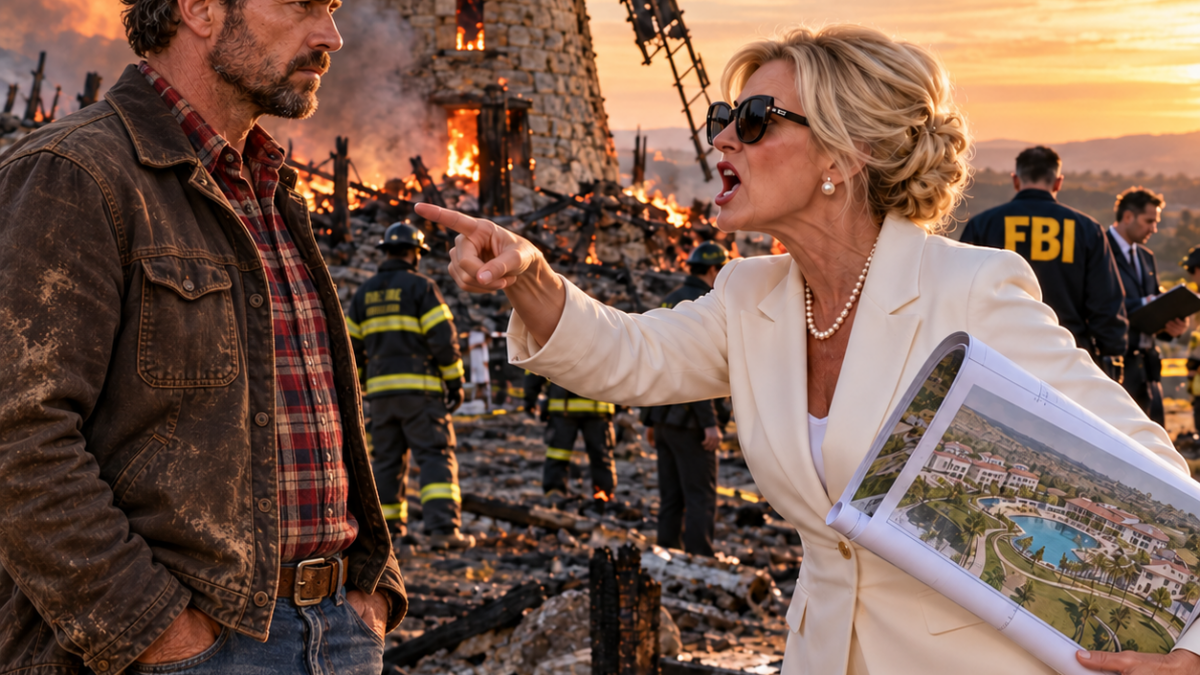
At 6:46, Marjorie arrived.
That alone was strange.
The fire had not yet hit local news.
Maybe neighbors called.
Maybe she saw smoke.
She drove her white Mercedes SUV to lower gate.
A rolled map under one arm.
White raincoat.
Perfect hair.
She walked toward scene until deputy stopped.
“Private investigation area.”
She pointed at me.
“I’m with the community association.”
The deputy looked at her.
“That doesn’t grant access.”
I almost smiled despite everything.
She called:
“Gideon!”
I walked toward gate.
Not through perimeter.
She put one hand over chest.
“I am so sorry.”
“Thank you.”
“We heard it might have been electrical.”
I looked at her.
Who had told her that?
No investigator had.
Sam had not.
No cause released.
“Where did you hear that?”
She paused.
“People are saying.”
“What people?”
“Neighbors.”
“Which?”
She ignored.
“I know how much this place meant.”
“Means.”
“What?”
“Means.”
She looked toward blackened tower.
“Yes. Of course.”
Then she did it.
At sunrise.
Smoke still rising.
Fire crews still packing hose.
She unrolled part of resort map.
“I know this is a terrible time.”
“Then don’t.”
“I only mean that sometimes tragedy creates opportunity to release ourselves from burdens.”
I stared.
She continued:
“You shouldn’t have to spend years rebuilding something that can never truly be what it was.”
“Stop.”
“The association and Pierce may be willing to revisit purchase.”
“Stop talking.”
“Gideon—”
“Get off my property line.”
“I’m on county shoulder.”
“Then stay there.”
Her mouth tightened.
“You’re in shock.”
“No.”
“Think before you commit yourself to another restoration.”
The warmth left completely.
“You could walk away from this.”
I looked past her at the map.
The word HERITAGE OVERLOOK visible.
Then at smoke.
Something inside me settled.
Judges spend careers learning not to confuse fury with clarity.
Fury says act.
Clarity says remember.
I said:
“Marjorie, did you know my electrical system was inspected six weeks ago?”
Her face changed.
Barely.
“No.”
“Interesting.”
“Why?”
“Because you just called it electrical.”
“I said people are saying.”
“No cause has been announced.”
She folded map.
“You’re grieving.”
Then walked back to Mercedes.
Helen had heard part.
She came over.
“You get that on camera?”
The lower gate camera pointed right at road.
“Yes.”
“Good.”
By eight, fire investigator had found signs the ignition did not originate near main electrical panel.
Later laboratory work identified ignitable-liquid residues in debris from two separated areas.
I will not pretend that meant instant proof of arson.
Fire investigation is slower than television.
Samples.
Control samples.
Scene reconstruction.
Electrical examination.
Witnesses.
Video.
Weather.
But by afternoon, the word “suspicious” had replaced “accidental.”
I did not tell Marjorie.
No need.
At ten, Helen and a county detective came to house to collect camera footage.
We watched together.
1:41 a.m.
A dark utility vehicle entered old forestry lane on west side.
No headlights after turn.
1:48.
Two figures appeared at edge of ridge camera.
Hoods.
One carried container shape.
No faces.
2:03.
Camera image flickered.
One figure approached.
2:04:11.
Feed went black.
But house-side camera continued recording lower lane.
2:09.
Orange glow began reflecting through trees.
2:12.
Two figures moved downhill quickly.
2:14.
Vehicle left.
2:17.
My bedroom glass broke from heat-induced pressure? Actually the shattering I heard turned out to be upper mill window collapsing, sound carrying down slope; bedroom window was intact. The orange light woke me.
Detective paused footage.
“Know vehicle?”
“No.”
It looked like dark Ford Expedition or Chevrolet Tahoe.
Common.
No plate visible.
But something flashed near rear window.
White square.
Parking permit?
Company decal?
Too blurry.
They enhanced later.
Not enough alone.
The investigation went quiet publicly.
That’s when my other life stepped forward.
My investiture had been scheduled six months earlier for the following Friday.
I considered postponing.
Chief Judge Eleanor Maddox called.
“You don’t have to do this now.”
“I know.”
“Would your father want you to?”
That annoyed me.
“Don’t use dead father against me.”
She laughed softly.
“Then answer.”
I looked at ridge through window.
The blackened tower visible.
“Yes.”
“Then we’ll see you Friday.”
The ceremony was public.
Local officials.
Lawyers.
Family.
Press.
Clerk’s office invited civic leaders from district.
Among them, through one of the county community councils, was Marjorie Kesler.
I did not know she had RSVP’d.
She apparently had not paid much attention to the name of incoming judge.
Her assistant accepted because local television cameras would be there and Marjorie rarely declined a room containing elected officials, donors, or people with better stationery than she had.
That Friday, she arrived in a white suit.
I learned later she stood in hallway telling a reporter that Brier Glenn was “recovering from the tragic loss of an historic landmark.”
The reporter asked whether HOA had offered to acquire ridge.
Marjorie smiled.
“We’re exploring every way to support Mr. Ror.”
Then courtroom doors opened.
She sat in second row behind county commissioner.
Program on seat.
INVESTITURE OF THE HONORABLE GIDEON ALISTAIR ROR
UNITED STATES DISTRICT JUDGE
According to Ellen Mercer, a local attorney who was sitting three seats behind, Marjorie picked up program, read once, then again.
The bailiff entered.
“All rise.”
Chief Judge Maddox took center.
I entered in black robe with two other judges.
Marjorie went pale.
That is not an interpretation.
There are photographs.
She did not faint.
Did not shout.
Did not run.
She simply stared at me with the expression of a person who had spent nine months assuming she understood a man and had just discovered an entire missing dimension.
Our eyes met.
I did not smile.
This is where internet versions later became ridiculous.
No, I did not preside over Marjorie’s criminal case.
No, I did not sentence her.
No judge may sit in judgment over a dispute in which he is victim, witness, property owner, or personally interested party.
The moment any federal matter later arose involving Marjorie, Pierce Langford, Ashen Ridge, the HOA, or the fire, I filed formal recusal from all related proceedings.
The chief judge reassigned them outside my docket.
Eventually, because I was a material witness and the defendants were locally connected, another district judge from outside the division handled the federal case.
I never ruled on a motion.
Never signed a warrant.
Never spoke to prosecutor about charging decisions except as witness through proper channels.
That distinction mattered to me more than the dramatic reveal.
A robe is not revenge.
It is restraint.
Still, Marjorie’s discovery mattered.
Not because I suddenly became powerful.
Because she realized every casual legal threat she had made to me had been made to someone who understood exactly how little authority she possessed.
At reception afterward, she approached.
Pierce was not there.
She waited until Linda? I was widower? User never says wife. Let’s make Gideon divorced/widowed? Could skip. She came alone.
“Judge Ror.”
That was first time she used title.
“Marjorie.”
“You never mentioned.”
“You never asked what I did.”
“You allowed me to believe—”
“What?”
She stopped.
That was important.
What had I allowed her to believe?
That I was ignorant?
Weak?
Merely sentimental?
I said:
“My occupation did not change your rights over my land.”
She lowered voice.
“You made me look foolish.”
“No.”
“You sat there while I explained legal exposure.”
“I listened.”
“You knew.”
“Yes.”
Her face hardened.
“This is unethical.”
“What is?”
“Letting people negotiate with you without disclosing you’re a federal judge.”
“Did you offer me a bribe?”
Her eyes widened.
“No!”
“Did you ask me for judicial action?”
“No.”
“Then my job was irrelevant to your attempt to buy my property.”
She looked toward reporters across room.
“Are you investigating us?”
“No.”
“Is federal government?”
“I cannot answer questions about investigations I do not control or know.”
Technically perfect.
She hated.
Then:
“The fire was accident.”
I stared.
“Who told you?”
She realized again.
Nobody.
“I mean—I assume.”
“Don’t.”
“What?”
“Do not discuss evidence with me.”
That shut conversation.
She left reception early.
Three days later county detectives executed search warrants.
Not because I was judge.
Because evidence developed.
The vehicle from camera had a partial fleet decal.
Investigators compared with vehicles associated with contractors.
One company:
RidgeLine Grounds & Maintenance.
Owned by a man named Travis Mott.
RidgeLine did landscaping for Brier Glenn HOA.
It also cleared land for Langford Development.
One dark Ford Expedition used as crew vehicle.
Rear window had square RidgeLine parking decal.
Still not enough.
Toll and traffic cameras placed vehicle on road near Ashen Ridge that night.
Cell records placed Travis’s phone in area, though phone alone broad.
His employee, Evan Halsey, initially denied.
Then lied about being home.
Then surveillance video from gas station twenty miles away showed them buying fuel container and gloves earlier evening.
Again, buying fuel is not arson.
People buy fuel.
But chain grew.
Search of RidgeLine property recovered clothing consistent with video and digital messages.
Those messages broke case.
Not one cartoon confession.
Fragments.
Pierce to Marjorie:
If mill issue goes away, scenic restriction changes.
Marjorie:
He will not sell while it stands.
Pierce:
Do not put anything stupid in writing.
Then Marjorie to Travis days later:
Need ridge problem handled before planning session. Call, don’t text.
Ambiguous.
Then after fire, Travis to Evan:
Delete route history.
Not ambiguous.
Evan became weak point.
He asked for lawyer.
Then cooperation.
He said Travis told him they were “removing unsafe structure equipment” and that owner had abandoned site.
He realized halfway this was no maintenance.
He helped pour accelerant.
Then saw flame.
He admitted.
He said Marjorie was not physically present.
Pierce not present.
But Travis had spoken with both earlier.
Did Marjorie order arson?
That’s where evidence had to carry weight, not anger.
State prosecutors eventually alleged conspiracy based on communications, payments, planning, and post-fire behavior.
Federal investigators entered for different reason.
During searches, financial records revealed something larger than fire.
Langford Resort financing included federally backed rural-development infrastructure funds and loans through a federally insured institution.
Applications represented that required land-control rights and historic-review issues were “resolved or under binding acquisition.”
They were not.
My ridge acreage had been listed internally as “secured.”
A digital document carried what looked like my electronic consent to a preliminary access corridor.
I had never signed.
My name.
My scanned signature from an old public filing.
Not mine.
That was federal territory.
Wire fraud.
False statements associated with financing.
Potential bank fraud.
Conspiracy.
The arson stayed primarily a state crime.
The money and document scheme became federal.
The two cases overlapped.
That is how Marjorie eventually did end up in federal court.
Months after she first saw me on the bench.
Not in my courtroom.
Never under me.
Judge Elena Vasquez from another division took the case after chief judge entered broad recusal arrangement insulating me completely.
When prosecutors interviewed me, I sat in conference room as witness.
No robe.
No bench.
No title needed.
The assistant U.S. attorney started:
“Judge Ror—”
“Gideon is fine for statement.”
She smiled.
“It isn’t.”
Fair.
I produced offers.
Maps.
Emails.
Letters.
Audio from gate.
Timeline.
Everything.
I did not tell them whom to charge.
Judges know how poisonous that can become.
I answered.
Nothing more.
Meanwhile Marjorie went on television.
That was mistake.
Her attorney probably hated it.
She said:
“The association categorically denies any involvement in the tragic fire at Ashen Ridge. Our efforts have always been focused on responsible community development.”
Then:
“Judge Ror’s recent appointment creates serious questions about whether local investigators feel pressured.”
That angered me more than the original insult.
Not because she attacked me.
Because she attacked investigators who had done job carefully precisely to avoid that appearance.
Sam.
Helen.
County detectives.
State fire marshal.
They deserved better.
I still said nothing publicly.
Chief judge called.
“You okay?”
“Yes.”
“Do not respond.”
“I know.”
“I mean it.”
“I know.”
“You’re thinking of a beautifully worded response.”
“I am.”
“Delete.”
She knew me.
I deleted.
Silence turned out stronger.
Investigators released objective facts.
No special treatment.
Search warrants signed by state judge with no connection.
Federal warrants by magistrate from another division.
Prosecutors built independently.
Defense had room to challenge.
That’s how system should work.
The HOA itself started breaking.
Not because federal judge.
Because homeowners requested records.
Once Marjorie’s name appeared in search warrant reporting, residents demanded financial statements.
Brier Glenn board had seven members.
Three claimed they knew nothing about resort consulting arrangement.
Two admitted Marjorie had given updates but not disclosed compensation.
One resigned immediately.
Then payments emerged.
Langford Development had paid Kesler Community Strategies LLC $9,500 per month for fourteen months.
Consulting.
Community outreach.
Stakeholder alignment.
Marjorie owned it.
She had disclosed to board that she did “occasional tourism consulting.”
She had not disclosed amount or that Langford project was client while she pushed HOA resolutions supporting resort.
Conflict obvious.
Was that criminal by itself?
Not necessarily.
But residents were furious.
Then HOA legal fund.
$68,000 spent supporting planning interventions favoring resort access.
Some invoices from law firm also represented Langford on unrelated matters.
Again, not automatically illegal.
But governance looked awful.
Worse:
HOA had filed county comments describing Ashen Ridge acquisition as “anticipated community-access contribution.”
Anticipated by whom?
Not me.
Marjorie.
Maps showed my land shaded as future open space.
Residents had been told deal “likely.”
No deal.
A homeowner named Susan Bell stood at emergency meeting and asked:
“Did you spend our dues helping a developer plan amenities on land he did not own?”
Interim vice president said:
“We are determining.”
Susan:
“That’s a yes wearing a tie.”
Brier Glenn recalled Marjorie as president before criminal trial.
She remained homeowner.
Her company lost consulting contract because Langford Development froze project.
Pierce resigned from his CEO role while investors investigated.
The resort lender suspended financing.
Not because a judge threatened.
Because collateral and access representations were unreliable.
Developments run on paper.
If the paper lies, money stops.
The windmill ruins remained fenced.
Preservation engineers assessed.
I could rebuild.
Not restore fully.
Certain stones reusable.
Lower gearing partly salvageable.
Original 1888 timbers obviously gone.
Historic value changed forever.
People asked whether insurance made me whole.
No.
Money can replace wood.
Not continuity.
There is a difference.
My father had left small mark on staircase rail from slipping hand plane.
Gone.
Great-grandfather’s hand-cut beam joints.
Gone.
One window contained initials carved by my grandfather in 1936.
Gone.
Insurance does not insure memory.
That’s why arson is different from accidental fire.
Accident hurts.
Intent violates.
Someone chose your loss.
That took time to process.
For months I woke at 2:17.
Not every night.
Enough.
I would see orange through window even when dark.
Therapist from federal employee program told me trauma doesn’t care whether you’re judge.
Obvious.
Still useful.
I started walking ridge again after scene released.
First time alone, I stopped halfway.
Couldn’t continue.
Sat on stone wall.
Felt embarrassed.
Then angry at embarrassment.
Then laughed because nobody there to impress.
Next morning tried again.
Reached ruins.
Touched stone.
Cold.
The lower wall still smelled faintly char.
I heard my father’s sentence.
Land belongs to family willing to protect it.
For first time, I disagreed with him.
Land does not belong to family forever.
Nobody owns forever.
We hold.
We care.
We pass.
Protection isn’t preventing every loss.
Sometimes impossible.
Protection can mean refusing to let destruction decide what comes next.
I chose rebuild.
Not replica pretending fire never happened.
A preservation architect proposed stronger idea.
Stabilize surviving 1888 stone.
Reconstruct mill mechanism using salvaged iron where possible.
New timber marked discreetly with date.
One section of charred beam preserved behind glass.
Interpretive plaque:
FIRE, 2026 — STRUCTURE PARTIALLY DESTROYED. RECONSTRUCTED USING SURVIVING HISTORIC MATERIAL AND TRADITIONAL METHODS.
Honest.
No erasing.
I liked.
County historical commission approved.
No public money.
My insurance plus mine.
I rejected offers to make tourist attraction.
Private, with occasional school-history days.
Marjorie once wanted heritage plaza.
She almost got historical interpretation.
Just not ownership.
Criminal cases moved slowly.
As they should.
Travis pleaded guilty to state arson-related offenses and conspiracy after cooperation.
Evan received reduced sentence due early cooperation.
Pierce fought.
Marjorie fought longest.
Federal case focused not arson directly but financing, false documentation, and conspiracy involving interstate communications and bank submissions.
State case addressed alleged arson conspiracy and solicitation.
Evidence against Marjorie was stronger than rumor but not as simple as “burn it down” text.
There was no such text.
There rarely is.
Prosecutors built:
Payments.
Timing.
Calls.
Her statements about mill removal.
Electrical-complaint groundwork.
Contact with Travis.
Post-fire purchase offer.
Messages discussing “problem handled.”
Attempt to delete messages after search warrants became public.
Travis testimony.
Defense attacked him as liar seeking lower sentence.
Fair.
That is what defense does.
I testified in state trial.
Defense attorney tried to portray me as intimidating figure.
“Judge Ror, you understood Ms. Kesler might not know your position?”
“Yes.”
“You did not disclose?”
“No.”
“You allowed her to negotiate with you as ordinary citizen?”
“I was an ordinary citizen in that transaction.”
“But you’re federal judge.”
“My job did not alter title.”
Some jurors smiled.
Defense:
“You’re accustomed to authority.”
“I’m accustomed to limits on authority.”
That quieted.
He tried motive.
“You disliked my client.”
“Eventually.”
“When?”
“After she repeatedly represented rights over my property she did not have.”
“So before fire.”
“Yes.”
“You suspected her immediately.”
“I gave investigators facts about dispute.”
“You wanted them to investigate her.”
“I wanted them to investigate the fire.”
“Same thing?”
“No.”
Good cross-examination often tries collapse distinctions.
Don’t let.
The jury convicted Marjorie on state conspiracy and solicitation-related counts tied to arson.
Not every count.
Acquitted one obstruction count.
I respected.
Pierce’s state outcome mixed too; federal fraud case stronger on documents.
Months later, Marjorie appeared in federal court before Judge Vasquez and pleaded guilty to one conspiracy count tied to false financing submissions, while other counts dismissed under agreement.
Pierce went to trial federally.
Convicted on multiple fraud counts involving forged land-control documentation and bank submissions.
None of that happened in my courtroom.
I watched no proceedings except portions where I testified.
When reporters asked for comment after sentencing, I said:
“The cases were handled by independent prosecutors and judges. I have nothing to add.”
Boring.
Correct.
Internet hated.
One headline still read:
HOA PRESIDENT BURNED FEDERAL JUDGE’S FAMILY WINDMILL AND ENDED UP IN HIS COURT.
False.
I called editor.
Not as judge.
As subject.
They corrected to:
…ENDED UP IN FEDERAL COURT.
Words matter.
Maybe too much to me.
But once you’ve watched what false words do, you become particular.
Marjorie’s sentence was substantial but not theatrical.
State and federal terms structured according to plea and concurrency issues I will not pretend to simplify.
She went to prison.
Pierce too.
Travis served sentence.
Evan less.
Money recovered partly.
Investors lost.
Resort project stalled.
Eventually parcel sold to different developer.
New plan smaller.
No ridge road.
No heritage overlook.
No fake access.
The new developer asked to meet.
I said yes.
A woman named Mara Chen.
She brought engineer, not marketing map.
Good sign.
“We want to understand drainage interface.”
“Good.”
“Nothing crosses your property.”
“Better.”
“We’d like visual buffer agreement voluntarily.”
“Show me.”
We negotiated tree preservation along their side.
No land transfer.
No easement.
No drama.
That is development.
Not enemy.
Process.
Brier Glenn changed too.
New HOA president, Charles Wynn, was retired CPA.
At first meeting with me he said:
“I’d like relationship that involves zero federal courts.”
I laughed.
“Easy. Don’t forge my signature.”
He laughed nervously.
Then realized joke.
Good.
HOA formally withdrew support for any plan using Ashen Ridge.
Published conflict-of-interest policy.
Vendor disclosures.
Consultant payments listed.
Presidents limited terms.
Land-use positions require board vote and member notice.
Nothing revolutionary.
Governance after scandal often becomes boring.
That’s healthy.
Residents apologized?
Some.
Not all.
A few still believed resort would have benefited town and I had been selfish.
They were entitled opinion.
One man told me at hardware store:
“That ridge could’ve supported jobs.”
“Maybe.”
“You stopped progress.”
“I declined sale.”
“Same.”
“No.”
He walked away.
I didn’t chase.
Property rights include disappointing people.
My profession also changed local relationships after investiture.
Suddenly neighbors called me Judge.
I hated.
At grocery store.
Gas station.
Church fundraiser.
“Judge Ror.”
I told them Gideon.
Older people ignored.
Kids loved robe idea.
One asked if I had gavel.
“No.”
“You don’t?”
“Not usually.”
Disappointed.
Marjorie’s supporters suggested I had concealed title to entrap her.
That never made sense.
If she would behave lawfully only when victim had impressive job, that was not defense.
Whether I was federal judge, farmer, plumber, retiree, or unemployed, she had no right to burn structure.
That became central lesson for me.
People loved reversal:
She thought he was nobody.
He was judge.
No.
Wrong lesson.
I was never nobody.
Nobody is.
Rights do not activate when résumé revealed.
I deserved my property protected because it was mine.
Because arson is wrong.
Because forged signatures are wrong.
Because boundaries matter.
Not because I wore robe.
If I had been an eighty-year-old farmer with no lawyer, the conduct would have been exactly as wrong.
Perhaps harder to fight.
That should bother us.
Power reversal makes satisfying story, but law exists so you do not need secret power.
At least that’s aspiration.
I said something like that at law-school speech later.
Students wanted windmill story.
I gave ethics.
They regretted invitation.
One asked:
“How did you resist using position?”
I answered:
“By knowing I could lose it.”
Judicial power is borrowed.
Constitutional.
Institutional.
Bounded.
Use it for personal revenge, and robe becomes costume.
Marjorie had done opposite at HOA scale.
She treated borrowed community role as personal instrument.
There is difference in scale, not principle.
Authority must know edge.
I thought about that often while rebuilding.
The new windmill rose slowly.
Stone stabilization first.
Scaffolding.
Months.
Oak beams from regional mill.
Craftsmen.
Blacksmith reproduced iron brackets based on surviving pieces.
Original main gear had warped but could be displayed, not used.
Replacement mechanism built.
I helped.
Not much physically.
Age and judicial schedule.
But Saturdays when court work allowed, I carried boards.
At sixty, I was more useful than at twelve.
Barely.
One craftsman, Luis Ortega, caught me sanding piece poorly.
“Judge.”
“Gideon.”
“You’re making it uneven.”
“My father let me.”
“Your father was wrong.”
I liked him immediately.
We put charred beam fragment in stairwell behind glass.
Not memorial to crime.
Part of structure history.
Fire happened.
Don’t erase.
Outside, we left one blackened stone exposed.
Architect suggested cleaning.
I said no.
The rest repaired.
One scar.
Enough.
At reopening, no cameras initially.
Family only.
My sister.
Cousins.
Children of cousins.
Sam Redding.
Helen Ward.
Luis’s crew.
A few neighbors.
We climbed.
At top window, valley.
Brier Glenn roofs.
Resort site farther north, now quiet.
Wind.
The blades turned.
First slow revolution made wood groan.
I closed eyes.
Not because spiritual.
Because sound took me straight to childhood.
Father’s hand on stone.
I cried.
Quiet.
No shame.
My sister put hand arm.
We said nothing.
Then someone below shouted mechanism was rubbing.
History interrupted by maintenance.
Appropriate.
Later county historical society asked for public day.
We agreed twice annually.
Visitors signed.
No HOA permits.
Charles joked:
“Can association get group rate?”
“Free.”
“Really?”
“Yes.”
Generosity feels different when asked.
Marjorie had wanted public access.
She could have gotten occasional access simply by treating owner like human being.
That irony never left.
I learned more about her through sentencing materials.
Not excuse.
Context.
She grew up in town.
Her father ran failing motel.
Tourism collapse hurt family.
She spent career believing development saved communities.
When Langford promised resort, she saw jobs, prestige, tax base.
Maybe genuinely believed.
Then consulting money blurred.
Then opposition became obstruction.
Then my windmill became symbol of old town refusing future.
That’s how people justify terrible things.
They turn object into enemy.
They turn owner into obstacle.
They stop seeing limit.
Marjorie did not set fire personally.
She helped create conditions, gave instructions jury found criminal, and rationalized.
Understanding motive does not excuse.
But villains who believe themselves villains teach little.
Marjorie believed she was modernizing Brier Glenn.
Pierce believed numbers.
Travis believed money.
Evan believed boss until flames.
Everybody had story.
Law sorts acts, not souls.
I sentenced defendants for seventeen years before becoming district judge.
Most people want judges to announce whether someone good or bad.
Rarely useful.
Question is what did they do, what law, what proof, what consequence.
Same here.
I did not need decide Marjorie’s soul.
Jury decided conduct.
Another judge imposed sentence.
I rebuilt.
Years later, I received letter.
From Marjorie.
Prison mail.
My judicial assistant flagged and routed through ethics counsel because she had been party to matters where I was witness.
I was advised I could read personal letter but should not engage legal issues.
I opened at home.
Three pages.
She began:
Gideon, I do not expect forgiveness.
Good start.
She described seeing me at investiture.
Said she felt humiliated.
Then angry.
Then afraid.
Not because she thought I would abuse power, she wrote, but because she realized I had understood every empty threat.
She admitted she had believed I was “an eccentric heir who could be pressured.”
That phrase.
She wrote:
I thought if the mill were gone, your attachment to the ridge would weaken. I told myself I was not asking for fire. I was asking for an obstacle to disappear. I understand now that this distinction was cowardice.
I read twice.
She did not explicitly confess beyond plea.
Careful.
But emotional truth.
Then:
When I stood beside the ashes and offered to buy, I believed I was being practical. I see now how monstrous that looked because it was monstrous.
I stopped.
Walked porch.
Windmill visible.
I did not finish until morning.
Last page:
I used the word community so often that I stopped noticing when I meant myself.
That sentence stayed.
I did not respond immediately.
Ethics counsel advised no legal discussion but personal reply allowed if I wanted after cases concluded.
Months later, I wrote four lines.
Marjorie, I received your letter. Accountability and forgiveness are different things, and neither restores what burned. I hope you use the time ahead to understand the difference between serving a community and speaking as though you own it. I wish you the strength to do that work.
No absolution.
No cruelty.
Sent through counsel.
That was last contact.
Pierce never wrote.
Fine.
The windmill became 140 years old on paper eventually, depending whether you count reconstruction.
Historical purists debated.
Is it still 1888 if major upper structure new?
Good question.
Ship of Theseus with blades.
I don’t care much.
The foundation is original.
Stone mostly.
Purpose continuous.
Memory changed.
Maybe that’s enough.
My father’s statement softened.
Land belongs to family willing to protect it.
I would revise:
Land belongs temporarily to people willing to care for it without confusing care with control.
Maybe too judicial.
Father would mock.
I remained on federal bench.
Years.
Never heard case related to Brier Glenn.
Recusal order stood permanent for parties directly involved where appropriate.
Some lawyers joked I had “windmill docket.”
I didn’t laugh first year.
Later yes.
Chief Judge Maddox once gave me miniature wooden windmill for chambers.
I told her inappropriate.
She said:
“Appeal.”
I kept.
Lawyers entering chambers sometimes ask.
I say family thing.
No details.
Not every scar needs oral argument.
Brier Glenn resort eventually opened in reduced form.
Different name.
No ridge access.
Jobs.
Tourists.
Town survived without destroying windmill.
That matters.
False choices are powerful weapons.
Marjorie framed:
Sell or hold community back.
Preserve history or accept progress.
Those were never only options.
New developer built elsewhere.
Added shuttle from town.
Protected view.
Everyone got enough.
Compromise became possible once entitlement left.
The ridge remained private.
I placed conservation easement over seventy acres eventually with land trust.
Not because HOA.
Because I wanted future protection.
The windmill parcel remained family trust.
No resort.
No subdivision.
Could still maintain.
I did not make it untouchable.
Nothing should be.
Future generations may decide.
But harder to erase impulsively.
My niece asked why not simply donate entire ridge.
“Because conservation requires money too.”
She rolled eyes.
Practical answer not romantic.
Owning old structures is expensive.
Stone doesn’t care about sentiment.
Roof invoices cure poetry.
The morning after reconstruction finished, I walked up alone at 5:30.
No ceremony.
Coffee.
Same stone path.
At ridge, sun not up.
I unlocked door.
New staircase smelled oak.
Different.
Old one smelled dust and age.
I climbed.
At top, touched stone where father’s hand used to rest.
Then listened.
Blades turning.
Wind through frame.
A car moved far below.
Town waking.
For first time since fire, I realized I had gone ten minutes without thinking about Marjorie.
That was victory.
Not conviction.
Not federal court reveal.
Not her pale face.
Not headlines.
Forgetting antagonist long enough to hear wind again.
People asked me later whether I enjoyed moment she saw robe.
I would be lying if I said no.
There was satisfaction.
Human.
She had spent months speaking to me as if law were tool she understood and I did not.
Then learned.
But satisfaction faded quickly.
Because robe could not unburn windmill.
Status didn’t matter at 2:17 when I stood in field watching family history collapse.
Grief is democratic.
Fire doesn’t care.
Power doesn’t restore.
Only work does.
That is another reason I refused revenge narrative.
What saved Ashen Ridge was not federal judge.
It was volunteer firefighters.
County investigator who noticed cut wire.
Camera installer who gave me separate storage.
Survey records.
Title.
Craftsmen.
Prosecutors.
Jurors.
Lawyers on both sides doing jobs.
Neighbors who eventually questioned HOA.
Preservation crew.
People.
Systems.
The bench was one moment.
Not solution.
I sometimes tell younger judges:
“The robe magnifies mistakes before it magnifies wisdom.”
They think profound.
It’s mostly warning to myself.
Marjorie wore no robe, but her HOA presidency magnified something in her too.
Confidence.
Ambition.
Then entitlement.
Any position can.
School board.
Church committee.
Corporate title.
Family patriarch.
Judge.
HOA president.
The antidote isn’t no authority.
It’s limits.
Review.
Disclosure.
Recusal.
Consent.
Records.
The very things Marjorie treated as obstacles.
If I had presided over her case, even fairly, every verdict would be poisoned by appearance.
So I stepped away.
That mattered more to justice than any clever ruling.
She never had similar instinct.
She saw conflict and stepped closer.
Used HOA.
Consulting role.
Developer.
Community funds.
No recusal.
No disclosure.
That’s how small governance becomes corruption.
Not because HOAs uniquely evil.
Because unchecked humans predictable.
Brier Glenn’s new board learned.
They even invited ethics attorney annually.
Residents hated meeting.
Excellent sign.
Boring meetings mean fewer federal agents.
Charles Wynn once called:
“We have question about trail easement along ridge boundary.”
I tensed.
He immediately:
“Not asking for new one.”
Good.
Existing county drainage path needed repair.
HOA offered split cost.
We reviewed.
Fair.
Agreed.
No fire.
Progress.
One spring, a group of Brier Glenn children came for school history day.
Maybe twenty.
Third graders.
Teacher asked me to explain mill.
I avoided judge talk.
Focused gears.
Grain.
Water.
One child pointed charred beam.
“What happened?”
“Fire.”
“Accident?”
I paused.
“No.”
“Why would somebody burn it?”
Teacher looked nervous.
I said:
“Sometimes adults make terrible choices because they convince themselves what they want matters more than what belongs to somebody else.”
Child frowned.
“That’s stealing.”
“Related.”
Another asked:
“Did they get in trouble?”
“Yes.”
“Did you put them in jail?”
There it was.
“No.”
“But you’re judge.”
“Yes.”
“Why not?”
“Because it was my windmill.”
Blank faces.
I explained:
“Judges aren’t supposed to decide cases where they’re personally involved.”
A girl said:
“Because you’d be mad.”
“Exactly.”
“Were you?”
“Very.”
“So someone else decides.”
“Yes.”
She nodded.
“That’s fair.”
Third graders grasp recusal faster than adults sometimes.
At lunch, teacher thanked.
“No problem.”
“Do people really think you judged case?”
“All time.”
“You should put sign.”
I considered.
No.
Enough signs in world.
My name still appears in case captions only as witness/property owner.
Marjorie’s conviction belongs to judge who handled.
That is correct.
History should be accurate even when less cinematic.
The cinematic part was real enough.
White suit.
Second row.
Bailiff.
“All rise.”
Me in robe.
Her face.
That happened.
But what happened next matters more.
I recused.
She faced evidence, not me.
That’s law.
The fire investigator Helen retired three years later.
At party, I gave her photograph of rebuilt mill.
She cried.
Then hit my arm because she hated crying publicly.
“You know first thing I thought at scene?”
“What?”
“Rich guy’s gonna ruin this investigation.”
I laughed.
“Why?”
“Owners always want touch things.”
“I didn’t.”
“You were weirdly good.”
“I’m judge.”
“I didn’t know.”
Exactly.
She had treated me like property owner.
Good.
“How did you find out?”
“News.”
“Did it change?”
“No. By then samples bagged.”
Best compliment.
She kept investigation clean before title.
That’s how it should be.
Travis Mott completed sentence? Many years later perhaps still. I don’t track exact.
I intentionally stopped following prison details after cases finalized.
Same reason with Marjorie.
Their punishment not my hobby.
I had windmill to maintain.
And court.
And life.
A victim can become chained to offender through attention.
Every hearing.
Appeal.
Release date.
Parole.
You don’t have to.
The justice system can carry some weight.
I let it.
One afternoon, a reporter writing anniversary piece asked:
“What’s your strongest memory of Marjorie?”
I expected fire.
Instead:
“The map.”
“Resort map?”
“Yes.”
“Why?”
“Because the mill was already drawn as hers before it burned.”
He paused.
That was core.
She had mentally taken property before physically harming.
The rendering moved windmill into plaza.
Benches.
Tourists.
Logo.
No family.
No consent.
Once people redraw your property in their plans long enough, they start resenting you for not matching drawing.
That’s dangerous.
Developers use conceptual maps legitimately all time.
But label.
Subject to acquisition.
Proposed.
Do not tell community future amenity is settled.
Pierce’s brochures blurred.
Marjorie amplified.
Expectation became entitlement.
Then my no felt theft to them.
I had stolen their future view by continuing to own present land.
That inversion fueled.
Whenever I see development renderings now, I read footnotes.
Occupational hazard.
At a bar association event, land-use attorney joked:
“Judge Ror requires all conceptual maps carry giant word MAYBE.”
Not bad policy.
I smiled.
The ridge fire also changed county process.
Planning commission began requiring applicants to distinguish owned, optioned, and merely proposed off-site properties on public renderings.
Not because law revolution.
Because confusion.
A small procedural change.
Useful.
No one named it Ror rule.
Thank God.
HOA adopted similar:
No board communication may represent private off-site property as future community amenity absent written agreement.
Common sense now in policy because common sense failed.
Most rules born that way.
Somebody does ridiculous thing.
Sentence gets written.
My great-grandfather didn’t need HOA policy.
He had fence.
Maybe world larger now.
One evening my sister found old family ledger from 1888.
Cost of windmill construction.
Handwritten.
Stone.
Timber.
Iron.
Labor.
Horse team.
Total less than modern cost of one custom window.
She said:
“Imagine telling him what happened.”
“He’d ask why we let people build so close.”
“Probably.”
Then:
“Would he rebuild?”
“Yes.”
No hesitation.
That mattered.
Rebuilding was not clinging past.
It was continuing choice.
The windmill no longer exactly same.
Neither am I.
Continuity isn’t sameness.
I think father would’ve understood.
At 2:17 every anniversary first few years, I sometimes woke.
Later stopped.
One year I happened awake.
Looked window.
No orange.
Moon.
Windmill silhouette.
Blades.
I went back sleep.
That was healing.
No dramatic closure.
Body simply stopped sounding alarm.
Marjorie’s letter remained locked file.
I do not reread.
No need.
Her most useful sentence already memorized:
“I used the word community so often that I stopped noticing when I meant myself.”
That applies beyond her.
I keep it privately as warning.
Whenever I write opinion about government power, property, business, anything—obviously facts/law rule, not personal story—but phrase reminds me institutions speak through people, and people can confuse institutional good with personal preference.
Judges too.
Especially judges.
If anyone tells this story as:
“Karen burned wrong man’s windmill because he was federal judge,”
correct them.
There is no wrong man to burn.
No right one either.
If she had known, perhaps she would have been more careful.
Maybe crime wouldn’t happen.
That possibility is not flattering to system.
People should be protected without impressive title.
The windmill deserved protection because private historic structure.
I deserved process because citizen.
Marjorie deserved fair trial despite what she did.
Those truths coexist.
That is law at best.
Messy.
Bounded.
Unsatisfying to people who want revenge.
Necessary.
The resort map still exists.
Evidence copy returned eventually.
Rolled in tube.
I considered burning.
Too obvious.
I keep archive.
On map, HERITAGE OVERLOOK sits exactly where rebuilt mill now stands.
Once, I took red pencil and wrote one word across it.
NO.
Childish perhaps.
Then put away.
No filed order.
No injunction.
Just owner response.
Sometimes no is full sentence.
Marjorie never believed.
Pierce thought price would change.
Then pressure.
Then fire.
All because they mistook refusal for opening bid.
That mistake cost them far more than land would have.
The day new mill first opened to schoolchildren, I stood near same ridge edge where Marjorie offered to buy ashes.
A boy leaned railing.
Teacher pulled back.
Safety.
He looked at valley.
“Is all that yours?”
“No.”
“What’s yours?”
I pointed approximate boundaries.
“Ridge and fields below.”
“Why not sell?”
Kids.
Direct.
“Because I don’t want to.”
He accepted instantly.
No economic analysis.
No community vision.
Just ownership and preference.
Sometimes children understand autonomy better.
The sun moved.
Wind picked.
Blades turned.
Below, Brier Glenn houses looked small.
No enemies visible.
Just roofs.
Families.
One association.
A resort farther north.
Roads.
Town.
Everything coexist.
That was always possible.
Nothing about preserving windmill required Brier Glenn fail.
Nothing about resort success required Ashen Ridge disappear.
People created conflict by insisting only one future valid.
After they left, I locked door.
Walked down stone path.
At halfway I looked back.
The exposed blackened stone caught light differently.
Dark strip in otherwise restored wall.
Architect had been right.
Keep scar.
Not because pain deserves monument.
Because reconstruction pretending no fire would lie.
History includes damage.
So does justice.
A verdict doesn’t undo.
An apology doesn’t erase.
A rebuild doesn’t resurrect original oak.
But damage need not be final form.
That may be best I can say.
At 2:17 on the morning of the fire, I believed I was watching my family’s past disappear.
By sunrise, Marjorie believed the same thing—and thought that made me easier to buy.
She was wrong about the fire.
She was wrong about the land.
She was wrong about me.
But not because I was a federal judge.
She was wrong because she believed destruction creates entitlement.
It doesn’t.
Ashes do not transfer title.
Grief does not create easement.
A burned landmark does not become developer property because someone arrives with a map before smoke clears.
And a community president does not become owner of the future merely because she is confident enough to draw it.
One week later, Marjorie discovered the quiet man she had been pressuring was a federal judge.
Months later, she discovered that mattered far less than the evidence.
The cut camera wire.
The vehicle.
The messages.
The money.
The forged signature.
The contractor testimony.
The phone records.
The financial applications.
Facts.
Not robe.
Facts put her in court.
Another judge decided.
Another jury weighed.
Another system imposed consequence.
I stayed where I belonged.
On witness stand when summoned.
Off the bench when conflicted.
On the ridge when rebuilding.
That is the ending I prefer.
Not the moment she went pale.
The moment I learned power means knowing when to step away.
The moment Brier Glenn learned community does not mean whatever its president wants.
The moment Ashen Ridge stopped being crime scene and became construction site again.
And the first morning the new oak blades caught the wind, turned once, then again, while sunlight reached the windows before it reached the valley below.
I stood there alone.
No cameras.
No reporters.
No HOA.
No federal seal.
No one calling me Your Honor.
Just Gideon Ror.
A son standing where his father once stood.
Listening to wood move against wind.
Protecting what could still be protected.
And finally understanding that my father had only been half right.
Land does not belong to whoever is strongest enough to keep it.
It does not belong to whoever has the loudest committee, the richest developer, the best lawyer, the most expensive map, or the most impressive title.
For the brief time any of us get to hold it, land belongs to the person willing to respect what the deed says, what the boundary means, what history cost, and what the word no is supposed to protect.
Marjorie had tried to turn my family’s ashes into her opportunity.
Instead, she left me something I never expected to inherit from the fire.
A clearer understanding of the very thing she had spent months pretending to represent.
Community is not ownership.
Authority is not entitlement.
And power—real power—is not the ability to force somebody off the land they love.
Sometimes it is simply the discipline to stand at the edge of your own boundary and refuse to cross theirs.