The Black Shelter Cat Who Brought Her Toys to Strangers—Until One Woman Realized She Was Offering the Last Pieces of Her Old Home
PART3:
The man stood near the counter in an expensive navy jacket, checking his phone like our shelter had personally inconvenienced him. He was in his mid-thirties, clean-shaven, with polished shoes that looked absurd against the scuffed intake floor. Beside his leg sat a hard plastic carrier. Inside was darkness at first. Then two green eyes appeared.
Roxy.
She sat upright in the back of the carrier, small and black and still. Her fur was dull from stress, but beneath that I could see she had once been glossy and well cared for. A few white hairs sprinkled her chest, just enough to look like stray snow. Her eyes were round and watchful.
Not wild.
Not aggressive.
Watchful.
The man glanced up.
“Are you in charge?”
“Of adoptions,” I said. “For intake, Marlene is.”
“I already explained this. My grandmother died. I’m clearing out the house. The cat can’t come with me.”
Marlene slid the form across the counter.
“We need her history.”
“I don’t know her history.”
“You know her name.”
“Roxy.”
“Age?”
“Seven, maybe. Eight? My grandmother talked about her like she was a child, so who knows.”
His impatience landed in the room like a bad smell.
I moved closer to the carrier.
“Hi, Roxy.”
Her ears tilted toward my voice.
The man sighed.
“I have a meeting at noon.”
“Then we’ll be efficient,” I said. “Medical history?”
“She went to a vet.”
“Which vet?”
“I don’t know.”
“Food?”
“Cat food.”
Marlene stopped writing.
I looked at him.
“What kind?”
“The normal kind.”
There is a special kind of anger that builds in shelters when people treat living beings like furniture left over after an estate sale.
I have learned not to let that anger speak first.
It rarely helps the animal.
“Did she live indoors?” I asked.
“Yes.”
“Any other animals?”
“No.”
“Children?”
“No.”
“Behavior concerns?”
He looked at the carrier.
“She’s needy.”
I waited.
“She brings things,” he said, as if describing a defect. “Toys. Socks. Whatever. Drops them by your feet. My grandmother thought it was charming. It gets old.”
From inside the carrier, Roxy blinked.
Marlene’s pen moved slower.
“Any aggression?”
“No.”
“Litter box issues?”
“No.”
“Medical concerns?”
“No.”
“Is she spayed?”
“I assume so.”
“You assume?”
“My grandmother wasn’t irresponsible.”
That was the first warm thing he said, and even then it wasn’t for Roxy.
Marlene asked for his identification and contact information. He resisted the surrender fee until I explained, with the calm voice I used for difficult adopters and angry school board members, that surrender fees helped cover intake exams, vaccines, parasite treatment, food, and housing.
He paid.
Then he lifted a large reusable grocery bag onto the counter.
“Her stuff.”
Inside were toys.
More toys than I expected.
Soft mice, felt balls, crinkle fish, tiny stuffed birds, a fabric carrot, a blue plush moon, a knitted mouse with one ear missing, and a small yellow duck worn almost flat from use.
At the bottom was a fleece blanket, black with little red hearts.
Roxy pressed one paw against the carrier door.
The man saw it and looked away.
Not quickly enough.
For one second, something like discomfort crossed his face.
Then it was gone.
“My grandmother’s neighbor said the cat should go to someone quiet,” he said. “So put that on the card or whatever.”
“What was your grandmother’s name?” I asked.
He paused.
“Why does that matter?”
“Because Roxy lost her person. Sometimes details help us help them.”
His expression hardened.
“Helen Ward.”
Then he walked out before we finished the intake.
Marlene watched the front door close.
“Well,” she said. “He was a delight.”
I crouched in front of the carrier.
Roxy looked at me, then at the bag of toys on the counter.
“We’ll keep them with you,” I promised.
Her eyes stayed on the bag.
That was the first thing I noticed.
Before she cared about food, before she cared about the room, before she cared about me, she cared about those toys.
We set Roxy up in cat kennel nine first, because it was quieter and away from the main adoption traffic. New arrivals usually need time before being placed in the public room. Roxy allowed Marlene to lift her from the carrier without protest, though her body went stiff in that heartbreaking way cats do when they are enduring rather than accepting.
We scanned her.
No microchip.
That surprised me.
A cat loved enough to have a bag full of toys but not chipped. It happened, but it still bothered me.
Dr. Singh checked her that afternoon.
“Overall, good condition,” she said. “Stressy, but healthy. Teeth look consistent with seven. Spayed. Nails a little long. Mild dandruff. Nothing alarming.”
“Behavior?”
“Quiet. Tolerates handling. No aggression. Watches everything.”
That became Roxy’s first shelter note.
Watches everything.
For three days, she barely moved when people were in the room.
She ate at night.
Used the litter box.
Slept on the heart blanket.
Ignored the beds we gave her.
Ignored the scratching pad.
Ignored me.
But every morning, when I opened the kennel to clean, one toy would be sitting in her water dish.
At first, I thought it was an accident.
The yellow duck floating in the bowl.
Then the blue moon.
Then the one-eared mouse.
Every morning, a toy in the water.
“Roxy,” I said on the fourth day, lifting a soggy fabric carrot from the bowl, “we have to stop baptizing your belongings.”
She sat on the heart blanket and watched me.
Her expression was unreadable, which is normal for cats and inconvenient for humans.
On the fifth day, while I was refilling food, she picked up the yellow duck and carried it to the front of the kennel.
She placed it gently beside my hand.
Then stepped back.
I froze.
“Well,” I whispered. “Thank you.”
Her tail curled around her paws.
I picked up the duck, held it out, then set it beside her blanket.
She looked at it.
Then at me.
The next morning, the duck was in the water again.
That was the beginning.
By the second week, Roxy had settled enough to move into the adoption room.
Kennel twelve.
Middle row.
Good visibility.
Soft bed.
Heart blanket.
Bag of toys.
New card:
ROXY
7-year-old spayed female
Sweet, quiet, gentle
Enjoys soft toys
Best in a calm home
I added one more line by hand.
She has a loving little heart.
Marlene rolled her eyes when she saw it.
“You’re getting sentimental.”
“I work in animal rescue. Sentiment is part of the compensation package.”
“It’s not in my paycheck.”
“It’s under emotional damages.”
Roxy sat in the back of the kennel the first hour.
Then a family came through with two children.
The younger child, a girl maybe six, stopped in front of Roxy.
“Mom, look. Black kitty.”
Roxy stood.
Slowly.
She turned, picked up the yellow duck, and carried it to the front.
The child gasped.
“She brought me a toy!”
Roxy placed the duck near the kennel door.
The girl pressed both hands to her chest.
“Oh my gosh.”
For one bright second, hope rose in me so fast it hurt.
Then the mother glanced at the card.
“Seven years old,” she said. “Let’s look at the kittens.”
The girl hesitated.
Roxy waited with the duck at her paws.
The family moved on.
Roxy watched them go.
After a moment, she picked up the duck and carried it back to her blanket.
That was the first time I saw the whole ritual.
Not just bringing.
Offering.
Waiting.
Retrieving.
I told myself not to make it too human.
Cats carry toys for many reasons. Play. Prey behavior. Comfort. Habit. Attention-seeking. Stress displacement. Learned routine.
All true.
All possible.
None of it made watching easier.
Day after day, Roxy began carrying toys to visitors.
One by one.
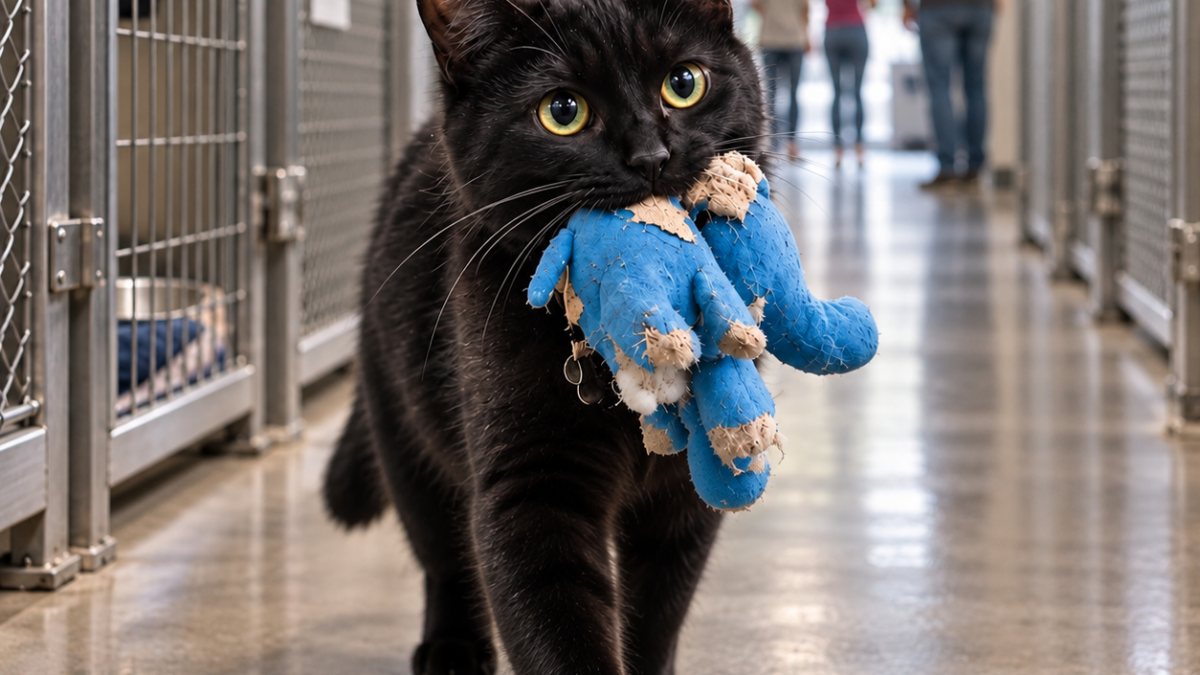
If someone paused at her kennel, she would rise from her blanket, select an item with serious consideration, and bring it forward. The duck for children. The blue moon for quiet adults. The one-eared mouse for staff. The fabric carrot for reasons known only to her.
She never threw them.
Never batted them wildly.
Never begged with her paws.
She simply placed them near the door and looked up.
Look what I have.
Will you stay?
The shelter staff fell in love with her.
That happens, of course.
But Roxy inspired a particular kind of tenderness. Maybe because she was polite about wanting. She did not demand attention. She offered something first.
People stopped.
Smiled.
Filmed her.
Said, “Aww.”
Then walked away.
After three weeks, I began to hate the word cute.
“She’s so cute.”
“She’s adorable.”
“Oh my gosh, she brought a toy.”
But the adoption applications went to kittens, young cats, bonded pairs, fluffy cats, cats with blue eyes, cats who climbed shoulders, cats who performed affection quickly.
Roxy remained.
The first adoption event after she moved to the main room was awful.
Not visibly awful.
The kind that looks successful if you only count numbers.
Fourteen cats adopted in one weekend.
Six kittens.
Three adult males.
One senior pair.
Two tabbies.
One orange chaos demon who knocked over a donation display and was adopted by a man who said, “I like personality.”
Roxy brought toys to twenty-three people.
I counted.
I wish I hadn’t.
Twenty-three offerings.
Zero applications.
At closing, I found her sitting beside the kennel door with every toy arranged near the front, as if she had run out of ways to ask.
I sat on the floor outside her kennel.
“Some days people are stupid,” I told her.
She pressed the yellow duck against the bars.
I touched one finger to the metal.
“I know.”
That night, I pulled her intake file again.
Helen Ward.
The name bothered me because it felt like there was more to the story. Not because the grandson had done anything illegal. People surrender animals after deaths all the time. Sometimes they are grieving too. Sometimes they are overwhelmed. Sometimes they truly cannot take in another life. I knew that.
But Roxy’s bag of toys felt intentional.
Not random.
Not “her stuff.”
Each toy looked chosen.
Kept.
Loved.
Some had been repaired by hand.
The one-eared mouse had a patch sewn over its side in tiny stitches.
The yellow duck had thread around the wing where stuffing had once escaped.
At the bottom of the bag, beneath the blanket, I found something I had missed before.
A small cloth pouch.
Inside was a needle, black thread, yellow thread, and a folded scrap of paper.
On the paper, in shaky handwriting, were four words:
For Roxy’s little friends.
I sat back in the chair.
The note was not addressed.
No signature.
But I knew.
Helen.
Roxy had not simply owned toys.
Someone had repaired them for her.
Someone had known the duck mattered.
Someone had packed them with love.
I unfolded the heart blanket and looked more closely. In one corner, stitched in red thread, were the letters H.W.
Helen Ward.
And beside them, smaller:
Roxy’s blanket.
I pressed the fabric between my fingers.
That was when I stopped thinking of Roxy as a shelter cat with a cute habit.
She was a grieving cat trying to share the only pieces of home she had left.
The next morning, I called the number on the surrender form.
It went to voicemail.
“This is Claire Bennett from Cedar Hollow Animal Shelter. I’m calling about Roxy. Nothing is wrong. I just had a few questions about her history and her toys. Please call me back when you can.”
He did not.
I called again three days later.
Nothing.
A week later.
Nothing.
So I did what I always tell adopters not to do.
I searched online.
Helen Ward’s obituary appeared immediately.
Helen Louise Ward, 78, beloved teacher, neighbor, gardener, and friend, passed away peacefully at home on August 31.
No surviving spouse.
One daughter deceased.
One grandson, Bradley Ward.
There was a photo of Helen holding a black cat.
Roxy.
Younger maybe, but unmistakable.
Roxy stood across Helen’s lap with the yellow duck in her mouth.
The obituary said Helen had taught elementary school for thirty-nine years. Loved birds, crossword puzzles, lemon cake, and “her loyal cat Roxy, who greeted every visitor with gifts.”
I read that sentence three times.
Greeted every visitor with gifts.
So that was not new.
That was not a shelter behavior.
That was home.
That was history.
That was love.
I printed the obituary and placed it in Roxy’s file.
Then, because I am not always as professional as I should be, I went into the adoption room, opened her kennel, and sat with her in the meet-and-greet room during lunch.
She carried the blue moon to me.
I picked it up.
“Did Helen make this?”
Roxy watched my face.
“I bet she did.”
She came closer than usual and sniffed the edge of my shoe.
Progress.
Tiny, but real.
The next week, a woman named Grace Lin visited the shelter.
She came in during a rainstorm, hair damp from the parking lot, glasses fogged, coat buttoned wrong in a way that suggested she had dressed while thinking about something else. She was in her early forties, quiet, with ink on her fingers and a canvas tote bag that read Support Your Local Library.
I liked her immediately.
People who carry library tote bags are not automatically good adopters, but it helps.
“Can I just sit with the cats?” she asked at the front desk. “I’m not sure if I’m ready.”
That sentence also helps.
People who know they might not be ready are often more thoughtful than people who declare themselves perfect.
I walked her back to the cat room.
“Take your time,” I said. “Let me know if you want to meet anyone.”
Grace moved slowly along the kennels. She smiled at the kittens but did not linger. She spoke softly to an older calico. She read every card.
Then she stopped in front of Roxy.
Roxy looked up.
Grace read the card.
“Seven,” she said softly.
Roxy stood.
Selected the yellow duck.
Carried it forward.
Placed it by the door.
Grace’s mouth opened slightly.
“Oh,” she whispered.
Roxy sat behind the duck.
Grace crouched.
“Is that for me?”
Roxy blinked.
Grace did not laugh. She did not pull out her phone. She did not call anyone over.
She simply sat down on the floor in front of the kennel, cross-legged, rain dripping quietly from her coat onto the tile.
“I had a black cat when I was little,” she said to Roxy. “His name was Martin. He hated everyone except my grandmother and the refrigerator.”
Roxy watched her.
Grace stayed there fifteen minutes.
Then twenty.
Visitors walked around her.
A toddler pointed at her and asked his mother why the lady was sitting on the floor.
Grace did not seem to care.
Eventually, Roxy picked up the blue moon and brought it too.
Grace put one hand against her chest.
“That’s two gifts,” she said. “I’m honored.”
I stood near the doorway pretending to organize adoption brochures.
Marlene came up beside me.
“Don’t stare,” she whispered.
“I’m not staring.”
“You’re vibrating.”
“I am professionally observing.”
“You’re emotionally hovering.”
Roxy brought the one-eared mouse next.
Grace’s eyes filled.
Not dramatically.
She wiped them quickly, like someone embarrassed by her own tenderness.
I approached then.
“Would you like to meet her?”
Grace looked up.
“I don’t want to scare her.”
That answer was almost always a good sign.
“We can go at her pace.”
In the meet-and-greet room, Roxy did what she usually did.
She hid behind the cat tree.
Grace did not look disappointed.
She sat on the floor, pulled a paperback from her tote, and began reading silently.
After ten minutes, I said, “I’ll give you both some space.”
Grace nodded.
When I checked through the little window half an hour later, Roxy was under the chair near Grace’s feet.
Not touching.
Near.
That counted.
At the end of the visit, Grace filled out an application.
She wrote slowly, carefully, answering every question in full sentences.
Home: small townhome, quiet.
Other pets: none.
Children: no.
Work schedule: remote three days, library four days, flexible.
Previous pets: childhood cat Martin, later adult cat Juniper, deceased two years ago at age sixteen.
Why this cat?
Grace paused on that question for a long time.
Then she wrote:
Because she offered me everything she had and did not ask me to hurry.
I cried in the office.
Marlene saw me.
“Allergies?” she asked.
“I hate you.”
“No, you don’t.”
Grace was approved pending a home check, which she welcomed.
That should have been the happy turning point.
It was not.
The complication arrived because of the video.
One of our younger volunteers, Tessa, had filmed Roxy bringing toys to visitors weeks earlier. It was sweet, respectful, and short. We had not posted it because I was wary of turning Roxy into content without a plan for handling attention.
After Grace’s application came in, Tom, the shelter director, suggested posting Roxy’s story to help raise awareness about overlooked adult cats.
“She may be adopted soon,” I said.
“Even better,” he replied. “We can use it to show why patience matters.”
I agreed, but only after we wrote carefully.
No pity language.
No “unwanted.”
No “nobody loved her.”
No sad music.
Just Roxy being Roxy.
The caption told the truth: that she was seven, gentle, grieving, and looking for a quiet home; that she brought toys to visitors; that adult black cats are often overlooked; that sometimes the cat who seems quiet has the biggest heart.
The video went up Friday morning.
By Friday evening, it had been shared thousands of times.
By Saturday, news stations were calling.
By Sunday, people were lining up to meet Roxy.
That might sound wonderful.
It was not.
Viral attention is not the same as adoption interest.
Some people came because they genuinely cared.
Others came because they wanted to see “the toy cat.”
Several asked if she would bring toys on command.
One woman said, “We want the viral one.”
I said, “Roxy is not available as a collectible.”
She did not adopt.
Another family wanted her for their daughter’s birthday because the daughter loved the video. They had three dogs and two toddlers.
No.
A man asked if she could be filmed for his channel before adoption.
Absolutely not.
Grace watched the chaos from a distance when she came for her second visit.
Roxy, overwhelmed by the increased attention, retreated to the back of her kennel and did not bring a single toy for three hours.
Visitors looked disappointed.
One said, “Maybe she only does it for the camera.”
Grace’s face changed.
She stepped between that woman and the kennel.
“She doesn’t owe anyone a performance.”
The woman blinked.
Grace turned to me.
“Can she go somewhere quiet?”
I nearly hugged her.
Instead, professionally, I said, “Yes.”
We moved Roxy into the back office with her blanket and toys. Grace sat on the floor beside the filing cabinet and read aloud from her paperback for nearly an hour. Roxy remained under the desk.
At minute fifty-two, the yellow duck emerged first.
Then Roxy’s face.
Then the rest of her.
She carried the duck to Grace and placed it beside her knee.
Grace did not touch Roxy.
She touched the duck.
“Thank you.”
Roxy sat down.
That was the moment I knew.
If Roxy had a say, she had just given it.
Then Bradley Ward came back.
Helen’s grandson arrived Monday morning in a black SUV, wearing another expensive jacket and the irritated expression of a man accustomed to being taken seriously.
I saw him from the front desk and felt my body go cold.
Marlene, beside me, whispered, “Oh no.”
He walked in holding his phone.
“That’s my grandmother’s cat,” he said.
Tom came out of his office.
“Mr. Ward.”
“You posted my grandmother’s cat online without permission.”
“You surrendered Roxy to us.”
“I did not surrender ownership. I placed her here for care because I was handling the estate.”
Marlene’s eyebrows shot up.
“That is not what the paperwork says,” I said.
He looked at me as if I had spoken out of turn.
“The story is getting attention,” he said. “Our family has decided we want her back.”
Our family.
There was no our in the intake room when Roxy sat in a carrier with her toys in a bag.
Tom remained calm.
“You signed an owner surrender agreement.”
“I told you she wasn’t mine.”
“You paid the surrender fee.”
“Because your staff pressured me.”
Marlene made a sound.
I stepped slightly in front of her.
Bradley continued.
“My grandmother would be horrified to see her cat used for social media sympathy.”
That one almost worked.
Not because he was right.
Because Helen mattered.
Her name mattered.
Her love for Roxy mattered.
I had used her obituary in Roxy’s file. I had wondered what she would have wanted. I had worried whether the video, even carefully done, had turned Roxy’s grief into a tool.
But then I remembered what Bradley had said at intake.
She’s needy.
It gets old.
The anger steadied me.
“Your grandmother wrote in her obituary that Roxy greeted visitors with gifts,” I said. “She loved that about her.”
Bradley’s eyes narrowed.
“You looked up my grandmother?”
“I looked up Roxy’s history because you refused to provide it.”
His face flushed.
Tom said, “Mr. Ward, Roxy is under shelter ownership and currently in the adoption process with an approved applicant.”
“That applicant can pick another cat.”
“No,” I said.
Tom glanced at me.
I should have let him handle it.
I did not.
“No,” I repeated. “Roxy is not a chair in an estate sale. She is not going back to someone who described her love as annoying and abandoned her with strangers after her person died.”
Bradley stared at me.
“You people are insane.”
“Possibly,” Marlene muttered.
He pointed his phone toward us.
“I’ll be contacting my attorney.”
Tom nodded.
“That is your right.”
Bradley turned to leave, then stopped at the adoption room door.
Roxy was not there. Thank God.
He looked back at me.
“You think you’re saving her,” he said. “But cats don’t care who feeds them.”
That sentence told me everything.
After he left, I went into the back office.
Grace was still there.
She had heard enough.
Roxy was sitting beside her tote bag, the duck under one paw.
Grace looked up at me.
“Can he take her?”
“No,” I said.
I hoped I was right.
Bradley did contact an attorney.
For two miserable weeks, Roxy’s adoption was paused while the shelter’s lawyer reviewed the surrender agreement, Bradley’s claims, and estate documents. Grace came every other day anyway. She never pressured us. Never complained. Never acted as though Roxy had become less worth waiting for because the process got messy.
She sat with her.
Read to her.
Accepted toys.
Brought a soft black carrier lined with fleece and left it in the meet-and-greet room so Roxy could explore it on her own terms.
“She should have something that doesn’t smell like fear,” Grace said.
During that time, more of Helen’s story came to us.
A neighbor named Mrs. Alvarez called after seeing the viral video.
“I knew Helen,” she said. “She loved that cat more than most people love people.”
Mrs. Alvarez came to the shelter with photographs.
Helen in her garden with Roxy on a chair.
Helen sitting by a Christmas tree while Roxy held the blue moon.
Helen’s handwriting on the back of one picture:
Roxy brought Mrs. Alvarez the duck today. Excellent hostess.
Then Mrs. Alvarez gave us something else.
A copy of a letter Helen had written before she died.
Not a legal will. Not notarized. Not enough to control ownership.
But enough to break my heart.
The letter was addressed to Bradley.
Bradley,
If I pass before Roxy does, please do not keep her if you cannot love her. She is shy with noise but sweet with patience. She brings toys because she wants company. The yellow duck is her favorite. If you cannot take her, ask Mrs. Alvarez or find a quiet rescue that will understand her. Do not leave her somewhere frightening. She will think I am coming back.
Please make sure her toys go with her.
They are her little friends.
Love,
Grandma
I read it in Tom’s office and cried openly.
So did Marlene.
Tom took off his glasses and rubbed his eyes.
“That poor woman knew,” he said.
Bradley had ignored the letter.
That was not illegal in the way people want cruelty to be illegal.
But it mattered.
The shelter’s attorney sent Bradley’s attorney copies of the surrender agreement, intake notes, Roxy’s medical and care records, the adoption hold status, and Helen’s letter. The response came three days later.
Bradley would not pursue further action.
No apology.
No admission.
No dramatic reckoning.
Just withdrawal.
Sometimes justice is not a thunderclap.
Sometimes it is an email from a lawyer saying the person who tried to reclaim what he discarded has decided it is not worth the trouble.
Roxy’s adoption was finalized the following Friday.
Grace arrived wearing the same raincoat from her first visit, though the day was bright and warm. She said it felt lucky. She brought the soft carrier, a folder of printed instructions, and a calmness that made the entire shelter breathe easier.
Roxy was in the back office.
I had arranged her toys in a small pile beside the heart blanket.
The duck.
The moon.
The one-eared mouse.
The fabric carrot.
The crinkle fish.
All of them.
Grace knelt in front of her.
“Hi, Roxy.”
Roxy picked up the yellow duck.
She carried it to Grace.
Grace accepted it with both hands.
“I’m going to take that as permission.”
Roxy blinked.
We let Roxy choose when to enter the carrier.
It took thirty-seven minutes.
Nobody rushed.
Nobody sighed.
Nobody said we had other things to do.
Grace sat nearby, reading aloud. I sat beside the desk. Marlene pretended to inventory microchip scanners and cried into a clipboard.
Eventually, Roxy walked into the carrier with the yellow duck in her mouth.
Grace closed the door softly.
The shelter went quiet.
I touched the top of the carrier.
“You get to stop asking now,” I whispered.
Grace looked at me.
I swallowed.
“She’s been asking for so long.”
Grace’s eyes filled.
“I know.”
The first updates were small.
Roxy hid behind the laundry basket for six hours.
Expected.
Roxy ate at midnight.
Good.
Roxy used the litter box.
Excellent.
Roxy carried the duck from the safe room to the hallway at 3:14 a.m.
Progress.
Grace had prepared a quiet room with all of Roxy’s things. She kept the heart blanket on a low bed by the window. Food and water stayed in predictable places. She did not invite visitors. She did not post videos. She sent me text updates because she knew I needed them, not because the world did.
Day four, Grace sent a photo.
A black shape under a chair.
Two green eyes.
The yellow duck at the edge of the shadow.
Caption: She brought it halfway.
Day seven:
Roxy sat on the window ledge while Grace worked at the desk.
Day twelve:
Roxy touched Grace’s ankle with one paw.
Day sixteen:
Roxy slept on the heart blanket in daylight.
Day twenty-three:
Roxy placed the one-eared mouse on Grace’s pillow.
Grace wrote, I think I have been accepted into staff.
I wrote back, Promotion pending review.
A month after adoption, Grace invited me to visit.
I said no at first.
Not because I did not want to see Roxy.
Because I did.
Too much.
But I worried my presence would confuse her or pressure the new bond.
Grace understood.
Two weeks later, she asked again.
“She’s steady,” she said. “And I think she’d like to show you something.”
So I went.
Grace’s townhome was small, quiet, and filled with books. The kind of home where lamps glowed instead of overhead lights shouting from the ceiling. There was a window perch in the living room, a basket of toys near the couch, a scratching post by the hallway, and the heart blanket folded on a chair that had clearly been surrendered to cat ownership.
Roxy appeared at the top of the stairs.
Her coat looked better already. Glossy in places. Fuller. Her green eyes were bright.
“Hi, Roxy,” I said softly.
She stared.
Then vanished.
“That went well,” Grace said.
“I’ve had worse greetings.”
We sat in the living room with tea.
Fifteen minutes passed.
Then I heard a faint sound upstairs.
A soft thump.
Roxy appeared again.
This time, she carried the blue moon.
She came down one stair.
Paused.
Another.
Pause.
Grace looked at her hands, not staring.
I held still.
Roxy reached the bottom, walked across the room, and placed the blue moon near my shoe.
Then she turned and went to Grace.
Not me.
Grace.
She rubbed her face against Grace’s knee, just once, then sat beside her.
I felt something inside me unclench.
That was the moment I knew Roxy was home.
Not because she remembered me.
Because she chose Grace.
The toys had changed meaning.
At the shelter, they had been offerings.
Questions.
Please notice me.
Please stay.
Please choose me.
In Grace’s home, they became gifts again.
Not desperate.
Not pleading.
Shared.
That is the difference safety makes.
The viral attention faded, as it always does.
Another story came along. Another animal. Another outrage. Another miracle. The internet moved on.
Roxy did not care.
Her world had become smaller and better.
Grace’s updates continued.
Roxy sitting beside her during Zoom meetings, off-camera like a tiny supervisor.
Roxy carrying the yellow duck to the door when Grace came home from the library.
Roxy hiding during thunderstorms but coming out when Grace read aloud.
Roxy sleeping on the foot of the bed.
Roxy waking Grace at 5:52 a.m. because breakfast was apparently a legal obligation.
Roxy gaining half a pound.
Roxy purring.
That one got me.
Video attached.
No image of Roxy’s face, just a black cat curled beside Grace’s leg, the sound of a soft, steady purr.
I played it three times in the shelter laundry room.
Marlene walked in.
“Allergies?”
“Get out.”
She hugged me instead.
The Mabel Fund from another shelter inspired us later that year to create our own long-term adult cat program.
We called it The Roxy Project.
Not because she was famous.
Because she taught us something we should already have known.
Adult cats have histories.
Not all of them are dramatic.
Not all are tragic.
But every one carries routines, preferences, losses, attachments, and language that humans often misread.
A cat bringing toys may be playing.
Or grieving.
Or greeting.
Or asking.
A cat hiding may be unfriendly.
Or overwhelmed.
Or wise enough to wait before trusting.
A cat passed over for weeks may not be less loving.
Just less loud.
The Roxy Project changed how we wrote profiles.
No more “needs patience” without explaining what patience looked like.
No more “shy” as a dead-end label.
We wrote:
Enjoys quiet companionship.
Feels safest when visitors sit low and speak softly.
Offers toys as greeting.
Likely grieving previous owner.
Best with someone who values slow trust.
We trained volunteers not to make animals perform for visitors.
If Roxy’s video taught us anything, it was that tenderness can become exploitation the moment the animal’s comfort stops being more important than the audience’s reaction.
Bradley never contacted us again.
Mrs. Alvarez did.
She sent a Christmas card addressed to Roxy, care of Grace.
Inside was a copy of another photo: Helen sitting in a floral chair with Roxy across her lap, the duck between them.
On the back, Mrs. Alvarez had written:
Helen would have liked Grace.
Grace framed it.
Years later, I would still think about Helen’s letter.
She will think I am coming back.
That line haunted me in the beginning.
Then, slowly, it began to comfort me.
Because maybe, in a way, someone did come back.
Not Helen.
No one replaces the person an animal loved first.
That is not how love works.
But Grace came.
Again and again.
She came to the kennel.
To the meet-and-greet room.
Through the legal delay.
Through the quiet adoption.
Through the hiding days.
Through every slow step after.
Roxy did not get Helen back.
She got a new someone who understood that old love does not have to disappear for new love to become real.
Two years after adoption, Grace brought Roxy to the shelter for our senior cat awareness event.
Not into the main adoption room.
Never.
We would not do that to her.
Roxy stayed in a quiet office with Grace, me, and Denise, who had driven over from another town because she had followed Roxy’s story from afar and wanted to meet “the toy ambassador.”
Roxy wore no costume.
No bow.
No nonsense.
She sat on Grace’s lap for eleven whole minutes while we whispered like people in church.
Then she climbed down, walked to her little travel bag, and pulled out the yellow duck.
She brought it to me first.
I accepted it with the gravity it deserved.
“Thank you, Miss Roxy.”
Then she brought the blue moon to Denise.
Denise pressed one hand over her heart.
“I have been chosen.”
Then Roxy carried the one-eared mouse to Grace.
Grace smiled.
“That one’s mine?”
Roxy placed it beside her shoe.
The three of us sat in that office, three grown women undone by a cat distributing toys.
Outside the room, visitors learned about adult cats. They met cats who needed quiet homes. They adopted two seniors, one diabetic tabby, and a nine-year-old black cat named Pepper who had been at the shelter five months.
Inside, Roxy curled on the heart blanket and slept.
No longer asking.
No longer performing.
Just present.
That evening, Grace sent me one final message.
I don’t think she brings toys because she’s afraid I’ll leave anymore. I think she brings them because she finally believes she has someone to share them with.
That was the whole story, really.
Everything else was noise.
The shelter.
The waiting.
The viral video.
Bradley.
The lawyer.
The adoption.
The programs.
The updates.
At the center of it was one sweet black cat with a bag of repaired toys, trying to turn strangers into family the only way she knew how.
Look what I have.
Will you stay?
For nearly two months, people smiled and walked away.
Then Grace stayed.
That is what love looked like for Roxy.
Not a dramatic rescue.
Not a perfect first meeting.
Not someone sweeping her up and declaring her healed.
Love looked like a woman sitting on a shelter floor in a damp coat while a black cat placed a duck by the kennel door.
It looked like patience when the viral crowd wanted performance.
It looked like waiting thirty-seven minutes for a cat to enter a carrier on her own.
It looked like taking the toys home because they mattered.
It looked like understanding that when an animal has already lost one world, the next world must be built gently.
Roxy is older now.
Her black fur has silver threads through it. Her face has softened. She has arthritis in one hip and very strong opinions about medication. She still has the yellow duck, though it has been repaired so many times it looks less like a duck than a beloved historical document.
Every evening, when Grace settles into her reading chair, Roxy chooses a toy from the basket.
Sometimes the duck.
Sometimes the moon.
Sometimes the one-eared mouse.
She carries it across the room, tail high, eyes bright, and places it near Grace’s feet.
Then she jumps into the chair beside her.
Not because she is asking to be chosen.
Not anymore.
Because she was.
And when Grace reaches down to touch the toy and says, “Thank you, Roxy,” the little black cat purrs like someone who finally got the answer she had waited for all along.
Yes.
I see you.
Yes.
I’ll stay.
Yes, sweet girl.
You are family now.








