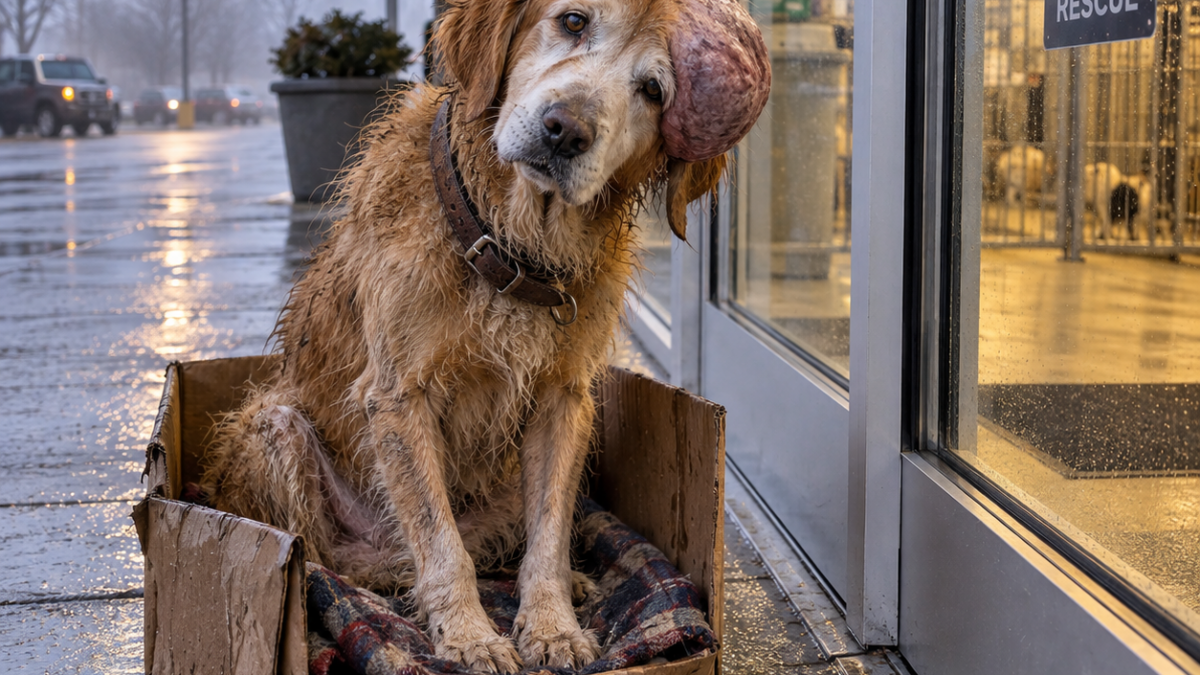
Someone Left an 11-Year-Old Golden Retriever With a Grapefruit-Sized Tumor Outside a Rescue—Then Staff Found the Note: “Please Don’t Let Him Die Alone
PART3:
He stepped out of the box carefully.
Then stopped.
His balance was wrong.
The weight on his skull pulled him sideways.
He compensated automatically, widening his stance.
Maya stared.
This wasn’t new.
Whatever had happened to this dog, he had been living around it for a long time.
She looked into the cardboard box.
A folded flannel shirt covered the bottom.
Heavy plaid.
Red and navy.
Men’s.
Old.
The elbows were worn pale.
Someone had folded it twice to keep the dog’s body from resting directly on wet cardboard.
Beside it lay one sheet of notebook paper.
Maya opened it.
The handwriting stopped her.
Large, shaky letters.
Every line uneven.
His name is Buddy.
He is 11.
He is a good boy.
I do not have the money to get him fixed.
Please don’t let him die alone.
Nothing else.
No phone number.
No signature.
No explanation.
Maya read it again.
Please don’t let him die alone.
Behind her, a car pulled in.
Kev Sanders, one of the kennel technicians, got out carrying a breakfast biscuit and a Monster energy drink.
He saw Maya kneeling.
“What happened?”
Then he saw Buddy.
“Oh, hell.”
Within fifteen minutes, half the morning staff stood around the intake table.
Nobody wanted to stare.
Everybody stared.
Diane at the front desk read the note.
Her mouth tightened.
“Who does this?”
Kev slammed a stack of stainless-steel bowls onto the counter.
“Somebody who should never own another animal.”
Maya was trimming burrs carefully from Buddy’s belly.
“Easy.”
Kev pointed toward the tumor.
“That doesn’t happen overnight.”
“I know.”
“That thing is years old.”
“I know.”
“You don’t wake up one morning and suddenly your dog has a grapefruit on his head.”
Diane read the note again.
“‘Please don’t let him die alone.’”
She shook her head.
“So what do you do?”
“You leave him alone in a parking lot.”
Buddy’s ears lowered at the sharp voices.
Maya touched his shoulder.
“Hey.”
He leaned toward her.
“Not your fault.”
Kev exhaled.
“I’m sorry, buddy.”
He crouched.
“But seriously.”
He looked at Maya.
“If somebody couldn’t pay, why didn’t they call?”
“Why didn’t they surrender him when it was small?”
“Why six years?”
Maya didn’t answer.
She kept looking at the handwriting.
She had noticed something nobody else had mentioned.
The note was written on ordinary spiral notebook paper.
But there were tiny round indentations near the bottom, as though the person who wrote it had stopped several times and rested the pen without enough strength to keep going.
The letters leaned differently from one line to the next.
Not drunk.
Not careless.
Weak.
Old, she thought.
Then the shirt.
The only part of the box that was dry.
Whoever left Buddy had chosen the one place beneath the shelter awning protected from rain.
The box had not been tossed.
It had been centered carefully under the light.
And the shirt beneath him was warm flannel.
Not a rag.
Not old towel.
A man’s shirt.
Someone had given Buddy a piece of himself.
At ten o’clock, Dr. Sam Whitfield arrived.
Sam was forty-nine, broad-shouldered, soft-spoken, and had worked shelter medicine long enough to develop a face that became still whenever he was afraid of what he might find.
He entered the treatment room carrying Buddy’s intake sheet.
Then stopped.
“Wow.”
Maya nodded.
“Yeah.”
Sam approached.
Buddy wagged his tail.
“Still friendly?”
“Very.”
“No vomiting?”
“Not since arrival.”
“Eating?”
“A little.”
“Drinking?”
“Yes.”
Sam palpated the mass gently.
Buddy did not pull away.
His right rear foot shifted once.
Tiny signal.
Pain.
Sam stopped.
“How long?”
Kev asked from doorway.
Sam shook his head.
“Impossible to know just by looking.”
“But years?”
“Yes.”
He examined Buddy’s eyes.
Ears.
Heart.
Lungs.
Gums.
Nodes.
Then tried to help him lie down.
Buddy resisted.
Not behaviorally.
Physically.
He lowered his front end, tried to turn left, and immediately struggled back upright.
Sam frowned.
“Again.”
Maya guided him.
Buddy tried right side.
The mass pulled heavily.
He ended up half-curled with his neck twisted.
Then sat again.
Sam’s expression changed.
“He can’t sleep normally.”
Maya looked at him.
“What?”
“The weight.”
Sam touched tumor.
“If this has been there as long as I think, he’s adapted his entire posture around it.”
“Meaning?”
“He probably sleeps sitting up.”
Kev said:
“For how long?”
Sam did not answer immediately.
“Could be years.”
The room went quiet.
Maya looked at Buddy.
Old dog sat crooked.
Patient.
As if nothing unusual was happening.
Maybe because for him nothing was.
Pain becomes normal when it stays long enough.
Sam continued.
“We need needle aspirate first.”
“Then?”
“CT.”
“Why CT?”
“To see whether this is superficial, muscle-involved, skull-involved.”
“And if it’s cancer?”
“We biopsy.”
“And if it’s malignant?”
Sam looked at Buddy.
“We decide what is kind.”
Maya hated that phrase even though she understood it.
Shelter medicine required decisions private veterinary medicine sometimes postponed.
Money had limits.
Beds had limits.
Staff had limits.
Every dollar spent on one animal did not magically regenerate for the next.
At noon, director Carol Bennett came into treatment carrying a clipboard.
Carol was fifty-eight.
She had run Roanoke Valley Animal Rescue eleven years and learned to be the person everyone hated for ten minutes when numbers arrived.
She loved animals.
That was exactly why she had to count.
She handed estimate to Sam.
He read.
Then gave it to Maya.
CT.
Bloodwork.
Biopsy.
Anesthesia.
Referral surgery.
Possible overnight hospitalization.
Postoperative medication.
Minimum:
$7,800.
Maya’s stomach dropped.
“Our quarterly medical budget is nine thousand.”
Carol said it quietly.
Kev muttered something.
Carol looked at him.
“You think I like this?”
“No.”
“Two hundred twelve animals came through here last quarter.”
“I know.”
“Parvo puppies.”
“I know.”
“Broken legs.”
“I know.”
“Heartworm.”
“Carol.”
“I need you to understand what the number means.”
Maya looked through treatment-room glass.
Buddy had been moved to Kennel 7.
He sat on a blue blanket.
Still crooked.
Still watching kennel door.
Carol followed her gaze.
“I’m not saying today.”
Maya looked back.
Carol took something from pocket.
A red plastic kennel tag.
Three words written in black marker.
CONSIDER FOR EUTHANASIA.
Maya felt sick.
“Carol.”
“I don’t want to.”
“You can’t.”
“I can.”
Her voice hardened.
Then softened.
“And I may have to.”
She hung tag on kennel door.
Maya stared at it.
Carol said:
“He is eleven.”
“So?”
“He has a mass that could be malignant.”
“So?”
“We do not know if it has invaded the skull.”
“So?”
“Even if surgery is technically possible, anesthesia is real risk.”
“So?”
“Maya.”
Carol’s voice cracked.
“What happens if I spend almost everything on Buddy?”
Maya said nothing.
“What happens tomorrow when somebody brings me six puppies with parvo?”
Silence.
“Or a cat hit by car?”
Silence.
“Or a pit bull with infected chain wound?”
Maya looked down.
Carol sighed.
“I hate this too.”
Buddy lifted his head at voices.
His tail tapped blanket.
Maya looked at him.
“Give me forty-eight hours.”
Carol frowned.
“What?”
“Forty-eight.”
“For what?”
“To raise it.”
“Maya.”
“Please.”
“We’re not a national nonprofit.”
“Forty-eight hours.”
“You think you can raise eight grand in two days?”
“No.”
“Then—”
“I think we can try.”
Carol looked toward red tag.
Then Buddy.
Then Maya.
Her shoulders dropped.
“Forty-eight.”
That evening Brianna Cole stayed after closing.
Twenty years old.
Nursing student at Virginia Western.
Volunteer who handled shelter Facebook page because she understood social media better than everyone else combined.
She sat cross-legged inside Kennel 7.
Buddy leaned against her.
She took one photograph.
Not twenty.
One.
Old golden dog sitting crooked on blue blanket.
White muzzle.
Huge tumor.
Warm eyes directly into camera.
Beside it she posted photograph of note.
His name is Buddy.
He is 11.
He is a good boy.
I do not have the money to get him fixed.
Please don’t let him die alone.
Then she wrote:
Buddy was left at our door this morning in a cardboard box.
Somebody loved him enough to put him beneath our awning out of the rain and give him the shirt off their back.
Now we need $7,800 to find out if we can save him.
We have 48 hours.
Please don’t let him die alone.
She stared at post.
Maya stood behind.
“Too much?”
“No.”
“You sure?”
Maya looked at Buddy.
“No.”
Then:
“Post it.”
9:14 p.m.
The first donation came three minutes later.
Five dollars.
Then ten.
Then twenty-five.
Brianna went home.
At six the next morning she had two hundred notifications.
By breakfast, the post had been shared several hundred times.
By noon:
four thousand.
Local news called.
A Roanoke reporter came.
Maya hated camera but stood beside Buddy.
“What do you know about his owner?”
“Nothing.”
“Do you believe he was neglected?”
Maya looked at reporter.
The answer everyone expected was yes.
She thought of shirt.
Dry awning.
Shaking handwriting.
“I believe somebody waited too long to get him care.”
She said carefully.
“But I don’t know why.”
“Are you angry?”
“Yes.”
“At owner?”
Maya hesitated.
“At situation.”
Reporter nodded.
Better answer than they wanted.
Donations arrived.
A retired teacher in Ohio sent fifty.
For Buddy. My old dog had a lump too. Nobody helped us.
A seven-year-old girl in Texas emptied piggy bank.
$2.31.
Truck driver in Montana:
$100.
Woman whose golden died at twelve:
$300.
Local landscaping company:
$500.
One anonymous donor:
$1,000.
At 4:00 p.m., total reached $5,986.
Carol stood behind front desk refreshing screen.
“I hate the internet.”
Brianna grinned.
“Not today.”
At midnight:
$7,201.
Maya stayed shelter.
She could not go home.
Buddy sat beside front office while they watched numbers.
At 8:45 second night:
$7,691.
Brianna said:
“Come on.”
Carol was pretending to complete payroll.
Nobody believed her.
At 9:02 p.m.—forty-seven hours and forty-eight minutes after the post—
Maya refreshed.
$8,412.
She covered mouth.
Brianna screamed.
Kev punched air.
Diane cried before anybody else.
Carol walked to Kennel 7.
Buddy rose.
Carol reached for red tag.
Pulled it off.
Looked at him.
“All right.”
Her voice shook.
“All right, old man.”
She scratched under chin.
“Let’s fix you.”
The next morning Dr. Whitfield drove Buddy to specialty hospital in Blacksburg himself.
The shelter waited.
Nobody worked well.
Maya spilled food.
Kev forgot kennel sheet.
Diane answered phone:
“Roanoke Valley Animal—Buddy is still in testing, yes.”
By 3:47, Sam called.
“Speaker.”
Maya hit button.
Everybody crowded front desk.
Sam took breath.
“It’s benign.”
Nobody reacted.
“What?”
Carol asked.
“Benign.”
Sam laughed.
“It’s not cancer.”
Brianna screamed.
Kev threw cap.
Diane sat down.
Maya’s knees weakened.
Sam continued.
“Lipoma.”
“A huge fatty tumor.”
“No bone invasion.”
“No skull involvement.”
“It’s under muscle and displaced tissue, but clean planes.”
Carol pressed both hands to counter.
“So surgery?”
“Yes.”
“Can they remove it?”
“Yes.”
“How long has it been there?”
Sam went quiet.
“Years.”
“How many?”
“Given size and muscle displacement…”
He exhaled.
“Six, maybe more.”
Silence returned.
Six years.
Maya felt old anger rising.
Sam continued:
“If it had been removed when marble-sized, it might have been a short procedure.”
“How much?”
Kev asked.
“Two or three hundred.”
“And now?”
“Three-hour surgery.”
Maya whispered:
“They said they didn’t have money.”
Nobody answered.
Two days later, surgeon removed four pounds, six ounces of tumor.
More than Buddy’s entire head should ever have had to carry.
He woke shaved on left side.
Long neat incision.
Groggy.
When Maya saw him, she cried.
Not because he looked worse.
Because his head was straight.
For first time since they had known him, Buddy’s neck sat naturally over his shoulders.
He looked oddly younger.
That night at shelter, Maya sat in Kennel 7.
Buddy circled blanket.
Once.
Twice.
He stopped.
Looked at Maya.
Then lowered himself.
Slowly.
Carefully.
Onto left side.
The side that had been impossible for years.
His legs stretched.
His head rested flat.
He exhaled.
A long, shuddering sigh.
Then fell asleep.
Maya covered face.
Brianna stood in doorway.
“He’s lying down.”
Maya nodded.
“He’s really lying down.”
They watched an eleven-year-old dog sleep.
Nothing dramatic.
No reunion.
No miracle.
Just sleep.
It felt enormous.
Everybody thought story was over.
It wasn’t.
The next morning Maya arrived at 6:52.
Kennel 7 empty.
Her heart jumped.
“Buddy?”
She ran hallway.
Then stopped.
Front lobby.
Buddy sat beside glass door.
Exactly where cardboard box had been.
Front paws together.
Back straight.
Head clean and level.
Staring outside.
At parking lot.
At road.
“Buddy?”
His tail tapped once.
He did not turn.
Kev emerged with bowls.
“He did that after I let him out.”
“What?”
“Walked straight here.”
Next morning, same.
And next.
Every morning.
The moment someone opened Kennel 7, Buddy walked to lobby and sat by front glass.
Every car arriving made ears rise.
Every door opening made body lean forward.
Every time it was not whoever he expected, head lowered.
No whining.
No barking.
Waiting.
On fifth morning Brianna whispered:
“He’s waiting for somebody.”
Kev crossed arms.
“The person who dumped him?”
Nobody laughed.
Maya stared at Buddy.
Flannel shirt had been washed.
Folded on shelf in intake room.
She thought about it often.
Why give your shirt?
Why dry spot?
Why note saying alone?
What kind of person abandons a dog with such care?
The answer came at 2:13 in morning from a stranger.
Facebook message.
Hi. I’m a night nurse at Mercy Ridge Hospice House in Salem. I saw Buddy’s story on the news. I don’t want to get anyone in trouble, but I think I know that handwriting.
Brianna called Maya at 6:10.
By 6:20 Maya was awake.
By 6:25 calling number.
Grace Mensah answered first ring.
Warm West African accent.
Soft voice.
“I’m sorry to message you.”
“Don’t be.”
“You recognized note?”
“I think.”
“How?”
“Our patients fill meal cards.”
Pause.
“One patient has handwriting like that.”
“The same shaky capital B.”
“The same spacing.”
Maya sat edge bed.
“And?”
Grace hesitated.
“He says same sentence every night.”
“What sentence?”
Long silence.
“He asks me if anybody saved his dog.”
Maya stopped breathing.
“Who?”
“Arthur Pell.”
“Eighty-four.”
“Congestive heart failure.”
“He came three weeks ago.”
“Doctors think he has weeks.”
Maya’s hand covered mouth.
Grace continued:
“His neighbor told us the night before ambulance came, Arthur got on city bus around midnight.”
“Wearing robe and slippers.”
“Carrying cardboard box.”
Everything aligned at once.
The handwriting.
Shirt.
Dry awning.
Waiting dog.
Midnight.
Hospice.
“Where is he?”
“Salem.”
“Six miles from you.”
Maya was dressed in three minutes.
That afternoon she and Carol drove.
Mercy Ridge Hospice House sat on low hill.
Brick.
Quiet.
Rocking chairs on porch.
Garden full of chrysanthemums browned at edges by cold.
Grace met them.
Tall.
Navy scrubs.
Gentle eyes.
She led to Room 14.
Arthur Pell looked smaller than Maya imagined.
Thin enough blanket rose barely over legs.
Wisps of white hair.
Oxygen cannula.
Large knobby hands.
Beside bed:
framed photograph.
A smiling woman in garden holding a golden puppy.
Arthur saw Grace enter with strangers.
Body stiffened.
Grace said:
“Mr. Pell.”
“These ladies are from animal rescue.”
His lips parted.
“Is he…”
Couldn’t finish.
Maya crossed room.
“He’s alive.”
Arthur stared.
“He’s alive.”
She said again.
“He had surgery.”
“The tumor wasn’t cancer.”
“It’s gone.”
“He’s eating.”
“He’s sleeping.”
“On both sides.”
Arthur’s face collapsed.
Tears slid silently.
“Somebody saved him.”
His voice barely air.
“Somebody saved him.”
Carol moved chair.
Arthur cried without sound.
Maya cried with him.
When he could speak, he told story.
Buddy had belonged to wife June.
She chose him from litter at Bedford County farm eleven years ago.
Golden puppy with oversized paws.
Followed June through garden.
Dug zinnias.
Stole gloves.
Slept beside her chair.
“Buddy.”
Because he was her buddy.
Then June developed dementia.
Slow.
Then quick.
Arthur had been school janitor thirty-eight years.
No pension fortune.
No retirement savings beyond modest.
He spent.
Home aides.
Medication.
Then nursing care.
Sold second car.
Then only car.
June’s jewelry.
Tools.
Anything.
The lump appeared when Buddy was five.
Small.
Soft.
Arthur asked one vet.
Likely lipoma.
Could remove.
A few hundred dollars.
But June had crisis that month.
Then another.
“Next month.”
Arthur whispered.
“I kept saying next month.”
Next month became year.
Then tumor bigger.
More expensive.
June worse.
Arthur older.
Two years ago June died.
By then Buddy’s tumor huge.
Arthur’s heart failing.
Money gone.
“I watched it.”
He cried.
“Every day.”
Maya held hand.
“I’d sit porch.”
“Hold his head in lap.”
“Take weight off neck.”
His voice broke.
“I failed him every day.”
Maya shook head.
“We don’t know—”
“I do.”
He said.
“I know.”
There was no use absolving too quickly.
Regret sometimes needs space.
Three weeks ago doctor told Arthur heart quitting.
Hospice.
Weeks.
Maybe less.
He looked around empty house and understood one thing.
If he died alone, Buddy might remain beside body.
Hours.
Days.
No family nearby.
Neighbors irregular.
Old dog with giant tumor.
Maybe no food.
No water.
Maybe die too.
So night before hospice admission, Arthur found cardboard box.
Folded his flannel shirt under Buddy.
Could not carry dog far.
Used bus.
Midnight route on Melrose.
Robe.
Slippers.
Coat over pajamas.
Dog in box beside seat.
He reached shelter.
Placed Buddy beneath awning.
Dry.
Wrote note.
Then crossed road.
Sat at bus shelter.
Maya’s throat tightened.
“You stayed?”
Arthur nodded.
“I couldn’t leave till somebody came.”
“How long?”
“Till light.”
“What happened?”
“I saw building light come on.”
“You?”
Maya whispered.
Arthur’s eyes searched her face.
“I saw a woman walk up.”
“Dark hair.”
“Coffee.”
Maya began crying harder.
“That was me.”
Arthur closed eyes.
“Oh.”
He squeezed fingers weakly.
“Thank you.”
“You watched?”
“I saw you kneel.”
“Then I went home.”
“And ambulance came next morning.”
Grace stood doorway crying.
“Every night.”
She said.
“He asks me.”
“Did anyone save him?”
“And every night I had to say I didn’t know.”
Arthur looked at Maya.
“Can I see him?”
The question was almost childlike.
“Just once.”
“Before I go.”
Maya looked at Carol.
Carol looked at Grace.
Grace’s face changed.
Rules.
Hospice had strict infection control.
Own pets could visit with current vaccines and veterinary clearance.
Therapy dogs certified.
Buddy had just undergone massive surgery.
Open incision.
Sutures.
No way.
Not yet.
Maya pushed.
Grace pushed.
Medical director refused.
Not cruelty.
Other patients immunocompromised.
One infection could matter.
Need healed incision.
Vet clearance.
Fourteen days.
Arthur might not have fourteen.
Maya returned shelter that night.
Sat with Buddy until midnight.
She held head.
“It’s Arthur.”
Dog’s ears lifted at name.
Maya froze.
“You know that?”
Tail moved.
“Arthur.”
Again.
Thump.
She cried.
“He’s alive.”
“Six miles away.”
“He asks about you.”
Buddy pressed cheek into lap.
Next morning, 6:52.
Front door.
Waiting.
Maya went to Sam.
“Can you remove sutures early?”
“No.”
“Please look.”
Sam examined.
Healing beautifully.
“But no.”
“How long?”
“Ten days minimum.”
“It’s day five.”
“Maya.”
“He may not have ten.”
“I have responsibility to Buddy too.”
She knew.
Hated knowing.
Waited.
Every night Grace called.
“He slept.”
“He asked about Buddy.”
“He barely ate.”
“He drank juice.”
“He smiled at video.”
Brianna visited day seven with phone.
Showed Arthur video.
Buddy asleep on left side.
Head straight.
Paws twitching.
Grace said Arthur watched eleven times.
Then held phone to chest.
Fell asleep.
Day eight, Grace called afternoon.
Wrong time.
Maya knew before answering.
“His breathing changed.”
“What does that mean?”
“Comfort care.”
Maya sat.
“They’re stopping treatment.”
“How long?”
“Could be days.”
Pause.
“Could be tonight.”
“He keeps saying Buddy.”
Maya went to Sam.
“It’s day eight.”
“No.”
Tears.
“I know.”
“Please.”
“Maya.”
“He’s waiting at door every morning.”
“Arthur is asking every night.”
“They’re six miles apart.”
Sam’s face tightened.
“I’m vet.”
“I have to protect dog.”
“And Arthur protected him.”
Maya’s voice broke.
“He took midnight bus because he thought he’d die and Buddy would die beside him.”
“He put him under our awning.”
“Gave him his shirt.”
“He didn’t leave until light came on.”
“And now he’s going to die without knowing Buddy came home.”
Sam looked away.
No answer.
At 9:40 that night, Grace called.
Maya sat in Kennel 7.
Buddy’s head in lap.
“Maya.”
Grace was whispering.
“If there’s anyone he needs to see…”
Pause.
“Tonight.”
“I don’t think he makes morning.”
Maya closed eyes.
Sam was standing in doorway.
Coat on.
Medical bag.
He had heard.
He walked inside.
Knelt.
Turned on phone flashlight.
Examined incision.
Long.
Carefully.
Then opened bag.
“Hold his head.”
Maya stared.
“Sam.”
“Hold.”
He clipped.
One suture.
Then another.
Slow.
Two days early.
No rushing.
He cleaned site.
Applied dressing.
Soft protective wrap.
“I’ll sign clearance.”
Maya sobbed.
“If medical director has issue, give her my number.”
He stood.
“Go.”
Six miles.
Maya drove.
Carol passenger.
Brianna in back with Buddy across lap.
They passed Melrose bus stop.
Maya imagined Arthur at midnight.
Robe.
Slippers.
Dog in box.
Watching shelter light.
They reached Mercy Ridge.
Grace held front door.
No words.
Buddy entered.
Quiet hallway.
Nails clicking.
Maya held leash.
Halfway to Room 14, dog stopped.
Nose lifted.
Ears rose.
Tail began moving.
Slow.
Then faster.
He pulled.
Maya loosened.
“Go.”
Buddy trotted.
Eleven years old.
Stiff hips.
Bandaged head.
Straight.
He reached Room 14.
Stopped doorway.
One second.
Arthur lay by window.
Eyes closed.
Breathing shallow.
Oxygen tube.
Buddy crossed.
Jumped carefully onto bed.
Stepped between tubes.
Curled along Arthur’s body.
Pressed clean, straight head against chest.
Whined.
Arthur’s eyes opened.
At first unfocused.
Then down.
Buddy.
His hand lifted.
Trembling.
Touched white muzzle.
“Buddy.”
Dog licked chin.
Arthur’s face changed.
“Oh, Buddy.”
His fingers traced bandage.
“Look at you.”
He cried.
“Look at your head.”
Buddy pushed closer.
Arthur whispered:
“Somebody saved you.”
Again.
“Somebody saved you.”
Everyone in doorway cried.
Grace.
Maya.
Carol, who almost never did.
Brianna with both hands over mouth.
Arthur stroked ear.
“They told me I wouldn’t make morning.”
He said after a long time.
“I was ready.”
Pause.
“I just didn’t want to go without knowing.”
He looked at Maya.
“I thought I was saving him.”
“Taking him to you.”
“So he wouldn’t die alone in that house.”
He looked at dog.
“But I’m the one who was dying alone.”
Buddy’s head rose.
Arthur smiled.
“And he came for me.”
Arthur did not die that night.
Or next.
His breathing steadied.
Heart did not heal.
Nothing miraculous medically.
But crisis eased.
On third morning, he asked for scrambled eggs.
Hospice doctor told Maya quietly:
“I’ve seen this.”
“What?”
“People hold on.”
“For something.”
“And sometimes after they get it…”
She smiled.
“They hold on a little longer.”
Arthur lived five more weeks.
Buddy stayed.
Mercy Ridge medical director came next day.
Saw old man asleep with arm around dog.
Said nothing about rules.
Grace brought dog bed.
Buddy used only when Arthur told him.
They watched leaves fall.
Arthur told stories.
June in garden.
Tomatoes.
Zinnias.
Puppy digging.
Buddy stealing slipper.
How June laughed before dementia stole words.
Maya visited evenings.
Brianna Saturdays.
Carol brought treats and pretended they were for staff.
Grace sat breaks.
Arthur grew weaker.
But not afraid in same way.
One night he told Maya:
“I thought people would hate me.”
“For leaving him?”
“Yes.”
“Some did.”
He nodded.
“Fair.”
Maya hesitated.
“I did at first.”
Arthur smiled faintly.
“Fair too.”
“I saw shirt.”
“What?”
“The flannel.”
“You gave him your shirt.”
Arthur’s eyes filled.
“June bought it.”
“Thirty years ago.”
“I thought smell might keep him calm.”
Maya swallowed.
“You put him in only dry spot.”
“Yes.”
“You waited across street.”
“Yes.”
“You should have asked for help earlier.”
Arthur closed eyes.
“I know.”
“But that isn’t same as not loving him.”
Arthur cried silently.
“No.”
He whispered.
“No, it isn’t.”
Maya learned something then.
Love does not automatically make people capable.
Poverty does not stop disease.
Shame delays help.
Fear narrows choices.
None erase responsibility.
But responsibility without context becomes cruelty.
Arthur had failed to get Buddy help for years.
True.
Arthur had also spent years caring for dying wife while getting poorer and sicker.
True.
He had waited too long.
True.
And when he realized he could not save dog himself, he used last strength to put Buddy where someone else might.
Also true.
People contain contradictions.
On a cold night in early December, 2:20 a.m., Arthur died.
Grace was there.
Buddy lay with head on chest.
Arthur’s hand rested over white muzzle.
Breathing slowed.
Stopped.
Buddy did not move for an hour.
Grace sat beside.
She later told Maya:
“He was listening.”
Maybe for heartbeat.
Maybe for breath.
Maybe simply because dog had learned that where Arthur was, Buddy stayed.
Eventually Buddy climbed down.
Walked to Grace.
Leaned whole body against her legs.
Grace put hands on his shoulders.
“I know.”
Two weeks later she adopted him.
“I’ve never had a dog.”
Maya laughed through tears.
“Starting with Buddy is cheating.”
Grace smiled.
“He chose me.”
“On that last night, he came to me.”
“I’m not arguing with him.”
In January, Mercy Ridge made Buddy its first official resident therapy dog after veterinary clearance and temperament assessment.
Blue vest.
THERAPY DOG.
Grace kept Arthur’s cracked brown collar.
Added new brass tag.
BUDDY.
Nobody here dies alone.
Every night Buddy walked halls.
Room to room.
He learned who wanted company.
Who didn’t.
He lay beside dying people.
At feet.
Sometimes chest.
Families stroked him when words failed.
Grace said he had particular instinct for doors.
If a patient’s family was running late, Buddy often sat nearby.
No one pretended he predicted death.
No mysticism necessary.
He was simply an old dog with enormous experience waiting beside frightened humans.
That was enough.
At 6:52 every morning, end of Grace’s shift, she often found him by hospice glass doors.
Front paws together.
Back straight.
Watching parking lot.
Exactly how Maya found him.
Except now he sat inside.
Warm.
Clean.
Head straight.
Waiting for families arriving.
Not for rescue.
For whoever needed him next.
Grace kept Arthur’s last meal card in locker.
Filled morning before he died.
Under breakfast request:
Scrambled eggs.
And a little bacon for Buddy.
The handwriting shook.
Same capital B.
Same uneven lines.
Sometimes Grace read it when night had been hard.
When family sobbed.
When patient was afraid.
When she questioned why she kept doing hospice nursing.
She remembered an eighty-four-year-old man who had believed his final useful act was giving his dog a chance.
She remembered old dog crossing Room 14.
She remembered what Arthur said.
I thought I was saving him.
But I’m the one who was dying alone.
The shelter kept Buddy’s original note framed behind intake desk.
Not for sentimentality only.
For staff.
When abandoned animal arrived, anger came naturally.
Sometimes deserved.
But Maya would point to note.
“Ask what you don’t know yet.”
Not excuse.
Ask.
A dog may be abandoned from cruelty.
Or eviction.
Domestic violence.
Hospitalization.
Poverty.
Dementia.
Death.
None look different from cardboard box at first.
Information matters.
Brianna eventually finished nursing school.
She took job at Mercy Ridge.
Grace trained her.
First week, Brianna said:
“This is because Buddy.”
Grace smiled.
“No.”
“It was in you already.”
Buddy simply showed direction.
Kev mellowed.
Years later a man came to surrender a twelve-year-old hound.
Said he couldn’t afford insulin.
Kev’s first instinct flashed across face.
Then stopped.
“Sit down.”
He said.
“Let’s see what options exist.”
That was Buddy’s legacy too.
Not just therapy-dog vest.
Culture.
Questions before judgment.
Carol started emergency owner-assistance fund.
Small.
Never enough.
But enough sometimes.
Food.
Low-cost surgery.
Temporary foster.
One senior dog kept from surrender because they covered antibiotics.
Another stayed with elderly owner through hospitalization using crisis foster.
They called it Buddy Fund.
Maya hated name initially.
Too sentimental.
Carol said:
“Donors like names.”
Practical wins.
Fund grew.
One year raised twenty-three thousand.
Then forty.
Every time a family avoided desperate midnight box, Maya thought of Arthur.
He could not benefit.
Others could.
That matters.
Dr. Whitfield kept photo of tumor on phone for teaching.
Four pounds six ounces.
He used case to explain early intervention.
“If a lump appears, get it checked.”
He also emphasized not every huge mass is cancer.
Size looks terrifying.
Diagnostics matter.
One student asked:
“Was dog owner charged?”
Sam paused.
“No.”
“Why not?”
“Because reality.”
Student frowned.
Sam told abbreviated story.
Then:
“Veterinary medicine is not morality court.”
“We document condition.”
“We treat patient.”
“We report legally required abuse.”
“But we should be careful pretending medical neglect always has same cause.”
That lesson traveled.
Buddy lived almost three more years after surgery.
Fourteen by end.
Arthritis.
Kidneys.
Hearing.
But comfortable.
Loved.
Therapy visits shortened.
Eventually he could not climb beds.
Grace got little ramp.
Then he preferred floors.
Patients reached down.
One woman with ovarian cancer whispered:
“Your head used to be crooked?”
Grace told story.
Woman laughed.
“Mine too, some days.”
Buddy rested chin.
On his final week, he stopped wanting hallway walks.
Grace knew.
Brought him to Brookside? No, wrong story. Keep Dr. Whitfield/shelter vet.
Sam examined.
Cancer unrelated.
Age.
Organs failing.
Grace asked:
“Is he hurting?”
“A little.”
“Can we control?”
“For short time.”
She nodded.
Buddy spent final days at Mercy Ridge.
Not as official therapy dog.
Just Grace’s dog.
Maya came.
Carol.
Brianna.
Kev.
Even Diane.
They sat garden under blanket.
Someone brought scrambled eggs.
Bacon.
Grace cried seeing plate.
Buddy ate bacon first.
Of course.
His last night Grace brought him to Room 14.
The room had housed many people since Arthur.
But she asked.
Empty that evening.
They put Buddy on bed.
He turned once.
Lay on left side.
Head flat.
Same freedom Maya had cried over years before.
Grace sat beside.
“You did enough.”
She touched old collar.
“You waited enough.”
Buddy looked at door once.
Then at her.
At 4:11 a.m., with Grace’s hand on his chest, Buddy died.
Not alone.
Never again.
The tag stayed with Grace.
BUDDY.
Nobody here dies alone.
Mercy Ridge hung photograph near nurses’ station.
Not dramatic tumor photo.
Not cardboard box.
Buddy after surgery, asleep on left side.
Arthur’s hand resting on head.
Caption:
Sometimes care means making sure love arrives in time.
Maya preferred that.
The viral story faded.
They always do.
Internet found another dog.
Another tragedy.
Another outrage.
But people who were there did not forget.
Maya especially remembered 6:52.
Fog.
Coffee on pavement.
Old dog sitting like patient.
She remembered first assumption.
Somebody abandoned you.
Then later:
Somebody loved you enough to leave.
Both sounded contradictory.
They were.
That was life.
Arthur did something painful.
He left Buddy.
He also did it because he knew keeping Buddy would mean both dying alone.
Sometimes love’s final act looks like abandonment from outside.
That does not make every abandonment love.
It means look closer.
The cardboard box mattered.
Dry awning.
Folded shirt.
Shaky note.
Details.
Compassion lives in details too.
Years later, a volunteer asked Maya why she still kept Arthur’s flannel shirt in supply closet.
Washed.
Folded.
“Throw it away?”
“No.”
“Why?”
Maya touched fabric.
“It was last thing he had to give.”
That was enough.
The shelter framed note but not shirt.
Some things do not need display.
Sometimes Maya unfolded it.
Held it.
Imagined Arthur removing it at midnight bus stop.
Cold.
Robe underneath.
Maybe shivering.
Putting shirt under Buddy.
Telling him to stay.
How do you tell dog you love him and walk away?
Maya thought it must have nearly killed him before heart failure did.
Grace once described Arthur’s nightly question.
“Did anyone save him?”
Not:
Is Buddy alive?
Not:
Did they find him?
Save.
Arthur knew what he had done was surrender control.
He had put dog’s life into strangers’ hands.
That is why Buddy waited at shelter door after surgery.
People interpreted as owner return.
Maybe true.
Dogs remember scents.
Places.
Routines.
He knew box.
Door.
Road.
Could have been waiting for Arthur.
Could have been watching because last meaningful separation occurred there.
We cannot know exact thoughts.
Maya learned not to overstate.
But observable thing was enough:
Every morning he sat.
Every car mattered.
And when he smelled Arthur halfway down hospice hall, there was no hesitation.
He knew.
That reunion belonged to them.
Not internet.
Not shelter.
Maya often wished there had been no camera in Room 14.
There wasn’t.
Good.
Only memories.
Arthur’s hand.
Buddy’s bandage.
“Look at your head.”
“Somebody saved you.”
Then:
“I’m the one who was dying alone.”
Some moments should remain human.
Not content.
Brianna agreed despite being social-media person.
She posted one update after visit.
No photo of dying man.
Only Buddy’s paw on hospice blanket.
Caption:
Buddy found the person he was waiting for.
They are together tonight.
Thank you for giving them time.
Millions of reactions.
Comments.
People demanded owner’s name.
She did not share.
No need.
Later Arthur’s story told with consent through Grace? after death maybe shelter shared generalized. But in our story source did reveal. We can keep internal narrative.
The people who had called owner monster felt embarrassed.
Some wrote apologies though Arthur never saw.
One commenter:
I judged him without knowing.
Maya replied:
We all did.
That was honest.
She had too.
Carol had.
Kev.
Diane.
Everybody.
Judgment is fast.
Context slow.
Cardboard box gives one version.
Hospice room gives another.
Both facts.
What changes is meaning.
The tumor still grew six years.
Arthur still waited.
Buddy suffered.
No romanticizing.
But cruelty was not the whole explanation.
Poverty and caregiving and grief and illness narrowed Arthur’s world until every month became survival.
Then when he had no future left, he finally made a choice that hurt him to save dog.
That does not erase delay.
It complicates it.
Maya became better rescuer because she could hold both.
Accountability and mercy.
She later trained volunteers:
“We can be angry at what happened to animal without deciding we know everything about person.”
That sentence became unofficial shelter rule.
One winter a woman surrendered three cats after domestic violence shelter refused pets.
She was sobbing.
New volunteer whispered:
“How can she leave them?”
Maya answered:
“She may be choosing between losing cats and losing her life.”
The volunteer went quiet.
Buddy again.
Different form.
Grace stayed at Mercy Ridge fifteen more years.
Retired at sixty-seven.
At retirement dinner she wore Buddy’s brass tag on chain.
Nobody here dies alone.
She told staff:
“I came to hospice believing our job was to make death comfortable.”
Pause.
“Buddy taught me sometimes job is also to make sure love gets through door before death arrives.”
They cried.
Grace hated speeches.
That was all.
After retirement, she still volunteered with therapy dogs.
Never owned another personally.
People asked why.
“He was first.”
“And enough.”
She did not mean nobody else could compare.
Just some relationships complete particular chapter.
Buddy had.
Maya eventually became shelter director after Carol retired.
First thing she changed?
Emergency fund expanded.
Second?
A weatherproof drop area with camera and heated kennel outside front door for after-hours surrender.
Not because she wanted abandonment.
Because it happened.
If desperate person was going to leave animal, better safe space.
Sign:
IF YOU ARE IN CRISIS, PLEASE CALL.
WE MAY BE ABLE TO HELP YOU KEEP YOUR PET.
Below:
IF YOU CANNOT STAY, YOUR PET WILL BE SAFE HERE.
No shame.
Phone number.
Instructions.
Carol visited.
Read.
“Buddy.”
Maya nodded.
“Buddy.”
The old cardboard box story altered architecture.
That is what good stories should do.
Not only make people cry.
Change something.
One night, years later, camera caught elderly woman leaving terrier.
She paused.
Saw crisis number.
Picked phone.
Called.
Shelter arranged temporary foster while she entered hospital.
Three weeks later she reclaimed dog.
Maya watched reunion.
Thought:
Arthur never got that option.
Now someone did.
That made grief useful.
The rescue kept one empty red tag in office drawer.
CONSIDER FOR EUTHANASIA.
The original.
Carol had almost thrown away.
Maya kept as reminder.
Not that euthanasia is always wrong.
Sometimes compassionate.
Sometimes necessary.
Sometimes resources genuinely cannot stretch.
But tag reminded:
Before final decision, ask whether story finished.
Buddy had forty-eight hours.
Internet.
Benign tumor.
Owner.
Hospice.
Five weeks.
Three extra years.
Not every animal gets those pieces.
But you cannot know without looking.
Maya became careful telling story because people love miracle more than reality.
Buddy’s tumor benign—that was luck.
Surgery successful—skill and money.
Fundraising—thousands strangers.
Arthur lived five extra weeks—not proof dogs cure heart failure.
Hospice doctor had said sometimes people stabilize after emotional need fulfilled.
Medicine still medicine.
Arthur died.
Buddy aged.
No magic.
Meaning did not need magic.
A dying man wanted dog safe.
A dog wanted his person.
Strangers built bridge.
Enough.
At Roanoke shelter anniversary, Brianna returned.
Now RN.
Grace came though retired.
Sam grayer.
Carol white-haired.
Kev finally married and still loud.
They stood by front door.
Maya brought framed note.
They read.
His name is Buddy.
He is 11.
He is a good boy.
I do not have the money to get him fixed.
Please don’t let him die alone.
Kev shook head.
“Man.”
Diane said:
“I was such an ass.”
Maya laughed.
“We all were.”
Carol touched frame.
“You gave me forty-eight hours.”
“You gave them.”
Carol corrected.
“Community did rest.”
Grace smiled.
“Arthur always knew somebody would.”
Maya looked.
“Did he?”
“He told me once.”
“What?”
“He said shelters are where people take animals when they have run out of answers.”
Grace’s eyes softened.
“He hoped you might have one left.”
They stood in silence.
Outside fog began forming as evening cooled.
Same kind of gray air.
Maya remembered first morning so vividly she could smell coffee on concrete.
If she could speak to younger herself kneeling beside box, what would she say?
Not:
Don’t be angry.
Anger moved action.
Not:
Owner is good man.
Too simple.
Maybe:
Notice the shirt.
Notice dry spot.
Notice handwriting.
Notice that cruelty and desperation do not leave same clues.
Stay curious.
That became her way.
One day a journalism student interviewed for article on viral rescues.
Asked:
“What made Buddy different?”
Maya thought.
“Nothing.”
Student looked confused.
“Nothing?”
“He deserved help same as any dog.”
“But story went viral.”
“Yes.”
“Why?”
“Visible tumor.”
“Old dog.”
“Note.”
“Good photo.”
“Timing.”
“People responded.”
“So lesson?”
Maya leaned back.
“Don’t confuse virality with worth.”
Student stopped writing for second.
Maya continued:
“There were dogs here before Buddy nobody shared.”
“After Buddy too.”
“They mattered.”
“The internet gave Buddy money.”
“Wonderful.”
“But our job is to care even when nobody is watching.”
That was another evolution.
Buddy became famous.
But at 6 a.m. next day twenty kennels still needed cleaning.
Compassion cannot depend on story quality.
Arthur’s plea worked partly because words pierced people.
Other animals have no note.
Still need care.
Buddy Fund helped.
Not enough.
Always more need.
No perfect ending.
But better.
Years after Buddy’s death, Mercy Ridge adopted another therapy dog.
A black Lab named Annie.
Grace visited.
Annie sat beside front doors.
Grace smiled.
Nurse asked:
“You okay?”
“Yes.”
“You’re thinking of him.”
“Always.”
She touched old tag at neck.
Nobody here dies alone.
That phrase spread around hospice.
Not as literal promise impossible to keep—sometimes people died before family arrived.
But staff made effort.
A volunteer stayed.
Nurse held hand.
Therapy dog lay beside.
Music.
Presence.
Nobody should have to vanish unnoticed if someone can stay.
Buddy’s work became practice.
Arthur would have liked that.
Maybe June too.
His final act was not leaving dog.
It was sending him somewhere he might live.
That distinction shaped everything.
When Arthur sat across road that night, he did not know tumor benign.
Did not know strangers donate.
Did not know Buddy would become therapy dog.
He only knew he could not afford treatment and was dying.
He chose shelter.
He waited until light.
Then let go.
There is humility in surrendering something you love to people who can do what you cannot.
Pain too.
If he had kept Buddy from pride, both might have died alone.
Instead he accepted shame.
Let strangers call him monster without defense.
He did not attach name.
Maybe because embarrassed.
Maybe afraid shelter would return dog.
Maybe no strength.
But outcome:
Buddy lived.
Arthur saw him.
Neither died alone.
That is enough.
At the very end of Arthur’s life, Grace asked him:
“Do you regret leaving him?”
Arthur thought long.
“Yes.”
Then:
“No.”
Grace smiled.
“Both?”
“Yes.”
“I regret I had to.”
“I don’t regret doing it.”
That may be best summary.
Some decisions hurt because every alternative hurts worse.
Arthur’s was one.
Maya later wrote those words on training whiteboard:
Sometimes surrender is an act of care.
Not always.
Sometimes abandonment is abandonment.
But rescue workers must distinguish when possible.
Help before judgment.
Ask before shame.
Offer resources before separation.
Buddy changed them.
Not by being saintly dog.
By exposing a gap.
An old man in poverty should not have had to wait six years.
A dying caregiver should not need midnight bus.
A shelter should have mechanisms.
Community should.
No one person fixes system.
But they built one small bridge.
That is how change often works.
One dog.
One note.
One red tag.
One fundraiser.
One nurse recognizing handwriting.
One veterinarian removing sutures two days early after weighing risk.
One hospice bending rules compassionately.
Then policy.
Fund.
Heated surrender kennel.
Therapy-dog program.
Small ripples.
The original box disintegrated.
Maya wished briefly she had saved it.
Then laughed at herself.
It was cardboard.
Wet.
Dirty.
Not sacred.
Objects matter because what people do with them.
They threw it away.
Good.
Buddy had better bed.
Arthur had better last weeks.
Memory did not require cardboard.
Only note remained.
And shirt.
And collar with tag Grace kept.
And stories.
On final page of Buddy’s medical record, Dr. Whitfield wrote:
Senior golden retriever mix.
Post-op giant cranial lipoma excision.
Good quality of life for approximately three years.
Beloved.
The last word was not medical.
Sam left it.
No one corrected.
Beloved is relevant history.
At funeral? Dogs don’t usually have funeral, maybe cremation. Grace scattered ashes? Let’s add modest.
Grace kept ashes for year.
Then one spring drove Bedford County with Maya.
They found old farm where June got Buddy.
New owners allowed walk to meadow.
Grace scattered some ashes beneath maple near pasture.
Kept rest with Arthur’s memorial? Arthur likely cremated/buried. Let’s say at Mercy Ridge garden.
Half she placed in hospice memorial garden.
No drama.
She said:
“He had two homes.”
Maya answered:
“More.”
Grace smiled.
True.
Buddy belonged to June.
Arthur.
Shelter briefly.
Grace.
Mercy Ridge.
Every patient whose bed he visited.
Love can expand without erasing first bonds.
Arthur’s red flannel eventually wore out in shelter storage from time and washing.
Maya cut small square before discarding.
Placed behind framed note.
Nobody knew.
That was for her.
When difficult decision came, she sometimes touched frame back.
Remember context.
Remember unknown.
Remember person across road waiting for light.
One October morning, exactly many years after Buddy arrived, Maya came at 6:52.
Habit.
Fog.
Coffee.
No box.
No dog.
She stood beneath awning.
Looked across street.
At bus shelter.
For first time she pictured scene from Arthur’s side.
An old man sitting there.
Heart failing.
Bare ankles above slippers.
Watching dark shelter.
Dog he loved across street in box.
Waiting for light.
Then finally a car.
A woman.
Coffee.
Keys.
Door.
Arthur seeing Maya kneel.
Maybe relief.
Maybe guilt.
Maybe grief.
Then getting on bus.
Going home alone.
Maya had always thought she found Buddy.
That morning she understood Arthur had chosen her without knowing her name.
Chosen whatever human opened door.
Trusting stranger.
That is rescue at deepest level.
People hand you what they cannot carry anymore and hope you will not punish vulnerable thing for their failure.
Sometimes they fail badly.
Sometimes they are cruel.
Sometimes they are dying.
You do not know at 6:52.
You just open door.
Maya finished coffee.
Went inside.
Kennels woke.
Dogs barking.
Cats demanding breakfast.
Normal.
She smiled.
At front lobby, new volunteer had placed plaque near Buddy’s old spot:
ONCE, AN OLD DOG WAITED HERE FOR SOMEONE TO SAVE HIM.
NOW, BECAUSE OF HIM, WE ASK HOW TO HELP BEFORE WE ASK WHO TO BLAME.
Maya thought it was slightly too sentimental.
She left it.
Some lessons deserve repetition.
And somewhere in Mercy Ridge archives, Arthur Pell’s final meal card remained scanned.
Scrambled eggs.
A little bacon for Buddy.
Faint handwriting.
Near bottom Grace had once written to herself:
He took midnight bus because he didn’t want his dog to die alone.
All he wanted before he left was answer.
Did anyone save him?
Years later, everyone involved knew response.
Yes.
They saved Buddy.
Then Buddy crossed six miles and gave Arthur exactly what he had been trying to give him all along.
Company.
Warmth.
A familiar body beside him.
Someone who stayed.
And when Arthur’s heart finally stopped five weeks later, his hand was resting on Buddy’s head.
The old dog did not leave for an hour.
Then he stood.
Walked to Grace.
Leaned against her legs.
As if one job had ended.
As if another had begun.
That was why, when Mercy Ridge made Buddy its first official therapy dog and placed the new brass tag on the cracked old collar Arthur and June had bought eleven years earlier, nobody argued with the words.
BUDDY.
Nobody here dies alone.
Every night afterward, he walked those halls.
Every morning at 6:52, he sat inside the glass doors and watched people arrive.
Families.
Nurses.
Visitors.
People carrying fear.
People carrying grief.
People carrying love they did not know where to put.
Once, Buddy had sat outside a door waiting to be saved.
For the rest of his life, he sat inside one.
Waiting for whoever needed him next.








