Someone Cut Both Ears Off a 2-Year-Old Cat With Scissors—Then Left Her in a Groomer’s Drop Box With a Note Saying, “Problem Solved”
Someone Cut Both Ears Off a 2-Year-Old Cat With Scissors—Then Left Her in a Groomer’s Drop Box With a Note Saying, “Problem Solved”
The groomer expected to find an early-drop-off dog in the box outside her salon that Monday morning, but instead she found a two-year-old gray-and-white cat staring up at her with both ears cut nearly in half.
Folded beside the cat was a handwritten note that said the “scratching problem” had been solved and that she would no longer need anyone cleaning her ears.
But when the veterinarian examined the perfectly straight wounds and the little cat immediately pushed her head into his hand and began to purr, the note stopped looking like an explanation and started looking like evidence of something far worse.
At 6:42 on Monday morning, the parking lot outside Willow Creek Grooming was almost empty.
The bakery two doors down had its lights on.
A delivery truck idled behind the pharmacy.
The sky had only begun to turn from black to the pale blue-gray that comes before sunrise.
Inside the grooming salon, no dryers were running yet.
No dogs barked from the holding kennels.
No phones rang.
No customers stood at the desk asking whether their golden retriever really needed to be shaved.
For twenty-three minutes, the entire place belonged to one woman, a set of keys, the smell of shampoo, and the quiet routine she had followed for nearly twelve years.
Her name was Dana Mitchell.
Forty-six years old.
Owner of Willow Creek Grooming for eight of those twelve years.
She had learned long ago that animals usually told you what kind of morning you were about to have before their owners did.
A terrified Yorkie trembling in a carrier meant patience.
A Labrador dragging its owner across the floor meant towels.
A husky arriving already screaming meant aspirin.
And a doodle whose owner said, “He has just one tiny mat behind his ear,” usually meant three hours of work and a conversation no one enjoyed.
Dana liked arriving early.
The salon felt different before opening.
Clean.
Still.
Manageable.
She turned on the lobby lights, set her coffee beside the register, unlocked the back grooming room, and checked the appointment book.
First dog at seven-fifteen.
A toy poodle named Sophie.
Then a cocker spaniel.
Two nail trims.
A shepherd mix who hated the dryer but loved cheese.
Nothing unusual.
Dana was halfway through tying her apron when she remembered the overnight drop box.
The box was mounted into the side vestibule near the rear entrance.
It was not really a “box,” despite what customers called it.
It was a ventilated secure holding compartment for early drop-offs.
Clients with prearranged appointments could place a carrier inside before business hours, close the outer door, and the carrier would remain locked in the climate-controlled interior compartment until a groomer arrived.
Dana hated the system at first.
Too impersonal.
But several nurses, factory workers, and people with early shifts used it regularly.
She checked the list.
No scheduled early drop-off.
PART2:
Still, sometimes a customer misunderstood instructions.
Dana walked toward the back door.
As she approached the vestibule, she heard something.
Not barking.
Not scratching.
A small metallic tap.
She opened the interior access panel.
A plastic carrier sat inside.
Dark blue.
Old.
No name tag.
No appointment card clipped to the handle.
Dana frowned.
“Hello?”
Nothing.
She crouched.
Through the carrier door, two green eyes looked back at her.
Cat.
That was unexpected.
Willow Creek groomed cats occasionally, but only by special appointment.
Cats required quieter scheduling.
Different handling.
Different equipment.
There were no cats booked that morning.
Dana opened the larger compartment door and pulled the carrier into the salon.
“Okay, sweetheart.”
The cat stayed still.
PART3:
Gray-and-white domestic shorthair.
Small.
Maybe six pounds.
White chest.
White paws.
Gray back.
A little gray mask around one eye.
Pretty.
Calm.
Too calm.
Dana looked for paperwork.
Nothing attached to the carrier.
Then she saw the folded piece of notebook paper pushed beneath the handle.
She pulled it free.
Three lines written in blue ink.
Problem with scratching fixed.
She won’t need anyone cleaning those ears anymore.
Free to whoever wants her.
Dana read it once.
Then again.
“What?”
She looked into the carrier.
The cat turned her head.
And Dana saw the ears.
For several seconds, her mind refused to understand what her eyes were showing her.
Both ears were shorter than they should have been.
Not naturally small.
Not folded.
Not tipped the way feral cats sometimes have one ear surgically marked after spay-and-release programs.
Both.
Cut.
The upper portions were simply missing.
Dana’s coffee cup slipped from her hand.
It hit the rubber floor mat and spilled down the cabinet.
She did not notice.
“Oh my God.”
The cat flinched at her voice.
Dana immediately softened it.
“No, no. I’m sorry.”
She lowered herself onto the floor.
The cat’s ears—what remained of them—ended at almost the exact same height.
Straight lines.
Scabs covered the edges.
There was dried crusting along the healing tissue.
No active bleeding.
But Dana knew enough about animal skin to know she was not looking at an old injury.
Days.
Maybe a week.
Her stomach turned.
She opened the carrier slowly.
The cat backed into the rear corner.
Dana stopped.
“You don’t have to come out.”
The cat watched her.
Dana slid one hand inside but kept it flat on the carrier floor.
Nothing happened.
Thirty seconds.
A minute.
Then the cat moved.
One step.
Then another.
She sniffed Dana’s fingers.
Dana barely breathed.
The cat pressed her forehead against Dana’s knuckles.
That did it.
Dana started crying.
Not loudly.
Tears simply came.
“Oh, sweetheart.”
The cat pushed harder.
Dana scratched gently between the shortened ears.
The cat began to purr.
That sound made Dana cry harder.
Somewhere in her mind she kept seeing the note.
Scratching problem fixed.
Dana looked down at the cat’s paws.
Claws intact.
Nothing obviously wrong.
No defensive posture.
No swatting.
No hissing.
The cat leaned into her hand.
“Who did this to you?”
The purring continued.
Dana took out her phone.
The first call was not to animal control.
It was to Dr. Elaine Porter at Westbrook Veterinary Clinic, six blocks away.
Dr. Porter answered on the fourth ring.
“Dana?”
“I need you.”
“What happened?”
“I have a cat.”
“That sounds manageable.”
“No.”
Dana’s voice broke.
“Somebody cut her ears off.”
Silence.
“What do you mean cut?”
“With something. Scissors. I don’t know.”
“Is she bleeding?”
“No.”
“Conscious?”
“Yes.”
“Responsive?”
“She’s purring.”
Another silence.
“I’m coming over.”
“We don’t open until eight.”
“I know where your back door is.”
Dana wrapped the cat loosely in a towel.
The animal did not resist.
She weighed almost nothing.
Dana had lifted overweight Persians who felt like sacks of concrete compared with her.
The cat tucked her head beneath Dana’s chin.
Dana sat on the salon floor.
She stayed there.
Five minutes.
Ten.
Fifteen.
She should have been cleaning the spilled coffee.
Should have been preparing the first station.
Should have been calling the seven-fifteen appointment.
Instead she sat cross-legged beneath the fluorescent lights with a mutilated cat in her arms.
Every time she looked at the ears, anger rose.
Every time the cat purred, the anger became something worse.
The first employee to arrive was nineteen-year-old Madison Reed.
She opened the back door at 6:58.
“Morning—”
Then stopped.
Dana was still on the floor.
“What happened?”
“Call Sophie’s owner.”
“Why?”
“Tell her we need to move the appointment.”
Madison saw the cat.
“Oh, cute.”
Then she saw the ears.
Her face drained.
“What the hell?”
“Madison.”
“What happened to her?”
Dana handed her the note.
Madison read it.
Then whispered, “No.”
Dana nodded.
“No.”
“That’s not real.”
“It was in the carrier.”
Madison looked toward the drop box.
“Who dropped her off?”
“I don’t know.”
“Camera?”
Dana’s stomach dropped again.
The salon had cameras inside.
Front desk.
Grooming area.
Hall.
But the rear vestibule had never been covered.
The landlord had promised to install exterior security after a series of car break-ins the previous winter.
It had not happened.
Dana stood.
“Check the interior cameras anyway.”
“For what?”
“Anything.”
Madison hurried toward the office.
Dana called animal control.
Then she called police non-emergency.
Then she photographed everything.
The carrier.
The note.
The location where she found it.
The cat before cleaning.
The ears.
She hated taking those photographs.
It felt invasive.
But Dr. Porter had told her once during another cruelty case:
Document before you touch anything unless the animal needs immediate care.
Dana remembered.
So she documented.
At 7:11, Dr. Porter arrived through the back door carrying a veterinary bag.
She was fifty-eight, silver-haired, direct, and rarely impressed by human excuses.
She took one look at the cat.
Her entire expression hardened.
“Exam room.”
“We don’t have one.”
“Table.”
Dana cleared a grooming table.
They placed a clean towel over it.
The cat sat.
Dr. Porter approached slowly.
“Hi, baby.”
The cat leaned forward.
Head into hand.
Purr.
Dr. Porter looked at Dana.
“She’s social.”
“Very.”
“Any aggression?”
“None.”
Dr. Porter began examining the ears.
The edges were healing.
Straight.
Symmetrical.
Nearly level with the top of the skull.
“Not torn,” she said.
“No.”
“Not bite wounds.”
“No.”
“Not frostbite.”
Dana swallowed.
Dr. Porter gently moved the remaining pinna.
The cat flinched but did not pull away.
“Sharp instrument.”
“Scissors?”
“Could be.”
“Clippers?”
“Possibly heavy shears. But scissors are consistent.”
Dana stared.
“Somebody held her down.”
“Yes.”
“And did both.”
Dr. Porter did not answer immediately.
She did not need to.
Both ears had been cut at almost the same height.
That required restraint.
Positioning.
More than one movement.
It was not a startled accident.
Not one slip.
Not a child with scissors making a split-second mistake.
Someone had completed one side.
Then completed the other.
Dana looked at the cat.
“Why?”
Dr. Porter exhaled.
“You read the note.”
“That makes no sense.”
“No.”
“Scratching has nothing to do with ears.”
“Correct.”
“Nothing.”
“Correct.”
Dana pressed both hands against the edge of the table.
“So whoever did this was trying to solve something that wasn’t connected.”
Dr. Porter looked at the paws.
“Possibly furniture scratching.”
“Then trim the nails.”
“Yes.”
“Get a scratching post.”
“Yes.”
“Ask a vet.”
“Yes.”
“Do literally anything except cut off part of the cat.”
Dr. Porter’s jaw tightened.
“Yes.”
Madison returned.
“No exterior footage.”
“Interior?”
“Nothing until you opened the compartment.”
“Neighbors?”
“I asked the bakery. Their camera faces the street, not our door.”
Dana closed her eyes.
Animal control arrived at 7:27.
Officer Luis Grant had been with the city for nine years.
He photographed the carrier and note.
Bagged the note carefully.
Asked Dana to repeat everything from the beginning.
“What time did you leave Saturday?”
“Two-fifteen.”
“Sunday closed?”
“Yes.”
“Any staff here?”
“No.”
“So drop could have happened any time after Saturday afternoon.”
“Correct.”
“Monday morning you arrived?”
“Six-thirty-five.”
“And found her?”
“Six-forty-something.”
Officer Grant looked at the carrier.
“No urine?”
Dana checked the towel inside.
A small dried spot.
“Some.”
“Food?”
“None.”
“Water?”
“None.”
Dr. Porter said, “She’s mildly dehydrated. Not severe.”
Grant nodded.
“So probably not in there all weekend.”
“Probably not,” Dr. Porter said. “Could have been overnight.”
The cat sat quietly while they spoke.
Madison reached toward her.
The cat bumped her hand.
Madison’s face twisted.
“She trusts everybody.”
Dana looked away.
That was the part she could not tolerate.
If the cat had hissed, bitten, swatted, screamed, Dana could have understood it.
Not the mutilation.
Never that.
But the fear afterward.
The defensive behavior.
The obvious message:
Humans hurt me.
Stay away.
Instead the animal kept asking for touch.
She pressed her head into every gentle hand as if hands had not already taught her the worst thing imaginable.
Officer Grant asked, “Has she scratched anyone?”
Dana almost laughed.
Not because it was funny.
“No.”
“During removal from carrier?”
“No.”
“Exam?”
Dr. Porter shook her head.
“Nothing.”
The officer looked at the note again.
“Could ‘scratching problem’ refer to her scratching her own ears?”
Dr. Porter stopped.
That was at least anatomically related.
“Possibly.”
Dana stared at her.
“What would make a cat scratch her ears?”
“Mites. Infection. Allergies. Polyps. Irritation.”
“And the solution?”
“Diagnosis.”
“Medication.”
“Yes.”
“Cleaning.”
“Sometimes.”
Dana looked sick.
“So maybe they thought cutting the ears off would stop itching.”
Dr. Porter’s expression was grim.
“Possibly.”
That explanation somehow felt worse.
Not because it excused anything.
Because it suggested planning disguised as problem-solving.
Dana looked at the note.
She won’t need anyone cleaning those ears anymore.
The line suddenly had another interpretation.
Not furniture.
Ear scratching.
Perhaps the cat had been scratching at irritation.
Perhaps the owner became annoyed with cleaning.
Perhaps they decided the ears themselves were the inconvenience.
Dana touched the cat’s back.
“Can you check for mites?”
“I will.”
Dr. Porter took swabs.
No obvious mites.
Some mild debris.
Nothing that would justify even routine discomfort, much less what had happened.
Officer Grant finished his initial report.
“We’ll check surrounding businesses.”
“Will they find whoever did it?”
“I can’t promise that.”
“Can you fingerprint the note?”
“We can submit it.”
“The carrier?”
“We can check.”
“The lock box?”
“Dana.”
“I need something.”
“I know.”
Grant softened.
“But I don’t want to lie to you.”
She nodded.
No cameras.
No appointment.
No name.
No microchip visible yet.
No one had been seen.
Somebody had chosen the timing carefully or simply gotten lucky.
At eight-fifteen, Dr. Porter took the cat to her clinic for a fuller examination.
Dana went too.
Willow Creek stayed closed that morning.
She posted a short message:
Emergency closure. Existing clients will be contacted.
She did not explain.
Not yet.
At the clinic, the cat weighed 6.1 pounds.
About 2.8 kilograms.
Small adult female.
Estimated two years old based on teeth.
Not spayed, according to the initial exam.
No microchip.
No major health problems.
Mild dehydration.
Healing bilateral ear wounds.
Some stress.
Otherwise astonishingly healthy.
Dr. Porter cleaned the wounds carefully.
The cat trembled once when saline touched the scabs.
Dana held her.
“Easy.”
The cat pressed into Dana’s chest.
Purr.
Dr. Porter paused.
“She’s remarkable.”
Dana looked down.
“She’s stupid.”
Dr. Porter looked up sharply.
Dana immediately shook her head.
“No, I don’t mean that.”
“I know.”
“She still trusts us.”
“That isn’t stupidity.”
“What is it?”
Dr. Porter thought.
“Maybe she hasn’t learned that one terrible person means all people are terrible.”
Dana did not answer.
The ears would never grow back.
Dr. Porter explained the basic anatomy.
Cats used their outer ears not only for hearing but for directional sound localization and communication.
Removing the upper ear flap altered appearance and some signaling.
But the ear canal itself remained intact.
Hearing should remain functional.
The cat would adapt.
“Will she hurt forever?”
“No.”
“Scar?”
“Yes.”
“Hair?”
“Some should regrow along the margins.”
“Could we reconstruct them?”
Dr. Porter looked at her.
“Cosmetic reconstruction would create more trauma and no meaningful benefit.”
Dana nodded.
Of course.
The cat did not need normal-looking ears.
Humans wanted her to look restored because humans disliked seeing evidence of what had happened.
The cat needed healing.
Food.
Safety.
Time.
Dr. Porter applied medication.
Prescribed pain relief.
Antibiotics because the cuts had been made outside a sterile setting and had been healing untreated.
Bloodwork.
Vaccination planning.
Spay after recovery.
Then she asked the question everyone had been avoiding.
“Where is she going?”
Officer Grant had already said animal control could take custody while the case was investigated.
There was room at the municipal shelter.
Dana looked at the cat.
The cat looked back.
“No.”
Dr. Porter raised an eyebrow.
“No shelter?”
“She’s coming with me.”
“You have two cats.”
“They have a spare bedroom.”
“Your husband?”
“Has a garage.”
Dr. Porter almost smiled.
Dana did not.
“I’m serious.”
“I know.”
“She was left in my box.”
“Yes.”
“I found her.”
“Yes.”
“I’m taking her home.”
“Foster?”
Dana hesitated.
“Foster.”
Dr. Porter smiled now.
“Sure.”
“Don’t.”
“I didn’t say anything.”
“You made a face.”
“I did not.”
Officer Grant returned with an evidence receipt.
He explained that if no owner could be identified and no legal claim emerged, custody could eventually transfer through the normal process.
For now, foster placement with Dana was acceptable under the rescue partner arrangement the clinic already used.
Dana signed.
“What’s her name?” the receptionist asked.
Everyone stopped.
The cat had no name.
Nothing on the note.
No collar.
No chip.
Nothing in the carrier.
Dana looked at her.
Gray.
White.
Green eyes.
Two shortened ears.
Small paws.
Still purring.
Madison, who had come over after opening the salon for limited appointments, said, “Lucky.”
Dana shook her head.
“No.”
“Why?”
“I hate names that make trauma sound like a blessing.”
Fair.
Dr. Porter said, “Hope?”
“No.”
“Grace?”
“No.”
“Scissors?”
Everyone stared at Madison.
“What? Too soon?”
“Extremely,” Dana said.
Then she noticed something outside the exam-room window.
A patch of clover grew between the sidewalk and the building.
Four leaves on one cluster.
Probably coincidence.
Dana pointed.
“Clover.”
Madison smiled.
“Lucky.”
Dana sighed.
“Fine. But less obvious.”
The cat became Clover.
Dana took her home that afternoon.
Her house sat fifteen minutes outside town.
One-story ranch.
Fenced yard.
Two cats already ruled it.
Murray, an eleven-year-old orange male who believed all furniture belonged to him.
Penny, a six-year-old tortoiseshell who believed Murray belonged to her.
Dana’s husband, Mark, opened the door.
He looked at the carrier.
“No.”
Dana walked past him.
“You haven’t heard the story.”
“I don’t need the story.”
“You absolutely do.”
“We agreed no more animals.”
“We agreed no more permanent animals.”
“That carrier has the face of a permanent animal.”
Clover stared through the door.
Mark saw her ears.
His expression changed instantly.
“What happened?”
Dana handed him the note.
He read it.
His jaw tightened.
“Who?”
“Don’t know.”
“Police?”
“Yes.”
“Camera?”
“No.”
“Can they find them?”
“Don’t know.”
Mark crouched beside the carrier.
Clover sniffed toward him.
He opened his hand.
She pushed her forehead against his fingers.
Mark closed his eyes.
“Damn it.”
Dana folded her arms.
“What?”
“She can stay in the guest room.”
“Thank you.”
“Temporarily.”
“Of course.”
“Do not say it like that.”
“Like what?”
“Like the way you said ‘of course’ before Murray.”
Dana smiled for the first time all day.
Clover entered the guest room.
Bed.
Litter box.
Water.
Food.
Blanket.
A cardboard scratcher.
Dana opened the carrier.
Clover stayed inside for thirteen minutes.
Then stepped out.
Walked directly to the food.
Ate.
Walked to the litter box.
Used it.
Then jumped onto the bed.
Not high.
One clean movement.
She sniffed the pillow.
Turned twice.
Lay down.
Dana sat beside her.
Clover crawled closer.
Head against thigh.
Purr.
Dana took a picture.
Not of the wounds.
Not for evidence.
Just Clover sleeping.
Then she started crying again.
Mark sat beside her.
“You’ve been doing that a lot.”
“I know.”
“You okay?”
“No.”
He nodded.
“Fair.”
Dana looked at the cat.
“I keep imagining it.”
“Don’t.”
“I can’t stop.”
“Then imagine what’s happening now.”
She looked at him.
“What?”
“She’s on a bed.”
Dana stared down.
Clover had already fallen asleep.
“She ate.”
“Yes.”
“She’s warm.”
“Yes.”
“She’s safe.”
“Yes.”
Mark touched Dana’s shoulder.
“Stay here.”
That night, Dana slept in the guest room.
Not because Clover needed her.
Because Dana needed to know the cat was still there.
At 2:17 in the morning, she woke.
Clover sat beside her pillow.
Watching.
“You okay?”
Clover leaned forward.
Forehead to forehead.
Dana laughed quietly.
“Personal space.”
Purr.
The next morning, Clover scratched the cardboard pad.
Dana froze.
Mark, standing in the doorway, saw it too.
Clover stretched.
Front paws extended.
Claws embedded into corrugated cardboard.
Scratch.
Scratch.
Scratch.
Normal cat behavior.
Dana stared.
Then she laughed so hard she started crying again.
Mark said, “That’s gonna be a problem.”
She threw a pillow at him.
The police report spread quickly through the local animal community.
Not publicly at first.
Groomers talked.
Veterinary staff talked.
Rescue groups were notified.
Someone eventually shared a photograph.
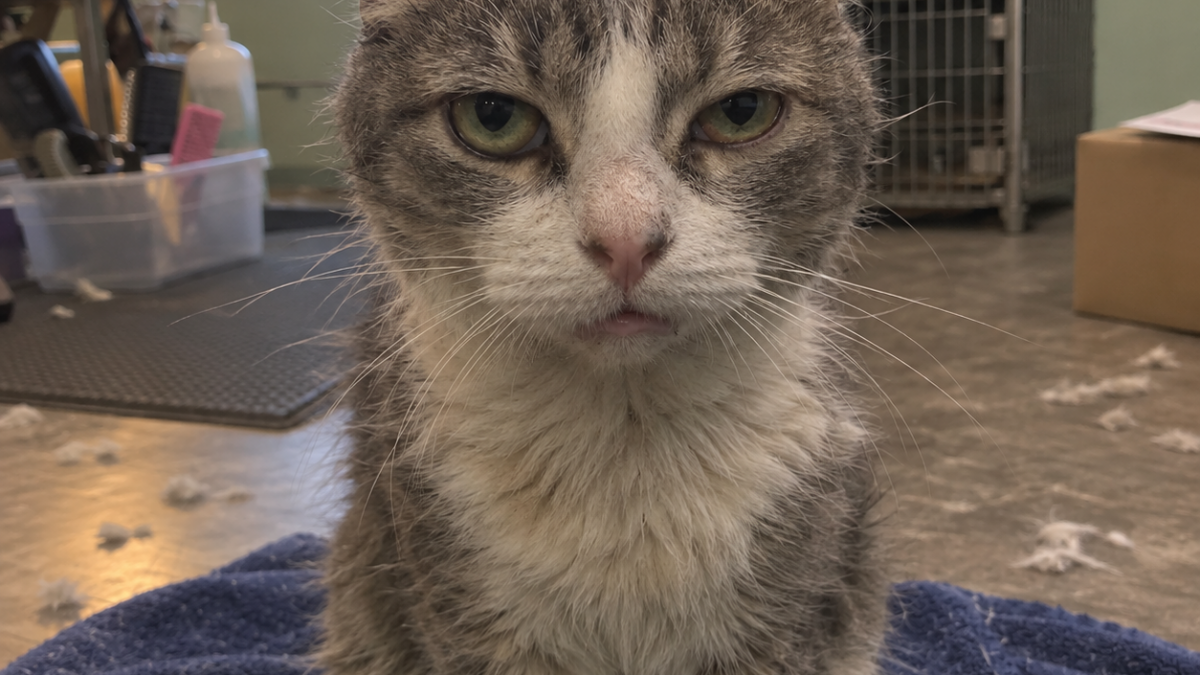
Clover looking directly at the camera during her first exam.
Both ears visibly shortened.
Healing scabs.
Calm green eyes.
The image moved.
Facebook first.
Then local groups.
Then larger rescue pages.
People were furious.
Comments arrived by the thousands.
Some demanded punishment.
Others insisted the owner must be found.
A few claimed the wounds looked like intentional “ear cropping.”
Dr. Porter corrected that publicly.
Cats do not have an accepted cosmetic ear-cropping procedure comparable to certain dog practices.
A single ear tip may be surgically removed under anesthesia to identify sterilized community cats.
This was not that.
Both ears.
Large portions.
Uneven tissue healing despite straight cut lines.
No anesthesia evidence.
No medical record.
No reason.
The note mattered.
Police released only part of its wording publicly.
That caused more attention.
Problem solved.
People could not understand it.
Dana could.
Not the logic.
The attitude.
That was worse.
Whoever wrote it believed they had accomplished something.
Not lost control.
Not acted in a moment of rage and immediately regretted it.
They wrote a summary.
A conclusion.
Almost a joke.
The handwriting bothered Dana more than the scissors.
Scissors could be impulsive.
Writing required sitting down afterward.
Finding paper.
Finding a pen.
Choosing words.
Folding the note.
Putting it with the cat.
Driving to the salon.
Leaving her.
Every step gave the person a chance to stop.
They did not.
Officer Grant visited nearby hardware stores.
Nothing.
The scissors could have come from anywhere.
Grooming shears.
Kitchen scissors.
Utility shears.
No way to know.
He checked traffic cameras.
Cars passed behind the shopping center at all hours.
Without a specific vehicle description, useless.
A bakery employee remembered seeing a dark SUV near the service lane early Monday.
Another employee thought it was Sunday evening.
No plate.
No driver.
A convenience store across the road had exterior footage.
But the angle showed only the entrance to the shopping center.
Dozens of vehicles.
No clear handoff.
The carrier itself was generic.
Sold in multiple stores.
Fingerprints were smudged.
Dana’s and staff prints were now mixed in because no one had realized it would become evidence until after handling.
The note produced partial prints.
None matched anyone in the system.
No DNA result that could identify an unknown person.
No microchip meant no veterinary trail.
Dana began calling clinics anyway.
“Two-year-old gray-and-white female. Ear problems maybe. Possibly scratching ears. Any patient disappear?”
Most said no.
Some agreed to check records.
One clinic remembered a similar cat.
Wrong markings.
Another had treated a gray-and-white female for mites six months earlier.
Different age.
A rescue group compared lost-cat posts.
Nothing.
Clover might have been owned quietly.
Never vaccinated.
Never chipped.
Never registered anywhere.
A pet living inside a private home can be almost invisible to every system until someone harms it.
Dana hated that thought.
At home, Clover did not behave like an abused animal.
At least not in ways Dana recognized.
She was cautious about being restrained.
Very cautious.
If two hands came toward her head at once, she ducked.
When Dana first tried applying prescribed ointment, Clover flattened herself against the bed.
Not aggressive.
Frozen.
Dana stopped.
Sat back.
Waited.
Then used one hand.
Slowly.
Clover tolerated it.
“That’s what they did, isn’t it?”
Dana whispered.
Clover purred afterward.
Dana hated the sound for a moment.
Not the purr itself.
The trust.
It felt like being forgiven for something she had not done.
Clover met Murray through the door.
Murray hissed.
Clover sat.
Murray hissed again.
Clover blinked.
Murray walked away as if he had won.
Penny took three days to accept Clover’s existence.
Then they began playing paws beneath the door.
By the second week, supervised introductions started.
Clover explored the hallway.
Kitchen.
Living room.
Couch.
The first time she saw the couch, she jumped onto the arm.
Walked across the cushions.
Turned around.
Settled.
Dana took another photo.
Clover on the couch.
Not scratching it.
That detail became a running joke.
“She hasn’t destroyed it yet,” Mark said.
“Give her time.”
“She has a reputation.”
“According to a psychopath with scissors.”
Mark stopped joking.
Dana regretted the sentence.
“Sorry.”
“No.”
He looked at Clover.
“You’re right.”
The term scratching problem still bothered them because nobody knew what it meant.
Dr. Porter eventually offered another possibility.
“People sometimes misunderstand ear scratching.”
Dana sat in the exam room during Clover’s follow-up.
“Meaning?”
“If she had chronic discomfort, she may have scratched herself enough to annoy the owner.”
“But her ears are clean.”
“Now.”
“Could she have had an infection?”
“Certainly.”
“And it resolved before?”
“Possible.”
“Could someone really believe removing the ear flaps would stop an ear infection?”
Dr. Porter did not answer immediately.
“Yes.”
Dana stared.
“People think that?”
“People cut tails because they get dirty.”
“What?”
“People remove claws because cats scratch furniture.”
“That’s surgery.”
“Declawing removes the last bone of each toe.”
Dana grimaced.
“I know.”
“My point is that humans sometimes alter animals because modifying the animal feels easier than changing the environment.”
Dana looked at Clover.
“What environment makes cutting ears easier?”
“None.”
Exactly.
Clover gained half a pound.
The wounds improved.
Scabs loosened naturally.
Fresh pink tissue formed.
Fur began growing around the edges.
The straight lines softened slightly as swelling disappeared.
But the ears remained short.
Always would.
People online called her beautiful.
Dana disliked some of those comments too.
She understood the intention.
Still, she did not want Clover transformed into inspirational decoration.
She did not need strangers to say mutilation made her unique.
She would have been beautiful with her ears.
She was beautiful despite losing them.
Those were different statements.
A local television station asked for an interview.
Dana refused at first.
Then Officer Grant called.
“Publicity might produce a tip.”
So she agreed.
But with conditions.
No filming Clover being restrained.
No sensational close-ups of wounds.
No describing the cat as “disfigured” in front of Dana.
The reporter agreed.
They filmed Clover on the couch.
Walking across Dana’s living room.
Playing with a string.
Eating.
Looking ordinary.
The reporter asked:
“What went through your mind when you saw her?”
Dana answered honestly.
“I thought I was looking at the result of somebody getting angry.”
“Do you still think that?”
“No.”
“What changed?”
“The note.”
Dana looked into the camera.
“Anger can be quick. The note took time.”
The clip aired that night.
A tip arrived the next morning.
A woman called animal control.
She believed Clover belonged to someone in her apartment complex.
A young couple had owned a gray-and-white cat.
The cat had disappeared recently.
The woman remembered hearing them complain that she “wouldn’t stop messing with her ears.”
Officer Grant drove out.
The couple denied owning Clover.
They showed him their cat.
A tabby.
Different animal.
Another tip.
A man claimed his former roommate had done it.
The roommate lived two states away.
Another.
Someone said they saw Clover listed for free online months earlier.
Screenshot showed another gray cat.
Another.
Another.
Every tip made Dana hope.
Every dead end made her angrier.
Meanwhile Clover learned the house.
She slept on the back of the couch in afternoon sunlight.
Stole Penny’s toys.
Ignored expensive cat beds.
Sat inside empty laundry baskets.
Followed Mark into the bathroom every morning.
Mark claimed to dislike this.
Then Dana caught him carrying Clover around the kitchen while making coffee.
“I thought she was temporary.”
“She climbed up.”
“Cats don’t climb into arms from the floor.”
“She indicated.”
“How?”
“Emotionally.”
Dana laughed.
Clover purred against his shoulder.
At three weeks, Clover scratched the couch.
One vertical line.
Two inches long.
Mark looked at it.
Dana looked at him.
Clover looked at both.
Mark said, “Well.”
Dana waited.
“Problem.”
She stared.
Mark smiled.
“Guess we buy another scratcher.”
Dana kissed him.
The scratching post went beside the couch.
Clover used it.
Mostly.
The damaged cushion remained.
Dana refused to repair it.
Not because it mattered.
Because every time she saw the mark, she remembered how little a scratch actually cost.
Fabric.
That was all.
A few pulled threads.
Not ears.
Never ears.
One evening, Dana sat with Madison after closing.
The young groomer had been quieter since Clover.
“You okay?” Dana asked.
Madison shrugged.
“Yeah.”
“No.”
She stared at the floor.
“My dad used to hit our dog.”
Dana stayed silent.
Madison had never told her that.
“When I was little.”
“How little?”
“Eight. Nine.”
“I’m sorry.”
“He’d say the dog was stupid.”
Dana listened.
“I thought everybody yelled at pets.”
“Kids normalize whatever house they grow up in.”
Madison nodded.
“When I saw Clover, I kept thinking maybe somebody knew.”
“Knew what?”
“That whoever did this was like that.”
Dana understood.
A neighbor.
Relative.
Friend.
Someone might have seen the person mistreat Clover before.
Maybe heard complaints.
Maybe joked about it.
Maybe ignored a smaller warning.
Cruelty rarely begins at maximum intensity.
Officer Grant had said the same thing.
People often see pieces.
A dog kept outside too long.
A cat thrown from a room.
An animal frightened of one person.
A threat said as a joke.
Dana wondered what pieces existed before the scissors.
No answer came.
Clover’s stitches did not need surgery because there were no stitches.
That detail haunted Dana too.
Whoever cut the ears had apparently done nothing afterward.
No sutures.
No veterinary wound closure.
No proper bandage.
The cat had healed by scabbing.
Five to seven days, Dr. Porter estimated.
Maybe more.
For those days, Clover remained somewhere with open wounds on both sides of her head.
Did anyone clean them?
The note said she would not need anyone cleaning those ears anymore.
Dana kept returning to that line.
Maybe the owner had been told to clean an infection.
Maybe Clover resisted.
Maybe she scratched.
Maybe someone became angry after being scratched while administering drops.
The theory fit.
But theories could become stories too easily.
Dana refused to turn guesses into fact.
“We know what happened to the ears,” she told Madison.
“We don’t know why.”
“The note tells us.”
“It tells us what they wanted us to think.”
That distinction mattered.
A month after Clover arrived, the investigation slowed.
Officer Grant did not say closed.
He said inactive pending new information.
Dana hated bureaucratic language.
“So nothing.”
“Not nothing.”
“You don’t have a suspect.”
“No.”
“You don’t know where she lived.”
“No.”
“You don’t know who cut her.”
“No.”
“Then what do we have?”
Grant looked at Clover asleep in the salon office.
“We have documentation.”
Dana waited.
“If somebody recognizes her later, the case exists.”
“That feels small.”
“It is.”
He paused.
“But small isn’t zero.”
Dana had learned enough about cruelty investigations to know he was right.
Cases often failed because nobody reported.
No photos.
No records.
No veterinary documentation.
No chain of evidence.
Clover had all of those now.
If a name surfaced, the story would not begin from memory.
It would begin from a report.
Dana thanked him.
She still felt unsatisfied.
Justice, she discovered, did not arrive because suffering deserved it.
That was another ugly lesson.
Clover did not care.
She cared about dinner.
The heated blanket.
Penny’s tail.
Dana’s lap.
She developed a habit of sleeping directly on Mark’s chest.
“You weigh six pounds,” he complained.
Clover purred.
“How can six pounds affect breathing this much?”
Dana said, “Emotional pressure.”
“Please remove her.”
“You have hands.”
“I can’t move.”
“Sounds serious.”
Clover stayed.
By week six, the visible wounds had closed.
Dr. Porter cleared her for spay surgery.
Dana panicked more about routine anesthesia than Clover seemed to.
“She’ll be fine,” Dr. Porter said.
“You don’t know that.”
“She’s young.”
“She has had enough things happen.”
“That doesn’t make anesthesia statistically more dangerous.”
“I know.”
“Then why are you pacing?”
“Because knowing and feeling are different departments.”
Dr. Porter smiled.
Clover’s surgery was uneventful.
Dana took her home wearing a soft recovery suit instead of a hard cone.
The shortened ears meant standard cone fit was awkward anyway.
Clover slept through most of the afternoon.
At dinner, she ate.
Dana finally breathed.
The foster agreement was nearing its end.
Animal control contacted Dana.
No owner identified.
No claimant.
Clover could be legally transferred for adoption.
The coordinator asked:
“Do you want us to list her?”
Dana stared at the phone.
Mark sat across the room.
He could hear.
He mouthed, No.
Dana covered the microphone.
“You said temporary.”
“I changed my mind.”
“When?”
“Day one.”
“You argued.”
“For tradition.”
She uncovered the phone.
“No listing.”
The coordinator laughed.
“Foster fail?”
“Apparently.”
“Name staying Clover?”
“Yes.”
“Good.”
The adoption papers arrived electronically.
Dana signed them at the kitchen table.
Clover sat on the laptop keyboard halfway through.
“This concerns you.”
Clover stepped on the delete key.
“Helpful.”
Mark took a picture.
The final form asked:
Reason for adoption.
Dana typed:
Already home.
She deleted it.
Too sentimental.
Then typed:
Permanent placement with foster family.
Professional.
Boring.
Correct.
She submitted.
That evening, she told Clover:
“You’re officially ours.”
Clover scratched the cardboard post.
“Beautiful reaction.”
Dana’s social-media post announcing the adoption received thousands of comments.
She did not use the original wound photo.
She chose Clover asleep on the couch.
Caption:
The cat from our drop box has a home.
Her name is Clover.
Her ears are healed.
She is safe.
She scratches the furniture occasionally.
We bought more scratching posts.
Problem solved.
Mark read it.
“That last line.”
“I know.”
“You sure?”
“Yes.”
Dana wanted those words back.
Not erase what they had meant.
Reclaim them.
Problem solved did not mean cutting part of an animal away.
It meant changing the human response.
Move the scratcher.
Cover the couch.
Trim nails.
See a veterinarian.
Learn.
Adapt.
Accept that living with another creature meant some inconvenience.
Months passed.
Clover’s fur thickened.
The scars became pale lines beneath gray-and-white hair.
From a distance, people sometimes thought her ears were naturally small.
Up close, the straight edges remained obvious.
Children asked.
Dana answered simply.
“Someone hurt her before she came here.”
“Do her ears grow back?”
“No.”
“Does it hurt?”
“Not anymore.”
“Can she hear?”
“Yes.”
One little boy at the salon stared at Clover, who had become an occasional office cat.
“Why would somebody do that?”
Dana looked at his mother.
The mother seemed unsure.
Dana said:
“Sometimes people hurt animals because they don’t understand them.”
The boy frowned.
“Then they should learn first.”
“Yes.”
That was enough.
Clover became excellent around frightened grooming clients.
Especially cats.
Dana did not intentionally use her as a therapy animal.
It just happened.
Clover would sit in the office window.
A nervous carrier would arrive.
Sometimes Clover approached.
Sniff.
Sit nearby.
No drama.
One day, an elderly woman brought in a Persian named Snowball whose ears needed routine cleaning.
Snowball hated it.
The woman apologized repeatedly.
“She scratches me.”
Dana asked, “Have you had her checked for infection?”
“Vet says allergies.”
“Using prescribed cleaner?”
“Yes.”
Dana showed her towel wrapping.
Positive reinforcement.
Short sessions.
Stop before panic escalated.
The woman looked toward Clover.
“What happened to that one?”
Dana told her.
Not every detail.
Enough.
The woman put one hand over her mouth.
“Because she scratched?”
“That’s what the note implied.”
The customer stared at Snowball’s carrier.
“I get frustrated.”
“That’s normal.”
“I’ve yelled.”
“Also common.”
“I would never…”
“I know.”
Dana touched the carrier.
“Frustration is information. It tells you the method isn’t working.”
The woman nodded slowly.
Not everyone who became frustrated became cruel.
Dana had learned that distinction too.
Demonizing anger helped nobody.
People needed alternatives before anger became action.
Ask for help.
Stop.
Walk away.
Call a vet.
Call a groomer.
Reschedule.
Sedation when medically appropriate.
Medication.
Training.
Another person.
There were always options before scissors.
Always.
The police never identified Clover’s previous owner.
At least not that year.
No confession.
No usable camera footage.
No witness who could prove anything.
That absence frustrated people online.
They wanted a villain with a face.
Dana did too.
For a while.
Then something changed.
Every time a reporter or follower asked:
“Did they catch whoever did it?”
Dana noticed the story pulled backward.
Back to the scissors.
Back to the note.
Back to a person Clover no longer lived with.
Dana began answering:
“No. But Clover is doing well.”
Some people thought that dodged the question.
It did not.
It reordered the importance.
The unknown person mattered to the investigation.
Clover mattered to the life.
Those were different.
One year after the morning Dana opened the drop box, she arrived at Willow Creek at 6:40.
Same parking lot.
Same bakery lights.
Same quiet salon.
She stood near the box.
She had resisted removing it.
Some friends told her it carried bad memories.
She disagreed.
The box had not hurt Clover.
It had been the place someone left her.
And the place someone found her.
Both could be true.
Dana had installed a camera over it now.
High resolution.
Night vision.
Clear view of faces and license plates.
A sign read:
ALL DROP-OFFS BY APPOINTMENT ONLY.
AREA UNDER VIDEO SURVEILLANCE.
She checked the compartment.
Empty.
Good.
Then she heard a meow behind her.
Mark had entered through the back door carrying Clover.
“What are you doing here?”
“She screamed when you left.”
“She did not.”
“She made one sound.”
“That’s not screaming.”
“I’m married to a groomer. I exaggerate professionally now.”
Clover saw Dana.
Jumped from Mark’s arms onto the low counter.
Her ears looked almost soft around the edges now.
Still shortened.
Still unmistakable.
Dana stroked the space between them.
Purr.
“Happy anniversary,” Mark said.
“That’s a terrible phrase.”
“Found-you day?”
“Also terrible.”
“Normal Monday?”
Dana smiled.
“Better.”
Clover walked into the lobby.
Jumped onto the couch they kept near reception.
Turned three circles.
Settled.
Then stretched.
Front paws forward.
Claws extended into the fabric.
Scratch.
Scratch.
Dana stared.
Mark started laughing.
“Problem.”
Dana walked over.
She picked up the scratching post and moved it closer.
Clover immediately transferred her attention.
Scratch.
Scratch.
Scratch.
“Problem solved,” Dana said.
This time, the words meant what they should have meant all along.
Not pain.
Not punishment.
Adjustment.
Understanding.
A two-foot movement of cardboard.
That was it.
Clover finished scratching and jumped back onto the couch.
She curled into a ball.
Dana sat beside her.
Outside, traffic increased.
The bakery opened.
A truck backed into the loading lane.
People started another ordinary Monday.
Dana thought about the person who had once held Clover still.
She did not try to imagine their face anymore.
She had spent enough time giving that unknown person space in her mind.
Instead she remembered the first morning.
Not the wounds.
The moment after.
Clover pushing her head into Dana’s hand.
Purring.
That had seemed heartbreaking at the time.
Now Dana understood it differently.
Trust was not Clover’s weakness.
It had not made what happened to her possible.
The blame belonged entirely to the person who abused it.
Clover’s willingness to trust again was not foolishness.
It was simply part of who she was.
Soft.
Social.
Affectionate.
Curious.
Annoyingly interested in coffee cups.
Occasionally destructive to upholstery.
Normal.
She had not become a symbol in her own mind.
She did not wake each morning thinking:
I am the cat whose ears were cut off.
Humans did that for her.
Humans built identities around scars.
Clover woke thinking about food.
Sun.
Dana.
Mark.
Murray.
Penny.
The warm spot behind the front desk.
Whatever bird was outside the window.
Her world had moved on before many of the people talking about her had.
That became Dana’s final lesson.
Healing was not pretending the injury had never happened.
The ears were gone.
The scars remained.
The investigation existed.
The note stayed sealed in an evidence bag.
Nothing could change those facts.
Healing was allowing those facts to become smaller than the life surrounding them.
Months after adoption, Dr. Porter took a new photograph for Clover’s medical file.
Same exam table.
Same green eyes.
But healthy weight.
Glossy coat.
No scabs.
Short ears covered in soft fur along the margins.
Clover looked directly into the camera.
Dana placed the photograph beside the first one on her phone.
In the first, Clover looked calm too.
That surprised her.
The difference was subtle.
Not fear versus joy.
Animals do not pose emotional narratives for human convenience.
But in the second photograph, Clover’s body leaned toward Dana.
One paw rested against her wrist.
Dana liked that.
Not because it proved anything.
Because it was ordinary affection.
The kind no one should have had to earn through suffering.
On certain mornings, customers still recognized her.
“Is that Clover?”
“Yes.”
“The cat from the story?”
Dana sometimes said yes.
Sometimes:
“She’s just Clover.”
Both were true.
One afternoon, a woman came into the salon carrying a gray kitten.
The kitten was scratching one ear obsessively.
The woman looked exhausted.
“I don’t know what to do.”
Dana immediately asked:
“Vet?”
“Appointment tomorrow.”
“Good.”
“She won’t let me clean it.”
“Then don’t force it tonight.”
“But she’s scratching.”
“I know.”
“What if she hurts herself?”
“We can help you with a towel wrap, but if she panics, stop.”
The woman looked relieved.
“You don’t think I’m a bad owner?”
“No.”
“I feel terrible getting frustrated.”
Dana leaned against the counter.
“Getting frustrated is not the same as hurting her.”
The woman nodded.
Clover walked across the desk.
The customer saw her ears.
Her face changed.
“Oh.”
Dana scratched Clover under the chin.
“This is why we stop when frustration gets bigger than the problem.”
The woman swallowed.
“I understand.”
Dana hoped she did.
Not because Dana suspected cruelty.
Because prevention mattered before anyone reached a breaking point.
Education mattered.
Support mattered.
Removing shame mattered.
People ask for help more easily when they are not afraid of being judged.
Clover sat beside the kitten’s carrier.
The kitten hissed.
Clover blinked.
Dana smiled.
“Excellent bedside manner.”
The woman laughed.
That was the kind of moment Dana wanted Clover’s story to create.
Not only rage after cruelty.
Better choices before it.
Years later, the original note remained in police evidence.
No breakthrough.
No suspect.
Clover never knew.
She became seven.
Then eight.
The shortened ears became simply her ears.
People who met her without knowing the story sometimes asked whether she had been born that way.
Dana would decide case by case how much to tell.
Not every meeting needed to become a trauma recital.
Clover did not owe anyone the worst thing that had happened to her.
That mattered too.
One winter evening, Dana sat on her couch reading.
Clover slept beside her.
Mark watched television.
Murray snored in a chair.
Penny occupied a heating pad.
The house was quiet.
Clover woke.
Stretched.
Walked toward the corner.
Scratch.
Scratch.
The couch again.
Dana looked over.
“Seriously?”
Clover scratched once more.
Dana sighed.
Mark laughed.
“Get the scissors.”
The room went silent.
Mark’s face fell immediately.
“Damn. I’m sorry.”
Dana stared at Clover.
Then started laughing.
Mark looked confused.
“You’re laughing?”
“Yes.”
“Why?”
“Because she doesn’t know what you said.”
“That’s not funny.”
“No.”
Dana wiped her eyes.
“But look at her.”
Clover had moved to the scratching post.
Perfectly unconcerned.
She scratched.
Then returned to the couch.
Climbed onto Dana.
Curled against her chest.
Purr.
Dana held her.
“You’re right.”
“About what?”
“She doesn’t know.”
That sentence felt like a gift.
Clover did not know the note.
Did not know the photograph circulated.
Did not know strangers had argued about her.
Did not know humans considered her appearance tragic.
Did not know a police report carried her story in clinical language.
She knew pain once.
Yes.
Her body had known restraint.
Healing.
Fear.
But whatever memory remained, it did not come with human sentences.
Problem solved.
Those words belonged to people.
Clover had another language.
Warmth.
Food.
Touch.
Distance.
Safety.
Routine.
A hand that stopped when she asked.
A home where scratching furniture resulted in cardboard being moved six feet closer.
A couch she was allowed to damage a little because couches were replaceable.
Ears were not.
That became the rule in Dana’s house.
Furniture could be repaired.
Curtains replaced.
Rugs cleaned.
Wood touched up.
Human pride swallowed.
Animals did not need to be physically altered to fit perfectly into somebody’s possessions.
Living things were allowed to be inconvenient.
Clover proved extremely talented at inconvenience.
She threw up on the duvet twice.
Knocked a mug off the counter.
Stole chicken from a plate.
Woke Dana at 4:50 because breakfast apparently required military precision.
Scratched the couch.
Then a chair.
Then another couch.
Mark joked they had spent more replacing furniture than Clover’s adoption had cost.
Dana always answered:
“Still cheaper than being a monster.”
Eventually, they stopped replacing the couch.
They placed a cover over it.
Clover continued living.
That was enough.
On the fifth anniversary of her arrival, Dana opened the salon before sunrise.
She checked the drop box.
Empty.
Then entered the office.
A framed photo hung on the wall.
Not the original wound photograph.
Clover healthy.
Sitting on the salon couch.
Short ears upright.
Eyes bright.
Underneath, a small sign:
PLEASE ASK FOR HELP BEFORE YOU GET FRUSTRATED.
WE WOULD RATHER ANSWER A “STUPID” QUESTION THAN SEE AN ANIMAL HURT.
Customers noticed it.
Some asked why.
Dana told them when appropriate.
Others simply read.
Maybe one person went home and chose patience.
Maybe one called a veterinarian instead of improvising.
Maybe one stopped trying to force an ear cleaning.
Dana would never know.
Small prevention rarely comes with dramatic proof.
That did not make it unimportant.
At seven, Madison arrived.
Now twenty-four.
Senior groomer.
Engaged.
Still working at Willow Creek.
She saw Dana looking at the photograph.
“Five years.”
“I know.”
“Feels longer.”
“Yes.”
“Remember the coffee?”
Dana laughed.
“I never cleaned behind that cabinet properly.”
“I knew it.”
They stood there.
Then Madison said:
“Do you ever wonder who did it?”
“Less.”
“Really?”
“Yes.”
“Why?”
Dana looked at the photograph.
“Because they got one week of her life.”
Madison waited.
“Maybe two.”
Dana continued.
“We got everything after.”
That was not justice.
Dana knew better than to confuse the two.
Whoever hurt Clover should have been identified.
Held accountable.
Prevented from harming another animal.
That remained true.
But justice being incomplete did not mean Clover’s life had to remain centered around the missing piece.
Clover was at home that morning.
Probably asleep on the couch.
Maybe scratching it.
Definitely waiting for breakfast number two if she could convince Mark that breakfast number one had never happened.
The anonymous person had left behind a note meant to define what had been done.
Problem solved.
The phrase had failed.
The person had not solved anything.
They had created wounds.
Then abandoned the animal carrying them.
The actual problem had been solved later.
By a groomer who opened a door early.
A veterinarian who treated without judgment.
An officer who documented.
A husband who said “temporary” and meant “forever.”
A home that learned where to put scratching posts.
Hands that stopped when Clover pulled away.
Meals.
Medicine.
Time.
The ordinary discipline of choosing care repeatedly.
That was what solution looked like.
Not scissors.
Not punishment.
Not control.
Understanding.
One hour had mattered that first morning.
Dana sometimes thought about that.
If she had arrived at her usual opening time instead of early.
If she had forgotten to check the box.
If the salon had become loud.
If dogs had begun barking.
If Clover had remained inside the carrier longer while injured and frightened.
Maybe nothing catastrophic would have happened.
Maybe everything would have been fine.
But Dana had opened the compartment when she did.
Clover had been there.
Two green eyes.
Two shortened ears.
One folded note.
And an entire life waiting beyond that moment.
People like to call that luck.
That was why Dana had named her Clover.
But years later, she thought the word meant something different.
Luck was not what happened before the box.
There was nothing lucky about that.
Luck was the timing of discovery.
Luck was the right person opening the right door.
Luck was reaching the place where cruelty ended.
Not because the past disappeared.
Because the future finally became larger.
At home that evening, Clover was on the couch.
Exactly where she was not supposed to be.
Dana sat beside her.
Clover woke.
Stretched.
Then rubbed her head beneath Dana’s palm.
Right between the two ears that would never grow back.
Dana scratched gently.
Clover purred.
No flinch.
No freezing.
No fear of the hand.
Just pressure.
Trust.
Comfort.
Clover shifted closer.
Her claws caught the upholstery.
A thread pulled.
Dana saw it.
She smiled.
“Go ahead.”
Mark looked over.
“You know we own scratching posts.”
“I know.”
“That couch is expensive.”
“I know.”
Clover scratched once.
Then settled.
Dana ran her thumb along the soft edge of one shortened ear.
Five years earlier, somebody had decided a cat’s behavior was a problem important enough to alter her body permanently.
Now the evidence of that decision rested beneath Dana’s fingers.
But it was no longer the most important thing about Clover.
That was the part people rarely understand when they see a rescue photograph.
They see the injury first.
The missing ears.
The scar.
The dramatic before.
But animals continue past the photograph.
Clover had continued.
She had birthdays.
Vet appointments.
Favorite windows.
Enemies.
Friends.
A preferred brand of food.
A specific place on Dana’s pillow.
A habit of stealing warm laundry.
An irrational hatred of one blue vacuum cleaner.
A love of cardboard boxes too small for her body.
She aged.
She gained weight.
Lost it.
Gained it again.
She learned every sound in the house.
She became ordinary.
And ordinary was the victory.
Not because what happened to her became acceptable.
Never.
Because it stopped being the only sentence anyone could write about her.
The ears were cut.
The wounds healed.
The person disappeared.
And Clover lived.
She lived long enough for the scabs to fall away.
Long enough for new fur to soften the scars.
Long enough for strangers to stop gasping.
Long enough for the couch to accumulate scratches nobody bothered repairing.
Long enough for the words on that folded note to become ridiculous.
Problem solved.
Yes.
Eventually it was.
Just not in the way the person with the scissors imagined.
The problem was never Clover.
And once she reached a home that understood that, nobody ever tried to fix her again.