She Traveled 11 Days to Oregon to Marry a Man Who Never Came—Then a Stranger at the Empty Station Said Her Full Name and Offered Her His Horse.
PART2:
What remained was her trunk, her mother’s Bible, three dresses, a sewing kit, a pair of gloves, and the green ribbon wrapped in tissue at the bottom of a drawer.
Silas’s letters had arrived like a hand held out across distance.
Patient.
Plain.
Respectful.
He did not flatter extravagantly.
That had reassured her.
He wrote about weather, lumber prices, grass, cattle, church, the ache of eating supper alone, and the room he intended to build onto the cabin before she arrived.
In August, he asked for help buying lumber.
Only until the cattle sale, he wrote. I would not ask if it were not for the room meant to be yours.
Naomi sent him two hundred dollars.
Nearly everything left from her father’s life.
She had told the whole congregation she was going west to marry a rancher.
The women had smiled too brightly.
The men had shaken her hand.
Reverend Cole had prayed over her journey.
Naomi had been proud then.
Terrified, yes.
But proud.
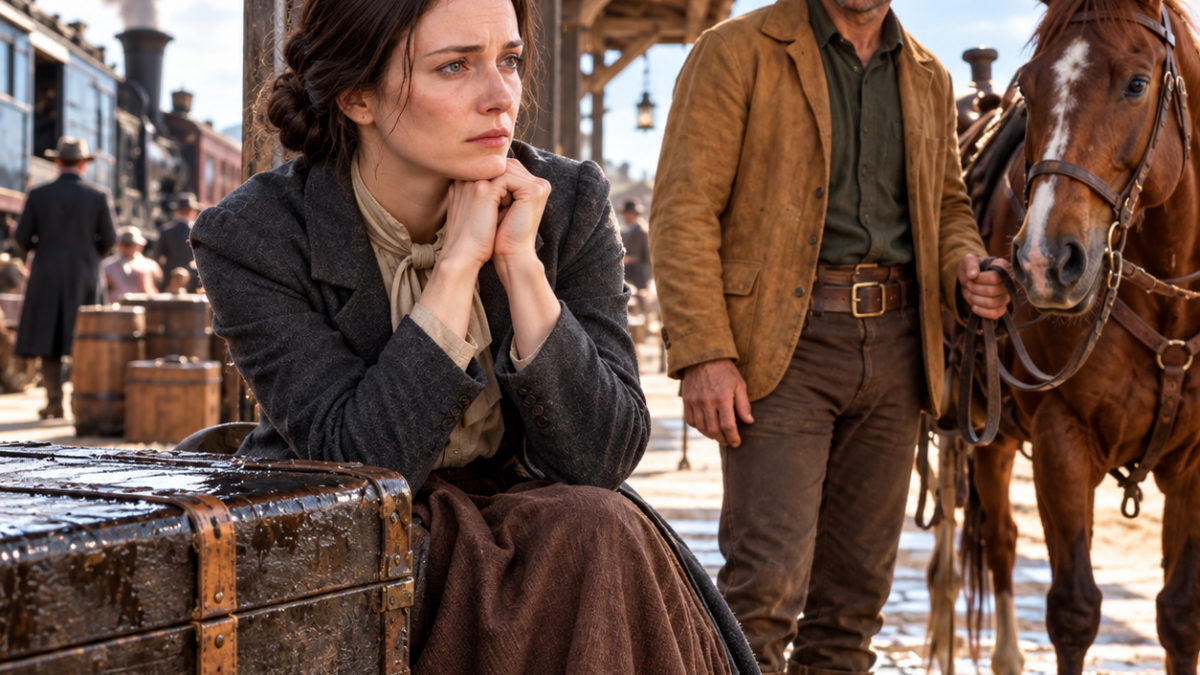
Now the station clock ticked toward evening, and the road remained empty.
A tired station agent with gray whiskers came out after the last wagon left.
He stood beside her with his cap in his hands.
His name, she had learned earlier while asking after Silas, was Mr. Thornton.
“Miss Hartley.”
Naomi did not look at him.
“Perhaps he has been delayed.”
The words sounded foolish before they fully left her mouth.
Mr. Thornton shifted.
“I sent a boy to the livery and another to the feed store. Asked around.”
Naomi closed her eyes.
“Mr. Pruitt is not in town.”
“No, ma’am.”
“He may be at his claim.”
“No, ma’am.”
That was when she looked at him.
The pity in his face was worse than impatience would have been.
Thornton drew a slow breath.
“Silas Pruitt left the county in August.”
The platform tilted beneath her.
“No.”
“I’m sorry.”
“No. He wrote me in September.”
“I expect he wrote from somewhere else.”
Naomi’s hands tightened around the Bible in her lap.
“He promised to meet me.”
Thornton looked toward the hills as if the right words might be waiting there.
“He owed the feed store. The saloon. Two banks. There’s rumor he went south with another woman’s savings.”
The sound that left Naomi was not quite speech.
Thornton removed his cap.
“I did not know where to reach you. If I’d known you were coming, I would have tried.”
She nodded because nodding required less strength than answering.
“The waiting room closes at nine,” he said gently. “Boarding house is a dollar a night.”
Naomi had four dollars and twelve cents.
She knew because she had counted twice on the train and once in the station privy with the door locked and her hands shaking.
“Thank you, Mr. Thornton.”
He flinched slightly at the politeness.
Her mother had taught her to thank people even when they handed her the end of the world.
Thornton hesitated.
“I can speak to Mrs. Bell at the boarding house. Perhaps she’ll allow—”
“No,” Naomi said quickly.
Too quickly.
Then softer, “No. Thank you.”
He wanted to say more.
She could see that.
But kindness has a limit when it stands before another person’s humiliation. Sometimes stepping away is the only mercy left.
Thornton went back inside.
Naomi sat very straight until the door closed.
Only then did the shame rise hot in her throat.
It was not the money that hurt most.
That surprised her.
Two hundred dollars was ruinous.
It was the last practical piece of the life her father had spent forty years building. A sum large enough to change the shape of a woman’s survival.
But the money was not what made her want to disappear.
It was how hopeful she had been.
How carefully she had folded his letters.
How many nights she had read them until the paper softened.
How she had imagined the porch.
The creek.
The little room.
The spring wedding.
How she had looked at herself in the small mirror above her rented room and tied her mother’s ribbon in her hair, believing she was not a discarded woman after all.
Worst of all was the fact that some part of her still kept glancing toward the road.
Still waiting.
Still imagining dust rising.
Still hearing a man she had never met say, I’m sorry, Naomi. The wagon wheel broke. The horse went lame. I came as fast as I could.
Hope, she discovered, does not always die when the truth arrives.
Sometimes it lingers out of habit, looking foolish and faithful at the same time.
The sun slipped lower.
The wind turned cold.
That was when Naomi noticed the man at the far end of the platform.
He had been there a long while.
She realized that slowly.
Not because he moved.
Because he did not.
He leaned against a post with a chestnut mare standing quiet at his shoulder, reins loose in one hand. He was tall, weathered, wearing a tan canvas jacket and a brown hat pulled low enough to shade most of his face.
The mare’s ears flicked toward Naomi.
The man did not approach immediately.
That frightened her more than if he had.
Men who hurried had a purpose.
Men who waited had time to choose one.
Naomi had heard what could happen to a woman alone in a western station with no family, no money, and nowhere to go. Stories traveled east faster than trains. Some were exaggerated. Some were not.
She gripped her mother’s Bible and lifted her chin.
If she was to be frightened, she would not look easy to frighten.
The man came toward her slowly.
At ten feet, he stopped.
Then he removed his hat.
That mattered.
Naomi wished it did not, but it did.
“Miss Naomi Hartley?”
The ground seemed to shift beneath her.
Nobody in Oregon knew that name.
She stared at him.
His face was sun-browned, lean, older than Silas had claimed to be in his letters. Forty, perhaps a little more. His beard was trimmed short. His eyes were the gray-blue color of winter water.
“Who are you?”
“My name is Gideon Marsh.”
The name meant nothing.
He seemed to know that it would not.
“I would not ask you to believe a stranger’s word. I only ask whether you are Naomi Hartley from Millbrook, Ohio.”
Her lips were too dry.
“Yes.”
His eyes moved, just once, to the green ribbon in her hair.
Something changed in his face.
Relief.
Not the relief of a man finding opportunity.
The relief of a man setting down a heavy sack after carrying it too long.
“I am glad I found you,” he said.
“You know Silas Pruitt?”
His mouth tightened.
“I know of him.”
That was answer enough to make her stomach sink.
Gideon looked toward the station window. Thornton stood inside, watching. When Gideon met his eyes, the station agent gave one slow nod.
Naomi saw it.
So did Gideon.
“I bought Pruitt’s abandoned claim in September,” Gideon said. “Forty acres bordering mine. It held the creek my cattle need, and he had left it untended.”
Naomi looked at the road.
Forty acres.
Good grass.
The creek.
The words from Silas’s letters returned, but now they belonged to a stranger’s mouth.
“I was clearing out the cabin,” Gideon continued. “Found a flour sack tucked into the rafters. Sixteen letters tied with twine.”
Naomi closed her eyes.
Hers.
“I read them,” he said.
Her eyes opened.
He lowered his head slightly.
“I know I had no right. At first I read only enough to learn where to send word. Then I read more because…” He stopped, ears reddening. “Because I could not stop.”
Her humiliation sharpened.
“You read my private letters?”
“Yes, ma’am.”
“Letters written to a man I intended to marry.”
“Yes.”
“And now you have come to inspect the foolish woman who wrote them?”
“No.”
The word came firm enough that her anger lost footing.
Gideon’s expression held no amusement.
No pity.
Only earnest discomfort.
“The last letter said you would arrive on the fourteenth of October,” he said. “It said he would know you by a green ribbon.”
Naomi touched the ribbon again despite herself.
“I’ve ridden into Pendleton nine days straight to meet every train.”
She stared at him.
“Why?”
“To keep you from sitting here alone when you learned the truth.”
The answer struck harder than she expected.
In all her trouble, in all the miles behind her, in all the fear rising around her now, she had not imagined that anyone anywhere had been looking for her.
Gideon reached into the inner pocket of his coat and withdrew a sealed envelope.
“I tracked Pruitt to a card table in Baker City.”
Naomi went still.
“He had little left.”
“What did you do?”
“Asked for what was yours.”
“And he gave it?”
“No.”
Gideon’s face did not change.
“He gave it eventually.”
Naomi did not ask how.
A woman alone with four dollars and twelve cents learns quickly not to reject the rough edges of justice when they are the only edges available.
“I got seventy dollars back,” Gideon said. “All that remained. I added seventy of my own.”
He held out the envelope with both hands.
Naomi recoiled.
“No.”
“It is yours.”
“No.”
“Miss Hartley—”
“I will not take charity from a stranger.”
“It is not charity.”
“It is exactly charity.”
“It is restitution.”
“From you? Did you steal from me?”
“No.”
“Then it is charity.”
Her voice shook.
She hated that.
Gideon did not argue.
Instead, he lowered the envelope.
“I’ll keep it safe until you want it.”
“I will not want it.”
“Then I will keep it safe longer.”
The answer was so infuriatingly calm that she nearly laughed.
Or cried.
She did neither.
Gideon tucked the envelope back into his coat.
“Then I’ll say what I truly came to ask.”
Naomi stiffened.
“There it is.”
He accepted the accusation with a small nod.
“I have a daughter.”
That stopped her.
“Her name is Ada. She is nine years old. She has not spoken one word since her mother died of fever two winters ago.”
Naomi forgot, briefly, to guard her face.
“I am sorry.”
“So am I.”
The simplicity of it quieted them both.
Gideon looked at the mare beside him.
“I need someone to keep the house and teach her letters. Mrs. Lane, a neighbor woman, has been helping, but she has sons of her own and cannot stay forever.”
Naomi’s grip loosened on the Bible.
“I read how you wrote about the sky over Ohio,” he said. “The way you wrote about your father’s shop. About your mother’s hymns. About wanting to be useful somewhere, not merely taken in.”
Naomi looked away.
“A silent child might listen to a woman who sees the world that way.”
There are offers that sound like rescue but are only another kind of trap.
Naomi knew that now.
She looked at the empty platform.
Then the cold road.
Then Gideon Marsh.
“Why should I trust you?”
He did not flinch.
“You should not.”
The answer startled her.
“Not yet,” he added.
He pointed gently toward the station window.
“Mr. Thornton knows me. So does the preacher in town. You can ask either before you decide anything. My ranch is eleven miles off. Mrs. Lane lives in the house with my daughter and will keep every propriety. If you come, you will have your own room and wages agreed before work begins.”
He led the chestnut mare forward.
“This is Ruby. Gentlest animal I own. You can ride. I’ll walk beside.”
Naomi looked at the mare.
Ruby lowered her head as if she had already decided Naomi was harmless.
Gideon’s voice changed then.
Softer.
Not pleading.
Leaving space.
“If you trust me, ride.”
Naomi looked at him.
“And if I do not?”
“Then I’ll sit on that cold bench with you until the morning train and pay your fare home myself.”
The words settled around her.
No pressure.
No anger.
No insult to her caution.
Through the window, Thornton gave another slow nod.
Naomi thought of the church in Millbrook.
Of the women’s faces if she returned.
Of the house gone.
The shop gone.
Her father gone.
Of Silas’s letters, now made dirty by what he had done with them.
Then she thought of the only thing she still owned that no one had taken from her.
Trust.
Not trust in him.
Not yet.
Trust in her own ability to choose.
She stood.
Her knees trembled.
She placed one hand on Ruby’s warm neck.
“All right,” she said.
Gideon did not smile.
Not immediately.
He seemed to understand that smiling too soon would make it look like victory.
He only nodded and turned to gather the reins.
They left Pendleton as the sky turned the color of a bruised peach.
Naomi sat sidesaddle with her Bible in her lap and her trunk left behind at the station. Gideon told her two men from the livery would bring it by wagon in the morning. He walked at Ruby’s head, boots steady in the frozen ruts, never once reaching for the bridle in a way that took control from her hands.
The road wound through wheat stubble and sage.
The hills rose and fell like sleeping animals.
The cold deepened as the sun disappeared.
Stars came out so thick Naomi felt she could gather them in her skirt if she dared let go of the reins.
Gideon did not crowd her with talk.
Once he said his wife, Abigail, had planted lilacs beside the porch.
Once he said Ada drew horses on everything—fence boards, flour sacks, window dust.
Once he pointed out a badger hole so Ruby would step wide.
That was all.
Somewhere in the dark, coyotes started up.
The sound rose from the low country, lonely and ragged.
That was when Naomi finally let go of what she had held since the platform.
She wept without sound.
Her shoulders shook.
Her face turned toward the dark so Gideon would not see, though of course he must have heard.
He did not turn around.
Instead, he reached back and held out a folded handkerchief.
He kept walking, giving her the dignity of not being watched.
Naomi took it.
That was the first kindness she believed.
A lantern burned in the window of a low house with a wide porch when they crested the last rise.
Lilac bushes, bare now, stood near the steps.
Smoke lifted from the chimney.
An old woman in a shawl waited in the doorway.
Beside her stood a small girl in a white nightgown, pale and thin, with a long dark braid and her father’s serious eyes.
Ada did not run.
Did not wave.
Did not speak.
She stared at Naomi on the horse.
At the green ribbon.
At the Bible.
Gideon stopped at the foot of the porch.
“She waited up every night for nine days,” he said quietly. “Wouldn’t ask why.”
Naomi slid down stiffly from Ruby’s back.
Her legs nearly failed, but she found her balance.
Mrs. Lane stepped forward, took the Bible gently from her hands, and said, “You must be frozen clean through.”
Naomi barely heard her.
She looked at Ada.
Then knelt on the porch boards, not too close.
The way one approaches a frightened foal.
She asked the child nothing.
No name.
No greeting.
No demand to be polite.
She simply began to hum.
Low.
Unhurried.
The hymn her mother had sung over her bed on every sleepless night of her childhood.
Ada’s eyes changed.
Just slightly.
Naomi kept humming.
A long moment passed.
Then Ada took one step.
Then another.
She reached out with two careful fingers and touched the end of the green ribbon in Naomi’s hair.
Gideon turned away and looked toward the dark hills.
The weeks that followed were quiet and full of small mercies.
Naomi learned the stove, which smoked if the damper was set wrong.
The pump, which froze at the handle near dawn.
The hens, who had stronger opinions than many church ladies.
The temper of the wind, which seemed personal some mornings.
Mrs. Lane stayed in the house the first month, partly for propriety and partly, Naomi suspected, to decide whether the woman from Ohio was likely to faint at hard work.
Naomi did not faint.
She scrubbed floors.
Mended shirts.
Set the pantry in order.
Cooked poorly at first, then better.
Washed curtains yellowed by stove smoke.
Learned where Abigail had kept the good dishes.
Found dried lilac blooms pressed inside a book of psalms.
And she taught Ada letters.
Not at a desk at first.
Ada would not sit for lessons like a child in a schoolroom.
So Naomi traced letters in flour with a stick.
A.
D.
A.
Ada watched.
Then copied them with one finger.
Later came chalk on a barn board.
Then slate.
Then paper.
The girl learned fast.
She filled pages with words she carried everywhere.
Horse.
Sky.
Ruby.
Papa.
Naomi.
But she did not speak them.
Gideon watched without appearing to watch.
He rose before dawn and came in after dark.
He was not a man who filled a house with words, but his quiet had a shape Naomi came to recognize.
If he was troubled, he checked the fire twice.
If he was pleased, he lingered by the kitchen door with some unnecessary task in his hands.
If Ada smiled, his whole body seemed to ease before his face remembered not to show too much.
Naomi also found the ranch ledger in what could generously be called disorder.
“Cheerful disaster” was the phrase she used to herself.
Numbers wandered.
Receipts were tucked between pages.
Feed expenses sat beside shoeing costs and a note that simply said, ask Bill, which seemed to Naomi an unacceptable accounting method.
She set every column straight.
Gideon studied the neat figures a long time.
Then looked at her.
“You did this?”
“Yes.”
“How long did it take?”
“Less time than it would have taken to keep being offended by it.”
He almost smiled.
After that, small things began appearing on the kitchen table.
A jar of wild honey.
A bundle of fine kindling.
A smooth blue stone from the creek.
A tin of tea from Pendleton.
He never said they were gifts.
She never thanked him like they were.
Neither of them mentioned the envelope.
The one with the recovered money.
The one he still kept somewhere safe.
On Christmas Eve, a blizzard came off the Blue Mountains without warning.
It arrived like a wall.
At noon, Gideon had ridden out to bring in a heifer stuck in a draw.
By dusk, snow fell so thick the barn vanished from the window.
Mrs. Lane had gone home before the storm.
Naomi sat in the lamplight with Ada pressed against her side, both pretending to sew.
The wind screamed in the chimney.
The windows rattled.
Snow hissed under the door.
Naomi checked the clock.
Then the window.
Then the clock again.
Hours passed.
Ada’s small body remained stiff beside her.
Naomi began to pray under her breath.
Then, because prayer made her hands shake harder, she began to hum the old hymn.
Ada went rigid.
Naomi stopped.
The child’s eyes were fixed on the door.
Then Ada spoke.
Her voice was thin as paper.
Rusty from two years of silence.
“Is Papa coming home?”
Naomi stopped breathing.
The sewing slid from her lap.
Ada looked up at her, frightened now by her own voice.
Naomi gathered the child into her arms.
“Yes,” she said.
She was crying and laughing at once.
“Yes, sweetheart. He is coming home.”
Ada’s mouth trembled.
“Papa?”
“Yes.”
Ada said it again.
“Papa.”
Then again.
Like a bird finding an open window.
“Papa. Papa. Papa.”
The door crashed open near midnight.
Gideon staggered inside crusted with ice, his hat lost somewhere in the white, one sleeve torn, face raw from wind.
Ada tore from Naomi’s arms.
“Papa!”
Gideon froze.
The word struck him harder than the storm.
Ada ran to him.
“Papa! Papa! Papa!”
His knees gave out on the floorboards.
He caught his daughter against him with hands too frozen to close properly. He pressed his ice-crusted face into her hair and wept openly, without shame, while she spoke every saved word into his coat.
Naomi pulled a blanket around both of them.
Gideon looked up at her.
His eyes said what his mouth could not manage.
Outside, the storm raged on.
Inside, something that had been dead for two winters began breathing again.
After that night, the house changed.
Not all at once.
Grief does not leave because one word returns.
Ada did not become a chatterbox by morning.
Some days she spoke only three words.
Some days none until evening.
But the silence no longer ruled the house.
It had doors now.
It could open.
Ada began saying small things.
Ruby.
Cold.
More bread.
No.
Papa.
Naomi’s name came in February.
They were in the barn, Ada drawing horses in the dust on a feed bin.
Naomi bent to correct a letter on the slate.
Ada touched her sleeve.
“Naomi.”
That was all.
A name.
But it held enough trust that Naomi had to step outside afterward and stand in the cold until she could breathe evenly.
In April, when the creek ran loud with snowmelt and the lilacs began to bud, Gideon asked Naomi to ride out to the old claim.
She went on Ruby.
Ada chattered beside her on a pony, explaining in great detail that Ruby was too dignified to enjoy mud but not dignified enough to avoid apples.
The trail followed the creek east.
When they reached the place, Naomi recognized it from Silas’s letters and despised him again for having described beauty truthfully while lying about everything else.
There was a new fence along the creek.
A stack of fresh lumber.
A framed foundation where the rotten cabin had stood.
Gideon dismounted.
Naomi did not.
Not yet.
“What is this?”
He reached into his coat and withdrew a folded paper.
“This was filed at the county seat in January.”
He held it up.
“It is a deed.”
Her heart moved strangely.
“To what?”
“The forty acres.”
Naomi stared at him.
He stepped closer but not too close.
“The name on it is yours.”
She did not take the paper.
“I don’t understand.”
“I bought the claim in the name of the money Silas took from you.”
“You already owned it.”
“I bought it because the creek bordered mine. That part is true. But after I found the letters, after I understood what he had done, I knew I could not keep it simply because he had been a thief first.”
He looked toward the framed foundation.
“The seventy dollars I recovered, the seventy I added, the rest I paid over time through the winter. The deed is yours.”
Naomi’s throat closed.
“I told you I would not take charity.”
“That is why the deed bears your name.”
“That makes no sense.”
“It makes perfect sense to me.”
“Gideon—”
“I did not want you staying under my roof because need cornered you there. I did not want you teaching my daughter because you had nowhere else to go. I did not want every kindness between us to be tangled with the question of whether you were trapped by gratitude.”
His voice roughened.
“Whatever you choose, this land is yours. If you wish to build here, you can. If you wish to sell it and go home, you can. If you wish to live alone and never again answer a letter from any man west of the Mississippi, you can do that too.”
Ada had gone quiet near the creek.
Even she seemed to understand something important was being placed into the wind.
Gideon held out the deed.
“The rest is only a question I won’t ask until you want it asked.”
Naomi took the paper.
Her hands trembled so badly the edges shook.
She thought of the Pendleton platform.
The cold bench.
Mr. Thornton’s pity.
Silas’s letters.
The long road under stars.
Gideon walking beside Ruby with steady boots in frozen ruts.
The handkerchief held out behind him.
Ada’s fingers touching the ribbon.
Papa spoken into a storm.
The ledger.
The honey.
The blue stone.
The quiet man who had given her choices when every other man in the story had assumed the right to decide her fate.
Naomi looked at Ada laughing now in the grass, her braid half undone.
Then at Gideon.
He did not ask.
So she answered the question he had refused to speak.
Not with words.
She reached up and untied the green ribbon from her hair.
The wind caught a loose strand and carried it across her cheek.
Gideon stood very still.
Naomi stepped down from Ruby.
She took his right hand and wrapped the ribbon around his wrist, knotting it carefully.
The way her mother had once done for her father.
Gideon looked at the ribbon.
Then at her.
“Naomi.”
“If I trust you,” she said softly, “I ride.”
His eyes filled.
She smiled.
“And I think I have ridden far enough to know.”
Ada came running then, asking what the ribbon meant.
Naomi looked at Gideon.
He looked at Naomi.
Then Ada answered her own question in the way children sometimes do when adults are too slow.
“It means stay,” she said.
Naomi laughed.
Gideon wiped one hand across his face and laughed too.
They rode back toward the house on the hill with Ada talking ahead of them and Ruby walking slow beneath Naomi’s hand.
Naomi had come west to be rescued by a promise.
The promise had been a lie.
But a stranger had made a better one and kept it mile after mile without asking for anything in return.
She had been left at a station.
Found on a road.
Welcomed by a silent child.
Given back the dignity of choosing her own life.
And all it had cost her, in the end, was the courage to trust one more time.







