She Sold Pies by a Dusty Road for Years Just to Survive—Then a Widowed Rancher Returned Again and Again Before Making an Offer She Never Expected
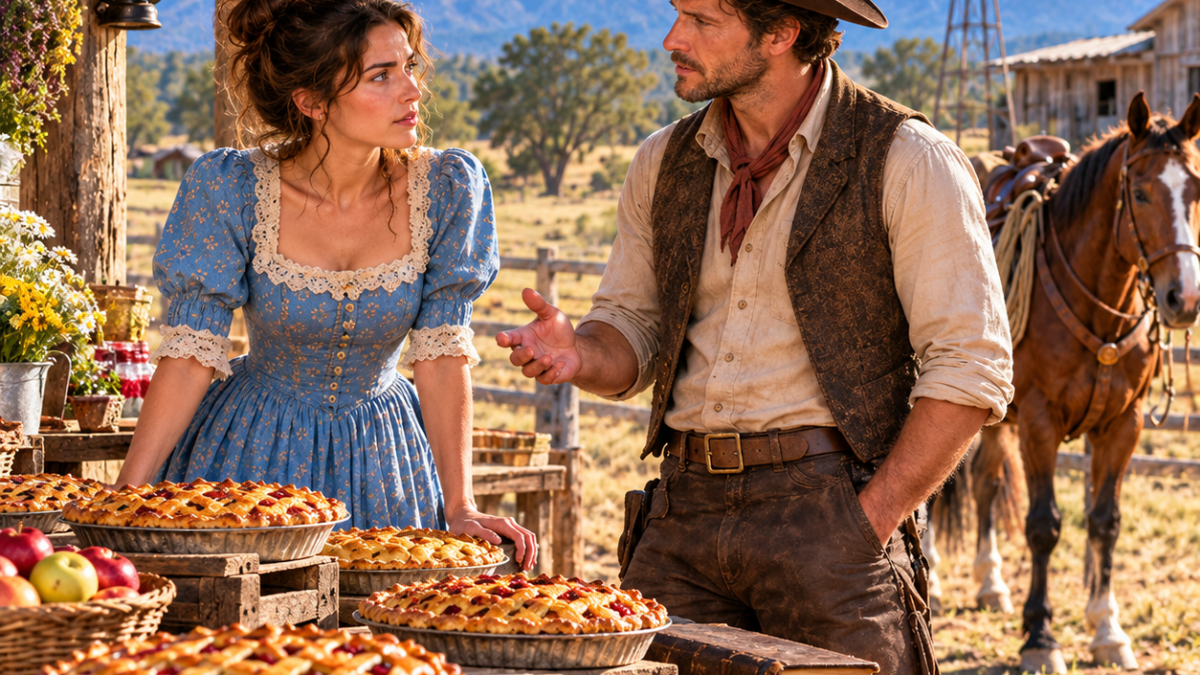
She Sold Pies by a Dusty Road for Years Just to Survive—Then a Widowed Rancher Returned Again and Again Before Making an Offer She Never Expected.
Mercy Langden had spent four years selling pies beside a dusty road because trusting the wrong man had nearly ruined her once.
So when the richest widowed rancher in three counties stood across her pine table and told her to stop selling there, she thought he had come to take the last honest thing she owned.
But hidden inside his clumsy words was an offer that would force them both to face old wounds, broken trust, and the truth that some doors only open after pride finally kneels.
“I want you to stop selling pies on this road.”
Those were the first words Thaddius Vance spoke that truly frightened Mercy Langden.
Not because his voice was cruel.
It was not.
Not because he raised it.
He did not.
In fact, he said the words slowly, almost carefully, the way a man sets down a heavy thing he has carried too far and does not know where else to put it.
But Mercy had learned long ago that a soft voice could still carry a hard intention.
She stood on the other side of her rough pine table with flour still caught in the creases of her fingers, one hand resting on the lid of a pie crate, the other near her mother’s old Bible at the corner of the stand. The autumn wind moved cold across the crossroads, rattling the dry leaves beneath the red oaks and lifting the edge of the checked cloth she had folded over the pies still warm from the morning bake.
For four years, she had stood at that same bend in the road where the Hill Country rolled east toward the Tennessee line. Four years of cool dawns, muddy springs, dusty summers, and winters when her fingers ached so badly she had to warm them over the lantern before she could tie string around a parcel.
Four years of earning every coin honestly.
Four years of asking no man for permission.
And now Thaddius Vance, owner of the largest spread in three counties, had ridden down from his big ranch on the ridge to tell her to stop.
Mercy looked at him for a long moment.
The wind tugged at the loose strands of hair near her cheek. She did not push them back. She would not give him the satisfaction of seeing her hands tremble.
“I beg your pardon?” she said.
Thaddius stood very still.
He was a broad man, well past forty, tall enough that he had to duck slightly beneath the edge of her cedar-shake lean-to. His face was weathered by sun and wind, his beard trimmed short, gray threading through the dark at his jaw and temples. He wore no fine city coat, no polished boots meant for parlors. His leather vest was worn, his linen shirt plain, his hands scarred from work.
But a man could dress simply and still believe the whole county should bend around him.
“I want you to stop selling pies on this road,” he repeated.
The words landed harder the second time.
Mercy closed the crate in front of her.
The latch clicked.
“You spent weeks buying from me,” she said, voice quiet, “asking questions about my flour, my berries, my ovens, my customers, and now you come to tell me where I may and may not earn my bread?”
Something shifted in his expression.
Regret, maybe.
Too late.
“I said that poorly.”
“You said it plainly enough.”
“No,” he said. “I said it wrong.”
Mercy’s mouth tightened.
PART2:
Men had a way of saying wrong things and expecting women to wait patiently while they found better words. She had waited for men’s better words before. They usually cost her money.
“I do not sell on your land, Mr. Vance.”
“I know.”
“I block no road.”
“I know that too.”
“I pay for my flour, my apples, my butter molds, and every scrap of paper I wrap these pies in.”
“I do not doubt it.”
“And I have never once asked the Vance ranch for favor.”
His eyes lowered briefly to the table, then to the little slate hanging from a nail where she had written that morning’s offerings in chalk.
Sour Apple with Cider
Blackberry Sorghum
Pumpkin Custard
Fresh Butter
“No,” he said quietly. “You have not.”
“Then speak plainly.”
“I want you to see another place.”
Mercy almost laughed.
It came up sharp and bitter, but she swallowed it before it escaped.
Another place.
That was how trouble often began.
Not with a demand, but with a place.
A larger kitchen.
A better road.
A city opportunity.
A buyer who knew markets.
PART3:
A promise that honest work could become more, if only she trusted the right man to carry it farther than her own two hands could reach.
She looked past Thaddius toward his bay horse tied near the road. The animal stood calm and expensive-looking, its coat shining even in the cold light. Beyond him, the road stretched in both directions, the same road that had carried farmers, travelers, widows, preachers, stagecoach passengers, and hungry children to her table for years.
That road had not made her rich.
But it had kept her free.
“What place?” she asked.
“The old stone mill on my land,” Thaddius said.
Mercy stilled.
She had heard of the Vance Mill, though she had never seen it. Everyone in the valley had heard of it. Years ago, before drought and debt and hard decisions left scars across the county, the mill had ground wheat, bought apples, baked for depot houses, supplied neighbors, and kept money moving through small farms that had few other reliable markets.
Then one year, it closed.
Just closed.
The Vance ranch survived.
Some families around it did not.
Thaddius seemed to know what had crossed her mind, because he looked toward the empty road rather than at her.
“It has stood shut for years,” he said. “But the walls are sound. The millstones are still there. There are long kneading tables, three brick ovens, and a stone cellar over the spring where butter would keep firm through August.”
Mercy said nothing.
“There is work to be done,” he continued. “Some of it may be past saving. The wheel will need a millwright’s eye. One of the flues may be cracked. But I have been thinking about bringing it back to life.”
“And you need a woman to bake for you.”
“No.”
She lifted one brow.
“No?”
“I do not need a hired woman to bake her recipes so the Vance ranch can sell them under its own name.”
That answer was better than she expected.
Not good enough.
But better.
“Then what do you need?”
Thaddius looked at her table again.
Not at the pies first.
At the ledger beside them.
At the little rows of names and orders written in her careful hand.
At the cold water crock where the butter sat wrapped in cloth.
At the way each pie had been placed so the warmer ones stayed shielded from the wind.
“You have something I cannot build with stone,” he said.
“Recipes?”
“Trust.”
Mercy did not answer.
That word touched a place in her she preferred strangers not to reach.
He seemed to understand, because he did not dress it up.
“Folks do not buy from you only because they like pie, Miss Langden. They buy because they trust you. They trust that what you say is in that crust is truly in it. They trust that if you say a pie will hold until Sunday, it will. They trust that if one is not fit to sell, you will not sell it.”
“Trust cannot be hauled to your ranch in a wagon.”
“No,” Thaddius said. “It cannot.”
“And what would you gain from this arrangement?”
“I want the mill running again. If it works, the ranch will profit.”
“At least you are not telling me this is charity.”
“I am not that good a man.”
Against her will, Mercy almost smiled.
Almost.
The wind shifted, carrying the smell of apples and nutmeg from beneath the cloth. A wagon creaked somewhere down the road, still distant.
Thaddius reached inside his vest and withdrew a folded scrap of paper.
“Come see the mill,” he said. “No agreement. No contract. No answer today. Only look at it with your own eyes.”
Mercy did not take the paper.
“If that place is so fine, why has it stood shut?”
The change in him was small but unmistakable.
The ease left his face.
“The ranch passed through a hard time.”
“So did a great many people.”
“Yes.”
Mercy waited.
He said nothing more.
That told her more than an excuse would have.
At last, he laid the paper beside her mother’s Bible.
“I would rather explain it properly once you have seen the place,” he said. “Part of the answer is there.”
He touched the brim of his hat, turned, and walked back to his horse.
Mercy watched him ride away until the red oaks swallowed him from sight.
Only then did she pick up the paper.
The directions were written plainly.
No flourish.
No pressure.
Just the road, the creek, the turn, and the Vance ranch.
Mercy folded the paper and set it under the Bible.
Then she sold the last two pumpkin pies to a farmer’s wife with three tired children in the wagon and smiled as if her whole future had not just been invited to step off a road she understood and into a place that had already broken trust once before.
That evening, in her little cabin, Mercy set her ledger on the kitchen table.
The room was small, but it was hers.
A narrow bed against one wall.
A shelf of jars.
A stove that drew poorly in hard wind.
A patched curtain at the window.
A tin can hidden beneath a loose floorboard, holding coins she had saved one slow week and one stubborn day at a time.
She took Thaddius’s paper from her apron pocket and set it beside the ledger.
For a long while, she stared at both.
She did not need his mill to survive.
That mattered.
Four years earlier, she might have.
Four years earlier, the offer of brick ovens and a spring cellar would have felt like rescue. Now it felt like risk.
Mercy had learned to measure a thing not only by what it promised, but by what it required.
Her mother had taught her pie crust.
Life had taught her caution.
Her mother taught her to render lard slow and clean until it smelled of nothing at all. To choose apples with a hand that knew firmness better than eyes knew color. To dry blackberries on screens in July so winter could still taste faintly of sun. To never sell a pie because it looked done when the smell said the center still needed time.
Her mother also taught her Scripture.
In the evenings, by tallow candlelight, she read from Proverbs 31.
She perceiveth that her merchandise is good: her candle goeth not out by night.
As a girl, Mercy thought that passage was about a woman who worked hard enough to impress God.
As a grown woman with debts once pressing on her like stones, Mercy understood it differently.
It was about dignity.
The dignity of knowing your work was good because you had refused to cheapen it when no one was watching.
Mercy had not always known how costly that dignity could become.
Years before Thaddius Vance ever rode up to her table, a commission merchant from Memphis had stopped at the crossroads.
Silas Crannle.
She still disliked the sound of his name in her own mind.
He wore a fine coat, a gold watch chain, and the smooth confidence of a man who never lifted anything heavier than a pen but spoke as if he carried entire towns on his back. He bought two pies the first day. Came back the second. Asked questions. Complimented her crust. Praised her butter. Said the depot eating houses and river-town stores would pay well for such quality if only someone knew how to place it before the right customers.
Mercy believed him.
Not all at once.
She was not foolish.
But slowly, because he said many things that were true.
She could sell more.
She did have skill.
Her table did limit her reach.
Good work deserved more than passing wagons.
For a season, it seemed Providence had opened a door.
Silas handled the hauling. Silas took the orders. Silas spoke of expansion, regular accounts, wholesale opportunity. Mercy baked late into the night by lantern light. She bought extra flour and lard on credit at the mercantile. She turned away some of her oldest customers because there were only so many hours and the Memphis orders had to be filled.
Then payments slowed.
Then orders grew without guarantee.
Then came pressure to lower prices.
Then hints that the hotels could buy cheaper.
Then the day Silas suggested she use lower-grade flour because “nobody eating at a depot counter can tell the difference once enough sugar is in it.”
That day, Mercy understood.
She had not grown free.
She had grown dependent.
She had worked harder, carried more risk, and placed the name she had built into the hands of a man who thought quality was only useful until it interfered with volume.
She ended the arrangement.
Silas moved on to cheat someone else.
Mercy stayed behind with debt.
It took two years to clear what she owed.
Two years of cornbread suppers.
Two years of winter mornings when her fingers cracked open from cold.
Two years of selling on the road even when rain came sideways, setting aside coins under the floorboard while hunger sat politely at the table with her.
She survived.
By God’s grace and her own stubborn hands, she survived.
Since then, people had called her cautious.
Some even called her small-minded.
Mercy did not mind.
Small had kept her honest.
Small had kept her free.
But as she sat at the table with Thaddius Vance’s directions beside her ledger, another thought troubled her.
There was a difference between guarding what she had built and letting one man’s deceit rule every door that opened afterward.
Fear could dress itself up as wisdom if a person let it.
Mercy bowed her head.
“Lord,” she whispered, “do not let fear be my master. But do not let foolishness wear the face of opportunity either.”
Two days later, she sent word that she would come see the mill.
Not because she trusted Thaddius Vance.
Because she wanted to know what still stood behind the door.
She rode out on a borrowed mule just after nine in the morning, shawl pulled tight against the chill.
The Vance ranch announced itself before she reached the gate.
Long fences in good repair.
Pastures holding sleek cattle with shining backs.
Freight wagons moving in orderly rhythm.
Hands working without shouting.
Barns painted, roofs sound, tools stacked where tools belonged.
Everything bore the mark of a man who believed disorder was a kind of sin.
Mercy was not easily impressed by size.
She had known rich men with rotten hearts and poor men with clean ones.
But order impressed her when it served life rather than pride.
Thaddius waited down by the creek beside a long, low building of gray fieldstone set apart from the main house. He did not take her through the parlor or past the new barn. He did not show the ranch as if presenting a kingdom.
He only helped her down from the mule and said, “It is this way.”
The mill stood beneath a great white oak, its wooden waterwheel still and dark against the creek side. Moss grew thick between stones near the foundation. The roof shingles were weathered but not collapsed. The oak door had swollen in its frame, and Thaddius had to put his shoulder to it before it groaned open.
The smell came first.
Cold stone.
Old flour dust.
Shut-up air.
Then light as he pushed open shutters one by one.
Pale autumn sunshine fell across the floor in long bars.
Mercy stepped inside and forgot, for several seconds, to be careful.
This was no shed.
No rich man’s whim.
Two pairs of millstones sat beneath dusty canvas. Grain bins lined one wall, their labels faded but still legible. Long hard-maple kneading tables stretched across the baking room, worn smooth by years of hands. At the far end stood three domed brick ovens with black iron doors. Down a short flight of steps, a stone cellar held a channel where spring water ran clear through rock troughs designed for butter crocks and cream pans.
Mercy walked slowly.
She touched nothing at first.
Then she laid one hand on the maple table.
The wood was cold.
Solid.
Waiting.
She knelt before the nearest oven and studied the mouth, then leaned slightly to examine the flue. She walked to the millstones and looked at the grooves. A little dressing, maybe. Not ruined. Neglected, but not ruined.
Thaddius stayed behind her.
That was wise of him.
“How many bushels did this grind in a day?” she asked.
He told her.
She did a sum in her head.
“These ovens have not been fired in years.”
“No.”
“That mortar will need looking at.”
“I expected so.”
She opened one iron door.
The hinge complained but moved.
“One flue is cracked.”
“I thought maybe.”
“You did not think maybe. You knew.”
“I knew.”
She glanced at him.
He held a small tally book and pencil.
Writing.
Not arguing.
That caught her attention.
Mercy was used to people treating doubt as ingratitude.
Thaddius did not defend the building. He wrote down every fault she named.
For nearly an hour, she inspected what she could reach.
The floor near the wheel was rotted through in two places. The wheel shaft needed a millwright’s eye. One oven might require nearly full relining. The shutters could be repaired, not replaced. The spring cellar was better than anything she had hoped. The grain bins would need scouring and sealing. The tables could be planed and cleaned. The place needed work.
But it could live.
At last they stepped outside and sat beneath the white oak.
The creek moved quietly nearby, sunlight breaking over the water in small bright pieces.
“It can be mended,” Mercy said.
Thaddius did not smile in triumph.
“I think so too. But it will not come cheap.”
“No.”
She looked back at the stone walls.
Against her better judgment, she pictured pies cooling on those racks. Butter firm in the spring cellar even in August. Flour ground close. Fruit coming in from orchard families. Not nameless goods shoved into distant markets, but good work made with room enough to breathe.
The idea was good.
That troubled her.
Good ideas were dangerous when the conditions came later.
“So,” she said, turning to him, “who decides?”
“Decides what?”
“The price. The flour. The fruit. Quantity. Recipes. Whether a pie leaves that oven if I say it is not fit to sell. Whether a large buyer can press us into lowering quality. Whether we bake more simply because the oven is large enough to allow it.”
Thaddius looked at the creek.
“You do not step lightly.”
“I cannot afford to.”
“No.”
He was quiet a moment.
“The building belongs to the ranch.”
“That is not an answer.”
“I know.” He turned back. “I do not picture this as master and hired woman. But I admit I have not yet worked out the shape of what it should be.”
“That shape matters.”
“Yes.”
“I once entered an arrangement where, in the beginning, I had a voice too.”
His face changed.
Not pity.
Understanding beginning to open.
Mercy told him only what was needed about Silas Crannle. The larger orders. The delayed payments. The pressure to cheapen ingredients. The debt that followed.
She did not tell him about the worst winter week, when she sliced one unsold apple pie into seven pieces and made it last seven suppers.
Some things did not need telling to be true.
When she finished, Thaddius did not promise grandly that this would be different.
That would have made her distrust him.
Instead, he asked, “What would have to be different for you even to consider it?”
Mercy answered without hesitation.
“I keep authority over quality. I will not depend on one buyer. I will not bake more only because the building can hold more. Growth must come from what we can truly make well and truly sell. Every supplier agreement must be written clearly. Payment dates fixed. Weights honest and visible. And if I say no to an order because it risks the work, then no means no.”
Thaddius listened.
His jaw tightened once or twice.
Good.
If he agreed too quickly, she would not believe him.
“A building this size must earn its keep,” he said.
“Then perhaps it is not the right building.”
His eyes moved to the mill.
“That may be.”
The honesty surprised her.
They did not settle anything beneath the oak that day.
But they both understood something important.
This would not be simple.
And perhaps that was exactly why it might work.
Before she left, Mercy stood again at the open mill door.
She looked inside at the grain bins, the racks, the three ovens.
“This was not built only for your ranch,” she said.
Thaddius came to stand beside her.
“No.”
“A great many people brought wheat and fruit here once.”
“Yes.”
“What happened?”
His face went still.
Then, because he had brought her to the place and could no longer hide behind half-answers, Thaddius told her.
Seven years before, not long after he buried his wife, the drought came.
Two summers nearly without rain.
The creek shrank until the wheel stood useless. Corn burned in the fields. Cattle had to be driven miles for water. A note came due at the bank in Little Rock that could have taken the ranch entire.
The mill, which bought from small farmers up and down the valley, had become a heavy cost at the worst possible time.
Closing it saved the ranch.
Thaddius said that plainly.
Then he said the part that mattered more.
It did not save everyone else.
Families had planted wheat counting on the Vance Mill to buy it. Orchard families expected their fruit to have a market. Haulers depended on the work. When the mill shut, some sold to river buyers at poor prices. Some sold livestock. Old Abner Gentry sold his mule team to pay taxes. Two families pulled up stakes and went to Texas.
Mercy listened without interrupting.
What troubled her was not that he had made a hard decision. Hard seasons forced hard choices. She knew that.
What troubled her was that the ranch carried on while those who supplied it were left behind.
“Did you give them fair warning?” she asked.
Thaddius looked at the silent wheel.
“Less than I should have.”
No excuse.
No long explanation.
Less than I should have.
Mercy respected the honesty.
She did not mistake it for repair.
In the weeks that followed, Mercy gave him one condition before any money was spent.
She wanted to speak to the old suppliers herself.
Not through Thaddius.
Not through ranch hands.
Not through polite letters.
Face to face.
Thaddius agreed.
The first visit was Josiah Pruitt, who worked a small wheat farm up the valley. He received Mercy with courtesy and Thaddius with a chill that could have kept butter firm through July.
He listened to the proposal.
Then shook his head.
“I’ve got a buyer.”
“Could our terms be better?” Thaddius asked.
“Price ain’t the only matter.”
Mercy sat quietly.
Josiah looked at her, not him.
“When one big house makes a choice, a small kitchen can go hungry. I learned that once. Don’t need to learn it twice.”
Mercy understood that sentence so deeply she felt it in her bones.
It was nearly the farming version of what Silas Crannle had taught her.
They rode away without agreement.
Thaddius looked frustrated.
Mercy did not.
“That was worth hearing,” she said.
“He would not even consider the figures.”
“Because figures did not fail him first. Trust did.”
The second farmer, Caleb Weir, listened differently. He disliked the river buyer and hated the long haul. He asked about price, payment days, and whether the mill would take a smaller crop if weather turned poor. He did not trust Thaddius fully, but he could not afford to ignore a better chance.
The third visit was Widow Martha Hembrey, who kept apple orchards with her grown son Eli.
Martha invited them into a kitchen that smelled of dried apples and wood ash. She asked practical questions, sharp as pins.
Would there be written terms?
A fixed payment day?
A least amount the mill agreed to take if the crop came in?
What happened if hail damaged half the orchard?
Could she test the weights herself?
Then she looked Thaddius straight in the eye.
“The Lord hates a false balance, Mr. Vance. So do I.”
Mercy liked her immediately.
Martha was not looking for sweet words.
She wanted rules.
Clear ones.
Honestly kept.
On the ride back, Mercy said, “That ought to be part of the new way.”
Thaddius nodded.
“If farmers bind themselves to deliver,” she continued, “the mill binds itself to them.”
“That limits us.”
“Yes.”
He glanced over.
Mercy met his eyes.
“Trust usually does.”
Little by little, their talk changed. They stopped speaking only of reopening a building and began speaking of how not to repeat the same old dependence under a cleaner name.
Thaddius had to consider not only what the mill could gain, but what steadiness it could offer.
Mercy had to admit her caution had limits too. If she demanded perfect safety, she would never begin.
Every agreement held risk.
The question was whether all the risk would be piled on one side.
The mill began to change before Mercy gave her heart permission to believe in it.
A crew swept out years of dust. A stonemason relined the cracked flue. A millwright came up from the river to dress the stones and examine the shaft. The shutters were repaired. The spring cellar was scrubbed clean. The maple tables were planed, sanded, washed, oiled, and brought back to a golden smoothness beneath Mercy’s hands.
She came nearly every day.
At first, she told herself it was because the work required her eye.
Then she told herself it was because Thaddius would make poor decisions about baking rooms if left unattended.
Then she stopped telling herself anything.
Thaddius began bringing coffee for two.
Mercy began packing an extra biscuit.
Neither mentioned it.
They came to know one another not through declarations, but through work.
Mercy learned that Thaddius had less patience with a broken wheel than with a hurting person. He could stand quietly while a farmer cursed him for old wrongs, but one stubborn iron bolt brought out language she pretended not to hear.
Thaddius learned Mercy forgot to eat when absorbed in a task. He began placing food near her elbow without comment. She noticed and ate without thanking him too warmly.
He learned to ask before moving anything in the baking room.
She learned that not every question he asked was a challenge.
That took time.
One morning, Abner Gentry came walking up the mill lane.
He was sixty-eight, with hands bent and knotted from a lifetime around reins, plow handles, and grain sacks. He had once hauled for the Vance Mill with a mule team he loved nearly as much as family.
He had sold that team after the mill closed.
Thaddius went out to meet him.
Mercy watched from the doorway.
The tension between the two men felt like weather before lightning.
Abner heard the terms.
Asked questions.
Walked slowly through the mill.
He touched the old tables, stood beside the stones, and looked at the ovens for a long while.
At last he said, “I’ll bring a few bushels. Small amount. Nothing more.”
Thaddius bowed his head.
“Thank you.”
Abner’s eyes narrowed.
“I ain’t coming back because I trust you, Vance.”
Thaddius said nothing.
Abner nodded toward Mercy.
“I’m coming because I trust her.”
Mercy felt those words like a weight placed gently in her hands.
At the door, Abner turned back.
“Good Book says the steps of a good man are ordered by the Lord. I reckon I’ll watch a while and see where yours go.”
Thaddius did not answer.
There was no good answer to give.
That day, he understood what no ledger could have taught him.
The ranch could buy new stones, repair ovens, and offer fair prices.
But trust was not property.
And the trust Mercy carried had taken years to build.
The first week of baking nearly humbled them all.
The mill helped Mercy, but it demanded a different discipline. There was more flour to watch, more fruit arriving, more butter to keep, more timing, more hands moving at once. On the second day, one oven ran too hot and scorched an entire batch of sour apple pies. Mercy stood before the blackened crusts with both hands on her hips and a face like judgment.
“They go to the hogs,” she said.
A young helper winced. “All of them?”
“All of them.”
“They’re only dark on the edges.”
Mercy turned slowly.
The girl swallowed.
“All of them,” she said quickly.
Mercy softened.
“What we throw away today protects what people trust us for tomorrow.”
The girl nodded.
Thaddius, standing near the door, heard it and said nothing.
A wagon of apples arrived late.
The wheel jammed once on a branch carried down the creek.
One batch of butter nearly softened because someone forgot to shift the crocks deeper in the spring trough.
And yet, when the first good pies came out golden and fragrant and were set on the long racks to cool, Mercy felt something she had not felt in years.
Pride without fear.
Not the brittle pride of surviving alone.
Not the frantic pride of trying to keep up with orders that owned her.
Something steadier.
The feeling of building something larger without losing sight of her own hands inside it.
The mill began to win customers beyond the crossroads.
Thaddius saw to hauling and sales routes.
Mercy kept baking and quality in her authority.
It worked, not because they always agreed, but because they learned the difference between disagreement and disrespect.
Then Horace Pell arrived.
He supplied railroad eating houses and stagecoach hotels from Little Rock to Memphis. He had tasted Mercy’s pies at a depot and requested a meeting.
He wore a good suit and spoke briskly, laying out quantities that made Thaddius sit straighter and Mercy go still.
The order was enormous.
Large enough to pay for much of the mill restoration within months.
Large enough to buy more wheat and fruit from the valley.
Large enough to put the Vance Mill back on every serious map in the region.
Also large enough to swallow them whole.
Mercy listened without interrupting.
She asked about delivery dates.
Payment terms.
Spoilage.
Price revision.
Written agreement.
Mr. Pell paid sixty days after delivery.
“Standard practice,” he said.
Mercy looked at him.
“Standard for whom?”
He smiled like a man humoring a woman who knew too much to be charming.
“Business requires trust.”
Mercy folded her hands.
“It also requires payment.”
After he left, Thaddius was lit with possibility.
“We can do this.”
Mercy removed her apron slowly.
“No.”
He stopped.
“No?”
“The order is too large.”
“We can take on more help.”
“And buy more grain.”
“Yes.”
“More fruit.”
“Yes.”
“Carry cost for sixty days.”
“We have reserves.”
“Depend on one buyer for more than half the mill’s output.”
“For a season.”
Mercy’s eyes sharpened.
“That is how dependence introduces itself. Only for a season.”
Thaddius’s jaw tightened.
“Every business must seize its chances when they come.”
“Not every chance must be taken whole.”
“You cannot let Memphis decide every future decision.”
The words struck exactly where they should not have.
Mercy went very still.
Thaddius knew immediately he had gone too far.
But knowing did not unsay it.
Mercy’s voice was calm when she answered.
“And you cannot call it fear every time someone refuses to grow at the speed you think proper.”
“Mercy—”
“No. Let us speak plainly.” She faced him across the maple table. “You say I have a voice here. Then answer this. If I truly have a voice, will you accept hearing me say no?”
He did not answer quickly enough.
The silence answered for him.
Mercy removed her work cloth from the table, folded it, and set it aside.
“I am going home.”
She did not threaten to leave the mill.
She did not weep.
She only walked out.
That was worse.
Thaddius spent that night at his kitchen table with ledgers spread before him and a lamp burning low.
At first, he searched for arguments proving the order could be done.
He found some.
Good ones.
Then, past midnight, honesty began doing its slower work.
To fill Horace Pell’s order, they would need to buy more grain quickly, press farmers to increase deliveries, hire before the work had settled into rhythm, and carry the costs for weeks before a dollar returned. If Pell delayed payment, changed terms, complained about price, or found another supplier after they had adjusted around him, the burden would not fall on the ranch alone.
It would fall on Mercy.
On the young women she had begun training.
On Abner Gentry.
On Martha Hembrey.
On every farmer who planted, picked, or hauled because Vance Mill said the market would be there.
Thaddius stared at the columns.
He had seen this shape before.
Different season.
Different numbers.
Same old danger.
He pushed the ledger away and drew his late wife’s Bible toward him.
It had not been opened in longer than he cared to admit.
The spine creaked softly.
A pressed violet lay between pages marked years ago.
Psalm 37.
The steps of a good man are ordered by the Lord: and he delighteth in his way.
Though he fall, he shall not be utterly cast down: for the Lord upholdeth him with his hand.
Thaddius thought of Abner at the mill door.
I reckon I’ll watch a while and see where yours go.
For seven years, Thaddius had believed responsibility meant deciding fast and bearing consequences alone.
But some consequences were not his alone to bear.
At last he bowed his head over the table.
“Lord,” he said, voice rough in the empty kitchen, “order my steps. I am no longer sure I can trust myself to order them rightly.”
The next morning, he rode to the crossroads.
Mercy still kept her stand there one day a week. She said it was to remain close to old customers, but Thaddius understood more now. That little table reminded her that no single buyer should ever again decide the future of her work.
He waited while she served a preacher, two farm boys, and a woman buying apple pie for a sick neighbor.
When the road quieted, he laid several sheets of paper on the pine boards.
“I redid the figures.”
Mercy did not reach for them.
He continued.
“Not the full order. A portion. One we can meet with what we already do well. If Pell accepts, we revisit after three months. If he does not, we let him go.”
Mercy looked at him.
“You changed your mind.”
“I changed my arithmetic.”
Her eyes narrowed slightly.
Thaddius exhaled.
“And I was wrong.”
That mattered more than the arithmetic.
“I spoke to you as if caution were fear,” he said. “Sometimes it is. Not this time. I wanted the mill secure so badly that I nearly put the risk on people who had trusted us to be different.”
Mercy looked down at the pages then.
She read carefully.
Made him wait.
Then she picked up a pencil and changed two figures.
Thaddius leaned closer.
“What did you do?”
“Improved it.”
He read the changes.
Then laughed.
The sound startled a passing farmer’s mule.
Mercy fought a smile.
“Now,” she said, “I can sleep at night.”
Horace Pell complained.
Pressed.
Suggested he could find another supplier.
Mercy held steady.
Thaddius did not interrupt.
Three days later, Pell accepted the smaller order.
That negotiation taught Thaddius something neither money nor experience had taught him before.
Sometimes growth was not grabbing every opportunity.
Sometimes growth was refusing part of one in order to protect the very thing that made the work worth doing.
Through winter and into spring, the mill became alive.
The wheel turned.
The ovens breathed warm sweetness into the mornings.
Farmers who had watched from a distance began coming up the lane.
Not all returned.
Thaddius learned to stop treating that as defeat.
A changed man was not owed immediate trust.
A restored mill did not erase what closing it had cost.
Some wounds healed by apology.
Some by repayment.
Some only by years of faithful behavior.
Some did not heal in time for the person who caused them to see it.
He began riding out with no offer in his pocket. No contract. No plan. Only apology.
At kitchen tables and barn doors, he said what he should have said years before.
“I gave too little warning.”
“I thought saving the ranch was enough.”
“I did not count the cost to you as carefully as I counted the cost to myself.”
Some received him kindly.
Some coldly.
One man shut the door.
To the families who had gone to Texas, he wrote letters and sent bank drafts without telling anyone.
Mercy learned of it only because Martha Hembrey mentioned that people were talking.
When Mercy asked him, Thaddius shrugged as if it were only accounting.
“It is not accounting,” she said.
“No.”
“Good.”
Mercy changed too.
More quietly.
She was still careful, still firm, still unwilling to let speed become master. But she no longer met every offer as a trap. She learned that keeping her voice did not mean carrying every burden alone.
She trained two young women from the valley, Ruth Bell and Clara Gentry. The first time she allowed Ruth to prepare crust without standing over her shoulder, Mercy walked outside afterward and had to take several deep breaths.
Thaddius found her by the creek.
“Something wrong?”
“No.”
“You look as if you just faced a bear.”
“I let Ruth handle the dough.”
His mouth twitched.
“Brave woman.”
“Do not mock me, Mr. Vance.”
“I would not dare.”
But his eyes were warm.
By then, people had begun noticing.
Mercy noticed too, though she pretended not to.
Thaddius found reasons to come by the mill even when nothing needed his eye. A hinge already repaired. A delivery already confirmed. A question he could have asked Walter, Caleb, Martha, Abner, or any living soul besides Mercy.
She began bringing coffee enough for two even on days she claimed not to expect him.
One evening, after the last worker had gone home, Mercy sat at the maple table finishing accounts.
Thaddius appeared in the doorway.
“Anything need seeing to?”
“No.”
He came in anyway.
Mercy closed the ledger.
“You come here a great deal when nothing is wrong.”
He leaned against the table.
“I reckon I am becoming less efficient with age.”
“That must be troubling for a man like you.”
“Deeply.”
They smiled at each other.
No urgency sat between them that evening.
No contract.
No order.
No question about authority or trust.
Only lamplight, cooling ovens, and two people who had built enough honesty between them that quiet no longer felt dangerous.
After that, things moved slowly.
As everything worthwhile between them had moved.
Thaddius asked permission to walk her home from church one Sunday.
She gave it.
They walked the long way past Martha’s orchard, dogwood white along the road.
Mercy told him plainly, “I will never be a woman who needs taking care of.”
He answered without hesitation.
“I have no wish to take care of you.”
She looked at him.
“I only wish to walk beside you,” he said. “If you will allow it.”
That was the first time Mercy let her hand brush his and did not pull away quickly.
A full year passed from the day Thaddius first rode up to her table.
Another autumn came, red and gold along the fence rows.
The mill was running.
Not perfectly.
Nothing living ever ran perfectly.
But honestly.
Abner Gentry’s grandson had begun saving for a new mule team. Martha’s apples were weighed on scales she could test herself. Caleb Weir had delivered wheat three months straight and been paid on the promised day every time. Josiah Pruitt had not returned, but one morning he sent his nephew with two sacks of grain “just to test the stones.”
Mercy called that progress.
Thaddius called it mercy.
She pretended not to understand the second meaning.
One Saturday afternoon, late in the day, Mercy was packing up the crossroads stand. The shadows of the hills lay long across the road. A cold wind moved leaves against the table legs. Her mother’s Bible rested in its usual corner.
Thaddius rode up on the bay horse.
He waited until the last customer left.
Then he stood on the far side of the pine table, exactly where he had stood a year before.
Mercy looked at him and remembered every feeling from that day. Anger. Fear. Suspicion. The old wound of Silas Crannle opening beneath new words.
Thaddius removed his hat.
“A year ago,” he said, “I stood right here and told you I wanted you to stop selling pies on this road.”
“You said it badly.”
“I said it terribly.”
“Yes.”
He smiled faintly.
“Let me try again.”
Mercy rested one hand on the Bible.
“All right.”
“I do not want you to stop, Mercy. Not selling pies. Not speaking your mind. Not saying no. Not keeping this table, if it reminds you who you are.” His voice lowered. “I would only like to stand on this side of it with you. One day a week, and every other day the Lord gives us, if you will have me.”
Mercy’s throat tightened.
“You are asking to marry me beside a pie crate.”
“Yes.”
“Most men choose a parlor.”
“I have learned not to move you too far from your own ground when asking important things.”
That made her laugh through sudden tears.
He stepped around the table slowly.
Not assuming.
Waiting.
Mercy looked at him a long while.
“You will still hear me say no sometimes.”
“I am counting on it.”
“I will not be swallowed by your ranch.”
“I know.”
“I will not have my name turned into Vance property.”
“No.”
“And if you ever try to accept an order before showing me the figures—”
“I will deserve whatever happens.”
She smiled then.
A real smile.
The kind that made his heart feel too large for his chest.
“Yes, Thaddius,” she said. “I will marry you.”
He did not sweep her into his arms.
He knew better by then.
He took her hands as if they were something entrusted to him, not something claimed.
They were married the following spring in the little white church in the valley, with dogwood blooming along the road and the creek running full beside the old stone mill.
Martha Hembrey stood with Mercy.
Abner Gentry sat in the front pew in a borrowed coat, wiping his eyes with the same handkerchief three times while pretending his allergies had worsened.
Ruth and Clara baked most of the pies for the wedding supper under Mercy’s supervision, though Mercy remade two crusts herself because a woman could be in love and still have standards.
After the ceremony, the whole valley ate at long tables beside the mill. The wheel turned steadily in the creek, catching sunlight as if it had never stood still. Children ran through the grass. Farmers who once approached the Vance name with bitterness sat near ranch hands and talked of weather, crops, and prices.
Not everything was mended.
But something honest had begun.
Every Saturday after that, beneath the cedar-shake lean-to at the crossroads, there were two people behind the pine table instead of one.
Mercy still wrote the day’s pies on the slate.
Thaddius still brought coffee.
Sometimes he wrapped orders. Badly at first. Better with practice.
Mercy corrected him in front of customers without mercy.
He accepted it with admirable humility.
People came from farther than before. Some for pies. Some for butter. Some because they liked seeing the richest rancher in three counties tying brown paper around blackberry pie while his wife told him the knot was crooked.
No one who knew them called it rescue.
Mercy had not needed rescuing.
Thaddius had not fixed everything with money.
They had both built much before they ever built together.
What changed was not that Mercy found a man to save her.
What changed was that she found a partner who learned to respect the voice she had fought so hard to keep.
And Thaddius found a woman who would not let him confuse profit with righteousness, speed with wisdom, or silence with peace.
Years later, when the Vance Mill had become known not only for good flour and better pies but for fair weights and prompt payment, Mercy sometimes stood in the doorway at dusk and watched the creek turn gold beneath the wheel.
Thaddius would come stand beside her.
Neither needed many words.
Once, Abner Gentry, much older and leaning heavy on a cane, stopped there after delivering a small sack of wheat grown by his grandson.
He looked at the wheel.
Then at Thaddius.
“Took you a while,” the old man said.
Thaddius nodded.
“Yes, sir.”
Abner looked at Mercy.
“Worth waiting to see.”
Then he walked on.
Mercy leaned gently into Thaddius’s shoulder.
“That was high praise from Abner.”
“I may recover by morning.”
She smiled.
The ovens breathed warm air behind them. The spring ran cold below. Somewhere in the baking room, Ruth laughed at something Clara said. A wagon creaked down the road toward home.
Mercy thought of the woman she had been years ago, sitting alone in a small cabin with debts on the table and fear at the door. She wished she could tell that woman something.
Not that she would never be deceived.
Not that trust would become easy.
Not that every opportunity would be safe.
Only this:
The Lord does not waste honest labor.
And fear, though understandable, makes a poor master.
Sometimes wisdom means guarding the table you built with your own hands.
Sometimes it means letting someone worthy stand beside it.
Mercy placed her flour-dusted hand over Thaddius’s.
“Do you remember what you said to me that first day?”
He groaned.
“I try not to.”
“I want you to stop selling pies on this road.”
“I have repented many times.”
“You should.”
He glanced down at her.
“And yet here we are.”
“Yes,” she said. “Here we are.”
The road remained dusty.
The work remained hard.
Trust still had to be chosen in small ways, again and again.
But under the cedar shakes on Saturdays, and beside the old stone mill through the week, Mercy Langden Vance no longer worked from survival alone.
She worked from peace.
And that, more than the mill, more than the orders, more than the ranch, was the shocking offer Thaddius had never known he was making that cold autumn day.
Not wealth.
Not rescue.
Not ease.
A place where trust could be rebuilt without asking her to surrender herself.
And by God’s grace, that was enough to make more than pies.
It made a home.








