She Had Three Hours to Save Her Father’s Farm and Begged a Rancher to Buy Her Beloved Horse for $10—Then He Looked at Her and Said, “Come Inside. We Need to Talk.”
PART2:
Nora stood on the porch until the buggy wheels disappeared beyond the cottonwoods.
Fourteen dollars.
She had $4.40.
She had $4.40 after selling the last of the autumn preserves that morning. After delivering embroidery work to Mrs. Caldwell on Tuesday. After finishing three shirts by lamplight on Wednesday with her eyes burning so badly that the stitches blurred. After counting every coin in the blue crock on the shelf above the stove, the tobacco tin beneath her father’s old ledger, and the apron pocket where she sometimes forgot a penny or two.
$4.40 was not fourteen dollars.
It did not become fourteen dollars when counted slowly.
It did not become fourteen when arranged by denomination.
It did not become fourteen when placed beside the open ledger where her father’s handwriting still marched across the early pages in neat, steady columns.
Nora had run the numbers three times.
Her father had taught her to keep the farm books before he taught her to saddle a horse.
“Land is lost more often through bad arithmetic than bad weather,” James Callum used to say.
Nora had believed him then because she believed nearly everything her father said. Now she believed him because bad arithmetic had become a physical weight on her chest.
The remaining principal on the debt was eight dollars.
The missed payment, interest, and penalty brought the demand to fourteen.
If she paid fourteen today, she could keep the county from filing, hold the property, and continue pressing down the principal one small payment at a time. If she failed, the legal fees would begin. Voss would not need to be unkind after that. Paperwork could destroy a person without raising its voice.
Nora went back inside after he left and finished the bread.
Because the bread needed finishing.
That was how life worked.
Crisis did not excuse dough from rising.
She made twelve loaves. Stacked them on the kitchen table. Wrapped four for market delivery. Set two aside for her own week. Looked at the remaining six and wondered who might buy them before sundown.
Not enough.
Never enough.
The house smelled of fresh bread, woodsmoke, and the faint lavender soap she had made in September. It was the same house her father had worked for twenty-two years to keep. The same kitchen where he taught her sums at the table while stew simmered. The same window where her mother’s curtains had once hung before fever took her when Nora was sixteen. The same floorboards she had scrubbed the week after the funeral because she did not know what else to do with a grief that made breathing feel excessive.
James Callum had been dead fourteen months.
Fourteen months of learning what one person alone could and could not carry.
At first, Nora had believed she could manage everything if she worked hard enough.
She could sew.
She could bake.
She could cure meat.
She could keep accounts.
She could ride deliveries.
She could mend harness.
She could plant, harvest, barter, cook, patch, stretch, repair, and do without.
Her father had left her forty acres on the east side of the valley. Not the best land. Not the worst. The kind that produced enough if worked correctly. It had been enough for one man, one daughter, and one white horse named Hope.
It was not enough for one woman alone.
That was not something Nora had understood all at once.
She had learned it slowly.
First as a suspicion.
Then as fatigue.
Then as missed work after a sprained wrist.
Then as late payments.
Then as Harlan Voss standing on her porch saying fourteen dollars before sundown.
She went outside.
Hope lifted his head from the paddock when she approached.
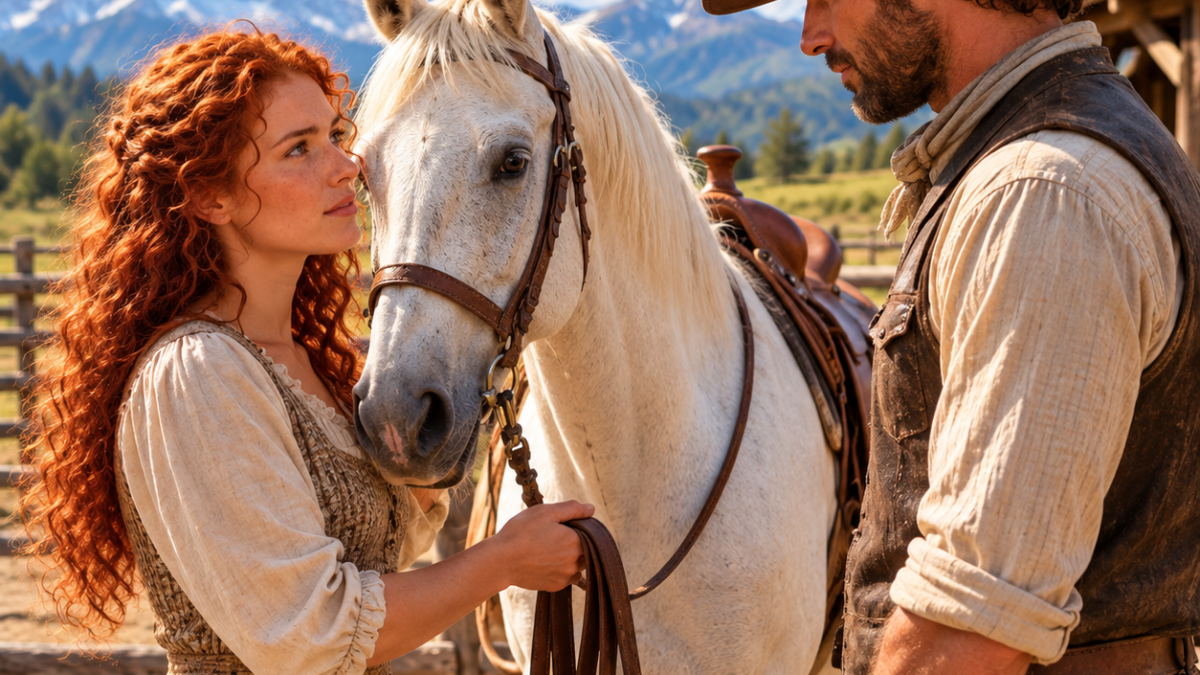
He was twelve years old, white as winter except for a gray smudge near one ear and a faint scar across his shoulder from a fence accident when he was young. Her father had brought him home when Hope was two.
“This one is for you, Nora,” James Callum had said, standing in the yard with one hand on the horse’s neck. “He’ll take care of you when I can’t.”
Nora had been sixteen then and too young to understand that some gifts were instructions for a future nobody wanted to name.
Hope pushed his nose into her shoulder.
He had done that since the day he arrived.
Nora closed her eyes and pressed her forehead against him.
“I’m sorry,” she whispered.
The horse breathed warm against her coat.
He had been taking care of her for fourteen months.
He had carried her to market, to deliveries, to the mill, to church when she could spare the time, and once through a storm so bad she had tied the reins loose and trusted him to find the road because she could not see past his mane.
He made her work possible.
He also ate feed she could not quite afford.
That was the cruelty of necessity.
It made you consider selling the very thing keeping you alive.
Her father had known this possibility existed.
In the last month of his life, when his breath came thin and his strength left in visible increments, he had called Nora to the bed one afternoon and given her the kind of practical instructions dying people give when they love someone enough not to spend all their remaining words on comfort.
“The south fence needs replacing before spring.”
“I know.”
“Don’t trust Voss past the written line.”
“I know.”
“The plow team at Henderson’s goes too cheap every March because he buys more than he can feed.”
“I know, Papa.”
“And if you ever have to let Hope go, take him to Robert Shaw.”
Nora had looked up sharply.
“I won’t.”
“If you have to.”
“I won’t.”
James had placed one thin hand over hers.
“If you have to,” he repeated. “Robert knows horses. He’s a fair man. He’ll treat the animal right.”
He had said it once.
Clearly.
Without repetition.
Nora had remembered it for fourteen months without needing it.
She needed it now.
She stood at the paddock fence with Hope’s nose against her shoulder and did not pretend the numbers would change.
They would not.
She needed ten dollars she did not have.
She had one thing worth far more than ten.
And she would sell him to the only man her father had trusted to treat him correctly.
At half past two, Nora saddled Hope.
She wore her dark coat, mended twice at the cuffs, and tucked the $4.40 into the inside pocket. She locked the house, though there was little worth stealing except things no thief would value properly: her father’s ledgers, her mother’s Bible, a chipped blue bowl, three good quilts, a photograph, and twenty-two years of labor sunk into soil and wood.
The Shaw Ranch was twelve minutes from the Callum property on horseback.
Twelve minutes that covered, in almost every visible way, the distance between survival and prosperity.
Robert Shaw owned five hundred acres of the best valley land. His main house was larger than necessary and solid enough to outlast men with softer hands. His barn was the largest private barn in the county. Cattle moved across the south pasture like a living brown river. His fences stood straight. His corrals were well built. His men were paid on time. His operation had the look of something run by a man who paid attention before problems turned expensive.
Robert had inherited the ranch at twenty-eight, six years earlier.
Nora knew him the way neighbors know each other in country where people lived far apart but saw one another at market, church, fence lines, and funerals. He had known her father better than he knew her. Shared fence conversations. Lent tools. Discussed cattle. Stood in the back at James Callum’s funeral with his hat in both hands and his face unreadable.
For fourteen months, Robert had not interfered.
Nora had noticed.
And appreciated it.
Mostly.
A proud person wants help in theory and privacy in practice. Nora wanted both, which left her often angry and always tired.
She rode through the Shaw gate at half past two.
Robert was in the corral working a young sorrel.
Patient work.
Not forcing. Not breaking. Asking.
The sorrel circled with restless energy, ears flicking, tail switching. Robert stood calm at the center, lead in hand, body turned slightly, voice low. He was thirty-four, tall, broad-shouldered, with dark hair beneath a worn hat and a face more thoughtful than handsome until he smiled, which he did rarely enough that one noticed.
He saw Nora at the gate and read something in the way she sat.
Straight.
Too straight.
The way a person sits when managing the collapse of something private.
He handed the sorrel’s lead to Tom, his foreman, and walked over.
Tom watched him go with the expression of a man storing the moment for later.
Robert removed his hat.
“Nora.”
“Robert.”
She had rehearsed three versions of what she meant to say on the ride over.
All were measured.
Dignified.
Sensible.
None survived the sight of him standing there.
“I need to sell Hope,” she said.
Robert looked at the horse.
Then at her.
He did not speak.
That was the right thing.
Nora needed to get through it, and his silence gave her enough room.
“Harlan Voss is calling the debt today. Before sundown. I’m short $9.60, and I have nothing left to sell except Hope.”
Her voice held.
She was grateful for that.
“My father said if I ever had to let him go, I should bring him to you.”
She paused.
“He said you’d treat him right.”
Robert looked at Hope for a long moment.
The white horse watched him with calm attention, as if taking his measure.
“How much do you need?”
“Ten dollars.”
Robert’s eyes returned to hers.
“That covers the gap and gets me through the month,” Nora said. “I know what he is worth. I know ten dollars is not what he is worth. But it is what I need, and it is what I am asking.”
Robert Shaw looked at this woman at his gate on a Monday afternoon.
He thought of James Callum, who had once told him over a shared fence that his daughter kept better books than he did and had more pride than good sense, which James had clearly intended as high praise.
He thought of the lamp burning late in the Callum house for fourteen months.
He thought of riding past that ridge and telling himself not to interfere because Nora was capable and proud, and interfering with capable, proud people was the quickest way to make them enemies.
He thought, too, that perhaps he had respected her pride longer than kindness required.
He put his hat back on.
“Come inside.”
Nora stiffened.
“Robert—”
“We need to talk about something other than a sale.”
“I have two hours.”
“Then we should talk efficiently.”
She followed him because there was no better option available.
He held the door.
She entered the Shaw kitchen and noticed three things immediately.
The table was sturdy and clean.
The stove was excellent and underused.
The pantry was organized by someone who understood ranching but not provisioning.
Bulk supplies sat in the wrong order. Flour stored too close to kerosene. Dried beans behind sugar. Coffee not sealed properly. Salt sacks too near damp. Whoever kept the household running had managed by memory rather than system, which meant the arrangement could survive one person and fail under two.
Nora filed all of this without meaning to.
Robert made coffee.
She did not refuse.
When he sat across from her, he did not lean back like a man settling into a negotiation. He sat forward slightly, forearms on the table, as though whatever happened next mattered enough to deserve posture.
“You’re short $9.60.”
“Yes.”
“The remaining principal after today is eight dollars.”
“Yes.”
“Monthly payment?”
“Two dollars.”
“Interest?”
“Too much.”
A corner of his mouth moved.
Almost a smile.
Almost.
Nora held her cup but did not drink.
“I am not looking for charity.”
“I know.”
“I came to sell a horse.”
“I know that too.”
“If you are about to tell me Hope is worth more than ten dollars, I already said so.”
“He is.”
“Robert.”
“I am not buying Hope.”
Her throat tightened despite every effort.
“Then I need to try somewhere else.”
“No.”
The word was quiet but firm.
Her eyes flashed.
“You do not get to say no to what I must do.”
“You’re right,” he said.
That stopped her.
Most men did not agree quickly when corrected.
Robert continued.
“I should have said I have no intention of letting you sell Hope for ten dollars when there is a better arrangement available.”
“What arrangement?”
“I need someone to manage the household operation here. Accounts. Provisions. Scheduling. Ordering. Rotation. Wages related to kitchen and house. My housekeeper left in August. Since then, five men and I have been pretending ranch skills somehow extend indoors.”
Nora looked toward the pantry.
“They do not.”
“No,” Robert said. “They do not.”
“You want a housekeeper?”
“I want a manager.”
“That is not the same thing.”
“I know.”
Her eyes narrowed.
“Do you?”
“I know enough to know I need one.”
He nodded toward the pantry.
“You already found six things wrong since you walked in.”
“Seven.”
This time, he did smile.
Briefly.
“There. The position pays three dollars a week. You keep your own property. You ride here daily or stay when the weather makes that sensible. Hope can board here and work from here. Better paddock, better feed. I advance you ten dollars against the first wages. You pay Voss before sundown. You keep the horse.”
Nora stared at him.
“That is charity dressed in boots.”
“No,” Robert said. “That is a practical arrangement that benefits both parties.”
“It benefits me more.”
“For the first three weeks, perhaps. After that, I suspect it benefits me considerably.”
“You are inventing work to solve my problem.”
“I assure you, Nora, the work has been inventing problems here for months without assistance.”
She looked again toward the pantry.
He was not wrong.
That irritated her.
“Why didn’t you come before?” she asked.
Robert looked down at his coffee.
“Because you did not ask.”
Her pride rose, hot and immediate.
He looked up before she could speak.
“And because your father told me once that you had more pride than good sense, which he meant as the highest compliment he knew how to give. I respected that. Maybe too long.”
The room grew quiet.
Nora thought of her father saying, Take him to Robert Shaw. He’ll treat the animal right.
She had thought he meant Hope.
Robert held her gaze.
“I’d rather give you both a home,” he said. “The position for you. The paddock for Hope. Fair wages for fair work. That is not charity.”
Nora sat in Robert Shaw’s kitchen with $4.40 to her name and two hours until sundown.
She thought about the house her father built.
The debt.
The horse in the yard.
The pantry with flour beside kerosene.
The man across from her, who had known her father and had watched the ridge for fourteen months without once coming to her door.
Finally, she said, “All right.”
Robert did not move.
“I’ll take the position,” she said. “On the terms you stated. Three dollars a week. Ten-dollar advance. Hope remains mine. My property remains mine. And if this arrangement stops being practical for either party, we say so plainly.”
Robert stood.
“Agreed.”
He fetched the money.
She paid Harlan Voss at 4:45.
He accepted the bills with the expression of a man who had expected a different outcome and disliked being denied the satisfaction of it.
“Will there be anything else, Mr. Voss?” Nora asked.
He looked at her.
“No, Miss Callum.”
“Good day, then.”
She walked back to Hope, put her forehead against his, and stood there in the Cedar Falls late afternoon until the tremor inside her passed.
Then she rode home, made supper, and went to bed.
She started at the Shaw Ranch on Wednesday.
By noon, she had confirmed that the house accounts were not merely disordered but aggressively neglected. Not through laziness. Robert was not lazy. His men were not lazy. But the household had been treated as something that happened in the background while the real business occurred in pasture, barn, and ledger.
Nora had strong opinions about that.
A house was an operation.
Food did not appear.
Clean linens did not reproduce in cupboards.
Candles did not refill themselves.
Coffee did not stay fresh through optimism.
By Friday afternoon, she had created a full inventory, reorganized the pantry, separated fire risks from food storage, established a rotation system, labeled dry goods, corrected supplier entries, and located $11.40 in overpayments from the past six months.
Tom appeared in the kitchen doorway while she was moving sugar.
He was forty, lean, sun-browned, and possessed of the exact expression men wore when encountering an authority they had not expected in a kitchen.
“The sugar was where I could find it,” he said.
“The sugar was beside kerosene.”
“I knew where it was.”
“It was also a fire hazard.”
Tom looked at the new location of the sugar.
Then at Nora.
Then back at the sugar.
“Robert know you moved everything?”
“Robert hired me to manage the house.”
“Yes.”
“The pantry is in the house.”
Tom leaned against the doorframe.
“You’ve been here three days.”
“The pantry needed attention on day one.”
“And?”
“I was being patient.”
Tom nodded slowly, as if witnessing something he intended to remember.
He went outside and found Robert by the south pasture fence.
“The new housekeeper moved the sugar,” Tom said.
Robert looked over.
“Is that a problem?”
Tom considered.
“No.”
“Then why tell me?”
“Seemed like the kind of thing a man should know about his own house.”
Robert looked toward the kitchen.
Then back at the cattle.
“Noted.”
That evening, he came in for supper and could not immediately locate the flour.
He stood in the kitchen doorway, looked toward where the flour used to be, and said nothing.
Nora was at the stove.
The kitchen smelled like fresh bread.
Robert understood, in the specific way of a man who had been eating his own cooking for six years, that this was better and that the flour question could wait.
On Friday, Nora called him to the table with the supplier ledgers.
She had expected a reaction.
She was not sure which kind.
Robert sat across from her and studied the figures she had laid out.
“Three suppliers,” she said. “Six months. Eleven dollars and forty cents in overpayments.”
He was still for a long moment.
“You found this in three days?”
“The filing system had room for improvement.”
“How much room?”
“Considerable.”
He looked at the ledger.
She continued.
“I’ve written to the suppliers. You should receive corrections by the end of the month.”
Robert looked at her.
“My father taught me to keep farm books before he taught me to saddle a horse,” Nora said. “He said land was lost more often through bad arithmetic than bad weather.”
Robert’s expression changed.
“He said that about you.”
Nora paused.
“What?”
“The last time I spoke with your father. About a month before he died.”
Robert looked down at the ledger, then at the pencil beside it.
“He said the Callum farm would survive him because Nora kept better books than he did.”
Nora’s throat tightened.
“I thought he meant it as comfort,” Robert said. “I am beginning to think he meant it as information.”
Nora looked at the figures.
Then at her hands.
Her father had always been economical with praise. Not ungenerous. Just careful. If he said something, he meant it. If he repeated it, he meant it twice. He had apparently been speaking of her to Robert Shaw. Not as a daughter to pity. As a capable person to trust.
“Three dollars a week,” Robert said suddenly.
Nora looked up.
“Is that still the agreed rate?”
“It is what you offered.”
“It is not enough for what you’re doing.”
“We agreed to three.”
“We can renegotiate.”
“No.”
Robert sat back slightly.
“No?”
“Do not change the terms.”
His brow furrowed.
“Nora—”
“I need to know what the terms are.”
He stopped.
Then he understood.
She saw it happen.
She needed the arrangement to remain what it was until she decided what else it might become. She needed help that did not shift shape beneath her feet. She needed fair work and agreed wages, not gratitude that turned into obligation or admiration that rewrote the contract.
Robert nodded.
“Three dollars,” he said. “As agreed.”
She looked down at the ledger again.
“Thank you.”
Tom, working on a harness in the adjacent room and hearing all of it, said nothing.
But later that day he moved the sugar back to its proper new place after one of the hands put it wrong.
By December, Montana Territory had made travel difficult enough that practicality settled what neither Nora nor Robert had named.
Snow buried the lower fence rails. Wind cut across the valley. The twelve-minute ride from the Callum property became forty minutes of careful work through drifts that Hope handled with the patience of a horse who had known worse.
One evening, Robert said without ceremony, “The east bedroom is unused.”
Nora looked up from the provision schedule.
“Yes.”
“It makes no practical sense for you to ride forty minutes in the dark when the work is here.”
“No practical sense.”
“No.”
She waited.
He continued.
“You can use it through winter.”
The offer hung between them.
Practical.
Reasonable.
Dangerous.
Nora looked at the ledger.
Then toward the window where the dark had already swallowed the yard.
“I’ll bring my own quilts.”
“Of course.”
“And Hope stays in the east paddock.”
“That was assumed.”
“I will continue maintaining my own property.”
“Yes.”
“And this does not change the wages.”
“No.”
She nodded.
“Then it is practical.”
She moved into the east bedroom two days later.
She told herself it was practical every morning when she sat at the kitchen table before the house woke, coffee in hand, watching Montana dark turn gray, then blue.
She told herself it was practical when she learned the sound of Robert’s steps in the hallway.
The third board creaked under him every morning.
She told herself it was practical when she knew he read at the table for twenty minutes before going outside and that on mornings when something worried him, he read the same page twice without noticing.
There were more second reads in December than there had been in November.
She told herself it was practical when she began setting his coffee out before he entered.
Black.
No sugar.
Mug warmed near the stove first, because he drank slowly when reading and she disliked seeing good coffee go cold.
Everything could be called practical if one tried hard enough.
One evening in December, she found him in the barn after supper working on a harness by lamplight.
This was not unusual.
What was unusual was the tool on the workbench beside him.
Leather-handled.
Old.
Repaired several times.
Used carefully and repaired again.
Nora recognized the stamped mark before anything else.
Her father’s mark.
“That was his,” she said.
Robert looked at the tool.
Then at her.
“He lent it to me four years ago.”
Nora stepped into the barn.
“I kept meaning to return it,” Robert said.
“Why didn’t you?”
“After he died, I thought…”
He stopped.
Outside, winter pressed against the barn walls.
“I kept it because it was the last thing he lent me. I should have brought it to you. I didn’t know how.”
Nora crossed to the workbench and picked it up.
The handle fit her hand with terrible familiarity. She had last seen it in her father’s grip, sunlight falling across his sleeve, his voice explaining how to repair a strap properly instead of quickly.
Take Hope to Robert Shaw.
He’ll treat the animal right.
She thought now of a man who had known Robert well enough to lend him a tool and trust it would come back.
She turned the tool over once.
Then handed it to Robert.
“Keep it.”
His eyes searched hers.
“He would want it used.”
Robert took it.
“He talked about you,” he said.
“Often?”
“Every time I saw him.”
Nora looked away first.
Not because she disbelieved him.
Because she did.
And believing hurt.
The house began feeling like hers somewhere between November and December.
Not because she owned it.
Not because Robert said anything grand.
Because her systems held.
Because Tom stopped asking where things had gone and started putting them where she had placed them.
Because the men came to her for supply questions rather than Robert.
Because Hope settled into the east paddock as if he had personally approved the arrangement from the beginning.
Because Robert began reading the same page twice whenever Nora was absent from the breakfast table.
Because her father’s tool hung on the barn wall where it could be used.
Then January came.
On the first Monday of the month, Nora rode to Cedar Falls to make the debt payment.
Two dollars exact.
She had placed it in an envelope the night before.
At Voss’s office, the clerk looked at the envelope, then at his ledger, then back at her.
“Miss Callum.”
“Yes?”
“The account is settled.”
She stared at him.
“What?”
“In full.”
He turned the ledger.
“January fifteenth. Payment of eight dollars against the remaining principal. Account closed.”
Nora looked at the line.
Robert Shaw.
She had been at the Shaw Ranch on January fifteenth. That morning, she had reorganized the provision schedule. That afternoon, she had corrected Tom’s repair on a wagon spoke. That evening, she had sat across from Robert at supper while he read the newspaper and made no mention of paying off the last of her debt.
She folded the two-dollar envelope and put it back into her pocket.
Then she thanked the clerk, walked out onto the boardwalk, and stood in the January cold.
She thought about practical arrangements.
Agreed terms.
Three dollars a week.
Don’t change the terms.
She thought about the eight dollars paid without a word.
She got on Hope and rode back to the Shaw Ranch.
She did not decide what she would say.
Only that she would say it before she found a reason not to.
Robert was at the south fence when she arrived.
He looked up, saw her face, and understood enough to go still.
“You went to the lending office.”
“Yes.”
“Nora—”
“You paid the account.”
“It was eight dollars.”
“That is not the point.”
“I know.”
“Do you?”
He looked toward the mountains.
“I should have told you.”
“Yes.”
“I didn’t tell you because I knew you would not accept it if I asked first.”
She held his gaze.
“And you decided that made it acceptable?”
“No.”
The answer came quietly.
He turned fully toward her.
“I was wrong.”
Nora did not move.
“Helping you did not give me the right to decide for you,” Robert said. “The eight dollars can remain a loan. You can repay it through wages. Or I can ask Voss to reverse the entry and we settle it another way. Or I can mark it as a bonus for correcting eleven dollars and forty cents in overpayments, if that feels fair to you. You choose.”
He swallowed.
“Those options are genuinely on the table.”
Nora looked at him for a long moment.
Then at Hope grazing nearby, calm as sunrise.
“That,” she said, “is the first thing you have said today that sounds like respect.”
Robert lowered his eyes.
“Yes. I know.”
“You are better at solving problems than explaining them.”
“I am working on the explaining.”
“Are you?”
“I am not naturally good at it.”
“Why? Because you dislike talking?”
“Because when I care about something, I tend to act instead of speak.”
He looked at her then.
“It is a consistent failing.”
Nora almost smiled.
Not quite.
Robert continued.
“I paid the eight dollars because I did not like watching you carry it. Not because you could not manage it. You clearly can manage your affairs better than I managed my own for six years. I simply did not want you to have to carry it alone.”
His voice grew quieter.
“That is the honest reason. I should have been honest about it before acting.”
Nora stood in the February cold and looked at a man who had paid eight dollars in silence, then offered her three genuine choices and admitted a failing without decoration.
She thought about a house that had started feeling like hers.
A tool on a workbench.
A lamp burning late seen from a ridge.
Her father, who never wasted words.
Give me until Sunday,” she said.
Robert nodded.
“To decide about the money?”
“No.”
He looked at her.
“Not to decide whether I care for you,” Nora said. “I know whether I care for you.”
Robert’s face changed.
Just slightly.
“To decide whether I can trust you with that knowledge.”
He did not argue.
Did not persuade.
Did not reach for her.
“Sunday,” he said.
Behind her, Tom had been checking the east section of fence and heard most of this. He waited until Nora rode away before walking to Robert.
“April,” Tom said.
Robert turned.
“What?”
“I’m betting April.”
“For what?”
“The proposal.”
Robert stared.
Tom went back to work.
Nora returned Sunday.
Not with an answer ready, but with the answer she had known and spent three days deciding she could trust.
Robert was on the porch when she rode in.
Which meant he had been watching.
Which she noted.
She tied Hope at the post and sat on the porch step. Robert sat beside her.
For a while, they only looked at the snow in the lower pastures and the mountains beyond.
“The eight dollars,” she said.
“I’ll repay it through wages. Two dollars a month until it’s settled.”
“All right.”
“And next time, you ask me first.”
“Yes.”
“I mean that.”
“I know.”
“No deciding for me because caring makes you impatient.”
“Yes.”
She looked at Hope.
“My father knew you,” she said.
Robert stayed quiet.
“He trusted you with his tool. His horse. His last instruction.”
She turned to him.
“I have been trying to understand what he knew that I did not.”
“What did he know?”
“That you solve problems before explaining them.”
Robert’s mouth tightened.
“And that you were working on the explaining,” Nora added.
He looked at her.
“He also knew I have more pride than good sense, which means I need someone honest enough to say what I do not want to hear.”
A pause.
“You were honest on Friday. That mattered.”
Robert looked toward Hope, then back at Nora.
“Nora.”
“Yes.”
“I would like to court you. Properly.”
“I know.”
He blinked.
“I’ll let you.”
This time, she did almost smile.
He saw it.
“But Robert?”
“Yes?”
“Next time you want to do something for me—ask first.”
“Yes,” he said. “I will.”
They sat on the porch in the February cold while Hope lifted his head from the post, looked at them both, and went back to waiting.
He had known since November how this would go.
March came with thaw and mud and relief.
Robert courted Nora the way he did most things: practically, sincerely, and with occasional difficulty in execution.
He brought wildflowers once with the stiff discomfort of a man who understood the gesture was correct but not what to do after delivering them.
Nora placed them in the window above the kitchen sink.
She did not mention them.
She also did not remove them until they wilted.
On Easter Sunday, he tried to compliment her dress.
“That dress suits you.”
“The dress?”
“The color.”
“Only the color?”
Robert looked toward Tom, who immediately found urgent business near the barn.
Robert looked back.
“The dress suits you,” he said again.
It was not an improvement.
But it was honest.
Nora found that, on balance, far more valuable than a man who said polished things easily and meant half of them.
On an April evening, she was making supper when Robert came in from the south pasture with the air of a man who had decided something and was done waiting on himself.
He sat at the kitchen table.
Looked at his hands.
Then at her.
“I used to think this house was quiet because I preferred it that way,” he said.
Nora stopped stirring.
Robert looked directly at her.
“Now I know it was only waiting for someone whose absence I would notice.”
The spoon rested against the pot.
Nora turned fully.
“Nora Callum,” he said. “Will you marry me?”
It was, somehow, both a question and the only honest statement left between them.
She walked to the table.
Sat across from him.
Placed both hands on the wood.
Robert put his hands over hers.
“Yes,” she said simply.
The way she said everything that mattered.
They married in June at the Cedar Falls church.
The valley was green from snowmelt. The mountains stood clear and blue beyond town. The whole of Cedar Falls came, partly because weddings were rare enough entertainment and partly because anyone with eyes had been expecting this one since February.
Tom sat in the third row.
He had been there since the morning.
After the ceremony, he appeared at Robert’s side.
“April twenty-third,” Tom said.
Robert looked at him.
“What?”
“I won by seven days.”
“You bet April.”
“I bet before May.”
“April twenty-third is before May,” Robert said.
“That is technically a win.”
Tom held out his hand.
Robert stared at him, then reached into his pocket and handed over a silver dollar.
Tom accepted it with the satisfaction of a man who had been right since November.
“You should have bet February,” Robert said.
“I knew February,” Tom replied. “I just didn’t think you did.”
Then he walked away.
The Callum property did not go to auction.
That was Nora’s decision, and Robert did not argue.
Those forty acres were hers. Her father’s work. Her mother’s home. Her own fourteen months of holding together what others expected to fail. She would not let them go simply because she had married a man with five hundred.
The two properties ran alongside each other with the practical cooperation of two people who understood the same land and respected separate claims on it.
Hope had the run of both.
He took advantage of this completely.
Once, he removed Tom’s hat from a fence post and carried it into the south pasture, where he stood over it without remorse.
Nora continued managing the Shaw Ranch accounts. By the end of the first year, she was also keeping books for two neighboring operations and charging fair wages. She did not undercharge. Robert ran the land with the same patient attention he had always given it, understanding that soil, cattle, horses, and people all gave back according to how honestly they were tended.
On an evening in the second spring, Nora sat on the porch in the last light and watched Hope grazing in the near pasture.
Robert came out with two cups of coffee.
He handed one to her and sat beside her.
She thought about a Monday afternoon in November.
Two hours until sundown.
$4.40.
A white horse she had ridden twelve minutes to the one man her father trusted.
She thought about ten dollars that had become an east bedroom, a reorganized pantry, a tool on a workbench, wildflowers in a kitchen window, and a man who learned to ask before helping.
She thought about her father’s last instruction.
He had not said Robert Shaw will give you a home.
He had not said Robert Shaw is the man you will marry.
He had only said:
He’ll treat the animal right.
Nora looked at Hope.
Then at Robert.
“My father knew,” she said.
Robert followed her gaze to the horse.
Then back to her.
“Yes,” he said. “I think he did.”
Nora held her coffee in the Montana spring evening and looked at everything her father had left her.
The property.
The horse.
The last instruction.
The man the instruction had led her to.
“He never wasted a word,” she said.
Robert smiled faintly.
“No. I don’t suppose he did.”
Nora Callum had ridden to the Shaw Ranch gate with a white horse and a price that was not what the horse was worth.
She had thought she was selling Hope.
She had been following the last careful map her father ever gave her.
Take him to Robert Shaw.
He’ll treat the animal right.
He had.
Robert had treated the horse right.
The accounts right.
The terms right, once he learned how.
And eventually, Nora right.
Which meant honestly.
Patiently.
With the understanding that a woman who had held forty acres together alone for fourteen months did not need rescuing.
She needed fair terms.
She needed those terms to remain steady until she was ready for them to become something else.
She needed a man who could admit a failing, offer true choices, and ask next time.
That is what love looked like when it became honest.
Not rescue.
Not taking over because caring made someone impatient.
Partnership.
A home with room enough for pride, work, forgiveness, and a white horse named Hope who had known before either of them did exactly where they belonged.







