She Found a Wounded Cowboy Half-Dead Beside Her Fence and Took Him In—Then She Lifted His Saddle Flap and Saw the Brand Her Father Had Hated for 20 Years.
PART3:
Her father had pointed it out only once when she was a child, but once had been enough. His voice had gone flat in a way that frightened her more than anger would have.
If you ever see that brand, you come home. You hear me, Tessa? You come home, and you do not speak to whoever carries it.
She had been eight years old then.
Young enough to obey.
Old enough to remember why.
Crowe.
Silas Crowe.
The name her father never said without something hardening in his face.
The man he believed had brought fire to the Rowan barn twenty years earlier.
The man whose silence had let that belief grow roots deep enough to split two families apart.
The man connected to the night Tessa’s mother died.
Tessa looked at the brand.
Then at the wounded stranger in the wet grass.
Then at the sky, brightening over the ridge.
The nearest town was forty minutes off if a horse was fresh.
Her father was in Laramie.
The man had a fever climbing in his skin.
Whatever that mark meant, it did not change the arithmetic in front of her.
He was hurt.
She was there.
That was enough.
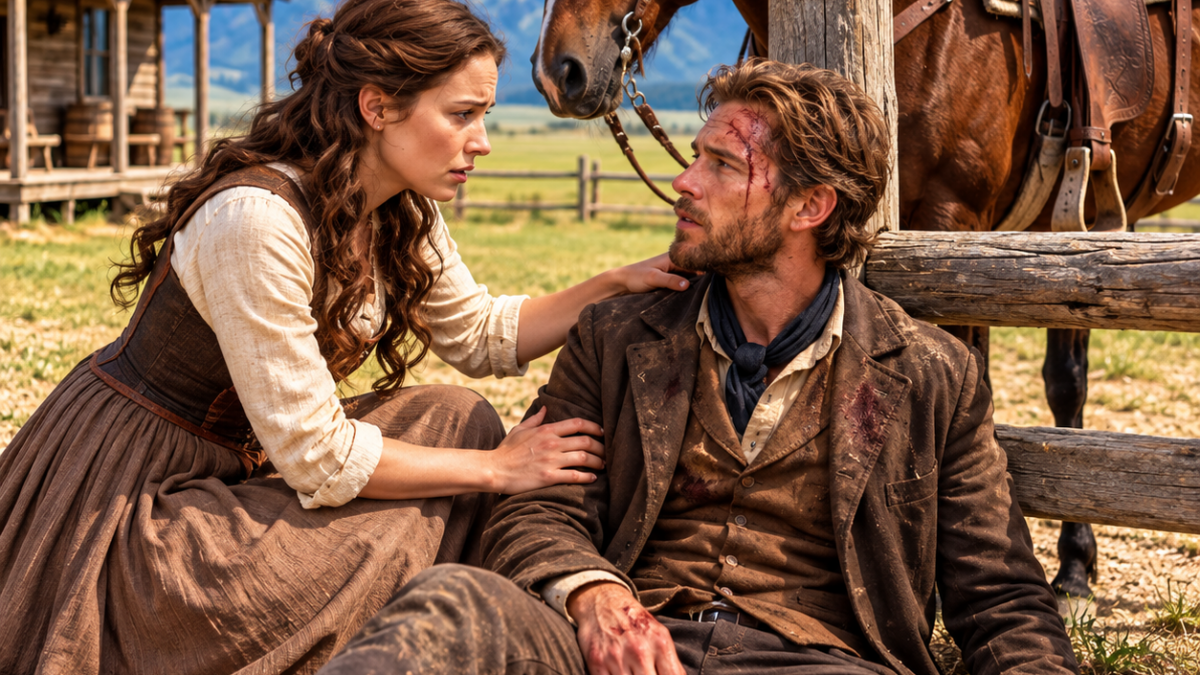
She brought her mare beside him, spoke low to both horses, and spent the better part of twenty minutes getting a man who outweighed her by sixty pounds up across the saddle. Twice he nearly slid off. Once he woke enough to curse softly and try to push her away, then passed out again before she could tell him he was in no condition to be particular.
“Save your pride,” she muttered, tightening the rope around him. “You may need it later.”
She led both horses toward the old grazing cabin.
It stood half a mile west of the creek, used mostly during calving season now, with a cot, a water barrel, a stone hearth, and a roof that leaked only in storms hard enough to make a man regret many things.
By the time she got him inside, sweat had cooled along her spine despite the morning air.
She built a fire.
Cut away his wet shirt.
Cleaned the gash above his eye.
Splinted his shoulder as well as she could.
Then sat beside the cot with a rifle across her knees and watched the fever come.
The fever broke on the second night.
Tessa had fallen asleep in the chair without meaning to, chin dropped, hands folded around a tin cup gone cold.
She woke near three in the morning to find him watching her.
His eyes were dark.
Unfocused.
But conscious.
“You’re in the grazing cabin on Rowan property,” she said before he could ask. “Your horse is in the lean-to. Your shoulder’s wrenched. You took a fever. I set it as best I could.”
He blinked slowly.
“How long?”
“Second night.”
His eyes closed, then opened again.
“Thank you.”
“Don’t thank me yet. You’re not clear of the fever.”
He looked at her a moment as if trying to decide whether she was real.
Then he slept again.
By morning, the fever had eased, though standing left him gray in the face and breathing hard. On the third day, sitting propped against the wall with a cup of broth he could barely hold steady, he told her his name.
“Daniel Crowe.”
Tessa’s hand tightened once around the ladle.
He did not notice.
“Horse breeder,” he added. “I was cutting through toward Clearwater when my mare spooked at a rattler and threw me.”
“You ride a gelding.”
“My mare’s at home. Borrowed the gelding from my father.”
“Your father.”
“Yes.”
“What’s his name?”
“Silas Crowe.”
There it was.
Spoken plainly.
Without caution.
Without knowing what it meant on this side of the valley.
Tessa looked into his face and understood.
He did not know.
Not fully.
He knew his own name.
His father’s name.
The brand on the saddle.
But he did not know what those things cost where she lived.
She could tell him.
She could throw the old wound between them like a blade.
Your father ruined mine.
Your family burned my mother out of this world.
Your name is not welcome here.
But that story belonged first to Ephraim Rowan.
Her father had carried it for twenty years.
It was not hers to hand over while he was gone.
“Tessa Rowan,” she said instead.
Daniel studied her face.
“I owe you considerably, Miss Rowan.”
“You owe me the use of a cot. That’s the accounting.”
Something in his expression moved.
Not quite a smile.
“Is that how you keep things? Simple accounting?”
“Makes them easier to carry.”
He held her gaze for a moment.
Then let his eyes drop shut.
She took the empty cup before it tipped from his hand.
And she did not examine too closely what she felt about a man wearing that brand who had just handed her own words back to her as if they mattered.
Daniel did not touch the fence for another week.
His shoulder would not allow it.
The first time he tried to lift a rail, Tessa told him plainly to sit back down.
He did.
She noted that.
A foolish man would have argued.
A proud man would have tried anyway.
Daniel Crowe looked at the rail, then at his shoulder, then sat down on the cabin step without another word.
By the second week, he could reset a single post one-handed while Tessa held it steady.
By the third, he could manage the post-hole digger if he moved slowly and cursed under his breath only when he thought she could not hear.
By then, repairing the fence had stopped being a debt and become a habit.
Neither of them named it.
“You found the tool shed,” she said one morning when he came back with the maul.
“Door was open.”
“There’s no one to knock for.”
“I knocked first.”
“Why?”
“Habit.”
He moved to the next post.
She found that she liked that answer more than she should.
One morning, she brought coffee out to the fence line.
They stood side by side, looking at the September light catching in the aspens high on the ridge. Gold had begun to show in patches among the green. The wind moved through them with that dry rushing sound aspens make when they are speaking to one another and not to you.
“How long have you been running this place with your father gone?” Daniel asked.
“Since my mother died.”
“How old were you?”
“Eight.”
He did not offer condolence.
She was grateful.
Twenty years of condolences had not changed the fact.
“My sister is buried near a creek too,” he said after a while.
Not as invitation.
Just a fact laid beside hers.
“How old were you?”
“Twelve. She was eight.”
They stood with that for a moment.
Two children lost.
Two families altered.
Neither yet brave enough to ask whether those losses belonged to the same night.
Then Daniel handed back the empty cup.
“Third post needs resetting. I’ll have it by noon.”
She went back inside and thought, not for the first time, about a man who could say a thing like that and return to work.
He left a tin of healing salve on the gate post the following week.
A small note sat beneath it.
For the cut supply.
D.C.
She had used the last of hers on him and had not mentioned it.
He had noticed anyway.
After that, the encounters continued the way valley encounters do.
Frequent enough not to be accidental.
Ordinary enough to need no acknowledgment.
At Cedar Falls General Store, where he bought wire and she bought flour.
At the farrier’s, where their horses stood together in the shade and neither of them moved away.
At the autumn market, where he bought two jars of her apple butter and said the second was for his father.
She watched him walk away and noticed before he had gone twenty feet that the lid on the first jar was already loose and the level already down by a third.
She said nothing.
She filed it away with all the other things she had begun filing.
The way he rubbed the gelding’s nose before mounting.
The way he never interrupted when she spoke to a seller.
The way he listened to land like a person might listen to a song.
The way he spoke of his father with care and frustration tangled so closely she could not separate them.
At the farrier’s, while waiting on new shoes, Daniel told her the rest of his own history.
“I was sent to my aunt in Clearwater after Elsie died,” he said. “I was twelve. Grew up there. Learned horses from her husband. Built my trade out that way.”
Tessa kept her face still.
“I only came back to my father’s place this past spring,” he continued. “His health started failing. I’ve been trying to piece together what happened to my sister ever since.”
“What do you mean?”
“My father doesn’t talk about it. Never did. I found an old letter of his that mentioned a spring shared between two fence lines. Followed the trail of it.”
He looked toward the road.
“That’s how I ended up on your east road.”
“You’ve been back six months.”
“About that.”
It explained things she had not known needed explaining.
Why a man wearing that brand did not seem to know what it cost here.
Why he moved through the valley like someone relearning a place he had loved and lost before he was old enough to understand it.
Why grief sat behind his eyes, not guilt.
Not yet.
One Wednesday, he asked if she had ever ridden the West Ridge.
She had.
Many times.
She said no because she wanted to hear him describe it.
He described it correctly.
The narrow trail where the shale turned loose underfoot.
The third stand of aspens.
The spring that still ran clean even late in the year.
The place where the valley opened suddenly and made a person feel as if the whole county had unfolded below them.
“My father’s land runs the south edge of that valley,” he said. “We grazed that pasture before I was born.”
The shared spring.
Tessa noted it.
Filed it.
She still had not told him what her father believed.
That could wait for October, she told herself.
Her father would return in October.
It was only September.
They rode up on a Saturday.
The sky was enormous.
The aspens made their dry rushing sound in the wind.
Daniel let her set the pace where she knew the trail better. She let him lead where the creek crossed soft ground he remembered from childhood.
At the top, the whole valley lay below them.
The Rowan barn.
The east fence standing straight now.
The orchard on the north edge, neglected but not dead.
Past it, the invisible line where Crowe land began.
“If the land were mine outright,” Tessa said, surprising herself, “I’d bring the north orchard back.”
Daniel looked toward it.
“My mother planted half of it before she died. Nobody’s touched it since.”
“What’s stopping you?”
“Time. A father who thinks it’s more trouble than the apples are worth.”
“Where would you sell them?”
“Past the county line maybe. If I ever got that far.”
“You’d get that far.”
It did not sound like flattery.
It sounded like an observation.
She looked at him.
He was watching the orchard now, as if filing something away too.
At the top of the ridge, he reached over and took her hand.
Tessa did not move away.
She thought, This is the last easy day.
She made herself remember it.
The gold aspens.
The wind.
His hand warm around hers.
The valley spread below.
The two properties divided by an old wound neither of them had opened yet.
Four days later, Ephraim Rowan came home early.
The horse sale in Laramie had finished ahead of schedule. He crossed the yard with a saddlebag in one hand just as Tessa and Daniel came riding down the north track.
He stopped.
Looked at his daughter.
Looked at the man beside her.
Then at the saddle.
The mark was visible from twenty feet.
A crow above two crossed lines.
Ephraim’s face went beyond anger.
Past fury.
Into something older.
“Get away from my daughter.”
Tessa’s blood chilled.
“Papa.”
“Get inside.”
“I know who he is.”
“No,” Ephraim said. “You don’t.”
Daniel stayed mounted, one hand on the reins, his expression shifting from confusion to understanding that something terrible had arrived before anyone explained it.
Tessa dismounted and stood between them.
“Tell me,” she said to her father.
Ephraim looked at the brand for a long moment.
Then spoke.
“Your mother. The fire.”
The world narrowed.
“Silas Crowe’s horse was outside our barn that night,” Ephraim said. “His saddle on the fence post. That same mark.”
Tessa turned slowly toward Daniel.
“I went to him the next morning,” Ephraim continued. “He didn’t deny being there. Said nothing at all.”
His voice stayed level in the way of something held too long.
“He let me believe what I believed for twenty years.”
Daniel had dismounted now.
His hat was in his hands.
The color had gone from his face.
“Daniel,” Tessa said. “Tell me what you know.”
He looked at Ephraim.
“I was twelve when the fire happened. My sister Elsie was eight. I was sent to my aunt in Clearwater two weeks later. I only came back this spring when my father’s health started failing.”
He swallowed.
“I’ve spent six months trying to understand what happened that night because he never explained it to me.”
His voice did not shake.
It went level instead, which was what a voice did when steady was not quite possible.
“I didn’t know until now that you believed he started it. I didn’t know what he let you carry.”
Ephraim’s jaw tightened.
Daniel continued.
“I don’t know everything my father did that night. I know he was there. I know he’s never spoken of it. I know my sister went with him and didn’t come home.”
He held Ephraim’s gaze.
“I’m going to ride home and ask him again. And I’m going to keep asking until I have all of it.”
Then he looked at Tessa.
Standing between them.
Between the last easy day and whatever this was now.
“I’m sorry,” he said, “for what my family cost yours.”
He put on his hat, mounted, and rode south.
Tessa watched him go.
Then turned to her father, who stood in the yard with twenty years of grief on his face and the first beginnings of doubt he had never allowed himself to feel.
Daniel found Silas Crowe in the barn, working a length of harness leather.
The old man set it down the moment his son appeared.
Silas had grown thinner since spring, though he still had the same strong hands Daniel remembered from childhood. His beard had gone white at the chin. His cough came more often now. The doctor from Clearwater had used careful words. Daniel had heard what they meant.
Time was no longer something Silas had much of.
“I met Ephraim Rowan’s daughter today,” Daniel said.
Silas went still.
“I met her because I spent six months trying to understand what happened the night Elsie died. Today Ephraim looked at my saddle and told me what you never did.”
Silas looked down at his hands for a long time.
Then he spoke.
“I was riding to the Rowan place that night to settle the dispute over the spring.”
Daniel said nothing.
“I wanted to propose we share the water. I’d wanted to for two years and didn’t because pride is cheaper than sense until the bill comes due.”
He drew a slow breath.
“I never reached the house. Storm caught me at the property line. Lightning struck the old oak near the barn. Sparks caught the dry grass at the foundation.”
Daniel’s hands closed.
“I ran in to free the horses before the fire spread.”
Silas’s voice roughened.
“I didn’t know Elsie had followed me on her pony until I heard her inside calling for it. One of the animals had bolted into a stall and wouldn’t come. She went in after it before I could stop her.”
Daniel sat slowly on the bench.
“I went back in for her,” Silas said. “Got her as far as the door.”
His eyes closed.
“Miriam Rowan saw her go in.”
Daniel stopped breathing.
“She was there?”
“She and your mother had been close as sisters before either of you children were born. Miriam had come to help with the horses, same as I had. She saw Elsie run in and went straight after her. No hesitation.”
The barn seemed to darken.
“I went back for both of them. Smoke. Horses. Noise. In the scramble, I knocked a lamp off the post. Fire caught faster after that. Took the loft.”
His voice broke once, then steadied.
“I got them near the door. A support timber came down between us. Threw me clear toward the opening. I couldn’t get back.”
Daniel could see it.
Wished he could not.
“Elsie didn’t make it,” Silas said. “Miriam didn’t make it. I did.”
He looked at his hands.
“When Ephraim came to me the next morning and said I’d started the fire, I let him believe it.”
“Why?”
“Because I had been there without telling him. Because I knocked over the lamp. Because his wife died going in after my daughter and I came out and they didn’t.”
Silas’s eyes lifted.
“I believed I deserved every bit of what he thought of me. Some days I still do.”
Daniel thought about six months of questions.
About Tessa standing between two men in a yard.
About a spring two families had fought over for no reason worth the cost.
“The families were close,” Daniel said.
Silas reached into his coat and drew out a small locket on a chain.
Blackened along one edge.
Hinge warped by heat.
“Open it.”
Daniel did.
Inside was a tiny photograph.
Miriam Rowan on porch steps.
Elsie tucked laughing under her arm.
Miriam looking down at the child with the kind of love a person gives to someone who belongs to them, even when she does not.
Daniel closed his eyes.
“Why keep it hidden?”
“Because looking at it hurt.”
“And not looking at it?”
Silas gave a faint, broken laugh.
“That hurt too.”
Daniel returned to the Rowan property on Thursday.
He did not know whether either of them would see him.
He came anyway because not coming was impossible.
Tessa opened the door.
For a moment, neither spoke.
“I came to talk to your father,” Daniel said.
He held up the locket.
Ephraim sat at the kitchen table because Tessa asked him to, not because he wanted to.
Daniel told the story plainly.
In order.
The storm.
The oak.
The horses.
Elsie following without Silas knowing.
Miriam going in after her.
The lamp.
The timber.
“He did not start the fire,” Daniel said. “He was there without telling you why. The lamp went over in the scramble to save both of them. He carried that for twenty years believing he deserved everything you gave him for it.”
Ephraim’s face did not move.
Daniel slid the locket across the table.
“Open it.”
For a long time, Ephraim did not touch it.
Then he did.
His thumb stopped on the scorched edge.
He opened the locket.
Whatever anger remained on his face fractured.
“Miriam,” he whispered.
Not to Daniel.
Not to Tessa.
To the photograph.
He knew exactly which summer.
Exactly which week.
Exactly how his wife had looked on those porch steps.
“She wouldn’t have wanted this,” he said finally.
“I know,” Daniel said.
“Does your father know you’re here?”
“He wants to come himself. I told him to let me come first.”
Ephraim closed the locket carefully.
“Not today.”
Daniel nodded.
“Tell him not today.”
He stood.
Tessa walked him to the door.
When he passed her, she put one hand briefly on his arm.
Not romance.
Not yet.
Just two people standing in the same wreckage, acknowledging the weight of it.
Daniel understood.
He rode south.
Silas came on a Monday.
On foot.
The forty-minute walk from the south line.
He came without witnesses.
Without written account.
Without an excuse prepared.
He waited at the gate until Ephraim came out.
The two old men stood on opposite sides of the fence that had carried more hatred than wire could justify.
“I didn’t start that fire,” Silas said.
Ephraim did not move.
“But I knocked over the lamp. I let you believe I started it because I was there, and Elsie followed me, and your wife went in after her, and I was the only one who came out.”
He did not look away.
“My silence fed your hate for twenty years. I can’t give back what you lost. I can’t undo what I chose not to tell you.”
His voice lowered.
“I’m asking your pardon. Not for the fire. For the silence.”
Ephraim studied him a long time.
He did not say I forgive you.
That would have been too simple, and nothing between them was simple.
“My wife’s name was Miriam.”
“I know,” Silas said.
“Your daughter was eight.”
“She was.”
“She was kind.”
“Yes.”
“Miriam would have gone in for her even if she wasn’t ours to protect. That was who she was.”
Silas swallowed.
“I know. That is why I kept the photograph.”
Ephraim looked down at the fence latch.
Then opened the gate.
Not an invitation.
Not forgiveness.
An opening.
The way one lets air into a room shut too long.
That was the beginning.
Standing there was the beginning.
They opened the spring together in November.
Silas and Ephraim.
Daniel and Tessa watching from the rise.
The water ran clean the way it always had, patient through the whole dispute above it.
Tessa suggested they plant two trees beside it.
One for Miriam.
One for Elsie.
Both fathers said yes without arguing.
That told her something.
Reconciliation did not arrive as a single event.
There were weeks when Ephraim could not look at Silas without old grief rising.
Weeks when Silas could not come to the fence line at all.
Days when Daniel and Tessa rode in silence because the past sat between them too heavily.
But the trees grew.
Their small leaves opened in spring.
Their roots found water.
One February morning, Ephraim came out to find Daniel saddling Tessa’s horse at the gate.
Daniel’s gelding stood beside it, trying for the third time that week to tug Daniel’s glove from his coat pocket by the fingers.
A habit Daniel had given up correcting.
Ephraim looked at the brand on Daniel’s saddle.
Not with forgiveness exactly.
With the beginning of trying.
“She likes the West Ridge in the morning,” Ephraim said.
Daniel looked up.
“I know.”
“Don’t keep her past noon. South weather comes in fast this time of year.”
“Yes, sir.”
Ephraim went back inside.
Tessa came out with her coat and read Daniel’s face.
“What did he say?”
“That south weather comes in fast.”
“Was that a blessing?”
“Closest we’re likely to get before a wedding.”
She went still.
Daniel cursed himself silently.
That had not been how he meant to say it.
They rode to the West Ridge in March.
The place where they had first taken each other’s hand.
The aspens were bare, but the shape of spring had begun beneath the ground.
Daniel dismounted near the overlook.
“I’ve been turning something over,” he said.
Tessa watched him carefully.
“I want to say it plainly. The way you taught me.”
“I taught you?”
“Yes.”
“When?”
“Every time you refused to let me hide behind half of something.”
She smiled faintly.
He took off his hat.
“I won’t ask you to marry me to mend what our fathers broke. That is not a reason good enough for either of us.”
“Then don’t,” Tessa said.
He froze.
Her eyes softened.
“Ask me because Tuesdays have become the best day of my week.”
Daniel could not speak.
“Ask me because I stopped riding this ridge alone and do not want to start again.”
She stepped closer.
“Ask me because that is the truth of it. Nothing about our fathers changes what is true.”
So he asked her because of that.
And she said yes because of that.
They told Ephraim first.
Then rode south to tell Silas.
Neither man said much.
Ephraim looked at them both and said only, “Well. The trees are already planted.”
Silas said nothing at all.
He put one hand briefly on Daniel’s shoulder.
That was more than either expected.
They married in spring on the strip of land between the two properties.
Not Rowan land.
Not Crowe land.
Where the spring ran.
The two young trees stood nearby, coming into their second season.
Ephraim walked Tessa to where Daniel waited.
He placed her hand in Daniel’s.
For one moment, he looked at his son-in-law.
At the man who had returned to a valley carrying a name he had not known the weight of and had not walked away once he learned it.
Then Ephraim nodded.
That was all it took.
Silas stood on the other side, watching his son marry Ephraim Rowan’s daughter.
The locket with Miriam and Elsie’s photograph hung on a chain around Tessa’s neck.
After the ceremony, standing by the spring, Tessa thought about a Tuesday morning in September.
A man facedown in tall grass.
A decision made by simple arithmetic.
He was hurt.
She was there.
Everything after had been anything but simple.
She thought about the tin of salve on the gate post.
The open jar of apple butter.
The West Ridge in October.
The brand on Daniel’s saddle.
The fire.
The locket.
The gate opening.
The two trees.
She thought about her mother, who would have gone into a burning barn for a child she loved, even knowing the cost.
She thought about Elsie, eight years old, kind and brave enough to follow her father into danger because something living needed help.
“She would have liked you,” Tessa said.
Daniel looked at her.
“Which one?”
“Both.”
He took her hand.
The spring ran beside them.
The trees kept growing.
And in every way that mattered, it was worth all of it.
Tessa Rowan found a wounded cowboy by her fence on a Tuesday in September and helped him because the arithmetic was simple.
He was hurt.
She was there.
What followed was not simple at all.
Silas Crowe knocked over a lamp inside a burning barn and spent twenty years carrying blame for a fire he had not started because silence felt safer than the truth of why he had been there.
Ephraim Rowan lost his wife and pointed twenty years of grief at a name because grief, left alone, needs somewhere to go.
Neither man was cruel.
Both were in pain.
And pain left alone too long can harden into something harder to undo than the original wound.
Daniel and Tessa did not fix twenty years in a day.
They did not erase the dead.
They did not turn grief into something clean.
They opened a gate.
They let air into a room shut too long.
They planted two trees.
They let a spring keep running the way it always had.
Patient.
Clear.
Waiting for someone to notice it was still there.







