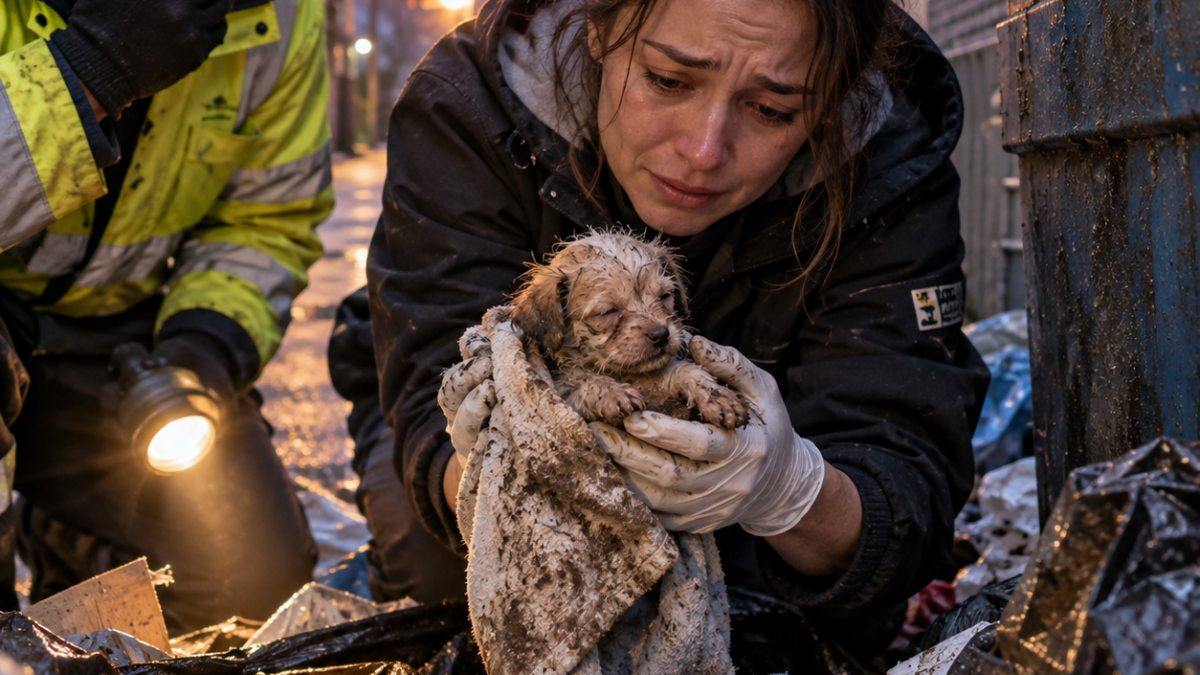
Sanitation Workers Heard Crying Inside a Trash Bin and Found an 800-Gram Puppy Barely Alive—But Just When Coco Seemed Safe, Her Tiny Body Faced an Even Greater Fight
PART3:
The nearest veterinary clinic did not open for another hour.
I called anyway.
Then another.
Then an emergency number.
Finally, a veterinarian I knew answered in a voice thick with sleep.
“Bring her to the back door,” Dr. Parker said. “I’ll meet you there.”
I do not remember the drive clearly.
I remember checking her breathing at red lights. I remember keeping one hand near the box and talking to her the entire way. I remember promising things I had no right to promise.
You’re safe now.
You’re going to be okay.
I’ve got you.
People say those words to animals because we need them to be true.
At the clinic, Dr. Parker opened the back door wearing sweatpants under her white coat and a face that changed the moment she saw the puppy.
“Oh no,” she breathed.
That is not something you want to hear from a veterinarian.
She took the puppy from my hands and moved fast.
Temperature check.
Heart rate.
Blood sugar.
Gums.
Hydration.
Weight.
“She’s hypothermic,” Dr. Parker said. “Severely underweight, dehydrated, and covered in fleas.”
As if summoned by the words, one of the technicians parted the puppy’s fur and inhaled sharply.
The fleas were everywhere.
Tiny dark bodies crawling through her coat, clustered around her neck, belly, ears, and tail. On a healthy adult dog, fleas are uncomfortable and dangerous if ignored. On a puppy this small, they can drain enough blood to kill.
“She may be anemic,” the technician said.
Dr. Parker nodded. “Warm first. Stabilize first. We remove them carefully once she can handle it.”
The puppy barely reacted as they worked.
That scared me too.
A puppy should protest.
Cry.
Squirm.
Fight.
This one simply lay there, too exhausted even to object to being saved.
They warmed her slowly.
Too fast could shock her system. Too slow might not be enough. Everything about caring for a puppy that small felt like balancing glass over a cliff.
When they finally cleaned enough dirt from her face, we could see how young she was.
“Four weeks,” Dr. Parker said. “Maybe five. Too young to be away from her mother.”
“Could she have crawled into the trash?”
Dr. Parker looked at me over the puppy’s tiny body.
We both knew the answer.
“No,” she said softly. “Not likely.”
I sat in the corner of the treatment room while they worked.
I did not want to get in the way, but I could not leave.
There are some rescues that become personal before you have permission for them to. Maybe it was because she opened her eyes in my hands. Maybe because she was so impossibly small. Maybe because someone had chosen a dumpster for her, and I could not stop thinking about the moment that happened.
Had she cried immediately?
Had the person hesitated?
Had they walked away faster to avoid hearing her?
Had her mother searched for her?
That question hurt most.
Somewhere, there might have been a mother dog grieving a missing baby she could not find.
Or maybe the mother was gone too.
In rescue work, every answer opens another wound.
Once the puppy’s temperature rose enough, the staff began removing fleas.
It took a long time.
Tweezers.
Gentle combing.
Tiny careful hands.
Medication safe enough for her age and condition.
Warm cloths.
The puppy remained half-conscious through most of it, occasionally letting out a faint sound that barely counted as a whimper.
By afternoon, Dr. Parker placed a hand on my shoulder.
“She’s not out of danger.”
“I know.”
“She needs monitoring around the clock. Hypothermia, dehydration, possible anemia, gastrointestinal stress. We’ll test for parvo as soon as she’s stable enough.”
The word parvo made my stomach drop.
Every rescuer knows that fear.
Canine parvovirus is one of those words that turns hope fragile. It can move fast. It can steal puppies before you even understand how sick they are. And tiny puppies, abandoned puppies, stressed puppies — they have so little reserve.
“Do what you need to do,” I said.
That night, I went home without her.
I hated it.
My apartment felt wrong. Too quiet. Too warm. Too safe. I kept thinking of her in the incubator at the clinic, fighting for each breath while machines hummed around her.
I slept with my phone on my chest.
At 6:12 the next morning, Dr. Parker called.
“She’s awake.”
I sat up so fast the room tilted.
“She is?”
“Still weak,” the vet warned. “But yes. Awake.”
When I got to the clinic, the puppy was lying on a clean towel inside a warmed enclosure. She looked even smaller without the dirt. Her fur, now visible, was a soft pale color, patchy in places from flea irritation but beautiful in a way only helpless things can be beautiful.
Her eyes were open.
This time, she tracked me when I walked in.
“Hi, baby,” I whispered.
Her tiny tail moved.
Not a wag exactly.
More like a question.
My knees almost gave out.
The parvo test came back negative that day.
I cried in the hallway.
Not big dramatic sobs.
Just the kind of tears that slip out when your body releases fear before your mind catches up.
Negative did not mean safe.
But it meant one monster had not found her yet.
On the third day, she woke crying.
A sharp, distressed cry that made everyone in the clinic move.
Her belly was bloated and painful. She curled and stretched, unable to get comfortable. Dr. Parker examined her carefully, adjusted medication, changed her feeding schedule, and treated her stomach pain. Her digestive system had been through too much too soon — hunger, cold, stress, trash exposure, parasites, weakness.
“She’s fragile,” Dr. Parker said. “But she wants to live.”
That became our sentence for her.
She wants to live.
When her IV line had to be removed because her tiny legs were too thin and delicate to keep it safely placed, I panicked.
“How will she get enough fluids?”
“Carefully,” Dr. Parker said. “Tiny amounts. Often. We adapt.”
Everything with her was tiny amounts.
Tiny meals.
Tiny syringes.
Tiny blankets.
Tiny improvements.
But the fear was enormous.
No one could explain why she had been in that dumpster.
No one could make it make sense.
She was not dying of some obvious condition that a cruel person might have used as an excuse. She was not deformed. She was not aggressive. She was not old, inconvenient, or expensive yet.
She was a baby.
A sweet, helpless baby.
“Why?” I asked Dr. Parker one evening as we watched the puppy sleep.
The vet’s face softened with the tired sadness of someone who had seen too much.
“Because some people think if something is small enough, abandoning it doesn’t count.”
I reported the case to local authorities.
The sanitation workers gave statements. The waste collection schedule was reviewed. Nearby security cameras were requested from businesses and apartment buildings. Someone official wrote down words like animal cruelty, abandonment, investigation.
I wanted those words to matter.
I wanted whoever placed her in that trash to be found.
But the truth was, my attention had to remain on the puppy.
Justice could move slowly.
She could not.
The clinic staff started calling her “the little trash baby,” with affection, but I hated that.
She deserved a real name.
Something soft.
Something happy.
Something that did not begin where she had been found.
On the fourth night, I watched her sleep curled against a stuffed toy shaped like another dog. She had pressed herself into it as if she missed the warmth of her mother’s body. Her tiny paws twitched. Every now and then, she made a small sucking motion in her sleep, searching for milk that was not there.
That hurt in a place I did not have words for.
“She misses her mom,” one of the technicians said.
“I know.”
“She’s so little.”
“I know.”
A puppy that young should not learn loneliness before learning how to play.
By day ten, she was stronger.
Still fragile.
Still requiring veterinary care.
But stronger.
She could lift her head for longer periods. She could wobble forward on unsteady legs. She could complain when she disliked something, which was one of the most beautiful sounds I had ever heard.
The first time she barked, it was barely a squeak.
Everyone in the room celebrated like she had delivered a speech.
That same day, the clinic gave her the first vaccine she was healthy enough to receive.
I held my breath when the needle went in.
She did not even cry.
Dr. Parker smiled.
“Brave girl.”
“She’s braver than all of us,” I said.
Every morning, when the weather allowed, I carried her outside to a quiet patch of sunlight behind the clinic.
Not for long.
Only a few minutes.
She was still too young, too weak, too vulnerable.
But sunlight matters.
Warmth matters.
The world outside pain matters.
I would sit on the bench with her wrapped in a little blanket against my chest. She would blink in the light, nose twitching at smells she had not yet learned. Grass. Dust. Car exhaust. Flowers near the fence. My shirt. My hands.
She was smaller than a beer bottle.
Smaller than my forearm.
But inside that tiny body lived a heart that refused to surrender.
From the day she woke fully, she began looking for me.
The clinic staff noticed before I did.
“She knows your voice,” one technician said.
“No, she doesn’t.”
“Watch.”
She stepped near the enclosure and spoke.
The puppy opened one eye, then closed it again.
Then I said, “Hi, baby.”
Her head lifted.
My heart did something painful and wonderful at the same time.
I had become familiar.
Maybe even safe.
To a creature who had been thrown away before she learned the world had good hands in it, that felt sacred.
I began holding her more often.
Carefully, because she was so small.
She liked to curl into the crook of my arm while I stroked her back with one finger. Sometimes she fell asleep against my chest with her head tucked beneath my chin. Sometimes she would wake, look up at me, and make a tiny sound as if reminding me not to stop.
It is dangerous to fall in love with rescue cases.
You do it anyway.
Around that time, I named her Coco.
I wanted a name that sounded warm.
Sweet.
Round.
A name that belonged in a home, not in a police report.
“Coco,” I whispered the first time.
Her ears twitched.
“Coco.”
Her tail moved.
That settled it.
On day fifteen, the authorities still had no real update.
“They’re gathering camera footage,” the officer told me. “We’re reviewing the area around the dumpsters and trying to determine the time window.”
“Do you think you’ll find who did it?”
He paused.
“We’re trying.”
Trying is a word that can hold both effort and defeat.
He added, “This isn’t something we can ignore.”
I appreciated that.
I did.
But when I hung up, I felt helpless all over again.
Because I could not stop thinking about Coco’s mother.
Had she belonged to someone nearby?
Was she healthy?
Was she searching?
Were there other puppies?
Had Coco been the only one?
That question would haunt me until we finally learned the truth much later.
For the moment, Coco needed us.
So we stayed focused.
By day twenty, she had changed so much that the sanitation workers barely recognized her when they came to visit.
Luis stood outside the clinic enclosure, smiling like a proud uncle.
“That’s the same puppy?”
“That’s her.”
“She looks… alive now.”
I understood what he meant.
Her eyes were brighter. Her belly rounder. Her fur softer after repeated gentle cleaning. She could toddle across a towel with great determination, then collapse dramatically as if walking six inches had been a historic expedition.
Dr. Parker scheduled one more examination.
“If she passes today,” she said, “she can go home.”
Home.
The word landed in my chest.
I sat in the waiting area while they checked her.
Coco, completely unaware that her future was being decided, chewed the corner of a small blanket and then fell asleep halfway through the battle.
I worried about everything.
Her weight.
Her blood values.
Her stomach.
Her temperature.
Her energy.
Her risk.
Dr. Parker came out holding the file.
“She can leave the hospital.”
I covered my mouth with both hands.
“Really?”
“Carefully,” she said. “She still needs monitoring, scheduled vaccines, controlled exposure, a safe environment, and immediate attention if anything changes. But yes. She’s ready for the next step.”
I cried again.
I was starting to cry so often around that puppy that the clinic staff stopped pretending not to notice.
That afternoon, I brought Coco home.
The first thing I did was prepare a warm bath.
I was terrified.
Bathing a puppy that tiny felt like washing a soap bubble. Too much water, too cold, too warm, too slippery — everything seemed dangerous.
But Coco surprised me.
She stood calmly in the shallow basin, blinking at the water like she had decided to be patient with my incompetence. I used a soft cloth, gentle shampoo, and water tested so many times I could have written a scientific paper about it.
At first, she only watched.
Then a soap bubble drifted past her nose.
She tried to bite it.
I laughed.
She tried again.
Missed.
Then sneezed.
That was the first time I saw her play.
Not survive.
Not tolerate.
Play.
It broke me open in the best way.
After the bath, wrapped in a towel twice too big for her, Coco looked like a tiny burrito with eyes. I dried her carefully and set her on a soft blanket.
Someone had given us a little outfit as a joke — a tiny cowgirl-style vest and a miniature bandana. I did not think she would tolerate it, but when we slipped the bandana loosely around her neck for a photo, she strutted two whole steps like she owned the house.
“Our little cowgirl,” I said.
Coco sneezed again.
From that day on, happiness began to find her in small daily ways.
She learned the sound of the food bowl.
She learned that hands could bring comfort.
She learned that blankets were for burrowing.
She learned that toys could squeak if attacked with enough conviction.
She learned that my lap was hers.
She learned that being carried did not mean being discarded.
Every day, she grew.
Not quickly enough to stop me from worrying.
But enough.
Her legs steadied. Her appetite improved. Her eyes became bright and mischievous. She followed me from room to room, tiny paws tapping against the floor, stopping whenever I stopped.
Sometimes I looked at her and felt a wave of anger so strong it frightened me.
Because she was so easy to love.
That was the part I could not understand.
She was not difficult.
Not cruel.
Not inconvenient in any way that love could not handle.
She was a baby who wanted warmth, food, safety, and someone to answer when she cried.
Who looks at that and chooses a dumpster?
The next month passed quietly.
Too quietly, maybe.
Sometimes, before a storm, the sky becomes perfectly still.
Coco had received her vaccines on schedule. She was eating. Playing. Growing. Making everyone fall in love with her. I allowed myself to believe the worst was behind us.
Then one morning, she refused breakfast.
At first, I told myself not to panic.
Puppies have off mornings.
Maybe she was tired.
Maybe she did not like the food.
Maybe she had eaten too much the day before.
Then she vomited.
Then diarrhea.
Then her little body went limp in my hands.
No.
Not again.
I rushed her to the clinic so fast I barely remember the drive.
Dr. Parker’s face changed the moment she saw Coco.
Tests were run.
Fluids prepared.
Medication drawn.
I stood there with my hands pressed together, silently bargaining with everything in the universe.
Please not this.
Please not after all of that.
Please not her.
The test came back positive.
Parvo.
And severe enteritis.
I felt the room tilt.
“But she tested negative before,” I said.
“She did,” Dr. Parker replied. “And she’s had vaccines. But she was extremely vulnerable. Depending on exposure timing, immune response, and how compromised she was when found… it can still happen.”
I heard the explanation.
I understood none of it emotionally.
All I knew was that Coco had survived the trash, hypothermia, fleas, hunger, stomach pain, abandonment — and now a virus was trying to take her anyway.
“She needs hospitalization immediately,” Dr. Parker said.
“Will she live?”
The vet did not answer fast enough.
That was answer enough to terrify me.
“We’ll fight,” she said.
So we fought.
If the first hospitalization was fear, the second was war.
Coco received so many injections I lost count.
Fluids.
Antiemetics.
Antibiotics for secondary infection risk.
Pain control.
Nutritional support.
Temperature monitoring.
Every hour mattered.
Every small change mattered.
Some days she looked at me with tired eyes, and I could see how hard she was working just to stay.
Her fever rose again and again.
We prepared cool compresses constantly. Soft cloths dampened and placed carefully. Not too cold. Never shocking. Just enough to help her burning body find relief. I sat beside her enclosure and watched the staff move with the focused urgency of people trying to hold a match flame alive in a storm.
I cried when I thought no one could see me.
Of course they saw.
They just let me have the dignity of pretending.
Coco endured it all with a quietness that broke my heart.
Some puppies cry through treatment. Some fight. Some panic.
Coco seemed to fold inward.
As if some ancient wisdom inside her tiny body understood that resisting would waste energy she needed to survive.
I kept telling her she was strong.
But sometimes I wondered if strength was too heavy a word to place on someone so small.
She should not have needed strength.
She should have had a mother’s warmth.
A safe home.
A clean bed.
She should have been chewing toys and tumbling over her own paws, not fighting for her life under clinic lights.
On the third night, Dr. Parker warned me.
“The next twenty-four hours are critical.”
I sat in my car after that and screamed into my hands.
Then I wiped my face, walked back inside, and sat beside Coco.
Because she did not need my fear.
She needed my presence.
On the sixth day of treatment, Coco lifted her head when I entered.
Not much.
But enough.
Dr. Parker smiled for the first time in a week.
“She’s turning a corner.”
I stared at her.
“Say that again.”
“She’s past the worst of it.”
I started crying before she finished the sentence.
Coco blinked at me from her blanket, unimpressed by my lack of composure.
That tiny puppy had fought viruses inside a body that had once weighed only 800 grams.
And somehow, again, she stayed.
Recovery took time.
She came home weaker than before, but alive. Her legs trembled. Her appetite returned slowly. She slept more than she played at first. But every day brought something back.
A tail wag.
A tiny bark.
A clumsy pounce.
A renewed interest in biting bubbles.
And then, one afternoon, while she was curled on my lap with her head resting over my wrist, my phone rang.
It was an officer connected to the abandonment case.
“We identified the owner,” he said.
My body went still.
“What?”
“We reviewed camera footage and followed up with nearby residents. The dog who gave birth belonged to a family in the area. According to statements, Coco was the only puppy in the litter.”
“The only one?”
“Yes.”
I closed my eyes.
In a way, that was a relief.
No missing siblings in another dumpster.
No hidden litter dying somewhere.
But it also made the cruelty sharper.
One puppy.
One helpless baby.
And they still chose to throw her away.
“What happens now?” I asked.
“The case is being handled through the proper channels.”
I knew that phrase.
It meant the process would move slowly. It meant evidence, interviews, paperwork, decisions, consequences maybe, frustration probably.
“Did they say why?”
The officer paused.
“No reason that justifies what they did.”
That was the only honest answer.
After I hung up, I looked down at Coco.
She was asleep, one paw curled beneath her chin, belly rising and falling softly.
She had no idea the people who discarded her had been found.
She had no idea there was a word like owner attached to someone who had not loved her.
Good.
Some truths belong to the people who must fix them, not the animals who survived them.
What mattered now was Coco’s future.
And by then, we had found one.
A family I trusted had been following her journey from the beginning. They were not interested because she was cute, though she was. They were not moved only by the drama of her story, though it had moved them. They understood medical follow-up. They understood patience. They understood that tiny survivors still need structure, care, and calm once the emotional story fades.
They visited slowly.
No grabbing.
No overwhelming.
They sat on the floor and let Coco approach.
At first, she stayed near me.
Then curiosity won.
She toddled to the woman’s shoe and sniffed it.
The woman did not move.
Coco looked up.
The woman whispered, “Hi, sweetheart.”
Coco wagged.
The man covered his mouth with one hand.
That told me something.
People who understand the privilege of being chosen by a small animal often make good homes.
The adoption day was harder than I expected.
I had always known Coco was not mine forever.
Rescue means loving with open hands.
That sounds noble until the day you have to open them.
I packed her things slowly.
Blanket.
Medical records.
Food schedule.
Medication notes.
Tiny toys.
The ridiculous cowgirl bandana.
Coco attacked a shoelace while I tried not to cry.
Her new family arrived with a soft carrier, a warm blanket, and eyes full of nervous love.
I went over instructions in far too much detail.
They listened to all of it.
Every word.
That helped.
When it was time, I lifted Coco and held her close.
She tucked her head beneath my chin, exactly the way she had when she was still fighting to stay warm.
For a moment, I was back at the dumpster.
Her eyes barely opening.
Her body cold in my hands.
That tiny tail asking whether life had anything kind left in it.
I kissed the top of her head.
“You don’t have to be brave all the time anymore,” I whispered. “Just be happy.”
Then I handed her to the woman who would become her new mother.
Coco looked back at me once from the carrier.
Not with fear.
Not with confusion.
Just looking.
Then she curled into the blanket and settled.
That was how I knew she was ready.
Her new family sent updates often.
At first, every day.
Then every few days.
Then whenever Coco did something funny, sweet, mischievous, or impressive.
She grew beautifully.
Her coat filled out. Her eyes brightened. Her legs became sturdy. She discovered couches, sunbeams, chew toys, and the joy of stealing socks from laundry baskets. She made friends. She learned her name. She learned that bowls refill. She learned that bedtime happens in warmth. She learned that when people leave, they come back.
One photo showed her lying belly-up on a soft rug, completely shameless, paws in the air.
I stared at that picture for a long time.
That was the opposite of a dumpster.
That was safety.
Another photo showed her wearing the cowgirl bandana, sitting beside a much larger dog who looked both protective and mildly annoyed by her energy.
Another showed her asleep against her new father’s chest, one paw hooked over his shirt like she owned him.
She did.
Of course she did.
Months later, I visited her.
I was not sure if she would remember me.
People ask that often.
Do rescued animals remember?
I think memory is more complicated for them than we understand. Maybe they do not remember events as we do. Maybe they remember smells, tones, body feelings, safety, fear, warmth. Maybe the body keeps its own record.
When I stepped into the yard, Coco stopped mid-run.
She was bigger now.
Healthy.
Bright.
Alive in every direction.
For one second, she stared.
Then she ran at me.
Full speed.
Ears flying.
Tail whipping behind her.
She slammed into my shoes and rolled onto her back as if no time had passed at all.
I sat down in the grass and cried into her fur while she tried to lick my face and chew my sleeve at the same time.
Her new family laughed softly behind us.
“She knows you,” her mother said.
I nodded because I could not speak.
Coco knew.
Maybe not everything.
Not the dumpster.
Not the clinic nights.
Not the fever compresses.
Not the way we begged her to stay.
But some part of her knew that my hands had once lifted her from the trash and carried her toward life.
That was enough.
The cruelty of Coco’s beginning never fully stopped hurting me.
I still thought about the moment someone chose to abandon her. I thought about the cold, the fleas, the hunger, the fear she was too young to understand. I thought about her mother, whether she searched, whether she mourned, whether anyone comforted her.
But grief cannot be the only way we honor survival.
Joy matters too.
So when I think of Coco now, I try not to picture the dumpster first.
I picture the sunlight behind the clinic.
The first tiny wag.
The bubble she tried to bite.
The day she wore that ridiculous bandana.
The way she fought parvo with a body smaller than hope should fit inside.
The way she ran to me months later, not as a discarded puppy, but as a beloved dog who knew exactly where she belonged.
From trash to tenderness.
From fever to sunlight.
From abandonment to family.
That was Coco’s journey.
People often call animals like her lucky.
I understand why.
But I have never liked that word.
Luck did not save Coco.
The sanitation workers who stopped and listened saved her.
The veterinarian who opened the clinic early saved her.
The technicians who removed every flea and measured every drop of medication saved her.
The people who investigated her abandonment saved her dignity.
The family who gave her a home saved her future.
And Coco saved herself too.
With every breath.
Every tiny swallow.
Every morning she opened her eyes again.
Every time her little heart kept beating when it had every reason to stop.
She was 800 grams when we found her.
Eight hundred grams of cold, dirt, fleas, and almost no strength left.
But inside her was a will larger than the cruelty that tried to erase her.
That is what I remember most.
Not the trash.
Not the person who left her.
Not even the fear.
I remember the first time she looked at me.
The way her eyes opened slowly in my hands, as if she had crossed an ocean of darkness just to see whether the world had finally sent someone kind.
I hope, in that moment, she felt the answer.
Yes, Coco.
Someone came.
And from that moment on, you were never alone again.








