Phoenix Couldn’t Lift His Head, See, or Breathe Properly—Then One Tiny Change Gave His Caretaker Hope.
PART3:
Nose clogged.
Breathing through an opening that barely seemed large enough.
His head rested flat because he did not appear able to raise it.
I touched his shoulder.
No reaction.
Then his front paw moved.
Barely.
“He’s alive.”
Karim nodded.
“I know.”
We carried him inside.
The first priority was not the face.
Not the eyes.
Not even the jaw.
Breathing.
Always breathing.
Oxygen.
Airway.
Heart rate.
Temperature.
The veterinarian, Dr. Miriam, moved fast.
“Can you hear me?”
No response.
She checked his mouth.
“Jaw trauma.”
His nose.
“Severe obstruction.”
Eyes.
“Can’t assess yet.”
I looked at the monitor.
“Is he stable?”
“No.”
That one word.
Not yet.
We gave oxygen.
Pain medication.
Fluids.
Started cleaning only what we had to.
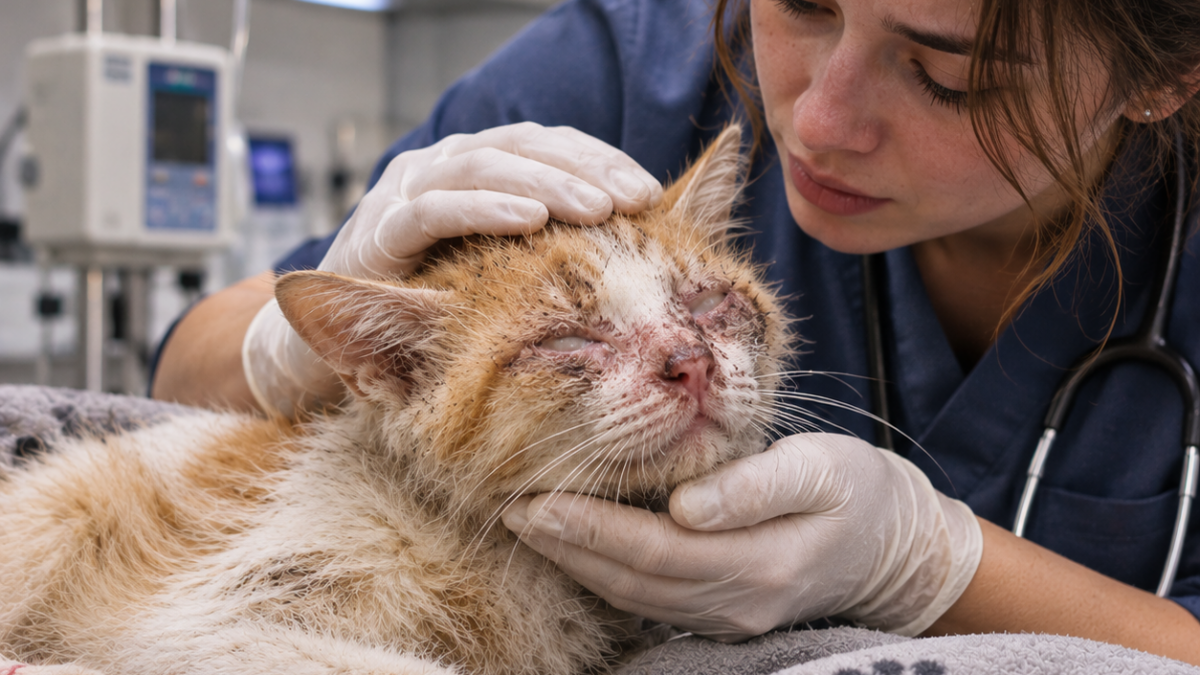
The amount of debris around his eyes and nose made it difficult to tell what belonged to the original injury and what had developed afterward.
There was pus.
Swelling.
Crusting.
The smell of infection.
The face had taken the worst of whatever happened.
We suspected a vehicle impact.
No one saw it.
No camera.
No witness.
Only the result.
I stayed beside the treatment table.
Phoenix did not have a name yet.
For the first few hours he was simply:
Roadside cat.
Male.
Trauma.
Critical.
Those labels are necessary.
I hate them.
They turn someone into a problem to solve.
So before the end of the first day, I gave him a name.
Phoenix.
Not because he had already risen from anything.
He hadn’t.
He was still lying there.
I named him for what I wanted to believe was possible.
The first examinations gave us more questions than answers.
His facial nerves did not respond normally.
His jaw would not close properly.
The nose was severely obstructed.
He could not smell food.
He did not seem able to see.
The eyes were damaged and covered with discharge.
Even lifting his head appeared beyond him.
Dr. Miriam touched different areas around the face.
No response.
“Loss of sensation?”
“Likely.”
“Temporary?”
“I don’t know.”
That became the answer to almost everything.
Can he see?
I don’t know.
Will sensation come back?
I don’t know.
Can he eat normally?
I don’t know.
Will the jaw improve?
I don’t know.
Will he breathe without intervention?
I don’t know.
Will he survive?
We hope.
The first night, Phoenix needed help with almost every basic function.
We softened food.
Adjusted position.
Cleaned the face.
Kept the nose as open as possible.
Watched his breathing.
Every few minutes, I found myself staring at his chest.
Up.
Down.
Up.
Down.
I began counting.
Not because anyone told me to.
Because if I counted, the breaths kept existing.
Thirty-one.
Thirty-two.
Thirty-three.
He slept.
Or maybe simply drifted.
Pain medication softened the edges.
His body looked exhausted in a way that made sleep seem deeper than sleep.
At three in the morning, I touched his head.
“You don’t have to do anything right now.”
No response.
“Just breathe.”
That was the goal.
Not healing.
Not walking.
Not playing.
Breathe.
The following morning, Phoenix was still alive.
That felt like victory.
Small.
Fragile.
But real.
Further cleaning revealed the extent of the damage.
There was severe pus buildup around parts of the face.
The tissue needed repeated care.
His jaw remained misaligned enough that eating on his own was difficult.
He could not smell.
He did not appear to respond visually.
The eyes frightened me most.
Not because they looked terrible.
They did.
Because I could not tell whether he was looking at me.
I would speak.
His ears sometimes moved.
But the eyes did not track.
When I moved my hand from left to right, nothing.
Light response was abnormal.
Dr. Miriam recommended an eye specialist.
We transferred him for evaluation.
I sat beside the carrier in the car.
Phoenix lay on a thick towel.
Head supported.
Breathing noisy through the nose.
“You’re collecting doctors.”
His ear moved.
“Very expensive hobby.”
No reaction.
“Could at least look grateful.”
Then I stopped.
Because he couldn’t look.
That realization landed harder than I expected.
At the ophthalmology clinic, the specialist examined each eye carefully.
He took his time.
The longer he stayed quiet, the worse I felt.
Finally he stepped back.
I asked the question.
“Can he see anything?”
The doctor looked at me.
“No.”
My hand tightened around the carrier handle.
“Temporary?”
“I don’t believe so.”
“What about after swelling goes down?”
“The visual pathways have sustained severe damage.”
I knew what he was telling me.
Still asked.
“So his sight isn’t coming back.”
“No.”
There are some sentences you understand immediately.
Others take hours.
This one did both.
I heard it.
Understood.
Then kept thinking:
Never?
Not later?
Not one eye?
Not shadows?
Not light?
Nothing?
The doctor explained what could still be managed.
Comfort.
Eye health.
Medication.
Cleaning.
Preventing further irritation.
Adapting his environment.
Blind cats can live good lives.
I knew that.
I had seen blind cats thrive.
But Phoenix was not only blind.
He also could not smell properly.
His face had reduced sensation.
His jaw did not close normally.
He struggled to breathe.
Blindness by itself was not the whole problem.
His entire relationship with the world had been disrupted at once.
Sight gone.
Smell impaired.
Touch altered.
Breathing compromised.
I looked at him.
His head still rested low.
“How does he know where anything is?”
The specialist answered gently.
“He’ll learn.”
“How?”
“Sound.”
“Touch where he has sensation.”
“Routine.”
“Memory.”
“Vibration.”
“And if smell improves, that too.”
I looked at Phoenix.
“He has to relearn everything.”
“Yes.”
That was when the story changed for me.
Until then, I thought we were trying to restore Phoenix.
Fix him.
Return him.
But some things were not returning.
We were going to have to help him build a different map of the world.
The days that followed were repetitive.
Medication to the eyes.
Cleaning crust.
Softening buildup.
Feeding.
Checking breathing.
Cleaning again.
More medication.
Phoenix also had allergies that complicated his skin and eye recovery.
Some days his eyes looked cleaner.
Then the next morning there would be more crust.
His nose would open slightly.
Then clog again.
Progress did not move forward in a straight line.
It circled.
One step.
Half a step back.
Two sideways.
One forward.
I learned not to celebrate too early.
Phoenix learned me.
That part happened before I realized it.
At first, when I approached, his body stiffened.
He could not see who was coming.
Could not rely on smell.
So every touch arrived from nowhere.
Imagine living like that.
A hand appears against your body before your brain knows whether it is safe.
I started announcing myself every time.
“Phoenix.”
Pause.
“It’s me.”
Then I touched the blanket first.
Not him.
A small vibration.
Then one finger against his shoulder.
Same place.
Every time.
Routine became language.
“Phoenix.”
Blanket.
Shoulder.
Then care.
After a few days, he stopped flinching as hard.
After a week, his ears moved when he heard my voice.
After another, his body softened before I touched him.
That was trust.
Not eye contact.
Phoenix could never give me that.
We had to find other ways to know each other.
His first real improvement was almost embarrassingly small.
He lifted his head.
Maybe an inch.
Maybe less.
I was cleaning one eye.
Phoenix had been lying flat.
Then he pushed slightly with his front legs.
Neck muscles engaged.
Head rose.
Wobbled.
Stayed.
Three seconds.
Then down.
I froze.
“Phoenix?”
His ear moved.
I called Miriam.
“Come here.”
She rushed over expecting an emergency.
“What?”
“He lifted his head.”
She stared at me.
Then at him.
“That’s why you called me?”
“Yes.”
She smiled.
“Do it again, buddy.”
Phoenix did not.
Of course.
But we had seen it.
That mattered.
People who met Phoenix later would never understand why head control made us emotional.
They did not know the version of him whose cheek lay against a towel because gravity was too much.
The next day he did it again.
Longer.
Then while feeding.
Then when he heard a door.
His body was getting stronger.
Not fixed.
Stronger.
Eating remained difficult.
Without smell, food had less meaning.
Without normal jaw closure, mechanics were harder.
We experimented with texture.
Soft.
Smooth.
Warm enough to increase aroma.
Position adjusted.
Smaller portions.
Medication hidden where possible.
Nutritional support.
Some meals went well.
Others took forever.
I would sit with him.
“Come on.”
He licked.
Paused.
“Again.”
Another lick.
“Good.”
It was ridiculous how much praise one mouthful earned.
Phoenix deserved all of it.
Eventually he began recognizing mealtime from sound.
A bowl touching the counter.
A spoon tapping ceramic.
Package opening.
His head lifted.
Not sight.
Not smell.
Sound.
He built associations.
That was the beginning of his new map.
The room itself came next.
At first, Phoenix moved cautiously.
One front paw.
Pause.
Another.
Whiskers forward.
Head slightly lifted.
Touch wall.
Stop.
Turn.
He bumped into things.
Of course.
We kept the environment consistent.
No moving furniture.
No random boxes.
Food in the same place.
Water in the same place.
Bed in the same corner.
Litter positioned predictably.
Phoenix began memorizing distances.
Five steps from bed to water.
Turn.
Wall.
Follow.
Doorway.
He became more confident.
Not fast.
But intentional.
Then he began doing something beautiful.
He listened before moving.
A person entered.
Phoenix’s ears turned.
A door clicked.
His head lifted.
A bowl touched down.
He moved toward it.
Blindness had not made his world empty.
It had made sound larger.
I began wearing the same soft bracelet with tiny beads because it made a faint sound when I moved.
Not loud.
Just enough.
Phoenix learned it.
Eventually, I could walk across the room and his head would turn toward me.
Not because he saw.
Because he knew.
The first time that happened, I cried.
Again.
Phoenix caused a lot of that.
But one major problem remained.
Breathing.
His nose never became normal.
Some days better.
Some worse.
You could hear the effort.
A blocked, uneven sound.
We initially blamed swelling.
Infection.
Scar tissue.
Then too much time passed.
Something structural was wrong.
Advanced imaging confirmed it.
A fracture from the original trauma had caused part of the nasal passage to collapse.
The airway itself was narrowed.
I stared at the scan.
“So all the cleaning…”
“Helps,” the specialist said.
“But it can’t fix that.”
“No.”
“What will?”
“Procedure.”
Of course.
Phoenix had already survived the accident.
Infection.
Blindness diagnosis.
Weeks of treatment.
Now another intervention.
Rhinoscopy.
Nasal dilation.
The goal was not cosmetic.
Not to make him look normal.
To make breathing easier.
That distinction mattered.
Before surgery, I sat beside him.
My hand rested near his front paws.
“Remember when I told you all you had to do was breathe?”
His paw moved against my finger.
“Apparently we’re still working on that.”
The procedure went forward.
Waiting was awful.
People think waiting becomes easier after enough hospital visits.
It does not.
You simply learn the layout.
Which chair squeaks.
Where the coffee machine is.
Which hallway the surgeon comes from.
Hours later, the doctor appeared.
“The passage is more open.”
My shoulders dropped.
“Successful?”
“For today, yes.”
“For today?”
“There is significant trauma and scarring. We need to watch how it heals.”
No promises.
Always no promises.
Phoenix came back groggy.
His breathing sounded different.
Still not quiet.
But more air.
I placed my hand beside his face.
“It’s me.”
He moved toward it.
Not far.
Enough.
Recovery from the procedure added another layer.
Medication.
Monitoring.
More careful meals.
Then one evening he started coughing.
Hard.
Repeated.
The kind of sound that takes all the relief you have built and destroys it instantly.
We returned to the hospital.
More examination.
More fear.
The cause was managed, treatment adjusted, and Phoenix stabilized again.
I remember sitting in the parking lot afterward with both hands on the steering wheel.
I did not cry.
I was too tired.
Ten months sounds simple when written in one sentence.
Phoenix recovered for ten months.
That is easy.
Living ten months is different.
Ten months of alarms.
Appointments.
Medications.
Eye cleaning.
Food preparation.
Laundry.
Monitoring.
Special diets.
Phone calls.
Setbacks.
Questions.
Hope.
Fear.
Repeat.
There were mornings I woke before the alarm because I thought I heard his breathing change.
Nights I stood over him checking whether his chest moved.
Days I wondered whether we were asking too much.
Then Phoenix would do something ordinary.
Eat.
Stretch.
Walk toward my voice.
Find his bed without help.
And ordinary would answer the question.
He was living.
That mattered.
Month by month, eating became easier.
The jaw remained abnormal.
His face remained altered.
Blindness remained permanent.
But the struggle around every meal decreased.
He learned textures.
He learned bowl position.
He learned routine.
Eventually, feeding stopped being the event everything else revolved around.
That was enormous.
Phoenix began gaining weight.
His shoulders filled out.
His coat improved.
His movements became steadier.
He held his head normally for longer stretches.
If you had met him then without knowing the beginning, you would have seen a blind cat with a damaged face and medical needs.
You would not have seen the animal who could not lift his own head.
I saw both.
Always.
His personality appeared slowly.
Phoenix was not the sweet, passive saint people expected.
He was stubborn.
Very stubborn.
He disliked being interrupted during meals.
Hated one particular eyedrop.
Learned exactly when I was preparing it.
He could not see the bottle.
Could barely smell.
Still knew.
I would enter.
“Phoenix.”
His ears moved.
Then I made the tiny click of the cap.
He turned away.
“You cannot see me.”
Turn farther away.
“This is cheating.”
He walked toward the opposite wall.
I laughed.
“Fine.”
Treatment still happened.
Phoenix forgave me about thirty seconds later if food was involved.
He also discovered soft blankets.
Not all.
One specific thick fleece blanket.
If it was moved, he searched.
Walk.
Touch.
Pause.
Turn.
Listen.
Eventually find.
Then circle three times and lie down like he owned the shelter.
He did.
Emotionally, at least.
When new volunteers came in, I taught them Phoenix’s routine.
Talk first.
Touch blanket.
Then shoulder.
Do not approach silently.
Do not move his bowls.
Do not rearrange the room.
Do not assume he wants to be picked up.
One volunteer asked:
“But he can’t see us.”
“Exactly.”
Another said:
“Wouldn’t it be better to carry him so he doesn’t bump into things?”
“No.”
“Why?”
“Because he needs to learn.”
We protected him from danger.
Not from independence.
That became one of the most important choices we made.
If Phoenix never had the chance to navigate, he would always need someone to move him.
So we created a safe space and let him solve it.
At first, slowly.
Then confidently.
He learned walls.
Corners.
Doorway thresholds.
Different floor textures.
Rugs became landmarks.
A mat near the food.
Another near the water.
Smooth floor meant open room.
Textured runner meant path.
He mapped with paws.
Whiskers.
Ears.
Memory.
The first time he crossed the whole room without bumping anything, I followed silently.
Three steps behind.
He reached his bed.
Turned.
Lay down.
I whispered:
“You did it.”
His ears flicked.
No celebration.
Phoenix had places to be.
His world was not dark to him in the way darkness feels to us.
That took me a long time to understand.
People would say:
“Poor baby. He lives in darkness.”
I stopped using that phrase.
Phoenix did not remember vision the way I imagined it.
Maybe some fragments remained.
Maybe not.
But his life was not an empty black room.
It was full.
Voices.
Footsteps.
Air movement.
Floor texture.
Blankets.
Food.
Warmth.
Touch.
Vibration.
Routine.
He knew when I entered.
Knew when another cat was near.
Knew when food came.
Knew where sunlight warmed the floor even if he could not see the light.
His world had shape.
Just not visual shape.
One afternoon, I found him sitting beside the window.
Face turned toward it.
For a moment, grief hit me.
He could not see outside.
No birds.
No trees.
No moving clouds.
Then the window opened slightly.
Air came through.
Phoenix lifted his head.
His whiskers moved.
He listened.
Birdcall.
Leaves.
Traffic far away.
His ears rotated.
He stayed there for twenty minutes.
I realized I had been mourning the view.
Phoenix was experiencing the window differently.
Not less.
Differently.
That changed me.
Recovery is complicated when the person caring wants something the patient no longer needs.
I wanted his sight back.
Phoenix wanted dinner.
I wanted normal facial sensation.
Phoenix wanted his blanket.
I wanted him to breathe silently.
He wanted to follow my footsteps.
Those desires were not equally important to him.
So I learned to separate my grief from his life.
That was hard.
One day, someone asked me:
“Would you still have saved him if you knew from the first hour he would never see again?”
The question offended me.
Then I realized the person was genuinely asking.
“Yes.”
“Even with all the medical care?”
“Yes.”
“Even if he always needs help?”
“Yes.”
“Why?”
I looked at Phoenix.
He was trying to pull a piece of paper beneath his bed.
“Because blindness didn’t make him stop wanting things.”
That was the answer.
Phoenix wanted.
Food.
Comfort.
Attention.
Exploration.
Predictability.
His own choices.
A life with limitations is still a life with preferences.
That is enough reason to care.
Around the tenth month, Phoenix reached a milestone that would sound boring to anyone else.
He ate a full meal without us treating it like a medical procedure.
No extended coaxing.
No repeated adjustments.
No endless pause.
He found the bowl.
Lowered his head.
Ate.
Finished.
Then groomed one front paw.
I sat there staring.
A volunteer asked:
“What?”
“He ate.”
“He eats every day.”
“I know.”
She looked confused.
I smiled.
“You didn’t know him before.”
That sentence became common.
You didn’t know him before.
Before he could lift his head.
Before he could find the bowl.
Before breathing improved.
Before he knew the room.
Before he knew my voice.
Progress looks small when you miss the beginning.
Phoenix still required a special diet.
Eye care.
Medical follow-up.
Monitoring of his nasal passage.
Allergy management.
He was not cured.
I stopped using cure as the measure.
Stable.
Comfortable.
Interested.
Those became better words.
He came home with me eventually.
The shelter had become safe.
But home offered something different.
Quiet.
Routine without shift changes.
Fewer new footsteps.
A place where furniture stayed exactly where Phoenix needed it.
The first night, I kept him in one room.
Small.
Safe.
Bed.
Food.
Water.
Litter.
Textured mats.
He explored.
Wall.
Corner.
Chair leg.
Bed.
Door.
Again.
Again.
He memorized.
The next day I opened access to the hallway.
Phoenix stood at the threshold.
Listened.
One paw forward.
Then back.
I sat several feet away.
“Come on.”
His ears turned toward me.
He walked.
Slow.
Hit the wall gently.
Adjusted.
Followed my voice.
Reached me.
I touched his shoulder.
He leaned.
That became our method for expanding his world.
One room at a time.
Kitchen.
Living room.
Bedroom.
No rushing.
No carrying him everywhere.
Soon Phoenix knew the house better than visitors did.
People would move a chair.
I moved it back.
They laughed.
“Seriously?”
“Yes.”
Phoenix’s map depended on consistency.
One night, I forgot a laundry basket in the hallway.
Phoenix bumped it.
Not hard.
Still stopped.
Touched it.
Walked around.
The next morning I moved the basket.
Phoenix approached the same area cautiously.
Touched where it had been.
Nothing.
He paused.
Then continued.
That moment taught me how quickly a small human inconvenience becomes a major environmental change for a blind animal.
I became neater because Phoenix required it.
Possibly his greatest miracle.
He followed sound.
If I cooked, he stayed near the kitchen entrance.
If I worked, he found the textured rug beside my desk.
If I showered, he waited outside the bathroom because the water sound confused his map.
When I returned home, he learned the rhythm of my key in the lock.
Click.
Door.
My shoes.
Then Phoenix’s head came up.
He would walk toward me.
Not always directly.
Sometimes he overshot by a foot.
I would tap the floor lightly.
He corrected.
Then leaned against my ankle.
He never saw my face.
Not once.
That used to break my heart.
Eventually, it didn’t.
Because Phoenix knew me better than many seeing animals knew their people.
My voice.
My steps.
My schedule.
My hands.
The way I touched the blanket before touching him.
My breathing when I sat down beside him.
Sight was not required for recognition.
Years later, I sometimes forgot he was blind.
Not literally.
The medication reminded me.
The careful home setup reminded me.
But emotionally.
He moved with enough confidence that the blindness stopped dominating the room.
Visitors would ask:
“How does he know where everything is?”
“Because it stays where it belongs.”
“How does he find you?”
“He listens.”
“How does he know it’s you?”
I never knew how to answer that completely.
Maybe the same way we all know familiar people.
Pattern.
Presence.
Repetition.
Phoenix was an expert in those.
His nose never became completely normal.
Breathing remained something we monitored.
There were follow-up procedures.
Flare-ups.
Allergy days.
Times crust returned around the eyes more heavily.
Times I worried the nasal passage was narrowing again.
Recovery did not end.
It became management.
That is another thing rescue stories often hide.
The dramatic treatment ends.
Then somebody has to live Tuesday morning.
And Wednesday.
And every day after.
Phoenix needed those ordinary days.
Medication at 7:00.
Breakfast.
Cleaning.
Nap.
Walk through the hallway.
Lunch.
Window.
Dinner.
More medication.
Bed.
His survival depended less and less on emergency heroics and more on boring consistency.
I came to love boring.
Boring meant no hospital.
No alarms.
No new diagnosis.
No breathing crisis.
Just Phoenix complaining about medicine.
Perfect.
One winter morning, years after I first saw him, I woke to silence.
Too much silence.
I sat up.
“Phoenix?”
Nothing.
My heart instantly went somewhere terrible.
I got out of bed.
Hallway.
Empty.
Living room.
Empty.
Kitchen.
Then I heard a tiny sound near the window.
Phoenix sat on his favorite mat.
Head raised.
Listening to birds outside.
I stood there.
Almost angry.
“You scared me.”
His ear turned.
“Do you know how dramatic you are?”
He did not move.
I sat beside him.
Cold light filled the room.
He could not see it.
That thought came and went.
Then Phoenix leaned against my leg.
The bird outside called again.
His ears turned.
I realized something.
All those years earlier, I thought the tragedy was that Phoenix would never see the people who loved him.
Maybe that was the wrong way to frame it.
He did not need to see us to know we were there.
He knew through what we repeated.
The medicine arriving.
The bowl filling.
The blanket being cleaned.
The voice saying his name.
The hands returning.
Safety does not always need a face.
Sometimes it needs consistency.
People often asked why I named him Phoenix.
“Because he rose from the ashes?”
Not exactly.
There were no ashes.
No magical rebirth.
He did not come out of treatment restored.
His blindness remained.
His face remained damaged.
Breathing needed management.
The allergies remained annoying.
Special food remained expensive.
Phoenix did not rise by returning to the cat he had been before the accident.
He rose by becoming someone new without disappearing inside what happened to him.
That is harder.
And more beautiful.
A miracle is easy to admire when everything lost comes back.
Phoenix taught me to admire the life that grows when some things never do.
He never saw my face.
But he knew when I smiled because my voice changed.
He never smelled dinner the way another cat might.
But he knew the sound of his bowl.
He never navigated the house with eyes.
But he knew exactly where my bed was at three in the morning when he wanted to wake me for reasons known only to him.
He never needed sight to make himself the center of my life.
One evening, I found an old photograph from his first day.
I almost deleted it.
Phoenix lay on a treatment pad.
Face swollen.
Head down.
Eyes crusted.
Body limp.
The image was difficult to look at.
Then I compared it with the cat sleeping beside me.
Head upright.
Body filled out.
Front paws tucked.
Breathing steady.
Same cat.
Not the same life.
I did not delete the picture.
I kept it.
Not because suffering deserves to be preserved.
Because beginnings matter.
Without that image, someone might look at Phoenix and see only what remained wrong.
Blind cat.
Facial nerve damage.
Special diet.
Medical history.
The photo reminded me how much had become right.
He could lift his head.
Eat.
Navigate.
Choose.
Trust.
Rest.
Breathe better.
Find me.
Those things were invisible if you only measured him against a healthy cat.
They became enormous when measured against himself.
That is how Phoenix deserved to be measured.
Not against what another cat could do.
Against the place he started.
Somewhere along the way, I stopped saying:
“He can’t see.”
And started saying:
“He knows the house.”
Stopped:
“He can’t smell properly.”
Started:
“He recognizes dinner.”
Stopped:
“His face is numb.”
Started:
“He likes scratches behind his ears.”
Both versions were true.
One described loss.
The other described life.
Phoenix taught me to hold both without letting one erase the other.
The taxi driver visited once.
Karim.
He came almost a year after the rescue.
I had sent him updates.
But photographs do not prepare someone.
He walked in.
Phoenix was sitting on his blanket.
Karim stopped.
“That’s him?”
“That’s him.”
“He’s big.”
“He eats.”
Karim laughed.
He crouched.
Reached automatically.
I stopped him gently.
“Talk first.”
He nodded.
“Phoenix.”
Phoenix’s ears moved.
Karim’s eyes filled.
“Hey.”
He tapped the blanket softly.
Phoenix turned.
Walked forward.
Smelled almost nothing.
Saw nothing.
But heard him.
Karim held one finger near the floor.
Phoenix touched it with his nose.
Then walked away.
Karim laughed through tears.
“He doesn’t remember me.”
“Maybe not.”
“I thought I’d be sad.”
“You are.”
“Not about that.”
He looked at Phoenix.
“I’m glad he doesn’t need to remember the road.”
That sentence stayed with me.
Phoenix did not need to remember the road.
We did.
The people.
Because roads are still full of animals who lie too quietly.
Not every injured cat screams.
Not every body makes suffering obvious.
Some just become still.
The easiest life to miss is the one no longer strong enough to ask.
Karim noticed Phoenix because he looked twice.
That was the first miracle.
Not surgery.
Not medication.
Attention.
Everything after depended on that.
A person saw something small by the road.
Stopped.
Got out.
Checked.
Acted.
Phoenix never knew how close he came to being left there.
I am grateful for that too.
He carried enough.
He did not need our horror added to his.
When people asked what Phoenix taught me, I used to say resilience.
Too simple.
Then trust.
Closer.
Eventually, I found the real answer.
Adaptation.
Not passive acceptance.
Active rebuilding.
Phoenix’s body lost one way of understanding the world.
So he built others.
He could not see the hallway.
He memorized it.
Could not rely on scent.
He listened.
Could not interpret touch easily across damaged facial nerves.
He learned safe patterns.
Could not breathe normally.
Doctors opened a path.
Could not eat easily.
We changed food and routine until he could.
Every limitation became a problem to negotiate rather than a verdict.
That is what life with Phoenix became.
Negotiation.
Not defeat.
Not cure.
Something more realistic.
And, in a strange way, more hopeful.
On the tenth anniversary of the day Karim found him, I sat beside Phoenix’s favorite window.
He was older.
Slower.
Still blind.
Still unmistakably himself.
Birds were loud outside.
Phoenix listened.
I put my hand on the blanket.
Tap.
Then shoulder.
The same routine.
He leaned into me before I finished.
Ten years.
Thousands of repetitions.
“Phoenix.”
His ears moved.
“You know me.”
He pushed his head lightly against my hand.
That was answer enough.
I thought about the specialist who told me he would never see again.
The doctor had been right.
Phoenix never did.
And yet that terrible sentence had not predicted the shape of his life.
It only described one thing that would be missing.
It could not describe everything that would remain.
Curiosity.
Appetite.
Memory.
Temper.
Routine.
Comfort.
Attachment.
Choice.
Love.
Medicine often has to tell us what the body may never recover.
It cannot always tell us what the life around that body can still become.
Phoenix’s story began with survival.
For a long time, that was enough.
Then survival became recovery.
Recovery became adaptation.
Adaptation became routine.
Routine became home.
And one day, without any dramatic moment marking the change, I realized Phoenix was no longer the cat everyone was trying to save.
He was simply Phoenix.
The cat who knew where his bowl belonged.
The cat who hated medicine.
The cat who listened to birds.
The cat who found me in any room.
The cat who had never seen my face and somehow knew me anyway.
If I could speak to him on that first night, when he could not lift his head and every breath sounded like work, I would not promise him his vision would return.
It wouldn’t.
I would not promise the surgeries would make everything normal.
They didn’t.
I would not promise recovery would be quick.
It took months.
I would tell him something smaller.
Something true.
You will learn the house.
You will eat without a fight.
You will lift your head.
You will know when I walk into the room.
You will have a blanket you refuse to share.
You will discover the window.
You will make people rearrange their lives around furniture you cannot safely navigate.
You will become inconvenient in all the best ways.
And one day, the fact that you cannot see will stop being the first thing I notice when I look at you.
Because I will stop seeing only what the accident took.
I will see everything it failed to take.
That was Phoenix’s victory.
Not sight.
Not perfect healing.
Life.
A complicated, stubborn, carefully managed life.
And after everything that had tried to take even that from him, it was more than enough.