Our HOA President Locked Relief Trucks Outside After the Storm—Then Federal Investigators Found the Email Proving He Had Ordered Hungry Families Turned Away.
PART2:
I tried to make the house feel normal.
But by the third morning, the novelty was gone.
Everyone was tired.
The house was hot.
Cell signals came and went.
Our refrigerator had been without reliable power too long to trust most of what had been inside.
We had been conserving food.
Breakfast that morning was nearly nonexistent.
Ethan had not eaten properly in about fourteen hours.
He was trying not to complain.
That was what bothered me most.
An eight-year-old should complain when he is hungry.
He should ask for cereal ten times.
He should ask why there are no pancakes.
He should be annoying about breakfast.
Instead, he came into the kitchen quietly.
His hair was flattened on one side from sleeping on the couch.
He stood near the counter and asked, “Aunt Laura?”
“Yeah, buddy?”
“Is there any cereal left?”
PART3:
I looked toward the pantry even though I already knew the answer.
“No.”
“What about toast?”
We had bread.
Barely.
But I was trying to save it because I didn’t know when stores would reopen normally.
“We’ll figure something out.”
He nodded.
No whining.
No argument.
Just a quiet, “Okay.”
I turned away for a second.
I did not want him seeing my face.
I had spent years helping coordinate food for strangers after disasters.
Now there was a hungry child in my own kitchen and I could not give him a normal breakfast.
That feeling does something to you.
At 9:10 that morning, my phone finally caught enough signal to download three messages at once.
One came from our neighborhood text group.
RELIEF SUPPLIES ARRIVING AT NORTH GATE AROUND 10.
Bring ID and proof of residence.
Limited quantities.
First come, first served.
My sister saw it over my shoulder.
“Water?”
“Yes.”
“Food?”
“Looks like both.”
Ethan heard us.
“Can we go?”
I smiled.
“Yeah, buddy.”
We grabbed bags.
Empty water bottles.
My sister stayed behind with her husband because he had injured his ankle clearing debris the day before.
Ethan came with me.
The north gate sat maybe eight minutes away on foot.
Normally I would have driven.
But downed branches made the internal roads a mess.
People were already gathering when we arrived.
Families.
Older residents.
A woman holding a baby against her shoulder.
Three teenagers carrying empty coolers.
People looked exhausted.
Not desperate yet.
But close.
That distinction matters.
Desperation rarely begins with screaming.
It begins with calculations.
How many bottles left?
How many diapers?
How long can insulin stay cold?
How much formula?
How many meals can be skipped before children notice?
Then we heard diesel engines.
Two box trucks turned onto the main approach road.
White.
Magnetic placards on the side from a regional relief organization I recognized.
Community Response Coalition.
CRC.
I had worked with them dozens of times.
Good people.
Fast-moving.
Volunteer-heavy.
The lead truck slowed near the guardhouse.
Then stopped.
The second pulled behind it.
People began clapping.
Not loud.
Relieved.
You could feel shoulders drop.
Ethan squeezed my hand.
“Is there cereal?”
“Probably not cereal.”
“What food?”
“We’ll see.”
A woman from the first truck stepped down holding a clipboard.
I recognized the reflective vest.
Distribution lead.
She walked toward the HOA gate.
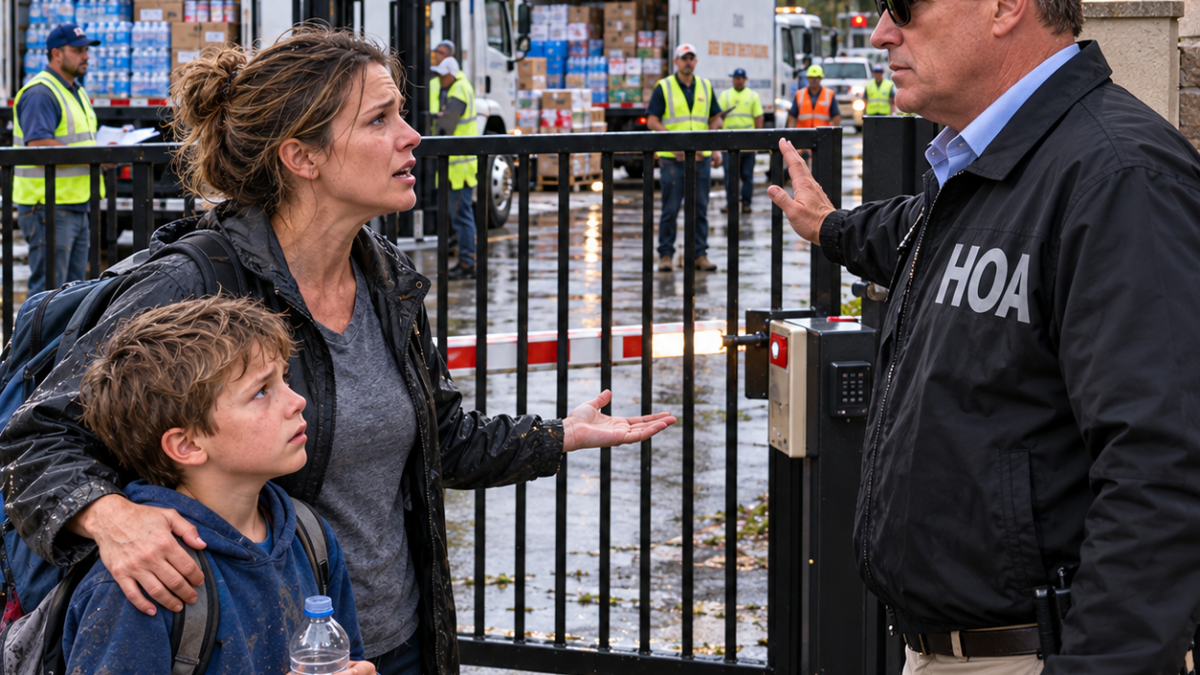
That was when Marcus Hail appeared.
Marcus was sixty-one.
HOA president for three years.
Former commercial property manager.
Always immaculate.
Pressed shorts.
Golf shirts.
Hair perfectly cut.
Even after three days without full power, Marcus somehow looked like he had just stepped out of an air-conditioned boardroom.
He came from the clubhouse side with two board members and our contracted security supervisor.
The distribution lead spoke first.
“Community Response Coalition. We’re scheduled for neighborhood drop-off.”
Marcus shook his head.
“No distribution until we verify eligibility.”
The woman blinked.
“We were told this was a neighborhood-wide emergency distribution.”
“It is.”
“Then what do you need?”
“Residents only.”
She glanced toward the crowd.
“Everyone here appears to be from the neighborhood.”
Marcus corrected her.
“Verified residents.”
I knew that tone.
Administrative obstruction disguised as procedure.
The woman asked:
“What counts as verification?”
“HOA-issued resident ID or driver’s license matching a property address.”
That immediately excluded:
Children.
Visiting relatives.
People displaced from nearby damaged homes.
Renters whose license addresses had not updated.
Elderly parents sheltering with adult children.
Anyone temporarily housed inside the community.
The distribution lead said:
“These supplies were allocated based on household count and emergency sheltering estimates.”
Marcus folded his arms.
“Our rules are our rules.”
I stepped forward.
“Marcus.”
He saw me.
His face tightened slightly.
He knew what I did for work.
Not details.
Enough.
“Laura.”
“You cannot apply HOA residency rules to emergency relief allocated for impacted households.”
“This is private property.”
“The trucks are at your gate because your emergency committee requested them.”
“That does not eliminate eligibility standards.”
“Whose standards?”
“Ours.”
“Why?”
“To prevent abuse.”
“Abuse of bottled water?”
His mouth tightened.
People around us began listening.
Marcus said:
“We have people staying here who are not dues-paying residents.”
My sister.
Ethan.
Others.
I looked toward the woman holding the baby.
“Displaced family members.”
“Non-residents.”
“They are disaster-affected households.”
“They are guests.”
Ethan tugged my sleeve.
“Aunt Laura?”
I looked down.
His bottle was empty.
He held it by the loop.
Marcus saw him.
That made what happened next worse.
I said:
“My nephew’s home is damaged. He and his parents are staying with me.”
Marcus nodded.
“Then your household allocation covers him.”
“What allocation?”
“One case per verified address.”
“One case?”
“We need equitable distribution.”
“There are additional trucks in staging. CRC can return.”
“If needed.”
The distribution lead interrupted.
“Sir, we’re carrying formula, shelf-stable milk, ready-to-eat food, bottled water, hygiene kits, flashlights, batteries, and medical cooling packs. This load was designated for broad emergency support.”
Marcus turned to security.
“Do not open the gate.”
The guard hesitated.
“Mr. Hail—”
“Keep it closed.”
The woman from CRC stared at him.
“Are you refusing delivery?”
“No.”
“Then open the gate.”
“We are requiring compliance with site rules.”
She looked at me.
I could see the question in her face.
Is this guy serious?
I said:
“Document refusal.”
Marcus snapped toward me.
“Nobody is refusing anything.”
The distribution lead took out her phone.
“I’m documenting that access is denied pending HOA verification requirements.”
Marcus said:
“Those supplies remain available to legitimate residents.”
The word legitimate landed badly.
A man behind me said:
“My mother is sleeping in my guest room because her roof is gone.”
Marcus did not look at him.
Another woman said:
“My sister’s kids haven’t had cold milk in two days.”
Marcus said:
“Again, verified resident households will receive distribution.”
The crowd started getting louder.
I knew exactly how dangerous that could become.
Hunger plus heat plus perceived unfairness.
So I did the thing that felt least satisfying.
I did not yell.
I turned to the CRC lead.
“What’s your name?”
“Jenna Morales.”
“Jenna, who dispatched you?”
“Regional staging center.”
“Do you have refusal protocol?”
“Yes.”
“Use it.”
Marcus stared at me.
“You have no authority here.”
“No.”
I looked at him.
“But neither do you over those trucks.”
Jenna nodded.
“We’ll contact staging.”
Marcus looked almost pleased.
As if he had won.
Then the trucks turned around.
Ethan watched.
That image stayed with me longer than everything else.
Not the lawsuits.
Not the hearings.
Not Marcus’s face.
An eight-year-old boy standing in heat, holding an empty bottle, watching water drive away because an adult with a title had decided hunger needed paperwork.
He asked quietly:
“Are they coming back?”
I crouched.
“I’m going to try.”
That answer hurt because I was not sure.
We walked home.
I gave Ethan half a granola bar I had kept in my emergency bag.
He broke it in two.
Held one half toward me.
“For you.”
That nearly destroyed me.
“No, buddy.”
“You need food too.”
“I ate.”
Lie.
He looked suspicious.
Then ate both halves.
At home, my sister asked:
“What happened?”
I told her.
She said something about Marcus I will not repeat.
Then:
“What do we do?”
This was where fourteen years of disaster coordination took over.
I opened my laptop.
Not to social media.
Not neighborhood group.
Documentation.
Time.
9:58 a.m.
Two CRC trucks arrived north gate.
Vehicle numbers from Jenna’s text.
10:04.
Marcus refused entry absent HOA residency verification.
Witnesses.
Security.
Board members.
Residents.
Supplies turned away.
I saved screenshots of the neighborhood distribution announcement.
Then I downloaded the HOA emergency updates Marcus had sent since the storm.
Day one:
The HOA Emergency Committee is coordinating with regional aid partners to ensure priority access to essential supplies.
Day two:
Residents are asked not to travel outside the community unless necessary. Relief coordination is underway.
That mattered.
He had told people to wait.
Then blocked what came.
I called CRC staging.
My professional credentials helped get me through quickly.
A supervisor named David Chen answered.
I explained.
He already knew.
“Jenna called.”
“Where are the trucks?”
“Redirected to Desert Springs Middle School distribution site.”
“Can residents go there?”
“If roads are safe.”
Many weren’t.
“Can you return later?”
“Maybe.”
“How was Millbrook—or Desert Willow, our HOA was Desert Willow Estates—added to route?”
David looked it up.
“Request from HOA emergency committee.”
“Name?”
“Marcus Hail.”
Of course.
“What quantity?”
“Allocation based on approximately 240 households plus displacement estimate.”
I stopped.
“Displacement estimate?”
“Yes.”
“Then he knew supplies included displaced guests.”
“Request form specifically noted temporary hosting of extended families.”
There it was.
“Can you preserve that form?”
Silence.
“Laura, why?”
“Because he just said non-residents don’t qualify.”
David understood.
“I’ll preserve it.”
“Thank you.”
Then I asked:
“Who funded this load?”
“Mixed sources.”
“Any federal commodities?”
“Yes.”
That changed the stakes.
Some supplies were from nonprofit stock.
Some state emergency distribution.
Some federally supported commodity channels routed through local partners.
Not everything federal.
Enough that arbitrary diversion or misrepresentation could become more than an HOA dispute.
I did not know yet what Marcus was doing.
Only that his rules contradicted his own request.
That was enough to keep looking.
Around noon, a neighbor knocked.
Tasha Green.
Single mother.
Two kids.
She held a printed HOA notice.
“Did you see this?”
Emergency Supply Distribution Policy.
Issued 11:32 a.m.
After trucks left.
It stated:
Due to limited resources, all external relief supplies delivered to Desert Willow Estates will be consolidated through the HOA Emergency Committee and distributed exclusively to verified homeowners in good standing.
I read it twice.
“Homeowners?”
“That’s what I saw.”
Renters excluded.
Tasha rented.
“So my kids don’t count.”
“They do.”
“Marcus says homeowners.”
I felt anger rising.
“Don’t worry about that notice yet.”
“How?”
“Because he doesn’t own the supplies.”
That afternoon we organized a neighborhood inventory.
Not through HOA.
Neighbors.
Who had water.
Who needed formula.
Who had diabetic medication needing cooling.
Who had generators.
Who had extra canned food.
This is what communities do when institutions become obstacles.
A retired electrician ran extension cords from a generator.
Someone pooled bottled water.
A family with a gas grill cooked everything in their freezer before it spoiled.
We fed twenty-three people that night.
Ethan got a cheeseburger.
He ate it in six bites.
I cried in the garage afterward.
Quietly.
Then went back to my spreadsheet.
The second relief problem came the next morning.
A refrigerated van carrying insulin coolers and medical ice packs arrived.
Security let it through.
Why?
Because it was addressed directly to three residents.
Interesting.
Then a pickup carrying diapers from a church was turned away.
Why?
No HOA authorization.
Interesting.
Then a landscaping contractor’s fuel truck entered without question.
Interesting.
Rules were not rules.
They were discretion.
I began asking who benefited.
At 3:00 p.m., an HOA volunteer called me privately.
Her name was Beverly.
Sixty-eight.
Former librarian.
She whispered as though Marcus had wiretapped her kitchen.
“I think you need to know something.”
“What?”
“There are supplies in the clubhouse.”
“What supplies?”
“Water.”
“How much?”
“A lot.”
My stomach tightened.
“When did they arrive?”
“Last night.”
“From where?”
“I don’t know.”
“Who has access?”
“Marcus and emergency committee.”
I walked to clubhouse.
Doors locked.
Through side windows I could see cases stacked in meeting room.
Bottled water.
Maybe eighty cases.
Boxes.
Some labeled hygiene kits.
I photographed through glass.
Then noticed one label.
CRC.
Community Response Coalition.
Those trucks had supposedly turned away.
I called David.
“Did any CRC supply reach Desert Willow?”
Pause.
“One pallet.”
“How?”
“One of our logistics contractors received a call from HOA stating gate restrictions were resolved and requested partial drop after hours.”
“Who called?”
“Marcus Hail.”
“When?”
“6:14 p.m.”
So Marcus had rejected the public distribution.
Then privately accepted a smaller delivery after residents dispersed.
Why?
I would learn soon.
The HOA sent another notice at 5:00.
EMERGENCY SUPPLY PICKUP — VERIFIED HOMEOWNERS ONLY.
Location:
Clubhouse.
Time:
6:00 to 7:30.
Requirements:
Government ID.
HOA account current.
One supply unit per property.
HOA account current.
That phrase made me sit down.
Emergency aid tied to dues status.
No.
Absolutely not.
At 6:00, I went.
Not to collect.
To observe.
Marcus stood behind folding tables.
Cases of water.
Food kits.
Hygiene supplies.
Volunteers checking a spreadsheet.
An older man ahead of me gave address.
Volunteer frowned.
“You have a balance.”
“What?”
“Your HOA account.”
“I’m on a payment plan.”
“Then you need approval.”
“For water?”
Marcus heard.
Walked over.
“Mr. Ellis, emergency resources are for members in good standing.”
The man stared.
“My wife uses oxygen.”
“We are making exceptions for medical necessity.”
“Then give me water.”
“Complete the form.”
I took out my phone.
Recorded.
Marcus saw.
“No recording inside clubhouse.”
“This is a distribution of emergency goods.”
“Private HOA property.”
“I’m standing outside the doorway.”
He stepped toward me.
“Laura, stop interfering.”
“Are these CRC supplies?”
“Some.”
“Did you tell CRC yesterday non-residents couldn’t receive them?”
“Our policy evolved.”
“Did you request aid using displacement numbers?”
His face changed.
Small.
Enough.
“Where did you hear that?”
I did not answer.
He lowered his voice.
“You are creating confusion during an emergency.”
“No.”
“I am documenting it.”
“You think your job gives you special status?”
“No.”
“Then stop acting like it does.”
That sentence would matter later.
Not because it was cruel.
Because it revealed he knew my background and still chose to bypass standard emergency distribution principles.
At 7:18, a woman named Priya came with her father.
Her father lived outside Desert Willow.
His apartment complex had flooded.
He was staying with her.
They were denied.
“Not on resident file.”
Priya said:
“He is seventy-six.”
Marcus said:
“Then your household allocation must cover him.”
She pointed at water.
“There are stacks.”
“We need reserves.”
“For what?”
“Future demand.”
“From who?”
“Residents.”
Her father stared at him.
Then said quietly:
“I am standing in your neighborhood.”
Marcus did not respond.
That night I called the county emergency management duty officer.
I knew him professionally.
Not closely.
“Laura?”
“Hey, Andre.”
“You okay?”
“Personally, yes.”
“You don’t sound yes.”
I explained.
He became quiet.
“HOA is conditioning aid on dues status?”
“Yes.”
“Federal commodities?”
“Some.”
“Do you have documentation?”
“Building it.”
“Send me only what you can verify.”
Exactly the answer I expected from a competent emergency manager.
I sent:
Photos.
CRC request data confirmation from David.
HOA policy notice.
Recording of dues restriction.
Times.
No speculation.
Andre replied:
Received. Preserving.
Then:
Do not confront further.
That was when I knew this was leaving the neighborhood level.
Marcus did not know.
The next day he escalated.
An HOA violation appeared on my door.
UNAUTHORIZED INTERFERENCE WITH EMERGENCY OPERATIONS.
Fine:
$500.
Second:
HARASSMENT OF HOA VOLUNTEERS.
$750.
Third:
UNAUTHORIZED RECORDING ON HOA PROPERTY.
$1,000.
I laughed for the first time all week.
My sister said:
“What’s funny?”
“They’re fining a disaster coordinator for documenting disaster aid.”
“That seems bad for them.”
“Yes.”
Marcus emailed residents:
Certain individuals are spreading misinformation and attempting to undermine emergency response leadership. Please rely only on official HOA communications.
Then one line:
Outside agencies do not understand the unique security and residency requirements of a private community.
That was the line that would haunt him.
Because outside agencies were already reading.
On day five after the storm, county emergency management sent two staff to inspect distribution.
Marcus welcomed them.
Of course.
He set up a table.
Printed charts.
Claimed supplies were being distributed “equitably to registered households.”
The staff asked for intake logs.
He provided them.
They asked about displaced guests.
He said:
“Hosted individuals are included through resident sponsors.”
Not what he told us.
They asked about renters.
He said:
“All lawful occupants are eligible.”
Not what the printed notice said.
They asked whether HOA dues status affected eligibility.
“No.”
I almost admired it.
He lied cleanly.
The county staff left without confrontation.
Marcus looked at me afterward.
“See?”
“See what?”
“Professionals understand.”
I smiled.
“Sometimes professionals let people keep talking.”
He did not like that.
Two days later, power began returning.
Stores reopened slowly.
Immediate hunger eased.
That is when bad actors often assume emergency scrutiny will disappear.
Marcus relaxed.
He should not have.
Because relief organizations reconcile inventory after response.
Every pallet.
Every case.
Every drop location.
Every signature.
CRC had records.
The county had records.
The state emergency coordination center had copies.
And Marcus had submitted forms.
Forms are patient witnesses.
One particular email surfaced during reconciliation.
I did not know about it until later.
Marcus had sent it to the HOA board treasurer and emergency committee before the storm even arrived.
Subject:
SUPPLY CONTROL / POST-STORM DISTRIBUTION.
The email read, in part:
If outside relief arrives, do not permit open distribution inside the gates.
All supplies should come through HOA control so we can prioritize owners, reinforce dues compliance, and avoid resources being consumed by non-members sheltering here.
Then:
This is also an opportunity to demonstrate the value of gated management. Residents who are delinquent should not receive identical benefits to families who have kept accounts current.
Then the sentence federal investigators would later read aloud:
If agencies object, we can cite security, verification, and crowd-control concerns.
It was not improvised after the trucks arrived.
Not confusion.
Not evolving policy.
Preplanned.
He intended to use disaster aid as leverage.
Dues compliance.
HOA legitimacy.
Political control.
That changed everything.
The email reached county emergency management because one board member forwarded it anonymously after realizing investigators were asking questions.
Andre called me.
“Laura.”
“Yes.”
“Do you know about an email from Marcus before landfall?”
“No.”
“Don’t ask around.”
That told me enough.
“What do you need from me?”
“Nothing right now.”
“Understood.”
Then state officials became involved.
Then federal program-integrity staff.
Not FBI agents crashing through gates.
That is not how most of this starts.
Auditors.
Emergency management investigators.
Grant and commodity compliance staff.
People with laptops.
People who ask precise questions repeatedly.
Three weeks after the storm, Desert Willow received a formal request for records related to emergency resource receipt and distribution.
HOA board panicked.
Marcus called an emergency meeting.
I went.
Standing room only.
People had heard.
Marcus opened:
“This is routine.”
A woman shouted:
“Then why did we hire another lawyer?”
Good question.
Marcus continued:
“State and federal partners are reviewing response procedures.”
Another resident:
“Did you block relief trucks?”
“They were not blocked.”
I raised my hand.
Marcus ignored it.
Someone else yelled:
“We watched them leave.”
Marcus said:
“The first delivery lacked appropriate distribution safeguards.”
That was the story now.
Safeguards.
Board treasurer, Helen Ward, looked terrible.
She had been quiet throughout the storm.
Now she raised her hand.
“Marcus.”
He turned.
She said:
“We need executive session.”
Residents booed.
Helen shook her head.
“No.”
Then looked at all of us.
“Actually, no.”
She stood.
“I think residents need to hear something.”
Marcus said:
“Helen, stop.”
She looked at him.
“Did you send the emergency committee an email before the storm telling us to use relief supplies to reinforce dues compliance?”
The room went silent.
Marcus did not answer.
She asked again.
“Did you?”
His attorney leaned toward him.
“Do not answer.”
That answered enough.
Someone behind me whispered:
“Oh my God.”
Helen continued:
“I should have objected then.”
She looked at residents.
“I didn’t.”
Her voice shook.
“I thought he meant HOA-funded supplies.”
“I did not understand he intended to apply it to outside relief donations and government-supported commodities.”
Marcus snapped:
“You are mischaracterizing a planning discussion.”
Helen looked at him.
“No.”
“I’m finally characterizing it correctly.”
Then she stepped down.
The meeting ended without any vote because the attorney advised adjournment.
Outside, reporters were already arriving.
I hated that.
Disasters become spectacle quickly.
I gave no interview.
Ethan asked why vans were outside.
“People are asking questions.”
“About Mr. Marcus?”
“Yes.”
“Is he in trouble?”
“I don’t know.”
“Did he do something bad?”
I thought.
“He made choices that hurt people.”
“Is that bad?”
“Yes.”
Children simplify ethics efficiently.
The federal review team arrived four days later.
Three people.
Not uniforms.
One from FEMA regional program integrity.
One from USDA commodity program oversight because some food distribution channels touched federal commodities.
One from state emergency management compliance.
They met with HOA leadership in clubhouse.
Requested:
Emails.
Distribution logs.
Gate security logs.
Commodity quantities.
Volunteer rosters.
Aid request forms.
Criteria used.
Denial lists.
Dues records referenced during distribution.
Marcus’s attorney attempted to limit production.
Subpoenas followed through appropriate channels.
Then they interviewed residents.
I was one.
The lead investigator was a woman named Denise Calder.
Early fifties.
Simple black folder.
No wasted words.
She asked:
“Were you denied supplies?”
“My nephew was.”
“Why?”
“Marcus stated displaced non-residents were ineligible except through host household allocation.”
“Exact words?”
I gave them.
“Did he know your nephew was disaster displaced?”
“Yes.”
“How?”
“I told him at the gate.”
“Any recording?”
“No.”
“Witnesses?”
Many.
Then:
“What did you do afterward?”
I gave her my timeline.
Every message.
Photo.
Video.
CRC contact.
I did not exaggerate.
When I did not know something, I said:
“I don’t know.”
That builds credibility faster than certainty.
Denise asked:
“Why did you document this?”
“Because disaster aid without traceability becomes vulnerable to control.”
She looked at me.
“Professional answer.”
“Personal answer?”
“Yes.”
“My nephew was hungry.”
She closed the folder briefly.
“I understand.”
At the end she asked:
“Did you ever tell Mr. Hail you intended to report him?”
“No.”
“Why not?”
“Because I was not trying to win an argument.”
“What were you trying to do?”
“Preserve facts.”
That seemed to satisfy her.
The famous moment happened during the second HOA board interview.
I was not inside.
But enough people later described it consistently, and parts became public in administrative findings.
Marcus repeatedly said:
“Everything I did was about safety.”
Crowd control.
Fraud prevention.
Security.
Private access.
Denise placed his pre-storm email on the table.
Asked him to read the second paragraph.
He refused.
She read it.
Residents who are delinquent should not receive identical benefits to families who have kept accounts current.
Then:
If agencies object, we can cite security, verification, and crowd-control concerns.
And asked:
“Which part of that sentence is about emergency safety?”
Marcus reportedly said:
“You’re taking it out of context.”
Denise replied:
“Then give me the context.”
That was the problem.
There was no good context.
The email showed the explanation before the event.
Security was not the reason.
It was the cover.
That distinction destroyed him.
Within a week, the HOA board voted to remove Marcus as president pending investigation.
Five to one.
Marcus voted no.
Two board members resigned.
Helen stayed long enough to turn over records.
Then resigned too.
The HOA hired independent counsel.
All emergency-related fines issued to me were rescinded.
My “harassment” fine disappeared.
Tragic loss to neighborhood governance.
Then came restitution and administrative consequences.
The exact jurisdictional path was messy because the relief load had mixed funding and ownership.
Some supplies belonged to nonprofit partners.
Some were purchased using state emergency funds.
Some were federal commodities passing through authorized distribution systems.
Investigators separated categories.
That mattered.
Not every case of water became a federal case merely because FEMA personnel were involved later.
But enough regulated supplies had been diverted into an eligibility system unauthorized by the distributing agencies that formal findings were issued.
Desert Willow was temporarily removed from direct-site relief delivery lists pending revised controls.
Future aid would go through county-managed points.
The HOA had to reimburse certain administrative costs.
Provide corrected distribution records.
Notify residents that emergency relief could not be conditioned on HOA dues status.
Marcus personally faced separate civil and administrative exposure connected to representations and recordkeeping.
The board’s insurer became involved.
Then lawyers.
Lots of lawyers.
People wanted a dramatic arrest.
There wasn’t one.
No handcuffs at the clubhouse.
No convoy.
Instead Marcus received something men like him often fear more:
Loss of control.
He lost office.
Lost authority to speak for the HOA.
Lost committee access.
Lost the ability to define what had happened.
His own email did that.
Residents recalled him formally two months later.
Seventy-nine percent.
That number did not surprise me.
What surprised me was who spoke before the vote.
Mr. Ellis.
The older homeowner Marcus made complete a medical-necessity form before receiving water.
He walked slowly to microphone.
“My dues were late.”
Nobody interrupted.
“My wife had been in the hospital.”
“I fell behind.”
He looked toward Marcus.
“I was embarrassed.”
“That is why I didn’t tell neighbors.”
“Then the storm came.”
“I went for water.”
“And a man who already knew my account was behind made me prove my wife needed it.”
His voice broke.
“I have lived here seventeen years.”
“No one had ever made me feel poor until the day we all needed help.”
Nobody moved.
Then Priya spoke.
Her seventy-six-year-old father stood beside her.
“My father paid taxes and served this country for forty years.”
“He lost his apartment temporarily.”
“He needed three days under my roof.”
“The HOA called him non-resident.”
She looked around.
“If disaster does not turn a guest into a neighbor, what kind of neighborhood are we?”
That line stayed.
Then Tasha.
Renter.
She held the homeowner-only notice.
“I pay rent here.”
“My kids sleep here.”
“My address is here.”
“But because I don’t own the walls, Marcus decided emergency food was not for us.”
She looked toward the board.
“Never again.”
The recall passed.
Marcus left through side door.
No applause.
That mattered to me.
Public humiliation is easy.
Rebuilding trust is harder.
The new president was Helen only temporarily.
She refused permanent nomination.
Instead residents elected Dr. Miguel Santos.
Pediatrician.
Quiet.
Practical.
His first board action was not about Marcus.
It was an emergency-aid policy.
One page.
In a declared emergency:
No external relief goods may be conditioned on dues status, ownership status, or HOA account standing.
Eligibility follows donor or agency criteria.
Guests displaced by the disaster are treated according to agency household guidance.
HOA may support logistics but may not alter distribution rules without written authorization from the supplying organization.
All receipts and distributions documented.
No board officer may unilaterally restrict emergency deliveries.
I helped draft it.
Unpaid.
On one condition.
“What?”
Miguel asked.
“Remove my name before adoption.”
“Why?”
“Policies should survive people.”
He nodded.
Good president.
The county changed too.
Relief partners stopped routing large aid deliveries directly through private associations unless a county liaison confirmed distribution rules.
Some gated communities complained.
Andre said:
“Good.”
Not because gated communities are bad.
Because no private organization should be able to convert public or donated emergency aid into a membership reward without scrutiny.
CRC returned later for a community meeting.
Jenna Morales came.
Ethan recognized her.
“You were driving the water?”
She laughed.
“I was in the truck.”
“Why did you leave?”
That question hurt everyone nearby.
Jenna crouched.
“Because adults were arguing about rules.”
Ethan frowned.
“We needed water.”
“I know.”
“Did you come back?”
“Some did.”
He thought.
Then handed her a drawing.
Two trucks.
A gate.
A giant red X over gate.
Children communicate policy clearly.
Jenna kept it.
A month after the storm, the neighborhood held a preparedness day.
Not HOA-branded.
County fire.
Emergency management.
CRC.
Local church groups.
Medical volunteers.
We distributed emergency kits.
Everyone.
Owners.
Renters.
Guests.
Kids.
No dues check.
Ethan manned the water table.
He took the job very seriously.
Every person got two bottles.
Then he tried giving everyone four.
I said:
“Buddy.”
“They might be thirsty.”
Fair.
We adjusted.
My sister rebuilt her damaged roof.
They moved home.
The first night Ethan was gone, my house felt too quiet.
Funny.
During the emergency, I wanted normal back.
Then normal meant an empty couch.
He still came over weekends.
For his ninth birthday I bought him a ridiculous cereal dispenser.
Two containers.
He stared.
“Why?”
“You complained about no cereal during the storm.”
“I didn’t complain.”
“Exactly.”
He hugged me.
That was the only award I cared about.
Marcus remained in Desert Willow for another year.
That surprised people.
His house was paid off.
Moving would have looked like fleeing.
Maybe he had nowhere else.
We passed each other occasionally.
Mailbox.
Walking path.
No conversation.
Then one evening he came to my house.
No clipboard.
No HOA polo.
Just Marcus.
He stood outside.
“I won’t stay.”
“Okay.”
“I wanted to ask something.”
“What?”
“Did you send that email to federal investigators?”
“No.”
He looked surprised.
“Who did?”
“I don’t know.”
That was true then.
Later I suspected a board member, but never confirmed.
Marcus stared toward street.
“I thought it was you.”
“Why?”
“You built the record.”
“Yes.”
“You wanted me removed.”
“No.”
He looked at me.
“You didn’t?”
“I wanted aid delivered.”
“You knew what would happen.”
“I knew records would matter.”
“That is not the same.”
He laughed once.
Bitter.
“No.”
Then:
“Do you think I was stealing?”
Interesting question.
“No.”
His face changed.
“You don’t?”
“I think you were controlling.”
He looked almost insulted.
“Is that better?”
“No.”
I shook my head.
“Stealing would have been simpler.”
“What does that mean?”
“You wanted disaster relief to reinforce your authority.”
“You wanted people to understand the HOA mattered.”
“You wanted dues-paying owners rewarded.”
“You wanted outsiders excluded.”
“You told yourself that was fairness.”
He said nothing.
I continued.
“The problem wasn’t that you wanted the water for yourself.”
“The problem was that you believed you had the right to decide who deserved it.”
Marcus looked away.
“I was trying to stop chaos.”
“I know.”
“People were panicking.”
“I know.”
“You’ve worked disasters.”
“Yes.”
“Then you know uncontrolled distribution gets ugly.”
“Yes.”
He turned quickly.
“Then why does everyone act like I invented cruelty?”
“Because control has limits.”
“What limits?”
“The ones belonging to the people who supplied the aid.”
He stared.
“CRC decided eligibility.”
“State did.”
“Federal program rules did.”
“You did not.”
“And even if the HOA had bought those supplies itself?”
I paused.
“Then denying children food over dues would still be disgusting.”
He flinched.
Good.
Some truths should.
“I made mistakes.”
“Yes.”
“You enjoyed proving that.”
“No.”
He looked skeptical.
“Marcus, my nephew was hungry.”
That silenced him.
“I didn’t care about your career.”
“I cared about the trucks.”
He nodded slowly.
Then left.
No apology.
Not then.
Six months later I received a letter.
Handwritten.
Laura,
I have spent a lot of time telling myself the storm created conditions nobody could manage perfectly.
That is true, but it has also become an excuse.
I used the emergency to enforce distinctions that should not have mattered.
I told myself members who paid dues deserved first access because the HOA had arranged delivery.
I understand now that arranging delivery did not make the supplies ours.
I also should never have connected emergency assistance to account status.
I cannot undo the moment your nephew watched those trucks leave.
I am sorry.
Marcus
I read it twice.
Then put it in a drawer.
I never wrote back.
Forgiveness is not a receipt someone is entitled to after apology.
But I believed the letter.
Mostly.
That was enough.
The federal and state review concluded the following spring.
No cinematic prosecution.
Instead:
Compliance findings.
Civil repayment obligations tied to mishandled aid.
Corrective-action agreements.
Board governance reforms.
Records retained.
Marcus barred under settlement terms from controlling future relief distributions through certain partner channels.
Separate HOA civil matters resolved.
The county published an after-action report without sensational language.
One section discussed:
PRIVATE GATEWAY CONTROL OF PUBLIC/CHARITABLE RELIEF.
That was the real lesson.
Emergency supply chains fail at chokepoints.
A destroyed bridge is obvious.
A locked gate looks smaller.
Administratively, though, both can stop aid.
Gatekeepers matter.
The report recommended:
Direct agency liaison.
Written distribution criteria.
No unilateral private eligibility changes.
Alternate pickup points.
Public communication.
Backup access.
Those changes mattered more than Marcus losing an election.
I returned to work full time.
Next wildfire season, I was coordinating relief two counties away.
A volunteer site manager called.
“We have a homeowners association asking to limit supplies to owners.”
I closed my eyes.
“Renters?”
“Excluded.”
“Guests?”
“Excluded.”
“Who owns supplies?”
“We do.”
“Then use your criteria.”
He laughed.
“You sound experienced.”
“You could say that.”
That site never became a crisis.
One phone call.
Clear rule.
Gate opened.
Sometimes a lesson becomes valuable only when the next disaster is less dramatic.
Years passed.
Ethan grew.
At twelve, he no longer remembered every detail.
He remembered the hot house.
The trucks.
Being hungry.
The cereal dispenser.
At fifteen, his civics teacher assigned an essay:
What does community responsibility mean during emergencies?
He interviewed me.
I hated that.
Teenagers record everything.
“What did Marcus do wrong?”
He asked.
I said:
“He treated aid like a privilege.”
“Wasn’t it?”
“No.”
“Why not?”
“Because somebody else donated it for disaster victims.”
He typed.
“What about the HOA?”
“What about it?”
“They requested trucks.”
“Yes.”
“So they helped.”
“Yes.”
“Then he wasn’t all bad.”
I looked at him.
“Correct.”
He seemed surprised.
“Really?”
“Yes.”
“Marcus helped bring aid to the neighborhood.”
“He also blocked and restricted it.”
“People can do both.”
Ethan typed again.
“That makes my essay harder.”
“Good.”
He looked annoyed.
Then:
“Why do adults always want people to be one thing?”
Good question.
“Because mixed stories require thinking.”
He rolled his eyes.
“That sounds like teacher talk.”
“You asked.”
His essay got an A.
He did not show me until graduation.
The line I remembered:
A community is not proven by how well it rewards members. It is proven by whether it can still see a stranger as a person when resources get scarce.
I cried.
Of course.
My sister took a photo.
Of course.
Desert Willow changed over time.
New board.
New security contractor.
Better emergency plan.
Backup generators at clubhouse.
Community water cache purchased with HOA funds.
Important distinction.
Those supplies actually belonged to HOA.
Even then, the policy prioritized medical need and household size during declared emergencies.
No dues check.
Renters included.
Displaced relatives included.
Nobody used the phrase verified residents the way Marcus had.
We practiced once a year.
People complained drills were annoying.
Good.
Annoying is better than thirsty.
Dr. Santos eventually stepped down.
Normal term.
No scandal.
The board became boring.
I have learned boring leadership is a gift.
Budgets.
Landscaping.
Pool resurfacing.
Roof tiles.
Nobody trying to redefine humanitarian eligibility.
My sister still jokes that I destroyed Marcus with a spreadsheet.
I correct her every time.
“I didn’t.”
“What did?”
“His email.”
“You preserved everything around it.”
“Yes.”
“So spreadsheet.”
No winning.
The truth is, I did not expose everything alone.
Jenna documented the refusal.
David preserved CRC request forms.
Beverly told me supplies were inside clubhouse.
Helen turned over board records.
Andre preserved county communications.
State staff compared policies.
Federal reviewers traced commodity rules.
Residents testified.
Marcus wrote the email.
Systems of accountability work when many small records agree.
One screenshot rarely changes everything.
A timeline does.
A gate log does.
An aid request does.
A truck manifest does.
An email explaining motive does.
Truth becomes difficult to dismiss when independent records point the same direction.
That is the lesson I teach young disaster coordinators now.
Not:
Catch bad people.
Instead:
Document decisions.
Who authorized?
What time?
Which criteria?
What source funded the goods?
Who changed the rules?
Who was denied?
Why?
Did the change match donor requirements?
Could the same decision survive daylight later?
That last one matters.
Emergencies create pressure for shortcuts.
Some necessary.
Some dangerous.
If you cannot explain a decision later without inventing a cleaner motive, something probably went wrong.
Marcus’s email hurt him because it showed motive before the pressure arrived.
He had already decided.
Dues compliance.
Owner priority.
Membership value.
Security would be the justification if challenged.
The storm did not create that thinking.
It revealed it.
I still live in the same house.
The north gate was replaced two years ago.
Storm damage eventually warped the original mechanism.
The new gate opens faster.
Manual override clearly marked.
County emergency access code stored with dispatch.
Relief agencies have secondary entrance instructions.
Every time I walk past it, I remember Ethan holding that empty bottle.
Not with rage anymore.
Memory changes shape.
At first I saw failure.
Now I see sequence.
Truck arrives.
Gate closes.
Child watches.
Record begins.
People speak.
Email surfaces.
Rules change.
The useful ending is not that Marcus fell.
It is that the gate no longer depends on one man deciding who deserves water.
That is institutional memory.
The best kind.
Ethan is nineteen now.
College.
Engineering.
Not emergency management.
I am relieved.
He comes home hungry constantly, which feels appropriate after everything.
Whenever he opens my pantry he says:
“No cereal?”
There is always cereal.
Too much.
At least four boxes.
Trauma expresses itself strangely.
Last summer a monsoon knocked power out for six hours.
Nothing serious.
Ethan was home.
Lights flickered.
He looked at me.
I looked at him.
Without a word, he opened pantry.
Held up cereal.
“Prepared.”
I laughed until I cried.
He hugged me.
“It’s okay, Aunt Laura.”
I know.
It is.
Mostly.
People still ask whether I hate Marcus Hail.
No.
That disappoints them.
Anger had work to do initially.
It got me moving.
Kept me focused.
But if I still hated him all these years later, he would still be managing resources in my life.
I will not give him that position.
I remember what he did.
I believe consequences were necessary.
I believe his choices were harmful.
I also believe a man can become more than his worst emergency decision if he chooses to.
Whether Marcus did fully, I do not know.
Not my responsibility.
Mine is simpler.
When the next storm comes, keep the gate open.
Not literally always.
Security matters.
Safety matters.
Crowd control matters.
Verification sometimes matters.
But none of those words should become costumes for exclusion.
Ask:
Whose supplies?
Whose rules?
Whose need?
Who gets harmed if we are wrong?
And especially:
Are we protecting people, or protecting control?
That question would have changed everything at the north gate.
Maybe Marcus would have let the trucks in.
Maybe Ethan would never remember hunger as something adults argued over.
Maybe residents would have received water without proving they were financially worthy.
Maybe no federal investigator would ever have read that email.
That would have been the better story.
I would have preferred it.
But since that is not the story we got, we made something useful from the one we did.
The next emergency plan printed by Desert Willow Estates contains one sentence in bold:
EXTERNAL RELIEF REMAINS SUBJECT TO THE PROVIDER’S ELIGIBILITY RULES, NOT HOA STATUS.
Beneath it:
NO PERSON WILL BE DENIED BASIC EMERGENCY AID SOLELY FOR RENTAL STATUS, DUES STATUS, OR TEMPORARY DISPLACEMENT.
No name.
No Marcus.
No Laura.
No Ethan.
Just the rule.
That is how it should be.
Because someday everyone who remembers the storm will be gone.
Another board will sit in that clubhouse.
Another child will sleep on somebody’s couch.
Another truck may arrive at the gate.
And the people standing there should not need to know our story.
The system should already remember it for them.