Nobody Noticed the Quiet Nurse—Until Every Military K9 Broke Formation and Ran Straight to Her
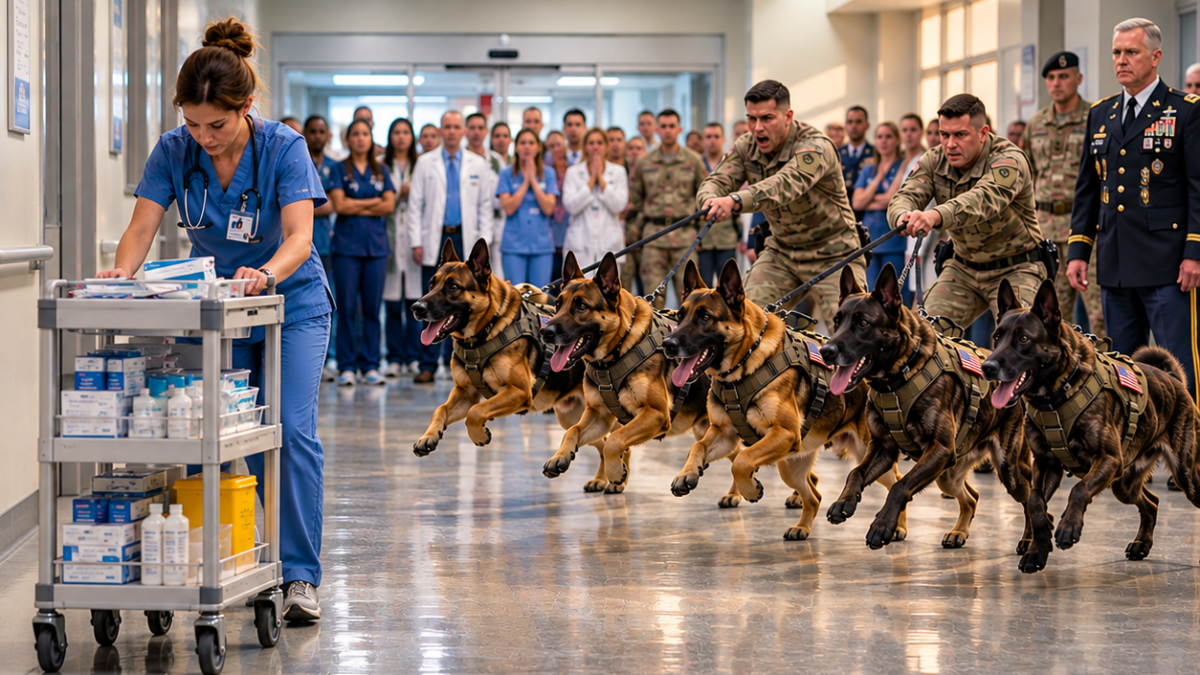
PART2:
At the time, everyone assumed she liked holiday pay.
She was one of those nurses patients remembered.
Not because she was bubbly.
Clare was not bubbly.
She did not call eighty-year-old men “sweetie.”
She did not decorate her badge reel with cartoon characters.
She did not sing while changing dressings.
She was quiet.
Direct.
Calm.
When somebody was frightened, Clare lowered her voice.
When somebody was dying, she pulled up a chair.
When somebody’s family became demanding because fear had disguised itself as anger, she almost never took it personally.
She had a way of making panic feel embarrassing without ever embarrassing the person.
“Look at me,” she would say.
Then:
“One thing at a time.”
People listened.
Dr. Patel once told a resident:
“If Dunmore says a patient doesn’t look right, you stop what you’re doing and go look.”
The resident learned why three weeks later.
Clare caught a pulmonary embolism before the monitor did.
Another time she recognized sepsis in a retired mechanic whose vital signs still looked almost normal.
She knew when pain was exaggeration.
She knew when it wasn’t.
She knew how to move injured men without startling them.
She knew how to approach patients from the side if they startled awake violently.
She knew never to grab a sleeping veteran’s wrist.
One evening, a new nurse named Patrice watched Clare wake an elderly former infantryman from a nightmare without touching him.
Clare stood six feet away.
Said his name once.
Waited.
Then said:
“You’re in Texas.”
The man opened his eyes.
Clare continued:
“Hospital room 417.”
His breathing slowed.
“Door is on your right.”
He looked.
“Window is behind me.”
His hands unclenched.
“You are safe.”
Later Patrice asked:
“Where’d you learn that?”
Clare was charting.
“Learn what?”
“That.”
Clare typed another line.
“Experience.”
“With veterans?”
“With scared people.”
Then she changed the subject.
That was Clare.
There was always a door.
Sometimes you could see the door.
Nobody knew how to open it.
The only personal object at her station was a four-by-six picture frame angled so sharply toward the wall that almost nobody had ever seen the photograph inside.
Patrice once moved it while wiping spilled coffee.
Clare took it gently from her hand.
“Sorry.”
“No problem.”
She turned it back toward the wall.
Patrice caught only three things.
Dust.
A tent.
A dog.
For months she assumed it was some old family pet.
She couldn’t have been more wrong.
The Saturday everything changed began as a staffing problem.
Fort Bellwood served active-duty military families, retired service members, civilian employees, and veterans referred from surrounding counties.
The medical center had been partnering with the base’s Military Working Dog program and a nonprofit sanctuary called Homeward K9 for months.
The event sounded simple enough.
Retired service dogs.
Veteran families.
Adoption information.
Small recognition ceremony.
Local media.
Children.
Coffee.
The kind of event hospital administrators loved because it generated good photographs.
The event coordinator expected twelve dogs.
Five were former military working dogs.
Others had worked in law enforcement or search and rescue.
The five military dogs were the centerpiece.
Duke.
Ranger.
Coach.
Nova.
Atlas.
Each had a history longer than most people in the room understood.
Each carried scars.
Some visible.
Some behavioral.
Some buried in veterinary notes and old deployment logs.
Clare had no intention of seeing any of them.
She didn’t even know they would be there.
That was what she later told Colonel Nathan Reyes.
It was true.
If she had known Atlas was coming, she might have called in sick.
Not because she didn’t want to see him.
Because she wanted to see him too much.
That morning, Fourth Floor was short two nurses.
A respiratory therapist had influenza.
One CNA’s child had broken his arm.
At eleven-fifteen, the nursing supervisor, Marlene Cho, appeared beside Clare’s workstation.
“Please tell me you love community outreach.”
Clare didn’t look up.
“I hate the way you opened that sentence.”
Marlene smiled.
“I need medical coverage downstairs.”
“No.”
“You don’t even know what it is.”
“I know your face.”
“Event hall. Two hours.”
“No.”
“Clare.”
“No.”
“There’ll be old veterans.”
“We have old veterans here.”
“There’ll be food.”
“Worse.”
Marlene sighed.
“Dogs.”
Clare’s fingers stopped on the keyboard.
Only for a fraction of a second.
Marlene missed it.
“Retired military K9 thing.”
Clare slowly looked at her.
“How many?”
“Dogs?”
“Yes.”
“Maybe ten? Twelve?”
Clare looked back at her chart.
“I can’t.”
That got Marlene’s attention.
Clare almost never refused anything.
“Why?”
“I have patients.”
“I’ll cover them with Patrice and Sam.”
“No.”
“Clare.”
“Send somebody else.”
“I tried. You’re the only ACLS-certified nurse who can float without wrecking coverage.”
Clare said nothing.
Marlene leaned against the desk.
“It’s two hours.”
Silence.
“You stand by the wall with a first-aid kit and make sure Colonel Grandpa doesn’t faint.”
Despite herself, Clare smiled.
Marlene seized victory.
“Thank you.”
“I didn’t say yes.”
“You smiled.”
“That was contempt.”
“I’ll take it.”
Clare looked down the hallway.
Something old had begun moving beneath her ribs.
She had spent fourteen years building a life around not looking backward.
Not because she had forgotten.
Because she remembered too clearly.
She finally said:
“What time?”
“Now.”
Of course.
Ten minutes later Clare entered the hospital event hall in blue scrubs carrying a red medical bag.
She chose the back wall.
Naturally.
Close to an exit.
Naturally.
She did not scan the room carefully.
That was deliberate.
Families.
Retired soldiers.
Children.
Handlers.
Sanctuary volunteers.
Local news camera.
Podium.
Flags.
Dogs.
Clare looked at the floor.
Breathe.
She could do two hours.
She had survived longer things.
She positioned herself beside a supply cabinet.
A younger nurse from outpatient surgery stood near her.
“I’m Lindsey.”
“Clare.”
“I’ve seen you upstairs.”
Clare nodded.
“You like dogs?”
The question struck harder than it should have.
“Yes.”
“Me too.”
Lindsey pointed toward the center.
“That big gray one is beautiful.”
Clare did not look.
“Which?”
“Atlas.”
The room narrowed.
Clare’s hand tightened around the medical bag.
“What did you say?”
“Atlas.”
Lindsey pointed again.
“The old shepherd.”
Clare looked.
Fourteen years disappeared.
The dog was older.
Of course he was.
Silver covered his muzzle.
One ear sat slightly lower than the other.
His shoulders were thicker.
His gait stiffer.
But the scar.
Left side.
A pale broken line beneath the fur.
Clare knew that scar.
She had cleaned that wound twice a day while a twenty-four-year-old handler died four hundred yards away in a field hospital she had not been allowed to enter.
She whispered:
“No.”
Lindsey glanced at her.
“You okay?”
Clare took one step backward.
Atlas sat beside a volunteer near the front.
He hadn’t seen her.
Couldn’t have.
His back was partly turned.
Clare looked toward the exit.
Leave.
She could tell Marlene she felt sick.
She could find another nurse.
Walk upstairs.
Go home.
Continue being Clare Dunmore.
General medical nurse.
Private person.
No past.
No questions.
She turned.
That was when Duke smelled her.
The old German Shepherd had been lying near the Homeward K9 display table.
His caretaker, Ben Shaw, held the leash loosely.
Duke lifted his head.
His nose moved.
Once.
Twice.
His ears came forward.
Ben was talking to a family about adoption requirements.
He didn’t notice until Duke stood.
“Easy.”
The dog ignored him.
Duke turned.
The movement pulled the leash tight.
Ben looked down.
“Duke.”
The dog stared across the room.
At Clare.
Clare saw him.
Her knees weakened.
Duke.
His shoulder had been torn open.
She remembered the blood.
So much blood.
She remembered using her own trauma shears to cut his harness away because nobody could find veterinary scissors.
His handler, Lieutenant Aaron Mills, had been in surgery.
Duke kept trying to stand.
Kept falling.
Clare had slept beside his kennel because every time the lights went dark, he began scratching at the metal door until his paws bled.
“Sit,” Ben said.
Duke walked.
Not running.
Not dragging.
Just walking with extraordinary certainty.
Ben hurried after him.
“Duke, stop.”
Clare could have left.
She didn’t.
Maybe some part of her understood there was no point now.
Duke crossed fifty feet of crowded floor.
People smiled.
Children stepped aside.
One woman laughed.
“Somebody found a friend.”
Clare pressed herself against the wall.
Duke reached her.
Stopped.
Looked up.
For one second, Clare saw the two-year-old shepherd from a canvas recovery tent.
Not the gray dog.
The wounded one.
Terrified.
Searching.
She whispered:
“Duke.”
The dog’s entire body shuddered.
Then he leaned.
All eighty pounds.
Head against her thigh.
Clare dropped the medical bag.
Ben arrived breathless.
“I am so sorry.”
Clare crouched.
Duke pushed his face into both her hands.
Her composure cracked.
“Hi.”
Her voice was almost nothing.
“Hi, sweetheart.”
Duke whined.
Ben stopped speaking.
Something in the way she touched the dog changed his expression.
Clare’s thumb moved automatically to the ridge above Duke’s left eye.
Exactly where she used to rub when he trembled during bandage changes.
Duke closed his eyes.
Ben stared.
“Have you met him?”
Clare did not answer.
“Ma’am?”
Her fingers trembled in the dog’s fur.
“Yes.”
“When?”
She looked at Duke.
“A long time ago.”
“How long?”
Clare swallowed.
“Fourteen years.”
Ben frowned.
“That can’t be right.”
Duke was twelve.
Clare realized it.
Wrong dog?
No.
Then she remembered.
Maybe thirteen years.
Dates had blurred.
Deployment rotations.
Transfers.
She whispered:
“Thirteen. Maybe fourteen.”
Before Ben could answer, Ranger stood.
Staff Sergeant Marissa Cole felt the leash pull.
“Ranger.”
The Belgian Malinois stared toward Clare.
Cole followed his gaze.
Duke.
Nurse.
Nothing unusual.
Then Ranger began walking.
“Ranger, heel.”
Nothing.
Cole’s eyebrows rose.
Ranger had spent two years with her.
He obeyed.
Always.
He was retired now but still carried training like bone structure.
“Ranger.”
The dog moved faster.
Now people noticed.
A local reporter turned.
Camera swung.
Cole followed.
“Excuse me.”
Ranger reached Clare.
She saw him coming.
“No.”
She covered her mouth.
Ranger stopped beside Duke.
Sat.
Then placed one paw on Clare’s shoe.
Clare laughed once through tears.
“You still do that.”
Cole froze.
“What?”
Ranger lifted the paw.
Tapped her shoe again.
Clare whispered:
“You bit me, you little bastard.”
Several people laughed nervously.
Cole did not.
“You know him.”
Clare looked up.
“Yes.”
“How?”
Clare’s eyes moved over Ranger’s face.
A memory.
Dark tent.
A dog slamming himself against a kennel wall.
Two medics with puncture wounds.
Clare sitting six feet away reading a paperback aloud because silence made him listen for gunfire.
Day one.
No contact.
Day two.
Water bowl pushed closer.
Day three.
Ranger stopped growling.
Day four.
He let her clean the infected wound along his hind leg.
Clare said:
“He hated Hemingway.”
Cole stared.
“What?”
“I read to him.”
“What are you talking about?”
Ranger leaned his shoulder into Clare.
Then Coach stood.
The Dutch Shepherd’s handler, retired Sergeant William Knox, tightened his grip.
“Coach.”
Coach’s damaged hearing meant voice commands were inconsistent.
Knox used a hand signal.
Down.
Coach watched the hand.
Then looked away.
Toward Clare.
Knox tried again.
Nothing.
Coach walked.
Nova followed seconds later.
Her caretaker said:
“Nova?”
Four dogs converged.
The event stopped.
The chaplain at the microphone turned.
Parents raised phones.
The news cameraman zoomed.
Clare remained crouched.
Coach pushed his nose beneath her elbow.
Without thinking, Clare raised her hand.
Palm outward.
Two fingers angled down.
Coach froze.
Then sat.
Knox’s face emptied.
“What signal was that?”
Clare looked at her hand.
She had not used it in years.
“Nothing.”
“That is not one of ours.”
“It was his.”
“What?”
“After the blast.”
She touched Coach’s ear.
“He couldn’t hear consistently.”
Knox stared.
“We use modified visual commands with him.”
“I know.”
“How?”
Clare looked up.
“Because I made half of them up.”
Nobody laughed.
Nova moved against Clare’s other side.
Clare touched her abdomen before catching herself.
A memory again.
Canvas tent.
Headlamp.
Blood.
Five puppies.
A Malinois technician shouting that they had no proper obstetric kit.
Clare saying:
“Then bring me towels.”
One stillborn.
Four breathing.
No.
Five breathing after six minutes.
She’d forgotten.
Or tried.
Nova licked her wrist.
Clare began crying.
The hall became completely silent.
Then Atlas stood.
That was different.
Every K9 handler in the room noticed.
Colonel Nathan Reyes noticed.
Reyes had spent thirty-eight years around military working dogs.
He had treated blast wounds.
Heat injury.
Snakebite.
Combat trauma.
He had signed retirement evaluations.
He had euthanized animals whose bodies had given everything.
He knew the difference between curiosity and recognition.
Atlas was not curious.
The old shepherd had gone rigid.
His eyes locked on Clare.
His handler, sanctuary director Jonah Bell, felt the leash tremble.
“Atlas?”
Atlas began moving.
Slowly.
His hips were arthritic.
He had no reason to hurry.
Yet every step carried urgency.
Clare saw him.
All the noise left her head.
She stood.
Not consciously.
Atlas crossed the room.
Nobody spoke.
He reached her.
Stopped.
His nose touched her scrub top.
Then his legs nearly gave out.
Clare caught his shoulders.
Atlas made a sound.
Not a whine.
Not a bark.
A deep, broken moan from somewhere inside him.
Every experienced handler in the room recognized distress.
Clare recognized something else.
The first night.
After Wyatt Price died.
Atlas had made that sound once.
Just once.
He had lain facing the empty tent entrance waiting for boots that never returned.
Clare had sat nearby until sunrise.
Now, fourteen years later, he made it again.
Clare wrapped both arms around his neck.
Her face disappeared into silver fur.
“I’m sorry.”
The words came out against him.
“I’m sorry I left.”
Atlas pushed harder.
Clare cried without trying to stop.
Nobody in the hall knew what they were witnessing.
Five retired military working dogs gathered around an ordinary medical nurse.
Not excited.
Not playful.
Settled.
Protective.
Home.
Colonel Reyes approached.
He did not interrupt immediately.
He waited until Clare lifted her head.
“Ma’am?”
She wiped her face.
“I’m sorry.”
“Please don’t apologize.”
He crouched.
“Nathan Reyes. Veterinary Corps.”
“I know who you are.”
That surprised him.
“How?”
Clare looked at his insignia.
“Your name’s on three papers I read fourteen years ago.”
Reyes stared.
“What papers?”
“Transfer reports.”
“Whose?”
She looked at Atlas.
Reyes’s expression changed.
“Who are you?”
Clare almost answered the safe version.
Clare Dunmore.
Fourth-floor RN.
General medicine.
Then Atlas rested his head against her hip.
The old lie became impossible.
“My name is Clare Dunmore.”
Reyes waited.
“That isn’t what I asked.”
The room was silent enough that the nearest fifty people could hear.
Clare closed her eyes.
“When those dogs knew me, my name was Clare Everett.”
Reyes went still.
Behind him, an older man gasped.
“Everett?”
Clare looked up.
She didn’t recognize him.
He wore civilian clothes.
Gray hair.
Cane.
His eyes had gone wet.
“Clare Everett?”
“Yes.”
The man whispered:
“Oh my God.”
Reyes turned.
“You know her?”
The man shook his head slowly.
“No.”
Then:
“But I know that name.”
That was the beginning of the unraveling.
The official event was paused.
Hospital administration wanted the dogs moved.
Handlers resisted.
The dogs refused anyway.
Atlas would not leave Clare.
Ranger followed.
Duke lay across her feet.
Colonel Reyes requested a private room.
Clare said:
“No cameras.”
The local reporter immediately lowered his camera.
To his credit, he obeyed.
Five handlers.
Reyes.
Marlene.
Clare.
The dogs.
And the gray-haired man with the cane.
His name was First Sergeant Daniel Ortega.
Retired.
He had served with Atlas’s original handler.
Sergeant Wyatt Price.
The name hit Clare like a physical blow.
“Wyatt?”
Ortega nodded.
“You knew him?”
Clare looked at Atlas.
“Everyone at Forward Surgical Bravo knew Wyatt.”
Ortega stared at her.
“No.”
“What?”
“He wrote about you.”
Clare stopped breathing.
“He didn’t know your name.”
“What?”
Ortega pulled his phone from his pocket.
“My wife keeps telling me to delete old files.”
He searched.
Then handed it over.
A photograph of a handwritten letter.
Faded.
Creased.
Clare recognized Wyatt’s writing before reading a word.
Block letters.
Ugly.
He had written letters during night shift sometimes.
She remembered teasing him.
“You write like a hostage.”
He said:
“My mother can read it.”
Clare zoomed.
The letter was dated eleven days before Wyatt died.
She read silently.
There is a medic in the surgical tent who Atlas likes.
Don’t know her name.
Quiet woman.
Dark hair.
She sits with the dogs nobody can handle.
Atlas listens to her better than he listens to me some days, which is insulting.
If anything happens to me, I hope somebody finds her.
He trusts her.
Maybe more important, she stays when there’s nothing she can fix.
Clare lowered the phone.
Her face had gone white.
“I didn’t know.”
Ortega’s voice broke.
“Neither did I.”
Clare looked at him.
“Why do you have this?”
“Wyatt’s mother gave me copies after the funeral.”
Clare sat down.
Atlas immediately lay beside her.
Fourteen years compressed into one impossible room.
Reyes said quietly:
“Ms. Dunmore—Everett—can you tell us what happened?”
Clare looked around.
Handlers.
Dogs.
People waiting.
She shook her head.
“Not the version you want.”
“What does that mean?”
“You want a story.”
Reyes said:
“I want the truth.”
Clare looked at him.
“Truth is messy.”
“I’ve worn a uniform forty years.”
“Then you know.”
Reyes nodded.
“Yes.”
Clare rested both hands on Atlas.
Then began.
Fourteen years earlier, she had been twenty-five.
Not a nurse yet.
Not exactly.
She was a combat medic with advanced trauma training attached to a forward surgical team.
Her legal name then was Clare Everett.
Married.
Young.
Certain she understood endurance.
She didn’t.
Her forward base handled injuries too urgent for long transport.
Soldiers.
Contractors.
Local civilians when circumstances allowed.
Dogs when veterinary support was delayed.
“People imagine military dogs have veterinarians standing twenty feet away.”
Clare said.
“Sometimes they do.”
She looked at Coach.
“Sometimes the vet is forty miles away and there’s blood coming out of something now.”
So medics learned.
Pressure.
Fluids.
Airways.
Sedation under phone guidance.
Bandages.
Splints.
Keep alive until somebody better could take over.
The dogs came through Clare’s tent because somebody noticed they reacted to her differently.
“Why?” Marissa asked.
Clare shrugged.
“I didn’t stare.”
“What?”
“Scared dogs hate staring.”
Reyes nodded.
“I didn’t grab.”
Another nod.
“I sat sideways.”
She looked at Ranger.
“And I was too tired to be afraid.”
Duke arrived first.
Roadside blast.
Shoulder shredded.
Handler in surgery.
Duke kept trying to reach him.
Every restraint increased panic.
Clare told everyone to leave.
She sat outside the kennel.
Didn’t touch him.
Didn’t command him.
She ate dinner there.
Then breakfast.
Eventually Duke pushed his nose through the bars.
Clare gave him her hand.
“That was it.”
Ben looked at the dog.
“You slept beside him?”
“Three nights.”
“Why?”
“He cried.”
People in the room stopped moving.
Clare said it matter-of-factly.
“He cried when lights went out.”
Ben wiped his eyes.
Ranger came months later.
Ambush.
Two dead.
One injured handler.
Ranger had blood on him that wasn’t all his.
He bit the first medic.
Then another.
Someone wanted sedation.
Clare agreed but couldn’t get close enough safely.
So she sat.
Read.
“What?”
Marissa asked.
Clare smiled faintly.
“For Whom the Bell Tolls.”
Marissa laughed despite herself.
“He hated it?”
“Apparently.”
Day four, Ranger let her close.
His infection had nearly reached the joint.
She cleaned it.
He bit the sleeve of her uniform once but not her arm.
Afterward he placed one paw on her boot.
Same as today.
Coach survived a blast but lost hearing.
He panicked at shadows because sound no longer warned him what was coming.
Clare developed visual cues with a K9 technician named Elias Grant.
Palm.
Two fingers.
Touch to chest.
Slow circle.
Not official.
Improvised.
Years later some had migrated into rehabilitation notes.
Knox looked stunned.
“Our sanctuary trainer said these were adapted from old combat rehab protocols.”
Clare laughed once.
“Combat rehab protocol was two exhausted idiots waving hands until Coach stopped trying to climb through canvas.”
Nobody laughed.
Because she wasn’t joking.
Nova arrived pregnant during an evacuation.
Nobody knew until labor started.
Five puppies.
Supply tent.
Two a.m.
No obstetric instruments.
Clare used shoelaces as umbilical ties until somebody found proper clamps.
One puppy didn’t breathe.
She worked on it six minutes.
It survived.
Clare did not know what happened to any of them.
Then Atlas.
Everyone in the room looked toward the old dog.
Clare stopped.
Atlas’s story was why she had buried everything.
Wyatt Price had been thirty.
Funny.
Annoying.
Excellent handler.
He treated Atlas like a partner, not equipment.
He once argued with an officer for twenty minutes because Atlas had been worked too long in extreme heat.
He won.
Wyatt visited the medical tent often.
Not because Atlas was sick.
Because he liked coffee.
Clare’s coffee.
Terrible coffee.
“He said it tasted like engine oil.”
Ortega smiled.
“He told everybody that.”
“He still drank it.”
“He was stupid.”
“Yes.”
They both laughed.
Then stopped.
The mission happened in August.
Clare was treating a casualty when casualties started arriving too fast.
Gunfire.
Explosion.
Heat.
Dust.
Shouting.
Wyatt came in first.
No.
Atlas came first.
Two soldiers carried him.
Blood.
Chest wounds.
Fragments.
One rear leg torn badly.
Clare asked:
“Where’s Price?”
Nobody answered.
She asked again.
A captain said:
“Gone.”
That word.
Gone.
Military people use small words for enormous things.
Clare stared at Atlas.
The dog was conscious.
Searching the tent entrance.
Blood pressure dropping.
He tried to stand.
Collapsed.
She stabilized him with instructions from a veterinarian over radio.
Then waited for Wyatt.
Because Atlas waited.
Hours.
No Wyatt.
Atlas refused food.
Then water.
He snapped at anyone who approached.
Clare slept beside him.
Night one.
Night two.
Night three.
On night four, the dog began making that broken sound.
The same sound he’d made when he saw her again.
Clare sat closer.
“I’m sorry.”
Atlas watched the entrance.
“He’s not coming.”
Clare had never told a dog somebody was dead before.
She felt ridiculous.
She did it anyway.
“Wyatt isn’t coming.”
Atlas stared.
Clare started crying.
Maybe for Wyatt.
Maybe for everyone.
Maybe for herself.
She moved closer.
Atlas didn’t growl.
She rested one hand on his neck.
That was the first contact he accepted after Wyatt died.
From then on, he ate when Clare sat beside him.
Allowed dressing changes if Clare was present.
Slept only when she was within view.
Eight months later Clare’s deployment ended.
She requested information about Atlas.
Transferred.
Rehab.
Returned to service.
Then another transfer.
She wrote twice.
No reply.
Life moved.
Or pretended to.
Clare returned home.
People threw a party.
She hated every second.
Her husband, Daniel Everett, had expected the same woman.
She was not.
He tried.
For a year.
Maybe two.
Clare woke screaming.
Could not tolerate fireworks.
Avoided crowded restaurants.
Stopped sleeping.
Worked emergency medicine because silence was worse.
Then emergency medicine reminded her of the forward tent.
She quit.
Nursing school.
Changed specialty.
Marriage collapsed slowly.
No villain.
No affair.
No dramatic betrayal.
Just two people who loved each other and no longer knew how to reach across the distance.
After the divorce Clare took back Dunmore, her maiden name.
Moved states.
Then Texas.
General medicine.
No military units.
No trauma bays.
No dogs.
Reyes asked:
“Why didn’t you seek recognition for your service?”
Clare stared.
“For what?”
“For what you did.”
“I did my job.”
“You weren’t assigned veterinary duty.”
“No.”
“You created recovery protocols.”
“We improvised.”
“You kept animals alive.”
“So did everyone.”
Reyes leaned forward.
“You are minimizing.”
Clare’s expression hardened.
“Don’t.”
The room changed.
Reyes stopped.
Clare’s voice became colder.
“I know what you think this is.”
“No, I don’t.”
“A redemption story.”
Nobody answered.
“Quiet nurse secretly war hero.”
She glanced toward the door where the local reporter waited outside.
“Dogs remember mysterious woman.”
She looked at Atlas.
“That’s not what happened.”
“What did happen?”
Clare’s jaw shook.
“I came home and fell apart.”
Silence.
“I wasn’t brave.”
She swallowed.
“I drank for a while.”
Marlene’s eyes widened.
Clare continued.
“I missed shifts.”
“I yelled at people.”
“I almost lost my license.”
Nobody moved.
“My husband left because he couldn’t keep drowning with me.”
Her voice broke.
“I stopped answering calls from people I served with because every voice took me back there.”
She looked at Ortega.
“People died and I was angry at them for leaving me alive.”
Ortega lowered his head.
Clare whispered:
“I wasn’t heroic.”
Reyes spoke carefully.
“Those things are not mutually exclusive.”
Clare looked at him.
He continued.
“You can have done something extraordinary and still have suffered afterward.”
Her eyes narrowed.
“You don’t get to turn suffering into proof of courage.”
“No.”
He nodded.
“But you also don’t get to use suffering as proof courage never happened.”
That hit her.
Clare looked away.
Atlas shifted closer.
The hospital administrator, Linda Carver, entered then.
She had been briefed.
Poorly.
She looked tense.
“Clare, can we talk privately?”
Clare glanced at the dogs.
“About what?”
“There are some concerns.”
Reyes’s posture changed.
“What concerns?”
Linda looked around.
“This has become a media event.”
“I didn’t ask for that.”
“I know.”
“There are claims regarding military records and prior service that the hospital needs to verify before—”
Clare laughed.
No humor.
“Before what?”
Linda hesitated.
“Before staff represent themselves publicly as having military affiliations.”
Marlene said:
“She didn’t represent herself as anything.”
Linda looked uncomfortable.
“The reporter heard her say she treated these dogs.”
“I did.”
“I understand.”
“No, you don’t.”
Clare stood.
The dogs stood too.
All five.
That visual did not help Linda.
“I am not asking the hospital for a medal.”
“Clare—”
“I didn’t call the news.”
“I know.”
“I didn’t bring the dogs.”
“No.”
“I didn’t tell them to cross the room.”
“Of course not.”
“Then what exactly are you investigating?”
Linda’s answer was bureaucratic.
“Potential reputational exposure.”
Reyes made a sound of disgust.
Clare went still.
There it was.
The reason she’d hidden.
People never wanted the burden.
Only the version they could control.
Linda said:
“Until records are reviewed, we’d prefer you not make further public statements.”
Ortega stood.
“She’s telling the truth.”
Linda looked at him.
“And you are?”
“First Sergeant Daniel Ortega, retired.”
“Were you present?”
“Not for every incident.”
“So—”
Reyes interrupted.
“I was stationed in theater veterinary command during part of that period.”
Linda turned.
“You knew her?”
“No.”
Reyes looked at Clare.
“But I’m about to find out who did.”
He pulled out his phone.
“Colonel—”
“I am not under your chain of command.”
That ended that.
Clare almost smiled.
The verification took three hours.
Not because the truth was hard to find.
Because Clare’s old surname changed everything.
Everett.
Not Dunmore.
Once the correct name was searched, records appeared.
Combat Medic Badge.
Deployment orders.
Field surgical assignment.
Performance evaluations.
A letter from Captain Luis Hernandez praising Specialist Clare Everett for “exceptional improvisational medical support involving wounded military working dogs during periods of veterinary personnel shortage.”
Another note.
Sergeant Elias Grant.
Coach.
Modified visual cue rehabilitation.
Another.
Emergency neonatal assistance involving MWD Nova.
Clare’s face changed when that appeared.
“They documented that?”
Reyes looked at her.
“Yes.”
“I thought nobody cared.”
“They cared enough to write it.”
“Not enough to tell me.”
Nobody answered.
Then Atlas.
Veterinary transfer note.
Patient initially resistant to human contact following handler fatality. Improved tolerance in presence of MED SPC Everett, C.
Reyes read it twice.
Further line:
Feeding resumed only after repeated exposure to familiar medic.
Reyes looked up.
“That’s you.”
Clare said nothing.
Then a second report.
Recommendation that medic Everett accompany K9 during evacuation due to behavioral stabilization.
Clare stared.
“I flew with him.”
“You never mentioned that.”
“I forgot.”
Marlene laughed softly.
“How do you forget flying with a traumatized military dog?”
Clare looked at her.
“The same way you forget where you put your keys when the house is on fire.”
Marlene stopped smiling.
More records surfaced.
Clare had not imagined any of it.
If anything, she had understated.
Linda Carver returned.
This time without administrator voice.
She stood in the doorway.
“Clare.”
Clare looked up.
“I owe you an apology.”
“Yes.”
Linda blinked.
Clare did not rescue her from discomfort.
“I reacted like you were a liability before I checked whether you were telling the truth.”
“Yes.”
Linda nodded slowly.
“That was wrong.”
Clare’s face softened slightly.
“Thank you.”
Linda stepped closer.
“Your job is not in question.”
“I didn’t think it was.”
“I did.”
Clare looked surprised.
Linda swallowed.
“I thought you might resign.”
Clare glanced at Atlas.
“Not today.”
The news story aired that evening only after Clare agreed.
Seven minutes.
No dramatic music.
No reenactment.
The reporter, James Holloway, kept his promise.
He showed the dogs crossing the hall.
Clare crying with Atlas.
A short interview with Reyes.
One sentence from Clare:
“I don’t know whether they remembered my face, my voice, my scent, or just something from a long time ago. I only know I remembered them.”
The story spread.
Not because Clare wanted it to.
Because people recognized something in it.
The woman nobody noticed.
The dogs who did.
Within forty-eight hours, Fort Bellwood received calls from retired handlers.
Veterinary officers.
Former medics.
Families.
Some knew Clare.
Some knew the dogs.
One call came from a woman in Oregon.
Margaret Price.
Wyatt’s mother.
Ortega called Clare first.
“She’s asking for you.”
Clare panicked.
“No.”
“Clare.”
“I can’t.”
“She isn’t angry.”
“That might be worse.”
“Why?”
Clare closed her eyes.
“I was there when her son didn’t come back.”
“You didn’t kill him.”
“I know.”
“Do you?”
Silence.
Ortega waited.
Clare finally agreed.
Margaret’s voice sounded older than Clare expected.
“Is this Clare?”
“Yes, ma’am.”
A pause.
“My boy called you the quiet one.”
Clare covered her mouth.
“I just saw the news.”
“I am sorry.”
Margaret became silent.
“For what?”
“For Wyatt.”
“Oh, honey.”
That word.
Clare almost broke.
“I couldn’t save him.”
“You weren’t with him.”
“I was with Atlas.”
“I know.”
“I should have—”
“No.”
Margaret’s voice sharpened.
“Do not take a mother’s grief and turn it into your guilt.”
Clare stopped.
Margaret continued.
“My son died doing his job.”
Tears ran down Clare’s face.
“He loved that dog.”
“I know.”
“No.”
Margaret laughed softly.
“He loved Atlas more than he loved most people.”
Clare laughed through tears.
“That sounds right.”
“He wrote me about you.”
“Ortega showed me.”
“He said you stayed with animals after everybody else went to sleep.”
Clare looked at Atlas, lying across her living-room floor during his first permitted home visit.
Margaret said:
“Thank you.”
Clare whispered:
“You don’t owe me that.”
“I know.”
“Then why?”
“Because gratitude isn’t a debt.”
Clare had no answer.
Margaret mailed the original letter.
Not a scan.
The actual paper.
Clare held it with gloves at first.
Then realized that was ridiculous.
Wyatt had touched it.
Folded it.
Maybe carried it in his pocket before mailing it.
One line had not appeared clearly in the photograph.
Margaret had underlined it years later.
If I don’t make it home, somebody better tell that quiet medic she doesn’t have to save everything.
Clare read it once.
Then again.
Then sat on her kitchen floor and cried harder than she had in fourteen years.
The next morning she called her ex-husband.
Daniel Everett answered after four rings.
“Hello?”
She nearly hung up.
“Daniel.”
Silence.
“Clare?”
“Yeah.”
Another silence.
“Are you okay?”
She laughed.
“Still the first question.”
“It usually was.”
She closed her eyes.
“I saw Atlas.”
Daniel said nothing.
“He’s alive.”
A breath.
“The dog?”
“Yes.”
“The one you used to talk about?”
“Yes.”
Daniel became quiet.
Then:
“I’m glad.”
Clare cried.
“I owe you an apology.”
“No.”
“Yes.”
“Clare, it’s been twelve years.”
“I know.”
“You don’t owe me—”
“I made you responsible for surviving what I wouldn’t talk about.”
Daniel inhaled.
“That isn’t the whole truth.”
“I drank.”
“Yes.”
“I shut you out.”
“Yes.”
“I said things—”
“So did I.”
“I made you feel guilty for not knowing how to fix me.”
Daniel’s voice softened.
“You were drowning.”
“So were you.”
He did not disagree.
They talked for forty minutes.
Not reconciliation.
No dramatic reunion.
Daniel had remarried.
Two children.
A good life.
Clare was happy for him.
Surprised to discover the happiness was real.
Before hanging up Daniel said:
“You know something?”
“What?”
“I kept that picture.”
“What picture?”
“You with the dogs.”
Clare froze.
“What picture?”
“The one you emailed from deployment.”
“I emailed a picture?”
“You don’t remember?”
“No.”
Daniel laughed sadly.
“You were sitting outside some tent.”
Her heart began pounding.
“One German Shepherd had his head in your lap.”
“Atlas?”
“I don’t know.”
“Can you send it?”
Five minutes later it arrived.
Clare stared.
Twenty-five-year-old Clare.
Dirty uniform.
Hair loose.
Exhausted smile.
Atlas asleep across her boots.
Ranger behind her kennel fence.
Duke barely visible.
On the back wall, Coach.
Four dogs.
Four ghosts returned.
Clare printed the picture.
For the first time, the frame at her nursing station faced outward.
Patrice noticed on Monday.
She stopped.
“Is that you?”
Clare nodded.
“You look twelve.”
“I was twenty-five.”
“Same thing.”
Clare smiled.
Patrice leaned closer.
“That’s Atlas?”
“Yes.”
“And Duke?”
“Yeah.”
Patrice looked at her.
“Why didn’t you ever tell us?”
Clare considered the question.
Before the event, she would have answered:
Nothing to tell.
Now she said:
“Because I thought if I talked about the good parts, I’d have to talk about everything else too.”
Patrice nodded.
“And?”
“I was right.”
“Was it worth it?”
Clare looked at the photograph.
“I don’t know yet.”
Healing rarely gives immediate answers.
The dogs became part of Clare’s life slowly.
Duke remained at the sanctuary.
Ranger lived with Marissa Cole.
Coach with Knox.
Nova had been adopted by a retired Army physician.
Atlas’s health made permanent placement complicated.
Arthritis.
Kidney disease.
Separation anxiety.
The sanctuary suggested Clare foster him.
She refused.
Twice.
The third time Jonah Bell asked:
“Why not?”
“I work twelve-hour shifts.”
“We’ll arrange daycare.”
“My apartment is small.”
“He sleeps.”
“Vet bills.”
“Covered.”
“I don’t—”
Jonah interrupted.
“Clare.”
She stopped.
“Are you afraid he’ll need too much?”
“No.”
“Then?”
Her eyes filled.
“I’m afraid he’ll die.”
Jonah’s face softened.
“He will.”
That honesty made her angry.
“Thank you.”
“You’re welcome.”
“You’re terrible.”
“I’ve been told.”
Clare looked through the sanctuary window.
Atlas lay facing the parking lot.
Waiting.
Jonah said:
“He’s already old.”
“I know.”
“You don’t get to make loving him safer by refusing the last part.”
Clare hated him for twenty minutes.
Then signed the foster papers.
Atlas came home.
The first night he refused the expensive orthopedic bed.
Slept beside Clare’s bedroom door.
She woke at three.
Found him there.
Lay on the floor beside him.
“Still stupid.”
Atlas sighed.
She rested her hand on his shoulder.
“I left once.”
His eyes opened.
“I’m not going anywhere this time.”
He slept.
So did she.
Hospital staff changed around Clare.
Not always for the better.
Some became overly curious.
“Did you see combat?”
“Yes.”
“Did you shoot anybody?”
Clare walked away.
“Did dogs really remember scents fourteen years?”
“Ask a behaviorist.”
“Were you special operations?”
“No.”
“Did you get PTSD?”
Clare stared until the person apologized.
Others became awkwardly respectful.
Called her hero.
She hated that more.
One intern said:
“It must feel amazing being recognized.”
Clare answered:
“You assume being recognized feels good.”
He thought about that for days.
Then came the backlash.
Internet comments.
Fake story.
Dogs were trained.
Hospital staged it.
Clare wanted attention.
No way five dogs remembered one person.
Why had nobody heard of her?
Why change surnames?
Why no medals?
Why no public record?
James Holloway called.
“Do you want to respond?”
“No.”
“Some of it is getting ugly.”
“Let it.”
“People are accusing you of stolen valor.”
That word.
Clare went cold.
“Excuse me?”
He sent screenshots.
Thousands of strangers.
She couldn’t stop reading.
Fake nurse.
Attention seeker.
Military cosplay.
Show the DD214.
Why wasn’t she decorated?
Something snapped.
Clare drove to the sanctuary.
Atlas was there for physical therapy.
Reyes found her sitting in her car.
“You okay?”
“No.”
He nodded.
“Good answer.”
She showed him the phone.
His face hardened.
“We can release service verification.”
“No.”
“Why?”
“Because I shouldn’t have to prove my life to strangers.”
“You shouldn’t.”
“Then don’t.”
Reyes leaned against her car.
“There’s a difference between owing strangers proof and protecting your name from a lie.”
Clare said nothing.
Reyes continued:
“Silence can be dignified.”
She looked at him.
“It can also leave the field open to people without dignity.”
That irritated her because it sounded true.
With Clare’s permission, Fort Bellwood issued a statement confirming her prior Army service and medical assignment.
No classified details.
No sensationalism.
Captain Hernandez, now retired, gave an interview.
He said:
“Clare Everett was one of the best medics I ever worked with. The only inaccurate part of the story is that she’s making what she did sound smaller than it was.”
Clare called him immediately.
“What the hell?”
He laughed.
“Hello, Clare.”
“You didn’t ask.”
“You gave the Army permission to verify.”
“I didn’t give you permission to say that.”
“Then sue me.”
“You’re still impossible.”
“You sound better.”
That stopped her.
“What?”
“You used to sound empty.”
Clare sat down.
Hernandez became quiet.
“I tried calling after you got home.”
“I know.”
“You never answered.”
“I know.”
“I thought you hated us.”
“No.”
“What then?”
“I hated who I was when I remembered.”
Long silence.
Hernandez said:
“We missed you.”
Clare covered her eyes.
“I didn’t know.”
“You made it hard to tell you.”
Fair.
Reconnection spread.
Not everyone.
Some names were too painful.
Some people were gone.
Two medics Clare had served with had died by suicide.
That news crushed her.
One had called her during her first year home.
She hadn’t answered.
Clare spiraled for three days.
Atlas followed her from room to room.
On the fourth morning, she called a therapist specializing in combat trauma.
Not because Atlas healed her.
Animals do not replace treatment.
Love doesn’t substitute for treatment.
Memory doesn’t.
Recognition doesn’t.
Clare knew medicine too well to romanticize that.
She called because she finally stopped believing asking for help meant she had failed to survive.
Her therapist, Dr. Elaine Mercer, irritated her immediately.
“What would happen if you stopped calling yourself a coward?”
“I don’t call myself that.”
“You imply it every twelve seconds.”
“I don’t.”
“Thirteen.”
Clare glared.
Dr. Mercer smiled.
Good therapist.
Annoying woman.
Months passed.
Clare talked.
About Wyatt.
About the dogs.
About soldiers.
About the smell of burned fabric.
About the sound of helicopters at night.
About the patient whose name she still remembered even though she’d never known his face.
About Daniel Everett.
Alcohol.
Shame.
Silence.
The hospital event.
Atlas.
One afternoon Mercer said:
“You keep telling me you left them.”
Clare nodded.
“Your deployment ended.”
“I left.”
“You were ordered home.”
“I left.”
“Did you have authority to remain?”
“No.”
“Could you legally take military working dogs home?”
“No.”
“Then you didn’t abandon them.”
Clare looked furious.
“Don’t do word games.”
“I’m doing responsibility.”
Mercer leaned forward.
“You had control over some things.”
“Yes.”
“You did not have control over everything.”
Clare’s voice rose.
“That sounds like an excuse.”
“No.”
Mercer stayed calm.
“It sounds like reality.”
Clare hated reality when it reduced guilt.
Guilt had structure.
Reality was messier.
Atlas declined the following winter.
Kidneys.
Mobility.
Hearing.
Clare recognized the signs before anyone said them.
She increased rugs through the apartment so he wouldn’t slip.
Built a ramp.
Administered medication.
Cooked bland chicken.
Slept lightly.
One morning Atlas could not stand.
Clare sat on the floor.
“Not yet.”
Atlas looked at her.
“Please.”
She knew better.
She’d seen families do this.
Ask bodies for more because hearts weren’t ready.
She called Reyes.
He came personally.
Examined Atlas.
Listened.
Waited.
“He’s tired.”
Clare nodded.
“We could hospitalize him.”
“Yes.”
“Fluids.”
“Yes.”
“Maybe days.”
“How many?”
“Maybe.”
She closed her eyes.
“Would he come home?”
Reyes did not lie.
“I don’t know.”
Clare looked at Atlas.
Fourteen years earlier she had sat beside him because Wyatt would not return.
Now she was the one expected to decide when staying became selfish.
“I hate you.”
Reyes nodded.
“I know.”
They arranged a final day at the sanctuary.
Duke came.
Ranger.
Coach.
Nova.
Five old dogs.
Five handlers.
No cameras.
Ortega came.
Margaret Price joined by video from Oregon because travel was impossible.
Atlas lay beneath an oak tree.
Clare sat beside him.
The other dogs settled nearby.
Nobody needed to interpret it.
Maybe dogs didn’t understand death the way people did.
Maybe they understood better.
Margaret’s face appeared on Clare’s phone.
“Is he comfortable?”
“Yes.”
“Can he hear me?”
“Probably not.”
“Tell him anyway.”
Clare held the phone near Atlas.
Margaret said:
“Hi, Atlas.”
The old dog’s ear moved.
Everyone froze.
Margaret cried.
“You take care of my boy when you see him.”
Clare began sobbing.
Ortega turned away.
Reyes knelt.
The injection was ready.
Clare placed her forehead against Atlas’s.
“You waited for him.”
Her voice broke.
“Then you waited for me.”
Atlas breathed slowly.
“You don’t have to wait anymore.”
She held him.
Medication entered.
Muscles softened.
Breathing eased.
Clare whispered:
“I’m here.”
Again.
“I’m here.”
Again.
“I’m here.”
Until he wasn’t.
Nobody rushed her.
That was the gift.
When Clare finally looked up, Duke had moved closer.
His head rested against Atlas’s back.
Ranger sat beside Clare.
Nova lay down near his paws.
Coach faced outward.
Guarding.
Five became four.
Clare cried into Ranger’s fur.
Later the sanctuary asked where Atlas should be buried.
Clare said:
“Near Wyatt.”
Nobody knew if that was possible.
Ortega called Margaret.
Wyatt was buried in Oklahoma.
Margaret owned a family plot.
She said yes immediately.
Atlas was cremated.
Clare drove the ashes herself.
Nine hours.
Ortega came.
Reyes too.
At Wyatt’s grave, Margaret waited in a folding chair.
Eighty-one years old.
Tiny.
Clare had never met her in person.
Margaret stood.
Clare stopped.
Neither knew what to do.
Then Margaret opened her arms.
Clare entered them.
Margaret whispered:
“You’re the quiet one.”
Clare laughed and cried simultaneously.
“Not so quiet anymore.”
“Good.”
They buried Atlas’s ashes beneath a stone beside Wyatt.
The marker read:
ATLAS
MILITARY WORKING DOG
LOYAL BEYOND COMMAND
Margaret added one line herself.
HE FOUND HIS WAY HOME TWICE.
Clare touched the words.
That should have closed the story.
Instead, it opened another.
After Atlas died, Clare began volunteering at Homeward K9.
One day a week.
Then two.
Not medical heroics.
Mostly ordinary work.
Cleaning kennels.
Walking retired dogs.
Teaching volunteers how to approach animals with trauma histories.
“Stop reaching over the head.”
“Turn sideways.”
“Don’t corner him.”
“Let her choose.”
“Quiet isn’t refusal.”
That last one applied to people too.
Veterans began showing up.
Some because they’d seen the news story.
Some because sanctuary staff referred them.
Some just because dogs were easier than rooms full of humans.
Clare sat with them.
Not as therapist.
She was careful about boundaries.
But she understood sitting.
One veteran named Lewis spent six visits without speaking.
He sat near a retired Malinois named Pepper.
Clare cleaned equipment.
Never asked why he was there.
On the seventh visit Lewis said:
“My wife wants a divorce.”
Clare continued folding towels.
“I’m sorry.”
“She says I scare the kids.”
Clare stopped.
“Do you?”
He looked down.
“Sometimes.”
That was the real work.
Not calling everyone brave.
Not pretending trauma excused harm.
Holding truth on both sides.
“You need help.”
“I know.”
“Professional.”
“I know.”
“You willing?”
He looked at Pepper.
“Maybe.”
Clare gave him a number.
He called.
Months later his marriage still ended.
He remained in treatment.
His relationship with his children improved.
Healing did not always restore the old life.
Sometimes it built a safer new one.
The hospital changed too.
Marlene created a staff support group for clinicians with prior military service.
Clare refused to lead it.
Then attended every month.
Linda Carver invited Clare to speak at a leadership retreat about assumptions.
Clare said:
“Absolutely not.”
Linda asked again six months later.
Clare said:
“Twenty minutes.”
She spoke for forty-five.
Her talk had nothing to do with dogs until the end.
She told managers:
“You don’t know what your quiet people carry.”
She looked at Linda.
“Don’t romanticize that.”
Linda nodded.
Clare continued.
“Some quiet people are just quiet.”
A few laughed.
“But some are surviving things you don’t see.”
Pause.
“Your job isn’t to interrogate them.”
Another pause.
“Your job is to build places where they don’t have to hide to remain safe.”
That line traveled through the hospital system.
Someone printed it.
Clare hated that.
Then secretly kept one copy.
The military K9 recognition event became annual.
Clare avoided the second year.
The third year, Marissa Cole tricked her.
“Lunch?”
“You’re lying.”
“Yes.”
“Where?”
“Event hall.”
“No.”
“Ranger wants you.”
“That is emotional blackmail.”
“Correct.”
Clare went.
This time she did not stand against the back wall.
Ranger saw her.
He did not break formation.
He was too old to care about drama.
He simply walked over after being released.
Placed his paw on her shoe.
People laughed.
Clare crouched.
“Still terrible manners.”
Ranger leaned into her.
Duke died the following spring.
Nova two years later.
Coach lasted longest.
Each loss hurt.
Clare attended each one.
She had once believed avoiding attachment would protect her from repeated grief.
The dogs taught her the opposite.
Love was not safe.
Neither was loneliness.
Only one of them was worth the cost.
Five years after that first hospital event, Clare received a letter from the Department of the Army.
She almost threw it away.
Reyes called.
“Open it.”
“How do you know what it is?”
“I may have committed paperwork.”
“That sounds illegal.”
“Open it.”
Clare did.
Formal commendation.
Recognition of medical support to military working dogs during deployment.
Not a dramatic valor medal.
Not a rewritten identity.
Just an official acknowledgment that what she’d done had mattered.
Clare called Reyes.
“I don’t want a ceremony.”
“I know.”
“No ceremony.”
“Understood.”
“Colonel.”
“Clare.”
“There will be no surprise room full of people.”
Silence.
“Nathan.”
“There may already be a room.”
She hung up.
There was a ceremony.
Small.
She almost killed him.
Marlene attended.
Patrice.
Ortega.
Margaret Price by video.
Marissa.
Knox.
Jonah.
Her ex-husband Daniel sent flowers.
The note said:
You stayed with them. I’m glad someone finally stayed long enough to notice.
Clare kept that one.
At the ceremony, she was asked to speak.
She said no.
Then changed her mind.
She stood behind the microphone.
Looked at the commendation.
Then at the people.
“I spent a lot of years thinking the worst thing that happened to me was that I remembered too much.”
Silence.
“Then five dogs walked across a room.”
A few people smiled.
“And I realized I’d also forgotten things.”
She looked at Reyes.
“I forgot people tried to help me.”
At Marlene.
“I forgot I was good at something before I got sick.”
At Ortega.
“I forgot dead people had loved me.”
At Margaret on the screen.
“I forgot that staying with somebody counts even when you can’t fix them.”
Her eyes filled.
“And I forgot that being unseen is not the same thing as being worthless.”
She stopped.
Nobody moved.
Clare smiled faintly.
“That’s all.”
It was enough.
Years passed.
Clare became charge nurse.
Then clinical educator.
She refused management because she said meetings caused more suffering than disease.
Marlene agreed.
She trained young nurses.
One afternoon she demonstrated de-escalation techniques.
A student asked:
“How do you know when somebody’s about to panic?”
Clare answered:
“You pay attention before they panic.”
The student frowned.
“That’s vague.”
“Medicine is rude that way.”
She explained posture.
Hands.
Breathing.
Eye movement.
Positioning.
The student asked:
“Where’d you learn this?”
Clare paused.
Once, she would have said experience.
Instead:
“War.”
The room quieted.
Clare continued teaching.
No drama.
No apology.
War had happened.
It no longer owned the room.
On the tenth anniversary of the K9 event, Fort Bellwood opened a small rehabilitation wing for retired working dogs and veterans participating in animal-assisted recovery programs.
They wanted Clare’s name on it.
She refused.
Absolutely.
They asked again.
Still no.
Finally she suggested:
“The Price-Atlas Recovery Wing.”
Wyatt Price and Atlas.
Margaret cried when they told her.
At the dedication, Clare stood near the back.
Old habit.
A young volunteer approached.
“Ma’am, reserved guests are in front.”
Clare almost laughed.
“I’m fine here.”
The volunteer recognized her.
“Oh.”
Clare watched realization spread.
“I’m sorry, Ms. Dunmore.”
“For what?”
“I didn’t—”
“Ask?”
The volunteer looked embarrassed.
Clare smiled.
“You did better than somebody once did.”
She walked to the front.
Not because of status.
Because Margaret had saved her a seat.
A photograph of Atlas and Wyatt hung inside the entrance.
Beside it hung another.
Clare at twenty-five.
Sitting outside a recovery tent.
Atlas asleep across her boots.
Underneath:
SOMETIMES THE PERSON WHO SAVES YOU DOESN’T KNOW THEY DID.
Clare protested the wording.
Nobody listened.
She secretly liked it.
At sixty-one, Colonel Reyes finally retired.
Clare attended.
No dogs broke formation.
He complained.
“I expected spectacle.”
“You’re not that interesting.”
“Cruel.”
“Accurate.”
During his speech Reyes told the audience:
“The best veterinary lesson I learned in forty years came from a medic who wasn’t a veterinarian.”
Clare shook her head.
He continued.
“She taught me that trauma care sometimes begins before treatment.”
Pause.
“It begins with whether the patient believes you’re safe enough to approach.”
He looked at Clare.
“That applies to dogs.”
Then:
“And apparently to nurses.”
People laughed.
Clare cried.
Afterward Reyes gave her a small box.
Inside was Atlas’s original identification tag.
Clare stared.
“How?”
“Sanctuary archive.”
“Why me?”
“Because he chose.”
She closed her hand around the metal.
The tag stayed on her key ring for the rest of her career.
Patients sometimes asked.
She said:
“Old friend.”
That was enough.
Clare retired from Fort Bellwood at sixty-two.
The hospital held a party.
She tried to escape.
Marlene, now gray-haired and still terrifying, blocked the elevator.
“You are not leaving.”
“I hate you.”
“You’ve said that for twenty-six years.”
“Because you’ve earned consistency.”
The event hall was packed.
Nurses.
Doctors.
Former patients.
Veterans.
K9 handlers.
Sanctuary staff.
No working dogs remained from the original five.
Their photographs stood together near the podium.
Duke.
Ranger.
Coach.
Nova.
Atlas.
Clare stopped in front of them.
Five faces.
Five lives.
Five witnesses.
Patrice came beside her.
“You okay?”
Clare smiled.
“Yes.”
That answer had once been automatic.
This time it was true.
During speeches, a young nurse told the story everyone already knew.
How nobody noticed Clare.
How the dogs did.
Clare interrupted.
“That’s not exactly true.”
People laughed.
She took the microphone.
“I’ve had thirty years to become annoying about details.”
More laughter.
Clare looked around.
“People noticed me.”
The room quieted.
“Marlene noticed I never said no and made me cover an event.”
Marlene grinned.
“Patrice noticed how I woke frightened patients.”
Patrice wiped her eyes.
“Daniel noticed I was drowning even when I insisted I wasn’t.”
Her ex-husband had attended with his wife.
Both cried.
“Wyatt noticed me sitting with Atlas.”
Clare touched the dog tag on her keys.
“His mother noticed a sentence in a letter and kept it.”
Margaret had died years earlier.
Her photograph rested beside Wyatt’s.
“Reyes noticed five dogs behaving strangely and didn’t dismiss it as cute.”
Reyes nodded.
“People noticed.”
Clare swallowed.
“I just didn’t believe being noticed meant being safe.”
Silence.
“That’s different.”
She looked at the five dogs’ photographs.
“They didn’t ask permission.”
A laugh.
“They didn’t ask whether I was ready.”
Another.
“They remembered a version of me I had spent years pretending didn’t exist.”
Her voice shook.
“And because they remembered her, eventually I had to.”
Nobody applauded immediately.
That was good.
The truth needed a second.
Then they stood.
Clare hated standing ovations.
She endured this one.
After retirement, she volunteered three mornings a week at the Price-Atlas wing.
Eventually two.
Then one.
Age.
Knees.
Life.
One afternoon a teenage boy waited outside a therapy room.
His father was a veteran.
The boy looked angry.
Clare sat nearby.
Didn’t ask.
After ten minutes he said:
“My dad’s messed up.”
Clare nodded.
“Maybe.”
The boy stared at her.
“Aren’t you supposed to say he’s a hero?”
“No.”
That surprised him.
“He was.”
“Could still be.”
“He screams.”
“That’s not okay.”
The boy’s expression changed.
“He punched a hole in our wall.”
“Also not okay.”
“He says war made him do it.”
Clare shook her head.
“War may explain pain.”
She looked directly at him.
“It doesn’t give anybody permission to make you unsafe.”
The boy’s eyes filled.
“Then why does everybody act like I’m mean if I don’t want to be around him?”
Clare thought about Daniel Doyle, Hannah—no, different story. She thought about herself. About how people confuse compassion with access.
“Because adults like simple stories.”
The boy frowned.
“What does that mean?”
“They want your dad to be either hero or bad man.”
Clare leaned back.
“People can be wounded and still responsible for what they do.”
“Can I love him and not live with him?”
“Yes.”
Immediate.
No hesitation.
The boy cried.
Clare sat there.
Did not touch him.
Did not fill silence.
She had learned that fourteen years before five dogs crossed a hospital event hall.
Some things were medicine even when no one wrote orders for them.
Presence.
Distance.
Patience.
Truth.
The willingness to stay without pretending you could fix everything.
When Clare was seventy, Fort Bellwood invited her to speak to a graduating nursing class.
She refused.
Then they told her the students had specifically requested her.
Manipulative.
Effective.
She went.
She stood behind a podium she did not need.
No notes.
She told them medicine would teach them procedures.
Dosages.
Protocols.
Documentation.
She told them those things mattered.
Then she said:
“But you will meet patients whose bodies are not the hardest part.”
The room stilled.
“You will meet veterans who apologize for surviving.”
“Children who don’t believe pain counts unless it is visible.”
“Families who are angry because fear is easier.”
“Animals who cannot tell you where it hurts.”
“And coworkers who look completely fine because they have practiced looking fine longer than you’ve practiced medicine.”
She paused.
“Pay attention.”
Someone in the front row cried.
Clare continued:
“You do not have to force people’s doors open.”
She remembered Patrice describing her years earlier.
A door that doesn’t open.
“You do have to make sure they know somebody is on the other side.”
Afterward a student asked:
“Was Atlas really the first dog who ran to you?”
Clare smiled.
“Duke.”
“Oh.”
“Atlas was last.”
“Why does everybody remember Atlas?”
“Better story.”
The student laughed.
Clare said:
“Real life is usually less tidy.”
Then:
“But yes. They remembered.”
“How?”
Clare looked toward the photograph displayed in the lobby.
Five dogs around a nurse.
“I stopped needing to know.”
The student seemed disappointed.
Clare understood.
People wanted mechanisms.
Scent.
Memory pathways.
Associative conditioning.
Trauma bonding.
Behavioral cues.
All real possibilities.
Maybe Duke caught her scent.
Maybe Ranger followed Duke.
Maybe Coach followed familiar body language.
Maybe Nova followed the group.
Maybe Atlas recognized something unique.
Maybe all five had stronger associative memory than their handlers expected.
Science could explain parts.
Clare loved science.
She had built a career on it.
But explanation did not reduce meaning.
Dogs had remembered a person connected to safety.
That was enough.
The strangest part, Clare later decided, was not that the dogs ran to her.
The strangest part was how easily humans accept that kindness disappears if nobody records it.
A medic sits beside a frightened animal at three in the morning.
No citation.
No medal.
No photograph.
No witness except the animal.
Does it count?
A nurse stays after shift because a patient’s daughter is three states away.
No award.
Does it count?
A veteran calls another veteran at midnight and keeps him talking until morning.
Nobody knows.
Does it count?
A woman forgives herself enough to make one therapy appointment.
Does that count?
Clare spent years believing only failures left permanent marks.
Atlas proved otherwise.
The body remembers injury.
So does the heart.
Apparently dogs remember refuge too.
The last time Clare visited Wyatt and Atlas’s graves, she was seventy-four.
Ortega had died the year before.
Reyes’s health no longer allowed travel.
Marlene called every Sunday.
Clare moved more slowly.
She brought no flowers.
Wyatt had probably hated flowers.
She brought coffee.
One cup for herself.
One closed cup set beside Wyatt’s stone.
“Still terrible.”
She smiled.
Then she sat beside Atlas.
The Oklahoma wind moved through the grass.
Clare took his old identification tag from her pocket.
She had stopped carrying keys much.
Retirement.
No hospital badge.
No medication cart.
No apartment anymore; she’d moved into a small senior community where everyone knew her story whether she liked it or not.
She placed the tag against Atlas’s marker.
“Hello, sweetheart.”
Same words.
All those years later.
For a while she sat without speaking.
Then:
“I thought you were the one who needed me.”
Wind.
Grass.
Nothing.
She smiled.
“Typical dog.”
Her eyes watered.
“You let me believe that.”
She looked at Wyatt’s stone.
“You too.”
Clare thought about the twenty-five-year-old medic sitting on a floor in a recovery tent.
Too tired to know she was traumatized.
Too young to understand grief could accumulate inside a body until there was no room left.
She wanted to tell that woman something.
Not that everything would be okay.
That phrase had always annoyed her.
Everything would not be okay.
Wyatt would still die.
People would still die.
Her marriage would still end.
She would still drink too much for a while.
Still hide.
Still lose friends.
Still wake sweating years later.
Atlas would still age.
Still die.
Love did not make outcomes painless.
What she wanted to tell twenty-five-year-old Clare was simpler.
You are not background.
That was what Wyatt’s letter had given her.
What the dogs had given her.
What everyone since had tried to say.
You are not background.
Even when nobody applauds.
Even when your name changes.
Even when records sit unread.
Even when the people you helped cannot speak.
Even when you decide the safest place in every room is against the back wall.
The things you do to keep another living being from facing terror alone matter.
They leave evidence.
Sometimes in paperwork.
Sometimes in people.
Sometimes in a gray-muzzled German Shepherd that sees you across a room after fourteen years and decides every command in the world matters less than reaching you.
Clare touched the engraved letters.
ATLAS.
She could still feel his head against her chest.
Still hear the broken sound.
Still remember the hall going silent.
For years people had told the story as if the miracle were that five military dogs remembered one quiet nurse.
Clare eventually understood the real miracle was smaller.
And harder.
She let them remind her.
She let the old life touch the new one.
She let strangers ask questions.
She told the truth when the truth was messy.
She admitted courage and damage could occupy the same person.
She stopped confusing invisibility with safety.
She stopped treating survival like something she needed to apologize for.
She finally stood.
Slowly.
Knees protesting.
“Goodbye, boys.”
She walked toward her car.
Halfway there, she stopped.
Looked back.
Two stones.
One handler.
One dog.
A shared story reaching across decades.
Clare smiled.
Then she said the sentence she had once whispered to Atlas in a hospital hall, the sentence she’d promised again when he came home, and the sentence she had eventually learned to say to herself.
“I’m not leaving you behind.”
She turned.
And this time, leaving did not feel like abandonment.
It felt like carrying them with her.
Because fourteen years earlier, five military dogs had crossed a crowded hospital room toward a nurse nobody had bothered to know.
Everyone thought the dogs had found Clare.
The truth was, Clare had been lost for years.
They were simply the first ones stubborn enough to come get her.







