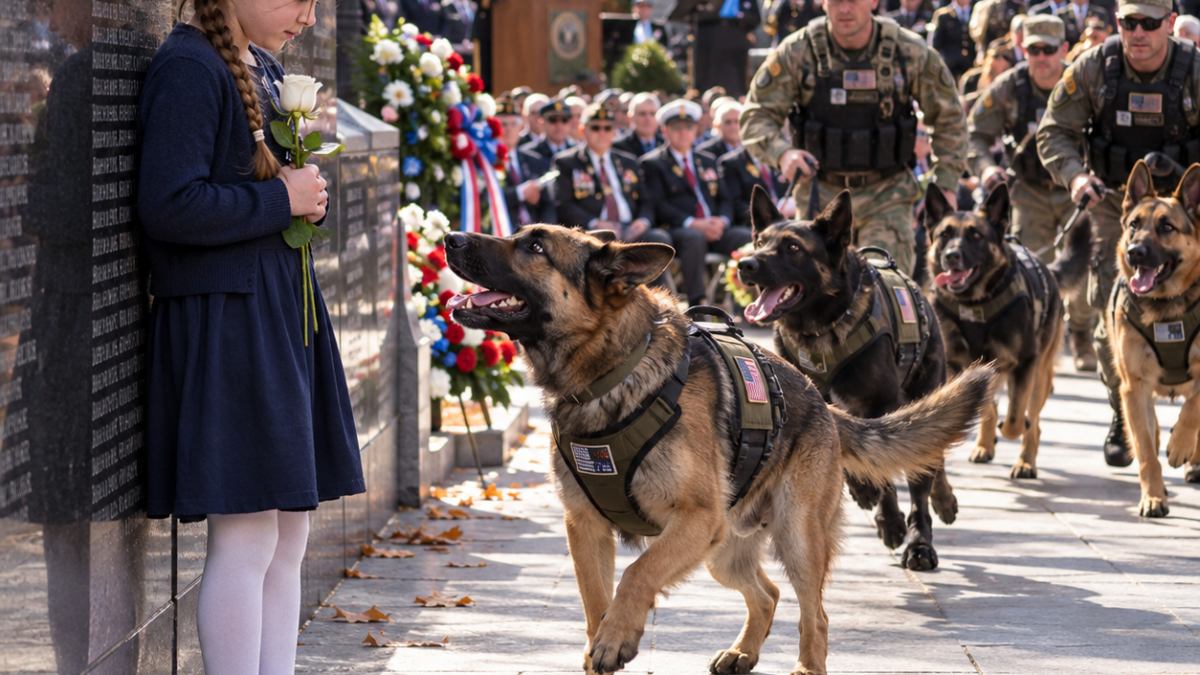
Nobody Noticed the 10-Year-Old Girl Standing Alone at the Military Memorial—Then Two K9s Broke Formation and Led Everyone to the Fallen Handler’s Daughter.
PART2:
PART3:
STAFF SERGEANT DANIEL A. REYES
UNITED STATES ARMY
1987–2025
She had found him before the sun was fully above the trees.
She reached toward the letters.
Not all at once.
First the D.
Then the A.
Then the N.
Her finger followed every carved line.
As though spelling him correctly mattered.
As though getting his name right could prevent another part of him from disappearing.
When she finished, she lowered her hand.
Then she whispered:
“Hi, Dad.”
No one heard.
Maya had practiced saying more.
She had done it in her bedroom the night before.
She had imagined standing here and telling him about school.
Her math test.
Grandma Ruth’s broken washing machine.
The stray orange cat that had started sleeping underneath the porch.
She had planned to tell him that she finally learned how to ride the bicycle he gave her before his last deployment.
She had planned to tell him she was angry.
That part mattered.
People always expected dead fathers to be spoken about softly.
Reverently.
As if death erased every unfinished argument.
Maya was angry at Daniel.
She was angry because he had promised to come home.
She knew that promise had never truly been under his control.
That didn’t make the anger disappear.
She had wanted to say:
You promised.
Instead she only managed:
“Hi, Dad.”
Then footsteps approached.
Maya wiped her face even though she hadn’t cried.
A woman wearing a burgundy blazer and an event credential was moving toward her.
Her name was Cynthia Vale.
Executive director of the Ashbury Veterans Memorial Foundation.
Cynthia was forty-six, polished, efficient, and known for running the annual memorial ceremony with the same precision some people used to run corporate conferences.
She had a clipboard.
A headset.
A phone in one hand.
She was giving instructions before she reached Maya.
“No, the mayor needs to be seated before the state delegation. Put the Reeves family in the second row if Colonel Reeves uses the wheelchair entrance.”
Then she stopped.
“Young lady?”
Maya looked at her.
“Yes, ma’am?”
“Where are your parents?”
“My grandma dropped me off.”
Cynthia frowned.
“Why?”
“She’s coming back.”
“That isn’t what I asked.”
Maya gripped the gardenia harder.
Cynthia softened her voice in the way adults do when they think a child is confused.
“Are you participating in the school choir?”
“No, ma’am.”
“Junior ROTC family?”
“No.”
“Then you shouldn’t be inside the memorial perimeter yet.”
“I came for the ceremony.”
Cynthia looked around.
“You need an adult.”
“My grandmother said it was okay.”
“That doesn’t mean we can have an unattended minor wandering around before a large public event.”
“I’m not wandering.”
Maya pointed toward the wall.
“I’m standing here.”
Cynthia exhaled.
She was already late.
To her, Maya was not cruelly unwanted.
She was a problem outside the plan.
Those can feel exactly the same to a child.
“Come with me.”
Maya did.
They walked toward the chairs.
At the front were several rows marked with gold cards.
GOLD STAR FAMILIES.
Maya slowed.
One seat had DANIEL REYES FAMILY printed on a card.
She stopped.
“That’s ours.”
Cynthia followed her gaze.
“What?”
“That seat.”
“No, sweetheart.”
“My dad’s Daniel Reyes.”
Cynthia looked at Maya.
Then at the card.
Then back.
“What is your father’s full name?”
“Staff Sergeant Daniel Antonio Reyes.”
For one second, Cynthia hesitated.
Then someone spoke urgently into her headset.
She turned aside.
“Yes, I know the congresswoman arrived early.”
Maya remained beside the chair.
Cynthia covered her microphone.
“Do you have identification?”
Maya blinked.
“I’m ten.”
“Does your grandmother have the family credential?”
“I don’t know.”
“The Gold Star section is reserved.”
“I know.”
“For immediate family.”
“I am immediate family.”
Cynthia’s expression tightened.
Not because she disliked Maya.
Because Maya’s certainty felt like resistance.
“Sweetheart, we can’t simply let anyone sit in reserved seating because they recognize a name.”
Maya stared at her.
“My name is Maya Reyes.”
Cynthia’s phone rang.
She ignored it.
“Do you have anything showing that?”
Maya touched her pocket.
Inside was a letter.
Her father’s letter.
Not proof.
Not the kind Cynthia meant.
“No.”
“Then for now, you need to remain outside the reserved area.”
A few early arrivals had started watching.
An elderly veteran in a wheelchair glanced over.
A woman pinning a corsage onto her coat stopped.
Maya became aware of all of them.
The embarrassment traveled up her neck.
She looked at the chair bearing her father’s name.
“I don’t need to sit.”
“Good.”
Cynthia immediately regretted the word.
But it was already there.
Maya nodded.
She walked back toward the wall.
Cynthia returned to the million details demanding her attention.
Years later, Cynthia would tell an interviewer that one word haunted her more than anything else.
Good.
Not because it was vicious.
Because it was careless.
Maya spent the next hour standing.
By nine o’clock, nearly five hundred people had filled the lawn.
Veterans.
Families.
Active-duty personnel.
Local officials.
Police.
Firefighters.
Schoolchildren.
Reporters.
Gold Star families were seated near the front.
Some held framed photographs.
Some wore pins.
Some held nothing.
Military grief has its own visual language.
Folded flags.
Silver bracelets.
Portraits in dress uniform.
Empty chairs.
But grief itself looks different on every person carrying it.
An old woman dabbed her eyes before the ceremony had even started.
A young man in a suit sat rigidly beside a photograph of his brother.
A boy about Maya’s age kicked his shoes against a folding chair while his mother whispered at him to stop.
Maya remained near the wall.
Nobody invited her forward.
Nobody told her to leave either.
She had become invisible in the safest way possible.
The master of ceremonies stepped to the podium.
Colonel Nathan Bishop, retired.
Broad shoulders.
Silver hair.
A voice trained over thirty years to carry without shouting.
“Good morning.”
The crowd quieted.
“We gather today not to celebrate war, but to remember service.”
Maya looked toward her father’s name.
Colonel Bishop continued.
“To speak a name is to resist forgetting.”
That sentence reached her.
She liked it.
She repeated it silently.
Resist forgetting.
Because forgetting was the thing she feared most.
Not forgetting Daniel entirely.
That seemed impossible.
She feared forgetting small things.
The exact sound of his laugh.
The rough patch on his left thumb.
Which side he parted his hair.
The smell of the green soap he used after shaving.
Whether he said pancakes first or coffee first on Saturday mornings.
People talked about memories like they were permanent.
Maya knew better.
Memory faded.
She had already discovered that.
At eight years old, she could picture her father’s face perfectly.
At ten, sometimes she needed the photograph on Ruth’s mantel to get his eyes right.
That terrified her.
Daniel had been thirty-eight when he died.
Staff Sergeant Daniel Reyes.
Explosive detection K9 handler.
Father.
Terrible cook except scrambled eggs.
Owner of six identical gray T-shirts.
A man who laughed too loudly in movie theaters.
A man who cried the day Maya was born and denied it for years.
A man who wrote real letters.
That mattered to Maya.
Other fathers texted.
Daniel wrote.
Every deployment, envelopes appeared.
Sometimes three in one week.
Sometimes nothing for eighteen days.
Each began:
Mi corazón,
My heart.
Daniel said electronic messages disappeared.
“A letter is different,” he told her.
“You can hold a letter.”
Maya kept all of them in a shoebox under her bed.
The one in her pocket was the last.
Written eleven days before his death.
She had unfolded it so many times that the creases felt like cloth.
Most of it was ordinary.
He told her about bad coffee.
Hot weather.
A soldier named Turner who snored.
Then Ranger.
There was always Ranger.
Ranger was Daniel’s military working dog.
Belgian Malinois.
Fawn coat.
Black mask.
Dark ears.
Maya had never met him.
That fact felt unfair.
Ranger had known her father in places she never would.
He had slept beside Daniel.
Worked beside him.
Ridden in vehicles with him.
Walked patrol beside him.
Daniel wrote about Ranger almost like a coworker and almost like another child.
Ranger stole socks.
Ranger hated baths.
Ranger could detect explosives that no human could smell.
Ranger once refused to leave Daniel during a sandstorm even when another handler tried to move him.
“He’s stubborn,” Daniel wrote.
“Reminds me of somebody.”
Maya knew he meant her.
In the final letter, Daniel had written:
Some mornings out here, I think Ranger understands something the rest of us are still trying to figure out. He isn’t proud and he isn’t scared of looking foolish. He just shows up completely. Whatever is in front of him gets all of him.
Then:
Try to be like that, mi corazón. Wherever you are, be there.
Eleven days later, Daniel was killed.
The official account used careful language.
Convoy.
Roadside explosive.
Secondary attack.
Staff Sergeant Reyes sustained fatal injuries while protecting members of his unit.
Ranger survived.
That was all Maya knew.
She asked what happened to him.
Adults said:
He was reassigned.
Then later:
He retired.
Then:
We aren’t sure where he went.
For eighteen months, that question stayed inside her.
Was Ranger alive?
Was he old?
Did he sleep inside a house?
Did he still wait for Daniel?
Did dogs understand death?
Maya had searched online.
Nothing.
Ruth tried.
Nothing.
The Army had given them several phone numbers.
None led anywhere.
Eventually adults stopped asking.
Maya didn’t.
Her father had once written:
Ranger has saved my life more times than he’ll ever understand.
Maya wanted to meet the dog who had saved her father.
Even if only before the day he couldn’t.
A chaplain stepped to the podium.
The opening prayer began.
Maya bowed her head.
When she raised it, six dogs were entering the grounds.
She stopped breathing.
The military K9 unit came along the outer path in formation.
German Shepherds.
Belgian Malinois.
Handlers in dress uniform.
The dogs moved beautifully.
Not like pets.
Like soldiers who happened to have four legs.
Controlled.
Alert.
Focused.
The crowd murmured.
Children pointed.
Phones rose.
Maya did none of that.
She just stared.
A Belgian Malinois near the front looked enough like Ranger that her chest hurt.
Same fawn coat.
Same black ears.
Not Ranger.
She knew that immediately.
Too young.
But something opened inside her.
Colonel Bishop spoke about military working dogs.
Their courage.
Their discipline.
Their partnership with handlers.
Maya barely heard him.
She watched.
One senior handler noticed her.
Staff Sergeant Marcus Webb.
Thirty-seven.
Four deployments.
Fifteen years around working dogs.
The kind of man who trusted animal behavior more than almost anything people said.
His assigned dog that morning was Atlas.
A five-year-old Belgian Malinois.
Beside them stood Staff Sergeant Olivia Grant with a German Shepherd named Kaiser.
Atlas sat perfectly.
Kaiser sat perfectly.
Then Atlas’s nose lifted.
Tiny movement.
Marcus noticed.
He gave a subtle correction.
Atlas resettled.
Thirty seconds later, Kaiser turned his head.
Olivia corrected him.
The dogs obeyed.
Marcus glanced toward the crowd.
Nothing obvious.
No food.
No loose animal.
No threat.
Just people.
Flags.
Flowers.
Cold air.
And a little girl standing alone.
He saw her.
Then the ceremony moved on.
Maya did not know anybody had noticed.
Her thoughts had gone backward.
To the last morning she saw Daniel.
The airport was crowded.
He knelt in front of her.
Uniform on.
Bag over one shoulder.
“Look at me.”
She refused.
“Maya.”
“No.”
“Mi corazón.”
“No.”
“You mad?”
“Yes.”
“Good.”
She looked at him then.
“Good?”
“Means you love me.”
“That’s stupid.”
“Probably.”
“You said you wouldn’t go again.”
Daniel’s face changed.
“I said I hoped I wouldn’t.”
“You promised.”
“I shouldn’t have.”
“You lied.”
He closed his eyes.
Maybe those words hurt more because they were true.
“I’m sorry.”
Maya was eight.
Old enough to understand danger.
Young enough to believe anger could keep someone home.
Daniel pulled a white gardenia from behind his back.
He always bought one at the airport flower kiosk.
Every deployment.
Every homecoming.
Their silly tradition.
Maya refused to take it.
“Don’t want it.”
Daniel’s mouth trembled.
He set it beside her anyway.
Then he hugged Ruth.
Maya’s mother, Elena, stood farther back crying.
Daniel kissed her.
When his boarding group was called, he looked at Maya one last time.
“Love you.”
She kept her arms crossed.
He waited.
Maya said nothing.
Daniel nodded.
Then walked away.
Those were the final words her father ever said to her.
Love you.
And Maya had not said it back.
That had become the secret inside her grief.
Adults told her not to feel guilty.
She did anyway.
Daniel died four months later.
Her mother never fully recovered from the loss.
Elena had always been bright and social.
After Daniel died, she stopped sleeping.
Then she stopped eating properly.
Then driving became dangerous.
She began forgetting where she was going.
One afternoon Ruth found her sitting on the kitchen floor with Daniel’s uniforms spread around her.
Elena finally agreed to treatment for complicated grief and severe depression.
She spent months moving between outpatient care and a residential program.
Maya went to live with Ruth.
Nobody had abandoned her.
But loss does not always care about technical explanations.
Her father was dead.
Her mother was sick.
Her old house was rented to strangers because they couldn’t afford to keep it.
The dog Maya had grown up with died of old age the following winter.
By ten, Maya had learned that things could disappear in layers.
That was why Ranger mattered.
He was one piece of Daniel’s world that might still be alive.
The ceremony reached the reading of names.
Colonel Bishop returned.
The bell stood beside him.
A brass bell on a wooden frame.
He explained that each name would be followed by one strike.
No applause.
Only the bell.
Maya stepped closer.
Cynthia noticed.
She nearly walked over.
Then stopped.
Something about the child’s face finally made her hesitate.
The names began.
Captain Matthew Allen.
Bell.
Sergeant First Class Jordan Bell.
Bell.
Petty Officer First Class Natalie Brooks.
Bell.
After each name, the sound traveled across the lawn.
Not loud.
But impossible to ignore.
Maya counted.
She knew roughly where Daniel would fall alphabetically.
Her hands tightened around the gardenia.
Marcus Webb felt Atlas shift beside his left leg.
Again.
Not enough for anyone else to notice.
But Marcus knew.
Kaiser did it too.
Olivia looked at him.
He gave the smallest shrug.
Then:
“Staff Sergeant Daniel Antonio Reyes.”
The bell struck.
Maya closed her eyes.
The world disappeared.
Dad.
One word.
Inside her.
Atlas’s head snapped toward Maya.
Kaiser’s followed.
Both dogs leaned forward.
Handlers corrected simultaneously.
Atlas obeyed.
Kaiser obeyed.
But their attention did not return to the podium.
Marcus stared.
He knew Daniel Reyes.
Not personally.
But the name.
Every military working dog community is smaller than outsiders imagine.
Stories travel.
Handlers remember teams.
Daniel Reyes and Ranger.
He had heard of them.
A patrol.
An explosion.
A dog refusing to leave his handler.
Marcus looked toward Maya.
The girl’s eyes opened.
She looked directly at the K9s.
Something cold moved through him.
The ceremony continued.
Cynthia walked toward Maya.
Quietly.
“Sweetheart.”
Maya looked at her.
“Could you step a little farther back? We need to keep this pathway open.”
Maya stared at the empty pathway.
Nobody was using it.
“I’m not blocking anything.”
Cynthia lowered her voice.
“I’m trying to keep things organized.”
“I’m standing by my dad.”
Several people heard.
Cynthia glanced toward them.
“Maya, I understand what you’re saying, but we still haven’t verified—”
“My grandmother knows.”
“I’m sure she does.”
The condescension in the sentence was small but unmistakable.
Maya’s eyes filled.
“His name was just read.”
“I heard.”
“That was my dad.”
Cynthia looked toward the card in the reserved section.
Then back.
“Until your guardian arrives, I need you to remain outside the marked family area.”
Maya nodded.
There was no argument left in her.
She stepped backward.
Marcus Webb saw that too.
He didn’t know what had been said.
He saw the girl shrink.
That bothered him.
But the ceremony was still underway.
He remained in formation.
The chaplain began the closing benediction.
The crowd started to relax almost imperceptibly.
Programs folded.
Children shifted.
A few people checked phones.
Then Atlas stood.
Marcus immediately gave the command.
“Atlas. Sit.”
Atlas did not sit.
He wasn’t lunging.
He wasn’t agitated.
He simply began walking.
“Atlas.”
Stronger now.
The dog continued.
At almost the same instant, Kaiser rose.
Olivia’s voice sharpened.
“Kaiser, heel.”
Nothing.
Hundreds of hours of obedience.
Military discipline.
Public ceremony.
Gone.
But not chaotically.
Both dogs moved with extraordinary calm.
Straight toward Maya.
Marcus stepped after Atlas.
Then stopped.
He had never seen this exact behavior.
The dog wasn’t distracted.
He had found something.
The chaplain’s voice faltered.
People turned.
Atlas reached Maya first.
She didn’t move.
He stopped directly in front of her.
Sat.
Then leaned his head against her left hand.
The hand holding the gardenia.
Kaiser came beside him.
Sat too.
Looked up at Maya.
Maya’s mouth opened.
Nothing came out.
Then the control she had maintained since before sunrise disappeared.
She cried.
Not loudly.
No screaming.
Just sudden tears pouring down her face as though somebody had opened a door.
Atlas pressed closer.
The gardenia trembled between her fingers.
The crowd became completely silent.
The chaplain stopped speaking.
Even Cynthia froze.
Marcus approached slowly.
Olivia beside him.
Maya looked frightened now.
“Am I in trouble?”
That question landed like a blow.
Marcus crouched.
“No.”
“But they left.”
“They did.”
“Was I not supposed to touch them?”
“You didn’t do anything.”
Maya looked at Atlas.
“Why did they come to me?”
Marcus did not know yet.
He looked at the girl.
Then at the wall.
Then the white flower.
“What’s your name?”
“Maya.”
“Maya what?”
“Reyes.”
His pulse changed.
“Your dad.”
Maya nodded.
“Daniel Reyes?”
Another nod.
Marcus slowly sat down on the grass.
Dress uniform and all.
He didn’t care.
Behind them, whispers moved through the crowd.
“That’s his daughter.”
“Daniel Reyes.”
“The handler?”
“Ranger’s handler?”
Cynthia’s face went white.
Marcus said:
“Your dad worked with a dog.”
Maya’s eyes widened.
“You know Ranger?”
“Know of him.”
It was the first time that morning Maya stopped crying.
“You know where he is?”
Marcus hesitated.
“I might.”
That single word changed her entire face.
“Might?”
“Can I see something?”
She reached into her pocket.
Pulled out Daniel’s letter.
Marcus did not touch it.
He looked at the envelope.
Unit designation.
Deployment code.
Return markings.
Everything matched the story he remembered.
He glanced at Olivia.
She had understood too.
Marcus asked:
“Did your dad ever work with these dogs?”
Maya shook her head.
“No.”
“Did he train at Fort Ashbury?”
“Sometimes.”
“What about his gear? Do you have any of it?”
“A jacket.”
“At home?”
“Yes.”
Marcus looked toward Atlas.
Dogs have extraordinary scent abilities.
Experienced handlers learn to respect recognition without inventing magic around it.
Marcus could not scientifically explain exactly what Atlas had detected.
Maybe something on Daniel’s old letter.
Maybe the faint shared scent of a household.
Maybe soap or fabric or something associated with training facilities and equipment.
Maybe nothing connected to Daniel at all.
But two highly trained dogs had responded to Maya within moments of Daniel’s name being spoken.
Whatever the mechanism, the behavior was real.
Marcus asked:
“Who are you here with?”
“My grandma’s picking me up at noon.”
“You came alone?”
“She dropped me off.”
“Does she know you’re here?”
“Yes.”
“Do you have her number?”
Maya recited it from memory.
Marcus pulled out his phone.
Cynthia approached.
“Sergeant Webb, I’m sorry to interrupt, but we need to restore the program.”
Marcus looked up.
“No.”
Cynthia blinked.
Colonel Bishop heard.
He stepped from the podium.
“What’s going on?”
Marcus stood.
“This is Staff Sergeant Daniel Reyes’s daughter.”
Every face near them changed.
Colonel Bishop looked at Maya.
Then toward the reserved seat.
The card still read:
DANIEL REYES FAMILY.
Empty.
He turned toward Cynthia.
“Why isn’t she seated?”
Cynthia swallowed.
“She arrived unattended, sir.”
“So?”
“We couldn’t verify her identity.”
Maya stared at the ground.
Colonel Bishop’s voice remained quiet.
“You asked a ten-year-old for identification?”
Cynthia looked increasingly uncomfortable.
“I was following the Gold Star access protocol.”
“The protocol prevents fraudulent access to private receptions.”
He pointed around them.
“This is a public memorial.”
Cynthia’s face tightened.
“I made a judgment call.”
“Yes.”
Colonel Bishop looked at Maya.
“A poor one.”
No one applauded.
That would have made it theatrical.
Instead, several Gold Star parents in the front row simply looked at Maya.
And the judgment on their faces was enough.
Cynthia’s eyes filled.
“Maya, I—”
Maya looked at Marcus.
“Do you know where Ranger is?”
She didn’t care about Cynthia anymore.
Marcus did.
He remembered a handler network message from the previous year.
Ranger had been retired after a hind-leg injury.
Transferred stateside.
A retirement facility.
Which one?
He began searching contacts.
A retired master sergeant named Cole.
No answer.
Another handler.
Voicemail.
Then Olivia said:
“Try Dalton.”
“Who?”
“Canine Haven.”
Marcus looked at her.
“That’s twenty minutes from here.”
“Exactly.”
He called.
A woman answered.
Marcus identified himself.
Asked about Ranger.
There was a long pause.
Marcus looked at Maya.
“Yes.”
Another pause.
His face changed.
Maya stood perfectly still.
“Is he alive?”
Marcus held up one finger.
Wait.
“Yes, ma’am.”
Pause.
“Daniel Reyes.”
The woman on the phone became emotional enough that Marcus turned away slightly.
Finally he disconnected.
Maya whispered:
“What?”
Marcus crouched again.
“Ranger’s alive.”
The entire world seemed to leave Maya’s body in one breath.
“He is?”
“Yes.”
“Is he okay?”
“He’s nine.”
“Is that old?”
“For his breed, getting there.”
“Is he sick?”
“No.”
“Injured?”
“He has an old leg injury.”
Maya gripped the gardenia.
“Does he have a family?”
Marcus chose his words carefully.
“He lives at a retirement facility.”
“That means no.”
“Not exactly.”
“Does somebody love him?”
“Yes.”
The answer came quickly.
Maya nodded.
That mattered.
Marcus continued.
“They say he’s gentle.”
“Does he remember my dad?”
The question was almost a whisper.
Nobody nearby moved.
Marcus looked toward Atlas and Kaiser.
Both dogs remained beside her.
He could have given the easy answer.
Of course.
He chose something more honest.
“I don’t know what Ranger remembers the way you and I remember things.”
Maya’s face fell slightly.
“But dogs know their people.”
He touched Atlas’s harness.
“They know them deeply.”
Maya looked at him.
“I think Ranger misses your dad too.”
She closed her eyes.
Then asked four words.
“Can I meet him?”
Marcus looked at Olivia.
Olivia looked toward Colonel Bishop.
The colonel was already nodding.
Marcus called back.
Maya expected somebody to say no.
Adults often said no for reasons children couldn’t argue with.
Policy.
Liability.
Schedule.
Permission.
Today something different happened.
People started solving problems.
Canine Haven could bring Ranger.
The facility director wanted guardian approval.
Marcus called Ruth.
At first Ruth thought it was a scam.
“My granddaughter is where?”
“At the memorial.”
“I know that.”
“Ma’am, my name is Staff Sergeant Marcus Webb.”
Then he explained.
Silence.
“Ranger?”
“Yes.”
“Daniel’s Ranger?”
“Yes, ma’am.”
Ruth began crying so suddenly she had to hand the phone to someone else.
She was already driving.
“I’m ten minutes away.”
The event schedule stopped mattering.
The reception was delayed.
Nobody complained.
Some people wandered toward coffee tables.
Most stayed.
Because word spread.
Daniel Reyes’s daughter.
Her father’s dog.
Coming here.
Cynthia disappeared for several minutes.
When she returned, she had removed her headset.
No clipboard.
She approached Maya carefully.
Maya sat on the low stone wall with Atlas at one side and Kaiser at the other.
“Maya?”
Maya looked up.
“I owe you an apology.”
The girl said nothing.
Cynthia swallowed.
“You told me exactly who you were.”
Maya looked down.
“And I didn’t believe you.”
“No.”
“You were right.”
“No.”
That second no hurt more.
Cynthia continued.
“I was so worried about the ceremony looking organized that I forgot what the ceremony was for.”
Maya looked toward her father’s name.
Cynthia followed her eyes.
“Your father should have had family in that seat.”
Maya whispered:
“He did.”
“What?”
“I was here.”
Cynthia’s composure broke.
“Yes.”
She nodded.
“Yes, you were.”
The memorial foundation board chairman stood nearby.
He had heard enough.
Cynthia would later be removed from direct Gold Star family coordination and reassigned to logistics.
Not because Maya demanded it.
She never did.
Because several board members realized their procedures had become more important than the people they claimed to honor.
That was justice in its quietest form.
Not humiliation.
Correction.
At 11:03, Ruth arrived.
Sixty-eight years old.
Gray hair escaping a bun.
Coat half buttoned.
She moved through the crowd as quickly as her knees allowed.
“Maya!”
Maya ran.
That was the first time all morning anyone saw her behave like a ten-year-old.
She crashed into Ruth.
Her grandmother held her.
“I’m sorry.”
Maya pulled back.
“For what?”
“For leaving you.”
“You didn’t leave me.”
“I should’ve stayed.”
“I wanted to come alone.”
Ruth looked toward the dogs.
“What happened?”
Maya said:
“Ranger’s coming.”
Ruth froze.
Her face collapsed.
“No.”
“He is.”
“Daniel’s Ranger?”
Maya nodded.
Ruth covered her mouth.
Then sat down abruptly in an empty chair.
For months after Daniel’s death, Ruth had helped Maya search for that dog.
They wrote emails.
Called offices.
Filed requests.
Every trail ended.
Now Ranger had been twenty minutes away.
Twenty minutes.
Grief sometimes puts the thing you need close enough to touch while bureaucracy makes it feel like another continent.
The crowd waited.
Forty minutes feels short when you are late to work.
It feels endless when your dead father’s dog is driving toward you.
Marcus sat with Maya.
Ruth beside her.
Atlas and Kaiser had returned to formation, though both kept looking toward her.
Marcus told Maya what he knew about Daniel.
Not much.
But in the world of K9 handlers, Daniel’s story had traveled.
“He was respected.”
Maya smiled slightly.
“Dad said respected means people think you’re boring.”
Marcus laughed.
“That sounds like a handler.”
“Did he save people?”
“Yes.”
“How many?”
“I don’t know.”
Maya frowned.
“Then how do you know?”
“Because explosive detection teams save people every time they find something before somebody steps on it.”
Maya looked toward the wall.
“Was he brave?”
Marcus thought.
“Probably.”
“Probably?”
“Brave people usually don’t think about themselves as brave.”
That sounded like Daniel too.
At 11:41, a white van appeared at the gate.
No announcement was made.
None was needed.
People noticed.
The rear door opened.
A woman in khaki pants stepped out.
Her name was Dr. Eleanor Price.
Canine behavior specialist.
Then Ranger appeared.
Maya forgot to breathe.
He was larger than she imagined.
Nine years old.
Fawn coat darker along his back.
Black ears.
Gray beginning around the muzzle.
He favored his left rear leg slightly.
But his head was high.
His eyes alert.
Maya knew him.
Not because she had ever seen him in person.
Because Daniel had sent photographs.
Ranger sitting beside a Humvee.
Ranger wearing goggles.
Ranger asleep with his head on Daniel’s boot.
Ranger looking annoyed while Daniel smiled behind him.
It was him.
“Ranger.”
Maya’s voice carried farther than she expected.
The dog stopped.
Dr. Price loosened the lead slightly.
Ranger’s nose lifted.
One second.
Two.
His entire posture changed.
Not wild excitement.
Something more focused.
He started walking.
Dr. Price followed.
The crowd opened.
No one directed them.
Veterans stepped aside.
Gold Star families rose.
The photographer lifted his camera.
Then lowered it.
At first.
Ranger came across the grass.
Maya stood near the wall.
Ruth behind her.
Marcus several feet away.
When Ranger reached twenty feet, he began pulling gently.
Ten feet.
Five.
Dr. Price let the leash go slack.
Ranger stopped in front of Maya.
Looked at her.
Maya’s chin trembled.
“Hi.”
Ranger sat.
Exactly as Atlas and Kaiser had.
Maya knelt.
She did not throw herself at him immediately.
Daniel had taught her never to hug unfamiliar working dogs.
Even after death, his rules remained.
She held out her hand.
Ranger smelled it.
Her fingers.
Her wrist.
The sleeve of her dress.
Then her pocket.
The letter.
His nose pressed against the fabric.
Maya gasped.
Ranger smelled again.
Then made a sound.
Not a bark.
A low whine.
Dr. Price covered her mouth.
Marcus looked away.
Ranger moved closer.
His head pressed against Maya’s chest.
That was when she broke.
Maya wrapped both arms around his neck.
The dog allowed it.
More than allowed it.
He leaned into her until she nearly lost balance.
Maya buried her face in his fur.
Nobody heard what she said.
Not Marcus.
Not Ruth.
Not Dr. Price.
That belonged to Maya and Ranger.
But years later, Maya would tell Ruth.
She had whispered:
“I’m sorry I didn’t tell him I loved him.”
Ranger had remained perfectly still.
Then Maya said:
“Can you tell him for me?”
She knew dogs could not deliver messages to the dead.
She was ten.
Not foolish.
But grief sometimes needs somewhere physical to put words.
Ranger was there.
He had known Daniel.
That was enough.
Maya took the gardenia.
The flower she had held for nearly four hours.
She tucked it beneath Ranger’s collar.
Daniel’s flower.
On Daniel’s dog.
Ruth cried openly.
Marcus stood with his head bowed.
An old veteran at the back removed his cap and held it over his heart.
The ceremony had begun with speeches about sacrifice.
None of those speeches came close to the sight of one little girl kneeling in the grass with the dog who had once walked into danger beside her father.
Dr. Price eventually approached.
“Maya?”
She looked up.
“Yes?”
“I need to tell you something.”
Maya loosened her grip slightly.
“What?”
“Ranger has had a difficult time retiring.”
Maya looked worried.
“Is he bad?”
“No.”
“Sad?”
Dr. Price smiled gently.
“Maybe.”
She sat on the grass.
“When working dogs retire, some adapt quickly.”
“And Ranger?”
“He waits.”
“For what?”
“That’s the thing.”
Dr. Price glanced at Marcus.
“We weren’t sure.”
She continued.
“He checks doors whenever someone wearing a uniform enters.”
Maya’s eyes filled.
“He sleeps near his old harness.”
Ruth began crying harder.
“And sometimes, when vehicles arrive at the facility, he gets up before the other dogs.”
Maya whispered:
“He thinks Dad’s coming.”
Dr. Price did not say yes.
She didn’t need to.
Maya stroked Ranger’s ears.
“He’s not coming.”
Ranger looked at her.
“I know.”
She said it again.
For herself this time.
“I know.”
Something happened in that moment that no camera could prove.
No scientist could measure it.
Nothing supernatural.
Nothing magical.
Just two living creatures who had been waiting differently for the same person.
A daughter.
A dog.
Both forced to understand an absence they had never chosen.
Ranger stayed beside Maya for almost an hour.
When she walked toward Daniel’s name, he followed.
She touched the granite.
“Dad, look.”
Her voice shook.
“I found him.”
Ranger sniffed the base of the wall.
Then sat.
Maya smiled through tears.
“You were supposed to find me.”
Ruth laughed and cried at once.
Later, Colonel Bishop asked Maya if she wanted the ceremony’s closing remarks completed.
Maya looked confused.
“Why are you asking me?”
“Because we interrupted everything.”
She looked around at five hundred people.
Then at Ranger.
“Can you just say Dad’s name again?”
Colonel Bishop stared at her.
“Yes.”
They returned to the podium.
Maya did not stand at the edge this time.
She sat in the front row.
In the chair labeled:
DANIEL REYES FAMILY.
Ruth beside her.
Ranger at Maya’s feet.
Marcus and Olivia stood nearby.
Colonel Bishop took the microphone.
No grand speech.
No attempt to manufacture meaning.
He said:
“We began this morning by saying that speaking a name is an act of remembrance.”
He looked toward Maya.
“So we will speak one again.”
He paused.
“Staff Sergeant Daniel Antonio Reyes.”
This time there was no bell.
There didn’t need to be.
Maya whispered:
“Love you, Dad.”
Quiet.
But this time she said it.
For eighteen months, she had carried the final airport morning like a punishment.
She had believed her silence might somehow be the last thing Daniel carried overseas.
Marcus later told her something that changed that.
He asked:
“You think your dad thought you didn’t love him?”
Maya shrugged.
“I didn’t say it.”
Marcus smiled sadly.
“Your father spent three years working with a creature that never said one word.”
He pointed at Ranger.
“You think he only believed love when somebody said it out loud?”
Maya stared at him.
“No.”
“Your dad knew.”
“Are you sure?”
Marcus looked at Ranger.
“I’m sure.”
That sentence did not erase Maya’s guilt immediately.
Healing is rarely that efficient.
But it gave the guilt somewhere to loosen.
After the memorial, Dr. Price invited Maya and Ruth to Canine Haven.
They visited the following Saturday.
Then again.
Then every weekend.
Ranger changed.
Everybody noticed.
He stopped waiting at the main gate as often.
He began sleeping in the visitor room whenever Maya stayed late.
He followed her.
Not obsessively.
Quietly.
Daniel had trained him to heel on the left.
Ranger naturally walked on Maya’s left.
The first time it happened, Ruth had to turn away.
Maya started reading Daniel’s letters aloud to him.
“Dad said you stole a sandwich.”
Ranger looked innocent.
“He says it was Sergeant Turner’s sandwich.”
No response.
“He says you blamed another dog.”
Ranger yawned.
“Criminal.”
Maya laughed.
The sound surprised Ruth.
It had been a long time since laughter came easily.
Three months later, Canine Haven contacted them.
Dr. Price sat with Ruth first.
Then Maya.
“Ranger can be adopted.”
Maya’s entire body went still.
“What?”
“He’s eligible for permanent placement.”
“With us?”
“If your grandmother agrees.”
Maya turned.
Ruth was already crying.
“Grandma?”
Ruth sighed.
“You know I just bought a new couch.”
Maya stared.
“That means yes?”
“It means that dog is going to destroy it.”
Maya screamed.
Actually screamed.
She threw herself around Ruth.
Then Ranger.
For the first time since Daniel died, something from his world came home.
Not a medal.
Not a folded flag.
Not a photograph.
Something alive.
Ranger slept at the foot of Maya’s bed the first night.
Exactly where her old family dog once slept.
Maya woke at 2:13 in the morning.
Moonlight through the curtains.
Ranger’s breathing.
She whispered:
“Are you there?”
His head lifted.
Then lowered again.
Maya smiled.
“I’m here too.”
Ruth heard her from the hallway.
She didn’t go in.
Some moments belong to healing and should not be interrupted.
School changed for Maya afterward.
Not magically.
She was still quiet.
Still disliked being the center of attention.
But she stopped eating lunch alone every day.
A girl named Sophie started sitting with her.
Mostly because Sophie loved Ranger.
Then because she liked Maya too.
Maya began writing again.
She had stopped after Daniel died because letters felt like something only he did.
Now she wrote to him.
Not because she believed he physically read them.
Because, as he once said, letters were something you could hold.
She kept them in the same shoebox.
One began:
Dad,
Ranger snores.
You never told me that.
Another:
Dad,
I’m still mad at you sometimes.
Ruth said that’s allowed.
And another:
Dad,
I finally understand what you meant about showing up completely.
Ranger does.
He always does.
Cynthia Vale wrote Maya a letter too.
Not an email.
A letter.
Maybe she understood symbolism better after that day.
Maya did not read it for a week.
Eventually she opened it.
Cynthia apologized without excuses.
She told Maya that she had spent years organizing events honoring families while slowly becoming better at protecting schedules than seeing people.
She wrote:
You told me who you were, and I decided your truth needed paperwork before it deserved my respect.
I am deeply sorry.
Maya showed Ruth.
“What should I say?”
“You don’t owe her forgiveness.”
“I know.”
“Do you want to answer?”
Maya thought.
“Yes.”
Her reply was six lines.
Thank you for apologizing.
I was telling the truth.
Kids usually are.
Next year, if another kid comes alone, ask their name before asking for proof.
My dad said paying attention is part of doing your job.
Maya Reyes
Cynthia framed that letter in her office.
The following year, memorial procedures changed.
Any unaccompanied child was assigned a family liaison.
Gold Star seating could be verified afterward.
Nobody was moved away from the wall without cause.
Cynthia no longer ran family access.
She accepted that consequence.
To her credit, she volunteered for the new liaison training.
When reporters later wanted to turn her into the villain of Maya’s story, Maya refused.
“She was mean to me,” Maya said.
“Isn’t that enough?”
“No.”
The reporter looked surprised.
Maya continued.
“She was wrong.”
Then she scratched Ranger behind the ears.
“People can be wrong without being monsters.”
Ruth nearly cried from pride.
Justice did not always require somebody to be destroyed.
Sometimes it meant making sure they never had the power to repeat the same harm without learning from it.
Marcus Webb became part of their life.
At first accidentally.
Then deliberately.
He visited Ranger.
Brought old K9 photographs.
Showed Maya how handlers cared for working dogs.
He eventually found more of Daniel’s former unit.
One man was retired in Texas.
Another stationed overseas.
A third, Master Sergeant Caleb Turner, lived only three hours away.
The sandwich victim.
When Caleb arrived at Ruth’s house, he stood in the doorway looking at Maya for almost a full minute.
She looked uncomfortable.
“What?”
He laughed through tears.
“You’ve got his face when you’re suspicious.”
“Dad?”
“Exactly.”
Caleb had stories nobody else knew.
Daniel singing terribly during patrol preparation.
Daniel pretending Ranger’s gas was someone else’s.
Daniel carrying letters from Maya inside a waterproof pouch.
Maya froze.
“My letters?”
Caleb nodded.
“All of them.”
“Every one?”
“Far as I know.”
“What did he do with them?”
“Read them.”
“No, after.”
“Kept them.”
“Where?”
Caleb’s expression changed.
“In his vest.”
Maya started crying.
“Even the last one?”
“What was the last one?”
She knew immediately.
A drawing she made after the airport argument.
She had mailed it two days later.
Daniel standing beside Ranger.
Above them, in eight-year-old handwriting:
SORRY I WAS MAD.
LOVE YOU.
Caleb smiled.
“That one.”
“You saw it?”
“Everybody saw it.”
Maya stared.
“What?”
“Your dad showed that drawing to half the unit.”
“Why?”
“Because he was obnoxiously proud of you.”
She laughed through tears.
Caleb continued.
“He kept it folded inside his vest.”
Maya’s face changed.
“Was it…”
She couldn’t finish.
“Recovered?”
Caleb understood.
“Yes.”
“Where is it?”
“I don’t know.”
That became the next mystery.
Not a dramatic one.
Paperwork.
Phone calls.
Military personal effects offices.
Inventory numbers.
Storage.
Records.
Ruth nearly gave up.
Maya did not.
Months later, a package arrived.
Brown government box.
Inside were small personal effects that had never reached them because Daniel’s next-of-kin paperwork listed an old address during Elena’s hospitalization.
A watch.
Dog tags.
A small multitool.
Two photographs.
And folded into a plastic evidence sleeve:
Maya’s drawing.
SORRY I WAS MAD.
LOVE YOU.
She sat on the kitchen floor for twenty minutes.
Ranger beside her.
That night she removed one burden from her heart forever.
Her father had known.
There was no question anymore.
Daniel had carried her love against his chest.
The last year of Maya’s childhood did not become easy.
Her mother’s recovery remained uneven.
Elena came home permanently when Maya was eleven.
Relearning how to be mother and daughter took patience.
Maya was angry.
Again.
She had every right.
“You left me.”
Elena cried.
“I was sick.”
“You still left.”
“Yes.”
Ruth did not force reconciliation.
Marcus didn’t.
Therapists didn’t.
Love came back slowly.
Elena started with Saturday breakfasts.
Then school pickups.
Then overnight visits.
Ranger distrusted her at first.
That wounded Elena.
“He remembers me?”
Ruth said:
“Maybe.”
The truth was, Ranger had met Elena only briefly years earlier.
Nobody knew.
Eventually he accepted her.
Dogs are sometimes better at allowing the present to become new than humans are.
Elena moved into Ruth’s house for six months.
One evening Maya found her mother sitting beside Ranger.
Holding Daniel’s dog tags.
Crying.
Maya nearly walked away.
Instead she sat.
They stayed there without speaking.
It was not forgiveness.
Not yet.
But it was presence.
Daniel would have respected that.
Wherever you are, be there.
The next memorial came one year after the morning everything changed.
Maya was eleven.
She wore the same navy dress.
It fit better now somehow, even though children usually grow out of clothes.
Ruth had altered it.
The braid was different.
Elena braided it this time.
That mattered.
Ranger walked beside Maya.
Not as a military working dog anymore.
No harness.
Just a dark leather collar.
A new gardenia tucked carefully through it.
They arrived at 7:40.
Before the chairs were finished.
Tom Pritchard was there again.
He saw her.
This time he did not forget.
“Maya.”
She smiled.
“Hi, Mr. Pritchard.”
He looked at Ranger.
“That him?”
“Yeah.”
Tom knelt.
“Can I?”
Maya nodded.
Ranger accepted a scratch beneath the chin.
Tom stood.
Then looked toward the wall.
“You want company?”
Maya considered.
“Not yet.”
Tom nodded.
“Okay.”
He walked away.
Not because she was invisible.
Because she had been seen and allowed to choose solitude.
There is a difference.
Maya went to Daniel’s name.
Ranger beside her.
She touched the letters.
“Hi, Dad.”
This time more words came.
“Mom’s better.”
Pause.
“I’m better.”
Another pause.
“Ranger still steals food.”
The dog glanced up.
She smiled.
“Marcus says you were worse.”
Ranger looked away as if refusing involvement.
Maya placed the gardenia beneath Daniel’s name.
Then sat on the ground.
When the ceremony began, she was in the front row.
Nobody needed proof.
Cynthia was there too.
Working at a side table.
She saw Maya.
Their eyes met.
Cynthia gave a small nod.
Maya returned it.
That was enough.
Six K9 teams entered.
Atlas was there.
So was Kaiser.
Both older by a year.
When they passed Maya, Atlas glanced at her.
He did not break formation.
Marcus smiled.
Maya whispered:
“Good boy.”
The names were read.
When Daniel’s came, Maya held Ranger’s collar.
“Staff Sergeant Daniel Antonio Reyes.”
Bell.
Ranger remained still.
Maya cried.
Not because something was wrong.
Because grief was allowed.
She no longer treated tears like a failure of discipline.
After the ceremony, a boy approached.
Maybe eight.
His father had died four months earlier.
He stared at Ranger.
“Is that a military dog?”
“Retired.”
“Was he your dad’s?”
“Yes.”
The boy looked toward the wall.
“My mom’s name is there.”
Maya didn’t know what to say.
A year earlier, that would have frightened her.
Now she remembered Wade—
No, not Wade.
Marcus.
Daniel.
Ranger.
The lesson repeated across different lives.
You did not need perfect words.
You needed to stay.
Maya sat on the grass.
“What was your mom’s name?”
The boy told her.
They talked for twenty minutes.
Nothing profound.
School.
Dogs.
How annoying adults became after somebody died.
At one point the boy laughed.
His father, sitting nearby, covered his face.
Maya saw.
She understood that too.
By the time Maya was thirteen, Ranger’s muzzle had turned almost entirely gray.
He slowed down.
Stairs became difficult.
They put rugs over Ruth’s hardwood floors so he wouldn’t slip.
Maya slept downstairs on bad nights.
One evening Ranger could not stand.
The emergency vet found a severe spinal issue.
Surgery might help.
Might not.
He was twelve.
Old for a Malinois.
The veterinarian spoke gently.
Maya hated gentle voices now.
They usually carried terrible things.
“What would you do?” she asked.
The vet hesitated.
“If he were yours?”
Maya insisted.
The veterinarian looked at Ranger.
“I would ask whether I was trying to give him more life or because I wasn’t ready for less.”
Maya started crying.
Ruth held her.
Elena cried too.
Marcus came.
So did Caleb Turner.
They sat on the floor of the veterinary clinic.
Ranger’s old team, in the only form still possible.
Maya rested her head beside his.
“You saved Dad.”
Ranger breathed slowly.
“You found me.”
His eyes remained on her.
“Everybody keeps saying you were his dog.”
She stroked his ear.
“But you were mine too.”
Marcus turned away.
Maya whispered:
“I don’t want you to stay because I’m scared.”
That sentence took enormous courage.
She tucked one last gardenia beneath Ranger’s collar.
“You can go.”
Ranger died with Maya’s hand on his chest.
Ruth beside her.
Elena behind her.
Marcus kneeling at his feet.
There was no miracle.
No last-minute recovery.
No supernatural sign.
His breathing slowed.
Then stopped.
Maya sobbed.
Real grief.
Wild grief.
The kind nobody should make poetic while it is happening.
The next morning, she woke and instinctively looked toward the foot of her bed.
Empty.
That emptiness hurt in a new way.
She had lost the last living creature who had known Daniel in that distant country.
For weeks, Maya felt as though her father had died again.
Then Marcus brought something.
Ranger’s retired working collar.
The military one.
Not the collar he wore at home.
A worn section of material where Daniel’s hand had repeatedly held it.
Maya put it beside Daniel’s letters.
She did not display Ranger’s ashes prominently.
She kept them private.
Some losses do not need to become decorations.
At the memorial that autumn, Maya carried two gardenias.
One beneath Daniel’s name.
One beneath a small temporary plaque the K9 association had placed for Ranger near a tree planted in honor of retired service dogs.
Marcus stood beside her.
“You okay?”
“No.”
He nodded.
“Me neither.”
They stayed.
Years moved.
Maya grew taller.
Her grief changed shape.
At sixteen, she volunteered with a nonprofit that helped retired military working dogs find adoptive families.
At seventeen, she testified before a state veterans committee about simplifying family access to retired K9 records.
Not politics.
Not speeches for attention.
A practical problem she had lived.
Families should not spend eighteen months wondering whether their loved one’s canine partner was alive twenty minutes away.
The proposal led to a regional registry linking handlers’ next of kin with retirement organizations whenever privacy and service rules allowed.
The first family notified through the new system was the widow of another fallen handler.
Maya was there when they met the dog.
She stood at the back.
Nobody noticed her.
She liked it that way.
The dog recognized the widow’s old jacket.
The woman cried.
Maya did too.
At eighteen, Maya received a scholarship from the memorial foundation.
Cynthia presented it.
Before handing over the envelope, Cynthia said privately:
“You know, you changed this place.”
Maya shook her head.
“No.”
Cynthia smiled.
“You did.”
“The dogs did.”
“Maybe.”
She looked around.
“But we needed to notice what they noticed.”
Maya liked that answer.
At twenty-two, Maya graduated college with a degree in veterinary behavior science.
Ruth sat in the front row.
Elena beside her.
Marcus behind them.
Caleb too.
There was an empty seat with Daniel’s photograph.
Maya hated empty-chair symbolism at first.
Then decided some clichés existed because people needed them.
She carried one gardenia.
After graduation, she went to work with retired military and law-enforcement dogs.
Not because she believed dogs were magical.
She became more scientifically careful as she grew older.
Scent recognition was powerful.
Association was powerful.
Memory in dogs was complex.
People often projected too much onto animal behavior.
Maya resisted that.
When interviewers asked:
“Did Atlas and Kaiser smell your father on you?”
She answered:
“I don’t know.”
“Did Ranger recognize Daniel through you?”
“I don’t know exactly.”
“Do you believe Ranger knew you were Daniel’s daughter?”
Maya always paused.
Then said:
“I know what he did.”
That was enough.
Facts first.
Atlas and Kaiser broke formation.
They went directly to her.
Ranger met Maya forty minutes later.
He smelled Daniel’s letter.
He stayed beside her.
Then eventually he came home.
Nobody needed to turn it into a ghost story.
Reality was already extraordinary.
Maya returned to the memorial every October.
Even when Ruth became too old to walk the full path.
Even after Marcus retired.
Even after Cynthia left the foundation.
Even as Daniel’s name weathered slightly inside the stone.
One year, Tom Pritchard died.
The volunteer who first noticed Maya and forgot her five minutes later.
His widow found a note among his things.
It read:
PAY ATTENTION TO THE QUIET ONES.
She gave it to Maya.
Tom had apparently written it after that first memorial.
Maya framed it at her office.
Not as accusation.
As instruction.
Because Maya eventually understood something adults rarely admit.
Most failures of compassion are not spectacular.
They are ordinary.
We are busy.
Distracted.
Following procedure.
Checking schedules.
Assuming somebody else will ask.
Believing quiet means okay.
Cynthia had not screamed at Maya.
Tom had not abandoned her intentionally.
The crowd had not chosen to ignore a grieving child.
They simply didn’t notice.
And sometimes not noticing hurts almost as much as cruelty.
The dogs noticed.
Or at least they responded.
And their response forced everybody else to look.
That was the part people remembered.
“Nobody noticed the quiet girl until the K9s ran to her.”
Articles used that line.
Videos used it.
People shared it millions of times over the years.
But Maya always corrected one detail.
“They didn’t run.”
“What?”
“They walked.”
“Does that matter?”
“Yes.”
“Why?”
“Because they weren’t excited.”
She would pause.
“They were certain.”
At thirty, Maya gave a speech at the twentieth anniversary of the memorial’s expansion.
She almost refused.
She disliked public speaking.
Ruth had died the previous winter.
Elena was seated near the front.
Marcus, gray-haired now, sat beside her.
Maya stood at the podium.
Behind her was the wall.
Daniel’s name.
Still there.
Always there.
She looked across the crowd.
Veterans.
Children.
Families.
K9 teams.
Then toward a little girl standing near the edge with a photograph in her hands.
Maya stopped her prepared remarks.
“Before I say anything,” she said, “could someone bring that young lady a chair?”
Several heads turned.
The girl looked startled.
Maya smiled.
“Or she can stand if she wants.”
The crowd laughed softly.
“But somebody should ask.”
A volunteer approached the child.
Maya waited.
Only when she saw the girl was with her aunt and wanted to remain standing did Maya continue.
“I was ten years old the first time I came here alone.”
Her voice caught slightly.
“Most people didn’t notice me.”
She looked toward Marcus.
“Two dogs did.”
A few people smiled.
Marcus looked down.
“My father was Staff Sergeant Daniel Reyes.”
Maya turned toward the wall.
“He died when I was eight.”
She let the sentence remain simple.
“He was a military working dog handler.”
“And his partner was Ranger.”
The large screen behind her showed a photograph.
Daniel.
Young.
Smiling.
Ranger beside him.
Then another photograph.
Ten-year-old Maya kneeling in a navy dress.
Ranger pressed against her.
The gardenia beneath his collar.
Maya had once hated that photograph.
The photographer had eventually given it to Ruth rather than publishing it immediately.
He waited six months.
Asked permission.
Ruth asked Maya.
Maya said yes.
Now it was one of her most treasured possessions.
“People have asked me for twenty years what happened that day.”
Maya looked across the crowd.
“I can tell you what happened.”
She took a breath.
“A child came to visit her father.”
“Two working dogs left formation.”
“Some very good people stopped following the program long enough to pay attention.”
“And somebody made a phone call.”
A few people laughed softly.
“Forty minutes later, I met Ranger.”
Her voice trembled.
“That dog gave me five years I did not know I needed.”
She looked at Marcus.
“He connected me to my father’s old unit.”
“To stories.”
“To people.”
“To parts of my dad no official casualty report could ever carry.”
She looked at Daniel’s name.
“But Ranger did something even more important.”
“He taught me that grief and loyalty are not the same as refusing to move.”
The field was silent.
“For a long time, I thought moving forward meant leaving my father behind.”
“I thought laughing meant I was forgetting.”
“I thought loving another dog might mean Ranger mattered less.”
“I was wrong.”
She smiled.
“Love is strange that way.”
“It makes room.”
Maya reached into her pocket.
Pulled out a folded piece of paper.
Daniel’s last letter.
The original.
Protected now inside archival film.
“I’ve carried this letter for most of my life.”
She looked down.
“My father wrote something I didn’t understand at ten.”
Then she read only one line:
“Wherever you are, be there.”
Maya folded the letter.
“That’s all Ranger ever did.”
“He was there.”
“That’s all Atlas and Kaiser did when they came to me.”
“They were there.”
“That’s what Marcus did.”
“What my grandmother did.”
“What my mother learned to do again.”
She looked toward Elena.
Her mother was crying.
“And that is what memorials should do.”
“Not freeze people inside the worst day of their lives.”
“Not turn the dead into names we speak once a year.”
“They should help the living remain present with what mattered.”
Maya looked around.
Then smiled.
“So if you remember nothing else from the quiet girl and the dogs…”
She paused.
“Look around.”
“Somebody near you may be carrying something enormous very quietly.”
“You do not need the perfect words.”
“You do not need proof before kindness.”
“You do not need to solve their grief.”
“Just notice.”
Marcus stood first.
Not applause immediately.
Just stood.
Then Elena.
Then Gold Star families.
Then veterans.
Then everyone.
Maya hated standing ovations.
She laughed through tears.
“Please sit down.”
Nobody did.
At the edge of the crowd, the little girl with the photograph was crying.
A volunteer had stayed beside her.
Maya saw.
That mattered more than the applause.
Afterward, Maya walked to Daniel’s name alone.
Thirty years old now.
No navy dress.
No braid done in the dark.
No gardenia trembling in small hands.
She placed a flower anyway.
Always white.
Always gardenia.
“Hi, Dad.”
She smiled.
“Still here.”
Then she walked toward Ranger’s tree.
Marcus followed slowly.
Age had changed his stride.
“You know,” he said, “Atlas was the best dog I ever handled.”
Maya looked at him.
“Ranger was better.”
“Absolutely not.”
“Ranger ignored retirement and adopted me.”
“Atlas ignored direct commands in front of five hundred people.”
“Fair.”
They laughed.
For a moment Maya could see the whole bridge of her life.
Daniel.
Ranger.
Atlas.
Kaiser.
Marcus.
Ruth.
Elena.
A memorial official making a mistake.
A crowd learning to look.
None of them erased what happened before.
Daniel remained dead.
Ranger remained gone.
Ruth too.
That is not what healing means.
Healing does not negotiate with facts.
It changes the relationship we have with them.
Maya once stood beside that wall believing her father existed only behind her.
Later she understood that love had traveled forward in strange ways.
Through letters.
Through soldiers who remembered jokes.
Through procedures changed because a child had been dismissed.
Through retired dogs reunited with families.
Through Ranger sleeping at the foot of her bed.
Through the work Maya chose.
Through every quiet person she noticed because once nobody noticed her.
Daniel had died.
But what he built in people and animals had not stopped moving.
That was the bridge.
At sunset, Maya prepared to leave.
Near the gates stood a K9 handler and a young Belgian Malinois.
The dog stared at her.
Maya smiled.
“Don’t even think about it.”
The handler laughed.
“He likes you.”
“I have history with dogs breaking protocol.”
“I heard.”
Maya scratched the dog’s neck after receiving permission.
Then she looked one last time at the wall.
When she was ten, she had arrived at 7:42 in the morning holding a single flower.
She had thought she came only to visit her father.
Instead, she found the dog who had once kept him safe.
She found soldiers who had known him.
She found proof that the final words between father and daughter were not the measure of their love.
She found a purpose she could not yet name.
And the people at that memorial found something too.
They learned that grief is often quiet.
That children can carry it with extraordinary dignity.
That procedure without compassion becomes another kind of blindness.
And that sometimes the person standing farthest from the honored seats is the person with the deepest right to be there.
For years afterward, people told the story as if the remarkable part was that two trained K9s recognized something in Maya.
Maybe it was.
But Maya thought the more important part came afterward.
The humans finally looked.
They saw the polished shoes.
The braid.
The gardenia.
The letter worn soft at the folds.
The small hand tracing one name.
They saw a daughter.
And once they saw her, they stopped treating her grief as an inconvenience and started helping her carry it.
That was how Ranger came back into Daniel’s family.
That was how Maya learned her father had carried her drawing against his chest.
That was how a little girl who had spent eighteen months wondering whether she had failed to say “I love you” learned that her father had never doubted it.
And that was how one memorial ceremony stopped being only about the dead and became, for one child, the beginning of finding her way back to the living.
The quiet girl nobody noticed did not leave alone that day.
Ruth walked on one side.
Marcus on the other.
And between them, moving slowly because of an old injury, walked Ranger.
Daniel Reyes’s partner.
Maya Reyes’s dog.
A white gardenia tucked beneath his collar.
He never looked back at the wall.
Maya did.
Just once.
Then she remembered the line from her father’s letter.
Wherever you are, be there.
So she turned around.
Ranger matched her step.
And together they went home.







