My Stepmother Broke My Arm With a Steel Chair During My Purple Heart Ceremony—Then a Three-Star General Stepped Between Us and Revealed the Truth My Family Had Never Known
PART3
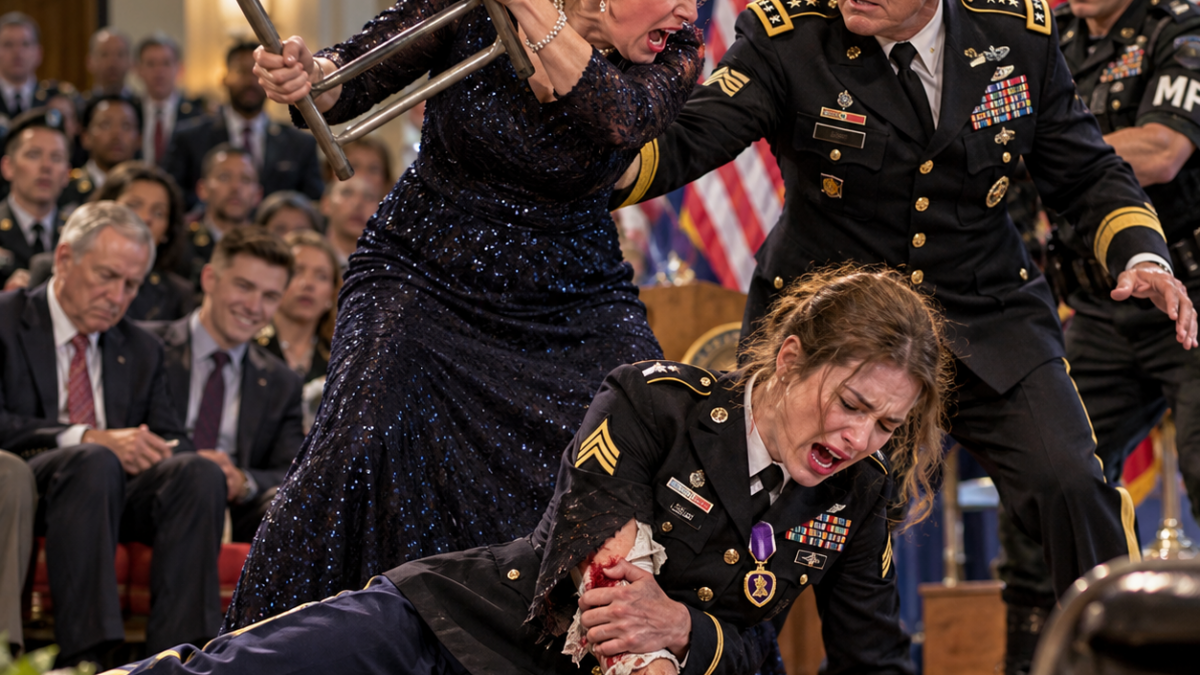
Pain shot up my arm so violently I nearly blacked out.
“No,” I gasped.
“Compound fracture,” another medic said, cutting through my sleeve. “Possible nerve involvement.”
Linda still refused to stop.
“You don’t understand her,” she shrieked at General Hayes. “She plays innocent. She’s done this her whole life!”
General Hayes slowly turned toward her.
“Done what, exactly?”
Linda looked around.
For the first time, she seemed to realize that three hundred people were no longer an audience.
They were witnesses.
Any rational person would have stopped.
Linda had never been rational when cruelty was available.
“She does things for attention,” she shouted. “You think getting wounded makes her special? She probably did that for attention too!”
The medic beside me froze for half a second.
General Hayes stared at Linda as if she had spoken a language too vile to translate.
“You believe sustaining blast injuries in a combat zone was a stunt for attention?”
My father finally stood, pale and sweating.
“Linda,” he muttered. “Let’s just go.”
An MP stepped in front of him.
“Nobody leaves this premises until formal felony statements are documented.”
My father blinked like the words had been spoken to someone else.
“Felony?”
The MP’s face did not change.
“You are on a federal military installation, sir. Your wife assaulted an active-duty soldier during an official ceremony.”
Linda jabbed a finger toward me.
“She’s exaggerating the pain. She’s always been a hypochondriac.”
The medic working on my arm looked up slowly.
“Ma’am,” he said coldly, “her bone is visible.”
A low wave of horror moved through the room.
General Hayes turned away from Linda and faced the audience.
His voice rose, filling the hall.
“The citation read today was heavily redacted at Sergeant Mara Ellison’s explicit request because she refused to turn this ceremony into a spectacle about herself.”
My stomach dropped.
“No,” I whispered.
The general heard me.
He looked down.
His expression softened for half a second.
Then hardened again.
“But since her own family has chosen to desecrate her service in front of the soldiers she saved,” he continued, “then everyone in this room deserves to know who she truly is.”
The entire hall held its breath.
I closed my eyes.
Not because of the pain.
Because of what was coming.
For months, I had begged him not to say it.
I did not want my story turned into a headline.
I did not want strangers calling me brave when I still woke up screaming.
I did not want people looking at me like a symbol.
I just wanted to receive the medal, survive the ceremony, and go back to rehab.
That was all.
But Linda had made quiet dignity impossible.
General Hayes stepped toward the podium.
“Sergeant Mara Ellison was assigned as a combat medic attached to a joint evacuation element outside Kandahar Province.”
His voice was steady.
“On March 17th, her convoy was struck by an improvised explosive device and then ambushed from elevated positions. The blast killed two soldiers instantly and wounded nine others. Sergeant Ellison sustained shrapnel wounds, burns, and a concussion in the initial explosion.”
I could smell it again.
Diesel.
Smoke.
Blood.
Hot metal.
I could hear Staff Sergeant Ortiz screaming for his mother.
I could hear radio static.
I could hear the crack of rounds striking the burned-out vehicle beside my head.
The medic near me said something, but his voice came from far away.
General Hayes continued.
“Despite her own injuries, Sergeant Ellison crawled through open fire to reach the first casualty. She applied a tourniquet with one hand while shielding the soldier’s body with her own.”
Linda scoffed.
The sound was small.
Ugly.
Suicidal.
General Hayes stopped speaking.
He turned toward her.
“Do not interrupt me again.”
Linda’s mouth closed.
“After stabilizing the first casualty,” he continued, “Sergeant Ellison made four separate trips across exposed ground. Four. She dragged three wounded Americans and one Afghan interpreter behind cover. When ammunition began cooking off inside a burning vehicle, she entered that vehicle to pull out a trapped radio operator.”
The hall was silent.
“She was ordered to fall back.”
I remembered Captain Briggs screaming at me.
Ellison, get down!
I remembered ignoring him.
“She refused.”
My father lifted his head slightly.
For the first time that day, he looked at me.
Not with pride.
With confusion.
As if he had never considered that I might have become someone when he was not paying attention.
General Hayes gripped the podium.
“By the time the quick reaction force arrived, Sergeant Ellison had treated eleven casualties. Six survived because of her immediate intervention.”
His voice changed then.
Just slightly.
“And one of them was my son.”
A sharp gasp moved through the room.
Kyle stopped smiling.
Linda blinked.
My father’s face went completely slack.
General Hayes let the silence sit.
“My son, Captain Daniel Hayes, was pinned beneath a burning axle with a severed artery in his leg. Sergeant Ellison crawled into that fire, cut him free, applied a tourniquet, and carried him far enough for extraction. She did this while bleeding from her own abdomen and with shrapnel embedded in her shoulder.”
He looked back at me.
His eyes were bright now.
“She saved my son’s life.”
My throat closed.
I had never wanted that said out loud.
Daniel had already thanked me.
His wife had thanked me.
His little girl had hugged my good leg in the hospital and given me a crayon drawing of a woman with a red cross on her helmet.
That had been enough.
General Hayes looked toward Linda.
“And when this soldier woke up in Germany, the first thing she asked was not whether she would receive a medal. It was whether everyone else had made it.”
The room blurred.
Pain throbbed in my arm.
But beneath it, something older hurt worse.
For twenty years, Linda had called me selfish.
Attention-seeking.
Dramatic.
A burden.
My father had never defended me.
Not once.
When I was nine and Linda locked me outside in December for spilling juice, he said I should learn not to be clumsy.
When I was thirteen and Kyle cut the braid my mother used to brush every night, my father said boys were rough sometimes.
When I was sixteen and Linda told my guidance counselor I was “emotionally unstable” so I would lose a scholarship interview, my father said family matters should stay private.
When I enlisted at eighteen, he stood on the porch and said, “Don’t expect us to come running when you fail.”
I did not fail.
I survived.
Apparently, that offended them more.
General Hayes’s voice dropped.
“Sergeant Ellison requested that the classified portion of the operation remain sealed. She requested no press. No special ceremony. No public retelling of the worst day of her life. She asked for one thing only.”
He looked toward the fallen medal on the floor.
“To stand quietly among her peers and honor the soldiers who did not come home.”
An older veteran in the front row removed his hat.
Then another.
Then another.
Linda’s hands shook at her sides.
“This is ridiculous,” she said, but the power had gone out of her voice.
An MP took the bent chair from her reach.
“Ma’am, place your hands behind your back.”
Linda recoiled.
“What?”
“You are being detained for aggravated assault.”
“You can’t arrest me! I’m her mother!”
“No,” I said.
My voice came out broken.
Everyone turned toward me.
I had barely spoken since the chair came down.
The medic held my arm steady while another started an IV.
I looked at Linda through the pain.
“You are not my mother.”
The words were not loud.
But they landed.
My father flinched.
Linda’s face twisted.
“How dare you—”
“My mother was Rebecca Ellison,” I said. “She died when I was seven. And every day since, you made sure I knew I had lost the only person in that house who loved me.”
For the first time in my life, Linda had nothing ready.
So I looked at my father.
That was harder.
His face was gray.
“Mara,” he whispered.
I almost laughed.
After all those years, my name sounded strange in his mouth.
“You sat there,” I said.
He swallowed.
“I was shocked.”
“No. You were practiced.”
His eyes filled, but I did not look away.
“You watched her hurt me my whole life. You watched Kyle hurt me. You watched me shrink myself smaller and smaller until joining the Army felt less like bravery and more like escape.”
Kyle shifted in his seat.
“Come on,” he muttered. “This is getting dramatic.”
A hundred heads turned toward him.
He sank lower.
General Hayes’s gaze moved to Kyle.
“I would advise silence.”
Kyle obeyed.
Cowards usually understand rank faster than love.
My father took one step toward me.
“I didn’t know it was that bad.”
That old sentence.
The anthem of weak men.
I did not know.
As if ignorance were innocence.
As if looking away were not a choice.
I stared at him.
“You knew enough.”
The medics lifted me onto a stretcher.
My vision blurred at the edges.
General Hayes walked beside me as they moved me off the stage.
The hall remained silent until I reached the center aisle.
Then someone stood.
I do not know who.
One soldier in dress uniform.
Then another.
Then another.
Chairs scraped.
Boots shifted.
Within seconds, the entire room was on its feet.
Not clapping.
Not cheering.
Standing.
Respect.
That nearly broke me.
I had spent my whole childhood trying to be believed.
Trying to be seen.
Trying to be worth someone standing up for me.
And now three hundred strangers stood because my own family never had.
As the medics carried me toward the exit, Linda was handcuffed beside the stage.
She was still shouting.
Something about lies.
Something about manipulation.
Something about how I had always wanted to destroy the family.
No one listened.
That might have been the cruelest punishment for her.
Not the handcuffs.
Irrelevance.
In the ambulance bay outside, rain tapped lightly against the pavement.
The air smelled like wet concrete and antiseptic.
General Hayes stood beside the stretcher while the medics prepared transport.
“I’m sorry,” he said quietly.
“For what, sir?”
“For exposing what you wanted private.”
I looked at him.
“You told the truth.”
“I should have asked.”
“She broke my arm with a chair,” I said. “I think the rules changed.”
For the first time that day, the corner of his mouth moved.
“Fair assessment, Sergeant.”
Pain medicine began to warm the edges of the world.
Before they loaded me in, he leaned closer.
“You are not alone in this. The Army will handle the formal process. The MPs have witness statements. CID will be notified. And Mara?”
“Yes, sir?”
His voice softened.
“You never have to invite them into another room where you are being honored.”
That sentence undid me.
Not because it was dramatic.
Because it was permission.
I had invited my father because some child inside me still wanted him to see me.
Still wanted him to finally understand that I had become someone worthy of pride.
Instead, he had brought Linda and Kyle because he had never stopped being what he was.
A man who confused family with endurance.
The hospital reset my arm that afternoon.
Two fractures.
Surgery required.
Metal plate.
Nerve swelling.
A doctor told me I was lucky.
I stared at him until he corrected himself.
“You’re fortunate the damage wasn’t worse.”
That, I accepted.
General Hayes visited after surgery.
So did Daniel Hayes, walking with a cane, his wife beside him and their little girl holding a stuffed rabbit.
The little girl climbed carefully onto the chair beside my bed and whispered, “My daddy said you’re the reason he came home.”
I closed my eyes.
Not fast enough.
Tears escaped anyway.
Her mother squeezed my hand.
No cameras.
No speeches.
No medals.
Just a family existing because I had refused to stop crawling through fire.
That was worth more than anything pinned to my uniform.
Two days later, my father tried to visit.
The nurse came in looking uncomfortable.
“There’s a man outside who says he’s your father.”
I stared at the window.
My arm was elevated in a brace. Pain still came in waves. My face had bruised where I hit the stage. My Purple Heart sat on the bedside table in a small evidence bag because the clasp had broken when it fell.
“Is he alone?” I asked.
“Yes.”
I thought about saying no.
Then I thought about the little girl with the stuffed rabbit.
About Linda’s chair.
About twenty years of swallowed words.
“Five minutes,” I said.
My father entered like an old man, though he was only sixty-one.
His hair seemed thinner.
His shoulders smaller.
He stood by the door, twisting his hat in his hands.
“Mara.”
I did not answer.
He looked at my arm.
“They said you needed surgery.”
“Yes.”
“I’m sorry.”
I waited.
He swallowed.
“I should have stopped her.”
“Yes.”
Another silence.
He looked toward the medal on the table.
“I didn’t know what you did over there.”
“No,” I said. “You didn’t ask.”
His face tightened.
“You never told me.”
I laughed once.
It hurt my ribs.
“When would I have done that, Dad? Between Linda calling me a liar and Kyle stealing from my room? Between you pretending not to hear any of it?”
He looked down.
“I was trying to keep peace.”
“No. You were trying to keep yourself comfortable.”
His eyes filled.
“I loved you.”
That one made me angrier than if he had denied it.
“Maybe,” I said. “But you loved me in a way that never cost you anything. That is not the kind of love a child can survive on.”
He covered his mouth with one shaking hand.
I did not comfort him.
That was new.
For most of my life, I had managed his guilt for him.
Not anymore.
“Linda is being charged,” he said.
“She should be.”
“She’s saying she had a breakdown.”
“I’m sure she is.”
“She wants me to help her.”
For the first time, I turned fully toward him.
“And will you?”
He did not answer quickly enough.
That was answer enough.
I nodded.
“Five minutes are over.”
“Mara—”
“No.”
His face crumpled.
“I’m your father.”
“You were,” I said. “But you resigned from that job a long time ago.”
He stood frozen.
The nurse appeared at the door.
“Sir, you need to leave.”
My father looked at me one last time.
Maybe he expected me to soften.
Maybe the old Mara would have.
The girl who begged for birthday cards.
The teenager who pretended not to hear Linda laughing.
The recruit who mailed graduation photos home and received no reply.
But that girl had crawled through fire.
She had carried men twice her size.
She had bled into foreign dirt and still kept moving.
She had earned the right to stop begging cowards for love.
So I looked away first.
My father left.
Linda’s case moved quickly.
There were too many witnesses for her usual tactics.
She tried claiming she tripped.
Video proved otherwise.
She tried claiming I provoked her.
Three hundred people disagreed.
She tried claiming emotional distress.
The prosecutor called it premeditated assault with a deadly object on a federal installation.
Kyle made things worse for her when investigators found messages between them.
Messages mocking my ceremony.
Messages joking that Linda should “knock the medal off her chest.”
Messages calling me names I will not repeat.
My father claimed he knew nothing.
Maybe that was true.
Maybe it was not.
It no longer mattered.
Linda accepted a plea only after the video was played during a preliminary hearing and she realized the world could finally see her clearly.
Kyle lost his job after the messages became part of the public record.
My father left three voicemails.
I deleted all of them.
Six months later, I stood in another ceremony.
Smaller.
Private.
No press.
No family by blood.
General Hayes was there.
Daniel was there.
My squad was there.
The medic who had treated my broken arm was there, grinning like he had personally fought the chair and won.
My left arm still ached in cold weather.
The scar from surgery ran along my forearm like a pale line of truth.
General Hayes pinned the Purple Heart back onto my uniform himself.
This time, no one interrupted.
No chair crashed.
No one screamed.
No one called me trash.
After the medal was secure, the general stepped back and saluted.
I returned it.
Then the room applauded.
Not loudly at first.
Gently.
Like they understood that some honors need quiet around them.
Afterward, Daniel’s little girl ran up and handed me another drawing.
This one showed me wearing a medal, standing beside a small girl and a man with a cane.
At the top, in crooked purple letters, she had written:
Thank you for bringing my daddy home.
I framed that drawing.
Not the newspaper clipping.
Not the ceremony program.
Not even the official citation.
The drawing.
Because that was the truth I wanted to remember.
Not Linda’s chair.
Not my father’s silence.
Not Kyle’s laugh.
That little girl.
Her father breathing.
A life continuing because, on the worst day of mine, I kept moving.
People later asked if the general’s speech healed me.
It did not.
Truth is powerful, but it is not magic.
My arm still hurt.
My childhood still happened.
My mother was still gone.
My father still chose weakness when courage mattered.
Healing came slower.
It came in physical therapy.
In learning to trust my left hand again.
In nightmares that softened over time but did not vanish.
In unanswered calls I let stay unanswered.
In sitting with other wounded soldiers who understood that pain is not always visible and heroism does not make you feel heroic.
It came in realizing I did not need my family to admit what they had done in order for it to have been real.
That was the hardest part.
For years, I thought closure meant they would finally confess.
Linda would say she was cruel.
My father would say he failed me.
Kyle would say he enjoyed it.
But closure did not come from them.
It came from me.
From saying:
I know what happened.
I know who I am.
I know what I survived.
And I do not need the people who broke me to certify my pain.
One year after the ceremony, I returned to active duty in a limited medical training role.
Not the same work.
My body had changed.
My mind too.
But I still had something to give.
I trained young medics before deployment.
I taught them tourniquets, airway control, blood loss assessment, and the importance of keeping their hands steady even when their hearts are not.
On the first day of each class, I told them:
“Panic is contagious. So is calm. Choose carefully.”
I never told them all of my story.
Only enough.
But sometimes, when a young soldier looked scared beneath the bravado, I recognized myself.
And I would say quietly:
“You do not have to feel brave to do the right thing. You just have to do the next right thing while afraid.”
I had learned that in war.
And in a hospital bed.
And in a ceremony hall where a steel chair revealed more truth than a medal ever could.
My name is Sergeant Mara Ellison.
I was not trash in a costume.
I was a soldier.
A medic.
A survivor.
A woman who crawled through fire, carried the wounded, buried the need for love from people who had none to give, and finally stopped mistaking endurance for family.
My stepmother broke my arm in front of three hundred witnesses.
She thought she was exposing me.
She did.
Just not the way she intended.
She exposed the cruelty I had survived.
The cowardice my father had hidden behind.
The sickness of a family that needed me small.
And then, in that same room, surrounded by soldiers who understood sacrifice better than blood relatives ever had, the truth finally stood up for me.
I used to think being honored meant my father would look at me with pride.
Now I know better.
Being honored means standing in the truth of who you are, even when the people who should have loved you cannot bear the sight of it.
It means letting the right people see you.
It means knowing that a medal can be knocked to the floor, a bone can be broken, a ceremony can be ruined — and still, nothing anyone does can make your courage less real.
Linda called me trash.
The general called me a soldier.
For the first time in my life, I believed the right voice.








