My Husband Told Me to Skip Our Son’s Birthday Because His Wealthy Family Was Ashamed of Me—Then I Walked Down the Stairs in Uniform, and the Entire Room Went Silent
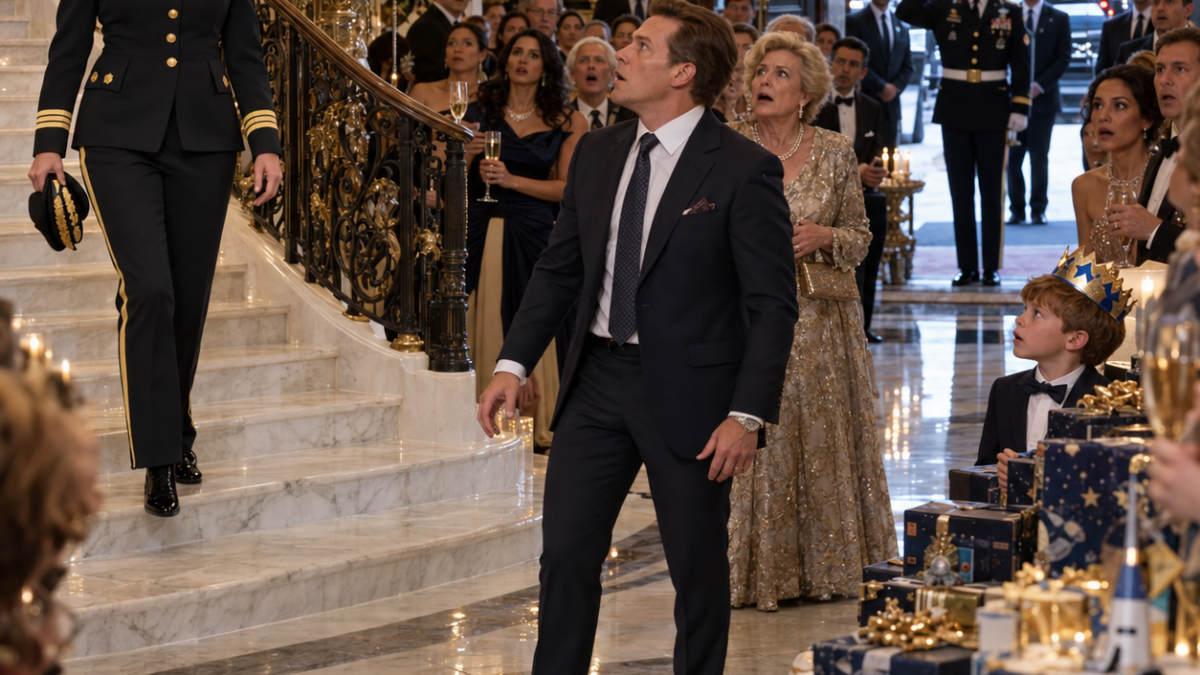
PART3:
The estate was forty-eight hours from auction.
His father had leveraged the property against failed investments. Ethan had tried to hide the collapse by borrowing against future business deals that did not yet exist. Margaret had spent years pretending superiority while collection notices piled up behind locked office doors.
I saved the house.
Not with Vance money.
With mine.
Years of hazard pay.
Investments.
A trust from my mother that I had never touched.
Strategic silence.
Howard Vance, no relation to Ethan despite the irony of the name, handled the purchase through a private holding structure. By the time Margaret hosted her next charity brunch and introduced me as “Claire, who helps with office filing,” I owned the estate outright.
I did not tell them.
At first, because Ethan begged me not to humiliate his parents.
Later, because knowing the truth while they mocked me became a kind of private armor.
And finally, because I wanted Noah to grow up with a family, even a flawed one.
That had been my mistake.
A child does not need a family built on polished cruelty.
He needs one honest enough not to make his mother disappear.
So yes, I let the song finish.
I helped Noah cut cake.
I laughed when he got frosting on his nose.
I listened as he explained the difference between rockets and space shuttles to Colonel Reed, who nodded with the gravity of a man receiving battlefield intelligence.
The guests slowly resumed breathing.
But they did not resume celebrating.
Not really.
They watched me.
Watched Ethan.
Watched Margaret, who stood like a queen whose palace had suddenly informed her it was rented.
Twenty minutes later, I gave Noah permission to take his friends to the theater room with the nanny, the magician, and the astronaut ice cream station I had personally arranged.
Before he left, he turned back to me.
“You’re coming after?”
“Absolutely.”
“Promise?”
I crouched again.
“Front row forever.”
That satisfied him.
When the children were gone, the air changed.
The party was over.
The reckoning began.
I turned toward Howard.
“Now.”
Howard opened the blue folder.
Ethan inhaled sharply.
Margaret snapped, “This is absurd. Claire, whatever little performance you’ve arranged, you are embarrassing yourself.”
I looked at her.
For ten years, she had mistaken my restraint for weakness.
That ended now.
“Margaret,” I said, “you will speak when I allow it.”
Her eyes widened.
Several guests looked down at their champagne glasses as if they had suddenly discovered urgent bubbles.
Ethan stepped forward.
“Claire, can we discuss this privately?”
“No.”
His jaw tightened.
“This is our son’s birthday.”
“I protected our son’s birthday,” I said. “You used it as a stage to erase me.”
“I was trying to avoid conflict.”
“You texted your wife at 2:07 in the morning and asked her not to attend her own child’s party because your mother was ashamed of how she dresses and speaks.”
A murmur ran through the room.
Margaret’s face flushed.
“That was a private family matter.”
“No,” I said. “A private family matter is a disagreement over dinner. Publicly lying to a seven-year-old about his mother being too busy to keep a promise is emotional cruelty.”
Ethan looked at the guests.
That was his second mistake.
He should have looked at me.
“Claire,” he said quietly, “please. Important people are here.”
I smiled.
“So am I.”
Colonel Reed’s mouth twitched once.
Howard removed the first document.
“Deed of ownership,” he announced clearly. “Primary residence and surrounding estate, Fairfax County, Virginia. Sole legal owner: Colonel Claire Rebecca Vance.”
The room went still.
Margaret blinked.
“That is impossible.”
Howard continued.
“Property was acquired five years ago from foreclosure proceedings through a private holding entity, later transferred directly into Colonel Vance’s name following satisfaction of all creditor claims.”
Ethan closed his eyes.
His father, Walter Vance, who had remained silent near the fireplace, gripped the mantel with one hand.
I looked at him.
“You knew.”
Walter said nothing.
Margaret turned on him.
“Walter?”
His silence answered for him.
Margaret’s hand went to her throat.
“You told me the refinancing went through.”
“It did,” I said. “Mine.”
Her mouth opened.
Nothing came out.
It was the first time I had ever seen Margaret Vance speechless.
I wished it felt better.
Howard lifted the second document.
“Additionally, this folder contains evidence of unauthorized attempts by Ethan Vance to represent the estate as collateral in investor discussions over the past eight months.”
The investors in the room shifted.
There it was.
Fear.
Not social discomfort.
Financial fear.
Ethan’s head snapped up.
“That’s not—”
Howard looked at him over his glasses.
“Careful.”
Ethan swallowed.
I took one step toward him.
“Did you promise these people access to a property you do not own?”
He looked around.
His face betrayed him before his mouth could catch up.
One tech CEO, a sharp woman in a white suit who had ignored me when I greeted her earlier, slowly set down her glass.
“Ethan,” she said, “you told our group the family estate could be pledged against the fund’s bridge exposure.”
Margaret grabbed Ethan’s arm.
“What is she talking about?”
Ethan shook her off.
“I was negotiating.”
“With my house,” I said.
“Our house.”
“No,” I said. “That is what you told yourself because calling it mine would have forced you to respect me.”
His face hardened.
There he was.
The real Ethan.
Not charming.
Not embarrassed.
Angry.
The mask slipping because control had slipped first.
“You kept this from me,” he said.
A few guests actually looked shocked at his audacity.
I laughed once.
Quietly.
“You asked me to keep it from your parents.”
“That’s different.”
“Yes,” I said. “When secrecy protects your pride, it’s loyalty. When it protects my position, it’s betrayal.”
Margaret found her voice again, though it came out thinner than before.
“You manipulated this family.”
I turned to her.
“No, Margaret. I funded it. Protected it. Maintained it. Staffed it. Paid the tax liens you created with your charity vanity projects and unpaid pledges. Repaired the roof you bragged was original while rainwater was destroying the east wing. Covered payroll when your husband’s accounts froze. And through all of it, I let you keep your name on invitations because Ethan said losing face would kill you.”
Her eyes glistened.
Not with remorse.
With rage.
“You had no right.”
That was so absurd even Walter looked at her.
“No right?” I repeated.
I gestured around the foyer.
“To the floors I saved? The staff I paid? The home my son sleeps in? The birthday party I planned while you practiced ways to exclude me from it?”
She stepped toward me.
Colonel Reed moved half an inch.
That was all.
Margaret stopped.
Smart woman.
Cruel, but not suicidal.
Ethan lowered his voice.
“Claire, you’re overreacting.”
The room heard him.
The collective temperature dropped.
I had been shot at.
Interrogated.
Undermined by men with more stars on their shoulders than Ethan had original thoughts.
But nothing revealed a weak man faster than the word overreacting when his world had finally met consequences.
“Overreacting,” I said.
He realized too late.
“I didn’t mean—”
“You told me not to attend our son’s birthday.”
“I was under pressure.”
“You lied to him.”
“I was trying to manage Mother.”
“You allowed your business associates to believe you had authority over my property.”
“I intended to fix that.”
“You let your family mock me for ten years.”
His face twisted.
“You never corrected them.”
The sentence hung in the air.
There it was.
The defense of every coward.
You let me do it.
So it must not have hurt.
I stepped closer.
“No, Ethan. I gave you room to become decent without being forced. You used that room to become smaller.”
His eyes flashed.
“Do you know how hard it is being married to you?”
The question surprised me.
Not because it hurt.
Because it was honest.
Finally.
“There it is,” I said softly.
His laugh was bitter.
“You walk around like nothing touches you. Classified calls. Locked rooms. Medals you never explain. Money you never talk about. Decisions you make without consulting anyone. Do you know what it feels like to be invisible beside your own wife?”
I stared at him.
For one wild second, I almost felt pity.
Almost.
“You felt invisible,” I said, “so you made me disappear from our son’s life for one afternoon to feel powerful?”
His jaw clenched.
The pity died.
“You could have told them who you were,” he said.
“You could have told them I mattered.”
That landed.
His eyes dropped.
My voice lowered.
“I did not need them to know my rank. I needed my husband to defend my place at the table.”
No one spoke.
The guests stood trapped between scandal and revelation, too invested to leave, too uncomfortable to breathe normally.
Howard cleared his throat.
“There are additional documents.”
Ethan looked alarmed.
“No.”
I held up one hand.
Howard paused.
I turned toward the room.
“Everyone whose name appears in Ethan’s investment discussions will receive copies through counsel. This gathering is not a financial briefing. It is a boundary.”
I looked at Margaret.
“At 6:00 p.m. tonight, you and Walter will leave this house.”
She gasped.
“What?”
“You will be given access to the guest wing to pack personal belongings. Anything legally belonging to you will be shipped.”
“This is my family home.”
“No,” I said. “It was your family’s house. Then your family lost it. I made it my son’s home.”
Walter’s shoulders sagged.
He looked old suddenly.
Not sympathetic.
Just deflated.
“Claire,” he said quietly, “please.”
I met his eyes.
“You watched her humiliate me.”
His lips trembled.
“I am sorry.”
“I believe you are sorry now.”
He looked away.
That was the closest he would get to honesty.
Margaret pointed a shaking finger at me.
“You cannot throw us out.”
“I can. I am. But unlike you, I will not do it cruelly. You will have thirty days of temporary housing paid through Howard’s office. After that, you are responsible for yourselves.”
She laughed sharply.
“You expect me to be grateful?”
“No. I expect you to be gone.”
Her face crumpled, then hardened again.
“You think a uniform makes you superior.”
“No,” I said. “Discipline made me patient. Motherhood made me merciful. Ownership makes me legally correct.”
Someone coughed into their hand.
It sounded suspiciously like a laugh.
Ethan stared at me.
“And me?”
That was the question, wasn’t it?
The room waited.
I could have destroyed him right there.
I could have opened the rest of the folder.
The messages.
The investor misrepresentations.
The private comments about my “usefulness.”
The draft documents Howard had intercepted when Ethan quietly explored whether my deployments could be used to argue emotional abandonment if divorce proceedings ever began.
Yes.
I knew about those too.
But Noah was upstairs.
And one day, Noah would ask how his parents ended.
I wanted to be able to say I had chosen dignity when revenge was available.
So I said, “You will move into the east guest suite tonight.”
Ethan blinked.
“We are separating.”
Margaret inhaled dramatically.
I ignored her.
“You will have daily access to Noah under a schedule we agree on through counsel. You will not discuss adult matters with him. You will not blame me. You will not use him to carry messages. And you will not allow your mother near him without my written permission.”
His face tightened.
“He is my son too.”
“Yes,” I said. “Start acting like that means protecting him, not recruiting him into your fear.”
Ethan swallowed.
For the first time all morning, he looked truly ashamed.
Not publicly embarrassed.
Ashamed.
It was too late for it to matter much.
But Noah deserved a father who might still choose better, even if he had failed as a husband.
Colonel Reed stepped forward.
“Ma’am, the convoy has secured the perimeter. Your briefing window remains available for another ninety minutes, but Washington is requesting confirmation.”
Ethan looked at him.
“Briefing?”
Colonel Reed did not answer.
I did.
“There was a national security meeting scheduled here this afternoon. Quiet arrival. Controlled access. Your birthday guest list complicated the logistics.”
A man near the piano whispered, “Jesus.”
Margaret sank into a chair.
Ethan’s voice was hollow.
“You were hosting a classified briefing here?”
“I was hosting our son’s birthday,” I said. “The briefing was secondary.”
That seemed to confuse him more than anything.
Powerful men often misunderstood priorities when mothers held them.
A staff member appeared near the hallway, nervous.
“Colonel Vance?”
I turned.
“Noah is asking for you. The magician is about to start.”
I looked at the frozen room.
Then back toward Howard.
“Begin exit protocols for nonessential guests. Anyone connected to Ethan’s fund discussions provides contact information before departure.”
Howard nodded.
I looked at Colonel Reed.
“Keep it discreet.”
“Yes, ma’am.”
Then I walked upstairs.
Noah sat in the front row of the theater room between two friends, clutching astronaut ice cream and wearing his crooked crown. When he saw me, his whole face lit.
“Mom! You missed the rabbit!”
“I heard rumors of a rabbit.”
“It came out of a hat.”
“Operationally impressive.”
He giggled and patted the empty chair beside him.
“Sit here.”
Front row.
I sat.
For twenty minutes, while my marriage quietly collapsed downstairs under legal supervision, I watched a magician pull scarves from his sleeve and pretend not to be terrified of the armed convoy outside.
Noah laughed.
That was the sound I held on to.
Not Margaret’s gasp.
Not Ethan’s panic.
Noah’s laugh.
Later that evening, after the guests had gone, after Margaret had screamed herself hoarse behind a closed guest room door, after Walter had quietly packed photographs into boxes, after Ethan had moved into the east wing without meeting my eyes, I found Noah in his bedroom.
He was still wearing the paper crown.
He sat on the edge of his rocket-shaped bed, turning a toy astronaut over in his hands.
“Mom?”
I sat beside him.
“Yes, baby?”
“Is Grandma mad because you’re important?”
My throat tightened.
Seven-year-olds see more than adults think.
“No,” I said carefully. “Grandma is mad because she is used to being unkind without consequences.”
He considered that.
“Dad looked scared.”
“Yes.”
“Of you?”
I shook my head.
“Of the truth.”
Noah leaned against me.
“Are you still my mom when you wear that uniform?”
That question nearly broke my heart.
I wrapped my arm around him.
“I am your mom before anything else. Before the uniform. Before the rank. Before the house. Before every important meeting in the world.”
He nodded against my side.
“Good.”
A few seconds later, he whispered, “I liked when the soldier called you ma’am.”
I smiled.
“Colonel Reed?”
“Yeah. He sounded like when teachers talk to the principal.”
“That is one way to put it.”
Noah looked up.
“Do I have to call you ma’am?”
“Only if you want no dessert for a week.”
He burst out laughing.
And just like that, some of the fear left the room.
After he fell asleep, I stood in the doorway for a long time.
Ethan appeared at the end of the hall.
He had changed out of his party suit. He looked younger without the performance of wealth wrapped around him. Or maybe he looked smaller.
“Is he okay?” he asked.
“He will be.”
He nodded.
Silence stretched between us.
Finally, he said, “I hated that they respected you.”
I looked at him.
He rubbed his face with both hands.
“God, that sounds horrible.”
“Yes.”
“I don’t mean—”
“Yes, you do.”
He closed his mouth.
For once, he did not try to correct the ugly thing inside him after it escaped.
After a moment, he said, “All my life, I was told this family was special. That the name meant something. Then I married you, and you never seemed impressed by any of it.”
“I loved you,” I said. “That should have been better than being impressed.”
His eyes reddened.
“I know.”
But he had not known.
Not when it mattered.
“I wanted them to approve of me,” he admitted. “Especially her.”
“Margaret.”
He nodded.
“She made love feel like a prize. I kept thinking if I gave her the right wife, the right son, the right investors, the right image, she’d finally—”
“Ethan.”
He stopped.
“You are allowed to understand your damage,” I said. “You are not allowed to hand it to me or Noah and call it duty.”
He nodded slowly.
“I don’t want to lose him.”
“Then become safe for him.”
“And you?”
I was quiet.
His face fell before I answered.
“I don’t know if there is anything left to save,” I said. “But if there is, it will not be saved by apology. It will be saved by sustained conduct.”
The military had taught me many things.
One of them was this:
Anyone could say the right thing when cornered.
The truth lived in patterns.
Ethan whispered, “I’ll try.”
“For Noah,” I said.
He nodded.
“For Noah.”
I walked past him.
At the stairs, I paused.
“And Ethan?”
He looked up.
“If you ever ask me to disappear from our son’s life again, you will not get a second conversation.”
He believed me.
Good.
The following weeks were brutal in quiet ways.
Margaret and Walter left the estate within forty-eight hours.
Not gracefully.
Margaret threatened lawsuits, social ruin, public statements, private investigators, and the kind of vague old-money vengeance that sounds powerful until it meets a lawyer with properly filed deeds.
Howard handled all of it.
Walter sent one handwritten note.
It said simply:
Claire,
I knew more than I admitted.
I benefited from your silence.
I am sorry.
It was not enough.
But it was more honesty than I expected.
Margaret sent nothing.
That was also honest.
Ethan entered therapy.
Not the soft, performative kind where men learn words like boundaries and use them as weapons.
Real therapy.
Ugly therapy.
The kind that left him pale afterward.
He apologized to Noah first.
Not dramatically.
Not with excuses.
He sat on the floor of the playroom and said, “I made a bad choice. I hurt your mom. I hurt you. It was not your fault. I am going to do better.”
Noah asked if Grandma was still coming to his soccer game.
Ethan cried.
I left the room before my own feelings could complicate theirs.
As for me, I returned to work.
There were briefings.
Calls.
Reports with sections blacked out even from people with high clearance.
Colonel Reed came and went with the convoy twice more before the operation moved elsewhere.
Each time, the staff stood a little straighter.
Each time, people called me ma’am without Margaret’s voice in the walls making it sound strange.
The estate changed too.
Not immediately.
But steadily.
Portraits of Vance ancestors came down from the main hall. Not all of them. I was not interested in erasing history. But I removed the ones Margaret had used like weapons.
In their place, I hung photographs Noah chose.
A rocket launch.
The Blue Ridge Mountains.
A picture of him covered in frosting at age three.
A framed drawing he made of me in uniform standing beside him on the moon.
Under it, in crooked handwriting, he had written:
Mom is front row.
That one went in the foyer.
Six months later, Ethan and I signed a formal separation agreement.
Not divorce.
Not yet.
But truth on paper.
He moved into a townhouse nearby. Something modest by Vance standards, though still nicer than most people’s homes. Noah spent weekends with him after Ethan earned that trust through consistency, not demand.
Margaret tried once to contact Noah through his school.
That ended the same day.
Some boundaries should be velvet.
Others should be steel.
A year after the birthday party, Noah turned eight.
This time, we held the party in the backyard.
No investors.
No champagne tower.
No society photographers.
Just classmates, a bounce house, barbecue, paper plates, and a telescope station on the lawn.
Ethan came.
Alone.
He helped carry coolers.
He thanked the caterer by name.
He stayed when Noah opened presents but did not perform fatherhood for applause.
At one point, he stood beside me near the patio and looked toward the house.
“I thought this place made us important,” he said.
I followed his gaze.
Noah was running across the grass with his friends, laughing so hard he nearly fell.
“No,” I said. “People did that. We just forgot which ones.”
Ethan nodded.
He had become quieter.
Not fixed.
People are not broken appliances.
But quieter.
More honest.
Sometimes that is the beginning of becoming useful to the people you hurt.
“Claire,” he said.
I looked at him.
“I am sorry I made you prove who you were.”
The old me might have softened too quickly.
The old me had mistaken being understood for being loved.
Now I knew better.
“You did not make me prove who I was,” I said. “You made me remember.”
Across the yard, Noah shouted, “Mom! Front row!”
He was pointing to the telescope.
I walked over.
Ethan did not follow.
That was growth too.
The stars came out slowly that evening.
One by one.
Noah pressed his eye to the telescope and gasped like the universe had personally opened a door.
“Mom,” he whispered, “you have to see this.”
I bent down.
Through the lens, the moon floated bright and scarred and beautiful.
I thought about that night at 2:07 a.m.
The text.
The humiliation.
The staircase.
The folder.
The convoy.
The family that wanted me hidden.
And the child who only wanted me in the front row.
People talk about revenge as if it is loud.
As if it requires shouting, destruction, humiliation.
But the best revenge I ever took was quieter.
I kept my promise to my son.
I stopped begging a cruel family to recognize my worth.
I took my name, my house, my rank, my motherhood, and my dignity back into my own hands.
And when Noah looked up from the telescope, grinning beneath the open Virginia sky, I knew exactly what victory felt like.
It felt like being present.
Fully.
Unapologetically.
Front row.








