I Woke at 3 A.M. and Found a Biker Beside My Dying 11-Year-Old Son—Then Noah Said, “Mom, He Comes Every Night After You Fall Asleep.
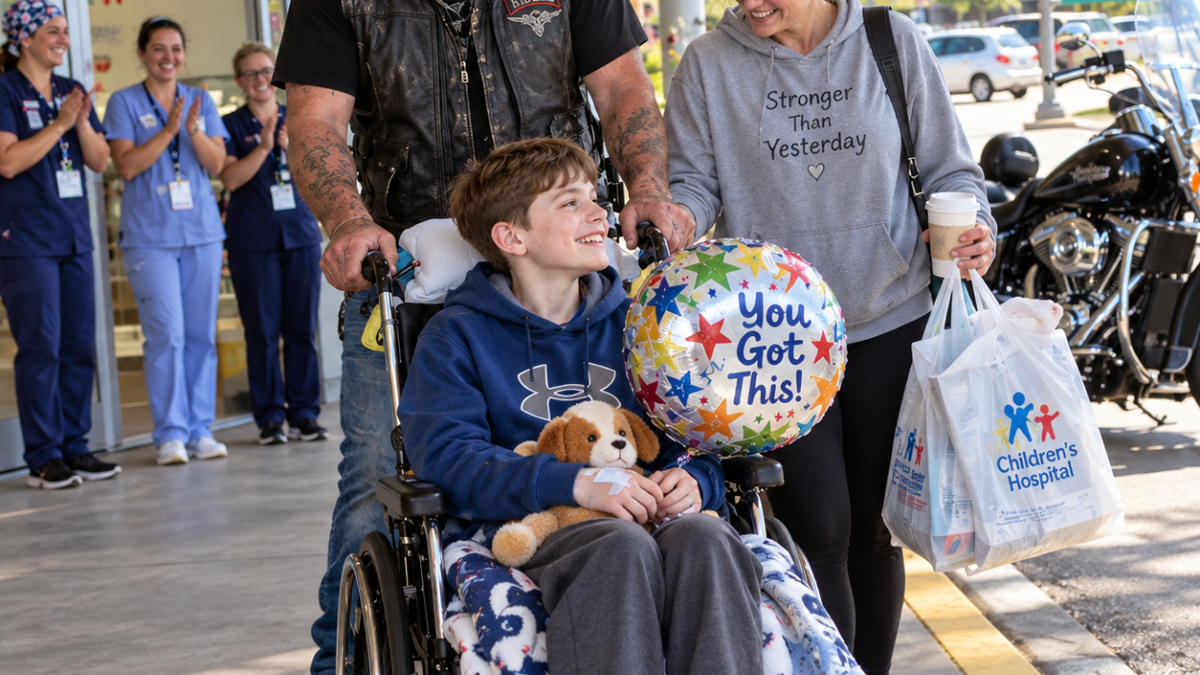
I Woke at 3 A.M. and Found a Biker Beside My Dying 11-Year-Old Son—Then Noah Said, “Mom, He Comes Every Night After You Fall Asleep.
I sold the last thing my dead husband had ever given me for $180 because I didn’t have enough gas money to reach the hospital where our eleven-year-old son was dying.
Three nights later, I woke at 3 AM and found the terrifying biker who had overheard me at the pawn shop sitting beside Noah’s bed—and my son admitted the stranger had secretly been coming every night after I fell asleep.
Then a nurse told me why that biker always appeared around three in the morning, and the truth about the little boy who had died in Noah’s exact room changed everything I thought I knew about grief, guilt, and the kind of people who show up when everyone else has gone home.
The day I sold my wedding ring, I had thirty-seven dollars and fourteen cents left in the world.
I know that because I counted it three times in the parking lot before walking into the pawn shop.
Two twenties would have felt different.
Forty dollars would have felt like money.
Thirty-seven dollars and fourteen cents felt like proof that I had already lost.
My name is Rachel Mercer.
I was thirty-four years old then, widowed, exhausted, and so far past pride that I had started measuring my life in gallons of gasoline.
My eleven-year-old son, Noah, was eighty-one miles away in Memphis with a heart that was slowly giving up.
I was in Batesville, Mississippi, standing beside a Toyota Corolla with bald front tires, an overdue registration, and a fuel gauge resting so far below empty I had spent the entire drive praying the engine would not stop.
Inside my purse were three maxed-out credit cards, two hospital parking receipts, one shutoff warning from the electric company, and my wedding ring.
Kyle’s ring.
My ring.
The gold band he had slid onto my finger thirteen years earlier while his own hands shook so hard the pastor had laughed.
Kyle had been dead six years.
I had kept wearing the ring anyway.
People told me that was unhealthy.
People who said things like that usually still had their husbands.
The pawn shop was called Dwayne’s Gold & Loan, although the sign out front had lost the G in GOLD sometime around 2018, so from the highway it read:
DWAYNE’S OLD & LOAN.
That felt appropriate.
Everything inside looked old.
Guitars.
Power tools.
Shotguns behind glass.
Wedding rings that had once meant forever.
A television playing a daytime courtroom show with the volume muted.
And people.
More people than I wanted.
A young couple looking at a laptop.
An older man trying to sell a chainsaw.
Two construction workers near the gun counter.
And behind me, although I didn’t notice him at first, a very large biker dressed almost entirely in black.
The man behind the glass took my wedding ring into his palm.
He squinted at the inside.
“Fourteen karat.”
“Yes.”
He put it on a tiny scale.
My throat tightened.
“Engraving hurts resale.”
I stared at him.
“What?”
“Inside.”
He turned the ring.
K + R.
FOREVER.
Kyle had thought that engraving was romantic.
PART2:
I had teased him that FOREVER was ambitious.
Turns out forever had lasted seven years.
The clerk looked at the scale again.
“One-eighty.”
For a second, I thought I had misunderstood.
“Eighteen hundred?”
He almost laughed.
“No, ma’am. One hundred eighty dollars.”
I looked at the ring.
Then at him.
“That ring cost more than twelve hundred.”
“Retail isn’t resale.”
“It’s solid gold.”
“It’s light.”
“My husband bought it for me.”
PART3:
The clerk’s expression changed just enough to say that personal history had no market value.
“I can do one-eighty.”
I swallowed.
“Two hundred?”
“One-eighty.”
“Please.”
He shook his head.
“Ma’am—”
“I need gas.”
The words came out too loudly.
Several people looked over.
Heat climbed into my face.
I lowered my voice.
“I have to get to Memphis.”
The clerk waited.
“My boy’s at Children’s.”
My throat closed.
I had been able to say the medical terms.
Dilated cardiomyopathy.
Ejection fraction.
Milrinone.
Transplant status.
Ventricular function.
But there were two words I still couldn’t say without breaking.
“My son…”
I stopped.
The clerk’s eyes softened.
And that kindness finished me.
“My son is dying.”
I covered my mouth.
Nobody in the shop moved.
“Please,” I whispered. “I just need gas money. He’s at Children’s in Memphis. I can’t even get there to sit with him.”
The tears came hard then.
Ugly tears.
Not movie tears.
My nose ran.
My shoulders shook.
I hated every person in that room for witnessing it.
Mostly, I hated myself.
A month earlier I had still been pretending we were managing.
Two months earlier I had still been telling the hospital social worker, “We’re okay.”
Three months earlier I had still believed there was a line between struggling and poor.
By that afternoon, my dead husband’s wedding ring was sitting on a pawn-shop scale and I was begging a stranger for twenty more dollars.
The clerk looked down.
“I’m sorry.”
I wiped my face.
“One-eighty.”
He nodded.
I signed the paper.
He counted the cash through the slot.
Nine twenties.
I picked them up.
That was when I turned around.
The biker was standing directly behind me.
He was enormous.
Maybe six-foot-two.
Broad shoulders.
Gray beard.
Black leather vest over a faded charcoal T-shirt.
Boots that looked older than some of the people in the shop.
On the left side of his vest was a worn circular patch.
I couldn’t read it.
His arms were marked with tattoos and scars.
His face looked like a closed fist.
I had seen men like him at gas stations and unconsciously checked that my doors were locked.
His eyes moved toward the ring still lying in the clerk’s hand.
Then he looked at me.
I tightened my grip on my purse.
He said nothing.
Didn’t offer money.
Didn’t offer sympathy.
Didn’t give me that awful pitying smile strangers give you when they’re grateful your disaster belongs to you instead of them.
He just stepped aside.
I walked past him.
By the time I reached the parking lot, I had forgotten his face.
I had bigger things to carry.
Noah had been funny from the day he learned how to talk.
At three, he told our pastor Jesus probably liked dinosaurs because “everybody likes dinosaurs.”
At five, he informed a supermarket cashier that his father snored “like a tractor drowning.”
At seven, after Kyle died, he asked me if heaven had telephones.
I said I didn’t know.
He thought about that and said, “It better.”
Kyle died on Noah’s fifth birthday.
A tractor-trailer crossed the median on Interstate 55 during a rainstorm.
Kyle never saw it coming.
According to the state trooper, death was immediate.
People tell you that like it helps.
He didn’t suffer.
It was quick.
Be grateful.
I tried.
There had been a grocery-store birthday cake on the passenger seat.
Chocolate.
Blue icing.
HAPPY 5TH BIRTHDAY NOAH.
The impact threw it against the windshield.
For years after that, I couldn’t walk through a bakery section without feeling sick.
After Kyle died, people surrounded us for about three weeks.
Casseroles.
Flowers.
Church envelopes.
Offers to mow the lawn.
Then everyone went back to their lives.
That isn’t cruelty.
It’s how grief works.
Your world ends.
Everybody else still has work Monday morning.
So Noah and I learned to be two people instead of three.
I worked the register at a discount store during the week and cleaned small offices on Saturdays.
We rented a two-bedroom house with a porch that tilted slightly to the left.
Noah had Kyle’s smile.
Kyle’s brown eyes.
Kyle’s habit of leaving socks in impossible places.
We didn’t have much.
But for years, we were okay.
Then the summer Noah turned ten, I noticed him stopping halfway up our porch steps.
“You tired?”
“No.”
He was breathing hard.
“It’s hot.”
“Yeah.”
Two weeks later he quit halfway through a baseball game because his chest hurt.
The urgent care doctor thought it might be asthma.
It wasn’t.
The cardiologist used the phrase dilated cardiomyopathy.
He explained that Noah’s heart muscle had stretched.
The chambers were enlarged.
The pumping function was weak.
I nodded like I understood.
Then I sat in my car and Googled every word.
That was the beginning.
Medication.
Appointments.
Bloodwork.
Echocardiograms.
One hospitalization.
Then another.
The doctors were optimistic in the beginning.
Children were resilient.
Some stabilized.
Some improved.
Noah did not.
Seven months before the pawn shop, we heard the word transplant for the first time.
I hated it instantly.
A transplant meant hope.
A transplant also meant somewhere, someday, another mother would have the worst morning of her life so my son could have another morning.
Nobody says that part.
But every transplant parent knows it.
You wait for a phone call you desperately want and pray never comes because if it comes, somebody else is screaming.
By the time Noah had been at Children’s for two continuous months, the doctors had stopped saying things like:
“When he goes home.”
They had started saying:
“We’ll keep him comfortable.”
Comfortable.
That word terrified me.
Doctors use comfortable when they are trying to teach your heart a sentence your ears cannot hear yet.
Noah knew too.
Kids always know more than adults think.
One night he asked me, “Am I dying?”
I lied.
“No.”
He looked at me for several seconds.
“Mom.”
“You are not allowed to die.”
“That’s not what I asked.”
I turned away and fixed his blanket.
He let me.
That was worse than arguing.
Money disappeared slowly, then all at once.
Unpaid leave.
Gas.
Parking.
Hospital meals.
Bills at home.
Kyle had left a little life insurance, but most of it had gone years earlier keeping us afloat.
My savings lasted six weeks.
My emergency credit card lasted another month.
The hospital helped with some lodging and meal vouchers, but it wasn’t enough.
So I drove home to Batesville when necessary.
To work a shift.
Pay something.
Wash clothes.
Pretend our house still belonged to people who lived there.
The day I sold my ring, I drove back to Memphis on a full tank and ate crackers for dinner because hospital sandwiches cost seven dollars.
Noah was asleep when I arrived.
I kissed his forehead.
He opened one eye.
“You smell like outside.”
“That’s because I came from outside.”
“Suspicious.”
“You want me to leave?”
“No.”
He closed his eye again.
Then he reached beneath the blanket and found my hand.
I sat there until morning.
Three nights passed.
At 3:00 A.M. on the third night, I woke to laughter.
At first I thought I was dreaming.
It had been weeks since I had heard that sound.
Noah’s real laugh.
Not the little polite puff of air he gave nurses when they tried to cheer him up.
Not the fake laugh he used when I made bad jokes.
This was his whole laugh.
Sharp and high and uncontrollable.
I opened my eyes.
The room was dark except for the green and blue light from the monitors.
And there, sitting on the edge of my dying son’s hospital bed, was the biker from the pawn shop.
For half a second I couldn’t place him.
Then I saw the beard.
The vest.
The patch.
The face.
I came out of that recliner so fast my hip caught the IV pole.
It crashed sideways.
The infusion pump alarm screamed.
“What the hell are you doing?”
The biker stood.
“Ma’am—”
“GET AWAY FROM MY SON!”
Noah’s smile vanished.
“Mom!”
“Who let you in here?”
I got between them.
The biker immediately lifted both hands.
He was so large I barely reached his shoulder.
“Mom, stop!”
“Noah, quiet.”
“But—”
“I said quiet.”
The biker took one step toward the door.
That scared me more.
Like he knew how to leave quickly.
“How do you know my son?”
He looked at Noah.
Noah answered for him.
“He comes every night.”
I turned.
“What?”
“After you fall asleep.”
The floor seemed to move.
“How many nights?”
Noah shrugged.
“I don’t know.”
“How many?”
The biker said quietly, “Six.”
My head snapped toward him.
“Six nights?”
“Yes, ma’am.”
“You’ve been coming into this room while I’m asleep?”
Noah groaned.
“Mom.”
“You don’t know this man!”
“I do.”
“No, you don’t!”
“He knows dinosaurs.”
I stared at him.
Noah continued.
“And motorcycles.”
“That is not better.”
“He’s got a dog named Biscuit.”
“NOAH.”
The door flew open.
A nurse rushed in.
Her name was Maribel.
“What happened?”
I pointed at the biker.
“This man has been coming into my son’s room every night without my permission.”
Maribel looked at him.
Then at me.
She didn’t reach for security.
Her face changed.
“Oh.”
That one syllable stopped me.
“What?”
She glanced at the biker.
He looked uncomfortable.
“Ma’am, I thought someone explained.”
“Explained what?”
She swallowed.
“Russ is an approved hospital volunteer.”
The biker slowly pulled his vest aside.
Clipped underneath was a laminated badge.
MEMPHIS CHILDREN’S MEDICAL CENTER.
VOLUNTEER.
RUSSELL HOLLOWAY.
The photograph looked at least ten years younger.
I stared.
“That doesn’t explain why he’s in here at three in the morning.”
Maribel’s eyes filled.
“He does the overnight program on cardiac.”
“What overnight program?”
Her gaze moved toward Noah’s bed.
Then back to me.
“Russ comes because his son died in this room.”
Nobody spoke.
I released the grip I had on the IV pole.
“What?”
Noah watched me carefully.
Russ looked at the floor.
Maribel lowered her voice.
“I thought day shift covered his volunteer role when Noah was admitted.”
“They didn’t.”
“I’m sorry.”
Russ stepped toward the door.
“I should’ve introduced myself.”
His voice was rough.
Deep.
Not threatening now.
Just tired.
“Didn’t figure a woman in your situation wanted some stranger knowing her business.”
He looked at me.
“I heard you at the pawn shop. Then I saw you on the family list when I came in that night.”
I stiffened.
“You recognized me?”
“Yes.”
“You followed me?”
“No, ma’am.”
“Then how—”
“Children’s keeps overnight volunteer assignments. I saw Noah Mercer, Batesville, Mississippi. Put it together.”
He glanced toward Noah.
“I’m sorry I scared you.”
Then he looked at my son.
“Night, buddy.”
Noah frowned.
“You’re leaving?”
“Think your mama needs some space.”
Noah looked at me like I had just kicked a dog.
“Mom.”
Russ smiled faintly.
“I’ll see you tomorrow.”
Then he walked out.
His boots barely made a sound.
Maribel followed.
I stood beside the bed.
Noah crossed his skinny arms.
“You embarrassed him.”
“I embarrassed him?”
“He’s nice.”
“He is a strange grown man sitting beside your hospital bed at three in the morning.”
“He knows every dinosaur.”
“That does not make somebody safe.”
“He brought me a fossil.”
My head snapped around.
“What fossil?”
Noah pointed toward the windowsill.
A small stone sat there.
I picked it up.
“He said it’s probably a shell, not a dinosaur. He didn’t lie.”
“That is not the point.”
“He never lies.”
“How do you know?”
Noah stared at me.
Then he said quietly, “Because he talks about Danny.”
Danny.
I sat down.
“Who’s Danny?”
“His son.”
“What does he say?”
Noah shrugged.
“Stuff.”
“What stuff?”
“That Danny liked dinosaurs.”
He looked toward the doorway.
“And that Danny got scared at night too.”
I stopped.
Noah’s voice changed.
“Sometimes I get scared when you sleep.”
My anger disappeared so quickly it made me dizzy.
“Baby.”
“I don’t want to wake you.”
“You wake me.”
“You don’t sleep.”
“I sleep.”
“No, you don’t.”
Eleven-year-olds should not know how exhausted their mothers are.
He continued.
“Russ says you gotta let people sleep when they can.”
I looked away.
“Does he talk to you about dying?”
Noah hesitated.
My heart tightened.
“Noah.”
“Sometimes.”
“What does he say?”
“He says being scared doesn’t mean you’re giving up.”
I swallowed.
“He says brave people are scared all the time.”
I touched his hair.
“What else?”
Noah looked toward the monitor.
“He said Danny was scared.”
That night I barely slept.
The next afternoon, the night charge nurse found me in the family kitchen.
Her name was Tasha.
She was probably in her late forties.
Short hair.
Reading glasses hanging from a chain.
The expression of somebody who had watched a thousand families receive both miracles and nightmares.
She poured coffee into two Styrofoam cups.
“This tastes terrible,” she warned.
“I don’t care.”
“You will.”
I drank it.
It tasted like something scraped from an engine.
She sat across from me.
“I owe you an apology.”
“For what?”
“Russ.”
I stiffened.
“Somebody should’ve explained the program.”
“Yes.”
“Day shift missed it.”
“That seems like a pretty big thing to miss.”
“It is.”
She accepted that.
Then she said, “But you should know who he is.”
I waited.
“His son’s name was Danny Holloway.”
“Eleven?”
She looked surprised.
“Noah told you?”
“Yes.”
“Same age.”
Tasha wrapped both hands around her coffee.
“Danny had cardiomyopathy too.”
The kitchen refrigerator hummed behind us.
“He waited on this floor fourteen months.”
“That long?”
“Yes.”
“Did he get a heart?”
Tasha looked at me.
That was answer enough.
“No.”
“Was this really his room?”
“4112.”
I knew our room number.
I still glanced toward the hallway.
“Yes.”
My stomach tightened.
“What happened?”
Tasha inhaled slowly.
“The call came for a heart at 5:40 one morning.”
I waited.
“Danny died at 3:07.”
I set my coffee down.
“Two and a half hours?”
“Two hours and thirty-three minutes.”
“That’s…”
“Cruel?”
I nodded.
“Yes.”
She looked tired.
“This floor has a lot of cruel math.”
I thought of another family getting that heart.
“Where was Russ?”
Something changed in Tasha’s face.
“You should ask him.”
“Why?”
“Because that part is his.”
I hated that answer.
“When did he start volunteering?”
“About a year later.”
“Here?”
She smiled faintly.
“Not officially.”
“What does that mean?”
“He showed up at midnight and told security he wanted to sit with sick kids.”
I almost smiled.
“How’d that go?”
“They escorted him out.”
“That sounds about right.”
“He came back.”
“Of course.”
“Next night too.”
“What did he want?”
“To sit with kids whose parents needed sleep.”
Tasha stirred her coffee even though there was nothing in it.
“Eventually volunteer services got involved. Background check. Training. Infection control. CPR. Bereavement training. Pediatric boundaries.”
“How long ago?”
“Sixteen years.”
I stared.
“He’s been coming here for sixteen years?”
“Just about every night.”
“Why?”
Tasha looked at me.
“Some people run from the place where their worst day happened.”
She glanced toward the hall.
“Russ comes back.”
That night, I didn’t sleep.
At 1:17 A.M., the door opened quietly.
Russ stood there.
He stopped when he saw me awake.
For the first time I noticed that despite his size, he always waited at the threshold.
He never assumed entry.
His eyes went to me.
Then Noah.
Then back.
I whispered, “It’s okay.”
Russ didn’t move.
“Noah’s been asking.”
Only then did he enter.
Instead of sitting on the bed, he took the second chair.
Noah slept between us.
The IV pump clicked.
For almost ten minutes, neither of us spoke.
Finally I said, “I’m sorry.”
Russ looked at me.
“For screaming.”
He shrugged.
“You should’ve screamed.”
“I knocked over an IV pole.”
“I noticed.”
“I was scared.”
“Any mama who wakes up and finds a man who looks like me sitting next to her kid and doesn’t scream probably needs her instincts checked.”
I laughed despite myself.
Russ smiled.
Then I said, “Tasha told me about Danny.”
The smile disappeared.
He looked at Noah.
“Yeah.”
“He liked dinosaurs?”
That brought something back into Russ’s eyes.
“Knew all the names.”
“So does Noah.”
“Your boy corrected me on Parasaurolophus last night.”
“You said that correctly.”
“Because he made me say it nineteen times.”
I smiled.
Russ rubbed his hands over his knees.
“Danny liked correcting me too.”
I wanted to ask him what happened.
I wanted to ask where he had been at 3:07.
But his jaw tightened.
So I asked something easier.
“Tell me about Biscuit.”
Russ looked at me.
Then grinned.
Biscuit was a three-legged pit bull mix who rode on the back of Russ’s motorcycle in a custom sidecar.
He wore goggles.
Tiny black goggles.
“He does not.”
Russ pulled out his phone.
He did.
For the first time in two months, I laughed so loudly I worried I’d wake Noah.
Noah woke anyway.
He smiled when he saw Russ.
“Quiz.”
Russ groaned.
“No.”
“Dinosaurs.”
“I hate dinosaurs.”
“You love dinosaurs.”
“I tolerate dinosaurs.”
Noah’s laugh filled the room.
I sat back.
Something inside me loosened.
Five days later, I drove home to Batesville because my final partial paycheck had arrived.
Two hundred seventy-three dollars after taxes.
I withdrew two hundred.
Then I went straight to the pawn shop.
Dwayne recognized me immediately.
He looked uncomfortable.
“I want my ring back.”
He rubbed his neck.
“About that.”
My stomach tightened.
“What?”
“It’s gone.”
I stared at him.
“What do you mean gone?”
“Sold.”
“You said you’d keep it.”
“I said we usually hold inventory.”
“I’ve only been gone a week.”
“I’m sorry.”
My palms went cold.
“Who bought it?”
He hesitated.
Then said, “That biker.”
Everything inside me stopped.
“What biker?”
“The big guy behind you that day.”
Russ.
I gripped the counter.
“When?”
“Two minutes after you walked out.”
“How much?”
“Two-forty.”
“He bought my wedding ring?”
“Yes.”
“Why?”
Dwayne shrugged.
“He asked if I’d sold it yet.”
“And you sold it?”
“That’s what I do.”
I stared at him.
“Did he say anything?”
Dwayne thought.
“He said something like, ‘That shouldn’t be sitting under glass.’”
I drove back to Memphis furious.
Not frightened.
Furious.
I had started trusting Russ.
I had let him sit with my son.
I had told him about Kyle.
He had known I was broke.
Known I was vulnerable.
And all this time, he had my wedding ring.
My experience with men had been mostly good.
Kyle had been good.
My father had been good.
But widowhood teaches you something ugly.
Some men interpret desperation as opportunity.
There were contractors who had doubled estimates after realizing I didn’t know construction.
A coworker who offered to “help financially” if I “got lonely.”
A landlord who suddenly became interested in my personal life after Kyle died.
Men did not always give without wanting something.
I arrived at Children’s ready to confront Russ.
I didn’t get the chance.
At 11:40 that night, Noah’s monitor alarm changed.
Parents on cardiac floors learn alarms.
Some you ignore.
Some nurses ignore.
Some cause three people to appear before you have processed the sound.
This was the third kind.
A nurse came in.
Then another.
Then a doctor.
“Noah?”
His eyes opened.
He looked frightened.
“Mom?”
“I’m here.”
A nurse said, “We need some room.”
“What’s happening?”
“His rhythm has changed.”
The monitor screamed.
Noah grabbed my hand.
“Mom.”
“I’m here.”
“Mrs. Mercer, please step outside.”
“No.”
“Mom!”
I leaned over him.
“I’m right here.”
A doctor moved between us.
“Rachel, we need to work.”
That was the first time a doctor had used my first name.
Someone guided me into the hall.
The door shut.
I heard voices.
Medication names.
Instructions.
Then the curtain moved across the glass.
I stood there staring at blue fabric.
Tasha appeared.
She put both hands on my shoulders.
“Come sit.”
“No.”
“Rachel.”
“No.”
“They’re helping him.”
“Then I’m standing here.”
For forty-three minutes, I stood.
By sunrise, Noah had been moved to the cardiac ICU.
His heart could no longer keep enough blood moving.
The doctor showed me a diagram.
A mechanical support system.
Cannulas.
Tubing.
A pump.
Words blurred.
“What does this mean?”
“It means we can support him while we wait.”
“For the transplant?”
“Yes.”
“How long?”
The doctor paused.
That pause told me everything.
“We don’t know.”
“Days?”
“We hope.”
“Weeks?”
“Rachel—”
“Can this machine keep him alive for weeks?”
“It can.”
“That isn’t what I asked.”
She looked directly at me.
“The risks increase each day.”
My knees went weak.
“What risks?”
“Bleeding. Infection. Stroke. Clotting. Organ damage.”
“And without it?”
She didn’t answer.
I understood.
Noah was now at the top of the transplant list.
The sickest kid.
The child whose phone call would come before everyone beneath him.
That is a position no parent wants.
I sat beside his ICU bed for nineteen hours.
He was sedated.
Tubes ran from his chest.
Machines breathed and pumped and clicked.
I prayed four words until they stopped sounding like language.
Please don’t take him.
Please don’t take him.
Please don’t take him.
At 2:55 A.M., the ICU doors opened.
Russ walked in.
He wasn’t wearing his volunteer badge.
Just the leather vest.
The nurse at the desk looked at him, then at me.
She let him pass.
He walked to the foot of Noah’s bed.
He didn’t speak.
All the anger from the pawn shop came back.
“You bought my ring.”
Russ froze.
He looked at me.
“What?”
“My wedding ring.”
His shoulders lowered slightly.
I stood.
“You bought it after I left the pawn shop.”
He didn’t deny it.
“Why?”
“Rachel—”
“Why do you have my dead husband’s wedding ring?”
He reached slowly into the inside pocket of his vest.
For one wild second, I thought I had misjudged everything.
Then he pulled out a folded brown paper towel.
Hospital paper towel.
He opened it.
My ring rested in his palm.
I stared.
“I was going to give it back.”
“When?”
“First night.”
“You came into my son’s room with my ring?”
“Yes.”
“Why didn’t you?”
“You started screaming before I got a chance.”
Despite myself, a tiny part of me recognized the logic.
Russ continued.
“Then I thought if I handed it to you, you’d think I was trying to buy my way into your life.”
“Why buy it at all?”
His expression hardened.
Not angry.
Protective.
“I wasn’t gonna let that man put your husband under a glass counter with a price tag.”
My throat tightened.
“It was just a ring.”
“No, it wasn’t.”
I looked at him.
Russ held it toward me.
“I heard what you said.”
I didn’t move.
“You needed gas to get to your boy.”
His voice softened.
“I knew what that meant.”
Finally I took the ring.
The gold was warm from being inside his vest.
That destroyed me.
I pressed it into my palm.
“Why?”
Russ sat in the plastic chair.
For several seconds, he stared at Noah.
Then his eyes moved toward the clock.
3:01 A.M.
“I guess you oughta know.”
I sat.
Russ leaned forward.
“Danny waited fourteen months.”
I said nothing.
“I was here almost every night.”
His voice changed.
Not the rough voice Noah joked with.
Something older.
“Twelve months turned into thirteen. Thirteen into fourteen. His mama and I quit going home together. One of us was always here.”
“You were married?”
“Then.”
“What happened?”
“Grief happened.”
I understood more than he knew.
Russ continued.
“One week Danny got real bad.”
His hands tightened together.
“My wife had been here six straight nights. Barely sleeping.”
He looked down.
“So I told her to go home.”
“At night?”
“Yeah.”
“I said I’d stay.”
The clock changed to 3:02.
Russ stared at it.
“And?”
He swallowed.
“I didn’t.”
I waited.
“I was tired.”
His jaw trembled.
“Not tired like you’re tired.”
He looked at me.
“Angry tired.”
I knew exactly what he meant.
“The kind where you hate doctors for not fixing it. Hate healthy kids for walking past. Hate God. Hate everybody asking how you’re doing.”
His eyes reddened.
“I was seven years sober then.”
Something in his wording caught me.
“Sober?”
“Alcohol.”
I hadn’t known.
He continued.
“That night I walked downstairs to get coffee.”
His fingers tightened.
“Got on my bike instead.”
I already knew where the story was going.
“I rode south.”
“Where?”
“Tunica.”
My stomach dropped.
Russ stared at the floor.
“I found a bar.”
He wiped his mouth with one hand.
“I told myself I’d have one.”
“What happened?”
“I had enough that I stopped counting.”
The clock read 3:04.
“I left my phone in the saddlebag.”
“Why?”
“Because I didn’t want it ringing.”
His voice cracked.
“I didn’t want another doctor.”
Another alarm.
Another bad number.
Another call asking me to come upstairs because my son was scared.”
He closed his eyes.
“I wanted one night where nobody needed me.”
There was no judgment left inside me.
Only dread.
“At three in the morning,” Russ said, “Danny woke up.”
I stopped breathing.
“He couldn’t catch his breath.”
Russ looked toward Noah.
“Heart rate dropped.”
His hand shook.
“He asked for me.”
I covered my mouth.
“Tasha was twenty-five then.”
“Tasha?”
“The nurse.”
My eyes filled.
“She sat beside him.”
Russ looked at the clock.
3:06.
“He asked her where his daddy was.”
A tear slid into his beard.
“Tasha told him I loved him.”
I whispered, “Russ.”
“My boy died at 3:07.”
The clock changed.
3:07.
Neither of us moved.
Russ cried without sound.
“My eleven-year-old son died in this room holding a stranger’s hand while asking for his father.”
I reached toward him, then stopped.
He continued.
“I got the voicemail at 4:20.”
His voice barely worked now.
“By the time I got back, he was gone.”
“What about the heart?”
His eyes closed.
“It came at 5:40.”
I turned away.
“Oh God.”
“Two hours and thirty-three minutes.”
The same cruel math.
“They’d already started making calls to the next patient.”
“Russ…”
“I missed my boy’s last hour for a barstool.”
“That’s why you come at three.”
“Yes.”
His answer came immediately.
“I got sober again.”
He wiped his face roughly.
“Lost my marriage. Lost my job for a while. Lost damn near everything.”
Then he looked at Noah.
“But about a year later, I kept thinking about that nurse holding Danny’s hand.”
He took a breath.
“So I came back.”
“Every night?”
“As much as they let me.”
“Why three?”
“Because no kid on this floor is waking up around three asking where everybody went.”
He looked at me.
“Not if I can still get through the door.”
My tears fell.
Russ nodded toward my fist.
“And at that pawn shop, when you said you couldn’t get here…”
His face folded.
“I heard myself.”
“What?”
“The night before Danny died, I kept thinking I needed a break.”
He looked at me.
“You were standing there trying to sell the last piece of your husband because you couldn’t even afford the drive.”
He shook his head.
“I know exactly what it feels like to think money is the reason you might miss the most important hour of your life.”
I opened my fist.
The ring sat in my palm.
“I paid two-forty,” he said.
A laugh escaped through my tears.
“I brought two hundred to buy it back.”
“You got robbed either way.”
I laughed harder.
He smiled.
Then I leaned forward and put my hand over his.
“You didn’t kill Danny.”
Russ looked at me.
“I left.”
“Yes.”
“I broke my sobriety.”
“Yes.”
“I ignored the phone.”
“Yes.”
He seemed surprised I wasn’t trying to erase it.
I said, “You did something terrible on the worst night of your life.”
His face tightened.
“But that cannot be the only thing you are for sixteen years.”
Russ stared at me.
“Noah told me you said brave people are scared all the time.”
“He talks too much.”
“I think he learned that from you.”
For a few minutes, neither of us spoke.
We just watched Noah’s chest rise because a machine was making it rise.
At 3:38, Russ stood.
“You need anything?”
“No.”
“Food?”
“No.”
“That means yes.”
“Russ.”
He left.
Twenty minutes later he returned with vending-machine crackers, a banana, and the worst coffee I had ever tasted.
I ate every bite.
The call came two nights later.
4:15 A.M.
I was awake.
Russ was in the chair near the window.
Noah was still unconscious.
Dr. Patel entered the ICU.
She was smiling.
In two months I had never seen that woman smile before sunrise.
I stood.
My body knew before she spoke.
“We have a heart.”
I grabbed the bed rail.
Russ rose behind me.
“What?”
“It’s a very good size match.”
My knees buckled.
Russ caught me beneath both arms.
“Oh God.”
“We’re completing final testing, but if everything confirms, we’ll take him to the OR around six.”
I covered my mouth.
A heart.
Somewhere, another child had died.
Somewhere, another mother had heard words I could not imagine surviving.
And inside my chest, hope exploded so violently it felt almost obscene.
I cried.
Then laughed.
Then cried harder.
Dr. Patel let me.
At 5:05, she returned.
“It’s confirmed.”
Noah was awakened enough before surgery to understand.
He looked terrible.
Pale.
Groggy.
But his eyes opened when I said his name.
“Baby.”
He blinked.
“We have a heart.”
For several seconds he just stared.
Then he whispered, “For me?”
“Yes.”
His eyes filled.
“Some kid died?”
I froze.
Even half sedated, he understood.
“Yes.”
Noah turned his head.
Russ stood near the door.
“Russ.”
He stepped closer.
“Right here, buddy.”
“Did Danny get one?”
Russ’s face changed.
“No.”
Noah’s eyes closed briefly.
Then opened.
“I’m sorry.”
Russ bent down.
“Don’t you carry that right now.”
Noah whispered, “You’ll be here?”
Russ looked at me.
I nodded.
“Yeah.”
“When I wake up?”
“I’ll be right here.”
“Promise?”
“Promise.”
At 6:10, they wheeled my child away.
I walked beside him as far as the red line on the floor.
A nurse stopped me.
I kissed his forehead.
“I love you.”
“Love you.”
Then he looked past me.
“Russ?”
“I’m here.”
“Don’t leave.”
Russ held up a hand.
“Not going anywhere.”
The doors shut.
The surgery lasted eight hours and forty minutes.
If you have never waited while your child’s chest is open in an operating room, there is no way to explain time.
Minutes are not minutes.
Every elevator ding becomes a verdict.
Every doctor walking toward you becomes death until they pass.
At 8:30, Russ bought coffee.
At 9:05, the waiting-room doors opened.
Four bikers walked in.
Every conversation stopped.
One was taller than Russ.
One had a white beard to his chest.
One wore a bandana.
One had forearms covered in military tattoos.
A father across the room pulled his daughter slightly closer.
I noticed because a week earlier I might have done the same thing.
Russ barely looked up.
“My brothers.”
“Your motorcycle club?”
“Riders group.”
“What’s the difference?”
“Depends who’s asking.”
One of the men set a cardboard tray of coffee on the table.
Another put down a sack of sausage biscuits.
“Rachel?”
I nodded.
He extended his hand.
“Earl.”
The white-bearded one said, “Bear.”
Of course his name was Bear.
The youngest was Mikey.
The fourth man was Charles, although everybody called him Preacher despite the fact that, according to Russ, he had not voluntarily entered a church since 1994.
None of them gave me inspirational speeches.
Bear handed me a biscuit.
I said I wasn’t hungry.
He unwrapped it and put it in my hand.
“Eat.”
I ate.
At ten, Earl asked for my car keys.
“Why?”
“Need to move it.”
“Where?”
“Better shade.”
I was too exhausted to argue.
Three hours later he returned.
That evening I discovered four new tires on the Corolla.
I found Russ near the window.
“You put tires on my car?”
“No.”
“Your friend did.”
“Then yell at Earl.”
“Russ.”
“He worries about tread.”
“I can’t pay for those.”
“Then don’t.”
“I’m serious.”
“So am I.”
“I don’t want charity.”
Russ looked at me.
“You sold your wedding ring to buy gasoline.”
That shut me up.
Then he softened.
“Rachel, there’s a difference between being helpless and letting people help.”
I looked away.
“I’ve been taking care of myself a long time.”
“Yeah.”
His voice was quiet.
“I noticed.”
The bikers stayed.
They lined the wall.
One slept.
One played solitaire.
Preacher disappeared and returned with more coffee.
Bear called somebody about my electric bill.
I didn’t find out until later.
At 2:50 that afternoon, the surgeon walked through the doors.
She was still wearing her cap.
Everyone stood.
My knees locked.
The surgeon smiled.
“The new heart started beating on its own.”
I started crying immediately.
“It’s strong.”
She continued.
“We had no major complications.”
My hands flew to my mouth.
“He’s doing beautifully.”
I don’t know what sound came out of me.
Russ caught me again.
This giant man had become very good at keeping me upright.
I turned and buried my face against his vest.
For the first time, I hugged him.
His arms hesitated.
Then closed around me.
“He did it,” I sobbed.
“He did.”
“My baby did it.”
“Yeah.”
Behind us, Bear was openly crying and pretending he had something in his eye.
That evening, Russ and I stood beside the large window at the end of the cardiac hallway.
Memphis glowed below us.
I was exhausted beyond words.
But for the first time in months, the exhaustion did not feel like mourning.
Russ said, “Somewhere tonight, there’s a mama sitting in another hospital.”
I closed my eyes.
“I know.”
“She got the other news.”
“Yes.”
He leaned his forearms on the railing.
“That’s why your boy has a heartbeat.”
Tears filled my eyes.
“I don’t know how to live with that.”
“You don’t have to make it make sense.”
He looked at me.
“But don’t forget her.”
“I won’t.”
“When Noah’s strong enough, write the donor family.”
“What do I say?”
“Whatever’s true.”
“What if they hate me?”
“They probably won’t.”
“But if they do?”
Russ looked back toward Noah’s unit.
“They earned the right to feel whatever they feel.”
It took me almost a year to write that letter.
I rewrote it thirty-one times.
I never used the phrase thank you for your sacrifice.
Their child had not died for Noah.
Their child had died.
Then, in the middle of a nightmare, they had chosen to give something away.
I wrote:
Your child’s heart is loved.
Your child’s heart is protected.
My son knows it did not become his because he deserved life more.
We speak about your family even though we don’t know your names.
Every birthday we celebrate belongs partly to you.
I don’t know if they ever read it.
I hope they did.
Noah woke the morning after his surgery.
The first thing he asked was whether the dinosaur fossil had been moved.
The second was:
“Is Russ here?”
Russ had spent the entire night in the corner folded into a chair two sizes too small.
He stood.
“Right here.”
Noah blinked at him.
“Quiz.”
“You just got a new heart.”
“Dinosaurs.”
“Absolutely not.”
“Tyrannosaurus.”
“Too easy.”
“Spinosaurus.”
“Fake.”
Noah looked horrified.
“Fake?”
Russ grinned.
“I knew that’d wake you up.”
Noah tried to laugh.
His chest hurt too much.
Russ apologized for ten straight minutes.
Recovery was not simple.
The transplant did not turn Noah into a healthy child overnight.
There were biopsies.
Anti-rejection medication.
Steroids.
Infection precautions.
Blood tests.
More blood tests.
A frightening fever six weeks later.
One episode of mild rejection.
A return to the hospital.
But his cheeks slowly regained color.
He started walking farther.
One hallway lap became two.
Two became five.
The first day he climbed stairs in physical therapy, I hid in a bathroom and cried because a year earlier stairs had been the first sign something was wrong.
Russ kept coming at night.
Not only for Noah.
For everybody.
One night I followed him.
Not secretly exactly.
I told him I wanted to see what he did.
He shrugged.
“Nothing exciting.”
He was wrong.
Room 4107 had a nine-year-old girl waiting for a transplant whose mother worked night shifts because she had already lost her apartment once.
Russ sat beside her and braided doll hair badly.
In 4120, a teenage boy recovering from surgery refused to sleep.
Russ played cards with him.
In 4103, a four-year-old woke crying for his grandmother.
Russ held his hand until a nurse could reach her.
Nobody applauded.
Most families never knew.
He simply moved down the hallway.
Room to room.
Night after night.
At 3:07, I noticed he always became quieter.
Sometimes he stopped at Danny’s old room.
Our old room.
Room 4112.
Even after Noah moved to ICU, Russ would stand outside that doorway for several seconds.
Then continue.
I asked Tasha about it once.
“Does he ever forgive himself?”
She smiled sadly.
“That’s not really how grief works.”
“What do you mean?”
“People think forgiveness is a door.”
She shook her head.
“It’s more like a hallway.”
“You walk it again and again.”
Eight weeks after the transplant, we went home.
The entire cardiac floor lined the hall.
Nurses.
Doctors.
Therapists.
Volunteers.
Russ.
Even Biscuit was waiting outside the main entrance wearing his ridiculous goggles.
Noah cried harder over the dog than over the transplant.
I put Kyle’s wedding ring on a chain around my neck.
It felt different there.
Not like a marriage I had refused to release.
Like a piece of every version of myself that had survived.
Before we left, I tried to hand Russ an envelope.
“What’s this?”
“Money.”
He immediately handed it back.
“No.”
“For the ring.”
“No.”
“For the tires.”
“No.”
“Russ.”
“No.”
“You spent over three hundred dollars.”
“Probably.”
“I’m paying you.”
“You can’t.”
“I have enough now.”
He looked at the envelope.
Then at me.
“Okay.”
I was surprised.
“Okay?”
“Put it toward gas.”
I frowned.
“What?”
“The next mama.”
“What next mama?”
He pointed toward the hospital.
“The one who won’t have enough money to drive here.”
That became the beginning of something.
Not immediately.
At first it was just an envelope.
Then the nurses learned about it.
Then the Riders Club matched it.
Then Bear bullied three local businesses into donating.
Within a year, the Fourth Floor Gas Fund had almost twelve thousand dollars.
No family got rich.
That wasn’t the point.
They got gas cards.
Parking vouchers.
Sometimes a tire.
One father got a bus ticket from Arkansas.
One grandmother got two nights at a motel.
Small things.
Except when your child is dying, small things are not small.
Noah turned twelve.
Then thirteen.
He grew four inches.
He joined the middle-school bowling team because his cardiologist vetoed football and Noah called bowling “basically football with air conditioning.”
He ate constantly.
Transplant medication sat beside the cereal.
Morning and night.
We never pretended the transplant erased anything.
Noah knew the heart had belonged to another child.
Every year on the transplant anniversary, he lit a candle.
He called it Heart Day.
The first year, he asked:
“Do you think they miss it?”
“The donor family?”
He nodded.
“They miss their child.”
“Does having the heart make that worse?”
“I don’t know.”
He thought.
“Can two things be happy and sad?”
“Yes.”
He nodded.
“Seems like most stuff is.”
Thirteen-year-old philosopher.
Russ remained in our lives.
Sunday dinner sometimes.
Christmas.
Birthdays.
He gave Noah his first leather motorcycle jacket.
I said absolutely not.
Noah wore it for three years.
Russ eventually told me more about Danny’s mother, Denise.
They had divorced eighteen months after Danny died.
“For years I blamed her,” he admitted.
“For what?”
“Leaving the hospital that night.”
I stared.
“You told her to leave.”
“I know.”
“Then why blame her?”
“Because blaming myself every minute was killing me.”
That sentence stayed with me.
“Did she blame you?”
“Yes.”
“Still?”
“No.”
“How do you know?”
Russ looked down.
“She died three years ago.”
“Oh.”
“Cancer.”
“Were you with her?”
“Last week.”
“What?”
He smiled sadly.
“Last week of her life.”
I touched his arm.
“She forgave you?”
Russ took a while to answer.
“She said she did.”
“You don’t believe her?”
“I think forgiveness from other people is easier than forgiveness from yourself.”
“Maybe Danny forgave you.”
Russ’s face tightened.
“Don’t.”
“Why?”
“Because people say things like that to make grief comfortable.”
I understood.
So I never said it again.
Two years after Noah’s transplant, I started volunteering.
Thursday nights.
The first time I clipped on the badge, Noah laughed.
“Your picture looks like a mugshot.”
“So does yours at school.”
“Rude.”
Russ trained me unofficially.
“Rule one: never tell parents everything’s going to be okay.”
“Why?”
“Because you don’t know.”
“Then what do I say?”
“Tell them you’re there.”
“Rule two?”
“If somebody offers you hospital coffee, say no.”
“Useful.”
“Rule three: kids know more than you think.”
I knew that one.
“Rule four?”
“Parents too.”
My first month was hard.
I sat with a father whose baby was waiting for a heart.
I brought blankets to a grandmother.
I played Uno with a girl named Sophie who cheated openly and denied it.
Then one Thursday night around 2:40, a nurse asked me to sit with a seven-year-old while her mother showered.
The little girl slept.
I sat in the chair.
Her mother apparently came back without me hearing.
At 3:02, I felt someone grab my shoulder.
I woke.
The mother was staring at me.
“Who are you?”
I sat up.
She looked terrified.
For half a second, I saw myself.
Noah.
Room 4112.
Russ’s leather vest in the dark.
The mother’s voice rose.
“Why are you sitting beside my daughter?”
I held up both hands.
“It’s okay.”
She looked toward the hall.
I pointed to my badge.
“I thought somebody told you.”
That sentence hit me so hard I nearly laughed.
The nurse entered behind her.
Explained.
The mother apologized.
I said the same thing Russ had once said to me.
“Don’t.”
“You were right to ask.”
Afterward I found Russ sitting in the family lounge.
“You knew this would happen.”
“What?”
“A mother woke up and thought I was a murderer.”
He laughed.
“Welcome to nights.”
“I said your line.”
“Which line?”
“Thought somebody told you.”
“Copyrighted.”
I threw a sugar packet at him.
Russ was sixty-six by then.
His knees hurt.
Some nights he moved slower.
Noah started teasing him.
“You’re ancient.”
Russ said, “I have boots older than you.”
“Your beard’s older than me.”
“Respect your elders.”
“Respect dinosaurs.”
But Russ still showed up.
Usually around one.
Always before three.
Sometimes I wondered whether coming back had become its own kind of punishment.
One night I asked.
“Do you still come because of guilt?”
Russ looked down the dark hallway.
“Some nights.”
“And other nights?”
“Because these kids are funny.”
“That’s it?”
“Mostly.”
He smiled.
“Guilt might get you through the door.”
He nodded toward a room where a child was laughing.
“Love is what keeps you coming back.”
Years passed.
Not many.
Enough.
Noah turned fourteen.
Then fifteen.
He became taller than me.
He got a learner’s permit.
I nearly had a second cardiac crisis watching him merge onto the interstate.
His donor heart continued to do well.
Not perfectly.
Transplant medicine came with consequences.
He took precautions other teenagers did not.
He had clinic appointments.
He worried about rejection every time he had a fever.
But he lived.
He argued about curfew.
Forgot homework.
Left shoes in the hallway exactly like Kyle.
Ordinary problems became miracles.
One afternoon, Noah asked to go with Russ to the cemetery.
Danny’s grave.
I wasn’t sure.
Russ was.
“Only if he wants.”
Noah did.
When they returned, I asked what they talked about.
Noah said, “Dinosaurs.”
Of course.
Years later Russ told me the rest.
Noah had stood beside Danny’s grave and said:
“I’m sorry you didn’t get your heart.”
Russ had answered:
“Danny wouldn’t want yours.”
Noah asked why.
“Because it belongs to you.”
Then Noah had apparently said:
“I wish I could’ve known him.”
Russ cried telling me that.
I cried hearing it.
The Fourth Floor Gas Fund grew.
So did the volunteer program.
A local motorcycle dealer sponsored an annual ride.
At first, I hated the idea.
“People are going to think this is about motorcycles.”
Russ shrugged.
“It is about motorcycles.”
“It’s about families.”
“Families like money.”
The first ride raised twenty-eight thousand dollars.
One hundred seventy motorcycles came.
I stood in the parking lot of Children’s watching leather-vested men and women hand a giant cardboard check to the hospital foundation.
A reporter interviewed Russ.
He hated cameras.
“Why do you do this?” she asked.
Russ looked toward the building.
“For Danny.”
“Your son?”
“Yes.”
“Do you feel like this honors his memory?”
Russ took a long breath.
“No.”
The reporter seemed confused.
“No?”
“My boy doesn’t need me to turn his death into something beautiful.”
The reporter blinked.
Russ continued.
“He was eleven.”
His voice tightened.
“He should’ve gotten to grow up.”
Nobody moved.
“I do this because other kids are still here.”
That clip went viral locally.
People called Russ inspirational.
He hated that too.
“I’m not inspirational.”
Noah said, “You kind of are.”
“Traitor.”
One winter, Russ slipped on ice and tore something in his knee.
Doctors told him he needed surgery.
He postponed it three times.
Finally Linda—his longtime girlfriend by then—called me.
“Make him do it.”
“How?”
“You’re the only woman besides me he’s scared of.”
“I am not scary.”
Linda laughed for a solid fifteen seconds.
We forced him into surgery.
For six weeks, Russ couldn’t volunteer overnight.
He was miserable.
So Noah and I did something.
At 3:07 every morning Russ was recovering, somebody from the Riders group called him.
First night: Bear.
Second: Preacher.
Third: Earl.
Fourth: Noah.
Russ answered groggily.
“What happened?”
Noah said, “Nothing.”
“Then why are you calling?”
“So you know nobody’s alone.”
Russ didn’t speak for so long Noah thought the call had dropped.
Then he said:
“You little punk.”
His voice was breaking.
Noah smiled.
“Go back to sleep.”
When Russ returned to the hospital, the nurses applauded.
He told them all to stop.
They applauded louder.
But the moment I remember most happened years after the pawn shop.
No cameras.
No fundraiser.
No transplant surgery.
Just another Thursday.
A young mother named Elena sat in the family kitchen crying over a stack of bills.
Her daughter had been hospitalized three weeks.
Elena kept saying:
“I’m going to lose my job.”
I sat beside her.
“What do you do?”
“Hotel housekeeping.”
“They won’t give you leave?”
“I used it.”
She wiped her face.
“I need to go home tomorrow and work.”
“Who stays here?”
“Nobody.”
Her voice broke.
“My sister has kids.”
She looked toward the hallway.
“My baby wakes up scared.”
I felt time fold.
Pawn shop.
$180.
The ring.
Noah.
Russ.
I said, “Go to work.”
Elena stared at me.
“What?”
“Go tomorrow.”
“I can’t leave her.”
“You’re not leaving her alone.”
She looked confused.
I pointed through the glass.
Russ was walking down the hallway.
Slower now.
Gray beard almost white.
Badge clipped beneath his leather vest.
“He’ll be here.”
Elena looked frightened.
“That biker?”
I smiled.
“Yeah.”
“That biker.”
At 2:55 the next morning, I sat outside Elena’s daughter’s room.
Russ entered carrying two coffees.
He handed me one.
“Girl asleep?”
“Yes.”
“Mom?”
“Working.”
He nodded.
We sat.
At exactly 3:07, the little girl stirred.
Her eyes opened.
She looked toward the empty chair where her mother usually slept.
“Mama?”
Russ stood.
I leaned in.
“Your mama’s at work, sweetheart.”
Her face crumpled.
“She coming back?”
“Yes.”
“When?”
“This afternoon.”
She looked at Russ.
“Who are you?”
He touched his volunteer badge.
“My name’s Russ.”
“You scary.”
He nodded.
“I get that a lot.”
She looked at his beard.
“Are you Santa?”
I bit my lip.
Russ looked offended.
“Absolutely not.”
“Santa has beard.”
“His beard’s fake.”
She giggled.
Then she asked:
“Can you stay?”
Russ sat.
“Yeah.”
“I can stay.”
I watched him take her tiny hand.
3:07 passed.
3:08.
3:09.
And somewhere inside that old man, maybe the clock finally moved too.
Noah is seventeen now.
Six years post-transplant.
He wants to become a pediatric cardiac nurse.
When he first told Russ, the man stared at him.
“You sure?”
“Yeah.”
“Lot of school.”
“I’m smarter than you.”
“Low bar.”
Noah laughs.
He still asks about Danny.
He still visits room 4112 when we go to Memphis.
And he still tells anyone who listens that Russ does not know enough about dinosaurs.
I still wear Kyle’s wedding ring on the chain.
I never sold it again.
I probably never will.
Sometimes people ask why I don’t put it back on my finger.
Because its meaning changed.
It used to represent the husband I lost.
Now it represents every person who carried us after he was gone.
Kyle.
Noah.
The donor family.
Tasha.
The surgeons.
A bunch of bikers who replaced my tires without permission.
And one massive gray-bearded stranger who heard a woman crying inside a pawn shop and never said a word.
He just bought her ring.
Then showed up.
That is what Russ taught me.
Some people are very good at saying the right thing.
Russ rarely says the right thing.
He swears in hospital parking lots.
He forgets birthdays.
He once gave an eight-year-old a motorcycle magazine because he couldn’t find the coloring books.
He makes terrible coffee.
He thinks salad is what you put beside meat so the plate looks responsible.
He still carries guilt he cannot completely put down.
He still wakes sometimes from dreams about Danny.
He still remembers exactly what the clock looked like at 3:07.
He is not a saint.
He would be furious if anybody called him one.
He is simply a man who made a terrible mistake on the worst night of his life and decided that mistake would not be the last thing it produced.
There is something powerful about that.
We like redemption stories where one huge heroic act cancels an old failure.
Real life isn’t like that.
Russ could save a hundred children from being alone at night and Danny would still have died without his father beside him.
He knows that.
Nothing balances the scale.
That’s not why he keeps showing up.
He shows up because the scale is not the point.
The child in room 4103 doesn’t care what Russ did sixteen years ago.
She cares that somebody is holding her hand tonight.
The mother driving home on bald tires doesn’t need a perfect man.
She needs gas.
The father who hasn’t slept in four days doesn’t need an inspirational speech.
He needs somebody he trusts to sit in the chair while he closes his eyes.
The little boy waiting for a heart doesn’t need a hero.
He needs someone who can answer dinosaur questions at three in the morning.
Russ once told me:
“You can’t change who was alone yesterday.”
Then he looked down the hospital hallway.
“But you can check who’s alone tonight.”
That may be the wisest thing anybody has ever said to me.
Last month, Noah and I stopped at Dwayne’s pawn shop.
The same one.
The sign had finally been replaced.
Dwayne was older.
So was I.
He recognized me after a moment.
“The ring lady.”
I laughed.
“That’s one way to put it.”
His eyes went to the gold ring hanging around my neck.
“Well, I’ll be damned.”
“He gave it back.”
“The biker.”
“Yes.”
Dwayne nodded slowly.
“Knew he would.”
“You did?”
“No.”
I stared.
He grinned.
“But it sounds better if I say I did.”
Noah wandered toward a glass case.
There were wedding rings inside.
Rows of them.
Different sizes.
Different stories.
Dwayne leaned against the counter.
“How’s your boy?”
I pointed.
“That’s him.”
Dwayne’s face changed.
“No.”
Noah looked over.
“What?”
“You were dying.”
Noah smiled.
“Got better.”
Dwayne laughed.
Then wiped his eyes.
I looked toward the spot where I had stood years earlier begging for twenty dollars more.
For so long I had remembered that moment as one of the most humiliating days of my life.
Now I saw something different.
If I had not run out of money, I would not have gone into that store.
If I had not sold the ring, Russ might never have heard my name.
If he had not heard my name, maybe he still would have found Noah through the volunteer list.
Maybe not.
Life is full of doors we only recognize after walking through them.
Before we left, Noah noticed an old motorcycle helmet on a shelf.
“Russ would like that.”
“He owns fourteen helmets.”
“Thirteen.”
“Why do you know that?”
“I counted.”
We bought it anyway.
It cost sixty dollars.
On the drive back to Memphis, Noah said:
“Mom?”
“Yeah?”
“You think Dad would’ve liked Russ?”
I smiled.
“No.”
Noah laughed.
“Seriously?”
“Your dad hated motorcycles.”
“Why?”
“Too loud.”
“What else?”
“He thought tattoos looked painful.”
“They are.”
“And Kyle was suspicious of anybody with facial hair longer than an inch.”
Noah grinned.
“So definitely no.”
I looked at him.
“But after five minutes?”
“What?”
“He would’ve loved him.”
Noah nodded.
“Yeah.”
That evening we brought the helmet to the fourth floor.
Russ was sitting in the volunteer lounge.
He opened the bag.
“What the hell is this?”
“Language,” I said.
“I’m sixty-eight.”
“You’re inside a children’s hospital.”
Noah held up the helmet.
“Vintage.”
Russ inspected it.
His eyes brightened.
Then narrowed.
“How much?”
“None of your business.”
“You paid too much.”
“You bought my wedding ring.”
“You still bringing that up?”
“Until one of us dies.”
Russ looked at Noah.
“See what your mother does?”
“Every day.”
Traitor.
At 2:58 that night, the hallway was quiet.
I had taken Thursday shift.
Russ was across from me.
Noah had fallen asleep in a lounge chair while pretending he was too old to be tired.
I looked at the clock.
3:00.
Russ noticed.
“Stop.”
“Stop what?”
“Watching the clock for me.”
“I wasn’t.”
“You were.”
3:03.
A monitor beeped somewhere.
Nurses moved quietly.
3:05.
Russ looked toward room 4112.
For sixteen years that time had owned him.
Maybe it always would.
3:06.
I asked, “What would you say to Danny now?”
Russ didn’t answer immediately.
3:07.
His eyes filled.
“I’d tell him I’m sorry.”
I waited.
“And?”
He looked toward Noah sleeping in the chair.
“I’d tell him I finally came back.”
The clock changed to 3:08.
For once, Russ watched it change.
Then he stood.
“Come on.”
“Where?”
“4118.”
“What’s in 4118?”
“New kid.”
He picked up his coffee.
“Ten years old.”
“Heart?”
“Yeah.”
“Parents?”
“Dad’s driving in from Arkansas.”
“And Mom?”
“Dead.”
I stood.
Russ adjusted his vest.
“What does he like?”
I asked.
Russ sighed.
“Dinosaurs.”
I laughed so hard I nearly woke Noah.
Russ shook his head.
“I hate dinosaurs.”
“No, you don’t.”
“Absolutely do.”
We started down the hallway.
Behind us, Noah woke.
“Where you going?”
Russ turned.
“Bed.”
“Whose?”
“New kid.”
Noah sat up.
“Dinosaurs?”
Russ groaned.
“You people are cursed.”
Noah followed us anyway.
Three generations of people who had no reason to know one another except grief had thrown us into the same hallway.
An old biker who lost his son.
A widow who nearly lost hers.
And a teenage boy alive because somewhere another family had chosen generosity on the worst day of their lives.
We entered room 4118 quietly.
The boy was awake.
He looked frightened.
His father had not arrived yet.
Russ pulled up a chair.
Noah took the other.
I stood in the doorway.
The boy looked at Russ’s beard.
“Who are you?”
Russ tapped the badge under his leather vest.
“Name’s Russ.”
The boy looked at Noah.
“And you?”
“Noah.”
“What happened to you?”
Noah touched the long scar beneath his shirt.
“Got a new heart.”
The boy’s eyes widened.
“You did?”
“Yep.”
“Did it hurt?”
“Yeah.”
“Are you okay?”
“Mostly.”
The boy considered that.
Then whispered:
“I’m scared.”
Noah leaned forward.
“I was too.”
Russ said nothing.
He didn’t need to.
The boy looked toward the doorway.
“When’s my dad coming?”
“Soon,” I said.
Russ pulled his chair a little closer.
“We’ll stay till he gets here.”
The boy looked at him.
“You promise?”
Russ’s expression changed.
Just slightly.
But I knew what that promise meant.
“Yeah, buddy.”
He put one scarred hand on the edge of the mattress.
“I promise.”
I stepped into the hallway.
The clock at the nurses’ station read 3:14 A.M.
And for the first time, that hour didn’t feel haunted.
It felt occupied.
That was Russ’s gift.
Not that he erased the worst thing he had ever done.
Not that he became perfect.
Not that grief disappeared.
He simply made sure another empty chair didn’t stay empty.
People used to look at him in hospital corridors and pull their children closer.
They still do sometimes.
They see black leather.
Motorcycle patches.
A gray beard.
Scars.
They don’t see the photograph of Danny inside his wallet.
They don’t know about the sobriety chip in his pocket.
They don’t know how many frightened children have woken at three in the morning and found him sitting nearby.
They don’t know that sixteen years ago he failed one little boy he loved more than life.
And instead of spending the rest of his life pretending the failure never happened, he walked straight back into the building where it happened.
Night.
After night.
After night.
I understand him now.
Because every Thursday, I do the same thing.
Not because the hospital is easy.
Because it isn’t.
Not because I enjoy seeing sick children.
I don’t.
I go because once I was the woman with thirty-seven dollars and fourteen cents.
Once I was the mother begging a pawn-shop clerk to give me enough money to reach my dying child.
Once I woke in darkness and thought a stranger had come to hurt my son.
And that stranger turned out to be the reason my son had laughed for the first time in a month.
Sometimes salvation arrives looking nothing like we expected.
Sometimes it wears scrubs.
Sometimes it comes through the hands of a donor family whose names you may never learn.
Sometimes it looks like four new tires you didn’t ask for.
Sometimes it is a gold ring wrapped in a brown hospital paper towel.
Sometimes it is an old biker sitting in a plastic chair that is far too small for him.
And sometimes love is not a speech.
It is showing up.
At 1 AM.
At 2 AM.
At 3:07 AM.
Especially when nobody is watching.
Russ heard me say my son was dying in a pawn shop.
He never promised me anything that day.
He never handed me money.
He never told me everything would be okay.
He just stepped out of my way and let me leave.
Three nights later, he appeared beside my son’s hospital bed.
Then he came back the next night.
And the next.
And the next.
He kept showing up until a donor heart came.
He kept showing up through surgery.
Through recovery.
Through rejection scares.
Through birthdays.
Through Noah growing taller than both of us.
He showed up so often that eventually I stopped thinking of him as the biker from the pawn shop.
He became Uncle Russ.
The man who knows almost nothing about dinosaurs.
The man who saved my wedding ring.
The man who missed his own son’s final moments and has spent nearly two decades making sure another frightened child never has to ask the same question Danny asked at 3:07 in the morning.
Where’s my daddy?
Russ cannot go back and answer his son.
None of us can go backward.
That may be the hardest truth grief teaches.
But we can answer someone else.
We can walk into the room that scares us.
We can sit down.
We can stay.
And some nights, staying is the closest thing this world has to a miracle.







