I Told Her, “I’ll Leave as Soon as My Horse Heals”—Then She Looked Up From His Bandage and Said Six Words That Made Me Dread the Day He Got Better.
PART2:
The trail behind them was a mess. The trail ahead dropped toward the valley, and town lay miles beyond that, past Cutters Creek, past the lower road, past country that could turn deadly fast in weather like this.
Wesley looked at his horse.
Then at the sky.
Then back at Braveheart.
“All right,” he said. “We walk.”
He loosened the girth, took the reins in hand, and led the horse down the mountain step by careful step.
The descent took the better part of two hours.
By the time the trail opened into a fold of hills, Wesley’s coat was soaked through, his boots sucked mud with every step, and Braveheart was favoring the leg enough that Wesley knew they would not be making town before dark.
Then he saw the smoke.
A thin gray ribbon rising from a chimney below.
The homestead sat tucked into the valley as if it had grown there rather than been built. A small log house with a porch, a fenced corral, a low barn, a shed, and a kitchen garden gone muddy in the storm. Lamplight glowed in one window against the gray afternoon. A few chickens huddled beneath a wagon. The place looked isolated, but not abandoned. Poor, perhaps, but not neglected. Every fence rail sat straight. Every tool leaned where it had reason to be.
A woman came out onto the porch before Wesley had finished knocking mud from his boots.
She was twenty-eight, maybe. Tall for a woman, with dark hair braided down her back and eyes sharp enough to notice a lie before it finished forming. She wore a plain brown dress, a wool shawl pinned at one shoulder, and boots that had seen more actual work than most men’s.
Her gaze did not go to Wesley first.
It went straight to the horse.
“That’s a bad step,” she said.
No greeting.
No alarm.
Just assessment.
Wesley glanced at Braveheart.
“He slipped on the ridge.”
“Bring him round to the corral slow. Don’t make him turn tight.”
Wesley was not a man accustomed to taking orders from strangers, but the woman said it with such immediate certainty that he obeyed before pride could interfere.
She came down from the porch and walked toward Braveheart with one hand extended, palm low. The gelding flicked his ears, snorted, then settled under her voice before she touched him.
“What’s his name?” she asked.
“Braveheart.”
One eyebrow lifted.
“Bold name for a horse that lost a fight with wet rock.”
“He was named before he met the wet rock.”
“Most of us are named before life tests the claim.”
That was the first thing Mabel Thorne ever said that Wesley remembered wishing he had thought of himself.
She guided him into the corral and crouched beside the injured leg, her hands moving with quiet confidence. Not timid. Not hurried. She felt the tendon, joint, hoof, shoulder. Braveheart flinched once. She murmured something too soft for Wesley to hear, and the horse stilled.
A second woman came from the house carrying a lantern though daylight remained.
This one was older, fifty-five perhaps, with silver in her hair and the steady posture of someone who had decided long ago that life could bend her but not fold her. She looked Wesley over from hat to boots with the frank assessment of a woman who had been sizing up strangers on her land for thirty years.
“Sheriff,” she said.
Wesley glanced down at the star pinned to his vest beneath the open coat.
“Yes, ma’am. Wesley Marsh.”
“Ruth Thorne.”
She nodded toward the woman at the horse’s leg.
“My daughter, Mabel.”
Mabel did not look up.
“He’ll live,” she said. “But he won’t be ridden for three weeks. Maybe longer.”
Wesley stared at her.
“Three weeks?”
“Did I stutter?”
Ruth’s mouth twitched.
Wesley looked toward the darkening sky.
“I’ll walk back to town, then.”
“You’ll do no such thing,” Ruth said.
Wesley turned.
The older woman lifted the lantern slightly.
“The bridge over Cutters Creek went out with the first storm this morning. Rider came through an hour before you did. Said half the crossing is sitting in the creek bed now.”
“There’s another ford south.”
“In dry weather.”
“I know the country.”
“So does the creek,” Ruth said. “And right now, it knows it has the advantage.”
Wesley looked at Mabel.
She was wrapping Braveheart’s leg now with strips of clean cloth taken from a basket near the fence.
“I appreciate the concern,” he said, “but I have a town expecting me.”
Mabel finally looked up.
“Your town will be better served by a sheriff who hasn’t drowned trying to walk a washed-out road in the dark.”
Ruth nodded.
“Sensible girl.”
Mabel stood and brushed mud from her skirt.
“Until the bridge is passable and the horse can carry you,” she said. “Not a day longer.”
There was no softness in the offer.
That should have made it easier to accept.
It did not.
Wesley had lived too long alone to find dependence comfortable. He had been sheriff six years, a rider before that, and orphaned at nineteen in a house fire that took everything except his clothes, his father’s pistol, and a stubborn reluctance to need anyone. He had slept in jail offices, barns, saddles, train stations, and once beneath an overturned wagon in a hailstorm. He trusted his own judgment, his own hands, his own horse.
Now he was being told by a woman with dried herbs in her pockets and rain on her braid that he could not leave.
He hated that she was right.
“Much obliged,” he said.
Mabel’s expression made clear she doubted the sincerity.
“You can put your saddle in the barn,” Ruth said. “Then come inside before you drip yourself into pneumonia.”
That was how Wesley Marsh came to stay at the Thorne homestead.
The first days were, by his own private accounting, mostly awkward.
Mabel treated Braveheart twice a day.
Wesley watched.
He told himself he was only being responsible. Braveheart was the best horse he had ever owned, and a sheriff without his horse in that territory was like a judge without a courtroom. A man had a right to observe treatments performed on his animal.
Mabel called it hovering.
“You’re hovering,” she said on the second morning.
She was crouched beside Braveheart’s leg with a fresh poultice in hand, her sleeves rolled to the elbow. The corral smelled of rain, wet hay, and the sharp green scent of whatever she had crushed into the cloth.
“I’m observing.”
“You’re hovering like a man who thinks a badge makes him an expert on horses.”
Ruth, sitting on the porch step with mending in her lap, did not bother hiding her amusement.
“A star on your vest doesn’t make you a horse doctor, Sheriff,” she called. “Any more than it makes you good company at breakfast, though I notice you’ve managed the second part better than the first.”
“I wasn’t aware I was being graded.”
“Everyone in this house is graded on everything,” Ruth said placidly. “Mabel simply grades harder.”
Mabel shot her mother a look.
Ruth met it with the serene expression of a woman who had raised her only child and intended to enjoy watching that child be teased by someone else for a change.
Wesley tried not to smile.
Failed slightly.
Mabel saw it.
“Hold his head,” she said.
He did.
Braveheart, traitor that he was, leaned into Mabel’s shoulder as if she had owned him for years.
“You always this trusting?” Wesley asked the horse.
“He has better judgment than you,” Mabel said.
The first week settled into a rhythm Wesley did not intend to like.
Morning treatment.
Breakfast.
Chores.
Rain.
More treatment.
Supper.
Long evenings with Ruth sewing by lamplight, Mabel reading at the table, and Wesley pretending not to be aware of how peaceful the room felt after years of offices, cells, and rented beds.
The Thorne house was not large.
Two bedrooms, a kitchen, a main room, a spare room that smelled of clean linen and dried lavender, and a treatment room off the back where Mabel kept shelves of jars, roots, bandages, old medical books, tinctures, splints, and tools arranged with a precision that told Wesley disorder was not tolerated there.
He noticed books first.
Partly because there were so many.
Medical texts, herbals, animal treatment manuals, notebooks full of pressed leaves, ledgers, and a Bible with a cracked spine. One afternoon, while Mabel was out at the well and Ruth was gathering eggs, Wesley found himself standing beside the shelf.
One book lay open on the table.
A worn volume on herbal treatments.
The margins were crowded with handwriting.
Not Mabel’s. The script was older, rounder, more patient.
He was reading a note about yarrow when Mabel came back in.
“That’s my mother’s writing.”
Wesley straightened.
“I wasn’t looking to pry.”
“You were,” she said, setting the water pail down. “Just carefully.”
He looked at her.
She took his cup from the table, refilled it without being asked, and handed it back.
“You do everything carefully, Sheriff. It’s your most obvious habit and your worst-kept secret.”
He accepted the cup.
“My job rewards caution.”
“Does it?”
“Usually.”
“And the rest of life?”
He did not answer.
She did not press.
That was one thing Wesley noticed early about Mabel Thorne. She could ask a question sharp enough to cut, then leave it lying there for a man to pick up or step around as he pleased. She did not chase. Did not coax. Did not soften what she meant to make it easier for someone else to swallow.
At first, he found that irritating.
Then he found it restful.
A person always wondering how to be polite could be exhausting.
Mabel saved everyone time.
As Braveheart improved, Wesley made himself useful.
Not because he was asked.
Because idleness scraped at him.
He mended a loose fence rail near the lower pasture. Split wood Ruth insisted did not need splitting and then accepted cheerfully once it was done. Reinforced a sagging corner of the barn roof. Fixed a hinge on the smokehouse door. Cleaned mud from the water trough. Carried feed. Hauled buckets. Learned Ruth had a chore ready for any man foolish enough to stand still within her sight.
“You’re not a guest anymore if you’re patching my barn,” Ruth said one afternoon.
“What am I?”
“Useful.”
“Is that promotion or demotion?”
“In this house? Highest praise available.”
Mabel stood nearby, tying bundles of dried sage.
“She’s not wrong.”
“I’ll carve it on my headstone,” Wesley said. “Here lies Wesley Marsh. Useful.”
Mabel’s mouth twitched.
He began to watch for that.
Not the full smile.
That came rarely.
The twitch.
The almost-laugh she tried to hide as if amusement were a card she disliked showing too soon.
One morning, she asked him to come into the hills to gather yarrow and comfrey.
He said yes before asking why.
The storm had passed by then, leaving the world washed clean. Sunlight lay soft over the wet grass. The high country smelled of pine, stone, and damp earth. Mabel carried a canvas satchel and a short knife. Wesley walked beside her, still favoring a bruise on his hip from Braveheart’s fall but saying nothing because he preferred not to give Mabel another reason to call him stubborn.
She did anyway.
“You’re limping.”
“I’m walking.”
“With a limp.”
“Observation doesn’t require commentary.”
“Then stop making the observation obvious.”
He gave her a sidelong look.
She looked innocent.
He had begun to suspect innocence was not among her gifts.
They found yarrow on a shaded slope. Mabel knelt, cutting stems close and clean.
Wesley watched the movement of her hands.
Competent.
Certain.
No wasted effort.
“Why Braveheart?” she asked.
He looked toward the direction of the ranch, though the horse was out of sight.
“Why what?”
“The name. Bold choice for a horse that spooked at a wet rock.”
“He didn’t spook. He slipped.”
“The rock remains unimpressed by the distinction.”
Wesley crouched to help gather.
“Named him young. He was skittish when I first bought him. Jumped at wind, shadows, his own tail. Figured a horse that scared easy needed a name to remind him otherwise.”
Mabel looked at him.
“And did it work?”
“On him? Eventually.”
“And on you?”
He paused.
The question was too close.
He pulled another stem.
“Turned out to be more of a reminder to me than to him.”
Mabel let the silence sit.
He appreciated that more than any answer she might have given.
Further up the slope, they found comfrey. She showed him the leaves, the roughness, the way to tell them from similar plants.
“You worked in town?” he asked after a while.
“For two years.”
“With Doctor Harlan?”
Her hand stilled.
“Yes.”
“Why did you leave?”
She pulled another stem free. Harder than necessary.
“Because the doctor found my hands useful and my voice inconvenient.”
Wesley waited.
Mabel placed the plant into the satchel.
“A boy came in with a fever. I said there was infection under the skin near his shoulder from a wound no one had cleaned properly. Harlan said it was lung fever. I argued. He told me to remember my place.”
“And?”
“The boy nearly died. Harlan finally opened the wound two days later and did exactly what I’d said needed doing. When people asked why he hadn’t done it sooner, he let them believe I had delayed him. Told the town I had confused the symptoms and made the case worse.”
Wesley’s jaw tightened.
“That wasn’t fair.”
“No.”
“Did no one speak for you?”
“The boy’s mother tried. Quietly. But Harlan had a diploma, a surgery, a man’s voice, and the town’s habit behind him. I had bloody aprons and no certificate.”
Her face remained calm, but Wesley saw the old hurt beneath the even tone.
“My mother turned the spare room into a treatment room and told me to keep working, whatever the town thought of it. So I did.”
She straightened and looked at him.
“It’s smaller than what I trained for. It’s also mine.”
Wesley did not offer sympathy.
Something told him she would hate that.
He only nodded.
On the walk back, he caught himself slowing twice whenever Mabel stopped to examine a plant.
The second time he looked over, she was not studying the ground.
She was watching him.
Neither said anything.
After that, habits formed without announcement.
Wesley began bringing coffee to the corral on cold mornings, setting it on the rail near wherever Mabel was working before moving off to whatever chore Ruth had invented for him.
Mabel began leaving a clean cloth beside his place at supper when he came in with mud on his sleeves. She never mentioned it. He used it. That became its own conversation.
Ruth watched all of this with quiet satisfaction.
She developed, over the course of two weeks, an unusually specific talent for remembering chores on the far side of the property whenever Wesley and Mabel lingered too long in the same room.
“You’d think this house had twice the fences it actually does,” Mabel said one evening after Ruth had announced she needed to check the far gate for the third time that week.
Wesley looked toward the door Ruth had just closed behind herself.
“I’ve noticed the same thing.”
“She’s not subtle.”
“No.”
“She believes she is.”
“That’s the dangerous part.”
Mabel laughed then.
Fully.
It surprised him.
Not because he thought she lacked laughter, but because he had not heard it unguarded before. It changed her whole face. Removed the severity without removing the strength.
Wesley found himself wanting to earn it again.
That worried him.
Over one of those morning coffees, Mabel asked, “What do you do?”
Wesley looked down at his cup.
“Drink coffee, apparently.”
“I mean when you’re not on patrol. When there’s no fence needing mending. No prisoner needing watching. No horse needing nursing.”
He considered the question longer than it seemed to require.
“Clean my gun. Check the office ledger. Ride the perimeter in case I missed something the first time.”
“That sounds like work.”
“It is.”
“What do you do that isn’t work?”
He had no answer ready.
That unsettled him.
“I’ve never had much reason to answer that before.”
Mabel’s expression softened, though not with pity.
“No family close by?”
“None left.”
She waited.
“My parents died when I was nineteen. House burned. I was away helping a neighbor move cattle. Came back to smoke and nothing standing.”
Mabel’s hand stilled on her cup.
“I’m sorry.”
He nodded once.
“After that, I took work where I found it. Rode freight guard. Deputy work. Marshal work. Eventually sheriff. Never saw much point rebuilding a home for just myself, so I never did. Office in town has a cot in the back. That’s been the whole of my address for six years.”
The words sounded harsher aloud than they had inside him.
Mabel did not rush to comfort him.
She only rose, took the coffee pot from the stove, and refilled his cup.
Then she sat again.
The quiet that followed said more than sympathy would have.
By the second week, the Cutters Creek crossing had been shored up enough for careful travel.
A neighbor’s boy brought word at noon.
Wesley felt the information land in the room before anyone commented on it.
The bridge was not perfect, the boy said, but passable if a man went slow. Horses could cross. Wagons light-loaded could make it. The road to town was open again.
Braveheart was improving but not yet sound.
That should have settled the matter.
Still, the air changed.
The next morning, Wesley borrowed the neighbor’s gelding and rode into town for a few hours to check the office, reassure his deputy he was alive, collect clean clothes, and prove to himself he had not forgotten where he belonged.
Deputy Foss sat at Wesley’s desk when he entered, feet on a lower rung, ledger open, coffee cup beside him. Foss was twenty-six, steady, and far too observant.
He looked up.
“Well, Sheriff. Was beginning to wonder if the mountain swallowed you.”
“Horse went lame. Bridge washed out.”
“So I heard.”
“Office still standing?”
“Despite my best efforts.”
Wesley removed his hat.
“Any trouble?”
“Drunk miner slept it off Wednesday. Simmons brothers argued over a saddle that belongs to neither of them. Mrs. Bell reported her rooster stolen, then found it on her own roof. Territory remains mostly law-abiding in your absence.”
“Good.”
Foss leaned back.
“Bridge has been passable two days.”
Wesley looked up.
“Careful travel only.”
“Yes. Man could have ridden in yesterday if a horse’s leg were truly the only thing keeping him.”
Wesley stared.
Foss smiled.
Not broadly.
Just enough to risk his employment.
“The horse needed watching,” Wesley said.
“Sure it did.”
“Careful, Deputy.”
“Yes, sir.”
But the grin stayed exactly where it was.
Wesley returned before dark with a bolt of clean bandage cloth, a sack of coffee, a bag of sugar for Ruth, and a used medical volume he had found at the mercantile. It was an older text on wound care, worn but sound, and he told himself any capable practitioner could use good reference material.
He did not examine too closely why he had felt such satisfaction buying it.
Riding up the last stretch of trail, he saw Braveheart lift his head and nicker at the borrowed gelding before anyone came to the door.
Then Mabel stepped onto the porch.
She had been watching for him.
He knew it from how quickly she appeared.
She knew he knew.
Neither mentioned it.
Ruth, from her rocking chair, saw the whole exchange with the expression of a woman collecting evidence for a case already settled.
That evening, Wesley gave Mabel the book.
She accepted it quietly.
Ran her fingers over the cracked spine.
“Where did you find this?”
“Mercantile. Back shelf.”
“You thought of me in town?”
The question was gentle.
Too gentle.
He looked toward the stove.
“Seemed useful.”
“Of course.”
He risked looking at her.
She was smiling at the book, not at him.
But it counted.
Ruth raised the harder question first.
Not to Wesley.
To Mabel.
The next morning, while Wesley was in the barn and Mabel was drawing water, Ruth sat at the kitchen table folding linen with unnecessary precision.
“He’ll go back to that town eventually,” she said.
Mabel set the pail down.
“I know that.”
“Do you?”
“Sheriffs don’t leave their offices forever, Mother.”
“No. But I’ve watched you wait for his boots on the porch the same as I’ve watched him wait for yours.”
Mabel reached for a cup.
“He’s a guest.”
“Mm.”
“A kind one.”
“Mm.”
“That doesn’t make him a fixture.”
Ruth folded another cloth.
“No. Wanting him to stay might, though.”
Mabel’s face tightened.
“I won’t leave this ranch.”
“No one asked you to.”
“Or you.”
“I did not volunteer to be abandoned, no.”
“I built something here. Something that does not require town approval or Doctor Harlan’s blessing. I won’t walk away from it because a man admires me during a crisis and may not want the quiet of this life once the crisis ends.”
Ruth looked up then.
“Has he given you reason to think that is all this is?”
Mabel opened her mouth.
Closed it.
“No,” she admitted.
Ruth’s expression softened.
“That frightens you more, doesn’t it?”
Mabel looked out the window toward the barn.
“Yes.”
Ruth reached across and patted her daughter’s hand.
She said nothing more.
Some fears are better left to prove themselves wrong in their own time than be argued out of existence too early.
It happened on an ordinary afternoon, three weeks in.
The air had turned clear and bright after days of rain. The corral mud had dried at the edges. Braveheart stood calmer now, weight more even, ears relaxed while Mabel unwrapped the old bandage.
Wesley leaned on the rail, watching.
Not hovering.
He had learned better than to call it anything at all.
Mabel ran both hands down the leg. Felt heat. Pressed. Watched the horse shift.
Then Braveheart set his weight fully on the injured leg for the first time since the fall.
No flinch.
No favor.
No hitch.
Mabel looked up.
“Looks like he’s nearly well.”
The words should have pleased him.
They did.
But something else moved beneath the relief.
Something heavy and unwelcome.
Wesley smiled because that was the proper response.
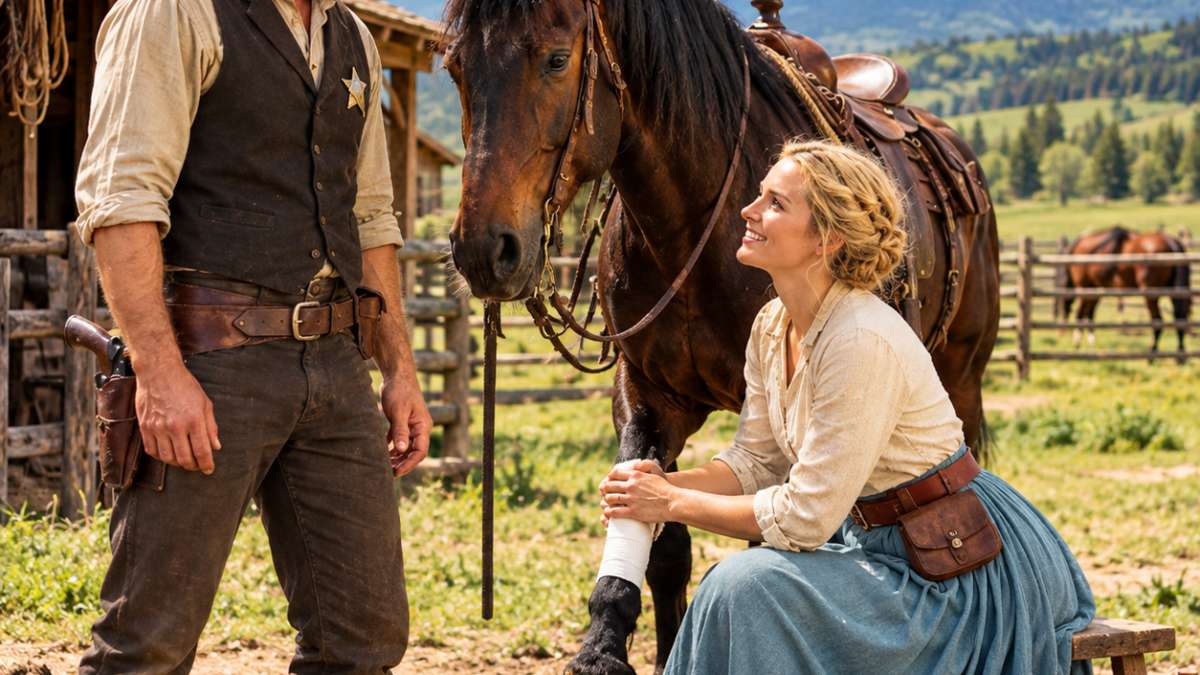
“I’ll leave as soon as my horse is better.”
Mabel’s hands stilled over the bandage.
Only half a breath.
Then she looked up with something careful passing across her face before she managed lightness.
“Then I hope he heals very slowly.”
They both laughed.
Too quickly.
Too softly.
Braveheart, sensing the pause, leaned his head against Mabel’s shoulder.
Neither Wesley nor Mabel held the other’s gaze long after that.
From the porch, Ruth had come out to call them in for supper. She saw exactly what had passed between them, then slipped back inside before either noticed she had been there at all.
Two days later, a rancher arrived at the gate half-frantic.
His boy was running a fever the town doctor could not explain.
Mabel was out of the house before the man finished speaking.
“How long?”
“Two days bad. Worse since midnight.”
“Chills?”
“Yes.”
“Wound?”
“Not that I know.”
Mabel was already gathering her bag.
Braveheart’s leg was sound enough for gentle walking, but not for hard speed. Wesley would not risk him over pride. He borrowed the rancher’s second horse. Ruth climbed into the man’s wagon beside the remedy box, looking grim and ready.
They reached the ranch house near sunset.
Doctor Harlan was already there.
Wesley recognized him by reputation before introduction. Thin, gray-mustached, polished boots, hands too clean for the hour, face arranged in the tired superiority of a man accustomed to being obeyed even when uncertain.
The sick boy lay in bed, face flushed, breathing shallow. His mother hovered with red-rimmed eyes. His father stood near the wall twisting his hat.
Harlan glanced up when Mabel entered.
His expression hardened.
“Mrs. Thorne.”
“Miss,” Mabel said.
“As you like.”
“I came because the family sent for me.”
“I did not.”
“No. They did.”
The boy shifted under the blanket and gave a sharp intake of breath.
Mabel noticed.
Harlan did not.
He was busy arranging offense on his face.
“What have you examined?” Mabel asked.
“Fever pattern. Appetite. Chest. Belly.”
“Leg?”
Harlan frowned.
“Why would I examine the leg?”
Mabel moved to the bedside.
The boy looked ashamed before she even touched the blanket.
“Did you fall?” she asked gently.
He looked at his mother.
“Thomas,” the woman said.
The boy whispered, “From the hayloft.”
“When?”
“Two days ago.”
“Where did you land?”
“My side. Leg hit the ladder.”
The mother pressed a hand to her mouth.
“You told me it was only a scrape.”
Harlan stepped forward, irritated.
“Let me see.”
He checked the lower scrape quickly, too quickly, and said, “Not enough to cause this.”
Mabel watched the boy’s face as he shifted again.
“Remove the stocking.”
Harlan turned.
“There is no need—”
“Remove it.”
The room went silent.
Wesley’s hand moved instinctively toward the authority his badge carried. He was halfway to speaking when Mabel looked at him.
One look.
Stop.
He stopped.
She turned back to the family.
“Let the family choose,” she said. “Not him. Not me. The boy is yours.”
Thomas’s mother looked between Harlan and Mabel.
Then stepped aside.
“Help him.”
Mabel removed the stocking herself.
There, higher on the calf, hidden beneath wool and dirt, was a second wound.
Small.
Angry.
Red spreading beneath the skin.
Harlan’s face changed.
Mabel did not look triumphant. She had no time for it.
Working with Ruth beside her, she cleaned the wound, opened what needed opening, drew out the source of infection, and worked through the night to bring the fever down. Harlan stayed at first, then retreated to the kitchen, pride wounded but not yet dead.
Wesley spent those hours outside.
He tended the family’s animals. Brought in water. Kept the yard quiet. Chopped wood. Sat on the porch near midnight and listened to Mabel’s calm voice through the open window, giving instructions, comforting the boy, refusing panic any foothold.
This time, he did not insert himself into the sick room.
By sunrise, the boy’s fever had broken.
Thomas slept.
His mother wept into both hands.
Harlan stood in the kitchen with the family gathered around him and admitted, with considerably less pride than he had shown at the bedside, that Mabel had found what he had missed.
He did not apologize for the two years he had allowed the town to believe worse of her.
He did not say he had been wrong then.
Only now.
Only about the leg.
Then he left.
It was smaller than the reckoning Mabel deserved.
She said as much on the ride home.
“He admitted the diagnosis,” she said.
“No,” Wesley agreed. “Not the two years before it.”
“He let them all think I was careless.”
“I know.”
“And today he would have let that boy suffer before listening.”
“Yes.”
“And you reached for your badge.”
Wesley looked over at her.
Mabel rode beside him, tired, pale, and fierce in the morning light.
“I did.”
“I spent two years with men deciding for me what I was allowed to do in a sick room,” she said. “I don’t need a well-meaning sheriff doing it more gently than the last man did.”
The words struck harder because they were true.
“I wasn’t trying to control you.”
“I know.”
“I was trying to protect you.”
“I know that too.”
They rode several yards in silence.
“From where you stood,” Wesley said finally, “those looked like the same thing.”
Mabel’s shoulders lowered slightly.
“Yes.”
“I understand that now.”
“Do you?”
“I’ll try to remember it.”
She did not forgive him aloud.
He did not ask her to.
That night, she poured him a second cup of coffee before bed without being asked.
By then, between the two of them, that was its own kind of answer.
Word moved slowly at first.
Three mornings later, Ruth opened the door to find two horses tied at the rail and a woman on the step holding a coughing child against her shoulder. Not sent by Thomas’s family directly, but by a neighbor who had heard secondhand and trusted her own judgment enough to ride out.
Mabel treated the child at the kitchen table.
Ruth kept a ledger, writing the family name into a book that had once held mostly household accounts.
When the woman left, grateful and relieved, Mabel stood at the wash basin scrubbing her hands long after they were clean.
Ruth watched her.
“It isn’t the whole town yet.”
Mabel dried her hands slowly.
“No.”
“But?”
“It is someone who came because she trusted my hands. Not because a man in town sent her out of guilt.”
She looked at the ledger.
“That is worth more to me than anything Doctor Harlan could have said.”
Within the week, Braveheart was sound.
Truly sound.
No limp. No heat. No swelling. Only a faint stiffness in the first morning step and a scar that would fade in time.
Wesley saddled him on a clear morning.
His few belongings were tied behind the saddle. Ruth packed food he had not asked for. Mabel stood by the gate with her arms folded, expression calm enough to insult them both.
The goodbye had the appearance of something ordinary.
That made it worse.
“Well,” Wesley said.
“Well,” Mabel answered.
Ruth stood on the porch.
“Ride careful.”
“Yes, ma’am.”
“And don’t pretend you don’t know the way back.”
Wesley looked at her.
Ruth looked back blandly.
Mabel’s mouth twitched.
He mounted. Turned Braveheart toward the trail. Rode through the gate.
One length.
Two.
Three.
The road curved ahead, leading toward town, toward duty, toward the sheriff’s office with its cot in the back, toward the life he had understood because it asked nothing of him he did not already know how to give.
He drew rein.
Braveheart stopped.
For a moment, Wesley sat there unmoving.
Some part of him had not agreed to what the rest of him was doing.
Then he turned the horse around.
Mabel was still standing near the gatepost when he rode back.
Her face had changed.
Not hope exactly.
She was too guarded for that.
But something had broken the surface.
Wesley swung down.
“You didn’t make the joke this time.”
“What joke?”
“About hoping he heals slowly.”
Mabel’s hands curled against her skirt.
“He’s well.”
“Yes.”
“I have no more reason to ask you to stay.”
Wesley reached up and unpinned the star from his coat.
Mabel’s eyes dropped to it.
He held it in his palm.
Not to give it up.
Only so she would understand plainly that what he said next carried no authority behind it except whatever lived in his chest.
“Then don’t ask the sheriff,” he said. “Ask the man.”
Mabel looked at him for a long moment.
Every careful wall she had built after Doctor Harlan, after town whispers, after learning that trust could be turned against a woman, seemed to tremble at once.
“I don’t want to see you go,” she admitted.
The words came out quiet.
But they came.
Wesley closed his fingers around the star.
“I spent half my life believing home was wherever duty sent me,” he said. “It took a bad step on a wet trail and three weeks in this house to show me the one road I never learned to recognize.”
Mabel’s eyes filled despite her effort to keep them steady.
“What road is that?”
“The one that leads back to somebody waiting.”
Ruth came down from the porch then, unhurried, with the plain satisfaction of a woman whose instincts had been right from the very first storm.
“The guest room will still be here,” she said. “At least until you and Mabel give the preacher reason to ask which Sunday you’re free.”
“Mother.”
“What? I am an old woman. I prefer efficient courtships.”
“You are fifty-five.”
“Old enough to know when two sensible people are wasting daylight.”
Wesley laughed.
Mabel looked at him then.
The last of her restraint gave way into a smile.
Not the guarded twitch.
The real thing.
He rode back to town properly that afternoon to settle his affairs.
He did not give up the badge.
Not then.
Not entirely.
He simply stopped treating it as the only thing that told him where he belonged.
Foss, naturally, noticed.
“Back for good?” the deputy asked.
“Back for work.”
“That was not my question.”
“It’s the answer you get.”
Foss grinned.
“Thorne place treating Braveheart well?”
“Yes.”
“And his owner?”
Wesley looked at him.
Foss raised both hands.
“Ledger’s on the desk, Sheriff.”
From then on, Wesley split his time between the small sheriff’s office and the Thorne ranch. Foss handled more in town, capably and with only occasional smugness. Wesley still rode patrol, still answered disputes, still wore the star. But more often than not, when evening came and duty allowed, he rode toward the hills.
Toward lamplight in a window.
Toward Ruth’s blunt remarks.
Toward coffee set out before he asked.
Toward Mabel.
He courted her properly through autumn.
Sunday dinners.
Walks into the hills.
A ring ordered quietly from the mercantile, though Foss saw the box arrive and nearly injured himself pretending not to notice.
A conversation with Ruth conducted with more nervousness than Wesley had shown facing armed men.
Ruth listened from her kitchen chair, hands folded.
“So,” she said, when he finished asking for her blessing, “you intend to marry my daughter.”
“If she’ll have me.”
“She will.”
“I have not asked yet.”
“I was not speculating.”
Wesley blinked.
Ruth continued.
“I knew the answer by the second week of your stay and saw no reason to make you wait for my blessing longer than the ring took to arrive.”
“You are very direct, Mrs. Thorne.”
“People waste years being otherwise.”
He asked Mabel at the corral.
Of all places.
Braveheart stood beside them, fully recovered and behaving as if he had some personal investment in the matter.
Wesley had planned words.
Good words.
Careful words.
He had worked on them for two days, then discarded them, then built new ones, then forgotten every single one when Mabel turned and looked at him.
“I had a speech,” he said.
“Did you?”
“Yes.”
“Where is it?”
“Gone.”
“That is unfortunate.”
“I remember the important part.”
She waited.
He took her hand.
“I love you, Mabel Thorne. Not because you need protecting. Not because I need fixing. I love you because this is the first place in my life I’ve wanted to come back to when nobody ordered me there.”
Her face softened.
“I love the way you trust your own hands. I love the way you argue with men who deserve it. I love the way you say exactly what you mean and nothing more. I love your mother, though I reserve the right to fear her.”
“Wise.”
“I love this ranch. I love that horse, though he caused all this trouble.”
Braveheart snorted.
Wesley ignored him.
“And if you’ll have me, I’d like to spend the rest of my life finding reasons to stay even when the road is open.”
Mabel’s eyes shone.
“You are much better at speeches than you claimed.”
“That was not the speech.”
“No?”
“No.”
“Good. This one will do.”
He opened the ring box.
She said yes before he finished the question.
That winter, the three of them turned the old shed on the property into a proper treatment room for people and animals both.
Ruth kept the ledger and greeted patients with the authority of a general.
Mabel handled every treatment herself, steady and unhurried, no longer waiting for anyone’s permission to be trusted.
Wesley mended whatever needed mending, rode into town for supplies, and developed a habit of appearing at precisely the moment someone questioned what two women were doing running a treatment room without a physician’s name over the door.
Most people only made that mistake once.
One morning in spring, a small used book arrived at the ranch gate.
No note.
An old text on wound care.
Doctor Harlan’s name was faintly visible on the flyleaf.
Mabel stood with it in her hands for a long time.
She never mentioned it to anyone except Ruth and Wesley.
She did not forgive the doctor for the two years.
Not fully.
Not neatly.
But she placed the book on the shelf beside her mother’s old volume and decided that, for now, it was reckoning enough.
Wesley and Mabel married that spring in the small church in town.
Ruth sat in the front pew and cried without apology.
Foss stood awkwardly in the back in his good coat, trying to look solemn and failing every time Wesley glanced his way.
Braveheart, sound and strong, was tied outside at the rail through the ceremony.
Mabel insisted he be there.
“He brought you,” she said.
“He fell.”
“Exactly.”
Months later, Braveheart ran the high pasture again, the injury nothing more than a faded scar along one leg.
Wesley came back from patrol one afternoon to find Mabel already waiting at the corral. Ruth sat on the porch sorting dried herbs she absolutely did not need to sort, watching with the same quiet smile she had worn since the first storm.
Mabel nodded toward the horse.
“Has he taken another bad step?”
“No.”
“Then why bring him to me?”
Wesley swung down and tied the reins.
“I may need to keep bringing him around just to be sure.”
Mabel laughed.
Then kissed him gently beside the fence while Braveheart stood between them, entirely unbothered, as if he had known from the beginning that his worst step had been no accident at all.
Wesley Marsh had spent half his life reading trails by the marks horses left behind.
It took Braveheart’s bad step on a wet mountain road to show him the one road he had never learned to recognize.
The road that led back to someone waiting.
He found a ranch that did not need him to prove anything.
A mother who saw the truth before either of them admitted it.
A woman who had built a life on her own certainty long before the world learned to respect it.
And every time he looked at Braveheart’s healed leg, he remembered the day he had said, “I’ll leave when my horse is better.”
And Mabel, with her hands still wrapped around the bandage, had smiled like she was only joking when she answered:
“Then I hope he heals very slowly.”
As it turned out, the horse healed right on time.
Wesley was simply the one who had needed a little longer to understand that not every delay is misfortune.
Sometimes it is mercy.
Sometimes it is the road washing out, the horse going lame, the lamp in the window, the woman at the corral saying exactly what needs saying.
Sometimes a man thinks he is waiting for his horse to recover.
When really, life is waiting for him to realize he has finally come home.







