I Screamed When a Biker Carried a Child-Sized Coffin Into My Daughter’s 8th Birthday Party—Then He Whispered, “I Built It for Her Two Years Ago.
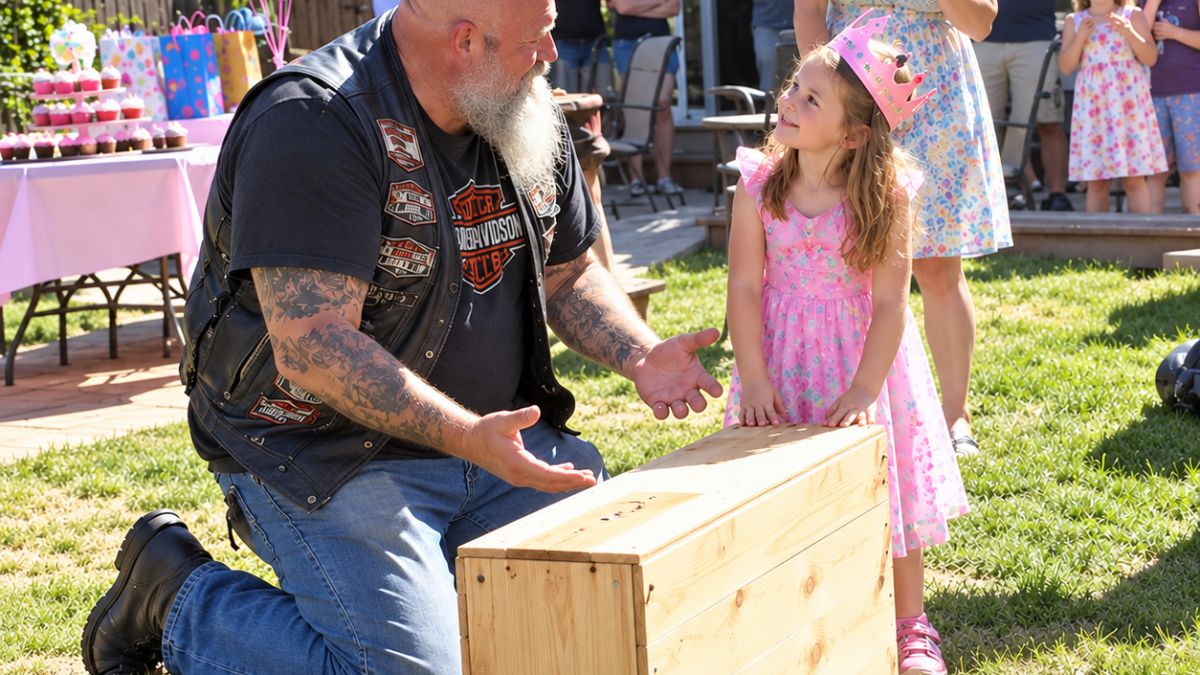
I Screamed When a Biker Carried a Child-Sized Coffin Into My Daughter’s 8th Birthday Party—Then He Whispered, “I Built It for Her Two Years Ago.
Two years after doctors told me to prepare for my six-year-old daughter’s funeral, a giant gray-bearded biker walked into her eighth birthday party carrying the exact child-sized coffin I had once vomited at the sight of in a hospital storage room.
I screamed at him in front of fourteen children and every parent in my backyard, demanding he take that horrible thing away—until he quietly told me he was the man who had built it for free and had spent every night praying my daughter would become the first child who never needed one of his boxes.
Then he opened the lid, and I discovered he had spent two years transforming the coffin into a cedar memory chest stamped with two words—SHE STAYED—because after building 211 caskets for dying children, Maisie was the only little girl who had ever sent one back.
I screamed before the biker made it halfway across my backyard.
Not shouted.
Not called out.
Screamed.
The kind of sound that tears itself out of your throat before your brain catches up.
“Get that thing away from her!”
Every conversation stopped.
Fourteen second graders froze around a pink bounce house.
A paper crown fell off somebody’s head.
The music playing from the portable speaker beside our patio kept going for maybe three seconds before one of the parents lunged over and shut it off.
Suddenly all I could hear was the low rumble of six motorcycles cooling at the curb.
And my own breathing.
The man carrying the box stopped.
He was enormous.
That was my first coherent thought.
Six-foot-four, maybe.
Broad shoulders beneath a black leather vest.
Gray beard down to his chest.
Faded tattoos running from both wrists up under his sleeves.
Heavy boots.
Leather gloves.
The sort of man strangers notice when he walks into a room even if he is trying not to be noticed.
But I barely saw him.
I saw the box.
Small.
White.
Rounded lid.
Polished brass-colored handles.
Child-sized.
A coffin.
Not something that resembled one.
Not a storage chest shaped strangely enough to trigger a frightened mother’s imagination.
A coffin.
I knew because I had seen that exact one before.
Two years earlier.
In a hospital.
Waiting for my daughter to die.
“How dare you!”
My voice cracked across the yard.
“What is wrong with you?”
PART2:
A few parents pulled their children backward.
One mother, Mrs. Kessler, physically put her son behind the cupcake table as if this gray-bearded stranger might have arrived to drag children away.
Someone whispered:
“Dana, who is he?”
I didn’t know.
That made it worse.
My daughter Maisie stood near the bounce house holding a half-eaten strawberry cupcake.
Pink frosting around her mouth.
A glittery number 8 pinned to her shirt.
Alive.
Healthy enough to run.
Healthy enough to complain that I had not bought enough purple balloons.
Healthy enough that the curls growing back after chemotherapy had reached her shoulders.
And this man was carrying the object that had once been prepared for her body.
“Get it out!”
I moved toward him.
“Get it away from my daughter right now.”
He did not argue.
Did not tell me to calm down.
Did not raise his voice.
He lowered the box slowly onto the grass.
Carefully.
Like even after all this time he could not bring himself to set it down roughly.
Then he removed his gloves.
That was when I noticed his hands were shaking.
Not a little.
Badly.
He took off his sunglasses.
His eyes were red.
This enormous man looked as if he had been crying the entire motorcycle ride over.
“Ma’am.”
His voice was deep but surprisingly soft.
“I’m sorry I scared you.”
“You need to leave.”
“I will.”
“Now.”
“Yes, ma’am.”
He swallowed.
“But before I go, I need you to know one thing.”
“I don’t need to know anything.”
“I’m the one who built it.”
Everything inside me stopped.
The children were still silent.
The parents too.
He looked down at the box.
“I built it for Maisie.”
My knees weakened.
I gripped the back of a patio chair.
Two years disappeared.
The backyard disappeared.
The balloons.
The bounce house.
The cupcakes.
All gone.
I was back at St. Matthew’s Children’s Hospital.
Maisie was six.
Thirty-eight pounds.
Almost no hair.
Too weak some days to hold her own juice box.
I was sitting in a small consultation room with a tissue box between me and two doctors who had stopped using words like next step and started using words like comfort.
There are sentences a parent’s brain refuses to accept even while hearing them.
“We need to talk about what happens if treatment stops working.”
I remember the doctor’s hands.
Clean.
Folded on the table.
I remember a child laughing somewhere in the hallway.
I remember wanting that child to shut up.
Then hating myself for wanting it.
The doctor continued.
“We think it may be time to start making arrangements.”
Arrangements.
Adults invent soft words for things too cruel to name.
I stared at him.
“What arrangements?”
He did not answer immediately.
He didn’t need to.
I knew.
Funeral.
Cemetery.
Casket.
Clothes.
A six-year-old’s body.
My daughter.
I said:
“No.”
Then again.
“No.”
As if grammar could override biology.
The doctors gave me time.
A nurse stayed.
Carol Jensen.
Mid-fifties.
Short brown hair.
Blue-framed glasses.
The sort of nurse who had learned that sometimes medicine ends and sitting becomes the treatment.
She held my hand after doctors left.
I cried until I couldn’t breathe.
Then Carol said something I thought I had misunderstood.
“There’s a man.”
“What?”
“A local man.”
“He makes children’s caskets.”
I pulled my hand away.
“I don’t want to talk about that.”
“I know.”
“Don’t.”
“I know.”
“Please.”
She waited.
Then:
“He does it for free.”
I stared at wall.
“No catalogs.”
She said.
“No funeral-home salespeople.”
“No family gets a bill.”
“If you want, I can call him.”
I had no idea why that mattered.
Free.
Not free.
Oak.
Pine.
Gold handles.
Cardboard.
Nothing mattered.
But when your child is dying, every decision becomes impossible.
You are expected to decide things no parent should ever know exist.
What music?
Which cemetery?
What dress?
Open casket?
Closed?
Would she want the stuffed rabbit?
She was six.
She wanted waffles and cartoons.
She did not want funeral preferences.
So I said yes.
Because yes required fewer muscles than no.
I never met the man.
Carol handled everything.
I did not want a name.
A face.
A conversation.
I needed the coffin to exist somewhere outside my sight so I could pretend it was not real.
Then one evening, three days later, I took the wrong hallway coming back from the cafeteria.
A storage-room door stood open.
And there it was.
Small.
White.
Finished.
Waiting.
The exact box now sitting in my backyard.
I remember stopping.
My stomach turned.
I threw up against the wall before I could make it to bathroom.
A nurse found me crouched there crying.
I never looked at the coffin again.
Not until Maisie’s eighth birthday.
Because the impossible happened.
A bone-marrow donor was found.
Overseas.
A match close enough that one doctor came into Maisie’s room holding the paperwork like it was a winning lottery ticket.
Everything became urgent again.
More tests.
More chemotherapy.
Conditioning.
Transplant.
Isolation.
Days when Maisie could not keep water down.
Days when her mouth hurt too badly to talk.
Days when she looked at me and asked:
“Mommy, is this supposed to make me better?”
And I lied with absolute confidence.
“Yes.”
Because parents are allowed certain lies.
Then engraftment.
Numbers began moving the right direction.
One day.
Then another.
Then another.
Hope returned so carefully none of us trusted it.
Two months later, Maisie walked out of St. Matthew’s holding my hand.
Walked.
Not carried.
Not wheeled.
Walked.
She wore a yellow mask decorated with little cats.
The nurses lined hallway.
Carol cried.
I cried.
Everybody cried.
Maisie complained because she wanted McDonald’s fries and we were taking too long.
That was the happiest complaint of my life.
Before we left, I found Carol.
“What happened to…”
I couldn’t say coffin.
She understood.
“The box?”
“Yes.”
“What do you want me to do?”
“Give it away.”
She looked at me.
“To another family.”
“Dana—”
“I don’t want it.”
“Okay.”
“I never want to see it.”
“Okay.”
“Promise.”
She hesitated.
But I did not notice then.
“I’ll handle it.”
That was two years ago.
I believed that was the end.
Now the man who had built it stood in my backyard.
“I prayed every night she’d never need it.”
His voice pulled me back.
Maisie came toward us before I could stop her.
“Maisie.”
She ignored me.
Children are terrible at respecting adult emotional timing.
She stopped beside the box.
Looked down.
Then up at biker.
Her head tilted slightly, the way it always did when she was solving something.
“Is that for me?”
My whole body went cold.
“No.”
The biker answered before I could.
“Not anymore.”
Maisie crouched.
“Why is Mom crying?”
He looked at me.
I couldn’t answer.
He knelt on grass so they were almost eye level.
Up close he looked older than I first thought.
Early sixties.
Deep lines around eyes.
One small scar across his chin.
His huge hands rested on his knees.
“Your mama remembers this box from when you were sick.”
Maisie looked at me.
Then back.
“Hospital sick?”
“Yes.”
The biker nodded.
“I made it back then.”
“What for?”
Every parent close enough to hear went still.
I moved.
“Maisie—”
But the biker did not lie.
Not exactly.
“It was something I built because everybody was very scared.”
She thought.
“Were you scared?”
His eyes filled immediately.
“Yes.”
“Why?”
“Because I didn’t know if you were going to get better.”
Maisie looked down at box.
Then back at me.
I could see questions beginning.
Questions I had spent two years avoiding.
Children who survive serious illness eventually realize survival implies an alternative.
You can postpone that.
Not forever.
The biker said:
“When Nurse Carol called and told me you were going home…”
His voice broke.
He looked at me.
“I didn’t give it away.”
I stared.
“You what?”
“I couldn’t.”
“I told her—”
“I know.”
“I told her to give it to another family.”
“Carol told me.”
“Then why didn’t you?”
He looked at box.
“Because her name was already on it.”
“What?”
“On the bottom.”
He touched wood.
“Before I paint one, I write the child’s name underneath in pencil.”
“Every time.”
“It belongs to them all the way through.”
His hands trembled again.
“I couldn’t put another child in Maisie’s.”
The words nearly dropped me.
He continued.
“So I took it home.”
“For two years?”
“Yes.”
“What have you been doing with it?”
He looked directly at me.
“Turning it into something she can keep for rest of her life.”
I did not understand.
Did not want to.
“I don’t care.”
My voice cracked.
“Take it.”
He nodded.
“I will if that’s what you want.”
“I mean it.”
“Yes, ma’am.”
“Right now.”
He began rising.
Then two small brass latches clicked.
I turned.
Maisie.
“Maisie, don’t.”
Her fingers were already on lid.
She looked over shoulder.
“Mom.”
“No.”
“It’s okay.”
“No, baby.”
“He’s not scary.”
Then she said something only a child could say in the middle of a trauma response.
“Look at his face.”
So I did.
The man was not watching me.
He was watching Maisie’s hands.
His expression looked terrified.
Not like someone delivering surprise.
Like someone waiting to learn whether something he had carried for years would be accepted or rejected.
Maisie lifted lid.
The smell reached me first.
Cedar.
Warm.
Sweet.
Clean.
The white satin was gone.
No tiny pillow.
No funeral lining.
Every inch of inside had been rebuilt with smooth reddish cedar boards.
Polished by hand.
Fitted tightly.
A shallow removable tray stretched across top.
Small compartments divided it.
Places for jewelry.
Photographs.
Letters.
Baby teeth.
Things children collect because adults don’t understand value.
Below tray, the chest was deep.
Empty.
Waiting.
Then Maisie looked at inside lid.
There was a brass plate.
Simple.
No decoration.
Two words.
She read them slowly.
“She…”
Pause.
“Stayed.”
SHE STAYED.
My hand went to fence post.
The yard tilted.
Behind me somebody whispered:
“Oh my God.”
Another parent said:
“Was that…”
Someone answered:
“Shh.”
Maisie smiled.
“I stayed?”
The biker nodded.
“You sure did.”
That was when Carol’s blue Honda came around corner too fast.
One tire went onto curb.
She got out wearing hospital scrubs.
Badge still clipped.
Running.
“Dana!”
I turned.
She reached gate, breathing hard.
“I’m so sorry.”
“You knew?”
“I was supposed to get here before him.”
“You knew?”
“Yes.”
“For two years?”
“Yes.”
“You let him keep it?”
Carol’s face crumpled.
“I did.”
Anger arrived again.
Different target.
“I asked you to give it away.”
“I know.”
“You promised.”
“I know.”
“Why?”
“Because Lyle called me after you left hospital.”
Lyle.
Finally man had a name.
Ordinary.
Lyle.
Not undertaker.
Not coffin maker.
Not shadow from worst year of my life.
A man.
Carol put hand on my arm.
“He told me he couldn’t use it for another child.”
“I should have told you.”
“Yes.”
“I tried.”
“When?”
“Three times.”
I stared.
She nodded.
“Letters.”
“I never sent them.”
“Every time I pictured you opening one, I thought maybe I was doing it for him instead of you.”
“So I waited.”
I looked at Lyle.
He remained kneeling near Maisie.
“Why today?”
Carol’s eyes moved to number 8 balloon.
“Because she’s eight.”
Something passed between Carol and Lyle.
Pain.
History.
I saw it.
“Five minutes.”
Carol said.
“What?”
“Hear him for five minutes.”
“If after that you want him gone, I’ll help him load chest myself.”
I looked around.
Children staring.
Parents pretending not.
Music dead.
Birthday frozen around us.
I wanted all of them gone.
I wanted to close gate.
Burn box.
Go backward fifteen minutes to when biggest problem was whether frosting was melting.
Instead I sat on back steps.
Carol beside.
Lyle took chair only after I gestured.
Maisie sat cross-legged beside cedar chest.
Other bikers stayed at curb.
Five men.
Different ages.
All leather.
All trying very hard not to look toward us.
“They came with you?”
I asked.
Lyle nodded.
“My brothers.”
“Club?”
“Some.”
“Mostly friends.”
“Why stay there?”
“Giving us room.”
Of course.
Lyle rubbed palms together.
Then:
“I had a daughter.”
I knew before he said next words.
“Her name was Rosie.”
Maisie looked up.
“How old?”
Lyle looked at her.
“Six when she got sick.”
Same.
My stomach tightened.
“What did she have?”
I asked.
He told me.
Different disease.
Same world.
Hospitals.
Needles.
Blood counts.
Parents learning words they never wanted.
Rosie fought fourteen months.
She died nine days before her eighth birthday.
March 1996.
Thirty years earlier.
Lyle said date like it was last spring.
Some dates never age.
“When she was gone,” he said, “the funeral-home man gave me binder.”
His voice became flat.
“Laminated pages.”
“Pictures.”
“Prices.”
“Like picking cabinet doors.”
“I was cabinet maker then.”
“Twenty-nine years old.”
“I sat there choosing box for my little girl from page six.”
He laughed once.
No humor.
“Eleven hundred dollars plus tax.”
He looked at me.
“I remember tax.”
I understood that.
Grief preserves stupid details and deletes important ones.
I remember hospital cafeteria charging me $2.17 for coffee morning doctor told me Maisie might die.
Why?
No idea.
But $2.17 lives permanently in my head.
“That isn’t crazy.”
I said.
Lyle nodded.
“I could have built hers.”
“I had wood.”
“Tools.”
“Shop.”
“I’d built kitchens worth fifty grand.”
“Couldn’t measure one board for Rosie.”
He looked at hands.
“Couldn’t think.”
“For years I hated myself for that.”
Maisie moved closer.
He continued.
“A couple years later, family at church lost baby boy.”
“I heard mama crying because casket cost more than they had.”
“That night I went into garage.”
“Built one.”
“No charge.”
“Then another.”
“Hospital started calling.”
“Carol started calling.”
“The brothers started riding with me.”
I looked toward five men.
One skinny with gray ponytail.
Another broad bald man with scar through eyebrow.
They looked away when they noticed.
“How many?”
I asked.
Lyle did not hesitate.
“Two hundred eleven.”
I forgot to breathe.
Two hundred eleven.
Two hundred eleven little boxes.
Two hundred eleven mothers.
Two hundred eleven fathers.
Two hundred eleven rooms with tissue boxes.
Two hundred eleven times Lyle measured small wood dimensions no adult should know by heart.
Maisie’s expression changed.
Even at eight, she understood number meant many.
Lyle looked at her.
“Every one went in ground.”
Then paused.
“Except yours.”
The party disappeared again.
He smiled through tears.
“In twenty-eight years, you’re the only kid who ever sent one back.”
Maisie smiled.
Proud.
As if surviving had been an assignment she completed exceptionally well.
I put face in hands.
“I screamed at you.”
My voice broke.
“I called you…”
I couldn’t remember exact words.
Monster maybe only in my head.
“I’m so sorry.”
Lyle shook his head.
“You had every right.”
“No.”
“Yes.”
“You think I don’t know what that box looks like to a mama?”
He touched lid.
“I know better than anybody.”
That silenced me.
He explained why he kept it.
Maisie’s name in pencil.
Underneath.
He could not give it to another family because every box was built for one child.
Could he have sanded name away?
Probably.
Built new bottom?
Yes.
But that was not point.
He took Maisie’s coffin home.
Placed under tarp in garage.
At first he could barely look.
He almost burned it twice.
Then something changed.
“Bad weeks.”
He said.
“What does that mean?”
“When hospital calls.”
“A kid.”
“I build.”
“Deliver.”
“Funeral.”
He looked toward bikers.
“Sometimes we escort.”
“Family car.”
“Funeral coach.”
“Whatever they need.”
“After a bad one, I’d get home.”
“Sit in garage.”
“Her box was there.”
“Maisie’s?”
“Yes.”
“It was only one that meant child lived.”
That hurt and healed simultaneously.
Like pressing bruise and finding heartbeat.
“So I started changing it.”
“When?”
“About year and half ago.”
He removed satin.
Lined with cedar.
Built tray.
Refinished.
His friend Dutch—the ponytail biker—made brass plate.
SHE STAYED.
“I only worked on it during good weeks.”
“What’s a good week?”
He looked at me.
“One where Carol doesn’t call.”
Pause.
“You’d be surprised how few.”
Carol looked down.
I could not speak.
Then Maisie asked:
“Why today?”
Lyle’s face softened.
“Because you’re eight.”
“So?”
“Rosie didn’t get to be.”
Maisie stopped smiling.
Children understand injustice through birthdays very quickly.
“She died before?”
“Nine days.”
“Did she have party planned?”
“Yes.”
“What kind?”
“Horses.”
Maisie brightened.
“I like horses.”
Lyle laughed through tears.
“She did too.”
Then he reached inside leather vest.
Pulled out something small.
A package.
Faded pink wrapping paper.
Edges soft.
Tape yellow.
It looked ancient.
He held it toward me.
Not Maisie.
“I bought this for Rosie’s eighth birthday.”
My chest tightened.
“I hid it in sock drawer.”
“She never opened.”
“You kept it?”
“Thirty years.”
“In your house?”
He shook head.
“In this vest.”
I stared.
“This vest?”
“Not every day.”
“Whenever I deliver one.”
His hand shook.
“I don’t know why.”
“Maybe because she comes along.”
He swallowed.
“I’d like Maisie to have it.”
“If you say no, I understand.”
I looked at the package.
Thirty years.
A gift waiting for a child who never turned eight.
My daughter had almost joined her.
Every birthday after serious illness feels stolen back from something.
I called:
“Maisie.”
She hopped up.
“Mr. Lyle has something for you.”
She sat beside him.
Took faded package carefully.
Even she sensed age.
She peeled tape instead of ripping.
Inside:
little white jewelry box.
Cotton yellowed.
Silver bracelet.
One charm.
Tiny horse in mid-gallop.
Maisie gasped.
“A horse!”
Lyle closed eyes.
For one second his face became unbearable to look at.
“Rosie loved them.”
“Like really loved?”
“Drew them everywhere.”
“My tax forms.”
“Walls.”
“Her hands.”
“She wanted a real one.”
Maisie held horse charm up.
It spun in sunlight.
“Who is Rosie?”
Lyle looked at me.
I started to answer.
He shook head gently.
He needed this.
“Rosie was my little girl.”
He said.
“She got sick like you.”
“But she didn’t get to come home.”
Maisie stared.
“And she never got to be eight?”
“No.”
Maisie looked at bracelet.
Then at Lyle.
Children sometimes take grief straight instead of walking around it.
“Were you sad?”
Lyle breathed out.
“Still am.”
Maisie considered.
Then held out wrist.
“Can you put it on?”
His hands shook so badly clasp took three tries.
Bracelet too big.
Slid toward hand.
He smiled.
“She’ll grow into it.”
Mostly to himself.
Maisie turned wrist.
Watched horse flash.
Then:
“Can I be eight for her too?”
Lyle did not understand.
Neither did I.
“What do you mean?”
“Like, since she didn’t get to.”
Maisie became serious.
“I could do her birthdays with mine.”
“Eight.”
“Nine.”
“Ten.”
“All of them.”
She shrugged.
“I’m good at birthdays.”
Lyle folded.
That is only word.
The biggest man I had ever seen bent forward on my back steps and covered face with one huge hand.
His shoulders shook.
No sound.
Dutch removed sunglasses at curb.
Looked toward sky.
Carol cried openly.
I cried.
Maisie patted Lyle’s knee.
“It’s okay.”
Maybe it wasn’t.
Maybe okay is sometimes too small.
But she said it.
He nodded.
“Thank you, sweetheart.”
The party resumed awkwardly.
That was reality.
There was no cinematic moment where every adult instantly understood.
Some parents were uncomfortable.
Mrs. Kessler gathered her son and left.
Another mother texted that night:
I’m glad Maisie is okay, but bringing a coffin to a child’s birthday was really inappropriate.
I did not argue.
Two hours earlier I would have agreed.
Most stayed.
I walked to curb.
The bikers straightened as I approached.
Dutch looked prepared to leave.
I said:
“We have too much cake.”
Nobody moved.
“That was invitation.”
The bald man with scar pointed at himself.
“All of us?”
“Yes.”
They looked at one another.
Six giant bikers suddenly uncertain about entering eight-year-old’s birthday party.
Dutch shrugged.
“Ma’am, I can eat cake.”
That broke tension.
They came.
Within twenty minutes, scarred biker Tommy wore pink paper crown because Maisie insisted.
Second graders lined up to honk motorcycle horn under supervision.
A little boy asked Dutch if his ponytail was real.
“Yes.”
“Why?”
“Forgot haircut for twenty years.”
The boy accepted.
Ethan Ruiz’s father was firefighter.
He shook every hand.
Asked bikes.
One toddler fell asleep against Dutch’s chest.
The man froze.
Didn’t want move.
His face softened into something almost frightened.
I realized these men had spent years accompanying families on worst days.
They knew how to stand beside grief.
Birthday joy seemed unfamiliar.
Dutch told me what happens after Lyle finishes a casket.
Sometimes brothers ride escort.
Motorcycles ahead and behind funeral procession.
Not for show.
“So family doesn’t get split at lights.”
He explained.
“We’ve ridden rain.”
“Sleet.”
“Hail once.”
“Awful.”
He looked across yard.
Maisie ran toward bounce house.
Silver horse flashing.
Dutch smiled.
“We’ve followed a lot of little white boxes.”
Then his voice roughened.
“First time one ever brought us to birthday party.”
That sentence stayed.
Lyle remained near cedar chest.
Cupcake in hand.
Never ate.
Every time Maisie ran past, she slapped his hand.
High five.
Every time he looked surprised.
Like her touching him proved reality again.
Alive.
Eight.
Running.
He had spent twenty-eight years delivering boxes that went one direction.
Garage.
Hospital.
Funeral home.
Cemetery.
Never back.
Maisie reversed route.
Hospital sent box home.
Garage turned it into chest.
Motorcycles brought it to balloons.
There was something almost impossible about that.
At sunset, they prepared to leave.
Lyle helped carry chest inside.
I almost stopped him when it crossed threshold.
Old instinct.
Then Maisie pointed:
“My room.”
He looked at me.
I nodded.
We placed it foot of her bed.
White exterior still intact.
That mattered.
He had deliberately left outside unchanged.
“I wanted you to know it was same one.”
He said.
Part of me wished he hadn’t.
Part understood exactly.
Transformation only matters if you can still see what transformed.
At gate, Lyle held my hand longer than ordinary handshake.
“Thank you for letting her keep it.”
I answered without thinking.
“Thank you for keeping her.”
Neither of us knew exactly what I meant.
Maybe keeping her box.
Her name.
Her survival.
Her place among all children he remembered.
Lyle nodded like he understood.
Six motorcycles started.
Every kid left in yard rushed fence.
Maisie waved both arms.
The bikers rode away slowly, side by side.
The sound faded.
Party ended.
Parents left.
Balloons sagged.
Frosting dried on plates.
Wrapping paper collected.
Maisie fell asleep wearing horse bracelet.
Wouldn’t remove for bath.
I stood in doorway watching her.
Then looked at cedar chest.
For two years, I had practiced not remembering.
People talk about trauma as intrusive memories.
Mine worked both directions.
Some memories attacked.
Others I locked away.
Hospital year became room in my mind nobody entered.
I stopped driving near St. Matthew’s.
Avoided certain songs.
Could not smell hand sanitizer with aloe without nausea.
Boxes from treatment went into closet.
Taped.
Never opened.
I told myself that was moving on.
That night, after Maisie slept, I went to my room.
Top shelf.
Behind winter blankets.
Shoebox.
Brown.
Tape across lid.
I carried it to Maisie’s room.
Sat on floor beside chest.
My hands shook opening tape.
Inside:
Hospital wristband.
MAISIE CARTER.
Room number.
Barcode.
A curl of blond hair from morning her hair started falling.
Kindergarten get-well card with twenty-two crooked names.
A crayon drawing of me and Maisie outside building with red cross.
One tiny sock.
Why had I saved one sock?
No idea.
A folded cafeteria receipt.
$2.17.
There it was.
I laughed.
Then cried.
I lifted cedar lid.
SHE STAYED.
Removed tray.
Placed wristband into one compartment.
Hair.
Card.
Drawing.
Sock.
Receipt.
One object at a time.
Not burying.
Keeping.
That difference was entire world.
“Mom?”
I jumped.
Maisie propped on elbow.
“What are you doing?”
“Putting some things where they belong.”
She leaned over bed.
“Is that my hospital bracelet?”
“Yes.”
“I thought you threw it away.”
“I couldn’t.”
She nodded.
Of course.
Children understand contradiction better than adults.
She glanced at chest.
“Can we invite Mr. Lyle to my ninth birthday?”
“I think we have to.”
“And bikers?”
“Yes.”
“Can we have motorcycle cake?”
“We’ll discuss.”
“Horses too.”
“Go to sleep.”
She dropped back.
“Night.”
“Night, baby.”
Silver horse still on wrist.
She slept.
I closed lid.
For first time in two years, that box did not mean death.
It held proof of life.
That should be end.
But stories do not stop because meaning arrives once.
Lyle became part of our lives.
Not constantly.
He did not suddenly become grandfather substitute.
He lived two towns away.
Had his shop.
His club.
His own grief.
But Maisie wrote him.
Mostly drawings.
Horses.
Motorcycles.
Once horse riding motorcycle, which became his phone background for nearly a year.
For her ninth birthday, he arrived without casket.
Thank God.
He brought Dutch.
Tommy.
Others.
Maisie had mailed invitation eleven months early.
Horse wearing paper crown.
Lyle kept on refrigerator.
Next to Rosie drawing from 1996.
At party, Lyle gave Maisie small wooden horse he carved from cedar scraps.
No sadness attached.
That mattered.
Their relationship was not built only around children dying.
It became ordinary.
She told him school gossip.
Asked why beard gray.
Asked if tattoos hurt.
He told her yes.
She decided not to get one until “at least twelve.”
I corrected eighteen.
Lyle wisely stayed silent.
Carol came too.
She remained in our lives.
At first I resented she had kept chest secret.
We talked.
“I should have told you.”
She said.
“Yes.”
“I was afraid you’d say no.”
“I would have.”
“I know.”
“That wasn’t your decision.”
“No.”
She accepted without excuse.
That repaired more than apology that tries erasing responsibility.
I asked:
“Why did you agree?”
She thought.
“Because I’ve watched Lyle hand parents boxes for twenty years.”
“I’d never heard his voice the way it sounded when he called about Maisie.”
“What did he say?”
Carol looked away.
“He said, ‘What do I do with one that lived?’”
I stopped.
“He had never needed answer.”
Neither had Carol.
None of them.
Maisie was statistical anomaly in Lyle’s private grief.
Not because other sick children never recovered.
Of course many did.
But Lyle was called only after outcome had become nearly certain.
His work lived at edge.
He built when families were told to prepare.
Usually, by time box completed, ending had already arrived.
Maisie’s donor appeared in that impossible narrow window.
I asked hospital later whether we could know donor.
There were rules.
Waiting periods.
Eventually contact became possible.
His name was Marek.
Twenty-four-year-old university student in Poland when registered.
He had no idea who Maisie was at donation.
Just number.
Match.
Procedure.
Months later he learned recipient survived.
Years later we exchanged letters.
Then video call.
Maisie showed him horse bracelet.
Lyle joined one call eventually.
Marek listened as I explained chest.
He became quiet.
“I gave marrow.”
He said.
“This man gave…”
He searched English.
“A place for memory?”
Exactly.
Survival requires more than one kind of rescue.
Medicine saved Maisie’s body.
People like Carol carried us through days.
Lyle eventually helped me carry memory.
I had not realized I needed that.
And there was another wound.
Maisie’s father.
His name was Ryan.
He left three months into treatment.
Not disappeared entirely.
Paid some support.
Called sometimes.
But physically left.
He said:
“I can’t sit in that room and watch her die.”
I hated him for that.
Still do in certain corners.
But later I understood hatred protected me from seeing similar thing in myself.
I stayed physically.
Yes.
Every appointment.
Every hospital night.
Every fever.
But after recovery, I abandoned year emotionally.
Locked away everything connected.
Would not talk.
Would not let Maisie ask much.
When she said:
“Do you remember when I had tube?”
I changed subject.
When she asked why certain nurses cried at discharge, I said because happy.
When school health lesson mentioned cancer, I left room once.
I was present.
But part of me ran.
The cedar chest exposed that.
Lyle had done opposite.
He spent thirty years walking toward grief.
Box after box.
Not because healthy in every way.
I later learned he had years when drinking too much.
A marriage that failed.
Depression.
Rosie’s room left untouched for eleven years.
He was no saint.
He turned pain into work slowly.
Not all at once.
The first casket after Rosie did not heal him.
Neither did tenth.
Or hundredth.
But building gave his hands something to do with helplessness.
That made sense to me.
I started therapy.
I wish I could say chest alone cured me.
It did not.
It opened door.
Therapist helped me walk through.
First session I talked about birthday scream for forty minutes.
Then apologized for talking too much.
Therapist said:
“That is literally why you are here.”
I laughed.
First honest laugh in therapy.
Maisie also met pediatric counselor.
Survivor guilt can happen in children too.
I did not know.
She became old enough to understand some kids she met during treatment did not leave.
One girl, Emmy, had shared craft room.
Maisie asked one day:
“Why did my medicine work and hers didn’t?”
No parent answer.
We stopped pretending answers existed.
“I don’t know.”
That became acceptable sentence.
Lyle helped unexpectedly.
Maisie asked him why Rosie died.
“I don’t know.”
He said.
“Doctors tried.”
“She tried.”
“Still happened.”
“But you didn’t.”
Maisie said.
“What?”
“You didn’t die when she did.”
Lyle went quiet.
“No.”
“Why?”
He looked at me.
Then:
“I almost forgot how to live for a while.”
“Then what?”
“Started building.”
Maisie nodded.
Children understand actions better than abstractions.
At ten, she started adding birthday charm for Rosie.
Not expensive.
One each year.
At nine, tiny number 9 charm.
At ten, star.
At eleven, another horse.
She called them Rosie birthdays.
We never turned it into public ritual.
No social media campaign.
No viral charity brand.
Just theirs.
Lyle cried less each year.
Not because cared less.
Because grief changed shape.
At Maisie’s tenth birthday, he finally ate cupcake.
Progress.
The biker club had a name, Iron Ravens.
I had disliked biker clubs from a distance because everything I knew came from television and loud exhaust.
Then I learned theirs.
Electricians.
Retired teacher.
Mechanic.
Two veterans.
One firefighter.
One accountant who looked terrifying enough to collect debts but mostly did taxes.
They rode funerals for families free.
Sometimes paid gas themselves.
One spring they held fundraiser for Lyle’s casket materials.
I went.
Hundreds of motorcycles.
Maisie sold lemonade.
People bought cups for twenty-dollar bills.
She raised almost two thousand dollars.
Lyle complained.
She said:
“You’re welcome.”
He lost.
Of course.
I saw workshop for first time that day.
That was difficult.
Rows of lumber.
Templates.
Tools.
White paint.
Hardware organized by size.
No completed caskets at moment.
Thank God.
On one wall hung photographs.
Not children.
Thank-you notes.
Some from parents.
Some funeral cards.
Lyle never displayed child pictures without permission.
Near back, a shelf held ledger.
Names.
Dates.
Two hundred eleven when Maisie’s was built.
More now.
I did not ask current number.
He caught me looking.
“You don’t want to know.”
“No.”
“Me neither.”
Yet he knew every one.
He showed me bottom of unfinished box.
Pencil name.
Small.
Private.
I ran finger near it without touching.
“So that’s why.”
“Yes.”
Every child belonged before paint.
I cried in workshop.
Lyle did not hug immediately.
He asked:
“Can I?”
I nodded.
That mattered too.
Consent after grief.
He wrapped arms.
Leather smelled like cedar and gasoline.
Funny combination.
Years passed.
Maisie remained well.
That sentence deserves space.
She remained well.
Checkups stretched from monthly to quarterly.
Then twice yearly.
Then yearly.
Every oncology anniversary carried fear.
Blood draw.
Waiting.
Numbers.
Normal.
Each normal result made us breathe.
At five-year milestone, hospital rang bell.
Some families love bells.
Some hate.
Maisie wanted.
She rang hard enough to make everyone laugh.
Carol stood beside.
Lyle waited outside because he said hospitals made knees weak.
I told him that was ridiculous after two hundred caskets.
He said:
“That’s why.”
Fair.
After bell, we brought him in.
He touched wall outside old storage room.
Same hallway where I threw up.
“I delivered it through there.”
He said.
I stared.
“You were here?”
“Yes.”
“You saw me?”
“No.”
“Carol met us loading dock.”
Of course.
He had been physically close that day.
Unknown.
He said:
“I sat in truck twenty minutes after.”
“Why?”
“Every delivery.”
“What do you do?”
“Pray I wasted wood.”
That nearly broke me.
He had prayed two hundred eleven times.
Once, prayer came true in way he could see.
I am careful with miracle language.
Marek’s marrow.
Doctors.
Science.
Timing.
Luck.
Maisie survived because many concrete things happened.
But I understand Lyle calling it prayer answered.
Humans name gratitude differently.
At age twelve, Maisie asked directly:
“Was chest really my coffin?”
I had known day coming.
“Yes.”
She stared.
We sat on floor beside it.
It had scratches now.
Stickers on one side despite my objections.
A friendship bracelet hanging handle.
No longer pristine.
Good.
“Like they were going to put me in it?”
“If you died.”
She swallowed.
“Were you going to?”
“What?”
“Put me in it.”
I began crying before answer.
“I don’t know.”
That was true.
I had never reached decision.
Funeral home would have.
People would help.
I could not picture.
Maisie touched brass plate.
“SHE STAYED.”
“Did Lyle know I would?”
“No.”
“So he built it thinking I wouldn’t.”
“Yes.”
She sat quietly.
Then:
“That’s sad.”
“Yes.”
“Does it scare you?”
“Sometimes.”
“Should we get rid of it?”
The question shocked.
“Do you want to?”
“No.”
“Then no.”
She looked at hospital things in tray.
Over years we added:
first post-transplant school photo.
Marek’s first letter.
Bell ribbon.
Horse birthday charms.
A lock of hair grown back.
Birthday invitations.
Rosie drawing copy Lyle shared.
The chest now held both death that didn’t happen and life that did.
That was why it worked.
Not because transformed coffin hid past.
Because it refused to hide.
At fourteen, Maisie became embarrassed by story.
Healthy phase.
“Mom, stop telling people.”
“I don’t.”
“You told Aunt Jenna.”
“She was there.”
“Oh.”
“Lyle tells.”
“He doesn’t unless asked.”
“Carol?”
“She’s nurse.”
Maisie groaned.
“I don’t want to be coffin girl.”
That hit.
Survivors get trapped in inspiring narratives adults love.
Brave cancer kid.
Miracle child.
Warrior.
Maisie wanted to be bad at algebra and obsessed with music.
So we stopped mentioning.
Birthday bracelet remained private.
Lyle understood immediately.
“She gets to be anything else.”
He said.
That was another gift.
He did not need Maisie to remain symbol of Rosie.
He let her become herself.
At sixteen, she dyed two streaks purple.
Lyle said Rosie would approve.
Maisie said:
“You always say that.”
“No.”
“Rosie hated broccoli.”
“You like broccoli.”
“I hate broccoli.”
“See?”
They laughed.
Lyle aged.
Gray beard turned white.
Knees.
Shoulder.
Motorcycle got heavier.
He eventually stopped long rides.
Iron Ravens still escorted.
Younger members joined.
Dutch died first.
Cancer.
Cruel symmetry.
At funeral, Maisie was seventeen.
She wore horse bracelet.
Bikers lined road.
No child-sized box.
Full adult casket.
Lyle stood near grave.
After, Maisie hugged him.
He whispered:
“We’re getting too good at this.”
She answered:
“Then come to more birthdays.”
He smiled.
She was right.
Lyle began attending graduations.
Weddings.
Retirements.
Not only funerals.
Maybe that was part of what Maisie changed.
People who serve grief sometimes forget celebration also needs witnesses.
When Maisie graduated high school, Lyle sat front row with me and Carol.
She walked stage.
He cried harder than I did.
Which annoyed me.
“She’s my kid.”
I whispered.
He wiped eyes.
“Then catch up.”
Afterward, Maisie handed diploma to him for picture.
Then to Carol.
Then me.
I complained about order.
Nobody cared.
The cedar chest went to college?
No.
Stayed home first year.
Maisie said:
“Dorms steal things.”
True.
She took horse bracelet.
She called often.
Less often after making friends.
Healthy.
When first semester got hard, she called Lyle instead of me once.
I pretended not jealous.
“What did he say?”
“Quit whining.”
“Seriously?”
“He said Rosie didn’t get algebra so I’m allowed to hate it but not waste it.”
“That sounds like Lyle.”
She passed.
The chest moved with her after college.
That was strange day.
She had apartment.
I helped pack.
At foot of childhood bed, white exterior.
Still unmistakable if you knew.
She looked.
“You okay if I take it?”
“It’s yours.”
“Really?”
“Always was.”
She smiled.
Lyle’s pencil name remained under bottom.
MAISIE CARTER.
He had never sanded it.
We carried to truck.
I remembered first time he carried through gate and I screamed.
Now I held other side.
“Mom?”
“Yes?”
“You’re crying.”
“I know.”
“Because coffin?”
“Because moving.”
“Good.”
“Why good?”
“Coffin would be weird.”
She always had dark humor.
Survivor privilege.
We loaded.
Years later, Lyle’s hands became too unsteady for precise joinery.
He resisted stopping.
Of course.
Iron Ravens found solution.
Apprentices.
Woodworkers.
He taught.
The program became small nonprofit eventually.
Not Lyle’s Hero Caskets.
He hated hero.
Name:
Rosie’s Workshop.
Maisie designed logo.
Tiny horse.
I cried when I saw.
Lyle pretended dust.
At workshop opening, plaque listed:
For Rosie, and for every family who should never have to shop for the smallest box.
Below:
And for the children who send theirs back.
There were more by then.
Not many.
But Maisie no longer only one.
Medicine changed.
Circumstances changed.
Occasionally a casket was commissioned during hopeless period then no longer needed.
Lyle had developed return tradition.
Never reuse.
If family wanted, converted to memory chest.
Some declined.
Then box dismantled respectfully, wood repurposed into shelves or keepsake boxes.
No child went into another child’s named casket.
His rule held.
Maisie’s remained first.
Template.
The brass plates varied.
HE CAME HOME.
SHE MADE IT.
STILL HERE.
No one used SHE STAYED again.
“That’s yours.”
Lyle said.
More years.
Lyle died at seventy-six.
Not suddenly.
Heart failure.
Hospital.
Carol had retired.
Still came.
Maisie was twenty-something.
I was older.
We sat beside.
Horse bracelet around Maisie’s wrist.
Still too loose? She had grown into it years ago.
Lyle noticed.
“Rosie’s horse.”
“Yes.”
“You kept.”
“Obviously.”
He smiled.
He asked:
“Chest?”
“At my apartment.”
“Good.”
Long silence.
Then:
“Dana.”
I leaned.
“I’m sorry I scared you that day.”
All those years later.
I laughed and cried.
“I’m sorry I screamed.”
“You were supposed to.”
“No.”
“Yes.”
He looked at Maisie.
“Needed to know somebody would fight like hell over box.”
His humor dark to end.
At funeral, Iron Ravens rode.
A lot more than six.
Maisie stood beside me.
No white child-sized casket.
Lyle chose simple cedar adult coffin built by apprentices.
On lid, tiny brass horse.
When procession moved, hundreds motorcycles followed.
At cemetery, Maisie placed paper crown on casket.
Pink.
Like her eighth birthday.
Then whispered:
“You came to enough birthdays.”
I could not hear rest.
Didn’t need.
After funeral, Rosie’s Workshop continued.
That was his instruction.
Not memorial only.
Work.
Maisie joined board.
Not because cancer survivor obligated.
Because she wanted.
She became occupational therapist working with children? Could choose, but we should avoid destiny too neat. She actually went into graphic design? Maybe. Let’s keep unspecified career and volunteer.
She designed materials.
Helped families choose memory conversions when caskets returned.
She refused to call them miracles publicly.
“Kids are not stories.”
She said.
“They’re kids.”
I loved that.
The original chest became more scratched.
Life accumulated.
Photos.
Letters.
Rosie charms.
Lyle funeral program.
Carol retirement card.
Marek’s wedding invitation.
A Polaroid of six bikers in paper crowns.
The hospital bracelet.
All inside.
The white exterior yellowed slightly over decades.
One brass handle tarnished.
Maisie never refinished.
“Why?”
“Because Lyle left it like that on purpose.”
She understood transformation needs evidence of before.
I understand now too.
For years I thought healing meant making hospital year disappear.
Then Lyle carried it through birthday gate.
I hated him for those first seconds because he dragged death into celebration.
What I could not see was that death was already there.
In me.
In sealed shoebox.
In panic around hospitals.
In questions I would not answer.
He did not introduce it.
He gave it somewhere to go.
Cedar tray.
Brass plate.
Memory.
That is different.
I still think about woman who texted that casket was inappropriate.
She was not wrong from where she stood.
Context changes objects.
To her:
coffin at birthday.
To me at first:
threat.
To Lyle:
one box that came back.
To Maisie:
chest.
To Rosie:
in some strange indirect way, birthday gift finally delivered.
Objects do not decide meaning.
People do.
That small white box began as worst purchase no parent should need.
Then became evidence that prediction failed.
No magic.
No denial.
Just transformation.
The most important thing Lyle did was not carpentry.
It was refusing to put another child inside something that already had Maisie’s name.
He treated her survival as permanent fact before I knew how.
He could have burned it.
He nearly did.
Instead he waited for good days.
That detail destroys me still.
Only worked on good days.
Because he would not let another child’s death enter Maisie’s chest.
What discipline that took.
How many weeks untouched under tarp.
How many calls from Carol.
How many names penciled under new boxes.
How many funerals.
Then one quiet week:
one cedar board.
Sand.
Fit.
Stop.
Another good week:
tray.
Another:
hinges.
Another:
brass.
Two years.
Grief builds slowly.
So does healing.
At Maisie’s eighth birthday, I saw a coffin.
Lyle saw unfinished proof.
Maisie saw box.
Children are sometimes smartest because they have not yet agreed on symbols.
She opened it.
That simple act changed everything.
Years later, when she had her own daughter, I became Grandma Dana.
She named child Rose as middle name.
I did not ask whether for Rosie.
Maisie eventually said:
“Partly.”
Lyle never met baby.
But horse bracelet hung framed? Maybe she still wore. She wore it less, kept safe.
When Rose turned eight, Maisie called me.
“Mom.”
I knew why voice.
“Today?”
“Yes.”
We did not make it sad.
Cupcakes.
Horses.
Pictures.
After party, Maisie opened cedar chest with daughter.
Told story.
Not all graphic details.
Age appropriate.
“This box was made for me when everyone thought I might die.”
Rose stared.
“But you didn’t.”
“No.”
“What happened?”
“Lots of people helped.”
“Medicine.”
“Donor.”
“Doctors.”
“Nurses.”
“Mr. Lyle.”
“Who is he?”
Maisie showed photograph.
Gray beard.
Paper crown.
Rose laughed.
“He looks scary.”
“That’s what Grandma thought.”
I protested.
“Reasonably.”
Maisie continued.
“He was kind.”
Rose touched brass plate.
“What does she stayed mean?”
Maisie smiled.
“It means sometimes people prepare for goodbye and get more time instead.”
I had to leave room.
Cried in kitchen.
Some tears become old friends.
When I returned, Rose asked:
“Can I keep something in it?”
Maisie looked at me.
Then:
“Sure.”
Rose put paper crown from birthday into tray.
Another layer.
That is how stories should survive.
Not frozen.
Added to.
The first lines never change.
Two years ago, my daughter was dying.
A nurse told me about a man who built caskets.
I saw one.
I threw up.
Then a donor appeared.
Maisie lived.
I asked to never see coffin again.
Then Lyle brought it to her eighth birthday.
I screamed.
All true.
But if I had known what was inside, would I have screamed?
Probably.
Trauma does not wait for explanations.
That is okay.
Lyle never held it against me.
That taught me something too.
People who understand grief do not demand perfect manners from grieving people.
He did not say:
How dare you judge me.
He set box down.
Took glasses off.
Let me be afraid.
Then explained.
That compassion mattered as much as gift.
I have retold story countless times now.
People ask:
“Was it really a coffin?”
Yes.
“Did you really keep it?”
Maisie did.
“Was it creepy?”
For about thirty seconds.
Then no.
“Did the biker really make 211?”
At that point, yes.
More later.
“Was Rosie real?”
Very.
I never met.
But I know her horse drawings.
Her father’s stories.
Her bracelet.
Her birthday.
Grief can introduce people across generations.
I know Rosie through absence.
Maisie knows her through gift.
Rose knows through name.
That is not replacement.
Rosie remains herself.
A child who loved horses and did not get eighth birthday.
We do not turn her death into inspirational device.
That was important to Lyle.
Once a reporter asked him:
“Would you say Rosie died so you could help hundreds of families?”
Lyle became furious.
“No.”
“She died because she got sick.”
“I helped families because I didn’t know what else to do afterward.”
That distinction stayed with me.
We should never make tragedy retroactively necessary.
It was not necessary.
It was terrible.
Meaning came after.
Not justification.
Same with Maisie’s illness.
I would erase every minute if I could.
Even if it erased people we met?
Yes.
Parents are allowed that answer.
I would trade cedar chest, bracelet, friendship, lessons, all of it for my daughter never having suffered.
But since I cannot change history, I choose what grows around it.
That is where meaning lives.
The box at foot of Maisie’s bed became first proof.
Something built for ending became container for continuing.
At Lyle’s funeral, Carol whispered:
“He always said she saved him.”
“Maisie?”
“Yes.”
“He thought he was making boxes because of Rosie.”
“Then Maisie’s came back.”
“He realized maybe he needed one story where craftsmanship did not end underground.”
I looked at coffin being lowered.
Adult-sized.
Cedar.
His apprentices had made.
“He got it.”
I said.
Carol nodded.
“Yes.”
He did.
Not enough to erase two hundred eleven.
Nothing could.
But one.
Sometimes one is not statistically much.
Emotionally, one can keep person alive.
Lyle watched Maisie run with horse bracelet.
Maybe that image carried him through next call.
And next.
And next.
That is why I no longer regret letting him bring the box.
I regret screaming?
Yes and no.
I am embarrassed.
But I forgive woman I was.
She saw death walking through gate toward child she had almost lost.
Of course she screamed.
Lyle forgave her immediately.
I should too.
Maisie says same.
“Mom, if somebody brought my coffin to my party now, I’d scream.”
“Good.”
“Then stop apologizing.”
Children grow into adults and start parenting us.
Rude.
The brass plate remains.
SHE STAYED.
Two words.
At first I thought they were about Maisie staying alive.
Then Lyle.
He stayed beside grief.
Carol stayed with families.
I stayed through treatment even while part of me ran after.
Marek stayed anonymous long enough for marrow to do work.
The bikers stayed at curb until invited.
Later friendships stayed.
The words expanded.
She stayed.
And so did he.
And eventually, so did I.
That is what I understand now.
The coffin was not the darkest thing carried into Maisie’s eighth birthday.
The darkest thing was everything I had refused to face for two years.
Lyle only gave it hinges.
Cedar.
Compartments.
A place.
The first night, I put hospital bracelet inside.
Years later, paper crown.
Then letters.
Then lives.
If you open it now, you would not immediately know its original purpose.
Unless you look at shape.
White exterior.
Rounded lid.
The past remains visible.
Good.
Healing that requires pretending something never happened is fragile.
Maisie’s chest does not pretend.
It says:
This was almost one thing.
Then it became another.
That may be why people respond to story.
Not because biker.
Not because coffin.
Because everyone has something in life built for ending they wish could become beginning.
Not everything can.
That is truth too.
But some can.
A box.
A memory.
A person.
The last photograph I have of Lyle at Maisie’s birthday is not dramatic.
He is sitting in lawn chair.
Pink paper crown crooked on white-gray hair.
Cupcake untouched in hand.
Maisie blurred behind, running.
You can see silver horse flashing near her wrist.
Lyle’s eyes are on her.
His expression is not smiling exactly.
It is astonishment.
I used to think he was looking at Maisie.
Now I think he was looking at future.
Something Rosie never got.
Something two hundred ten other children did not get.
A child getting older right in front of him.
That was why he had to carry the coffin in himself.
Why he did not leave it on porch.
Why he could not give it to another family.
Why he waited two years.
Why he only worked on good days.
Why he rode there with five men who usually escorted boxes toward cemeteries.
He needed to see lid open.
He needed to see Maisie standing beside it.
After two hundred eleven goodbyes, he needed one hello.
And I almost sent him away before he got it.
Thank God I didn’t.
Because that afternoon, for the first time in twenty-eight years, Lyle Carter followed a child-sized casket somewhere no casket had ever taken him before.
Past balloons.
Past cupcakes.
Past a pink bounce house.
Into the bedroom of a little girl who was still alive.
And when Maisie lifted the cedar lid, nothing inside was waiting for her body.
Only her life.








