I Saw a Car Hit a Tiny Kitten and Rushed Him to the ER—But Saving His Life Led to a Far More Painful Fight Than I Ever Expected
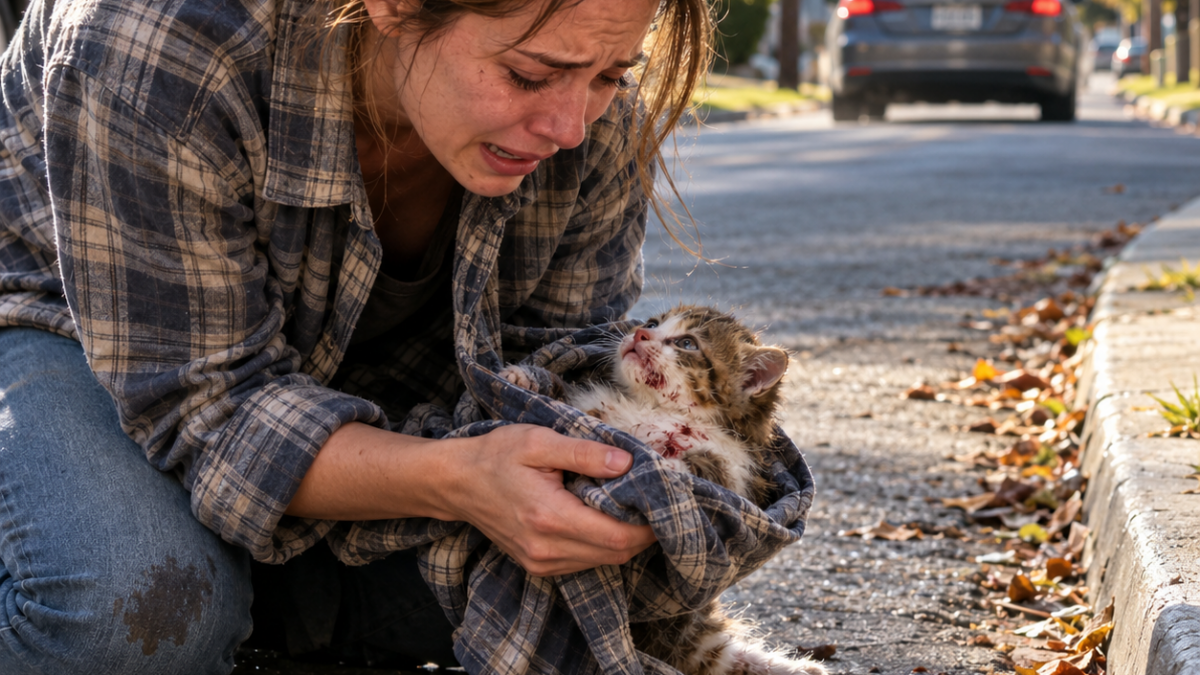
PART3:
“Yes.”
“There will be costs.”
“Yes.”
“We can give an estimate once the doctor—”
“Yes.”
She stopped.
I must have looked wild.
“I’ll bring the forms,” she said softly.
A veterinarian named Dr. Rebecca Collins came out almost forty minutes later.
Her expression told me the truth before she spoke.
“He’s alive.”
I exhaled so hard my knees almost buckled.
Then she added, “But he has a very serious spinal injury.”
My relief collapsed.
“What kind?”
She brought me to a computer.
On the X-ray, even I could see something was wrong. The vertebrae in the middle of his back did not form the smooth line they should have. There was a break in the order of him, a violent shift where no shift belonged.
“His thoracic spine is fractured,” Rebecca said. “There’s significant displacement.”
“What does that mean?”
She looked at me with the terrible gentleness of a doctor deciding how much truth a frightened person can hold.
“It means we don’t know yet how much function he’ll recover.”
I stared through the glass toward the ICU.
The kitten lay beneath a warming blanket surrounded by equipment that looked enormous next to him. A tube ran into one tiny front leg. Oxygen flowed near his face. His eyes were closed, but his ears twitched when someone moved near the cage.
“Can he stand?”
“No.”
“Will he?”
Rebecca paused.
“I can’t promise that.”
That was when the fear became real.
This was not a broken paw.
Not a cut that could be stitched and forgotten.
The accident had damaged the part of his body that carried messages to everything behind it.
His hind legs.
His bladder.
His future.
Rebecca told me the next several hours mattered most. They needed to stabilize him first. Control pain. Watch for shock. Make sure there was no internal bleeding. Evaluate neurological function when his body could tolerate it.
I nodded because nodding was easier than falling apart.
Then the technician asked whether the kitten had a name.
I looked through the glass.
He had survived the road.
The drive.
The first examination.
He was still there.
“Bonnie,” I said.
I do not know why that name came to me. Maybe because he looked too small for something harsh. Maybe because I needed to call him something that did not sound like trauma. Maybe because names are the first way humans tell suffering it has become personal.
When I stepped closer to his cage and whispered it, one tiny ear moved.
“Bonnie.”
His eyes opened.
For one second, he looked directly at me.
That small response hit harder than anything the doctors had told me.
He was not finished.
And standing there with blood drying on my clothes and no idea what the next day would bring, I made a decision before I understood how much it would cost.
Rebecca tried to send me home that night.
I refused.
Not dramatically.
I simply sat down in the plastic chair outside the ICU and stayed there.
At 11:30, a technician brought me coffee. At midnight, Rebecca came out again, arms folded, her white coat wrinkled and her hair slipping loose from the clip at the back of her head.
“You know staring at that door won’t change what happens in there.”
“I know.”
“You should sleep.”
“I know.”
“You have said ‘I know’ twice without moving.”
“I noticed.”
She looked at me for a long moment.
Then she sat in the chair beside mine.
“Bonnie is stable.”
I let out a breath.
“For now?”
“For now.”
“What does stable really mean?”
“It means his blood pressure is holding. His breathing is better. We don’t see evidence of major internal bleeding. He’s responsive.”
“And his spine?”
“That hasn’t changed.”
I stared at the ICU door.
Rebecca continued more gently.
“The next question is neurological function.”
“You already said he can’t stand.”
“That tells us part of the story. Not all of it.”
“What else?”
“We need to evaluate sensation, reflexes, bladder function, and whether there is deep pain perception in the hind limbs.”
I hated every word.
Not because I did not understand them.
Because I did.
“Deep pain is good?”
“If present, yes. It gives us more reason to hope for neurological recovery.”
“And if it isn’t?”
Rebecca paused.
“The prognosis becomes much more guarded.”
Guarded.
That was another word medicine used when hope could not be trusted to stand on its own.
At two in the morning, they allowed me five minutes inside the ICU.
Bonnie looked even smaller at night.
His fur had been cleaned as much as possible, but rusty stains remained near his mouth and side. A catheter ran into his front leg. Another line disappeared beneath the blanket. His back half did not move.
I approached slowly.
“Hey.”
His eyes opened.
I reached through the opening of the enclosure and touched the top of his head with one finger.
He did not pull away.
“I named you Bonnie,” I whispered. “I’m aware it may not be the toughest name.”
One tiny ear moved.
“You can file a complaint when you’re stronger.”
His eyes stayed on me.
I swallowed.
“I don’t know where you came from. I don’t know whether someone is looking for you. And I don’t know how much of this you can understand.”
I stopped.
The words I actually needed to say were simpler.
“But I’m here.”
Bonnie closed his eyes.
I kept my finger on his head until the technician told me visiting time was over.
I slept two hours in my car.
At six, the hospital called.
I nearly dropped the phone trying to answer.
“This is Rebecca.”
“I’m here.”
“I assumed.”
“Is he alive?”
“Yes.”
The word hit me like sunlight.
I was inside three minutes later.
Rebecca had new X-rays on the screen. She pointed to the middle of Bonnie’s back.
“The fracture is around the lower thoracic region. The alignment is poor.”
“How bad?”
“Bad.”
I appreciated that she did not soften it.
“The vertebrae shifted enough that the spinal cord was compressed or injured at impact.”
“Can surgery fix that?”
“Surgery can stabilize bone. It cannot guarantee repair of damaged spinal cord tissue.”
“So even if you put everything back where it belongs—”
“He may remain paralyzed.”
I looked at Bonnie.
“What would you do?”
Rebecca crossed her arms.
“If he were my patient?”
“He is.”
“If he were my cat?”
That was the real question.
She took a breath.
“First, I would stabilize him. Control inflammation and pain. Assess neurological status over the next few days. Then I would get a specialty neurological consultation before making a major surgical decision.”
“You wouldn’t put him down?”
Her expression changed.
“No.”
Relief hit me harder than I expected.
“At this moment,” she said, “he’s alert. He’s eating tiny amounts. His front half works normally. His pain is being controlled. Paralysis alone is not automatically a reason to euthanize an animal.”
I looked at her.
“People do it.”
“Yes.”
“Why?”
“Sometimes because the animal has other injuries. Sometimes because long-term care is more than the family can manage. Sometimes because the prognosis is poor and suffering cannot be controlled.”
“And sometimes?”
Rebecca’s eyes held mine.
“Sometimes because people confuse disability with suffering.”
That sentence stayed with me.
Bonnie survived the second day.
Then the third.
On the fourth morning, he ate from a spoon.
I had never celebrated anything so ordinary.
A technician named Luis held a small dish while I sat beside Bonnie.
“Come on,” I said.
Bonnie sniffed.
Turned away.
“Do not embarrass me.”
Luis laughed.
“He doesn’t care.”
“I have told six people he’s a fighter.”
Bonnie sniffed again.
Then took a lick.
I froze.
Luis smiled.
“There.”
Bonnie took another.
Then another.
Within minutes, he had eaten nearly half the portion.
I looked at Luis.
“Did you see that?”
“I am standing right here.”
“He ate.”
“Yes.”
“He actually ate.”
Luis shook his head.
“You’re going to be one of those owners.”
“I’m not his owner.”
Luis looked at me.
I looked at Bonnie.
Neither of us said anything.
The neurological examination brought less good news.
Bonnie had some reflexive movement, but meaningful voluntary control of his hind legs was absent. His bladder was not functioning normally. The veterinary team had to express it manually, then later place a urinary catheter when irritation developed and monitoring became more important.
Watching them handle him was difficult.
Not because anyone was rough.
They were incredibly gentle.
It was difficult because Bonnie was so small.
Every tube looked too large. Every strip of tape seemed to cover half his body. Every medical decision felt enormous when measured against a kitten who barely weighed three pounds.
I began visiting twice a day.
Before work.
After work.
Sometimes during lunch.
I stopped pretending I was merely checking on him.
Bonnie began recognizing me.
At least I believed he did.
When strangers approached, his eyes followed them. When I spoke, his ears lifted. By the end of the first week, he would move his head toward my hand.
That was enough to make leaving unbearable.
One evening, I found Rebecca reviewing his chart.
“What happens next?”
“We can continue conservative management here.”
“That sounds like you have another sentence.”
She looked at me.
“There’s a larger specialty hospital two hours away with a veterinary neurologist and more advanced rehabilitation equipment.”
“Would you transfer him?”
“I would at least get the consultation.”
“How much?”
She told me.
I almost laughed.
Not because the number was funny.
Because fear sometimes comes out that way.
“That’s just the consultation?”
“Imaging and treatment could add considerably more.”
I looked at Bonnie.
My savings account came immediately to mind.
Emergency fund.
Future down payment.
A trip I had promised myself for years.
Responsible adult money.
Bonnie stretched one front paw toward the edge of his blanket.
Rebecca mistook my silence.
“There’s nothing wrong with recognizing financial limits.”
“I know.”
“No one here will judge you.”
“I know.”
“You did more than most people would have done by bringing him in.”
That sentence bothered me.
More than most people.
As if there were some invisible line where leaving became acceptable because I had already been generous enough.
“What happens if I don’t transfer him?”
“We continue treatment. Maybe he improves. Maybe he doesn’t.”
“And if I do?”
“Same possibilities, but you’ll have more information and more specialized options.”
I took out my phone.
“What are you doing?” Rebecca asked.
“Transferring money.”
She sighed.
“Of course you are.”
The specialty hospital was called North Valley Veterinary Center.
We transferred Bonnie the next morning.
I followed the transport vehicle almost the entire way, even though he had an entire medical team with him. At one red light, I realized what I was doing and laughed at myself. Apparently I needed to see the back of the vehicle carrying a kitten who had been in my life for less than ten days and had already taken full control of it.
North Valley was enormous compared with Rebecca’s hospital.
Neurology.
Surgery.
Rehabilitation.
Imaging.
An ICU that looked more advanced than some human clinics I had visited.
Dr. Nathan Reed, the neurologist, met me that afternoon. He was younger than I expected, maybe early forties, calm in the way specialists often are. That calm made me suspicious. People with terrible news often become calm before giving it.
He examined Bonnie carefully.
Checked reflexes.
Pinched toes with an instrument.
Watched Bonnie’s response.
Moved his hind limbs.
Pressed along the spine.
Bonnie tolerated everything with an expression that seemed increasingly offended.
Finally Nathan stood.
“We have serious spinal cord injury.”
“How serious?”
“His deep pain response is difficult to interpret, but not completely absent.”
“Is that good?”
“It’s better than completely absent.”
I clung to that sentence like a rope.
“Can you operate?”
“Technically, yes.”
“Should you?”
He sat down.
“That’s harder.”
More imaging confirmed severe vertebral displacement. Nathan showed me scans that made the injury look worse than the first X-rays.
“I could surgically stabilize the fracture.”
“And then he walks?”
“No.”
The answer was immediate.
“I need you to hear that clearly,” he said. “Stabilization can prevent additional mechanical movement. It may reduce some risks. But the neurological damage already happened at impact.”
“What are the odds?”
He would not give me a clean percentage.
I hated him for that.
Later, I respected him for it.
“Bonnie may regain some function,” he said.
“Some?”
“Voluntary movement. Better bladder control. Ability to support weight with assistance. Possibly more.”
“Or none?”
“Yes.”
“Could surgery make him worse?”
“Yes.”
“What do you recommend?”
Nathan looked toward Bonnie.
“Given his current stability, his size, the age of the injury now, and what we see neurologically, I would continue conservative management first.”
I felt both relieved and disappointed.
I wanted a dramatic intervention. A surgery with a clean before and after. Something that felt like action. Something that justified the money, the fear, the waiting.
Medicine offered patience again.
The next two weeks became routine.
Medication.
Nutrition.
Neurological checks.
Bladder management.
Rehabilitation.
Gentle exercises.
Warm compresses.
Massage.
Assisted positioning.
Bonnie hated being turned onto his side when he wanted to sleep. Bonnie loved chicken. Bonnie despised one particular technician’s thermometer. Bonnie discovered that if he stared at me long enough, I would hold food closer to his mouth.
That discovery probably slowed his independence by three days.
One afternoon, while I was stroking his forehead, he did something that destroyed me.
He reached one tiny front paw outward and placed it against my wrist.
That was all.
A paw.
Barely any pressure.
I had spent the entire visit telling him, “You’re okay,” and “Good boy,” and “Keep going.”
Then his paw touched me.
For one ridiculous second, it felt like the comfort went the other direction.
I laughed.
Then I cried.
“Don’t do that,” I told him. “You’re the patient.”
Bonnie blinked.
“You’re not supposed to reassure me.”
His paw stayed there.
“Fine.”
I put my other hand around the tiny paw.
“We’ll both pretend we’re okay.”
The hospital bills climbed.
I did not tell many people at first. There is a strange shame that comes with spending too much money on an animal, especially one whose outcome cannot be guaranteed. People ask questions that sound practical but land like judgment.
How much will it cost?
Will he ever walk?
Is he suffering?
Are you sure?
I asked myself those questions too.
Then Rebecca did something I initially disliked.
She posted Bonnie’s story through the clinic’s rescue-support page. No graphic photographs. No dramatic begging. Just a small brown-and-white kitten with a spinal injury, an unknown future, and a person willing to give him a home if he survived long enough to come home.
People started donating.
Five dollars.
Ten.
Twenty.
One woman sent fifty with a message:
For the little guy’s chicken fund.
A retired teacher donated twenty-five in memory of a cat named Pepper.
A college student sent seven dollars and wrote:
It’s all I can do this week.
That seven dollars made me cry harder than the largest donation.
People Bonnie would never meet were paying for pieces of his future.
A rehabilitation session.
Medication.
Catheter supplies.
Nutritional supplements.
I had always thought kindness was personal. Hand to hand. Face to face.
Bonnie taught me strangers can hold up part of your life without ever entering it.
The harder side of public attention arrived too.
Comments.
Most were kind.
Some were not.
One person wrote:
Why spend thousands on a paralyzed cat? Put him down and save healthy animals.
Another:
People care more about animals than humans.
Another:
That kitten will never have quality of life.
I wanted to answer every one.
Rebecca stopped me.
“Don’t.”
“They don’t know him.”
“Exactly.”
“They think he’s suffering every second.”
“Is he?”
“No.”
“Then you know what matters.”
I still read the comments for another night, because apparently I believed emotional self-harm became research if done with enough attention.
Bad decision.
Sitting beside Bonnie’s hospital enclosure, I whispered, “Apparently you are economically controversial.”
Bonnie was eating.
“Strong rebuttal.”
He kept eating.
I put the phone away.
That was the last night I read strangers arguing about whether he deserved to live.
Bonnie had already decided.
He ate.
He watched.
He played with the edge of his blanket.
He reached for hands.
His body was damaged.
His life was not over.
Around that time, I finally started thinking seriously about the car.
I had replayed the accident in my mind hundreds of times.
Dark blue sedan.
Maybe gray.
Older model.
Right headlight slightly fogged.
The driver had slowed.
No.
Stopped.
The more stable Bonnie became, the more the unanswered part returned.
Someone knew.
Someone felt an impact.
Someone saw a kitten roll across the road.
Someone kept driving.
I went back to the convenience store.
The owner, Sam Patel, recognized me.
“You’re the kitten guy.”
“Apparently.”
“How is he?”
“Alive.”
Sam smiled.
“Good.”
“Do you have cameras facing the intersection?”
His smile disappeared.
“Maybe.”
My heart started pounding.
“How long do you keep footage?”
“Usually thirty days.”
The accident had happened eighteen days earlier.
“Can we look?”
Sam hesitated.
“Police?”
“I filed an incident report that day.”
“You did?”
“I called after the hospital stabilized him.”
“Then bring them.”
I did.
Officer Elena Morales met me there the following afternoon. She had originally taken the basic report. At the time, there had been little to go on. Now Sam pulled the footage.
Camera one showed the parking lot.
Camera two captured part of the street.
We watched.
Cars.
Pedestrians.
A delivery truck.
Then me walking toward my car.
A tiny movement beneath a parked SUV.
Bonnie.
My stomach tightened.
I knew what came next.
The sedan entered the frame.
Bonnie darted.
Impact.
Even without sound, I felt it.
Bonnie rolled.
The sedan braked.
Actually braked.
Not just slowed.
It stopped for almost two full seconds.
Then drove away.
Elena leaned closer.
“Can you zoom?”
Sam tried.
The plate was blurry but not useless.
Three letters.
Maybe four numbers.
The vehicle make became clearer.
Blue Toyota Camry.
Older model.
Damage to the front right bumper after impact.
Elena wrote everything down.
Then she asked Sam for footage from another camera farther down the building. That camera captured the car leaving.
Better angle.
Better plate.
Not perfect.
Enough.
Elena looked at me.
“We may be able to identify him.”
Something cold moved through my chest.
“Good.”
Bonnie came home before the driver was found.
That day remains one of the happiest and most terrifying of my life.
Nathan gave me three pages of instructions.
Medications.
Bladder care.
Skin monitoring.
Signs of urinary infection.
Exercises.
Nutrition.
When to call.
When to return immediately.
I read every line twice and asked seventeen questions.
Nathan finally said, “You know he’s a cat, not a nuclear reactor.”
“He has a damaged spinal cord.”
“Yes.”
“He needs help urinating.”
“Yes.”
“He can injure himself dragging.”
“Yes.”
“So nuclear reactor seems easier.”
Nathan smiled.
“You’ll be fine.”
“I don’t believe you.”
“You don’t need to. You just need to keep showing up.”
There was that idea again.
Stay.
Show up.
Bonnie’s entire recovery seemed built from verbs nobody considered heroic.
Feed.
Clean.
Massage.
Watch.
Return.
I prepared my apartment like a nervous parent.
Soft flooring.
Washable pads.
Low-sided litter box even though he could not use it normally yet.
Ramps he did not need.
Three beds.
Four blankets.
A small enclosed area to keep him safe when unsupervised.
Protective drag garments for his hindquarters.
Food bowls low enough for him to reach.
Bonnie arrived home and ignored every carefully designed sleeping area.
He dragged himself directly beneath my coffee table.
Then went to sleep.
I sat on the floor.
“You’re welcome.”
One eye opened.
“That orthopedic bed cost more than the table.”
Eye closed.
“Excellent.”
The first night was terrible.
At 1:00 a.m., I woke because Bonnie was crying.
I rushed over.
He had soiled himself. The catheter had been removed before discharge, and bladder function was starting to return inconsistently. He could urinate a little on his own, but not enough and not predictably.
He was wet.
Cold.
Confused.
I picked him up.
“Okay.”
He struggled.
“It’s okay.”
I filled a basin with warm water, cleaned him, dried him, changed the bedding. Bonnie stared at me as if his entire back half had become a problem he could not understand.
When I placed him on the clean blanket, he crawled toward me.
I sat down.
He climbed as far into my lap as his body allowed.
I cried.
Not because the care was disgusting.
It wasn’t.
I cried because I imagined him living like this alone.
In an alley.
Under a car.
Unable to clean himself.
Unable to move away from danger.
The accident had already happened. I could not undo it. But I could make sure he never faced the consequences alone.
Morning became a system.
Medication mixed into food.
Supplements.
Bladder check.
Cleaning.
Hind-leg massage.
Passive range-of-motion exercises.
Breakfast for me somewhere in between.
Work became complicated. For the first month, I rearranged my schedule so I could check on him at midday. A friend helped twice a week. Rebecca’s clinic handled afternoon care when needed.
Bonnie learned everyone.
But he watched for me.
That became obvious.
At around 5:30 every afternoon, he positioned himself where he could see the door. The first time my friend noticed, she texted:
Your cat has been staring at the entrance for twenty minutes.
I answered:
He’s waiting for dinner.
She replied:
Sure.
When I opened the door, Bonnie’s front half rose immediately. He made a strange chirping sound and dragged himself toward me as quickly as possible.
His back legs followed.
My heart broke and healed at the same time.
I knelt.
“Hey.”
Bonnie pushed his face into my hand.
“You know I came back.”
He chirped again.
“I know.”
His personality exploded once he felt safe.
The kitten from the road had seemed quiet because pain had taken everything else. At home, I discovered chaos.
Bonnie loved cables.
Phone chargers.
Laptop cords.
Lamp cords.
Anything that could create an expensive inconvenience.
I bought protective covers.
He treated them like new puzzles.
Trash cans fascinated him. He learned to hook one front paw over the edge of the bathroom bin and pull until it fell. The first time I found him sitting inside a pile of tissues, I stared.
“You survived a spinal fracture for this?”
Bonnie bit a tissue.
“Worth it?”
Another bite.
Apparently.
He discovered paper grocery bags. He crawled inside and refused to leave. He attacked shoelaces. He chased shadows using only his front legs. He could cross the living room faster than people expected.
Visitors would see his limp rear half and say, “Oh, poor thing.”
Then Bonnie would steal something from their bag.
Pity usually disappeared.
Good.
I wanted people to see a cat.
Not a diagnosis.
Two months after the accident, we returned to North Valley.
I was nervous enough for both of us.
Bonnie was not.
Nathan examined him. We repeated neurological tests. Some reflexes had improved. Voluntary movement remained minimal. Bonnie could occasionally flex one hind leg, but he could not support his weight.
His bladder control was better.
That was significant.
He could urinate mostly independently now, though I still monitored him carefully.
Nathan smiled at that result.
“That matters.”
“I know.”
“Don’t say it like it’s small.”
“I didn’t.”
“You’re waiting for me to say he’ll walk.”
I looked away.
“Yes.”
Nathan sat across from me.
“I may never say that.”
The words hurt even though I knew they were coming.
“Never?”
“I’m saying we cannot promise normal walking.”
“What about abnormal walking?”
He smiled slightly.
“That is a more interesting question.”
We discussed acupuncture, physical rehabilitation, neuromuscular stimulation, hydrotherapy adapted for his size. None came with guarantees.
I agreed to try them.
On the drive home, I cried.
Bonnie slept beside me.
I wanted more for him.
That was the truth.
He was alive.
Happy.
Loved.
I still wanted more.
Standing.
Running.
Jumping.
I had turned recovery into a finish line Bonnie did not know existed.
At a red light, he woke, looked at me, then tried to chew the corner of a receipt.
I laughed through tears.
“You really don’t care, do you?”
Bonnie shredded the receipt.
That was the beginning of me learning acceptance.
Not giving up.
Acceptance.
Different thing.
Three days later, Officer Elena Morales called.
“We identified the driver.”
My entire body went still.
“Who?”
“Ryan Keller. Forty-six. Lives about six miles from the intersection.”
“Did he admit it?”
“Not initially.”
“What does that mean?”
“We found the vehicle.”
“Damage?”
“Front bumper consistent with the video.”
I stood.
“What did he say?”
“He said he thought he hit debris.”
I laughed once.
“That is a lie.”
“Then he was shown the footage.”
“And?”
“He changed his statement.”
My anger sharpened.
“To what?”
“He said he saw the kitten after impact but believed it was dead.”
I closed my eyes.
“He stopped.”
“Yes.”
“He stopped for two seconds.”
“Yes.”
“He saw him.”
“Likely.”
“And drove away.”
“Yes.”
I looked at Bonnie.
He was sleeping in a basket near the window.
“What happens now?”
Elena hesitated.
“That depends on applicable local statutes, what can be established, and whether animal-control violations apply.”
I hated that answer.
“Can people just hit an animal and leave?”
“Thomas—”
By then, half the hospital knew my name.
So did the officers.
So did everyone who had watched Bonnie’s story spread online.
“I’m not telling you nothing will happen,” Elena said. “I’m telling you the legal process may not look like the punishment you’re imagining.”
I stared at the floor.
“What am I imagining?”
“You tell me.”
I thought of Ryan standing in the road. Seeing Bonnie. Leaving.
“I don’t know.”
That frightened me.
Because for the first time since the accident, I wanted something bad to happen to another person.
Ryan’s insurance company contacted me before Ryan did. The representative was polite, mechanical. They wanted veterinary invoices, documentation, proof that Bonnie was the animal struck. I sent everything through an attorney recommended by a friend.
The total shocked even me.
Emergency care.
ICU.
Imaging.
Specialty consultation.
Hospitalization.
Rehabilitation.
Medication.
Supplies.
Follow-up.
Donations had covered part.
I had covered a lot.
The insurer questioned whether all treatment was “reasonable and necessary.”
That phrase nearly made me throw my phone.
Nathan wrote a letter. Rebecca wrote another. Both explained that Bonnie’s treatment directly related to traumatic injuries from the collision.
The insurer became more cooperative.
Then Ryan called me personally.
I did not answer.
He left a voicemail.
“Mr. Lawson, this is Ryan Keller. I think you’re the guy with the cat. I’d like to talk before this gets more out of hand.”
More out of hand.
I replayed that phrase.
Bonnie dragged himself across the carpet toward a toy.
I deleted the voicemail.
Ryan called again two days later.
Then emailed.
You are letting people destroy my reputation over an accident.
I had never publicly named him.
Not once.
Neither had the clinic.
But court records and local reporting connected the case, and people found him.
I responded with one sentence.
Please communicate through counsel.
He replied:
I stopped. The kitten looked dead. What was I supposed to do?
I stared.
Then typed nothing.
Rebecca had taught me something.
Not every ugly sentence deserves your energy.
Ryan disagreed.
He came to North Valley during one of Bonnie’s rehabilitation visits.
I was carrying Bonnie in a padded carrier when a man stepped away from the wall near the parking entrance.
“Thomas?”
I knew immediately.
Not because I had seen him clearly during the accident.
Because I had seen the photograph in the report.
Ryan Keller.
I stopped.
“What are you doing here?”
He raised both hands.
“I just want five minutes.”
“You shouldn’t be here.”
“I called.”
“I know.”
“You won’t answer.”
“Correct.”
He looked at the carrier.
Bonnie was inside.
For one second, Ryan’s face changed.
Not anger.
Something like shame.
“That him?”
I moved the carrier behind my leg.
“Leave.”
“Come on.”
“Leave.”
“I’m not trying to hurt anybody.”
The sentence was so wrong I almost laughed.
“You already did.”
His jaw tightened.
“It was an accident.”
“The impact was.”
I looked at him.
“Leaving was a decision.”
He flinched.
Good.
“I thought he was dead.”
“You stopped.”
“Yes.”
“You looked.”
“I saw blood.”
“And?”
Ryan raised his voice.
“What did you expect me to do? Scoop up a bloody animal with my bare hands?”
“Yes.”
He stared.
“Or call somebody. Animal control. Police. A veterinary hospital. Me. The convenience store. Anyone.”
Silence.
“You think everybody knows what to do?”
“No,” I said. “I didn’t know what to do.”
He looked at the carrier.
“Then what makes you better than me?”
I felt anger surge.
That was what he wanted.
A fight.
A reason to make himself the injured person.
I lowered my voice instead.
“I turned around.”
Ryan’s face tightened.
“That’s it.”
I pointed toward the parking exit.
“I turned toward him.”
Security had noticed us. A guard approached.
Ryan looked at him, then back at me.
“You’re enjoying this.”
“No.”
“Don’t lie.”
“I’m not enjoying any part of this.” I touched the carrier handle. “I would trade every dollar, every article, every hearing, every conversation with you for the chance to make that car miss him.”
Ryan looked down.
For a second, the anger disappeared.
Then he said quietly, “I panicked.”
I believed him.
That did not make it okay.
“You had two seconds to panic,” I said. “Bonnie lives with what happened every day.”
Security stepped beside us.
“Sir, do we have a problem?”
Ryan shook his head.
“No.”
He walked away.
Bonnie made one soft sound inside the carrier.
I crouched.
“You okay?”
His nose pushed against the mesh.
“I know.”
My hands were shaking.
I was not sure whether I was talking to him or myself.
That confrontation changed the legal process. The hospital documented that Ryan had approached me after being instructed to communicate through counsel. His attorney became more involved. So did mine.
Eventually, there was a formal settlement regarding Bonnie’s veterinary expenses. Ryan’s insurer covered a significant portion. Ryan personally contributed additional restitution as part of resolving the animal-control matter connected to leaving the scene without seeking aid after acknowledging the injured kitten.
The exact legal labels mattered less to me than the result.
Bonnie’s ongoing rehabilitation was funded.
The remaining donations were transferred, with donors’ permission, into a small veterinary assistance fund for other injured stray animals.
Rebecca named it the Bonnie Fund.
I objected.
Bonnie did not.
The first animal it helped was a senior terrier with a fractured pelvis.
Then a cat with burns from hiding near an engine.
Then a puppy with a broken jaw.
Bonnie’s worst day began paying for other animals’ next mornings.
That felt better than revenge.
Almost.
Ryan faced consequences outside the case too. His employer learned he had been driving a company vehicle at the time. At first, Ryan claimed the company had no policy requiring reporting of animal collisions. Maybe that was true. What mattered more was that he had not reported damage to the car either.
The company suspended him.
Later, I heard he lost the position.
I did not celebrate.
At least not the way I thought I would.
Rebecca told me over coffee.
“You heard about Ryan?”
“Yes.”
“What do you think?”
I looked at Bonnie.
He was attempting to climb into a box.
“I thought it would feel satisfying.”
“Doesn’t?”
“A little.”
She smiled.
“Human.”
“But mostly…” I stopped.
“Mostly what?”
“Mostly I wish none of us knew each other.”
Rebecca understood.
If Ryan had slowed earlier.
If Bonnie had stayed under the parked car.
If the intersection had been empty.
If.
Revenge cannot compete with undoing.
And undoing is impossible.
Bonnie began acupuncture that winter.
The first session was anticlimactic. I had imagined some visible reaction, some dramatic moment where his body remembered itself. Instead, he sat on a towel with tiny needles placed at specific points and looked personally insulted.
“Is this doing anything?” I asked.
Dr. Maya Chen, the rehabilitation veterinarian, smiled.
“Ask me after several sessions.”
“Everyone in veterinary medicine loves saying wait.”
“We train for years.”
Bonnie tried to bite the towel.
“See?” I said. “Improvement.”
“That is not neurological recovery.”
“Spiritually.”
Maya laughed.
We combined acupuncture with gentle electrical stimulation and physical therapy. I massaged his legs every morning, moved each joint through controlled range, pressed his paw pads, encouraged weight-bearing with a sling beneath his abdomen.
For weeks, nothing obvious happened.
Then one morning, my thumb was resting beneath his left hind paw.
I felt movement.
Tiny.
I froze.
“Bonnie?”
He was eating.
I pressed lightly again.
The paw flexed.
Not a reflex I had seen before.
Or maybe it was.
I could not trust myself.
I recorded it and sent it to Maya.
She replied:
Interesting. Don’t overinterpret. Bring him Friday.
I hated professionals.
Friday, Maya tested him.
Then again.
Nathan came in. They discussed reflexes as if I were not standing there losing my mind.
Finally I said, “Can someone translate?”
Nathan smiled.
“We may be seeing increased voluntary motor activity in the left hind limb.”
My heart pounded.
“Meaning?”
“He moved it.”
“I know that.”
“Then why did you ask?”
“Meaning he’ll walk?”
Nathan’s smile disappeared gently.
“We’re not there.”
There it was again.
Not there.
Not yet.
Maybe never.
But movement.
Bonnie had movement.
Progress was uneven. One day Bonnie flexed the left leg several times. The next day, nothing. Then movement appeared on the right. We adjusted exercises. Started supported standing.
At first, Bonnie collapsed immediately.
His front legs pushed upward.
His hindquarters folded.
I caught him.
“Again?”
He stared.
“Excellent enthusiasm.”
We tried again.
Two seconds.
Then three.
One afternoon, he held himself with the sling carrying most of his weight for almost ten seconds.
I cheered.
Bonnie looked frightened by the noise.
“Sorry.”
Maya laughed.
“You’re embarrassing him.”
“Ten seconds.”
“I counted eight.”
“Traitor.”
Bonnie sat down.
Technically fell down.
Then attacked the sling.
That was progress too.
Home became increasingly chaotic. As Bonnie gained confidence, he refused to accept the limitations I had organized around him.
I placed a barrier near the stairs.
He found the only gap.
I put him on a soft mat.
He dragged himself toward the kitchen.
I bought a protective drag bag to prevent friction injuries.
Bonnie hated wearing it.
Then discovered it made him faster on smooth floors.
Within three days, he used it like racing equipment.
He learned to launch himself around corners using his front legs. Visitors laughed until he stole something. One friend left a sandwich on the coffee table. Bonnie crossed the room in seven seconds.
Disability did not reduce criminal intent.
The urinary issues improved significantly. That was one of the most meaningful changes. Bonnie began signaling when he needed to go. At first inconsistently, then more reliably. I still cleaned him often. Still trimmed the fur around his rear legs and tail. Still monitored for irritation.
But the constant fear of infection decreased.
His body was learning new ways to manage what damage had changed.
So was I.
At six months, we discussed a mobility cart.
I resisted.
Not because I disliked carts.
Because some irrational part of me felt buying one meant admitting Bonnie would not walk normally.
Maya noticed.
“You think this is giving up.”
“No.”
“Yes.”
I looked away.
She placed a brochure on the table.
“A cart is not a verdict.”
“I know.”
“It’s transportation.”
“I know.”
“Bonnie doesn’t care whether he moves using perfect neurological function or tiny wheels.”
I looked at him.
He was chewing the corner of her brochure.
“Clearly.”
“Let him have more ways to move.”
That sentence convinced me.
The cart arrived three weeks later.
Tiny frame.
Two lightweight wheels behind him.
Support under the hips.
The first fitting was a disaster.
Bonnie froze.
Would not move.
Looked at me as if I had betrayed every agreement between us.
“Come on.”
Nothing.
Maya put chicken six feet away.
Bonnie looked at the chicken.
Then at us.
Then at the wheels.
One front paw moved.
The cart rolled.
Bonnie stopped.
Another paw.
Roll.
Then he understood.
He reached the chicken.
A minute later, Maya placed another piece across the room. Bonnie went faster. Then another. By the fourth piece, he was moving with confidence. By the seventh, he was trying to turn sharply.
The wheel caught a mat.
He tipped.
We righted him.
Bonnie immediately tried again.
I laughed so hard I cried.
Within two weeks, he was racing down the hallway.
Not like another cat.
Like Bonnie.
The first time I took him outside in the cart, three people stopped.
One woman put her hands over her mouth.
“Oh, poor baby.”
Bonnie rolled straight toward her shoelace and attacked it.
I said, “He prefers dangerous criminal.”
She laughed.
Good.
That became my strategy.
I did not want pity to be the first thing Bonnie received from strangers.
Curiosity was fine.
Questions were fine.
Kindness was welcome.
Pity that erased his personality was not.
Bonnie had survived too much to become a sad symbol.
Ryan disappeared from my life for almost a year.
Then a letter arrived.
No lawyer.
Handwritten.
I almost threw it away.
Instead, I opened it after Bonnie went to sleep.
Ryan wrote that he had spent months furious with me, then with the police, then the insurance company, then his employer. He blamed the camera. The news story. Everyone except himself.
After losing his job, he began driving for a warehouse supplier. One evening, he saw a dog injured on the shoulder of a highway. He stopped. Called animal control. Waited.
The dog survived.
Ryan wrote:
I wish I could tell you I stopped because I had become a good person. I stopped because I saw that kitten every time I looked at the dog.
I continued.
I thought Bonnie was dead that day. That is true. What I never admitted was that I didn’t check because I was afraid he wasn’t. If I had checked and found him alive, then I would have had to do something. Driving away was easier.
I sat back.
That was the first completely honest explanation I had heard.
Not I panicked.
Not It was an accident.
Not What was I supposed to do?
I did not want responsibility.
He continued:
I know paying bills doesn’t fix him. Losing my job doesn’t fix him. You being angry doesn’t fix him. I don’t expect forgiveness. I just wanted you to know I understand the worst thing I did was not hitting him. It was deciding not to find out whether he needed me.
I folded the letter.
Bonnie slept in his bed.
His little wheels leaned against the wall.
I had spent months imagining Ryan as the villain of Bonnie’s story.
Maybe he was.
But Bonnie’s life had become too large to revolve around him.
I put the letter in a drawer.
I did not answer.
Not yet.
A year after the accident, North Valley held a small fundraiser for spinal-injury rehabilitation. They asked me to bring Bonnie.
I said yes.
Mostly because Bonnie enjoyed any event where strangers might carry chicken.
The hospital set up an indoor course for disabled pets.
Ramps.
Mats.
Small obstacles.
Bonnie arrived in his cart wearing a blue harness.
He became the unofficial star.
Not because he was the most disabled animal.
Because he was the loudest.
A dachshund in a cart barked at him.
Bonnie hissed.
The dachshund barked again.
Bonnie rolled forward as if planning a duel.
I grabbed the cart.
“You are an ambassador.”
Bonnie objected.
Nathan walked over laughing.
“He looks healthy.”
“He’s become impossible.”
“Best neurological outcome.”
We did a demonstration.
Maya removed the cart, placed Bonnie on a padded surface, and supported his abdomen lightly.
“Come on,” she said.
Bonnie pushed up.
His front legs straightened.
Then his left rear paw planted.
The right slipped.
He adjusted.
For perhaps four seconds, he stood.
Almost entirely under his own power.
The room erupted.
Bonnie immediately sat down and looked terrified by the applause.
I covered my mouth.
Maya whispered, “Breathe.”
“He stood.”
“Yes.”
“He stood.”
“Yes.”
“Did you see?”
“I was holding him.”
I knelt.
Bonnie crawled into my hands.
I pressed my forehead gently against his.
“That’s enough.”
I meant it differently now.
Not enough progress.
Enough pressure.
Enough needing his body to prove something.
“You don’t owe me another step.”
Bonnie purred.
That was the first time I truly believed what I had been saying for months.
If four seconds was all we ever got, his life was complete anyway.
The Bonnie Fund grew.
People continued donating after the original bills were settled. Rebecca turned it into a formal clinic assistance program with financial oversight. I stayed out of administration. I was terrible at it.
But I visited some of the animals.
A tabby with a crushed paw.
A pit bull recovering from surgery after being struck by a truck.
A rabbit surrendered after a spinal injury.
The rabbit reminded me of Bonnie.
I donated the first custom mobility cart.
The owner cried.
I understood.
At eighteen months, Bonnie could occasionally take two or three assisted steps without the cart.
Not normal steps. His rear paws sometimes knuckled. His balance was poor. His left side stronger than the right.
But voluntary.
Real.
Nathan filmed one session.
“Ready?”
I held my hands six feet away.
Bonnie stood with Maya supporting lightly under his belly.
“Come on.”
One front paw.
Then another.
His rear left leg pushed.
Right dragged.
Then repositioned.
One step.
Two.
He collapsed.
I picked him up.
He purred.
I laughed.
“You dramatic little monster.”
Nathan looked at me.
“You know two years ago you asked whether he would ever stand.”
“Don’t.”
“And I said I couldn’t promise.”
“Still don’t.”
“And now?”
I looked at Bonnie.
“Now I don’t need promises.”
That became the shape of our life.
Bonnie used his cart outside and for longer movement. Inside, he dragged, scooted, stood, climbed in ways that made veterinarians nervous, and occasionally took small unassisted steps when motivated.
Usually by food.
He never walked like an unaffected cat.
He did not care.
He learned to climb onto a low sofa using his front legs and a ramp. He learned how to pull himself onto my lap. He learned that the sound of the refrigerator meant possibility. He developed favorite windows, favorite blankets, favorite people.
He hated vacuum cleaners.
Loved cardboard.
Feared nothing about himself.
That last part mattered most.
Humans looked at his body and saw what did not work.
Bonnie woke each morning and used what did.
I eventually answered Ryan’s letter.
It took almost a year.
My response was short.
Bonnie is alive. He is happy. He uses a mobility cart and has regained limited voluntary movement in his hind legs. What happened cannot be undone, and I’m not interested in pretending otherwise. If stopping for that injured dog changed what you do next time, then keep doing that.
I hesitated.
Then added:
The next helpless thing you see should not have to depend on whether someone else comes along.
I mailed it.
Ryan did not respond.
That was fine.
Two years after the accident, I saw him again.
Not at the hospital.
At an adoption event.
I was there with Rebecca and Bonnie.
Ryan stood twenty feet away carrying a crate.
Inside was a terrified orange kitten.
I froze.
He saw me.
We stared at each other.
Then Ryan approached slowly.
“I found him behind the warehouse.”
I looked at the crate.
The kitten had an injured paw wrapped by a clinic.
“You took him in?”
Ryan nodded.
“Clinic says he’ll be fine.”
I did not know what to say.
He looked down at Bonnie.
Bonnie sat in his cart, tail twitching.
“Is that him?”
“Yes.”
Ryan’s eyes filled.
“He’s bigger.”
“Cats do that.”
A weak laugh.
“He really moves around in that thing.”
“You should see him when food is involved.”
Ryan crouched several feet away.
He did not reach.
“Hi, Bonnie.”
Bonnie stared.
No recognition.
Why would there be?
To Bonnie, Ryan had been a vehicle.
An impact.
Pain.
Not a face.
Ryan whispered, “I’m sorry.”
Bonnie began cleaning one front paw.
I almost smiled.
There was something perfect about his indifference.
Ryan looked at me.
“He doesn’t know me.”
“No.”
“Good.”
I understood.
Ryan stood.
The orange kitten cried inside the crate.
Ryan immediately turned toward him.
“It’s okay.”
His voice changed.
Soft.
Attentive.
He picked up the crate.
“I should get him home.”
I nodded.
“Ryan.”
He stopped.
“Don’t leave when he gets difficult.”
His face tightened.
“I won’t.”
He walked away.
That was the last conversation we ever had.
Years passed.
Bonnie became an adult cat.
That was something I had not allowed myself to imagine the day I carried him from the road.
His kitten face sharpened. His body filled out. The scar near his spine disappeared beneath thick fur. His hind legs remained thinner than his front. One stayed slightly curled when he rested. His mobility cart was replaced twice as he grew.
The last one was bright red.
I did not choose the color.
Rebecca did.
“Race car.”
“Insensitive.”
“Bonnie approves.”
Bonnie did.
He learned that red wheels meant outside time. The moment I picked up the cart, he became excited.
His daily care remained work.
That never vanished.
Medication changed. Bladder monitoring continued. Occasional urinary infections required treatment. His fur needed trimming around the hindquarters. Skin checks mattered because reduced sensation could hide injuries. I massaged his legs, moved joints, cleaned accidents, replaced pads, washed blankets, scheduled appointments, paid bills, canceled plans.
There were nights I was tired.
That truth matters.
Love did not turn care into something effortless.
Sometimes I wanted one evening where no one needed medication. One morning where I could sleep late. One trip without calculating who could manage bladder care.
Then Bonnie would do something ordinary.
Fall asleep against my chest.
Wait at the door.
Chirp when I came home.
And the burden became a life again.
Not easy.
Worth it.
Those are different measurements.
People occasionally told me, “I could never do what you do.”
I knew they meant kindness.
But sometimes it irritated me.
I did not wake up one day magically qualified to care for a disabled cat.
I learned.
Badly at first.
I got urine on my clothes. Mixed medication wrong once and called Rebecca in a panic before realizing I had caught the mistake before giving it. I fitted the drag bag backward.
Twice.
I cried after difficult appointments. I resented the alarm that went off for early medication.
Then I got up.
Capability often arrives after responsibility, not before.
You do the thing badly.
Then again.
Then better.
Bonnie’s favorite ritual never changed.
Waiting for me.
At first, he waited because he feared I might not return.
Later, he waited because he knew I would.
There is a huge difference between those two kinds of waiting.
I noticed it one evening when I came home late. A meeting had run over. My friend sent a photograph: Bonnie sitting near the front door.
Not distressed.
Not crying.
Just looking.
When I entered forty minutes later, he chirped once, then rolled toward the kitchen.
I laughed.
“That’s it?”
Apparently I was no longer worthy of emotional collapse.
Good.
Trust had become boring.
That is one of the best things that can happen to a frightened animal.
On the fifth anniversary of the accident, I drove back to the intersection.
I had avoided it for years.
Bonnie came with me.
I parked near the convenience store. Sam still owned it. He recognized me immediately.
“No way.”
I smiled.
“Hi.”
He looked at the carrier.
“That him?”
“Bonnie.”
Sam came around the counter. Bonnie was in his small red cart.
Sam stared.
“He survived.”
“He did.”
“I saw pictures online, but…”
He shook his head.
“He was tiny.”
“Still thinks he is.”
Sam brought out a piece of plain chicken from his lunch. I checked the seasoning. Bonnie accepted it.
Then we walked outside.
The road looked insultingly ordinary.
Cars.
Painted lines.
A bus stop.
Nothing marked the place where my life changed.
I stood near the curb.
Bonnie sniffed.
Did he remember?
I have no idea.
Maybe the smell of asphalt meant nothing. Maybe his body remembered something his mind did not.
He rolled a few feet, stopped near a patch of grass, and tried to eat it.
I laughed.
“Deep emotional moment.”
Bonnie chewed.
I crouched.
Five years earlier, I had knelt on that same pavement with his blood on my hands.
Now he was healthy enough to ignore me.
That felt like victory.
Sam had upgraded the store cameras after the case.
“Better plate capture,” he said.
“Because of Bonnie?”
“Partly.”
He also kept an emergency animal transport box in the back room.
Towels.
Gloves.
A collapsible carrier.
Animal-control numbers.
I looked at him.
“You did all this?”
He shrugged.
“After what happened, I kept thinking if you hadn’t been outside…” He stopped. “I don’t want the next one depending on luck.”
There it was again.
The next one.
Bonnie’s life had become a small correction in other people’s behavior.
Camera.
Fund.
Emergency kit.
Ryan stopping for an injured dog.
People donating.
Not enough to undo the accident.
Enough to change what came after.
By seven years, Bonnie had developed arthritis around the old injury.
No surprise.
We adjusted pain medication, reduced some exercises, used the cart more. He could still stand briefly, but his few independent steps became rarer.
At first, that devastated me.
I thought we were losing progress.
Nathan corrected me during an appointment.
“Recovery is not a permanent upward line.”
“I know.”
“You’re doing it again.”
“What?”
“Treating walking as the grade for his entire life.”
I hated that he remembered.
“He worked so hard,” I said.
“Yes.”
“So did you.”
“Yes.”
“And the nerves recovered as much as they could.”
I looked down.
Nathan continued.
“Bonnie is aging.”
“I know.”
“He does not need to spend old age proving the treatment worked.”
That sentence broke something open.
The goal had never been walking.
The goal was living.
We had gotten years.
Real years.
The cart was not failure.
Pain medication was not failure.
More help was not failure.
Age was not failure.
I took Bonnie home, placed him on the couch, and he crawled toward my side.
“Apparently you’re retired.”
Bonnie head-butted my hand.
“No more proving anything.”
Purr.
“You should have told me sooner.”
Purr.
I laughed.
The Bonnie Fund had helped more than sixty animals by then. Rebecca never stopped counting. She sent me annual spreadsheets. I pretended to read them. One line always mattered:
Animals assisted this year: 18.
Eighteen.
Dogs.
Cats.
A rabbit.
Once, a goose.
I still do not understand the goose.
Rebecca called it interdisciplinary compassion.
I called it chaos.
The goose recovered.
The most meaningful case came in year eight.
A woman named Maria brought in a kitten with hind-leg paralysis after a fall from an apartment balcony. The kitten’s name was June. Maria cried in the waiting room.
“I can’t do this,” she whispered.
I happened to be there with Bonnie.
I sat beside her.
“You don’t know that yet.”
She looked at Bonnie’s cart.
“Is he paralyzed?”
“Partially.”
“How long?”
“Eight years.”
Her face changed.
“Eight?”
I nodded.
“Does he have a good life?”
Bonnie attempted to steal the drawstring from her hoodie.
She laughed despite herself.
“That answer your question?”
Maria cried harder.
But differently.
June eventually regained more function than Bonnie had. She walked with a strange hopping gait. Maria sent me a video.
I showed Bonnie.
He tried to bite the phone.
Mentorship was going well.
When Bonnie turned nine, I threw him a birthday party.
This was objectively ridiculous.
Rebecca brought chicken. Maya brought a new blanket. Nathan joined by video because he had moved to another hospital. Sam sent a cardboard box large enough for Bonnie to crawl into.
Bonnie ignored the people and sat in the box.
Perfect.
Someone asked, “Do you know how old he actually was when you found him?”
“No.”
We had only estimated a few months.
“So this birthday is made up?”
“Entirely.”
Bonnie chewed cardboard.
“Does he know?”
“He has hired counsel.”
Later that night, after everyone left, I sat on the floor beside him.
Nine years.
I touched the fur along his back.
Somewhere beneath my hand was the place that had once appeared horrifyingly misaligned on an X-ray.
The place doctors warned might permanently take his mobility.
It had.
Partly.
It had also failed to take almost everything else.
Appetite.
Curiosity.
Temper.
Affection.
Stubbornness.
Trust.
“Nine years,” I whispered. “You really stayed.”
Bonnie opened one eye.
Then closed it.
The following spring, Rebecca called me into her office after a routine exam.
I knew from her face.
Not disaster.
Concern.
Bonnie’s kidney values had begun changing.
Early chronic kidney disease.
Manageable.
Common in older cats.
Still, the words frightened me.
We adjusted diet. Added fluids later when needed. More medications. Another layer of care.
I drove home angry.
At who?
Time, mostly.
Unhelpful target.
Bonnie slept in the passenger carrier.
At a red light, I looked at him.
“Do you remember when your spine was our biggest problem?”
He opened his eyes.
“Good times.”
I laughed.
Kidney disease progressed slowly.
Years, not months.
That was a gift.
Bonnie became gray around the face. His cart journeys shortened. He preferred windows, warm blankets, my lap. He still attacked cords if given access.
Some instincts survive everything.
His bladder function actually remained fairly stable. The body is strange. One system weakens, another adapts. Nothing follows the script exactly.
At twelve, Bonnie stopped waiting at the door for me.
That scared me.
I came home one evening.
No chirp.
No wheels.
No face near the hall.
I found him asleep in the bedroom.
“Bonnie?”
He lifted his head.
Tail flick.
Relief flooded me.
Then I realized.
He had not stopped caring.
He had stopped hearing the lock.
Age.
His hearing had declined.
I sat beside him.
“You’re allowed.”
He purred.
I started turning on the hall light before entering. The changing brightness woke him. Then he would look toward the door.
Still there.
Just adapting again.
Near the end of Bonnie’s thirteenth year with me, we faced the decision I had feared since the first ICU night.
Not because of his spine.
Kidneys.
His appetite declined.
Then returned.
Then declined again.
Fluid therapy helped. Anti-nausea medication helped.
For a while.
He still wanted my lap.
Still looked outside.
Still purred.
We continued.
Then one morning, chicken failed.
Bonnie loved chicken more than dignity.
He sniffed.
Turned away.
My heart sank.
Rebecca came to the apartment that evening. She examined him gently. Bonnie was thin again. Not like the road. Age-thin. Ill-thin. His breathing was comfortable.
But he was tired.
“So?”
My voice barely worked.
Rebecca sat beside me on the floor.
“You know.”
I hated her.
For maybe three seconds.
Then I hated myself for hating her.
“Today?”
“We don’t have to decide this minute.”
“Tomorrow?”
“Thomas.”
I looked at Bonnie.
He rested on the blue blanket from the original hospital. I had kept it all those years. Threadbare. Washed hundreds of times. Still his.
“What would you do?”
Rebecca’s eyes filled.
It had been thirteen years since she first answered that question.
“If he were mine?” she asked.
“Yes.”
“I would choose a peaceful day before he reaches a terrible one.”
I covered my face.
“I promised I wouldn’t give up.”
“You didn’t.”
“What if he wants more time?”
“Then look at him.”
I did.
Bonnie’s eyes were open.
Calm.
No panic.
No hunger.
No curiosity about the cardboard box near the wall.
He looked tired.
Rebecca whispered, “This is not the road.”
I looked at her.
“What?”
“You’re not leaving him injured because care became inconvenient.” Her voice broke. “You stayed thirteen years.”
I started crying.
“He doesn’t need you to prove it again.”
I chose the next afternoon.
At home.
Sunlight through the window.
No hospital cage.
No equipment.
No strangers.
Maya came.
Rebecca came.
Sam stopped by in the morning with chicken, though Bonnie only licked a little from my finger.
The Bonnie Fund staff sent a card covered with photographs of animals his story had helped. I placed it nearby.
Bonnie did not care.
Correct priorities.
I placed his blue blanket on my lap. His red cart stood in the corner. His first tiny mobility cart hung on the wall like a strange trophy.
I held him.
“You know, you cost me a lot of money.”
His ear moved.
“Terrible investment.”
A tiny purr.
“You destroyed three chargers.”
Purr.
“A lamp cord.”
Nothing.
“Two sets of headphones.”
He shifted his head into my hand.
“And possibly my ability to live without cat hair.”
Rebecca laughed through tears.
I swallowed.
“Worth it.”
Bonnie’s eyes met mine.
“I need you to know something,” I whispered.
My voice broke.
“That car does not get the last chapter.”
His purr continued faintly.
“Ryan doesn’t get it.”
I touched his forehead.
“The hospital doesn’t get it.”
His eyes slowly closed.
“You do.”
Rebecca gave the sedative.
Bonnie relaxed.
No fear.
No pain.
I kept talking.
I told him about the convenience store.
The first spoonful of food.
His paw on my wrist.
The first flex of his hind foot.
The first four seconds standing.
His red wheels.
The Bonnie Fund.
June the kitten.
The goose.
Especially the goose.
I told him people had called him broken.
That they had been wrong.
I told him paralysis never made him less of a cat.
I told him he taught me that saving a life and changing a body are not the same thing.
That I had spent years hoping his legs would become normal before realizing Bonnie had never asked to be normal.
He only asked, in every way he knew, not to be left alone.
“I stayed,” I whispered.
My tears fell into his fur.
“I told you I would.”
Rebecca administered the final medication.
Bonnie’s breathing slowed.
One breath.
Another.
Then quiet.
His head remained in my hand.
Exactly where it had rested thousands of times.
I pressed my forehead against his.
“Good boy.”
Thirteen years after I lifted a bloody kitten from the road, Bonnie died warm, old, loved, and entirely certain where he belonged.
There was no greater revenge than that.
I had him cremated with the blue blanket.
I almost changed my mind at the last second. Then I realized the blanket had done its job too.
I kept the red cart.
The first little front harness.
His silver name tag.
And one ruined phone charger.
Rebecca thought that was strange.
It was.
I did not care.
The apartment was unbearable afterward.
Too clean.
No pads.
No medicine alarms.
No tiny wheels against the floor.
No water bowl.
For the first week, I kept looking toward the door at 5:30.
Part of my body expected him to be waiting.
Grief has habits.
Mine had thirteen years of them.
The Bonnie Fund continued.
I had considered ending it.
Rebecca refused.
“You don’t get to.”
“Apparently I have no authority over anything named after my cat.”
“Correct.”
So it stayed.
A year after Bonnie died, the fund paid for spinal surgery for a six-month-old kitten hit by a motorcycle.
Her name was Poppy.
I visited once.
Poppy had stronger neurological function than Bonnie did after his accident. The surgeon expected walking.
I stood beside her enclosure.
She reached one tiny paw toward me.
I froze.
Thirteen years disappeared.
Bonnie’s paw.
My wrist.
I put my finger against Poppy’s.
“Keep going.”
Then I corrected myself.
“No.”
Poppy blinked.
“You don’t owe anybody a miracle.”
That was Bonnie’s final lesson.
Survival does not owe us inspiration.
Disabled animals do not exist to prove determination.
They deserve comfort whether they recover or not.
They deserve care whether they walk or not.
They deserve love without having to turn suffering into a beautiful story.
Bonnie happened to give me one anyway.
Today, the intersection looks exactly the same.
The store is still there. Sam’s son runs it now. A small sticker near the register shows a brown-and-white cat in a red mobility cart.
Underneath are five words:
STOP. CHECK. SOMEONE MAY NEED YOU.
No dramatic memorial.
No picture from the road.
Just a reminder.
Ryan moved out of the area years ago. The last thing I heard was that he continued volunteering occasionally with animal transport. I hope that is true. I do not need to know.
His punishment was never the ending.
His change was not the ending either.
Bonnie was.
People still ask me whether Bonnie ever walked again.
I understand the question.
I used to ask it more desperately than anyone.
So here is the complete answer.
Bonnie regained limited voluntary movement. He learned to support himself briefly. He took a few uneven steps at times. He used his mobility cart for speed and freedom.
He never walked normally.
He never jumped onto high counters like other cats.
He never climbed a tree.
And none of that kept him from having thirteen extraordinary years.
He chased toys.
He stole food.
He waited for me.
He slept in sunlight.
He grew old.
He became demanding.
He became expensive.
He became slower.
He needed more help.
And I stayed.
That is the part of his recovery I am proudest of.
Not the four seconds standing.
Not the first assisted steps.
Not the cart.
The years.
Because the first day I met Bonnie, one person had already made a decision.
The driver felt the impact.
Stopped.
Looked.
And drove away.
I made the opposite decision.
I turned toward him.
At first, the distance between those two decisions was twenty feet of pavement.
Eventually, it became thirteen years.
Thirteen years of meals.
Medicine.
Mess.
Bills.
Laughter.
Wheels.
Warm windows.
Vet appointments.
Chicken.
Fear.
Trust.
A tiny paw on my wrist.
And a final afternoon when I got to keep the promise I had made before I even knew his name.
I did not leave him there.
Not on the road.
Not in the hospital.
Not when the doctors said paralysis might be permanent.
Not when caring for him became difficult.
Not when age made him need even more.
And not at the end.
I stayed.
Bonnie spent the first minutes of our story fighting to survive an impact that should have killed him.
He spent the rest of it doing something far more important.
Living.
Not waiting to become a different cat.
Not waiting for his hind legs to work normally.
Not waiting for anyone to decide his life was worthy.
Just living the life that was his.
And in the end, that life was not defined by the car that broke his spine.
It was defined by everything the accident failed to take from him.
His appetite.
His curiosity.
His stubbornness.
His trust.
His ability to love.
And the ordinary, extraordinary fact that when he asked with his eyes whether anybody was going to stay, somebody finally did.








