I Pulled a Broken Dryer Away From the Wall—Then Found a Mother Cat Raising Four Kittens in a Nest Made of Warm Dryer Lint
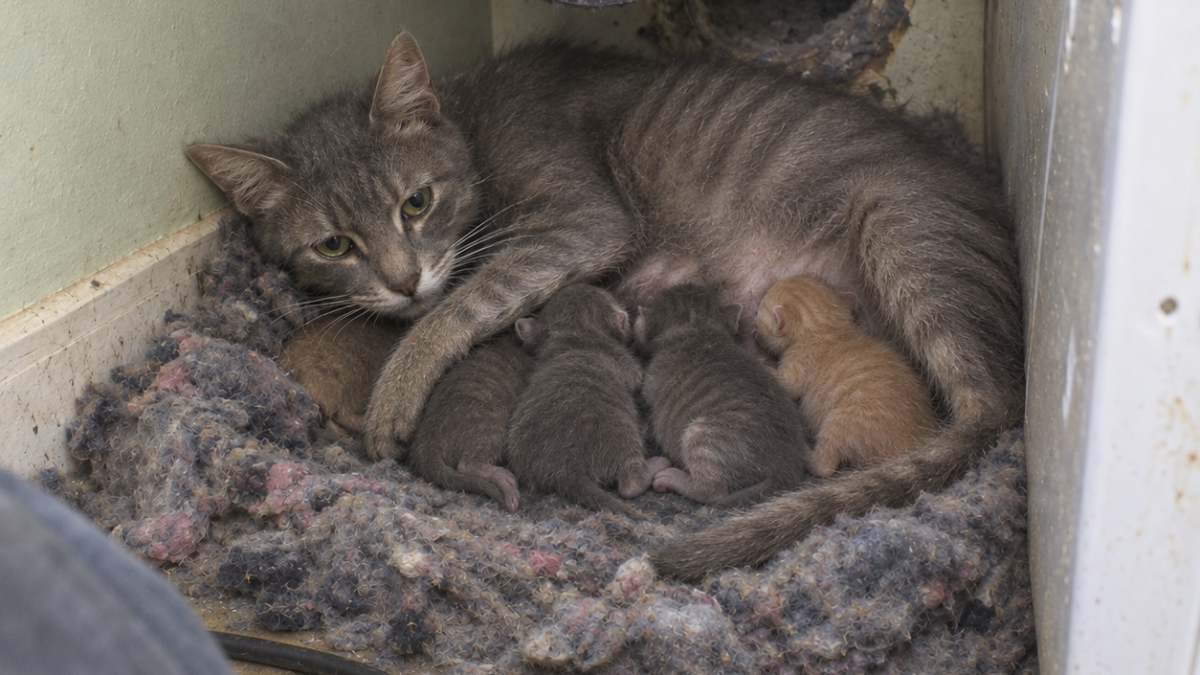
I Pulled a Broken Dryer Away From the Wall—Then Found a Mother Cat Raising Four Kittens in a Nest Made of Warm Dryer Lint.
I had been called to fix a Maytag dryer that had stopped heating properly, but when I pulled it away from the wall, I found a gray mother cat nursing four newborn kittens in a perfectly round nest she had built from weeks of warm dryer lint.
The homeowner stared at me and said, “I don’t have a cat,” until I showed her the disconnected exhaust vent the mother had apparently used as a doorway—and the hidden little family that had been living just a few feet from her kitchen without making a sound.
But when I explained that repairing the dryer meant sealing the only entrance the mother knew how to use, the woman looked at the cat, then at her four babies, and made a decision that turned a twenty-minute service call into something I still think about every time I pull an appliance away from a wall.
I have repaired more dryers than I can reasonably count.
Not hundreds.
Thousands.
That is not an exaggeration.
I have been doing residential appliance repair for seventeen years, and dryers are among the most predictable machines people own.
They look complicated because they are large, loud, hot, and capable of swallowing an entire week’s worth of clothing, but most of the time when somebody tells me, “The dryer runs but it doesn’t heat,” there are only a handful of likely causes.
Heating element.
Thermal fuse.
Thermostat.
Airflow restriction.
Bad connection.
Vent problem.
If you have done the job long enough, you can often make a decent guess before opening your toolbox.
My name is Mark Dalton.
I work for a small appliance company outside Indianapolis.
There are five of us.
Two technicians.
One apprentice.
A dispatcher named Paula who knows every customer in three counties by the sound of their voice.
And the owner, Frank, who technically retired four years ago but still comes into the shop every morning at six-thirty because apparently retirement means sitting in the same office without accepting a salary.
I do between three and five residential calls a day.
Washers.
Dryers.
Dishwashers.
Refrigerators.
Occasionally an oven.
I will work on almost anything that plugs into a wall and costs too much to throw away.
Most calls are not memorable.
That is not an insult.
People do not hire me because they want an experience.
They want their washing machine to stop flooding the laundry room.
They want the refrigerator to stop freezing lettuce.
They want their dryer to dry.
I arrive.
Put on shoe covers if the house is clean.
Listen to the customer explain what happened.
Take something apart.
Find problem.
Replace part.
Collect payment.
Leave.
Sometimes I return because the replacement part has to be ordered.
That is the job.
Over the years, I have found almost everything behind appliances.
Coins.
Socks.
Pens.
Children’s toys.
Pet food.
A spoon.
An engagement ring that had been missing for six years.
One remote control.
PART2:
Enough loose change behind one customer’s dryer to buy lunch.
A bra underwire inside a washing-machine pump.
A toy dinosaur jammed behind a refrigerator fan.
Once, a snake skin behind a dishwasher.
That was enough snake involvement for one career.
But until last Thursday, I had never pulled an appliance away from a wall and found an entire family living behind it.
The work order looked ordinary.
MAYTAG DRYER.
RUNS.
NO HEAT / CLOTHES REMAIN DAMP.
Customer: Lauren Beckett.
Appointment window: 9:00–11:00 a.m.
I arrived at 9:18.
The house sat at the end of a quiet subdivision where most of the homes had been built in the late nineties.
Two-story.
Beige siding.
Small covered porch.
Basketball hoop beside the driveway.
Nothing unusual.
Lauren answered the door.
Early forties.
PART3:
Dark hair pulled back.
Sweatshirt.
Jeans.
She apologized immediately for the laundry piled on a chair.
Every customer does that.
I always tell them I repair appliances for a living.
Laundry is not going to shock me.
She led me through the kitchen to a small utility room.
Washer on the left.
Dryer on the right.
Shelves above them.
Detergent.
Paper towels.
A basket full of unmatched socks.
“You said it runs?”
“Yeah.”
She pressed start.
The dryer turned.
“Sounds normal.”
“It sounds normal. It just stopped drying.”
“When?”
“A few weeks ago, maybe.”
“Gradually?”
“I think so. At first it took two cycles. Now I can leave towels in there forever and they’re still damp.”
That immediately suggested airflow.
“Any burning smell?”
“No.”
“Breaker issues?”
“No.”
“Have you cleaned the lint screen?”
She gave me the look customers always give when they think you have accused them of being stupid.
“Every load.”
“Good.”
I shut the dryer off.
Pulled the lint filter.
Clean.
“Vent been cleaned recently?”
“I don’t know.”
“How long have you lived here?”
“Six years.”
“Then maybe not.”
She laughed.
“Is that bad?”
“Potentially expensive answer.”
I pulled the dryer forward several inches.
The first thing I noticed was heat.
Not extreme.
Just warmer than the room should have been.
That was strange because the dryer had barely run.
I moved it farther.
Then I saw the aluminum vent hose.
Detached.
Completely.
It hung from the back of the dryer like a broken silver arm.
The wall connection sat maybe eight inches away.
There it was.
Easy repair.
The warm, moist exhaust that should have gone through the wall and outside had been blowing directly into the gap behind the appliance.
That explained everything.
The dryer was heating.
The heat simply was not being exhausted properly.
Moist air stayed in the room and around the machine.
Clothes remained damp.
I almost called Lauren back immediately.
Then something moved.
Low.
Behind the dryer.
At first I assumed it was a clump of lint shifting from the air movement.
There was a lot of lint.
More than I expected.
Gray.
White.
Blue.
Little threads from jeans.
Fibers.
Dust.
Enough material had accumulated to form a thick layer against the baseboard.
Then two green eyes opened.
I froze.
They were staring directly at me.
I have worked in houses with cats.
I have worked in houses with twenty cats.
I have had cats sit on my toolbox.
Steal screws.
Climb into cabinets while I am trying to repair hinges.
One particularly aggressive Siamese once slapped me every time I touched its owner’s refrigerator.
So seeing a cat during a service call is not unusual.
Seeing one behind a dryer when the homeowner has never mentioned owning a cat is more unusual.
This cat did not run.
She was gray.
Small.
Short-haired.
Maybe eight pounds.
Her body was curled against the wall.
At first I could see only her face and shoulders.
Then I noticed something moving against her belly.
Tiny.
I leaned closer.
One kitten.
Then another.
Then another.
I stopped breathing for a second.
Four.
Four kittens.
All nursing.
I just stared.
There is something strange about encountering life where your brain expects machinery.
A dryer is metal.
Wires.
Belts.
Heating elements.
Bearings.
A motor.
Then suddenly there is a mother animal looking back at you from the exact space where you expected to find a vent clamp.
The cat’s eyes stayed on me.
No hiss.
No growl.
She did not flatten her ears.
She simply watched.
Calm.
Alert.
Almost offended that I had moved part of her house.
That was when I saw the nest.
She was not just lying on lint.
She had built something.
The material had been gathered into a circular depression.
Dryer lint.
Mostly.
Gray fibers.
White fibers.
Blue strands from denim.
Some hair.
A few pieces of thread.
It was several inches thick in places.
Warm.
Soft.
Perfectly shaped around her body.
The kittens were nestled inside it.
Three gray.
One orange.
Their eyes were barely open.
Maybe two weeks old.
Possibly younger.
They looked healthy.
Round bellies.
Clean fur.
No obvious discharge from their noses or eyes.
The mother was lean but not starving.
I sat there on my heels with one hand on the dryer.
Then I slowly pushed the appliance forward again.
Not all the way.
Just enough to give her back some darkness.
I walked into the kitchen.
Lauren was putting coffee into a mug.
“Ma’am?”
She looked up.
“Bad?”
I did not know how to answer.
“Do you have a cat?”
She blinked.
“No.”
I waited.
She smiled uncertainly.
“No. Why?”
“You’re sure?”
That made her laugh.
“I think I’d know.”
“Okay.”
“What?”
I leaned against the doorway.
“Well.”
Pause.
“You do now.”
Her smile disappeared.
“What?”
“You actually have five.”
She stared at me.
“I’m sorry?”
“There is a cat behind your dryer.”
“No, there isn’t.”
“There is.”
She put down the mug.
“And four kittens.”
For several seconds, nothing happened.
She looked at me the way people look when they are trying to determine whether the repairman standing in their kitchen is joking.
I wasn’t smiling.
“You’re serious.”
“Yeah.”
“How?”
“That part I think I can explain.”
She followed me into the laundry room.
I pulled the dryer forward slowly.
The mother cat opened her eyes again.
Lauren gasped.
Both hands flew over her mouth.
“Oh my God.”
The cat remained where she was.
One kitten shifted.
A tiny gray body rolled partly over another.
Lauren crouched.
“Oh my God.”
She said it quieter the second time.
Then again.
“Oh my God.”
That seemed to be all the language available.
I understood.
I had known about the cats for approximately three minutes longer than she had, and I was not doing much better.
“How long have they been there?”
“I don’t know.”
“Are they okay?”
“They look okay.”
“Can I touch them?”
“I wouldn’t yet.”
She nodded immediately.
The mother looked at us.
Lauren whispered, “Hi.”
The cat blinked.
Then returned her attention to the kittens.
That was when I examined the vent more closely.
The dryer hose had detached from the wall fitting.
But the wall connection itself was unusual.
It was not sealed with a standard exterior flap immediately on the other side.
The duct ran through a short cavity and exited low near the side of the house.
With the interior hose disconnected, there was effectively a four-inch passage from outside into the laundry-room wall cavity.
Not comfortable for a person.
Perfect for a cat.
I pulled out my flashlight.
The opening showed dirt.
Hair.
A little debris.
Signs of use.
“She came through here.”
Lauren leaned closer.
“Through the dryer vent?”
“Looks like it.”
“That hole goes outside?”
“Yes.”
She stared.
“You’re telling me a pregnant cat crawled through my dryer vent?”
“Probably.”
“How?”
“Cats fit through ridiculous spaces.”
I pointed at the disconnected hose.
“This came loose.”
“When?”
“No way to know.”
“Could it have been weeks?”
“Absolutely.”
I touched the lint nest lightly near the edge.
Warm.
Not hot.
Warm.
The disconnected dryer had been blowing heated exhaust directly into that space every time Lauren ran a load.
Warm air.
Dark enclosure.
No foot traffic.
A protected exit outside.
And lint.
Endless lint.
I suddenly understood exactly why the cat had chosen it.
Lauren understood at almost the same moment.
“She was using the heat.”
“Yes.”
“Every time I ran the dryer…”
“You heated this space.”
Her eyes filled.
“And the lint?”
I looked down.
“Construction materials.”
For one second, she stared at me.
Then she laughed.
Not a little laugh.
A real one.
The kind that happens when something is too absurd for any other response.
“So I’ve been running utilities for a cat I don’t own?”
“Basically.”
“And supplying insulation.”
“Yes.”
She laughed harder.
Then, without warning, started crying.
That happens more often than people admit.
Laughter and crying are neighbors.
Especially when something frightening turns out to be alive and tiny.
Lauren crouched near the cat.
“Where did you come from?”
The mother blinked.
“How long have you been living behind my dryer?”
No answer.
One orange kitten pushed between two gray siblings.
Lauren wiped her face.
Then looked at me.
“What do I do?”
That was the harder question.
I looked at the vent.
Then the dryer.
“The dryer itself is easy.”
“How easy?”
“Five minutes.”
“That’s good.”
“Except…”
She waited.
“If I reconnect the hose correctly, this area stops receiving hot air.”
“Okay.”
“And depending on how I secure the vent, I’ll probably close off the opening she’s using.”
Lauren looked toward the cat.
“She won’t be able to get out?”
“Or back in.”
Her face changed.
“She needs to get out.”
“Yes.”
“For food.”
“Yes.”
“And bathroom.”
“Yes.”
“And then back to them.”
“Exactly.”
We both looked at the four kittens.
Tiny.
Barely mobile.
Completely dependent.
Lauren sat back on the floor.
“So you can’t repair it.”
“I can.”
“But you shouldn’t.”
“Not until we figure out another access route.”
She was quiet.
The mother cat began grooming one kitten’s head.
The tiny body disappeared beneath her tongue.
Lauren whispered, “She chose here.”
I nodded.
“Looks that way.”
“Of every place.”
“Warmest hidden space in the house.”
“I didn’t even know.”
“No reason you would.”
Lauren looked around the laundry room as if seeing it differently.
“How did I not hear them?”
“They’re young.”
“I’m in here every day.”
“Dryer is loud.”
“My kitchen is right there.”
“Cats are good at being invisible when they want to be.”
She stared at the mother again.
“What if I had called someone else?”
“What do you mean?”
“What if somebody just pulled the dryer, fixed the hose, pushed it back, and never checked?”
I did not answer.
There was no useful answer.
The mother needed that opening.
If it had been sealed while she was outside, the kittens might have been trapped.
If she had been inside, she could have been trapped too unless somebody noticed.
Lauren shook her head.
“No.”
She stood.
“Fix the dryer.”
I looked at her.
“Okay.”
“But leave her a way out.”
“We need to figure out how.”
“I’ll figure it out.”
That answer had a tone.
The kind people use when a decision has already become permanent even though they do not realize it yet.
I unplugged the dryer.
Moved it farther from the wall but kept enough distance from the nest that the cat did not panic.
Then I inspected the entire duct.
The hose clamp had loosened.
Easy.
I could replace it.
The exterior vent also needed a better cover.
But not today.
Not if we wanted the mother to continue using the route.
I reattached the dryer hose temporarily in a way that restored proper exhaust while leaving a separate access gap in the wall cavity.
Not a permanent solution.
Safe enough for a few days.
I also warned Lauren about lint.
Dryer lint plus heat is not something to ignore.
Fire risk.
The nest itself needed to be moved eventually.
We could not simply leave five cats living behind a running appliance.
Warm was good.
Hot metal, electrical components, moving machinery, and loose lint were not.
“We need to relocate them.”
Lauren looked alarmed.
“Outside?”
“No.”
She relaxed.
“Somewhere in the house.”
“Can we move them?”
“Probably. Carefully. But the mother has to accept the new location.”
“I have a bathroom.”
“Too busy?”
“Guest bathroom. Nobody uses it.”
“That could work.”
She looked toward the mother.
“Will she let us?”
“That’s the question.”
I was an appliance technician.
Not a cat rescuer.
I made that clear.
“I can call someone.”
Lauren already had her phone out.
“Who?”
I thought about a customer from the previous year.
A woman named Renee who fostered cats and had once trapped a kitten behind a dishwasher before I arrived.
I called her.
She answered.
“Mark?”
“I have a weird one.”
“You always say that.”
“I found a cat behind a dryer.”
“That’s not that weird.”
“She has four kittens.”
Pause.
“Okay. That’s better.”
I explained.
Disconnected vent.
Warm air.
Lint nest.
Two-week-old kittens.
Mother appears calm.
Renee asked several questions.
Is mom feral?
Unknown.
Does she allow proximity?
Yes.
Any sign of injury?
No.
Kittens nursing?
Yes.
Then Renee said, “Do not separate them.”
“We weren’t planning to.”
“Prepare another nest nearby first.”
“How nearby?”
“Same room if possible.”
Lauren overheard and pointed at a corner beside the washer.
There was enough floor space.
Renee continued.
“Large box or covered carrier. Clean towels. Something that feels enclosed.”
“What about the lint?”
“Take a little of it.”
I laughed.
“What?”
“Her scent is in it. Babies’ scent is in it. Put some in the new nest under towels.”
That made sense.
“What if she moves them back?”
“She might.”
“What if she leaves?”
“She might temporarily.”
“Very reassuring.”
“You asked.”
Renee told us to keep the access open temporarily, move the kittens only when the mother was calm, and observe whether she followed.
If she was friendly enough, we could eventually keep her indoors.
If she was feral, that would require a different plan.
After the call, Lauren stood in the middle of the laundry room.
“All right.”
I checked the time.
9:56.
My next appointment was at 10:30.
Normally I would have needed to leave.
Instead I called Paula.
“I’m going to be late.”
“How late?”
“Unknown.”
“Why?”
“Cats.”
Silence.
“What appliance?”
“Dryer.”
“Cats broke dryer?”
“Not exactly.”
I explained.
Paula was quiet for several seconds.
Then:
“Send picture.”
I did.
Ten seconds later:
“Oh my God.”
Then:
“I’ll move your ten-thirty.”
“Thanks.”
“Do not leave until babies are safe.”
“You understand I am appliance repair, right?”
“Today you’re cat repair.”
Frank was going to love that.
Lauren found a large plastic storage bin.
We cut an entrance low in one side.
Covered sharp edges.
Lined it with towels.
I wore gloves and gathered a small amount of the dryer lint from the outer edge of the nest.
Warm.
Soft.
Clean enough in the center.
We placed it beneath the towel.
Then moved the new nest into the laundry-room corner.
The mother watched everything.
“She’s going to kill us,” Lauren whispered.
“She hasn’t hissed.”
“That could mean she’s planning.”
I laughed.
We waited.
Nothing.
Finally the mother shifted enough for us to see the kittens clearly.
One gray kitten had a white chin.
Another had darker stripes.
The third was almost solid blue-gray.
The orange one was the smallest.
Lauren crouched a few feet away.
“Should we name them?”
“I would wait.”
“Why?”
“Because you’re definitely keeping them if you name them.”
She looked at me.
“I’m not keeping five cats.”
“Good.”
“I’ve never owned a cat.”
“Even better.”
“I travel.”
“Excellent point.”
“I don’t know anything about kittens.”
“Very convincing.”
She frowned.
“Stop.”
I held up both hands.
“I didn’t say anything.”
We decided to move one kitten first.
I reached slowly.
The mother watched.
Her ears moved forward.
No growl.
I touched the gray kitten nearest the edge.
The mother’s body tensed.
I stopped.
Waited.
Then she relaxed slightly.
I lifted the kitten.
It fit almost entirely in one hand.
Warm.
Eyes barely open.
Tiny paws moving.
I placed it in the prepared nest.
The kitten immediately cried.
The mother stood.
That was the first time I saw her whole body.
Thin.
Not dangerously.
Her belly low from nursing.
She stepped out of the lint nest.
Walked toward the new box.
Sniffed.
The kitten cried again.
She climbed inside.
Lauren whispered, “Oh my God.”
The mother licked the kitten.
Then looked back toward the dryer.
“Good sign,” I said.
We moved the other three.
One by one.
No panic.
No aggression.
The mother remained in the new nest.
By the time we transferred the orange kitten, she had already curled around the first three.
The orange one disappeared against her belly.
All four began nursing.
Lauren sat on the floor.
Hands over her mouth again.
“She moved.”
“Yeah.”
“She actually moved.”
“Looks like she approves.”
The abandoned lint nest remained behind the dryer.
A perfect little bowl.
I took a picture before disturbing it.
Then another of the mother and kittens in their original location.
I normally do not photograph customers’ homes.
But Lauren said, “You have to.”
She was right.
The first image still looks unreal.
A gray mother cat staring directly into the camera.
Four tiny kittens pressed against her.
A round nest made almost entirely of dryer lint.
The silver vent hose hanging above them.
A Maytag dryer in the foreground.
It looked staged.
It wasn’t.
I cleaned the dangerous loose lint from behind the machine.
Reconnected the exhaust properly.
Secured the clamp.
Tested airflow.
The dryer heated normally.
Problem solved.
Technically.
Then came the cat door.
Not that day.
But the idea started that day.
Lauren did not want to trap the mother permanently without knowing whether she was comfortable indoors.
She also did not want her climbing through a dryer vent ever again.
Reasonable.
So we left a temporary route accessible through a nearby window setup until Renee could visit that evening.
Renee arrived.
Checked everyone.
The kittens looked healthy.
Mother looked surprisingly comfortable around people.
Renee sat on the laundry-room floor for twenty minutes.
The cat watched her.
Then came out for food.
“Not feral,” Renee said.
“How can you tell?”
“Feral mother with two-week-old kittens generally doesn’t walk past three humans for tuna.”
The cat ate.
Lauren whispered, “Hi, Mama.”
The cat looked at her.
Then went back to the kittens.
Renee smiled.
“She knows this place.”
“What happens now?”
“Keep them here.”
“All of them?”
“For now.”
Lauren looked at me.
I said nothing.
She pointed.
“Don’t.”
“I did not say anything.”
“You have a face.”
“So I’ve been told.”
Renee left supplies.
Kitten-safe bedding.
Food appropriate for a nursing mother.
Litter tray.
Advice.
Veterinary appointment information.
Lauren asked the question I had been waiting for.
“What happens when the kittens are old enough?”
Renee answered carefully.
“We find homes.”
Lauren nodded.
“And her?”
“If you don’t want to keep her, we find her one too.”
“Okay.”
That sounded reasonable.
Temporary.
Organized.
Sensible.
I packed my tools.
Before leaving, I stood in the laundry-room doorway.
The gray cat had her head resting on the edge of the new nest.
Lauren was sitting several feet away scrolling through something on her phone.
“What are you doing?”
“Looking up names.”
I laughed.
She looked offended.
“For the mother.”
“Of course.”
“Not the kittens.”
“Absolutely.”
She narrowed her eyes.
“Leave.”
I left.
At the shop, Paula was waiting.
“Well?”
“Dryer works.”
“I don’t care about dryer.”
“Five cats alive.”
She smiled.
Frank came out of his office.
“What took two hours?”
“Vent problem.”
Paula said, “Cat problem.”
Frank frowned.
“Cat in vent?”
“Cat behind dryer.”
“With kittens.”
Frank stared.
Then looked at me.
“You charge for extra occupants?”
“No.”
He shook his head.
“Company’s going broke.”
The next morning Lauren texted me.
I had given her my number because of the vent setup.
There was a photograph.
The mother cat was sitting in the new nest.
Four kittens nursing.
Message:
EVERYONE ALIVE. I NAMED HER MAY.
I replied:
Why May?
Lauren:
MAYTAG.
I stared at the phone.
Then:
That is terrible.
She responded:
YOU FIX MACHINES. I NAME CATS.
Fair.
The kittens became Zip, Spin, Tumble, and Fluff.
I wish I were joking.
Lauren claimed the names were temporary.
They were not.
Over the next several weeks, I received regular updates despite never requesting them.
DAY 3: MAY LET ME TOUCH HER HEAD.
DAY 5: ORANGE ONE OPENED BOTH EYES.
DAY 8: THEY ARE ESCAPING THE BOX.
Then a photograph of four kittens scattered across the laundry-room floor while May sat on top of the dryer looking exhausted.
I laughed so loudly Paula came over.
“What?”
I showed her.
She took my phone.
“Oh, look at them.”
“They’re criminals.”
“Which one are you taking?”
“None.”
“Sure.”
I was not taking one.
My wife, Susan, had made our household limit clear.
We already had two dogs and an elderly cat named Winston who believed other cats were evidence of moral decay.
No kittens.
I remained strong.
Lauren did not.
At first she said she was fostering.
Then she bought a cat tree.
Temporary, apparently.
Then toys.
Temporary.
A better litter box.
Temporary.
A window perch.
Temporary.
A veterinary wellness plan for May.
Less temporary.
Three weeks after the discovery, I got another service call at Lauren’s address.
I looked at the work order.
WASHER MAKING LOUD NOISE.
I called Paula.
“Did she request me?”
“Yes.”
“Why?”
“She said you know the family.”
I sighed.
When I arrived, Lauren opened the door holding the orange kitten.
“You’ve gotten worse.”
“What?”
“You’re carrying one.”
“He climbed my jeans.”
“That is how it begins.”
She ignored me.
The laundry room looked completely different.
The dryer was back against the wall.
Vent functioning properly.
Beside it sat a proper cat bed.
Food bowls.
Water fountain.
Litter box.
Cat tree near the window.
The kittens were on a blanket.
May was stretched across the top of the dryer.
She opened one eye when I entered.
“Hey, May.”
Her tail moved.
Lauren looked proud.
“She likes you.”
“She remembers the rent I paid in warm air.”
I checked the washer.
A coin had lodged in the drain pump.
Normal repair.
Fifteen minutes.
While I worked, kittens attacked my tool bag.
Zip climbed onto my knee.
Spin tried to bite the end of my screwdriver.
Fluff disappeared beneath the washer and caused five minutes of panic before emerging covered in dust.
Tumble, the orange one, slept through most of it.
May remained on the dryer.
Completely relaxed.
I looked at Lauren.
“You’ve decided.”
She was filling the water fountain.
“What?”
“You’re keeping her.”
She paused.
“May?”
“Yes.”
“Yes.”
I nodded.
“And the kittens?”
She looked toward them.
“All four?”
“You tell me.”
She sighed.
“I know what you’re thinking.”
“I’m thinking nothing.”
“I’m considering options.”
“Of course.”
“I talked to Renee.”
“Good.”
“She already has adopters interested.”
“Good.”
Lauren picked up Tumble.
The orange kitten immediately settled against her chest.
“But…”
There it was.
“But?”
She looked embarrassed.
“What if they’re bonded?”
“All four?”
“Maybe.”
“With their mother?”
“Possibly.”
“You know what bonded means?”
“Yes.”
“Are you sure?”
“Stop being annoying.”
I smiled.
A week later she texted:
I’M KEEPING THEM.
Then:
ALL OF THEM.
Then:
THIS IS YOUR FAULT.
I replied:
I REPAIRED YOUR DRYER.
Lauren:
YOU FOUND THEM.
Me:
TECHNICALLY YOUR DRYER FOUND THEM FIRST.
She sent a photograph of all five cats asleep together.
There are moments when you realize resistance is pointless.
That was one.
Lauren told me later why she kept them.
It was not because she believed every animal family must remain together.
That would be unrealistic.
Kittens are adopted away from mothers every day.
They do fine.
May herself probably would have adapted to a separate home.
Lauren knew that.
But something about the circumstances had gotten to her.
“I kept thinking about where she chose to have them.”
We were standing in the laundry room.
May sat nearby.
“What do you mean?”
“She didn’t choose my couch.”
“No.”
“Or my bed.”
“No.”
“She didn’t know me.”
“Right.”
“She found a hole.”
Lauren pointed toward the wall.
“Crawled inside. Found warmth. Built this little nest out of garbage.”
“Lint.”
“Fancy garbage.”
“Fair.”
“She made it work.”
I looked at May.
“She did.”
Lauren became quiet.
“My mom raised me alone.”
I had never known that.
“We moved a lot when I was little. Apartments. Friends’ basements. Once a motel for almost a month.”
She rubbed one arm.
“My mom could make any place feel temporary and safe at the same time.”
I waited.
“She would unpack my pajamas first.”
“What?”
“Everywhere we went. Pajamas first. She said if your pajamas were in a drawer, you lived there.”
Lauren smiled.
“I don’t know why seeing May behind that dryer made me think about that.”
I did.
But I let her continue.
“She found one warm place and decided, okay, this is enough. I can have babies here.”
May began grooming one paw.
Lauren looked at her.
“I don’t want to separate a family that chose my house.”
That sentence later became the one everybody repeated.
Because yes, eventually the story got out.
Not because Lauren posted it.
Because I showed the photograph to Frank.
Frank showed his wife.
His wife showed someone at church.
Somebody knew somebody who ran a local community page.
Within a week, I received a message asking whether they could share “the dryer kittens.”
I asked Lauren.
She hesitated.
Then agreed as long as they did not publish her address.
The photograph went up.
Caption:
LOCAL REPAIR TECH PULLS OUT “BROKEN” DRYER, FINDS MOTHER CAT WITH FOUR KITTENS LIVING IN NEST MADE FROM WARM LINT.
People lost their minds.
I learned quickly that the internet likes cats almost as much as it likes being angry.
Fortunately, there was not much to be angry about.
Some people still tried.
“Why didn’t homeowner hear them?”
Because they were newborn kittens behind an appliance.
“Why was the vent disconnected?”
Because clamps loosen.
“She should have cleaned back there.”
Most people do not pull their dryers away from the wall weekly.
“She should keep them all.”
She was.
That ended most arguments.
A local television station called.
I did not want to go on camera.
Paula volunteered me.
“You are dead to me.”
“You need publicity.”
“I repair dryers.”
“Now you repair cat apartments.”
The reporter came to the shop.
They interviewed me beside a display dryer Frank kept for training.
“What did you think when you pulled the machine out?”
“That this was not in the service manual.”
They laughed.
“What was the cat doing?”
“Nursing.”
“Was she frightened?”
“Not particularly. She looked more annoyed that I had removed her wall.”
“How did she get there?”
I explained the vent.
Warm air.
Exterior opening.
Lint.
The reporter smiled.
“So every time the homeowner used the dryer…”
“She was heating the cat’s apartment.”
“And furnishing it.”
“With insulation, yes.”
The story aired that evening.
Lauren’s line became the ending:
“I’m not separating a family that chose my house.”
People loved it.
Donations appeared.
Cat food.
Litter.
Toys.
Someone mailed May a tiny blanket with a picture of a dryer embroidered on it.
That was ridiculous.
Lauren used it anyway.
May preferred cardboard.
Of course.
Then came the part of the story that mattered more than the cute photographs.
We had to fix the wall properly.
The temporary access arrangement was not a good long-term solution.
A dryer vent needs to vent dryer exhaust.
Not serve as a pet entrance.
So Lauren hired a handyman.
He installed a proper exterior vent with a backdraft flap.
Then, two feet away, he installed a small insulated cat door leading directly into the laundry room.
A real entrance.
Safe.
Controlled.
No access to ductwork.
The first time May used it, Lauren recorded video.
She stood outside.
May sniffed the flap.
Pushed.
Stopped.
Pushed again.
Head through.
Shoulders.
Then body.
She entered the laundry room.
Walked past the functioning dryer.
Jumped onto her bed.
Done.
Lauren sent me the video.
Message:
UPGRADE COMPLETE.
I replied:
Better HVAC system.
She wrote:
RENT STILL FREE.
The kittens grew.
Fast.
That is the shocking thing about kittens.
One week they fit inside your palm.
A month later they are scaling curtains and knocking glasses off counters.
Zip became adventurous.
Spin became affectionate.
Fluff became enormous.
Tumble remained orange in every stereotypical sense of the word.
He fell off things.
Ran into doors.
Once climbed inside Lauren’s reusable grocery bag and became trapped because he could not figure out how to turn around.
May tolerated all four.
When they became too old for nursing, she enforced that boundary with impressive clarity.
One hiss.
One paw.
Meeting adjourned.
Lauren sent updates less often after a while.
That was good.
It meant the cats had stopped being an emergency.
They had become life.
Ordinary.
Food.
Litter.
Veterinary appointments.
Hair on furniture.
The dryer continued working.
That pleased me professionally.
Six months after the discovery, I returned again.
Not for an appliance.
Lauren invited me to see the finished laundry-room setup.
Susan came too.
She wanted proof the story had not been exaggerated.
May greeted us at the cat door.
The kittens were nearly adult-sized.
All five lived throughout the house now.
The laundry room was simply home base.
The original photograph was framed above a shelf.
I stood looking at it.
May.
Four tiny kittens.
Lint nest.
Disconnected duct.
It felt like looking into another world.
Lauren had saved a little piece of the lint nest inside a clear plastic bag.
“You saved dryer lint?”
“It’s sentimental dryer lint.”
“That sentence should not exist.”
Susan laughed.
Then she looked at me.
“You would have thrown it away.”
“Yes.”
“That’s why nobody lets men manage family archives.”
I did not argue.
Lauren showed us the new cat entrance.
“May uses it every day.”
“Does she still go outside?”
“Just the backyard mostly. She comes back for meals.”
“And the kids?”
“Indoor.”
“Good.”
Tumble appeared behind the dryer.
I pointed.
“No.”
Lauren laughed.
“He can’t get behind it anymore.”
She had installed a simple barrier.
Smart.
No sequel.
Over dinner that night, Susan asked me something.
“Do you think May knew the dryer was warming the spot?”
I thought about it.
“Not like we would.”
“But she chose it because it was warm.”
“Absolutely.”
“And she collected the lint.”
“Looks like it.”
Susan smiled.
“That’s pretty smart.”
“Cats survive by being smart.”
I thought about May outside.
Pregnant.
Unknown history.
Maybe abandoned.
Maybe born outdoors.
Maybe somebody’s pet once.
She found a four-inch opening.
Followed it.
Discovered darkness and warmth.
Then found loose fibers accumulating around her.
She gathered them.
Made a nest.
Had four kittens.
While a woman on the other side of the wall loaded towels into a machine and unknowingly turned on the heat.
There was something almost funny about the cooperation.
Lauren washed clothes.
May raised babies.
Neither knew they were sharing infrastructure.
I started checking behind dryers differently after that.
Not because I expected cats.
I have never found another one.
But I look.
Every time.
Before pulling aggressively.
Flashlight first.
Check.
Then move.
Once I found a mouse nest.
Empty.
Once a lizard.
Very much alive and very fast.
Mostly I find socks.
So many socks.
But I check.
Frank noticed.
“You afraid of cats?”
“Prepared for tenants.”
He laughed.
“Company policy?”
“It should be.”
Eventually it became one.
Not officially.
But whenever we trained apprentices, I added one instruction.
“Before moving an appliance, look behind and underneath if possible.”
One apprentice said, “For wires?”
“For wires. Water lines. Gas. Pets.”
“Pets?”
I showed him the photograph.
He stared.
“No way.”
“Way.”
“Behind a dryer?”
“Yep.”
“That is insane.”
“Wait until you see what people put in washing machines.”
The story affected Lauren too.
Not just because she now owned five cats.
She began volunteering with Renee’s rescue.
At first, once a month.
Then more.
She became good at fostering nervous mother cats.
“She has experience,” I joked.
One year after finding May, Lauren fostered a pregnant calico whose owner had died.
That cat gave birth in a proper nesting box.
Clean towels.
Temperature-controlled room.
No lint.
Lauren sent me a photograph.
Caption:
LOOK, MARK. PROFESSIONAL HOUSING.
I replied:
May started from nothing. These kids are spoiled.
May appeared in the background.
Still queen of the house.
Lauren eventually bought a larger home.
Not because of the cats.
Mostly.
The day she moved, she called me.
“Can you come over?”
“Appliance problem?”
“No.”
“Then my rates triple.”
“Just come.”
I stopped after work.
The old laundry room was almost empty.
Washer and dryer still there.
Cat supplies packed.
May sat on the floor.
The wall still had the cat door.
Lauren looked at it.
“I feel weird leaving this.”
“Take the door.”
“What?”
“Remove it. Patch the wall.”
“I’m selling the house.”
“Exactly.”
She laughed.
“You think the next owner is going to accidentally inherit cats?”
“It has happened before.”
We removed it.
Patched the opening.
Lauren held the little door in her hands.
“I’m putting this in the new laundry room.”
“For nostalgia?”
“For May.”
“Does the new house need a cat door?”
“Not really.”
I stared.
“Sentimental architecture.”
“Exactly.”
We installed it later.
Not through a dryer vent.
Through a normal wall.
May used it.
The kittens, now full-grown cats, did not because they remained indoors.
The new laundry room had a large window.
Cat shelves.
Beds.
Five bowls.
The old photograph on the wall.
The piece of lint in its ridiculous plastic bag.
Years passed.
My work continued.
Appliances failed.
People complained.
Heating elements burned out.
Water pumps clogged.
Ice makers froze.
Life stayed ordinary.
May and her kittens aged.
Lauren sent me a Christmas card every year.
Not a normal card.
A photograph of all five cats.
The first year, getting them into one picture appeared to have required bribery and possibly sedatives.
The second was better.
By the fourth, they seemed resigned.
Zip in the window.
Spin near Lauren.
Fluff on the sofa.
Tumble upside down.
May in the center.
Always May.
The mother.
The one who had found warmth inside a wall.
One December, the card arrived without May in the photograph.
I noticed immediately.
I called Lauren.
She answered softly.
“Yeah.”
My chest sank.
“When?”
“October.”
“How old?”
“Vet thought maybe fourteen or fifteen.”
I sat down in the service van.
“What happened?”
“Kidneys.”
I closed my eyes.
“I’m sorry.”
“She had a good run.”
“She did.”
Lauren was crying.
“So many years.”
“Yeah.”
“Do you remember what she looked like that first day?”
“Of course.”
“She was so skinny.”
“She was.”
“I thought she was calm because she trusted us.”
I waited.
“Now I think she was just exhausted.”
“Could be both.”
Lauren laughed through tears.
“Maybe.”
She told me May had slowed during the final year.
Slept more.
Stopped using the outdoor door.
Preferred the laundry room.
Of course she did.
In the last weeks, Lauren moved a heated bed beside the dryer.
Not behind it.
Beside it.
May slept there.
“She always liked the sound,” Lauren said.
I smiled.
“The machine?”
“Yeah.”
“She grew up with it.”
“Her babies did.”
“You know what I mean.”
I did.
The final day, Lauren sat on the laundry-room floor.
May rested against her leg.
Tumble was nearby.
Then Spin.
Eventually all four of the kittens—adult cats now, much larger than their mother—ended up in the room.
Lauren said she did not know whether they understood.
Probably not in the way she did.
But they were there.
May died at home.
Warm.
Not alone.
Afterward Lauren put the original photograph beside the small wooden box containing May’s ashes.
The lint too.
I did not make fun of it.
Not that time.
A month later, Lauren invited me over.
She had changed the framed photograph.
Now there were two.
The first:
May behind the Maytag dryer.
Four newborn kittens.
Lint nest.
The beginning.
The second:
May in the same laundry room years later.
Older.
Lying on top of the dryer.
All four adult cats scattered around her.
The family she had built inside the wall had grown up around her.
Lauren stood beside me.
“I almost wish you hadn’t fixed the dryer.”
I looked at her.
“What?”
She laughed.
“I mean, obviously I’m glad you did.”
“Good.”
“But if it hadn’t broken…”
“You might never have found them.”
“Exactly.”
That thought had occurred to me too.
The dryer was not actually failing to heat.
It was producing heat perfectly well.
The problem was that the heat was going to the wrong place.
From Lauren’s perspective, the machine had malfunctioned.
From May’s perspective, it had become central heating.
The same fault.
Two completely different experiences.
There is something in that I have never been able to put into words without sounding sentimental.
A problem for one life can become shelter for another.
Not always.
We should not romanticize malfunction.
The disconnected vent was unsafe.
The lint was a fire hazard.
Behind an operating dryer was not an appropriate long-term home for cats.
That matters.
But before anybody knew those kittens existed, that broken connection kept them warm.
Every load of towels.
Every pair of jeans.
Every sheet Lauren tried to dry and then complained was still damp.
Warm air escaped.
Fibers collected.
May stayed.
The kittens lived.
The failure bought time.
Then the repair call brought someone close enough to notice.
People sometimes call that fate.
I do not know.
I repair machines.
I like causes.
Loose clamp.
Detached hose.
Escaping exhaust.
Insufficient airflow.
There is comfort in cause and effect.
But I also know that if the clamp had remained tight, May might have found another shelter.
Maybe better.
Maybe worse.
If Lauren had called a week earlier, the kittens might not have been born yet.
If she had called later, the lint buildup might have become dangerous.
If I had moved the dryer aggressively, I could have hurt them.
If May had panicked, she could have fled.
There are too many branches.
I do not find destiny useful.
I find attention useful.
Look.
Notice.
Adjust.
That is enough.
The four kittens are still alive as I write this.
Not kittens anymore.
They are senior cats now.
Zip developed thyroid problems.
Spin is still the most affectionate.
Fluff became enormous exactly as predicted.
Tumble continues to behave as though gravity was invented specifically to inconvenience orange cats.
Lauren sends fewer photographs these days.
But every so often one appears.
Last month:
Tumble asleep in a laundry basket.
Message:
HE STILL THINKS EVERYTHING IN THIS ROOM BELONGS TO HIM.
I replied:
Inherited property.
She answered:
FROM HIS MOTHER.
That got me.
I still repair Maytag dryers.
Whirlpools.
LGs.
Samsungs.
GE.
Whatever people own.
Most service calls still take twenty or thirty minutes.
Most contain no emotional revelations.
Most dryers contain only lint.
Which is exactly how I prefer appliances to behave.
But every time I loosen the screws, disconnect a vent, and prepare to pull a dryer from the wall, I think of two green eyes opening in the darkness.
I look first.
Always.
Flashlight.
Floor.
Gap.
Then I move the machine.
The younger technicians make fun of me.
I let them.
One day, they will find something unexpected too.
Maybe not a cat.
Maybe a leak.
A burned wire.
A forgotten photograph.
A wedding ring.
A mouse.
Homes collect hidden things.
Machines conceal them.
That is part of why repair work is stranger than people realize.
You enter somebody’s private space because one object stopped behaving normally.
Then sometimes you see a piece of their life nobody else sees.
I have stood in kitchens while couples argued.
I have repaired washers while elderly customers told me about spouses who had died ten years earlier.
I have found children’s toys behind refrigerators and watched parents cry because the child who lost them is now grown.
People talk when you are fixing something.
Maybe because you are temporary.
You arrive.
Work.
Leave.
No obligation to remember.
But I remember.
And out of thousands of calls, the one I remember most began with a dryer that “wouldn’t heat.”
That complaint was technically wrong.
It was heating beautifully.
Just not the clothes.
The heat was escaping behind the machine.
Into a narrow dark space.
Onto a little round nest built from gray and blue fibers.
Onto four newborn kittens.
Onto a tired mother cat who had somehow found the warmest hidden place in a stranger’s house and decided it was enough.
Enough to stop.
Enough to give birth.
Enough to trust the darkness.
Lauren once told me she still thinks about what May experienced before entering that vent.
So do I.
We never learned.
No chip.
No missing-cat report matching her.
No neighbor claimed her.
No history.
Maybe she had always lived outdoors.
Maybe somebody abandoned her.
Maybe she wandered.
Maybe she had lived inside another home once.
That chapter remained closed.
In some ways, I am glad.
Not every story needs a villain.
May’s life with Lauren did not need to be defined by whatever happened before.
She found a hole.
Then warmth.
Then a house.
The order was strange.
But it worked.
There is one detail I have not forgotten.
The morning I first found them, after we moved the kittens into the clean nest and May followed, I went back behind the dryer to clean the old lint pile.
At the bottom of the nest, underneath layers of gray fiber, I found a small piece of red fleece.
Not dryer lint.
Fabric.
About three inches long.
Maybe torn from an old blanket.
May must have brought it in herself.
From outside.
Perhaps from somewhere she slept before.
She had carried it through the vent.
Placed it at the center.
Then gathered lint around it.
I held it up.
Lauren looked at it.
“What is that?”
“No idea.”
She took it.
For years, she kept that piece of fleece with the lint.
After May died, Lauren told me she placed it beside the ashes.
That small red scrap bothers me more than all the other details.
Because it means May did not simply discover the pile.
She built the nest intentionally.
Brought something.
Arranged something.
Prepared.
In whatever limited way a cat prepares for motherhood, she did.
She had almost nothing.
A hole.
Warm air.
Lint.
One scrap of fleece.
And she made a place where four babies could survive.
People use the word “home” too casually.
We imagine walls.
Ownership.
Mortgages.
Addresses.
May had none of that.
Her first home in Lauren’s house was four inches wide at the entrance and existed between a Maytag dryer and drywall.
Yet she had everything she needed for the moment.
Warmth.
Darkness.
A way in.
A way out.
A soft place for babies.
Later, Lauren gave her more.
Food.
Veterinary care.
A bed.
A window.
A cat door.
Years.
But the first act belonged to May.
She found a place where life could continue.
I was only there because a clamp came loose.
That still humbles me.
People sometimes say I saved the cats.
I disagree.
May saved them first.
She carried them.
Fed them.
Chose the shelter.
Built the nest.
Kept them warm.
Lauren saved them by allowing her house to become theirs instead of treating them as an infestation.
Renee helped.
The veterinarian helped.
I repaired a hose.
Everybody did a piece.
That is usually how good outcomes happen.
Not one dramatic hero.
Several ordinary decisions lined up in the right direction.
Look behind the dryer.
Do not scare the mother.
Do not seal the exit.
Build a safer nest.
Make the call.
Buy the food.
Open the door.
Stay.
The very first day, Lauren said something I thought was temporary.
“Repair the dryer. Leave the hole. I’ll figure something out.”
She did.
That might be my favorite part.
Not that she had an immediate plan.
She did not.
She simply decided the cats were now part of the problem she intended to solve instead of something to remove.
There is a difference.
People become families in similarly unplanned ways.
A phone call.
An emergency.
A relative needing a room.
A child arriving early.
An animal showing up.
One minute, the house is arranged for the life you expected.
Next minute, there are five cats behind the dryer.
Then you adapt.
Years later, nobody can remember why the house ever felt complete without them.
Lauren did not own a cat when I arrived.
She told me that very clearly.
“I don’t have a cat.”
Technically correct.
For approximately another thirty seconds.
Then she looked behind the Maytag.
After that, language needed updating.
One cat.
Four kittens.
Five bowls.
Five veterinary records.
Five names on Christmas cards.
Five lives eventually sprawled across furniture they had no intention of respecting.
Now, four remain.
And May remains too, in the way the first member of any family remains after they are gone.
In habits.
Objects.
Stories.
A little door in the laundry-room wall.
A photograph.
A ridiculous plastic bag containing dryer lint.
And four aging cats who once fit together inside a warm nest behind a machine.
The dryer itself eventually died.
That feels appropriate somehow.
Nine years after I first repaired it, Lauren called me.
“You’re not going to believe this.”
“What?”
“The Maytag is dead.”
“Actually, I absolutely believe that. It’s old.”
“You can’t save it?”
I came out.
Motor failure.
Control board issues.
Drum rollers worn.
Repair cost no longer sensible.
I gave the verdict.
Lauren looked genuinely sad.
“You’re emotional about a dryer.”
“It started the family.”
“It almost burned your house down.”
“Details.”
We replaced it.
Before the delivery crew removed the old machine, Lauren asked me to wait.
She crouched beside it.
Placed one hand on the top.
I laughed.
“Are you saying goodbye?”
“Shut up.”
Then she took a photograph.
The new dryer arrived.
Efficient.
Quiet.
Properly vented.
No cats behind it.
Before pushing it into position, I checked the wall cavity one last time.
Empty.
Clean.
Safe.
I secured the exhaust clamp tighter than necessary.
Lauren watched.
“Think that one’s coming off?”
“Not while I’m alive.”
“Good.”
Tumble sat nearby.
I pointed at him.
“No tenancy.”
He yawned.
We slid the dryer back.
Job complete.
Twenty minutes.
The kind of service call I had expected the first time.
Before leaving, I looked at May’s photograph above the shelf.
Gray cat.
Four babies.
Warm lint.
Silver vent.
I realized something then.
I had spent years thinking of that day as the time I discovered cats behind a dryer.
That was not exactly what happened.
I discovered them.
Lauren discovered them.
But May had already discovered us.
She found a hole in a house where nobody knew her name.
She entered.
Found warmth.
Stayed.
Built a nursery.
And waited long enough for the people on the other side of the wall to realize they had a family living with them.
That feels different.
Maybe she did not choose Lauren personally.
Probably not.
Maybe she chose heat.
Darkness.
Safety.
But sometimes that is how belonging begins.
Not with recognition.
With refuge.
Then repetition.
Food appears.
Nobody chases you away.
A hand becomes safe.
A room becomes familiar.
A door becomes yours.
Years accumulate.
Eventually, the place you entered because you were cold becomes the place where somebody keeps your ashes because they cannot imagine their life without the years you spent there.
I repair appliances.
I am not supposed to be philosophical about dryer vents.
But seventeen years in people’s homes will do that to you.
Machines break.
Homes adapt.
People adapt.
Animals adapt even faster.
And sometimes a dryer stops doing its job correctly because all the heat meant for wet clothes is escaping into a hidden space where a mother cat has decided four tiny lives need it more.
The repair took five minutes.
The family lasted years.
I cannot think of a better service call than that.
The dryer works now.
The vent is secure.
The laundry room is warm.
Four old cats still wander through it.
And nobody in that house ever again says:
“I don’t have a cat.”