I Heard One Meow Inside My Garbage Truck—Two Seconds Before the Compactor Would Have Crushed Her
I Heard One Meow Inside My Garbage Truck—Two Seconds Before the Compactor Would Have Crushed Her
I had spent three years feeding thousands of garbage bags into the back of the same truck without ever hearing anything alive inside—until one tiny meow cut through the engine and hydraulic noise with roughly two seconds left in the compactor cycle.
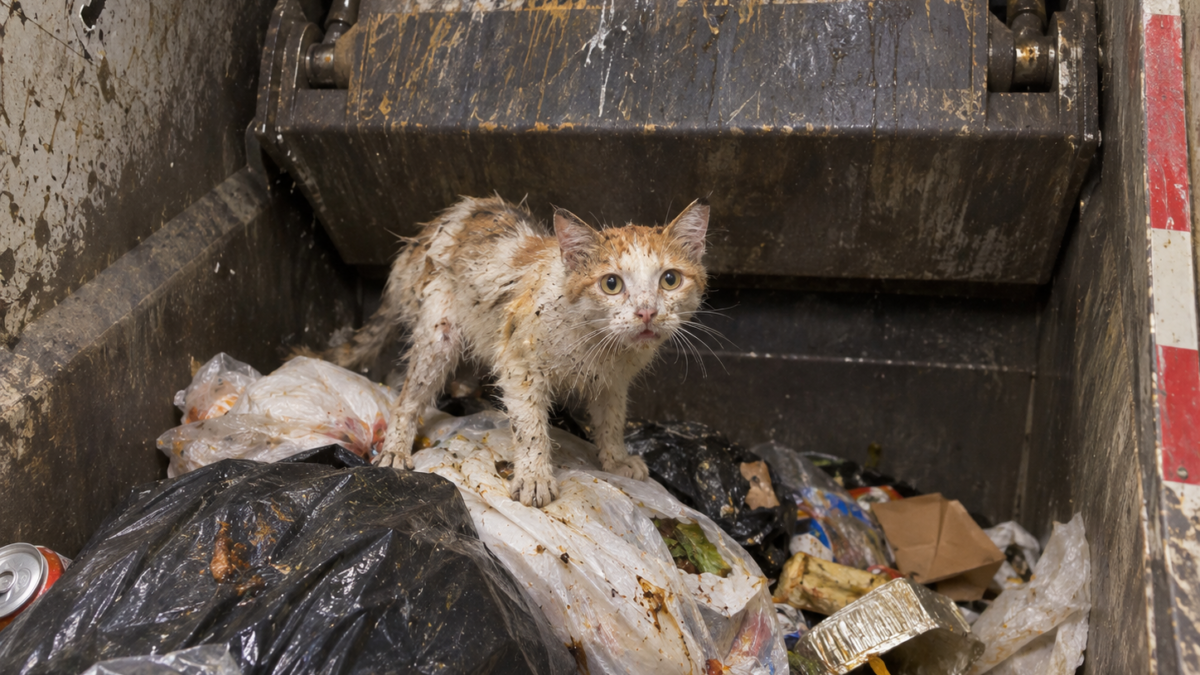
When I hit the emergency stop and climbed into the hopper, a little orange-and-white cat stood trembling on top of torn trash bags, food scraps stuck to her fur, while the steel compactor plate waited less than eighteen inches behind her.
Then I saw the ripped white garbage bag beneath her feet, still tied shut at the top, and understood that she had not climbed into somebody’s trash by accident—someone had put her inside the bag alive and left her at the curb for us to collect.
My name is Daniel Mercer.
I collect garbage for a living.
That is not usually the kind of sentence that begins an emotional story.
Most days, nothing happens on my route that anybody would want to read about.
Trash is not dramatic when you handle it for forty hours a week.
It is heavy.
Wet.
Sharp sometimes.
It leaks.
It smells worse in July.
It freezes to the inside of bins in January.
It contains things people should have wrapped better, things people should not have thrown away at all, things nobody wants to admit once belonged to them.
Coffee grounds.
Cat litter.
Broken toys.
Baby diapers.
Old food.
Beer cans.
Branches.
Half-used paint cans people pretend are empty.
Furniture.
Mattresses.
Christmas trees in January.
Pumpkins in November.
People’s lives eventually become garbage in remarkably ordinary ways.
I had been working residential collection in a small Pennsylvania town for three years.
Before that I worked construction.
Before that, warehouse loading.
Garbage collection paid better than people assumed.
The benefits were decent.
I got home early enough most days to have dinner with my wife, Melissa, and our daughter, Hannah.
The hours were hard, but I liked finishing work while most people were still staring at computers.
I also liked routine.
Same truck most days.
Truck 27.
White cab.
Blue company logo.
A hydraulic system that groaned differently in cold weather.
Same partner, most weeks.
His name was Marcus.
Fifty-three.
Twenty-seven years in sanitation.
PART2:
He knew every shortcut in town, every dead-end street where backing out was easier than turning around, every customer who complained if we arrived six minutes later than usual, and every house where someone routinely put things at the curb that violated at least four disposal regulations.
Marcus could identify the contents of a garbage bag by the way it hit the hopper.
Glass bottles had a particular clatter.
Grass clippings landed heavy and flat.
Old clothes made almost no sound.
Cat litter hit like a bowling ball.
“You’ll learn,” he told me during my first month.
“I don’t want to learn that.”
“You will anyway.”
He was right.
You learn everything eventually when you repeat it thousands of times.
Residential collection has a rhythm.
Truck stops.
Brake hisses.
Step down.
Grab bags.
Lift.
Throw.
Move.
Every few stops, depending on how full the hopper is, activate the compactor.
The hydraulic blade moves forward.
Trash compresses into the body.
Blade retracts.
Continue.
Hundreds of times.
PART3:
At first, I watched the mechanism every cycle.
New workers do.
There is something intimidating about machinery powerful enough to crush furniture into half its original size.
But after months, the machine becomes another sound.
Like a refrigerator compressor.
You know what it does.
You respect it.
You follow procedure.
But you stop staring.
That is what scares me now.
How normal it becomes.
Push button.
Hydraulics engage.
Metal moves.
Trash disappears.
Push button.
Again.
Again.
Again.
For three years, I had never heard an animal inside.
Not once.
We found animals near garbage.
That happened.
Raccoons inside bins.
Possums.
Rats.
One furious squirrel that shot out of a trash can and almost sent Marcus into early retirement.
Stray cats regularly investigated ripped bags.
Dogs occasionally knocked bins over.
But inside the hopper?
Never.
The idea barely entered my mind.
That changed at 7:15 on a Tuesday morning.
It had rained overnight.
Not much.
Enough to leave the streets dark and damp.
The sun had come up, but the sky was still gray.
We had already completed two neighborhoods and were working through Cedar Avenue, a street of older one-story homes, narrow driveways and big maples.
Ordinary street.
Ordinary Tuesday.
Trash day.
The kind of morning that disappears from memory because nothing distinguishes it from a hundred others.
At number 418, there were four garbage bags at the curb.
Three black.
One white.
I remember that now.
I did not then.
One white kitchen-style trash bag among three larger contractor bags.
Nothing unusual.
People mixed bags all the time.
I jumped off the riding step.
Grabbed two black bags.
Tossed them.
Then the third black one and the white one.
The white bag was lighter.
Maybe twelve pounds.
Maybe less.
I did not think about it.
I picked it up with one hand.
Something inside shifted.
Trash shifts.
Wet food.
Loose items.
Normal.
I threw it.
The bag hit the steel hopper.
There was a dull thump.
Then it slid down against other garbage.
I stepped back onto the truck.
Marcus moved us forward half a house length.
The hopper was getting full.
I walked to the control.
The compactor cycle lasted around eight seconds.
Depends on load.
Temperature.
Hydraulic pressure.
But roughly eight.
I engaged it.
The familiar hydraulic whine started.
The plate moved.
One second.
Two.
Three.
Trash shifted.
Crushed.
Plastic cracked.
Metal scraped.
Four.
Five.
Then I heard something.
A sound.
Very small.
For years afterward, I would try to remember exactly what it sounded like.
A meow?
A squeal?
A cry?
At the time, my brain did not label it.
It simply knew:
Wrong.
The sound did not belong.
My hand hit the emergency stop.
I did not decide to push it.
I did not think:
There may be an animal inside.
There was no sentence.
My hand moved.
Red button.
Hydraulics stopped.
The entire mechanism froze.
Marcus looked out from the cab.
“What?”
I was already moving toward the rear.
“I heard something.”
“What?”
“I don’t know.”
I climbed onto the side step.
Looked inside the hopper.
Trash.
Black bags.
Cardboard.
Coffee cups.
Food scraps.
A broken plastic laundry basket.
Nothing.
Then something moved.
Two eyes.
I froze.
A cat stood on top of the garbage.
Small.
Orange and white.
Her fur was soaked in something brown.
Coffee grounds covered part of her head.
A piece of wilted lettuce clung to her shoulder.
Her front paws were spread wide across a torn white garbage bag.
She was shaking.
Behind her was the compactor plate.
Less than eighteen inches away.
Maybe sixteen.
Maybe eighteen.
Forty-five centimeters, roughly.
I stared.
The cat stared back.
Neither of us moved.
Marcus climbed down.
“What is it?”
I did not answer.
He came around.
Then saw her.
“Oh, Jesus.”
The plate had stopped so close behind her that if she had taken one step backward, her tail would have touched steel.
I looked at the control.
Then the plate.
Then the cat.
My brain began doing the math after the fact.
The cycle had been running approximately six seconds.
Maybe slightly more.
Two seconds remained.
Maybe less.
Two seconds.
The phrase entered my head and never really left.
Marcus said:
“Get her.”
I climbed into the hopper.
You are not normally supposed to climb into a garbage-truck hopper casually.
Obviously.
But the machine was shut down and locked in emergency stop.
Marcus stood at the controls.
I stepped onto a compressed layer of bags.
The smell hit hard.
Old food.
Wet cardboard.
Coffee.
Something sour.
The cat crouched.
“Easy.”
She opened her mouth.
Tiny sound.
The same sound.
The sound I had heard through the engine.
I moved closer.
She tried to retreat.
There was nowhere to retreat.
The compactor plate behind her.
I extended one gloved hand.
“Come on.”
She looked at it.
Then at me.
Her paws slipped on a wet plastic bag.
I lunged forward slightly.
Not grabbing hard.
Just enough to get one arm beneath her chest.
The second I touched her, she attached herself to me.
All four paws.
Claws through the outer layer of my work gloves.
Around my forearm.
Her body pressed against my sleeve.
I lifted.
She weighed almost nothing.
Six or seven pounds, maybe.
Her whole body trembled so hard I could feel it through my jacket.
“It’s okay.”
I said that repeatedly.
Not because I believed she understood.
Because I needed words.
“It’s okay.”
I climbed backward.
Marcus took my elbow as I stepped down.
The cat did not release me.
She dug in harder.
I looked back into the truck.
That was when I saw the white bag.
Torn.
The knot still tied at the top.
A rip down one side, maybe six inches long.
Orange-and-white fur stuck to the torn plastic.
I looked at the cat.
Then the bag.
My stomach turned.
“Marcus.”
He saw it too.
“No.”
I stepped closer.
The bag had been tied shut.
Not loosely twisted.
Tied.
A simple overhand knot pulled tight.
Inside were a few paper towels.
Some food packaging.
And fur.
The cat had not been sitting inside an open garbage bag.
She had been sealed inside it.
Someone had tied it.
Placed it at the curb.
Then I had picked it up.
Thrown it into the hopper.
I remember looking at my hand.
The same hand that had grabbed that bag.
I could suddenly feel the weight again.
Light.
Soft shift inside.
Something moved.
Trash shifts.
That was what I had thought.
I nearly vomited.
Marcus said:
“You didn’t know.”
I did not answer.
“You hear me?”
I looked at him.
“You did not know.”
I looked down at the cat.
She was still wrapped around my arm.
Coffee grounds in her whiskers.
Something like spaghetti sauce across one flank.
Her eyes were enormous.
I whispered:
“I threw her in.”
Marcus grabbed my shoulder.
“Daniel.”
“I threw that bag in.”
“You picked up garbage from a curb.”
“There was a cat in it.”
“You didn’t put her there.”
I knew that.
Logically.
I knew.
My body did not care.
I had lifted a living animal in a tied garbage bag and thrown her into a garbage truck.
There are facts you can understand rationally that still feel unbearable emotionally.
That was one.
Marcus radioed our dispatcher.
“Truck 27, hold route.”
The dispatcher responded.
“Problem?”
“Animal in load.”
Pause.
“What kind?”
“Cat.”
Another pause.
“Alive?”
“Yeah.”
Marcus looked at me.
“Barely lucky.”
He told them we needed ten minutes.
Then he opened the passenger-side cab.
We wrapped the cat in an old clean shop rag we kept behind the seat.
Not ideal.
Best available.
She refused to release my arm at first.
I had to unhook one paw at a time.
“Easy.”
She dug in.
“Come on, sweetheart.”
One claw.
Then another.
The moment I put her on the passenger seat, she tried climbing back toward me.
Marcus said:
“Sit with her.”
“We’re blocking the road.”
“I’ll move the truck.”
I climbed into the passenger side.
The cat pressed against my thigh.
Marcus drove twenty yards forward and pulled close to the curb where traffic could get around us.
I picked her up again.
She buried her face against my chest.
For several minutes, we just sat.
The truck idled.
Hydraulic system quiet.
Cars passed.
People looked.
Nobody knew that eighteen inches of steel had just been the difference between an ordinary morning and something I do not like imagining.
Marcus called animal services.
Then I looked at the cat more carefully.
No obvious blood.
No broken leg.
No difficulty breathing.
Dirty.
Terrified.
But alive.
Very alive.
She began licking garbage from one paw.
I stopped her.
“No.”
She looked offended.
“You do not want to eat whatever that is.”
Marcus opened the passenger door.
“Animal control says twenty-five minutes.”
I looked at the route.
Bins lined both sides.
“We can’t sit here.”
“We can.”
“We’re blocking half the lane.”
“I moved us.”
“We’re behind.”
“Daniel.”
He rarely used that tone.
“You almost compacted a cat.”
I looked down.
He corrected himself immediately.
“No. Somebody almost got a cat compacted.”
That distinction mattered.
I would need years to believe it emotionally.
We decided to complete only enough of the immediate stop to clear the roadway and then meet animal control.
Marcus held the cat while I stepped down.
She fought him.
Not scratching aggressively.
Trying to get back toward me.
“Apparently she likes garbage men with guilt complexes,” Marcus said.
“Not funny.”
“Little funny.”
My hands were shaking.
I picked up the remaining loose container from the curb.
Then stopped.
Stared at the next garbage bag.
Marcus noticed.
“You okay?”
“Yeah.”
I grabbed it.
It felt normal.
Heavy.
Nothing moved.
I lifted.
Then I heard something in my mind.
Meow.
I dropped it.
Marcus said nothing.
I stood there breathing.
“I can’t.”
“Yes, you can.”
“What if—”
“Check.”
“What?”
“Check it.”
“How?”
“Feel the bags.”
“That’s insane.”
“So be insane for ten minutes.”
I squeezed the sides.
Cans.
Boxes.
Nothing alive.
I threw it.
The rest of that morning, every bag felt different.
Not garbage.
Possibility.
I hated that.
Animal services arrived fourteen minutes later.
A woman named Officer Kelley.
She approached the passenger door.
The cat was on Marcus’s lap by then.
Barely.
She still kept looking toward me.
Officer Kelley examined her.
“Any injuries?”
“Not that we see.”
“How did she get there?”
I handed her the torn white bag.
Still tied.
Kelley stared at it.
“You’re sure this is the bag?”
“Yes.”
“Was it sealed when you picked it up?”
“I didn’t check.”
She looked at me.
“It was trash.”
“I threw it.”
“You were supposed to.”
Same sentence.
Different voice.
Still did not help.
She photographed the bag.
The rip.
The knot.
The location.
She asked which curb.
I showed her.
House number 418.
Then the situation became more complicated.
Because a garbage bag placed at a particular curb does not automatically belong to the person who lives in the house.
People dump trash in other people’s piles.
Passersby add bags.
Neighbors move things.
Still, it was a starting point.
Officer Kelley knocked at the house.
No answer.
She left a card.
Then she asked whether the cat could go to the veterinary clinic instead of the shelter because she wanted an immediate exam and documentation.
I said:
“I’ll take her.”
Kelley looked at the truck.
“You’re working.”
“I’ll take her after route.”
“No.”
Marcus said it before anyone else.
“You’re taking her now.”
“We’ve got six hours.”
“I’ll finish with somebody else.”
“You can’t solo this route.”
“Dispatch will send Ray.”
I looked at him.
“You sure?”
“Go.”
The dispatcher agreed.
My supervisor did not love it.
Then Marcus told him what happened.
The supervisor said:
“Take the animal. We’ll handle the route.”
So at 7:58 Tuesday morning, still wearing my sanitation uniform, I drove a city truck—not the garbage truck, a supervisor brought a pickup—to a veterinary clinic with a cat wrapped in a shop towel on the passenger seat.
She did not stay on the seat.
The second we started moving, she climbed into my lap.
I pulled over.
“Absolutely not.”
She climbed higher.
“Ma’am.”
I put her back.
She returned.
Eventually I placed the towel like a nest beside me and kept one hand there.
That worked.
Mostly.
The clinic opened at eight.
We arrived at 8:09.
The receptionist looked at my fluorescent work jacket.
Then the cat.
“What happened?”
“I found her in the garbage truck.”
She smiled automatically.
Then understood.
“Inside?”
“Yes.”
“Oh.”
The veterinarian took her immediately.
I sat in the waiting room smelling like trash.
Nobody complained.
A golden retriever sitting across from me kept sniffing my pants with enormous interest.
“Don’t.”
He sniffed harder.
His owner apologized.
“He thinks you smell exciting.”
“I have bad news about his standards.”
Twenty minutes later, Dr. Patel came out.
“She’s okay.”
I stood.
“You sure?”
“Yes.”
“No broken bones?”
“No.”
“No internal injury?”
“None that we can detect.”
“Chemical exposure?”
“Mostly food waste and normal garbage residue. We’re cleaning her.”
“Temperature?”
“Normal.”
“Dehydrated?”
“Very mildly.”
“Age?”
“Probably two.”
“Chip?”
“We haven’t scanned yet.”
She paused.
“Can I ask exactly what happened?”
I told her.
The bags.
The compactor.
The meow.
Emergency stop.
Eighteen inches.
Dr. Patel listened without interrupting.
Then said:
“She was tied inside the bag?”
“Yes.”
“You saw the knot intact?”
“Yes.”
Her face changed.
“Bring animal control the bag.”
“They have it.”
“Good.”
I nodded.
Dr. Patel watched me.
“You all right?”
“Why does everyone keep asking me that?”
“Because you look like you’re about to throw up.”
“I threw her in.”
She understood instantly.
“You threw away a garbage bag.”
“There was a cat in it.”
“You didn’t know.”
“I know.”
“You had no reason to know.”
“I know.”
“And you stopped the machine.”
“Two seconds.”
“What?”
“There were maybe two seconds left.”
Dr. Patel was quiet.
I sat back down.
“Two.”
The word came out smaller.
“She was forty-five centimeters from the plate.”
“You measured?”
“Marcus did after.”
“Why?”
“I don’t know.”
I did know.
We needed numbers.
Fear likes numbers.
Numbers give shape to things you cannot bear imagining.
Two seconds.
Eighteen inches.
Six pounds.
One meow.
Dr. Patel sat across from me.
“She’s alive because you heard her.”
That should have felt good.
Instead I said:
“What if I hadn’t?”
She did not answer.
Good doctors know when not to lie.
The cat had been washed by the time I saw her again.
She looked completely different.
The wet brown streak on her side had been some kind of gravy or food waste.
The coffee grounds were gone.
Underneath:
White chest.
Orange patches across her back.
Orange tail.
White nose.
A small orange patch above one eye.
Pretty little thing.
She looked offended by the bath.
That made me laugh for the first time.
“There you are.”
She walked across the exam table.
Straight toward me.
Head into my hand.
Purr.
“You almost die and this is your judgment?”
Purr.
Dr. Patel scanned her.
No microchip.
Checked ears.
Teeth.
Paws.
No identification.
Not spayed.
Approximately two years old.
Six pounds, fourteen ounces.
Around 3.1 kilograms.
A little underweight.
Otherwise healthy.
“Somebody owned her,” I said.
“Possibly.”
“She’s friendly.”
“Friendly cats can be strays.”
“She looks cared for.”
“Not recently enough.”
I looked at her fur.
Clean now.
Soft.
“Why would someone—”
Dr. Patel interrupted gently.
“Don’t.”
“What?”
“Try to make it logical.”
I looked at her.
“People do cruel things for reasons that stop making sense once you assume the animal’s life has value.”
That stayed with me.
Officer Kelley arrived around ten.
She had spoken to the homeowner at 418.
The homeowner was an elderly man.
He denied owning the cat.
He did own the trash pile.
But he said the white bag had not been his.
“Are you sure?” I asked.
Kelley nodded.
“He uses black contractor bags. His daughter put his trash out the night before and confirmed four black bags.”
“How many did I pick up?”
“Three black and the white one.”
“So one black was already taken?”
“Possibly moved. Possibly there were three. We’re checking.”
That meant somebody might have placed the white bag at his curb later.
“When?”
“Could be anytime between ten last night and collection.”
“Camera?”
“His doorbell camera doesn’t cover the curb well.”
“Neighbors?”
“We’re asking.”
The cat sat beside my arm.
Officer Kelley looked at her.
“Temporary name?”
“No.”
“Need one for paperwork.”
I said:
“Don’t call her Trash.”
“I wasn’t going to.”
“Garbage either.”
“Daniel.”
“Dumpster.”
“No.”
“Good.”
Dr. Patel smiled.
“What about Tuesday?”
I looked at her.
“Because it’s Tuesday?”
“Yes.”
“That’s terrible.”
Officer Kelley said:
“Better than Compactor.”
I stared at her.
She shrugged.
“Dark occupational humor.”
For the paperwork, she became Jane Doe Cat #24-1187.
That was worse than every suggestion.
I did not know she would be called Two later.
Not yet.
Around noon, the clinic told me she could leave if animal control approved foster placement.
Otherwise they could transfer her to the municipal shelter.
I looked at the cat.
She sat on the folded towel.
Clean.
Fed.
Alive.
Shelters do important work.
I know that.
This is not one of those stories where the shelter is a terrible place.
Our county shelter had good people.
But I could not imagine handing her over that day.
Maybe because she kept coming to me.
Maybe because guilt had already connected us.
Maybe because I had thrown her into the truck and some irrational part of me believed I now had to be personally responsible for everything after.
I called Melissa.
“Hey.”
“You’re calling during work.”
“I’m not at work.”
“Are you okay?”
“Technically.”
“What happened?”
“I found a cat.”
Pause.
“You sound like our daughter.”
“Different.”
“How?”
“She was in the garbage truck.”
Another pause.
“What?”
I told her.
All of it.
The bag.
The meow.
The compactor.
Two seconds.
Melissa was quiet for a long time.
Then:
“Bring her home.”
“You haven’t seen her.”
“Doesn’t matter.”
“We don’t have cat stuff.”
“We have Walmart.”
“What if somebody owns her?”
“Then we keep her safe until they’re found.”
“You sure?”
“Daniel.”
“Yes?”
“You called me from a vet clinic sounding like you’ve been punched.”
I said nothing.
“Bring the cat home.”
So I did.
Not permanently.
That is what I told myself.
Foster.
Temporary.
Until owner found.
Until animal control investigation.
Until shelter space.
Temporary.
Every permanent pet probably begins with that word.
My daughter Hannah was nine.
She got off the school bus at 3:26.
I was sitting at the kitchen table.
The cat slept in a cardboard box lined with towels near the radiator.
Hannah opened the door.
Dropped her backpack.
“Dad?”
“What?”
“Why are you home?”
“Long story.”
She saw the box move.
“What is that?”
“Short version of long story.”
The cat lifted her head.
Hannah’s mouth opened.
“CAT.”
“Inside voice.”
“WE HAVE A CAT?”
“Temporarily.”
Melissa came around the corner.
“Your father almost compacted her.”
I stared at my wife.
“That is not how we are phrasing it.”
Hannah’s face changed.
“You did what?”
“I stopped the compactor.”
Melissa crossed her arms.
“Two seconds before.”
“Melissa.”
“What? That’s what you told me.”
Hannah approached the box.
“What happened?”
I sat with her.
Explained carefully.
Someone had put the cat inside a bag.
Garbage collection.
I heard her.
Stopped.
Hannah looked horrified.
“Somebody put her in the trash?”
“Yes.”
“Alive?”
“Yes.”
“Why?”
“I don’t know.”
“Did they hate her?”
“I don’t know.”
“Did she do something?”
“No.”
“How do you know?”
“Because nothing a cat does deserves that.”
Hannah nodded.
That answer satisfied her.
Children sometimes understand moral lines better when adults stop complicating them.
She crouched.
The cat opened one eye.
Hannah held out a finger.
The cat sniffed.
Then stood.
Climbed out of the box.
Walked into Hannah’s lap.
My daughter gasped.
“She picked me.”
“Apparently.”
The cat curled against her stomach.
Hannah looked at me.
“What’s her name?”
“She doesn’t have one.”
“What did the vet call her?”
“Jane Doe Cat number something.”
“That is horrible.”
“Agreed.”
She looked at the cat.
Then me.
“How close was she?”
I knew what she meant.
“To the compactor?”
Hannah nodded.
“About this far.”
I held my hands approximately eighteen inches apart.
Her eyes widened.
“How long?”
“What?”
“Before it got there.”
“Maybe two seconds.”
She looked down at the cat.
“Two.”
Something in her expression changed.
“What?”
“That should be her name.”
“Two?”
“Yeah.”
“That’s not a cat name.”
“Neither is Jane Doe.”
Fair.
Melissa said:
“I like it.”
“Of course you do.”
Hannah stroked the cat.
“Two.”
The cat purred.
“There. She likes it.”
“Cats purr at microwaves.”
“Her name is Two.”
That was the end of the discussion.
Two spent her first night in Hannah’s bedroom.
We had purchased everything.
Litter box.
Food.
Bowls.
A cheap bed.
Toys.
Scratching post.
Two ignored the bed.
She slept on Hannah’s pillow.
At two in the morning, I stood in the doorway watching them.
My daughter asleep.
One arm above her head.
Cat curled near her shoulder.
I should have felt relief.
Instead I saw the steel plate.
Eighteen inches behind her.
My brain played the scene.
Not what happened.
What almost happened.
The compactor continues.
I do not hear the meow.
The plate moves.
Trash compresses.
No.
I left the room.
Went downstairs.
Sat at the kitchen table.
Melissa came down ten minutes later.
“You okay?”
“Yes.”
“Lie better.”
I looked at her.
She made coffee even though it was after two.
We sat.
“I can’t stop seeing it.”
“The truck?”
“The bag.”
“You didn’t know.”
“I picked it up.”
“You’ve said that twelve times.”
“I could feel something move.”
Melissa was quiet.
“I thought it was trash shifting.”
“Because that is what trash does.”
“What if I had stopped?”
“You had no reason.”
“What if I had opened it?”
“You do not open garbage bags before collecting them.”
“What if—”
“Daniel.”
She put her hand on mine.
“The person who tied that bag made the decision.”
“I threw it.”
“You did your job.”
“I started the compactor.”
“You also stopped it.”
“Two seconds.”
“Yes.”
I stared at the coffee.
“Two.”
Melissa squeezed my fingers.
“You heard her.”
I hated the sentence.
Not because it was wrong.
Because it contained its opposite.
What if I had not?
The next morning, I returned to work.
I did not want to.
That surprised me.
I had never feared the truck.
Machines were machines.
Follow procedure.
Stay aware.
But when Truck 27 started, the hydraulic noise made my stomach tighten.
Marcus noticed.
“You sure?”
“No.”
“Good.”
“What?”
“Means you’re not pretending.”
We started the route.
First stop.
Two bags.
I grabbed one.
Paused.
Marcus did not say anything.
I squeezed it.
Nothing.
Threw it.
Second.
Same.
Third stop.
Four bags.
I inspected every one.
“You’re gonna add three hours to the route,” Marcus said.
“I know.”
He sighed.
Then started checking bags on his side too.
I looked at him.
“What?”
“Shut up.”
For the next week, we listened.
Every bag.
Every sound.
Every time the compactor cycled, my hand hovered near emergency stop.
At six seconds, my heart jumped.
One.
Two.
Stop.
I imagined a meow that was not there.
No one tells you that after a near-miss, silence can become frightening.
Before Two, silence inside a garbage truck meant nothing.
After Two, silence meant:
Are you sure?
The company safety manager heard about the incident.
Within days, our entire crew had a meeting.
Not because I had done anything wrong.
Because nobody had considered live-animal disposal as a realistic hazard in residential bags.
The manager asked me to explain.
I hated standing in front of everyone.
“The bag was tied.”
I held up a similar white kitchen bag.
“It looked normal.”
“How heavy?”
“Maybe ten pounds.”
“Any movement?”
“I remember something shifting when I lifted it.”
A supervisor asked:
“Could you distinguish that now?”
“No.”
That was the point.
You cannot safely assume every shifting bag contains an animal.
You also cannot open every bag.
Broken glass.
Needles.
Chemicals.
Human waste.
Opening household garbage manually creates other hazards.
So procedures changed only slightly.
Listen before compaction where feasible.
Pause if unusual sounds are heard.
Investigate abandoned carriers, boxes or suspiciously tied containers.
Report suspected animal disposal.
It was not enough to guarantee anything.
No procedure could.
That bothered me.
For weeks.
Maybe months.
Animal control investigated.
The white bag itself was generic.
Sold at several stores.
No identifying garbage inside.
A receipt fragment too damaged to read.
Food packaging without useful information.
No mail.
No label.
No fingerprints that meant anything.
Garbage bags are handled.
The curb had no useful camera.
A neighbor across the street had a doorbell camera.
It captured part of the road.
At 11:46 p.m. Monday, a vehicle slowed near number 418.
Dark SUV.
Could not identify plate.
At 11:47, something light-colored appeared near the existing trash.
The angle was too poor to show who placed it.
That was likely the bag.
But likely is not proof.
The homeowner remembered nothing.
He had been asleep.
The dark SUV could have belonged to anyone.
People online later became convinced they knew.
They did not.
Tips came in.
Someone blamed an ex-girlfriend.
Another blamed a neighbor.
One person claimed Two belonged to a couple four streets away.
Wrong cat.
Another said she had seen Two near a trailer park.
Maybe.
No proof.
No microchip.
No veterinary record matching her exactly.
Nothing.
The person who tied the knot remained unknown.
That made me angry.
Not dramatic anger.
Persistent.
A small hot place behind my ribs.
I wanted to know who could put a living animal in a garbage bag and tie it.
The tying bothered me most.
You have to handle the bag.
Pull both sides.
Loop.
Tighten.
The animal is inside.
You can feel movement.
Hear something.
Then carry it.
Place it at a curb.
Walk away.
There were so many moments to stop.
The veterinarian said the same thing when I returned Two for vaccinations.
“She was alive inside the bag.”
“I know.”
“In sunlight if it sat there after dawn.”
“I know.”
“No ventilation except whatever air leaked through.”
“I know.”
“She could have suffocated even before collection.”
“I know.”
She stopped.
“I’m sorry.”
“No. It’s okay.”
It was not.
But that was not her fault.
Two adapted to our house almost immediately.
That confused me.
I expected fear.
Hiding.
Trauma.
Instead she acted like she had reviewed the property and found it acceptable.
She slept with Hannah.
Sat on Melissa’s lap while she watched television.
Followed me into the garage.
Stole food.
Knocked pens off counters.
Climbed curtains once.
Only once because she fell and scared herself.
She loved cardboard boxes, which felt darkly ironic.
The first time she climbed into an empty kitchen trash bag, I panicked.
Melissa had pulled a new liner from the roll and left it open on the floor while cleaning the cabinet.
Two walked inside.
Just curious.
I came around the corner.
Saw orange-and-white fur inside plastic.
I shouted.
“TWO!”
She exploded out.
Melissa jumped.
“What?”
I grabbed the bag.
My hands shook.
Two disappeared beneath the table.
Melissa understood.
She slowly took the plastic from me.
“I’m sorry.”
“You didn’t do anything.”
“We’ll keep them put away.”
“No.”
“What?”
“We can’t redesign the entire house around my brain.”
“It’s one bag.”
“I know.”
She put it away anyway.
That night Two slept against my legs.
I barely moved.
At work, people started joking.
Not cruelly.
Sanitation crews use humor the way soldiers and nurses probably do.
If you cannot laugh at something adjacent to terrible, the terrible gets too much room.
Ray asked:
“How’s Garbage Cat?”
“Her name is Two.”
“Worse.”
“Shut up.”
Another guy called her Compactor.
I threatened violence.
Marcus called her Lucky.
I hated that too.
“Why?”
“Because she is.”
“She shouldn’t have needed luck.”
Marcus looked at me.
“No.”
Then added:
“But she had it.”
He meant me.
I pretended not to know.
A customer recognized me a month later.
The story had reached a local community page because Officer Kelley posted a warning asking people never to dispose of animals in bags and encouraging information about the case.
Someone shared the photograph Marcus had taken.
I had forgotten he took it.
Right after the emergency stop.
Before I climbed in.
Two standing on top of trash.
White-and-orange body dirty.
Eyes wide.
Steel compactor plate behind her.
The photo made the distance look even smaller.
People shared it hundreds of times.
Then thousands.
A local page wrote:
TWO SECONDS FROM DEATH.
I hated the headline.
It was accurate.
That was why I hated it.
At a stop on Maple Street, a woman came outside.
“Are you the guy?”
“What guy?”
“The cat guy.”
I sighed.
“Yes.”
“How is she?”
“Good.”
“You kept her?”
“Temporarily.”
This was six weeks after she moved into our house.
The woman smiled.
“Sure.”
I threw her trash into the truck.
Then she said:
“You’re a hero.”
I turned.
“No.”
“You saved her.”
“I heard her.”
“You stopped the machine.”
“That’s my job.”
“Is it?”
Fair question.
But I did not want the title.
Hero.
It made the story cleaner than it was.
I had thrown the bag.
I had activated the compactor.
Yes, unknowingly.
Yes, because somebody else created the situation.
But emotionally, I could not stand on one side of the story and pretend I had only rescued.
I was also part of the sequence that almost killed her.
Melissa said I needed to stop saying that.
“You are taking responsibility away from the person who did it.”
“I’m not.”
“You are.”
“How?”
“Every time someone says you saved her, you answer that you threw her in.”
“Because I did.”
“No.”
She leaned toward me.
“You collected garbage.”
I started to argue.
She did not allow it.
“Who put the cat in the bag?”
“I don’t know.”
“Was it you?”
“No.”
“Who tied it?”
“I don’t know.”
“Was it you?”
“No.”
“Who put it at the curb?”
“I don’t know.”
“Was it you?”
“No.”
“What were you supposed to do? Unwrap every piece of trash in town?”
“No.”
“Did you hear her?”
“Yes.”
“What did you do?”
“Stopped the machine.”
“Then stop trying to stand beside the person who hurt her.”
That ended the argument.
Not the guilt.
But it changed it.
Two became legally ours after the stray hold expired and no owner claimed her.
We did everything properly.
Animal control paperwork.
Public notice.
Lost-pet checks.
Rescue database.
Nothing.
Officer Kelley called.
“You want to adopt?”
I looked at Two asleep on Hannah’s school backpack.
“Do I have a choice?”
“Legally, yes.”
“Emotionally?”
Kelley laughed.
“No.”
Hannah insisted on signing as witness even though her signature had no legal relevance.
At the bottom, beside my name, she wrote:
TWO MERCER.
I asked:
“Why does the cat have our last name?”
“She’s family.”
That answer required no debate.
Two was spayed a month later.
Microchipped.
Vaccinated.
The microchip registration asked how we acquired her.
There was a dropdown menu.
Shelter.
Breeder.
Found stray.
Transfer.
Other.
I selected found stray.
It felt inadequate.
Found inside compactor with two seconds left was not an option.
Maybe that was good.
Some stories do not belong inside forms.
The months after Two arrived were normal.
That surprised me most.
Trauma creates this expectation that everything afterward should remain dramatic.
It does not.
Life becomes ordinary aggressively.
Hannah had homework.
Melissa complained about laundry.
I forgot milk.
The lawn needed mowing.
Two knocked over a plant.
Bills arrived.
Work continued.
The world refused to organize itself around what had almost happened.
Two liked the kitchen window.
She chirped at birds.
She slept upside down on the couch.
She attacked shoelaces.
She developed a habit of sitting on my chest at 4:30 in the morning.
At six pounds, she somehow compressed lungs like an engine block.
I would wake.
Two inches from my face.
Green eyes.
“What?”
Meow.
“You already have food.”
Meow.
“It’s four-thirty.”
Meow.
“Get a job.”
She had no interest in sanitation.
Our daughter began telling everybody Two had nine lives minus one.
I told her not to.
“Why?”
“Because it sounds sad.”
“It’s true.”
“She still has nine.”
“How?”
“Cats don’t do accounting.”
Hannah considered.
“Then why is her name Two?”
I had no answer.
The first anniversary approached.
I dreaded it more than expected.
Not because we celebrated.
We did not.
But my mind counted automatically.
One year since the curb.
One year since the white bag.
One year since the meow.
At work that morning, Marcus remembered.
“Today?”
“Yeah.”
He looked toward the rear of the truck.
“Want me to run controls?”
“No.”
“You sure?”
“Yes.”
First stop.
Normal.
Second.
Normal.
At 7:15, roughly the time it happened the year before, we were three streets away.
I watched the clock.
Marcus saw.
“You’re doing it.”
“What?”
“Counting.”
I looked at him.
He said:
“She’s home.”
“I know.”
“Probably asleep.”
“Probably destroying something.”
“Better.”
I smiled.
Then we ran the compactor.
Eight seconds.
I listened.
Hydraulics.
Metal.
Trash.
No meow.
The plate completed its cycle.
For the first time in months, I did not feel relief when it stopped.
It had simply worked.
That mattered.
When I came home, Hannah had placed a small bowl of tuna on the floor.
Two was eating like royalty.
“What’s this?”
“Her almost-birthday.”
“No.”
“Her rescue day?”
“No.”
“Her Two-second day?”
“Absolutely not.”
Melissa handed me a beer.
“Your daughter will celebrate anything.”
“Good.”
I looked at Two.
Clean.
Healthy.
Heavier now.
Her orange coat bright.
Nothing about her said garbage truck.
That felt like a victory.
The investigation never produced a suspect.
Officer Kelley called occasionally.
Then less often.
Eventually the case remained open but inactive.
No evidence.
I had to accept something I hated:
Sometimes there is no satisfying punishment.
A bad act can exist without a courtroom scene.
The animal can recover while the person responsible remains unknown.
I wanted justice to be part of the ending.
Life did not owe us that.
So I focused on Two.
The person who tied the bag had controlled a few hours.
They did not get the rest.
That became important.
Two turned three.
Then four.
Hannah turned eleven.
Then twelve.
I stayed on the route.
Truck 27 eventually got replaced.
That was harder than it should have been.
The city sold it at auction after the transmission started failing and hydraulic repairs became too expensive.
The last day I drove it, I stood behind the hopper.
Looked at the compactor plate.
Same steel.
Different scratches.
I measured again.
Eighteen inches.
Marcus caught me.
“You still doing that?”
“Last time.”
He stood beside me.
“Two seconds.”
“Yeah.”
“You know what I remember?”
“What?”
“You moved before I even heard anything.”
I looked at him.
“What?”
“The meow.”
“You heard it?”
“After you hit stop.”
I had never known that.
“I thought you heard it too.”
“No.”
He shook his head.
“I heard it when the machine stopped.”
That changed something.
For years, I imagined the meow had been clear.
Loud enough.
Obvious.
Marcus had been six feet away and missed it beneath the hydraulics.
I had heard it because I happened to be standing at the control.
At exactly that angle.
At exactly that second.
My skin went cold.
Marcus saw.
“Don’t.”
“What?”
“Start doing the what-if thing.”
Too late.
“What if I’d been on your side?”
“You weren’t.”
“What if the radio—”
“It didn’t.”
“What if—”
“Daniel.”
I looked at him.
“She’s home.”
Same sentence.
Years later.
Still useful.
Truck 27 left the yard.
A week later we got Truck 31.
Quieter hydraulics.
Better camera system.
I liked it.
Felt guilty about liking it.
Humans are ridiculous.
Two hated thunderstorms.
We discovered that one summer.
A storm rolled in.
Thunder cracked.
Two disappeared.
We found her behind the washing machine.
Hannah sat on the floor for twenty minutes until Two came out.
Then carried her to bed.
I watched.
She was sixteen by then, Hannah.
Not the nine-year-old who named a trash-covered cat after two seconds.
“Remember when she fit in your lap?” I asked.
“She still fits.”
“She is twelve pounds.”
“She fits emotionally.”
That sounded like Melissa.
Two slept with Hannah through the storm.
Hannah left for college two years later.
That hurt Two.
For three days, she waited outside Hannah’s bedroom.
Then slept on her bed.
Hannah video-called.
“Put her on.”
I pointed the phone.
Two walked away.
“She hates me.”
“She’s a cat.”
“Tell her I’m coming Thanksgiving.”
“I’m sure that will resolve her emotional abandonment.”
Melissa said:
“Do not joke about abandonment with the trash-bag cat.”
Fair.
When Hannah came home Thanksgiving, Two heard her voice from the hallway.
She ran.
Actually ran.
Upstairs.
Hannah dropped her suitcase.
Two jumped into her arms.
My daughter cried.
Then looked embarrassed.
“Shut up.”
“I didn’t say anything.”
“You made a dad face.”
“There’s no dad face.”
“There is.”
Two purred against her shoulder.
The cat who had once clung to my work gloves now had people to miss.
That seemed worth noticing.
My job changed me after the incident.
Not only because I listened to bags.
I became more aware of what people threw away.
That sounds obvious.
But once you find a living animal in trash, garbage stops being entirely anonymous.
You wonder.
Why is this child’s bicycle broken in half?
Why are three framed wedding photographs in a bin?
Why is an unopened case of cat food being discarded?
Why is an elderly man’s entire wardrobe at the curb?
Why is there a box of letters with dates going back forty years?
You cannot rescue everything people decide to discard.
Most things are just things.
But I thought more about the line between unwanted and worthless.
Two had been put on one side of that line by somebody.
Then we simply refused to agree.
Nothing about her changed physically between the moment someone tied the bag and the moment Hannah let her sleep on her pillow.
Same cat.
Different human decision.
That was all.
Value had not appeared later.
It had been there inside the bag.
The failure belonged to the person who could not see it.
When Two was seven, a local elementary school invited me to speak during community-worker week.
I assumed they wanted to hear about garbage trucks.
Children love garbage trucks.
Adults underestimate this.
A garbage truck crushes things and has lights.
Basically a dinosaur with hydraulics.
I showed photographs of the truck.
Explained recycling.
Talked about safety.
Then one boy raised his hand.
“Are you the guy with the cat?”
I stared at the teacher.
She smiled apologetically.
“Some parents remembered the story.”
I sighed.
“Yes.”
The children immediately stopped caring about sanitation.
“Did she really almost get squished?”
“How close was it?”
“Did you keep her?”
“Can we see a picture?”
“Did the bad guy go to jail?”
That last one hurt.
“No.”
“Why?”
“We never found out who did it.”
“That’s not fair.”
“No.”
I looked at twenty children.
“It isn’t.”
A girl asked:
“Why would somebody throw away a cat?”
I gave them the same answer I had given Hannah.
“I don’t know.”
Another boy said:
“Maybe she scratched them.”
“Maybe.”
“Maybe she peed somewhere.”
“Maybe.”
“Maybe she was bad.”
“No.”
The room quieted.
“Animals can do things people don’t like. Scratch. Pee. Bark. Break things. Bite sometimes. That means you get help or keep people safe or find another home.”
I paused.
“It never means you put them in the trash.”
The teacher nodded.
Children nodded.
Simple.
Sometimes adults use complicated language to avoid simple moral facts.
I showed them a picture of Two sleeping in sunlight.
Not the truck photograph.
Just Two.
Several kids said:
“Aww.”
That was enough.
She was a cat.
Not a cautionary image.
At home, she became increasingly bonded to me as she aged.
I had expected her to remain Hannah’s cat.
But once Hannah moved away, Two shifted.
She followed me.
Garage.
Kitchen.
Basement.
If I sat outside, she watched through the screen.
When I returned from work, she waited near the door.
Garbage-truck smell and all.
Melissa joked:
“She still thinks you might accidentally throw her away.”
I did not laugh the first time.
She apologized.
Years later, we could joke.
That took time.
Trauma can become part of humor after it no longer owns the room.
Two developed kidney disease at twelve.
Early stage.
Dr. Patel was still our veterinarian.
Older now.
Gray in her hair.
When she saw Two’s chart, she smiled.
“The compactor cat.”
“I hate when you call her that.”
“I know.”
Bloodwork.
Special diet.
Water.
Monitoring.
Two did well.
At thirteen, arthritis.
Little steps appeared near furniture.
At fourteen, she slept more.
At fifteen, her orange patches faded slightly.
White fur thinned around her ears.
She became an old cat.
I had never imagined that on the day I pulled her from the hopper.
That day, survival meant next hour.
Next minute.
Now she had accumulated more than a decade.
Thousands of breakfasts.
Thousands of naps.
Years of holidays.
Hannah graduating high school.
College.
Marriage eventually.
Two appeared in wedding photographs because Hannah insisted on taking one at home before leaving for the ceremony.
The cat looked furious.
Perfect.
When Hannah had her first baby, she brought him to our house.
Two was sixteen.
She sniffed the baby.
Then walked away.
Hannah said:
“Rude.”
I said:
“She has seniority.”
Two eventually slept beside the bassinet during visits.
Not touching.
Watching.
The child who had named her Two became a mother.
The cat was still there.
That scale broke me sometimes.
Two seconds had become sixteen years.
People think near-death stories are about the near-death moment.
They are not, once enough time passes.
They become about everything that almost did not happen.
The first Christmas.
The second.
The tenth.
A child naming her.
A teenager crying when leaving for college.
A wedding.
A grandchild.
An old cat sleeping in a square of sunlight.
Every ordinary moment became something the steel plate nearly erased.
I stopped thinking of those moments as borrowed.
They were hers.
She had survived.
Life after survival is not a loan.
It belongs to you.
I retired from sanitation when Two was seventeen.
Back problems.
Shoulder.
Thirty-plus years of physical work across several jobs eventually send a bill.
My final route was not Cedar Avenue.
Routes had changed.
Town had expanded.
Marcus had retired five years earlier.
He came to my retirement breakfast.
Handed me a red plastic button.
I looked at it.
“What is this?”
“Emergency stop.”
I stared.
He laughed.
“Not the actual one.”
“Good.”
“I ordered it online.”
On the front he had written with black marker:
TWO SECONDS.
I punched him in the shoulder.
Then hugged him.
The button sits in my garage.
I considered throwing it away.
Could not.
People keep strange things.
Two was waiting when I came home after my final shift.
She no longer ran to the door.
She walked.
Slowly.
Tail upright.
I sat on the floor.
Uniform still smelled faintly like garbage.
She climbed into my lap.
I said:
“No more truck.”
She purred.
“You happy?”
Purr.
“Me too.”
Retirement gave us mornings.
For the first time in decades, I did not wake before sunrise because work required it.
Still did anyway.
Two and I sat in the kitchen.
Coffee.
Cat food.
Quiet.
Sometimes I thought about the Tuesday morning when the sun was just rising over Cedar Avenue.
Truck idling.
White bag.
One sound.
That scene had lived inside me so long that it felt almost like a photograph.
But the emotional weight had changed.
Early years:
terror.
Guilt.
Later:
gratitude.
Then eventually:
distance.
Not forgetting.
Integration.
It became a beginning instead of a near-ending.
Two reached eighteen.
Then nineteen.
Dr. Patel called her “remarkably stubborn.”
That was medically accurate.
Her kidneys worsened.
We gave fluids at home.
She tolerated them because Melissa fed treats.
She lost weight.
Slept more.
But still ate.
Still groomed.
Still wanted laps.
Good days.
Then fewer.
Hannah visited often.
Her son, Eli, was four.
He called Two “Grandma’s orange kitty.”
I corrected:
“Grandpa’s.”
Melissa said:
“Our.”
Hannah said:
“Mine.”
Nobody asked Two.
She probably considered us staff.
One evening, Eli asked:
“Why is she called Two?”
The room went quiet.
Hannah looked at me.
“You tell him.”
I held up two fingers.
“Because when I met her, I had about two seconds to help.”
“Two seconds is fast.”
“Yes.”
“Like this?”
He clapped twice.
“Yes.”
“Then what?”
“Then she came home.”
Children do not need every terrible detail at four.
He accepted that.
“Good.”
Then fed Two a treat.
The final winter was cold.
Two stopped climbing onto the couch even with steps.
We made a bed on the floor near the radiator.
She liked it.
One morning, I found her beside the kitchen trash can.
I laughed.
“You have a terrible sense of humor.”
She stared.
Maybe she wanted warmth.
Maybe food smell.
Maybe nothing symbolic at all.
Animals do not perform our metaphors.
We do that.
I moved her bed closer.
By March, Dr. Patel said the kidneys were failing.
Not an emergency.
A direction.
“How long?”
“You know I can’t answer that.”
“Days?”
“Maybe.”
“Weeks?”
“Possible.”
“Months?”
She looked at Two.
“Less likely.”
I nodded.
I had been here before with animals.
Still, nothing teaches you how to end a life you once fought for by two seconds.
Two had bad days.
Then good.
A full breakfast Tuesday.
No breakfast Wednesday.
Chicken Thursday.
Nothing Friday morning.
She walked to Hannah’s old bedroom.
Lay on the rug.
I called my daughter.
She drove three hours.
When she entered, Two lifted her head.
Hannah sat.
“Oh, baby.”
Two stood with effort.
Walked into her lap.
Hannah cried.
“I named you.”
I stood in the doorway.
She looked at me.
“Remember?”
“Of course.”
“You said it was stupid.”
“It is stupid.”
She laughed through tears.
Two purred.
That night, we all sat in the living room.
Melissa.
Hannah.
Me.
Two on her blanket.
Eli asleep upstairs.
We talked about the first day.
The smell.
The bath.
The name.
Hannah said:
“I remember thinking she looked so clean after the vet.”
“You were nine.”
“I remember.”
“Do you remember asking why someone threw her away?”
“Yes.”
“What did I say?”
“You didn’t know.”
Still true.
Nineteen years later, still no answer.
Maybe there had never been one worth hearing.
Saturday morning, Two could not stand properly.
Her back legs slipped.
I lifted her.
She did not resist.
Her head rested against my forearm.
Same size as memory and completely different.
Old.
Light.
Tired.
I called Dr. Patel.
She came to our house in the afternoon.
She had retired from full-time practice but still did home euthanasia for longtime clients.
When she saw Two, she smiled sadly.
“You again.”
Two blinked.
Dr. Patel examined her.
Then looked at me.
I knew.
“Today?”
She nodded.
“If you’re ready.”
“No.”
She waited.
“I mean I’m not ready.”
“I know.”
“But she is?”
Dr. Patel looked at Two.
“I think she’s tired.”
There is no red emergency button for that.
No machine to stop.
No two-second reaction that changes the outcome.
Age does not charge at you.
It approaches.
Slow.
Patient.
And eventually there is no responsible way to keep pushing it backward.
I hated that more than the compactor.
At least the compactor had a button.
We placed Two on Hannah’s old blanket.
Hannah sat on one side.
Melissa on the other.
I sat near her head.
Eli had gone to a neighbor.
I did not want his first understanding of death to be a medical procedure.
Maybe that was right.
Maybe not.
Parenting decisions never come with proof.
Two’s eyes stayed partly open.
I rubbed beneath her chin.
She purred once.
Faint.
Hannah whispered:
“Do you remember why we named you Two?”
I said:
“She does not.”
“Dad.”
“What?”
“Let me have this.”
I smiled.
“Okay.”
Hannah held up two fingers.
“You got two seconds.”
Two closed her eyes.
Dr. Patel gave the sedative.
Her body relaxed.
I thought of the garbage truck.
Of all things.
The hydraulic whine.
My hand hitting red.
The plate stopping.
This time there was nothing to stop.
Only stay.
So I stayed.
I kept my hand on her.
“Two seconds,” I whispered.
Melissa cried harder.
Hannah put her hand over mine.
The final injection went in.
Two’s breathing slowed.
One.
A breath.
Two.
Another.
Then none.
Dr. Patel listened.
Waited.
Looked up.
“She’s gone.”
Nineteen years after a steel plate stopped eighteen inches behind her.
Nineteen years.
I sat there trying to understand the math.
The person who placed her in the bag had decided, for whatever reason, that her life was disposable.
A garbage bag.
A knot.
A curb.
That decision lasted maybe minutes.
Our decision lasted nineteen years.
That mattered.
Not as revenge.
Not as competition.
You cannot undo cruelty by outloving it.
You can only refuse to let cruelty remain the final authority.
Two’s ashes came home in a small wooden box.
Hannah wanted to keep the collar.
Melissa kept one whisker she found on the couch.
I kept nothing at first.
Then I remembered Marcus’s red button.
TWO SECONDS.
I put it beside the wooden box.
Months later, I visited the sanitation yard.
New workers.
New trucks.
Truck 27 long gone.
The current safety supervisor recognized me.
“You’re Mercer?”
“Yeah.”
“The cat story.”
Of course.
“Yes.”
He showed me the new trucks.
Rear cameras.
Better sensors.
Emergency controls.
“Still tell your story in training.”
I stared.
“You do?”
“Every new hire.”
“Why?”
“Because routine makes people deaf.”
That sentence hit me.
He continued:
“Your story reminds them to listen.”
I looked at the truck.
“Do animals still get found?”
“Sometimes.”
“In bags?”
“Rarely.”
“But sometimes?”
He nodded.
Not cats usually.
Wildlife.
Kittens in boxes.
A puppy once in an abandoned tote.
My chest tightened.
The supervisor saw.
“We catch what we can.”
That was the truth.
Not everything.
What we can.
I thought about all those thousands of loads before Two.
The ones I used to obsess over.
What if there had been another sound I missed?
I had spent years refusing to think about it because the question could destroy my ability to work.
Standing there, retired, I finally let myself answer.
Maybe.
Maybe somewhere, sometime, I missed something.
Or maybe not.
I would never know.
You cannot live responsibly by making yourself guilty for every hypothetical tragedy.
You can only respond to the sound you actually hear.
That morning, I heard one.
I stopped.
That had to be enough.
A year after Two died, Hannah gave me a photograph for my birthday.
Not the famous one.
I hated the famous one.
The garbage.
The dirty fur.
The steel plate.
Instead, she chose a picture from when Two was about ten.
The cat asleep in a sunny window.
White belly showing.
Orange paws curled.
Completely relaxed.
On the frame, Hannah had engraved:
TWO SECONDS BECAME NINETEEN YEARS.
I stared at it.
Then cried.
Hannah said:
“Dad?”
“That’s cheesy.”
“You’re crying.”
“Still cheesy.”
“You love it.”
“Yes.”
It sits on my desk.
People who visit sometimes ask why she was named Two.
I tell them.
Not always the long version.
Usually:
“She was in a garbage bag. I heard her inside the truck with about two seconds left before the compactor finished its cycle.”
They stare.
Then ask:
“You kept her?”
“Nineteen years.”
That is the part I like telling now.
Not the eighteen inches.
Not the bag.
Nineteen years.
Because the arithmetic changed.
For a long time, I measured Two’s story backward from death.
Two seconds until.
Eighteen inches from.
One meow away from silence.
Eventually I learned to measure forward.
One night in Hannah’s bed.
One month.
One year.
Five.
Ten.
Nineteen.
A graduation.
A wedding.
A grandchild.
Thousands of mornings.
The steel plate became smaller every year.
Not literally.
In meaning.
That is what time can do when it is allowed to continue.
The photograph Marcus took still exists.
I keep a copy, though I rarely look at it.
Two stands on top of garbage.
Food stuck to fur.
Eyes enormous.
Plate behind her.
When I look now, I no longer see only the distance.
I see what the photograph cannot show.
The house she had not entered yet.
The little girl who had not named her yet.
The couch she had not scratched.
The vet appointments she had not hated.
The dog she never had because we never got another one while she was young.
The college goodbye.
The wedding photo.
The baby she would inspect.
The sunny window.
The old age.
The nineteen years.
All hidden inside a cat standing on trash.
That is the part that still takes my breath away.
When we say something almost died, we imagine the death that almost happened.
We should also imagine the life that almost did not.
That life is bigger.
Much bigger.
The person who tied Two inside the bag saw garbage.
I saw garbage too.
At first.
That is the truth.
A white bag.
One among thousands.
I picked it up.
Threw it.
I was doing exactly what I had been paid to do.
Then she made one sound.
And everything changed.
Sometimes people ask if I believe it was fate.
I do not know.
Maybe.
Maybe not.
I do not like turning another person’s cruelty into destiny.
Nobody needed to put Two in that bag for some cosmic purpose.
It was wrong.
Pointless.
Cruel.
Full stop.
But meaning can come after meaningless cruelty.
That I believe.
Meaning was my hand hitting the emergency stop.
Marcus helping me climb out.
Officer Kelley documenting the bag.
Dr. Patel washing garbage from Two’s fur.
Melissa saying bring her home.
Hannah holding up two fingers.
A little orange-and-white cat deciding our house would do.
Meaning was not what happened to her.
Meaning was what people chose afterward.
There is a difference.
I still wake early.
Retirement never fixed that.
Some mornings, before sunrise, I sit with coffee and hear the garbage truck turning onto our street.
Different crew now.
Different vehicle.
Hydraulic brakes hiss.
Bins roll.
Bags land.
Compactor engages.
For a long time, the sound made my stomach tighten.
Now I listen.
Eight seconds.
Hydraulics.
Metal.
Then silence.
The truck moves on.
I do not imagine what is inside anymore.
Mostly.
Instead, I look at Two’s photograph.
Nineteen years.
Sometimes I hold up two fingers.
It is stupid.
I know.
But I think about how small two seconds are.
You cannot make coffee in two seconds.
Cannot tie a shoe.
Cannot read a sentence.
Cannot tell someone you love them properly.
Two seconds is almost nothing.
Yet sometimes almost nothing is where everything fits.
A sound.
A reaction.
A red button.
A steel plate stopping.
A life continuing.
That morning, the margin between the compactor and Two was roughly eighteen inches.
The margin between one outcome and the other was perhaps two seconds.
For years, that terrified me.
Now I see it differently.
Those two seconds were not all she had.
They were only the door.
Everything that mattered came after.
And there was so much of it.