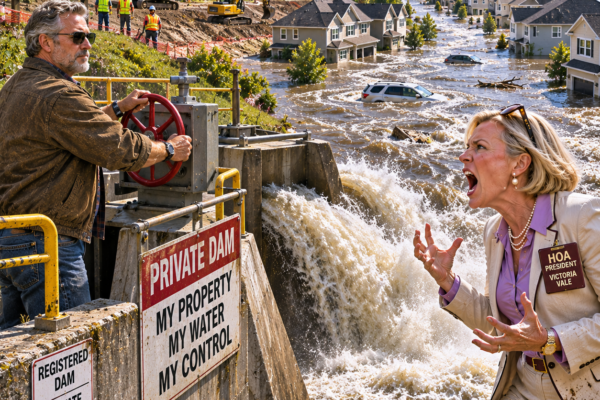
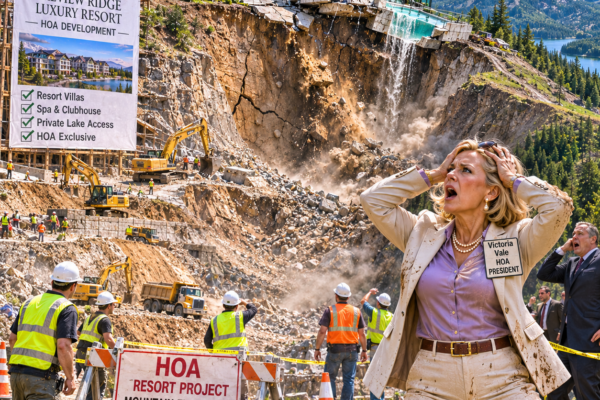
I Found 8 Illegal Taps on My Lake Ranch—I Cut Them Off and Their Pool Backfilled With Wastewater
part2
“Because this is a working ranch, Patricia. Cattle use the eastern pasture. Tractors move near the shoreline. I don’t want 180 households believing my private lake is an HOA facility.”
“We could manage liability.”
“That isn’t the point.”
She eventually said she understood.
She did not.
A month later, she came back with another idea.
The community pool apparently used more municipal water than the HOA liked.
Evaporation.
Cleaning.
Backwashing.
Landscaping.
Patricia asked whether Lakeside Reserve could pump water from my lake into a storage tank for pool maintenance and irrigation.
Again:
“No.”
She offered $10,000 a year.
Then $15,000.
Then $25,000.
Still no.
“You have millions of gallons sitting there.”
“That doesn’t make it community water.”
Her smile disappeared.
A week later, I received a letter from Lakeside Reserve’s management company claiming that “historical utility access” might give the HOA limited rights to water sources along my eastern boundary.
I sent it to Sarah Mitchell, my attorney.
Sarah searched the title records.
One utility easement existed.
County electric company.
Nothing else.
No Lakeside Reserve water rights.
No pool rights.
No irrigation rights.
Sarah sent a formal response.
For several months, everything went quiet.
I repaired fencing.
Cleared storm-damaged trees.
Replaced a pump near the barn.
George helped rebuild part of the dock.
Normal work.
Then the lake began dropping.
It was summer.
Hot.
Dry.
At first, I blamed the weather.
Except I had Dad’s records.
Even during bad summers, Bennett Lake had never dropped this quickly.
I checked the dam area.
Creeks.
Drainage.
Pump equipment.
Nothing.
Then I noticed one patch of grass near the eastern fence.
Everything around it was brown.
That patch was green.
I walked over.
Hidden beneath weeds was a plastic cover.
Under the cover—
a valve.
The pipe disappeared underground toward Lakeside Reserve.
I called George.
He stared at it.
“That wasn’t here when I moved in.”
“You sure?”
“Positive.”
We followed the visible direction as far as we could without digging.
Straight toward the clubhouse area.
I called Patricia.
She said she knew nothing about it.
Then suggested it might be an old irrigation line installed by the original developer.
“Inside my ranch?”
“I’ll check.”
Two days later, the valve disappeared.
Not removed.
Covered.
Fresh dirt.
Straw.
Somebody had tried to make the ground look undisturbed.
That was when suspicion became something else.
Sarah told me not to cut the pipe.
“Not yet.”
“It’s on my property.”
“Yes, and if it turns out to be tied into some legal utility system, I’d rather know before you create another issue. Document first.”
So I called William Grant, a licensed underground utility contractor.
I also notified the county water office.
William arrived Monday morning.
Within an hour, he found another pipe.
Then another.
Then another.
By late afternoon, colored flags covered part of my pasture.
Eight separate lines crossed from Lakeside Reserve onto Bennett Lake Ranch.
Eight.
Some were narrow.
Others large enough to move serious water.
I stood looking at the flags.
“How long have those been there?”
William shook his head.
“Different ages. Some older. Some definitely newer.”
County utility inspector Rachel Hayes arrived the next morning.
She looked at the lines, county maps, my deed, and Sarah’s easement search.
Nothing matched.
No permits tied to my parcel.
No recorded access.
No county water infrastructure.
Rachel asked whether my father had ever granted permission.
Sarah found nothing permanent.
Rachel ordered us not to disconnect anything yet.
First, trace them.
That was fine.
I wanted proof.
Line one ran from my old eastern pump area toward Lakeside’s landscaping.
Line two reached a large storage tank behind the clubhouse.
Three fed a decorative fountain.
Four went into the sprinkler system.
Five entered the community pool equipment room.
Rachel stopped.
“You sure?”
William checked.
“Yes.”
Line six also headed toward the pool.
Then seven and eight changed everything.
Those did not come from the normal lake pump system.
One connected toward an old ranch drainage channel near a livestock wash area that had not been active in years.
The other appeared to connect toward Lakeside Reserve’s wastewater lift station.
Rachel stared at William.
“That shouldn’t be connected anywhere near a pool water system.”
“No.”
I called Patricia.
“Eight pipes.”
Silence.
“Eight unrecorded pipes crossing my ranch.”
“I don’t know anything about eight pipes.”
“One enters your pool equipment room.”
“Then it could be old backup infrastructure.”
“Send me the records.”
The next day, the HOA attorney produced an agreement supposedly signed by my father twelve years earlier.
According to it, Dad had granted Lakeside Reserve four permanent water connections for landscaping emergencies.
Four.
Not eight.
But the signature looked real.
That bothered me.
Sarah read it carefully.
Something did not fit.
The current pool system had been rebuilt only six years earlier.
Why would a twelve-year-old agreement contain language that seemed written around newer systems?
Then George remembered something.
Years earlier, a county water main had broken.
Lakeside Reserve temporarily lost irrigation supply.
Dad let them connect a hose to the lake.
For one week.
That sounded like him.
I dug through old ranch files.
Eventually I found the actual agreement.
One hose.
Seven days.
Emergency irrigation only.
Dad’s signature.
Sarah put the real document beside the HOA version.
Same signature.
Not similar.
Same.
Same break in the ink.
Same slant.
Same tiny mark beneath the last letter.
Sarah looked at me.
“Ryan, somebody copied this.”
The document examiner confirmed it.
A genuine signature had been lifted from a temporary seven-day permission and placed beneath completely different language granting four permanent connections.
Rachel upgraded the investigation.
Meanwhile, William mapped the pool equipment.
It was worse than expected.
The automatic pool fill system had been modified over the years.
Instead of drawing from one clean municipal source, it could pull from several lines depending on pressure.
Municipal water.
My lake.
And something else.
Rachel pointed to the third path.
“What’s that?”
William traced it.
Then stared.
“Wastewater system.”
Nobody spoke.
Patricia immediately said sewage could not enter the pool.
William answered carefully.
“Under normal pressure, maybe not.”
“Maybe?”
“This system should never have been tied together like this.”
“What happens if the lake lines lose pressure?”
He looked at the gauges.
“I don’t know.”
That answer shut the pool.
Rachel posted a health closure.
Patricia was furious.
Children arrived with towels.
Parents complained.
The HOA held an emergency meeting that evening.
I went with Sarah.
The clubhouse was packed.
Patricia stood at the front.
“Ryan Bennett is threatening community facilities by challenging infrastructure that has served Lakeside Reserve for years.”
George stood.
“Did the HOA have permission?”
Patricia talked about historical agreements.
George asked again.
“Did you have permission?”
Then Sarah showed the two documents.
Dad’s real seven-day permission.
The forged permanent agreement.
The room changed.
Residents stopped looking at me.
They looked at Patricia.
One board member, Laura Jenkins, pulled up old financial records.
“Patricia, what is Wallace Utility Management?”
Patricia’s face tightened.
The company belonged to her brother.
David Wallace.
Laura read the invoices aloud.
“Lake auxiliary supply.”
“Pool rebalance line.”
“Wastewater return modification.”
Rachel stood.
“What wastewater return modification?”
Patricia claimed she did not know technical details.
“Who approved it?”
“The board.”
Laura checked the minutes.
No vote.
No approval.
Nothing.
Rachel ended the argument.
“Tomorrow morning the county will isolate all eight unverified connections under supervision. We are not destroying anything. We are shutting them down safely until ownership and health questions are resolved.”
The board voted.
Five to one.
Patricia was the only no.
The next morning county workers came to my ranch.
I stood beside Sarah.
Rachel supervised.
One by one:
Landscaping.
Off.
Storage tank.
Off.
Fountain.
Off.
Sprinklers.
Off.
Pool supply.
Off.
Automatic fill.
Off.
Then the strange drainage connection.
Seven.
Finally eight.
For the first time in years, Bennett Lake Ranch was no longer secretly feeding Lakeside Reserve.
Nothing happened.
For about fifteen minutes.
Pressure gauges stabilized.
William checked valves.
Rachel reviewed the readings.
Then my phone rang.
George.
“Ryan, something’s happening at the clubhouse.”
“What?”
“The pool.”
I could hear shouting behind him.
“What about it?”
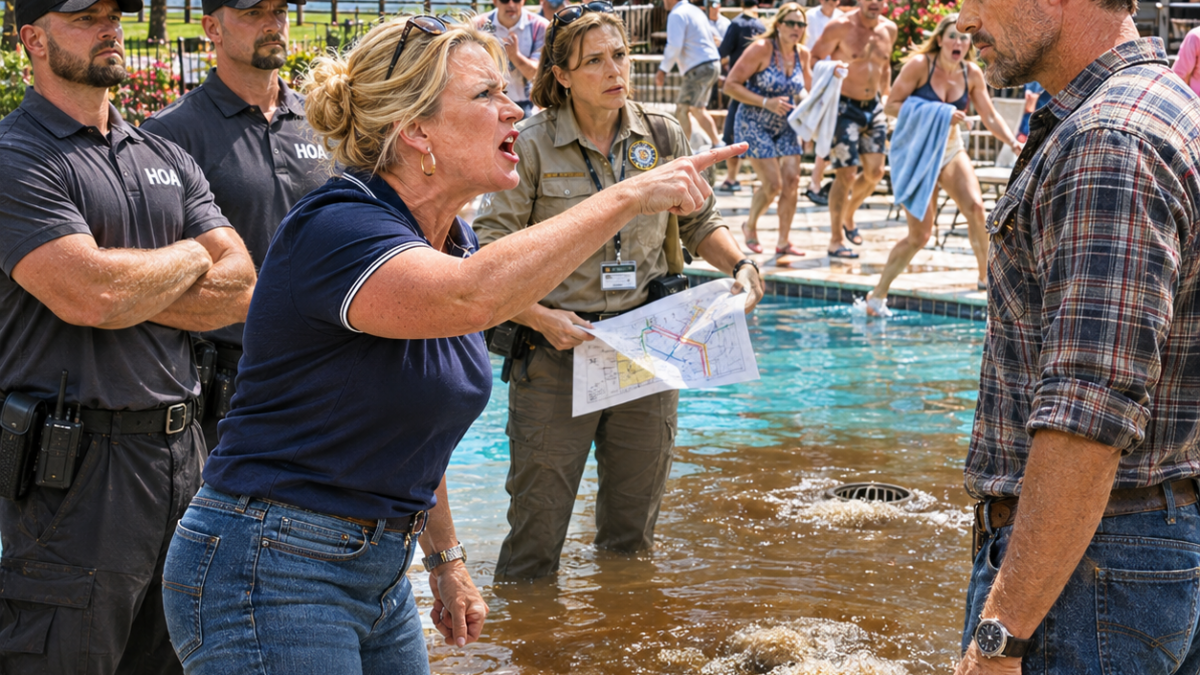
“The water’s turning brown.”
Three golf carts came racing toward us before we even reached the truck.
Residents were waving.
We drove toward the clubhouse.
People were running away from the pool.
Parents carrying children.
Wet towels.
Bags.
Someone yelling for everyone to get off the deck.
Then the smell reached me.
Sewage.
The bright blue pool had turned cloudy brown around the deep end.
Worse—
the water level was rising.
Something was pushing upward through the bottom circulation system.
Patricia came running.
“WHAT DID YOU DO?”
I pointed back toward my ranch.
“I stopped eight illegal taps.”
“You contaminated our pool!”
“No. Whoever connected wastewater to your pool did that.”
William opened the equipment room.
Pressure gauges were jumping.
The missing lake pressure had changed the system.
A wastewater-connected line was now pushing backward.
Rachel shouted,
“Nobody goes near the pool.”
Firefighters arrived.
Health officials.
Clubhouse staff shut everything down.
Parents moved farther away.
Then one utility worker ran toward us carrying a folded map from a locked valve box near my boundary.
He handed it to Rachel.
Eight colored lines.
Six marked water.
Seven:
RETURN.
Eight:
WASTE.
Rachel looked at Patricia.
“Who connected a wastewater line to a recreational water system?”
Patricia stopped yelling.
Then William pointed to a dotted line on the map.
It was not one of the eight.
“This gets worse.”
Rachel leaned closer.
“What is that?”
“Ninth connection.”
My stomach tightened.
The dotted line ran toward my lake.
Label:
EMERGENCY BYPASS.
Installation date:
Eleven months earlier.
Not fifteen years.
Not the original developer.
Eleven months.
Patricia had already been president.
William traced it.
The pipe did not stop at my pump house.
It continued beneath Bennett Lake.
Rachel called the county engineer, Thomas Reed.
He studied the symbol at the end.
“That isn’t an intake.”
“What is it?”
“Discharge point.”
My skin went cold.
Lakeside Reserve had not only been taking clean water from my ranch.
Something had been going back.
Environmental crews arrived within the hour.
The pool water was sampled.
Wastewater system.
Hidden return line.
Three points in Bennett Lake.
Sediment near the suspected discharge.
Rachel would not let anyone guess.
That mattered.
Anger is easy.
Evidence is better.
The ninth pipe was too new for Patricia’s original-developer excuse.
County crews tracked it almost two hundred feet beneath the lake to a weighted diffuser several feet underwater.
A diffuser.
Not simply a pipe ending at the shore.
A system designed to spread liquid beneath the surface.
I looked at Rachel.
“If somebody wanted to hide discharge, would that help?”
She chose her words carefully.
“It could make it harder to see from shore.”
The eastern half of my lake was temporarily closed.
No livestock access.
No fishing.
No swimming.
George helped me move cattle.
Susan brought sandwiches.
That afternoon he looked across the warning tape.
“You could tell every Lakeside resident to stay away forever.”
“I could.”
“You going to?”
“No.”
He smiled.
Most residents had not installed pipes.
Their children had not forged signatures.
Their grandparents had not designed wastewater systems.
That distinction mattered.
Pool test results came first.
Sewage contamination.
Wastewater indicators.
Bacteria.
The entire pool system needed cleaning, disinfection, reconstruction, and inspection.
Patricia posted a statement blaming “abrupt interruption of outside water sources.”
Sarah read it.
“Outside water sources?”
“My stolen lake water.”
“Apparently.”
Rachel issued the county version.
The contamination resulted from improper internal plumbing and backflow conditions.
The legally supervised isolation of unauthorized taps had exposed the defect.
It had not created it.
Then my lake results came back.
Better than I feared.
Most open water did not show dangerous contamination.
But sediment near the diffuser contained elevated wastewater bacteria and nutrients.
The line had been used.
Rachel explained why the water itself could look normal.
Dilution.
Movement.
Time.
Sediment kept the history.
The ninth line led back to a buried holding tank behind the Lakeside clubhouse.
That tank collected three things.
Pool-cleaning waste.
Clubhouse floor drains.
Overflow from the wastewater lift station during certain maintenance conditions.
It was supposed to be pumped out by a licensed waste company.
Then Rachel found something.
Monthly disposal payments had stopped eleven months earlier.
Exactly when the hidden underwater line was installed.
The reason on the HOA records:
NEW INTERNAL RECYCLING SYSTEM.
There was no recycling system.
There was my lake.
Patricia had approved canceling the hauling contract.
That alone did not prove she knew where the pipe ended.
Then another invoice appeared.
Wallace Utility Management.
$38,600.
CLUBHOUSE WATER RECOVERY LOOP.
Same month.
Same installation date.
David Wallace’s company.
The official drawing showed the holding tank sending liquid to landscape irrigation behind the clubhouse.
The actual pipe went underwater into Bennett Lake.
David appeared at the county office with an attorney.
He claimed his company built exactly what Lakeside management ordered.
Rachel asked,
“Did that include discharge into Bennett Lake?”
David said the work order described it as an “existing private water body return.”
When Sarah repeated that phrase to me, I laughed once.
Not because it was funny.
Because sometimes people make wrongdoing sound respectable by adding enough technical words.
Rachel asked who gave David the work order.
“Patricia.”
His sister denied it.
Brother blamed sister.
Sister blamed brother.
Records ended the argument.
Patricia to David:
“Need solution to reduce monthly waste pumping. Too expensive.”
David:
“Can tie holding tank into lakeside return if board accepts risk.”
Patricia:
“Will residents see it?”
David:
“No. Underwater outlet.”
Then:
Patricia: “Ryan will never agree.”
David: “He won’t know if we stay inside boundary access zone.”
There was no boundary access zone.
Then Patricia wrote:
“Keep it off regular community drawings.”
That was enough.
She knew.
Maybe not every technical detail.
Enough.
The board suspended Patricia’s financial and utility authority.
David’s company was barred from Lakeside infrastructure.
Independent engineers began mapping every connection between the HOA and my ranch.
They found a spiderweb.
Some old.
Some abandoned.
Some active.
Small branches.
Drainage.
Sprinklers.
Overflow lines.
But the biggest surprise sat beneath my old pump house.
Thomas found a concrete control chamber.
Inside were old valves, meters, and a map from the original development era.
The map confirmed something important.
Dad had indeed once authorized one emergency water connection.
Temporary.
Exactly as the real paper agreement showed.
Next to it, somebody had handwritten:
FUTURE HOA SYSTEM MAY USE RANCH LAKE UNTIL PERMANENT MUNICIPAL SUPPLY COMPLETED.
No signature.
No legal grant.
Just a developer’s wish written on paper.
Then Thomas noticed a much larger pipe.
It headed toward Lakeside.
“This is too big for a pool.”
We traced it.
Across my eastern pasture.
Past the clubhouse.
Past the original development.
Toward a construction site behind the trees.
Lakeside Reserve Phase 2.
Seventy new homes planned.
County documents said Phase 2 would use municipal water.
But beneath the ground was a pipe connecting the project directly toward Bennett Lake.
At the construction site, Thomas found a large storage tank.
Tens of thousands of gallons.
Connected.
Inside its control cabinet:
A new pump timer.
START 12:00 A.M.
STOP 4:00 A.M.
Every night.
Take lake water while people slept.
Rachel shut it down.
Then Sarah found the Phase 2 permit application.
Water source:
PRIVATE SUPPLY AGREEMENT — BENNETT RANCH.
My signature sat beside it.
I had never signed it.
Unlike Dad’s copied signature, this one looked exactly like my current digital signature.
I knew where they got it.
Eight months earlier, Lakeside volunteers had accidentally removed a fence panel during trail work.
When they returned it, Patricia asked me to sign a delivery receipt on a tablet.
One signature.
One receipt.
The image had been saved.
Then reused.
The county retrieved the original electronic file.
Same compression marks.
Same digital pattern.
Same signature.
Different document.
Thomas turned the next page.
There was another large pipe beside the Phase 2 water line.
One took water from my ranch.
The other came back.
Label:
STORM AND SANITARY EMERGENCY RETURN.
Rachel looked at Thomas.
“Is it connected?”
Thomas checked a gauge.
The needle moved.
Slowly.
But moving.
Something was already in the line.
He closed the local valve.
Pressure kept rising.
From the Phase 2 side.
Then—
BANG.
The ground shook.
BANG.
A buried joint beneath my pasture failed.
Dark water blasted upward through the soil.
The smell told us immediately it was not rainwater.
Rachel stepped back.
Thomas shouted for everyone away from the area.
He reached a second control farther uphill and shut it.
The flow stopped.
By then, a wide section of grass was black with foul water.
Thankfully my cattle had already been moved.
Environmental crews arrived.
Barriers.
Vacuum equipment.
Samples.
Containment.
The spill never reached the lake.
That was the good news.
Thomas inspected the Phase 2 system.
The return pipe connected to a temporary sanitation holding system used by construction crews and utility testing.
Officially, waste should have been removed by licensed haulers.
Instead, someone had installed a bypass pump.
Not on approved plans.
The subcontractor?
Wallace Utility Management.
Again.
The construction company, Southern Ridge Builders, handed investigators its documents.
They had been told a private utility cooperation agreement allowed temporary use of Bennett Ranch.
Sarah requested it.
My signature.
Again.
Same stolen digital image.
And the email sending the fake agreement came from Patricia’s HOA account.
Contractors were specifically instructed not to contact me directly.
All communication must go through Lakeside management.
Now I understood why not one engineer or construction supervisor had ever knocked on my door.
They thought I had already agreed.
Patricia positioned herself between me and anyone who might discover I had not.
The complete email chain erased whatever ambiguity remained.
David:
“Need owner cooperation document before Phase 2 testing.”
Patricia:
“Ryan will not sign.”
David:
“Use digital authorization from prior service receipt. Same parcel owner.”
Patricia:
“That only covers delivery.”
David:
“Contractors will not know that.”
That sentence stayed with me.
Contractors will not know.
Not:
We have the right.
Not:
Ryan approved.
They knew I had not.
They counted on other people not knowing.
The board called another emergency meeting.
Patricia attended with an attorney.
Laura placed the emails on the table.
“Did you send this?”
Patricia’s attorney told her not to answer.
Financial records showed another $112,000 paid to Wallace Utility Management for Phase 2 “water security and environmental support.”
Board members believed they had paid for backup water and drainage planning.
They had actually funded hidden pipes crossing my ranch.
Then laboratory results from the broken pasture line arrived.
Wastewater indicators.
Cleaning chemicals.
High bacterial levels.
Repeated-use residue.
The electronic bypass pump stored activation history.
Twenty-seven nights.
Mostly midnight to four.
The same hours the hidden water pump ran.
Water out.
Waste back.
Not every night.
Enough to create a system.
I sat at my kitchen table with Dad’s lake notebooks.
Dates.
Rainfall.
Water depth.
Several unexplained drops matched the pump history.
A few nights when I had written notes about bad smells near the eastern field matched return-pump activity.
Pieces I had noticed years apart suddenly connected.
Sarah tapped the notebook.
“This is evidence.”
“It’s just Dad’s records.”
“Exactly.”
Nobody could rewrite them.
Ordinary notes were harder to manipulate than official-looking documents people kept forging.
That gave me comfort.
Dad was still protecting the ranch.
The lake slowly improved.
Aerators ran near the affected shoreline.
Contaminated sediment was removed.
Monitoring continued.
Fish looked healthy.
Downstream water remained safe.
The pool was completely rebuilt.
Municipal water only.
Proper backflow protection.
Waste system physically separated.
Eventually health officials reopened it.
But our story was not finished.
William recovered historical flow data from the pool system.
We could estimate how much water Lakeside had taken.
Pool refills.
Landscaping.
Fountains.
Sprinklers.
Storage.
Over the years, the total was enormous.
Enough to explain those dry summers when my lake seemed to fall faster than rainfall records suggested.
George shook his head.
“They were already taking the water while Patricia was offering to buy rights from you.”
Exactly.
Maybe Patricia had not been asking permission to begin.
Maybe she had been asking me to legalize something already happening.
Then Sarah found a two-year-old internal memo.
Title:
BENNETT WATER RIGHTS REGULARIZATION.
It recommended getting formal owner approval to reduce legal exposure from “existing auxiliary connections.”
Existing.
The memo said if I accepted payment, the old lines could be folded into the new agreement.
If I refused, Lakeside should continue using “historical infrastructure” while legal options were reviewed.
They knew.
Not every board member.
Not every resident.
But the people managing the water system knew.
Laura became acting HOA president.
She called me.
“We’ll pay for restoration.”
“Good.”
“I’m sorry.”
“You didn’t install it.”
“I voted for budgets.”
“You weren’t told what they were really paying for.”
“I should have asked.”
Maybe.
But nobody can interrogate every invoice.
That is why trust exists.
And why abusing trust creates so much damage.
An independent firm rebuilt the mapping from scratch.
The county removed the underwater discharge.
Lake conditions improved.
I thought we were approaching the end.
Then Thomas called.
The large Phase 2 system had another connection.
More important, the project documents showed something bigger.
Future work.
A second intake.
Storage.
Fire hydrant feeds.
Landscape water.
And one proposed pipe leaving Bennett Lake toward a parcel west of my ranch.
That property did not belong to Lakeside Reserve.
Owner:
Wallace Land Development.
David Wallace.
The real plan became clear.
They were not building pipes only for the HOA.
They were turning my lake into a private water utility for multiple developments.
Without buying it.
Without an easement.
Without permission.
The master plan listed estimated savings.
Municipal water avoided.
Waste hauling avoided.
Construction water avoided.
Stormwater storage avoided.
More than $600,000 over several years.
My lake was profitable because they did not have to pay me.
Then Sarah found a page titled:
BENNETT RANCH ACQUISITION OPTIONS.
Option one:
Voluntary purchase of eastern twenty acres.
Option two:
Long-term water easement.
Option three:
PRESSURE THROUGH ENVIRONMENTAL LIABILITY.
I read it again.
Environmental liability.
The notes explained the strategy.
If contamination connected to “shared systems” could be blamed on Bennett Ranch, cleanup costs could hurt my property value.
Insurance problems could follow.
Legal pressure.
Then I might sell.
They were dumping waste into my lake while imagining a future where contamination became my problem.
Beside option three was a handwritten note:
POOL EVENT MAY HELP ESTABLISH CROSS-SYSTEM RESPONSIBILITY.
Sarah stared at it.
“Ryan…”
“What?”
“I think somebody knew the pool backflow could happen.”
We went back to the pool control logs.
Thirty minutes before county workers disconnected my eight illegal taps, somebody remotely changed a valve setting.
The change increased pressure on the wastewater-connected side.
Account:
Wallace Utility Management.
Device:
A laptop registered to David.
My hands went cold.
David knew the county was shutting off the taps.
If he increased pressure first, the system would reverse harder.
Sarah said what I was thinking.
“He wanted your cutoff to look dangerous.”
Residents see brown water.
Patricia points at me.
The HOA says I shut down “historical water infrastructure.”
Then the contamination becomes part of an argument over shared systems.
Investigators searched emails.
One from David the night before:
“Tomorrow may create the event we need.”
Patricia:
“Make sure responsibility points outward.”
Then:
David: “Once pressure drops, system will reverse. They’ll blame the shutoff.”
They knew.
That changed everything for me.
Stealing water was one thing.
Dumping waste into my ranch was another.
But letting a public swimming pool backfill with sewage while children were using that facility because you wanted political and legal leverage?
That was beyond property theft.
Rachel forwarded everything to health officials and law enforcement.
That evening George called.
“Ryan, trucks on your north field.”
I pulled up my cameras.
Three vehicles.
Flatbed.
Excavator.
Tanker.
The tanker carried the name:
Wallace Environmental Services.
A company I had never heard of.
The excavator began digging near my shoreline.
Workers unrolled a large hose.
One end went to the tanker.
The other—
toward my lake.
The valve opened.
Dark liquid started moving.
Sarah called the sheriff.
Another camera triggered.
Patricia stepped from an SUV.
David followed.
He shouted for the crew to move faster.
Sheriff’s lights appeared down the road.
David saw them.
Instead of stopping, he opened another valve.
The hose jumped.
Flow increased.
Then the excavator bucket hit something underground.
A large metal pipe cracked.
Water exploded through the soil.
The ground collapsed around the excavator.
One worker fell.
The tanker tilted.
Thomas reached the site with county crews and called me.
“Ryan, keep everybody away from the shoreline.”
“What did they hit?”
A pause.
“Your old dam bypass.”
My grandfather had installed that line decades earlier to control lake pressure during extreme storms.
It was not waste infrastructure.
It was part of the ranch’s water-control system.
Wallace’s crew had been told it was a contaminated transfer pipe that needed emergency removal.
Another lie given to another contractor.
By the time I arrived, the excavator was leaning toward the lake.
Thankfully, the operator was out.
One worker had twisted an ankle.
Another had cut his hands.
Nobody was seriously hurt.
That mattered more than everything else.
Thomas and emergency crews stabilized the bypass.
The tanker was secured.
David claimed the liquid was a “neutralizing solution” meant to clean contamination.
Rachel ordered samples.
The results destroyed that explanation.
It was concentrated wastewater from the Phase 2 holding system.
Same bacteria.
Same cleaning chemicals.
The same material his company was accused of sending through hidden return pipes.
Sarah looked at me.
“He wants contamination on the ranch side.”
The master plan suddenly made sense.
Environmental liability.
If enough contamination could be physically placed in Bennett Lake, someone could argue my ranch was the source.
Cleanup costs.
Falling value.
Insurance pressure.
Then a cheap acquisition offer.
Investigators searched David’s vehicle.
They found a printed checklist.
BENNETT RESPONSE EVENT.
- Confirm county tap shutdown complete.
- Document pool reversal.
- Establish ranch-side contamination connection.
- Offer cleanup assistance through Wallace contractor.
- Pursue acquisition after liability notice.
I read it twice.
The entire sequence was there.
The pool.
The blame.
The contamination.
The company that would conveniently “fix” the damage.
The eventual acquisition.
David had not merely reacted.
He had a plan.
Patricia’s role in the tanker operation was less direct.
Recovered messages showed David telling her he might need to “create ranch-side source.”
Patricia responded:
“Do not do anything that puts residents at risk.”
Later:
“I said no tanker.”
That did not erase everything she had already done.
The fake agreements.
Hidden pipes.
Water theft.
Phase 2.
Pool pressure plan.
But it mattered.
David had escalated beyond even what Patricia was willing to support.
Different wrongdoing deserves different responsibility.
I had learned that lesson through the entire mess.
The county reconstructed the system.
Eight original taps took clean water from Bennett Lake for irrigation, fountains, pool use, sprinklers, and storage.
A ninth line sent clubhouse and wastewater material back beneath my lake.
The larger Phase 2 system took lake water at night and returned waste through another hidden pipe.
Future plans intended to connect additional Wallace developments.
Over several years, engineers estimated tens of millions of gallons had probably been pulled from the lake system.
Slowly.
Quietly.
Enough to hide inside weather.
That was why the scheme worked for so long.
No dramatic overnight drain.
A little missing water here.
Another dry summer there.
A level that looked slightly wrong.
Then you blame the heat.
Until one day you start digging.
Sarah filed claims against the responsible entities.
The HOA.
Wallace Utility Management.
David’s development companies.
Related insurers.
But she separated responsibility.
Lakeside Reserve itself had benefited from stolen water.
That mattered.
But the new board had cooperated.
Turned over records.
Paid for restoration.
Removed Patricia.
Helped the county.
I had no interest in destroying 180 families because a few people abused the organization representing them.
Laura came to my ranch alone.
No attorney.
No folder.
She stood near the dock.
“I owe you an apology.”
“You didn’t install the pipes.”
“I approved budgets.”
“You didn’t know what they funded.”
“I should have.”
I looked across the lake.
“What does making it right mean to you?” she asked.
I answered immediately.
“Every unauthorized line comes off my property.”
“Yes.”
“Restore the lake.”
“Yes.”
“Restore the pasture.”
“Yes.”
“And put the truth in the county records so nobody tries this again after I’m dead.”
Laura smiled faintly.
“That sounds like something your father would say.”
Probably.
The HOA approved a permanent recorded boundary agreement.
Not an easement.
The opposite.
Lakeside Reserve had no automatic water rights.
No wastewater rights.
No utility rights.
No recreational rights.
No access rights.
No historical claim created by previous illegal use.
No emergency right to connect to Bennett Lake.
Any future permission would require a separately recorded written agreement signed by the ranch owner.
Simple.
The lake belonged to Bennett Ranch.
Then the physical cleanup began.
The eight original taps were not capped.
Removed.
The ninth underwater discharge line came out.
Phase 2 supply and return pipes came out after investigators finished with them.
The hidden bypass pump was seized.
Unauthorized trenches were filled.
Drainage restored.
My damaged dam bypass was rebuilt properly.
The northern pasture took months to recover.
But it recovered.
So did the lake.
Bacteria levels fell.
Sediment near the old discharge point improved.
County testing eventually cleared the water.
Fishing reopened.
George brought Tyler down first.
He asked permission.
As always.
I said yes.
Tyler cast from the dock.
Twenty minutes later he caught a bass.
He held it up like a trophy.
George looked at me.
“Think the fish knows what happened?”
“I hope not.”
Tyler released it.
That moment meant more to me than any settlement.
The lake was alive.
Still ours.
Still worth protecting.
Lakeside’s pool reopened too.
One legal municipal water connection.
Proper backflow protection.
Wastewater physically separated.
Independent inspections.
No Bennett Ranch water.
No hidden lines.
No Wallace Utility Management.
Laura invited me.
I almost said no.
Then I went.
Not for the pool.
For the families.
Parents apologized.
Residents shook my hand.
A little boy asked me,
“Is your lake cleaner than our pool?”
“Both are clean now.”
George leaned toward me.
“Tell him the fish don’t use chlorine.”
I laughed.
Patricia was formally removed as HOA president.
The vote was not close.
David’s company lost every Lakeside contract.
The legal cases took longer.
David faced allegations tied to fraud, false documents, environmental violations, trespass, and the tanker operation.
Patricia faced consequences for the forged agreements, hidden utility approvals, copied signature use, and her role in the pool-pressure scheme.
I did not attend every hearing.
Eventually, I stopped caring about watching them fall.
I had a ranch to restore.
Civil settlements covered verified losses.
Environmental monitoring.
Pasture damage.
Lake restoration.
Legal expenses.
Water taken.
The HOA’s insurer paid a portion.
Wallace-related companies paid more.
Phase 2 collapsed under its original structure and was eventually sold.
The new developer called me before restarting construction.
His engineers asked permission to walk the boundary.
Not cross it.
Walk it.
They showed me every proposed pipe.
Every valve.
Every drainage outlet.
Municipal water.
Legal sewer.
Nothing entering my ranch.
Nothing returning.
They gave me copies.
That is what normal development looks like.
Maps.
Permission.
Boundaries.
No midnight pumps.
No forged signatures.
No hidden pipes.
Months after everything settled, Patricia sent me a letter.
Not through an attorney.
She wrote that when she first became HOA president, she believed using Bennett Lake could save Lakeside money.
At first, she convinced herself Dad’s old emergency permission meant the HOA had some historical claim.
Then David showed her ways to expand it.
One temporary hose became several connections.
Then more.
Then wastewater return.
Then Phase 2.
Then fake paperwork.
She wrote that every compromise made the next one easier.
Eventually admitting the truth would have meant admitting all of it.
So she kept going.
That part stayed with me.
Bad decisions rarely arrive as one enormous decision.
They grow.
One excuse.
One shortcut.
One hidden pipe.
One forged document.
One more lie needed to protect the previous lie.
Until telling the truth feels more expensive than continuing.
Patricia apologized especially for the pool.
I waited.
Then sent one sentence.
I hope you use what happened to make better choices next time.
That was enough.
Forgiveness does not mean reopening the gate.
I could stop carrying anger without giving her water rights.
One year after county crews disconnected the eight original taps, I installed a sign near my eastern boundary.
BENNETT LAKE RANCH.
PRIVATE WATER.
NO UTILITY ACCESS WITHOUT WRITTEN PERMISSION.
George helped set the posts.
He stepped back.
“You think they understand now?”
“They better.”
We walked toward the dock.
The lake level was higher than it had been in years.
Not artificially high.
Normal.
That was the strange part.
For years, I thought drought was stealing water.
Some of it had been weather.
Some of it had been Lakeside Reserve.
Once the illegal system disappeared, Dad’s old records started matching reality again.
Rainfall made sense.
Seasonal changes made sense.
Lake loss made sense.
The water behaved the way it was supposed to.
I kept recording everything.
Date.
Weather.
Depth.
Tyler once asked me why I still bothered.
“The pipes are gone.”
“Because truth likes records.”
He looked confused.
Someday he will understand.
Around town, people remember the story in a simpler way.
Ryan Bennett found eight illegal taps on his ranch.
He cut them off.
Then the HOA swimming pool filled with wastewater.
Technically true.
But that version leaves out something important.
I did not walk into my pasture with a wrench and start cutting random lines because I was angry.
Utility professionals found the connections.
County inspectors traced them.
Documents were checked.
Officials ordered them isolated.
When the taps were removed under controlled conditions, the pressure change exposed a dangerous wastewater cross-connection inside the HOA’s own plumbing.
The brown water did not come from Bennett Lake.
It came from Lakeside Reserve’s hidden system.
That was almost poetic.
For years, they took clean water from my property.
At the same time, people connected to the same scheme quietly sent unwanted water back.
And the moment the free clean water stopped flowing—
their own pipes exposed them.
Not because I sabotaged anything.
Because they built it that way.
And the eight taps turned out to be only the first layer.
Behind them were the ninth underwater discharge.
Phase 2 supply and return lines.
My stolen digital signature.
Midnight pumping.
Fake utility agreements.
The master plan.
Environmental pressure.
The remotely altered pool valve.
The tanker.
The broken dam bypass.
Every layer existed for the same basic reason.
Somebody decided my answer did not matter.
That is the part I remember most.
Nothing was wrong with Patricia asking for lake access.
Nothing was wrong with asking to buy water.
A developer can ask for an easement.
A community can ask for fishing rights.
A neighbor can ask for help.
My father once said yes when Lakeside needed emergency water.
That was kindness.
But kindness works only when no still means no.
The moment someone decides your refusal does not count, the relationship changes.
Patricia and David treated one temporary favor my father gave years earlier like a blank check.
Then they built an entire hidden water system around that lie.
Today Bennett Lake Ranch is quiet again.
Cattle graze near the western field.
The dock has fresh boards.
George still visits.
Susan still brings peach cobbler.
Tyler still fishes.
Lakeside Reserve is still next door.
Residents still wave from the walking trail.
Sometimes somebody asks permission to fish.
Sometimes I say yes.
Sometimes I say no.
Nobody argues.
That may sound small after everything that happened.
To me, it is the whole point.
I found eight illegal taps on my lake ranch.
The county cut them off.
Their pool backfilled with wastewater.
But watching that water turn brown was never the victory.
The victory was standing on my dock a year later, looking across Bennett Lake, and seeing clear water where somebody else once saw free money.
The lake was mine.
The records said so.
The pipes said so.
And finally—
the neighbors understood it too.