I Came to Adopt the Gentlest Dog—But the Silent One Was Guarding a Blanket Full of Secrets
PART3:
I turned and saw the smile still on her face, but it looked pinned there.
“What’s his name?” I asked.
“Morrow.”
“And what’s with the blanket?”
She gave a little laugh that died before it reached her eyes.
“He came in with it. He gets weird if anyone touches it.”
Weird.
That word always shows up when someone wants a truth to sound smaller than it is.
I crouched near the bars.
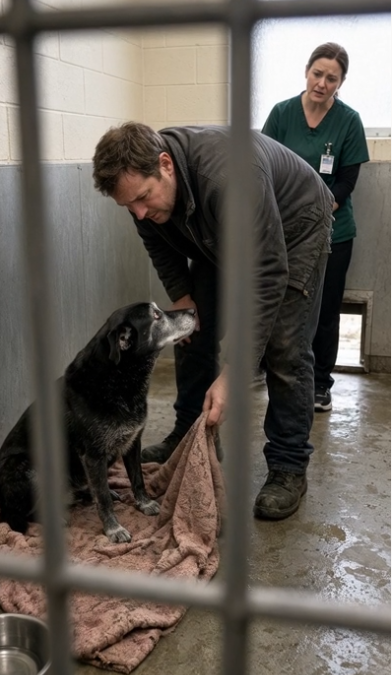
Morrow lifted his head, and for one second I thought he might back away. Instead, he leaned forward just enough to touch his nose to my knuckles.
One second.
Then he settled back over the blanket like he had finished checking something important.
At the far end of the row, a kennel tech in green scrubs stopped mopping and looked over.
“Can I meet him?” I asked.
Kendra hesitated.
A small thing.
Half a breath.
But I saw it.
“He’s not really on the recommendation list,” she said. “Older dog. Harder transition. Jasper would be a much better fit.”
Jasper barked from down the row, as if he knew he was losing.
The whole building wanted me to choose Jasper.
Instead, I kept looking at the blanket.
There was a smell around Morrow’s kennel that did not match the others. Not bad. Just older. Cedar, dust, and a faint trace of cologne that had once been expensive.
I reached slowly toward the bars again.
Morrow lifted his head. His chest rose once. His nose touched my knuckles for exactly one second, then he went still again.
Kendra opened the kennel for a supervised meet, though every movement she made told me she regretted it.
Morrow did not come to me.
He stayed over the blanket, chest low, one paw resting on the folded edge.
I noticed then that the stitching along the corner was uneven, almost hurried. Blue thread crossed through old brown wool in short, ugly lines.
When I took one slow step closer, Morrow pressed his weight down harder.
“See?” Kendra said softly. “He shuts down. He’s been like that since he came in.”
“When did he come in?”
Another pause.
“Six weeks ago.”
That answer should have ended it.
Instead, it made everything worse.
Six weeks was long enough for a shelter dog to either soften or unravel. Morrow had done neither. He had chosen one blanket and built his whole silence around it.
I took one step inside the kennel.
His ears twitched.
His body stayed low.
The brown blanket shifted slightly beneath him, and for one second I thought I saw something hard sewn into the corner seam.
A kennel door slammed somewhere across the room.
Morrow flinched, then pressed his weight down harder over the blanket.
“Can I see that?” I asked.
Kendra’s answer came too fast.
“No.”
The kennel tech behind her muttered, “Kendra.”
Then a man’s voice came from the hall, older and controlled.
“What seems to be the issue?”
I turned and saw the shelter director standing there in khakis and a navy fleece vest with the Pine Creek logo over the chest. He looked more like a banker than a rescue man.
Clean nails.
Polished shoes.
Kind smile with no warmth in it.
Kendra straightened immediately.
“Nothing,” she said. “Just a visitor asking about Morrow.”
The director looked at me.
Then at the dog.
Then at the blanket under him.
Something in his face shut like a drawer.
“I’m Tom Barrow,” he said, extending a hand. “Shelter director.”
I shook it.
His palm was dry and firm.
The kind of handshake designed to end questions, not welcome them.
“Morrow seems protective of that blanket,” I said.
“Fixation behavior,” Tom replied smoothly. “Not unusual in older dogs who come from difficult transitions.”
“What transition?”
He smiled again.
“Could we talk in my office?”
That alone told me the answer mattered more than a normal adoption question should.
Most shelters are too short on staff and too tired for side conversations with middle-aged men carrying personal grief in neat shoes. But Tom held the office door open for me with one hand and shut it carefully behind us like noise itself had become a liability.
His office was small, over-organized, and full of the kind of framed photos meant to sell trust.
Dogs in costumes.
Volunteers at fundraisers.
One photo of Tom shaking hands with a county councilman I recognized from local television.
He offered me coffee.
I said no.
“Morrow isn’t a suitable placement,” he said, settling behind his desk. “Older dogs with fixation behaviors can be difficult for first-time adopters.”
“I didn’t say I was a first-time adopter.”
He smiled politely, then ignored that.
“There are other dogs who need homes and would be easier.”
There it was again.
Not concern.
Redirect.
“Why are you so interested in a blanket?” I asked.
His expression did not change, but one finger tapped once against the desk blotter.
“It came with him. He guards it. Some dogs fixate on objects.”
“That isn’t what I asked.”
We sat in silence for a moment.
A real silence.
The kind where one person already knows the other has noticed the wrong thing.
Then Tom leaned back and said, “Morrow belonged to an older gentleman who died. Sometimes dogs carry grief in ways people misunderstand.”
That was the small reveal.
Neat enough to sound true.
Incomplete enough to itch.
“What gentleman?”
“A donor.”
Not a name.
A category.
“He left no family?”
Tom reached for a file, flipped it shut again without opening it, and smiled with the same careful emptiness.
“That part isn’t relevant to the adoption process.”
It became relevant five minutes later.
When I left his office, I passed the front lobby and saw a woman in a camel coat arguing quietly with Kendra at the desk.
Late sixties.
White hair set too carefully for the hour.
Pearl earrings.
Hands shaking despite the effort she made to hide it.
“I’m not asking for access to the whole building,” she said. “I only want confirmation.”
Kendra glanced at me and stopped speaking.
The woman followed her gaze.
For one second, all she looked at was my visitor badge.
Then she looked past me toward the kennel row and turned pale in a way healthy people do not fake.
“You’ve seen him,” she said.
I should have walked out.
Instead, I nodded.
She swallowed hard.
“Did he still have the brown blanket?”
That was the first moment I understood the blanket mattered to someone outside the shelter.
A stranger was not asking whether the dog was alive.
She was asking about the blanket first.
Her name was Eleanor Whitaker.
She told me that in the parking lot, standing beside a dark green Buick with a cracked taillight and a church bulletin on the dashboard. The air smelled like fallen leaves and rain coming. She kept twisting a leather glove in her hand as she talked.
Morrow, she said, had belonged to her brother, Charles Whitaker.
Retired probate attorney.
Widower.
No children.
Dead six weeks earlier from what she called “a stair accident.”
I knew the name.
Whitaker & Hines had handled wills, trusts, and estate disputes for half the county. Old-money people used them when they wanted paperwork to feel clean even when the family was not.
“He wasn’t supposed to end up here,” Eleanor said.
“Then how did he?”
“My nephew handled the estate.”
Something in the way she said nephew made the word sound temporary.
His name was Daniel Price Whitaker. Charles’s late wife’s son from her first marriage. Raised in the house, legally adopted at twelve, polished enough to look trustworthy in photographs and greedy enough, Eleanor implied, to count spoons during funerals.
There was family.
There had always been family.
Eleanor told me she came to the shelter twice asking after Morrow and was told no dog by that description had been processed.
That morning, she got an anonymous call from a blocked number.
Check Pine Creek.
Ask about the blanket.
“Why the blanket?” I asked.
She stared through the windshield for a moment.
Then she said, “Because Charles hid things in plain sight when he thought people were listening.”
That sentence stayed with me.
It sounded eccentric at first.
Then she gave me the next piece.
Charles had been preparing to change his will just before he died. Daniel knew it. A housekeeper knew it. Possibly the housekeeper’s daughter knew it too. Charles had become convinced money was missing from a family charitable trust set up in his wife’s name.
Not a few checks.
Hundreds of thousands over several years.
The trust supported scholarships, medical grants, and veterinary assistance across three counties.
Tom Barrow, the shelter director, sat on its local distribution committee.
There it was.
The first line connecting Tom’s office smile to the blanket under a silent dog.
“What did Charles plan to do?” I asked.
“Remove Daniel. Freeze the accounts. Hand the records to the state.”
“Did he?”
Eleanor looked down at her glove.
“He died before the meeting.”
That was when the room I had just left rearranged itself in my mind.
A wealthy donor dies in a fall.
His dog disappears.
His sister gets lied to twice.
A shelter director wants me far away from a blanket no one can explain.
I went back the next day.
Not because I had a plan.
Because once you notice a room tightening around one object, you either step away or follow the pressure.
Kendra was alone at the front desk this time, hair pulled into a rough bun, mascara smudged under one eye like she had not slept.
“I want to file adoption paperwork for Morrow,” I said.
She stared at me.
Then at the forms.
Then over my shoulder toward Tom’s closed office door.
“You should pick Jasper.”
“Everybody keeps saying that.”
“That’s because Jasper is what you came for.”
“No,” I said. “I came for the dog nobody’s letting me understand.”
Her face changed a little then.
Not trust.
Fatigue.
“Come back at lunch,” she whispered. “Tom leaves for Rotary on Thursdays.”
The quiet tech had not been the weakest link.
The smiling volunteer was.
At twelve-fifteen, Kendra let me into the kennel room through the side wash entrance.
It was quieter than usual.
A few dogs sleeping.
A mop bucket near the drain.
The fluorescent hum above us made everything look too exposed.
Morrow stood when he saw me, but only halfway.
Kendra knelt outside the kennel and said, “I’m only doing this because whatever this is, it’s bigger than a blanket.”
She unlocked the latch.
Inside, Morrow moved between us and the brown cloth instantly, not with aggression but with certainty.
Shoulders low.
Eyes alert.
Tail still.
“Hey,” I said softly.
He looked at me.
Then at Kendra.
Then down at the blanket.
“Let him choose,” she whispered.
So I sat on the concrete.
Cold went straight through my jeans.
Morrow watched me for nearly a minute, breathing slow, nose working the air.
Then he stepped closer and pressed his muzzle once against my wrist.
He was not guarding it from me.
He was waiting to see if I understood how to ask.
I slid one hand, slowly, toward the blanket edge.
Morrow placed his paw on top of my hand.
Not hard.
Just enough to stop me.
Then he lifted the paw, hooked the blanket corner with one claw, and dragged it toward me himself.
I still think about that moment.
All the noise in the building seemed to drop away.
Kendra stopped breathing for a second.
Morrow backed up two inches and lay down again, eyes fixed on the cloth between us.
The blanket was older than I thought.
Wool.
Dark brown once, now faded to tobacco and dust.
The hem had been opened and stitched closed again by hand, blue thread crossing unevenly near one corner.
I slipped a finger under the seam and felt something stiff inside.
Kendra made a sound under her breath.
I looked at her once.
She nodded.
So I opened it.
Inside the folded hem was a plastic sleeve, flat and sealed with packing tape.
Inside that were three things.
A key card.
A flash drive.
A notarized document folded into quarters.
The document was dated nine days before Charles Whitaker died.
It was not a will.
It was a statement.
Charles had written that he believed his adopted son, Daniel, had diverted funds from the Whitaker Family Trust using forged authorizations and vendor invoices routed through three local nonprofits.
One of them was Pine Creek Animal Shelter.
My stomach turned.
Kendra sat down on the floor.
The paper named account numbers, dates, and committee members who had signed off on “emergency disbursements.”
Tom Barrow’s name appeared twice.
At the bottom, Charles had written something stranger.
If this statement is found after my death, know that I placed the originals where Daniel would never think to look.
Morrow knows.
I read that line twice.
The dog had not only been carrying grief.
He had been carrying instructions.
The key card was for a private safe deposit box at Fifth Republic Bank downtown.
The flash drive was labeled only with a strip of masking tape and one handwritten word:
AUDIT.
Kendra started crying quietly, one hand over her mouth.
“I knew something was wrong,” she said. “I didn’t know this.”
“How long has Tom had that dog here?”
“From the day after Charles died.”
That timing turned the whole room.
Not rescue.
Containment.
We should have called the police right then.
Instead, misdirection got its turn.
Because the minute we stepped out of the kennel room, Daniel Whitaker was standing in the hall.
I had seen his type before.
Expensive coat.
Teeth too white.
Forty, maybe forty-two.
The kind of man who speaks softly because he has spent his life being obeyed before volume becomes necessary.
Tom stood beside him.
Kendra went rigid.
Daniel’s gaze dropped to the opened seam in my hand, then to Morrow behind me, then back to my face.
“That blanket belongs to my family,” he said.
Morrow, who had barely made a sound in two days, let out one deep growl.
It rolled through the hall like a door locking.
“You lied to the shelter,” I said.
Daniel smiled.
“No. My aunt is emotional. My father had cognitive decline. He confused paperwork. That dog fixated after the fall.”
There it was.
The full neat lie.
Old man confused.
Dog unstable.
Family misunderstanding.
It might have worked if Tom had not reached for the blanket.
That single movement changed everything.
Morrow lunged once, not to bite, but to block.
Front paws planted between Tom and me.
Body shaking.
Eyes bright and hard.
Tom stumbled back into the wall, and for one ugly second the banker smile vanished completely.
“Call security,” he snapped.
“There is no security,” Kendra said.
The fact that she said it almost made me laugh.
I backed toward the wash entrance with the plastic sleeve in my jacket.
Tom moved first.
Daniel second.
Neither of them got far, because Eleanor Whitaker stepped through the side door behind them with two sheriff’s deputies and a state fraud investigator I later learned had been quietly reviewing Whitaker trust complaints for months.
Eleanor had not waited in her car after all.
She had gone straight to the county with copies of Charles’s emails and the anonymous call record, and someone there had already started listening.
The room shifted instantly.
Tom’s voice changed.
Daniel’s posture did too.
Men used to private control almost always shrink in the exact same way when witnesses arrive.
The flash drive held scanned ledgers, committee minutes, and recorded calls between Daniel and Tom arranging backdated grant approvals, fake veterinary hardship payouts, and transfers from the trust into shell vendors that never existed.
The shelter, or at least the shelter under Tom, had been used as a respectable face for theft.
But the ugliest part was still waiting.
The state investigator was a woman named Lila Cortez, with a clipped voice and a yellow legal pad. She traced the missing grant payments against canceled requests.
One of the canceled grants had belonged to a boy named Eli Morgan.
Fourteen years old.
Leukemia.
Treatment support denied because the trust had “insufficient quarterly availability.”
His mother had held a fundraiser in the VFW hall that same month.
She had stood in front of neighbors and thanked the Whitaker Trust for “considering” the application.
The money had already been stolen.
That was the fourth big twist.
Not abstract fraud.
Not numbers.
Lives with names.
After that, everything came apart fast.
Tom was arrested first because he had nowhere to go and because his signature sat on too many forms.
Daniel lasted forty-eight hours before trying to move money out of a brokerage account and book a flight to Nassau through Cincinnati.
They caught him at the airport in a navy quarter-zip sweater with a passport, an overnight bag, and the kind of offended expression rich men carry when they confuse delay with injustice.
The aftermath spread through town in layers.
Donors wanted statements.
The board wanted distance.
Volunteers wanted to know how many animals had gone without treatment while Tom approved fake hardship checks in their names.
Kendra gave three interviews and then quit.
Eleanor, who had spent months being treated like a troublesome old woman with a family obsession, sat through every hearing in a navy coat with a notebook in her lap and her back so straight it made younger people fidget.
Morrow was the only one who never acted surprised.
Some creatures do not need the truth explained once they have lived inside its smell.
The medical grants were reviewed.
Several were reinstated through emergency county funds once the theft case became public.
The shelter board was replaced.
A forensic audit widened to two more partner organizations.
Charles Whitaker’s death was reopened as well.
The autopsy had called it accidental blunt-force trauma from a fall down the back staircase. Then a housekeeper admitted she had seen bruises on Charles’s wrist the week before and heard Daniel screaming about “papers and signatures” through a closed study door.
A handyman remembered the banister had seemed loose days before the fall, then strangely repaired by the time officers came.
Money almost never arrives alone.
It drags timing, repairs, missing people, and convenient paperwork behind it.
The death remained under investigation for months, and I will not lie to you by giving it a perfect courtroom ending it did not have yet.
Real life is slower than outrage.
But fraud stuck.
Conspiracy stuck.
Wire transfers and forged documents stuck beautifully.
And Morrow?
I adopted him.
There was paperwork, of course.
Too much of it.
Board approval.
Temporary hold release.
A new director who cried the first time she met him because she had already heard the story three ways and did not know how to apologize to a dog.
The first night home, Morrow would not enter the living room.
He stood by the door, looking past the couch and the lamp and the recliner that had been my father’s, as if houses could also contain traps invisible to decent people.
I sat on the floor with him for nearly an hour before he finally stepped in.
He ignored the expensive dog bed I had bought in a panic.
Ignored the chew toys.
Ignored the bowl of treats.
He carried that old blanket to the corner near my father’s recliner and lay down beside it like he had accepted temporary custody of my grief too.
That was the ending I had not seen coming.
I thought I was bringing home a dog after a scandal.
Instead, I brought home a witness who understood silence better than anyone I knew.
A week later, Eleanor came by with lemon bars in a tin and a folder of photographs.
Charles in his garden.
Charles in a fishing hat.
Charles at Christmas with Morrow still young enough to have a black muzzle and foolish paws.
In every photo, the dog was watching him the same way he had watched that blanket in the shelter kennel.
Not ownership.
Protection.
“He trusted him more than he trusted people at the end,” Eleanor said quietly.
I believed her.
The trust case continued into winter.
Daniel’s lawyers called Charles confused.
Then vindictive.
Then manipulated by grief.
Morrow would lift his head from the rug every time I read those lines aloud from the paper and stare at me until I stopped.
By spring, Eli Morgan’s mother sent a handwritten note thanking “whoever forced the truth out.”
I kept it in the kitchen drawer with takeout menus and stamps.
I never wrote back.
I did not know what to say that would sound clean enough.
Some evenings, Morrow still noses that brown blanket before he settles down.
Just once.
A check, not a ritual.
Then he comes over to where I am sitting, rests his chin on my knee, and lets out one long breath like a man finally unbuttoning his collar after a hard day.
The last twist is the one I live with now.
I went to the shelter to bring home the easiest dog to love.
Instead, the silent one chose me after dragging a buried truth into daylight and leaving me with a house that no longer felt empty.
A few months ago, I packed up my father’s recliner to donate it.
It had been sitting untouched since the funeral, collecting dust and guilt in equal measure.
When the pickup men came, Morrow stood in front of it.
Not growling.
Not guarding.
Just watching.
I put my hand on the chair back, then on his neck.
“It’s okay,” I said.
He looked at me for a second.
Then he stepped aside.
That was all.
No miracle.
No speech.
Just a dog who had once guarded the evidence that broke open a room full of lies, and who now seemed to understand the difference between holding on and letting something leave.
I stood there in the doorway while the truck pulled away.
Morrow leaned once against my leg.
And for the first time in a long while, the quiet in the house felt earned.
Not empty.
Not polite freedom.
Earned.
That is what Morrow gave me.
Not just companionship.
Not just a reason to come home.
He gave me a different kind of silence.
The kind that comes after truth has finally been spoken.
The kind that settles after grief stops demanding a room stay exactly the same.
The kind an old dog makes when he sleeps beside a blanket that no longer needs to hide anything.
Some people think Morrow saved a trust fund.
Some say he helped expose Daniel and Tom.
Some call him the dog who guarded evidence.
They are not wrong.
But they are not entirely right either.
Morrow guarded what his person could not protect anymore.
He guarded a promise.
He guarded the last honest thing Charles Whitaker left behind.
Then, when the right hands finally asked instead of took, he gave it up.
That is what I think about most.
Not the arrests.
Not the flash drive.
Not Daniel’s face in the hallway when control finally slipped out of his hands.
I think about Morrow placing his paw over mine.
Not to stop me forever.
Just to make sure I understood.
Some things cannot be grabbed.
Some truths have to be trusted into the open.
And some dogs, quiet as stone in the last kennel, are not waiting to be rescued.
They are waiting for someone patient enough to listen to what they have been guarding.
That day, I thought I was choosing a dog.
I know better now.
Morrow had already chosen his work.
He had already chosen the blanket.
He had already chosen to stay beside the last piece of truth Charles had left him.
All I did was sit on the floor long enough for him to decide I was not another person trying to take something.
And when he finally dragged that blanket toward me, he was not giving me an object.
He was giving me responsibility.
I brought him home because the shelter was no longer safe enough for him.
But in the months that followed, I realized he had brought something home for me too.
A reason to clear out my father’s chair.
A reason to stop eating dinner over the sink.
A reason to understand that grief is not love unless it eventually makes room for the living.
Morrow still sleeps near the window most afternoons.
The brown blanket stays nearby.
Clean now.
Mended properly.
The blue thread still visible in one corner because I asked Eleanor not to replace it.
I like that old uneven stitching.
It reminds me that Charles must have sat somewhere, maybe already frightened, maybe already suspicious, with a needle in one hand and Morrow watching from the floor.
A man hiding evidence inside a blanket because he trusted a dog more than the people around him.
That should be sad.
It is sad.
But it is also something else.
Proof that even when a house fills with lies, loyalty can still find a place to lie down and wait.
Morrow waited six weeks in a shelter kennel.
He guarded.
He watched.
He trusted almost no one.
Then he trusted me.
I try to live up to that.
Every morning, I open the back door and let him step into the yard at his own pace. He sniffs the air, checks the fence line, and looks back once before moving farther.
Just once.
A check, not a fear.
I know what he is asking.
Still here?
And every morning, I answer without saying a word.
Still here.
Not because I saved him.
Not because he saved me.
Because after everything both of us had lost, staying became the one promise that still mattered.
So when people ask why I did not take Jasper, I tell them Jasper found a home two days later with a family and three children who adore him.
Then I tell them Morrow came home with me.
And that is usually where I stop.
Because the rest is hard to explain quickly.
How a dog can turn an old blanket into evidence.
How a dead man can speak through blue thread.
How greed can hide behind charity until one silent animal refuses to move.
How a house can be full of furniture and still empty.
How the right dog can walk into that emptiness carrying a grief older than yours, and somehow make both burdens lighter.
Morrow is asleep beside me now as I write this.
His muzzle is whiter than it was that first day.
His paws twitch sometimes when he dreams.
The brown blanket lies beneath his chin.
It no longer smells like cedar and old cologne.
It smells like my house.
Like laundry soap.
Like sunlight through the window.
Like a life after the one he lost.
I do not know whether Morrow remembers the shelter the way I do.
Maybe he remembers more.
Maybe less.
Maybe memory for dogs is mostly scent, pressure, absence, and return.
But I know this.
He does not guard the blanket the same way anymore.
He rests on it.
There is a difference.
Guarding is fear with a job.
Resting is trust after the work is done.
And Morrow has done enough.
The truth came out.
The money was traced.
Some of the stolen help found its way back to the people who needed it.
Charles was no longer dismissed as a confused old man.
Eleanor was no longer treated like a nuisance.
Tom lost the shelter he had used as a mask.
Daniel lost the story he had built around himself.
And my house, the one that had sounded too large after my father died, learned a new rhythm.
A bowl on the kitchen floor.
Nails in the hallway.
A long breath beside my chair.
The quiet is still here.
But it no longer feels empty.
It feels like a room where nothing has to be hidden anymore.
And every night, before I turn off the lamp, Morrow lifts his head from that old brown blanket and looks at me.
Not at my hands anymore.
My face.
I reach down.
He presses his muzzle into my palm.
One second.
Then longer.
And I understand exactly what that means.
The door behind him closed.
The truth came out.
The chair left.
The house changed.
And this time, nobody is taking away what he chose to trust.








