I Brought Towels to the Shelter—Then a Scarred Old Cat Pressed His Head Against My Chest and Refused to Let Go
PART3:
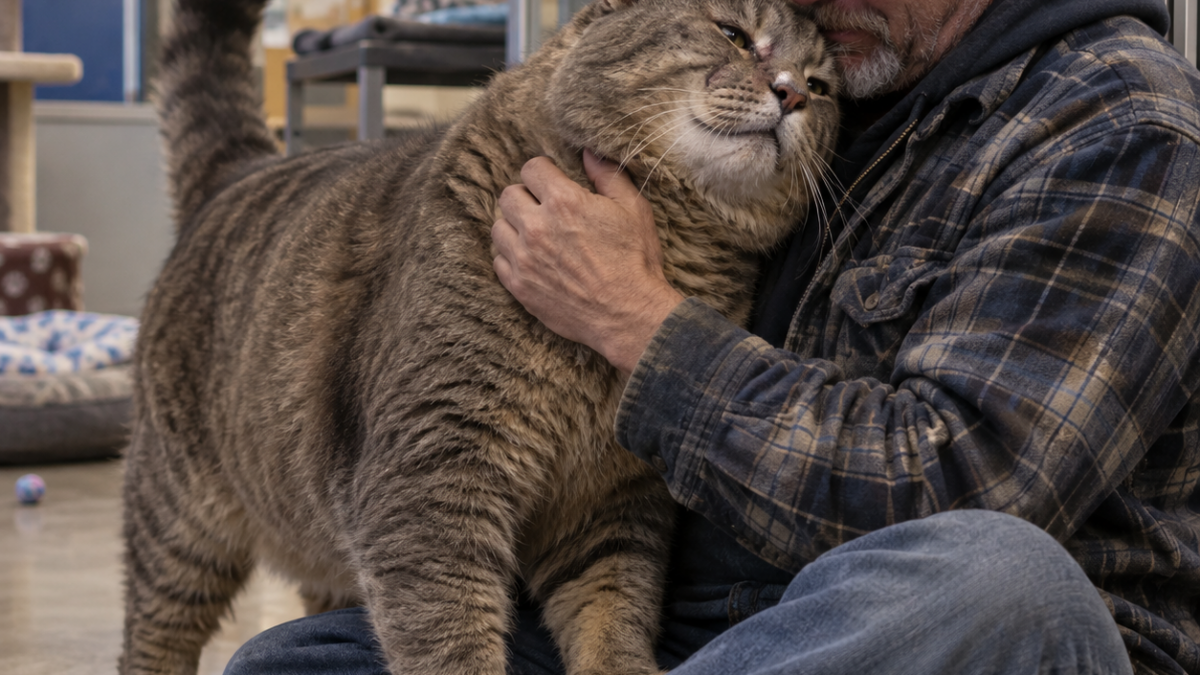
Not fluffy-large.
Solid-large.
He looked like someone had poured a cat into a concrete mold and then given it whiskers.
Broad shoulders.
Thick neck.
Enormous cheeks.
A head that seemed almost too big for his body.
His gray-brown fur was rough in places, uneven along the shoulders and sides, and a few old marks crossed his face. One ear had a small notch missing from the edge. His eyes were pale green and completely unimpressed.
He looked like he had spent years winning arguments in parking lots.
I stopped walking.
“Good grief,” I muttered. “That cat looks like I owe him money.”
Keely burst out laughing.
“That’s Rourke.”
“Rourke?”
“Yeah.”
“Of course his name is Rourke.”
“He came in with a different shelter name, but nobody used it. Rourke just fit.”
“How long has he been here?”
Her smile faded a little.
“A while.”
Something in her voice changed when she said it.
Not dramatically.
Just enough.
I looked through the glass again.
Rourke did not move.
He only kept staring.
“Is he mean?”
Keely shook her head.
“No.”
“Because he looks like he collects debts.”
“He looks like that,” she said. “He doesn’t act like that.”
She told me Rourke had spent years living outdoors before someone finally trapped him and brought him in. Nobody knew exactly where he had come from. He had been seen around apartment dumpsters, behind a tire shop, near a storage facility on cold mornings. People fed him sometimes, but nobody claimed him.
Street life had left marks.
Old bite scars.
Dental problems.
Ear mites.
Fleas.
A wound on one shoulder that had healed badly.
A few bloodwork concerns the staff was still monitoring.
“He’s doing much better now,” Keely said. “But he’ll need someone willing to keep up with vet care.”
I crossed my arms.
“Sounds expensive.”
“It can be.”
“You really know how to sell a cat.”
She smiled again.
“I’m not selling him. I’m answering honestly.”
I looked at Rourke.
He still had not blinked.
Most people, Keely said, wanted kittens. Or young cats with clean coats and playful faces. Cats that looked cute in photographs. Cats that made children squeal. Cats people could imagine curled neatly on a white couch without shedding evidence of every difficult year they had survived.
Rourke did not fit that description.
Rourke looked like he would file a complaint if your couch was too soft.
“He’s actually our biggest baby,” Keely said.
I looked at her.
“That guy?”
“Open the door.”
I almost laughed because I thought she was joking.
She wasn’t.
“I’m not a cat person.”
“Didn’t ask if you were.”
“I’ve never owned one.”
“He won’t quiz you.”
“What if he bites?”
“He might head-butt you aggressively.”
“That’s a thing?”
“With him, yes.”
I should have walked away.
Instead, I opened the glass door.
Rourke stared at me for a moment.
Then he stood.
He was even bigger in motion, all heavy paws and broad chest. I expected him to retreat into the back corner, or at least pause long enough to decide whether I was worth his time.
He did neither.
He walked directly toward me.
Without hesitation, he placed one paw on my boot, lifted his enormous head, and pushed his face straight into my chest.
Hard.
Like he was trying to climb inside my jacket.
Then he began to purr.
It was not a polite purr.
Not the delicate little vibration I had heard from cats in movies.
This sounded like an old lawn mower trying to start in cold weather.
I could feel it through my shirt.
I stood there awkwardly, one hand hovering in the air because I had no idea where it was acceptable to touch a cat the size of a bowling ball.
Keely smiled from the doorway.
“He does that when he likes someone.”
Rourke leaned harder.
“He’s going to knock me over.”
“That means he likes you a lot.”
“I brought towels.”
“Apparently that was enough.”
I finally set one hand on his back.
His fur felt rougher than I expected, thick but uneven, as if life outdoors had taught it to become armor. Beneath it, he was warm and solid. When I scratched gently between his shoulders, his purr deepened.
For a cat who had spent years surviving on his own, he had no interest in acting tough once someone offered affection.
He just wanted to be close.
A hand resting on his back.
A chest to lean against.
Someone sitting beside him.
Someone who would not leave the moment he stopped looking impressive.
I stayed there much longer than I planned.
Keely eventually sat on the floor outside the room and pretended to update paperwork while Rourke leaned against me like I had been assigned to him.
I cleared my throat.
“I work nights.”
Keely nodded.
“My house is small.”
Another nod.
“I don’t know anything about cats.”
“That can be learned.”
“I’m gone eight, sometimes ten hours.”
“Cats sleep a lot.”
“I don’t have climbing things.”
“He’s not asking for a gym membership.”
“I’m not looking for a pet.”
Keely looked at Rourke, who was now pressing his cheek into my sternum with absolute commitment.
“Maybe he wasn’t asking what you were looking for.”
That annoyed me because it sounded like something Maren would say.
I stepped away eventually.
Rourke looked up at me.
There was no drama in it.
No pleading.
No sad paw against the glass.
He simply watched.
That made it worse.
Dogs begged with their whole bodies.
Cats, apparently, gave you one chance to make the correct decision and then let you live with yourself.
“I should go,” I said.
Keely did not try to talk me into anything.
Somehow, that made leaving harder.
I drove home without him.
That night, I sat at my kitchen table eating leftover meatloaf while the television played in the living room.
Nobody was watching.
The house made its usual sounds.
Furnace kicking on.
Refrigerator humming.
A truck passing outside.
I chewed without tasting much.
I kept thinking about that ridiculous cat pressing his forehead against me as if we had known each other for years.
I told myself he would be fine.
Someone else would adopt him.
Someone who knew about cats.
Someone home during the day.
Someone better suited to managing medications, vet appointments, and whatever else came with a fifteen-pound former street boss who looked like he had unresolved business with the world.
I carried my plate to the sink.
The television kept talking in the other room.
I stood there with both hands on the counter.
For the first time in a long while, the noise bothered me.
It sounded fake.
The following evening, Maren called.
I had sent her a picture of Rourke without giving it much thought.
That was another lie.
I had sent the picture because some part of me wanted someone else to tell me what to do.
“So,” she said, “when are you bringing him home?”
“I’m not.”
“Why not?”
“He doesn’t need me.”
There was a brief silence.
Maren had inherited her mother’s patience and my ability to hear weakness in a sentence.
“Dad,” she said, “I think you two are both pretty good at pretending that’s true.”
I had no answer.
“He’s got medical problems.”
“So do half the men you work with. You still talk to them.”
“I’ve never owned a cat.”
“You never owned a daughter before me. You figured that out.”
“That is not the same.”
“No, cats are probably easier. Less college tuition.”
I almost smiled.
“I work nights.”
“You sleep days.”
“Sometimes.”
“You also sit in that house pretending the TV is company.”
I looked toward the living room.
The television was on.
Again.
“I’m fine.”
“Dad.”
One word.
A daughter’s whole argument.
I rubbed my forehead.
“I just dropped off towels.”
“Maybe that’s how he found you.”
“I don’t believe in that stuff.”
“You believe in routine because it keeps you from having to want anything.”
That irritated me.
Mostly because it was too close.
“I’m not lonely enough to adopt a cat out of guilt.”
“I didn’t say you were.”
“You implied it.”
“No,” she said gently. “I’m saying you sounded different when you talked about him.”
“I talked about how ugly he was.”
“You sent me three photos.”
“He’s unusual.”
“You said he looked like a debt collector.”
“He does.”
“And then you told me he purred into your chest.”
I said nothing.
Maren softened.
“You don’t have to bring him home. But don’t pretend the reason is that he doesn’t need anyone.”
After we hung up, I sat in the recliner with the remote in my hand.
I did not turn the volume up.
Two mornings later, after finishing my shift, I drove back to the shelter.
I had not called ahead.
I told myself I was only going to check on him.
It was barely after nine, and my body felt like it belonged to someone else. Night shifts do that. They blur your edges. You walk around in daylight feeling like the world started without asking you.
The shelter lobby was quieter than Saturday. A woman at the counter was filling out surrender paperwork with her head down. A volunteer carried a laundry basket through the hall. Somewhere, a dog barked three times and stopped.
I went straight to the glass room.
Rourke’s enclosure was empty.
My stomach dropped.
For one foolish moment, I felt angry.
Then embarrassed.
Of course someone had adopted him.
That was the whole point, wasn’t it?
He needed a home.
Someone gave him one.
Good.
That was good.
So why did I feel like I had missed a train I had not admitted I meant to catch?
Keely appeared around the corner.
“You okay?”
“Rourke’s gone.”
She studied my face for half a second longer than necessary.
Then smiled.
“He’s in the back getting checked out.”
The relief must have shown because her smile widened.
“You thought he was adopted.”
“No.”
“You did.”
“I was making an observation.”
“Your observation looked devastated.”
“I work nights. My face does things.”
“Sure.”
A minute later, I heard a rough little meow coming from down the hallway.
Then another.
Rourke appeared around the corner with a staff member holding his leash harness. He looked deeply offended by whatever medical indignity had just occurred.
The instant he spotted me, he began pulling toward me.
Not gracefully.
Rourke did not do anything gracefully.
He hauled his big body forward, claws clicking lightly against the floor, eyes locked on me like I had missed an appointment.
I knelt before I realized I was moving.
He walked straight into my arms.
Same enormous head.
Same ridiculous cheeks.
Same deep, rumbling purr.
But this time, I did not step away.
I put both hands around him and held on.
Keely said nothing.
That was kind of her.
Rourke pressed his forehead beneath my chin. I could feel the purr through my bones.
“I have no idea what I’m doing,” I muttered.
Keely handed me a clipboard.
“Most adopters don’t.”
“I’m not saying yes.”
“That’s adoption paperwork.”
“I can read.”
“You’re holding the pen.”
I looked down.
Somehow, I was.
The process took longer than I expected.
Rourke had a medical disclosure form.
Dental disease.
Previous skin infection.
Follow-up bloodwork recommended.
Weight monitoring.
Indoor-only home strongly advised.
Slow adjustment period.
Possible food sensitivities.
“Possible?” I asked.
Keely made a face.
“He has opinions about wet food.”
“How many opinions?”
“Several.”
“Great.”
She walked me through everything.
Feeding.
Litter boxes.
Scratching posts.
Medication.
Signs of stress.
How to introduce him to the house.
How not to take it personally if he hid.
“He doesn’t seem like a hider.”
“No,” she admitted. “He mostly seems like a man who has been waiting for service.”
I signed.
Paid the adoption fee.
Bought supplies from the little shelter store because I had nothing ready at home.
Litter box.
Litter.
Food.
Bowls.
A cat bed.
Two toys Keely said he might ignore.
A scratching post that barely fit in my truck.
Rourke entered the carrier only after three staff members, one towel, and several negotiations involving treats.
On the drive home, he complained for twenty minutes.
Not panicked.
Not terrified.
Complained.
A rough, gravelly meow every thirty seconds, each one sounding like he had more to say about my driving.
“I understand you’re upset.”
Meow.
“I didn’t design the carrier.”
Meow.
“I’m new at this.”
Longer meow.
“Noted.”
When I pulled into my driveway, I sat for a moment with both hands on the wheel.
The house looked the same.
Small porch.
Peeling paint near the side window.
One lonely chair visible through the living-room glass.
But something had changed before we even went inside.
The quiet waiting behind that front door was no longer empty.
It had a witness now.
A fifteen-pound, debt-collecting, street-fighting witness with medical paperwork and strong opinions.
I carried him in.
Rourke went still the moment we crossed the threshold.
I had prepared nothing properly, so I set him up in the spare room that still held boxes of Maren’s childhood books and a broken lamp I had meant to throw away for three years. I placed the litter box in one corner, food and water in another, the bed beside the wall.
Then I opened the carrier.
Rourke stepped out.
Slowly.
He sniffed the floor.
The bed.
The food.
The baseboard.
My boot.
Then he turned and walked out of the room.
“Hey.”
He ignored me.
“Keely said slow adjustment.”
He continued down the hallway.
“You are not following the instructions.”
He entered the living room, looked around as if assessing property value, then jumped onto the far end of the couch.
I stood in the hallway holding the carrier.
“Well,” I said. “Good talk.”
That first evening, I sat in my recliner and turned on the television out of habit.
Rourke sat at the far end of the couch.
He watched me.
Then the television.
Then me again.
After about ten minutes, he shifted closer.
Then a little closer.
Finally, he placed his enormous head on my thigh and fell asleep.
The television was still on.
A man in a commercial was talking about gutter protection.
I reached for the remote and turned it off.
The silence that followed surprised me.
For the first time in years, my house was completely quiet.
No background noise.
No voices pretending to be company.
Only the furnace, my own breathing, and Rourke’s deep, uneven purr.
For the first time in years, I did not mind the quiet.
The first week was not smooth.
That is another thing people leave out of adoption stories.
They skip from the emotional first moment to the cozy ending, as if love turns automatically into routine.
Rourke did not understand my schedule.
Or maybe he understood and objected.
The first time I left for my night shift, he stood by the door and stared at me with such silent accusation that I nearly called in sick.
“I have to work,” I told him.
He blinked.
“Food costs money.”
No reaction.
“Your food costs more than mine.”
Still nothing.
When I came home after midnight, he was waiting in the hallway.
Not at the door.
That would have seemed too eager.
He sat four feet away, broad chest forward, tail wrapped around his paws, expression flat.
“You’re awake.”
Meow.
“That sounds judgmental.”
Meow.
“I came back.”
He stood, walked to me, and pressed his head hard against my shin.
That became our first ritual.
I came home.
He pretended not to have waited.
Then he forgave me by head-butting my leg with enough force to threaten my balance.
The second ritual involved food.
Keely had warned me he had opinions.
She had understated the matter.
Rourke rejected three brands of wet food by sniffing them, looking at me, and walking away with the disgust of a retired judge.
“You lived behind a tire shop,” I reminded him. “You cannot be this selective.”
He sat with his back to me.
I called Keely.
“What did he eat at the shelter?”
She laughed.
“That bad?”
“He looked offended by chicken.”
“He prefers turkey.”
“I gave him turkey.”
“What texture?”
“There are textures?”
“Oh, you’re learning.”
Rourke liked pâté.
Sometimes.
Chunks in gravy, but only one brand.
Dry food, but only from a wide bowl.
Water, but preferably from a glass I had just poured for myself.
I bought a fountain after finding him with his face inside my water cup for the third time.
“You are expensive,” I told him.
He drank from the fountain exactly once, then returned to stealing from my cup.
Medical care was harder.
At his first follow-up appointment, Rourke protested the carrier so loudly that my neighbor came outside.
“Everything okay?”
“Cat.”
She leaned around me and looked at the carrier.
Rourke let out a sound like a rusty door being murdered.
My neighbor stepped back.
“Big cat.”
“Yes.”
“Friendly?”
“Depends how he feels about you.”
Rourke’s vet was Dr. Alameda, a calm woman with silver glasses and the fearless hands of someone who had examined far worse creatures than Rourke.
“He’s handsome,” she said.
Rourke looked suspicious.
“He looks like a bar bouncer,” I said.
“A handsome bar bouncer.”
She checked his teeth, skin, ears, and old scars. Rourke tolerated everything until she attempted to look in his mouth, at which point he placed one giant paw against her wrist and pushed.
Not scratched.
Pushed.
“Boundary noted,” she said.
His bloodwork improved slowly over the next month. His skin healed. He gained a little weight, then was instructed not to gain much more, which offended both of us because I had only just learned what he would eat.
One tooth needed extraction.
I worried about that more than I expected.
The night before the dental procedure, I sat on the couch with Rourke’s head on my thigh.
“You’ll be fine.”
His purr rumbled.
“I’m not worried.”
Purr.
“I am maybe a little worried.”
He rolled partly onto his side.
“You don’t care.”
He stretched one paw against my knee.
“Fine. I care.”
That was the first time I said it aloud.
Not love.
Not yet.
Care.
It seemed safer.
Smaller.
But words do not become less true because you choose cautious ones.
The morning I dropped him at the clinic, he looked at me from inside the carrier with the expression of a man betrayed by his driver.
“I’ll come back.”
His eyes stayed on me.
“I will.”
At work that night, I checked my phone every break even though the clinic had already called to say the extraction went well.
When I picked him up, he was groggy and furious.
He refused to look at me until we got home.
Then he climbed into my lap, turned in a clumsy circle, and fell asleep against my stomach.
I sat there for nearly two hours.
My legs went numb.
I did not move.
A month after Rourke came home, Maren visited.
She texted from the airport:
Prepare the beast.
I replied:
He is not a beast.
Then looked at Rourke sprawled across half the couch, one paw in the air, mouth slightly open, snoring.
Fine. He is a beast.
When Maren walked through the door, Rourke did not hide.
He rose from the couch, stretched with great ceremony, and walked toward her.
Maren froze.
“Dad.”
“What?”
“He’s huge.”
“I told you.”
“No, you said big. That is not a cat. That is a retired linebacker.”
Rourke sniffed her suitcase.
Then her shoes.
Then her hand.
After a moment, he pushed his head against her knee.
Maren’s face softened instantly.
“Oh.”
“Yeah,” I said.
She crouched.
Rourke leaned into her hand.
“Oh, Rourke.”
The way she said his name made something in my chest loosen.
For months, I had worried Maren would see my life exactly as it was: too quiet, too narrow, too full of habits designed to hide loneliness. I had worried she would feel responsible for it. Children can do that even after they grow up.
But when she looked around my house that weekend, she did not look sad.
She looked relieved.
There was cat hair on the couch.
A scratching post by the window.
A food mat in the kitchen.
A toy mouse under the recliner.
A living creature complaining from the hallway because no one had refilled his stolen water cup.
“You seem better,” Maren said that first night.
“I’m the same.”
She looked at me over her mug of tea.
“You are absolutely not.”
I scratched Rourke’s enormous cheek.
“People misread him.”
Maren smiled.
“Yeah?”
“They see the scars. The size. The face.”
“The debt-collector face.”
“Exactly.”
Rourke purred.
“They think he’s tough.”
“He is tough,” she said.
“Maybe. But mostly he wants to sit on someone.”
Maren looked at me for a long moment.
“Guess people used to misread you too.”
I stared at the floor.
She did not say anything else.
She simply stepped forward and wrapped her arms around me.
For a second, I stood there stiffly, as if I had forgotten how fathers were supposed to receive comfort from daughters.
Then I hugged her back.
Rourke stood between us, purring like an old lawn mower.
That weekend, Maren took photographs of him.
Rourke in the window.
Rourke on the couch.
Rourke sitting beside my boots.
Rourke looking personally offended by a feather toy.
She took one photo of me asleep in the recliner with Rourke stretched across my chest, one of his giant paws tucked beneath my chin.
I did not know she had taken it until she sent it to me after she flew home.
Under it, she wrote:
Two tough guys pretending they don’t need anybody.
I saved the photo.
Then, for reasons I still do not fully understand, I printed it.
It sits on my refrigerator now.
Time changed after that.
Not dramatically.
No great transformation.
I did not become a new man.
I still worked nights.
Still ate leftovers.
Still forgot to buy vegetables unless Maren reminded me.
Still answered “fine” sometimes when I did not feel like explaining myself.
But the house changed.
Rourke gave the rooms a rhythm.
Morning, for me, came after work. Midnight was our evening. I would come home tired, shoulders aching, and he would meet me in the hallway with that same stern expression, then push his head into my leg like he was stamping my return as acceptable.
I started cooking real food again because Rourke sat in the kitchen and watched me with interest.
Not because he cared about nutrition.
Because he wanted turkey.
Still, it worked.
I fixed a squeaky cabinet I had ignored for two years because the sound startled him.
I cleared the spare room because he liked sleeping in the afternoon sun there.
I bought a second blanket for the couch because he had claimed the first one.
I began talking to him.
At first, small things.
“Move.”
“You’re heavy.”
“That’s my chair.”
“No, you cannot have coffee.”
Then larger things.
“Maren says she might move back someday.”
“My knee hurts today.”
“Your vet bill cost more than my first truck.”
“Your purr sounds like bad machinery.”
He listened better than most people.
Or maybe he ignored me with more kindness.
Some nights, the old loneliness still came.
That surprised me.
I thought adopting him might erase it.
It did not.
Loneliness is not a light switch.
It is more like weather.
Some days clear.
Some days heavy.
But Rourke changed what happened when the weather came.
Before him, I filled the quiet with television.
After him, I let the quiet exist.
He would climb onto the couch beside me, press his scarred face against my side, and purr. Not to fix anything. Not to cheer me up. Just to be there.
Presence is different from rescue.
I learned that from a cat.
The first winter was when I understood how much he trusted me.
Snow had fallen all day, and by the time I got home from work, the driveway was half buried. I shoveled at one in the morning under the porch light, muttering about my back and the city plows. When I finally came inside, soaked and freezing, Rourke was waiting near the door.
“Don’t start,” I said.
He meowed.
“I was outside maintaining your estate.”
He followed me to the bedroom while I changed. Then to the kitchen while I heated soup. Then to the recliner, where I sat down with a blanket over my knees.
Rourke climbed onto me.
Not beside me.
Onto me.
All fifteen pounds of him settled against my chest.
His head tucked beneath my chin.
His purr started.
I put one hand on his back.
For a moment, the house was perfectly still.
Outside, snow tapped softly against the windows.
Inside, I could feel his breathing.
I thought about all those years he had spent outdoors.
Cold pavement.
Dumpsters.
Cars.
Strangers.
Fights.
Whatever else.
Now he slept heavily, completely, trusting that the room would remain warm and the man beneath him would not disappear.
That kind of trust is not cute.
It is holy.
I stayed awake longer than I needed to, one hand resting on his scarred back, listening to him breathe.
A year later, Rourke looked different.
Still huge.
Still tough-faced.
Still vaguely criminal.
But his coat had softened. His eyes were brighter. The old wound on his shoulder no longer looked angry. He had learned the house, my schedule, Maren’s ringtone, and the exact sound of a turkey container opening.
He had also learned that the bed was superior to all beds purchased for him.
Every night, or rather every morning after my shift, he slept against my side.
If I rolled over, he complained.
If I moved too much, he placed one heavy paw on my arm.
If I slept through my alarm, he stood on my chest until consciousness returned.
My doctor said having a pet could be good for blood pressure.
I did not mention the chest-standing.
On the anniversary of his adoption, Keely sent me a message through the shelter’s page.
How’s our big guy?
I sent a photo of Rourke asleep upside down on the couch, belly exposed, one fang visible.
Her reply came quickly.
I’m crying at work. Look what safe does.
Look what safe does.
I stared at those words.
Then looked at Rourke.
His scars were still there.
His ear still notched.
His cheeks still enormous.
He still looked like a cat who knew where bodies were buried.
But safety had changed the parts of him people could not see at first.
Maybe it had changed me too.
Maren came home again that summer.
This time, she brought a man named Nolan she had been dating for eight months. I prepared to dislike him on principle.
Rourke did not.
Nolan entered with a duffel bag and a cautious smile.
Rourke walked up, sniffed him, and immediately pressed his head against Nolan’s shin.
Maren laughed.
“Well, that settles it.”
“Not necessarily,” I said.
Rourke purred.
“Traitor.”
Nolan proved difficult to dislike.
He helped fix the back fence.
Brought Maren coffee without asking.
Asked me questions about warehouse work and listened to the answers.
Most importantly, when Rourke climbed into his lap after dinner, Nolan remained perfectly still for forty minutes even after his foot fell asleep.
“You can move him,” I said.
Nolan looked down at Rourke.
“I don’t think I can.”
“Physically or emotionally?”
“Both.”
I approved reluctantly.
That night, Maren helped me wash dishes.
“You like him,” she said.
“He’s fine.”
She smiled.
“One word that can hide an entire life.”
I groaned.
“Don’t use my own sayings against me.”
“You raised me.”
“I regret teaching you language.”
She bumped her shoulder against mine.
“You seem happy, Dad.”
I dried a plate.
“I seem?”
“You are?”
I looked into the living room.
Rourke was asleep on Nolan’s lap, apparently betraying me completely.
“I’m better,” I said.
It was the truest answer I had.
Years pass differently when there is someone to feed.
That sounds small.
It is not.
A creature’s needs pin you gently to the world.
Rourke needed breakfast.
Water.
Medicine sometimes.
Annual checkups.
A warm place by the window.
A hand on his back.
Someone to notice if he ate less.
Someone to open the door but not let him out.
Someone to come home.
In caring for him, I accidentally began caring for myself.
I went to my own doctor because I thought about how unfair it would be if something happened and no one knew Rourke’s food preferences.
I cleaned the house more often because litter tracked everywhere.
I visited Maren more because she insisted Rourke was not enough socialization for “a full human adult.”
I even invited two men from work over to watch a game.
Rourke sat between us on the couch and judged their snacks.
One of them, Steve, scratched Rourke’s head and said, “This cat looks like he’s done prison time.”
“He’s reformed,” I said.
Rourke stole a piece of turkey from Steve’s plate.
“Mostly.”
When Rourke turned what the vet estimated was ten, his health shifted.
Nothing dramatic.
Not at first.
A little stiffness.
A little less jumping.
More sleeping.
His bloodwork showed early kidney changes.
Dr. Alameda explained the plan.
Diet adjustment.
More monitoring.
Plenty of water.
Follow-up tests.
I listened, nodded, and asked questions like a responsible adult.
Then I sat in my truck afterward and cried so hard I fogged the windshield.
Not because he was dying right then.
He wasn’t.
Because someday he would.
That is the trap of loving animals.
You take them home knowing the ending is already unfair.
Rourke sat in his carrier on the passenger seat, looking irritated by my emotional display.
“I know,” I said, wiping my face. “You’re fine.”
Meow.
“I’m fine too.”
Meow.
“Don’t start with me.”
He blinked.
I laughed despite myself.
We managed the kidney disease.
Special food.
More water cups around the house because he still preferred stolen water to fountain water.
Medication when needed.
Regular labs.
For a cat who had once survived outdoors, he became remarkably offended by veterinary appointments. He would complain the entire drive, then charm every technician by smashing his head into their hands.
“Big baby,” one of them said.
“Yes,” I said. “But he has a reputation to protect.”
At home, he slowed but remained Rourke.
He still met me after work.
Still head-butted me.
Still slept with his body pressed against mine.
Still glared at the television if it was too loud.
Eventually, I stopped turning the television on at all unless I actually wanted to watch something.
That might not sound like a miracle.
It was.
The house did not need borrowed voices anymore.
It had its own.
The creak of floorboards under Rourke’s paws.
His rough meow.
His purr.
My voice answering him.
Maren’s calls on speaker.
Sometimes laughter.
Sometimes quiet.
Real quiet.
Not empty.
When people ask what Rourke gave me, they expect a simple answer.
Companionship.
Purpose.
Love.
Those are true, but not enough.
Rourke gave me back the ability to be seen without performing.
That old cat did not care whether I was fine.
He never believed the word.
He knew routines.
Weight.
Silence.
The difference between a man sitting peacefully and a man disappearing into his own house.
On bad days, he came closer.
On good days, he demanded food.
On all days, he expected me to return.
Expectation can be a form of love.
Maren once told me, “You sound less like you’re reporting from your life and more like you’re living in it.”
I pretended not to understand.
I understood.
One evening, years after I first dropped those towels at the shelter, I found myself standing in the hallway closet.
The shelf was full again.
Old towels.
Blankets.
A flannel sheet with a tear near one corner.
I loaded them into bags.
Rourke watched from the bedroom doorway.
“You started this,” I told him.
He meowed.
“I’m serious.”
He blinked slowly.
The next Saturday, I drove back to the shelter.
Keely still worked there, though now she had a different haircut and more gray in her curls. She recognized me immediately.
“Rourke’s dad.”
I had been called worse.
I handed over the bags.
She looked inside.
“More shelter diamonds.”
“How are things?”
“Busy. Always.”
I glanced toward the glass room.
There was a different cat inside now.
Small.
Orange.
Missing one eye.
He sat with his back to visitors.
“Does that one have a name?”
Keely smiled.
“Turnip.”
“Turnip?”
“He came with the attitude.”
I looked at the little cat.
He did not turn around.
“People interested?”
“Some. Until they notice the eye.”
I stood there longer than I meant to.
Keely said nothing.
I pointed at the door.
“Can I say hello?”
She opened it.
Turnip did not head-butt me.
He did not climb into my jacket.
He did not purr like machinery.
He stayed where he was, back turned, pretending the world behind him did not matter.
I sat on the floor anyway.
Not because I planned to adopt another cat.
I didn’t.
Rourke would never tolerate that without negotiations and possibly lawyers.
I sat because I had learned something from an old scarred cat with enormous cheeks.
Sometimes the ones who look least likely to want comfort are the ones measuring whether comfort can be trusted.
Turnip looked over his shoulder after ten minutes.
“That’s fine,” I said.
He turned away again.
“Take your time.”
Keely watched from the hall.
I thought about the morning I almost left Rourke behind.
How close I had come to letting fear dress itself up as practicality.
I did not adopt Turnip.
A young woman did three weeks later.
Keely sent me a picture.
Turnip asleep under a pink blanket, one eye closed, looking completely ridiculous.
I showed Rourke.
“Look. You inspired community service.”
Rourke sniffed the phone and walked away.
Humble as always.
Rourke is older now.
His muzzle has gone lighter around the whiskers. His walk is slower. He no longer jumps onto the couch every time; I bought steps for him, which he ignored for two weeks before deciding they had always been his idea.
He still looks like he has unpaid invoices to collect.
But when he sleeps, his face softens.
The hard years fall away.
He becomes what Keely knew he was from the beginning.
A big baby.
A survivor tired of surviving.
A tough-looking creature who never wanted toughness as much as he wanted someone to stay.
Sometimes, late at night after work, I sit in the recliner with Rourke pressed against me, and I think about the man I was the day I brought those towels.
I thought I had made my life simple.
Work.
Food.
Television.
Sleep.
Repeat.
But there is a kind of simple that is peaceful, and another kind that is only empty with the lights organized neatly around it.
Rourke complicated my life.
Food brands.
Vet bills.
Cat hair.
Medicine.
Litter.
Worry.
A creature who notices when I am late.
A daughter who now asks about him before asking about me because she knows that is the same question in a different shape.
He complicated everything.
Thank God.
I used to believe needing no one made me strong.
Rourke never believed that.
Maybe because he had tried it longer than I had.
He had lived outdoors.
Fought.
Endured.
Survived.
And the moment someone opened a door, he walked in and pressed his head against a stranger’s chest with all the honesty I had been avoiding for years.
That was his courage.
Not the scars.
Not the street years.
Not the debt-collector face.
The head-butt.
The purr.
The refusal to act like loneliness was dignity.
He knew what he wanted.
Warmth.
Touch.
A person.
A home.
It took me longer.
But I got there.
Tonight, the television is off.
The house is quiet.
Rourke is asleep beside me, heavy head resting against my leg, one paw stretched over my knee as if keeping me in place.
Outside, the street is dark.
Somewhere across town, night-shift workers are clocking in, families are finishing dinner, and maybe another man is telling someone he is fine because he does not know how else to explain an empty house.
I hope he meets his version of Rourke.
Not necessarily a cat.
Not necessarily a shelter animal with battle scars and a head too big for his body.
Just something alive enough to interrupt the lie.
Something that walks straight through the door he thought he was only opening for a minute.
Something that reminds him that being needed is not weakness.
That being loved does not require looking soft enough to deserve it.
That quiet can feel different when someone is breathing beside you.
I thought I was giving a former stray a home.
But somewhere along the way, Rourke gave me one too.
He reminded me that looking tough and actually being okay are two very different things.
He taught me that the ones who seem like they do not need anyone are often the ones who have been waiting the longest for someone to choose them.
And he proved that sometimes, the cat you never intended to adopt is the one who quietly brings warmth back into your life.
Rourke lifts his head now and looks at me.
Pale green eyes.
Scarred face.
Ridiculous cheeks.
Still unimpressed.
“What?” I ask.
He meows once.
Dinner, probably.
Or water from my cup.
Or maybe just acknowledgment that I am still here.
I set my hand on his back.
His purr starts under my palm.
Deep.
Rough.
Steady.
The old lawn mower sound.
The sound of something that survived long enough to be safe.
I smile into the quiet.
“I know,” I tell him.
And this time, for once, I think I do.








