I Adopted the Sick Senior Cat Nobody Wanted—Then the Family Who Abandoned Her Came Back Asking for Her
PART3:
Need has a sound when it has nowhere to go.
I tried not to look too closely.
That sounds cowardly.
Maybe it was.
But sometimes looking feels like making promises.
The cat room was quieter.
Not peaceful, exactly.
Cats have their own way of carrying stress. Some hide. Some stare. Some perform affection like a survival strategy. Some sleep so hard they look absent from their own bodies.
We were sorting through donated blankets and food when I noticed the kennel in the far corner.
It was away from the kittens.
Away from the bright center of the room where visitors naturally gathered.
Inside, curled on a folded towel, was a white cat.
At least, I thought she was white.
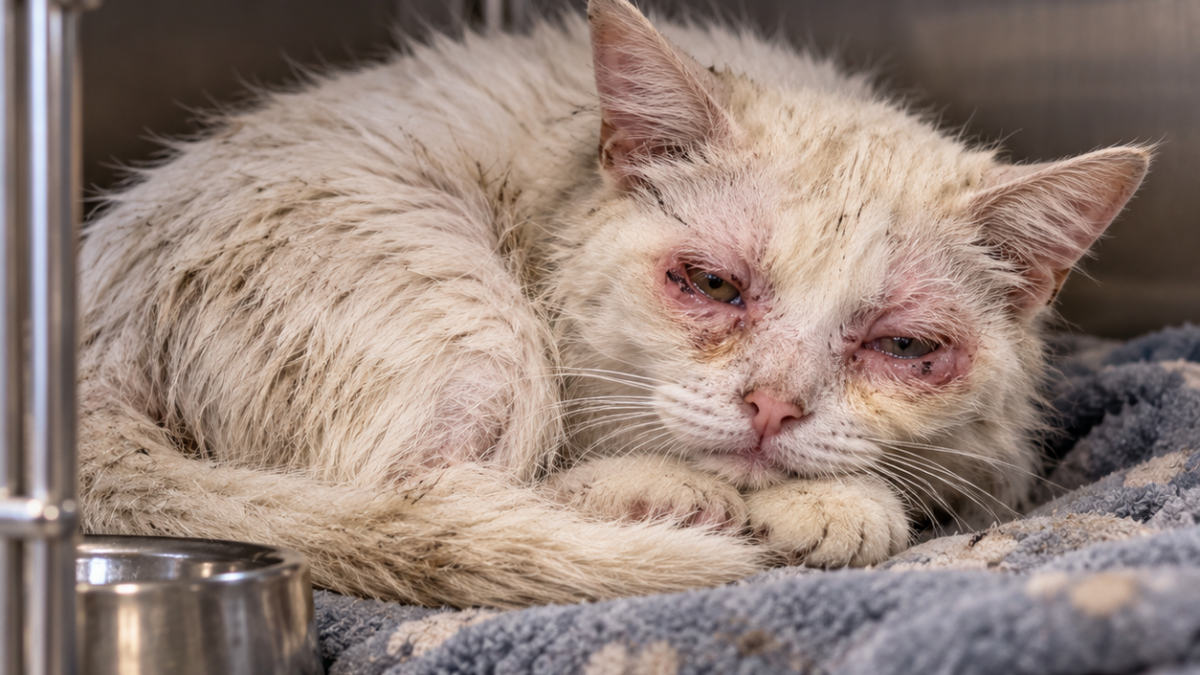
Her fur was dirty and yellowed in patches, flattened along her sides from lying too much. Both of her eyes were swollen and irritated, the skin around them pink and raw. Dried discharge clung beneath the corners. She looked exhausted in a way I recognized too well.
Not sleepy.
Defeated.
I stopped folding.
“What’s wrong with that one?”
Melissa followed my gaze.
Her face changed.
“That’s Pearl.”
“What happened to her?”
“She was surrendered last week.”
I assumed she meant found.
Dropped off.
Rescued from outside.
Something involving bad weather and worse luck.
“She was someone’s cat?”
Melissa nodded.
“For almost her whole life.”
“How old is she?”
“Ten.”
The number landed strangely.
Ten years old.
Not ancient.
Not young.
Old enough to have routines.
Old enough to know voices.
Old enough to know where the sun hit the floor in her home.
Old enough to understand being taken somewhere and left.
“Why did they surrender her?”
Melissa folded one towel too carefully.
“They were moving.”
“That’s it?”
“And she had medical needs.”
I looked back at Pearl.
She did not look up.
“What kind?”
“Eye infection. Pretty serious, but treatable. Some dental issues. Mild arthritis. Nothing unmanageable.”
“Was she dying?”
“No.”
“Was she in pain?”
“Probably uncomfortable. That’s why she needed care.”
Pearl shifted slightly on the towel and tucked her face away from the light.
People moved around her.
A little orange kitten two kennels down began batting at a toy mouse hanging from a string. A child squealed. Someone laughed. The kitten stood on his hind legs, missed the toy, fell over, and immediately became the most interesting creature in the room.
Pearl did not react.
It was like she had stopped expecting anyone to choose her.
I told myself I was only noticing.
That was the first lie.
Over the next week, I asked about her every time Melissa mentioned the shelter.
“How’s the white cat?”
“Pearl?”
“I guess.”
“She’s eating a little.”
“Good.”
A few days later:
“Did the medication help?”
“Some.”
“Any applications?”
“For Pearl?”
“Yes, for Pearl.”
Melissa sighed.
“No.”
Another week passed.
I went back with Melissa under the excuse of dropping off old blankets from my linen closet. They were not even old. I had pulled two perfectly good ones from the guest room because I needed a reason to be there.
Pearl was in the same corner kennel.
Her eyes looked slightly better, though still swollen. Her fur had been cleaned somewhat, but she remained thin beneath it. She sat upright this time, paws tucked beneath her chest, watching the room through half-open eyes.
I crouched in front of her.
“Hi.”
She did not move.
“I’m Claire,” I said, because apparently I had become the kind of woman who introduced herself to cats that looked offended by existence.
Pearl blinked slowly.
Not the sweet, theatrical slow blink people post about online.
This was more like she could barely afford the effort.
“I heard you’re dramatic.”
Nothing.
“I respect that.”
Her ears twitched.
I came back three days later.
Then again.
By the fourth visit, the shelter staff no longer pretended not to notice.
A woman named Tessa, one of the adoption coordinators, leaned against the counter while I signed in.
“You know you can ask to sit with her.”
“I’m just visiting.”
“Right.”
“I am.”
“Of course.”
“Don’t use shelter psychology on me.”
Tessa smiled.
“I don’t have to. Pearl already is.”
The first time they let me sit with her in a visiting room, she stayed under the chair for twenty-seven minutes.
I know because I watched the clock.
I sat on the floor with my back against the wall and pretended to look at my phone while Pearl hid in the shadow beneath a plastic chair, her tail wrapped tightly against her body.
I did not reach for her.
That felt important.
My entire life as a mother had been about reaching.
Reaching for feverish foreheads.
Reaching for lunchboxes forgotten on counters.
Reaching for boys who stepped away before they knew stepping away could hurt.
With Pearl, I did not reach.
I waited.
After almost half an hour, she emerged, took three steps, sniffed the toe of my shoe, and retreated again.
Tessa looked through the little window in the door.
I gave her a thumbs-up.
It was ridiculous how proud I felt.
The next visit, Pearl came out after fifteen minutes.
The next, after seven.
On the fourth, she walked directly to the edge of my skirt, smelled it, and sat down with her back to me.
Not touching.
Not affectionate.
Just near.
I cried in my car afterward.
Not a dramatic sobbing breakdown.
Just a quiet, embarrassed leak of feeling I did not know what to do with.
I told myself it was because Pearl was sad.
That was another lie.
Pearl was not the only creature in that room who had stopped expecting to be chosen.
When Tessa first mentioned fostering, I shook my head.
“No.”
“You didn’t let me finish.”
“I know where that sentence goes.”
“She needs a quieter place to recover.”
“I work full time.”
“You work nine to five.”
“I have no experience giving eye medication.”
“We teach people.”
“My house has stairs.”
“She’s a cat, not a rolling suitcase.”
“I’m not ready.”
That one made Tessa pause.
Not because it was practical.
Because it was true.
She softened.
“I’m not asking you to adopt her today.”
“No, you’re asking me to take her home and then emotionally destroy me.”
“She may emotionally improve you.”
“Same thing.”
But I took the paperwork.
I carried it in my purse for two days.
At work, I opened the forms during lunch, then closed them when I felt stupid. At home, I placed them on the kitchen counter and tried not to look at them. That lasted eighteen minutes.
Foster agreement.
Medication schedule.
Temporary care responsibilities.
Emergency contact numbers.
Pearl’s medical notes.
Age: approximately ten.
Surrender reason: owner moving / unable to manage care.
Temperament: quiet, low energy, tolerant, withdrawn.
Withdrawn.
That word did it.
Not aggressive.
Not difficult.
Not hopeless.
Withdrawn.
Like someone had pulled the cord on her life and she was still waiting in the dark.
I signed the papers the next morning.
Pearl came home on a rainy Tuesday.
Tessa helped me load her carrier into the back seat.
“She may hide for a while.”
“I know.”
“She may not eat the first night.”
“I know.”
“She needs medication twice daily for the eyes, pain management as prescribed, and the antibiotic until it’s gone.”
“I know.”
“If she stops eating completely, call.”
“I know.”
“Claire.”
I looked at her.
“You don’t have to be perfect.”
I almost laughed.
That was exactly the problem.
Mothers of nearly grown children are bad at temporary helplessness. We like solutions. Systems. Schedules. Lists. We like being able to do the right thing and watch the right thing work.
Pearl was not a homework project.
She was a living being who had lost a family, a home, and her health all at once.
“I’ll try,” I said.
“That’s all fostering is.”
Pearl cried once on the drive.
A low, rough sound from inside the carrier.
“I know,” I whispered.
Then I realized I had said that exact sentence to my boys a thousand times.
At the doctor.
During nightmares.
After scraped knees.
Before school events.
When their father moved out.
I know.
The great lie of caregiving.
Most of the time, we know almost nothing.
But we say it because the frightened thing beside us needs a voice that does not sound frightened.
At home, I had prepared the guest room.
Food.
Water.
A low-sided litter box.
A soft bed.
Two blankets.
A cardboard scratcher.
A night-light.
I had watched six videos on caring for cats with eye infections and one video about introducing senior cats to a new home. That last video featured a woman with an impossibly calm voice and a cat who seemed emotionally better adjusted than most adults I knew.
Pearl did not appreciate my preparation.
The second I opened the carrier, she bolted beneath the bed.
I lay flat on the carpet and looked under.
Two irritated eyes stared back from the shadows.
“Fair.”
She did not eat that night.
Or the next morning.
Administering her eye medication became the first test of our relationship.
Pearl hated it.
I hated it.
We both considered legal separation.
I wrapped her gently in a towel the way Tessa had shown me, but Pearl was stronger than she looked and had the moral flexibility of a courtroom attorney. She twisted, tucked her face, and somehow extracted one front paw just in time to push my hand away.
“Pearl.”
She glared.
“This is medicine.”
Glare.
“I am not doing this for fun.”
Stronger glare.
On the third attempt, I got one drop in her left eye and half of one in her right. The rest ran down my wrist.
I sat back, sweating.
Pearl retreated under the bed with the offended dignity of a queen betrayed by staff.
That first week was exhausting.
She needed medication several times a day.
Her eyes had to be cleaned.
She had veterinary appointments.
We tried different foods because she barely wanted to eat.
Some nights she hid so well I wondered if I had made a mistake bringing her home. Not because I wanted to give her back. Because I feared I had overestimated myself.
The house changed around her needs.
Alarms on my phone.
Medication charts taped to the wall.
Little bowls washed constantly.
Towels rotating through laundry.
A humidifier.
A soft lamp left on overnight.
I started coming home for lunch because she ate better when I sat in the room and pretended not to watch.
I told myself that was temporary.
Everything was temporary then.
Foster.
Medication.
My attachment.
Another lie.
One night, about two weeks in, Evan called from college.
“How’s the cat?”
“She hates me.”
“Already your child.”
“Very funny.”
“Send a picture.”
“She’s under the bed.”
“Send a picture of the bed.”
I did.
He replied with laughing emojis and then:
You sound less lonely.
I stared at the message longer than necessary.
Then typed:
She is a lot of work.
He answered:
So were we.
I sat on the edge of the guest-room bed and cried so quietly Pearl did not come out.
That was considerate of her.
Then one morning, everything changed.
It was still dark when I woke because something had touched my leg.
At first, I thought I had dreamed it.
Then I felt weight.
Light.
Careful.
Warm.
Pearl had climbed onto my bed.
Not the guest bed.
Mine.
I do not know when she crossed the hallway. I do not know how long she had stood beside the bed deciding whether to risk the jump. I only know that when I opened my eyes, she was standing near my knees, thin white body tense, eyes still not perfect but clearer than they had been when I met her.
I held my breath.
She took two small steps.
Then another.
She did not meow.
She did not ask for attention.
She simply curled up against my leg and fell asleep.
That was it.
No dramatic music.
No miracle.
No instant transformation.
A sick senior cat fell asleep against a lonely woman’s leg.
Something clicked.
I lay there completely still until my foot went numb.
The sunlight gradually touched the curtains.
A garbage truck passed outside.
My neighbor’s dog barked.
Pearl slept.
And for the first time in months, I woke up needed in a way that did not feel like being emptied.
After that, she started following me around the house.
At first from a distance.
Then closer.
Then too close, especially in the kitchen, where she behaved as if I had personally invented starvation.
She waited outside the bathroom.
She learned what time I came home from work.
She found the warm patch of sunlight beside the living-room window and claimed it as her own.
Slowly, she got better.
Her infection cleared.
Her eyes looked brighter.
Her appetite came back.
Her coat became soft after weeks of nutrition, gentle brushing, and her gradual decision that grooming was once again worth the effort.
The cat who had looked completely defeated in that shelter began acting like she had owned my house her entire life.
She had preferences.
Strong ones.
She hated salmon food.
Loved turkey.
Would not drink from a bowl unless it was wide enough that her whiskers did not touch the sides.
Considered my navy cardigan communal property.
She developed a habit of standing in the hallway and yelling at 9:30 every evening for no obvious reason.
I called Melissa the first time.
“Is she in pain?”
“What is she doing?”
“Yelling.”
“Is the food bowl empty?”
“No.”
“Litter box?”
“Clean.”
“Does she seem distressed?”
“She seems judgmental.”
“Then congratulations. She’s feeling better.”
Pearl also discovered the mirror in my bedroom.
For three days, she hissed at herself.
Then, apparently having established dominance over the strange white cat in the glass, ignored it forever.
At her six-week checkup, Dr. Navarro smiled for the first time.
“She looks like a different cat.”
“She acts like one too.”
Pearl sat on the exam table with her tail wrapped around her paws, radiating displeasure.
“Eyes are much improved,” he said. “Still some chronic irritation, likely something you’ll manage long term, but nothing like before.”
“Pain?”
“Much better. We’ll continue monitoring.”
“Quality of life?”
He looked at Pearl.
Pearl looked back as if she intended to leave him a bad review.
“I would say she has strong opinions about continuing to live.”
That night, I bought her a new bed.
She slept in the cardboard shipping box.
Naturally.
When the shelter asked if I wanted to officially adopt her, I did not even have to think about it.
Tessa called on a Thursday.
“We have to update Pearl’s foster status.”
“Okay.”
“She’s medically stable enough to be listed for adoption.”
I froze.
“Oh.”
There was a silence.
Tessa let it stretch for just long enough.
“Unless…”
“I’m adopting her.”
She laughed.
“That was fast.”
“I mean, unless there’s a reason I can’t.”
“No. I was hoping you’d say that.”
“I didn’t even ask the fee.”
“I’ll send it over.”
“I’ll pay whatever it is.”
“Careful. We’re a shelter. We will take that literally.”
I signed the papers the next morning.
Pearl was mine.
Or maybe I was hers.
It is hard to tell with cats.
That was almost three months ago.
By then, my life had a rhythm again.
Not the old rhythm.
Not the years of school pickups, laundry piles, orthodontist appointments, and teenage boys eating entire boxes of cereal in two days.
A quieter rhythm.
Pearl at the bedroom door each morning.
Medication.
Coffee.
Work.
Pearl waiting by the front window when I came home.
Dinner for both of us.
Television.
Pearl sleeping beside my leg.
Sometimes I would look around the house and realize the rooms no longer felt abandoned.
They felt occupied.
Not full.
Just alive.
Then, last week, the shelter called.
I was at my desk, half listening to a meeting about quarterly reports, when my phone lit up.
Green Hollow Animal Shelter.
My stomach tightened immediately because shelters do not call adopters three months later for fun.
I stepped into the hallway.
“Hello?”
“Claire, it’s Tessa.”
“What’s wrong?”
“Pearl is fine,” she said quickly.
I closed my eyes.
“Don’t start with shelter voice unless there’s bad news.”
“It’s not bad news exactly.”
“That means it is complicated news.”
A pause.
“Pearl’s former family contacted us.”
The hallway seemed to narrow.
“Okay.”
“They want her back.”
I did not understand the sentence at first.
“What do you mean, back?”
“They returned to the area. Their move didn’t work out, apparently, and their daughter has been struggling with losing Pearl.”
I leaned against the wall.
“They surrendered her.”
“I know.”
“I adopted her.”
“I know.”
“Legally?”
“Yes. The adoption is final.”
“Then why are we talking?”
“Because they asked if we would reach out.”
I almost laughed.
“Why would you?”
“Because they have a nine-year-old daughter who is heartbroken, and because I thought you deserved to hear it from us before they tried another way.”
That last sentence made my stomach drop.
“They know my name?”
“Not from us.”
Two days later, the mother found me through social media.
Her name was Marissa Holt.
Her profile picture showed a woman in her mid-thirties holding a little girl with curly brown hair and a missing front tooth. The message arrived at 8:14 p.m., just as Pearl was licking gravy from her dinner with the intensity of someone handling unfinished business.
Hi Claire. I know this is probably strange, but I think you adopted our cat Pearl. I’m Lily’s mom. I don’t know what the shelter told you, but we love her very much. Please, can we talk?
I read it three times.
Then I put the phone face down.
Pearl looked up from her bowl.
“No,” I said.
She returned to eating.
I did not answer that night.
Or the next morning.
Marissa sent another message.
I know you don’t owe me anything. I just want to explain what happened. My daughter has been crying for Pearl for months. She saw a picture of Pearl on the shelter page after recovery and has been asking if we can bring her home. Please. Even if the answer is no, please hear me out.
I hated that message.
Not because it was cruel.
Because it was not.
Cruelty would have been easier to ignore.
I called Tessa.
“She found me.”
“I’m sorry.”
“Did the shelter post a photo?”
“Before adoption, yes. Recovery update. No adopter information.”
“She must have recognized Pearl.”
“Probably.”
“What am I supposed to do?”
Tessa became quiet.
“That depends what you mean.”
“I mean morally.”
“Legally, Pearl is yours.”
“That is not what I asked.”
“I know.”
“What would you do?”
“That is also not fair.”
“I’m aware.”
She sighed.
“If you want my shelter answer, I would say Pearl was surrendered, treated, fostered, adopted, and is now settled in a safe home. That matters.”
“And your human answer?”
“My human answer is that a nine-year-old child may have loved her and had no control over the decision.”
I pressed my hand over my eyes.
“You’re not helping.”
“I know.”
That evening, I answered Marissa.
I wrote:
I am willing to hear what you want to say. I am not agreeing to return Pearl.
She replied within minutes.
Thank you. That’s all I’m asking.
It was not all she was asking.
We both knew that.
The messages came slowly at first.
Marissa told me they had moved out of state for her husband’s job. They had sold their house quickly. The rental they found allowed pets but then claimed Pearl’s medical care and litter box issues violated the lease terms. Her husband, Aaron, had started work immediately. Their daughter, Lily, had been struggling with the move. Pearl’s eyes had gotten worse. Money was tight after deposits, moving costs, and delayed paychecks.
“I panicked,” Marissa wrote.
That word appeared often in stories about abandonment.
Panicked.
As if fear were a force that lifted responsibility out of a person’s hands.
I did not respond immediately.
Marissa continued.
I know how it sounds. I know we failed her. But she was not just some cat to us. Lily grew up with her. Pearl slept in her crib when she was a baby. She followed her everywhere. We thought surrendering her to a shelter meant she would get care we couldn’t give right then. We didn’t know she would look so bad. We didn’t know she would shut down.
I stared at those words.
We didn’t know.
That was the privilege of surrender.
The person leaving often does not have to know what leaving looks like afterward.
Then the photos started.
Pearl as a young cat, bright white and sleek, curled beside a baby in a pink blanket.
Pearl sitting beneath a Christmas tree while a toddler tried to put a ribbon on her head.
Pearl at the foot of a small bed with princess sheets.
Pearl wearing a paper birthday crown while a little girl laughed beside her.
Years and years of memories.
I did not want to be moved.
I was.
The little girl in the photos loved Pearl.
That much was undeniable.
In one picture, Lily was maybe four, asleep with one hand resting on Pearl’s back. Pearl’s eyes were closed, her body relaxed in that particular way cats only allow when they feel entirely safe.
That photo broke something in me.
Because I had been telling myself Pearl had come from indifference.
The truth was worse.
Pearl had come from love that failed under pressure.
I did not know what to do with that.
My family split immediately.
My sister thought I should at least consider a reunion.
“I’m not saying hand her over tomorrow,” she said. “But a child lost her pet.”
“Pearl lost her family.”
“I know.”
“Do you?”
“Claire.”
“She was sick.”
“I know.”
“They left her when she was sick.”
My sister went quiet.
Then said, “People make bad decisions during crisis.”
“And animals pay for them.”
“Yes.”
That answer irritated me because it was honest.
Evan was more direct.
“Absolutely not.”
“You haven’t even seen the pictures.”
“I don’t need to.”
“She loved Pearl.”
“Then her parents should have kept Pearl.”
“She’s nine.”
“I’m not blaming the kid.”
“Then what about the kid?”
“What about Pearl?”
I looked down.
Pearl was asleep beside me as I talked to him, front paws curled beneath her chest.
Evan’s voice softened.
“Mom, Pearl needed her family most when she was sick. That’s when they chose not to be her family.”
I did not answer.
He continued.
“You didn’t just get a healthy cat they misplaced. You nursed her back.”
“I know.”
“And she trusts you now.”
“I know.”
“Then don’t make her pay twice because they regret it.”
After we hung up, I sat with that sentence for a long time.
Do not make her pay twice.
Meanwhile, Marissa asked if we could meet.
Not for Pearl.
Just us.
I agreed against every instinct.
We met in a coffee shop halfway between my house and theirs. I chose a public place because grief makes people unpredictable, and guilt makes them worse.
Marissa arrived ten minutes early.
She looked exhausted.
Not in a polished, tragic way.
In the real way.
Hair pulled back badly. No makeup. Dark circles. Hands gripping a paper cup she had not drunk from.
“I know you probably hate me,” she said before sitting fully.
“I don’t know you.”
“That’s fair.”
We sat across from each other.
For several seconds, neither of us spoke.
Then she pulled a small envelope from her purse.
More photos.
“I brought these because I need you to understand she wasn’t unwanted.”
I did not touch them.
“I never thought Lily didn’t love her.”
Marissa flinched at Lily’s name.
“She asks about Pearl every night.”
I looked out the window.
“Does she know you contacted me?”
“Yes.”
“That was unfair.”
“I know.”
“If I say no, you’ve made me the person taking Pearl away.”
Her eyes filled.
“I know.”
“Then why would you do that?”
“Because I didn’t know how to keep telling her I couldn’t even try.”
That answer was not noble.
It was human.
Messy.
Weak.
Understandable.
Wrong, maybe.
But understandable.
Marissa told me the move had been worse than expected. Aaron’s job fell through after six weeks. The rental was temporary. They stayed with friends. Pearl’s infection worsened. Lily cried whenever they discussed surrender. Aaron said they had no choice. Marissa said she believed the shelter would treat Pearl faster than they could.
“Did you ask for help?” I said.
She looked down.
“No.”
“Why?”
“Pride. Shame. Panic. All of it.”
“Did you tell the shelter she had medical issues?”
“Yes.”
“They said the infection was severe.”
“I know.”
“Did you take her to a vet before surrendering?”
Marissa closed her eyes.
“No.”
That was the answer that mattered.
“You watched her eyes get worse.”
“Yes.”
“And did nothing until surrendering her.”
Her tears spilled.
“Yes.”
I wanted to feel righteous.
I did not.
I only felt tired.
“She slept on Lily’s bed for years,” Marissa whispered. “Then suddenly she was gone. Lily kept asking if Pearl thought she abandoned her.”
I looked down at my hands.
“And what did you say?”
Marissa wiped her face.
“I said Pearl knew she loved her.”
I thought of Pearl in the shelter corner, eyes swollen, body curled so tightly she seemed to be trying to make herself disappear.
“I don’t know if that’s true,” I said.
Marissa nodded as if I had hit her.
Maybe I had.
“I deserve that.”
“I’m not trying to punish you.”
“It feels like punishment.”
“Pearl being gone?”
“Yes.”
“That may be the consequence.”
She cried harder then.
Quietly.
Into a napkin.
I let her.
Not because I was cruel.
Because rescue had taught me something in just three months that I wished I had never needed to learn.
Some tears are real and still do not change the decision in front of you.
When Marissa finally calmed down, she said, “We’ll pay for everything. Vet care. Food. Insurance. Whatever she needs.”
I believed her.
That was another problem.
“I think you would,” I said.
Her face lifted.
“But I don’t know what happens the next time life collapses.”
“We learned from it.”
“I hope so.”
“We did.”
“Maybe.”
She stared at me.
“You don’t believe people can change?”
“I do.”
“Then—”
“I don’t believe Pearl should be the test.”
That sentence came out before I had fully formed it.
Once spoken, it settled between us.
Marissa looked at me for a long time.
Then she nodded.
“I don’t know how to tell Lily.”
My throat tightened.
“I’m sorry.”
“I know you are.”
I left before I started apologizing for things I did not cause.
That night, I came home to find Pearl waiting by the door.
She always did now.
Not every time.
But most evenings.
She would sit just inside the entryway, tail wrapped around her paws, eyes clearer than they had been when she came to me. When I opened the door, she did not run to me like a dog. She simply looked at me as if my arrival had been scheduled and she was pleased I had not missed it.
“Hi, Pearl.”
She chirped.
That sound still surprised me.
For weeks, she had made almost no sound at all.
I hung up my coat.
She followed me into the kitchen.
I prepared her food.
She yelled because I was apparently slow.
“You have no idea there’s an argument happening over you.”
Pearl stared at the bowl.
“Exactly. Priorities.”
She ate like she was trying to make up for every meal she had missed.
Afterward, she followed me to the living room and climbed onto the couch. Not my lap. Not yet. Pearl had rules about laps. She chose the cushion beside my thigh and placed one paw against my leg.
That was enough.
I sat there with her and made the decision I had been avoiding.
Not out of anger.
Not because I wanted to punish Marissa or Aaron.
Not because I did not care about Lily.
Because Pearl had already been asked to survive one family’s crisis.
I would not make her survive their regret too.
I wrote Marissa the next morning.
I have thought about this carefully. I believe Pearl needs stability more than she needs to return to the home she lost. She is legally and permanently adopted, and I will not be returning her. I understand this is painful for Lily, and I am sorry for that. I am willing to send occasional updates and photos if that would help her, but only if it remains respectful and does not become pressure to reverse the adoption.
I stared at the message for five minutes before sending it.
Then I turned off my phone for two hours.
When I turned it back on, there was one reply.
I understand.
Then, a few minutes later:
Could Lily write Pearl a letter?
That undid me.
Not because it changed my decision.
Because it reminded me there was a child inside this who had no vote when adults failed.
I answered:
Yes.
The letter arrived four days later.
Pink envelope.
Stickers on the back.
Pearl’s name written in careful uneven letters.
Inside was a drawing of a white cat with huge blue eyes sitting under a rainbow. Pearl did not have blue eyes, but I did not care.
The letter said:
Dear Pearl,
I miss you every day. I am sorry you got sick. I wanted to keep you. Mom says you have a new home and the lady helped you get better. I hope you sleep in the sun. I hope you still like the purple blanket. I love you forever.
Love,
Lily
I cried over that letter longer than I expected.
Then I read it to Pearl.
She was sitting in her window patch, eyes half closed.
“You have mail.”
No reaction.
“From Lily.”
At that name, nothing changed.
Of course it did not.
Maybe she remembered the voice, not the word.
Maybe she remembered the smell of a child’s bedroom, the softness of a bed, the rhythm of a little girl’s breathing at night.
Maybe she remembered nothing in the way I imagined.
I read the letter anyway.
When I finished, Pearl stretched, turned, and pressed her head against my wrist.
That was not an answer.
Or maybe it was the only answer she had.
I placed Lily’s letter in a drawer with Pearl’s medical papers, adoption documents, and the first shelter photo I had taken of her.
I did not throw it away.
Pearl deserved all of her life.
Even the parts that hurt.
A week later, I sent Lily a photograph.
Pearl lying in the sun beside the living-room window, eyes clearer, fur clean, one paw stretched out in front of her like she owned the afternoon.
I wrote:
Pearl found a sunny spot today. She is eating well and feeling much better.
Marissa responded with a heart.
No pressure.
No argument.
For two weeks, that was all.
Then she asked if Lily could see Pearl one last time.
I said no at first.
My fingers typed it before my heart caught up.
No, I don’t think that would be good for Pearl.
I almost sent it.
Then I looked at Pearl.
She was asleep on the navy cardigan she had stolen from me permanently.
The question was not whether Lily deserved a goodbye.
The question was whether Pearl could handle one.
I called Tessa.
“Am I being cruel if I say no?”
“No.”
“Am I being cruel if I say yes?”
“Also no.”
“Again, not helping.”
“It depends how controlled it is.”
“What would that mean?”
“Neutral location. Short visit. No taking her out of carrier unless Pearl initiates. No emotional grabbing. No promises. No asking you in front of the child. And you can stop it at any time.”
“She might recognize them.”
“She might.”
“And want them.”
“She might.”
My throat tightened.
Tessa’s voice softened.
“Claire.”
“Yes?”
“Love is not custody.”
I closed my eyes.
That became the sentence I needed.
Love is not custody.
A child could love Pearl and still not be the one responsible for Pearl’s future.
Pearl could remember Lily and still belong where she was safe.
Those truths did not cancel each other.
They simply made everything harder.
I agreed to one visit.
At the shelter.
Not my house.
Not theirs.
Tessa arranged the room.
I brought Pearl in her carrier.
She complained the entire drive, which made me feel slightly better. A cat willing to criticize transportation remained very much herself.
Lily arrived holding Marissa’s hand.
She was smaller than I expected.
Nine is still little.
Her hair was in two braids, and she wore a purple sweater with a glitter cat on it. Her eyes were already red.
When she saw the carrier, she froze.
“Pearl?”
Pearl went still.
I set the carrier on the table.
“Hi,” Lily whispered.
Pearl sniffed.
Then gave one soft chirp.
Lily covered her mouth and started crying.
Marissa put a hand on her shoulder.
“Remember what we talked about.”
Lily nodded hard.
No grabbing.
No begging.
No trying to open the carrier.
I unlatched the door but did not pull Pearl out.
For several seconds, nothing happened.
Then Pearl stepped forward.
Slowly.
She emerged halfway from the carrier, looked at the room, then looked at Lily.
Lily sat on the floor immediately, as if some part of her remembered how to be small for a cat.
“Hi, Pearly.”
That name.
Pearl’s ears moved.
She took one step.
Then another.
She walked to Lily and sniffed her knee.
Lily stayed perfectly still, tears running down her face.
Pearl rubbed her cheek once against Lily’s hand.
Once.
Then she turned and walked back to me.
I cannot fully describe what that moment did to the room.
Lily cried harder, but not the way she had before.
Marissa looked away.
Tessa, standing near the door, wiped under one eye and pretended she was checking paperwork.
Pearl climbed into my lap.
Not because I called her.
Not because I pulled her.
Because that was where she chose to go.
Lily looked at me.
Her voice shook.
“She loves you.”
I could not answer for a second.
Then I said, “I love her too.”
Lily nodded.
“I’m glad she got better.”
That was the bravest sentence in the room.
Marissa knelt beside her daughter.
“Do you want to give her the blanket?”
Lily pulled a folded purple blanket from a tote bag. It was small, worn, and covered in little embroidered stars.
“She used to sleep on it.”
I looked at Pearl.
Pearl looked at the blanket.
I placed it beside her.
She sniffed it.
Then stepped onto it with both front paws.
Lily smiled through tears.
“She remembers.”
Maybe she did.
Maybe she liked soft fabric.
It did not matter.
Some offerings are about the giver.
Some are about the one receiving.
Some are about letting love change shape without pretending it disappeared.
The visit lasted eighteen minutes.
At the end, Lily whispered goodbye.
Not give her back.
Not please.
Goodbye.
Pearl was back inside the carrier by then, lying partly on the purple blanket.
Marissa turned to me in the hallway.
“Thank you.”
I nodded.
“I’m not doing another one soon.”
“I understand.”
“I mean it.”
“I know.”
She swallowed.
“You made the right decision.”
That surprised me.
“Did I?”
Marissa looked through the window at Lily, who was sitting with Tessa, choosing a sticker from a box.
“Yes,” she said. “I hate it. But yes.”
For the first time, I believed she had learned something.
Not because she wanted Pearl less.
Because she finally placed Pearl’s stability above her own regret.
That did not undo what happened.
But it mattered.
After that, Marissa sent money to the shelter.
Not to me.
I would not accept it.
She created a small medical sponsorship in Pearl’s name for senior cats whose owners surrendered them due to care costs.
When Tessa told me, I had complicated feelings.
“That’s good,” I said.
“It is.”
“I’m still angry.”
“You can be angry and still recognize good.”
“I hate emotional complexity.”
Tessa smiled.
“Most people do.”
The first cat helped by the Pearl Senior Care Fund was a twelve-year-old orange tabby named Milton with diabetes. His family loved him but could not afford the initial stabilization and monitoring supplies. The fund helped cover education, insulin, and follow-up so Milton could stay home.
When I heard that, I sat on the kitchen floor and cried.
Pearl walked over, sniffed my hair, decided I was not food, and left.
Comfort was not her strongest skill.
Months passed.
Pearl’s health stabilized into what Dr. Navarro called “manageable imperfection.”
Her eyes would always require monitoring.
She needed dental work, which she handled with dramatic resentment.
Her arthritis meant heated beds in winter and small steps near the couch.
She gained weight.
Then too much weight.
Then we had the deeply offensive experience of discussing senior-cat weight management.
Pearl did not forgive any of us for that.
But she thrived.
Not in a movie way.
In a real way.
She had good days and stubborn days.
She had one flare-up that sent me spiraling into panic until Dr. Navarro calmly adjusted treatment and reminded me that chronic conditions flare.
She learned to sleep beside my hip every night.
She stopped hiding when visitors came.
She developed a strong dislike of my sister’s husband for reasons none of us could identify but all of us eventually accepted as valid.
Evan came home for winter break and met her properly for the first time.
Pearl approached him, sniffed his backpack, and climbed directly into his suitcase.
“Well,” he said. “She’s stealing my laundry.”
“She has discerning taste.”
He sat on the floor beside her.
“She looks good, Mom.”
“I know.”
He looked around the house.
“You do too.”
I rolled my eyes.
“Don’t be sentimental.”
“I learned from you.”
“I am not sentimental.”
He glanced at Pearl, whose medication chart was color-coded on the refrigerator beside a framed copy of Lily’s drawing.
“Sure.”
That Christmas, for the first time since the divorce, both boys came home at the same time.
The house was loud again.
Different loud.
Adult sons loud.
Deeper voices.
Bigger shoes.
More sarcasm.
They cooked badly, argued over movies, and fed Pearl illegal scraps until I threatened all of them.
Pearl loved them immediately.
Traitor.
On Christmas morning, while the boys opened gifts, Pearl slept on the purple blanket Lily had given her.
I took a photo.
After asking Evan whether it was wise, I sent it to Marissa.
No caption.
Just the photo.
She replied hours later.
Merry Christmas, Pearl. Thank you.
That became our arrangement.
Not friendship.
Not co-parenting.
Not a bridge back.
Just updates.
A photograph every month or two.
Short.
Simple.
Pearl sleeping in sun.
Pearl inspecting a grocery bag.
Pearl glaring after a vet appointment.
Lily sometimes sent drawings back.
Pearl as an astronaut.
Pearl as a princess.
Pearl fighting a dragon.
I kept them all.
Not because Pearl needed them.
Because maybe Lily did.
Because maybe love, when it cannot have what it wants, can still become kindness if someone teaches it how.
One year after I first saw Pearl in the shelter, Green Hollow held a small event for senior pets.
Tessa asked if I would speak.
“No.”
“You didn’t let me finish.”
“I have learned.”
“Just five minutes.”
“No.”
“Pearl can come.”
“Pearl hates strangers.”
“Pearl loves attention.”
“Pearl loves being admired from a distance.”
“So do most celebrities.”
I agreed under protest.
Pearl wore no costume because I respected her boundaries and also valued my blood supply.
She sat in a soft carrier on a table beside me, looking mildly disgusted by community engagement.
I told the group a careful version of the story.
Not names.
Not blame.
Just truth.
A senior cat surrendered when her care became difficult.
A foster that became adoption.
A former family that regretted the decision.
A child who loved her.
A cat who needed stability more than anyone’s guilt needed repair.
When I finished, a woman in the back raised her hand.
“Do you ever feel bad for not giving her back?”
I looked at Pearl.
She was licking one paw.
“Yes,” I said.
People looked surprised.
“I feel bad for the child. I feel bad for the family’s regret. I feel bad that the situation ever happened.”
I touched the carrier.
“But feeling bad is not the same as believing I made the wrong decision.”
The room went quiet.
“Pearl is not an object that can be returned to the last person who misses her. She is a living animal who needed medical care, trust, routine, and safety. Once she found that, my job was not to reopen the wound because humans felt remorse.”
Tessa’s eyes filled.
Pearl yawned.
Perfectly timed.
People laughed.
That event led to three senior-cat adoptions.
Tessa told me later.
I pretended not to cry.
Pearl did not pretend anything.
She went home and demanded dinner.
Two years later, Pearl is still here.
Her eyes are not perfect.
They never will be.
Every morning, I clean them gently with warm gauze. She tolerates this with the facial expression of someone being unfairly detained. Then she receives her medication, eats breakfast, and moves to the sunny spot by the window.
She still waits by the door most evenings.
Not every night now.
Sometimes she cannot be bothered.
That is also healing.
Waiting because you trust someone will return is different from waiting because you fear they may not.
I no longer eat dinner over the sink unless I truly want to.
Most nights, I sit at the table.
Pearl sits in the chair across from me because she believes boundaries are for dogs and tax forms.
I tell her about my day.
She ignores most of it.
Sometimes she chirps when I pause too long, as if reminding me to continue providing sound for her benefit.
The house is still quiet.
But it is no longer empty.
There is a difference.
I think often about the question I almost asked strangers online.
What would you do?
Would you return Pearl?
Would you keep her?
Does surrender mean forever?
Does regret change anything?
I understand now that the better question was never what I would do for Marissa or Lily or even for my own loneliness.
The question was what Pearl needed.
Not what story felt most touching.
Not what ending looked most forgiving.
Not what would make adults feel absolved.
Pearl needed safety.
Consistency.
Medical care.
A person who would not measure her worth against inconvenience.
That is not a dramatic answer.
But most real love is not dramatic.
It is medication alarms.
Vet bills.
Washing blankets.
Learning which food does not upset her stomach.
Sitting on the floor beside a bed for twenty-seven minutes while a frightened cat decides whether the world is safe enough to step into.
It is saying no when yes would make everyone cry beautifully for five minutes and maybe hurt the animal for months.
It is making space for a child’s grief without giving that grief authority over a cat’s future.
And yes, sometimes love is accepting that you can fail someone, regret it deeply, and still not be entitled to undo the consequence at someone else’s expense.
Marissa and I are not friends.
But every year, on Pearl’s adoption day, she sends a donation to the senior-cat fund.
Lily is eleven now.
She still sends drawings sometimes, though less often. In the most recent one, Pearl was sitting in a window with sun all around her. At the bottom, Lily had written:
Pearl is home.
Not my home.
Not our home.
Just home.
I cried when I read that.
Then I placed it on the refrigerator.
Pearl later tried to bite the corner.
I told her she was disrespectful.
She did not care.
That evening, Pearl climbed onto my bed the way she had that first morning. Slower now. Heavier. More certain.
She turned twice, curled against my leg, and fell asleep.
I lay awake for a while, listening to her breathe.
I thought about the shelter corner.
The swollen eyes.
The dirty fur.
The way she barely reacted when people passed.
I thought about the photos of Lily and Pearl together.
The purple blanket.
Marissa crying into a napkin.
Evan saying, “Don’t make her pay twice.”
I thought about all the versions of love that had touched Pearl’s life.
A child’s innocent love.
A family’s failed love.
A shelter’s overworked love.
My frightened, accidental love.
And Pearl’s own small, stubborn decision to trust again.
Maybe that is why the story never felt simple.
Because love was everywhere in it.
But love, by itself, was not enough.
Love had to stay.
Love had to clean infected eyes.
Love had to ask for help before surrender.
Love had to let a child grieve without using the cat to soothe the adults.
Love had to become responsible, or it became only a feeling people claimed after the damage was done.
Pearl shifted in her sleep.
Her paw pressed against my ankle.
A tiny weight.
A complete answer.
I reached down and rested my hand lightly on her back.
“Still here,” I whispered.
She did not wake.
She did not need to.
Some promises become believable only after they are kept over and over in ordinary ways.
Morning after morning.
Dinner after dinner.
Door after door.
Pearl was not the cat nobody wanted anymore.
She was not the sick cat in the corner.
She was not the surrendered cat.
She was not the subject of an argument.
She was Pearl.
Difficult.
Demanding.
Soft.
A little cross-eyed when tired.
Beautiful in the ruthless way old cats become beautiful when they stop caring whether anyone approves.
She belonged here.
Not because paperwork said so, though it did.
Not because I loved her, though I did.
Because when she needed someone to build a life around the care she required, this was the place that did not turn away.
And after all the questions, guilt, photos, tears, and second thoughts, that is the answer I can live with.
Pearl stayed.
So did I.
And sometimes, when I come home from work and see her waiting near the door, eyes brighter than they once were, tail wrapped around her paws, I remember the woman I was before her.
The woman who thought she was only fostering a sick senior cat.
The woman who believed the empty house was something to endure.
The woman who did not yet understand that being needed is not the same as being trapped.
Pearl looks up at me.
I set down my bag.
She chirps once.
Not desperate.
Not afraid.
Just announcing that I am late, dinner is overdue, and she has been keeping the house exactly as she prefers it.
I laugh.
The sound fills the hallway.
And the quiet that follows no longer hurts.
It feels like home.