HOA Towed My John Deere From My Own Driveway—Then the Sheriff Read My 1987 Deed and Discovered Their “Section 12.4” Never Existed.
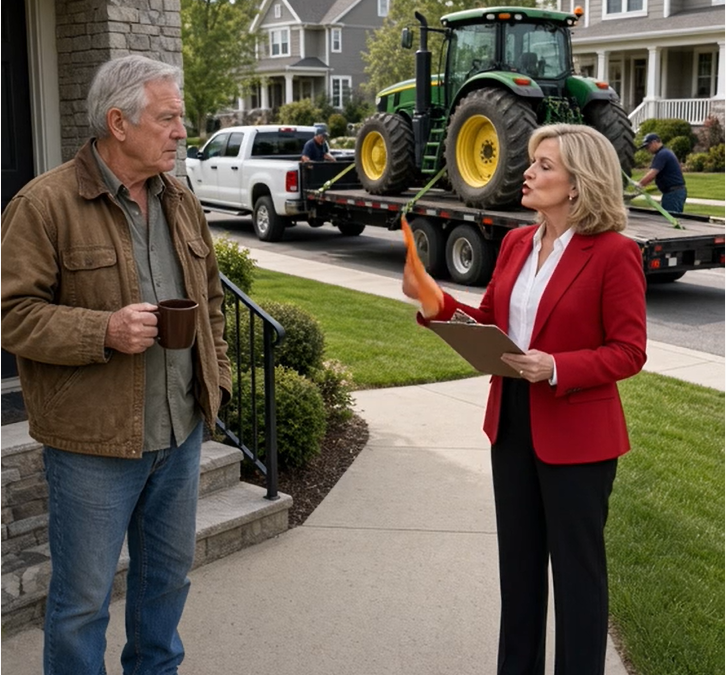
PART2:
People see seals and headings and stop thinking.
I read.
Slowly.
Vivian started talking before I reached the second page.
“Your farm has been operating in violation for years, Ezra. We tried to handle this cooperatively.”
“Cooperatively?”
“Noise complaints.”
“False.”
“Chemical runoff.”
“Tested clean.”
“Unsafe commercial traffic.”
“Farm road.”
“The court can decide.”
I did not answer.
I kept reading.
There was something wrong.
Not obvious.
Not yet.
But wrong.
The cited ordinance was from 1987.
I remembered it.
Commercial agriculture restrictions in residentially zoned parcels.
Under fifty acres.
Our farm was two hundred.
Forty actively cultivated.
But the parcel itself was two hundred.
The distinction mattered.
Vivian knew that.
Her lawyer knew it.
Unless—
I turned to parcel description.
Then I understood.
The order described only thirty-eight point six acres as the operative agricultural tract.
They had somehow separated my cultivated corn ground from the woodland and house parcel.
That was not how our deed read.
Never had been.
I looked up.
“Who prepared the survey attached to this?”
Vivian’s smile faltered for the first time.
“Our attorneys handled the filing.”
“That’s not what I asked.”
Martinez stepped in.
“Mr. Caldwell, we’re not here to debate the case.”
“I know.”
I handed him the papers.
“You’re here to enforce an order based on a parcel description that doesn’t match my deed.”
Vivian scoffed.
“You’re confused.”
I almost laughed.
Not because it was funny.
Because three weeks earlier Sarah had been alive.
Weak.
Thin.
Sitting in that same kitchen chair with a blanket over her shoulders.
And Vivian had stood outside complaining about irrigation noise while Sarah was throwing up from chemotherapy.
Confused was not what I was.
Tired.
Yes.
Heartbroken.
Yes.
Dangerously close to saying something I would regret.
Absolutely.
But not confused.
I walked inside.
Vivian called after me.
“Where are you going?”
“Records.”
The Caldwell family kept paper.
Too much paper, according to Sarah.
Deeds.
Tax maps.
Loan releases.
Old photographs.
Survey plats.
Right-of-way agreements.
Waterline easements.
Aerial photographs.
I had boxes dating back before my birth.
My grandfather Josiah used to tell me:
“Fence posts rot. Ink lasts longer.”
Sarah used to tease him.
“Until the basement floods.”
So we stored the originals upstairs.
I returned carrying a red folder.
The 1962 aerial photograph sat inside.
County-stamped.
Property boundary overlays in grease pencil.
I put it on the porch railing.
“Martinez.”
He stepped closer.
“This is our parcel.”
I pointed.
“Two hundred acres.”
Then I pointed at Pines Ridge Estates.
Or what had been woods in 1962.
“This is where the subdivision is now.”
Vivian moved forward.
“That photograph is sixty years old.”
“That land is older.”
“I’m talking about legal boundaries.”
“So am I.”
Her lips tightened.
I pointed at the modern map attached to order.
“This line has moved.”
Martinez leaned.
“How much?”
“I don’t know yet.”
“But enough that they’re treating my forty cultivated acres as separate tract.”
Vivian crossed her arms.
“You’re not a surveyor.”
“No.”
“But I know where my property is.”
“You thought you did.”
There was something in the way she said it.
Not confidence.
Knowledge.
Specific knowledge.
That mattered.
I looked at her.
Long enough that she shifted.
Then Deputy Martinez said:
“Mr. Caldwell, I’m not going to start shutting down equipment today.”
Vivian spun.
“What?”
“This order says preservation of status pending inspection.”
“It authorizes immediate enforcement.”
“It authorizes inspection.”
She shoved one page toward him.
“Read paragraph seven.”
He did.
Then looked up.
“It does not authorize seizure.”
Her face changed.
“You were briefed.”
“I was briefed that there was an emergency order.”
“And?”
“And I’m reading the actual order.”
She stared.
Martinez put his hat back on.
“We’re going to document current conditions.”
“No equipment moves until county counsel reviews.”
“Then we’ll proceed.”
Vivian’s mouth opened.
I could feel the moment slipping away from the scene she had planned.
She wanted me humiliated.
Police on my farm.
Neighbors watching.
Widower ordered to stop working.
Instead a deputy was slowing down.
Reading.
Asking questions.
That was the first crack.
Then Delores Martinez called.
Different Martinez.
No relation to deputy.
Marcus’s aunt.
Seventy-two.
County records clerk for thirty-seven years.
If Whispering Pines Valley had a human filing cabinet, it was Delores.
My phone buzzed.
I answered.
“Ezra.”
Her voice was urgent.
“Where are you?”
“Home.”
“Police?”
“Three cars.”
“Vivian there?”
“Yes.”
“I knew it.”
“What?”
“Get down here.”
“I’m a little busy.”
“No.”
Her tone changed.
“Ezra, honey, something is wrong with the surveys.”
I looked at Vivian.
She was arguing quietly with Deputy Martinez.
“What kind of wrong?”
“The kind your granddaddy warned people about.”
She lowered her voice.
“Lines are moving.”
That phrase froze me.
“Whose?”
“Yours.”
I turned toward the valley.
Two hundred acres.
Rolling hills.
Forty in corn.
Woodland climbing western ridge.
Sarah’s walking trails through the northern grove.
Her favorite place.
She had photographed trillium there every spring.
Foxes.
Owls.
Wildflowers.
The place where she told me after her diagnosis that she was not afraid of dying.
Only leaving.
“Come now.”
Delores said.
I ended call.
Vivian noticed.
“Another delay tactic?”
“No.”
I looked at Martinez.
“I need to go to county records.”
He nodded.
“I’ll finish documentation.”
Vivian stepped closer.
“You cannot leave while this order is being enforced.”
I looked straight at her.
“Watch me.”
Her smile disappeared.
That morning was not the beginning.
It was simply the moment all the pieces became visible.
The real beginning was eight months earlier.
Sarah had just started her second round of chemotherapy.
She had lost most of her hair.
Refused wigs.
Wore one of my old flannel caps around the house because she said every wig made her feel like she was auditioning for a church play.
I loved her for that.
Actually, I loved her for a thousand things.
Twenty-eight years gives you details outsiders never see.
The way she cut sandwiches diagonally even when no children were around.
The way she hummed when reading.
The way she said “Ezra” differently depending on whether I had done something stupid or merely annoying.
The way she photographed wildflowers as if each one were a celebrity.
Cancer did not remove those things.
It just made time around them sharper.
That was when Vivian moved into Pines Ridge.
Forty-seven houses built along the eastern slope of Whispering Pines Valley.
Big houses.
Stone fronts.
Three garages.
Decorative shutters that did not actually shut.
Expensive enough that people paid more for kitchens than my grandfather paid for our entire farm.
The development was marketed as authentic rural living.
That phrase should have warned me.
Buyers wanted valley views.
Open fields.
Barn silhouettes at sunset.
They did not necessarily want agriculture.
At six one morning, I started the harvester.
Sarah had been awake most of the night nauseated.
I tried delaying.
Weather would not.
Farming does not pause because life has become inconvenient.
I had been in the field maybe fifteen minutes when Vivian crossed from the subdivision.
Heels.
Clipboard.
White slacks.
I remember the shoes because nobody raised around farms wears that kind of shoe into a harvested field.
She waved both arms.
I throttled down.
“What?”
“This noise is unacceptable.”
I stared.
“What?”
“The machinery.”
I looked behind me at the machine.
“Yes.”
“It’s six in the morning.”
“Yes.”
“People are sleeping.”
“Corn isn’t.”
She blinked.
“That is not an appropriate response.”
“It’s the true one.”
She introduced herself.
HOA president.
I said:
“My farm isn’t in your HOA.”
She gave a little laugh.
“We’re all part of the same community.”
“No.”
“We’re in the same valley.”
“That’s what I said.”
“No.”
I looked back toward Pines Ridge.
“That’s what you meant.”
She did not appreciate the distinction.
Then she saw Sarah on our porch.
Blanket.
Coffee.
No hair.
Vivian lowered her voice.
“I understand your family is going through a difficult situation.”
That phrase.
So polished.
So bloodless.
“Then go home.”
“Excuse me?”
“Go home, Vivian.”
She did.
But she began filing complaints.
Noise.
Runoff.
Equipment.
Chemical storage.
Farm traffic.
Light pollution.
Dust.
Every week.
Sometimes twice.
Code enforcement appeared so often that one inspector, Mike, started bringing Sarah donuts.
“Since I’m already here.”
He would say.
Every complaint unfounded.
But complaints consume time.
Paperwork.
Inspections.
Calls.
Sarah was dying while I argued about tractor headlights.
That is why each one felt obscene.
Then came social media.
Concerned Pines Ridge Parents.
Vivian’s group.
Pictures of my irrigation equipment in black-and-white filters.
Captions:
Industrial agricultural machinery operating within close proximity of children.
A tractor photographed low-angle to make tires look enormous.
Unsafe commercial vehicle movement near family homes.
Then she crossed the line.
Recent family tragedy may be affecting operator judgment.
Grieving spouse appears increasingly erratic.
Sarah was still alive when first post appeared.
Not dead yet.
Family tragedy meant cancer.
That night Marcus came to my house with his phone.
He owns the auto shop in town.
Six-foot-two.
Beard.
Temper shorter than mine.
“Tell me you’re suing her.”
“No.”
“Why?”
“Because my wife is upstairs dying.”
His face changed.
Right.
Priorities.
I did one thing.
Saved screenshots.
Dates.
Times.
Everything.
Sarah came downstairs later.
Saw us.
“What are you two plotting?”
“Nothing.”
Marcus said too quickly.
Sarah looked at me.
“Show me.”
She read.
Her face stayed surprisingly calm.
Then she tapped one photograph.
“Where was that taken?”
“Field.”
“No.”
She zoomed.
I saw it.
Angle.
Camera had been inside my fence.
Eleven at night according to timestamp.
Vivian—or someone—had entered my property.
Sarah handed phone back.
“Put cameras up.”
“You want me worrying about cameras now?”
“I want you worrying later instead of regretting now.”
That was Sarah.
Always thinking beyond emotion.
I installed trail cameras.
Boundary cameras.
Cheap motion sensors.
Three weeks later, Sarah died.
Her last night, hospice bed was downstairs near windows facing valley.
She could barely speak.
Her hand felt weightless inside mine.
At 2:13 a.m., she opened eyes.
“Ezra.”
“I’m here.”
“Don’t let them take our home.”
I knew immediately who she meant.
“Sarah—”
“This land…”
She took breath.
“Our love story.”
I bent forward.
“I know.”
“Promise.”
“I promise.”
She died before dawn.
At funeral three weeks later, Vivian sent flowers.
That is the kind of detail that makes people ask whether someone is truly cruel or simply incapable of seeing themselves clearly.
White lilies.
Card:
With sympathy from your neighbors at Pines Ridge.
Two days later she filed lawsuit.
By the time I reached county records after police visit, Delores had already spread maps across a metal table.
The basement smelled like mildew, toner, old cardboard, and government.
She pointed.
“1962.”
Aerial.
“1985.”
Development survey.
“1991 revision.”
“2019 resale map.”
Then latest.
The lines crept.
Not dramatically on first glance.
Forty feet here.
Thirty-eight there.
Fifty-two along Sarah’s woodland.
Average forty-seven.
“Survey error?”
I asked.
Delores snorted.
“Errors don’t all move in same direction.”
She was right.
Every change expanded Pines Ridge.
Every change reduced my parcel.
I thought of fresh orange stakes I had found on Sarah’s trail days earlier.
“Someone has been surveying my woods.”
“I know.”
“How?”
“Because they filed preliminary boundary notice.”
“What?”
Delores slid page.
Proposed adverse-possession claim.
Twelve acres.
My twelve acres.
Sarah’s trails.
Claiming the HOA had maintained and improved woodland continuously for fifteen years.
The HOA had existed eight months under current governance.
Pines Ridge development itself was older, yes.
But those acres had never been theirs.
No maintenance.
No trails built by them.
Nothing.
It was ridiculous on face.
Unless supporting surveys lied.
Then ridiculous becomes expensive.
That is the danger.
A false claim does not need to be true to hurt.
It only needs enough paperwork to force defense.
Delores tapped an older document.
“Look.”
Original development company:
Thornridge Construction.
Project coordinator:
Vivian Thornridge.
Purple ink.
My stomach tightened.
“She was involved?”
“From beginning.”
“She told everybody she moved here eight months ago.”
“She did.”
“But she worked project decades ago.”
“Yes.”
“She knows boundaries.”
“Better than most.”
I sat down.
Suddenly nothing was random.
She was not an overenthusiastic newcomer.
She had history.
Knowledge.
Access.
And a reason.
We called Clayton Hayes.
Surveyor.
Thirty years licensed.
Weathered hands.
No tolerance for decorative language.
He came next morning.
Walked the lines.
Used modern GPS.
Compared old monuments.
By noon he was furious.
“This is not sloppiness.”
He kicked one fresh stake lightly.
“Somebody physically moved these.”
“How far?”
“Average forty-seven feet.”
“Enough to matter?”
He looked at me.
“Twelve acres at current development value?”
He whistled.
“Couple million minimum.”
“And if full farm rezoned?”
“Eight.”
Pause.
“Maybe twelve million.”
I felt sick.
Not because money tempted me.
Because now I understood scale.
A woman who complained about my tractor lights was not trying to improve neighborhood peace.
She was positioning property.
My cameras answered rest.
Three nights later, motion alert at 12:17 a.m.
I watched from bed.
Vivian.
Flashlight.
Two men in Thornridge Construction jackets.
One carried metal detector.
One sledge.
They pulled a survey stake.
Measured.
Moved.
Rehammered.
Then repeated.
GPS coordinates embedded in camera data.
License plates visible.
Vivian herself.
No ambiguity.
I sat in dark after video ended.
Sarah’s side of bed empty.
For first time since funeral, grief changed into something cleaner.
Not rage exactly.
Purpose.
Next morning attorney Rebecca Swift came.
She was fifty-one, sharp, practical, and had represented farms in land-use disputes for two decades.
She watched footage twice.
Then:
“Do not confront.”
“I wasn’t planning.”
“Do not post.”
“I won’t.”
“Do not send to HOA.”
“Fine.”
“Good.”
She smiled slightly.
“You’re easier than most clients.”
“I’m tired.”
“That helps.”
She dug.
Delores dug.
Clayton dug.
We found pattern.
Four older landowners in neighboring counties.
Boundary disagreements.
Pressure.
Legal costs.
Then sale.
One widow.
Two elderly farmers.
Brothers who inherited acreage.
Each property later connected to Thornridge-affiliated development.
Not identical.
But close enough.
Then Rebecca found deadline.
1985 land-banking provision.
Thornridge Construction held certain future-development options tied to adjacent voluntary sales.
Expiration December 31.
Six weeks.
Their debt load had grown.
Millions due early following year.
Future acreage mattered to lenders.
Vivian needed land.
Fast.
Then personal layer surfaced.
Her grandfather Harold Thornridge once owned a farm in valley.
Lost it in foreclosure in 1963.
County auction.
Buyer:
Josiah Caldwell.
My grandfather.
Eight thousand dollars.
Legal sale.
Fair notice.
But Harold spent rest of life telling family the Caldwells stole it.
Vivian grew up on grievance.
That did not excuse.
It explained.
She had taken old family story, combined it with financial desperation, and turned my dying wife and me into target.
Rebecca looked across table.
“This is where people make mistakes.”
“What?”
“They hear motive and start thinking it matters more than evidence.”
She tapped camera still.
“We do not need childhood revenge story.”
“We need moved stakes.”
“False filings.”
“Fabricated credentials.”
“Financial communications.”
“Stay with what we can prove.”
Good lawyer.
The first hearing came fifteen days later.
Vivian packed courthouse.
Forty-seven Pines Ridge residents.
Matching shirts:
COMMUNITY SAFETY FIRST.
I wore black funeral suit.
Only decent suit I owned.
Same one.
That detail made cameras turn.
I hated it.
Rebecca told me:
“Let them see.”
I brought evidence.
Noise measurements.
Agricultural zoning.
Environmental tests.
Old aerial.
Survey.
Vivian brought “Dr. Helena Frost.”
White lab coat.
Charts.
Titles.
She spoke like a television expert.
“Chemical runoff.”
“Irrigation contamination.”
“Operator instability caused by recent psychological trauma.”
That last phrase changed room.
She had taken my wife’s death and converted it into expert testimony.
I looked at Rebecca.
Rebecca whispered:
“Let her finish.”
Sarah’s voice came back.
When somebody lies to your face, make them prove it where everyone can see.
I searched Helena Frost.
State registry.
Professional licensing.
Business records.
Three minutes.
When she stopped, hearing officer Patricia Wells asked if I had questions.
I stood.
“Dr. Frost.”
“Yes.”
“You’re a certified environmental consultant?”
“Yes.”
“Through which credentialing body?”
She gave vague answer.
“Could you specify?”
She named an association.
No active record.
“What is your degree?”
“Environmental design.”
“From?”
Pause.
“Cornell continuing studies.”
Interesting.
I held phone.
“State professional registry identifies you as licensed landscape architect.”
Her face changed.
“That is one of my credentials.”
“Any environmental-science license?”
“I have extensive experience.”
“Any degree in environmental science?”
“No.”
“Any certification in agricultural chemical assessment?”
“I consult.”
“Do you design golf courses?”
Vivian’s attorney stood.
“Relevance.”
Wells leaned forward.
“Answer.”
Helena swallowed.
“Yes.”
“Whispering Oaks Country Club?”
“Yes.”
“Did you personally test my soil?”
“No.”
“Water?”
“No.”
“Air?”
“No.”
“Did anyone from your firm?”
“I reviewed supplied materials.”
“Supplied by whom?”
Silence.
Vivian.
The hearing collapsed.
Not theatrically as later retellings claim.
Wells did not scream.
She did something worse.
She became very quiet.
“Mrs. Thornridge.”
“Yes?”
“This forum is not a stage.”
The complaint was dismissed pending investigation into evidentiary misrepresentation.
Outside, I passed Vivian and attorney Augustus Grim by water fountain.
Grim whispered:
“Boundary claim tomorrow.”
Vivian answered:
“He won’t have time to mount proper defense while grieving.”
They did not know I heard.
I kept walking.
Twenty minutes later, Delores called.
“I found the 1918 deed.”
Everything shifted again.
Before the reservoir roads.
Before Pines Ridge.
Before Thornridge Construction.
My great-great-grandfather’s deed covered a vast section of valley.
Subsequent transfers showed what had been sold.
What had been retained.
What had been easement.
And what county apparently treated as developable later despite incomplete title chain.
Rebecca spent hours with it.
Then said:
“This could invalidate pieces of the 1985 assumptions.”
“Meaning?”
“Meaning Vivian may have built legal strategy on development rights her company never fully possessed.”
“Can we take their houses?”
“No.”
She looked annoyed that I even asked.
“People bought in good faith.”
“Courts protect reliance interests.”
“We’re not evicting forty-seven families because title history messy.”
Good.
I never wanted that.
“What can it do?”
“It can destroy her leverage.”
“Potentially void disputed transfers.”
“Strengthen restitution claims.”
“And, most importantly, prove your land is yours.”
That was enough.
Then sabotage began.
I woke one morning to irrigation lines sliced.
Not burst.
Cut.
Electronic controls smashed.
Four thousand dollars damage.
Tire tracks.
Wide luxury SUV tread.
Camera had blind angle because fog.
Not enough to accuse publicly.
I reported.
Documented.
That afternoon Vivian came to porch.
No police this time.
Envelope.
Offer.
Five hundred thousand dollars.
For twelve acres.
Sarah’s woods.
Contingent on ceasing active farming near development and resolving all claims.
I stared.
“You’re offering half million for land you say you already own?”
She smiled.
“Settlement.”
“No.”
“Ezra.”
Nobody called me Ezra except friends.
Coming from her felt invasive.
“You’re under stress.”
“Don’t.”
“Grief affects judgment.”
“Don’t use my wife again.”
Her smile flattened.
“Continued farming may no longer be realistic for someone in your condition.”
“What condition?”
She gestured vaguely.
“You’ve suffered tremendous loss.”
“So you’d like to help by taking land?”
“I’m offering financial security.”
“I have security.”
“This farm carries debt.”
How did she know?
Everybody farming carries debt.
Still.
“You’ve checked.”
“Public records.”
“Of course.”
She leaned slightly closer.
“I’d hate for additional complications to worsen what is already difficult.”
Threat hidden inside concern.
That was Vivian’s favorite language.
“I’m not selling.”
“Think carefully.”
“I have.”
She turned.
Then I said:
“You made one mistake.”
She stopped.
“You thought grief would make me desperate.”
She looked over shoulder.
“It didn’t.”
“What did it do?”
I thought of Sarah dying.
Empty kitchen.
Suit.
Flowers.
“It took away most of what I was afraid to lose.”
For first time, Vivian looked unsettled.
Not because I threatened.
I did not.
Because she realized leverage built on fear.
And grief had already introduced me to something worse than losing a lawsuit.
After that, Rebecca contacted state investigators.
Not dramatically.
Quietly.
Property fraud.
Potential wire communications.
Forgery.
Multiple counties.
Patterns.
They listened.
Then federal interest followed because financing and interstate transactions touched broader conduct.
I was told very little.
As it should be.
Investigations fail when civilians decide they are detectives.
I gave evidence.
Stayed home.
Worked.
Grieved.
The biggest break came from Vivian herself.
7:23 Tuesday morning.
Sirens.
Fire trucks.
Hazmat unit.
County environmental response.
She had called 911 claiming a toxic agricultural chemical release.
Completely false.
Janet Morrison, county environmental inspector, tested.
Soil.
Air.
Water.
No release.
No abnormal contamination.
She stood beside my sprayer.
“What exactly did caller claim?”
Deputy Martinez read notes.
“Strong chemical odor, visible vapor, animals becoming ill.”
Janet looked around.
Birds.
My old barn cat sleeping on tractor seat.
Clear air.
She said:
“Either caller doesn’t understand basic chemistry or somebody is abusing emergency system.”
Then Vivian arrived.
Again.
This time holding court order.
“Emergency seizure authority.”
I took it.
Read judge’s name.
Harrison Miller.
I knew that name.
Everybody did.
He had died six months earlier.
Heart attack.
His funeral made paper.
I stared at signature.
Then Vivian.
“Where did you get this?”
“Through counsel.”
“Signed yesterday?”
“Yes.”
“By Judge Miller?”
She frowned.
“Yes.”
I raised voice enough for everyone.
“Judge Miller died in May.”
Silence.
Martinez took document.
His expression changed.
“Ma’am.”
Vivian’s face lost color.
“It was provided to me.”
“By whom?”
“My attorney.”
“Step over here.”
She looked toward crowd gathering at road.
No control now.
Then two unmarked SUVs entered.
People in plain clothes.
Badges.
Not movie-perfect lines.
No dramatic speech.
Just procedural certainty.
Vivian was detained.
Questioned.
Then arrested pursuant to warrants already being prepared in wider investigation.
Forgery turned timing.
False emergency report gave fresh act.
The case had been building longer than she knew.
Her attorney Augustus Grim became subject of separate investigation.
Commission officials too.
The town exploded.
Not literally.
Socially.
Everybody who had spent months saying “probably just a neighbor dispute” suddenly had an opinion.
Reporters arrived.
Stella Remy from regional investigative desk had been working records with Rebecca.
She published first serious piece.
Not gossip.
Documents.
Boundary movements.
Patterns.
Land acquisitions.
Debt.
False environmental allegations.
I hated seeing Sarah’s name.
But I agreed to interview once.
Only once.
County commissioners meeting overflowed.
Hundreds.
I wore Sarah’s cornflower-blue tie.
She bought it years earlier because she said I owned too much brown.
When my turn came, I stood.
I had prepared notes.
Did not read most.
“Three weeks ago, I buried my wife.”
Room quieted.
“Sarah and I were married twenty-eight years.”
“We built our life on this farm.”
“She died believing someone wanted to take it.”
“My neighbor used her illness and death to suggest I was mentally incapable of managing land.”
I paused.
“That is not land use.”
“That is cruelty.”
Applause began.
I raised hand.
“Please.”
It stopped.
“I’m not asking this county to protect me because I’m grieving.”
“I’m asking you to enforce the same records, laws, surveys, and procedures whether I’m grieving or not.”
That mattered.
I held up 1918 deed.
“This paper does not love Sarah.”
“It does not hate Vivian.”
“It does not care who has money.”
“It records ownership.”
“That is what systems are supposed to do when personalities become dangerous.”
Rebecca told me later that was best sentence.
I do not remember planning it.
Commissioner Bradley was later arrested on bribery allegations.
Two others resigned under investigation.
I will not pretend whole government was corrupt.
Most were not.
Three people made choices.
That distinction mattered to me.
Same with Pines Ridge.
Most residents were not Vivian.
Some believed her because she spoke confidently.
Some feared property values.
Some disliked farm noise.
Some simply stayed silent.
When evidence surfaced, many changed.
The HOA collapsed organizationally after litigation and insurance crisis, then later reorganized in different form? In source it was dissolved. Keep dissolved, but residents formed neighborhood association.
Thornridge Construction entered bankruptcy.
Not because one old farmer destroyed empire.
Because it carried massive debt and depended on future development rights that became legally uncertain once fraud claims surfaced.
Vivian had built on leverage.
Leverage works beautifully until confidence breaks.
Investigators reopened older land cases.
Several elderly owners recovered property or settlements.
Not all.
Paper trails differ.
Courts move slowly.
But enough.
The Johnson brothers regained sixty acres.
Mrs. Peterson recovered title to pasture sold under pressure.
Others received compensation.
The number that eventually circulated was millions.
I stopped counting.
My concern was Sarah’s woods.
The stakes came out.
Real boundary reestablished.
Clayton drove permanent survey monuments.
He invited Caleb to watch.
“Never trust ribbon.”
Clayton told him.
“Trust monuments, records, coordinates.”
Caleb nodded like receiving scripture.
Sarah’s trail remained ours.
I walked it first time after case quieted.
Alone.
Autumn.
Leaves yellow.
Her favorite bend near creek.
She used to photograph cardinal flowers there.
I sat on log.
For months I had fought.
Police.
Lawyers.
Surveyors.
Meetings.
Evidence.
Now there was nothing to fight.
That was when grief returned full force.
I cried harder than at funeral.
Because crisis postpones mourning.
Purpose can hide emptiness.
Once land safe, Sarah was still gone.
No court fixes that.
No villain’s arrest balances death.
Revenge stories often lie at this point.
They imply victory fills the hole.
It does not.
You can save farm and still eat dinner alone.
You can expose fraud and still reach across bed in sleep.
You can win every hearing and lose person you wanted to tell about it.
That winter nearly broke me more than Vivian did.
Marcus kept showing up.
Coffee.
Dinner.
No announcement.
Delores brought records? No. She brought pie.
Caleb worked weekends.
My daughters called.
The church people kept coming.
Pines Ridge residents surprised me.
Some had once liked Vivian.
Some even wore those Community Safety shirts.
They apologized.
One woman named Denise stood at my porch.
“I shared one of her posts.”
I said nothing.
“I believed you were unstable.”
“Because my wife was dying?”
She cried.
“I’m sorry.”
I could have humiliated her.
Didn’t.
“Don’t do it to next person.”
She nodded.
That is enough sometimes.
The community began changing.
HOA meetings disappeared.
In their place, residents formed voluntary road and maintenance cooperative.
No architectural dictatorship.
Just shared snowplowing, drainage, common landscaping.
People could still be irritating.
Humans remain humans.
But no Vivian at center.
Potluck dinners replaced some meetings.
Marcus called that socialist casserole governance.
Nobody knew what he meant.
Everyone ate anyway.
Then came the foundation.
I did not start it.
At least not intentionally.
Families who recovered land wanted to help others.
Donations.
Rebecca offered pro bono hours.
Clayton discounted surveys.
Delores trained volunteers to search old deed books.
They wanted name.
I resisted.
Someone suggested Sarah Caldwell Memorial Foundation.
I said no.
Too personal.
My daughters said yes.
Caleb said:
“Grandma would hate you saying no for her.”
Unfairly accurate.
Foundation focused conservation easements, rural legal education, emergency survey assistance, scholarships.
Nothing flashy.
First year protected several hundred acres from coercive development.
Not all from development.
Important.
If owner chose to sell, fine.
Goal was choice.
Informed consent.
Clear title.
No intimidation.
First scholarship went to Elena, Marcus’s niece.
Sustainable agriculture.
When announcement made, Marcus cried and denied it.
Dust.
Indoors.
Sure.
Sarah’s vegetable garden finally happened too.
She had planned it during chemotherapy.
Raised beds.
Herbs.
Tomatoes.
Pollinator strip.
Never got strong enough.
My daughters came home.
Caleb built beds.
Granddaughters planted.
I mostly complained about spacing.
Sarah would have been furious I let children overwater basil.
Good.
Life returning does not mean forgetting.
It means memory becomes useful instead of only painful.
Her walking trails later became protected through voluntary conservation easement, with public access on limited days? Source says county nature preserve. But if we want preserve family ownership perhaps better: we granted a conservation easement and seasonal educational access. Yet source says became county nature preserve. Preserve central. Maybe later donated part.
We eventually donated a strip along trails to county nature preserve under agreement protecting habitat and keeping main farm private.
Children came.
Wildflower walks.
Photography classes.
Agricultural history.
A small plaque near trail entrance:
SARAH CALDWELL WALK.
No mention Vivian.
Good.
Do not build monuments to enemies.
A year after arrest, the valley held memorial harvest festival.
Heart-shaped corn maze because my daughters have no restraint.
I stood on hill.
Hundreds of people.
Pines Ridge families.
Old farmers.
Kids.
Food trucks.
Church tent.
Foundation booth.
Sarah’s photographs displayed in barn.
For first time since she died, silence felt different.
Not absence.
Space.
That story could end there.
Internet likes that.
Villain gone.
Farm saved.
Widower healed.
But healing does not work on schedule.
Vivian’s case dragged.
Charges.
Motions.
Lawyers.
Some dismissed.
Some remained.
Plea negotiations.
I stopped following every update.
At first I wanted maximum punishment.
Then I realized obsession would keep her on my property in different way.
She had spent months trying to occupy land.
I was spending months letting her occupy mind.
No.
I gave victim statement.
Then stepped back.
Augustus Grim lost license after misconduct findings and faced charges tied to forged filings.
Commission investigations produced resignations and convictions.
Again, not all dramatic.
Some plea agreements.
Fines.
Probation.
Restitution.
Consequences do not need cinematic perfection to matter.
The most important consequence was documentation.
Every fraudulent survey corrected.
Every affected owner notified.
Procedures changed.
County required independent verification before emergency land-use seizure.
Old deeds digitized.
Survey changes flagged.
That was real protection.
Systems changed.
Vivian had exploited gaps.
Closing gaps mattered more than seeing her in orange.
Stella Remy produced long investigative documentary.
It received awards.
The original source says Pulitzer; TV documentaries don’t receive Pulitzer, but this is a fictional story and user wants rewrite. Developer says don’t silently correct source. Better not mention Pulitzer specifics maybe “won regional awards”. However source explicit. But we can preserve by saying investigative series earned national honors? Yet must preserve source framing. Maybe can say “later earned major journalism awards” rather than false specific. Fine.
What mattered was people beyond valley learned pattern.
Move boundary.
Create nuisance complaints.
Question owner competence.
Use legal costs.
Push sale.
Repeat.
People think land theft looks like men with guns.
Sometimes it looks like certified mail.
That became foundation’s most repeated lesson.
My grandfather had been right.
When lawyers move lines, know the real lines.
Caleb absorbed that deeply.
He studied agricultural engineering.
Then land surveying minor.
Of course.
When he came home from college, first thing he did was criticize our drainage layout.
I told him tuition had made him arrogant.
He said drainage had made me inefficient.
Sarah would have enjoyed us.
One spring he asked:
“Grandpa, did you ever feel sorry for Vivian?”
I was replacing cultivator teeth.
“Sometimes.”
He looked surprised.
“Why?”
“Because imagine carrying grievance sixty years that isn’t even yours.”
“Her grandfather’s farm.”
“Yes.”
“He thought ours stole.”
“Yes.”
“Did we?”
“No.”
“Then why sorry?”
“Because Harold lost something.”
“He told his family story.”
“Vivian inherited anger, not truth.”
Caleb sat toolbox.
“That doesn’t excuse.”
“No.”
“But it explains.”
“Yes.”
“And if she’d asked?”
“What?”
“If she came before everything and said her family believed we stole land?”
I thought.
“I’d show records.”
“And?”
“Maybe she’d still hate us.”
He nodded.
“But she chose manipulation.”
“Yes.”
Lesson.
Inherited pain does not justify creating new victims.
That mattered beyond case.
Families pass stories.
Some true.
Some distorted.
Children build identities around wounds they never witnessed.
Vivian turned grandfather’s foreclosure into moral debt she believed my family owed.
Then added money.
Deadly mix.
At Sarah’s memorial trail, we eventually installed small educational panel about valley land history.
Included Thornridge farm.
I insisted.
Caleb asked why.
“Because it existed.”
“But Vivian—”
“History doesn’t disappear because descendant behaved badly.”
Harold Thornridge farm was real.
Foreclosure was loss.
The Caldwell purchase was legal.
Both facts.
History can hold more than one person’s pain without converting it into property claim.
That felt important.
Pines Ridge residents appreciated.
One older man said:
“You didn’t have to include Thornridge.”
“Yes, I did.”
“Why?”
“Because erasing their farm would prove her point.”
He understood.
Years later, one of Vivian’s nieces contacted foundation.
I expected anger.
Instead:
“Thank you for including my great-grandfather.”
She had not spoken to Vivian in years.
Family complicated.
We sent scans.
No fee.
That was closure I never expected.
The farm itself changed.
Forty acres active corn became rotating corn, soy, cover crop, vegetables.
Caleb introduced precision irrigation.
Sensors.
Drones.
I complained.
Then yields improved.
I stopped complaining loudly.
Granddaughters planted pumpkins.
Festival expanded.
The same new residents who once complained about tractors came to buy sweet corn.
A little hypocrisy.
A little growth.
People can change without admitting every previous mistake.
I learned to accept.
One homeowner apologized about smell complaint.
I told him:
“That smell wasn’t even mine.”
He laughed.
“Still?”
“Still.”
We identified western farm finally.
No one filed lawsuit.
Progress.
The funniest legacy was community safety shirts.
Marcus found box left from hearing.
He printed FARM SAFETY FIRST on backs and handed to harvest crews.
Rebecca threatened to sue for bad taste.
We wore anyway.
Grief needs humor.
Otherwise it hardens.
I kept Sarah’s last camera.
Sometimes walked trail.
Took pictures badly.
My flowers always blurry.
One day youngest granddaughter took it.
Perfect shot.
Goldenrod.
I showed.
“She got your eye.”
My daughter said.
Maybe.
Or maybe phone autofocus improved.
Let sentiment have one.
The farmhouse remained.
1920s wood.
Porch creak.
Sarah’s chair.
I never moved it.
Not shrine.
Still sat there sometimes.
Morning coffee.
Sunrise over valley.
In first year after her death, silence felt like punishment.
By third, companionship.
Memory settling.
Her sentence:
This land is our love story.
At first I interpreted literally.
Protect acreage.
Fight.
Later understood broader.
Love story was not dirt.
It was years lived.
Walks.
Meals.
Arguments.
Seasons.
Promises.
Even if someday land sells, story remains.
That realization loosened me.
I updated estate plan.
No pressure on daughters or Caleb to farm forever.
Conservation protections on sensitive acreage.
Clear options.
Choice.
I refused to turn Sarah’s wish into future generation’s chain.
That would make me a different kind of Vivian.
Power over land can become power over family if you are not careful.
I wanted continuity.
Not control.
Rebecca approved.
“You’re learning.”
“From you?”
“No.”
“Good.”
She was still intolerable.
The 1918 deed now sits framed in county archive reproduction display.
Original secure.
People ask:
“Did that deed really prove you owned whole valley?”
Not exactly.
It proved historical ownership and exposed breaks in later assumptions.
The viral line:
HE OWNED THE ENTIRE VALLEY.
Was dramatic.
Truth:
His ancestors had once held title to much of it, and the surviving chain of title gave him rights far stronger than Vivian expected.
Less catchy.
More accurate.
I insist because documents saved me.
Respect documents enough not to exaggerate them.
Same with police arrival.
Vivian did not literally ride to steal my entire farm that morning.
She brought law enforcement to enforce order built on manipulated parcel description.
That is bad enough.
No need cartoon.
She believed grief reduced my capacity.
That was written.
She weaponized spouse death.
That happened.
She targeted boundaries.
We filmed.
Real facts already ugly.
People weaken truth when adding nonsense.
I told Stella same.
“Don’t make me hero.”
“What are you then?”
“Landowner with boxes.”
She laughed.
Headline eventually included “widower.”
Could not prevent.
That was part story.
But I was not strong because widowhood.
I was functioning despite it.
There is difference.
Grief does not automatically make people dangerous, weak, irrational, enlightened, fearless, or heroic.
It makes them grieving.
Some days I forgot to eat.
Some days I argued with bank teller because I could not find checkbook Sarah always kept.
Some days I sat in truck outside grocery store unable to go in because buying one loaf instead of two felt unbearable.
Vivian tried to convert grief into legal incompetence.
That was vile.
My response was not becoming superhuman.
It was asking for help.
Delores.
Rebecca.
Clayton.
Marcus.
My daughters.
Caleb.
County staff.
Investigators.
Community.
That is why we survived.
Not lone widower outsmarting empire.
Network.
When bad actors isolate targets, community is defense.
Foundation now teaches:
Call someone.
Do not handle alone.
Get survey.
Get lawyer.
Save documents.
Photograph stakes.
Do not confront trespasser alone.
Report.
Create timeline.
Simple steps.
Boring.
Life-saving financially.
A farmer named Ed called one year.
Neighbor claimed fence moved.
Ed wanted rip posts out.
I told him:
“Don’t touch.”
He hated answer.
Survey showed neighbor right by six feet.
If he had acted first, Ed would have been wrong.
Evidence protects ego too.
Important.
Another woman called after developer letter.
Turned out legitimate easement.
We told her.
She said:
“I thought foundation fights developers.”
“No.”
“We fight coercion and fraud.”
“Sometimes developer is right.”
She did not like.
Truth not customer service.
Sarah would approve.
Vivian taught me another thing unintentionally.
Do not become mirror of enemy.
If she manipulated records to preserve outcome she wanted, and I manipulated facts to preserve mine, difference shrinks.
So we stay precise.
The farm may someday change.
Legally.
Voluntarily.
Fine.
Until then, corn grows.
Every fall, combine starts early.
Pines Ridge now gets notice:
HARVEST WEEK — EXPECT EARLY/LATE EQUIPMENT.
Not permission.
Courtesy.
Residents wave.
Some bring coffee.
Kids watch from sidewalk.
Full circle without pretending conflict never happened.
One October dawn, new family called.
“Mr. Caldwell?”
“Yes?”
“We hear machine.”
“Yes.”
“Is something wrong?”
“No.”
“Harvest?”
“Yes.”
“Oh.”
Pause.
“Can kids watch?”
I smiled.
“From safe side of fence.”
That is rural living.
Not silence.
Relationship.
The old trail-camera video remains archived.
Vivian and two men moving stakes in darkness.
I have not watched in years.
No need.
The stakes are gone.
Permanent monuments in place.
Her power existed only while uncertainty did.
Certainty restored.
One afternoon a journalist asked:
“What was the moment you knew you’d won?”
I hated phrase.
I said:
“When I stopped caring whether Vivian lost.”
She frowned.
“That doesn’t make good television.”
“Sorry.”
“What do you mean?”
“When goal changed from defeating her to protecting land and fixing system.”
“That’s when.”
Before, every move reaction.
After, plan.
That is strategic difference.
Anger asks:
How do I hurt them back?
Purpose asks:
What outcome do I need?
I needed:
Farm title secure.
Sarah trail protected.
False evidence exposed.
Emergency abuse stopped.
Other landowners warned.
Once achieved, Vivian’s personal suffering irrelevant.
That freed me.
Not noble.
Practical.
Hatred consumes fuel.
Farmers respect fuel.
The valley population grew.
847 became more.
Dogs still counted unofficially.
Murphy’s Diner renovated.
Marcus complains menu too fancy.
Still orders same eggs.
Delores finally retired.
County threw party.
She brought home two file cabinets.
Of course.
Clayton teaches apprentice surveyors.
Rebecca threatens retirement every year and never does.
Stella moved to larger investigative outlet.
Caleb married.
Has children.
Life.
The best revenge is continuity.
Not spectacle.
Vivian planned around my vulnerability.
Sarah died.
I kept breathing.
Farm kept producing.
Kids kept growing.
Valley absorbed scandal.
Eventually her name became footnote.
That is how time punishes people who believe they are center.
Sarah’s name remains because love stays where power does not.
Trail.
Foundation.
Garden.
Photographs.
Granddaughters who never knew her long enough but know stories.
That feels just.
At memorial festival anniversary, I stood in heart-shaped corn maze.
Ridiculous.
Beautiful.
Caleb’s oldest daughter, eight, ran up.
“Grandpa.”
“What?”
“Is this Grandma Sarah’s farm?”
I looked around.
Technically mine.
Soon theirs maybe.
But I said:
“Yes.”
She nodded.
“Good.”
Then disappeared into corn.
That was enough.
The first time Vivian entered our story, she came in heels to complain about harvester.
The last time I saw her in person was courthouse hallway months later.
No pearls.
No perfect smile.
She stopped.
Guards nearby.
We looked at each other.
She said:
“You think you won.”
I almost walked away.
Then:
“No.”
She frowned.
“My wife is dead.”
There was nothing she could say.
“That’s the thing you never understood.”
I continued.
“You were fighting over land like winning it would make somebody whole.”
“It doesn’t.”
Her eyes lowered.
“Land matters.”
“Yes.”
“But not because it’s money.”
She said nothing.
“I protected it because Sarah asked.”
“And because it’s mine.”
“Not because taking yours would fix anything.”
Then I left.
Maybe she heard.
Maybe not.
Not my job.
A year later, when legal matters settled, I removed one orange survey ribbon from drawer.
The fake one.
Bright.
Clean.
I tied it to broken fence post near trail temporarily.
Then took down.
Burn? No.
I threw it away.
Not everything deserves memorial.
We kept 1918 deed.
Sarah’s pictures.
Good things.
The corrupted stakes went evidence.
Exactly where they belonged.
Some stories become lighter when you stop collecting enemy artifacts.
I never forgot morning squad cars arrived.
Funeral suit.
Cold coffee.
Martinez embarrassed.
Vivian smiling.
She believed she had chosen perfect moment.
Widower exhausted.
Wife buried.
Court order ready.
Police present.
Neighbors uncertain.
She saw vulnerability.
What she failed to understand was Sarah had spent twenty-eight years building something stronger than a legal defense.
Relationships.
People.
Records.
Habits.
A family that kept paper.
Friends who answered phones.
A county clerk who remembered old maps.
A grandson who knew when to step back.
A lawyer who cared more about evidence than anger.
A surveyor who knew where lines belonged.
A community capable of changing mind.
Vivian attacked a man.
She ran into a network.
That was her real mistake.
Not deed.
Not deadline.
Not camera.
Isolation assumption.
She assumed grief had left me alone.
It had not.
Grief makes empty chair.
It does not erase every other chair.
That is what saved me.
When I think about Sarah’s last words now, I do not hear command to fight forever.
“Don’t let them take our home.”
At first, I heard ownership.
Now I hear dignity.
Do not let somebody define your loss.
Do not let somebody convert weakness into consent.
Do not let somebody take what you have not chosen to give.
Home can be field.
House.
Memory.
Voice.
We protected all four.
The valley at sunset still looks almost exactly like Sarah’s photographs.
Corn lower than hills.
Woodline dark.
Pines Ridge roofs catching orange light.
Farmhouse porch shadow.
No battle visible.
Good.
Land should not have to perform conflict forever.
People drive through and would never know.
Unless they stop at memorial trail.
Or read foundation plaque.
Or ask why certain survey monuments look newer.
Or hear Marcus at diner.
He tells story badly.
According to Marcus, Vivian arrived with twelve police cars, three judges, and bulldozer.
“Stop lying.”
I tell him.
“Artistic license.”
“You own auto shop.”
“Same thing.”
Everyone laughs.
I correct details.
He ignores.
That is small-town history.
But when granddaughters ask, I tell accurate.
“Did bad lady try steal farm?”
“She tried to take land using false claims.”
“Did police stop her?”
“Lots of people helped.”
“Did you beat her?”
“No.”
They look disappointed.
I smile.
“We protected what was ours.”
That is better lesson.
Victory is not domination.
It is preservation.
Choice.
Truth holding long enough.
One of them asked:
“Were you scared?”
“Yes.”
That surprised her.
“Even grown-ups?”
“Especially grown-ups.”
“What did you do?”
“Called people smarter than me.”
She laughed.
I didn’t.
Best answer.
At sixty-something, grief had made me feel ancient.
Years later, I felt less old even though objectively older.
That is how healing works sometimes.
Burden weighs more than time.
When purpose returned, shoulders changed.
Not fully.
Sarah still missing.
Always.
But memory no longer only ending.
It includes beginning.
First date at county fair.
Wedding.
Rain on farmhouse roof.
Burnt biscuits.
Fights.
Makeups.
Twenty-eight harvests.
Her photographing same patch of trillium every year.
Cancer is one chapter, not whole book.
Vivian almost succeeded in making Sarah’s death primary weapon.
I refused by living beyond it.
That may be the revenge Sarah would have preferred.
Not courtroom.
Garden.
One last detail.
The original court order Vivian brought with police was voided quickly once parcel discrepancy exposed.
I kept a copy.
For a while it sat with case file.
Eventually I placed it beneath the 1918 deed.
Old paper above.
New paper below.
The contrast amused Delores.
“Which matters more?”
She asked.
“Depends whether one’s true.”
Exactly.
Authority printed at top means nothing if foundation false.
That lesson applies beyond land.
Titles.
HOAs.
Consultants.
Officials.
People speak with confidence.
Check line.
Check source.
Check signature.
Check who benefits.
Seven minutes after Vivian arrived smiling in squad car, she learned my property records did not match story she had constructed.
Seven weeks later, investigators were pulling decades of Thornridge records.
Months later, multiple property owners reopened claims.
A year later, Sarah’s name marked conservation trail instead of forced-sale plat.
And the farm?
Still there.
The corn?
Still grows.
The house?
Still creaks.
Every sunrise, I make two cups of coffee by habit.
I usually realize before pouring second now.
Usually.
Sometimes I pour.
Set it across table.
Let steam rise.
Then I take both to porch.
One for me.
One for memory.
Below, valley stretches.
Pines Ridge.
Fields.
Wood.
Sarah’s trail.
All of it quiet.
Not empty.
Full.
Vivian once believed grief had made me too weak to defend my home.
What she never understood was that grief had stripped away my interest in being intimidated.
I had already stood beside the only loss that truly frightened me and watched it happen.
A lawsuit was paper.
A threat was noise.
A moved boundary was measurable.
A lie could be documented.
And land, unlike death, could still be fought for.
So I did.
Not by screaming.
Not by threatening.
Not by becoming what she said I was.
I opened old boxes.
Called good people.
Measured lines.
Saved footage.
Read deeds.
Showed up.
That was enough.
When Vivian tried to use my wife’s death as proof I could no longer manage my farm, she made the same mistake every bully makes eventually.
She confused pain with surrender.
Sarah was gone.
But the man she had built a life with was still standing.
And behind him were a hundred years of records proving exactly where his land began.
And exactly where Vivian Thornridge’s authority ended.








