HOA Sent a Tow Truck to Seize My Boat From My Driveway—Then the Sheriff Asked for the One Document They Couldn’t Explain
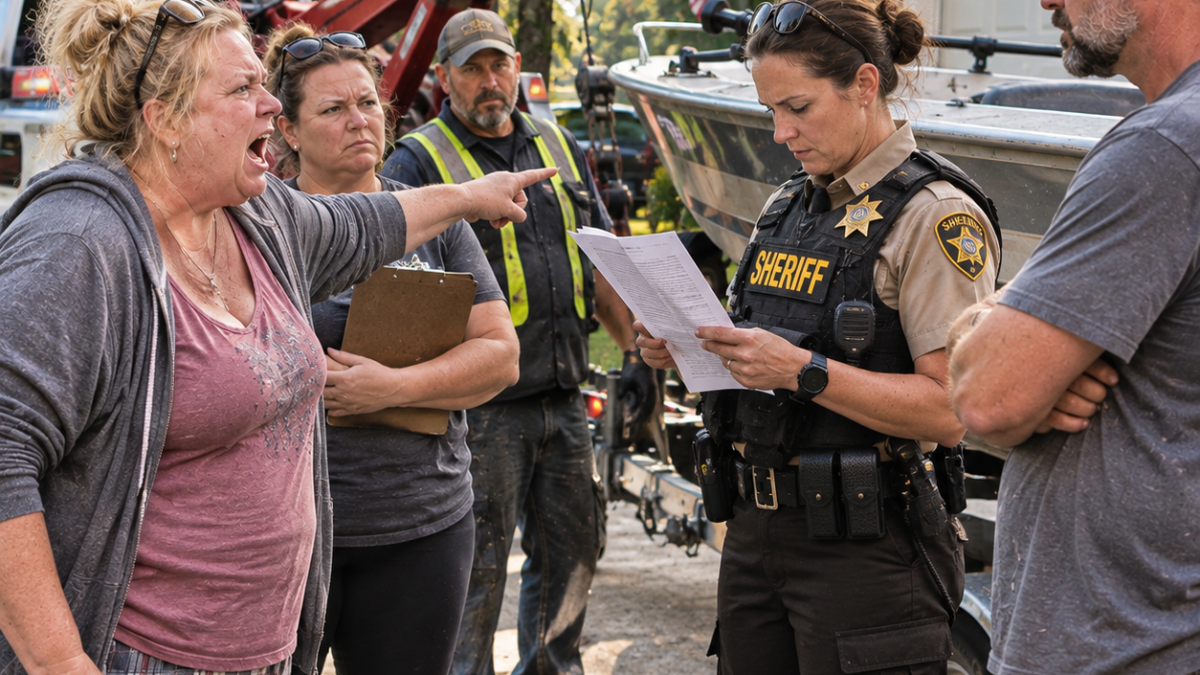
HOA Sent a Tow Truck to Seize My Boat From My Driveway—Then the Sheriff Asked for the One Document They Couldn’t Explain.
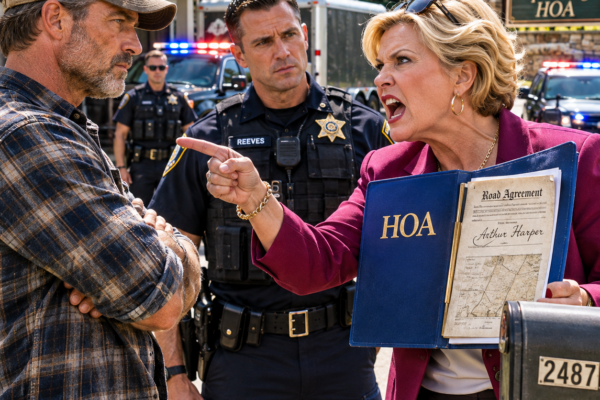
The tow truck was already halfway into my driveway when I came home, my father’s old fishing boat hooked to the winch while the HOA president stood beside it with her arms crossed and a red “FINAL ENFORCEMENT” notice taped across the windshield.
I had spent seven months telling Lake View Ridge the same simple thing—that my four-acre property existed before their neighborhood, that I paid only for a recorded road easement, and that I had never joined their HOA—but Karen Whitmore kept acting as if saying it often enough could somehow make their rules reach across my property line.
Then the sheriff arrived, opened the folder Karen claimed proved I was a member, studied the signature at the bottom of a document with my name on it, and asked a question that suddenly made the boat sitting behind us feel like the smallest problem on my land.
The first thing I noticed was the rear tire.
One of my boat trailer’s tires was hanging about an inch above the concrete.
That was how far the tow company had gotten before I turned onto Lake View Drive and saw the truck backed into my driveway.
The winch cable was tight.
The trailer tongue was already lifted.
My father’s nineteen-foot aluminum fishing boat sat at an angle I had never seen before, one safety chain stretched hard enough that it looked ready to snap.
And standing beside the tow truck was Karen Whitmore.
White blouse.
Khaki pants.
Sunglasses.
Clipboard tucked beneath one arm.
She looked less like someone watching a private boat being removed from somebody else’s property and more like a woman waiting for a ribbon-cutting ceremony.
I slowed my pickup.
For maybe half a second, I thought I had driven to the wrong house.
That sounds ridiculous.
I had owned the place seven months.
I knew every oak tree, every crack in the driveway, every place rainwater collected along the ditch.
Still, the scene made so little sense that my brain tried to reject it.
Then I saw the red paper taped across the boat windshield.
REMOVE BOAT IMMEDIATELY.
FINAL HOA ENFORCEMENT.
I stopped my pickup sideways across the driveway entrance.
Not aggressively.
Practically.
If the tow truck decided to leave with my boat, it was not going anywhere without going through my truck first.
Karen started walking toward me before I even shut the door.
“Ryan.”
I stepped out.
“What are you doing?”
“You were given thirty days.”
“For what?”
“You know exactly what for.”
She pointed toward the boat.
“The association has authorized removal.”
The tow driver looked at me.
PART2:
He was probably in his late forties, baseball cap, work gloves, remote control hanging from one hand.
He did not look happy.
That mattered.
People who believe they are unquestionably doing a legal tow usually do not look like that.
I ignored Karen for a second and walked toward him.
“Whose authorization?”
Karen answered before he could.
“Lake View Ridge.”
I looked down at the concrete.
Then at her.
“Authorized removal from whose property?”
Her mouth tightened.
“We have been through this.”
“Yes.”
“Lake View Ridge property standards apply to every home on this street.”
“No.”
“You live inside Lake View Ridge.”
“No.”
“You use Lake View Ridge roads.”
“Yes.”
“Then you are subject to Lake View Ridge standards.”
“No.”
The tow driver lowered his remote.
PART3:
Karen looked at me like I was deliberately pretending not to understand basic English.
That had been her favorite expression for months.
I pointed toward the mailbox.
Near it, partly hidden by grass, was an old survey marker.
Then I pointed toward the stone boundary post farther into my yard.
“My house was built twelve years before your HOA existed.”
Karen pulled a folder from beneath her arm.
“My deed is not part of Lake View Ridge. I have a recorded road easement. I pay my share for road maintenance because the easement requires it. That does not make me an HOA member. You do not own my driveway, and you do not have permission to touch my boat.”
“Your opinion does not override our governing documents.”
“That is fortunate, because my deed is not an opinion.”
She opened the folder.
Pulled out a page.
“Section Nine. Recreational vehicles and watercraft cannot remain visible from a roadway for more than forty-eight hours.”
“That section applies to members.”
“You are a member.”
“I am not.”
“You became one when you purchased the property.”
“No.”
The tow driver finally spoke.
“Ma’am?”
Karen turned toward him.
“Did the owner sign anything agreeing to this tow?”
“The association does not require individual permission when enforcing community rules.”
He looked at me.
“This private property?”
“Every inch beneath your boots.”
He exhaled.
Then glanced toward the road.
A sheriff’s SUV was turning onto Lake View Drive.
Karen looked at me.
“You called the sheriff?”
“I called before I got out of my truck.”
Her expression changed slightly.
Not fear.
Annoyance.
That was when I understood she really believed she was right.
Deputy Laura Mitchell parked along the curb and walked toward us.
Mid-forties.
Dark hair tied back.
Calm face.
The kind of deputy who did not waste movement.
She listened to Karen first.
Then me.
I gave her the copy of my deed I kept in the truck because by then carrying proof that I owned my own house had become part of my routine.
Laura read it.
Then looked at Karen.
“What document gives the HOA authority over this parcel?”
Karen did not hesitate.
That confidence should have reassured her.
Instead, it was the beginning of everything.
She handed Laura the folder.
Laura read the first page.
Second.
Third.
Then she stopped.
Turned backward.
Read something again.
Her eyes moved from the paper to me.
“Mr. Bennett?”
“Yes?”
“Have you seen this before?”
She held up a document.
At the top:
VOLUNTARY ANNEXATION AGREEMENT.
Below that was my property address.
My parcel number.
My name.
Ryan Bennett.
I walked closer.
“What is that?”
Karen said:
“The document confirming your property entered Lake View Ridge.”
I took one more step.
At the bottom was a signature.
My signature.
Almost.
I stared at it long enough that Laura asked:
“Did you sign this?”
“No.”
Karen answered too quickly.
“That document came from association records.”
Laura looked at her.
“I asked Mr. Bennett.”
I pointed at the signature.
“It looks like mine.”
Karen folded her arms.
“Because it is.”
“No.”
The beginning was close.
I sign Ryan with a long upward stroke on the R.
That part was there.
The B in Bennett was close too.
But the last letters were wrong.
Too careful.
My real signature gets worse toward the end.
Most people’s do.
Whoever made this had slowed down.
Copied the shape.
Tried to reproduce it instead of writing it naturally.
“I did not sign that.”
Laura studied the page.
Karen’s voice sharpened.
“You may not remember every document from closing.”
“I remember not joining an HOA.”
“You purchased a parcel subject to annexation.”
“No.”
The tow driver started unhooking my trailer.
Karen turned.
“What are you doing?”
“I’m not towing anything while ownership authority is disputed.”
“The HOA authorized—”
“Then the HOA can call my office.”
He loosened the winch.
The tire lowered.
I should have felt relieved.
I did not.
Laura was still reading.
She turned the annexation agreement toward the light.
Then looked at the date.
Her expression changed.
“Mr. Bennett.”
“Yes?”
“When did you purchase this property?”
“Seven months ago.”
She showed me the date printed above the signature.
Four months before my closing.
I read it.
Then read it again.
For the first time since I met her, Karen Whitmore had nothing to say.
Laura looked directly at her.
“According to this document, Mr. Bennett voluntarily annexed a property he did not yet own.”
Karen stared at the page.
“That must be an administrative error.”
Rebecca Hayes would later tell me that “administrative error” is one of those phrases people use when they suddenly wish paper could become smoke.
At the time, I only knew one thing.
The boat was no longer the story.
To understand how an HOA ended up standing in my driveway with a tow truck and a document carrying a signature I never made, you have to go back seven months.
Before Karen.
Before fines.
Before fake paperwork.
Back to my father.
Dad was the reason I bought the Harper place.
Not directly.
He never lived there.
He died the year before I bought it.
But nearly every important decision I made in those months connected somehow to him.
My father was not wealthy.
He worked as an industrial electrician for thirty-four years.
He believed in fixing things before replacing them, buying tools once if possible, waking before sunrise for fishing, and never trusting anybody who described a boat as an investment.
His boat was a nineteen-foot aluminum fishing boat with faded green paint and an outboard motor rebuilt twice.
It was not impressive.
At the marina, it sat beside fiberglass bass boats worth more than some cars.
I would not have traded it for any of them.
Every mark meant something.
The long scratch near the bow came from when I was sixteen and hit a dock because Dad had told me to approach slowly and I was sixteen, which meant I believed “slowly” was advice for weaker men.
One seat was mismatched because Dad dropped a tackle box through the original.
The left rear storage latch never closed unless you pushed it with your knee.
There was a cigarette burn near the console even though Dad quit smoking twenty years before he died.
My hands knew that boat.
When he died, the boat became mine.
I sold his house.
Kept tools.
Photographs.
A few watches.
And the boat.
That same year, I found the Harper property outside Knoxville near Douglas Lake.
Four acres.
Older brick house.
Detached garage.
Workshop.
Vegetable garden.
Mature oaks.
The property did not directly front the main lake, but it came with a recorded easement down an old gravel lane to a small private dock.
That sold me.
Not the house.
Not the garage.
The dock.
Two slips.
Old wood.
Quiet water.
The kind of place where you could sit before sunrise and remember somebody without feeling like you were trying too hard.
The Harper family had owned the property long before Lake View Ridge existed.
Lake View Ridge was a planned community of nearly two hundred houses built around it decades later.
Pool.
Clubhouse.
Tennis courts.
Matching mailboxes.
Walking paths.
Private road network.
The developer had tried to buy the Harper land years earlier.
George Harper refused.
So they built around him.
My driveway connected to Lake View Drive because it was the practical route to the county highway.
That connection was legal through a permanent recorded easement.
I paid a defined annual share of road maintenance.
In return, I had road access.
Nothing more.
No clubhouse.
No pool.
No voting rights.
No HOA dues.
No architectural committee.
No requirement that my mailbox match theirs.
No restriction saying my father’s boat had to disappear after forty-eight hours.
Rebecca Hayes handled my closing.
Rebecca was maybe five years younger than me, sharp, direct, and allergic to vague real-estate language.
She sat across from me the week before closing with the title documents spread across her desk.
“You understand this parcel is not part of Lake View Ridge?”
“That was one of the selling points.”
“You do share their road.”
“I know.”
“You pay road maintenance.”
“I know.”
“That is not HOA membership.”
“Good.”
She tapped the easement.
“Do not let anybody convince you otherwise.”
I laughed.
“You expecting trouble?”
“You’re buying an old non-member parcel physically surrounded by an HOA.”
“That common?”
“Common enough that I am telling you not to lose this paperwork.”
“You think they’ll send me letters?”
Rebecca did not laugh.
“You will probably get letters.”
She was right.
My first month was peaceful.
Most neighbors were friendly.
Frank Miller lived two houses down inside Lake View Ridge.
Retired firefighter.
Early sixties.
Broad shoulders going soft around the middle.
Always wearing a cap from a fire station he no longer worked at.
He walked over one Saturday while I was replacing a rotten fence board.
“You bought Harper’s place.”
“I did.”
“Good house.”
“Needs work.”
“They all need work.”
Then he noticed the boat.
“Nice boat.”
“Old.”
“Old boats catch fish too.”
I liked him immediately.
Susan Parker brought banana bread.
Robert Jenkins helped me move an old workbench farther into the garage.
Linda Harris told me which bait shop opened before five.
Nobody cared about the HOA boundary.
If anything, a few people seemed amused that my property sat like an island inside the planned neighborhood.
Then Karen Whitmore arrived.
White SUV.
HOA sticker on the rear window.
Clipboard.
She pulled up while I was washing Dad’s boat after a morning on the lake.
“Mr. Bennett?”
“That’s me.”
“I’m Karen Whitmore, president of the Lake View Ridge Homeowners Association.”
I shut off the hose.
“Nice to meet you.”
Her eyes went to the boat.
“How long will that remain there?”
I thought she needed driveway access.
“Probably until Saturday.”
“That long?”
I looked at the boat.
“Yes?”
“Watercraft cannot remain visible from the road more than forty-eight hours.”
I smiled.
She did not.
“I’m not in the HOA.”
“I know the Harper parcel has a special status.”
“Special status?”
“It is surrounded by the community.”
“That is geography.”
She tapped her clipboard.
“You use Lake View Ridge roads.”
“I pay for road maintenance.”
“That creates community obligations.”
“It creates a road obligation.”
Her mouth tightened slightly.
“Lake View Ridge maintains appearance standards to protect everyone’s property values.”
“I’m sure it does.”
“You should consider following them voluntarily.”
That word mattered.
Voluntarily.
“Sure. I’ll consider it.”
Karen nodded like she had won.
I watched her drive away.
Then I left the boat exactly where it was.
Not to provoke her.
I planned to fish again Saturday.
The detached garage was too short to store the boat without removing half a workbench and reconfiguring shelving.
I saw no reason to rebuild a garage because a woman with a clipboard disliked boats.
Two weeks later, I received my first notice.
COURTESY REMINDER.
WATERCRAFT VISIBLE FROM PUBLIC ROADWAY.
PLEASE RELOCATE TO APPROVED STORAGE.
I called Lake View Ridge management.
Jennifer Collins answered.
I gave my address.
There was a pause.
“Oh.”
“What?”
“You’re the Harper parcel.”
“Bennett now.”
“Right. Yes. You’re not showing as an association member.”
“Because I’m not one.”
“I’ll cancel the notice.”
That was it.
Easy.
I hung up thinking the problem was solved.
A week later:
$50 fine.
I called Jennifer.
She apologized.
Canceled it.
Then $100.
Canceled.
Then $200.
Canceled.
Every time the management office looked at its own property system, my address appeared outside the HOA.
Every time somebody else issued a violation anyway.
Frank noticed.
We were standing beside my boat one morning.
“What does Karen have against aluminum?”
“I think she hates boats.”
Frank laughed.
“No.”
“What?”
“She hates exceptions.”
That made more sense.
Lake View Ridge was organized almost obsessively.
Black mailboxes.
Approved fence colors.
Trash bins screened.
Limited parking.
Grass height.
Exterior paint.
Boats hidden.
I did not hate them for that.
People had bought into those rules.
They had signed contracts.
If matching mailboxes made them happy, fine.
The issue was simple.
I had not signed.
Then Karen changed tactics.
Instead of a fine, I received an invitation.
VOLUNTARY ANNEXATION INTO LAKE VIEW RIDGE.
There was a brochure.
Pool privileges.
Clubhouse access.
Neighborhood events.
Voting rights.
Security patrol.
Trash discount.
Annual dues: $1,860.
I read everything.
Then declined.
Karen called three days later.
“Can I ask why?”
“I don’t need membership.”
“You already live as part of the neighborhood.”
“I live beside it.”
“You use the same roads.”
“Through a recorded easement.”
“You benefit from our security.”
“I didn’t request security.”
“You benefit from Lake View Ridge property values.”
“My property existed first.”
Silence.
Then Karen said something I would remember later.
“Your house creates an enforcement gap.”
I leaned back in my chair.
“An enforcement gap?”
“If your property is allowed to maintain different standards while being visually integrated into Lake View Ridge, members question why restrictions apply to them.”
“The answer is because they joined.”
“That distinction is not always visible.”
“Legal distinctions usually aren’t.”
“This is exactly the type of attitude that makes cooperative planning difficult.”
I almost laughed.
“Karen, you asked me to join voluntarily.”
“Yes.”
“I voluntarily said no.”
“That does not mean we cannot keep discussing it.”
It should have.
The next escalation happened on a Saturday.
I found a yellow sticker attached to the boat trailer.
UNAPPROVED WATERCRAFT STORAGE.
The sticker was forty feet up my driveway.
Somebody had walked onto my property.
I checked my doorbell camera.
6:42 a.m.
Scott Wallace.
Head of Lake View Ridge Community Compliance.
I called him.
“Why were you in my driveway?”
“Routine enforcement.”
“You don’t enforce anything here.”
“We’re trying to handle this professionally.”
“Then stay off my property.”
“You’re refusing every reasonable request.”
“Because your rules do not apply to me.”
“Ryan, everybody else follows the same standards.”
“Everybody else joined.”
“You’re surrounded by Lake View Ridge.”
“Geography is not membership.”
I called Rebecca.
She sent a certified letter.
Clear.
Professional.
My parcel was not subject to Lake View Ridge covenants.
The road easement did not create HOA membership.
The association had no authority over my boat, landscaping, structures, mailbox, vehicle storage, exterior colors, or anything else on my property.
HOA staff were not permitted to enter my land for enforcement.
Stop sending violations.
Lake View Ridge’s attorney, Charles Bennett—no relation—responded.
He mostly agreed.
That should have ended it.
But Rebecca called me after reading his letter.
“He used a strange word.”
“What?”
“Currently.”
I opened the email.
Based on the records currently available to the association, the Bennett parcel is not currently subject to Lake View Ridge restrictive covenants.
“Probably lawyer language.”
“Maybe.”
“You don’t think so?”
“I think lawyers choose words.”
She called Charles.
He said the board was reviewing historical development files.
That made no sense to me.
The title history was clean.
The Harpers owned the property before the HOA.
They refused annexation.
The developer built around them.
End of story.
For six weeks, nothing happened.
No notices.
No stickers.
No calls.
Life returned to normal.
Frank and I fished twice.
I built a simple roof beside the garage so the boat could stay covered in winter.
Then Jennifer called.
Not Karen.
Jennifer.
Her voice sounded wrong.
“Ryan, did you sign any association paperwork recently?”
“No.”
“Nothing?”
“I think I would remember joining the HOA.”
She did not laugh.
“What happened?”
“Your property status changed.”
“To what?”
“Member.”
I sat up.
“Change it back.”
“I can’t.”
“Why?”
“There’s an annexation document.”
“What annexation document?”
“I probably shouldn’t be telling you this.”
“Jennifer.”
She exhaled.
“It says your parcel voluntarily joined.”
“When?”
“The document is dated before you bought the house.”
My skin went cold.
“That is impossible.”
“I know.”
“Who uploaded it?”
“I can’t say.”
“Is it recorded with the county?”
“I don’t know.”
Rebecca checked.
Nothing.
No annexation filed against title.
Good.
But inside the HOA’s system, someone had changed my parcel from non-member to member.
Then Jennifer said:
“The system also shows back dues.”
“How much?”
“Just over four thousand dollars.”
I laughed once.
Not because it was funny.
Because sometimes absurdity comes out of your mouth sounding like laughter.
Two days later, the letter arrived.
FINAL COMPLIANCE DEMAND.
Boat visible.
Unapproved boat shelter.
Unapproved exterior storage.
Mailbox color.
That one almost impressed me.
My mailbox was dark green.
Lake View Ridge required black.
Total current fines: $1,450.
Back dues: $4,186.
Legal and processing fees: $620.
Rebecca read it.
“Do not pay.”
“I wasn’t going to.”
“Do not sign anything.”
“I wasn’t going to.”
“And do not move the boat.”
That surprised me.
“Why?”
“Because if this becomes litigation, I don’t want them arguing that you accepted enforcement.”
“So I’m legally required to go fishing?”
Rebecca sighed.
“Please try not to enjoy this.”
The boat stayed.
HOA staff photographed it every morning for a week.
Same angle.
Same driveway.
I waved twice.
Then the red notice appeared.
FINAL WARNING BEFORE REMOVAL.
I called Charles directly.
“You’re threatening to tow my boat from private property.”
Silence.
“What?”
I sent him the notice.
He called back twenty minutes later.
“I did not approve this.”
“Who did?”
“I’m finding out.”
Four days later, I went into town for a marine battery.
When I came home, the tow truck was there.
Which brought us back to Karen.
Laura.
The fake signature.
And a date four months before I even owned the property.
Rebecca arrived fifteen minutes after the sheriff.
She walked up, took one look at the annexation agreement, and smiled.
Not happily.
Lawyer smile.
The kind that means somebody has just handed her something useful.
“This was supposedly signed by Ryan?”
Karen said:
“Yes.”
Rebecca pointed at the date.
“Before he owned the property?”
Karen’s jaw tightened.
“There may be an error in the archived copy.”
Rebecca flipped the page.
“Notary block.”
Patricia Nolan.
Commission number.
Seal.
Signature.
Rebecca photographed it.
Then checked the Tennessee notary database.
Patricia existed.
Her commission existed.
But the commission number on the document had been issued two years after the date printed on the annexation agreement.
Laura closed the folder.
“Nobody removes this boat.”
Karen started arguing.
Laura ignored her.
Rebecca kept reading.
Behind the fake agreement was a title page from East Tennessee Property Services.
HARPER PARCEL INCORPORATION.
Another page showed a map.
My four acres outlined in red.
Across the bottom:
PHASE FOUR EXPANSION.
Frank arrived while we were standing there.
He looked over Rebecca’s shoulder.
His expression changed.
“I’ve seen that.”
Karen turned.
“Frank, not now.”
He ignored her.
“That map was shown at last year’s reserve meeting.”
I looked at him.
“What map?”
He pointed toward the woods behind my house.
“The future expansion.”
“My land is on it.”
“Yes.”
“What expansion?”
Karen answered.
“It was conceptual.”
Rebecca raised the fake annexation.
“Conceptual plans usually don’t need forged membership agreements.”
Nobody spoke.
Then Laura’s phone rang.
Another deputy had been checking county filings.
A lien had been recorded that morning.
Lake View Ridge HOA against my property.
Karen’s name was on the filing.
At first, Laura said the amount looked like roughly six thousand dollars.
Then she opened the full record.
Her eyebrows moved.
“Wait.”
Rebecca looked over.
“What?”
Laura turned the screen.
$27,400.
I stared.
“That cannot be right.”
Most of the total was not normal dues or fines.
The largest line item:
SPECIAL ASSESSMENT — PHASE FOUR LAND INTEGRATION.
I looked at Karen.
“What exactly are you integrating?”
She did not answer.
Frank did.
Quietly.
“Ryan.”
I turned.
“I think they’ve been planning a road through your property.”
That sentence hit harder than the forged signature.
A boat violation was ridiculous.
A fake annexation document was serious.
A false lien was worse.
But a road explained motive.
Rebecca spread the Phase Four map across the hood of my pickup.
A proposed access route entered the eastern woods on my property, crossed near my workshop lot, passed close to the old vegetable garden, then connected Lake View Ridge to a county road beyond my land.
Second entrance.
Frank explained residents had wanted one for years.
School-hour traffic clogged the existing entrance.
Three years earlier, a brush fire blocked the main road for nearly forty minutes.
Families panicked because Lake View Ridge had only one practical exit.
A second road would improve emergency access.
Reasonable idea.
Wrong property.
Or at least property they did not own.
“The line goes through my workshop lot.”
Frank nodded.
“And the garden.”
“Yes.”
“And close to my dock lane.”
“Yes.”
Karen finally spoke.
“It was only one concept.”
Rebecca tapped the lien.
“Then why is Ryan being billed twenty-one thousand dollars for Phase Four land integration?”
“I did not create the accounting categories.”
“You signed the lien.”
“I signed what management prepared.”
“That is still your signature.”
Scott Wallace had barely spoken.
Laura turned toward him.
“You worked for the original developer?”
“Years ago.”
“What did you do?”
“Property coordination.”
Rebecca looked at him.
“That is vague.”
“Landowner outreach. Easements. Development paperwork.”
She held up the fake annexation.
“Did you prepare this?”
“No.”
“Have you seen it before?”
Scott hesitated.
Everybody noticed.
“I saw something similar in an old file.”
“Similar?”
“I don’t know if it was this exact document.”
“When?”
“Maybe two years ago.”
I stared at him.
“Two years ago?”
“Yes.”
“I did not own this property two years ago.”
Rebecca immediately understood.
“Was Ryan Bennett’s name on the document when you saw it?”
Scott said nothing.
Laura moved him several feet away from Karen.
“Mr. Wallace, answer clearly.”
He looked at Karen.
Then Laura.
“No.”
Karen turned.
“What?”
“The old form had George Harper’s name.”
George.
Previous owner.
Scott explained that when Lake View Ridge originally expanded, the developer drafted annexation paperwork for George.
George refused to sign.
The unsigned document went into storage.
Rebecca held up the version with my name and fake signature.
“So somebody took an unsigned George Harper annexation agreement and rebuilt it using Ryan Bennett.”
Scott looked away.
“Possibly.”
“Not possibly.”
She held up the page.
“It happened.”
Karen said:
“I did not know the document was altered.”
“Who gave it to management?”
“Scott.”
Scott’s face changed.
“That is not what happened.”
“You brought the historic file to the board.”
“The unsigned file.”
“That is not what Jennifer received.”
“You told me you wanted to review it before I gave it to her.”
“That’s a lie.”
Laura cut them off.
“Stop talking to each other.”
The tow driver raised one hand awkwardly.
“Deputy?”
“Yes?”
“Can I leave?”
“Yes.”
He apologized to me.
“I was told the boat was on association-controlled property.”
“It’s not your fault.”
“They said everything had been legally cleared.”
“By who?”
“Association management.”
He left.
I checked the boat.
Minor scratch on the safety-chain hook.
Nothing serious.
Dad’s boat had survived worse.
Rebecca looked at me.
“Do not move it.”
I stared.
“Again?”
“Yes.”
Karen laughed bitterly.
“You’re turning a boat into a lawsuit.”
Rebecca looked at her.
“No. Someone turned a boat into a fake annexation, a lien, and a land-acquisition strategy.”
That shut everyone up.
The sheriff took copies.
Rebecca sent preservation letters to Lake View Ridge, its management company, East Tennessee Property Services, and the developer contacts connected to Phase Four.
Do not delete emails.
Do not destroy drafts.
Do not modify records.
Do not suddenly discover that every relevant laptop fell into a lake.
That evening, I sat on my back porch.
Dad’s boat rested beneath the small roof beside the garage.
Kids rode bicycles along Lake View Drive.
Someone grilled.
Frank walked his dog.
Normal life surrounded me.
I needed that.
Because one thought kept getting louder.
I did not want Lake View Ridge destroyed.
Most of the nearly two hundred homeowners knew nothing about this.
They had not forged anything.
They had not filed a lien.
They had not sent a tow truck.
If this turned into a fight, I wanted the fight pointed at the people who actually made the decisions.
Not the neighborhood.
Frank came over the next morning with coffee.
“I should’ve told you about Phase Four.”
“You thought it was conceptual.”
“I saw your land on the map.”
“Did you know they planned to claim I was a member?”
“No.”
“Then stop apologizing.”
He explained the fire incident.
The second entrance made sense from a safety standpoint.
That surprised him when I admitted it.
“You’d consider selling land for the road?”
“Maybe.”
Frank stared.
“After this?”
“The road isn’t what forged my signature.”
I looked toward the eastern woods.
“Fair price. Proper route. Keep it away from the workshop. Protect the dock access. No HOA membership. Maybe.”
“You’re telling me they could’ve just negotiated?”
“Probably.”
Frank laughed.
“And instead Karen fined your boat.”
“Apparently.”
That was the tragedy hidden inside the stupidity.
They might have gotten cooperation by asking.
Instead they tried to manufacture authority.
Jennifer called that afternoon.
“I have something.”
I told her to call Rebecca first.
We met at Rebecca’s office.
Jennifer brought system audit logs.
Every file uploaded to the HOA database had timestamps, user accounts, and source information.
The fake annexation had been uploaded six weeks earlier.
Account:
KW Whitmore.
Karen.
Jennifer immediately added:
“That does not prove Karen personally uploaded it.”
“Why?”
“Shared administrator access.”
Scott used Karen’s login for some compliance tasks.
Terrible security.
Useful ambiguity.
Upload time:
Tuesday, 9:16 p.m.
Clubhouse entry records showed Karen’s key card entering at 8:42.
Scott’s card did not.
But there was a rear entrance with physical keys.
Karen.
Scott.
Property manager.
Two board officers.
Cleaning staff.
Still no proof.
The annexation PDF had been uploaded from a USB drive.
That same USB contained the Phase Four map.
The old unsigned Harper annexation.
Historic developer correspondence.
Then metadata.
Creator:
East Tennessee Property Services.
Author:
SWallace.
Scott Wallace.
Again, not definitive.
Files can be copied.
Computer user profiles can be misleading.
But the pattern tightened.
Then Jennifer opened a spreadsheet.
PHASE FOUR PARCEL STATUS.
One row:
BENNETT/HARPER PARCEL.
Status:
PRESSURE / ANNEX / ACQUIRE.
I read it twice.
Next column:
CURRENT LEVERAGE.
Boat violation.
Road maintenance.
Non-member status challenge.
Target outcome:
Voluntary annexation preferred.
Acquisition if non-compliant.
I sat back.
The boat was not random.
It had been listed as leverage.
Rebecca looked at Jennifer.
“Who had access?”
“A small development coordination group.”
Names:
Karen Whitmore.
Scott Wallace.
Paul Norton from East Tennessee Property Services.
Douglas Price, regional director for Mountain Ridge Communities.
Mountain Ridge wanted to build forty-six new homes east of Lake View Ridge.
My land blocked the easiest road connection.
Then we found the draft purchase offer.
$310,000 for the eastern two acres.
I had never seen it.
Notes:
Owner likely resistant.
Use HOA integration process first.
Boat non-compliance provides opening.
That made me angrier than the number.
Somebody had looked at my father’s boat in a real-estate listing and turned it into a pressure point.
Then Laura called.
The notary, Patricia Nolan, had been interviewed.
She never notarized my annexation.
Never met me for that purpose.
Her seal had been copied.
From where?
A legitimate road-easement amendment I signed three months after closing.
That public document contained my real signature and Patricia’s real seal.
Someone had harvested both.
The fake PDF contained image layers.
My signature.
The notary seal.
The old Harper form.
Digitally assembled.
No clerical mistake.
Forgery.
Then Jennifer revealed the $27,400 lien had originally been much smaller.
Around six thousand.
Someone added the Phase Four assessment later.
No board vote.
No homeowner approval.
No authority.
Charles, the HOA attorney, recommended immediate release of the lien.
Karen refused.
She wanted the board to “preserve the association’s position.”
The board overruled her five to one.
Lien released.
Then East Tennessee Property Services filed a separate notice claiming historic development rights over my parcel.
Another cloud on title.
Another door.
Paul Norton signed it.
The next day, Paul resigned.
Karen stopped answering calls.
Scott stopped reporting for work.
For a short period, every person connected to the Phase Four coordination group seemed to disappear at once.
Then surveyors showed up in my woods.
I was standing in the kitchen when Frank called.
“Come outside.”
Three workers were placing orange stakes through my back field.
The line matched the Phase Four road.
I walked over.
“Who authorized this?”
The crew leader showed me a work order.
Mountain Ridge Communities.
Property access granted by Lake View Ridge HOA.
“No.”
He looked confused.
“No?”
“This property is not controlled by Lake View Ridge.”
He studied the map.
“We were told—”
“You were told wrong.”
To his credit, he stopped.
Called his office.
Pulled the stakes.
That distinction mattered to me.
People should be judged by what they do once they learn something is wrong.
The survey crew did not argue.
The tow driver did not argue.
Others would.
Douglas Price arrived in a black SUV.
Suit.
Nice shoes.
Completely wrong outfit for my field.
“I think we need to talk.”
“Start with why your surveyors are on my land.”
“There appears to be confusion about access rights.”
Rebecca arrived.
“No confusion.”
She held up the deed.
“Your contractor trespassed.”
Douglas exhaled.
“I was told Lake View Ridge controlled the parcel through annexation.”
“By who?”
Pause.
“Scott Wallace.”
“Did you review a recorded annexation?”
“No.”
“Title report?”
“Not personally.”
“Recorded covenant?”
“No.”
“So you planned a road across a man’s property because an HOA employee told you the HOA controlled it?”
“We relied on development consultants.”
“Which consultants?”
“East Tennessee Property Services.”
Paul again.
Then Douglas admitted Mountain Ridge had already spent nearly $600,000 planning Phase Four.
Engineering.
Traffic studies.
Drainage.
Design.
Permits.
That created pressure.
Not ownership.
Pressure.
Then he said:
“We are prepared to make Ryan a fair offer.”
Rebecca looked at me.
“How fair?”
“Four hundred fifty thousand dollars for two acres and necessary road easement.”
Frank almost choked.
I could have accepted.
I did not.
“I’m not negotiating while someone is forging documents in my name.”
Douglas nodded.
“That’s fair.”
That surprised me.
Then he asked:
“If the title situation is resolved, would you consider a discussion?”
“Maybe.”
Frank looked like I had betrayed a cause he had invented for me.
But the road could help emergency access.
The land was not the sentimental part of the property.
The boat was.
The dock was.
The house mattered.
The eastern strip could potentially be redesigned around my workshop.
There might be a deal.
Just not under threat.
Then Laura’s phone rang.
Scott’s vehicle had been found outside an old storage building associated with East Tennessee Property Services.
Scott was not there.
But through an open doorway, deputies saw boxes.
HARPER/BENNETT.
PHASE FOUR.
ANNEXATION.
The building was secured while proper search authority was obtained.
I waited outside when investigators entered.
Laura came out carrying an evidence sleeve.
Old annexation agreement.
George Harper.
Unsigned.
No notary.
Exactly as Scott described.
Second sleeve:
My legitimate road-easement amendment.
My real signature.
Patricia Nolan’s seal.
Source material.
Third:
Draft fake annexation.
Across the top:
REPLACE HARPER WITH BENNETT AFTER CLOSING.
Then a handwritten checklist.
Acquire signature sample.
Update owner name.
Upload annexation.
Begin enforcement.
Escalate fines.
Lien if necessary.
Negotiate Phase Four access.
Final line:
If owner still refuses, initiate foreclosure strategy.
I felt cold.
They were not only trying to pressure me.
Somebody had written down a sequence designed to load my property with manufactured debt and then use that debt against my title.
At the bottom were two initials.
KW.
Karen Whitmore was the obvious assumption.
Laura refused it.
“Initials are not proof.”
That frustrated me.
It also reminded me why investigations should not be run by angry homeowners.
Evidence first.
Stories later.
The archive gave them a timeline.
George Harper had been approached repeatedly years earlier.
Join the HOA.
Sell land.
Grant access.
He refused.
The developer built around him.
But one internal file remained.
STRATEGIC ACQUISITION — HARPER PARCEL.
Old offers.
Road plans.
Notes.
Recommendation:
Revisit upon ownership transfer.
Then I bought it.
An email two months before my closing:
Scott Wallace to Paul Norton:
Harper Parcel under contract. New owner may be easier.
Paul:
Need buyer profile.
Scott:
Single male. Boat owner. No HOA background.
I stared at Rebecca.
“How did they know I had a boat?”
She pulled up the real-estate listing.
One photograph showed Dad’s boat near the garage.
They had looked at me before I owned the house.
Another email:
Scott to Karen:
New buyer may create standards issue. Boat likely visible. Could become useful leverage if Phase Four reopens.
Karen:
Do not create a fight before we know his position.
That message mattered.
It suggested she had not started with forgery.
Then I declined voluntary annexation.
Karen to Scott:
He declined annexation. Begin normal compliance sequence and see if he becomes cooperative.
Scott later:
Management keeps canceling fines because parcel is excluded.
Karen:
Then fix parcel status.
Four words.
Fix parcel status.
Laura asked when Karen first saw the unsigned George Harper document.
Three weeks before my status changed.
Six days later, the Bennett version was created.
Handwriting analysis of the checklist eventually pointed more strongly toward Scott, not Karen.
The KW at the bottom appeared to be a note indicating whose approval was needed.
Karen’s.
That complicated things.
Karen returned with an attorney.
She admitted wanting my parcel annexed.
Admitted knowing Phase Four planners wanted my land.
Admitted telling Scott to fix the property status.
Admitted management kept canceling my boat fines because I was not a member.
She denied ordering forgery.
“I never told anyone to fake his signature.”
Investigators asked:
“Did you see the annexation?”
“Yes.”
“Did you see Ryan Bennett’s name?”
“Yes.”
“The signature?”
“Yes.”
“The date?”
Long pause.
“I did not check the date carefully.”
Then the $21,000 Phase Four assessment.
She admitted approving it.
No board vote.
No authority.
“Why?”
“I believed the parcel belonged to the HOA and should contribute to integration costs.”
“Could you impose the assessment alone?”
“No.”
“Then why place it in the lien?”
“To preserve our claim.”
That was not a good answer.
Karen also admitted sending compliance pressure after I rejected annexation.
She said she wanted me to feel “the inconvenience of remaining outside.”
At minimum, that was an abuse of the position.
The board suspended her.
Then came something I did not expect.
The board asked to meet with me.
Frank.
Susan.
Robert.
Linda.
Another director.
They sat at my kitchen table.
Dad’s boat visible through the window.
Frank spoke first.
“We failed you.”
“You personally didn’t.”
“The association did.”
That was fair.
They offered immediate corrections.
All fines permanently canceled.
All dues removed.
Written confirmation that my property was not in Lake View Ridge.
No compliance officer allowed onto my land without permission.
No future annexation requests unless I initiated the conversation.
Reasonable legal expenses covered, subject to insurance.
I accepted the written boundary confirmation.
I did not sign a broad settlement yet.
Then Frank asked carefully:
“What about the road?”
Everybody looked at him.
He raised his hands.
“I’m not negotiating. I’m asking.”
I looked toward the woods.
“Maybe someday.”
Susan blinked.
“After all this?”
“The road itself isn’t the problem.”
That lowered the temperature.
Boundaries do that.
Once people understand who owns what, cooperation becomes possible.
Scott was eventually found at a motel outside Nashville.
He returned with an attorney.
Admitted writing the Phase Four checklist.
Denied forging the annexation.
Claimed Paul Norton told him the old annexation was valid.
Then investigators searched Paul’s work computer.
There it was.
Editing software.
Original Harper form.
My signature sample.
Patricia Nolan’s seal.
Draft versions.
One draft still said George Harper in a paragraph the editor missed.
Autosave records:
Windows user P. Norton.
Messages between Paul and Scott.
Scott:
Need parcel status solved before road package.
Paul:
Old annex form can be reconstructed.
Scott:
Is that safe?
Paul:
Once uploaded nobody will question it unless owner lawyers up.
Rebecca laughed when she read that.
“I suppose you ruined their plan.”
Another exchange:
Scott:
Karen wants movement this month.
Paul:
I’ll handle paper.
Karen’s messages with Paul were uglier.
Paul:
Historic annexation can be restored in system. Need admin login.
Karen:
Scott has it.
Paul:
Once status changes management can enforce.
Karen:
Good. I’m done arguing with him about that boat.
Still not “forge his signature.”
Then:
Paul:
Lien amount can include Phase Four prep if classified as property integration.
Karen:
Do it. He needs incentive to come to the table.
That crossed a line clearly.
She knew the giant assessment was pressure.
The board removed her permanently.
She resigned before the vote.
Paul was found in Kentucky staying with family.
He returned with counsel.
At first, he minimized everything.
Then investigators showed him the files.
He admitted creating the fake annexation.
He blamed Scott.
Scott blamed Paul.
Karen blamed both.
Then Paul produced something nobody expected.
His meeting software automatically recorded some video calls.
One meeting included Karen, Scott, Paul, and Douglas.
They discussed my property.
Phase Four.
The boat.
Douglas said Mountain Ridge preferred direct purchase.
Karen complained I had rejected annexation.
Paul said:
“The old Harper annexation was unsigned, so we cannot use it as is.”
Silence.
Then Karen:
“So what can we use?”
Paul:
“We can reconstruct continuity based on development intent.”
Development intent.
That phrase may be one of the dumbest phrases ever used to justify trying to manufacture somebody else’s legal obligation.
Scott asked:
“Would Ryan challenge it?”
Paul said:
“Probably not if enforcement starts gradually.”
Then Karen:
“Do whatever is necessary to get the parcel treated as inside for Phase Four discussions. I don’t want another year wasted over one boat and one stubborn owner.”
There it was.
Not explicit instruction to forge a signature.
But not innocent misunderstanding either.
She knew there was no signed annexation.
She wanted the result anyway.
The district attorney got the recording.
Residents demanded another HOA meeting.
I did not attend.
I was exhausted from being the central character in a neighborhood organization I had never joined.
Instead, Frank and I took Dad’s boat fishing.
Four hours.
Barely caught anything.
Best afternoon I had in months.
Frank sat near the stern.
“You know this boat might have saved your house.”
“How?”
“If Karen had picked something less obvious, maybe you wouldn’t have fought as hard.”
“Maybe.”
“You knew immediately they had no right to tell you where to park it.”
“Exactly.”
The boat made the first boundary simple.
Mine.
My driveway.
Their rule.
Not my contract.
That caused me to check everything else.
Sometimes the smallest boundary exposes the largest lie.
Frank asked:
“You still going to negotiate with Mountain Ridge?”
“Under conditions.”
He shook his head.
“You are unbelievable.”
“No HOA annexation. Road rights limited to the exact easement. Fair market value. Emergency-access benefit. Noise buffer. No construction through my driveway. Protect the workshop. Protect the dock lane.”
“You really would?”
“If they act like buyers instead of owners.”
Mountain Ridge returned.
Douglas came with a new attorney.
He said:
“We relied on bad information.”
Rebecca answered:
“You also failed to verify title.”
Douglas nodded.
“Correct.”
That was refreshing.
New offer:
$575,000.
Two acres and road easement.
Landscaping buffer.
Private gate.
Road moved twenty-five feet farther east from the workshop.
Sound wall.
Serious proposal.
Still no immediate yes.
For the first time, though, we were negotiating like adults.
No fake dues.
No boat restrictions.
No threats.
Then Laura called one evening.
“Ryan, where are you?”
“Home.”
“Is the boat there?”
“Yes.”
“Stay inside.”
My stomach dropped.
I went to the front window.
Dark pickup at the end of the driveway.
Lights off.
Then it started moving.
Pulled away.
“Laura, what is happening?”
“Paul turned over another file.”
“What file?”
“Contingency actions if you refused Phase Four.”
“What actions?”
“Damage the boat. Create storage complaints. Make the property look neglected. Increase pressure.”
Then she hesitated.
“There’s another item.”
“What?”
“Stage an accident involving the dock access road.”
Before I could respond, a metallic crash came from outside.
I looked toward the driveway.
The boat trailer dropped on one side.
A wheel rolled into the grass.
Not loose.
Removed.
The lug nuts were gone.
My blood turned cold.
I often fished Wednesday mornings.
If I had hooked that trailer to my truck before sunrise and reached highway speed—
I stopped the thought.
Laura shouted through the phone:
“Do not go outside.”
Headlights appeared.
The dark pickup returned.
Stopped.
A man stepped out carrying a small red fuel can.
He took three steps onto my driveway.
Then a sheriff’s cruiser turned onto the street with no siren.
Headlights caught him.
He froze.
Started turning back.
Two more cruisers came from the opposite direction.
The man dropped the fuel can.
The pickup tried to leave.
Blocked.
Less than a minute later, both men were detained.
I stayed inside until Laura cleared me to come out.
The first man was Travis Cole.
Never met him.
Driver:
Brian Mercer.
Contract labor connected to East Tennessee Property Services.
Neither lived in Lake View Ridge.
Neither had any business on my property.
The lug nuts were in a plastic bag inside Travis’s jacket.
Wrench in the truck.
Fuel can contained gasoline.
Matches in the center console.
That looked terrible.
Laura did not jump to conclusions.
Brian talked.
Travis asked for a lawyer.
Brian said Paul Norton hired them to make the “boat problem” worse.
Remove a wheel.
Make the trailer look unsafe.
Pour gasoline near it.
Call an anonymous county complaint claiming a fuel hazard.
He claimed they were not supposed to burn anything.
The matches complicated that.
Travis had brought them.
Maybe Paul planned one thing.
Maybe Travis planned more.
Evidence needed to separate responsibility.
Again, that mattered to me.
I had spent months learning what happens when people decide what they want to be true and then force facts to fit.
I did not want justice done the same way.
The boat was safe.
Trailer damaged.
But the boat itself survived.
Red and blue lights reflected across Dad’s old aluminum hull.
Frank walked over.
Looked at the fuel can.
Then me.
“You okay?”
“Yes.”
“That answer looks tired.”
“I am tired.”
He nodded.
“Fair.”
That was all.
Sometimes friendship is not making someone explain their worst night while they are still standing inside it.
The next morning, a trailer company replaced the hardware and checked every wheel.
Confirmed deliberate removal.
Brian’s phone contained messages.
Paul:
Need visible safety concerns around boat and driveway.
Need county complaint before Thursday meeting.
Trailer issue should be obvious enough that owner cannot ignore it.
Brian:
Damage okay?
Paul:
Nothing major. Just enough to make storage look unsafe.
No order to burn the boat.
No order to remove every lug nut.
Paul still ordered sabotage.
But evidence did not support blaming him for things he did not direct.
Paul’s attorney contacted Laura.
Paul stopped denying.
Fake annexation.
False status.
Phase Four pressure.
Boat strategy.
Inflated lien.
Survey pressure.
Sabotage.
Why?
Money.
East Tennessee Property Services stood to earn a major consulting bonus if Phase Four moved ahead.
Paul personally benefited.
Scott had an incentive tied to development readiness.
Karen’s motivation was different.
She had made Phase Four central to her HOA leadership plan.
Second entrance.
Emergency access.
More homes sharing road costs.
Potential reserve improvements.
She wanted the project badly enough that she started seeing my refusal as an obstacle instead of an answer.
Paul explained the escalation.
At first, he assumed I would not question an HOA letter.
Most people receive official-looking documents and assume someone has legal authority.
When the management office kept canceling fines, they changed my parcel status.
When I disputed status, they used a fake annexation.
When I refused to pay, they filed a lien.
When the lien failed, another property notice.
Then surveyors.
Then sabotage.
It had not begun as one giant master plan.
It had become a staircase.
Each bad decision required another.
That almost made it more believable.
And worse.
Karen had not personally copied my signature.
No evidence she pasted the notary seal.
No evidence she hired Travis or Brian.
But she knew the old Harper annexation was unsigned.
She still told Paul to do whatever was necessary to get my property treated as inside.
She knowingly approved an unauthorized Phase Four assessment as leverage.
She knowingly used HOA enforcement to pressure me toward a land deal.
Her attorney negotiated cooperation.
Records were turned over.
She was permanently removed from HOA leadership.
Paul faced the forgery-related case.
Scott faced consequences tied to false records, pressure planning, and conspiracy.
Travis faced charges connected to the trailer tampering and gasoline.
Brian cooperated early and received a reduced outcome.
Different evidence.
Different consequences.
That was how it should be.
Then Mountain Ridge did something unexpected.
They withdrew the entire Phase Four access proposal.
Douglas asked for another meeting.
This time he came with the company’s general counsel and a new development manager.
“We are terminating the old plan.”
“Why?”
“It was built on contaminated information.”
Good answer.
Then another folder.
“We would like to start from zero.”
Rebecca raised one eyebrow.
“Zero?”
“No historic rights. No HOA membership assumption. No enforcement theory. We want to purchase a narrow easement.”
That was the conversation we should have had from the beginning.
They proposed a road along the far eastern edge.
Independent appraisal.
Full survey.
Drainage protection.
Tree buffer.
Private gate for my use.
No HOA covenants.
No architectural control.
No association membership.
No shared driveway.
Construction access somewhere else.
The road would initially function as emergency access while the new development began.
Frank’s safety concern stayed legitimate.
I asked:
“How much?”
“Six hundred twenty-five thousand.”
I looked at Rebecca.
She did not react.
Good lawyers never react to numbers when someone else is watching.
I hired my own appraiser.
Engineer.
Surveyor.
The route shifted another thirty feet from my workshop.
I replaced the proposed sound wall with a planted berm because I would rather look at trees.
Mountain Ridge agreed to preserve several mature oaks.
They agreed to build a separate paved access lane so construction could not block me.
Two months later, I signed.
Not HOA membership.
A road easement.
Two completely different things.
Frank came over after.
“You went through all of that and still gave them the road.”
“I sold them an easement.”
“Sounds like the same thing.”
“It isn’t.”
“You are exhausting.”
“When people respect ownership, cooperation becomes possible.”
I meant that.
I did not need to reject a useful project forever just because bad people had tried to force it.
If I did, they would still control my decisions.
The second entrance was eventually built.
Emergency access improved.
Traffic improved.
Fire department supported it.
New homes went up east of us.
The road stayed away from my workshop.
The garden survived.
The dock lane stayed protected.
I got paid fairly.
Everyone could have gotten that result at the beginning.
All they had to do was ask.
Lake View Ridge changed too.
Frank became HOA president.
He tried to decline.
Nobody cared.
Susan became vice president.
Robert joined compliance oversight.
First reform:
Before issuing a violation, management had to verify the parcel was actually subject to HOA authority.
That sounds comically obvious.
Apparently it needed to be written.
Shared administrator logins ended.
Every upload tied to one user.
Special assessments required full board approval.
Liens required independent attorney review.
Development involving non-member property could not be handled as “compliance.”
Nobody could enter private property to place stickers or arrange towing without documented authority.
Frank jokingly wanted to call that Ryan’s Rule.
I threatened him.
They called it Non-Member Property Policy.
Much better.
Then the board sent a letter to every homeowner.
It admitted Lake View Ridge had wrongfully treated my parcel as a member property.
Admitted false membership documents entered the system.
Admitted the board failed to supervise development planning.
Apologized.
That mattered more than I expected.
Rumors ended.
Residents came over.
Susan.
Robert.
An older couple I barely knew.
Some apologized.
I kept saying the same thing.
“You did not tow my boat.”
“You did not forge anything.”
“You do not owe me an apology for living in Lake View Ridge.”
An HOA is made of people.
But not every person is responsible for every action committed under its name.
My neighbors were not my enemies.
That distinction kept the whole thing from becoming uglier than it already was.
Rebecca eventually finished the civil settlement.
Lake View Ridge’s insurer covered legal costs tied to the fake membership and lien.
All claimed fines and dues permanently removed.
Trailer damage from the attempted tow covered.
East Tennessee Property Services and its insurer paid separately for the forged-document mess and false filings.
Mountain Ridge covered costs related to the unauthorized survey.
I did not become rich from lawsuits.
The largest payment was the road easement.
That was a legitimate land transaction.
I used part of it to rebuild the detached garage.
Longer this time.
Enough room for Dad’s boat.
Frank stood inside after construction.
He looked around.
“All of this started because they wanted your boat hidden.”
“Yep.”
“And now you finally built a garage big enough to hide it.”
“Sometimes.”
“What do you mean sometimes?”
I pointed outside.
The boat sat in the driveway.
Frank stared.
“You did that on purpose.”
“Maybe.”
He laughed so hard he had to sit on my new workbench.
Truth was, I left the boat outside whenever I planned to fish early.
Not as a political statement.
Because backing it into the garage every night and pulling it out at four-thirty the next morning was inconvenient.
And because it was my driveway.
The criminal and regulatory cases took more than a year.
Paul admitted creating the fake annexation from the old Harper form, my recorded signature, and Patricia Nolan’s seal.
Scott admitted helping use false records to force membership status and Phase Four pressure.
The foreclosure language in his checklist mattered.
Karen reached a separate resolution based on her conduct and cooperation.
Not everybody got the same result.
Again, that mattered to me.
Revenge is emotionally simple.
Responsibility is more precise.
Then I met George Harper.
The previous owner.
Eighty-one.
Drove down from Kentucky after hearing what happened.
We sat beside Dad’s boat while I showed him the old unsigned annexation.
George laughed.
“They tried that on me.”
“The fake signature?”
“No.”
He tapped the old form.
“This. Maybe six times.”
“Why didn’t you sign?”
“Didn’t want an HOA.”
“Same.”
He smiled.
Then told me the original developer had once offered him substantial money for the eastern strip.
The same land Phase Four wanted.
“You almost sold?”
“Almost.”
“What stopped you?”
George looked toward Lake View Ridge.
“The man negotiating acted like he already owned it.”
That sentence stayed with me.
“He came to me explaining what was going to happen. Not asking.”
“So you said no.”
“I would’ve sold if he had treated me like a partner.”
History had repeated itself.
Same parcel.
Same basic mistake.
Different generation.
Someone sees a property owner’s refusal as a problem to overcome instead of an answer to respect.
George looked at my boat.
“Your father’s?”
“Yes.”
“Keep it.”
“I plan to.”
“He’d probably enjoy the trouble.”
I smiled.
“He probably would.”
A year after everything ended, I launched Dad’s boat early on a Saturday.
Frank came.
Susan’s grandson Noah came too.
We fished almost six hours.
Three bass.
Lost one near the dock.
Coffee.
Bad stories.
No lawyers.
No liens.
No surveys.
No forged signatures.
On the drive home, I backed the boat into my driveway and left it exactly where I always had.
Visible from Lake View Drive.
Frank looked at it.
“You know the rule says forty-eight hours.”
I stared at him.
“What rule?”
He smiled.
“Exactly.”
That became our joke.
Lake View Ridge still has boat restrictions.
Members follow them.
Fine.
Their property.
Their contract.
Their choice.
I am still not a member.
I pay my road-maintenance share because my easement requires it.
I do not use the clubhouse.
I do not vote in HOA elections.
They do not approve my paint.
They do not control my mailbox.
They do not control my driveway.
And they absolutely do not control Dad’s boat.
Oddly enough, my relationship with the neighborhood became better after the conflict.
Clear boundaries helped.
Nobody had to pretend anymore.
I was not a “special member.”
Not an “exception parcel.”
Not an “enforcement gap.”
I was a neighboring property owner with specific shared road rights.
Nothing more.
Nothing less.
Once that was settled, kindness got easier.
One fall, I let Lake View Ridge use my back field for a charity picnic.
Frank nearly had a medical emergency.
“You’re allowing the HOA onto your land?”
“For one day.”
“Voluntarily?”
“Yes.”
“Should I call Rebecca?”
“Get out.”
Families parked beneath the oaks.
Kids played games.
Robert and I cooked burgers.
Nobody issued me a violation.
Progress.
I eventually installed a wooden sign near my driveway entrance.
Not angry.
Not threatening.
PRIVATE PROPERTY.
NOT PART OF LAKE VIEW RIDGE HOA.
PLEASE ASK BEFORE ENTERING.
Frank said it was too polite.
That was the point.
Dad’s boat still sits behind that sign often.
Scratched.
Old.
Mine.
People who hear this story tend to focus on different parts.
Some like the forged annexation.
Some like the $27,400 lien.
Some focus on the Phase Four map.
Some remember the men with the missing lug nuts and the gasoline can.
Some think the most satisfying part is Karen losing her position.
For me, the moment I remember most is still the first one.
Karen standing beside that tow truck.
Arms crossed.
Absolutely certain that Lake View Ridge had the right to remove something from my driveway because every house around me followed the same rules.
That was the fundamental mistake.
Authority does not come from confidence.
It does not come from a clipboard.
It does not come from a neighborhood entrance sign or the number of people who follow a rule.
Authority comes from law.
Ownership.
Agreement.
Consent.
Being surrounded by an HOA does not make you a member.
Driving across an HOA road under a recorded easement does not make you a member.
Having a different mailbox does not make you noncompliant when you never agreed to compliance.
And saying no to joining does not make you difficult.
Sometimes no is the complete answer.
Karen, Scott, and Paul kept hearing my no as an invitation to apply more pressure.
No to annexation?
Send violations.
Violations canceled?
Change the records.
Records challenged?
Create paperwork.
Still no?
File debt.
Lien fails?
Survey the land.
Still resistance?
Make the boat look unsafe.
Every step came from the same mistake.
They believed a result they wanted mattered more than the boundary in front of them.
What makes the whole thing almost funny now is how unnecessary it was.
Respect got farther in two months than pressure got in nearly a year.
The road exists today.
Along the eastern edge of my land.
Fire trucks can use it.
Lake View Ridge got a second exit.
Mountain Ridge built its homes.
I got paid.
My workshop survived.
The old oak trees stayed.
My dock access remained mine.
Everybody got something useful.
Not because anyone won.
Because eventually everybody stopped trying to force somebody else to lose.
And Dad’s boat?
It is in my driveway right now.
I could put it in the new garage.
Sometimes I do.
But when the weather is good and I expect to fish before sunrise, I leave it outside.
The old aluminum hull catches morning light.
The same faded seat.
The same scratch I made when I was sixteen.
The same motor Dad rebuilt twice.
Every once in a while, I walk past the windshield and remember the red notice that was taped there.
REMOVE BOAT IMMEDIATELY.
FINAL HOA ENFORCEMENT.
They demanded I move it.
They fined me.
They tried to tow it.
They claimed I owed dues.
They filed a lien.
Someone even created paperwork pretending I had agreed to join their association.
But there was one fact no letter, fine, forged signature, assessment, tow truck, survey crew, or development plan could ever change.
I was never a member.